Introduction
Livestock husbandry plays an important role in shaping the livelihood among all traditional societies of the world. Since the advent of agriculture, livestock rearing has been an integral part of rural development. The livestock species being reared and the type within a species have been largely selected by rearers keeping in mind the needs and prevailing agro climate in the region. Such a delicate balance between need, adaptation and availability of the livestock species govern the development of a particular type which is further selected both naturally and by the inhabitants to suit their specific requirements. In the last century, many temperate livestock breeds were introduced in Asia, Africa and Latin America which altered the traditional livestock husbandry practices and also the introduction of modern selection criteria has led to the dilution of the traditional attributes of livestock selection in these regions. Result of a study by Mohanty (Reference Mohanty2004) indicated that selection of livestock has been an age old practice in India and the methods are often made simple by integrating it with the folk traditions, similar observations have also been reported by Hiwot (Reference Hiwot2013) from Ethiopia, where she recorded folk songs sung by the livestock rearers of Southern Ethiopia indicating the virtues of good cattle, in both cases the authors have observed that the selection methods are mostly based on the phenotypic description of the livestock. As indicated by Jena (Reference Jena2007) indigenous technical knowledge (ITK) is an integral part of the culture and history of local communities. It has evolved through many years of regular experimentation on the day-to-day life and available resources surrounding the community, and is essential for maintenance of the genetic resources for continued survival of the breed/type. Indigenous knowledge has significance in the designing of sustainable farming systems including animal husbandry practices thereby improving the livelihood of rural populations who accept, develop and maintain innovations and interventions (Singh and Kumar, Reference Singh and Kumar2012). Ghosh and Sahoo (Reference Ghosh and Sahoo2011) were in the opinion that ITK is essential for the maintenance of genetic resources (both plant and animal) for the well being, sustenance and development of the community.
The present study highlights some of the traditional livestock selection methods as practiced by the inhabitants of two woredas of the Sidama zone of Southern Ethiopia.
Materials and methods
The study was conducted at Arbegona and Lok Abaya woredas situated in SNNPRS region of Southern Ethiopia. The Arbegona woreda is situated between 6.47′N and 6°82′N latitude 38°59′E and 38°84′E longitudes. The agro ecology of the woreda comprises 92percent (highland) and 8 percent mid land although Lok Abaya woreda is situated West of Lake Abaya (6°17′25″N 37°49′44″E) and the major part of the woreda is in the lowlands. These two woredas were purposively selected as they were identified by the Bureau of agriculture to have a large section of agrarian society practicing traditional livestock husbandry practices. The two woredas are in contrast to each other as the former is largely highlands and midlands whereas in the latter a major part is the lowlands; based on the agro climatic conditions the livestock selection methods too were expected to be different. The study was conducted using stepwise purposive selection methods. The respondents were selected from the community based on their history of livestock rearing followed by their association with livestock husbandry methods, furthermore the selection was narrowed down to people who practiced traditional methods of selection for the livestock they owned. Thus, five kebeles (villages) were selected based on their proximity to all weather roads, three villages (Toga, Rooko and Hafurssa Nameto) were selected from Arbegona woreda, whereas two villages (Falka and Abaya Zurya) were selected from Lok Abaya woreda.
The study was based on a semi-structured questionaire followed by focus group discussions and individual interviews. The respondents were also requested to practically show the selection criteria they followed for their livestock, all the interviews were video recorded. The data were analysed using simple descriptive statistics (percentage and ranking).
Results
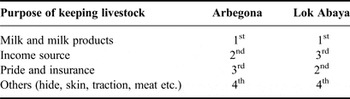
The results of the study indicated that almost all the respondents were elders (aged above 50 years) and most of them did not have any formal education, these observations are in accordance with the findings of Mesfin and Obsa (Reference Mesfin and Obsa1994), Fekadu (Reference Fekadu2010) and Mishra and Patro (Reference Mishra and Patro2010) who also reported that the harbourers of traditional knowledge are the elders among the community. The results from Table 1 indicate the various reasons for which the respondents prefer to rear livestock. The results indicate that the primary reason is to meet their requirements of dairy products. Butter is an important product both for culinary uses like niter kibbeh (clarified spiced butter used in almost all the dishes) and also as a hair moisturiser for women. Moreover, Ayib (Ethiopian cottage cheese prepared from fermented milk) and Ergo (naturally fermented curd) are considered as delicacies in Ethiopian cusine, thus requiring a lot of dairy inputs. The results also indicate that the respondents in Arbegona rear livestock to supplement their income while those of Lok Abaya prefer to rear livestock as a source of tribal pride and insurance against unforeseen calamities. However, the study also indicates that the sale of livestock products such as hide, meat etc., is ranked the lowest as there is a lack of market opportunities for the sale of such value added livestock products. It was also observed during the study that the respondents of Arbegona woreda still barter dairy products for household commodities like salt, the findings are in accordance with the results of Fekadu (Reference Fekadu1994), from southern parts of Ethiopia and also from Amhara region by Azage et al. (Reference Azage, Belete, Fekadu and Berhanu2010). The uses of livestock as a source of income and for fulfilling emergency needs are in accordance with the observations of Iqubal (Reference Iqubal2013).
Various reasons for rearing livestock as indicated by the respondents.

1 denotes the most and 4 the least important criteria.
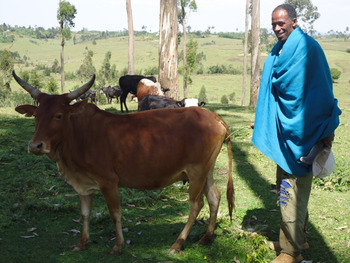
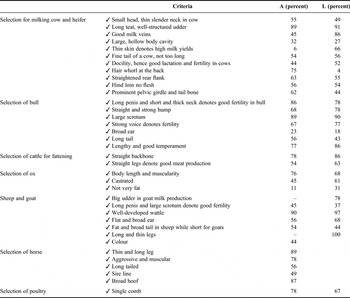
The results from Table 2 indicate the criteria used by the respondents for selection of livestock. The results also indicate that while the primordial criteria for the selection of milch cattle as was reported by the respondents from both the studied woredas was the length of the teat and well-structured udder (Figure 1), followed by prominent milk veins in Lok Abaya and hair whorls on the back in Arbegona. The third important criteria as mentioned by the respondents in Lok Abaya was the presence of thin skin among the cattle while those from Arbegona preferred to give importance to straight rear flank and prominent pelvic girdle and tail bones.
Dairy traits were used by the respondents of Lokabaya to select a cow.

Criteria used for selection of livestock by the respondents in the study areas.

A, Arbegona L, Lok Abaya.
The study further indicated that the bulls were selected based on the size of their scrotum with larger scrotum denoting better fertility this criterion was similar in both the studied areas, this was followed by the length of the penis where it was considered by the respondents that bulls with longer penis had better fertilizing ability, this was followed by selection of docile bulls (for better handling) and also the bulls with longer body length were considered to have a better libido. The results also showed that the respondents selected bulls with hoarser voice, which they thought denoted muscularity.
The selection of fattening livestock depended on the two prime criteria which was consistent in both the studied woredas, the first being straight backbone and legs, while the respondents indicated that an ox is usually selected based on its body length and muscularity, it should be castrated with not much fat, the rankings are consistent; however, the degree varied between the respondents of the two woredas.
The result of the study further indicated that the goats are selected based on the presence of wattles, where goats with wattles are preferred over those not having one, the observation was consistent in both the woredas. The respondents of Lok Abaya woreda preferred to select does with good udder capacity, whereas those of the Arbegona woreda preferred to select bucks with longer penis. The respondents of Lok Abaya preferred to select goats with long and thin legs followed by flat and broader ears while it was the primary criteria for selecting goats by the respondents of Arbegona worda. The study further indicates that respondents of both the woredas preferred to rear sheep with fat and broader tails, while for goats short tail was preferred. Selecting small ruminants based on their coat colour was practiced only among the respondents of Arbegona woreda.
The study further indicated that horses were reared only in Arbegona woreda, where they were selected based on their long and thin tail and broad hooves followed by their muscularity, tail length and sire line. The study further revealed that the respondents (irrespective of the woredas) preferred single combed chickens.
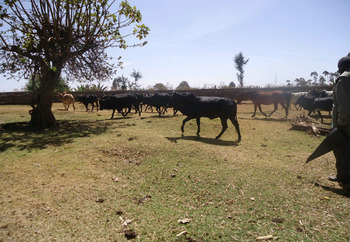
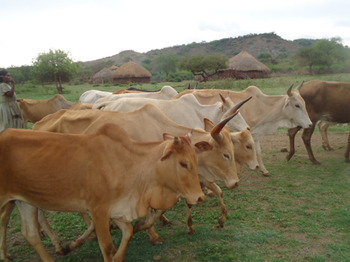
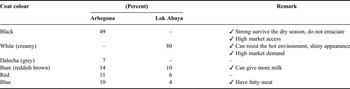
The results as presented in Table 3 indicate the respondent's perception towards selection of livestock based on their coat colour. The study indicates that while cattle with black coat colour is preferred in Arbegona woreda (Figure 2), the respondents of Lok Abaya woreda preferred rearing cattle with light-coloured coat (Figure 3). The results further indicated that the respondents in both the studied locations preferred to rear cows with reddish brown or red colour coats for they believe that such cattle are good milk providers, whereas the respondents in Arbegona woreda prefer to rear cattle with grey colour coats which they consider to have beef with high fat percentage.
Dark coat color of cattle reared in the Arbegona Woreda.

Light coat colour of cattle selected at Lok Abaya woreda.

Selection of cattle based on their coat colour as indicated by the respondents in the study areas.

Discussions
The respondents of the present study preferred to rear native livestock breeds over the crossbreds, they indicated that the native breeds play a multi-functional role in rural livelihoods, contributing not only to cash products but also to manure, and have a cultural importance. The respondents in the study reported that the crossbred and exotic breeds of livestock are unable to thrive in the area due to lack of proper veterinary facilities and feed availability throughout the year. They are also prone to commonly occurring diseases prevailing in the region, while on the other hand the native breeds have much better tolerance of diseases and are also able to thrive under environmental stress; during the dry season (October–March) they are mostly under fed and receive water once in several days. The quality of the feed they receive is also very poor, just enough for their sustenance.
The results are in consonance with the observations of Kunene and Fossey (Reference Kunene and Fossey2006) who reported that the farmers in the Natal region of South Africa prefer native (Nguni) livestock (cattle, sheep and goats) over the exotic breeds because of better adaptability and the ability of the native breeds to thrive on locally available feed resources. Similar observations as indicated in this study too have been reported by Raziq and Younas (Reference Raziq and Younas2007), Raziq, Younas and Kakar (Reference Raziq, Younas and Kakar2008), Bavikatte and Jonas (Reference Bavikatte and Jonas2009), Kakar (Reference Kakar2009).
The study further indicates that the respondents still prefer the age old phenotypic selection methods and that the better animals are identified based on the coat colour. The coat is correlated with the production traits and other similar phenotypic characters, these observations are similar to those reported by Karthikayan and Gajendran (Reference Karthikayan and Gajendran2005).
The phenotypic selection methods (both qualitative and quantitative traits) as observed in the study find similarity with the observations of Ouma, Abdulai and Drucker (Reference Ouma, Abdulai and Drucker2006), Wurzinger et al. (Reference Wurzinger, Ndumu, Baumung, Drucker, Okeyo, Semambo, Byamungu and Sölkner2006), FABRE (2006), Mbuku, Isaac and Alexander (Reference Mbuku, Isaac and Alexander2006), Shiferaw (Reference Shiferaw2006), Kakar (Reference Kakar2009), Endashaw et al. (Reference Endashaw, Tadelle, Aynalem, Wudyalew and Okeyo2012) and Shigdaf (Reference Shigdaf2011).
The study also indicated that the mating of the livestock is by and large panmictic, this is because most of the mating takes place in the communal grazing lands. The observations are in close agreement with the reports of Shiferaw (Reference Shiferaw2006) for Kereyu cattle reared in the Fental district of Oromia region and also of Agere (Reference Agere2008) for Horro cattle from the Horro Gudru area.
The two prevalent methods of livestock selection are the phenotypic selection and also an oral tradition of keeping the pedigree of the calves based on their maternal lineage. Formal pedigree recording in livestock has been a very old tradition in many parts of the globe with reports from Winchester (Reference Winchester1977) indicating the presence of such lineage of horses on clay tablets of Mesopotamia. The study also indicates that the respondents were aware of the heritable attributes of the livestock, which included physical, production and behavioural traits. The method of pedigree in the traditional breeding system has also been reported by Mathias, Ilse and Jacob (Reference Mathias, Ilse and Jacob2005) from other parts of Ethiopia, and also by Aujla, Jasra and Munir (Reference Aujla, Jasra and Munir1998), Kunene and Fossey (Reference Kunene and Fossey2006), Mbuku, Isaac and Alexander (Reference Mbuku, Isaac and Alexander2006), Raziq and Younas (Reference Raziq and Younas2007), Raziq, Younas and Kakar (Reference Raziq, Younas and Kakar2008) and Kakar (Reference Kakar2009) from different parts of the world.
The respondents were well aware of the problems associated with inbreeding in any form and try to avoid the same in cattle and horses as they believe that the offspring born of such breeding have a weak physical conformation, are susceptible to diseases and have retarded growth thereby affecting their survivability.
The results presented in Table 2 indicate that the major criteria for the selection of cows is the presence of long teat and well-structured udder, the long teats facilitate milking and studies by Morse et al. (Reference Morse, DeLorenzo, Wilcox, Collier, Natzke and Bray1988) have indicated that cows with longer teat tend to suffer less from mastitis, the reason being that the teat canal serves as an effective barrier towards any external infection, as the teat canal closes within a few minutes of milking and thus shutting off the link between the external environment and the udder tissues, the results, as reported by the respondents, too find similarity with the findings of Kuczaj (Reference Kuczaj2003), Alphonsus, et al. (Reference Alphonsus, Akpa, Oni, Rekwot, Barje and Yashim2010) and Yakabu (Reference Yakabu2011). However, results of studies by Berry, Harris and Winkelman (Reference Berry, Harris and Winkelman2005) and Yamazaki et al. (Reference Yamazaki, Takeda and Togashi2009) indicate that cows with long teats tend to hurt themselves while grazing or even while lying down and are therefore more prone to mastitis, whereas Tilki et al. (Reference Tilki, İnal, Colak and Garıp2005) reported that there was a negative relationship between teat length and milk yield. The presence of well-developed milk veins was also considered as a selection criterion and the results are in accordance with the observations of Bonsma (Reference Bonsma1980). The respondents in Lok Abaya woreda reported that the cattle with thin skin have better milk producing ability, the observations are in consonance with the results obtained by Bonsma (Reference Bonsma1980) and Hamid et al. (Reference Hamid, Husain, Khan, Islam and Biswas2000). However, the results of studies by Hammond, Ian and Terence (Reference Hammond, Ian and Terence1971) indicate that cattle with thinner hide tend to be more susceptible to tick borne diseases as thinner skins with high vascularity have blood capillaries near the skin surface, which in one way helps in dissipation of heat but on the other hand are exposed to infections transmitted by stinging pests thereby leading to susceptibility towards many external parasite borne diseases. Kshatriya, Trivedi and Dhami (Reference Kshatriya, Trivedi and Dhami2009) in their study concluded that both biometry of udder and skin thickness were related to milk yield and therefore could be considered as one of the criteria for the selection of dairy cows. All the above selection criteria are in accordance with the findings of Endashaw et al. (Reference Endashaw, Tadelle, Aynalem, Wudyalew and Okeyo2012) who reported that the Musi and Bodi pastoralists of Ethiopia select cows based on their milking ability, coat colour, fertility and udder size.
The docility and fertility are of course the primary concern for the rearers as a cow which is docile can be easily handled by all the family members followed by good fertility ensuring a higher frequency of lactation and also an increase in herd size. The observations are in accordance with the reports of Raziq and Younas (Reference Raziq and Younas2007), Raziq, Younas and Kakar (Reference Raziq, Younas and Kakar2008) and Kakar (Reference Kakar2009) from Baluchistan where docility was considered an important criteria for the selection of livestock by traditional camel, cattle and sheep breeders of tribal areas of Pakistan. The traits like hind loin which is devoid of flesh with prominent hip and pin bone, as was reported by the respondents, may be attributed to safe calving and less chances of dystocia, the observations are in accordance with the observations of Bonsma (Reference Bonsma1980) and Hammond et al. (Reference Hammond, Ian and Terence1971).
Result of a study by Peters, Horst and Kleinheisterkamp (Reference Peters, Horst and Kleinheisterkamp1982) indicated that coat colour pigmentation can assist in productive and reproductive ability of various livestock species especially in the humid and sub-humid environment. Thin skin of cattle is correlated with good milking ability especially in the lowland areas, where the climate is usually quite hot. This might be attributed to the low body fat deposition and the fact that most of the energy is utilized for milk production. Studies by Foster, Fourie and Neser (Reference Foster, Fourie and Neser2009) indicated that hide thickness is correlated with rectal temperature, high rectal temperature depresses the let down of milk. Similarly, cattle with thick and dense hair coat can exacerbate the effects of heat stress (Berry and Shanklin (Reference Berry and Shanklin1961), Finch, Bennett and Holmes (Reference Finch, Bennett and Holmes1984)), thereby the milk productivity of such animals is expected to be less in the lowland areas besides it may also affect the reproductive efficiency of the cattle.
As observed in the study, coat colour too plays a primordial role in the selection of small ruminants by respondents of Arbegona wordea; the observations are in accordance with the findings of Shigdef (2012) who indicated that white and red coat colour are preferred in sheep and goats in the Washera and Ferta districts whereas black is the least preferred one. The selection of goats on the basis of their coat colour too has been reported by Mbuku, Isaac and Alexander (Reference Mbuku, Isaac and Alexander2006) by pastoralists of Kenya.
The preferences of selecting cattle based on their coat colour as reported by the respondents have been presented in Table 3. The results indicate that coat colour is considered an important criteria for selection of cattle especially for their potential to adapt and production capacity. Coat colour as a selection criterion for cattle has also been well documented in the folklores of India as reported by Mohanty (Reference Mohanty2004). The respondents in this study indicated that coat colour is related to the adaptability and influences the disease tolerance of the livestock, they also reported that coat colour also influences the ability of the livestock to ward away the evil eye, meat of animals of a particular coat colour are considered to be tasty and certain coat colours have more market demand than the others. This might be a fallout, as an animal with a particular coat colour has better ability to tolerate the environmental variations; these findings are in close agreement with the results presented by Ebozoje and Ikeobi (Reference Ebozoje and Ikeobi1998) and Sanusi (Reference Sanusi2008) who reported better survivability. The observations are in consonance with the findings of Tekleyohannes et al. (Reference Tekleyohannes, Jamroen, Sayan, Girma, Asrat and Somkiert2012) from Ethiopia and Adedeji et al. (Reference Adedeji, Ozoje, Ojedapo, Fasoyin and Ogundipe2012) from Nigeria.
Results of a study by Bonsma (Reference Bonsma1980) indicated that at higher altitudes there are short wave or ultraviolet rays which are tolerated well by those with dark coat colour, like black and brown whereas the cattle with white coat colour tend to suffer from skin burns associated with ultraviolet rays. Although in the lowlands the infrared or long wavelength rays predominate which is reflected by the animals having white coat colour, similar observations too have been reported by Finch and Western (Reference Finch and Western1977); Olson, Lucena and Chase Junior (Reference Olson, Lucena and Chase Junior2003). Studies by Makokha et al. (Reference Makokha, Karugiab, Staalc and Kosura2006) indicate that animals with dark coat colour attract the Tse Tse flies and are therefore not preferred in the lowland areas such as Lok Abaya and places infested by stinging insects, which in this case is at Lok Abaya woreda. Similarly the results as obtained in the study finds consonance with the observations of Stewart (Reference Stewart1953), Hutchinson and Brown (Reference Hutchinson and Brown1969), Finch (Reference Finch1986) and Hansen (Reference Hansen1990) who reported that lighter coat colour reflect the sunlight and hence beneficial for cattle reared in the lowlands . This result goes in agreement with the finding of Ndumu et al. (Reference Ndumu, Baumung, Hanotte, Wurzinger, Okeyo, Jianlin, Kibogo and Sölkner2008) who reported that the farmers prefer red colour in Ankole longhorn cattle over other coat colours, Shiferaw (Reference Shiferaw2006) too reported high ranking for white colour preference for Kereyu cattle owners, the findings are in consonance with the present study for cattle selected in the Lok Abaya woreda.
The influence of coat colour on milk yield has also been reported in folklores by Mohanty (Reference Mohanty2004) who indicated that cattle with black coat colour are supposed to be better in milk yield, the importance of feather colour in selection of chickens have also been reported by Kassahun (Reference Kassahun2013) from Ethiopia and also by Karma (Reference Karma, Penjor, Gurung, Arasta and Moran2005) from Bhutan and Banerjee (Reference Banerjee2012) from India.
The hair whorl is also one of the important aspects to be selected according to the respondents. It is also known that a cow with high hair whorl tends to reach puberty earlier and that they also have high total milk and total solid yield (Young, McNaughton and Spelman, Reference Young, McNaughton and Spelman2007). Results of a study by Broucek et al. (Reference Broucek, Peter Kisac, Tefan, Anton, Michal and Vladimir2007) also indicate that animals with more hair whorl may grow faster than animals with a middle or low hair whorl; which can be correlated to the early development of mammary gland. According to the results of a study made by Bharadwaj, Sastry and Yadav (Reference Bharadwaj, Sastry and Yadav2011), coat colour, shape of head and face, tail switch, shape of udder and teats and skin thickness were some of the traits which were associated with milk production. The short and straight femur as reported by the respondents (straight thigh) can serve as an indication of its good grazing ability and endurance while grazing or reaching the watering points. The results are in accordance with the observations of Kedija (Reference Kedija2007) who reported that farmers preferred cattle with long and straight thighs in the Mieso district of Ethiopia.
As indicated by the selection of bulls based on penile length, the farmers correlated long penis with good fertility as they indicated that if the bull had a short penis there will be problems associated with its ability to breed, the observations are in accordance with the results obtained by Bruce (Reference Bruce2012), Bonsma (Reference Bonsma1980) and Hammond, Ian and Terence (Reference Hammond, Ian and Terence1971). The indication of long penis and fertility may be associated with the proper function of the cremaster muscle which is responsible for the movement of the penile sheath and therefore frequent urination and libido are correlated with the high level of androgen in bulls; Kedija (Reference Kedija2007) from his study in Meiso district too reported that the farmers selected bulls with long penis. In addition, scrotal circumference is a measure of the daily and total sperm production of a bull. Studies agree that neck conformation in bulls is very important by which a good bull should have a thick crest over his neck as well as a short neck. Studies by Hammond, Ian and Terence (Reference Hammond, Ian and Terence1971) too indicate that short neck in bulls are a good indicator of libido and high testosterone levels, as well as larger scrotal circumference (which relate to higher levels of hormones) and wider, more muscular shoulders. Short-necked bulls tend to sire wide-rumped (more depth in the hindquarters) steers and daughters that mature early, higher levels of testosterone are also associated with thick bones especially those of scapulae and metatarsus.
Results of studies by Hammond et al., (Reference Hammond, Ian and Terence1971) indicate that bulls with thick shoulders have large capacity in the ribcage (where heart and lungs are located) also indicating masculinity in bull, thicker and coarser muscles associated with thick shoulders, the observations are in accordance with the reports of Bonsma (1980). Large and well-developed scrotum and testes is also a good indicator for fertility amongst male livestock, hoarse voice is usually associated with androgen activity and is an indicator of muscularity as indicated by Hammond, Ian and Terence (Reference Hammond, Ian and Terence1971), broad and long ear is a breed character and it is usually associated with high vascualrity, which may be related to better dissipation of body heat and thereby better feed efficiency and also grazing ability.
Long tail is usually associated with an animal's ability to get rid of external parasites especially flies and other stinging insects which if the animal is able to overcome can be correlated with good health of the livestock as a whole. The results pertaining to selection of livestock for fattening indicates that those with flat spinous process and long femur are better for fattening, a common indicator for well-developed longissimus muscle, and a long and thick femur is an indicator for an animal's ability to walk long distances for fodder and also a thick bone provides large surface area for the attachment of muscles, thus muscle bundles are large and thick under such circumstances, the observations are in accordance with the results obtained by Hammond, Ian and Terence (Reference Hammond, Ian and Terence1971) and Kedija (Reference Kedija2007).
The selection of small ruminants and equine with long legs is a criteria to select animals which have endurance in travelling long distances. Results of studies by Hafez (Reference Hafez1968) indicate that longer femur and metatarsus are adaptive means for livestock reared in hot climates, long legs in one hand help the livestock travel long distances besides they help protect the vital organs against the solar radiation from the hard soil surface.
Fat tail of sheep is a breed character but among the animals of a particular breed those having fatter tails are able to tolerate drought better as they are able to have enough reserves in the form of fat, even the livestock with fat deposits have usually better feed conversion efficiency as excess of energy in feed is converted to fat deposits.
Broad hoof in horses is associated with its stability as a pack animal especially in the highlands of Ethiopia where the equines are generally employed as pack animals and hence strong and broad hoof is associated with stronger planter cushions and tendons and cartilages which are in accordance with the observation of Hafez (Reference Hafez1968).
The selection criteria for small ruminants (sheep and goats) as observed in the present study agree with the finding of Estifanos (Reference Estifanos2010) in the Umbulo watcho water shed of Southern Ethiopia, the presence of wattle as a selection criteria for goats as observed in the study are in accordance with the findings of Odubote (Reference Odubote1994b) who reported that goats with wattles are docile and thermoregulatory mechanism of the goats with wattles are better than those without wattles. Results of a study by Casu, Boyazoglu and Lauvergne (Reference Casu, Boyazoglu and Lauvergne1970) indicated that ewes with wattles had better fecundity when compared to the non-wattled. Although Richard et al., (Reference Richard, Cabaret and Cabourg1990) reported that there might be a genetic linkage between the presence of wattles and disease tolerance with Alphine and Saanen goats. The goats sporting wattles had significantly lower faecal output of strongyle eggs than those without wattles indicating a form of genetic tolerance to helminthoses. The result, as assessed in the present study pertaining to the selection of goats having wattles and of a particular coat colour, is also in accordance with the observation of Adedeji et al. (Reference Adedeji, Ozoje, Ojedapo, Fasoyin and Ogundipe2012).
Conclusion
The results from the present study indicate that the respondents in the studied areas practice selection of livestock based on some predefined physical attributes most of which have proper scientific justifications and are best suited to their agro-climatic conditions. Hence, these criteria can be included in developing selection mechanisms which can be further coupled with modern selection techniques. The age old system of livestock selection using phenotypic markers can be further refined using molecular markers; hence, it is of primordial importance to properly document the oral traditions from the elders who practice them.
Acknowledgements
The authors acknowledge the financial assistance received from Coordinator NORAD project. The authors also acknowledge the assistance received from the elders and traditional livestock rearers of both the woredas, the authorities of the agricultural bureau, head and staff members of the School of Animal and Range Sciences, Hawassa University.