INTRODUCTION
One hallmark of American politics since Ronald Reagan's election in 1980 has been the Republican Party's political alliance of fiscal and social conservatives. Realizing the enormous voting potential of cultural conservatives, particularly white evangelical Protestants who make up a disproportionate number of Americans living in the South, the GOP (Grand Old Party, which is a nickname for the Republican Party) began to take vocal, conservative positions on cultural wedge issues such as abortion, homosexuality, and school prayer beginning in the 1970s (Martin Reference Martin1996; Layman Reference Layman2001; Williams Reference Williams2010; Wilcox and Robinson Reference Wilcox and Robinson2010). As a result, white evangelical Protestants have become the most important single voting bloc within the GOP during the course of the past three decades (Green Reference Green, Brint and Schroedler2009). Even though white evangelical Protestants, like white Christians overall, are experiencing modest declines in religious self-identification in the United States, they still make up a large percentage of the Republican voting coalition. In the 2012 presidential elections, for instance, four out of every 10 votes Mitt Romney received came from white evangelical Protestants (Public Religion Research Institute 2012a).
Scholars have long analyzed the under-pinning of evangelicals’ views on social issues, finding clear linkages between conservative attitudes on abortion and other social policies and their support for the GOP (Layman Reference Layman2001), especially among the most observant and theologically conservative (Green Reference Green, Brint and Schroedler2009). That white evangelical Protestants hold more conservative views on cultural issues than other religious adherents, or that white evangelical Protestants place greater salience on such issues as part of their political calculus, should come as little surprise given the consistent messaging that many of them hear on such issues from their national religious figures (Martin Reference Martin1996; Oldfield Reference Oldfield1996; Wilcox and Robinson Reference Wilcox and Robinson2010), pastors (Djupe and Gilbert Reference Djupe and Gilbert2003), and lay leaders in congregations (Bean and Martinez Reference Bean and Martinez2015).
Less is known, however, about evangelicals’ views on economic issues or whether their views on such concerns have shifted over time. The few studies that examine the relationship between evangelicalism and economic attitudes find that evangelical Protestants hold more conservative attitudes on economic policy than other religious adherents (Wilson Reference Wilson, Smidt, Kellstedt and Guth2009; Barker and Carman Reference Barker and Carman2000), with some notable exceptions and caveats (Greeley and Hout Reference Greeley and Hout2006; Burton, Johnson, and Tamney Reference Burton, Johnson and Tamney1989). However, we believe an examination of the economic attitudes of evangelicals warrants more attention now given two important trends: the emergence of the Tea Party and the small, but vocal, rise of younger, moderate evangelical leaders who have begun to challenge the political priorities of the Republican Party.
Since its emergence on the political scene in 2009, the Tea Party has revitalized the GOP and shaped it into a more conservative party (Skocpol and Williamson Reference Skocpol and Williamson2012). Although it maintains a small fraction of libertarian support, the Tea Party is a movement that attracts a large percentage of self-described Christian conservatives (Public Religion Research Institute 2013). We argue that the Tea Party has helped shift the economic attitudes of white evangelical Protestants in a more conservative direction. We demonstrate that while white evangelical Protestants typically hold more conservative positions on economic concerns than Americans more generally, there is a growing gap between evangelicals and the rest of Americans on these issues since the Tea Party's emergence. We believe this development, in part, is linked to concerted efforts by Tea Party leaders, Republican politicians, and leading Christian Right figures to establish and promote a connection between Christian faith and the free-market system.
We argue that there is a cultural component that binds white evangelical Protestants to Tea Party economic views as well. Tea Party cries to “take America back” are often linked with efforts to radically reduce government spending at the federal level. Melissa Deckman (Reference Deckman2016) finds that Tea Party activists believe that government is ill equipped to handle economic problems, believing that solutions to such problems are best found within families, religious communities, charities, and the private sector. Similarly, sociologist Lydia Bean (Reference Bean2014) finds in her ethno-graphic work that many evangelicals believe the growth of the welfare state is linked to the decline of Christian America by supplanting the role of religious organizations in addressing social needs and thus argue that the size and scope of government should be reduced. Other scholars argue that the emergence of the Tea Party is not merely understood as a reactionary response to the decline of traditional religiosity in America, but growing racial and ethnic shifts in American society as well, including the election of the nation's first black president (Parker and Barreto Reference Parker and Barretto2014).
Building on Reagan's initial message that government is the problem and taxes are too high, many Tea Party leaders are finding ways to fuse fears of economic and cultural displacement that have resonance with many white evangelical Protestants. Scholars have long known that elite cues play an important role in shaping public opinion (Zaller Reference Zaller1992; Heatherington Reference Heatherington2001), and the heightened awareness that many conservative theological leaders are bringing to economic — and not merely social — policy may be conservatizing the economic views of evangelicals in the mass public. To accomplish this goal, Republican Party leaders and Tea Party activists have drawn from a theological and cultural framework to persuade many white evangelicals that fiscal conservatism has biblical precepts and theological grounding.
Of course, many religious thinkers use the Bible to justify more liberal economic orientations, particularly from Catholic or more liberal theological Protestant traditions, particularly in the black church (Lincoln and Mamiya Reference Lincoln and Mamiya1990). Some progressive evangelical leaders have joined their more theologically liberal counter-parts in other faith traditions who have long questioned whether advancing free-market policies is consistent with biblical precepts that call on Christians to look after the poor and marginalized (Wallis Reference Wallis2005; Claiborne and Campolo Reference Claiborne and Campolo2012). Younger evangelicals in the general population have shown a tendency to express moderate views on a range of public policy issues that stand at odds with the vocally conservative positions championed by the Christian Right, such as opposition to same-sex marriage, and are less likely to identify as politically conservative.Footnote 1 We believe that another important reason to analyze the economic attitudes of white evangelical Protestants is to see whether this moderating trend among this younger cohort of evangelical Protestants extends to attitudes on capitalism. Thus, our analysis considers whether evangelicals’ views on economic policy are influenced not just by Tea Party status, partisanship, and theology, but by age as well.
Finally, we isolate the role of class in shaping evangelicals’ views on economic issues. Studies show that an individual's level of income is an important determinant of economic attitudes and vote choice (Brewer and Stonecash Reference Brewer and Stonecash2006; Layman Reference Layman2001), although partisanship has been shown to be a more important predictor of such attitudes in some cases (Page and Jacobs Reference Page and Jacobs2009). Some research suggests, as well, that the personal economic circumstances of conservative Protestants (Greeley and Hout Reference Greeley and Hout2006) and fundamentalist Protestants (Jelen Reference Jelen1990) may mitigate opposition to expanding the role of government in addressing social welfare. Progressive voices such as Thomas Frank (Reference Frank2004) have famously argued that conservative economic policies championed by Republican legislators offer little benefit to social conservatives, who historically have occupied some of the lower rungs of the socio-economic ladder. Focusing on possible class distinctions among white evangelical Protestants with respect to economic attitudes, then, is important.
Using data from the General Social Surveys (GSS), we examine economic issue positions of white evangelicals over the past several decades, finding that, compared with all Americans, evangelicals have adopted slightly more conservative positions on the role of government in addressing economic problems. Moreover, we demonstrate that after 2010 — a historic election year in which Tea Party groups and candidates played a critical role — white evangelicals turned even more strongly against government intervention in the economy, diverging sharply from the general public.
Next, using the 2013 Religion, Values, and Immigration Reform Survey and the 2014 American Values Survey, both conducted by Public Religion Research Institute (PRRI), we find that white evangelical Protestants are significantly more inclined than other Americans to support economically conservative policies, even when adjusting for a host of important demographic and political attributes. White evangelical Protestants express greater skepticism about an active role of government in society and believe economic growth is more likely to be spurred by a reduction in taxes rather than in public investments. Moreover, in isolating our analysis to white evangelicals alone, we find that identifying with the Tea Party also has a conservatizing influence on their economic issue positions. We also find that partisanship, class, and in some cases, age, serve to modify the views of some evangelicals, reminding us that while white evangelicals remain a consistent part of the Republican base, their views are not necessarily monolithic. At the same time, this analysis shows that by and large, evangelicals have come to embrace the conservative fiscal message promoted by both the Republican Party and the Tea Party movement.
THE GOP, THE TEA PARTY, AND WHITE EVANGELICAL PROTESTANTS: AN ECONOMIC ALLIANCE?
Scholars have long recognized that religion impacts attitudes about numerous public policies, both foreign and domestic. Compared with other religious adherents, white evangelical Protestants have a distinctive, conservative point of view on a wide variety of issues. Evangelical Christians are more hawkish when it comes to foreign policy views of the Middle East (Baumgartner, Francia, and Morris Reference Baumgartner, Francia and Morris2008), are more likely to prioritize defense spending (Green and Guth Reference Guth, Green, Leege and Kellstedt1993) and maintaining superior military power worldwide (Wuthnow and Lewis Reference Wuthnow and Lewis2008), and are among the strongest supporters of Israel compared with others (Guth et al. Reference Guth, Green, Kellstedt, Smidt, Green, Guth, Smidt and Kellstedt1996). They are also more likely than other people of faith to hold more negative views of Islam (Baumgartner, Francia, and Morris Reference Baumgartner, Francia and Morris2008). On domestic issues, evangelicals hold more conservative positions than mainline Protestants and Catholics on cultural issues such as abortion and gay rights (Wilcox et al. Reference Wilcox, Brewer, Shames, Lake, Rimmerman and Wilcox2007; Putnam and Campbell Reference Putnam and Campbell2010), although such attitudes may be conditioned by political awareness and exposure to religion-based stimuli (Layman Reference Layman2001; Adkins, Layman, and Campbell Reference Adkins, Layman and Campbell2013).
Despite years of analysis that considers the impact of religion on public opinion, scholars who analyze economic attitudes tend to avoid religion.Footnote 2 Much of the literature on economic attitudes focuses on how people link their personal preferences and interests with policy choices (Cook and Barrett Reference Cook and Barrett1992; Brewer and Stonecash Reference Brewer and Stonecash2006). For instance, studies find that women are more likely than men to support increased government services and spending, in part because they are more economically vulnerable than men (Norrander Reference Norrander and Whitaker2008). Bartels (Reference Bartels2009) finds that economic policy preferences, however, may not always be consistent with personal interests; for example, people prefer tax cuts regardless of whether or not they will personally benefit from them. But the lack of an evident connection may hinge on political sophistication. Those with higher levels of political knowledge are more likely to have their policy choices consistent with their objective interests (Carpini and Keeter Reference Carpini and Keeter1997; Carsey and Layman Reference Carsey and Layman2006). Other classic works consider the role of ideology and values, including Americans’ ingrained sense of egalitarianism, in understanding views of the social welfare state (Hochschild Reference Hochschild1981; Feldman and Zaller Reference Feldman and Zaller1992; Feldman and Steenburgen Reference Feldman and Steenbergen2001), but again do little to address religion specifically.
There is some work on the intersection of religion and economic views, although the findings offer mixed results and depend on how “religion” is operationalized. Wilson (Reference Wilson, Smidt, Kellstedt and Guth2009, 195) argues that “the dominant view among modern scholars is that evangelicalism is associated with a greater propensity to endorse capitalism and to be suspicious of the welfare state.” Wilson's analysis finds that over five decades, evangelical Protestants generally hold the most conservative mean positions on government involvement in assisting the poor, guaranteeing that every person has a job, and providing healthcare as compared with mainline Protestants, black Protestants, Catholics, and Jews. Also, Barker and Carman (Reference Barker and Carman2000, 15) find that what they term “doctrinaire beliefs” (conservative Protestant doctrine) “inspires economic individualism through opposition to taxation, spending, and governmental activism” in a multivariate analysis. Indeed, some argue that white evangelicals’ theological predisposition toward individualism (Smith Reference Smith1998; Emerson and Smith Reference Emerson and Smith2000) is directly linked to their rejection of the social welfare state — unlike Protestants from other faith traditions, whose theology is often critical of the social and structural barriers that inhibit the wellbeing of individuals, leaving their adherents to be more likely to be supportive of a more pro-active role for government to address poverty and economic issues (Emerson and Smith Reference Emerson and Smith2000; Steensland Reference Steensland, Wuthnow and Evans2002). Moreover, while the rise of the Christian Right in the 1980s is often more closely linked to its opposition to liberal social issues, some fundamentalist evangelical leaders also justified neo-classical economic policies in biblical terms, harkening back to one of the central figures opposing the social gospel movement in mainline circles, Rousas Rushdooney, who argued among other things that “the Biblical tithe is said to demand a flat tax” and that the “eighth commandment (‘thou shall not steal’) condemns income redistribution as nothing more than institutionalized theft” (Iannaccone Reference Iannaccone1993, 7). Other prominent Christian fundamentalists, such as the late Jerry Falwell, pointed to the influence of more secular, neo-classical economists such as Milton Friedman in shaping their support for free-market capitalism. Friedman's work was heralded as “essential to an understanding of capitalism, freedom, and the role of government as well as the role our Judeo-Christian values play in undergirding our economic system,” according to Robert Mateer, the past president of the Contemporary Economics and Business Association, which was founded at Falwell's Liberty University in the 1980s as a way to marry market-based economic philosophy with biblicism (quoted in Terrie [Reference Terrie1994], 56).
Other empirical data, however, show that there have been relatively few differences among religious adherents in terms of economic positions through the late 1980s. Jelen (Reference Jelen1990) found that evangelicals, when compared with mainline Protestants and Catholics, did not hold more conservative views on government welfare programs; in fact, they were slightly more liberal than other Christians on this measure. Iannaccone (Reference Iannaccone1993) similarly found in an analysis from the late 1980s that fundamentalists are no different from other religious adherents in their attitudes on economic policy. More recently, Greeley and Hout (Reference Greeley and Hout2006) find that class matters more than religion when it comes to attitudes about income inequality in their study of conservative Christians, which confirms earlier work by Burton, Johnson, and Tamney (Reference Burton, Johnson and Tamney1989), who found that lower income fundamentalists believe that Washington ought to do more to reduce income inequality. Thus, one prevailing mindset among scholars who study religion, politics, and economic attitudes is that class interests trump religious values. Of course, these studies were largely undertaken before many evangelical Protestants switched their partisan affiliation to the GOP or well before the emergence of the Tea Party as a political force.
While a theological case for defending free markets long predates either the Tea Party in 2009 or rise of the Christian Right in the late 1970s — indeed, one only needs to point to Weber's classic work The Protestant Ethic and the Spirit of Capitalism to demonstrate that efforts have long been under way by some to infuse free-market capitalism with Christian theology — we believe that white evangelicals largely have become significantly more conservative in terms of their economic policy views in recent years, for several reasons. First, their growing attachment to the Republican Party over the past few decades, both in terms of party identification and voting behavior, has likely shifted their economic orientation in a more conservative direction. Scholars find that partisan shifts among traditionalist evangelicals from the Democratic to Republican Party are deeply connected to religious and cultural factors (Layman Reference Layman2001), with attitudes about abortion an important component of that re-alignment (Brewer and Stonecash Reference Brewer and Stonecash2006). Yet some evidence does suggest an economic component to that shift. Claassen and Povtak (Reference Claassen and Povtak2010), for example, argue that white evangelicals’ alliance with the GOP is more due to class interests and an improved socio-economic status than mobilization based on their attitudes about culture war issues. Regardless of what issues brought white evangelicals more closely into the GOP fold, however, research suggests that as the two major parties have become more polarized and clearly separated by their positions on a variety of issues (McCarty, Poole, and Rosenthal Reference McCarty, Poole and Rosenthal2006), their party's followers — particularly those who are party activists or who are most knowledgeable about the parties’ stances and care deeply about such issues (Carsey and Layman Reference Carsey and Layman2006) — shift their attitudes to better approximate their party's agendas, through a process known as “conflict extension” (Layman and Carsey Reference Layman and Carsey2002). This process doesn't happen overnight, and given that white evangelicals have consistently been increasingly more likely to vote Republican in the past few decades, it is reasonable to expect that they also hold more conservative economic views as a result.
Second, we believe that white evangelicals are more conservative on economic matters than other Americans because of the concerted effort by Tea Party leaders, Christian Right leaders, and conservative think tanks to establish more visibly a connection between Christian faith and the free-market system. For instance, the American Enterprise Institute funds a “Values & Capitalism” project with the stated purpose of “engaging Christian students in a discussion on the compatibility of their faith and the system of free enterprise.”Footnote 3 The Heritage Foundation's appointment of former Senator Jim DeMint, both a regular at the Christian Right's annual Values Voter Summit and a Tea Party favorite, as president also stitches these worlds together.
Moreover, Christian Right groups such as the Family Research Council have begun to promote conservative economic policies as a central concern to the family in ways that arguably were not as visible during earlier eras of Christian Right activity. Arguing that “free markets need to be freer,” today the Family Research Council on its website has a page devoted to Family Economics, with policy positions that call for eliminating the estate (or “death”) tax, reducing business regulations, and over-turning ObamaCare, among other conservative economic positions. Its call for a reduction in the size of the federal government also has patriotic overtones: “Given the innovative and entrepreneurial spirit that seems innate to our very identity as Americans, greater economic liberty and, commensurately, less federal intervention will result in more opportunity and a higher standard of living for all of us” (Family Research Council n.d.). Founded by former Christian Coalition Executive Director Ralph Reed in 2009 as a way to bring together social conservatives and Tea Party activists, the Faith & Freedom Coalition lists among its guiding principles “limited government, lower taxes, and fiscal responsibility to unleash the energy of entrepreneurs” (Faith & Freedom Coalition n.d.). In their writings, policy briefs, and forum appearances, there is increasing evidence that many Christian conservative elites have begun articulating the “link and resonance between economic conservatism and social conservatism” (Wilson and Burack Reference Wilson and Burack2012, 176) as a way to solidify support for the Tea Party among evangelicals, creating a new class of conservative activists described by Christian Broadcasting Network's David Brody (Reference Brody2012) as “the Teavangelicals.”
Evangelical scholars who have written about the biblical basis for conservative economic policies have also found a new platform to air their views via social media, which — combined with well-funded and well-organized right-wing media outlets on cable television and on AM radio — have helped fuel the Tea Party's organizational rise (Skocpol and Williamson Reference Skocpol and Williamson2012; Deckman Reference Deckman2016). For example, on Townhall.com, Senior Fellow and Director of the Center on Wealth, Poverty, and Morality at the Discovery Institute Jay W. Richards writes that Christians should be morally outraged by the size of the federal debt. He counsels against “centralized political authority” by pointing to several well-known Bible stories, including the prophet Samuel's admonition to the Jews to avoid appointing a king to rule over Israel (1 Samuel 8). He also likens the beast in this Bible passage to communist governments in the 20th century that murdered millions of their own citizens. He writes, “History and scripture agree: because of sin, governments with too much power become propagators of evil and destruction. This speaks directly to government debt, since deficit spending is a symptom of government doing more than it can or should” (Richards Reference Richards2013, 3).
It is not difficult to see why Tea Party organizers would want to appeal to white evangelicals with a conservative theological message. Since the movement's inception, white evangelical Protestants have made-up a disproportionate part of the movement. Our data show that when asked if they identify as “part of the Tea Party,” since 2010, white evangelicals Protestants represent, at a minimum, 34% of the membership of the Tea Party, which is roughly double their presence in the general population. Moreover, approximately 60% of members of the Tea Party in 2015 also identify as both “conservative” and “Christian” (Public Religion Research Institute 2015). We are not trying to make the case that white evangelical Protestants have been drawn to the Tea Party largely because of economic concerns. As a diffuse social movement, the Tea Party strikes many chords long connected with right-wing political causes that are likely to appeal to white evangelicals, including its calls for curtailing immigration (especially among Muslims), protecting gun rights, and decrying what it considers America's decline at home and abroad. Many Tea Party activists have also joined with Christian Right leaders in arguing that religious Americans, particularly Christians, have had to endure a government-backed war on religious liberty (Brody Reference Brody2012). However, given that the Tea Party also promotes free-market capitalism and reducing the size and scope of the federal government, we expect that the Tea Party may also be playing a role in shifting the economic attitudes of evangelicals in a right-leaning direction.
Finally, there is a cultural component that may also contribute to the growing tendency for white evangelical Protestants to hold more conservative economic views even apart from their views on theology. Many white Southerners, for example, have long distrusted the federal government and oppose many government programs to help the poor, particularly because many believe such programs disproportionately help African-Americans (Black and Black Reference Black and Black1989). But such views about the proper size and scope of government are not limited to white evangelicals in the South. Lydia Bean's (Reference Bean2014) work finds that evangelicals in upstate New York negatively link the growth of the welfare state to the decline of Christian America and believe that solutions to poverty are best handled through charity. Moreover, she argues that such views are reinforced by social mechanisms within these American churches that reinforce conservative tendencies more generally and create loyalty to the Republican brand, which helps to explain why, as compared to white Christians of other traditions, evangelicals are far more politically homogenous.
RESEARCH QUESTIONS, HYPOTHESES, AND METHODS
To more closely examine the link between evangelical orientation and attitudes about economics, we rely on the General Social Surveys, conducted by the National Opinion Research Center and two national surveys, the American Values Survey, and the Religion, Values, and Immigration Reform Survey, conducted by PRRI. The PRRI surveys were conducted by telephoneFootnote 4 among a random sample of the adult population (ages 18 and over). Both studies also rely on a common definition of white evangelical Protestant that includes respondents who identify as white, non-Hispanic Protestants who also self-identify as a “born-again” or “evangelical” Christian. In each survey, white evangelical Protestants represented approximately 20% of the sample. The American Values Survey was conducted in August 2014 and included roughly 4,500 respondents while the Religion, Values, and Immigration Reform Survey was conducted in March 2013 and also included about 4,500 respondents.Footnote 5
Our analysis of the economic priorities of white evangelical Protestants takes place in three stages. In the first stage, we consider views of white evangelicals over time by examining longitudinal data from the General Social Surveys. The first question we consider asked respondents to rate themselves on a scale concerning the extent to which the “government in Washington should do everything possible to improve the standard of living of all Americans” or whether they think “it is not the government's responsibility and that each person should take care of himself.”Footnote 6 Next, we analyze respondents’ answers to a similar question: the extent to which individuals think “government in Washington is trying to do too many things that should be should be left to individuals and private business” compared with thinking that “the government should do even more to solve our country's problems.”Footnote 7
Next, we consider how white evangelical Protestants compare attitudinally with other Americans on two specific economic measures from the PRRI surveys. The first measure we analyze asks respondents to choose the statement that better represents their views: “the government should provide more services, even if it means higher taxes” or “the government should provide fewer services and reduce taxes.”Footnote 8 The measure was designed to provide an indication of a respondent's overall orientation toward the role of government in society. Compared with other Americans, we hypothesize that:
(1) White evangelical Protestants will hold more conservative views on whether government should provide more services at the expense of higher taxes.
Next, we shift the analysis to a consideration of the best policy for economic growth. We ask respondents to indicate which statement comes closest to their own views regarding the best way to promote economic growth: (1) “lower taxes on individuals and businesses and pay for those tax cuts by cutting spending on some government services and programs” or (2) “spend more on education and the nation's infrastructure, and raise taxes on wealthy individuals and businesses to pay for that spending.”Footnote 9 This question requires the respondent to prioritize the benefits of public investment versus tax relief. Once again, we hypothesize that:
(2) Compared to other Americans, white evangelical Protestants are more likely to embrace tax relief — the more conservative position — over public investment as the best way to promote economic growth.
While we expect white evangelical Protestants to hold more conservative views on these economic indicators compared with other Americans, we also realize that evangelicals will not be monolithic in their views. In the second stage of the analysis, we examine the degree of diversity of opinion among white evangelical Protestants with respect to the role of government and their economic priorities. Both surveys employed in the analysis include large samples of white evangelical Protestants — 947 in the Religion, Values, and Immigration Reform Survey and 966 in the American Values Survey — that allow us to conduct extensive sub-group analysis and test the independent contributions of characteristics known to correlate with views on economic issues. We are especially interested in isolating the impact of age on these views, with special focus on millennial evangelicals, who have shown a willingness to hold more progressive views on some social issues than older evangelicals (Cox Reference Cox2007). Finally, we also consider how the standard socio-economic indicators that have been found to drive economic attitudes in other analyses, especially class, may interact among white evangelical Protestants. We hypothesize that:
(3) Both millennial evangelicals and low-income evangelicals will hold less conservative views on support for more government services at the expense of raising taxes and the belief that economic growth is best achieved through tax cuts.
At the same time, we also control for Tea Party status among evangelicals, with the expectation that:
(4) Identifying with the Tea Party will influence their economic views in a more conservative direction.
In addition to comparing differences among white evangelicals by standard political and socio-economic groups, this stage of the analysis will also compare differences across religious characteristics. The survey includes several religious measures including the degree to which respondents believe that the Bible is the word of God and should be taken literally and frequency of worship attendance. Studies show that more traditionalist evangelicals in terms of doctrine and those who attend church most frequently are more likely to vote Republican, identify as Republican, and hold more conservative positions on a variety of political issues (Green Reference Green, Brint and Schroedler2009); moreover, we believe that frequency of church attendance could serve as a proxy for being exposed to elite evangelical messaging, a factor that could motivate white evangelicals to hold more conservative political positions. Given that some studies have also linked the individualistic nature of evangelical belief to more conservative views on economics, we hypothesize that among white evangelical Protestants:
(5) Frequent church attendance and biblical literalism will lead to the adoption of more conservative views concerning support for more government services at the expense of raising taxes and the belief that economic growth is best achieved through tax cuts.
ATTITUDES ABOUT GOVERNMENT, ECONOMIC GROWTH, AND ECONOMIC ORIENTATIONS
White Evangelical Attitudes Overtime
Turning to the GSS data, we find that white evangelical Protestants’ economic views have gotten more conservative over the past 30 years on two separate economic measures. Notably, we find that white evangelical Protestants were only slightly more economically conservative than the general public prior to the 2000s.Footnote 10 There was more divergence between white evangelical Protestants and all Americans in the early 2000s, but the larger differences became more apparent after 2008.
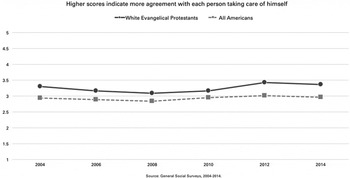
In 1988, at the tail end of the Reagan years, the difference in the mean scoresFootnote 11 of both questions was roughly 0.1 points on a scale from 1 to 5. Throughout the 1990s, the difference for both questions never exceeds 0.17. By 2004, the differences have more than doubled in size for both questions. Figure 1 shows that the white evangelical-general population gap on whether the government or individuals were responsible for securing a standard of living stayed relatively steady through the Great Recession and 2010 elections. The gap grew directly after and, as of 2014, was 0.4 points — three times larger than the 1988 gap.
Mean Score on Choosing Between Government Responsibility to Care for the Poor vs. Each Person Should Take Care of Himself, 2004–2014.

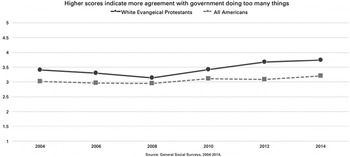
This pattern is even more pronounced in Figure 2, which examines the trend for whether the federal government does too much or too little. While the gap was 0.12 points in 1988, by 2004 it was nearly 0.4 points. While the Great Recession brought white evangelical opinion more in line with all Americans, this trend did not last. White evangelical Protestants’ mean scores had returned to pre-recession levels by 2010 and grew increasingly conservative through 2014. By 2014, the opinion gap was over 0.5 points, 4.4 times higher than the gap in 1988. White evangelical Protestants’ mean score was 3.74 in 2014, compared to 3.12 in 1988.
Mean Score on Choosing Between the Government in Washington Doing Too Many Things that Should be Left to Private Businesses & Individuals vs. the Government Should Do Even More to Solve Our Country's Problems, 2004–2014.

Our brief analysis of GSS data shows on two economic measures that tap into the role of government in helping the poor, more specifically, and its role in solving the country's problems, more generally, that white evangelicals not only hold increasingly more conservative positions than other Americans, but that their views on such issues have grown more conservative since 1988, when the questions were first asked by the GSS and especially from 2010 onward, since the emergence of the Tea Party. We next turn to our more comprehensive, multivariate analysis concerning the economic views of white evangelicals using PRRI data.
Support for more Government Services: Multivariate Analysis
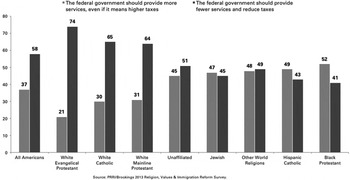
Recall that the PRRI survey asked respondents to indicate whether the following statements came closer to their own views: “the government should provide more services, even if it means higher taxes” or “the government should provide fewer services and reduce taxes.” Overall, we find that Americans trend toward the more conservative option of the two, with 58% believing that the government should provide fewer services and reduce taxes, compared with 37% who said that government should provide more services, even if it means higher taxes.
Figure 3 summarizes the findings by religious tradition. White evangelical Protestants are far more likely than other religious and non-religious Americans to hold the more conservative position. By a ratio of 3 to 1, white evangelical Protestants believe the federal government should provide fewer services and reduce taxes (74%) as opposed to believing that the federal government should provide more services, even if it means more taxes (21%). White Catholics and white mainline Protestants are also more likely to believe the government should be providing fewer, rather than more, services. While the religiously unaffiliated are split fairly evenly on this question, minority respondents, particularly black Protestants, Hispanic Catholics, and Jews, are the only religious groups to support more government services, although sizable minorities within all faith traditions also support the more conservative position.
Beliefs about Government Services by Religious Affiliation.

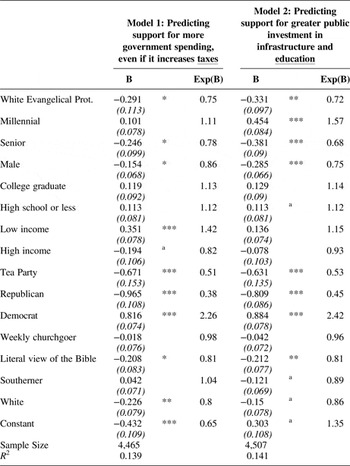
White evangelical Protestants still hold distinct views on this measure once we consider additional controls. Table 1 (Model 1) shows the results of a logistic regression analysis in which we regress support for more government servicesFootnote 12 on white evangelical Protestant statusFootnote 13 while controlling for a variety of factors, including age, gender, education, income, party identification, Tea Party status, Southern residency, race, and two religious variables.Footnote 14 Even after accounting for other important attributes, we find that white evangelical Protestants are about 1.3 times less likely than non-white evangelical Protestants to favor a larger role for government. The results also show a substantial influence of partisanship. Republicans are roughly three times less likely to favor an expansive role of government in society than independents and non-politically affiliated Americans. Democratic identity is also a strong predictor of attitudes about government. Household income, racial identity (identifying as white, non-Hispanic), and age are also significant predictors of attitudes about the role of government. Tea Party status is also a significant predictor of these attitudes, with Tea Partiers about two times less likely to favor an expansive role for government. Despite their reputation for being more open to government spending, there is no evidence to support the claim that millennials favor a more robust government involvement than older Americans. However, compared to middle-aged Americans, seniors are less likely to favor government spending if it requires an increase in taxes. Not surprisingly, Americans with household incomes below $30,000 per year are more supportive of increased government efforts while being a white, non-Hispanic American is predictive of holding the opposite view. While there is no evidence that weekly attendance at church predicts support for more government services, holding a literal view of the Bible makes Americans significantly less likely to favor an expansive role for government at the expense of more taxes. These findings appear to support the notion that perhaps theological orthodoxy, with its emphasis on individualism, may help foster attitudes among Americans that reject more government spending to help alleviate social problems.
Attitudes on government services, economic growth (All Americans – logistic regression model; standard errors in parentheses)

Sources: 2014 American Values Survey; 2013 Religion, Values, and Immigration Reform Survey. ***p < 0.001; **p < 0.01; *p < 0.05; a p ≤ 0.10.
Best Way to Stimulate Economic Growth: Multivariate Analysis
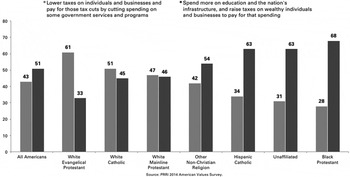
Next, we turn to our second economic policy question, which asks respondents their views on which policy is better to stimulate economic growth. Among all Americans, 43% believe that the best way to spur economic growth is to lower taxes and cut government spending, compared with 51% who said that government should make more investments in education and infrastructure while pursuing tax hikes to pay for these. Figure 4 summarizes the findings by religious tradition. Once again, white evangelicals stand apart from other Americans by holding the more conservative position: 61% support lower taxes and cuts in government spending as a means to spur economic growth compared to just 33% who favor the government investing in education and infrastructure. By contrast, non-white respondents, black Protestants, and Hispanic Catholics more closely mirror the religiously unaffiliated by holding far more liberal positions on this issue. White mainline Protestants and Catholics, however, are more evenly divided, split nearly in half on which approach would provide more economic growth.
Beliefs about Governement Spending by Religious Affiliation.

When we regress support for cutting taxes as a means to stimulate growth on white evangelical Protestant status in our logistic regression model (see Table 1, Model 2), we find that being white evangelical Protestant is a significant predictor of opposition to increased spending on public infrastructure.Footnote 15 We find that white evangelical Protestants again are roughly 1.4 times less likely than other Americans to believe that public investment in infrastructure and education is the best way to spur economic growth. Similar to the first model, partisanship plays a much larger role in predicting support for this position, which is hardly surprising given that this issue is a key one that distinguishes the parties’ philosophical approach toward governing. Democrats are almost two and a half more times likely than independents and non-affiliated Americans to believe public investment is the best method for producing economic growth. Respondents who identify as part of the Tea Party are also significantly more conservative on this issue, being almost two times less likely to support public investment than other Americans. The way age and income structure attitudes about public investment as a way to increase growth is somewhat different than in the previous model. While age is not a strong predictor of attitudes on government spending overall, when it comes to questions of public investment in education and infrastructure, notable generational divisions emerge. Millennials are more likely to support public investment as a means of economic growth, while seniors are less likely. In fact, while age is a stronger predictor in this model, variables measuring economic status have few effects. Whites are slightly less likely than non-whites to favor increased spending, while biblical views are also significant: those who view the Bible as literal are more likely to support tax cuts as the best approach to stimulate the economy. Being a Southerner is also marginally predictive of being less supportive of public investment as a way to grow the economy.
DIFFERENCES AMONG WHITE EVANGELICALS ON GOVERNMENT SERVICES, ECONOMIC GROWTH
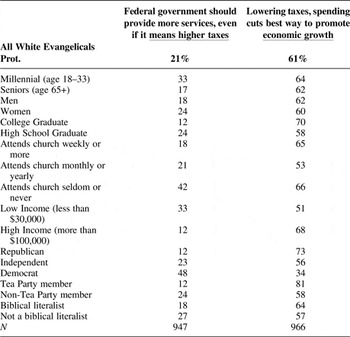
When it comes to economic policy and the role of government, our analysis shows that white evangelical Protestants hold far more conservative views than other Americans. However, we recognize that white evangelical Protestants are not monolithic in their attitudes. Turning first to the role of government, for instance, while nearly three-quarters of white evangelical Protestants believe the federal government should provide fewer services and reduce taxes, 21% say the government should provide more services even if it results in higher taxes (see Table 2). Despite the strong predilection for a more modest role for government, there is considerable variation in the level of support by age, socio-economic status, political orientation, and religious belief and behavior.
Percentage of white Evangelicals that agree that …

Sources: 2014 American Values Survey; 2013 Religion, Values, and Immigration Reform Survey.
Among the general public, younger adults and women exhibit more supportive views about government's role in society. Among millennial white evangelicals, nearly one-third (33%) favor a more expansive role for government, compared to fewer than one in five (17%) white evangelical seniors. White evangelical women are also slightly more likely to favor a larger role of government than white evangelical men (24% vs. 18%).
Americans with lower levels of educational attainment and lower levels of income also consistently support more government involvement — a pattern that is also evident among white evangelicals. One-quarter of white evangelicals with a high school degree say government should provide more services, more than twice the number of those with at least a four-year college education (24% vs. 12%). Similarly, white evangelicals with lower household incomes express more support of greater government involvement. Among white evangelicals with household incomes of less than $30,000 a year, one-third say government should be providing more services compared to 12% of those with household incomes in excess of $100,000.
There are also considerable political differences. Although Democrats make-up a relatively small proportion of all white evangelicals at just 15%, they nonetheless exhibit remarkably different attitudes about government than white evangelical independents and Republicans. Nearly half (48%) of white evangelical Democrats support more government services, compared to 23% of white evangelical independents and only 12% of white evangelical Republicans. Like their Republican counterparts, only 12% of white evangelical Tea Party members support more government services.
Finally, there are also notable differences in dispositions by religious belief and behavior. White evangelicals who report attending religious services at least once a week are less supportive of a more expansive role for government than those who report attending seldom or never. Fewer than one in five (18%) white evangelicals who attend at least weekly report that the government should provide more services, compared to 42% of those who attend seldom or never. White evangelicals who believe the Bible is literally true also hold more conservative attitudes on our economic indicators than those who do not.
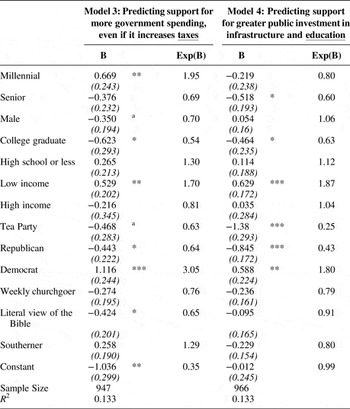
Examining support for more government services among white evangelicals only while controlling for a variety of factors, we can determine which, if any factors, may mitigate the overall conservative bent of evangelicals (See Table 3, Model 3). Several characteristics are statistically predictive of expressing greater support for more government services at the expense of tax cuts: membership in the Tea Party (p < 0.10), partisanship, age, and economic status. Clearly, evangelicals who are Democrats are far more likely to see a bigger role for government and this variable has the biggest impact on predicting support for such a role: Democratic white evangelicals are three times as likely as white evangelical independents and non-politically affiliated white evangelicals to favor a broader role for government in the economy, while Republicans are roughly one and a half times less likely to express support for government involvement. That partisan attachments predict attitudes about the role of government in society is not surprising given the centrality of this view in structuring the differences between the two political parties. However, that it remains such an important predictor even among a naturally conservative constituency, like white evangelical Protestants, attests to the continued way partisanship shapes attitudes toward basic economic questions. Membership in the Tea Party also exerts a negative influence on support for government spending similar in magnitude to Republican identification. Economic circumstances also play such a significant role in structuring attitudes about government's role in the economy. These results suggest that personal economic circumstances are still relevant and are not necessarily superseded by pre-existing ideological commitments. Age remains a significant predictor of attitudes about the role of government among white evangelicals, with millennials more likely to express support than those who are older.
Attitudes on scope of government and economic growth (White Evangelical Protestants only — logistic regression model; standard errors in parentheses)

Sources: 2014 American Values Survey; 2013 Religion, Values, and Immigration Reform Survey. ***p < 0.001; **p < 0.01; *p < 0.05; a p ≤ 0.10.
Turning to Model 4 in Table 3, we examine evangelicals’ support for public investment as the best way to promote economic growth. As in the previous model, partisanship is a strong predictor of supporting more public investment as a way to spur economic growth. White evangelical Democrats are almost than twice as likely as white evangelical independents and the non-politically affiliated to favor increased public funding in education and infrastructure projects, while white evangelical Republicans are 2.3 times less likely. This is not surprising, again, given that tax positions are a key area of distinction between the two parties. Tea Party status also emerges as a highly significant predictor, with Tea Party evangelicals four times less likely than other evangelicals to believe public investment holds the key to economic growth, which lends credence to our argument that the Tea Party has been particularly effective in shaping the economic attitudes of white evangelicals in a very conservative direction. Additionally, income remains an important distinction among evangelicals when it comes to attitudes on tax cuts: white evangelicals with lower incomes are much less likely than moderate income evangelicals and evangelicals who did not report their income to believe that lower taxes and spending cuts are the best way to promote economic growth.
CONCLUSION
Compared to other religious communities, white evangelical Protestants are strongly conservative when it comes to attitudes about government and economic policy. They remain skeptical of public investment as means to further economic growth and express skepticism about more government involvement in the economy. The economic conservatism expressed by white evangelical Protestants is likely driven by their strong partisan leanings. A majority (69%) of white evangelical Protestants identify as Republican or lean toward the Republican Party. In expressing distrust of government services and programs, white evangelical Protestants may simply be articulating a political belief system they have long since internalized.
However, neither the shifting partisan allegiances of white evangelical Protestants, nor the growing polarization of the parties on basic economic questions, may completely explain the sharply divergent attitudes white evangelicals express on government intervention in the economy. The emergence of the Tea Party, which has been credited for moving the Republican Party in a more conservative direction on many economic issues, may have played a role as well. Tea Party organizations, in collaboration with conservative think tanks and religious organizations, have embraced a biblically backed view of economic conservatism, which has found appeal among many white evangelical Protestants.
These results also suggest, however, that white evangelical Protestants demonstrate some diversity of opinion on fundamental economic questions. White evangelical Protestants have often been maligned for the perception that they vote against their economic interests, most famously by Thomas Frank (Reference Frank2004). Yet the results we present here challenge that central claim. We show that downscale white evangelical Protestants, defined as those with household incomes of less than $30,000 a year, are much more supportive of greater public investment in education and infrastructure than those evangelicals with more middle-class incomes. As the education level and socio-economic status of white evangelical Protestants has increased among this group, their economic interests have changed. It remains true that even among downscale white evangelical Protestants, there is a strong undercurrent of hostility toward government that is less pronounced among other downscale Americans.
Despite embracing a worldview that is suspicious of government involvement in the economy, white evangelical Protestants do not demonstrate blanket opposition to all progressive economic policies. For example, although raising the minimum wage has received criticism from Republican leaders in some quarters, our other work has found that a solid majority (56%) of white evangelical Protestants remain supportive of a minimum wage hike (Public Religion Research Institute 2014). Because criticism to increasing the minimum wage is generally couched in language about its macro-economic impact — it will hurt the economy by forcing companies to lay-off workers — rather than personal responsibility, we believe it engenders much less opposition among white evangelical Protestants. Emerging economic issues that have not been politically polarized are also less likely to engender opposition among white evangelical Protestants. Thus, a recent survey found that the overwhelming majority of white evangelical Protestants favor requiring companies to provide full-time employees with paid sick days, and paid leave for the birth of a child (Public Religion Research Institute 2014). In the absence of salient political cues, white evangelical Protestants are more likely to assess the merits of a policy on other factors. On more general orientations toward government spending and public investment at the expense of tax increases, however, evangelical Protestants remain the most committed of religious groups to Republican orthodoxy.