Introduction
From the 1960s, both Taiwan and the Republic of Korea or South Korea (hereafter Korea) experienced three decades of economic growth without major crises, but since the late 1990s considerable economic turbulence has led to rapidly increasing poverty and inequality in the two countries, and older people have been among the hardest hit. In both countries, the ratio of elderly people to the overall population is rising, whereas the rate of co-residence of older people and their children is decreasing. As a result, while old-age income insecurity is conspicuous in these so-called Confucian societies, an unprecedented consensus has formed about the need to expand social policy measures that protect the material wellbeing of older people. Interestingly, although the two countries are similar in many respects, they have adopted different policy tools for coping with old-age insecurity. The Korean government has expanded the coverage of the social insurance pension introduced in 1988, and in 2000 modernised the social assistance programme to target the poor. In Taiwan, in addition to the lump-sum old-age benefit provided by the Labour Insurance programme, the government has expanded non-contributory flat-rate allowance programmes, but they exclude the rich. Very different welfare politics have been pursued in these countries, and different actors have pursued different policy ideas (Aspalter Reference Aspalter2002; Yang Reference Yang2003).
Much has been written about these developments, but changes in the sources of income of elderly households, the actual performance of these programmes in reducing old-age poverty, and their effect on other income components have not been thoroughly examined. This paper concentrates on the anti-poverty effect of the programmes (rather than detailing the political process), firstly by describing recent developments in the two countries, and secondly, through a detailed examination using micro-household datasets of headcount poverty rates and the poverty gap. We argue that while the role of these programmes in reducing old-age security has increased over the years, the different policy choices have resulted in clearly different welfare outcomes. The paper provides a critical discussion of the recent policy reforms as well as the possible implications of these countries' policy choices on family wealth transfers.
Policy developments: insurance versus allowance
Prior to the 1990s, state welfare arrangements in Korea and Taiwan justified their classification as male-oriented ‘social insurance states’ (Tang Reference Tang2000). They had generous social insurance pensions for privileged occupational groups, including civil servants, teachers and military personnel, and employees of large and stable companies were likely to enjoy generous retirement benefits. During this period, old-age was not a significant macroeconomic policy or welfare issue since life expectancy after retirement was relatively short, and the family had a substantial role in providing material support for older people. For this reason, social policy for older people was not a priority, and a lump-sum retirement payment was preferred. Although the Korean government introduced in 1988 the National Pension Insurance Programme (hereafter the National Pension), it required participants to contribute for at least 20 years to be entitled to the full old-age benefit, meaning that the programme addressed future needs more than immediate needs.
Since the early 1990s, however, social policy for older people has become a key issue in both countries for several reasons. First, the birth rate decreased, and the percentage of the population aged 65 or more years increased more rapidly. For example, in Taiwan, the Total Fertility Rate fell from 1.66 in 1990 to 1.10 in 2002, and the percentage of the population in the older age group soared from 6.0 per cent in 1990 to 9.0 per cent in 2002 (Taiwan, Council for Economic Planning and Development 2003). The second concern has been the increasing vulnerability of older people in rural areas, a consequence of the rapidly shrinking agricultural sector, compounded in Korea by the opening up of the country's agricultural markets to international competition through the Uruguay Round in 1994 (Shin Reference Shin2003). In 1995, Korea expanded the social insurance pension so that the self-employed in the agricultural and fishery sectors received a contribution subsidy from the government, whereas Taiwan introduced an Old Age Allowance scheme for older people working in agriculture.
Thirdly, the economic crises and recessions of the late 1990s and early 2000s exacerbated the vulnerability of older people. While unemployment rose, the oldest and youngest workers were the hardest hit. For example, the employment rate for workers aged 55–64 years in Taiwan plunged from around 50 per cent in the mid-1990s to near 40 per cent in 2002 (International Labour Organisation 2004). Fourthly, households in the two countries have rapidly transformed towards more Western forms, with an increasing percentage of older people living apart from children, e.g. the co-residence rate in Korea fell from 55 per cent in 1998 to 43 per cent in 2002 (Choi Reference Choi2006). Lastly, the strengthening of democracy since the late 1980s has encouraged social policy reforms, for the political parties and governments started to listen to older people because they have been more likely to vote than younger people. After witnessing these changes, both governments developed various programmes for coping with rising old-age insecurity. The next sections of the paper examine the different approaches taken by the two governments.
Korea
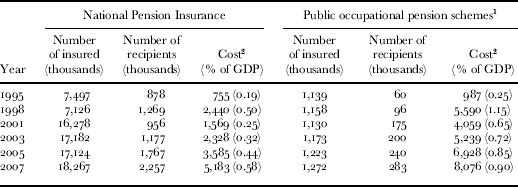
Korea has developed a dual system for protecting old-age income security: social insurance pensions and public assistance programmes. First of all, there are four public pension schemes in Korea: three are for special occupations, and the latest one, the National Pension, is the largest and a single, unified scheme that covers most Korean citizens including the rural and urban self-employed. Although the National Pension has been expanded rapidly since 1988 in terms of both its coverage and the assets of its accumulated pension fund, most of today's older people are still excluded from its benefits. While in 2007 the special occupational pension schemes paid out 0.9 per cent of the Gross Domestic Product (GDP) to only around 283,000 beneficiaries, the National Pension had not matured, for the total disbursements to the 2.26 million beneficiaries were as little as 0.58 per cent of GDP (see Table 1). Given this disparity, the number of older people who are institutionally excluded from the National Pension has consistently been a key issue whenever pension reform plans have been discussed (Kim and Kim Reference Kim, Kim, Bonoli and Shinkawa2004).
Public pension schemes in Korea, 1995–2007
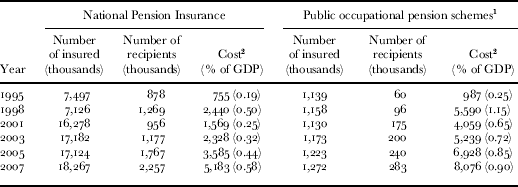
Notes: 1. Government Employees' Pension and Private School Teachers' Pension only. 2. In billion won. GDP: gross domestic product.
Source: Korea, Ministry of Health, Welfare and Family Affairs (2007).
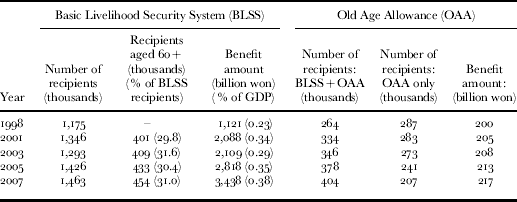
In this situation, two public assistance programmes have been very important for low-income older people, the Basic Livelihood Security System introduced in 2000, and the Old Age Allowance. Although these additions to the public assistance system were a ‘sea change’ (Kim J Reference Kim2004; Kim Y-M Reference Kim2008), eligibility is still highly restricted by two critical conditions. One filter is the level of household income and assets, and the other is the so-called ‘support obligator’ condition. Older people with no or low income may not be entitled to the benefits if they have an adult child who is deemed to have the capability to support them. As a matter of fact, the coverage provided by the Basic Livelihood Security System has not greatly expanded, either in terms of the number of beneficiaries or the percentage of older people that are beneficiaries (see Table 2).
Public assistance programmes for older people in Korea, 1998–2007
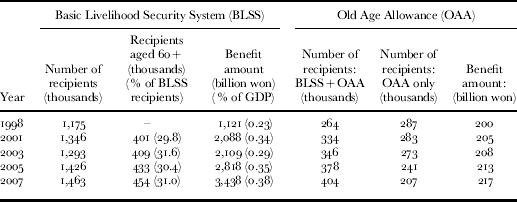
Notes: GDP: gross domestic product.
Source: Korea, Ministry of Health, Welfare and Family Affairs, White Paper on Health, Welfare and Family Affairs, various years; Korea, Ministry of Health, Welfare and Family Affairs (2007).
Whilst the Basic Livelihood Security System was enacted to guarantee a national minimum income for all citizens, the Old Age Allowance was launched in 1998 with the more direct purpose of supporting low-income older people who were excluded from the public pension schemes. In effect, it has functioned in two ways. Firstly, it provides supplementary benefits for older people who already receive public assistance benefits, and secondly for the low-income older people who were excluded from the National Pension by age restrictions, it complements the existing social insurance pension schemes. The benefit level per person per month in 2007 for public assistance recipients was between 45,000 won (US $40) for those aged 65–79 years and 50,000 won (US $45) for those aged 80 or more years. For the beneficiaries not receiving public assistance benefits, the benefit level per month is very low – 61,260 won (US $50) for a couple and 35,000 won (US $30) for a single person (Korea, Ministry of Health, Welfare and Family Affairs (MHWFA) 2008b).
Last but not least, it should be mentioned that these assistance schemes have not been adequate to address the financial hardship among older people not covered by the existing social insurance pensions. According to a government report, in 2005 seven-in-ten older people were not covered by any public old-age income security programme (MHWFA 2008a). Only 17 per cent of older people received benefits from public pension schemes, and only 14 per cent were beneficiaries of public assistance programmes. It is important to bear in mind that about 30 per cent of older people receiving one of these benefits are unlikely to have sufficient income to avoid material hardship.
Taiwan
In addition to the public pensions for privileged occupations, Taiwan has also established a dual old-age system: Labour Insurance and Old Age Allowances. The Labour Insurance programme introduced in 1950 has old-age benefits as one component. As of 2005, it provided lump-sum, old-age benefits to around 150,000 people, at a cost of approximately 1.2 per cent of GDP (Taiwan, Bureau of Labour Insurance 2010a). Although it is an important tool for promoting old-age security, the Labour Insurance scheme's ability to ease old-age poverty has been questioned in two respects. Firstly, its coverage, particularly before the 1990s, was limited to employees at larger workplaces and of stable organisations. Secondly, it offers a lump-sum benefit rather than an annuity. As a result, since the early 1990s, there have been various proposals for a new programme.
The emergence of old-age allowance programmes in Taiwan is arguably the most important development. The first were introduced and tested by local governments controlled by the pro-welfare Democratic Progressive Party, which helped to raise their political popularity. Although local-level implementation failed for lack of financial support from the central Nationalist government, old-age security became a prominent political issue. Subsequently, the main party proposed a social insurance pension scheme for old-age security, but non-contributory old-age allowance programmes were also a politically attractive option. As a result, the Old Age Peasants' Welfare Allowance was introduced in 1995 and extended to fishermen in 1997. Then, two years after the Democratic Progressive Party came to power in 2000, it was extended to older people living in urban areas.
The Old Age Allowance scheme provides a flat-rate benefit without requiring individual contributions. The benefits are means-tested with less strict rules than in the Korean scheme. Those who are working or receiving other benefits from the government cannot in principle receive the allowance, but we understand that a number of elderly people received both the Old Age Allowance and the Labour Insurance old-age benefit, partly because the latter's lump-sum payment is often inadequate to cover the entire duration of later life. An important difference with the Korean scheme is that the Taiwanese Old Age Allowance is an individual-based benefit not a household-based benefit, i.e. income and assets are not determined by household wealth but by individual wealth.
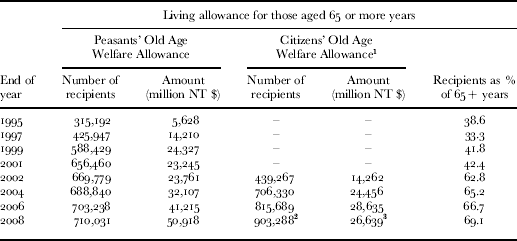
The amount of the allowance was NT $3,000 (US $96) per person per month and cost around 11 per cent of GPD per capita in 1995. The benefit for peasants and fishermen increased to NT $4,000 (US $128) in 2004 and NT $5,000 (US $160) in 2006. Although the benefit level is low, household income is doubled when there are two eligible older members. The coverage of those aged 65 or more years extended from 38.6 per cent in 1995 to nearly 70 per cent in 2008, and the total expenditure on these schemes increased considerably from NT $5,628 million (US $180 million) in 1995 to NT $69,850 million (US $2,101 million) in 2006, 4 per cent of government expenditures and just less than 0.6 per cent of GDP (Table 3). Although there is a separate public assistance scheme for the poor, its coverage is restricted by the low official poverty line. In 2006, only 1.17 per cent of all households received the public assistance benefit, covering less than one per cent of the total population (for further details seeCheng, Cheng and Leu Reference Cheng, Cheng and Leu2007). While these allowance programmes have contributed to the stability of income in old age, they have been criticised by many, including academics and politicians, as a ‘political show’ or financially unsustainable, but more often than not the criticisms have not been thoroughly supported by empirical evidence. This article aims to reveal to what extent these allowances have contributed to stabilising old-age income security by analysing changes in old-age poverty and whether there have been any knock-on effects from the allowances.
Old-age allowances in Taiwan, 1995–2008
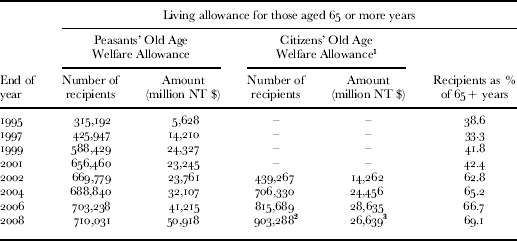
Notes: 1. Includes old-age allowance for indigenous people. 2. Estimate. 3. January to October 2008 only.
Source: Taiwan, Bureau of Labour Insurance (2010b).
Methodology
Micro-income datasets used
To understand the poverty reduction effects of old-age security programmes in Korea and Taiwan, it is essential to obtain reliable and comprehensive micro-income datasets. For international comparisons, the Luxembourg Income Study (LIS) has provided the best datasets for the last 20 years. Since Taiwan participated in the LIS from the beginning, this research will utilise three Taiwanese LIS datasets: the fourth (1995), fifth (2000), and sixth (2005) waves. The data enable changes in poverty among older people to be tracked and analysed between 1995 and 2005, the period during which the country's old-age allowance system developed significantly. Unfortunately, Korean data are not available from the LIS database (although Korea recently joined). The two most reliable micro-data sets are from the 2000 National Survey of Household Income and Expenditure and the 2006 Household Income and Expenditure Survey. Using these two datasets, we examine the poverty reduction effects of the income transfer system between 2000 and 2006. Note, however, that we cannot use the 1996 National Survey of Household Income and Expenditure dataset because it does not provide income data for self-employed and unemployed households, and consequently seriously under-represents households of poor and elderly people.
Methodological issues
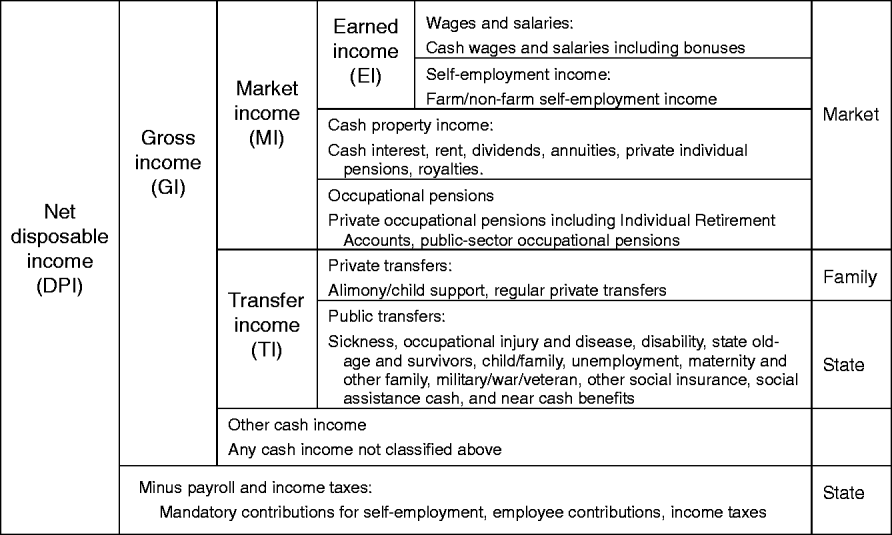
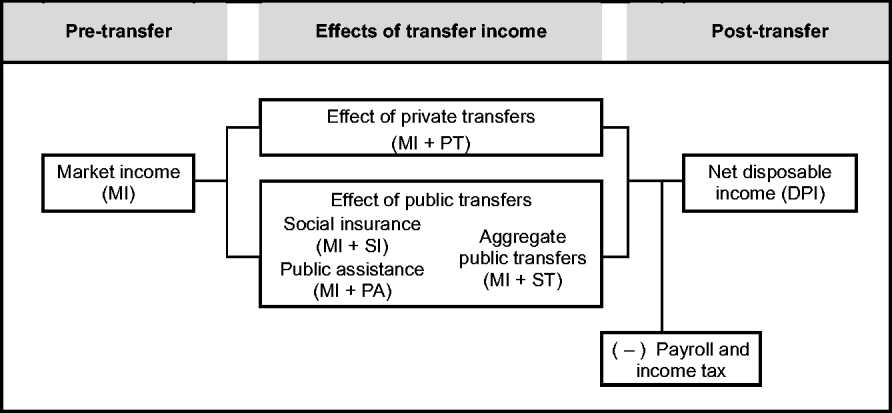
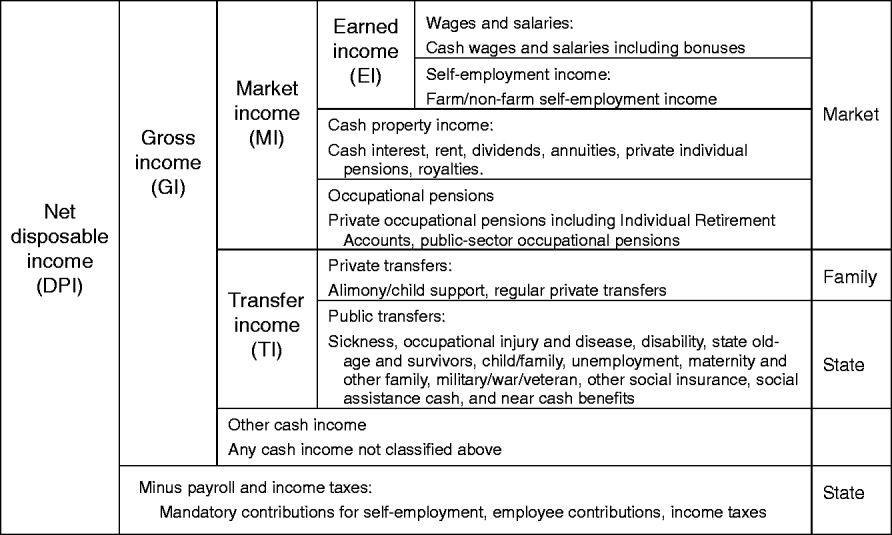
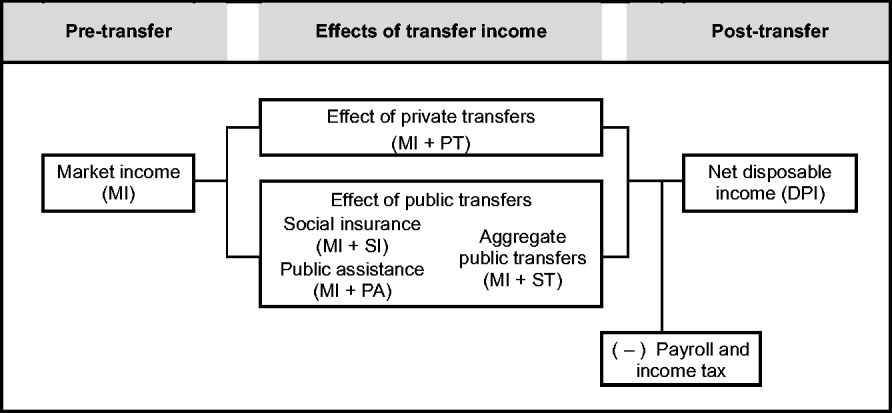
Many intricate methodological decisions are required when conducting comparative income studies, including which measures to use, i.e. income aggregates or indicators of inequality and poverty, and which income periods and equivalence scales to use (seeAtkinson, Rainwater and Smeeding Reference Atkinson, Rainwater and Smeeding1995; Mitchell Reference Mitchell1991). Here, only the key methodological issues are discussed. Firstly, the empirical analysis will establish the old-age ‘income mix’, as suggested by Esping-Andersen (Reference Esping-Andersen1990, Reference Esping-Andersen1999). Three major income sources are distinguished: market, family, and state. Market income includes earnings, cash property income, and private and occupational pensions. Family income accrues from private or inter-personal transfers. Income from the state comprises the monetary benefits received through the welfare state. As seen from Figure 1, these categories are very similar to those used by the LIS and in the Organisation for Economic Co-operation and Development's (OECD) classifications, which also specify additional components and aggregates of household income, namely market income, gross income, and disposable income. In contrast to most empirical studies conducted by Western scholars that treat private transfers as a component of market income, we categorise private transfers as income from the family. Secondly, for equivalised individual income (household income adjusted for the variable costs per head of living in households of different size and composition), we used one of the simplest formulae, the OECD's ‘total household income divided by the square root of the number of household members’ (Atkinson, Rainwater and Smeeding Reference Atkinson, Rainwater and Smeeding1995).
Income components, aggregates and mix.
Thirdly, when measuring the poverty reduction effects of the income transfer system, we employ both the headcount poverty rate and the poverty gap. A head-count measure of poverty is defined as the proportion of the population below a poverty line. On the other hand, the poverty gap can be measured as ‘the difference between the income of the unit in question and the income that would be required to bring that unit up to its defined poverty line’ (Mitchell Reference Mitchell1991: 37). In this study, the poverty gap is operationalised as the income gap ratio, the average shortfall of income for poor households from the poverty line as a percentage of the poverty line. Whilst the poverty rate measures the prevalence of poverty, the poverty gap indicates the depth of poverty. In terms of the poverty line in the empirical analyses, we also use a relative poverty concept – ratios of median income – that facilitates international comparisons. The poverty lines of the study were set for each country at 40, 50 and 60 per cent of median equivalised household income to compare the results when different poverty lines are applied. This is because it is well known that poverty measures are sensitive to the poverty line that is used (seeMitchell Reference Mitchell1991).
Measuring poverty reduction effects
We focus on the poverty reduction effects of the income transfer system by comparing the poverty figures before and after income transfers. In our study, the two reduction effects are computed by the percentage change in the rates with the introduction of the income transfer system (TS):


As seen on Figure 2, the poverty reduction effect of each component of income transfers or sources, i.e. private transfers (PT), public assistance payments (PA), and public pensions (SI), was computed separately and compared one with the others. In addition, the effect of total public transfers (ST, or PA+SI) is compared with that of private transfers. The final outcome of the income transfer system, disposable income (DPI), is produced by aggregating all components of transfer income and deducting outgoing transfer expenditure (such as payroll and income taxes).
Decomposition of poverty reduction effects of transfer income.
Analysis: the poverty rate and poverty gaps
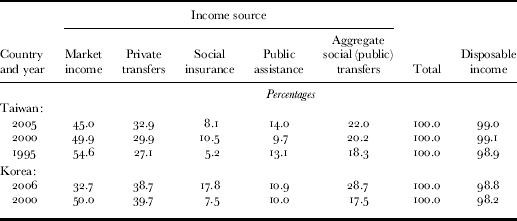
Table 4 shows various changes in the old-age income mix in the two countries. As expected from the recent benefits reforms, the strongest trends have been a rapid decrease in the proportion of all income from market sources and a marked rise in the share of public transfers. In Korea, the share of total old-age income from market sources plunged by around 17 per cent between 2000 and 2006, whereas the share from public transfers increased by around 11 per cent. The same trend was found in Taiwan but was less marked, for the increase in the share from public transfers was rather modest, from 18 to 22 per cent. In addition, there are noticeable differences between the two countries. In Taiwan, the share of private transfers increased rather than decreased, from 27 per cent in 1995 to 33 per cent in 2005. This contradicts a prediction based on the ‘weakening family’. The most plausible explanation is that the decrease in co-residence of parents and children makes private transfers more visible. In other words, when parents and children live together in a household, although there are financial transfers between them, those transfers are neither recorded nor reflected in national datasets. Once they live apart, however, the transfers become visible and are recorded.
Mix of old-age income sources in Korea and Taiwan, 1995, 2000 and 2005–06
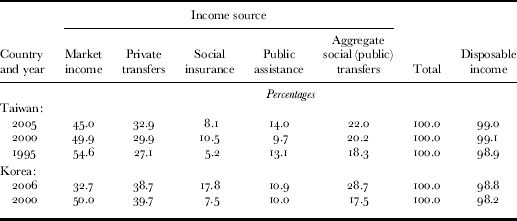
The data clearly reflect the two countries' different approaches to promoting old-age income security. In Korea, the share of income provided by social insurance benefits increased by more than 10 per cent between 2000 and 2006, whereas that of public assistance changed little. Although in 2006 the full National Pension old-age benefits were not yet being paid, the number of those receiving a ‘reduced old-age pension’ had increased (they are paid to those aged 60 or more years with 10–19 years of contributions and who are no longer gainfully employed). By contrast in Taiwan, social insurance benefits had not become a major source of old-age security by 2005. Public assistance benefits, including old-age allowances, accounted for 14 per cent of old-age income, more than the 8 per cent contributed by social insurance benefits. This confirms that the different systems developed by the two countries have had different effects on old-age income protection. The next section examines more closely how the contrasting systems have performed in terms of poverty reduction and eradication.
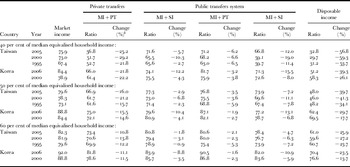
Table 5 shows changes in the headcount poverty rate in the two countries. Most striking is the prevalence and severity of old-age income insecurity. When applying a poverty line of 50 per cent of median income, if income had been entirely from market sources the poverty rates among older people would have increased during the last decade, in Korea between 2000 and 2006 from 84 to 89 per cent, and in Taiwan between 1995 and 2005 from 73 to 80 per cent. This means that most older people were at risk of poverty in the absence of public transfers. It is believed that increasing life expectancy, decreasing co-residence, the decrease in the number of working older people, and the worsening national economic situation all contributed to the trend. Even after adding public transfers, the poverty rates in 2005–06 remained around 46–48 per cent in Taiwan and 62–69 per cent in Korea. Generally, the poverty rates in Korea were higher than those in Taiwan. If the poverty line is taken as 40 per cent of median income, the difference in the two countries' poverty rates was greater, around 20 per cent, but if the poverty line is defined as 60 per cent of median income, the difference was less. These differences are explained by the different redistributive effects of income transfers in the two countries.
Headcount poverty rates before and after transfers, Korea and Taiwan, 1995, 2000 and 2005–06

Notes: 1. Change indicates the reduction in the poverty rate achieved by the specified source of income. MI: market income. PA: public assistance. PT: private transfers. SI: social insurance. ST: aggregate social transfers. For definitions and explanations of these terms including disposable income, see Figure 1.
In terms of poverty reduction, private transfers still played a more important role than public transfers. The poverty reduction effects of private transfers were around 15–16 per cent using the 50 per cent poverty line, and more than 20 per cent using the 40 per cent poverty line, whereas the reduction effects of public transfers were 7–11 per cent in Taiwan and 7–13 per cent in Korea using the 50 per cent poverty line. In Korea, however, it is clear that the anti-poverty role of public transfers had increased considerably regardless of the poverty lines, principally because they were social insurance benefits rather than means-tested benefits. It appears that the social insurance benefits were sufficient to lift some beneficiaries out of poverty, but the anti-poverty effect of public assistance benefits decreased, e.g. from 2.7 per cent to 1.9 per cent between 2000 and 2006 using the 50 per cent poverty line, which reflects the strict eligibility requirements of the new public assistance scheme and the old-age allowance scheme.
In Taiwan, the poverty reduction effects of public transfers decreased over the study period, though the picture is complicated. In general, the anti-poverty effect of means-tested benefits was higher than that of social insurance benefits, except in 2000. In spite of the rapid development of old-age allowances, their anti-poverty effects were rather disappointing except using the 40 per cent poverty line, presumably because of the low payment amounts. While this shows that the nearly universal old-age provisions in Taiwan have been insufficient to eradicate old-age poverty, it also suggests that the headcount poverty rates have not fully captured the anti-poverty dynamics of public transfers because they do not show the depth of poverty.
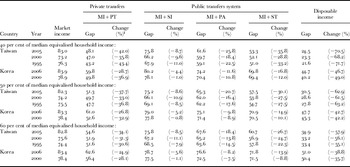
Table 6 shows that the poverty gap increased over time but reveals a picture that is completely different from the poverty reduction effects displayed in Table 5. The performance of public transfers in Taiwan markedly increased in comparison to Korea's; their anti-poverty effect almost achieved the level of private transfers. Using the 40 per cent poverty line, the anti-poverty effect of public transfers in Taiwan was 36 per cent in 2005, whereas the effect in Korea was 17 per cent. The reason for the difference lies in the role of public assistance, or more specifically the strong contribution of the Taiwanese old-age allowance scheme. As a result, the rate of reduction of the poverty gap in Taiwan was more than 70 per cent, much higher than in Korea. Also notable in Table 6 is the change in the anti-poverty effect of private transfers. A different trend is seen from that in Table 5, with the anti-poverty effect of private transfers increasing slightly over time in Taiwan, except when using the 40 per cent poverty line, whereas that effect decreased in Korea. Given that the proportion of private transfers increased in Korea, the decrease could imply the changing nature of private transfers in Korea – possibly from altruistic behaviour to exchange behaviour (seeCox Reference Cox1987 for a detailed discussion).
The poverty gap before and after specified income transfers, Korea and Taiwan, 1995, 2000 and 2005/6

Notes: 1. Change indicates the reduction in the poverty gap achieved by the specified source of income. MI: market income. PA: public assistance. PT: private transfers. SI: social insurance. ST: aggregate social transfers. For definitions and explanations of these terms including disposable income, see Figure 1.
Conclusion and implications
Although Korea and Taiwan have similar welfare states, the two countries have developed different old-age income security programmes. This study's examination of both headcount rates of poverty reduction and changes in the poverty gap (or depth of poverty) has shown that the different schemes have produced different welfare outcomes. Three key findings might be emphasised. First, the evidence for the reduction of poverty among older people in the two countries using the headcount rate is mixed, though the performance of the income protection measures in Korea clearly improved as payments from the National Pension began to spread. Second, in terms of the poverty gap, a much greater reduction was achieved in Taiwan than in Korea, which reflects the nature of Taiwan's flat-rate allowance schemes. Third, the observed changes in private transfers indicate that Taiwan's allowance programmes have been more compatible with traditional family support than Korea's schemes.
Social insurance pensions have been the central pillar for protecting the economic security of old-age in Korea and most East Asian states. Although these programmes initially aimed to protect ‘key workers’ including civil servants and military personnel, the coverage has recently extended. There is no doubt that social insurance pensions have contributed to poverty reduction in these countries, but a significant weakness remains; only those who are able to contribute benefit from the programme. In this sense, the Taiwanese experiment of flat-rate and nearly universal old-age allowance schemes has lessons for other developing countries in terms of poverty reduction. It should be also remembered, however, that the benefit level is low in Taiwan and it is questionable whether the government could raise the payment given the unprecedented pressures of economic globalisation.
With regard to the changes in private transfers, the interesting question is whether any features of public transfers have influenced their contribution to the reduction of the poverty gap. As explained earlier, the Korean public assistance has the ‘support obligator’ condition; that is, one cannot receive assistance when ‘supporters’ are available. Also, in principle, when calculating the benefit level, the amount of private transfers is deducted from the final benefit. By contrast, in Taiwan, flat-rate old-age allowance benefits, with less strict means-testing and without the support obligator exclusion, means that children do not have to take public old-age provisions into account when supporting their parents. Further research is required to clarify the interactions between private and public transfers, but it is possible that a stricter public assistance scheme undermines the traditional function of material support from the family even more than a universal allowance programme.
In conclusion, the two countries have implemented ambitious social policies for protecting the economic security of older people, and the presented evidence shows that these have already had positive effects. It is nonetheless doubtful whether the recent developments and reforms are sufficient to slow the increase in old-age poverty in the two ‘post-industrialising’ societies. It is almost certain that the old-age poverty rate will increase in line with the rapidly increasing number of older people, the rapid transformation of the countries' labour markets, and revisions to traditional family support arrangements. To address this institutional context, the two governments will need to introduce further reforms and elaborations of their pension systems.
Acknowledgements
This research was supported by a Korea University Grant (2009). We also wish to thank two anonymous referees for their constructive suggestions.