Introduction
In several regions of the world, economic development has increased urbanization and human migration from rural to urban areas, decreasing the level of rural poverty (UN-Habitat, 2016). However, in Latin America and the Caribbean, poverty and marginalization are still higher in rural communities than in urban centres (Vakis et al., Reference Vakis, Rigolini and Lucchetti2015). Rural areas are mainly characterized by low access to basic household services, such as sanitation, piped water, electricity, sewage systems, and garbage collection (International Fund for Agricultural Development, 2016). These conditions offer an environment rich in food and harbourage, supporting large populations of commensal or synanthropic rodents (Battersby et al., Reference Battersby, Hirschhorn, Amman, Bonnefoy, Kampen and Sweeney2008).
The black rat Rattus rattus and the house mouse Mus musculus are two of the main commensal rodents (Battersby et al., Reference Battersby, Hirschhorn, Amman, Bonnefoy, Kampen and Sweeney2008). These species are the source of some zoonotic pathogens, such as viruses, bacteria, protozoa and helminths. Commensal rodents are the definitive hosts of helminth species responsible for human morbidity, such as the cestodes Hymenolepis diminuta and Rodentolepis nana, and the nematodes Angiostrongylus cantonensis and Calodium hepaticum (syn. Capillaria hepatica) (Meerburg et al., Reference Meerburg, Singleton and Kijlstra2009). They also serve as intermediate hosts of other helminths of public health or veterinary concern, including Trichinella spiralis and Hydatigera taeniaeformis (Meerburg et al., Reference Meerburg, Singleton and Kijlstra2009).
Several studies around the world have focused on taxonomic description and community characterization of helminths of R. rattus and M. musculus (Milazzo et al., Reference Milazzo2003; Pulido-Flores et al., Reference Pulido-Flores, Moreno-Flores and Monks2005; Landaeta-Aqueveque et al., Reference Landaeta-Aqueveque, Robles and Cattan2007; Panti-May et al., Reference Panti-May2015). In contrast, few surveys have analysed factors affecting the patterns of helminth infections (Waugh et al., Reference Waugh2006; Mohd Zain et al., Reference Mohd Zain, Behnke and Lewis2012; Julius et al., Reference Julius, Schwan and Chimimba2018). To identify potential threats of parasite transmission to humans, epidemiological risk factors that influence the infection patterns must be studied (Mohd Zain et al., Reference Mohd Zain, Behnke and Lewis2012; Carvalho-Pereira et al., Reference Carvalho-Pereira2017). This is especially relevant in areas with low levels of hygiene, as R. rattus and M. musculus have domestic and peri-domestic habits leading to human exposure to pathogen agents shed in rodent excreta (Panti-May et al., Reference Panti-May2012).
In Mexico, there have been few studies on helminth parasites of R. rattus and M. musculus. These studies include descriptive data on species presence (Pulido-Flores et al., Reference Pulido-Flores, Moreno-Flores and Monks2005) or parasitological reports with data on prevalence and intensity of infections (Tay Zavala et al., Reference Tay Zavala1999; Panti-May et al., Reference Panti-May2015, Reference Panti-May2017). However, no previous study has analysed factors affecting the patterns of helminth infections. Thus, the aims of the present investigation were (1) to estimate the prevalence, intensity of infection, and richness of helminths in R. rattus and M. musculus from two rural communities in Mexico and (2) to identify intrinsic and extrinsic factors associated with these parasitological descriptors.
Materials and methods
Study sites
The study was carried out in two Mayan communities in Yucatán, south-eastern Mexico: Xkalakdzonot (20°26′21.35″N, 88°34′10.25″W), in the municipality of Chankom, and Paraíso (20°40′34.36″N, 90°06′54.23″W), in the municipality of Maxcanú. Both communities have high levels of social gap index or marginalization according to the Mexican Secretariat of Social Development (Secretaría de Desarrollo Social, 2015). Xkalakdzonot is located c. 59 km south of the city of Valladolid, with 685 inhabitants and 161 dwellings in an area of c. 0.67 km2 surrounded by medium deciduous tropical forest (Instituto Nacional de Estadística y Geografía, 2012). Paraíso is located c. 15 km north of the city of Maxcanú, with 656 inhabitants and 155 dwellings in an area of c. 0.23 km2 surrounded by patches of secondary low deciduous forest (Instituto Nacional de Estadística y Geografía, 2012). Inhabitants of both communities live in small concrete houses but also in Mayan houses constructed with stones and wooden poles and thatched with palm leaves. Garbage, unserviceable home appliances, fruit trees, weeds, vegetable plots, and domestic animals (i.e. poultry, pigs, dogs and cats) are common in the households.
Trapping methodology
To obtain the permission of residents for trapping, we explained the methodology in the Mayan language. In each community, 20 households were selected at random from satellite imagery maps. Rodent sampling was carried out during four sampling campaigns in 2016: May and June (dry season), and August and September (rainy season).
Following previously developed methodologies (Panti-May et al., Reference Panti-May2012, Reference Panti-May2016), eight Sherman traps (8 × 9.5 × 30.5 cm) and one Tomahawk trap (23 × 23 × 66 cm) were placed each month in each household for three consecutive nights. Traps were baited with a mixture of oatmeal and vanilla essence and were distributed in the house and yard, close to signs of rodent activity or potential sources of food and/or harbourage. The trapping effort was 2160 trap-nights in each community. Trapped specimens were anaesthetized with isoflurane and euthanized by either cervical dislocation or overdose of sodium pentobarbital.
Data collection
After euthanasia, specimens were separated for species identification. Sex, weight, body length, and season of capture were recorded. Rodents were classified as juveniles or adults on the basis of body weight and/or sexual maturity status and following previous studies (Panti-May et al., Reference Panti-May2012, Reference Panti-May2016). The trapping success was used as an index of rodent abundance for each household during each sampling campaign (Nelson and Clark, Reference Nelson and Clark1973). The weight/body length index was used to estimate body condition (Balčiauskienė et al., Reference Balčiauskienė2015).
The heart, lungs, stomach, liver, small intestine, caecum, colon, pancreas and mesenteries of each specimen were collected and stored in 96% ethanol. All organs were placed in Petri dishes and examined under a stereomicroscope. The helminths were removed, counted, and preserved in 70% ethanol. For identification, nematodes were cleared in lactophenol, whereas cestodes and acanthocephalans were stained with carmine acid. Helminths were identified following keys for Nematoda (Anderson et al., Reference Anderson, Chabaud and Willmott2009), Cestoda (Khalil et al., Reference Khalil, Jones and Bray1994), and Acanthocephala (Amin, Reference Amin1987), among other specific literature. Vouchers of helminth specimens were deposited in the Helminthological Collection of the Museo de La Plata (MLP-He 7362, 7423–7427, 7431–7435), Argentina, and in Colección Nacional de Helmintos of the Instituto de Biología (CNHE 10699, 10700–10703, 10706, 10708, 10710–10713), Universidad Nacional Autónoma de México, Mexico.
Statistical analysis
Helminth communities were described in terms of prevalence, mean intensity and mean abundance of infection, following Bush et al. (Reference Bush1997). Helminth species accumulation curves were produced to evaluate rodent sample size adequacy in each community (Colwell, Reference Colwell2013).
We used generalized linear models (GLMs) to investigate which independent variables, i.e. age, sex, body condition index, rodent abundance, and season, were associated with dependent variables, i.e. helminth prevalence, as well as the intensity of infection and the number of helminth species within infected hosts. These analyses were performed only in helminth species with prevalence levels higher than 10% (Mohd Zain et al., Reference Mohd Zain, Behnke and Lewis2012; Simões et al., Reference Simões2016). We performed GLMs with binomial distribution for prevalence, Poisson or negative binomial distribution for intensity, and Poisson distribution for richness. We tested the goodness-of-fit of models with a chi-square test based on the residual deviance and degrees of freedom. Univariate analyses were conducted and variables that were significantly associated with the prevalence, intensity or richness at a P value of < 0.10 were considered for inclusion in multivariate GLMs. Model selection was based on the Akaike information criterion corrected for small samples (AICc). The most parsimonious model was selected with ΔAICc < 2 compared with the final model (with the lowest value of AICc) (Burnham and Anderson, Reference Burnham and Anderson2002). For all models, specimens with missing values for any of the variables under evaluation were excluded. The level of significance was P < 0.05 and the software R (R Core Team, 2014) was used. Negative binomial models were run with the package MASS (Venables and Ripley, Reference Venables and Ripley2002).
Results
In total, 356 commensal rodents (117 R. rattus and 74 M. musculus from Xkalakdzonot; 7 R. rattus and 158 M. musculus from Paraíso) were trapped and examined. Six native species were also trapped; however, their capture did not exceed 9% at either site, and we did not report further on these species. The overall gastrointestinal helminth prevalence in commensal rodents was 31.5%. Comparison between communities revealed that the prevalence in Xkalakdzonot (52.4%) was higher than that in Paraíso (37.0%) (χ2 = 7.9, P = 0.01).
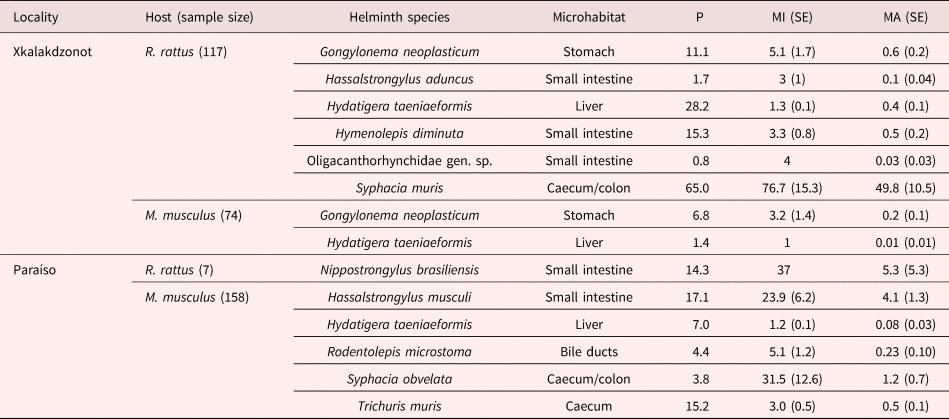
Eleven species of helminths were identified (table 1). Six species (Gongylonema neoplasticum, Hassalstrongylus aduncus, H. taeniaeformis, H. diminuta, Oligacanthorhynchidae gen. sp., and Syphacia muris) were recorded in R. rattus and two (G. neoplasticum and H. taeniaeformis) in M. musculus from Xkalakdzonot. Five species (Hassalstrongylus musculi, H. taeniaeformis, Syphacia obvelata, Trichuris muris, and Rodentolepis microstoma) were identified in M. musculus and one (Nippostrongylus brasiliensis) was recorded in R. rattus from Paraíso. Hymenolepis diminuta was the only zoonotic species, although H. taeniaeformis and R. microstoma have been reported in humans (Sterba et al., Reference Sterba, Blazer and Barus1977; Macnish et al., Reference Macnish2003).
Prevalence (P), mean intensity (MI), and mean abundance (MA) of gastrointestinal helminth infection in Rattus rattus and Mus musculus. SE, standard error.

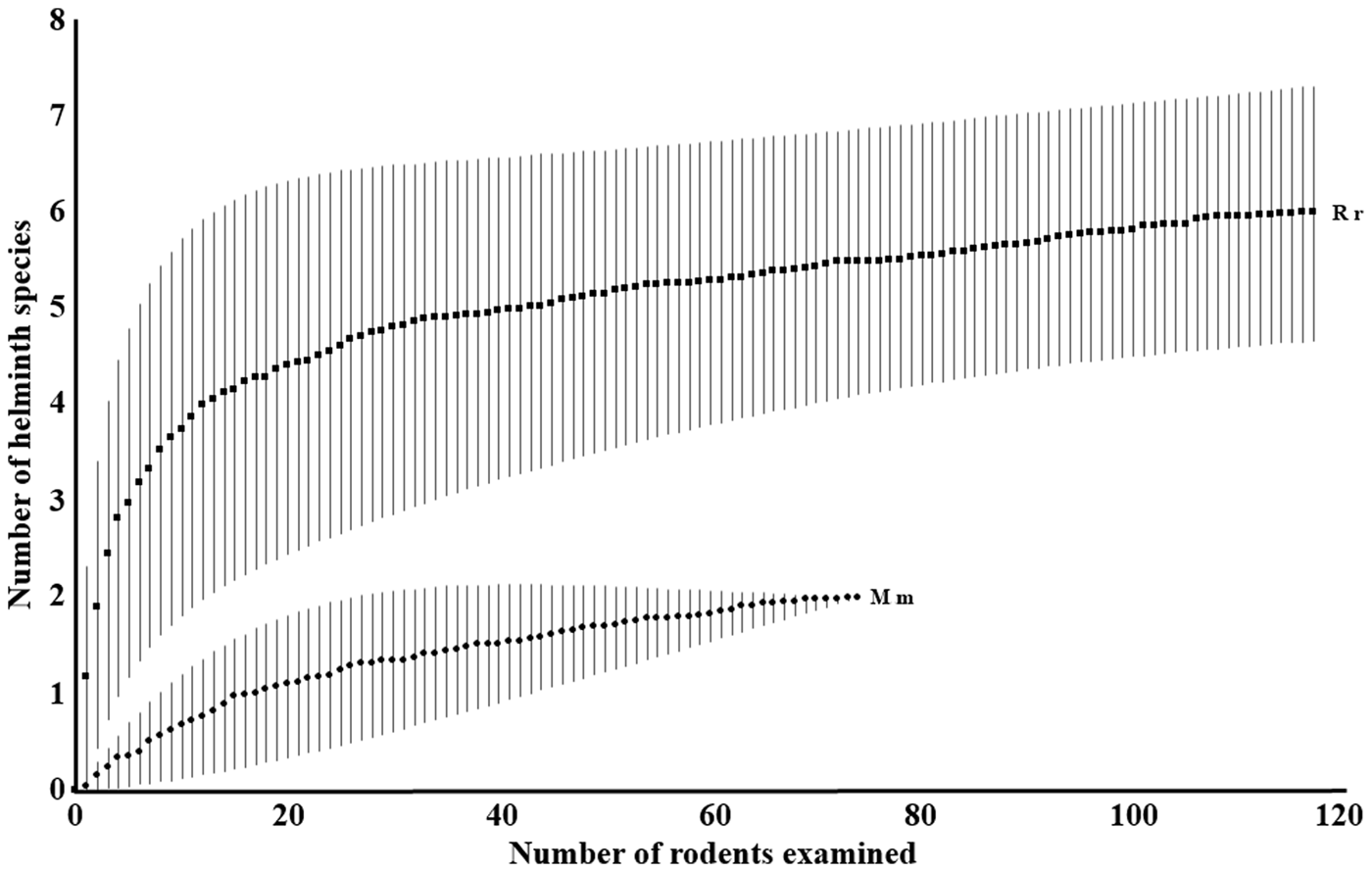
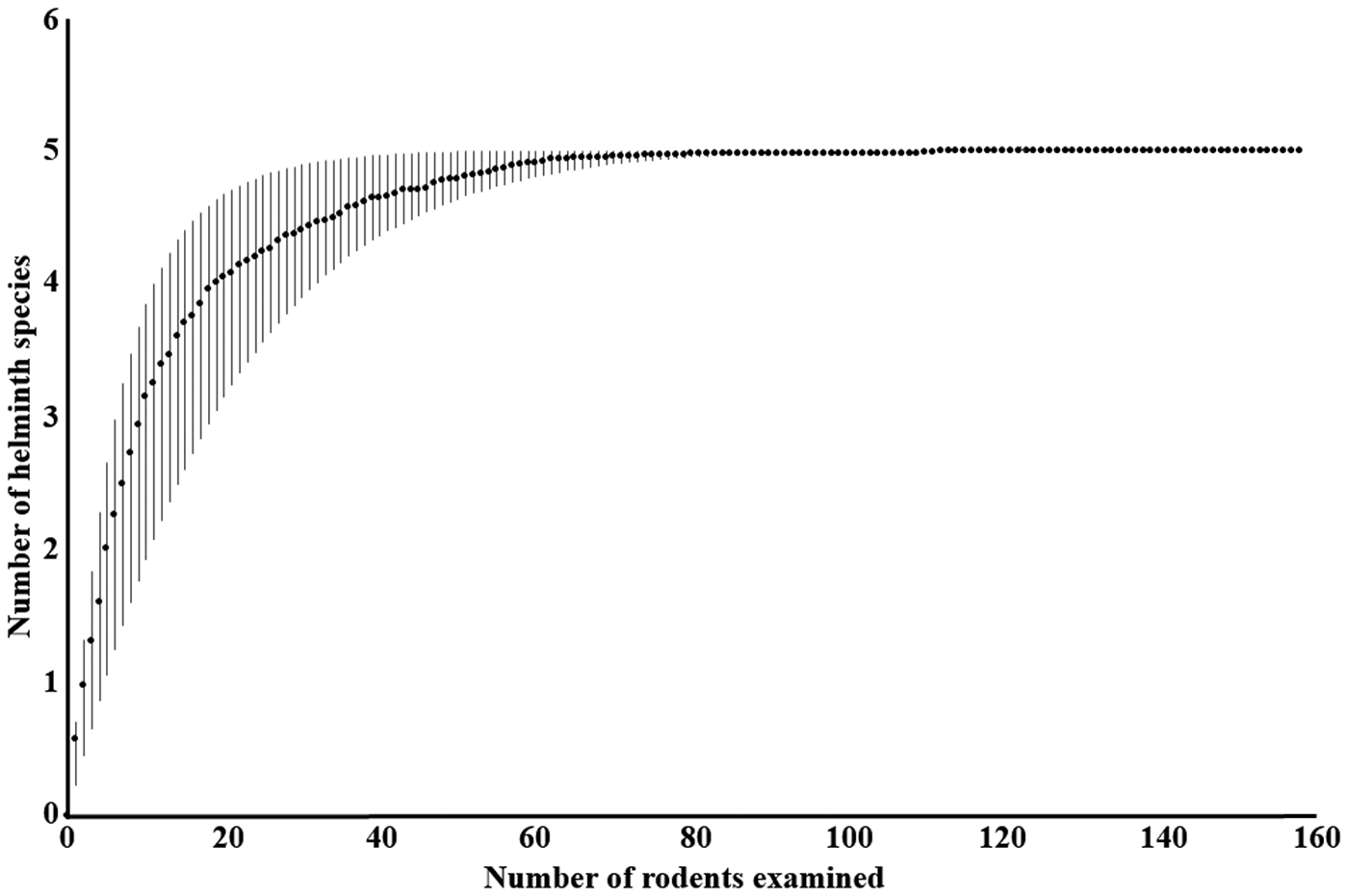
Of the 112 infected rodents, 49 (39.4%) were co-infected. In R. rattus from Xkalakdzonot, 27 specimens (28.7%) harboured two species of helminths, five individuals (5.3%) were infected by three species, and four specimens (4.3%) harboured four different species. In M. musculus from Paraíso, 12 individuals (20.0%) harboured two species and one specimen (1.7) was infected by three species. The mean richness of helminths was 1.5 ± 0.1 (± standard error) in R. rattus from Xkalakdzonot and 1.2 ± 0.5 in M. musculus from Paraíso. The helminth species accumulation curves of M. musculus from Xkalakdzonot (fig. 1) and Paraíso (fig. 2) increased in the initial stage and then showed a plateau, which suggests adequate sample sizes. In contrast, the species accumulation curve of R. rattus from Xkalakdzonot indicates that an increased sample size could increase the helminth species richness (fig. 1). No data were reported for R. rattus from Paraíso as it was rarely captured.
Species accumulation curve of gastrointestinal helminths from Rattus rattus (Rr) and Mus musculus (Mm) in Xkalakdzonot.

Species accumulation curve of intestinal helminths from Mus musculus in Paraíso. No data were reported for Rattus rattus, as it was rarely captured.

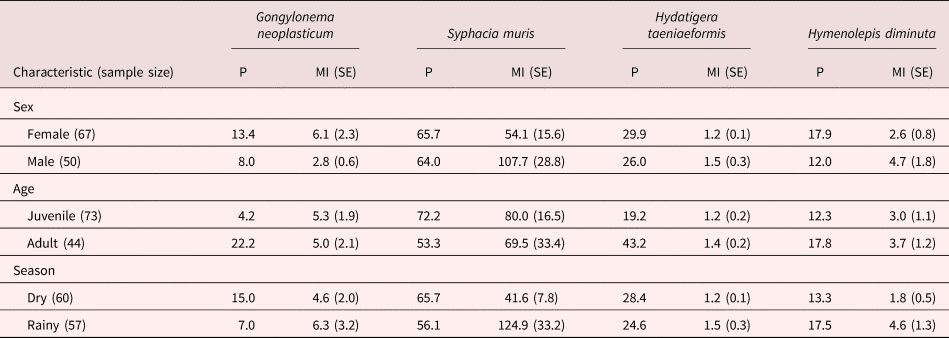
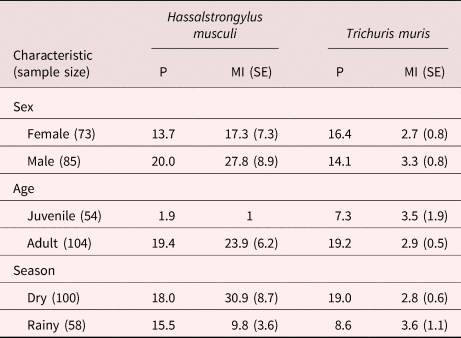
Six helminth species showed prevalence > 10% and were included in the univariate analyses: G. neoplasticum, H. taeniaeformis, H. diminuta, and S. muris from R. rattus (Xkalakdzonot), and H. musculi and T. muris from M. musculus (Paraíso). The prevalence and mean intensity of infection of these helminth species relative to host sex, age and season are shown in tables 2 and 3.
Prevalence (P) and mean intensity (MI) of helminths in Rattus rattus per sex, age, and season. SE, standard error.

Prevalence (P) and mean intensity (MI) of helminths in Mus musculus per sex, age, and season. SE, standard error.

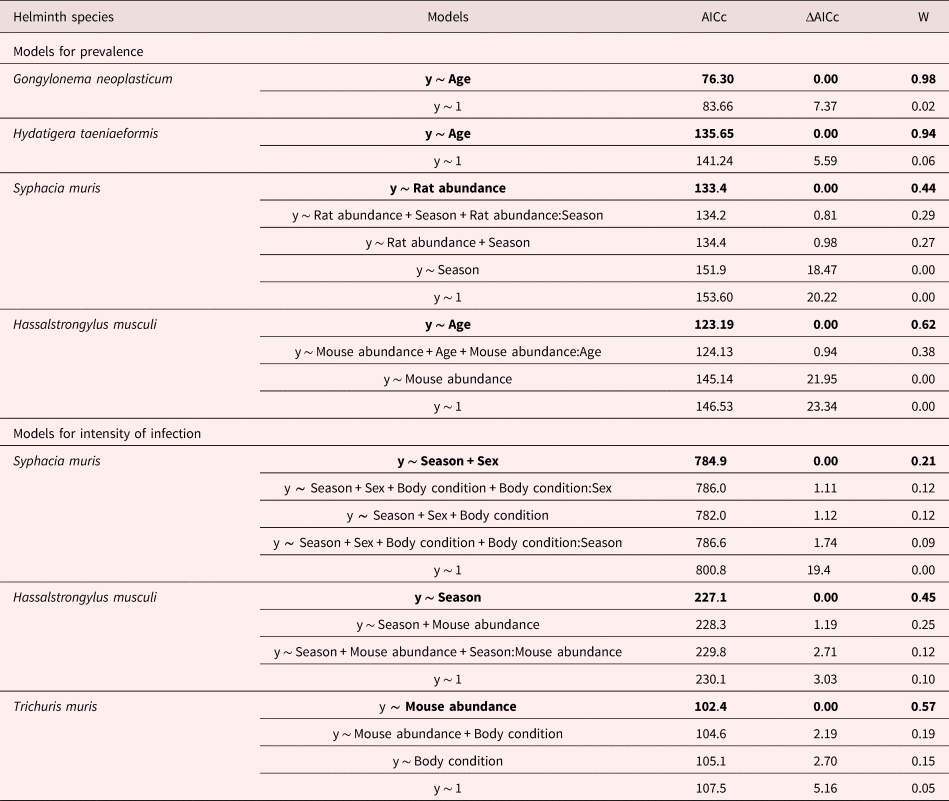
The results of the simple GLMs showed that none of the independent variables were significantly associated with the prevalence of H. diminuta and T. muris. Juvenile rats had lower probabilities of being infected with G. neoplasticum (odds ratio [OR] = 0.15, 95% CI = 0.04–0.56) and H. taeniaeformis (OR = 0.31, 95% CI = 0.14–0.72) than adults (table 4). An increased probability of being infected with S. muris was influenced by rat abundance (OR = 1.06, 95% CI = 1.03–1.09) and dry season (OR = 2.15, 95% CI = 0.99–4.66); however, only rat abundance was retained in the most parsimonious model (table 4). The probability of infection with H. musculi was associated with juvenile age (OR = 0.06, 95% CI = 0.01–0.43) and mouse abundance (OR = 0.97, 95% CI = 0.93–1.00), although the most parsimonious model explaining variations in prevalence only included age.
Generalized linear models explaining the effect of various independent variables on prevalence (with binomial distribution) and intensity (with Possion or binomial distribution) of each helminth species. AICc, corrected Akaike's information criterion; ΔAICc, difference between AICc score and lowest AICc score; W, Akaike's model weight. The most parsimonious models are shown in bold.

None of the independent variables were significantly associated with helminth richness in R. rattus (Xkalakdzonot) and M. musculus (Paraíso). Data collected from M. musculus (Xkalakdzonot) and from R. rattus (Paraíso) were not analysed due to their small sample size or low prevalence.
Among rats infected with H. taeniaeformis and G. neoplasticum, independent variables were not significantly associated with variations in the intensity of infection. Hymenolepis diminuta intensity was associated with the dry season (β = −0.97, 95% CI = −1.83 – −0.13, D = 5.13, df = 1), but the null model was the most parsimonious model. In the case of S. muris, the intensity level was significantly associated with the dry season (β = −1.10, 95% CI = −1.67 – −0.55, D = 15.27, df = 1), sex male (β = −1.10, 95% CI = −1.67 – −0.55, D = 5.53, df = 1), and body condition index (β = −0.74, 95% CI = −1.26 – −0.14, D = 5.69, df = 1). However, using the parsimony criterion, the most parsimonious model included season and sex (Final model: season, β = −1.00, 95% CI = −1.65 – −0.56; sex, β = 0.68, 95% CI = 0.15–1.23, D = 22.54, df = 2) (table 4). An increased intensity of infection with H. musculi was associated with the dry season (β = 1.15, 95% CI = 0.25–1.98, D = 6.07, df = 1) and mouse abundance (β = 0.05, 95% CI = −0.02–0.12, D = 2.30, df = 1), but season was the only variable retained in the most parsimonious model. The intensity of infection with T. muris increased with decreasing body condition index (β = −1.29, 95% CI = −2.42 – −0.22, D = 5.61, df = 1) and mouse abundance (β = −0.03, 95% CI = −0.06 – −0.01, D = 8.74, df = 1), although the most parsimonious model that described intensity variations included only mouse abundance (table 4).
Discussion
Patterns of parasite infections are shaped by both intrinsic (e.g. immunity, hormones) and extrinsic (e.g. host abundance, host behaviour, host size, or interaction with other sympatric host species) factors (Price, Reference Price, Esch, Bush and Aho1990; Cattadori et al., Reference Cattadori, Morand, Krasnov and Poulin2006). Field studies on commensal rodent populations have shown that extrinsic factors can vary over time and habitats, depending on environmental factors and landscape characteristics of each habitat (Cavia et al., Reference Cavia, Cueto and Suárez2009; Himsworth et al., Reference Himsworth2014). For example, in urban centres, such as Vancouver (Canada) (Himsworth et al., Reference Himsworth2014) or Salvador (Brazil) (Panti-May et al., Reference Panti-May2016), the dominant Rattus norvegicus has been reported as the main commensal rodent, whereas in other human settlements, for instance Mérida (Mexico) (Panti-May et al., Reference Panti-May2012) or Pothwar (Pakistan) (Khanam et al., Reference Khanam2017), M. musculus and R. rattus are the only commensal rodent species recorded. Moreover, most of the studies on intrinsic and extrinsic factors affecting patterns of helminth infections in commensal rodents have been focused exclusively on R. norvegicus (Hancke et al., Reference Hancke, Navone and Suarez2011; Simões et al., Reference Simões2016; Carvalho-Pereira et al., Reference Carvalho-Pereira2017; Galán-Puchades et al., Reference Galán-Puchades2018) or in sympatry with R. rattus (Waugh et al., Reference Waugh2006; Mohd Zain et al., Reference Mohd Zain, Behnke and Lewis2012). In our study, intrinsic (age, sex) and extrinsic factors (season, rodent abundance) were associated with prevalence and intensity of helminths in R. rattus and M. musculus from rural Mayan communities. Among the helminth species identified, the zoonotic H. diminuta was found, as well as other species that potentially may be transmitted to humans (H. taeniaeformis and R. microstoma).
Although both localities have similar socio-economic characteristics, the volume of vegetation (e.g. trees and bushes) observed in the residential area and in the periphery of Xkalakdzonot was higher than in Paraíso, which could favour the abundance of R. rattus, a species with a strong preference for areas above ground (Worth, Reference Worth1950; Battersby et al., Reference Battersby, Hirschhorn, Amman, Bonnefoy, Kampen and Sweeney2008). In contrast, in Paraíso, peri-domestic areas were more homogeneous, with small yards and few trees, creating an ideal habitat for M. musculus due to its limited movements in small areas (King, Reference King1950; Battersby et al., Reference Battersby, Hirschhorn, Amman, Bonnefoy, Kampen and Sweeney2008). We also found a higher overall prevalence of helminths in Xkalakdzonot than in Paraíso. In addition, we reported a contrasting helminth fauna between these localities, with only one shared species (H. taeniaeformis). These differences could be related to factors such as the abundance of definitive and intermediate hosts, host specificity, dietary habits, foraging behaviours, and micro-environmental conditions (Cattadori et al., Reference Cattadori, Morand, Krasnov and Poulin2006).
The zoonotic cestode H. diminuta was found in R. rattus. Commensal rats (Rattus spp.) are the main definitive hosts for this cestode, and beetles and fleas act as intermediate hosts. Humans, mainly children, are accidental hosts that acquire the infection by ingestion of infected intermediate hosts (Mega et al., Reference Mega, Galdos-Cardenas, Gilman and Magill2013). Moreover, R. microstoma was found in M. musculus from Paraíso. This mouse species is the main definitive host for this cestode, beetles and fleas being the intermediate hosts. Although M. musculus has a wide distribution in the Americas, most of the helminthological surveys have reported R. microstoma as an uncommon species from M. musculus (Hall et al., Reference Hall, Sonnenberg and Hodes1955; Pulido-Flores et al., Reference Pulido-Flores, Moreno-Flores and Monks2005; Landaeta-Aqueveque et al., Reference Landaeta-Aqueveque, Robles and Cattan2007; Panti-May et al., Reference Panti-May2017). Even though human infection with R. microstoma has been reported only in an Australian community, it is probable that infections with this cestode have been previously misdiagnosed as R. nana, as both species show morphological similarities in their eggs (Macnish et al., Reference Macnish2003).
Hydatigera taeniaeformis was the only species found in both hosts and communities. Hepatic metacestodes have been previously recorded from R. rattus (prevalence: 4.3–20.7%) and M. musculus (prevalence 9.3–17.3%) in four other localities in Yucatán (Panti-May et al., Reference Panti-May2015, Reference Panti-May2017). In human settlements, domestic cats are the main definitive hosts and rodents act as intermediate hosts (Jones and Pybus, Reference Jones, Pybus, Samuel, Pybus and Kocan2001). It is probable that domestic cats in the communities could be the definitive hosts for H. taeniaeformis, and this result is relevant for local authorities and veterinary services.
Of the 11 helminths identified, four species were found with low prevalence (< 5%). The fact that in Mexico there is no report of Oligacanthorhynchidae in rodents, and that this family has been recorded mainly in medium-sized wild mammals (García-Prieto et al., Reference García-Prieto, Falcón-Ordaz and Guzmán-Cornejo2012), suggests that infection was accidental. The nematode H. aduncus, a common parasite of rodents of the genus Sigmodon (Doran, Reference Doran1955), was identified in R. rattus. This indicates that R. rattus could be a suitable host for H. aduncus and that infection may spill back to native rodents. The low prevalence of R. microstoma found in Paraíso could be related to low abundance of intermediate hosts. Field studies have reported prevalence of infection with S. obvelata in M. musculus of 4.8–28.0% (Hall et al., Reference Hall, Sonnenberg and Hodes1955; Pulido-Flores et al., Reference Pulido-Flores, Moreno-Flores and Monks2005; Diagne et al., Reference Diagne2016; Panti-May et al., Reference Panti-May2017). The reason for this is not clear but could be related to factors such as the resistance of some strains, and capture of mature individuals who have had more exposure time (Taffs, Reference Taffs1976).
Our results showed that age and rat abundance were associated with the prevalence of some helminths. Juvenile rodents were less infected with G. neoplasticum, H. taeniaeformis, and H. musculi than adult individuals. This result may reflect the passive immunity in neonates, an increased exposure to infective stages during adulthood or an accumulative effect of exposure with host age (Theis and Schwab, Reference Theis and Schwab1992; Behnke et al., Reference Behnke1999; Mohd Zain et al., Reference Milazzo2012). Lloyd and Soulsby (Reference Lloyd and Soulsby1978) reported that neonatal mice were protected against H. taeniaeformis when administered colostrum from infected mothers, and that mice were protected to at least 21 days of age. After this age, rodents gradually grow and increase their home range and foraging behaviour, which may increase the probabilities of ingestion of H. taeniaeformis ova excreted by cats in the external environment (Theis and Schwab, Reference Theis and Schwab1992). Gales (Reference Gales1982) and Melo et al. (Reference Melo2014) reported that adult R. rattus eats more arthropods, compared with juveniles, rather than seeds or fruits during reproductive events, which may increase the probability of acquiring G. neoplasticum by consumption of the intermediate hosts, such as cockroaches. Jarrett et al. (Reference Jarrett, Jarrett and Urquhart1966) and Swanson and Bone (Reference Swanson and Bone1983) reported light infections of N. brasilienses in young rodents, a phylogenetically closely related species of H. musculi, and that chronic infections continued during the adulthood of their hosts. This result could explain the patterns we observed. However, these explanations could not apply to other helminths, such as H. diminuta, S. muris and T. muris. It is probable that ingestion of infective stages of these parasites could be similar between juvenile and adult rodents. If grain beetles are frequently consumed by rats, it is likely H. diminuta will occur at similar rates in juvenile and adult rats. Eggs of Syphacia and Trichuris are very resistant in the external environment (Taffs, Reference Taffs1976; Gupta et al., Reference Gupta, Khan and Santra2009), which could favour earlier infections in juvenile rodents.
In addition, S. muris prevalence was positively associated with rat abundance. This result was not surprising, as this parasite infects new hosts directly without intervention of an intermediate host, and eggs become infective rapidly after deposition (Taffs, Reference Taffs1976). Rats acquire the infection by ingestion of infective eggs from fur, especially from the perianal region, of an infected host, or from contaminated materials in the environment, including food and water. It has also been reported that female worms lay eggs in the daytime, when rats rest in their nests, which favours the exposure to infective states (Anderson, Reference Anderson2000).
Male rats had a higher intensity of infection with the oxyurid S. muris compared with females. Male rats display more aggression to other males when they compete for food or mates (Berdoy and Drickamer, Reference Berdoy, Drickamer, Sherman and Wolff2007), which may favour frequent male–male contact with infective eggs. In addition, Behnke (Reference Behnke1975) and Behnke et al. (Reference Behnke1999) reported that female mice (Apodemus sylvaticus and M. musculus) seem to be more resistant to infections with oxyurids (Aspiculuris tetraptera and Syphacia stroma, respectively) than male mice, possibly due to differences in immunocompetence. In addition, rats trapped during the rainy season showed higher infection levels than in the dry season. The most likely explanation for this is that micro-environmental conditions (e.g. lower temperature and higher relative humidity) could be more favourable for the survival of the infective eggs in the rainy season. In contrast, intensity of infection with H. musculi was higher in the dry season. According to Carvalho-Pereira et al. (Reference Carvalho-Pereira2017), a probable explanation may be that mice acquired infection during the rainy season and were caught harbouring past infection. We also found that the intensity of infection with T. muris was inversely associated with mouse abundance. It is probable that mice trapped in households where mice were abundant could be exposed to a larger number of eggs, potentially leading to a self-cure response and light intensity of infections (Behnke and Wakelin, Reference Behnke and Wakelin1973).
Despite our study limitations (the period of sampling and the sample size), the results reported here provide important information on the helminth communities of R. rattus and M. musculus from rural tropical areas in the Americas. Among the helminth parasites identified, the presence of H. diminuta in rats represents a potential risk of transmission to inhabitants. We identified factors associated with the prevalence and intensity of infection. This indicates different associated risk factors involved in the life cycle and route of transmission of helminths among rodents. Further studies evaluating a higher number of trapping sites, micro-environmental conditions, and potential intermediate hosts will increase our knowledge on the dynamics of parasite transmission and the subsequent risk of transmission to humans (Carvalho-Pereira et al., Reference Carvalho-Pereira2017), especially in low-income areas.
Author ORCIDs
J.A. Panti-May, 0000-0003-1669-5727
Acknowledgements
We thank the families from Xkalakdzonot and Paraíso for their participation and cooperation; Kenia Canché, Luis Caraveo and Orlando Osorio for their assistance in the field work; Erendira Martínez for her assistance in the Colección Mastozoológica at Universidad Autónoma de Yucatán; Dr Graciela Navone for her assistance at Centro de Estudios Parasitológicos y de Vectores; and Amanda Minter and two anonymous reviewers for their valuable comments.
Financial support
This work was funded by Consejo Nacional de Ciencia y Tecnología (CONACYT - México) (no. 2014-247005), Programa de Incentivos Universidad Nacional de La Plata (UNLP - Argentina), PICT - Agencia Nacional de Promociones Científica y Tecnológica (ANPCYT-Argentina), Consejo Nacional de Investigaciones Científicas y Técnicas (CONICET-Argentina). J.A. Panti-May was supported by the CONACYT - Doctoral fellowship (no. 259164) and the Dirección Nacional de Cooperación Internacional - Ministerio de Educación y Deportes of Argentina for doctoral research (2017).
Conflict of interest
None.
Ethical standards
The bioethics committee for the use of animals in research from the Campus de Ciencias Biológicas y Agropecuarias, Universidad Autónoma de Yucatán, approved the protocols used in this study (protocol number CB-CCBA D-2016-002). The rodent trapping was conducted under license from the Mexican Ministry of Environment (SGPA/DGVS/08420/15).