Introduction
The 2012 Summer Olympic Games held in London attracted a record number of 8.8 million spectators. 1 This visitor volume makes the Games one of the largest mass-gathering events in the world. Major adaptations are therefore required to host city infrastructure, including the health system, in order to ensure that both routine services are maintained and that specially-designated Olympic hospitals are established for athletes and Olympic officials during the Games period.
Sydney, Athens, Beijing, Vancouver, and London Games organizers have published reports describing their health care planning and delivery. Evidence from other literature is limited to specific health care issues experienced by athletes, medical services provision in the Olympic polyclinic where all health care is provided in the Olympic park, analysis of public health issues relating to surveillance development, or health promotion.Reference Abubakar, Gautret and Brunette 2 - Reference Engebretsen, Steffen and Alonso 5 To the authors’ knowledge, there are no studies that have attempted to examine the reoccurring health care planning issues. The aim of this study was to systematically identify and describe common planning issues and recommendations, based on the content of the reports from the five most recent host cities, for the benefit of future host city organizers.
This work was undertaken as part of a wider evaluation of the health care planning and delivery program of the National Health Service (NHS) in London for the 2012 Olympics.
Methods
A structured, critical, qualitative analysis of all Games health planning reports was undertaken to explore commonalities and differences in the planning process and outcomes. These reports included four Summer Olympic and Paralympic Games (from Sydney 2000,Reference Visotina and Hills 6 Athens 2004,Reference Tsouros and Efstathiou 7 Beijing 2008,Reference Dapeng, Ljungqvist and Troedsson 8 and London 2012 9 - Reference McCloskey and Endericks 14 ) and the Vancouver 2010 Winter Olympic and Paralympic Games report. 15 All publicly available reports were included in the analysis. All reports were written in English. These reports were voluntarily published by host cities. The International Olympic Committee does not require Olympic host cities to produce these reports. The reports were written by local organizing committees, except the London 2012 Games where NHS in London and Public Health England were the authors. Reports were written by senior planners and organizers, but reliability of the results cannot be verified because they were not independently assessed. Reports included differing data and definitions. This made comparison difficult. These reports were not written as scientific documents because they were written for future Olympic planners. The analysis focused on the following categories:
-
(1) Issues: occurrences, processes, or events that have implications for future Olympic host cities; and
-
(2) Recommendations: planning strategies proposed for future Games’ health planners.
“Issues” denotes an aspect of planning or delivery that was described, but about which no advice was given for the future organizers on how to tackle similar situations in the future. In contrast, “Recommendations” describes the authors’ proposal for a preferable outcome in future Olympic and Paralympic Games. A combination of fixed (deductive) and flexible (inductive) coding techniques were employed.Reference Fereday and Muir-Cochrane 16 Each document was coded using “issues” and “recommendations” categorization with the qualitative data analysis software NVivo 10 (QSR International, Burlington, Massachusetts USA). These categories were then explored further in discussion among members of the research team. Flexible coding techniques were applied in response to the report content in order to group identified information into larger themes. In discussions, a theme was defined as a specific message or recommendation that was mentioned in one or several reports. When analyzing the themes, the context in which they were presented was taken into account (eg, relating to the host city and nation), and its importance and transferability to other host cities.
Results
Content of Reports
All issues and recommendations were classified into six broad themes as described below. The report content was almost exclusively focused on Olympic health care planning within the venues, except London 2012 reports, and thus, the analysis was also mainly focused on medical planning inside Olympic venues. There was little explicit description of arrangements for the Paralympic Games. All identified themes were prevalent in all analyzed reports, except for the legacy theme which was not described in the Sydney 2000 report. Themes are not hierarchically numbered in order by importance to avoid any subjectivity and bias to issues.
Theme 1: Early Planning and Relationship Building
Timing
All host city reports stressed that timely preparation for the Games is essential. The early development of effective relationships to clarify roles with national organizations, including emergency and security services, national government ministries, and law enforcement authorities, is vital.Reference Xing, Wuchun and Hezuo 17 , Reference Baka, Isaakidis and Ferentinos 18 The Beijing health care planning report referenced the need to be transparent about potentially competing interests and organizational cultures among various governmental departments, health care providers outside and inside the Olympic venues, and the police.Reference Xing, Hua and Jun 19 The London report noted that early planning allowed enough time to test plans as well as develop and prepare for different scenarios. Although planning also started early in Vancouver, it was acknowledged that it was not taken seriously by some hospital staff until close to the Games. All reports noted that the relationship with the medical team of the host city's Olympic Organizing Committee was of particular importance.Reference Tsourous and Efstathiou 20
Communication Issues
The Beijing, Vancouver, and London reports emphasized the need for effective internal and external communications to ensure a coordinated health care response.Reference Dongming and Zhengmao 21 In Vancouver, poor communication was experienced initially in the Olympic polyclinic when staff were not included in appropriate communication routes.
Theme 2: Establishing General Medical Provision for the Games
Addressing Minor Medical Needs
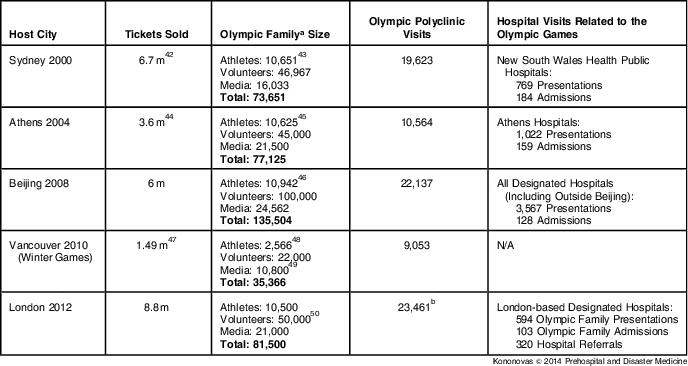
Evidence from all health care planning reports suggested that most of the health care needs of athletes and visitors were minor and were met through provision of primary care services (eg, a polyclinic) within Olympic venues. Very few polyclinic attendances resulted in referrals to hospitals (Table 1).
Key Health Care-related Data From Recent Olympic Games (Data Exclude Paralympic Games)

aIndividuals who were fully accredited by London Organizing Committee of Olympic Games, including athletes, team officials, technicians, media representatives, and VIPs.
bData from a privately-distributed report from London Organizing Committee of Olympic Games. This only includes London hospitals.
Medical Services Users
In Athens, Beijing, Vancouver, and London, the majority of health care demand, both for primary care (at the Olympic Polyclinic) and for hospital care, came from the Olympic technicians and media staff. Both Athens and Beijing organizers noted that this probably happened due to fatigue and stress.Reference Xiaohong, Dalong and Jing 22 , Reference Renström, Jiyong and Jianping 23 The Vancouver and Athens reports recommended that appropriate support should be provided to the Olympic workforce, including health care staff, to minimize anxiety during Games time and “post-event blues” after the Games have ended. Athens organizers proposed measures to manage the potential post-Games increase in requests for annual leave, including staggered vacation planning, so that local health service capacity was not affected. Despite these recommendations, the demand for health care/primary care from the Olympic workforce still remained higher during and after the Games than for athletes or any other individuals involved in the Olympic Games.
Presentation Types
In all compared Games, orthopedic problems, injuries, and digestive, respiratory, dental, and ophthamotlogical complications accounted for the greatest number of patient presentations to the Olympic Polyclinic for accredited members (athletes, country officials, technicians, media workers, and VIPs).Reference Parisis, Pyrros and Ditsios 24 The athletes themselves primarily required medical attention for orthopedic injuries, but they comprised the minority of presentations to primary and secondary care. Media and technical workers comprised the largest group of presentations in the Olympic polyclinic and designated hospitals. The same pattern of use of medical care followed in all analyzed reports, suggesting that specific services were correctly established in the Olympic polyclinic and hospitals according to previous Games experience. Public injuries and first aid figures were not published in the reports.
Theme 3: Managing Risks
Prevalence of Gastrointestinal and Food-borne Diseases
The Athens, Beijing, and London reports emphasized that the Games pose a major risk to the spread of communicable diseases due to the number of visitors congregating in the host city during the event.Reference Mavroidi, Mavroidi and Mavroidi 25 , Reference Tao, Xinghuo and Ting 26 Gastrointestinal and food-borne diseases were among the most commonly reported incidents in recent summer Olympics, although the numbers involved in all Games were very small compared to the total number of visitors.Reference Panagiotopoulos, Mavroidi and Spala 27 , Reference Chunhui, Tao and Ying 28 All organizers prepared to monitor and respond to possible threats of communicable diseases. Measures included enhanced syndromic surveillance and mandatory notification systems, a cruise ship inspection program, food and water safety programs, and environmental surveillance,Reference Hadjichristodoulou, Mouchtouri and Kourea-Kremastinou 29 , Reference Vassiliadou, Apostolopolous and Panteleaki 30 plus targeted vaccination programs (for migrant workers in Beijing and H1N1 influenza immunization in Vancouver). In response to recommendations from previous Games, the Health Protection Agency (HPA) established their team in the Olympic polyclinic to support the London Organizing Committee. The London 2012 Chief Medical Officer also received a daily public health situation report (SitRep).
Sexually Transmitted Infections
The Athens and Beijing reports also identified sexually transmitted infections (STIs) as a potentially important risk during Games time. This was addressed through condom distribution combined with sexual health education campaigns.Reference Stergachis and Tsouros 31 , Reference Htun-Hansen, Shamasch and Mascagni 32 Following the review of lessons from previous Games, NHS in London established a sexual health promotion and prevention program to disseminate information about potential risks and safety measures.
Multi-agency Planning
The importance of pre-Games, multi-agency planning for a range of public health emergencies, including noncommunicable disease incidents (such as heat-related illness and severe-weather events), was also emphasized in the three most recent reports prior to 2012.Reference Efstathiou, Tsouros and Knebel 33 The NHS London reports also described how sun-safe advice and free sunscreen were provided to spectators during the Games.
Theme 4: Planning and Managing the Security Risk of the Games
Prioritization of Security Planning
For the Games held after the 9/11 attacks in 2001, organizers prioritized planning for natural or deliberate release of hazardous chemical, biological, or radioactive substances, and the management of associated health risks. They paid considerable attention to establishing sophisticated multi-agency emergency response plans, at significant cost to the host nation.
Cost of Security Arrangements
In Athens (2004), security costs amounted to €1 billion (US $1.28 billion) out of the entire Olympic budget of €7 billion (US $8.96 billion). After the Athens Games, concerns were raised about whether the response was proportionate to the threat, and there were criticisms that security plans may have been activated too frequently and deactivated too slowly. Subsequent Olympic and Paralympics Games also spent significant resources to implement sophisticated security systems.
Theme 5: Administration and Logistical Issues
Common problems identified in relation to administration and logistics included difficulties in obtaining permission for health care staff to work in Olympic venues (referred to as accreditation), appropriate procedures required for athletes’ anti-doping testing,Reference Ljungqvist, Catlin and Wu 34 and the need for efficient procurement of medical products. For example, in Beijing, too few National Olympic Committees’ health care teams received accreditation, forcing those who were accredited to work extra hours in order to provide adequate coverage. In Vancouver, accreditation was reported to be a laborious exercise, due to the complex and time-consuming technical processes involved. Accreditation continued to be problematic in London 2012 Games.
Theme 6: Assessing the Development and Success of Health Legacy Programs
Establishment of Health Legacy Programs
Recent Games sought to achieve a range of public health goals, including raising awareness about risky behaviors (eg, smoking and STIs, including HIV/AIDS),Reference Troedsson, Ljungqvist and Wei 35 - Reference Zejun, Xianli and Xiaobo 37 improving exercise and dietary habits, as well as building local health and public health service capacity. The Athens report noted that security and emergency planning took priority, depleting available resources for health promotion activities. The report also suggested separating departments for health legacy planning from other aspects of Games planning in order to balance out resources. Health legacy organizers in London did not take into account that other parts of planning may take priority; health legacy organizers admitted that their program struggled to compete with health services planning and delivery programs in order to get appropriate parity.
Recommendations to Support Health Legacy
In order to improve health legacy efficiency, the Vancouver and Beijing reports recommended the development of close working relationships with relevant national and international partners from the outset (including the World Health Organization, the International Olympic Committee, and the local Olympic organizing committee),and early and long-term planning of legacy initiatives during and beyond Games time, together with improved methods for longitudinal data collection to enable the evaluation of specific legacy initiatives.Reference O'Leary, Laiying and Tunon 38 London organizers heeded those recommendations and encouraged health legacy initiatives to conduct evaluations to assess the quality of their work after the Olympic Games. Robust evaluations of health legacy initiatives could help organizers measure long-term impacts.Reference Murphy and Bauman 39 , Reference Weed, Coren and Fiore 40
Discussion
Reoccurring Health Care Planning and Delivery Themes
The analysis of past Olympic health care planning reports identified the following nine key issues:
-
1. All reports recognized that early development of effective relationships is vital to clarify roles with national organizations, including emergency and security services, national government ministries, and law enforcement authorities.
-
2. Despite recommendations to address the demand for health care/primary care from the Olympic workforce, usage from this group remains higher during and after the Games than for athletes, or any other individuals, involved in the Olympic Games. However, the same pattern of use of medical care followed in all analyzed reports, suggesting that specific services were correctly established in the Olympic polyclinic and hospitals according to previous Games experience.
-
3. Despite available evidenceReference Deering, Chettiar, Chan, Taylor, Montaner and Shannon 41 that STIs are uncommon in the Olympic Games, health care planners in the Beijing, Athens, and London Olympic Games established specific programs to fight STIs.
-
4. Emergency preparedness demands significant resources and there is a significant risk that this can reduce capability for other parts of planning, and particularly health legacy. After the Athens Games, concerns were raised about whether the response was proportionate to the threat, and there were criticisms that security plans may have been activated too frequently and deactivated too slowly.
-
5. Accreditation continues to be the most commonly-experienced administrative issue, despite warnings from previous Games reports.
-
6. Despite growing interest to use the Olympics to create sustainable long-term health impacts for the host city and country, there is very limited evidence of long-term improvement in population health as a result of hosting the Olympics.
-
7. The analyzed reports did not describe adjustments that were likely to have been needed to address Paralympians’ specific disabilities.
-
8. All Olympic reports 42 - 50 would have been more helpful if they had been scientifically rigorous, including standardization of data reported and standardization of definitions.
-
9. As the Paralympic Games are significantly smaller than the Olympic Games, and the Paralympic athletes have special medical needs due to their disabilities, it would be useful for future organizers to know what adjustments were made to address these aspects.
Strengths and Limitations of This Analysis
This is the first study to identify common health-planning issues in preparation for the Olympic and Paralympic Games. Published research on health services planning for mass gatherings is limited, often covering nonsporting events, such as the Hajj (Mecca, Saudi Arabia), which have different attending populations than typical Olympic Games spectators. By focusing on post-Games reports, authors have focused on evaluating the first-hand, in-depth insights of those who led the planning process from inception to delivery.
Each report was idiosyncratic in terms of the type and content of information presented. This made it difficult to make direct comparisons of similar topics. For example, all reports included some denominator data on the number of tickets sold, 42 , 44 - 46 , 48 but these data were too incomplete to provide an indication of the population who may be in need of health care because the same spectator may have purchased several tickets for different events. These differences made it difficult to compare data provided in all reports. London 2012 reports focused on local health services in the city, while previous Games reports limited their discussions to health care planning and delivery inside Olympic venues specifically.
This analysis was limited to medical planning reports in order to highlight the potential usefulness of this resource; however, a wider range of academic literature would provide stronger evidence of recurrent issues.
Conclusion
There have been significant differences among Olympic host city health care systems. Despite this, the recommendations made to future hosts were similar. Difficulties with communication, accreditation, and health legacy assessment after the Games tended to be experienced by each host city. Challenges faced by Olympic host cities in attempting to generate a tangible health legacy have also been documented in other mass gatherings. There is a growing recognition of the need for more robust evaluation methods to measure the longer term impact. The identification of recurrent issues suggests that existing information and opportunities to learn could be used more effectively to improve Olympic health care planning.
The use of existing evidence is crucial in ensuring that the planners establish good health care for the Olympic and Paralympic Games. A combined approach to presenting information, both inside and outside the Olympic venues, in one report would also help future host cities to improve coordination and communication, as public health, local health services, and Olympic planners often work in collaboration.
Contributors
Kostas Kononovas conducted the analysis and interpret data; Georgia Black designed the methodology and interpreted the data; Jayne Taylor analyzed and interpreted the data; Rosalind Raine contributed to the original conception and interpreted the data. All authors contributed to writing the manuscript and have approved the final version submitted for publication.