Participation by women in the roles of chairpersons, papergivers, and discussants on the panels and roundtables, as well as the poster sessions, that convene at the annual meeting of the American Political Science Association (APSA) has long been tracked by Gruberg (see, for example, but not inclusive, Gruberg 1992; 1993; 1994; 1995; 2001; 2002; 2004; 2006). His reports provide a welcome record of women's increasing presence at the APSA's annual meetings. This study seeks to supplement Gruberg's efforts by providing a comparative perspective with data from the most recent annual meeting of the International Studies Association (ISA). The ISA's annual meeting provides a useful comparison for two reasons. First, a very large percentage of its members are political scientists, thus offering a comparison to an association consisting of people with comparable training and research agendas as represented at APSA. Second, the APSA has in recent years sought to forge international connections, making ISA an increasingly relevant sister organization.
Literature
Research into the presence of women in political science and international relations has come from a variety of angles. In addition to Gruberg's aforementioned papers on the participation of women in the APSA annual meetings, several studies have investigated the presence of women authors publishing in journals (Kelly et al. 1994; Young 1995; Breuning and Sanders 2007) or in books (Mathews and Andersen 2001).
Furthermore, several comprehensive assessments have been published on the status of women in the political science profession (Sarkees and McGlen 1992; 1999; Committee on the Status of Women in the Profession 2001). These assessments present useful analyses of women's careers in the profession. They detail progress to date as well as the roadblocks that still remain.
This study seeks to contribute to our understanding of women's participation in one aspect of professional life: conferences. How does increased participation by women in the APSA's annual meeting over the past decades, as charted by Gruberg (2006), compare to that at ISA's most recent annual meeting? What can be learnt from this comparison about women's presence in political science and international relations? What is the likely impact of internationalization on women's participation in the profession?
Data and Methods
The analysis of women's participation in the ISA's most recent annual meeting is based on the published conference program. It follows the strategy adopted by Gruberg (e.g., 2006) and employs conference participation as its unit of analysis. This means that an individual who participates in only one capacity is counted once, but a person who gives a paper, chairs a panel, and is a discussant is counted three times—once for each participation, irrespective of whether those participations occur on one or more panels.
For each participation, I recorded the session's identification as listed in the program (e.g., WA01, TC40, SD02), as well as whether it was a panel, roundtable, or poster session. Additionally, I coded the session's sponsor—or sponsors for co-sponsored panels. Sponsors include the various sections of ISA, the convention theme, and 19 affiliated organizations. Of the 720 panels and roundtables, 555 were sponsored by one section, the conference theme, or an affiliated group, while 164 were co-sponsored and one session had three sponsors.
Each participation's role was coded as either chair, papergiver, or discussant. Last, I noted the participation's gender. This required some investigation. In some cases, I knew the individual's gender by having met the individual in question or through previous research. For those cases where I had no prior knowledge of a person's gender, I searched the Internet to resolve the largest proportion and additional cases were identified with the help of a colleague. I could not identify the gender of 16 participations (out of a total of 5,371). These were participations by individuals for whom my colleague and I could not locate a picture or a gender-specific reference, and the name (or, in one case, initials) was not identifiable as exclusively female or male. These participations are not included in the analysis. Since they account for only 0.3% of the total number of participations, it is quite unlikely that these 16 missing datapoints could significantly affect the results.
Findings
The ISA program included 720 panels and roundtables, as well as poster sessions during most of the available time periods.1
There were no poster sessions during the first time period on Wednesday (the first morning of the conference) or the two afternoon sessions on Saturday (the last afternoon of the conference).
Like the APSA, the ISA employs a two participation rule, although it also allows exceptions to the rule for various reasons.
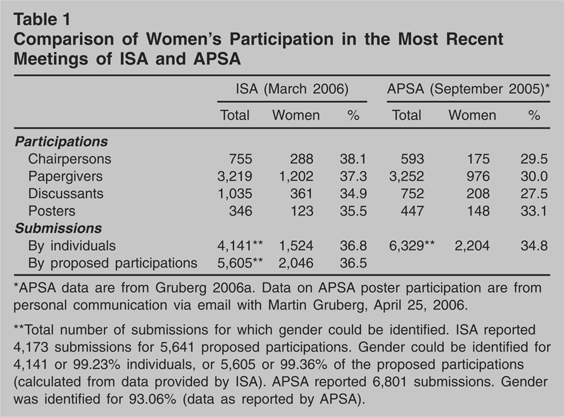
As shown in Table 1, 38.1% of all panel or roundtable chairs, 37.3% of papergivers, 34.9% of discussants, and 35.5% of poster presenters at the 2006 ISA meeting were female.3
The number of chairs exceeds the total number of panels and roundtables. This is explained by the fact that 37 panels or roundtables have two chairpersons.
Comparison of Women's Participation in the Most Recent Meetings of ISA and APSA

The difference in proportion of participations by women in the two associations' meetings is not due to differences in patterns of submissions and selection. As Table 1 also shows, women made up a slightly larger percentage of the submissions to ISA as compared to those to APSA.4
Data for APSA submissions by gender were provided by Christina Marmor of the APSA. The gender distribution of ISA submissions was calculated from data provided by the ISA. My thanks to both associations for their willingness to facilitate this research.
Interestingly, the somewhat larger representation of women at the ISA meeting does not reflect a difference in the gender balance of each association's membership. Breuning and Sanders (2007) report that 31.8% of ISA members and 32.2% of APSA members are female. The difference in women members between the two associations is negligible. There is furthermore little difference in the propensity of the two associations' flagship journals (ISQ and APSR) to publish work authored or co-authored by women (Breuning et al. 2005; Breuning and Sanders 2007). It appears that the proportion of female conference participations exceeds the presence of women members in ISA and approximates it for APSA. A possible explanation for this difference is explored below.
The size of the programs for the annual meetings of the two associations is now quite comparable. The ISA's program included 720 panels and roundtables across four full days of panels, whereas the APSA's program offered 730 panels and roundtables across three-and-a-half days. A difference between the two associations' meetings is the relative difficulty of being accepted to participate in the conference program. ISA reports an 82.8% acceptance rate for paper proposals and an 85.0% acceptance rate for panels (Reuveny 2006). It is substantially more difficult to be accepted to the APSA program. For the APSA's 2005 annual meeting, the acceptance rate for individual paper proposals was 37.2% and for organized panels it was 66.6%.5
Calculated from data provided by APSA Meetings and Conventions Director Christina Marmor, via email, May 1, 2006.
Data for APSA attendance are from the APSA eNewsletter, September 2005. Data for ISA are from ISA Executive Director Tom Volgy, via email, April 26, 2006.
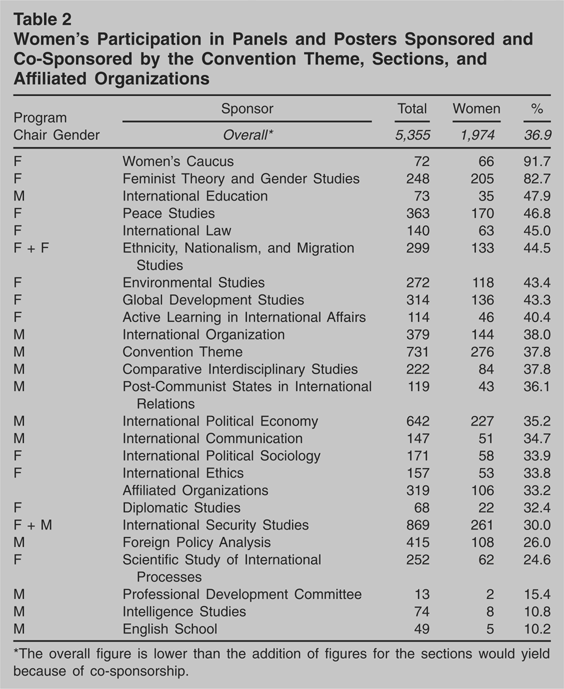
Women's relatively strong presence at ISA's most recent annual meeting may be explained in part by the rather large proportion of women involved in organizing panels on behalf of its various sections. Gruberg (2006) has noted a correlation between women organizers of section programs and the presence of women on the program. Table 2 suggests that this is true for ISA as well. Of the 11 sections that had participations by women at relatively higher rates than the overall proportion of 36.9%, eight (or 72.7%) had women organize the program. These sections are more likely to focus on topics that dovetail well with comparative politics, are also studied in American politics, or are of general interest, such as active learning. The programs for the 12 sections that had participations by women below the overall proportion were organized more often by men (seven, or 58.3%). These sections are also more likely to focus on “traditional” international relations topics, such as conflict (including Scientific Study of International Processes), security studies, diplomacy, and foreign policy.
Women's Participation in Panels and Posters Sponsored and Co-Sponsored by the Convention Theme, Sections, and Affiliated Organizations

Clearly, women also do not fare equally well in all sections of the ISA. Predictably, the Women's Caucus and Feminist Theory and Gender Studies sections exhibit the largest proportions of participations by women, 91.7% and 82.7%, respectively (see Table 2). Table 2 also shows that the sections with the largest numbers of participations include fewer participations by women than in the conference overall. Security Studies, which had the largest presence at the conference with 869 participations, included 30.0% participations by women. International Political Economy, the second largest section, fell slightly below the overall conference figures with 35.2% and Foreign Policy Analysis recorded just 26.0% participations by women. However, the lowest proportions of women were found in two small sections, Intelligence Studies (10.8%) and the English School (10.2%). The Professional Development Committee's two panels also included very few women among its total of 13 participations.
The 2006 ISA conference program counted relatively many women among the section organizers (13 of 23 sections, or 56.5%, not counting the convention theme or affiliated organizations). By comparison, Gruberg (2006) reports that 15 of 51 section organizers (or 29.4%) for the 2005 APSA meeting were women. The difference in the number of women section organizers is a plausible explanation for the difference in women's participation in the two associations' meetings, but the data do not clearly support it. The data show that women are represented only slightly above their proportion among submissions at ISA and only somewhat less at APSA.
However, if compared to women's presence among the membership of each association, a different picture emerges: women's participation in the APSA meeting is roughly in proportion to women's presence among the Association's membership, whereas ISA's 2006 meeting overrepresented women as compared to their presence among its members. As detailed earlier, the ISA had a larger proportion of women among its section organizers for this meeting. If women organizers do indeed affect the presence of women at the meeting, as Gruberg (2006) suggests, it appears that they do so more by attracting a greater number of submissions from women than by preferential treatment of women's submissions. Although the data are suggestive, further research will need to determine whether women do indeed perceive a greater incentive to submit a proposal when a woman organizes the program.
Conclusion
Data from the ISA's annual meeting provide a useful complement to the data on women's participation in the APSA's annual meetings and help refine our understanding of what mechanisms might encourage women's participation in each organization's annual meeting as well as the potential impact of internationalization on women's participation in the profession.
Although the proportion of women among the two associations' memberships is comparable, there is some difference in women's participation in their recent annual meetings. The 2005 APSA annual meeting saw women participate at rates comparable to their presence in that association, whereas the 2006 ISA meeting experienced participation by women in excess of their proportion in that association's membership. This is especially interesting in light of the commonly held perception that international relations (and therefore the ISA) is more male-dominated than political science (and the APSA).
The relatively larger presence of women at the ISA meeting is likely to be at least in part a function of the rather large proportion of women section organizers. Gruberg (2006) noted that within the APSA participation by women is boosted when women organize section programs. A comparison of submission and participation data for both associations refines his finding. If women section organizers have an impact on women's participation, it is expressed primarily through a greater propensity of women to submit proposals, not by women organizers favoring proposals by women. Nevertheless, this suggests that it is useful to encourage women to step forward as section organizers. Since the election of officers for the sections is in the hands of those sections and their membership, neither association can ensure that women will be selected. Each association can, however, provide incentives for sections to (s)elect women organizers with some frequency.
As the APSA seeks to internationalize, the ISA's recent experience may be instructive: despite the perception of international relations (and ISA) as a male-dominated field (and organization), the latter's 2006 meeting demonstrates that when women take an active part in the organization of the annual meeting, more women participate. Yet, the “traditional” international relations topics (such as conflict, security studies, diplomacy, and foreign policy), remain relatively male-dominated, at least as evidenced by participation in the ISA meeting. Topic areas that connect more easily with subjects studied by specialists in comparative and American politics, such as ethnicity and nationalism, development, environment, women and politics, as well as the ISA sections focused on teaching and learning (International Education and Active Learning in International Affairs), tend to include more women. To the degree that the APSA's efforts at internationalizing the Association focus on including scholars specializing in these various areas, such inclusion may have consequences for the gender balance within the Association and at its annual meetings unless an effort is made to demonstrate a commitment to women's participation by encouraging the selection of women as section program organizers.
On balance, then, internationalization may foster the perception of a less hospitable environment for women in APSA, which can be mediated by ensuring that women play an active role as section program organizers. A comparison of the meetings of the two associations suggests that women do seek the opportunity to participate and are more likely to do so when they see that other women are active in the associations.
Author Bio
Marijke Breuning is associate professor of political science at Truman State University. She has published work on foreign policy analysis, foreign aid and development cooperation, and ethnic politics. She has also published on the international studies curriculum and other pedagogical subjects. She is currently part of the editorial teams of the Journal of Political Science Education and Foreign Policy Analysis.