


Orientation
In the following considerations, I would like to highlight some problems and enigmatic properties concerning the way in which language is represented in the human brain. The discussion is based on four assumptions about facts that are by no means trivial, but should still be taken for granted.
(1) The ability to acquire and use a natural language is a species-specific property of human beings. Whatever similarities and relations between linguistic utterances and various types of animal behavior can be identified, the difference between them is not just a matter of degree, such that appropriate types of animal communication or expression could gradually extend into the domain of human linguistic behavior. The difference is rather a qualitative distinction, which cannot be overcome by training or learning. In other words, the Faculty of Language (FL) must be part of the biological endowment of the human organism. It is one, and perhaps the most important, of the features distinguishing the species from its relatives.
(2) To the extent to which FL is a species-specific property of homo sapiens, it must in some way be anchored in the human genome, either by means of conditions that directly determine properties of the organism devoted to FL (alongside those determining other organs), or by conditions that determine language-specific aspects of other systems that the genetic endowment accounts for. Ultimately, the distinction between ‘direct’ and ‘indirect’ determination might turn out to be spurious, given the sparse knowledge we generally have about the way in which behavioral conditions are genetically determined. More recent observations suggest that the genetic cluster, called FoxP2 might play a crucial role in the genetic basis of FL, but even if this is so, we do not know to what extent and in which way.
(3) Although the Faculty of Language must be based on a specific disposition, whose effects do not gradually emerge from conditions of animal communication, it is nevertheless the result of standard phylogenetic processes. Hence, FL rests on all relevant conditions of the organism, recruiting or modifying properties and functions according to general principles of biological evolution. This includes various aspects of perception and practical behavior, conditions of social interaction, but also evolutionary modifications of the vocal tract, especially the pharynx, which certainly play a crucial (but presumably not the decisive) role in the origin of FL.
(4) There seem to be strong reasons, which I will endorse here, according to which the core of FL is in fact the specific organization of the human brain. In other words, the major condition for FL is the representation and control of linguistic utterances in the human brain. Although language needs to be externally realized by noises created in the vocal tract (or by gestures used in sign language), the essential basis of language is the possibility of its realization in the brain.
In short, then, something in the genetically determined and phylogenetically evolved structure of the human brain accounts for FL. Various questions immediately arise: what exactly are the specific properties that characterize FL, how does FL differ from and relate to other mental capacities, such as visual perception, spatial orientation, action planning, or social interaction? And to what extent do we understand the underlying structures and functional principles of the brain?
The two fields of research contributing to answers to these questions are those of brain sciences and linguistics, as part of the more general field of cognitive sciences. The approaches of these two fields are fairly different and not easily reconciled, but a strong case can be made for the claim that insights of linguistics may be helpful or even indispensable for any substantial understanding of the neuro-physiology of language, for the simple reason that we need to know which behavioral phenomena the brain supports and controls in order to understand how they are (and how they cannot be) brought about by neuronal structures and principles.
On the Nature of Language
To begin with, an utterance of a linguistic expression like It’s raining assigns a certain meaning – namely a claim about the weather – to a (primarily acoustic) signal. More generally, the mental structures on which linguistic utterances are based relate internal representations of certain aspects of experience of the external and internal environment to reproducible patterns of articulated sounds. Abbreviating by PF (for Phonetic Form) the invariant pattern imposed by linguistic knowledge on the speech signal and by CF (for Conceptual Form) the invariant aspect of the experience expressed by the utterance, these general conditions can be summarized as follows:
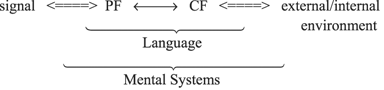
Actually, the double arrows abbreviate the highly complex systems of Articulation and Auditory (and other) Perception on the one side, and the various modules of Conceptual and Intentional Experience and Interaction with the environment on the other hand. In short, the system of linguistic knowledge determines a mapping between the two interfaces PF and CF, where PF connects linguistic expressions with the systems of Articulation and Perception, and CF connects expressions with the systems that support the interaction with all aspects of the internal and external environment. Three important points are to be added to this outline.
First, the relation between PF and CF – and hence between the signal and the objects or situations in the environment – does not depend on a similarity between signal and object or situation: there is no similarity between the sound-sequence represented by it’s raining and the weather it describes. Thus, linguistic expressions are not iconic, to use Peirce’s terminology. The relation is furthermore independent of any direct contiguity between signal and object – the utterance it’s raining describes the same weather in the presence or absence of rain. Linguistic expressions are not indexical, in Peirce’s terms. The crucial point is that linguistic utterances are symbolic, the relation between signal and object or situation is arbitrary and must be learned for each single symbol. This means that the ability to acquire symbols is a necessary condition for the Faculty of Language. It is not, however, like the Faculty of Language that rests on it, restricted to humans, but seems to be available in other species as well, although in different degrees.Reference Kaminsky, Call and Fischer1
Second, natural languages are not fixed and finite sets of symbols, pairing a phonetic and a conceptual structure, but can systematically be extended to complex expressions without upper limit, representing correspondingly complex and diverse situations, objects and dependencies among them. This possibility results from the fact that FL supports means to systematically combine linguistic expressions to new, complex expressions, exhibiting well-defined, non-trivial properties, some of which will be discussed below.
Third, the two interfaces, PF and CF, are of essentially heteromorphic nature, their internal organization is subject to completely different conditions for obvious reasons: PF corresponds to the organization of acoustic signals and is essentially based on linear sequences of segments and syllables, in line with the temporal properties of sequences of sounds; CF, on the other hand, represents all types of dependencies and combinations, which constitute hierarchical structures, largely without linear or temporal structure. This heteromorphy holds for the basic symbols (or words) in much the same way as for their complex combinations. Thus, the PF of the pronoun him is a sequence of three segments, but its CF is a complex of conditions, not a sequence of conceptual properties identifying first a person, than its gender, and finally its referential dependency. Likewise, the PF of Paul asked him is a sequence of syllables, made up from segments, its CF however represents an act involving two people, and not a sequence made up from Paul, followed by the past act of asking and then the addressee. In other words, it is the very gist of linguistic knowledge and its underlying capacity to create a correspondence between two essentially different systems of mental representation.
Three conclusions about language as a species-specific property are to be drawn.
First, although the recursive combination of mental entities is occasionally taken to be characteristic of natural language (as opposed to, for example, animal communication), it is easy to see that recursivity is a mode of operation applying within various domains of human behavior, and even beyond. Thus, the structure of mental representations resulting from visual perception, or the organization of all sorts of plans for practical action, exhibits recurring steps of combination and the formation of hierarchical structures.2 Hence, the capacity to build up mental representations with recursive structure is clearly a necessary, but not a sufficient, condition to characterize language. In fact, brains with the capacity of recursive representations are likely to phylogenetically precede the advent of homo sapiens.
Second, the capacity to acquire symbols, namely patterns of signals that depend neither on similarity nor on contiguity with the things they stand for, is a necessary prerequisite for FL and clearly distinguishes natural languages from all systems of animal communication. However, acquisition of symbols is apparently not strictly restricted to humans, either. But even then, the role and structural properties of symbols in language are fundamentally different because of their combinatorial disposition. A word is not just a labeled concept but at the same time a program for combination. A transitive verb like turn (in he turned the key) differs from the intransitive turn (in he turned home) or the noun turn (in a radical turn) in the combinatorial options it creates. Even more complex conditions hold for elements such as as or then or up. Thus, the lexical system of any natural language differs from possible repertoires of non-linguistic symbols not just in size, but, more importantly, by its complexity and the intrinsic nature of its elements.
Third, although linguistic utterances can be used for all purposes of communication, languages differ radically from other means of communication, especially systems of animal communication, which according to all we know are not the predecessors of language. Languages are means to express thoughts or intentions, and they may serve as means of communication, just because they express structured thoughts and intentions. This is not to deny that social interaction and communication is a pre-requisite for FL to emerge phylogenetically, but pre-verbal communication – which persists alongside the use of language – does not turn into the Faculty of Language just by adding one or the other refinement.
In short, then, the essence of the FL is to provide a systematic correspondence between the two heteromorphic interfaces PF and CF by means of recursive combination of learning-dependent symbols.3 To put it differently, FL provides a recursive mapping between two domains with essentially different principles of organization. Whether the specific functional principle of this capacity is the result of one developmental step, as Chomsky suggests,Reference Chomsky4 or whether it emerges as the result of a number of subsequent steps, as Jackendoff assumes,Reference Jackendoff5 must be left open here. In any case, this capacity gives rise to a wide range of human properties and types of behavior, including the creation of social institutions, whose characteristics cannot be the subject of the present remarks.
Activation Spreading and Hebbian Learning
With respect to the core problem – how this specifically human capacity, and the knowledge and processes eventually based on it, are realized in the brain – I have nothing to add to the presently available insights and assumptions about the functional architecture and the organizational principles of the human brain. What I take to be a reasonable issue to be discussed, however, is the question, of what the actual nature of the language capacity allows or forces us to infer about the way of its possible realization by means of the presently assumed functional principles of the human brain. Admittedly, linguists tend to be quite reluctant with respect to such assumptions and inferences and refrain, for plausible reasons, from serious attempts to connect linguistic descriptions to neuro-physiological structures and processes. Neuroscientists, on the other side, are not very concerned about the significant details in the structure of linguistic expressions. Characteristic misunderstandings about notions such as ‘universal grammar’, ‘deep structure’, or ‘transformation’ indicate that genuine concepts originating within the tradition of one field do not naturally fit very well to those of the other. There are, of course, important developments improving the mutual relation between the disciplines, and it is not only in the groundbreaking history of research in aphasia, where neuro-sciences and linguistics profited remarkably from each other. Through these and the more recent types of exploration using non-invasive technologies, we know quite a lot about where and (mostly alternatively) when something happens in the brain during processes of speech production and comprehension. But we do not really know what happens.
One of the important results of brain research is the insight that neurons – cells, networks of which activate each other through synaptic connections of their axons and dendrites – are the basic elements for all the functions and complexities that the central nervous system accounts for. Even if synapses are perhaps not the only form of functional contact between neurons, their fundamental role is generally accepted.Reference Fuster6 The actual cortical organization is based on various types and layers of integration, such as the cell assemblies introduced by Hebb, or the larger functional units called cognits proposed by Fuster, to achieve closer correspondence between cellular architecture, functional elements of cognitive organization, and the anatomy of the brain. The overall framework, within which all these connections and their effects are assumed to be explainable, relies on the concept of neuronal nets. Cognitive processes, including in particular the acquisition and use of language, are construed as activities and modifications within appropriately structured neuronal networks. Hence, what I want to discuss are the questions of whether and to what extent this view does in fact account for the phenomena for which the Faculty of Language is responsible. Two central assumptions are relevant in this respect.
First, the basic principle by which processes in the brain are realized is activation spreading, that is distribution of activating (or inhibitory) neuronal potentials according to the strength of synaptic contacts by which the elements of the net are connected. Each particular cognitive (or other) activity of the brain is realized by a characteristic pattern of activation within the relevant parts of the neuronal net. The pattern originates according to the synaptic connections that make up the net and the fully automatic propagation of action potentials. This general picture – corroborated in part by the observation of ‘event-related potentials’ ERP – is supposed to account for at least three central issues in the domain of cognitive processes. First, the synaptic connectivity of the network originates, at least in crucial respects, by modification of the synaptic strength, which is the effect of learning. Second, thereby, the structure of the network is tantamount to (long term) memory, as it preserves the result of learning, namely previous activation. Third, transitory activation of relevant parts within the network is the actual realization of what is usually called short-term memory or working memory. This is a plausible and in fact very elegant overall framework, and the question is: how far can it account for the whole range of cognitive and other mental processes?
As for language, this framework means that acquisition, namely the storage of lexical items and creating the patterns of combination, must result in an appropriately structured network, with the Faculty of Language being the genetically determined initial state of the network, from which appropriate modifications can arise. Production or comprehension of actual utterances would then be the activation of relevant partial networks, whose activity makes up the working memory involved in processing the utterances in question. Allowing for necessary refinements and details concerning the structure and the organization of the network, this is, in principle, the view proposed, for example, by Fuster.Reference Fuster7 The important point to be noted is that nothing but activation of elements within a given network is supposed to be the realization of linguistic performance. The network, to be sure, is accorded remarkable complexity and several layers and components, but the basic principle is activating elements within a given network. The question is, whether production or comprehension of linguistic expressions is logically possible on the basis of this functional principle. In the next section, I will argue that there are in fact crucial facts about linguistic behavior that these cannot capture.
The second assumption is called Hebbian Learning, and concerns the nature of learning, presupposed above as the way in which synaptic connections can change to make up the long-term memory. The basic principle usually assumed in this respect has been proposed by Hebb. According to this principle, the relevant changes come about as synaptic facilitation through repeated activation, leading to cell assemblies of more closely connected neurons.Reference Hebb8 Again, certain refinements notwithstanding, the central point is simple and elegant: activation increases the synaptic strength, learning is coincidence of activation. This principle relates long term to operative memory in a straightforward way, as only selectively activated neurons changing their synaptic connections participate in the creation of memory. One might furthermore assume that the initial, genetically determined architecture of the brain provides the ‘predispositions’ that allow learning to occur in different ways for different domains of brain activity. To the extent to which linguistic knowledge can be represented by connected cell assemblies, language acquisition could naturally be the result of Hebbian learning, and the FL would provide the network’s initial state, allowing relevant connections to be strengthened by subsequent activation.9
There are serious difficulties with these notions, though. Hebbian Learning is, by hypothesis, a matter of gradual modification, increasing the strength of memory by repetition of activation. While this gradual learning certainly plays a great role in many areas of experience and memory formation, there are crucial domains, where this is just not the case. Acquaintance with faces is a typical case in point, and the so-called fast mapping, which is characteristic for the acquisition of large areas of lexical knowledge, is another case, which directly concerns a central domain of linguistic knowledge. I will return to additional problems below.
To sum up, there can be little doubt that activation spreading in neuronal nets and Hebbian learning by a gradual increase of synaptic strength are efficient and central principles of brain activity. With this proviso, specific functions must depend on the anatomy of the brain and the complex organization of cortical structures. This leaves us with the question of to what extent these assumptions can account for the acquisition and use of natural languages, and whether additional principles must be assumed.
Four Impasses
As already noted, there are specific problems with spreading activation as well as with Hebbian Learning. In this section, I will discuss in slightly more detail four issues, relating to the structure of words, the acquisition of words, the repetition of words, and the sound-meaning-correspondence.
(i) The problem concerning the structure of words deals with the often hopelessly underestimated complexity of lexical items. As already noted, the basic symbols, on which the combinatorial structure of linguistic expressions relies, are not just labeled concepts, i.e. associations of conceptual and phonetic features, but also control much of their combinatorial properties. Thus, English words such as drive, turn, drink, etc, can occur either as a noun or as a verb, the latter with or without an object (with correspondingly different meaning), and they require, moreover the different morphological realizations sketched in (2) below. The choice of these variants depends on intricate contextual conditions, which must be lexically registered.

Examples such as these (which would be far more complex in languages with richer inflection than English) led to two competing psycholinguistic theories: different forms are either assumed to be constructed from their parts on demand, or they are assumed to be stored and activated as a whole. Although these theories make different claims about lexical knowledge, they are not mutually exclusive, and in view of conflicting evidence, one might be prepared for both options, reflecting different conditions. It must be noted, though, that the theory of full listing creates a puzzle for Hebbian learning, because we are naturally forced to assume knowledge of items that never occurred in the learner’s earlier experience, such as, for example, the past tense of a rare and regular verb, of which only the progressive form was encountered. This knowledge could not be the result of synaptic strengthening. The creation of complex items on the other hand is at variance with the principle of spreading activation, because it allows just activating stored configurations in the net. Hence, new configurations cannot be the target of activation – actually a very general problem.
However, even if one would get around these difficulties in one way or another, the problems arising from the structure of words are not yet settled. Morphological and syntactic variants like those in (2) are generally the simpler part of a lexical item’s complexity. It would go far beyond the present remarks even to sketch the conceptual diversity of, say, drive (as in they build a new drive, we drove too fast, he drives me crazy, they like driving foxes,…). Each of these, and a large range of further systematically related readings, must be connected to all and only the relevant phonetic variants in (2). It is completely unclear whether and how complex patterns of this type can be represented by a network that at least remotely accounts for the natural use of specific readings of a given item by some pattern of spreading activation. Advocates of this view might want to say: the brain just does it. That is true, but it does not say anything about neuronal nets and spreading activation.
(ii) The problem with the acquisition of words is straightforward and definitely excludes Hebbian learning as an account of the origin of lexical knowledge. First, the characteristic feature of word acquisition in childhood is appropriately called ‘fast mapping’: children pick up about ten words a day, on the basis of often incomplete evidence and few presentations. No repetition with gradual increase of synaptic strength can reasonably be supposed. A second and often related phenomenon might be called ‘learning by exclusion’, where the meaning of an item is acquired not by its actual identification, but just because contextual conditions exclude other possibilities. Again, repeated simultaneous activation of sound and meaning cannot seriously be invoked. Finally, the crucial phenomenon of ‘learning by analogy’, which provides inflectional forms such as walking on the basis of walked, in parallel to, for example, turning alongside turned is completely outside the range of Hebbian learning. More generally, neither the format of knowledge corresponding to morphological and other language specific rules nor their acquisition can in any serious sense be captured by Hebbian learning. These observations do by no means exhaust the relevant difficulties, but they should suffice to justify the claim that the principle must be supplemented, or perhaps completely replaced, by some other way to create knowledge representation in the brain, in order to account for lexical knowledge
(iii) The problem addressed as repetition of words does in fact concern the principle of spreading activation in a completely general and fundamental way. Notice that a simple utterance like they couldn’t and they didn’t do it is impossible to realize under the assumption of spreading activation, because both they and the negation not must be repeated within the pattern of activation by which the sentence is realized.10 Obviously, the same cell assembly (or cognit) cannot simultaneously be in two (or more) different states of activity, each corresponding to a different occurrence of the item it represents. It doesn’t help to object that they and not are functional elements that differ from ordinary nouns and verbs, because – besides the fact that this would be an escape, and not a solution – the problem holds for ordinary items in the same way, as shown by Jackendoff’s example The little star’s beside a big star,Reference Jackendoff11 or countless others like peace is peace and war is war or the famous a rose is a rose is a rose.
One might attempt to remedy the impasse by adding tags or some other sort of marking, in order to distinguish different states of repeated activation, but that would be just a different way to introduce a new means to supply the role of working memory. What is needed for quite general reasons is in fact an account of working memory that provides something like a copying mechanism, which integrates elements from memory into independent structures of actual utterances. By this move, the very notion of working memory as the activated state of long term memory breaks down, however. As we will see immediately, a notion of short-term memory for structures that are related to, but separate from long-term knowledge is indispensable anyway. This raises the question of how this short-term memory (which we were used to all the time, and which is necessary not just for language use, but for perception and action in essentially the same way) might be realized in the brain. The elegant principle of spreading activation, unifying working and long term memory, does not do.
(iv) The problem of sound-meaning-correspondence is the one that most specifically concerns the language capacity. In order to come to grips with it, we must take for granted the existence of structural representations in the sense just discussed. We are then ready to deal with the fact already noted, namely that linguistic expressions are based on pairs [PF, CF] of fundamentally different structures. PF is a sequentially organized phonetic pattern, and CF is the hierarchically structured conceptual structure, determining the meaning of the expression. The most natural correspondence between a hierarchy and a sequential structure is a projective mapping that preserves, as far as possible, the respective part-whole-relation in the following sense: If a is part of b in the hierarchy and a and b correspond to the sequential units a and b, respectively, then a is a sequential part of b. In other words, sequential and hierarchical inclusion correspond. A simple illustration of this principle is given in (3), where tentative semantic components are written in capitals (with specific representing reference to some particular object):
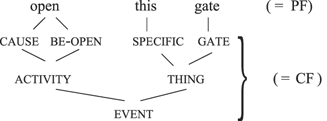
The Conceptual Form (3b) is simplified in several respects, as is, by the way, the Phonetic Form in (3a). The relevant point should be clear, however: the sequence open corresponds – as a lexical item – to the semantic complex activity consisting of the combination [cause be-open]], and the sequence this gate corresponds to the components [specific] and [gate], which constitute the complex thing. They are part of the total sequence open this gate corresponding to the event consisting of the configuration [[cause be-open] [specific gate]]. This type of projective mapping is in fact a fundamental principle controlling the sound-meaning-correspondence in natural languages. The resulting syntactic relations are the basis for further important conditions such as concord and agreement, leading to the distinctions shown in (4), where * marks expressions ruled out by grammatical conditions:

Dependencies like those between he and opens or these and gates are governed by structural conditions that originate from combinatorial operations and cannot be stored in long-term memory.12 Unless one would be ready to stipulate syntactic structures of arbitrary complexity to be stored in long term memory, there is no place where the conditions of agreement could apply. Once again: the independent role of working memory, which is apt to hold generated structures, turns out to be indispensable.
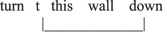
One decisive point must still be added at this place. Natural languages can systematically deviate from the projective correspondence just illustrated. For the sake of illustration, look at a simple case like turn this wall down! where the two morphological parts of the verb turn down are separated by the intervening constituent this wall, although the meaning of the verb is a coherent complex, just like that of turn out, turn over, turn on, and many others. Whatever the representation of this complex from CF might be, its counterpart in PF fails to be a coherent string, as it includes other parts of the expression. The relevant property of the structure can be indicated in various ways. In (5), down is represented as occupying two disjoint, but connected positions, a tacit one marked by t (for ‘trace’), to which it belongs as part of its lexical item, and an actual one at the place, where it is sequentially realized in PF.
This is a simple and apparently marginal case, which hardly seems to justify substantial departures from the principle of projective mapping. But this impression is fallacious. Cases like those in (6) below are but a minimal sample illustrating the variety of phenomena that go beyond projective mapping:
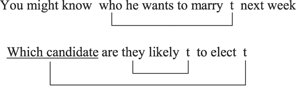
Notice, incidentally, that the trace in (6a) would disappear if the pronoun he is dropped, although t marks the tacit position of who and not of he.13 It is finally to be added that departures from projective mapping can be observed not only between, but also within words. While in unbelievable the morphological parts in PF are grouped in line with the conceptual relations – the possibility to believe is negated – this is impossible for cases like (7b): unhappier means more sad rather than not more happy, as the phonological grouping would require.
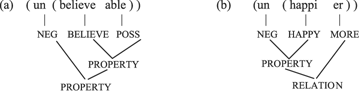
What is relevant in these and innumerable other examples is the fact that deviance from projective mapping shows up in simple and central utterances, and is by no means restricted to complex and elaborate expressions. The important point is, in fact, that projective mapping as well as the systematic deviation from it is a basic possibility the Faculty of Language does provide.14
Mysteries of Language and Beyond
According to fairly direct observations, the specific possibility FL creates is the recursive combination of symbols, leading to the (partially non-projective) correspondence between the hierarchical and the sequential structure of PF and CF, respectively.
By looking at various impasses, I have argued that models for the realization of language in the brain cannot be adequate to the extent to which they ultimately rely on the principle of spreading activation in neuronal nets and learning by repeated activation.15 Although spreading activation and Hebbian learning are presumably principles of central importance for the operation of the brain, it is clearly misleading to rely on them with respect to the characteristic phenomena in acquisition and use of language. At least the following major problems can be identified.
(a) There is an indispensable need for working memory as a function that disposes of some way to copy information from long-term memory in a representational format to which mental operations can apply.
(b) Acquisition of knowledge (as stored in long term memory) cannot be restricted to learning by repeated activation.
(c) The format and operation of principles of analogy and combination are decisive for the formation of complex symbols, but cannot be captured by spreading activation and Hebbian learning.
To sum up, there is no point in constructing mechanisms that are supposed to simulate the operation of brain structures without understanding the actual principles, by which observable phenomena can be accounted for. It is for this reason that the properties of linguistic expressions discussed above can possibly provide a guideline towards a more adequate view on the apparently mysterious relation between brain and language. Instead of expecting the enormous complexity of the human brain to create just more of the same spreading activation in the huge network, it might be necessary to be prepared for different principles, a change similar to what happened several times in the history of naturalistic inquiry.
Manfred Bierwisch is Professor Emeritus of the Humboldt-Universität Berlin, where he was head of the Max-Planck-Research Group of Structural Grammar. He was fellow at the Center for Advanced Study in the Behavioral Sciences in Stanford and at the Institute for advanced Study in Berlin. From 1993–1998 he was Vice-President of the Berlin-Brandenburg Academy of Sciences. His publications include the Grammatik des deutschen Verbs, Modern Linguistics, and Economy Principles in Linguistic Theory.


