In 1862, al-Ḥājj ʿUmar Fūtī Tall (d. 1864), one of the foremost West African Muslim intellectuals of the nineteenth century, conquered the Caliphate of Ḥamdallāhi.Footnote 1 Having initially taken up arms to redress a local dispute in eastern Senegambia in 1852, a decade later his military advanced through numerous other polities and ultimately ended the reign of the sole Muslim state that controlled the Middle Niger valley.Footnote 2 Then ruled by Aḥmad III, the Caliphate of Ḥamdallāhi was established in 1818 by his grandfather, Aḥmad Lobbo (d. 1845), also a Muslim intellectual.Footnote 3 This polity was one of several Islamic theocracies that emerged through revolution during the turbulent eighteenth and nineteenth centuries in West Africa.Footnote 4 These movements were revolutionary because Muslim intellectuals, including al-Ḥājj ʿUmar, breached long established norms of maintaining pious distance from the political realm.Footnote 5 Instead they articulated a new vision of power in the region that linked legitimate political rule with mastery over Islamic knowledge that they claimed only they had.Footnote 6 Analzying al-Ḥājj ʿUmar's conflict with Aḥmad III offers one critical perspective on political theology — the intersection between religious and political practices in various articulations of sovereignty — in nineteenth-century West Africa.Footnote 7
One source for such an analysis is a long polemical and legal work in Arabic that al-Ḥājj ʿUmar penned in 1861. The work, Bayān mā waqaʿa baynanā wa bayna amīr Māsina Aḥmad ibn Aḥmad (What happened between the ruler of Masina, Aḥmad ibn Aḥmad and us), is al-Ḥājj ʿUmar's account of his conflict with Aḥmad III.Footnote 8 In the introduction, al-Ḥājj ʿUmar dates the origins of this conflict to 1856, after he conquered the formidable Bambara polity of Kaarta.Footnote 9 He then explains how his conflict with Aḥmad III resumed in 1859, when he led his troops into the Middle Niger valley and subsequently conquered another powerful Bambara polity, Segu. In the first part of the Bayān, al-Ḥājj ʿUmar meticulously refutes Aḥmad III's claims to authority in the Western Sahel and the Middle Niger valley, while also justifying and legitimizing his own actions (Fig. 1).Footnote 10 In the second part of the work, al-Ḥājj ʿUmar systematically analyzes Aḥmad III's actions and ultimately denounces him as an apostate. Thus, the Bayān is not simply a narrative of ‘what happened’. Rather it is a series of complex, multifaceted arguments that al-Ḥājj ʿUmar presents aimed solely at delegitimizing Ahmad III's claims to authority and establishing the legal justification for his conquest of the Caliphate of Ḥamdallāhi several months later.
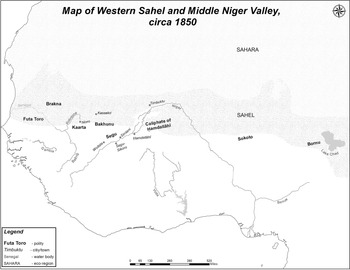
The Western Sahel and Middle Niger valley, ca. 1850. Map by Boris Michev.

The Bayān is one example of a large corpus of Arabic source material from West Africa that Ousmane Kane has recently conceptualized as the ‘Islamic library’.Footnote 11 In an emerging body of scholarship, scholars are using Arabic sources to ask new questions and produce new analyses of a range of topics in African history.Footnote 12 A study based on the Bayān adds to this wave of exciting scholarship. This article demonstrates how an engagement with the scholarly production of Muslim intellectuals in Arabic unveils new interpretative possibilities and conclusions on the history of Islam in Africa and on the discursive practices of Muslim communities more generally.Footnote 13 Specifically, it shows how nineteenth-century West African Muslim intellectuals constructed their authority, how they incorporated and debated through the Islamic intellectual tradition, and how they specifically linked their knowledge to a performance of power. In other words, the study of the Bayān underscores the need to take seriously how ostensibly religious discourses became intertwined with claims to political legitimacy in the nineteenth century in West Africa. This work utlimately shows that ‘religion’ is not a separate domain of human experience and practice, but rather is a generative factor within history and politics.Footnote 14
One of the defining aspects of the Bayān is how al-Ḥājj ʿUmar draws on a globally sourced corpus of nearly fifty distinct works of the Islamic religious sciences, including those on Qur'anic exegesis, jurisprudence, and theology.Footnote 15 He uses his extraordinary engagement with the broader Islamic intellectual tradition to create and support several new arguments. Thus, as Kane argues elsewhere, sources that belong to the Islamic library also demonstrate that ‘Saharan and Sub-Saharan Africans participated in this Islamic civilization, not only as consumers but also as contributors.’Footnote 16 In this respect, al-Ḥājj ʿUmar was adding to an exisiting history of political debates and discourses in nineteenth-century West Africa. Of particular note to these debates were the legal and political ideas of the controversial sixteenth-century North African scholar ʿAbd al-Karīm al-Maghīlī (d. 1504/5).Footnote 17 The legal opinions of this figure, including his emphasis on the permissibility of overthrowing ‘corrupt’ rulers and his equation of muwālā (affiliation, friendship, support) with nonbelievers as a form of apostasy had a lasting impact on the region.Footnote 18 These opinions had a strong influence on the intellectual thought and actions of the founding ruler of the Sokoto Caliphate (1804–1903), ʿUthmān dan Fodio (d. 1817), and his son and successor, Muḥammad Bello (d. 1837).Footnote 19 In the Bayān, al-Ḥājj ʿUmar reworks these preexisting ideas and redeploys them as the basis of several arguments to justify territorial conquests in completely different contexts.
In this article, I focus on the polemical and legal arguments that al-Ḥājj ʿUmar uses to make his claims to political legitimacy. An analysis of the Bayān reveals how the main argumentative thrust of this work rests on questions of belief and nonbelief. Specifically, al-Ḥājj ʿUmar constructs archetypal legal and theological distinctions between Muslims and non-Muslims. To explore the different layers of those arguments and explain how al-Ḥājj ʿUmar performs his authority, I develop and present two interlinked theoretical frameworks: the ‘political geography of belief’ and the ‘political theology of knowledge’.
I begin this article with a discussion on the polemical nature of the Bayān and briefly outline how al-Ḥājj ʿUmar represents his conflict with Aḥmad III in the introduction. By focusing on the first part of the Bayān, I demonstrate how the process of politicizing religious difference becomes critical to how al-Ḥājj ʿUmar maps vastly different populations and territories using similar legal terms. This, in turn, becomes central to how he legitimizes his conquests in the Western Sahel and the Middle Niger valley. I conceptualize how al-Ḥājj ʿUmar uses legal discourses and categories of belief to define territory and make claims to sovereignty as the political geography of belief. In continuing my analysis, I further argue that he uses his mastery over Islamic knowledge to construct his political authority. The numerous citations and his ability to produce such arguments partly validated his claims to legitimate rulership and gave his arguments potency. Conversely, one of al-Ḥājj ʿUmar's central claims in the Bayān is that Aḥmad III did not have any legitimacy as a ruler because he had no mastery over the Islamic intellectual tradition. I analyze how the multiple and entangled relationships between mastery over knowledge and religious authority form the basis of new claims to political authority as the political theology of knowledge.
Finally, I focus on the second part of the Bayān to investigate how al-Ḥājj ʿUmar used the legal concept of muwālā to denounce Aḥmad III as an apostate. In this discussion, I demonstrate how the two central frameworks I develop — the political geography of belief, and the political theology of knowledge — enable a deeper understanding of the legal case al-Ḥājj ʿUmar presents for conquering the Caliphate of Ḥamdallāhi. I conclude with an invitation to consider the possibilities that these frameworks hold not only for scholars of Islam in Africa, but also for other scholars in African studies and beyond.
A polemecist's narrative of conflict in brief
Al-Ḥājj ʿUmar completed the Bayān during a period of intense and growing conflict with Aḥmad III. As with other examples of polemical literature written by West African Muslim intellectuals, the Bayān was meant to legitimize a particular political project.Footnote 20 In the opening pages of the Bayān, he directly addresses a ‘discerning reader’ and invites them to carefully assess what happened between him and Aḥmad III.Footnote 21 This evocation, along with al-Ḥājj ʿUmar's use of ‘you’ throughout the work, suggests that he had a particular audience in mind. Yet he does not specify who exactly he wrote the Bayān for. While answering questions about the circulation of the Bayān and how it was read is beyond the scope of this article, it is still possible to speculate that al-Ḥājj ʿUmar wrote this work with more than one audience in mind.Footnote 22 A surviving missive that he sent to Aḥmad III in 1860, denouncing his actions, gives evidence of a history of correspondence between them.Footnote 23 This suggests the Bayān was al-Ḥājj ʿUmar's final statement in a much longer exchange. As David Robinson notes, al-Ḥājj ʿUmar also circulated the Bayān to the elites of the caliphate in what were ultimately failed attempts to negotiate for peace.Footnote 24 Therefore, one possible reason why he wrote the Bayān was an attempt to gain support against Aḥmad III from others in this polity. Additionally, al-Ḥājj ʿUmar perhaps wrote the Bayān for an audience beyond his immediate conflict with Aḥmad III. As I will discuss below, he went to great effort to place his conflict with Aḥmad III in a particular narrative frame and justify his actions. It is possible therefore he anticipated that other Muslim elites in West Africa would read the Bayān. After all, he was a well-known figure who was challenging the authority of an established Muslim polity and potentially going to war with it. In this respect he may have also wanted to preserve his legacy by documenting his perspective to control the narrative of this conflict. He certainly had an awareness that texts continued to circulate in West Africa well beyond the context of their production. He cites numerous examples of older texts in the Bayān, a point I will return to later in this article. Therefore, the possibility that al-Ḥājj ʿUmar also wrote the text with an audience in posterity in mind cannot be completely dismissed.
The polemical purpose and potential multiple audiences of the Bayān mean that al-Ḥājj ʿUmar did not produce an accurate portrayal of his conflict with Aḥmad III. As Bintou Sanankoua has demonstrated, this conflict has multiple layers and several local traditions of history that are not easy to untangle.Footnote 25 For example, internal narratives from Masina depict al-Ḥājj ʿUmar as an aggressor who was wrong to mobilize his military in the Middle Niger valley and attack another Muslim polity.Footnote 26 Other Muslim intellectuals fiercely resisted his actions against the Caliphate of Ḥamdallāhi and disagreed wholly with his opinions and legal justifications. Among his most significant antagonists was the powerful Kunta scholar Aḥmad al-Bakkāy (d. 1865). This figure wrote several polemical treatises against al-Ḥājj ʿUmar's justifications and eventually organized and led the successful armed resistance against him.Footnote 27 Finally, in the late 1920s or early 1930s, the Senegalese savant Muusa Kamara (d. 1945) wrote a long commentary on the Bayān to demonstrate why al-Ḥājj ʿUmar's legal reasoning and appeal to jihad was not justifiable.Footnote 28 Notwithstanding this larger body of source material, I do not engage with these other voices and political traditions in my analysis of this conflict. Instead, in this section I will briefly highlight the evolution of this conflict and explain how al-Ḥājj ʿUmar's representation of it underscores the larger political aims of the Bayān.
The narrative that al-Ḥājj ʿUmar presents in the introduction to the Bayān suggests that his conquest of the Caliphate of Ḥamdallāhi in 1862 had its roots several years earlier in the Western Sahel. It was in this region where he first encountered the army of Aḥmad III. While he was able to conquer Kaarta's capital, Nioro, with relative ease in 1855, al-Ḥājj ʿUmar was never really able to consolidate his power over this territory.Footnote 29 He immediately faced rebellion from the Masassi, the former ruling elites of Kaarta, as well as a group of Soninke-speaking Jawara.Footnote 30 The Jawara fled eastward, near the neighboring territory Bakhunu, and launched raids against trade caravans heading to Nioro.Footnote 31 When al-Ḥājj ʿUmar sent his troops to quell their rebellion, some of his troops also entered Bakhunu. The caliphate had long maintained strategic and commercial interests over this territory, despite a distance of nearly 400 miles.Footnote 32 Thus the presence of al-Ḥājj ʿUmar's troops in this territory led Aḥmad III to send his own army.
In the Bayān, al-Ḥājj ʿUmar initially expresses his surprise in witnessing the army of Aḥmad III so far from the Caliphate of Ḥamdallāhi and asks for its commander to send an envoy to Nioro.Footnote 33 Al-Ḥājj ʿUmar claims to have no knowledge of the fact that Aḥmad III's army was in this territory because of his actions. Eventually Aḥmad III's soldiers left Nioro and entered into an alliance with the Jawara.Footnote 34 Rather than wait for the caliphate to send reinforcements to support a population he depicted as rebels, al-Ḥājj ʿUmar sent his army to Kassekeri, north of Bakhunu.Footnote 35 After a long drawn out battle, however, al-Ḥājj ʿUmar's calculation to strike quickly paid off, as he emerged victorious. Consequently, Aḥmad III relinquished his interests in the Western Sahel to the authority of a new political ruler.
But conflict between these two Muslim elites did not end in the Western Sahel. A few years later, al-Ḥājj ʿUmar sought to conquer the Middle Niger valley. On the one hand, transformations in the Senegal River valley directly influenced his decision to head eastward. The French had expanded their commercial and political interests in this region and had come into direct conflict with him.Footnote 36 Consequently, by 1859 al-Ḥājj ʿUmar, already weakened by rebellion, had lost control over Kaarta and its surrounding territories.Footnote 37 He needed access to new agricultural land to support a growing army and numerous dependents, many of whom had migrated to Kaarta with him. On the other hand, political transformations in Segu may have also led al-Ḥājj ʿUmar to the Middle Niger valley. The new faama (king or ruler) of Segu, ʿAli bin Munzu (Bina Ali Diarra), had lent his support to the last remnants of the Jawara at the very moment al-Ḥājj ʿUmar was caught fighting against the French.Footnote 38 His decision to march into the Middle Niger valley was based on both pragmatic concerns and a desire to retaliate against the actions of an enemy state.
In marching into the Middle Niger valley, al-Ḥājj ʿUmar disregarded the historical and political entanglements of the Caliphate of Ḥamdallāhi and Segu.Footnote 39 Instead, his superior weapons gave him decisive victories against many of Segu's client states.Footnote 40 One of the most important battles happened at Woitala on the left bank of the Niger River. With 25,000 soldiers, he defeated 35,000 of Segu's soldiers.Footnote 41 From Woitala, al-Ḥājj ʿUmar explains in the Bayān that he marched to the commercial entrepôt of Sinsani in 1860.Footnote 42 It is after conquering Sinsani that he faced the army of Aḥmad III, who by this point had also entered into an alliance with Segu. However, the presence of the combined forces of Aḥmad III and ʿAli bin Munzu did not deter him from maintaining his occupation over Sinsani and subsequently marching against Segu, whose capital, Segu-Sikoro, he conquered in 1861. But just before al-Ḥājj ʿUmar's conquest, ʿAli bin Munzu managed to escape and sought refuge with Aḥmad III.Footnote 43 In the Bayān, al-Ḥājj ʿUmar notes that Aḥmad III only gave ʿAli bin Munzu amnesty and protection because the latter had paid him a large sum of money.Footnote 44 He claims there was no preexisting alliance between the two of them, because for the previous forty years the Caliphate of Ḥamdallāhi was at war with Segu.Footnote 45
It is this point of contention with Aḥmad III over the ruler of Segu that orients al-Ḥājj ʿUmar's narrative in the introduction to the Bayān. He depicts this particular conflict in the Middle Niger valley as an extension to his conflict with Aḥmad III in the Western Sahel several years earlier. He silences the vastly different political and historical contexts of these different regions. He also does not account for the evolution and transformations in his own circumstances that led him to invade the Middle Niger valley. Instead, al-Ḥājj ʿUmar focuses his narrative on what he insists were Aḥmad III's premeditated and unjustified attacks against him over a number of years.
Al-Ḥājj ʿUmar accomplishes the central goal of depicting Aḥmad III as an aggressor in his narrative by emphasizing categories of belief. Early in the introduction, he notes that after he conquered Kaarta, he sent letters to the elites of Futa Toro, the Caliphate of Ḥamdallāhi, and the Saharan confederation Awlād Mubārak.Footnote 46 He explains that the purpose of these letters was so that these other polities could ‘share in our joy because of all that God had inflicted on their polytheist enemies’.Footnote 47 In these letters he clearly appeals to a religious imaginary of solidarity based on a dichotomy between believers and nonbelievers. He emphasizes that all the territories that he came into conflict with were non-Muslim territories. The implication was that Aḥmad III's decision to send his army against al-Ḥājj ʿUmar could only have two interpretations. His actions were either in support of believers, or they were in support of nonbelievers. The rhetorical strategies that al-Ḥājj ʿUmar employs, including quoting numerous verses of the Qur'an with little contextual discussion, lead the reader to conclude the latter. Consequently, this emphasis on belief circumscribes al-Ḥājj ʿUmar's discussion and sets the stage for the legal and polemical arguments he makes to delegitimize Aḥmad III's claims to authority in the remaining parts of the work.
Towards conceptualizing the political geography of belief
In the first part of the Bayān, al-Ḥājj ʿUmar expands on his narrative in the introduction to explain why Aḥmad III had no authority to send his army against him in the Western Sahel and the Middle Niger valley. Aḥmad III had justified his actions by sending al-Ḥājj ʿUmar a total of five letters during their conflict. He sent two letters during their conflict in the Western Sahel and an additional three letters after al-Ḥājj ʿUmar entered the Middle Niger valley.Footnote 48 Aḥmad III unequivocally claimed that al-Ḥājj ʿUmar had violated the sovereignty of the Caliphate of Ḥamdallāhi and demanded he leave these regions. In the Bayān, al-Ḥājj ʿUmar frames his rebuttals to Aḥmad III's claims by first quoting large sections of these letters. He then places his counterarguments within numerous other quotations from several sources from the Islamic intellectual tradition to delegitimize Aḥmad III's claims over Kaarta, Bakhunu, and Segu, as well as the latter's client states, including Sinsani. The significance al-Ḥājj ʿUmar places on religious difference in the introduction becomes part of a much more complex legal argument about the relationship between categories of belief and the legitimacy of his territorial conquests in these different regions.
The example of Bakhunu captures the layered complexity of al-Ḥājj ʿUmar's arguments based on religious difference. While Aḥmad III claimed to have authority over Bakhunu, al-Ḥājj ʿUmar rebuts his claims by emphasizing the different categories of belief of this territory's population. He begins by identifying the majority of the population as ‘Bambara’ and then, in categorizing them as nonbelievers and polytheists, argues they ‘worship idols in the place of God’. Next, he categorizes a group of people, most likely the Jawara who were in rebellion against him, as muḥāribūn. Though the term muḥāribūn (sing. muḥārib) defines a group of people engaged in warfare, in legal terms it also carries a much broader meaning. The term also includes, as al-Ḥājj ʿUmar notes, people who act as bandits or highway robbers, tax people unjustly, make ‘those things forbidden licit’, and seize the property of both ‘Muslims and polytheists unjustly’. Al-Ḥājj ʿUmar, as I will explain in greater detail below, also defines this group as nonbelievers. Finally, he identifies and classifies a population in Bakhunu as a group of oppressed Muslims, who were ‘under the authority of the polytheist Bambara and others’.Footnote 49 These three distinct categorizations based on belief are meant to do political work and form the basis of several interrelated arguments al-Ḥājj ʿUmar presents about the legitimacy of his conquest over Bakhunu.
One of al-Ḥājj ʿUmar's most significant arguments is based on the relationship between categories of belief and the legal status of a territory. Since he depicts the majority of the population of Bakhunu as polytheists, he argues that this is also indicative of the territory's ruler. Thus, in reference to Bakhunu's ruler, whom he does not name, he explains that he ‘is either clearly a nonbeliever (kāfir ṣarīḥ) or a muḥārib or between the two of them. He only has pretensions of Islam’.Footnote 50 In this depiction, al-Ḥājj ʿUmar clearly frames the ruler of Bakhunu as a nonbeliever. This mattered because of an existing political and legal discourse in West Africa that argued that a territory whose ruler was a nonbeliever had to also be considered a non-Muslim territory.Footnote 51 A territory defined as such could not come under the jurisdiction of a Muslim ruler, like Aḥmad III had claimed.Footnote 52
The genealogy of these ideas in the discourses of West African Muslim intellectuals can be traced back to the North African scholar ʿAbd al-Karīm al-Maghīlī. In one crucial work, Ajwibat an as'ilat al-amīr Askiyā al-ḥājj Muḥammad (hereafter The Replies, per John Hunwick's published translation), he answered a series of legal questions that the ruler of the Songhay empire, Askiyā Muḥammad (d. 1537/8), had asked him.Footnote 53 The work consists of a wide-ranging discussion on numerous topics, including on the political implications of different categories of belief and nonbelief. Al-Maghīlī also presented an argument for why Muslim rulers could be considered as nonbelievers because of their actions, and why it would be legally justifiable to remove such rulers.Footnote 54 His opinions gave legitimacy to Askiyā Muḥammad's coup over Sunni ʿAli (d. 1492) in the early 1490s and also gave the former license to confiscate the property of the latter. Crucially, al-Maghīlī's intellectual and legal thought had a lasting impact on the elites of the Sokoto Caliphate. Nearly five decades before al-Ḥājj ʿUmar composed the Bayān, Uthmān dan Fodio reframed al-Maghīlī's ideas to justify his conquests of expansion over the Hausa city-states.Footnote 55 Those opinions were quite widespread, and through interaction with the Sokoto Caliphate, were certainly familiar to the elites of the Caliphate of Ḥamdallāhi.Footnote 56
In the Bayān, al-Ḥājj ʿUmar draws extensively from these older opinions to conceptualize Bakhunu as a non-Muslim territory and justify his conquest. In reference to Bakhunu, he argues, ‘It is under this characteristic [unbelief] that we found this land, and therefore there was no valid reason to deter us from the obligation of jihād against its people.’Footnote 57 This quotation demonstrates that al-Ḥājj ʿUmar considered it an obligation to fight against someone who was both clearly a nonbeliever (kāfir ṣarīḥ) and also maintained hostilities against Muslims. He argues that this opinion represents ‘the consensus of Muslim scholars’.Footnote 58 He further bases this interpretation on part of the Qur'anic verse, ‘And fight the idolaters all together, just as they fight you all together.’Footnote 59 Though he acknowledges that Muslim exegetes debated and disagreed on the meaning and legal scope of this verse, he maintains that its relevance went beyond the specific context of the Prophet Muḥammad and the early Muslim community.Footnote 60 He links his own specific circumstances in the nineteenth century to historical circumstances in the early history of Islam in seventh-century Medina. Consequently, he evokes ‘idolatry’ or ‘polytheism’ as a universal marker of hostility, underscoring that such groups were by default in a ‘state of war’ with Muslim communities across time.Footnote 61 This ‘state of war’ that the early Muslim community maintained with polytheistic Arab tribes during the life of the Prophet Muḥammad continued to influence al-Ḥājj ʿUmar's political imagination during his own time. By decontextualizing the perhaps restricted application of this Qur'anic verse, he explicitly argues that ‘the obligation of this command is valid so long as there are polytheists.’Footnote 62
Al-Ḥājj ʿUmar's association of polytheism with hostility is only one of the legal justifications that he employs for his conquest of Bakhunu. He also supports his actions with a parallel but different argument by using the category of muḥāribūn, referring to those who engage in warmongering, banditry, or rebellion. While in theory muḥāribūn were Muslims, since they pronounced the shahāda or testament of faith, al-Ḥājj ʿUmar unequivocally argues that this group should be treated as nonbelievers. The problem of ḥirāba, those actions that defined a muḥārib, took precedence over presumed religious affiliation for al-Ḥājj ʿUmar.Footnote 63 Because their conduct was harmful to the larger community of believers, their actions had made them into non-Muslims. The implication was that it was justifiable to attack them. It is also worth adding that according to The Replies, al-Maghīlī's opinion was that the muḥāribūn did not have legal protection as believers in conflicts with other believers, and therefore they had no protection against the seizure of their property and potential enslavement.Footnote 64
Since making Muslims into non-Muslims was certainly controversial, al-Ḥājj ʿUmar draws on a range of older Islamic legal works to frame his position. Apart from al-Maghīlī's opinions, he also cites from the significant sixteenth-century legal scholar ʿAbdul al-Raḥmān al-Ajhūrī (d. 1656), who noted: ‘Ibn Sha‘bān said that highway robbers in spreading fear on the roads are generally more deserving of jihād than the nonbelievers of Byzantium because of the dangers that they pose.’Footnote 65 This was one among other established rulings in the Islamic legal tradition that justified specific actions against a group of people categorized as muḥāribūn. But in citing older legal opinions, al-Ḥājj ʿUmar decontextualizes these legal rulings from the specific time, region, and circumstances within which Muslim jurists had made them. Instead he uses these opinions to define a general principle about how to deal with a group of people categorized as muḥāribūn that was applicable across time and space. Though al-Ḥājj ʿUmar never explains in the Bayān why he defines this specific population in Bakhunu as muḥāribūn, deploying this category was powerful. It allowed him to authorize his actions in his nineteenth-century context as an extension of much older Islamic intellectual discourses.
The political and legal significance that al-Ḥājj ʿUmar associates with a hierarchy of religious belief in Bakhunu underscores what I have defined as the political geography of belief. On the one hand, since he categorizes the ruler of Bakhunu as a nonbeliever, he subsequently treated this polity as a non-Muslim territory. It follows that since this was a non-Muslim territory and its ruler had engaged in hostilities against him, he was justified in attacking it. He also identifies two different Muslim populations and employs a second line of argumentation. The first group of Muslims he labels as muḥāribūn, who were nonbelievers because of their actions. Therefore, he argues he was still justified in attacking this territory because of the presence of this population. Finally, he also identifies an ‘oppressed Muslim’ population. In his view this group had come under the authority of nonbelievers. Consequently, he also considered it justifiable to attack Bakhunu in order to protect this disenfranchised population based on belief and shared religious affiliation. These multiple lines of argumentation about territory that al-Ḥājj ʿUmar articulates based on distinctions between believers and nonbelievers are central to his claims of political legitimacy. They underscore how he justified his actions in Bakhunu, while also arguing that Aḥmad III's claim to authority over this territory was tenuous at best and was simply based on pretension.Footnote 66 These arguments on the relationship between belief and territory were also central in his conquests of the Middle Niger valley.
But before investigating those arguments more carefully, it is worth explaining that Aḥmad III also constructed arguments rooted in a political geography of belief to legitimate his authority in the Middle Niger valley. Specifically, in one of the letters he sent to al-Ḥājj ʿUmar in Sinsani, he emphatically states: ‘Know that the Bambara have repented and turned to God. They have broken their idols and have constructed mosques, in accordance with what God demands of them.’Footnote 67 Aḥmad III draws from the Islamic tradition to explain the political implication of the conversion of the Bambara of Segu. For instance, he cites a ḥadīth attributed to the Prophet Muḥammad during an early conflict, in which the Prophet is reported to have said, ‘I was commanded to fight people until they witnessed that there is no other god except God.’Footnote 68 The allusion to conversion and conflict are quite apparent in this quotation. In the context in which unbelief signified hostility, Aḥmad III argues that on the occasions where the Prophet Muḥammad fought against people, he did so until they accepted Islam. Conversion in this case meant that a population no longer posed a military threat. Consequently, Aḥmad III framed his counterarguments against al-Ḥājj ʿUmar's mobilization in the Middle Niger valley by emphasizing the relationship between categories of belief and legitimate conflict.
From Aḥmad III's perspective, the elites of Segu had to be treated as Muslims. He substantiates this claim by arguing that they had broken their idols and had constructed mosques. The consequence of this change in state of belief are twofold. On the one hand, Aḥmad III argues that it was impermissible to fight against them because they were Muslims. On the other hand, as Muslims they could also legitimately come under his protection. Although it is unclear whether he was intentionally echoing al-Ḥājj ʿUmar's earlier arguments about Bakhunu, Aḥmad III implies that Segu had now become a Muslim territory, since its ruling elites had converted to Islam. Thus, whatever legal justification there may have been for al-Ḥājj ʿUmar to attack the Bambara of Segu previously, those justifications were no longer applicable. This territory was inviolable from the aggression of other Muslims, and its integrity and sovereignty had to be protected. Aḥmad III, as the ruler of the sole and historic Muslim polity in the region, was asserting his authority through a political geography of belief.
The question then is how did al-Ḥājj ʿUmar argue against these persuasive claims that were similar to the very legal reasoning he had used to conquer Bakhunu? He does this by attacking the very basis of Aḥmad III's claims that the Bambara of Segu had ever converted to Islam. In the Bayān, al-Ḥājj ʿUmar argues that the Bambara did not destroy their idols. He went as far as to confiscate their idols to demonstrate the ‘proof that made apparent his [Aḥmad III's] lie’.Footnote 69 He further argues that in Segu ‘there were no mosques’.Footnote 70 In al-Ḥājj ʿUmar's view, there were no spatial markers that externalized and signified the conversion of the Bambara to Islam. Whatever their interiority was in terms of belief, their belief was not sufficiently materialized in an observable form. The implication was that he still conceived of them as nonbelievers, and therefore in the context of conflict, their territory was a non-Muslim territory. As in the case of Bakhunu, because of the legal status of a non-Muslim territory, under no circumstances could Aḥmad III legitimately claim authority over it.
Al-Ḥājj ʿUmar further explains that even if the Bambara had converted, they continued to maintain hostilities against him. Therefore he argues that their actions abrogated the legal implication of safety that conversion offered them according to the hadith that Aḥmad III had quoted. In al-Ḥājj ʿUmar's political imagination, there was no possibility that the Bambara were only defending their territory from an outsider who had declared war on them. Thus, even if he had to admit that they may have become believers, in legal terms, by focusing on their actions, he dealt with them as nonbelievers. The examples of Bakhunu and Segu demonstrate that al-Ḥājj ʿUmar's narrow categorizations of belief had serious political implications. His turn to a political geography of belief allowed him to use very similar arguments to justify his conquests over very different territories in the Western Sahel and the Middle Niger valley.
Towards conceptualizing the political theology of knowledge
These polemical and legal arguments were inseparable from how al-Ḥājj ʿUmar performed his political authority by linking it to his erudition. In the Bayān, he demonstrates that any instantiation of Islamic authority in the political realm had to be supported through deep engagement with the broader Islamic intellectual tradition. This relationship between Islamic knowledge and political authority, or what I define as the political theology of knowledge, was not unique to al-Ḥājj ʿUmar among the leaders of the Islamic revolutions in the eighteenth and nineteenth centuries. But while these other figures engaged in reforming communities of which they were themselves members, al-Ḥājj ʿUmar was quite different. He had declared war in the Western Sahel and the Middle Niger valley as an outsider, with no previous historical links to these different territories. In the Bayān, he introduces a new articulation of politics that was different from the forms of political legitimation and modes of affiliation that were practiced in the territories he conquered. This new vision for political authority was central to how he dismisses the sources on which Aḥmad III had made his claims to political legitimacy.
Aḥmad III's claims to authority were rooted in his lineage as a member of the Bari ruling elite of the Caliphate of Ḥamdallāhi. He had come to power after his father died in 1853. For several decades, the caliphate remained the dominant Muslim polity of the Middle Niger valley. But when al-Ḥājj ʿUmar led his forces into the Middle Niger valley in 1859, he challenged the foundation of Aḥmad III's sovereignty in the region. As the main representative of the Tijānī Sufi brotherhood in the Sahel, al-Ḥājj ʿUmar also had numerous sympathizers and disciples within the caliphate.Footnote 71 He thus had a large base of support within this polity for his actions in the region. This, along with the fact that the elites of the Caliphate of Ḥamdallāhi did not unanimously support Aḥmad III in his ascension to power, meant that the latter faced internal opposition at the very moment he was also engaged in conflict with al-Ḥājj ʿUmar.Footnote 72 On the one hand, Aḥmad III claimed to be an Islamic ruler simply because he was the head of an established Islamic theocracy. On the other hand, he also explicitly performed his authority by drawing on the Islamic intellectual tradition.
In one letter that he sent al-Ḥājj ʿUmar, Aḥmad III focused on reinforcing his legitimacy as a ruler of an ‘Islamic polity’, the Caliphate of Ḥamdallāhi. He drew from the hadith literature to argue that according to the Prophet Muḥammad, it was not possible to have two Muslim rulers in a single geographic area. Aḥmad III argued that al-Ḥājj ʿUmar was a stranger who had inserted himself into the social and political landscape of the Middle Niger valley. He subsequently accused al-Ḥājj ʿUmar of orchestrating an invasion and spreading discord (fitna) and demanded that he take his fight elsewhere. The full implication of his argument was that as the sole Muslim authority in the region, Aḥmad III had every reason to support the Bambara, whom he considered his allies, against al-Ḥājj ʿUmar. He justified his actions as those of any other Islamic ruler against an invader. For this reason, he considered he was simply obeying the rules of legitimation established through an interpretation of the Prophet's commands.Footnote 73
The historic legitimacy of the Caliphate of Ḥamdallāhi as a putative Islamic theocracy was not something al-Ḥājj ʿUmar argued against. In the 1830s, he had travelled to the Niger Bend and met the founder of the Caliphate of Ḥamdallāhi, Aḥmad Lobbo, and accepted his authority as an Islamic scholar and ruler.Footnote 74 Instead, al-Ḥājj ʿUmar aimed to delegitimize the very idea that Aḥmad III was an Islamic ruler. Unlike his grandfather, Aḥmad Lobbo, Aḥmad III had no mastery over Islamic knowledge in al-Ḥājj ʿUmar's eyes.
For this reason, in so much of the Bayān, al-Ḥājj ʿUmar goes to great lengths to depict Aḥmad III as ignorant. He argues that Aḥmad III's citations of the Qur'an, hadith literature, and the broader Islamic intellectual tradition did not give him legitimacy. For instance, in one of the letters that Aḥmad III sent to al-Ḥājj ʿUmar during their conflict over Kaarta and Bakhunu, he quotes the Qur'anic verse, ‘This is My straight path, so follow it.’Footnote 75 Aḥmad III chastises al-Ḥājj ʿUmar and reminds him about established Muslim practice in the context of dispute. In response to this quotation, al-Ḥājj ʿUmar gives a lengthy explanation and rebuttal. He then writes, ‘This citation stems from his ignorance. It is an argument he uses because of his satisfaction with himself and his family. But in reality, it is a proof against him.’Footnote 76 In rebutting his use of this Qur'anic verse, al-Ḥājj ʿUmar explicitly argues that Aḥmad III considered that he was on the ‘straight path’ because his father and grandfather were Muslim scholars. The polemic arguments that al-Ḥājj ʿUmar makes against Aḥmad III were meant to demonstrate that his usage of Qur'anic verses did not reflect the reality of his actions. The assumed contradiction between Aḥmad III's use of quotations and his actions stemmed from his ignorance of the Islamic intellectual tradition.
In summarizing this point, al-Ḥājj ʿUmar emphatically explains why Aḥmad III had no legitimacy. He argues:
He is ignorant. He surrounds himself with the ignorant. He takes as his scribe not only someone who is ignorant, but the most ignorant of them. He takes as teachers those who are ignorant. His messengers are also all ignorant. The simple reason for this is that he has attained the peak of ignorance. He can neither exit nor escape from his ignorance. This is apparent in his citations that become a proof against him, and how he misinterprets the Book of God and the sunna of His Prophet. His ignorance is also apparent in how he considers the prohibited, not only permissible, but in his thought and speech something that is obligatory. Look closely at his letters and determine for yourself the truth of what he claims.Footnote 77
This quotation indicates precisely how al-Ḥājj ʿUmar represents the Caliphate of Ḥamdallāhi under the rulership of Aḥmad III in the Bayān. He argues that it was a territory that was enveloped in ignorance. The implication was that since al-Ḥājj ʿUmar argued for a politics steeped in Islamic knowledge, none of the actions that Aḥmad III took were legitimate. He was ignorant, and all the political elites of his state were also ignorant.
The problem with ignorance was that it was also tied to conceptualizations of morality. In explaining this relationship, al-Ḥājj ʿUmar quotes from a letter that Aḥmad al-Bakkāy, the main representative of the prominent Kunta family of Timbuktu, had sent to Aḥmad III. When the latter had come to power in 1853, he demanded that Aḥmad al-Bakkāy give him allegiance and submit to his authority.Footnote 78 In rejecting this demand, Aḥmad al-Bakkāy argued that Aḥmad III was ignorant, and further explained:
Any evil is better than following you, and every good action becomes evil by following you. You belittle the esteemed, and you befriend the lowly. You alienate the learned [fuqahā’] and you cherish the foolish [suffahāʾ]. You honor children, while you debase the parents. You give preference to the children of prostitutes, while you humiliate the children of virtuous women. So how can I submit to your authority, when your own subjects detest you?Footnote 79
According to Aḥmad al-Bakkāy, Aḥmad III was not in a position to demand fealty because he was morally corrupt.
The significance of quoting this letter was to show that al-Ḥājj ʿUmar's opinions were not simply isolated. Before he waged war in the Middle Niger valley, others had rebuked Aḥmad III and questioned his authority. By quoting Aḥmad al-Bakkāy, al-Ḥājj ʿUmar attempts to show how ignorance had also led Aḥmad III to moral and religious corruption. He performed actions that were not rooted in any understanding of the Islamic intellectual tradition. He therefore had no basis to claim he was a legitimate Islamic ruler. This was especially true from the perspective of al-Ḥājj ʿUmar, who in the Bayān attempts to demonstrate that legitimate Islamic authority was built on the basis of a political theology of knowledge. This conceptualization was meant to delegitimize any other basis for the construction of political authority. Thus, by appealing to his mastery over Islamic knowledge, al-Ḥājj ʿUmar's religious authority became the cornerstone to his new claims to political legitimacy.
Polemics, knowledge, belief, affiliation: Making Aḥmad III an apostate
The arguments that al-Ḥājj ʿUmar presents to delegitimize Aḥmad III's authority reach their crescendo in the second part of the Bayān. If the first part of the Bayān demonstrates the political implications of the relationship between belief and territory, on the one hand, and ignorance and authority on the other, in the second part al-Ḥājj ʿUmar extends those arguments further. In addressing his audience, he explains the purpose of this part was ‘to demonstrate to you how Aḥmad [III] in reality had abandoned Islam’.Footnote 80 It was not enough for al-Ḥājj ʿUmar to justify his actions in territory that Aḥmad III had claimed to have authority over in the Western Sahel and the Middle Niger valley. Instead, one of his primary objectives in framing his narrative in the Bayān was to prove that Aḥmad III was an apostate. By arguing that Aḥmad III was a nonbeliever, he deploys a political geography of belief to conceptualize the Caliphate of Ḥamdallāhi as a non-Muslim territory. Central to al-Ḥājj ʿUmar's attack are Aḥmad III's actions during their conflict. In particular, he singles out how Aḥmad III sent his army against him in support of the Bambara of Segu. These actions are again a consequence of Aḥmad III's alleged ignorance and illegitimacy as a ruler. By depicting Aḥmad III as an apostate, al-Ḥājj ʿUmar uses his mastery over Islamic knowledge to present an argument that interlinks categories of belief, affiliation, and action. He does this through an explanation of the political and legal implications of the concept of muwālā.
The term muwālā is a multilayered concept that can take a variety of meanings, including affiliation, friendship, or support. For this reason, in the second part of the Bayān, al-Ḥājj ʿUmar spends numerous pages discussing this term using a wide range of Qur'anic verses and commentaries on those verses. He concludes that the term defines a general understanding of the importance of solidarity among believers. He quotes the Qur'anic verse, ‘The believers are but brothers; so make peace between your brethren, and reverence God, that haply you may receive mercy.’Footnote 81 To support and explicate the apparent meaning of this verse, he subsequently quotes several narrations attributed to the Prophet Muḥammad. To summarize the main points of this discussion, he quotes from ʿUthmān dan Fodio's opinion that brotherhood was based on common faith as a radical marker of solidarity and affiliation. In this respect, ʿUthmān dan Fodio quotes from Abū ʿUthmān al-Jabrī, who explains that ‘brotherhood based on religion is firmer than brotherhood based on blood. Brotherhood based on blood can be broken because of a difference in religion, while brotherhood based on religion cannot be broken because of a difference of blood.’Footnote 82 The clear implication of this evidence is that solidarity or muwālā based on faith transcends kinship bonds, and any other form of affiliation.
Emphasizing the importance of muwālā among believers allows al-Ḥājj ʿUmar to then level an ideological and political attack against Aḥmad III. Referencing his own explanation of muwālā, he argues, ‘If this duty of muwālā between Muslims appears clear to you, you will realize that Aḥmad entirely rejected it.’ He accuses Aḥmad III of contravening established precedents of muwālā in Islamic thought and practice because he had supported and protected nonbelievers. More specifically, in al-Ḥājj ʿUmar's view, Aḥmad III had defended ‘polytheists despite their polytheism, and protected them against believers by mixing his army with theirs’.Footnote 83 Al-Ḥājj ʿUmar draws from several verses of the Qur'an and other legal opinions to explain that it was prohibited for believers to engage in acts that explicitly constituted unbelief.Footnote 84 He uses these verses to create an analogical argument to emphasize that it was also prohibited for believers to become affiliated with nonbelievers in the context of conflict. In other words, he takes the general interpretation of muwālā as defining solidarity among believers and applies a more narrow and restrictive meaning of this concept to describe Aḥmad III's actions.
To justify how muwālā with nonbelievers could be interpreted as apostasy, al-Ḥājj ʿUmar dedicates several pages of the Bayān to the legal opinions of ʿUthmān dan Fodio. The former wrote numerous works between 1811 and 1814 detailing, among other topics, the political implications of different categories of belief and a restrictive understanding of muwālā. The immediate context of these works was his ongoing conflict with the neighboring polity of Borno (Bornu).Footnote 85 Even though Borno was a Muslim polity, ʿUthmān dan Fodio argued that it should not be considered as such.Footnote 86 He used legal polemics to depict it as a non-Muslim polity. In analyzing the scholarship of ʿUthmān dan Fodio and his son Muḥammad Bello on this issue, Kota Koriya has recently argued that ‘according to their argument, at the core of apostasy is the support of unbelievers against Muslims and the establishment of muwālāt (friendship) with those who do not belong to the Islamic faith.’Footnote 87 These ideas certainly developed over time in the writings of ʿUthmān dan Fodio as his own political circumstances changed.Footnote 88 But by narrowing the definition of what constituted belief and who could be considered a believer, he ultimately justified his war against Borno.Footnote 89
In forming this opinion, ʿUthmān dan Fodio again reworked the opinions of al-Maghīlī. He not only cited The Replies, but also cited extensively from a different work, Misbāḥ al-arwāḥ (Lamp of the souls). Al-Maghīlī was the figurehead in the late-fifteenth-century persecution of the Jewish community of Tamantit, a settlement in the Saharan oasis Touat. He wrote Misbāḥ al-arwāḥ, a polemical legal treatise, to condemn the Jews of Touat and their Muslim allies.Footnote 90 It is in this work that al-Maghīlī also provided a long theoretical and theological discussion of why muwālā with nonbelievers could support an accusation of unbelief.Footnote 91 While the context of Hausaland, three hundred years later, differed markedly from Touat, ʿUthmān dan Fodio expanded al-Maghīlī's polemical use of muwālā directed at a specific Jewish community in the Sahara to also include ‘polytheists’ more generally.
It is worth mentioning that ʿUthmān dan Fodio's use of al-Maghīlī's ideas and the politicization of categories of belief that his opinions entailed did not go unchallenged. The influential scholar, and later ruler of Borno, Muḥammad al-Kānemī replied to several of ʿUthmān dan Fodio's accusations and argued that under no circumstances could Borno be considered a non-Muslim territory.Footnote 92 Further, in the Bayān, al-Ḥājj ʿUmar also quotes ʿAbd Allāh dan Fodio (d. 1829), who questioned the legal position of his brother ʿUthmān dan Fodio and his interpretation of al-Maghīlī's work. ʿAbd Allāh argued that al-Maghīlī's legal opinions on the question of muwālā with nonbelievers were ambiguous. Al-Maghīlī based his own opinions on interpreting several verses of the Qur'an that explicitly applied to the early Muslim community, including verses that dealt with hypocrites. The point he made, which ʿUthmān dan Fodio and al-Ḥājj ʿUmar expand on in their own writing, was that hypocrisy was especially grievous and condemnable in this context because it implied support and affiliation with nonbelievers against believers. Consequently, they argue through analogy that those believers that openly maintained muwālā with nonbelievers to attack other believers are worse than hypocrites. ʿAbd Allāh questions the validity of this analogy and argued in reference to al-Maghīlī:
When he describes as a nonbeliever the one who helps the troops of the nonbelievers against the troops of Muslims, this is not obvious to me because the verse [of the Qur'an] al-Maghīlī invokes on this subject relates to the help which one brings to them for an unfaithful cause as did the hypocrites.Footnote 93
He maintains that when one Muslim army attacked another Muslim army, this amounts to a sin and can never amount to an accusation of unbelief in the Islamic legal tradition. Similarly, he concludes that if believers made an alliance with nonbelievers to attack other Muslims, this too could only be considered as a sin.
Since this critique also had implications for the basis of al-Ḥājj ʿUmar's conceptualization of muwālā in depicting Aḥmad III as an apostate, he subsequently quotes ʿUthmān dan Fodio's lengthy reply to ʿAbd Allāh. In his reply, ʿUthmān dan Fodio is unwilling to challenge the authority of al-Maghīlī and his opinions, even if they seem to go counter to the normative opinions in the Sunni legal tradition.Footnote 94 Instead, he outlines a long theological and theoretical discussion on the nature of belief and unbelief more generally. He then subsequently uses numerous syllogisms and analogies to explain that al-Maghīlī's polemical conceptualization of the relationship between muwālā and apostasy in certain circumstances is in fact correct and justifiable. However, ʿAbd Allāh did force ʿUthmān dan Fodio to specify when exactly he thought that muwālā with nonbelievers amounted to apostasy. In a previous work, ʿUthmān dan Fodio had only defined muwālā according to three different categories.Footnote 95 But in reply to ʿAbd Allāh he expands those categories to five.Footnote 96 In this new conceptualization he emphasizes and admits that muwālā between believers and nonbelievers in some cases is legally warranted for a cause that was good and just. ʿUthmān dan Fodio argues this is in fact praiseworthy and allows believers to maintain good relations with nonbelievers. It is in defining the fifth category that he equates muwālā with nonbelievers and apostasy. In this regard, he emphasizes that when muwālā consists of assisting nonbelievers for the purpose of ‘weakening Islam and leading to its destruction or strengthening unbelief and exalting it’, then in his interpretation this is considered to be an act of unbelief.Footnote 97 However, this more explicit explanation of muwālā was still meant to support ʿUthmān dan Fodio's claims that any actions against him and his community were by definition ‘weakening Islam’ and therefore a form of apostasy.
While ʿUthmān dan Fodio applied this definition of muwālā only to justify his conflict with Borno, Muḥammad Bello used it to justify more expansive wars. In analyzing how Muḥammad Bello applied the concept of muwālā, Koriya explains that he ‘argued that the provision on apostasy could be applied to any Muslim, not only the people of Borno and the Taureg, when a person's muwālāt with unbelievers was confirmed’.Footnote 98 In the Bayān, al-Ḥājj ʿUmar also quotes extensively from Muḥammad Bello. Part of Muḥammad Bello's universalization of his father's narrow application of muwālā was based on his uncritical acceptance of al-Maghīlī's opinions. From al-Ḥājj ʿUmar's citation of Muḥammad Bello, the latter considered that there was a consensus (ijmaʾ) around al-Maghīlī's opinions.Footnote 99 It is not clear if Muḥammad Bello stated this opinion because of a misreading of the source material, but many of the jurists that he cited plainly disagreed with al-Maghīlī's authority and legal reasoning.Footnote 100 In fact there was no consensus on al-Maghīlī's opinions, and therefore there was no legal justification to apply his opinions universally. Thus, Muḥammad Bello's opinions were partly based on a mischaracterization of the assumed expansive applicability of muwālā. Yet his opinions were clearly relevant to al-Ḥājj ʿUmar who used these ideas developed in the context of Sokoto for his own accusations against Aḥmad III.
What is noteworthy about al-Ḥājj ʿUmar's use of these opinions to level a charge of apostasy against Aḥmad III was his own previous aversion to conflict among Muslims. For instance, in the early 1820s he had spent several months in Sokoto. He learned that there was renewed conflict between Muḥammad Bello and the aforementioned Muḥammad al-Kānemī, who became the ruler of Borno in 1820. It is not clear if at this point al-Ḥājj ʿUmar was aware of the legal opinions that Muḥammad Bello had used to justify this ongoing conflict. But in a long acrostic poem, Tadhkirat al-ghāfilīn (A reminder for the forgetful) that he composed in 1830, he harshly rebuked both Muḥammad Bello and Muḥammad al-Kānemī.Footnote 101 In several telling verses, he wrote:
Having fought, spilling blood, and enslaving the free, offending God
The ignorant and oppressors, as well as those in power consider it licit to sell human beings among you
And they say that certainly the two scholars have also permitted this knowingly.Footnote 102
In these lines he explicitly condemned the ‘two scholars’, Muḥammad Bello and Muḥammad al-Kānemī, for the social strife their wars had created. Thus, there was a transformation in al-Ḥājj ʿUmar's thought and actions as his circumstances changed over time. He had initially focused his intellectual efforts on moral and ethical reform through preaching and teaching. But as the main representative of the Tijānī Sufi brotherhood, which had made significant inroads in sub-Saharan West Africa through his efforts, al-Ḥājj ʿUmar also gained numerous enemies. By the early 1850s, he had lost the support of powerful patrons and temporal rulers that could assure the protection of his new emerging community.Footnote 103 Over time, as he attempted to carve out a new political space, he justified his territorial conquests explicitly on the very opinions that supported actions he had once condemned.
Those opinions became the centerpiece in al-Ḥājj ʿUmar's new context of conflict with Aḥmad III. Addressing his audience again, he writes, ‘You know well that abandoning the obligation of muwālā towards Muslims is a grave sin and a betrayal of the sharī‘a.’Footnote 104 He argues that Aḥmad III's support for the Bambara was inexcusable, and concludes that ‘those who take the polytheists as affiliates, protect them, aid them and sustain them against Muslims is a nonbeliever like them.’Footnote 105 Through articulating a political theology of knowledge, al-Ḥājj ʿUmar constructs himself as an Islamic ruler, and an exemplar of a believer. He uses his mastery over Islamic knowledge to construct an argument about muwālā to frame why Aḥmad III's actions against him, a legitimate Islamic ruler, support an indictment of apostasy against him. By making Aḥmad III a nonbeliever, al-Ḥājj ʿUmar reinforces his arguments rooted in a political geography of belief to establish that the Caliphate of Ḥamdallāhi was also a non-Muslim polity like Kaarta, Bakhunu, and Segu. This conceptualization provided him with a legal pathway to conquer this Islamic theocracy several months later. This is the ultimate conclusion that the entire narrative of the Bayān and the numerous interlinked arguments al-Ḥājj ʿUmar presents within it are meant to accomplish.
Conclusion
During the eighteenth and nineteenth centuries several West African Muslim intellectuals seized political power and breached long-established norms of political neutrality. These ‘Islamic revolutions’ were premised on various articulations of political theology. Despite the epochal shifts these movements brought in West Africa, the Arabic scholarly production of many of the main protagonists of the Islamic revolutions remains understudied. A turn to the Islamic library offers fertile ground to produce new analysis of seemingly well-known narratives in the history of West Africa. Specifically, West African Arabic sources open the way to explore examples of how religious authority became intertwined with political authority in arguments about territory and sovereignty prior to European colonialism and the formation of postcolonial nation-states in this region.
In this article, I centered my analysis on one Arabic source, the Bayān, that al-Ḥājj ʿUmar completed in 1861 prior to his conquest of the Caliphate of Ḥamdallāhi. Rather than viewing this narrative simply as documenting what happened over several years between al-Ḥājj ʿUmar and Aḥmad III, I highlighted the polemical nature of this work. The narrative framed the specific legal and political arguments al-Ḥājj ʿUmar attempted to make in order to justify his actions in the Western Sahel and the Middle Niger valley. In order to explain and describe these justifications, I conceptualized two intertwined theoretical frameworks through a close reading of this text. On the one hand, I used the ‘political geography of belief’ to explain the relationship between legal discourses and categories of belief to claims to sovereignty and territorial conquest. On the other hand, I used the ‘political theology of knowledge’ to explain the relationship between mastery over Islamic knowledge and performances of political authority.
These frameworks are useful for an analysis beyond the specific context of the conflict between al-Ḥājj ʿUmar and Aḥmad III. They have clear relevance for the study of the Islamic revolutions in West Africa more generally. Further, my emphasis on exploring questions of political legitimacy, sovereignty, and Islamic authority through these frameworks is relevant for scholars working on Muslim communities not only in the past, but also in the present. Though the political formation of modern-day nation-states is clearly different from al-Ḥājj ʿUmar's political context, many of the arguments he presents in the Bayān resonate in the discourses of both state and nonstate actors who attempt to radically transform their political landscapes, including in contemporary Africa.
In sum, my investigation of one Arabic manuscript written by a significant nineteenth-century West African Muslim intellectual makes new theoretical contributions that have import well beyond the context in which it was produced. My conceptualization of the political geography of belief can be transported across religious contexts to understand how religious-difference-making and identity formation can become central to imaginaries of territorial authority and political action. In a similar way, my discussion of the political theology of knowledge is useful to understand how mastery over religious knowledge produces religious specialists and experts who then may use their religious authority to engage with the political realm.
Acknowledgements
*I presented an early draft of this article during the symposium The Caliphate of Hamdallahi (1818–1862): ‘A History from Within’ at the University of Illinois at Urbana-Champaign in 2018. For their engagement and questions, I would like to thank the participants of this symposium, including Mauro Nobili, who subsequently read several drafts throughout the revision process. I would also like to thank Shafia Usman, Mari Webel, Gregory Mann, and the anonymous reviewer from The Journal of African History for their comments and critical feedback on the argument and structure of this article. Finally, I would like to thank Boris Michev from the University of Pittsburgh Library for creating the map of the Western Sahel and the Middle Niger valley. All translations from Arabic sources are my own, unless otherwise stated. My translations and interpretations of verses from the Qur'an are based on S. H. Nasr et al. (eds.), The Study Quran: A New Translation and Commentary (New York, 2015).