Implications
In pastoral-based systems, there has been a push to increase lamb birth weights in order to increase lamb survival rates. Mid-pregnancy shearing has consistently been shown to increase lamb birth weights; however, the ewe is put at risk of hypothermia and, in some cases, death. The major implication of this work is that the mechanism by which mid-pregnancy shearing results in increased lamb birth weight remains unknown. In addition, exposing pregnant ewes to repeated stressors, as a means of increasing lamb birth weight, without shearing is not likely to be a feasible option.
Introduction
Mid-pregnancy shearing in winter and under outdoor pastoral grazing systems results in an increase in the birth weight of both singleton (Morris et al., Reference Morris, McCutcheon and Revell2000; Sherlock et al., Reference Sherlock, Kenyon, Morris and Parkinson2003; Corner et al., Reference Corner, Kenyon, Stafford, West and Oliver2006 and Reference Corner, Kenyon, Stafford, West and Oliver2007b) and multiple-born lambs (Morris and McCutcheon, Reference Morris and McCutcheon1997; Smeaton et al., Reference Smeaton, Webby, Tarbotton and Clayton2000; Kenyon et al., Reference Kenyon, Morel and Morris2004; Corner et al., Reference Corner, Kenyon, Stafford, West and Oliver2006 and Reference Corner, Kenyon, Stafford, West and Oliver2007a) and has been shown to increase lamb survival rates (Morris et al., Reference Morris, Kenyon, Burnham and McCutcheon1999; Kenyon et al., Reference Kenyon, Revell and Morris2006). The birth weight response to mid-pregnancy shearing has also been observed in winter-housed ewes (Dyrmundsson Reference Dyrmundsson1991, Cam and Kuran, Reference Cam and Kuran2004) and summer-shorn, autumn-lambing ewes grazed on pasture (de Nicolo et al., Reference de Nicolo, Kenyon, Morris, Morel and Wall2008). These later results suggest that the birth weight response to mid-pregnancy shearing is not due to cold stress. Interestingly, Roussel et al. (Reference Roussel, Hamsworth, Boissy and Davaux-Ponter2004) reported that ewes socially isolated, for 1 h twice weekly during the final 5 weeks of pregnancy, gave birth to heavier lambs. In addition, the repeated transport of cows during early and mid-pregnancy (Lay et al., Reference Lay, Randel, Friend, Jenkins, Neuendorff, Bushong, Lanier and Bjorge1997) has been shown to increase the birth weight of calves. Repeated stressors result in elevated maternal stress hormones such as cortisol (Niezgoda et al., Reference Niezgoda, Wronska, Pierzchala, Bobek and Kahl1987; Coppringer et al., Reference Coppringer, Minton, Reddy and Blecha1991; Roussel et al., Reference Roussel, Hamsworth, Boissy and Davaux-Ponter2004). Similarly, shearing of pregnant ewes increases cortisol concentrations (Corner et al., Reference Corner, Kenyon, Stafford, West and Oliver2006). This increase in maternal cortisol may increase ewe metabolism by stimulating gluconeogenesis and increasing glycogen in the liver, which in turn can increase circulating glucose concentrations (Cunningham, Reference Cunningham2002). Therefore, it was hypothesised that the physiological response to chronic stress was the mechanism by which mid-pregnancy shearing increases lamb birth weight.
The aims of this study were twofold: to determine if repeated stressors, used to imitate chronic stress, produced an increase in lamb birth weight similar to mid-pregnancy shearing and secondly to establish if elevated maternal plasma cortisol concentrations between days 74 and 106 of pregnancy resulted in an increase in lamb birth weight.
Material and methods
Experimental design and animals
Oestrus in Romney ewes was synchronised using progesterone in controlled internal drug release devices (Eazi-Breed CIDR, Pfizer, Auckland, New Zealand) for 13 days before breeding. To increase the number of multiple pregnancies, ewes were given 400 IU serum gonadotrophin B (Folligon™, Intervet, Auckland, New Zealand) on the day of CIDR removal. Individual breeding dates were recorded by daily observations of ram crayon harness marks on the rump of ewes during the 5-day breeding period. Pregnancy diagnosis was conducted 49 days after the mid-point of the breeding period (day 49 of pregnancy) and ewes bearing twin foetuses (n = 144) were selected for the trial. Twenty-four ewes were allocated to each of 6 treatments on day 72 of pregnancy: control, sham-shearing on 10 occasions, isolation on 2 occasions (isolation×2), isolation on 10 occasions (isolation×10), cortisol injections on 10 occasions or mid-pregnancy shearing. All treatments were balanced for ewe live weight and all ewes had approximately 6 months of wool growth on day 74 of pregnancy. During pregnancy and lactation, ewes were randomly allocated to two paddocks. On each treatment day, all ewes were brought into the yards and drafted into their treatment groups.
Ewe treatments were conducted at various times between day 74 and day 106 of pregnancy. Isolation × 2 ewes were isolated twice during 1 week (days 75 and 78 of pregnancy) and ewes in the isolation × 10 treatment were isolated 10 times over 5 weeks (days 75, 78, 82, 85, 89, 92, 96, 99, 103 and 106 of pregnancy). Ewes were subjected to isolation for an hour on each treatment day by placing them in individual pens constructed with solid walls and a wire mesh roof and gate. When the ewes were in the isolation pen, they were unable to see any other sheep. Twelve ewes were kept in a group pen while the remaining ewes were isolated for 1 h. At the conclusion of the hour, ewes in the holding pen were moved into the isolation pens and ewes that had been isolated were held in the holding pen.
Ewes in the cortisol treatment were given hydrocortisone injected intramuscularly into the neck (Solu-Cortef, Pharmacia, Auckland, New Zealand) at a dose of 6 mg/kg (Jobe et al., Reference Jobe, Newnham, Moss and Ikegami2003) twice a week for 5 weeks (on days 74, 77, 81, 84, 88, 91, 95, 98, 102 and 105 of pregnancy). The dose rate of cortisol was selected based on the report of Jobe et al. (Reference Jobe, Newnham, Moss and Ikegami2003), which showed that the in vivo cortisol response to a dose of 6 mg/kg produced a plasma cortisol response that was similar to that observed in response to mid-pregnancy shearing (Corner et al., Reference Corner, Kenyon, Stafford, West and Oliver2007a).
Ewes in the sham-shearing treatment had no fleece removed, but were exposed to the events commonly associated with shearing: exposure to people, dogs and vehicles, noise of the shearing machinery, handling by the shearer and contact of the shearing machinery against the wool. This treatment deviated from shearing in that ewes were not fasted before treatment. To ensure that each ewe experienced similar conditions, the duration of sham-shearing was standardised to 2 min, which approximated the time taken to shear a ewe. Sham-shearing began on day 74 of pregnancy and was conducted twice a week for 5 weeks (on days 74, 77, 81, 84, 88, 91, 95, 98, 102 and 105 of pregnancy).
Ewes in the shearing treatment were drafted from the flock on day 75 of pregnancy and fasted for 24 h. On day 76 of pregnancy, ewes were shorn with a cover comb (Sunbeam Corporation Ltd, Auckland, New Zealand), which left a residual fleece depth of 7 to 9 mm. The weight of fleece removed was recorded for each ewe and subsequent live weights were adjusted for the weight of fleece removed.
Ewes in the control treatment were quietly walked to the yards, without the use of dogs, on each day that ewes were yarded for treatment. Control ewes were then drafted from ewes in the other treatments and returned to pasture. Control ewes were off pasture for no more than 30 min on each treatment day. To avoid restraining control ewes, and thus exposing ewes to a potential stressor, blood samples were not collected.
Ewe and lamb measurements
Blood samples were collected from ewes in each treatment group (except control ewes) on their first day of treatment (sham-shorn and cortisol on pregnancy day 74, isolation × 2, isolation × 10 and shearing on day 75). On day 74, blood sample collection from ewes in the cortisol treatment began at 0945 h and was completed by 1122 h, and from ewes in the sham treatment, sampling began at 1330 h and finished at 1530 h. On day 75, blood sample collection began for ewes in the shorn, isolation × 2 and isolation × 10 treatments at 0830, 0930 and 1130 h, respectively. Blood samples (5 ml) were collected by jugular venipuncture using 20 gauge needles into 10 ml collection tubes containing sodium heparin (BD Vacutainer, Preanalytical solutions, Franklin Lakes, USA). Blood was collected immediately before treatment and again 15 and 60 min after the start of treatment. Blood samples were also collected from ewes in the sham-shorn, isolation × 10 and cortisol treatments during the fifth (days 88 and 89 of pregnancy) and ninth treatments (days 102 and 103 of pregnancy), in accordance with the previous sampling procedure. On both the fifth and ninth treatments for ewes in the sham-shorn, isolation × 10 and cortisol treatments, blood sampling began at 0900 h, 1330 h and 1200 h, respectively. The total plasma cortisol concentrations of the blood samples collected were determined using diagnostic kits (Clinical Assays GammaCoat 125I-RIA, DiaSorin, MN, USA). The GammaCoat™ antiserum exhibits 100% cross-reactivity with cortisol. The published intra-assay coefficient of variation was 7.0% and the inter-assay variation was 9.2% (Anonymous, 2003).
All ewes were weighed 12 days before breeding (day −12 of pregnancy), and on days 48, 62 and 106 of pregnancy and day 63 after the mid-point of the parturition period (day 63 of lactation). Ewe body condition scores were recorded when ewes were weighed during pregnancy but were not recorded during lactation.
During the lambing period, ewes were observed three times daily by experienced shepherds to identify newly born lambs and, if required, to provide assistance to ewes lambing. Within 12 h of birth, lambs were ear tagged, identified to their dam, weighed and their body dimensions measured (crown rump length, girth, forelimb and hind limb lengths), and coat meconium colour was ranked on a scale of 0 to 3 (Oliver et al., Reference Oliver, Harding and Gluckman2001). During the ear tagging procedure, the maternal behaviour of the ewe was ranked on a scale from 1 (the ewe fled when the shepherd approached her lambs and did not return) to 5 (the ewe remained close to the lamb and made contact with the lamb or the shepherd; O’Connor et al., Reference O’Connor, Jay, Nicol and Beatson1985; Everett-Hincks et al., Reference Everett-Hincks, Blair, Stafford, Lopez-Villalbos, Kenyon and Morris2005). Lamb live weights were also recorded on day 63 of lactation.
The study was conducted with the approval of the Massey University Animal Ethics Committee.
Statistical analysis
The study design incorporated a randomised parallel group design incorporating ewe treatment (control, cortisol, isolation × 2, isolation × 10, sham-shorn and shorn). All ewes were included in the analysis of ewe cortisol responses to treatment; however, in the analyses of ewe live weight and condition score, ewes were excluded if they failed to give birth (n = 5), did not give birth to twin lambs (n = 3) or if a foetus died in utero (n = 1). One ewe was euthanased during the treatment period due to poor health and poor body condition.
Ewe live weight and cortisol response to treatment was analysed using repeated measures analysis in the general linear model procedure (PROC GLM) in SAS (SAS, 2005), including the fixed effect of ewe treatment. The distribution of plasma cortisol concentrations was not normal, and therefore a Log transformation was used to normalise the data. Tables contain the mean ± s.e.m. of the transformed data and the mean of the untransformed data presented in parentheses. The area under the cortisol response curve was calculated using the trapezoidal method.
Ewe condition scores were analysed using the NPAR1WAY procedure in SAS. Ewe maternal behaviour scores and lamb coat meconium staining scores were analysed using the PROC GENMOD procedure in SAS. Ewe condition score included the fixed effect of ewe treatment and the model of coat meconium score contained ewe treatment and sex of the lamb (male or female).
Lamb live weight and body dimensions were analysed using the generalised linear model (PROC GLM) including the fixed effect of ewe treatment and sex of the lamb. Models of lamb body dimensions were run both with and without lamb birth weight included as a covariate in the model. The analysis of lamb girth contained only lambs born alive, as lambs born dead did not breathe, which altered their girth measurement. Lamb girth, forelimb and hind limb lengths were not normally distributed, and therefore the data were transformed (χ 2 for girth and hind limb and Loge for forelimb). Tables containing these variables present transformed means and standard errors with the untransformed means in parentheses.
Results
Ewe plasma cortisol response
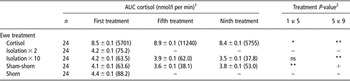
Ewes administered cortisol had a greater (P < 0.05) area under the cortisol response curve than all other ewes at each measurement period (Table 1). Repeated sham-shearing resulted in a decrease in area under the cortisol response curve between the first and fifth treatments; however, between the fifth and ninth treatments, cortisol responses tended to increase. The cortisol response of isolation × 10 ewes was similar during the first and fifth treatments and then decreased between the fifth and the ninth treatments, indicating that the ewes habituated to the stressor. Cortisol injection produced a greater (P < 0.05) response after the fifth treatment than after the first or ninth treatments.
Area under the cortisol response curve (AUC cortisol nmol/l per min) of ewes in the isolation × 2, isolation × 10 and sham-shorn and shorn on the first, fifth and ninth treatments (least squares mean ± s.e.)

1Data were loge transformed, untransformed means are presented in parentheses.
2ns indicates no significant difference between treatment events 1 and 5 or 5 and 9, +indicated P < 0.1; *indicates P < 0.05 and **indicates P < 0.01.
Ewe live weight
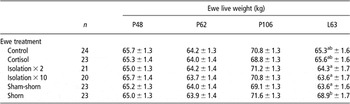
Ewe treatment had no effect on ewe live weight during pregnancy. In lactation (L63), ewes in the shorn treatment were heavier (P < 0.05) than ewes in the isolation × 2, isolation × 10 and sham-shorn treatments (Table 2), but they were not significantly different from ewes in the control group.
Live weight (kg) on days 48, 62 and 106 of pregnancy and day 63 of lactation of ewes in the control, cortisol, isolation × 2, isolation × 10, sham-shorn and shorn treatments (least squares mean ± s.e.)

a,bMeans within columns with different superscripts are significantly different (P < 0.05).
Shorn ewes had a greater (P < 0.05) weight gain (0.17 ± 0.02 kg/day) than ewes that were given cortisol (0.11 ± 0.02 kg/day) or sham-shorn (0.11 ± 0.02 kg/day) during the period between days 62 and 106 of pregnancy but did not differ from control, isolation × 2 or isolation × 10 ewes (0.15 ± 0.02, 0.16 ± 0.02 and 0.15 ± 0.02 kg/day, respectively).
Ewe condition scores
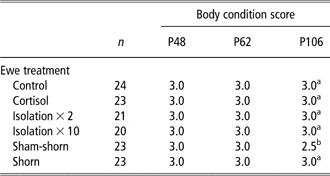
On day 106 of pregnancy, sham ewes had lower median (P < 0.05) body condition scores than ewes in all other treatments (Table 3).
Body condition scores on days 48, 62 and 106 of pregnancy of ewes in the control, cortisol, isolation × 2, isolation × 10, sham-shorn and shorn treatments (medians)

a,bMeans within columns with different superscripts are significantly different (P < 0.05).
Ewe gestation length and maternal behaviour
Ewe gestation lengths and ewe maternal behaviour scores at tagging of lambs did not differ between treatment groups (data not shown).
Lamb birth weight and size
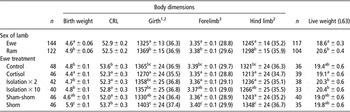
Ram lambs were heavier (P < 0.05) than ewe lambs at birth and at weaning and had a larger girth diameter and forelimb and hind limb lengths at birth (Table 4). In addition, ram lambs were heavier than ewe lambs on day 63 of lactation. Lambs born to shorn ewes were heavier (P < 0.05) at birth than lambs born to ewes in all other treatments. Lambs born to ewes administered cortisol were lighter (P < 0.05) than lambs born to ewes in all other treatments except lambs born to sham-shorn ewes. Lambs born to control and shorn ewes had longer (P < 0.05) crown rump lengths than all other lambs. The girth diameter of lambs born to cortisol ewes was shorter (P < 0.05) than all other lambs, except those born to sham-shorn ewes. Forelimb and hind limb lengths showed a similar pattern with lambs born to control and shorn ewes having longer (P < 0.05) limbs than lambs born to ewes in the cortisol, isolation × 2 and sham-shorn treatments. On day 63 of lactation, lambs born to ewes administered cortisol were lighter (P < 0.05) than lambs born to ewes in the isolation × 2 and isolation × 10 treatments.
Live weight (kg) at birth, crown to rump length (CRL), girth, forelimb and hind limb lengths (cm) of lambs born to ewes in the control, cortisol, isolation × 2, isolation × 10, sham-shorn and shorn treatments (least squares means ± s.e.)

1Lambs born dead were excluded from the analysis.
2Data χ 2 transformed, untransformed means are presented in parentheses.
3Loge transformed, untransformed means are presented in parentheses.
a,b,cMeans within columns with different superscripts are significantly different (P < 0.05).
Discussion
The results of this study add to the growing body of evidence that links mid-pregnancy shearing with increases in lamb birth weight (Keady and Hanrahan, Reference Keady and Hanrahan2009). The birth weight response from shearing observed in this study allows the role of chronic stress, as a potential mechanism for the birth weight response, to be tested. However, it is important to first exclude other potential mechanisms. Gestation length, as reported in previous studies (Kenyon et al., Reference Kenyon, Morris, Revell and McCutcheon2003 and Corner et al., Reference Corner, Kenyon, Stafford, West and Oliver2006), did not differ between ewe groups. Although not measured, ewe feed intake has been eliminated as a cause of the increase in lamb birth weight (Kenyon et al., Reference Kenyon, Morris, Revell and McCutcheon2003). In this study, differences were not observed between shorn and control ewes in live weight, change in live weight or body condition score, between days 48 and 106 of pregnancy, which are proxy measures suggestive that there was no difference in ewe intakes.
A single exposure to stressors that are commonly associated with shearing, for example, handling, fasting, crutching and sham-shearing, has been shown not to induce an increase in birth weight (Corner et al., Reference Corner, Kenyon, Stafford, West and Oliver2006 and Reference Corner, Kenyon, Stafford, West and Oliver2007a). Similarly, in this study, repeated sham-shearing and isolation failed to increase lamb birth weights. Plasma cortisol was measured as an indicator of the physiological stress response. In all treatment groups, cortisol was elevated after treatment, thus indicating that ewes experienced a stress response. It should be noted that in this study, treatments were conducted either in the morning or early afternoon, and therefore direct comparisons of ewe cortisol responses to treatment should be made with caution due to the circadian rhythm of cortisol secretion in the sheep (Fulkerson and Tang, Reference Fulkerson and Tang1979). The absence of an increase in birth weight in response to the isolation, sham-shearing and cortisol suggests that repeated stress was not the mechanism for the increase in lamb birth weight resulting from mid-pregnancy shearing. This observation is further supported by reported plasma cortisol responses to shearing, which show that cortisol returns to baseline concentrations within 60 min of shearing (Hargreaves and Hutson, Reference Hargreaves and Hutson1990; Corner et al., Reference Corner, Kenyon, Stafford, West and Oliver2007a) or 3 days after shearing when sheep were kept at 2°C to 13°C (Pierzchala et al., Reference Pierzchala, Bobek, Niezgoda and Ewy1983). Therefore, it appears that the repeated stressors employed did not adequately simulate the physiological changes associated with shearing.
The development of a management regimen that utilises a stressor to induce the birth weight response, without having to expose ewes to winter shearing and potentially death due to hypothermia, seems unlikely. Further work is warranted to determine the mechanism for the birth weight response to mid-pregnancy shearing. The obvious mechanism is a response to cold stress. However, thyroid hormone manipulation alone failed to increase lamb birth weight (Kenyon et al., Reference Kenyon, Sherlock, Parkinson and Morris2005). In addition, a birth weight response has consistently been observed under winter housed conditions (Dyrmundsson, Reference Dyrmundsson1991) and under summer/autumn pastoral conditions (de Nicolo et al., Reference de Nicolo, Kenyon, Morris, Morel and Wall2008), and therefore cold stress does not appear to be the driving mechanism.
Roussel et al. (Reference Roussel, Hamsworth, Boissy and Davaux-Ponter2004) observed that maternal isolation stress resulted in an increase in lamb birth weight; however, this was not observed in this study. Roussel et al. (Reference Roussel, Hamsworth, Boissy and Davaux-Ponter2004) reported that ewes had decreased plasma cortisol concentrations in response to successive exposures to isolation, thus indicating habituation to the stressor. This is consistent with this study, in which a reduction in plasma cortisol response to isolation was observed between the fifth and ninth treatments. However, the study of Roussel et al. (Reference Roussel, Hamsworth, Boissy and Davaux-Ponter2004) utilised primiparous ewes selected based on their cortisol response to isolation before treatment (low v. high reactivity), while in this study, mixed aged multiparous ewes were randomly selected from a commercial flock. These studies also differed in the breed of ewe used, with the Romney breed in this study and a Merino and Border Leicester cross in the study of Roussel et al. (Reference Roussel, Hamsworth, Boissy and Davaux-Ponter2004). The Merino is a highly gregarious breed that flock together when disturbed (Lynch et al., Reference Lynch, Hinch and Adams1992), while in preparation for parturition, hill breed ewes such as the Romney are more likely to seek isolation than Merinos (Dwyer and Lawrence, Reference Dwyer and Lawrence2005). Therefore, isolation may be a greater stressor for the primiparous Merino × Border Leicester ewes than the mixed-age Romney ewes.
Cortisol administration was given as a positive control to determine if elevated maternal cortisol concentrations in mid- to late pregnancy resulted in greater lamb birth weight. However, cortisol administration was observed to decrease lamb birth weight. The dose administered in this study was based on the study of Jobe et al. (Reference Jobe, Newnham, Moss and Ikegami2003), which observed that hydrocortisone administration on day 124 of pregnancy did not alter foetal weight on day P131. The rise in plasma cortisol reported by Jobe et al. (Reference Jobe, Newnham, Moss and Ikegami2003) was similar to the rise in plasma cortisol observed in response to mid-pregnancy shearing (Corner et al., Reference Corner, Kenyon, Stafford, West and Oliver2007a). However, in this study, the cortisol response observed in the cortisol-administered ewes was far greater than that observed in mid-pregnancy shorn ewes. The cause for this difference in unclear.
Conclusion
Mid-pregnancy shearing was observed to increase lamb birth weight in agreement with previous studies. However, exposing ewes to isolation, sham-shearing or artificially elevated maternal cortisol concentrations did not produce a similar response. Therefore, it appears that either these alternative repeated stressors do not adequately simulate the stress response to shearing or that the chronic stress associated with mid-pregnancy shearing was not the mechanism for the observed birth weight response. These results suggest that it would be difficult to devise a management system for winter pregnant ewes, which utilises a stressful event to achieve a birth weight effect without the removal of the fleece.
Acknowledgements
The authors would like to acknowledge the financial assistance of Massey University and the National Research Centre for Growth and Development. This study also benefited from the assistance of Graeme Poole and Dean Burnham.