Nomenclature
- AM
-
additive manufacturing
- HAZ
-
heat-affected zone
- L-DED
-
laser-directed energy deposition
- R
-
fatigue loading ratio (minimum load/maximum load)
- SEM
-
scanning electron microscopy
- 300M/300M
-
L-DED deposited 300M steel onto 300M substrate
- Δt
-
cooling time between deposited layers
1.0 Introduction
Additive manufacturing (AM) continues to gain significant attention in the aerospace industry, as maturing technologies allow for the creation of new lightweight designs with enhanced functionality [Reference Liu, Wang, Sparks, Liou, Newkirk and Brandt1]. This not only extends to new aircraft, but also to existing ones, with AM technologies providing a major avenue for lowering sustainment costs by reducing the need for spare parts, increasing aircraft readiness and improving the flexibility of supply chains [Reference Kundu, Jones, Peng, Matthews, Alankar, Raman and Huang2]. One area for enhanced sustainability is the refurbishment of damaged components through laser directed energy deposition (L-DED) [Reference Liu, Wang, Sparks, Liou, Newkirk and Brandt1, Reference Kanishka and Acherjee3]. This process uses a laser beam to locally melt a target substrate and build up additional material by delivering pneumatically blown powder to the melt-pool. In repair, damaged regions of existing component are machined out and then replaced by the deposited material. This is highly advantageous compared to traditional subtractive repair, as the restoration of load bearing area allows for structural repairs to be carried out, while also being compatible with modern component design where little excess material is available for removal.
The high cost of aerospace components, long lead times in production, and significant financial and operational losses associated with grounded aircraft makes aerospace a key market for additive repair. Indeed, a comprehensive review of over 440 articles found aviation to be the largest industrial sector for the deployment of the additive repair, making up 35% of sector specific publications [Reference Kanishka and Acherjee3]. Major success has been found in the repair of worn turbine blades and blisks [Reference Nowotny, Scharek, Beyer and Richter4–Reference Richter, Orban and Nowotny6], with excellent performance from titanium [Reference Choi, Sun, Liu, Brandt and Qian7] and nickel-based superalloys [Reference Chaurasia, Jinoop, Paul, Bindra, Balla and Bontha8]. Unique adaptations to L-DED further allow for the repair of single crystal blades without inducing new grain orientations [Reference Chen, Lu, Luo, Lai and Liu9, Reference Liu and Qi10]. The repair of ultra-high strength steels for landing gear applications have also attracted much interest, with repairs conducted using 4,340 [Reference Da Sun, Liu, Brandt, Luzin, Cottam, Janardhana and Clark11], 420SS [Reference Da Sun, Fabijanic, Barr, Liu, Walker, Matthews, Orchowski, Easton and Brandt12], Aermet100 [Reference Lourenço, Da Sun, Sharp, Luzin, Klein, Wang and Brandt13, Reference Walker, Lourenço, Sun, Brandt and Wang14], and 300M [Reference Barr, Da Sun, Easton, Orchowski, Matthews and Brandt15, Reference Barr, Rashid, Da Sun, Easton, Palanisamy, Orchowski, Matthews, Walker and Brandt16]. Repair of 300M is of particular concern for several reasons. Firstly, the extreme tensile strength of 2,000MPa comes at the cost of fracture toughness, which places the steel at great risk of crack propagation from fatigue and impact with foreign objects during take-off and landing. Second, 300M is highly prone to corrosion if left unprotected, as it lacks the additional alloying elements used in modern stainless steels. Finally, as few steels can match the strength of 300M, it is one of the primary steels used in landing gear and thus presents a high volume of potentially damaged parts.
Given the low fracture toughness of 300M, ensuring the L-DED process does not induce additional defects is of great concern. Poorly optimised deposits can be prone to cracking, lack of fusion defects and inter-run porosity between tracks and layers [Reference Zhong, Gasser, Schopphoven and Poprawe17], while other defects such as gas pores and unmelted powders can persist even with optimised parameters. Both gas pores and unmelted powders were found to be the primary initiator of fatigue failure in repaired 300M coupons [Reference Barr, Rashid, Da Sun, Easton, Palanisamy, Orchowski, Matthews, Walker and Brandt16], particularly when located close to the surface. Unmelted powders can be trapped when plunging into the melt-pool and caught by the rapidly advancing solidification front. The finer gas pores may have several origins, either caused by powder interactions with the melt-pool [Reference Ahsan, Bradley and Pinkerton18], entrained porosity in the feed powders [Reference Ahsan, Bradley and Pinkerton18], vaporisation due to excessive laser power [Reference Svetlizky, Zheng, Buta, Zhou, Golan, Breiman, Haj-Ali, Schoenung, Lavernia and Eliaz19] or the evolution of dissolved gasses [Reference Svetlizky, Zheng, Buta, Zhou, Golan, Breiman, Haj-Ali, Schoenung, Lavernia and Eliaz19]. A third, much larger type of gas pore was also identified in the above study, which were suggested to be caused by the build-up of oxides between layers due to the limited gas shielding supplied by the deposition nozzle. This follows the results of two different steel powders with different oxygen contents, with high oxygen (5,300ppm) resulting in significant porosity and limited mechanical performance, while the low oxygen case (280ppm) showed no porosity and good performance [Reference Dong, Kang, Xie, Chi and Peng20].
Given the major negative effects of the large gas pores on tensile [Reference Dong, Kang, Xie, Chi and Peng20] and fatigue behaviour [Reference Barr, Rashid, Da Sun, Easton, Palanisamy, Orchowski, Matthews, Walker and Brandt16], this study seeks to confirm the role of oxygen on their formation and its influence on other defects. To eliminate potential oxidation between deposited layers, this study utilises chamber-based argon shielding to purge environmental oxygen from the deposition process. The chamber shielded samples will be compared to the locally shielded equivalent and the subsequent differences in tensile and fatigue performance explored.
2.0 Materials and methods
300M is a martensitic ultra-high strength steel with very little alloy content. Quench and tempered plates of 300M with dimensions of 70 × 70 × 20mm were prepared for tensile specimens, with gas atomised metal 300M powder with a size range of 50–100μm sieved for the feed material. Two different powder batches were used during testing, as long-term powder storage may lead to oxygen contamination over time. Existing quantities of 300M supplied by Sandvik Ltd was used for locally shielded specimens, while a new batch of 300M powder supplied by Carpenter Technology was used for the chamber shielded specimens. The chemical compositions of the substrate and metal powders are shown in Table 1.
300M substrate composition and feed powder compositions for the local and chamber shielding specimens

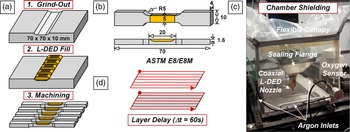
The L-DED repair process is shown in Fig. 1(a), while the intended tensile specimen dimensions are shown in Fig. 1(b). Substrates were slotted along the centre to a depth of 1.8mm with a blend radius of 6mm and sandblasted ready for deposition. L-DED was conducted on a TRUMPF TruLaser Cell 7020 system using a 3.0kW disk laser (λ = 1,030nm) and coaxial laser cladding head with motorised optics for spot size control. The spot size was set at 1.3mm, with deposited tracks spaced by 0.65mm (i.e. 50% overlap). Deposition was carried out using 800W laser power, a scan rate of 1,050mm/min. Powder was delivered at 4.6g/min using a helium gas at a flow rate of 10L/min. Localised nozzle shielding was provided using argon gas at a flow rate of 16L/min. A specially constructed enclosure was also used to provide chamber shielding to select samples (Fig. 1(c)), which was initially purged of oxygen to below 10ppm and maintained using an argon flow rate of 10L/min and supplemented by the 16L/min nozzle gas.
Overview of the L-DED repair testing, showing (a) summary of the repair process, (b) tensile sample dimensions, (c) scan path for deposition and (d) argon chamber setup.

Deposition was restricted only to where the mechanical specimens were to be machined, with a raster pattern used to deposit an area of 25 × 10mm. A 60 second delay between layers was used to facilitate the in-situ tempering of the 300M deposit (as shown in Fig. 1(d)) [Reference Barr, Da Sun, Easton, Orchowski, Matthews and Brandt15], as bulk heat treatment of repaired components should be avoided. Deposition was continued until at least three layers were present above the original surface. These layers were machined away, along with the top 0.2mm of the surface to ensure that 40% of the cross-section contained deposited material, and that all untempered martensite in the top layers was removed.
Tensile specimens were prepared in accordance with ASTM E8/E8M with testing performed on a 250kN MTS machine equipped with a laser extensometer, using a strain rate of 10-3 s-1. Tested specimens were sectioned perpendicular to the loading direction to observe the microstructure behind the fracture surface, with the specimens polished to a 1μm finish before being etched with a 3% Nital solution for metallographic examination. Macrostructures and fracture surfaces were observed using optical microscopy (Olympus BX-61) and scanning electron microscopy (SEM, Phillips XL30).
3.0 Results and discussion
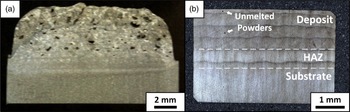
Oxygen shielding is necessary to avoid largescale defects in L-DED processed steels, with the macrostructure of a non-shielded specimen shown in Fig. 2(a), where severe porosity is present. Both locally shielded and chamber shielded specimens are effective at eliminating such defects, with the two strategies producing macrostructures similar to Fig. 2(b). The alternating bands of dark and light etching correlate to successive cycles of in-situ tempering with each layer, with darker etching corresponding to tempering at higher temperature, thereby exhibiting lower hardness [Reference Barr, Da Sun, Easton, Orchowski, Matthews and Brandt15]. The similarity in tempering is related to the shared thermal history between the two deposition strategies. The difference in shielding environment is unlikely to have a major impact in this regard, as heat conduction through the large substrate block is likely to account for the majority of heat dissipation, particularly with the layer delay. The groove geometry also limits the area available to convection, further reducing the impact of environment type.
Effect of shielding on sample macrostructure, with (a) the cross-section of an un-shielded 300M deposit, and (b) repaired 300M/300M with local shielding, which shows the same features as chamber shielding.

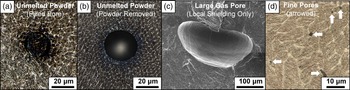
While deposition was optimised, some isolated defects remained as shown in Fig. 3. Unmelted powders were a common defect for both shielding types with sizes up to 50μm. These were found in either a partially fused state (Fig. 3(a)) or as spherical pores if removed during cross-sectioning (Fig. 3(b)). This occurs when powders plunge into the melt-pool and rapidly solidify when encountering the edges of the melt-pool. Given local shielding protects the region directly below the coaxial nozzle, it is difficult for chamber shielding to provide further protection against this type of defect. Very large gas pores up to 300μm in length are only found in locally shielded samples at the interface between tracks and layers (Fig. 3(c)), similar to the pores in the unshielded specimen. Combined with the purple discolouration with local shielding, such pores are a likely result of oxidation, as they were not present with chamber shielding. The formation of large pores is also likely to be a rare event compared to unmelted powders, as they were only revealed on the fracture surfaces of tested specimens. Despite this, their appearance in the fracture surfaces suggest they can have a significant deleterious effect on mechanical behaviour. Finally, very fine pores (<1μm) were also found with both shielding types, but do not appear to have a distinct cause. Such pores may be related to the entrapment of gasses during deposition regardless of shielding type [Reference Ahsan, Bradley and Pinkerton18], with bubbles unable to escape to the surface due to strong Marangoni flow in the meltpool [Reference Chouhan, Aggarwal and Kumar21].
Common defects in the repaired samples including, (a) filled and (b) unfilled pores related to unmelted powders, (c) very large gas pores found in the fracture surfaces of a locally shielded fatigue samples [Reference Barr, Rashid, Da Sun, Easton, Palanisamy, Orchowski, Matthews, Walker and Brandt16] and (d) very fine pores found with both shielding types.

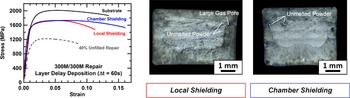
The tensile results are shown in Fig. 4(a), with both shielding types exhibiting the same strength but with increased ductility in the chamber shielded specimen. Studies on AM 300M reveal that different deposition parameters, scan paths and AM technologies can lead to variations in tensile properties [Reference Barr, Rashid, Da Sun, Easton, Palanisamy, Orchowski, Matthews, Walker and Brandt16, Reference Jing, Huang, Yang and Wang22]. This is due to differences in peak temperature during deposition, resulting in samples with higher heat inputs over-softening during in-situ tempering and exhibiting lower strength. As discussed above, the thermal history is expected to be near identical for both shielding types, which should lead to similar strength. The only difference between the shielding types is ductility, which in turn is strongly influenced by the type and number of defects present in the samples. The corresponding fracture surfaces in Fig. 4(b)–(c) show both samples displaying ductile fracture with well-developed shear lips. While unmelted powder defects are revealed for both surfaces, the locally shielded specimens are known to contain large gas pores, which may suggest other oxide related defects. Such defects may be sufficient to initiate earlier fracture compared to the unmelted powder defects, which were present in both samples. Reduced ductility through defects is a common theme for AM materials, with their elimination seen as a key means for improving performance [Reference Sanaei and Fatemi23]. While further work is underway to examine how the different compositions affect tensile behaviour, it is possible that the high temperature softening of 300M is more significant than the strength imparted by additional carbon above 0.30 wt.%, again leading to similar strength.
Tensile results for 300M/300M samples, showing stress strain behaviour and corresponding fracture surfaces.

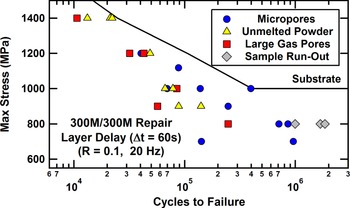
The presence of defects has larger implications for fatigue performance in AM materials, which have shown to be the key initiator of failure in locally shielded 300M repairs [Reference Barr, Rashid, Da Sun, Easton, Palanisamy, Orchowski, Matthews, Walker and Brandt16]. Figure 5 shows a summary of the different defect types on fatigue life for local shielding. As seen, large gas pores have the most detrimental effect on fatigue life, followed closely by unmelted powder defects. Although chamber shielding can eliminate the large pores, the continued presence of unmelted powders remains problematic for chamber shielding, with alternative strategies required for their removal. Further investigation is underway to characterise the effect of chamber shielding on fatigue performance, as the enhanced ductility of the tensile specimens suggests that fatigue behaviour may also be improved.
Influence of defects on the fatigue performance for locally shielded 300M/300M repairs [Reference Barr, Rashid, Da Sun, Easton, Palanisamy, Orchowski, Matthews, Walker and Brandt16], with the worst performance linked to large gas pores that are eliminated with chamber shielding. Unmelted powder defects are still problematic for chamber shielding.

4.0 Conclusions
Chamber shielding is shown to be an effective method for improving the ductility of L-DED repaired 300M, though strength remains the same as the locally shielded samples. The equivalent strength for both shielding strategies is related to similar thermal histories experienced during deposition, which act to heat treat the deposit without need for further processing. Large gas pores are found in locally shielded specimens are confirmed to be related to oxidation, as they can be eliminated via chamber shielding leading to improved ductility. Despite this, fine pores and unmelted powder defects remain, which require further optimisation of the L-DED process to eliminate. This is important for fatigue applications, as unmelted powder defects show similar deleterious effects on fatigue life as the large gas pores from oxidation.
Acknowledgements
This paper includes research that was supported by DMTC Limited (Australia). The authors have prepared this paper in accordance with the intellectual property rights granted to partners from the original DMTC project. The authors acknowledge the use of facilities within the RMIT Advanced Manufacturing Precinct, as well as the RMIT Microscopy and Microanalysis Facility for its support and thank the staff for their support.