Introduction
Despite decades of research, schizophrenia and related psychotic disorders remain among the most debilitating disorders in medicine (Tandon et al. Reference Tandon, Keshavan and Nasrallah2008). Retrospective studies from the 1980s redirected attention to the fact that patients with schizophrenia often showed early, less severe manifestations of the illness for, on average, 5 years before the onset of full psychosis (Häfner et al. Reference Häfner, Maurer, Loffler and Häfner)1995; Häfner & an der Heiden, Reference Häfner and an der Heiden1999). This period has been termed the ultra-high-risk phase or, retrospectively, the prodromal phase of psychosis (Phillips et al. Reference Phillips, Leicester, O'Dwyer, Francey, Koutsogiannis, Abdel-Baki, Kelly, Jones, Vay, Yung and McGorry2002; Yung et al. Reference Yung, Phillips, Yuen, Francey, McFarlane, Hallgren and McGorry2003). Recent research has afforded greater importance to this phase. It has been asserted that treatment of the prodrome could prevent onset of the full disorder or ameliorate or delay the onset phase, as claimed by Sullivan in 1927: ‘I feel certain that many incipient cases might be arrested before the efficient contact with reality is completely suspended, and a long stay in institutions made necessary’ (Sullivan, Reference Sullivan1994).
To date, low-intensity or intermittent positive psychotic symptoms are often the most common inclusion criteria for the ultra-high-risk phase (Miller et al. Reference Miller, McGlashan, Woods, Stein, Driesen, Corcoran, Hoffman and Davidson1999, Reference Miller, McGlashan, Rosen, Somjee, Markovich, Stein and Woods2002; Broome et al. Reference Broome, Woolley, Tabraham, Johns, Bramon, Murray, Pariante, McGuire and Murray2005a ; Yung et al. Reference Yung, Yuen, McGorry, Phillips, Kelly, Dell'Olio, Francey, Cosgrave, Killackey, Stanford, Godfrey and Buckby2005). Despite the unquestionable importance of these symptoms and their great pragmatic value, many authors have stressed the importance of examining psychopathological and phenomenological descriptions for more precise identification of individuals at risk of imminent psychosis (Parnas et al. Reference Parnas, Møller, Kircher, Thalbitzer, Jansson, Handest and Zahavi2005; Davidsen, Reference Davidsen2009; Nelson et al. Reference Nelson, Fornito, Harrison, Yücel, Sass, Yung, Thompson, Wood, Pantelis and McGorry2009a ,b; Parnas, Reference Parnas2011; Raballo & Larøi, Reference Raballo and Larøi2011). This need was explained by Nelson et al. (Reference Nelson, Yung, Bechdolf and McGorry2008) who, in line with Parnas' position (Parnas, Reference Parnas2005) regarding current operational criteria for the assessment of prodromal patients, stated: ‘it is not the symptoms as such that put an individual at risk but the underlying or core disturbance of psychotic vulnerability’, otherwise it would be like ‘predicting extreme heat by an increase in temperature, without identifying the fire that might be causing this change’. To contribute to ongoing research regarding detection of increased risk for psychosis, in this study we aimed to investigate a subtle and subjective psychopathological feature: interpersonal sensitivity.
The importance of interpersonal relationships and their influence on both personality development and psychopathology present challenges to researchers. An outstanding aspect of interpersonal interactions is interpersonal sensitivity, a personality trait described as excessive awareness of both the behaviour and feelings of others (Boyce & Parker, Reference Boyce and Parker1989). Highly interpersonally sensitive individuals are extremely sensitive to interpersonal interactions, perceive self-deficiencies in relation to others and behave in such a way as to minimize the risk of negative evaluation (Davidson et al. Reference Davidson, Zisook, Giller and Helms1989, Reference Davidson, Giller, Zisook and Overall1988). High interpersonal sensitivity was also found to be closely linked to low self-confidence, feelings of insecurity, and low self-esteem (Boyce & Parker, Reference Boyce and Parker1989). This personality trait was first conceptualized as a set of symptoms occurring both as a consequence of depression and as a vulnerability for the development of depression (Boyce et al. Reference Boyce, Parker, Barnett, Cooney and Smith1991; Boyce & Mason, Reference Boyce and Mason1996). Early studies indicated high interpersonal sensitivity and problems with self-confidence as being among the subjective symptoms and observable behavioural changes occurring during the prodromal phase of schizophrenia (Subotnik & Nuechterlein, Reference Subotnik and Nuechterlein1988; Häfner et al. Reference Häfner, Riecher-Rössler, Hambrecht, Maurer, Meissner, Schmidtke, Fätkenheuer, Löffler and van der Heiden1992; Hambrecht et al. Reference Hambrecht, Häfner and Loffler1994). More recent studies have confirmed an association between interpersonal sensitivity and persecutory ideations among ultra-high-risk and non-clinical samples (Valmaggia et al. Reference Valmaggia, Freeman, Green, Garety, Swapp, Antley, Prescott, Fowler, Kuipers, Bebbington, Slater, Broome and McGuire2007; Green et al. Reference Green, Freeman, Kuipers, Bebbington, Fowler, Dunn and Garety2011). Examining interpersonal sensitivity during the prodromal phase of psychosis may also be valuable because of its potential links with dysfunctional coping strategies. Since the early work of Falloon & Talbot (Reference Falloon and Talbot1981), it is generally accepted that coping may serve to diminish threat experiences or other psychotic symptoms and augment controllability. This may only be true for specific coping strategies, such as problem-solving strategies or integration, which can reduce distress (Dittmann & Schuttler, Reference Dittmann and Schuttler1990) and are associated with positive outcome. Less adaptive coping strategies may contribute to negative outcomes such as diminished quality of life and poor social functioning (Tait et al. Reference Tait, Birchwood and Trower2004). A functional sense of self or identity may facilitate coping efforts and has been posited as an important resilience factor in recovery from psychosis (Davidson & Strauss, Reference Davidson and Strauss1992). Feelings of insecurity and negative self-evaluation may encourage development of maladaptive coping strategies (Bernstein et al. Reference Bernstein, Cohen, Velez, Schwab-Stone, Siever and Shinsato1993), such as passivity and avoidance (Tait et al. Reference Tait, Birchwood and Trower2004), which could contribute to functional and social deterioration in ultra-high clinical risk individuals. A recent study found that people at ultra-high clinical risk of psychosis showed a greater reliance on maladaptive, passive coping strategies, which are associated with a higher level of negative symptoms, depression and anxiety (Lee et al. Reference Lee, Kim, Park, Park, Kim, Kang, Lee, An and Kwon2011). In line with these findings, Lin et al. (Reference Lin, Wigman, Nelson, Vollebergh, van Os, Baksheev, Ryan, Raaijmakers, Thompson and Yung2011) found that emotion-oriented coping (i.e. avoidance, escape) was associated with subclinical psychotic symptoms in a general population adolescent sample.
Greater knowledge concerning interpersonal sensitivity could enhance our understanding of the role of subjective and non-specific symptoms occurring during the prodromal phase of psychosis and their relationship with other psychopathological and behavioural features.
Aims of the study
The aims of the present study were: (i) to assess interpersonal sensitivity in a sample of individuals with an at-risk mental state (ARMS), compared to matched control participants; (ii) to explore, in both samples, the relationship between interpersonal sensitivity and prodromal symptoms of psychosis; (iii) to study, in both samples, the relationship between interpersonal sensitivity and coping; and (iv) to explore, in both samples, the relationship between interpersonal sensitivity and negative emotional states such as depression, anxiety and stress.
On the basis of previous research examining the relationship between interpersonal sensitivity, low self-esteem, feelings of insecurity, dysfunctional sense of identity and mental illness (Davidson et al. Reference Davidson, Reichenberg, Rabinowitz, Weiser, Kaplan and Mark1999; Larsen et al. Reference Larsen, Bechdolf and Birchwood2003; Tait et al. Reference Tait, Birchwood and Trower2004), we hypothesized that individuals with an ARMS would report higher interpersonal sensitivity than control participants and that this personality trait would be associated, in both samples, with positive prodromal symptoms, specifically paranoid ideation (Valmaggia et al. Reference Valmaggia, Freeman, Green, Garety, Swapp, Antley, Prescott, Fowler, Kuipers, Bebbington, Slater, Broome and McGuire2007; Green et al. Reference Green, Freeman, Kuipers, Bebbington, Fowler, Dunn and Garety2011). Moreover, we hypothesized that highly interpersonally sensitive individuals would report increased use of avoidant coping strategies and higher levels of negative emotional states (depression, anxiety and stress).
Method
Participants
There were 101 participants in this study: 62 with an ARMS and 39 healthy controls. People at high risk for psychosis were recruited through Outreach and Support in South London (OASIS), a clinical service for help-seeking young people, aged 14–35 years, at risk for psychosis (with an ARMS) (Broome et al. Reference Broome, Woolley, Johns, Valmaggia, Tabraham, Gafoor, Bramon and McGuire2005b ). The ARMS was evaluated using the Com-prehensive Assessment of At-Risk Mental States (CAARMS; Yung et al. Reference Yung, Yuen, McGorry, Phillips, Kelly, Dell'Olio, Francey, Cosgrave, Killackey, Stanford, Godfrey and Buckby2005). OASIS clients were referred from local general practitioners, schools and colleges, social and faith groups, adolescent and adult mental health services or self-referred. All clients are offered psychological (cognitive behaviour therapy, CBT) and/or pharmacological treatment for a maximum period of 2 years. Healthy control participants, from the same geographic region matched for age, gender and ethnicity to the ARMS group, were recruited using the following methods: searching on the MindSearch research volunteer database (www.mindsearch.iop.kcl.ac.uk); approaching people who had previously taken part in research studies at the Institute of Psychiatry; and asking existing control participants to give details of the study to any friends who might also be interested in taking part. The following inclusion criteria were used: participants aged between 18 and 35 years, lived (or grew up) in South London, and no personal history of mental health problems.
Research ethics approval was obtained from the National Research Ethics Service (Appendix 4.3 Ethics REC no. 08/H0722/45). Participants provided written informed consent prior to commencement of the study.
Measures
Sociodemographic and psychosocial variables were recorded during a clinical assessment using a non-standardized questionnaire modelled on the Census 2001 collection form, named the First Contact with OASIS Questionnaire.
To measure interpersonal sensitivity, we used the Interpersonal Sensitivity Measure (IPSM; Boyce & Parker, Reference Boyce and Parker1989), a 36-item self-report questionnaire. Self-statements are rated on a four-point scale (1=very unlike self, 4=very like self). The scale generates a total score ranging from 36 to 144, with higher scores indicating greater interpersonal sensitivity, and five subscales scores: ‘Interpersonal awareness’ (seven items, range 1–28); ‘Need for approval’ (eight items, range 8–32); ‘Separation anxiety’ (eight items, range 8–32); ‘Timidity’ (eight items, range 8–32) and ‘Fragile inner self’ (five items, range 5–20). Previous research among a non-clinical sample reported a mean score of 93.2 for the IPSM total score, 18.7 for ‘Interpersonal awareness’, 26.0 for ‘Need for approval’, 18.1 for ‘Separation anxiety’, 20.6 for ‘Timidity’ and 9.7 for ‘Fragile inner self’ (Green et al. Reference Green, Freeman, Kuipers, Bebbington, Fowler, Dunn and Garety2011). The IPSM has been found to have good internal consistency (α values from 0.85 to 0.86), test–retest reliability (r=0.70) and correlation with clinical judgment ratings of interpersonal sensitivity (r=0.72).
To assess prodromal and psychotic symptoms, we used the Prodromal Questionnaire (PQ; Loewy et al. Reference Loewy, Bearden, Johnson, Raine and Cannon2005), a self-report screening questionnaire that aims to identify individuals who may benefit from a clinical diagnostic interview. The 92 true/false items can be divided into four major subscales: (1) positive symptoms (e.g. unusual thinking and perceptual abnormalities); (2) negative symptoms (e.g. flat affect and social isolation); (3) disorganized symptoms (e.g. odd behaviour); and (4) general symptoms (e.g. depression and diminished role functioning). A score of eight or more positive symptoms on the PQ has been found to differentiate between individuals without an ARMS and those with prodromal or psychotic syndrome diagnoses with 90% sensitivity, 49% specificity, 78% positive predictive value and 69% negative predictive value.
We also used the Ways of Coping Questionnaire (WCQ; Folkman & Lazarus, Reference Folkman and Lazarus1985), a 66-item self-report questionnaire containing a broad range of coping and behavioural strategies that people can use to manage internal or external demands of stressful situ-ations (Folkman et al. Reference Folkman, Lazarus, Gruen and DeLongis1986b ). Responses are rated on a four-point Likert scale (0=not used, 3=used a great deal). The WCQ comprises eight subscales (Folkman et al. Reference Folkman, Lazarus, Dunkel-Schetter, DeLongis and Gruen1986a ): ‘Confrontive coping’ (six items, range 0–18); ‘Distancing’ (seven items, range 0–21); ‘Self controlling’ (seven items, range 0–21); ‘Seeking social support’ (six items, range 0–18); ‘Accepting responsibility’ (four items, range 0–12); ‘Escape-Avoidance’ (eight items, range 0–24); ‘Planful problem-solving’ (six items, range 0–18); and ‘Positive reappraisal’ (seven items, range 0–21). The WCQ has been used extensively in clinical and non-clinical samples, and the stability of its factor structure, its reliability and validity have been the subject of intense scrutiny, indicating good reliability and validity (Parker et al. Reference Parker, Endler and Bagby1993).
Finally, we used the Depression Anxiety Stress Scales (DASS; Lovibond & Lovibond, Reference Lovibond and Lovibond1995), a 42-item instrument consisting of three subscales measuring current symptoms of depression, anxiety and stress. Each of the subscales consists of 14 items with a 0–3 scale (0=did not apply at all to me, 3=applied to me very much). Participants are asked to rate the extent to which they experienced each state over the past week. Higher scores indicate increased levels of emotional distress. Subscale scores range from 0 to 42 and total scores range from 0–126. The scale's reliability and validity has been demonstrated in a large UK non-clinical sample (Crawford & Henry, Reference Crawford and Henry2003).
Statistical analysis
Descriptive statistics including mean and standard deviation values for continuous variables and absolute and relative frequencies for categorical variables were calculated. Group differences in categorical variables were examined using the χ2 test. Mann–Whitney U tests were conducted to explore the impact of the ARMS on interpersonal sensitivity (as measured by the IPSM), endorsement of escape/avoidant coping (as measured by the WCQ subscale), negative affectivity (as measured by the DASS) and positive prodromal symptoms (as measured by the PQ positive symptoms subscale).
Spearman's rank-order correlation coefficients (r s) were calculated to examine associations between interpersonal sensitivity, positive prodromal symptoms, negative affectivity and escape/avoidance coping according to group membership. Spearman's partial correlations were computed to explore the relationship between interpersonal sensitivity and prodromal positive symptoms of psychosis while controlling for depressive symptoms (as measured by the DASS). The level of statistical difference was set at p<0.05 and all reported significance values were two-tailed. Statistical analyses were performed using SPSS version 18 (SPSS Inc., USA).
Results
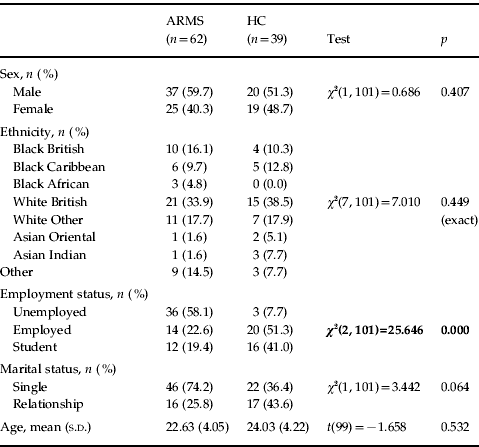
A total of 62 individuals with ARMS for psychosis and 39 healthy control participants were included in the present study. Sociodemographic characteristics of the sample are presented in Table 1. There were no significant differences between groups in age, sex, ethnicity and marital status. ARMS employment status differed significantly from healthy controls [χ2(2, 101)=25.646, p<0.001]: a greater number of participants with ARMS were unemployed (n=36, 58.1%) relative to control participants (n=3, 7.7%).
Sociodemographic characteristics of the sample

ARMS, At-risk mental state; HC, healthy controls; s.d., standard deviation.
Bold values indicate significant results.
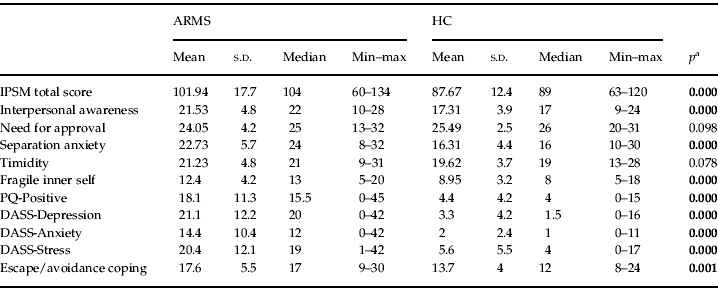
As illustrated in Table 2, there were statistically significant differences between groups in IPSM total score (U=577.0, p<0.001), interpersonal awareness (U=592.0, p<0.001), separation anxiety (U=474.5, p<0.001) and fragile inner self (U=644.5, p<0.001). There were also statistically significant differences between participants at ultra-high clinical risk for psychosis and controls in depression (U=203.0, p<0.001), anxiety (U=241.0, p<0.001) and stress (U=335.5, p<0.001) DASS subscales scores. A significant difference in escape/avoidance WCQ subscale median scores between groups was also found (U=537.0, p=0.001). Groups significantly differed in median PQ positive symptom subscale scores (U=314.0, p<0.001), with ARMS reporting significantly higher levels of positive psychotic symptoms (median=15.5) than control participants (median=4).
Comparisons between participants with ARMS and controls with regard to self-report measures
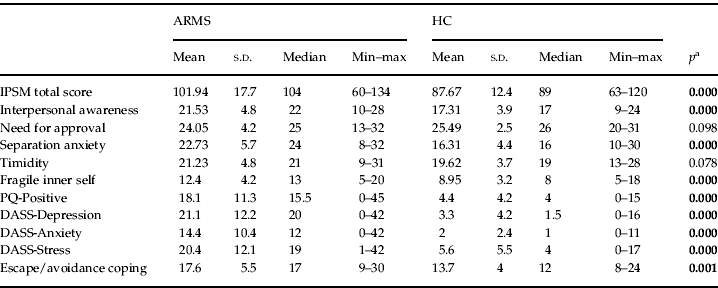
ARMS, At-risk mental state; HC, healthy controls; s.d., standard deviation; IPSM, Interpersonal Sensitivity Measure; PQ, Prodromal Questionnaire; DASS, Depression and Anxiety Stress Scale.
Bold values indicate significant results.
a Mann–Whitney U test.
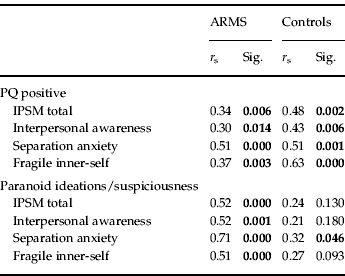
The relationship between symptoms and questionnaire scores are shown by group in Table 3. Higher sensitivity to interpersonal interactions, anxiety about separation from significant others and sense of having an inner or core self that is unlikeable and needs to be hidden from others were all associated with higher numbers of positive prodromal symptoms. Three PQ items specifically address the presence of paranoid ideation and suspiciousness (PQ25: ‘I often feel that other people have it in for me’; PQ68: ‘I often pick up hidden threats or put-downs from what people say or do’; PQ77: ‘I'm often concerned that my closest friends, classmates or co-workers are not really loyal or trustworthy’). The higher the interpersonal awareness (r s=0.52, p=0.001), separation anxiety (r s=0.71, p<0.001), fragile inner self (r s=0.51, p<0.001) and total IPSM (r s=0.52, p<0.001) scores among ultra-high clinical risk participants, the higher the level of paranoid ideas and suspiciousness. A significant association between separation anxiety subscale score and paranoid/suspiciousness was also found among control participants (r s=0.32, p<0.05).
Correlations between IPSM and PQ positive symptoms subscale (by group)
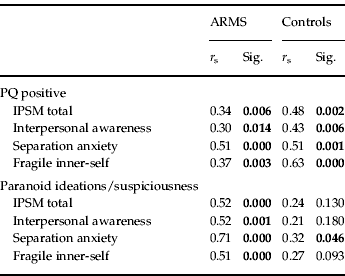
ARMS, At-risk mental state; IPSM, Interpersonal Sensitivity Measure; PQ, Prodromal Questionnaire; Sig., significance.
Bold values indicate significant results.
Spearman's partial correlations were computed to explore the relationship between interpersonal sensitivity and prodromal positive symptoms of psychosis while controlling for depressive symptoms (as measured by the DASS). The degree of association between IPSM total scores and PQ positive symptoms subscale scores were no longer statistically significant after controlling for depression.
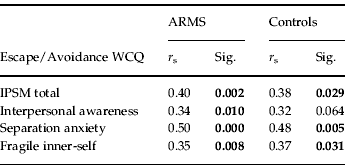
Among both at-risk and control participants, statistically significant positive correlations were found between IPSM scores, DASS subscales scores and escape avoidant coping. Among participants with an ARMS, total IPSM score (r s=0.40, p<0.01), interpersonal awareness (r s=0.34, p<0.01), separation anxiety (r s=0.50, p<0.01) and fragile inner self (r s=0.35, p<0.01) were significantly positively correlated with escape/avoidance WCQ subscale scores. Only total IPMS score (r s=0.38, p<0.05), separation anxiety (r s=0.48, p<0.01) and fragile inner self (r s=0.37, p<0.05) subscale scores were correlated with escape/avoidance coping among control participants (Table 4).
Correlations between IPSM and escape/avoidance WCQ subscale (by group)
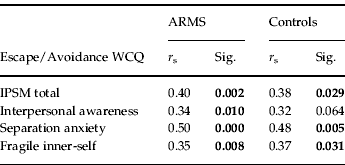
ARMS, At-risk mental state; IPSM, Interpersonal Sensitivity Measure; WCQ, Ways of Coping Questionnaire; Sig., significance.
Bold values indicate significant results.
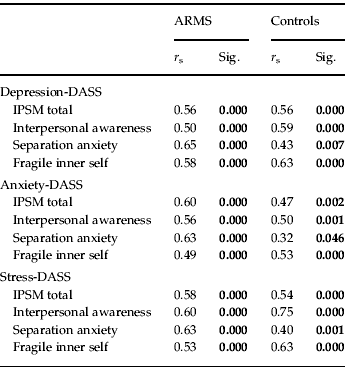
Among both at-risk and control participants, total IPSM score and interpersonal awareness, fragile inner self and separation anxiety subscales scores were significantly correlated with depression, anxiety and stress measures (Table 5).
Correlations between IPSM and DASS (by group)
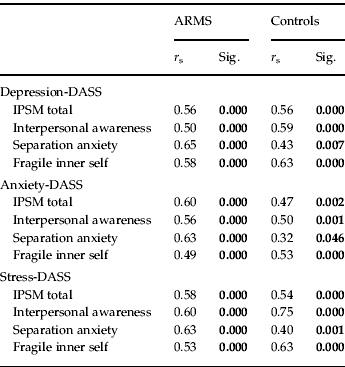
ARMS, At-risk mental state; IPSM, Interpersonal Sensitivity Measure; DASS, Depression and Anxiety Stress Scale; Sig., significance.
Bold values indicate significant results.
Discussion
This study explored interpersonal sensitivity among a sample with an ARMS relative to healthy control participants. Before discussing the results, it is important to note that the study was cross-sectional and therefore it is impossible to infer causality. Without longitudinal follow-up data we cannot draw any conclusion on whether interpersonal sensitivity is a predictive or an independent factor for the transition from an ARMS to first-episode psychosis.
In line with our first research hypothesis, we found that individuals with an ARMS scored higher on all IPSM subscales compared to control participants. IPSM scores of participants with an ARMS were similar to those reported by individuals with major depression (Luty et al. Reference Luty, Joycea, Muldera, Sullivan and McKenzie2002). Control participants' IPSM scores were similar to those reported within previous general population studies (Otani et al. Reference Otani, Suzuki, Ishii, Matsumoto and Kamata2008; Green et al. Reference Green, Freeman, Kuipers, Bebbington, Fowler, Dunn and Garety2011). Interpersonal sensitivity was first proposed as a vulnerability factor for depression (Boyce et al. Reference Boyce, Parker, Barnett, Cooney and Smith1991; Boyce & Mason, Reference Boyce and Mason1996; Sato et al. Reference Sato, Narita, Hirano, Kusunoki, Sakado and Uehara2001; Luty et al. Reference Luty, Joycea, Muldera, Sullivan and McKenzie2002). Retrospective studies have consistently documented the relatively high frequency of non-specific symptoms, such as depression, anxiety, social isolation and educational difficulties prior to the onset of schizophrenia (Yung & McGorry, Reference Yung and McGorry1996a ,b; Häfner & an der Heiden, Reference Häfner and an der Heiden1999). Lencz et al. (Reference Lencz, Smith, Auther, Correll and Cornblatt2004) conducted a prospective study focusing on negative and non-specific pre-psychotic symptoms showing that individuals at ultra-high clinical risk for psychosis reported depressed mood, anxiety and decline in school functioning about as commonly as positive symptoms. Addington et al. (Reference Addington, Epstein, Liu, French, Boydell and Zipursky2011) found that a high percentage of individuals with an ARMS had co-morbid diagnoses of major depressive disorder and anxiety disorder, suggesting depression as a primary presentation coexistent with and independent from prodromal symptoms of psychosis. Wigman et al. (Reference Wigman, Lin, Vollebergh, van Os, Raaijmakers, Nelson, Baksheev and Yung2011) also showed that subclinical psychosis and depression are inter-related phenomena that strongly co-occur in time, but longitudinally; one does not predict change in the other. Other researchers have hypothesized that depressive symptoms in ultra-high-risk individuals may be due to dysphoria and distress secondary to the recent onset of psychotic experiences (Birchwood et al. Reference Birchwood, Meaden, Trower, Gilbert and Plaistow2000; Demjaha et al. Reference Demjaha, Valmaggia, Stahl, Byrne and McGuire2010). In line with these studies, our results have demonstrated that interpersonal sensitivity, in both participants with an ARMS and healthy controls, is correlated to negative emotional states, such as depression, but also to positive prodro-mal symptoms. Previous research has demonstrated an association between interpersonal sensitivity and persecutory ideation among non-clinical samples (Free-man et al. Reference Freeman, Dunn, Garety, Bebbington, Slater, Kuipers, Fowler, Green, Jordan and Ray2005, Reference Freeman, Gittins, Pugh, Antley, Slater and Dunn2008; Green et al. Reference Green, Freeman, Kuipers, Bebbington, Fowler, Dunn and Garety2011). Valmaggia et al. (Reference Valmaggia, Freeman, Green, Garety, Swapp, Antley, Prescott, Fowler, Kuipers, Bebbington, Slater, Broome and McGuire2007) also found that paranoid ideation in people with an ARMS was predicted by a high level of interpersonal sensitivity. Similarly, this study found that the higher the sensitivity to interpersonal interactions, anxiety about separation from significant others and the sense of having an inner or core self that is unlikeable and needs to be hidden from others, the higher the level of paranoid ideation. However, as noted above, this research was cross-sectional and therefore it was not possible to evaluate whether interpersonal sensitivity predicted the paranoid thinking in our samples. This finding is in line with cognitive models of positive symptoms of psychosis, in which negative beliefs about the self as fragile and vulnerable to threat may lead to a tendency to attribute experiences as externally caused and in turn facilitate the formation and maintenance of paranoid ideation (Garety et al. Reference Garety, Kuipers, Fowler, Freeman and Bebbington2001). It has also been suggested that paranoid thoughts may build upon interpersonal anxieties and worries such as fear of rejection (Freeman et al. Reference Freeman, Dunn, Garety, Bebbington, Slater, Kuipers, Fowler, Green, Jordan and Ray2005). Trower & Chadwick's (Reference Trower and Chadwick1995) model distinguished between two types of paranoia: persecution (or ‘poor me’) and punishment (or ‘bad me’) paranoia. Consistent with this theory, individuals who experienced ‘bad me’ paranoia reported significantly lower self-esteem and increased depression compared to ‘poor me’ paranoid people (Chadwick et al. 2005). An et al. (Reference An, Kang, Park, Kim, Lee and Lee2010) also found a possible association between low self-esteem and depression and severity of paranoia among individuals with an ARMS. The finding of high levels of interpersonal sensitivity and its correlation with negative affectivity and paranoid ideations in the ARMS in the present study is more consistent with ‘bad me’ paranoia, in which paranoia is based on negative self-evaluation and others' malevolence is seen as a justified and deserved punishment for one's own inadequacies. However, a previous study reported that people with persecutory delusions who are in the initial stages of psychosis do not tend to show ‘bad me’ paranoia (Fornells-Ambrojo & Garety, Reference Fornells-Ambrojo and Garety2009). In our study, after controlling for the potential effect of depression, the correlation between interpersonal sensitivity and positive symptoms (including paranoid ideation items) was no longer statistically significant, indicating that there may be a mediating effect of depressive symptoms on the relationship between interpersonal sensitivity and positive prodromal symptoms. This suggests that the previously reported association between interpersonal sensitivity and paranoid thinking in ARMS (Valmaggia et al. Reference Valmaggia, Freeman, Green, Garety, Swapp, Antley, Prescott, Fowler, Kuipers, Bebbington, Slater, Broome and McGuire2007) may be explained by the presence of depressive symptoms. We might tentatively conclude that individuals with an ARMS may have a more preserved ‘affective core’ (i.e. interpersonal sensitivity and depressive symptoms) that may be characterized, at least in part, by negative self-evaluation, personal responsibility for badness/inadequacy and a sense of deserving mistreatment (‘bad me’ paranoia). Indivi-duals who have crossed the psychosis threshold may show more blunted affectivity and detachment from others, psychopathological features described as ‘primary symptoms’ of schizophrenia by Bleuler (Reference Bleuler1911), which may more easily result in ‘poor me’ persecutory paranoia.
In line with our second research hypothesis we found a significant positive correlation between interpersonal sensitivity and avoidant coping strategies (as measured by the escape/avoidance WCQ subscale), both in participants with an ARMS and healthy controls. These findings are in accordance with previous research reporting an association between interpersonal sensitivity and maladaptive problem-solving styles (McCabe et al. Reference McCabe, Blankstein and Mills1999). Social withdrawal, habituation or adaptation to illness, and ‘self-treatment’ with alcohol or drugs may constitute part of avoidant ways of coping used by young people when confronting stressful encounters. Some of the escape/avoidant WCQ subscale items reflected these responses: ‘avoided being with people in general’; ‘tried to make myself feel better by eating, drinking, smoking, using drugs or medications’; ‘refused to believe that it had happened’; ‘slept more than usual’. We found that personality traits characterized by negative sense of self and feelings of insecurity were associated with the use of avoidant coping strategies. Examining this association, particularly in relation to changes in social functioning among at-risk individuals, may be a valuable area of future research. It is well known that adolescents often struggle to achieve an integrated and coherent sense of self, consolidating the many different aspects of their private and social persona. The current findings suggest increased levels of inner-self fragility among those with an ARMS. Perceived self-deficiencies in relation to others, feelings of a fragile and bothersome core-self and paranoid ideation may contribute to social anxiety and isolation (Freeman et al. Reference Freeman, Gittins, Pugh, Antley, Slater and Dunn2008). Increased knowledge concerning the possible causes of impaired social functioning is crucial, considering that social withdrawal is the most commonly reported symptom by individuals with an ARMS (Lencz et al. Reference Lencz, Smith, Auther, Correll and Cornblatt2004), and is an important factor related to transition from the prodromal phase to frank psychosis (McGlashan et al. Reference McGlashan, Addington, Cannon, Heinimaa, McGorry, O'Brien, Penn, Perkins, Salokangas, Walsh, Woods and Yung2007). Lee et al. (Reference Lee, Kim, Park, Park, Kim, Kang, Lee, An and Kwon2011) argued that individuals who relied on maladaptive coping strategies might be more depressed, anxious and, as a consequence, more likely to avoid social interactions. Avoidant behaviours, such as social withdrawal, may constitute part of the negative symptom profile of psychosis, a consequence of low mood and lack of drive, and/or may result from suspiciousness and paranoia; however, in all of these cases, they may reflect the presence of troubles and difficulties in interpersonal relationships.
With regard to the relationship between interpersonal sensitivity and negative emotional states, we found a statistically significant correlation between fragile inner self, separation anxiety and interpersonal awareness and all three DASS subscales (depression, anxiety, and stress). This result is in line with previous researches (Boyce et al. Reference Boyce, Parker, Barnett, Cooney and Smith1991; Boyce & Mason, Reference Boyce and Mason1996) that showed that interpersonal sensitivity was both a consequence of depression and a vulnerability for the development of depression. Another study, investigating the relationship between interpersonal sensitivity and anxiety disorders, also found differential associations with specific anxiety disorders (Wilhelm et al. Reference Wilhelm, Boyce and Brownhill2004). As argued by Clarke & Watson (1991), anxiety and depression share a component called ‘negative affectivity’, which reflects the experience of subjective distress and unpleasurable engagement, manifested in emotional states such as guilt, anger and nervousness. On the one hand, pervasive feelings of insecurity, low self-esteem and hyper-attentiveness to the reactions and behaviours of others are personality traits that may contribute to emotions such as anger or nervousness and could be related to the development of negative emotions. On the other hand, depression, anxiety or distress could exacerbate the sensitivity to interpersonal interactions and feelings of having a fragile core self. Thus, a vicious cycle may arise between interpersonal sensitivity and negative emotional states that may result, together with avoidant coping strategies, in difficulties in social interactions or social isolation. Assessing levels of interpersonal sensitivity and planning targeted psychotherapeutic interventions during the ARMS for psychosis, focused on producing a more unified and integrated sense of self, as suggested by Nelson et al. (Reference Nelson, Sass and Skodlar2009b ), or focused on investigating the deeper nucleus of this self-core fragility may be helpful in combating potential difficulties in interpersonal relationships.
Finally, it is important to underline the possible affinity between the notion of interpersonal sensitivity, the object of our research, and the phenomenological model of self-disturbance, defined by some authors as the core clinical feature of schizophrenia spectrum disorders (Parnas & Handest, Reference Parnas and Handest2003; Sass & Parnas, Reference Sass and Parnas2003) and found to be present also in adolescents at risk of psychosis (Davidsen, Reference Davidsen2009). In particular, the hyper-reflectivity aspect of this model (defined as ‘an increase in the tendency to reflect about one's own thinking, feelings and behaviour, and inability to react and behave spontaneously and carefree; a tendency to excessively monitoring inner life, while at the same time interacting in the world’; Parnas et al. Reference Parnas, Møller, Kircher, Thalbitzer, Jansson, Handest and Zahavi2005) may have some similarities to interpersonal awareness and fragile inner self aspects of interpersonal sensitivity. This is confirmed by a recent study that showed that disturbance of the basic sense of self may underlie the social cognition and interpersonal difficulties present in psychotic disorders (Nelson et al. Reference Nelson, Sass, Thompson, Yung, Francey, Amminger and McGorry2009c ).
Limitations
Our results should be interpreted in view of the limitations of this study. As mentioned earlier, a major limitation is the lack of follow-up data to evaluate whether interpersonal sensitivity is a predictive, or independent, factor for the transition from an ARMS to first-episode psychosis. In future studies we intend to explore the correlations between baseline interpersonal sensitivity level and long-term outcomes in terms of psychopathology and social functioning. A further limitation was that paranoia and depression were not assessed using specific and diagnostic instruments, but rather using PQ (a screening instrument for prodromal symptoms) and DASS (a measure of current negative emotional states) scores. A final limitation was that all assessments were made by self-reported questionnaires rather than by clinical interviews; this weakens the strength of the results because it is possible that participants misinterpreted some questions.
Conclusions
We found that ‘hypersensitivity’ to interpersonal interactions was a subjective psychological feature manifest during the ARMS for psychosis and distinguished ultra-high-risk participants from controls. Furthermore, interpersonal sensitivity was related to negative emotional states such as depression, anxiety and stress and avoidant coping strategies, such as social withdrawal and self-treatment with alcohol and drugs. It can be speculated that interpersonal sensitivity may play an active negative role in functional deterioration present in the pre-psychotic phase (Fusar-Poli et al. Reference Fusar-Poli, Byrne, Valmaggia, Day, Tabraham, Johns and McGuire2010) and contribute to poorer long-term functional outcomes. For this reason, addressing difficulties in interpersonal relationships and offering targeted psychotherapeutic interventions may usefully be included in early intervention treatment strat-egies. As the findings of this cross-sectional study were largely correlational, further research will be required to examine the relationship between interpersonal sensitivity and long-term outcomes of individuals at ultra-high clinical risk for psychosis and to assess whether interpersonal sensitivity may predict the clinical features of potential future psychosis.
Acknowledgements
Our special thanks go to the staff and service users of OASIS. Dr L. R. Valmaggia was supported by a National Alliance for Research on Schizophrenia and Depression (NARSAD) Young Investigator Award and by a Peggy Pollack Research Fellowship from the Psychiatry Research Trust. We acknowledge the National Institute for Health Research (NIHR) Biomedical Research Centre for Mental Health at the South London and Maudsley National Health Service (NHS) Foundation Trust and Institute of Psychiatry King's College London for their financial support.
Declaration of Interest
None.