The 2008 Democratic presidential nomination process was one of the most competitive in recent history, and the battle between Barack Obama and Hillary Clinton lasted until early June. This protracted nomination contest was unexpected; many observers anticipated that the nomination race would be over by Super Tuesday (February 5, 2008), given the increased amount of front-loading in the 2008 primary and caucus calendar (Tolbert and Squire Reference Tolbert and Squire2009). Although some observers may have welcomed the increased competition, this scenario is always worrisome to party leaders. The expenses mount, the barbs continue to fly, and the supporters of losing candidates often fail to support the party in November. Thus, the consequences of party divisiveness loom large.
PARTY DIVISIVENESS
Each party's nominee emerges from the national convention anxious to heal any wounds caused by bitter fights during the primary season, but the desired goal of party unity is often elusive. Many presidential campaigns have shown that pre-convention divisions within the party have persisted through the fall campaign. This study tests the divisive primary hypothesis by examining the general election behavior of primary and caucus voters in 2008. The assumption is that the hotly contested race for the Democratic presidential nomination in 2008 translated into increased levels of nonvoting and defection in the general election, despite the Obama victory in November.
The divisive primary hypothesis posits that many primary and caucus voters remain disgruntled or disappointed over the failure of their preferred candidate to win the party's nomination. This disgruntlement can be seen as nonideological in nature, or as a type of “sore loser” response among supporters of a certain candidate. Sullivan (Reference Sullivan1977–78) has noted the effect of the long preelection campaign in creating a psychological attachment of supporters to a candidate, which often makes it difficult for them to redirect their allegiance from a losing candidate to the party's nominee.
However, such defection could also arise from dissatisfaction with the policy preferences or ideological leanings of the party's nominee. One might find such responses among individuals who favor candidates from the outer wings of the party or candidates who wish to move the party in a new direction (Southwell Reference Southwell1986). The degree of intraparty competition and choice in the primary may seem to offer a meaningful choice of candidates to such individuals and provide an incentive for them to vote in the primary or caucus. Following the national convention, however, their disillusionment may cause them to abstain from or defect in the general election. Zipp (Reference Zipp1985) has argued that feelings of indifference or alienation toward candidates lead many Americans to refrain from voting. He suggests that the availability of options to the potential voter is a prime factor affecting whether or not one votes. Presumably, the absence of a candidate who expresses his or her interests may lead an individual to refrain from voting in the general election, precisely because he or she may have been attached to such a candidate in the primary or caucus stage of the campaign (Southwell Reference Southwell1986; Southwell Reference Southwell1994).
Ideological concerns could also be a factor in an individual's decision to defect to another party. If a presidential candidate is on the “inner edge” of his party (i.e., is a conservative Democrat or a liberal Republican), he or she is likely to be supported by individuals who are wavering between the two parties. Should this candidate fail to win the nomination, certain supporters may easily gravitate to the opposite party in the general election.
An additional option for the “disgruntled” primary or caucus voter may arise in the form of a third-party or independent candidate. Such a candidate offers the option of a protest vote in the general election. My earlier multielection analysis (Southwell Reference Southwell1986) suggests that the candidacies of George Wallace or John Anderson in 1968 and 1980, respectively, offered supporters of losing primary candidates a way to stay engaged in the electoral process after the convention. I argued that many of these Wallace and Anderson voters were anxious to move the party in new directions, and that desire may have become more important to them than a victory for their party in November. This type of vote in the general election becomes a form of protest, sometimes with little ideological or issue consistency. (See also Southwell Reference Southwell1994 and Southwell Reference Southwell2004 for similar responses to the candidacies of Perot and Nader.)
PREVIOUS RESEARCH
Initial empirical analysis centered on the effects of party divisiveness at the state level (Hacker Reference Hacker1965; Johnson and Gibson Reference Johnson and Gibson1974; Herrnson and Gimpel Reference Herrnson and Gimpel1995; Piereson and Smith Reference Piereson and Smith1975; Bernstein Reference Bernstein1977; Born Reference Born1981). Romero's (Reference Romero2003) analysis of U.S. House districts found that the “divisive primary penalty” is asymmetrical, applying in incumbent but not open-seat races. Lazarus's (Reference Lazarus2005) analysis of House primaries between 1976 and 1998 concluded that expectations about general election results cause primaries to be divisive. Similarly, Hogan (Reference Hogan2003) looked at legislative campaigns in nine states during the 1994 and 1996 election cycles. He found that primary divisiveness does affect general election outcomes, but in the opposite direction than anticipated. Greater divisiveness in a candidate's primary leads to a higher vote share in the general election.
Earlier analyses of the impact of divisiveness in the presidential contest have examined the behavior of party activists (Stone Reference Stone1986; Buell Reference Buell1986; Kenney and Rice Reference Kenney and Rice1987), states that experience divisive presidential primaries (Comer Reference Comer1976), and respondents in a national survey (Southwell Reference Southwell1986). These studies concluded that activists or voters who support a nomination loser are less likely to vote in the general election, but for that group which does vote, the amount of defection is not sufficient to impact the outcome. Lengle, Owen, and Sonner (Reference Lengle, Owen and Sonner1995) examined presidential elections from 1932 to 1992 and concluded that the Democratic Party suffered more in primary states than in caucus states. However, Stone, Atkeson, and Rapoport's (Reference Stone, Atkeson and Rapoport1992) analysis of caucus attendees in 1984 and 1988 found strong evidence of a mobilizing effect that can occur after a competitive race, even for supporters of nomination losers. Similarly, Atkeson (Reference Atkeson1998), who used both a state-by-state model and an election-year model, found that divisiveness has only a modest effect and does not appear to affect general election outcomes.
THE CONTEXT OF THE 2008 DEMOCRATIC NOMINATION
In the 2008 Democratic nomination race, the policy and ideological differences among Obama and his principal opponents, Clinton and Edwards, did not seem to be a major factor, given that “experience” and “change” were some of the main themes repeated throughout the winter and spring of 2008. Nor was there a viable third-party candidate to siphon off Democratic votes. Therefore, psychological attachment to these losing nominees, as discussed previously, is a more plausible explanation for the Democratic nomination race in 2008. The drawn-out primary season, the increasing negativity of the campaign, the uncertainty of the status of delegates from Florida and Michigan, and the widely fluctuating superdelegate commitments were all factors that created an atmosphere that was ripe for such divisiveness. Although Hillary Clinton pledged her support for the Obama/Biden ticket in June and appeared to deliver on this promise in her fall campaign activities, many of her backers expressed considerable disappointment at her failure to accomplish the historic feat of becoming the first female presidential nominee.Footnote 1 The remainder of this article examines the hypothesis that Hillary supporters, as well as other backers of failed candidacies, translated their disappointment into nonvoting or defection to the opposition party's candidate.
PRELIMINARY DATA ANALYSIS
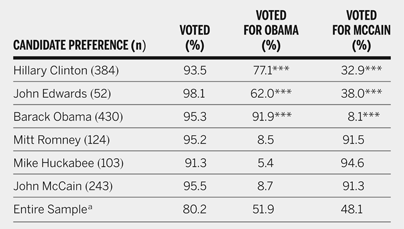
A preliminary look at the 2008 American National Election Study (ANES) data suggests that a very high percentage of primary voters or caucus attendees also voted in the general election, irrespective of their favored candidate for the party's nomination, as shown in table 1.Footnote 2 However, Clinton and Edwards supporters were much more likely to vote for Republican John McCain than were Obama backers. Nearly one-third of individuals who voted for Clinton or Edwards in the primary or caucus indicated that they voted for McCain in the general election. Republicans, in contrast, were much more unified in their support for their party's nominee.
General Election Behavior of 2008 Primary and Caucus Voters

Source: American National Election Studies 2009.
a 2,835 respondents; 2,445 voters
*** p < .001
MULTIVARIATE ANALYSIS
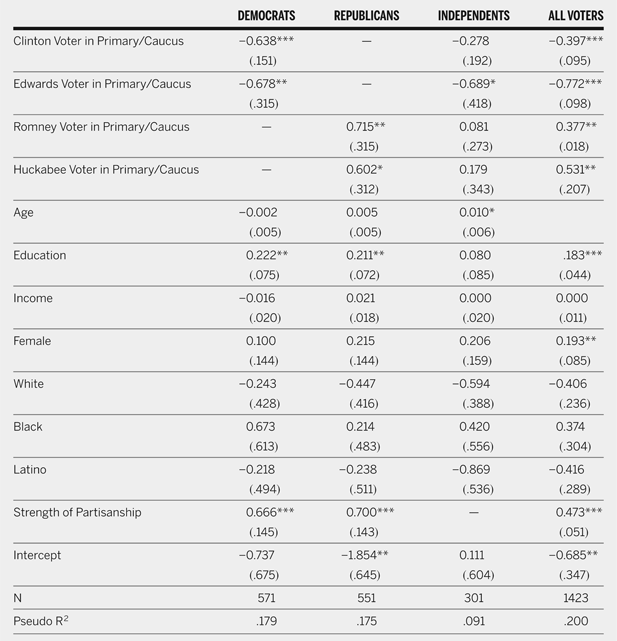
We used multivariate analysis to control for other factors, such as socioeconomic status, that also influence candidate preferences among primary or caucus voters. Our multivariate model also included age, education, income, race, sex, and partisan intensity, in addition to those variables indicating candidate preference.Footnote 3 We estimated a model with a dependent variable of “loyal party vote.” An individual was considered to be loyal if he or she voted in the general election for the candidate of the same party as his or her favored candidate in the primary or caucus, and disloyal if he or she defected to another party's candidate. Because the dependent variable is dichotomous, probit analysis was used to estimate the effect of each of these variables. The dummy variables for Obama and McCain supporters in the primary or caucus and the racial category of “Other” were excluded from this analysis. Maximum likelihood estimates (MLEs) are presented in table 2, separated along party lines.
Probit Analysis of Loyal Vote of 2008 General Election Voters

Source: American National Election Studies 2009. Values are maximum likelihood estimators, with standard errors in parentheses.
* p < .10;
** p < .05;
*** p < .001
The coefficients for the demographic variables suggest that strong partisans were more likely to be loyal to their party's nominee, as expected. Education also has a positive effect on loyalty, except for Independents. There is a weak relationship between age and loyal party vote for Independents, but, generally, demographic characteristics had little or no effect on loyal party vote.
Although the explanatory power of these four models is not particularly strong, the Democratic party appears to have been plagued by a considerable amount of disloyalty on the part of supporters of candidates who failed to win the nomination. Democrats who supported Clinton and Edwards in their primary or caucus were more likely to vote for John McCain.Footnote 4 In contrast, those individuals who voted for Huckabee or Romney in the primary or caucus were even more likely to vote for McCain than were McCain's own supporters in the nomination phase.
Although this research does not examine the ideological leanings of primary and caucus voters, these bifurcated results suggest that the defection among certain Clinton and Edwards supporters may have been the result of their more moderate stances on certain political issues, at least as perceived by the voters. For such individuals, McCain may have been preferable to Obama. However, Huckabee and Romney supporters, seeing no more conservative alternative to McCain, rallied behind his candidacy.
After McCain had virtually captured the Republican nomination in March of 2008, it is also possible that Republicans may have gravitated to the Democratic nomination race in open primary states and voted for Clinton or Edwards. Such individuals, however, were likely to return to the fold in the general election.
CONCLUSIONS
These findings suggest that hotly contested nominations can potentially damage the party in the general election, particularly in the case of the Democratic party. However, this party divisiveness clearly did not determine the winner in November, as was suggested by the earlier findings of Atkeson (Reference Atkeson1998), Southwell (Reference Southwell1986; Reference Southwell1994), and Ware (Reference Ware1979). Some scholars have suggested that such competitive races may actually help the party in the long run, because they help to mobilize young, less-educated, and low-income voters (Atkeson and Maestas Reference Atkeson and Maestas2009) or party activists (Stone, Atkeson, and Rapoport Reference Stone, Atkeson and Rapoport1992). From the standpoint of the two major parties, multicandidate races for the nomination may be less than desirable for the party, but the 2008 general election results suggest that this occurrence is an obstacle that can be overcome.