INTRODUCTION
The West Indian manatee (Trichechus manatus) is one of the four extant species within the mammalian order Sirenia, being divided into two subspecies: T. manatus latirostris (Florida manatee) (Harlan, 1824) and T. manatus manatus (Antillean manatee) (Linnaeus, 1758; Hatt, Reference Hatt1934). This species inhabits fresh, brackish and marine waters in the Wider Caribbean, from Florida to the north-eastern coast of South America. The Antillean manatee ranges from the east coast of Mexico and Central America to northern and north-eastern South America (Lefebvre et al., Reference Lefebvre, Marmontel, Reid, Rathbun, Domning, Woods and Sergile2001). The IUCN Red List of Threatened Species listed this marine mammal as ‘vulnerable’, in continuing decline, with severely fragmented populations (Deutsch et al., Reference Deutsch, Self-Sullivan and Mignucci-Giannoni2008). For both subspecies (Florida manatee and Antillean manatee) the category is ‘endangered’ (Deutsch, Reference Deutsch2008; Self-Sullivan & Mignucci-Giannoni, Reference Self-Sullivan and Mignucci-Giannoni2008).
Published estimates of Antillean manatee populations are few, because the Florida manatee is the subspecies more generally surveyed. The total population of the Antillean subspecies, based on crude estimates for the 20 range countries with year-round populations, was estimated at 6000 (Self-Sullivan & Mignucci-Giannoni, Reference Self-Sullivan, Mignucci-Giannoni, Hines, Reynolds, Aragones, Mignucci-Giannoni and Marmontel2012). A word of caution is in order, however, because as Marsh et al. (Reference Marsh, O'Shea and Reynolds2012) point out, most of the above data are based on anecdotal accounts.
In Brazil, manatees may have been an important source of animal protein in past centuries (Alvite & Lima, Reference Alvite, Lima, Hines, Reynolds, Aragones, Mignucci-Giannoni and Marmontel2012), although there are no data on the existing population during this period. The population decline of the Antillean manatee in Brazil, historically because of hunting, has intensified due to the continuous degradation of coastal and estuarine environments (Domning, Reference Domning1982; Parente et al., Reference Parente, Vergara-Parente and Lima2004; Borges et al., Reference Borges, Vergara-Parente, Alvite, Marcondes and Lima2007; Luna et al., Reference Luna, Lima, Araújo and Passavante2008; Meirelles, Reference Meirelles2008; Lima et al., Reference Lima, Paludo, Soavinski, Silva and Oliveira2011). The Antillean manatee was considered the most endangered aquatic mammal in Brazil (ICMBio, Reference Luna, Silva, Andrade, Marques, Normande, Velôso and Severo2011) and at present is categorized as ‘endangered’ by the Official List of Brazilian Fauna Threatened with Extinction (MMA, 2014).
Studies in the 1990s estimated 485 Antillean manatees along the northern and north-eastern coasts of Brazil, distributed in a discontinuous pattern between the states of Alagoas and Amapá (Luna et al., Reference Luna, Lima, Araújo and Passavante2008; Lima et al., Reference Lima, Paludo, Soavinski, Silva and Oliveira2011). Two abundance estimates were calculated for the north-eastern region: 278 (Lima, Reference Lima1997; Luna et al., Reference Luna, Lima, Araújo and Passavante2008) and 242 specimens (Lima et al., Reference Lima, Paludo, Soavinski, Silva and Oliveira2011). The methodology used in the three studies cited took into account the traditional knowledge of fishermen, which was based on the maximum number of live manatees sighted by each interviewee. These estimates are higher than the estimate of only 200 animals published by the IUCN, which did not include methodological details (Self-Sullivan & Mignucci-Giannoni, Reference Self-Sullivan and Mignucci-Giannoni2008). Nevertheless, each of these studies added new information to the understanding of Antillean manatee population trends in Brazil, albeit questionable in terms of the methodological and statistical approaches adopted.
Estimating the abundance of sirenians is essential for their conservation, and aerial surveys are one of the most suitable methods for monitoring manatee and dugong numbers in the world (Olivera-Gómez & Mellink, Reference Olivera-Gómez and Mellink2002, Reference Olivera-Gómez and Mellink2005; Wright et al., Reference Wright, Reynolds, Ackerman, Ward, Weigle and Szelistowski2002; Craig & Reynolds, Reference Craig and Reynolds2004; Preen, Reference Preen2004; Edwards et al., Reference Edwards, Pollock, Ackerman, Reynolds and Powell2007; UNEP, 2010; Langtimm et al., Reference Langtimm, Dorazio, Stith and Doyle2011; Reynolds et al., Reference Reynolds, Morales-Vela, Lawler, Edwards, Hines, Reynolds, Mignucci-Giannoni, Aragones and Marmontel2012; Bauduin et al., Reference Bauduin, Martin, Edwards, Gimenez, Koslovsky and Fagan2013). In Brazil, however, only one aerial survey has been conducted, with the aim of evaluating the distribution of Antillean manatees per a small geographic scale in the north-eastern state of Ceará (Costa, Reference Costa2006). Previous test flights had also been conducted by ‘Fundação Mamíferos Aquáticos’ in the 1990s, but the results were never published.
Aerial methods for abundance estimates are susceptible to spatial variation leading to availability bias (availability: probability of being available for detection, which is associated with the diving behaviour of each species and may vary in extensive and heterogeneous environments) and to imperfect detectability leading to perception bias (detectability: probability of an animal being detected, assuming it is available) (Pollock et al., Reference Pollock, Marsh, Lawler and Alldredge2006; Katsanevakis et al., Reference Katsanevakis, Weber, Pipitone, Leopold, Cronin, Scheidat, Doyle, Buhl-Mortensen, Buhl-Mortensen, D'Anna, de Boois, Dalpadado, Damalas, Fiorentino, Garofalo, Giacalone, Hawley, Issaris, Jansen, Knight, Knittweis, Kröncke, Mirto, Muxika, Reiss, Skjoldal and Vöge2012; Martin et al., Reference Martin, Edwards, Burgess, Percival, Fagan, Gardner, Ortega-Ortiz, Ifju, Evers and Rambo2012). Furthermore, this method can be logistically difficult and very expensive because it requires reliable aircraft, skilled pilots and trained observers (Reynolds et al., Reference Reynolds, Morales-Vela, Lawler, Edwards, Hines, Reynolds, Mignucci-Giannoni, Aragones and Marmontel2012).
The strip transect method is widely used in aerial studies of manatees and dugongs (Marsh & Sinclair, Reference Marsh and Sinclair1989; Lefebvre et al., Reference Lefebvre, Marmontel, Reid, Rathbun, Domning, Woods and Sergile2001; Olivera-Gómez & Mellink, Reference Olivera-Gómez and Mellink2002; Lanyon, Reference Lanyon2003; Marsh et al., Reference Marsh, Lawler, Kwan, Delean, Pollock and Alldredge2004; Hines et al., Reference Hines, Ulyanukosol and Duffus2005; Langtimm et al., Reference Langtimm, Dorazio, Stith and Doyle2011) because it is relatively easy to accomplish compared with distance sampling, another popular method. The latter, along with detection and counting of animals, requires simultaneous recording of distances perpendicular to the transect line (Marsh, Reference Marsh, O'Shea, Ackerman and Percival1995; Miller et al., Reference Miller, Ackerman, Lefebvre and Clifton1998; Pollock et al., Reference Pollock, Marsh, Lawler and Alldredge2006). For small or elusive species like manatees, this imposes additional difficulties (Lefebvre et al., Reference Lefebvre, Ackerman, Portier, Pollock, O'Shea, Ackerman and Percival1995).
This study aimed to apply the strip transect aerial methodology to estimate the abundance of Antillean manatees in a large-scale survey along the north-eastern coast of Brazil, and to assess the efficacy of an aerial survey in re-evaluating the conservation status of the Antillean manatee.
MATERIALS AND METHODS
Study area
The study included six states, covering roughly 1500 km (44%) of the 3400 km of Brazil's north-eastern coast. This area represents all the states in north-eastern Brazil in which the Antillean manatee occurs, except the state of Maranhão, which presents particular environmental characteristics (Luna et al., Reference Luna, Lima, Araújo and Passavante2008; Lima et al., Reference Lima, Paludo, Soavinski, Silva and Oliveira2011).
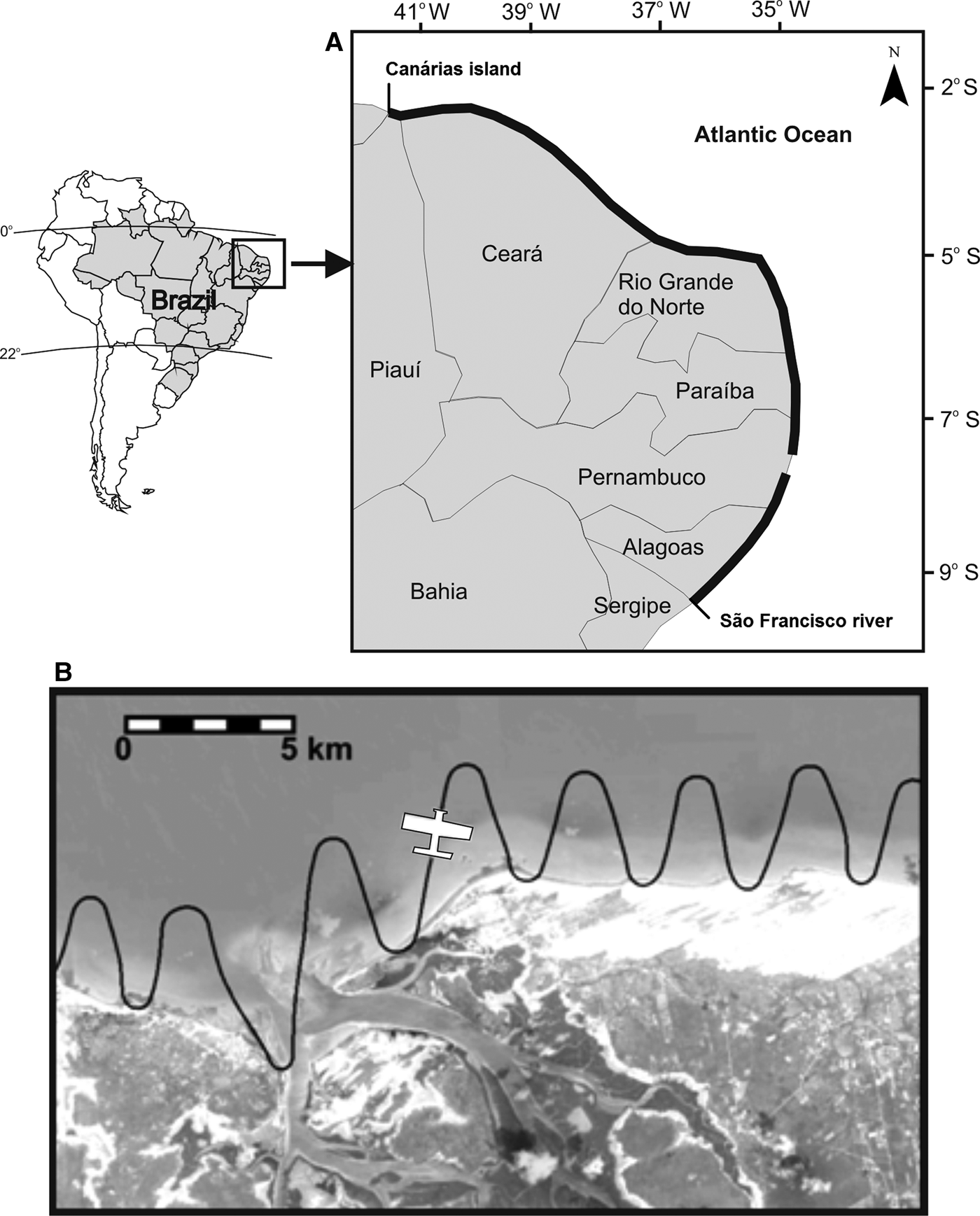
The study area extended to the Canárias island on the Parnaíba River mouth (Piauí state) to the north and the São Francisco River mouth (Alagoas state) to the south. A stretch of 22 km of coastline was not surveyed, due to traffic restrictions around Recife International Airport (Figure 1).
Study area between the states of Piauí and Alagoas, north-eastern Brazil (A). Aerial transects in a zigzag pattern in the estuarine mouth Delta do Rio Parnaíba (B).

The continental shelf of north-eastern Brazil ranges in width from 85 km in the north to 40 km in the south. The climate is tropical, with high temperatures (>24°C) (Muehe & Garcez, Reference Muehe and Garcez2005). Diversity in the coastal and estuarine environments includes beaches, dunes, coral reefs, mangrove forests and seagrass beds (Kempf et al., Reference Kempf, Coutinho and Morais1970; Oliveira-Filho et al., Reference Oliveira-Filho, Pirani and Giulietti1983; Castro & Pires, Reference Castro and Pires2001; Magalhães & Cazuza, Reference Magalhães and Cazuza2005), all of which are vulnerable to anthropogenic influences, especially urban development, tourism and fisheries (Cunha, Reference Cunha2005).
Aerial surveys
Aerial surveys were conducted using a single-engine, high-wing Cessna 172 A aircraft. To allow a wider viewing angle of the sea's surface, the plane was adapted with bubble windows at the rear (Zerbini et al., Reference Zerbini, Secchi, Danilewicz, Andriolo, Laake and Azevedo2010, Reference Zerbini, Danilewicz, Secchi, Andriolo, Flores, Cremer, Ferreira, Alves, Perez, Castro, Pretto, Sartori, Schulze, Denuncio and Laake2011). The team was comprised of two independent observers (Langtimm et al., Reference Langtimm, Dorazio, Stith and Doyle2011), positioned at each window, wearing polarized sunglasses to minimize perception bias; a recorder was placed in the front beside the pilot (Morales-Vela et al., Reference Morales-Vela, Olivera-Gómez, Reynolds and Rathbun2000). Two observers were already experienced in manatee observation; however, all observers were fully trained during a test flight (Alves et al., Reference Alves, Borges and Araújo2013a) to help reduce detection bias. The registrar used a global positioning system (GPS) to indicate all sighting points (latitude and longitude), in addition to the plane's GPS, which was used to record the aerial routes. The registrar also used nautical charts (1:300,000), two photographic cameras and a portable recorder to compile the field records.
Aerial surveys were performed using the strip transect method, consisting of a randomly selected fraction with known size from the total study area, with the assumption that all animals within the searched strip are detected and counted (Jolly, Reference Jolly1969). Transects were made in a zigzag pattern, perpendicular to the coast (Morales-Vela et al., Reference Morales-Vela, Olivera-Gómez, Reynolds and Rathbun2000; Hines et al., Reference Hines, Ulyanukosol and Duffus2005) (Figure 1B), with an angle of turn of 40°, to better cover the area and to maximize the flying effort (Cardona et al., Reference Cardona, Revelles, Carreras, Félix, Gazo and Aguilar2005; Andriolo et al., Reference Andriolo, Martins, Engel, Pizzorno, Más-Rosa, Freitas, Morete and Kinas2006, Reference Andriolo, Kinas, Engel, Martins and Rufino2010). Therefore, the surveyed areas transects were restricted from estuarine mouths (Figure 1) to 10−20 m isobaths.
The flights were standardized to an altitude of 150 m and an air speed of 140 km h−1, the minimum values for flight safety, and within the range found in other aerial surveys (Morales-Vela et al., Reference Morales-Vela, Olivera-Gómez, Reynolds and Rathbun2000; Olivera-Gómez & Mellink, Reference Olivera-Gómez and Mellink2005; Costa, Reference Costa2006; Langtimm et al., Reference Langtimm, Dorazio, Stith and Doyle2011). The widest sighting angle (approximately 65°) was determined with a clinometer during a test flight, which resulted in an accurate strip half-width of 321.7 m per observer (equal to a total strip width of 643.4 m) (Alves et al., Reference Alves, Borges and Araújo2013a).
Each area (A) had only a fraction searched (the strip of size a < A) to determine manatee density per square mile. Manatees detected within area ‘a’ were considered ‘on-effort’ and counted. Eventually, however, manatees were observed outside area ‘a’. Although not included in manatee counting for the purpose of density estimation, this ‘off-effort’ observation was valuable in defining its occurrence for this particular area A. A variable effort recount method (Lefebvre & Kochman, Reference Lefebvre and Kochman1991), consisting of a circular flight around the sighting point to confirm identification (Lefebvre et al., Reference Lefebvre, Ackerman, Portier, Pollock, O'Shea, Ackerman and Percival1995; Morales-Vela et al., Reference Morales-Vela, Olivera-Gómez, Reynolds and Rathbun2000; Langtimm et al., Reference Langtimm, Dorazio, Stith and Doyle2011), was applied in cases of doubtful sightings or imprecise specimen counts. All unconfirmed sightings were discarded. Calves corresponded to specimens measuring up to one-third adult size (Hartman, Reference Hartman1979). Two or more animals were defined as a group (Morales-Vela et al., Reference Morales-Vela, Olivera-Gómez, Reynolds and Rathbun2000).
Aerial surveys were conducted during mornings of the dry season to avoid incidence glare and to take advantage of generally light winds. High tide was chosen to reduce the possibility of confusing the manatees with reefs and algae sandstone substrates that are exposed at low tide (Costa, Reference Costa2006; Alves et al., Reference Alves, Borges and Araújo2013a, Reference Alves, Schwamborn, Borges, Marmontel, Costa, Schettini and Araújob). Under these favourable conditions, the animals’ access to shallow foraging areas (macroalgal banks and seagrass beds) and estuarine mouths (Paludo & Langguth, Reference Paludo and Langguth2002; Lanyon, Reference Lanyon2003; Hines et al., Reference Hines, Ulyanukosol and Duffus2005; Olivera-Gómez & Mellink, Reference Olivera-Gómez and Mellink2005; Langtimm et al., Reference Langtimm, Dorazio, Stith and Doyle2011) was facilitated. Sea conditions were Beaufort Sea state 2 or less, with absence of rain or mist (Lanyon, Reference Lanyon2003; Preen, Reference Preen2004).
Four visibility categories were defined based on water transparency across the landscape: 1 = excellent, manatees clearly visible, even when submerged; 2 = good, manatees visible when close to the water surface; 3 = medium, manatees visible only if a small part of the body was exposed on water surface (e.g. rostrum or caudal fin) and 4 = poor, manatees visible only if almost completely exposed on water surface. Due to high water turbidity inside portions of the estuaries (Alves et al., Reference Alves, Borges and Araújo2013a), rendering any recording under such conditions impossible, these areas were excluded from sampling to minimize detection bias, despite representing an environment widely used by the subspecies (Lima et al., Reference Lima, Paludo, Soavinski, Silva and Oliveira2011).
Aerial surveys were conducted between January and April 2010. The total coverage area was 2590.2 km2, calculated by strip transect width (643.4 m) and total linear distance travelled in zigzag. Each flight lasted less than 3 h per day. The effective effort exceeded 27 flight hours in 11 days.
Abundance estimate: structure data and statistical analysis
For estimating manatee abundance, a Bayesian approach was used (Craig & Reynolds, Reference Craig and Reynolds2004; Langtimm et al., Reference Langtimm, Dorazio, Stith and Doyle2011). Bayesian estimation (McCarthy, Reference McCarthy2007; Kinas & Andrade, Reference Kinas and Andrade2010) was chosen for two reasons: (a) statistical convenience in the case of a hierarchical model with a large number of latent variables and the associated elegant simplicity in deriving an abundance estimate as a posterior distribution; (b) the possibility of incorporating informative priors that reflect the already available ecological knowledge and may compensate for insufficient data.
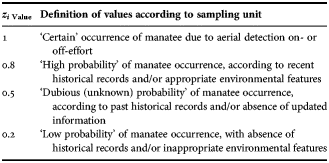
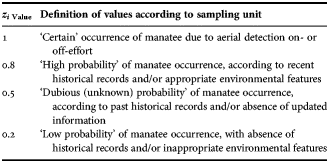
The statistical model employed used the following notations: region identifier index (i, where i = 1, 2 … 899), defined by sampling units of zig (coast–sea transect) and zag (sea–coast transect) coverage in m2; total area of region i (A i); area tracked by the observers in region i (a i, where a i < A i); number of manatees sighted on-effort in area a i (y i); visibility level (v i) based on water transparency; assigned parameter on the Bernoulli prior distribution for occurrence in region I (z_i), based on a priori records of sightings or strandings (Albuquerque & Marcovaldi, Reference Albuquerque and Marcovaldi1982; Parente et al., Reference Parente, Vergara-Parente and Lima2004; Costa, Reference Costa2006; Alves, Reference Alves2007; Luna et al., Reference Luna, Lima, Araújo and Passavante2008; Meirelles, Reference Meirelles2008; Lima et al., Reference Lima, Paludo, Soavinski, Silva and Oliveira2011), or observed individuals outside area a i (i.e. off-effort) during the survey (Figure 2, Table 1).
Figure representing parameters of statistical model used to analyse sightings of manatees (manatee drawing): i – identifier index of sampling units (numbers); A i – total area (rectangular spotted polygon), and a i – area tracked by observers (wavy band).
Criteria to determine parameters for the Bernoulli prior on occurrence (z values) of Antillean manatee in sampling units in north-eastern Brazil.
Latent variables and unknown model parameters were as follows: w i = latent variable indicative of occurrence (w i = 1) or absence (w i = 0) of manatee in region i; p[v i] = baseline expected probability to detect a manatee available in the on-effort searched strip at visibility v i; μ = expected number of manatees per unit of area (i.e. density); N i = total number of manatees in region i.
N = ΣiNi, manatee abundance in the region covered by the study (i.e. in area A = ΣiA i).
The hierarchical structure of the model starts with the Bernoulli distribution for the occurrence of manatee in a given region i, with imputed probability z i:
 $$w_i\sim{\rm Bern}\left({z_i} \right)$$
The number of manatees in region i is modelled by a Poisson distribution with mean conditional on manatee density (μ), area (A i) and effective occurrence (w i):
 $$N_i\sim{\rm Poi}\left(\mu {A_i}{w_i}\right)$$
Given the latent number of manatees (N i), the model to describe the number of detected individuals is binomial with detection probability p[v i] times the availability probability  ${a_i}A_i^{( - 1)} $:
 $$y_i \sim {\rm Bin}\left({N_i},\; p\left[v_i \right]{a_i}A_i^{- 1} \right).$$
The parameters to be estimated from this model are P = (p[v 1], p[v 2], p[v 3], p[v 4]), μ and total abundance N. Extra-data information was incorporated in two ways: by means of the z i variable that describes the probability of occurrence of manatees in the regions, and by means of informative prior distributions for p (probability of effective detection of manatee) and μ (mean density of manatees per km2). This information proved to be particularly useful in the study due to the reduced number of sightings, which rendered the flight data, in isolation, uninformative for estimating p and μ simultaneously. The models used a priori were:
 $${\rm ln}\left(\displaystyle{{\,p[\,j]} \over {1 - p[\,j]}} \right)\sim N(- 2.19,\; 1.0)\;{\rm for}\;j = 1,2,3,4$$
 $$\ln (\mu)\sim N( - 1.20,\; 0.32)$$
with N (a, b) indicating a Gaussian distribution with mean a and standard deviation b.
Three chains with different starting points were run using the R libraries rjags (Plummer, Reference Plummer2013) and R2jags (Su & Yajima, Reference Su and Yajima2012). Diagnostic tools to check for MCMC convergence and stationarity were applied (Plummer et al., Reference Plummer, Best, Cowles and Vines2006). A thinning of 10 was included to eliminate autocorrelation in the posterior sample of size 6000.
To evaluate model performance in estimating abundance, we simulated data using the proposed model so that posterior inference could be checked against known population parameters. Sensitivity to prior information was examined in two situations. First, we evaluated changes in the posterior distribution of manatee abundance by replacing all assigned values of z i < 1 with random draws from a non-informative uniform distribution U (0.1). Second, using the simulated data, we evaluated the effect on the posterior distribution for abundance by doubling variances in the prior distributions for μ and p.
Bayesian goodness-of-fit diagnostics were also performed by comparing observed data to 6000 simulated datasets from its predictive posterior distribution (McCarthy, Reference McCarthy2007). We evaluated the posterior empirical cumulative distribution function and the total number of on-effort counted manatees.
RESULTS
Prior specifications and abundance estimation
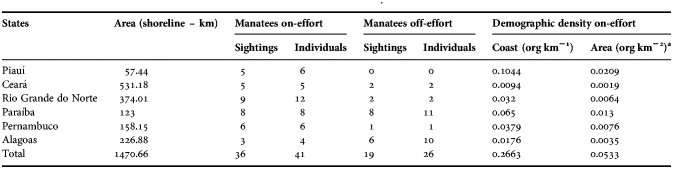
Thirty-six sightings and 41 individuals were recorded on-effort, with one calf sighted off Barreta beach (6°6′S 35°4′W), Rio Grande do Norte state; 19 sightings and 26 specimens were recorded off the transect area, with one calf sighted off Coqueirinho beach (7°26′S 34°45′W), Paraíba state (Figure 3). On four occasions, uncertain identification required additional circling around sightings; successful identification was achieved in three out of the four attempts.
Manatee sightings between Piauí and Alagoas states, during on-effort (manatee drawings) and off-effort (grey circle) periods. Black squares represent the capital or major coastal cities in each state.
Manatees occurred between the Miaí de Baixo beach (10°14′S 36°12′W) in Alagoas state and the estuarine mouth Delta do Rio Parnaíba in Piauí state (2°44′S 41°47′W). Despite the lack of sightings along the extensive coastline of Pernambuco, Rio Grande do Norte and Ceará states, aerial survey results expanded the subspecies’ known area of distribution, which now includes Iguape beach, Ceará (3°54′S 38°17′W) and Miaí de Baixo beach, in the southernmost portion of Alagoas (Figure 3).
On-effort manatee relative density was 0.26 org km−1 of coast and 0.05 org km−2 of area, considering the distance of 10 and 20 m isobaths of approximately 5 km offshore (Table 2). On-effort, the Antillean manatee density was at its highest in Piauí state, with five animals found within the estuarine complex of the rivers Timonha/Ubatuba and Cardoso/Camurupim (between 2°54′S 41°22′W and 2°53′S 41°29′W). The highest sightings and total manatee abundance (both on- and off-effort) were obtained for Rio Grande do Norte and Paraíba states, respectively (Table 2).
Occurrence of manatees on- and off-effort, and the demographic density by stretch of coast (DC = org km−1) and area (DA = org km−2) for each state on-efforta.
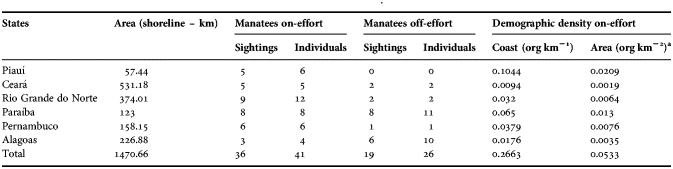
a Demographic density by area calculated based on distance of 5 km from coast.
Availability bias significantly affected animal detection, due to environmental variations throughout the survey area, as well as the morphological and behavioural characteristics that distinguish the Antillean manatee. These include their predominantly solitary habits (64.18% on- and off-effort), infrequent exposure on the water surface and cryptic colouration in turbid estuarine waters and sandstone substrate.
Wind conditions during on-effort manatee sightings were in accordance with proposed parameters, at levels between 0 and 2, with 52.78% (N = 19) of sightings at level 1. Water transparency in most of the sampled area was qualitatively characterized as either ‘good’ (N = 415) or ‘medium’ (N = 387). The most crystalline waters were detected predominantly on the southern coast of Pernambuco and the northern coast of Alagoas (between 8°24′S 34°57′W and 9°42′S 35°46′W). Turbid waters were detected in all estuarine mouths. Most of the 67 sighted manatees were detected under good conditions (40.3%; N = 27), followed by medium (26.86%; N = 18), excellent (20.9%; N = 14) and poor (11.94%; N = 8) (Figure 4).
Manatee sightings (black circles) under different scales of visibility, during aerial surveys in north-eastern Brazil: (1) Excellent – two manatees submerged in a seagrass bed, Quitéria beach (4°40′S 37°18′W) in Ceará state (2); Good – one manatee close to the water surface, Pirangi do Sul beach (5°58′S 35°6′W) in Rio Grande do Norte state; (3) Medium – two manatees, with one identified only because of the rostrum emergence in the water (black arrow), Oiteiro beach (6°51′S 34°53′W) in Paraíba state; and (4) Poor – one manatee visible after almost total body exposure on water surface, estuarine mouth in Guajú River (6°29′S 34°57′W) in Rio Grande do Norte state.
The logit distribution for p[j] assumes a priori uncertainty for which the 5, 50 and 95% quantiles of p[j] correspond to values of 0.020, 0.099 and 0.362, respectively. In addition, the probability p[j] > 0.4 equals 0.0346; i.e. we consider this possibility small.
In a similar way, the natural logarithm for μ assumes a priori uncertainties for which the 5, 50 and 95% quantiles of μ correspond to values 0.018, 0.301 and 0.501, respectively. Furthermore, the probability μ > 0.6 equals 0.0137. This relatively informative prior distribution for μ corresponds to the statement that the total manatee abundance in the study region is lower than 3400 individuals with 95% probability. Nevertheless, it leaves open (5%) the possibility of values above 3400 if adjusting the model to the data suggested so.
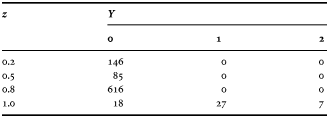
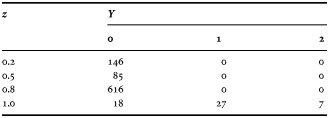
Manatee sightings occurred in only 52 sampling units of the 899 defined regions. In 18 of these units, sightings of 26 individuals occurred off-effort [and therefore have values y = 0 and z = 1]. In the 34 regions where sightings occurred on-effort, 41 individuals were counted in 36 sighting events. The remainder regions were assigned the value y = 0 (no sightings) (Table 3), qualified by the prior parameter on occurrence (z) (Table 1).
Distribution of 899 regions according to probability of manatee occurrence (z) and number of sighted individuals ‘on effort’ (Y).
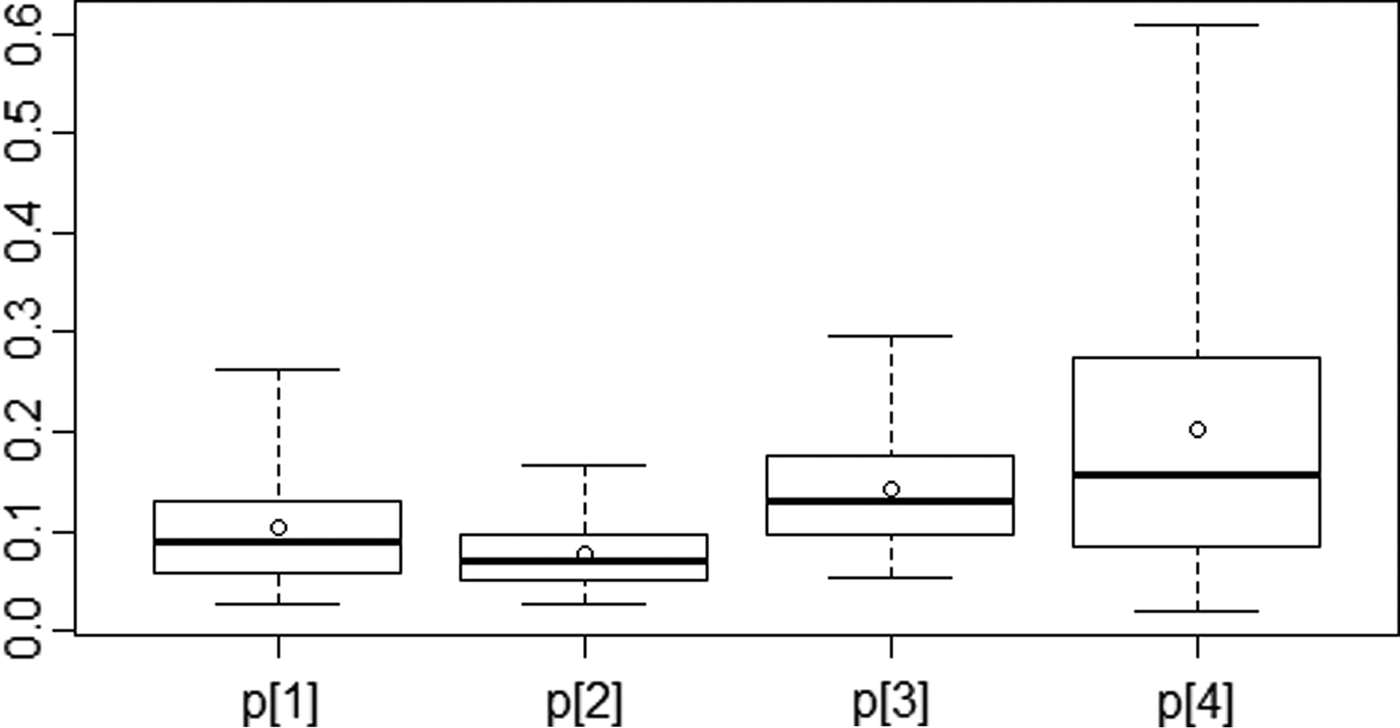
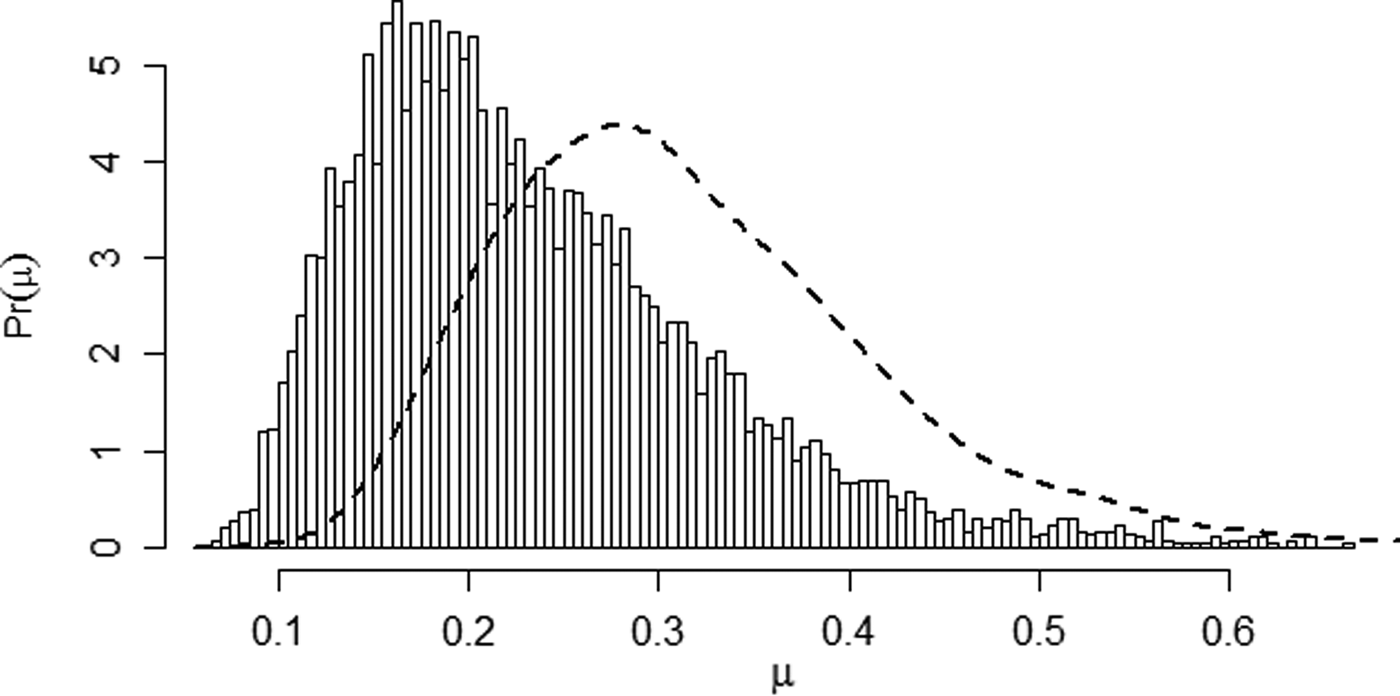
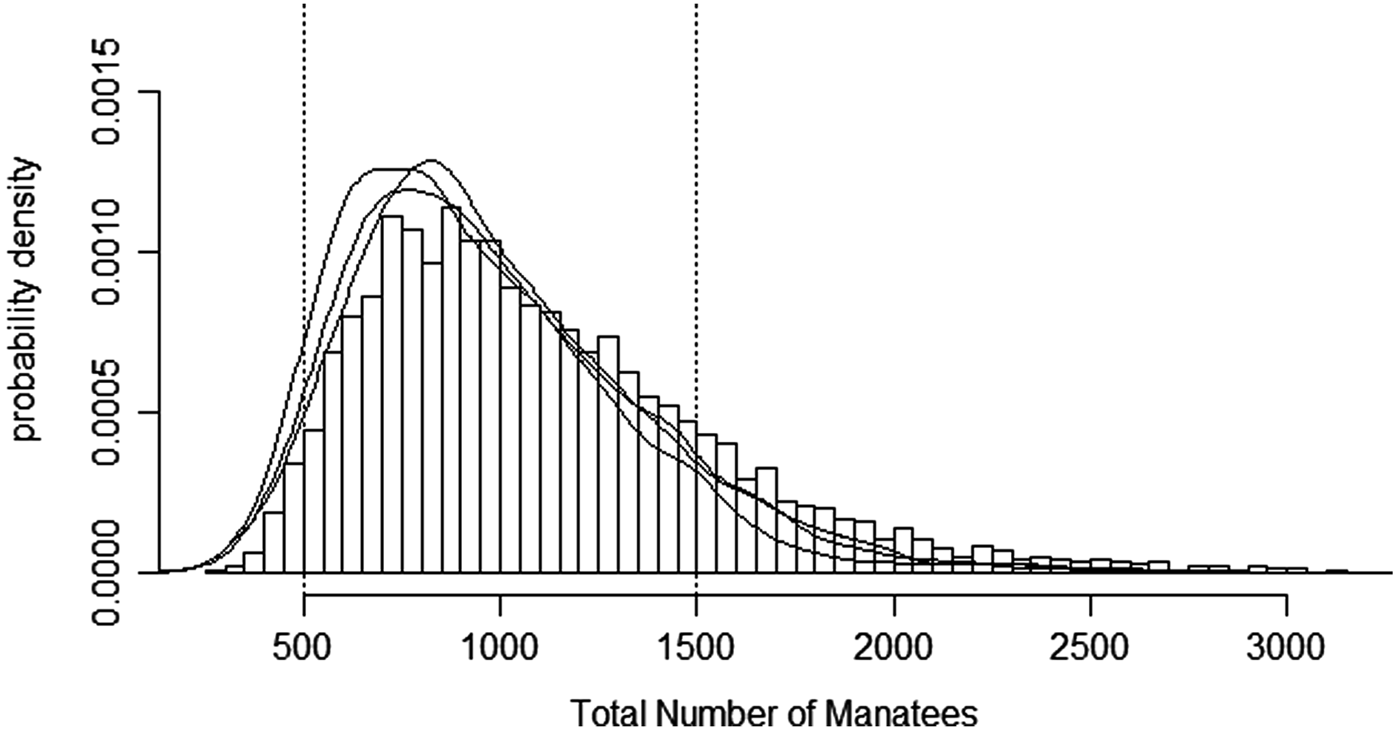
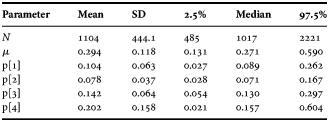
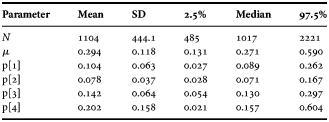
The statistical summaries of the marginal posterior distributions of all six models' parameters are shown in Table 4 with graphical displays in Figures 5 & 6. The posterior distribution for abundance N is represented by the histogram in Figure 7. The estimated number of manatees inhabiting the study area is 1104 individuals. Nevertheless, and despite the use of a priori distribution, which is partially informative, the results presented a considerable level of uncertainty, represented by the posterior coefficient of variation of 40% and the wide 95% credibility interval ranging from 485 to 2221 individuals. In comparison with the a priori probability attributed to abundance, the a posteriori probability that N be larger than 3400 is practically nil. In other words, the 95% quantile that initially was 3400 is reduced a posteriori to 2221.
Marginal posterior summaries of detection probabilities p [visibility]. Circles are posterior means, boxes and whiskers are 50 and 95% credibility intervals, respectively.
Prior (dotted line) and posterior (continuous blocks) distribution for the density of individuals μ.
Posterior distribution of manatee abundance (N) in the study area (histogram). The effect of replacing assigned z is by three replicated random sampled values from a non-informative uniform distribution U(0,1) are displayed as smooth lines, with average posterior mean of 996 manatees, and average probabilities of 4.5 and 9.8% that represent N < 500 and N > 1500, respectively.
Statistical summaries of marginal posterior distributions (2.5 and 97.5% quantiles span the 95% credibility intervals; ‘Mean’ are the point estimates used throughout the text).
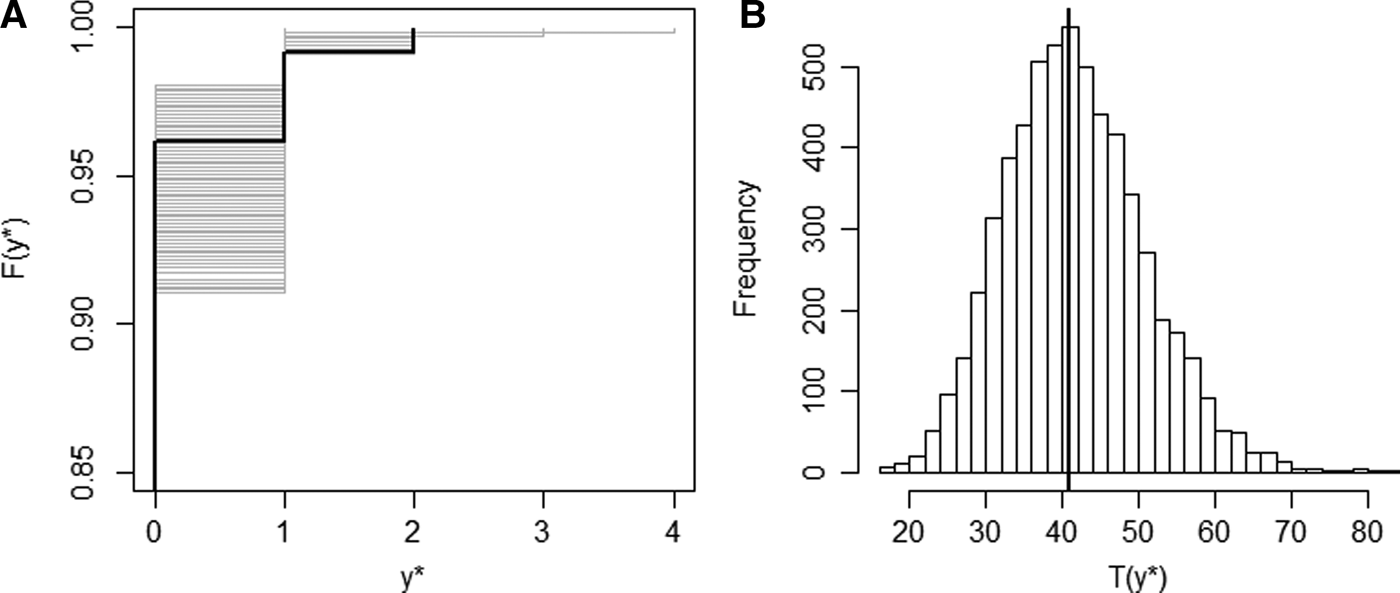
Goodness-of-fit diagnostics (Figure 8) indicate that the data can be well harmonized with the proposed model. Sensitivity to prior information on μ and P on the a posteriori estimated abundance N were small and are not shown here to avoid clutter.
Goodness-of-fit diagnostics: (A) empirical cumulative distribution function (ecdf) of manatee counts (y) per sampling units (bold line) compared with 6000 simulations from the posterior predictive distribution (grey lines); (B) realized (T(y) = 41) vs posterior predictive distribution for the total number of counted manatees T(y*). P(T(y*) > 41) = 0.525.
DISCUSSION
Antillean manatee distribution
The data collected on Antillean manatee distribution in north-eastern Brazil were similar to those found in historical records of the subspecies’ occurrence, which included the same areas of this study (Albuquerque & Marcovaldi, Reference Albuquerque and Marcovaldi1982; Parente et al., Reference Parente, Vergara-Parente and Lima2004; Costa, Reference Costa2006; Alves, Reference Alves2007; Luna et al., Reference Luna, Lima, Araújo and Passavante2008; Meirelles, Reference Meirelles2008; Lima et al., Reference Lima, Paludo, Soavinski, Silva and Oliveira2011). The slight expansion of the area used by the manatees may be related to the implementation of conservation measures in the 1980s (Luna et al., Reference Luna, Lima, Araújo and Passavante2008) and the recent translocation of captive specimens in the northern portion of the state of Alagoas (Lima, Reference Lima2008). However, the existing discontinuities may represent significant genetic effects that have occurred over time in the remaining populations. A study of the phylogeography of manatees in north-eastern Brazil showed that the small population size, coupled with low genetic diversity, presage the possibility of local extinction (Luna et al., Reference Luna, Bonde, Attademo, Saunders, Meigs-Friend, Passavante and Hunter2012).
The apparent discontinuity of sightings and low relative density (only 0.05 km−2) of manatees may indicate the existence of reduced and fragmented populations along the Brazilian north-eastern coast (Albuquerque & Marcovaldi, Reference Albuquerque and Marcovaldi1982; Lima et al., Reference Lima, Paludo, Soavinski, Silva and Oliveira2011; Alves et al., Reference Alves, Schwamborn, Borges, Marmontel, Costa, Schettini and Araújo2013b), with an index lower than the 0.075–0.240 km−2 found in other studies of sirenians (Morales-Vela & Olivera-Gómez, Reference Morales-Vela and Olivera-Gómez1994; Preen et al., Reference Preen, Marsh, Lawler, Prince and Shepherd1997; Olivera-Gómez & Mellink, Reference Olivera-Gómez and Mellink2002; Preen, Reference Preen2004). The sighting discontinuity in the states of Pernambuco, Rio Grande do Norte and Ceará may be related to the lack of natural resources (e.g. abundant aquatic vegetation) essential to the subspecies. However, this phenomenon is more likely due to the degradation of coastal and estuarine habitats due to human development (Lima et al., Reference Lima, Paludo, Soavinski, Silva and Oliveira2011; Alves et al., Reference Alves, Schwamborn, Borges, Marmontel, Costa, Schettini and Araújo2013b), causing the animals to search for less impacted areas. The hypothesis that manatees avoid extensive developed areas was considered in Florida (Bauduin et al., Reference Bauduin, Martin, Edwards, Gimenez, Koslovsky and Fagan2013). High densities of dugongs, up to 7.25 km−2 in Australia, have been recorded in specific foraging areas, with several individuals sharing a limited space (Lanyon, Reference Lanyon2003). The availability of foraging sites is pivotal to the distribution of manatees and the distance to seagrass sites is an important environmental covariate for the species distribution (Jiménez, Reference Jiménez2005; Olivera-Gómez & Mellink, Reference Olivera-Gómez and Mellink2005; Costa, Reference Costa2006; Langtimm et al., Reference Langtimm, Dorazio, Stith and Doyle2011; Bauduin et al., Reference Bauduin, Martin, Edwards, Gimenez, Koslovsky and Fagan2013).
The greatest demographic density of Antillean manatees along the Brazilian coast – which is that found in Piauí – can be directly linked to the presence of a collection of islands interspersed with estuaries and preserved bays within the Environmental Protection Area of the Parnaíba Delta (ICMBio, Reference Luna, Silva, Andrade, Marques, Normande, Velôso and Severo2011). The estuarine complex of the rivers Timonha/Ubatuba and Cardoso/Camurupim, where five animals were sighted, as well as the adjacent coastal zone, is considered an important habitat for the subspecies, with seagrass beds, freshwater sources and excellent rearing locations (Choi et al., Reference Choi, Campos, Meirelles, Campos and Fernandes2009). The sighting of a single manatee, at approximately 40 km from the other five sightings, was recorded at the estuarine mouth of Canárias Island. Although the highest manatee density occurs at the rivers’ estuarine complex, the poor water quality in the innermost of the estuaries precludes aerial sightings in north-east Brazil (Alves et al., Reference Alves, Borges and Araújo2013a).
The susceptibility to visibility bias, common in aerial surveys, may have influenced the few sightings recorded in this study. The vastness of the area surveyed, with a wide variety of environments and sea states (coastal morphology and water turbidity) impacted the subspecies (shy behaviour during exposure at the water's surface, cryptic morphology and solitary habit) as well as the observers. Observer fatigue may have affected detection probability, generating imperfect or heterogeneous detection of individuals as defined by the variable proportion of manatees present in a given area, and yet not sighted (Wright et al., Reference Wright, Reynolds, Ackerman, Ward, Weigle and Szelistowski2002; Langtimm et al., Reference Langtimm, Dorazio, Stith and Doyle2011; Katsanevakis et al., Reference Katsanevakis, Weber, Pipitone, Leopold, Cronin, Scheidat, Doyle, Buhl-Mortensen, Buhl-Mortensen, D'Anna, de Boois, Dalpadado, Damalas, Fiorentino, Garofalo, Giacalone, Hawley, Issaris, Jansen, Knight, Knittweis, Kröncke, Mirto, Muxika, Reiss, Skjoldal and Vöge2012).
The excellent transparency of the water on the northern coast of Alagoas was similar to that found by Alves et al. (Reference Alves, Borges and Araújo2013a), highlighting the favourable conditions for availability bias of manatees in this area. However, the low manatee abundance under conditions both excellent and poor may suggest an underestimation in more turbid waters, which is not an ideal condition for sighting of individuals (Alves et al., Reference Alves, Borges and Araújo2013a). By contrast, the Antillean manatee deems estuaries highly favourable for feeding, reproduction and resting (Olivera-Gómez & Mellink, Reference Olivera-Gómez and Mellink2005; Lima et al., Reference Lima, Paludo, Soavinski, Silva and Oliveira2011). Unfortunately, many estuaries have become silted (Alves et al., Reference Alves, Schwamborn, Borges, Marmontel, Costa, Schettini and Araújo2013b), which renders them inaccessible and may lead to strandings, especially of calves (Parente et al., Reference Parente, Vergara-Parente and Lima2004; Meirelles, Reference Meirelles2008). Water transparency is a key factor in abundance estimates (Marsh & Sinclair, Reference Marsh and Sinclair1989; Ackerman, Reference Ackerman, O'Shea, Ackerman and Percival1995) and may negatively influence availability bias when visibility is highly variable (Wright et al., Reference Wright, Reynolds, Ackerman, Ward, Weigle and Szelistowski2002; Hines et al., Reference Hines, Ulyanukosol and Duffus2005; Pollock et al., Reference Pollock, Marsh, Lawler and Alldredge2006; Edwards et al., Reference Edwards, Pollock, Ackerman, Reynolds and Powell2007). Posterior estimates of distinctive detection probability by visibility level confirms this influence in fitting the model. Detection of aquatic fauna (especially those cryptic, shy and solitary manatees) is particularly hampered in turbid waters of estuaries, lakes and rivers (Reynolds & Powell, Reference Reynolds, Powell, Perrin, Würsig and Thewissen2002). In eastern Ceará, where water transparency ranged from excellent to regular, nautical monitoring of manatees was more effective than aerial surveys (Costa, Reference Costa2006). Nautical surveys conducted in turbid waters would be measurably enhanced using a side-scan sonar. This method is allegedly efficient, albeit within limited areas, in acoustic detection of manatees in waters of Mexico and Florida (Gonzalez-Socoloske et al., Reference Gonzalez-Socoloske, Olivera-Gómez and Ford2009; Gonzalez-Socoloske & Olivera-Gómez, Reference Gonzalez-Socoloske and Olivera-Gómez2012).
Antillean manatee abundance estimate
The posterior estimate indicates abundance somewhere between 500 and 2000 manatees, along ~1500 km of coastline, which represents a small population relative to the large area of occurrence of Antillean manatee in Brazil. Although this number is higher than previous abundance estimates of manatees involving the states of Piauí to Alagoas (Lima, Reference Lima1997; Lima et al., Reference Lima, Paludo, Soavinski, Silva and Oliveira2011) no increase in manatee population is evident in the region from the 1990s until the present time due to the employment of different methodologies.
This result is not a precise estimate of the number of animals considering the posterior distribution indicates that abundance is most probably somewhere between 500 and 2000 manatees. Although changes in prior specification have modified the shape of the posterior distribution, the overall range still displayed acceptable stability. Traditional estimates were of a minimum of 500 animals needed to ensure population viability (Franklin, Reference Franklin, Soule and Wilcox1980). These estimates have been updated to 2000 and 5000 individuals (Traill et al., Reference Traill, Brook, Frankham and Bradshaw2010), further emphasizing the fragility of the population under study. Deutsch & Reynolds (Reference Deutsch, Reynolds, Hines, Reynolds, Aragones, Mignucci-Giannoni and Marmontel2012) point out that population trends are better indicators of a population's vigour. Applying a Bayesian approach to analyse data from an aerial survey can comprise a new tool for studies of the manatee population in Brazil. These data represent a baseline for future studies of distribution and population trends of the Antillean manatee (Ackerman, Reference Ackerman, O'Shea, Ackerman and Percival1995; Lefebvre et al., Reference Lefebvre, Ackerman, Portier, Pollock, O'Shea, Ackerman and Percival1995; Miller et al., Reference Miller, Ackerman, Lefebvre and Clifton1998; Olivera-Gómez & Mellink, Reference Olivera-Gómez and Mellink2002; Katsanevakis et al., Reference Katsanevakis, Weber, Pipitone, Leopold, Cronin, Scheidat, Doyle, Buhl-Mortensen, Buhl-Mortensen, D'Anna, de Boois, Dalpadado, Damalas, Fiorentino, Garofalo, Giacalone, Hawley, Issaris, Jansen, Knight, Knittweis, Kröncke, Mirto, Muxika, Reiss, Skjoldal and Vöge2012) and suggest the need for new efforts in the same area sampled, perhaps at a smaller scale to refine the methodology. For example, Florida manatee abundance was estimated via winter counts at power plants over a period of 20 years, using a Bayesian hierarchical model that allowed for uncertain detection, variable by region and water temperature. Their population trend estimates were more optimistic than those generated by conventional mark-recapture models (Craig & Reynolds, Reference Craig and Reynolds2004).
In the only aerial study of manatees published in the Brazilian north-east so far, in a small area of only 50 km of coast in Ceará state, generated errors were associated with water turbidity and the difficulties involved in identifying and counting each specimen (Costa, Reference Costa2006). Many of these errors possibly arose from an inappropriate sampling period (winter) and inadequate flight design (e.g. reduced sampling due to transects parallel to the coast; the absence of bubble windows). Among the recommendations for improvement, this author proposed the application of aerial methodologies in other areas.
Based on the ideal figure of < 20% for the coefficient of variation (Hines et al., Reference Hines, Ulyanukosol and Duffus2005; Marsh et al., Reference Marsh, Ath, Gribble and Lane2005), the value of 40% in this study suggests a considerable level of uncertainty in the abundance estimate of manatees. Nevertheless, values above the ideal are commonly recorded in aerial surveys for sirenian estimates, particularly when monitoring habitats with turbid waters, such as Chetumal Bay (Mexico) with values of 21–70.3% (Morales-Vela et al., Reference Morales-Vela, Olivera-Gómez, Reynolds and Rathbun2000) and 34.4–65.5% (Olivera-Gómez & Mellink, Reference Olivera-Gómez and Mellink2002); the Andaman coast (Thailand) with 33.4% (Hines et al., Reference Hines, Ulyanukosol and Duffus2005) and Puerto Rico, with 55.8% (Powell et al., Reference Powell, Belitsky and Rathbun1981). Large-scale studies in the region are needed to understand population trends over time. However, refinements in the aerial methodology and using smaller spatial scales are necessary to reduce the coefficient of variation and avoid potential sources of error of perception and availability bias (Marsh & Sinclair, Reference Marsh and Sinclair1989; Marsh, Reference Marsh, O'Shea, Ackerman and Percival1995). Other methodologies must also be adapted for estimating manatee populations, such as nautical surveys using side-scan sonar (Gonzalez-Socoloske et al., Reference Gonzalez-Socoloske, Olivera-Gómez and Ford2009; Gonzalez-Sololoske & Olivera-Gómez, Reference Olivera-Gómez and Mellink2012). This method is presently being used in Brazil in Amazonian manatee (T. inunguis) (M. Marmontel, personal communication) and Antillean manatee (K. Choi, personal communication) research.
Abundance estimation studies of the Antillean manatee in Brazil are considered a research priority by the National Action Plan for the Conservation of Sirenia, with the goal of implementing efficient management strategies for the animals’ protection (ICMBio, Reference Luna, Silva, Andrade, Marques, Normande, Velôso and Severo2011). For this to happen additional studies, designed appropriately to local scales, are needed. The identification, at a local scale, of manatee and dugong abundance hotspots is favourably used in population surveys and analyses of conservation status, mainly through aerial surveys (Lanyon, Reference Lanyon2003; Rajamani & Marsh, Reference Rajamani and Marsh2010; Castelblanco-Martínez, Reference Castelblanco-Martínez2012).
Based on the results of this study, some of the main hotspots for future aerial surveys along the Brazilian north-eastern region are: the coast of Piauí, the state which presents the highest density of individuals (despite its shortest coastline); the easternmost portion of Ceará, an important area in terms of manatee calf strandings (Parente et al., Reference Parente, Vergara-Parente and Lima2004; Meirelles, Reference Meirelles2008); areas along the south-western coast of Rio Grande do Norte state; the whole state of Paraíba, particularly the Barra de Mamanguape Area of Environmental Protection, with a past record of up to 15 manatee sightings (Albuquerque & Marcovaldi, Reference Albuquerque and Marcovaldi1982), and the traditional release area for captive animals (Lima, Reference Lima2008); the northernmost portion of Pernambuco, which contains extensive seagrass beds (Magalhães & Cazuza, Reference Magalhães and Cazuza2005), and northern Alagoas, where captive animals are presently being reintroduced (Lima, Reference Lima2008).
The implementation of studies at a small spatial scale may facilitate the monitoring of individuals, with better knowledge of the subspecies’ occurrence. Improved studies to calibrate detection probability more effectively (e.g. using dual observers) are also recommended. Side-scan sonar or alternative technology can be used to generate reliable indices for estuarine areas. The statistical analysis used, which included bibliographic records of sightings or strandings (Albuquerque & Marcovaldi, Reference Albuquerque and Marcovaldi1982; Parente et al., Reference Parente, Vergara-Parente and Lima2004; Costa, Reference Costa2006; Alves, Reference Alves2007; Luna et al., Reference Luna, Lima, Araújo and Passavante2008; Meirelles, Reference Meirelles2008; Lima et al., Reference Lima, Paludo, Soavinski, Silva and Oliveira2011) and sightings from aerial surveys, was applied due to the difficulty of sampling a dispersed population over a large area. This approach unavoidably rendered the analysis of abundance estimates susceptible to errors. The application of statistical models at the local level will gradually allow the compilation of data for the whole study region, ultimately refining abundance estimates.
The results of this survey highlight the importance of expanding conservation of the Antillean manatee. In addition, this report provides a platform for future studies that will amplify the understanding of population trends over a period of years. To fully realize the protections instituted for the Antillean manatee, surveys should be designed to generate consistent time series population indices and elucidate the population status of this critically endangered subspecies.
ACKNOWLEDGEMENTS
The authors would like to thank the Federal University of Pernambuco (UFPE) and the ‘Fundação Mamíferos Aquáticos’ (FMA) for supporting the survey; the ‘Centro Mamíferos Aquáticos’ (CMA) for initially supporting the research and the NVO air taxi team for adapting their plane to conduct the aerial survey and design the flight logistics. This study is part of the first author's doctoral thesis.
FINANCIAL SUPPORT
This work was supported by the ‘Petrobras’ through its ‘Programa Petrobras Ambiental’ in sponsoring the aerial surveys and ‘Conselho Nacional de Desenvolvimento Científico e Tecnológico’ (CNPq) through the doctoral scholarship granted to the first author.