1. Introduction
In the burgeoning literature on scientific modeling, there is one problem that has attracted considerable debate but whose solution is not within easy reach under any of the many available proposals. The problem is as follows. Let us start from the widely held assumption that one of the main tasks of any scientific model M is to represent (at least in part) a given target system S—let us call it the representationalist assumption (see Giere [Reference Giere2006] and Morrison [Reference Morrison2015], chap. 4, just to mention two examples). Consider now situations in which there is more than one model M that fulfills this representational role for target system S—let us call it the pluralist assumption. A classic example comes from nuclear physics (see Morrison Reference Morrison2011), where families of rival models for the atomic nucleus are routinely employed (i.e., the liquid drop model, the shell model, the cluster model, and the quark model).
A problem immediately emerges. For what is to be said about this plurality of allegedly representational models for the same target system? Frigg and Nguyen (Reference Frigg, Nguyen and Zalta2016b) have called this the problem of style. Morrison (Reference Morrison2011, Reference Morrison2015, chap. 5) calls it the problem of inconsistent models (PIM). This problem is ubiquitous in the sciences and poses a problem for scientific realism. Let us see why.
Situations of this nature typically invite two kinds of answers. The first answer is to go instrumentalist about scientific models: models are useful to get calculations done, but their representational content should not be taken literally as giving us a true story about what the target system is like (see Hacking Reference Hacking1982). The second answer is to defend realism about scientific models and introduce a series of caveats. One such caveat, for example, is that one would have to demonstrate first that all such models enjoy equal explanatory and predictive success. This first caveat is designed to take care of situations such as Ptolemaic models versus Copernican models of the solar system, for example, where the former did not enjoy the same predictive success as the latter. A second caveat is that the representation afforded by any scientific model can only be approximately true. Being approximately true allows each model to represent veridically some parts or portions of the target system while misrepresenting others. For example, a scientific realist might take the liquid drop model of the atomic nucleus as providing an approximately true story of how the binding energy can be released in nuclear fission while misrepresenting the atomic nucleus as consisting of a drop of incompressible nuclear fluid.
Yet these caveats can only partially shelter scientific realism from PIM. A problem still looms at large. If different models (partially and approximately true though they might be) veridically represent relevant properties of the target system and (here comes PIM’s bite) these properties are both essential and inconsistent with one another, a problem of metaphysical inconsistency arises (i.e., model M1 delivers a partial, veridical representation of properties a1, b1, c1, while model M2 delivers a partial veridical representation of properties a2, b2, c2, which are inconsistent with a1, b1, c1). After all, if, for example, the cluster model ascribes to the nucleus the essential property of an even and equal number of protons and neutrons clustered inside the nucleus while the shell model ascribes to the nucleus the essential property of being constituted of protons and neutrons arranged in concentric shells and governed by ‘magic numbers’ (2, 8, 20, 28, 50, etc.) as per Pauli’s principle, it seems that an obvious case of metaphysical inconsistency arises (no matter how partial each representation can be).
A dilemma follows. If there is one and only one model among several that provides an accurate representation of the target system (say, the quark model, as someone might be tempted to claim in this context), then pluralism about models cries out for an explanation. What is the purpose of having alternative models? In response, one might invoke a familiar line of argument to the effect that the quark model, even if fundamental at the level of particle physics, does not help scientists who are interested in studying chemical valence and bonds (for which the shell model is more appropriate) or scientists interested in stellar nucleosynthesis (for which the cluster model is more appropriate). If, however, there is not one and only one model that provides an accurate, veridical de re representation of the target system (where a de re representation is a representation that ascribes essential properties as opposed to, say, nominal properties to the target system), then PIM has a genuine bite and undermines the quest for realism.Footnote 1
In recent years, scientific perspectivism has been invoked as a possible way out of this tension between the pluralism latent in modeling practices and the quest for realism that many see as implicit in the representational role of models.Footnote 2 According to scientific perspectivism (Giere Reference Giere2006), models are perspectives on the target system, without having to either jeopardize the quest for realism (after all, the target system is not shaped or constructed by the scientific perspectives) or abdicate pluralism about modeling. However, scientific perspectivism has come under scrutiny. Critics have argued that scientific perspectivism is affected by the same problem that plagues scientific realism, namely, metaphysical inconsistency.
The goal of this article is to address these criticisms and draw attention to a large class of what—borrowing Rueger’s terminology (although at some distance from his intended relationalist reading)—I am going to call “perspectival modeling.” The upshot of this exercise is to show that perspectival modeling—suitably reinterpreted—can deliver on the quest for realism without abdicating on pluralism. A distinctive feature of perspectival models is their sui generis representational content. By contrast with other examples of nonrepresentational models that have recently attracted attention for their primarily explanatory function (see Batterman and Rice Reference Batterman and Rice2014; Rice Reference Rice2015), perspectival models are still representational in that they have a representational content (i.e., they are about X). But their being about X is not purported to stand in any mapping relation to worldly-states-of-affairs (X) so as to fulfill the realist quest via a plurality of partially accurate models of X, each of which may give a partial, yet accurate, and veridical image of X. The primary function of perspectival models is instead exploratory: they are crucial tools for scientific discovery in designated areas of scientific inquiry, where methodological challenges about the search for new kinds of entities arise. More important, their primarily exploratory function does not ride on the back of their representational content precisely because of the sui generis nature of such representational content, which is not about mapping onto an actual worldly-state-of-affairs (or suitable parts thereof) but has instead a modal aspect: it is about exploring and ruling out the space of possibilities in domains that are still very much open-ended for scientific discovery. The realist quest can be vindicated when one considers the indispensable role that such a plurality of perspectival models plays in advancing our knowledge of what might be real (i.e., what kind of fundamental particles might or might not be real).
Two preliminary clarifications: the first is about the link between perspectival models and what I have called the “realist quest” (or, more generally, what Giere calls “perspectival realism”). What I have called the “realist quest” is not one and the same as what Giere calls “perspectival realism.” If anything, perspectival realism is one among many other varieties of realism, all equally engaged in the quest for realism (broadly understood as the quest for the true theory). How perspectival realism delivers on such a quest is an important question (to be left for another occasion). It suffices to say that the ability of models to ‘accurately represent’ in the sense of mapping/mirroring/metaphysically describing relevant portions of actual and known to exist target systems (with all the usual caveats about abstraction and idealization) need not take center stage in delivering on the realist quest, in my view. There is more to the realist quest than the received view of models ‘accurately representing’ in the sense of veridically describing or mapping onto actual states of affairs or portions thereof (what I called the representationalist assumption). I contend that there is, instead, a genuine modal dimension at work in the realist quest (often enough scientists carve out a space of genuine—causal, epistemic, or objective—possibilities), and rethinking perspectival realism along this modal dimension (and coming to see modeling along this modal dimension) might have far-reaching consequences for how to respond to traditional antirealist arguments (from pessimistic metainduction to unconceived alternatives, just to mention two).
The second clarification concerns the difference between what I call perspectival models and exploratory models more generally. That models usually perform an exploratory function is nothing novel or surprising. The really interesting question is how do different models perform such a function? Gelfert (Reference Gelfert2016, 83–97) describes, for example, exploratory models as fulfilling four distinct (not exhaustive) functions:
• they may function as a starting point for future inquiry (as with car-following models of traffic flow),
• feature in proof-of-principle demonstrations like the Lotka-Volterra model of predator-prey dynamics,
• generate potential explanation of observed (type of) phenomena, as with Maxwell’s honeycomb model of the ether,
• or lead to assessments of the suitability of the target.
I would add to this list of exploratory models what I call ‘perspectival models’. But what makes ‘perspectival models’ stand out in the broader class of exploratory models is a particular way of modeling possibilities (different from what both concrete models, like the Lotka-Volterra, and fictional models, like Maxwell’s, are capable of delivering). I contend that perspectival models are an exercise in imagining, or, to be more precise, physically conceiving something about the target system so as to deliver modal knowledge about what might be possible about the target system. In a way, they perform hypothetical modeling but of a distinctive modal type—they model either epistemic or objective modalities about the target system (within broad experimental and theoretical constraints).Footnote 3 And this is also the reason that sets them aside from phenomenological models, in general, which are designed to model data or phenomena known to exist and be actual (indeed phenomenological models are designed to model observed occurrences rather than possibilities, as is the case with perspectival models).
Section 2 reviews the charge of metaphysical inconsistency that has been leveled against Giere’s scientific perspectivism. Sections 3 and 4 take a closer look at this charge, elucidate some of the implicit premises (i.e., Representing-as-mapping and Truth-by-truthmakers), and lay out what I take to be the argument for PIM. I deflate some of these worries concerning metaphysical inconsistency by showing that they apply primarily to a very stringent type of realism (namely, one that takes models as offering a de re representation of relevant essential properties for the target system). In section 5, I put forward a novel way of thinking about perspectival modeling, which does justice to the sui generis representational content of perspectival models, and to the pluralism inherent in them. I show that perspectival modeling so understood plays a fundamental exploratory function, and, as such, it can deliver on the quest for realism in the sense of allowing us to make progress in our knowledge of what might (or might not) be real. My final goal is to defend a suitable version of methodological perspectivism that is eminently compatible with the realist quest because it is an integral part of how science progresses in the search for a true story about nature. By contrast with scientific realism, the picture I ultimately defend is that of models, whose success in scientific inquiry is not parasitic on their accurately and veridically representing the target system (or parts thereof, along typical realist lines). Instead, my qualified defense of perspectivism emphasizes the modal nature of the representational content of perspectival models. Exploring the space of possibilities and carving out this space is often progress enough in science and a key ingredient for the realist quest.
2. Perspectivism and the Charge of Metaphysical Inconsistency
In Giere’s (Reference Giere2006) original formulation, perspectivism is a reaction against the God’s-eye view whereby it is possible for us to achieve a truly objective knowledge of nature. Unsurprisingly, most of the discussion surrounding perspectivism has focused on the role of models in science. Giere has offered a hierarchy of models to define what he calls a scientific perspective (chap. 4). Starting bottom-up, from models of the data, and top-down from scientific principles and initial conditions, in the middle sit what Giere calls ‘representational models’. For example, the pendulum model is a representational model that offers a way of fitting scientific principles (i.e., Newton’s laws of motion plus initial conditions) to models of the data (i.e., the specific observed motion of the pendulum) via tailored hypotheses and generalizations. This way of locating perspectivism in modeling practices has naturally prompted questions and doubts about perspectivism as a viable middle ground in between scientific realism and varieties of antirealism.
For example, Morrison (Reference Morrison2011, Reference Morrison2015, chap. 5) has argued that there is no genuine middle ground for perspectivism and that perspectivism is unhelpful in situations in which there might be several incompatible (or even inconsistent) models, as in fluid dynamics or nuclear physics. Hence, Morrison concludes that on closer inspection, perspectivism falls back into a sophisticated form of instrumentalism (rather than realism) about science. Chakravartty (Reference Chakravartty2010, Reference Chakravartty2017, chap. 6) has echoed Morrison’s concerns and argued that perspectivism seems incompatible with realism because (among other problems) perspectivism fails to generate a coherent understanding of ontological descriptions. At a closer look, the charge relies on the expectation that perspectivism is primarily a way (ultimately unsuccessful) to deliver on the realist quest by introducing a plurality of perspectives to describe or represent different aspects of the same target system. Is the atomic nucleus a bunch of concentric shells? Is it a bunch of clustered nucleons? Is it a drop of incompressible nuclear fluid? Understandably, the charge of metaphysical inconsistency originates from Giere’s own way of defining perspectives as families of models and his emphasis on representational models as mediating between higher-level principles and models of the data.
Let me say up front that I share Morrison and Chakravartty’s worries, and in particular I agree with some important points that Morrison (Reference Morrison2015) flags for our attention, namely, that
a) often enough perspectival models are best seen as “complementary rather than contradictory” (175)
b) and “the legitimacy of perspectivism … is grounded in the theoretical aspects of the problem solving context rather than in an appeal to philosophy for an interpretation of the modeling practices” (177).
Points a and b can help us articulate a novel kind of perspectivism about modeling practices, which I spell out in section 5. However, before we proceed with the novel proposal, it is important to clarify some of the implicit premises behind PIM, which Giere’s version of perspectivism might appear vulnerable to.
3. Representing-as-Mapping and Truth-by-Truthmakers: Where the Quest for Realism Goes Astray
How does the argument for PIM go? A good starting point is Morrison’s aforementioned observation that “perspectivism is the view that: from the perspective of theory T, model M represents system S in a particular way” (Reference Morrison2015, 159). What does it mean for model M to represent system S “in a particular way”? Representational models are for Morrison the “source of ‘mediated knowledge.’” Knowledge is mediated by the representation of the target system that scientists have constructed, a representation that “gives us a physical picture of how the system might be constituted” (136). A variety of representational models are typically developed, but only one model (“the representative model”) is selected in the end (136). One possible (realist) way of reading Morrison is that the model that gets chosen as the representative model is the one whose representational content successfully latches onto relevant ‘working’ posits of the target system, to borrow Kitcher’s terminology here.Footnote 4 Thus, the quest for the true model (i.e., the model that provides an accurate veridical representation of the target system) can be interpreted as the quest for the representative model. Obviously, a realist would concede that the representative model needs not be a perfect mirroring of the whole target system but only of relevant selected features thereof. Crucially, those features are those that secure the representational success of the model (pace—or maybe precisely in virtue of—any idealization and abstraction that might enter into the model).
What in section 1 I called the representationalist assumption—that is, the relatively uncontroversial assumption that scientific models (partially) represent relevant aspects of a given target system S—hides, at a closer look, two implicit (and more controversial) premises, which have to be in place for PIM to work as an argument against the realist quest. I call these two premises Representing-as-mapping and Truth-by-truthmakers:
Representing-as-mapping The true model is the one that offers an accurate, partial, de re representation of relevant essential features of the target system. Offering an accurate, partial, de re representation means to establish a one-to-one mapping between relevant (partial) features of the model and relevant (partial)—actual or fictional—states of affairs about the target system.
Truth-by-truthmakers States of affairs ascribe essential properties to particulars, and, as such, they act as ontological grounds that make the knowledge claims afforded by the model (approximately) true.Footnote 5
Let us clarify three key aspects of these two premises. First, in Representing-as-mapping the key idea of a de re representation is that to represent is to ‘map onto’ (actual or fictional) relevant states of affairs. Representing-as-mapping is congenial to certain accounts of scientific representations that have placed center stage mapping-onto-a-target-system (Giere’s [Reference Giere2010] agent-based account of representation; Weisberg’s [Reference Weisberg2013] similarity account). But it is less congenial to alternative accounts of scientific representation that have deflated the importance of mapping-onto-a-target-system.
Second, a word of caution about the term ‘states of affairs’, which has become a term of art with a huge literature attached to it (for an excellent introduction, see Textor [Reference Textor and Zalta2016]). In what follows, I use the term ‘states of affairs’ (loosely) in Armstrong’s (Reference Armstrong1993) sense; that is, I take states of affairs to be the truthmakers (or ontological grounds) that make the knowledge claims afforded by the model true (even in the partial and approximate way I have qualified above). However, I add an important caveat to the Armstrongian notion of states of affairs that makes the Armstrongian terminology better suited to discussions of modeling in science. While for Armstrong, states of affairs must be actual (there cannot be a nonexistent state of affairs because universals must be instantiated according to Armstrong), in discussing models and what makes them true, it seems appropriate to make room for nonactual states of affairs as well. After all, often enough scientific models map onto fictional states of affairs, not just actual ones. Thus, to make room for fictional models, states of affairs should be understood loosely to include also states of affairs that are the product of recombining some particulars and properties in fictional nonactual ways (see Armstrong Reference Armstrong1989, 45–49). The outcomes are fictional states; hence, the reason for the double adjective “actual or fictional” in Representing-as-mapping. For example, one might think that the fictional state of affairs “electrons are idle wheels in an elastic ether” is a recombination of particulars (electrons) and essential properties (rotating frictionless). Although it is not an actual state of affairs that electrons are idle wheels in an elastic ether, it is nonetheless a fictional state of affairs, which can act as the truthmaker of the knowledge claim expressed by the sentence “electric current is displaced within Maxwell’s ether model of electromagnetic induction.”
We are now in a position to see how the two tacit premises (Representing-as-mapping and Truth-by-truthmakers) are at play in the seemingly innocuous representationalist assumption, which enters into an argument for PIM against Giere’s perspectivism. Let us call this argument for PIM the Have-Your-Cake-and-Eat-It argument (HYCAEI).
1. Realism about science is the view that scientific theories (qua families of models) are approximately true (in the partial and qualified sense explained above). (Realist quest)
2. A scientific model is true when the model provides a partial yet accurate representation of the target system. (Representationalist assumption)
2.a. The true model is the one that offers an accurate, partial, de re representation of relevant essential features of the target system. Offering an accurate, partial, de re representation means to establish a one-to-one mapping between relevant (partial) features of the model and relevant (partial)—actual or fictional—states of affairs about the target system. (Representing-as-mapping)
2.b. States of affairs ascribe essential properties to particulars, and, as such, they act as ontological grounds that make the knowledge claims afforded by the model (approximately) true. (Truth-by-truthmakers)
3. Scientific perspectivism is the view that from the perspective of theory T, model M1 represents system S in a particular way (say z), but from the perspective of theory A, model M2 represents system S in a different way (say b).
4. Scientific perspectivism implies that different models provide different accurate, partial, de re representations for the same target system S. (Via 2.a)
5. Different accurate, partial, de re representations entail different states of affairs—actual or fictional—as the respective truthmakers of knowledge claims afforded by different models. (Via 2.b)
6. But different states of affairs—actual or fictional—ascribe different essential properties for the same particulars.
7. It follows that there is metaphysical inconsistency in supposing that one and the same target system is de re accurately represented (even partially) by different perspectival models (PIM, via 3, 4, and 5).
8. Hence, the realist quest (1) is incompatible with scientific perspectivism (3).
In the next section, I deflate some of the worries concerning HYCAEI and prepare the ground for a more positive view of perspectival modeling in section 5.
4. Two Problems with HYCAEI as an Argument for PIM
I take HYCAEI to be the main argument for PIM. If different models provide different (no matter how partial) de re accurate representations for the same target system S (or relevant parts thereof), then different states of affairs—actual or fictional—are eligible truthmakers for the knowledge claims afforded by different models. But different states of affairs—actual or fictional—ascribe different essential properties to the same particulars. And this implies that the essential properties that a perspectival model ascribes to a given target system S might well be inconsistent with the essential properties that another perspectival model ascribes to the same target system. Moral: the atomic nucleus, for example, cannot be essentially an incompressible drop of nuclear fluid and also essentially a bunch of strongly interacting quarks.
If the line of reasoning so far is correct, we can catch a glimpse of what has gone wrong with PIM. The problem is not that different models provide different partial and incomplete scientific images for the same target system. Rather, the problem lies in the assumption that different models ascribe different essential properties to the same target system. Yet two main problems affect HYCAEI, and a quick look at the premises in HYCAEI soon reveals that the charge of metaphysical inconsistency is based on an unduly strong and demanding realist reading of the representationalist assumption, captured by the two hidden premises.
First, Truth-by-truthmakers proves too crude a characterization for the kind of truth afforded by perspectival modeling. Thinking of states of affairs as ontological grounds that make knowledge claims afforded by perspectival models true or false leaves wide open the problem of explaining falsehood.Footnote 6 Take a sentence such as “Phlogiston is released in the combustion of metals.” This sentence was deemed true by the chemists of the eighteenth century, and it is false in our current chemistry. Truth-by-truthmakers has the unwelcome consequence of forcing us to assume there must have been a state of affairs x—actual or fictional though it might be—that made it true that phlogiston is released in the combustion of metals within the eighteenth-century perspective. But what could such a state of affairs be? Only two options seem available.
The first option is to assume that the state of affairs that might act as the truthmaker of “Phlogiston is released in the combustion of metals” in the eighteenth-century perspective is an actual state of affairs. In which case the challenge is to identify such an actual state of affairs. This challenge is insurmountable because, as far as we know, there is no such thing as phlogiston to start with, unless some exercise in fact-constructivism is gerrymandered to the purpose. But, Truth-by-truthmakers restricted to actually existing objects only seems, however, too stringent: it does not seem to do justice to the modal thought of how things could have been that is at the very heart of model building and scientific investigation (and, indirectly, of scientific perspectivism).
The second option is to assume that the state of affairs that acts as the truthmaker of “Phlogiston is released in the combustion of metals” in the eighteenth-century perspective is a fictional state of affairs. This seems a more promising option. For a great advantage of fictionalism is precisely the ability to deliver on truth within a fictional story. That “Anna Karenina died under a train” is true because there is a fictional state of affairs in Tolstoy’s novel that makes it true. But there is a problem with this more liberal construal of Truth-by-truthmakers extended to fictional (not just actually existing) states of affairs. It seems to open the door to Meinongian metaphysics: it populates discourse of nonexistent objects and fictional states of affairs acting qua truthmakers of sentences such as “Phlogiston is released in the combustion of metals.” And Meinongian metaphysics undermines the very realist quest that originally motivated Truth-by-truthmakers. If it ultimately turns out that by using Truth-by-truthmakers phlogiston theory can pass the realist test as well as oxygen theory (courtesy of Meinongianism), the realist quest will be self-defeating. Moral: Truth-by-truthmakers proves both too stringent as a characterization of the modality afforded by perspectival modeling and, at the same time, too metaphysically indulgent for realism in science (with self-defeating consequences).Footnote 7
A defender of PIM might at this point reply that maybe Truth-by-truthmakers is not needed after all for PIM to go through. Maybe a more modest theory of truth would do the job for PIM equally well, without having to embrace any unduly demanding and controversial notion of Truth-by-truthmakers. But what would such an alternative, PIM-friendly theory of truth look like? Deflationism about truth would not help the case for PIM. A deflationist about truth would not see rival models as giving rise to any metaphysical inconsistency about the target system, because the whole point about deflationism is that truth does not bring any metaphysical baggage with it. Tarskian theories of truth, similarly, would not help with PIM because Tarski’s theory is a purely formal apparatus that does not discriminate between realism and antirealism about truth as such. And a correspondence theory of truth along more modest metaphysical lines (e.g., Austin Reference Austin1961) would similarly not cut any ice for PIM because it would regard the correspondence between propositions and facts as purely conventional (rather than having metaphysical import of the type required for PIM). Thus, Truth-by-truthmakers is after all required for PIM (and, if my argument above is correct, Truth-by-truthmakers is indeed surreptitiously assumed in HYCAEI as the argument for PIM).
The second main problem affecting HYCAEI is too strict a notion of representation. Representing-as-mapping (recall premise 2.a) does not do justice to the complexity and variety of modeling practices. Consider as a simple counterexample a model of the Forth Bridge that connects Edinburgh with Fife. In what sense does it count as a model of the real bridge?Footnote 8 Surely, it stands in a representational relation to the real bridge. Indeed, it is a perfect example of Representing-as-mapping. It powerfully exemplifies a one-to-one mapping between features of the model and features of the real bridge (e.g., structure, shape, distribution of pillars). But is this standing in a relation of Representing-as-mapping sufficient to characterize the model of the Forth Bridge as a scientific model? Consider my son’s model of the Forth Bridge made by Meccano pieces. It surely stands in the same relation of Representing-as-mapping to the real bridge. But it would not be classified as a scientific model. Why? Blame it on the inaccuracy of the Meccano representation (maybe the number of pillars does not match the number on the real bridge or the shape is not exactly similar to the real one). Then, what about the image of the Forth Bridge printed on a stamp? This is certainly a more accurate Representation-as-mapping of the target system than my son’s Meccano model (the number of pillars is clearly visible and matches the real numbers). But the image on a stamp would not qualify as a scientific model either, despite offering an accurate Representing-as-mapping of the real bridge. Where to draw the line between objects that equally satisfy Representing-as-mapping relation but do not qualify as scientific models? At the very least, something ought to be said about why the model of the Forth Bridge is useful for applied sciences in a way that my son’s Meccano model (or the printed image on the stamp) is not. And it seems that an answer to this question cannot appeal to Representing-as-mapping—in and of itself—as a criterion for distinguishing genuine models from nonmodels. Representing-as-mapping—in and of itself—is not sufficient for something to qualify as a scientific model.
A defender of PIM might retort here that Representing-as-mapping is not needed for PIM either and that, even if there are situations (like those above) in which no Representing-as-mapping applies, PIM might still arise because after all PIM is a problem about models making contradictory claims about the target system (i.e., claims of the type “X is Y” and “X is Z,” where Y and Z are incompatible).Footnote 9 In response, it is worth considering under which conditions such metaphysically contradictory knowledge claims would arise. Would they arise if the models were not interpreted as “representing accurately” in the sense described above? As a foil, it is instructive to return to the distinction made in footnote 1 about representing de re versus de dicto. A fictionalist about models would argue that models represent de dicto relevant aspects of the target system because, for example, the representation afforded by Maxwell’s honeycomb model of the ether does not latch onto any actual state of affairs after all. Similarly, a fictionalist would claim that rival models of the atomic nucleus represent de dicto because they invite us to entertain a make-believe game about the target system. Thus, in a way, fictionalism about models (with its less stringent notion of representing) is less vulnerable to PIM. But it does not help with the realist quest either (for what would a fictionalist say about it?). In other words, the price to pay to relax the Representing-as-mapping assumption is to relax also the quest for realism. And that does not help if the overarching goal is precisely to demonstrate that (1) such a realist quest matters and (2) that it is compatible with pluralism about models. Thinking of the representational role of models along the lines of Representing-as-mapping is inadequate to capture the variety of modeling practices.Footnote 10 It proves, at once, too stringent and too liberal a criterion for scientific models. It does not take into account the many different ways in which models can fulfill their alleged representational function.
With these two lessons in hand, premises 2.a and 2.b in HYCAEI prove unduly demanding and ultimately inadequate to carry the full argumentative weight for PIM. In the next section, I offer my own take on perspectival models and their sui generis representational task, by considering two salient examples coming from contemporary high-energy physics.
5. Perspectival Models and Their Exploratory Function: Two Examples from LHC at CERN
Most of the discussion so far has concentrated on getting clear on some of the assumptions at play in PIM, which is designed to show that pluralism about perspectival modeling is incompatible with the realist quest (HYCAEI). But not much has been said about the importance of perspectivism in modeling practices. This final section attends to this task by first introducing a suitable class of models where perspectivism finds its natural home. I clarify the sui generis representational nature of these perspectival models not as ‘mapping onto’ relevant partial—actual or fictional—states of affairs of the target system but instead as having a modal component. Perspectival models are still representational in that they have a representational content (i.e., they are about X). But their being about X is being about possibilities (as opposed to actual or fictional states of affairs). And this is to be expected since their primary function is exploratory (i.e., the entities at issue are possible, neither known to be actual nor known to be fictional). Being primarily exploratory might look at a first glance as irrelevant to addressing the issue of realism. Why would models whose primary function is exploratory even be eligible candidates for realism? Should the realist quest not be confined to models whose proven track record of explanatory or predictive success is a reliable indicator that they are tracking real working posits (or whatever else we might want to call them)?
In reply, I want to make two points. First, the realist quest should not be construed as backward-looking (that is why, after all, I called it a “quest” and not a “track record”). The realist quest captures the realist aim of producing scientific theories (qua families of models) that are approximately true (in the partial and qualified sense explained above). This is an aim; it is something that scientists strive toward (if they have realist leanings). It is not wisdom of hindsight about what we should (or should not) be realist about. Thus, I see no reason why models that are exploratory should not be eligible candidates for the realist quest.
As a second and related point, the primarily exploratory function of such models in delivering an approximately true (albeit partial) story about nature does not ride on the back of their success in Representing-as-mapping onto relevant parts of the target system. Given the sui generis and modal nature of their representational content (which captures possibilities rather than actual or fictional states of affairs), the final verdict on the heuristic success of these models depends on their ability to explore and carve out the space of possibilities. If, by the end of it, the whole space of possibilities were to be excluded, this would still count as scientific progress. Often enough in science, scientific progress and the quest for the true model is delivered not just by identifying functional working posits but also—and equally importantly—by ruling out an entire spectrum of live rival possibilities.
Contemporary high-energy physics is a paradigmatic area where perspectival models are routinely used. Over past decades, scientific efforts to find new particles, whose existence (if proved) would force physics to go beyond the Standard Model, have increasingly resorted to a variety of model-independent searches. By “model-independent,” high-energy physicists mean usually “Standard-Model-independent” searches, that is, searches that bracket as much as possible assumptions about the Standard Model so as not to compromise the possibility of detecting new entities whose physical features are not accurately described or represented by the Standard Model. Perspectival models are widely used in model-independent searches in Beyond Standard Model (BSM) physics because they cut across traditional philosophical distinctions between data models and theoretical models. Although data enter in perspectival modeling by fixing, for example, the exclusion regions for relevant events under study; perspectival models are not a sheer description or representation of the data. Perspectival models are not theoretical models either, because they are designed to be model-independent (i.e., as independent as possible from the Standard Model). Perspectival models satisfy the following three broad features:
a) several of them are at play in any given scientific context (pluralism);
b) each of them provides only a partial account of the phenomenon at stake (partiality);
c) their primarily exploratory function is performed jointly, according to specific rules that vary from scientific context to scientific context (complementarity).
And they accomplish two main exploratory tasks in BSM physics:
1. to map the space of what is objectively possible by sampling, testing, and gradually eliminating physically conceivable scenarios (in situations in which we simply cannot have computational access to the full spectrum of what is physically conceivable);
2. to make experimental results exportable from one context to another context so that theoretical hypotheses with no direct empirical consequences can nonetheless be checked and eventually ruled out.
The following subsections illustrate points 1 and 2 by looking at two illuminating examples of perspectival modeling and their function from the Large Hadron Collider (LHC) at CERN.
5.1. Perspectival Modeling: The Case of the pMSSM at ATLAS and Its Role in Mapping the Space of What Is Objectively Possible
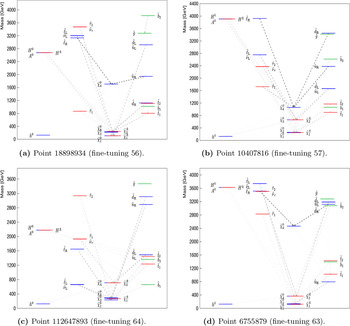
One possible way of exploring BSM physics is captured by the so-called Minimal Super-Symmetric Model (MSSM), which—as is typically the case with SUSY models—for each of the Standard Model quarks and leptons predicts the existence of scalar partners (called ‘squarks’ and ‘sleptons’).Footnote 11 How do we search for such possible—so far only hypothetical—entities? The parameter space of MSSM (with R-parity conservation) consists of around 120 parameters capturing the masses and decay products of such hypothetical ‘sparticles’. Such parameter space “is too large to be scanned exhaustively and be compared to ATLAS data” (ATLAS Collaboration Reference Collaboration2015, 2). Perspectival modeling comes to the rescue in the form of phenomenological MSSM (pMSSM). Running or simulating ATLAS searches for every conceivable value of those 19 parameters is not an effective heuristic strategy (indeed it is practically impossible with current technology), so the ATLAS Collaboration (Reference Collaboration2015) samples particular values of those parameters. Each sampling is called a ‘model point’ in the parameter space.Footnote 12 ATLAS sampled 310,327 such model points out of an original pool of 500 million. They selected the points in a random manner, with the intention that the model points be indicative of the full 19-dimensional space. The hope is that by sampling a sufficiently large number of model points, some of the main features of the full pMSSM might be captured.Footnote 13 Model points were selected by using as guiding principles both experimental observations (e.g., mass of the Higgs boson) and theoretical constraints, for example, R-parity conservation, consistent electroweak symmetry breaking, as well as assuming the lightest supersymmetric particle to be a neutralino, which is a putative supersymmetric particle with neutral charge and a possible dark matter candidate. The final outcome of this sampling takes the form of possible sparticles spectra, four of which are illustrated in figure 1 (with specific fine-tuning) compatible with ATLAS run 1 searches. These model points tell physicists where they may want to concentrate their attention during ATLAS run 2, for example, the possible existence of an 800 GeV uR squark. And as more data are brought in at run 2, more of these possible candidate sparticles are excluded, leaving out only live contenders. Model points of the pMSSM-19 (capturing kinematic features and decay modes of putative SUSY particles in pMSSM) are one example of what I call ‘perspectival models’. Why do we need all these model points? The answer is clear: there is no guarantee (or expectation) that the full pMSSM space will ever be surveyed, because physicists have only limited access to a finite number of samples. The pMSSM model points meet criteria a–c for perspectival models:
a) in this specific ATLAS Collaboration paper (Reference Collaboration2015), 310,327 of them are at play in the context of exploring the parameter space of pMSSM-19 (pluralism);
b) each model point (say, point 6755879 with fine-tuning 63) is only one physically conceivable sparticles spectra scenario among hundreds of thousands (partiality);
c) these very many model points jointly perform the crucial exploratory function of sampling from a much larger conceivable parameter space, with the hope that if there are SUSY particles, pMSSM can eventually provide an effective strategy for finding them (complementarity).
These model points do have representation content (i.e., they are about sparticles) but in a sui generis way, for there is no expectation that they map one-to-one onto actual or fictional states of affairs (sparticles remain only hypothetical as of today). For precisely this reason, despite the name “phenomenological,” the pMSSM model points are not phenomenological models in the traditional sense: they do not model actual and known to exist phenomena; they do not even model observed occurrences of data. They are instead a genuine exercise in modeling physically conceivable states for supersymmetric particles (within experimental and nomological boundaries) as a guide to what might be objectively possible in nature.
Possible sparticle spectra from pMSSM-19. ATLAS Collaboration (Reference Collaboration2015), 42. Copyright: CERN/ATLAS under CC BY 4.0.

5.2. Perspectival Modeling: The Case of SUSY Simplified Models at CMS and Their Exploratory Role in Making Experimental Results Exportable
Consider now a different methodology for BSM searches, where the task is to model physical scenarios characterized by a large missing energy transverse and multijets (which are primary examples of possible BSM signatures), without committing to the details of any particular SUSY model (e.g., without having to consider, for example, specific 19-parameter model points, fine-tuned in a particular way). How do we proceed? A currently popular methodology resorts to simplified models (see McCoy and Massimi Reference McCoy and Massimi2018). Let us consider the following recent instructive example coming from the Compact Muon Solenoid (CMS) experiment at CERN, where some searches concentrate on the possible production of the so-called lightest supersymmetric particle, the neutralino  .Footnote 14 Where do we look for this possible SUSY candidate? And how do we look for it? Simplified models help with the tasks, for their job is to model signal regions for possible SUSY events.
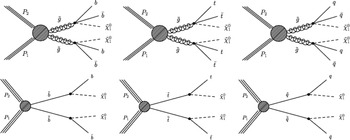
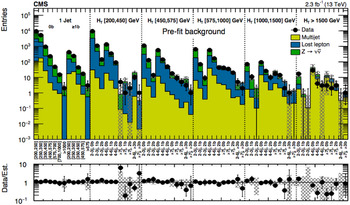
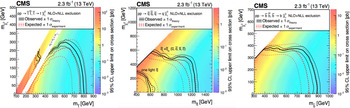
Consider, for example, some possible ways in which neutralinos might be produced in proton-proton collisions at LHC, with their respective Feynman diagrams (fig. 2): top row, proton collisions produce gluino-mediated neutralinos in conjunction with b quark-antiquark, top quark-antiquark, or light quark-antiquark, respectively; bottom row, proton collisions produce neutralinos via b squark-antisquark, top squark-antisquark, or light squark-antisquark, respectively. How do physicists build simplified models to search for neutralino production? The first step is to map the background (via Monte Carlo simulations) and compare the Standard Model expected background with the data coming from the LHC. Some of the results are shown in figure 3, which compares the expected background (i.e., the histograms) with the observed data (i.e., the dots). Each bin in this figure corresponds to a selected signal region. Figure 3 is important to establish “exclusion regions” for the designed search. These exclusion regions are mapped in figure 4, which features simplified models for the aforementioned Feynman diagrams in the bottom row in figure 2. These simplified models abstract from any other physical quantity except the respective masses of the relevant squarks (whose range of possible values in GeV is on the x-axis) and the mass of the neutralino (whose range of possible values in GeV is on the y-axis). The solid black line shows the exclusion region for neutralino production (i.e., the region where no evidence for neutralino production from hypothetical squark decay has been found). How is the exclusion region determined? For any specific model point, corresponding to a point in the plane of figure 4, physicists calculate what the signal contribution would be to the corresponding bin in figure 3. This contribution can be calculated from the intrinsic rate (cross-section) of the signal, the luminosity (intensity) available at the LHC, and the fraction of signal events that would pass selection. So, if there were a new signal (i.e., if there were indeed neutralino production as an excess of events not expected from the Monte Carlo–simulated Standard Model background), another area would have to be stacked on top of the histograms in figure 3. If there is less than 5% probability that such a signal would have produced an event count (dots) as low as the one recorded on figure 3, the model is said to be excluded at the 95% confidence level. This procedure is repeated for each model point in the plane of figure 4, and all the mass points thus excluded are below the solid black line. The dashed red lines, however, indicate the expected exclusion regions (if there were no signal), once statistical uncertainties are taken into account.Footnote 15 A plurality of simplified models is thus produced to explore (and eventually rule out) the possible production of neutralino from all the different conceivable decay channels envisaged in the Feynman diagrams of figure 2.
CMS Collaboration (Reference Collaboration2016), 20. Copyright: CERN/CMS under CC BY 4.0.

CMS Collaboration (Reference Collaboration2016), 18. Copyright: CERN/CMS under CC BY 4.0.

CMS Collaboration (Reference Collaboration2016), 23. Copyright: CERN/CMS under CC BY 4.0.

Simplified models such as those from CMS are yet another example of perspectival models.Footnote 16 There is more than one possible simplified model for any given search (pluralism). Each simplified model provides only partial information about what might go on in proton-proton collisions (partiality). And, it is the whole family of simplified models for a given search that jointly accomplishes the exploratory role of searching for possible SUSY particles (complementarity). Simplified models illustrate another important heuristic task for perspectival modeling. They make experimental results exportable from one context to another: the exclusion region found for top squark-to-neutralino decay contains precious exportable information. It tells physicists in which energy region they should not be looking for neutralinos, without having to get bogged down with calculations related to several theoretical parameters of the possible particles involved in each scenario (and related fine-tuning), which may or may well not have any direct testable consequence.
6. Concluding Remarks
I have attended to two main tasks in this article. First, I have analyzed PIM and how it can be made to work as an argument (HYCAEI) designed to show that perspectivism cannot deliver on the realist quest. I have identified two tacit assumptions behind HYCAEI and tried to deflate them. My second task was to draw attention to a class of modeling practices in which perspectivism can deliver on the realist quest. This is a distinctive class of models that I have called ‘perspectival models’, whose three distinctive features are plurality, partiality, and complementarity and whose sui generis representational content involves modality. I have illustrated the exploratory function of perspectival modeling with two examples coming from contemporary searches at LHC, CERN, where the realist quest becomes the quest for the true physics, which may exist beyond the Standard Model as we know and love it. Clearly, there is a lot more to explore about perspectival modeling than has been so far assumed. This article was only meant to sketch a possible road map for future directions of research.