One of the main reasons the Nazis were able to conquer Europe so rapidly was the combat motivation of individual German soldiers. German combat doctrine, which granted soldiers significant latitude in decision-making, permitted tactical flexibility on the battlefield. Underpinning this tactical freedom was the commander’s need to motivate soldiers to value fighting for the cause over their own self-preservation. German soldiers fought fiercely, even toward the end of the war, when it was clear that defeat was likely.Footnote 1 Not all armies show such commitment. Compare this, for example, to thirty thousand US-trained, US-armed Iraqi soldiers who “simply turned and ran” in the face of a mere eight hundred ISIS insurgents in Mosul.Footnote 2 What explains this variation in combat motivation? And more generally, given the risk of injury or death, why would combatants do anything more than try to survive? Even if soldiers believe in their cause, their contribution is likely to have a negligible effect on the conflict’s outcome. The rational course of action would therefore be to do the minimum necessary to avoid punishment. How then do military principals motivate their soldiers to fight?
Political philosophers have long considered nonmaterial factors to be crucial in motivating men to fight and die in war. In the sixth century bce, for example, Sun Tzu noted in The Art of War that a nation’s Tao (spirit) was an essential ingredient of its strength, as “it brings the people’s way of thinking in line with their superiors. Hence you can send them to their deaths or let them live, and they will have no misgivings one way or the other.”Footnote 3 Likewise, Machiavelli, in The Prince, championed a citizen militia for the Italian city-states because he believed citizens would be more motivated to fight for their home than would mercenaries.Footnote 4
Modern social scientists have produced many explanations for combat motivation. A number of classic studies of the early post–World War II era deemphasized ideological variables and stressed the importance of social networks (primary group cohesion) or “fighting for your buddies.”Footnote 5 For years this view represented the consensus, and it is still highly influential.Footnote 6 But explanations based on social networks have evidentiary problems, which we outline below, and are often theoretically indeterminate. More recently, an increasing number of scholars have come to see ideology as a primary driver of combat motivation. Yet ideational explanations have their own shortcomings because they are difficult to operationalize and test.
This article proposes a quantitative test of the proposition that propaganda can motivate soldiers to fight. We use a data set of 18,535 German army service records from World War II to test for the impact of Nazi propaganda on fighting motivation.Footnote 7 The documents contain extensive information on individual soldiers’ backgrounds, including their place of birth, along with their service history of punishments and medals.
To isolate the effect of Nazi propaganda, we use a measure of potential preenlistment exposure to Nazi radio broadcasts. In the age before television, radio was the primary form of mass media communication and the main avenue for Nazi propaganda to widen and deepen the acceptance of Nazism.Footnote 8 Importantly, radio coverage, while partly determined by an area’s population density and wealth, is also partly a function of factors that are plausibly exogenous to any other predictors of combat motivation. This is in line with studies that use exposure to radio broadcasts as a conditionally exogenous instrument for the transmission of political propaganda in other contexts. Such cases include the Nazi vote share in 1933,Footnote 9 antiregime protests in East Germany,Footnote 10 mass killings of Tutsis during the Rwandan genocide,Footnote 11 Russian propaganda during elections in Ukraine,Footnote 12 consumption behavior in Eastern Europe,Footnote 13 and public sentiment and graffiti.Footnote 14
Using radio signal strength from a soldier’s birthplace as a proxy for potential exposure to Nazi radio propaganda, we find it to be associated with an increased likelihood that a soldier received a combat decoration. This relationship holds even after controlling for a variety of individual soldier characteristics, including membership in the Nazi Party, particulars of the soldier’s birthplace, and the extent of his combat exposure, providing evidence that propaganda has a causal effect on combat motivation.
Our findings inform several debates in the social sciences. State survival and strength depend upon military capability, but this capability depends upon soldiers’ willingness to make the ultimate sacrifice. As Stephen Biddle argues, modern warfare entails the greater use of dispersion and concealment, thus lowering the ability of states to monitor their soldiers.Footnote 15 It follows that it should be harder for states to motivate soldiers through externally imposed sanctions and rewards. For non-state actors, who often do not have access to the coercive apparatus of a modern state and have even less ability to monitor their foot soldiers, intrinsic motivation is even more important. Our findings also contribute to a growing literature linking the effects of propaganda to the use of mass media.Footnote 16 Moreover, understanding why soldiers fight can also shed light on why individuals may choose to contribute to collective goods in peacetime. The issue of combat motivation should therefore be of interest to scholars of collective action problems in general, whether they concern protests, voting, tax compliance, or infrastructure provision.Footnote 17 In addition, our article contributes to a growing literature that uses modern econometric analysis to illuminate the causesFootnote 18 and consequencesFootnote 19 of Nazi rule in Germany. In particular, our analysis follows Nico Voigtländer and Hans-Joachim Voth and Maja Adena and colleagues in examining the persuasive effects of Nazi propaganda, though we examine its effects on behavior in wartime rather than on political opinion or voting behavior.Footnote 20
Soldier Motivation
Military power plays a crucial role in realist theories of international relations,Footnote 21 and even most IR scholars who are not realists agree that it is important under certain circumstances.Footnote 22 However, although military power could not exist without the willingness of individual soldiers to fight, it remains understudied.Footnote 23 Biddle, while noting that raw material capability is an inadequate measure of military power, only speculates as to why individual soldiers would lay down their lives in war,Footnote 24 even as he demonstrates why combat motivation is so important in modern warfare. Soldiers, after all, must be able to employ extensive dispersion and concealment to protect themselves from enemy firepower. On the one hand, this allows soldiers to hide from the enemy, but on the other hand, it also makes it harder for their superiors to monitor their behavior. And the harder it is to monitor soldiers, the more their intrinsic motivation matters.
In the aftermath of World War II, researchers produced several now-classic works examining the question of combat motivation, with particular attention paid to the Wehrmacht. The consensus of this research, which remains influential to this day,Footnote 25 is that propaganda and ideology matter little in combat motivation. Edward Shils and Morris Janowitz, for example, in developing the “primary unit cohesion” theory in their 1949 study of German fighting, noted that “the values involved in political and social systems or ethical schemes do not have much impact on the determination of the soldier to fight to the best of his ability.”Footnote 26 Other mid-twentieth-century studies based on the British or American militaries of the world wars came to similar conclusions. Samuel Mar-shall attributed the combat motivation of soldiers to “the near presence or the presumed presence of a comrade.”Footnote 27 Samuel Stouffer’s postwar survey research also noted the importance of the presence of a comrade in improving morale, while John Baynes identified the desire of enlistees to maintain the respect of noncommissioned and junior officers as a key motivator.Footnote 28 More recently Dora Costa and Matthew Kahn’s study of US Civil War Union army service records found that soldiers fought with higher motivation when placed in units with comrades from a similar ethnic background to their own, suggesting that they were more able to identify with and thus to fight for coethnics.Footnote 29
Social network–based theories of combat motivation are often challenged on both empirical and theoretical grounds. Theoretically, social network–based accounts are indeterminate: they explain why soldiers could cooperate with each other but not why they would cooperate in fighting the enemy rather than cooperating in deserting, surrendering, or mutinying. Indeed, Peter Bearman’s study of the Confederate army in the US Civil War showed that soldiers with strong ties to each other were more likely to desert together than to fight together.Footnote 30 Empirically, historical studies have shown that the rate of losses in the most intense combat periods of the world wars made the survival of long-standing primary units impossible—yet armies continued fighting.Footnote 31 In a case study of one US and one German infantry division in 1944, Robert Rush suggests the American “individual replacement system,” which replaced individual losses one by one, was more effective in generating fighting motivation than the German unit replacement system, which sought to preserve the integrity of small groups by replacing military units in their entirety.Footnote 32
An alternative theory of combat motivation claims prestige is a key driver. Philipp Ager, Leonardo Bursztyn, and Voth show that German pilots took greater risks when the exploits of their peers were made public; that is, social information or pressure can be used to motivate soldiers.Footnote 33 Although this argument is different from ours, the two are nonrivalrous. Ager, Bursztyn, and Voth examine service personnel of the same country fighting in the same war and focus on how individual prestige motivates soldiers to get their exploits publicly known. We investigate how being exposed to a collective ideology makes soldiers more motivated. One could believe that a desire for prestige relative to one’s peers can motivate individuals to fight regardless of whether they believe in the overarching goals of the war. Our contribution is to show that propaganda can also make a difference by imbuing soldiers with a belief in their cause.
Another theory of combat motivation is coercion. Historians have noted the importance of coercion in keeping soldiers fighting, as occurred, for instance, with the Soviet Red Army during World War II.Footnote 34 Others have noted motivational problems plaguing armies that did not rely on harsh punishments.Footnote 35 But the historical record does not support the theory. Thus, since 1941 the United States has executed only one soldier for cowardice and most American soldiers continue to fight.Footnote 36 By contrast, the Iraqi army under Saddam Hussein maintained ruthless discipline but experienced mass surrenders and desertions.Footnote 37
Given the substantial variation in combat motivation unexplained by coercion or social networks, many political scientists have looked to ideational factors. In the study of rebel organizations, Jeremy Weinstein argues that groups operating under conditions of resource scarcity will be more disciplined, as their recruiting necessarily relies on ideological appeals rather than the promise of material gain.Footnote 38 Similarly, Bernd Beber and Christopher Blattman contend that rebel organizations prefer to recruit child soldiers in spite of their lower levels of military skill because they are easier to indoctrinate.Footnote 39 Elisabeth Wood shows that Salvadoran peasant participation in insurgency in the 1980s and 1990s was primarily driven by moral commitments and emotional engagement.Footnote 40 In conventional warfare, Barry Posen argues, nationalism is a crucial component of fighting motivation, a claim echoed by Dan Reiter with respect to post–Meiji restoration Japan.Footnote 41 Reiter also holds that democratic values can provide the motivation for soldiers to fight. And Jasen Castillo argues that strong social control combined with ideology produces a “messianic army” (like that of later World War II Germany) that will continue to fight under conditions of severe adversity.Footnote 42
Qualitative accounts of this sort are problematic, however. Individual written accounts of combat motivation suffer from selection bias and possible preference falsification.Footnote 43 Individuals who choose to record an account of their fighting motivation may be atypical of the broader population of soldiers in terms of their ideological commitment. Moreover, in societies with widespread military censorship and punishment for dissent, soldiers may have incentives to exaggerate the extent to which they are motivated by the ruling regime’s ideology. Indeed, Sönke Neitzel’s study of the transcripts of secretly recorded conversations among German pows during World War II suggests that many German officers and men publicly proclaimed their adherence to a Nazi ideology that they privately despised.Footnote 44 Finally, qualitative accounts may be hampered by the researchers’ implicit biases, that is, they may accord too much weight to unusual cases because they are memorable, or they may overgeneralize from a small sample of written material.Footnote 45
Recognizing this, researchers have increasingly employed quantitative research designs to measure and test ideational theories of combat motivation. Keith Darden, for example, uses a natural experiment. He examines East Slavic populations who were assigned to Austrian or Hungarian rule in 1867 and is able to show how early socialization into one or the other national identity affected the choice of sides—the Nazis or Soviets—in World War II.Footnote 46 Jason Lyall uses a cross-national data set to argue that regimes that systematically exclude ethnic groups are more likely to suffer from mass desertion in wartime.Footnote 47 But Lyall himself notes that “cross-national data provides only a clumsy means for investigating a dynamic process that unfolds over time at the battle, not the war, level.”Footnote 48 By examining the link between the individual soldier and his exposure to ideas, this article seeks to complement the macrolevel work. It uses a data set that comprises soldiers from the same country fighting in the same war, and it therefore more closely satisfies the assumption of unit homogeneity.
Historical Background: Nazi Germany
The reliable and extensive historical microdata from Germany have enabled quantitative social scientists to contribute to the voluminous historical literature on the causes and consequences of Nazi rule, as well as to resolve some long-standing controversies. Gary King and colleagues’ analysis of the Weimar elections shows that the Nazis drew their votes from across the spectrum of German society and that their victory can be explained partly as standard retrospective economic voting.Footnote 49 John O’Loughlin and Jörg Spenkuch and Philipp Tillmann demonstrate the importance of confessional divisions to the Nazi vote, with German Protestants being much more likely than Catholics to vote for the Nazis.Footnote 50 Other studies document the effects of persistent anti-Semitic attitudes,Footnote 51 austerity measures,Footnote 52 and social capitalFootnote 53 on the Nazi vote. And, by contrast, Peter Selb and Simon Munzert show that Hitler’s speeches alone had no discernible causal effect on the Nazi vote.Footnote 54
Most relevant for this study, however, Adena and colleagues show that radio propaganda had a strong and significant influence on the Nazi vote.Footnote 55 Other research has focused on the consequences of Nazi rule. For example, Thomas Ferguson and Voth show that firms connected to the Nazi regime enjoyed higher than expected returns on the German stock exchange,Footnote 56 while Stephan Maurer shows that once the Nazis rose to power, they rewarded their voters with a greater share of public employment.Footnote 57 Looking at a longer time line, Voigtländer and Voth show that Nazi attitudes acquired in childhood and early adulthood have persisted to the present day among many Germans.Footnote 58
Our study adds to this growing literature by examining the effects of Nazi propaganda on a novel but crucially important outcome: the motivation levels of German soldiers under fire in World War II. Voigtländer and Voth show that Nazi attitudes acquired through the German school system persisted after the war, even though such attitudes were officially discouraged in Germany.Footnote 59 But the question remains: Did these attitudes also shape behavior? Combat motivation is thus an important outcome variable to explore not only because it helped the Nazis to conquer most of Europe, but also because it shows that propaganda can shape individuals’ behavior in high-stakes situations.
Radio in Nazi Germany
Radio in Germany became highly politicized following Hitler’s rise to power. Nazi propaganda chief Joseph Goebbels saw radio as the principal means to spread the Nazi message throughout Germany, saying: “I hold radio to be the most modern and the most important instrument of mass influence that exists anywhere.”Footnote 60 The Nazis moved to establish control over radio shortly after Hitler came to power in January 1933. Within weeks, ten out of the eleven heads of Germany’s regional broadcasting services had been replaced with loyal Nazis, as were lower-level “politically unreliable” workers.Footnote 61
Radio was the primary medium for communicating speeches by Hitler and other senior Nazis to the nation. Between his assuming the office of chancellor in January and the quasi-free election of March 1933, for instance, German radio broadcast sixteen of Hitler’s speeches.Footnote 62 In addition, German radio broadcast the numerous national events (like the Nuremberg rallies or the radio program, Stunde der Nation) that the Nazis created to foster a sense of national unity. Goebbels described these broadcasts as the moment when “hundreds of thousands will decide to follow Hitler, and fight in his spirit for the revival of the nation.”Footnote 63 Eugen Hadamovsky, Goebbels’s deputy and head of the German national radio corporation, sought to codify the principles of Nazi propaganda in his book Propaganda and National Power. In the chapter devoted to radio, he argued that the purpose of radio was the “formation of the national will [through the] conscious construction of a political type which will strengthen and safeguard the unity of the nation.”Footnote 64 Hadamovsky argued that the old-style “dutiful” Prussian officer who “served the state and nothing else” was antiquated and that the type of officer radio propaganda sought to produce would “possess unfailing political instinct.” In short, there is ample evidence that the Nazis viewed radio as the most important means for spreading their message among the German population. Further, the message, aiming for more than blind obedience to orders, sought a wholesale internalization of National Socialism, such that individuals would act spontaneously to further Nazi goals. This latter point tied in neatly with the German army’s long-standing command doctrine of Führung nach Direktiv, which stressed the importance of lower-level soldiers taking the initiative to further their superiors’ broader goals without the need for excessively detailed guidance.Footnote 65
The specific content most relevant for combat motivation included Nazi-slanted news broadcasts; plays that lauded militaristic Nazi ideals like sacrifice in battle (Thingspiele); speeches by Hitler and other senior Nazis; weekly summaries of the wartime situation by representatives of the army, navy, and air force; and especially Front Reports, which broadcast daily stories about heroic acts by German soldiers.Footnote 66 The account of a British journalist posted to Karlsbad in the Sudetenland in 1938 gives an idea of the effects of Hitler’s radio speeches on listeners’ behavior. He noted that after listening to a radio broadcast of one of Hitler’s speeches, local Germans spontaneously gathered in the town square to wave swastika flags, sing Nazi anthems, and attack Jewish-owned businesses.Footnote 67 The goals of Nazi propaganda were to mold “the younger generation into iron-hard Spartans” and to produce obedient soldiers to expand Nazi territory in the East.Footnote 68
Hypotheses
We argue that exposure to this propaganda should produce more motivated soldiers, as it works to change people’s self-conception such that they identify more closely with the state’s ideology, which in turn will inform the goals of the war. In George Akerlof and Rachel Kranton’s terms, soldiers take on an identity as an “insider” in the Nazi state, meaning they lose utility when their actions diverge from those appropriate to their identity.Footnote 69 To test this proposition, we propose two measures of soldiers’ effort: combat decorations and disciplinary record.
Modern combat decorations are explicitly intended to reward soldiers for acts of bravery above and beyond standard expectations.Footnote 70 For instance, the World War II German Iron Cross was awarded for “special bravery in the face of the enemy and exceptional leadership.”Footnote 71 Indoctrinated soldiers should be more likely to win more and higher combat decorations for two reasons. First, as they should be more ideologically motivated to fight, they should display the type of “special bravery” that would merit such an award. Second, as they should perceive the Nazi regime to be more legitimate than should those without access to the broadcasts, they should also value Nazi-bestowed awards more highly.
—H1. Soldiers with high potential exposure to propaganda before enlisting will win more and higher combat decorations for valor compared to soldiers who have low potential exposure to propaganda.
Indoctrinated soldiers should also have a better disciplinary record. Military commanders, historians, and social scientists view an individual’s disciplinary records as a good indicator of combat motivation.Footnote 72 Military commanders view the rise of disciplinary infractions as an indicator of the collapse of military fighting power. For instance, military analysts saw the rise of small-scale indiscipline as an indicator of the US army’s waning will to fight in Vietnam.Footnote 73 Therefore, if indoctrinated soldiers are more motivated soldiers, we expect soldiers who have been motivated to fight by Nazi radio propaganda to be less insubordinate.
—H2. Soldiers with high potential exposure to propaganda before enlisting will suffer fewer and less severe punishments for insubordination compared to soldiers who have low potential exposure to propaganda.
Data
The data for our analysis are derived from World War II German army service records from the German Federal Archives that were digitized by a team from the University of Aachen under Christoph Rass.Footnote 74 Al-though bombing during the war destroyed many of these documents, ten million remain, mostly for soldiers coming from the modern German Bundesland of Nordrhein-Westfalen.Footnote 75 The service records identify several individual characteristics, such as date and place of birth, social class, and level of education. The Wehrmacht’s personnel department supplemented this information with data about each soldier’s performance in combat and about his service history, including punishments received for infractions of military discipline, medals awarded, wounds, and whether the individual was killed in action or taken prisoner by the Allies.
Using these original sources, Rass and his team combined four samples for a total of 18,535 records. They created two service branch– based samples of randomly selected individuals who had served in the Waffen-SS and the Luftwaffe. In addition, they created two regional samples consisting of individuals who enlisted at the recruiting stations in Aachen-Düren and Eupen-Malmedy. For the army, they created a unit-based sample by selecting sixty-eight companies from the German military recruitment district of Wehrkreis VI. The sample was designed to be representative of the German army as a whole in terms of the proportion of different service arms. For each of the companies, they chose individuals whose service records were complete and who had served at least one day in that company. Note that company affiliation and any variables derived from it (for instance, combatant or noncombatant status) are available only for the soldiers drawn from the army unit–based sample, which is about one-third of our observations.
As Rass notes, the data set has its limitations. It is not a probability sample of all German males of military age, so the possibility of selection bias cannot be entirely ruled out for our analysis. Nevertheless, Rass’s selection criteria make it unlikely. First, Germany instituted the draft starting in 1935. Therefore, with rare exemptions only for those having critical war skills or medical problems, soldiers were chosen at random for conscription into the armed services, thus limiting the problem of selection bias. Second, it is unclear how the destruction of records through bombing, for instance, could be related to the causal relationship between propaganda and combat performance.Footnote 76 Third, Wehrkreis VI, from which most records are sampled, was both the biggest recruiting district for the Wehrmacht during the war and, by Rass’s account, the most demographically representative of Nazi Germany, including its levels of electoral support for the Nazis prior to their rise to power. Thus, although the Aachen data are imperfect when compared to modern data collected under peacetime conditions, they nonetheless offer one of the most detailed sources available for gauging the effects of propaganda on individual combat performance in wartime.
To geolocate the soldiers, Rass’s data set offers two locations regarding birthplace for almost all soldiers: the soldier’s town of birth and that town’s larger administrative unit. We took these locales, manually amended cities that changed their name, and used Google Maps api to obtain a longitude and latitude for each of the soldiers. We used the more precise birthplace first and the administrative location if the soldier’s birthplace was unavailable. This gave us a geocoded data set of approximately 17,400 soldiers.
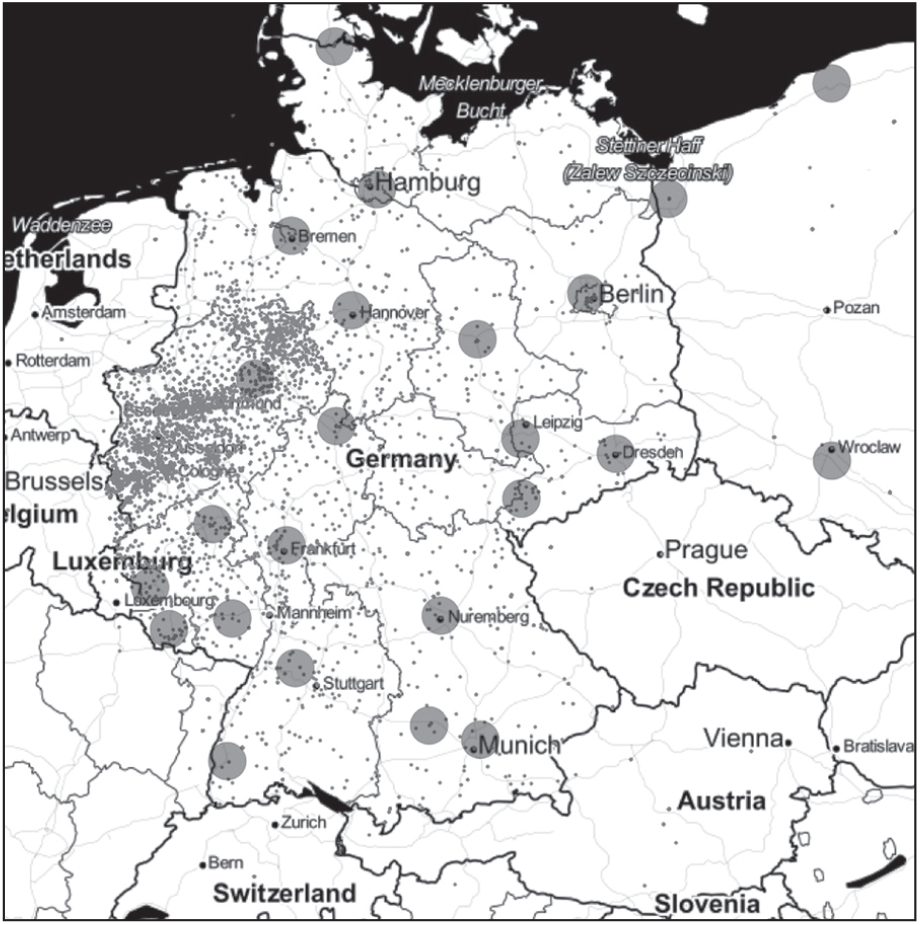
To capture potential exposure to Nazi radio broadcasts, we geocoded radio towers through Google Maps using data from Andreas Brudnjak, who compiled primary source documents about radio towers in Germany.Footnote 77 Figure 1 shows the geographic coverage of soldiers, represented by tiny dots, and radio towers, represented by large dots. Understandably, many transmitters were located close to the major cities, where the largest audiences would be. This, of course, raises the concern that the effects of radio signal strength alone could be confounded by the effects of urbanization, which could directly affect combat motivation in a number of ways. We therefore control in our statistical models for the urbanization level of each soldier’s birthplace, as detailed below.
Most of the radio towers were built before Hitler came to power. According to Brudnjak’s records,Footnote 78 only four of the twenty-eight radio towers were planned after Hitler’s appointment as chancellor, and the towers were mainly placed to maximize radio coverage across Germany.Footnote 79 Although many of the transmitter stations were repaired or rebuilt during the 1930s, most of their locations stayed the same. Further, as technology improved, taller towers were built in the same cities and the transmitters were transferred to the newer towers for better radio coverage. This addresses any concerns that radio towers were placed in regions correlated with Nazi support, something that may bias our results. Our results also hold if we exclude newer radio towers and the soldiers affected by their placement.
One might assume that listening to a radio broadcast is a binary outcome. In truth, radio reception is better conceptualized as a continuum: as the distance between transmitter and receiver increases, the probability a listener will be able to hear the station decreases until finally the station is just white noise. This probability depends on several factors: the broadcast wavelength, the power of the transmission, the sensitivity of the receiver, geographic features, and the distance between the transmitter and the receiver. Therefore, there is no definitive cutoff point at which radio stations cannot be heard. Instead, in line with Benjamin Olken, Adena and colleagues, Leonid Peisakhin and Arturas Rozenas, and Charles Crabtree and Holger Kern,Footnote 80 we construct a point-to-point measure of maximum radio signal strength for each solider in our sample. To do so, we use the Irregular Terrain Model, which allows us to calculate the signal strength from each radio tower to each soldier while considering each radio tower’s power and the topographical features of each receiver.Footnote 81 This provides us with a conditionally exogenous measure of potential exposure to radio broadcasts for each soldier.
German Soldiers and Radio Towers

Our measure of radio propaganda rests on a few assumptions. The primary assumption is that soldiers resided within their birthplace until they joined the war. As the cornerstone of our analysis, we use each soldier’s birthplace to calculate his potential exposure to propaganda. Although it is true that German within-country migration was high in the nineteenth century, within-country migration fell sharply in the twentieth century due to the effect of the Great Depression on the German economy.Footnote 82 If within-country migration was occurring, it was likely to be from the countryside to cities, that is, from low- to high-reception areas. This would imply that, in effect, some of our control group also received the treatment. While caution must be exercised in assessing the likely direction of omitted variable bias in a multivariate context,Footnote 83 if such a process were the only source of bias arising from within-country migration, then this is a classical measurement error problem, which is likely to bias estimates toward zero.
Second, we assume preenlistment propaganda conditions soldiers to fight. Three arguments may undercut this assumption: (1) radio was not the only method of indoctrination, (2) our measure of radio signal strength understates the quality of reception and the extent of listener-ship in Germany, and (3) postenlistment indoctrination is critical to explaining soldier motivation.
For the first argument, although the Third Reich certainly had other methods of indoctrination besides radio, such as the Hitler Youth, potential exposure to radio broadcasts occurs with exogenous variation across space. Therefore, soldiers with good radio reception were doubly exposed to Nazi ideology, while the others are getting only a single dose.Footnote 84
The second argument is similar to the discussion of within-country migration. If some soldiers received Nazi radio broadcasts when our measure of signal strength says they were not, it should attenuate any differences between our treatment and control groups and bias our estimate toward zero.Footnote 85 It should therefore make it harder for us to find an effect for our radio signal strength on our key dependent variables.
For the third argument, we assume that potential exposure to propaganda from radio broadcasts before enlistment will lead to increased likelihood of soldiers’ indoctrination that will affect their performance in battle. Obviously, postenlistment indoctrination should also matter. But due to the army’s indoctrination process, we assume that postenlistment indoctrination is relatively uniform for all soldiers. Bias would therefore emerge only if the army were doing more indoctrination of soldiers who likely had previous exposure to radio propaganda.
Last, indoctrination is determined by two factors: the probability of listening to propaganda messages and the length of potential exposure to propaganda. Because we investigate Nazi radio propaganda after Hitler’s rise to power, the amount of potential exposure to propaganda is calculated in terms of the amount of time from Hitler’s rise to power to the date the soldier joined the army. Although this potential exposure is perfectly correlated with when the soldier joined the army, there is a problem: because this date is correlated with other variables, such as the situation of the war upon enlistment, it is almost impossible to differentiate between the effects of length of potential exposure and those specific wartime characteristics. Therefore, to isolate the effect of potential exposure to propaganda, all model specifications use enlistment-year fixed effects to look only at the variation within each enlistment-year cohort.
It is important to note that due to data limitations, it is impossible for us to distinguish between the direct effect of a soldier listening to the broadcasts himself and the indirect effect of being embedded within a community with higher potential exposure to radio propaganda. Ideally, we would have listenership information at the individual level to distinguish these effects, but such information is unavailable. This means that our analysis captures the intent to treat rather than the preferred average treatment effect.
Analysis
If indoctrinated solders were the more motivated soldiers, they ought to have received more medals and to have been punished less than others. We therefore use these dependent variables—medals and punish-ments-to test for combat motivation. We take each soldier’s medals record from the Rass data set and John Angolia’s guideFootnote 86 to Nazi military decorations to create three variables: a binary variable recording whether a soldier ever received a decoration for bravery (excluding decorations given simply for performing ordinary duties, such as campaign medals), a count variable recording how many such decorations he received, and an ordinal variable recording the highest decoration he ever received (where “highest” is defined as the most prestigious medal according to Wehrmacht parade protocol).Footnote 87 Likewise, we code punishments in the same three ways: a binary variable for whether the soldier was ever punished, a count variable for the number of punishments, and an ordinal variable for the most severe punishment received. We test the relationship between potential propaganda exposure and our various dependent variables using ordinary least squares, although all of our results are robust to using generalized linear models.
We operationalize potential propaganda exposure through radio signal strength. We find the tower with the greatest signal strength for each soldier for every year beginning in 1933, the year of Hitler’s rise to power, to when the soldier joined the army. Because our dependent variables are cross-sectional, we need to collapse our measure for each soldier. We therefore take the average signal strength of all the years the soldier was exposed to radio broadcasts. For almost all our sample, the tower that broadcast the strongest signal was consistent for each soldier from 1933 until he joined the army.
To select soldiers who had a realistic chance of hearing the radio broadcast, we limit our sample to soldiers fewer than two hundred kilometers from the closest radio tower, although our findings are robust to different distance cutoffs. Unsurprisingly, our main independent variable, radio signal strength, is highly correlated with distance to the closest broadcasting tower. Therefore, as a robustness check, we also use distance from the closest broadcasting tower as an alternative independent variable, which also provides a more intuitive counterfactual.
The ability to hear a radio broadcast may also be nonlinearly related to signal strength. Increasing signal strength by 10db, for example, will matter more to people who have poor signal compared to those who are already listening to a strong signal. To account for this, we also run our analysis with the log transformation of radio signal strength.
One potential concern is that indoctrinated soldiers may be more likely to be exposed to combat than nonindoctrinated soldiers, a situation that could lead to an artificial increase in decorations while simultaneously leading to decreased insubordination. Since the Wehrmacht placed combat and noncombat troops in separate companies, we rerun our analyses with army company fixed effects for the initial company to which the solder was assigned to ensure that our results are not driven by differential exposure to combat. Unfortunately, this information is only available for the company-stratified sample taken from Wehrkreis VI.
There are also several variables that need to be accounted for when trying to isolate the effect of Nazi propaganda on soldiers. At the location level, we follow work by Adena and associatesFootnote 88 and control for a myriad of kreise-level factors, including: number of welfare recipients, social renters, war participants per thousand people, share of Jewish and Catholic population in 1933, share of unemployed and partially employed in 1933, share of white- and blue-collar workers in 1925, logged distance to the closest city, and logged average property tax in 1930.Footnote 89 Most important, given the potential confounding effects of urbanization, we follow Adena and associate’s procedure by controlling for the fifth-order polynomial of each soldier’s home (kreise-level) population.Footnote 90
We also control for various individual factors. First, more affluent citizens were more likely to have radio receivers. Therefore we account for each soldier’s social class and education. For human capital, we create a variable based on the highest level of education attained by the soldier; for social class we create an ordinal variable based on Detlef Mühlberger’s classification of occupational categories in Weimar and Nazi Germany.Footnote 91 We also control for factors that predict risky behavior or insubordination on the part of soldiers. As younger soldiers may be more inexperienced or more compliant than older soldiers, we control for how old the soldier was when he joined the army relative to the age of eighteen. Likewise, we also control for marital status, which has been shown to correlate with risk propensity (that is, married men are more risk averse).Footnote 92 German Catholics were less receptive to the Nazis’ message, and therefore Catholic soldiers might be less likely to be indoctrinated at the same level of potential exposure.Footnote 93 We also include two measures that serve as rough proxies for the physical aptitude of the soldiers: the relative height and weight of soldiers compared to the mean sample.
One concern for our analysis is to identify any direct connection between the independent variable and the dependent variables in terms of whether a soldier was a member of a Nazi organization. Nazism could influence our findings in a few ways. First, soldiers who were members of Nazi organizations were more likely to internalize propaganda and to be more motivated soldiers. Second, the Nazi support in a soldier’s birthplace might alter the calculations of officers awarding medals or meting out punishments. If this is the case, officers might be biased to favor members of Nazi organizations or to give medals strategically to increase domestic support. To alleviate concern that decorations and punishments were given because of underlying Nazi support in the soldier’s birthplace, we include the vote share of the Nazi Party in the locale in which a soldier was born.Footnote 94 To guard against the possibility of favoritism in favor of members of the Nazi Party, we control for this variable in our main models.
It is important to note that all our variables have limited coverage, and including many control variables results in a significant reduction in sample size due to listwise deletion. For example, although we are able to determine the exposure of about 15,400 soldiers to radio broadcasts, once we account for minimal control variables, such as age, and Kreise-level controls used by Adena and colleagues, such as population, our sample drops to just over ten thousand.Footnote 95 Adding a proxy for the soldier’s class reduces it further to just over nine thousand. Given the large swings in sample size, one concern is that choosing a particular set of controls could yield significant results that are a by-product of a particular subsample of the data. To alleviate this concern, we conduct an extreme bounds analysis (eba) in Section 8 of the supplementary material to ensure that our findings are robust to different model specifications and sample sizes.Footnote 96
Last, a major confounding factor could be when a soldier joined the army. Soldiers joining the army in 1944 faced a much different war than the one faced by soldiers joining in 1939. Therefore, all our specifications control for enlistment-year fixed effects. This allows us to analyze the differences between soldiers in the same enlistment year, providing a look at the effect of potential propaganda exposure across soldiers fighting within the same type of war.
Results
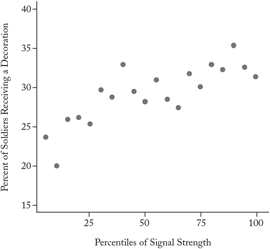
We find that soldiers with increased potential exposure to radio broadcasts are more motivated. Stronger radio signal strength increases the likelihood that soldiers will be decorated and increases their number of decorations. In particular, our findings regarding decorations and number of medals received are robust to several different types of specifications, eba, and tests for omitted variables. Our findings are even present in raw averages of decorations. In Figure 2 we divide our sample into 5 percent increments of radio signal strength and then calculate the average number of decorations for each group. As we see, soldiers exposed to the lowest levels of radio broadcasts were the least likely to receive decorations while those who were exposed to the highest levels of radio broadcasts were the most likely to receive decorations.
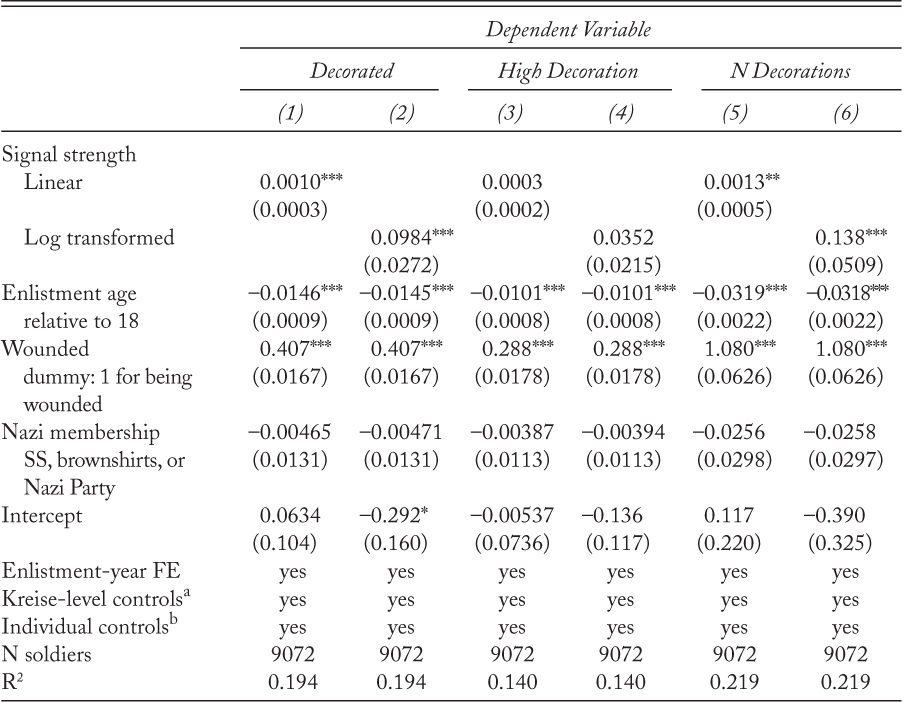
Table 1 shows the relationship between radio signal strength and receiving medals across just over nine thousand soldiers. Consistently across our regressions, radio signal strength is positively associated with receiving a first decoration and then additional decorations. This means that soldiers who experienced increased propaganda were more likely to have been decorated and to have more medals than soldiers who were less likely to hear radio broadcasts.
One potential concern is that medals could be given for political reasons, with Nazi Party members receiving more medals. We found that Nazi Party membership had an insignificant negative relationship with receiving a medal and the number of medals received. One might also expect Nazi Party members to have been more indoctrinated and thus more likely to receive medals. But given that membership in the party brought a number of private benefits in civilian life, being a member may reflect opportunism as well as conviction—something that would explain its noneffect.Footnote 97 To further rule out the possibility that our results may be driven by official favoritism toward Nazi-inclined soldiers, we generated a variable representing how high an individual’s first recorded military rank was. The intuition is that this should give us an indication of how favorably superiors viewed a soldier before he was tested in combat. If signal strength predicts high initial rank, this suggests that favoritism may be at work. As we report in Section 10 of the supplementary material, there is no significant relationship between radio signal strength and initial rank, giving us further confidence that our results are not driven by political favoritism.Footnote 98
Radio Signal Strength and Decorations

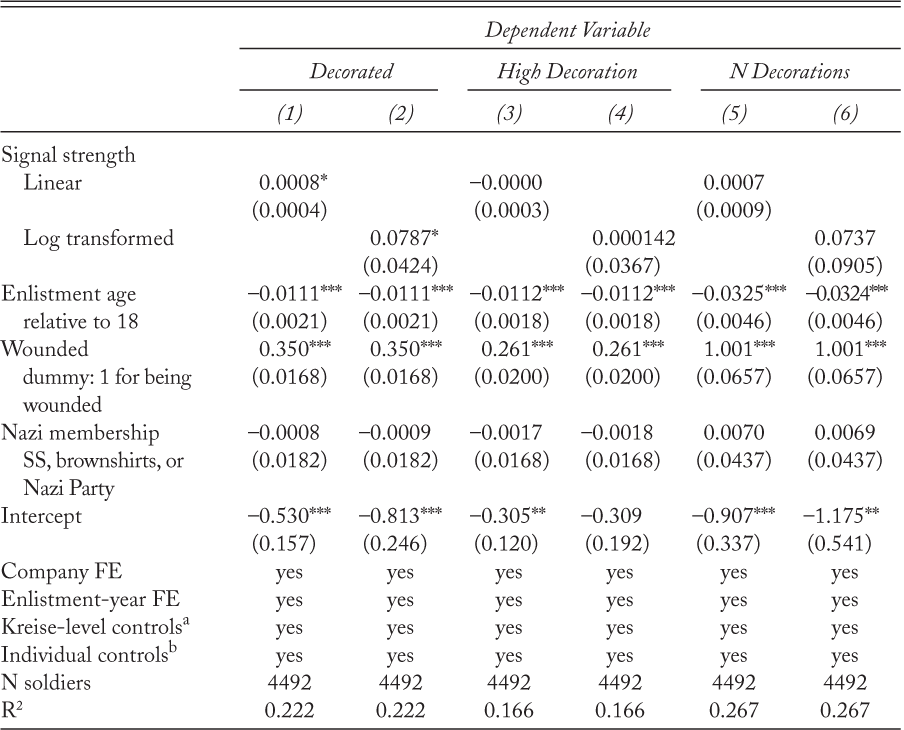
One major confounder is that soldiers are not uniformly exposed to combat: soldiers exposed to a high level of combat have more opportunities to earn recognition or to be punished. To ensure that we were comparing soldiers exposed to similar types of combat, we reran our main analyses using fixed effects for the companies to which soldiers were assigned. Table 2 shows the results with company fixed effects.
Radio Tower Signal and Soldier Decorations

***p ≤ .01, ** p ≤ .05, * p ≤ .1; kreise-clustered standard errors in parentheses
a Kreise-level controls include the fifth-order polynomial of population, the share of Jewish and Catholic population in 1933, the share of unemployed and partially employed in 1933, the share of white- and blue-collar workers in 1925, the logged distance to the closest city, the percentage of Nazi vote in 1933, the logged average property tax in 1930, and the number of welfare recipients, social renters, and war participants per thousand people.
b Individual controls include whether the soldier was Catholic or married, the soldier’s economic class, a dummy for living in a large city, and his relative height and weight.
Here, we no longer find that radio exposure has a significant effect on the number of medals given. But we still find significant evidence that potential exposure to radio propaganda is positively correlated with a soldier having been decorated.
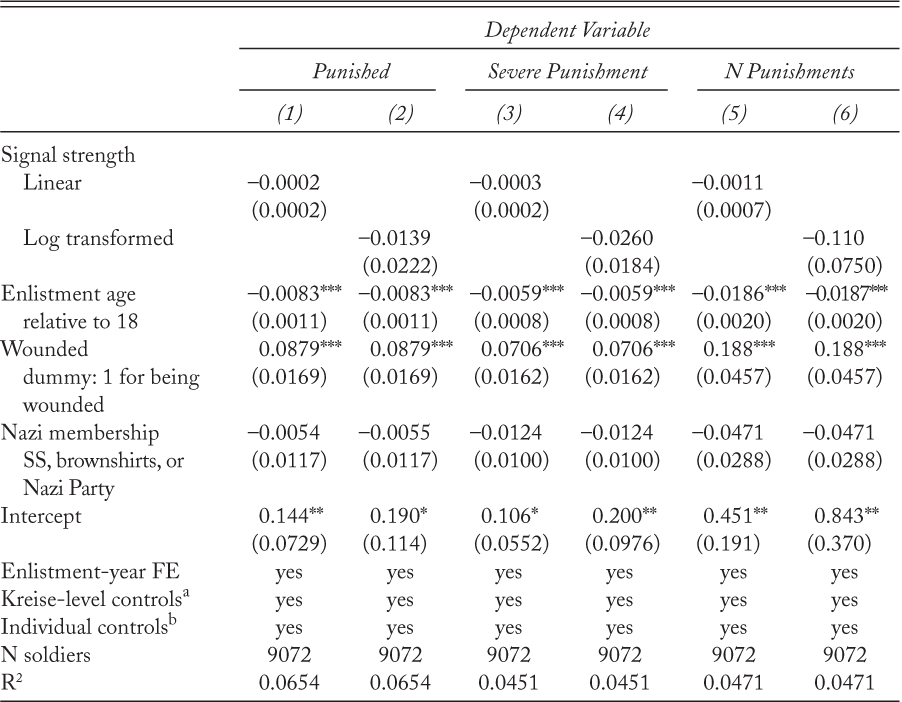
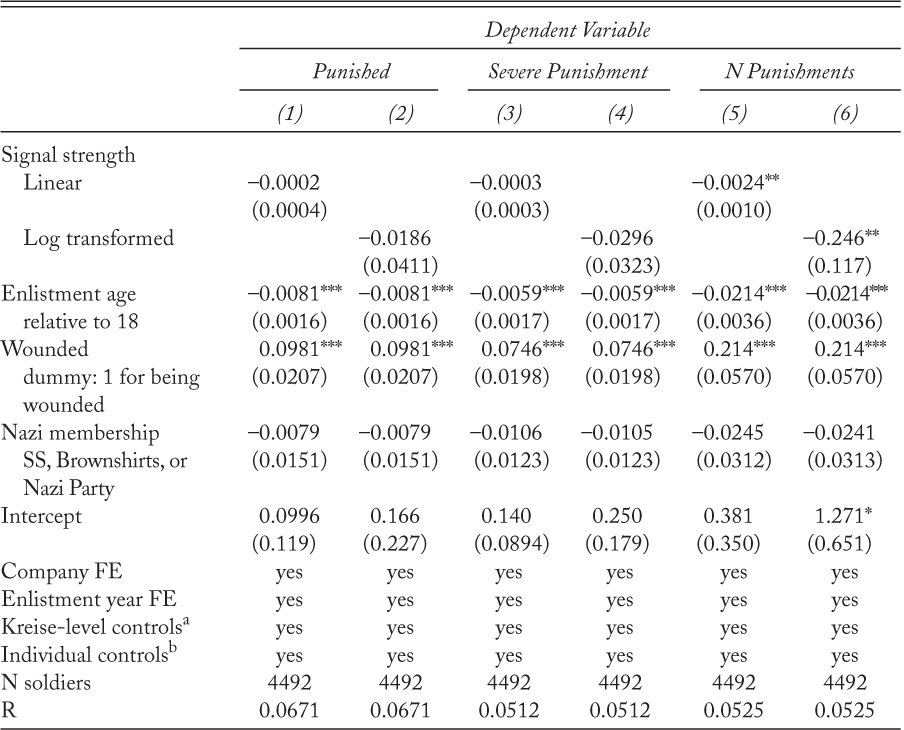
While we find evidence of a link between radio signal strength and decorations, we find no statistical evidence that radio signal strength decreases the likelihood that soldiers will be punished. Tables 3 and 4 show our findings when using punishments as the dependent variable. Although in all specifications the models produce negative estimates of the effect of radio signal strength on various aspects of punishment, the results are not consistently significant at conventional levels. The only significant finding is the negative relationship between radio signal strength and the number of punishments with company fixed effects.
Radio Tower Distance and Soldier Decorations: Company Fixed Effects

***p ≤ .01, ** p ≤ .05, * p ≤ .1; kreise-clustered standard errors in parentheses
a Kreise-level controls include the fifth-order polynomial of population, the share of Jewish and Catholic population in 1933, the share of unemployed and partially employed in 1933, the share of white- and blue-collar workers in 1925, the logged distance to the closest city, the percentage of Nazi vote in 1933, the logged average property tax in 1930, and the number of welfare recipients, social renters, and war participants per thousand people.
b Individual controls include whether the soldier was Catholic or married, the soldier’s economic class, a dummy for living in a large city, and his relative height and weight.
Two factors may explain these null results. First, there are simply fewer punishments than medals in our data set. This means there is less variation to help us identify an effect. Second, Nazi radio propaganda typically stressed heroic individual achievement more than habits of obedience.Footnote 99 Habits of obedience would be more likely to be formed through Nazi institutions like the Hitler Youth, the German Labor Front, and the army itself. Therefore, if radio propaganda stressed obedience less than heroic achievements, then this might have a weaker effect on future soldier punishments. Note that the two explanations are not mutually exclusive: if the message of obedience is weaker and there is less variation to identify the effect, in combination the two might lead to our null finding.
Radio Tower Signal and Soldier Punishment

***p ≤ .01, ** p ≤ .05, * p ≤ .1; kreise-clustered standard errors in parentheses
a Kreise-level controls include the fifth-order polynomial of population, the share of Jewish and Catholic population in 1933, the share of unemployed and partially employed in 1933, the share of white- and blue-collar workers in 1925, the logged distance to the closest city, the percentage of Nazi vote in 1933, the logged average property tax in 1930, and the number of welfare recipients, social renters, and war participants per thousand people.
b Individual controls include whether the soldier was Catholic or married, the soldier’s economic class, a dummy for living in a large city, and his relative height and weight.
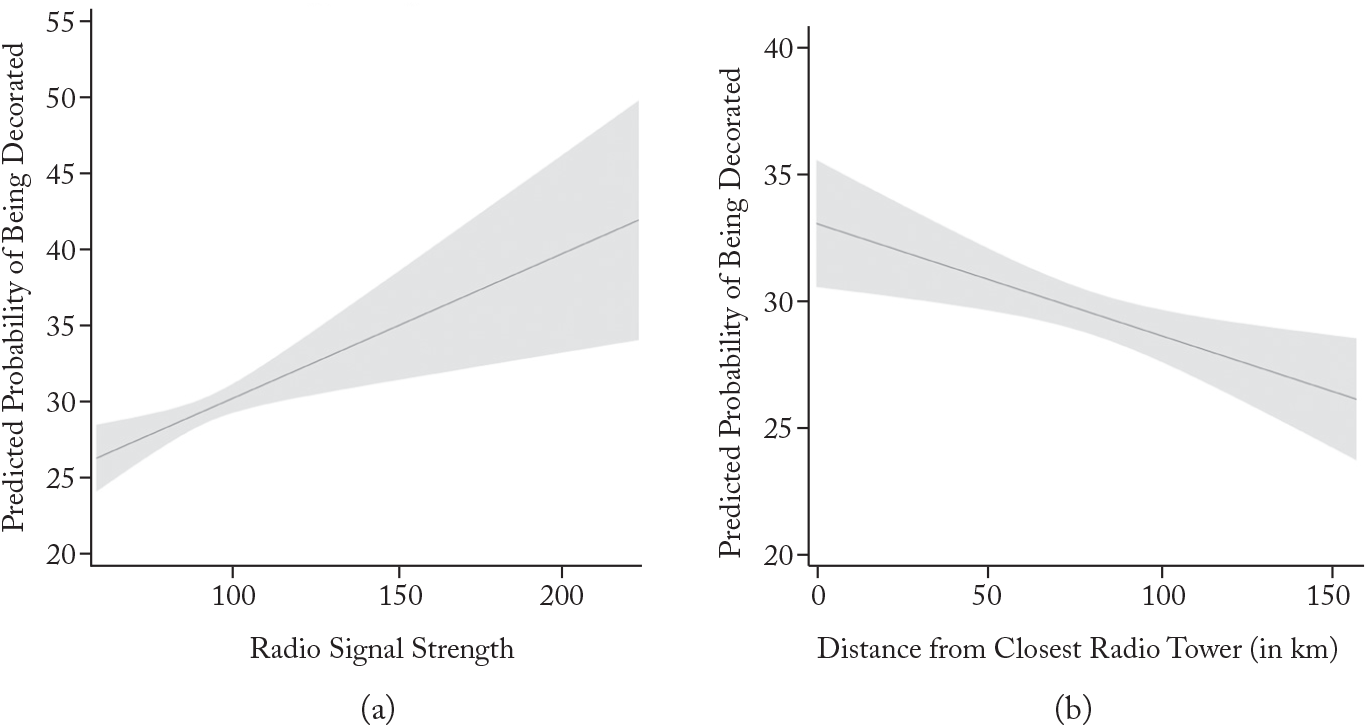
To show the substantive effects of our results on decorations, we graph the postestimated results in Figure 3. The effects of radio signal strength are substantial. Moving from minus one standard deviation to plus one standard deviation from the mean of radio signal strength increases the predicted probability of receiving a decoration from 28 to 31 percent, an overall increase of about 11 percent. To illustrate this more intuitively, we rerun all our results in the supplementary material using distance in kilometers to the nearest radio tower and find nearly identical results as with radio signal strength.Footnote 100 As Figure 3(b) shows, the predicted probability of receiving a medal decreased with the distance to the closest tower. A soldier born one hundred kilometers away from a radio tower was approximately 13 percent less likely to have received a medal than a soldier born right next to one.
Radio Tower Distance and Soldier Punishment: Company Fixed Effects

***p ≤ .01, ** p ≤ .05, * p ≤ .1; kreise-clustered standard errors in parentheses
a Kreise-level controls include the fifth-order polynomial of population, the share of Jewish and Catholic population in 1933, the share of unemployed and partially employed in 1933, the share of white- and blue-collar workers in 1925, the logged distance to the closest city, the percentage of Nazi vote in 1933, the logged average property tax in 1930, and the number of welfare recipients, social renters, and war participants per thousand people.
b Individual controls include whether the soldier was Catholic or married, the soldier’s economic class, a dummy for living in a large city, and his relative height and weight.
Testing the Mechanism
Although we cannot measure a soldier’s exposure to propaganda directly, we rest our analysis on the assumption that our measure of radio signal strength can serve as a proxy for Nazi propaganda. How can we be sure of the construct validity of our measure? One way to test its plausibility is to look at its relationship to membership in the Nazi Party or another Nazi organization. If radio signal strength does proxy for propaganda, our measure for potential radio broadcast exposure should be positively related to membership in a Nazi organization.
Postestimated Predicted Probability of Radio Tower Signal Strength and Distance on Decorations

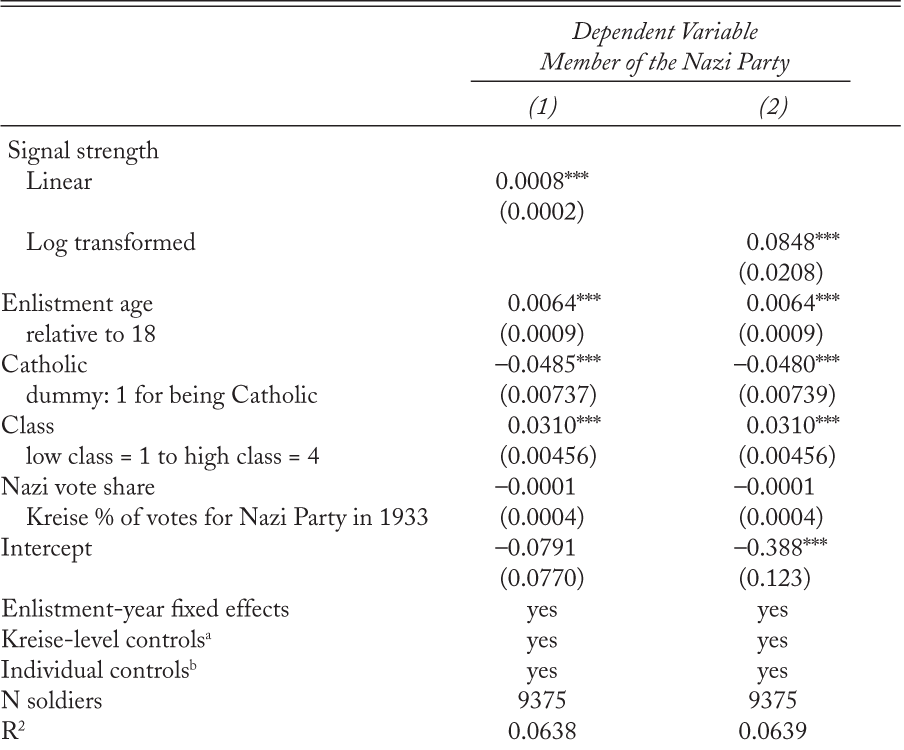
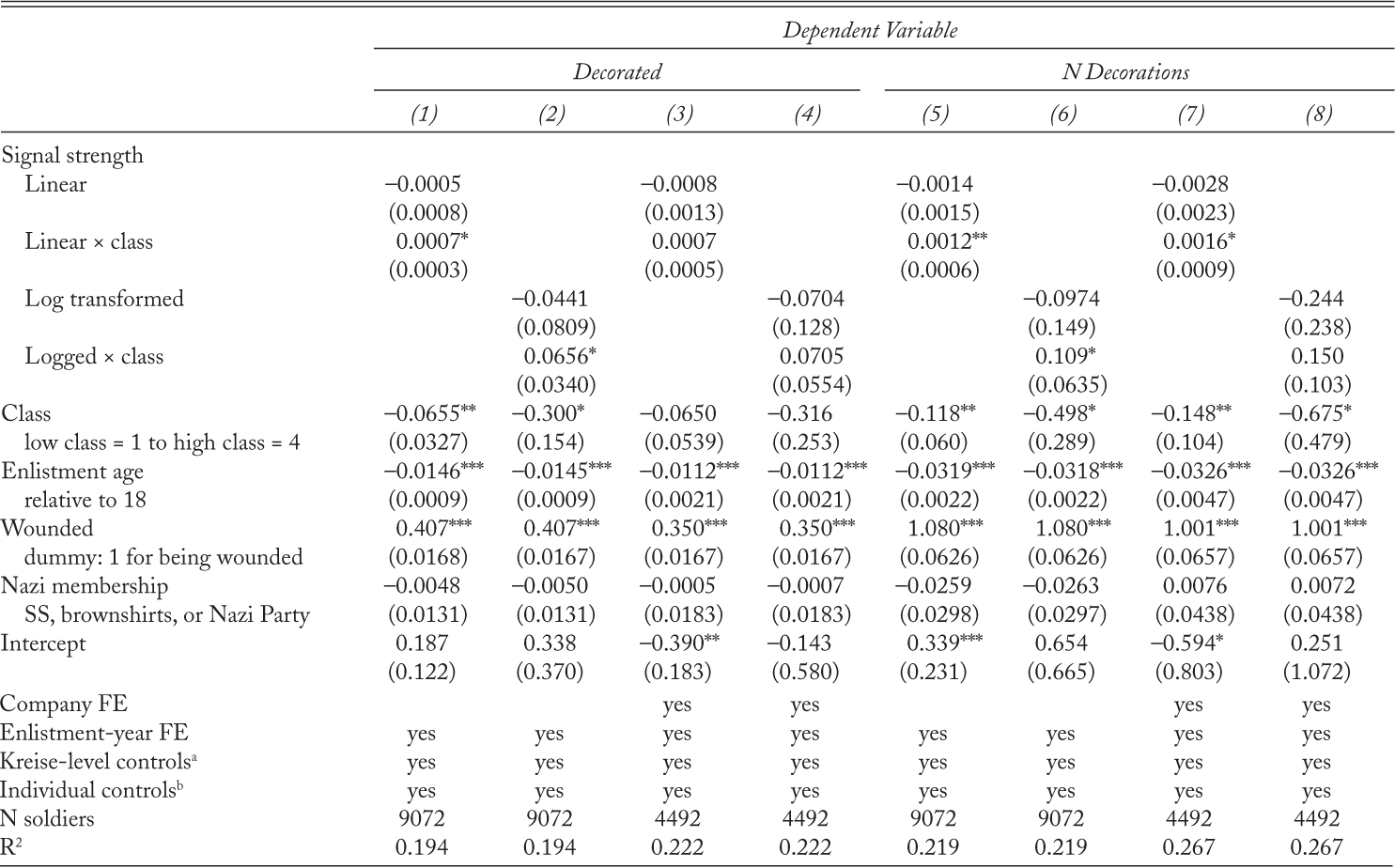
We therefore rerun our analysis to see if our measure of radio signal strength predicts whether a soldier became a member of the SS, the brownshirts, or the Nazi Party. We show the stylized results in Table 5. As we would expect, radio signal strength is positively associated with whether a soldier became a member of a Nazi organization in both the linear and the log transformed models. This is consistent with Adena and colleagues’ findings that Nazi radio propaganda was potent enough to significantly increase the Nazi vote share in the 1933 election even though the Nazis had had control over German radio for only a few months.Footnote 101 These results give us confidence that our measure of radio signal strength is capturing exposure to propaganda.
Moreover, if our radio signal–strength measure is picking up the effects of propaganda and not some other difference between areas with radio coverage and those without, then we should expect that the effects of signal strength should be stronger among soldiers who were more likely to own radios and hence listen to propaganda. In spite of Nazi attempts to reduce the cost of radio sets, they remained expensive and were more likely to be owned by wealthier individuals.Footnote 102 Clemens Zimmermann notes that even by 1941 only about 65.1 percent of German households were radio listeners. Although the advent of the Nazi-subsidized radio, the Volksempfänger, had reduced the cost of a radio set to 65 marks,Footnote 103 it would still have taken an unskilled laborer about 130 man-hours to earn enough to buy one.Footnote 104 Our social class variable should therefore be a good proxy for radio ownership. If our theory is correct, then the interaction between social class and signal strength should be positive and significant. We test this through an interaction between class and radio broadcasts in Table 6. Overall, we find a positive relationship between class and radio strength across almost all our measures of decorations received; but the results are consistently significant only in models without company fixed effects. This means that if a soldier was in a high social class, that is, the soldier was most likely to have a radio, he was more likely to have received a medal if he also had high levels of potential exposure to radio signals. We believe these results lend tentative support to our mechanism that radio is a vehicle of propaganda.
Radio Tower Signal and Nazi Membership

***p ≤ .01, ** p ≤ .05, * p ≤ .1; kreise-clustered standard errors in parentheses
a Kreise-level controls include the fifth-order polynomial of population, the share of Jewish and Catholic population in 1933, the share of unemployed and partially employed in 1933, the share of white- and blue-collar workers in 1925, the logged distance to the closest city, the logged average property tax in 1930, and the number of welfare recipients, social renters, and war participants per thousand people.
b Individual controls include whether the soldier was married and a dummy for living in a large city, and his relative height and weight.
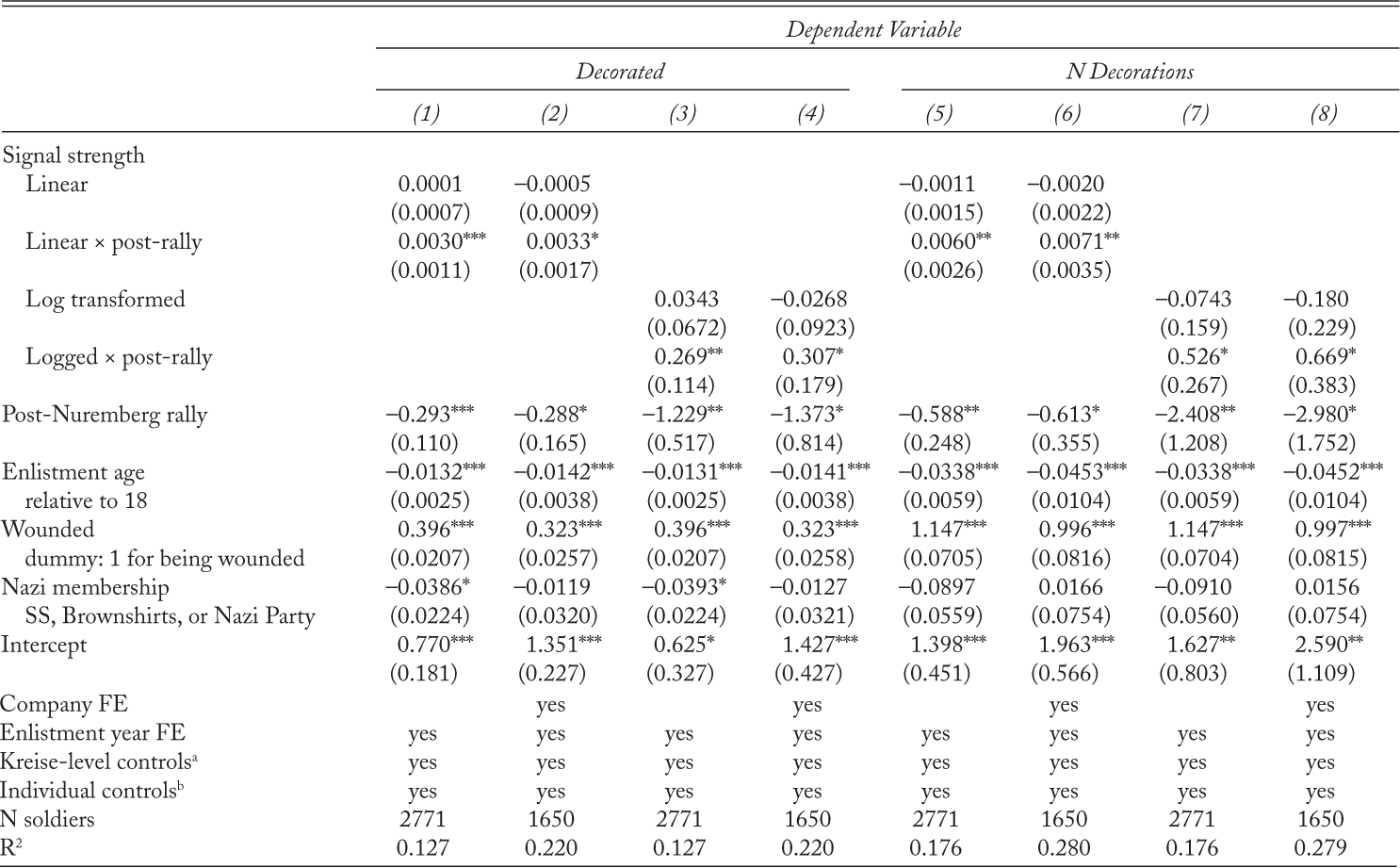
Another potential concern is that our results stem mainly from cross-sectional findings of soldiers exposed to propaganda of roughly the same intensity. If our theory is correct, those exposed to propaganda of higher intensity should also be more motivated as soldiers. To see how different levels of propaganda intensity affect combat motivation, we leverage the enlistment date of soldiers around one of the largest annual Nazi propaganda events—the Nuremberg rallies, which were broadcast to the nation with the goal of unifying the German people behind Hitler. The rallies featured daily speeches by Hitler and other senior Nazis, such as Goebbels, Hess, and Rosenberg, along with carefully choreographed parades featuring the Wehrmacht, the Hitler Youth, and other Nazi organizations.Footnote 105 If our theory is correct, we should expect soldiers who joined the army just after being exposed to these propaganda rallies to be more motivated than soldiers who joined just before the rallies took place.
To test this, we limit the sample to soldiers who joined the army three months before and three months after the Nuremberg rallies. We then interact a dummy for the soldiers who joined the army within ninety days after a Nuremberg rally with our proxy for radio signal strength to test whether increased propaganda intensity makes soldiers more likely to earn a medal. Since the Nuremberg rallies were broadcast across the Third Reich, this essentially compares soldiers with similar radio exposure but with different levels of propaganda exposure. We include all our normal controls in these model specifications, including enlistment-year fixed effects. As we would expect, the interaction term between radio signal and soldiers exposed to the Nuremberg rallies is positive and significant across all our models (see Table 7). This means soldiers who had high levels of radio signal strength were more likely to receive a medal after being exposed to an intense level of propaganda than were soldiers who had high levels of radio signal strength but missed the exposure to the propaganda. This adds credibility to the claim that propaganda is a driving force for combat motivation.
Radio Tower, Class, and Soldier Decorations

*** p ≤ .01, ** p ≤ .05, * p ≤ .1; Kreise-clustered standard errors in parentheses
a Kreise-level controls include the fifth-order polynomial of population, the share of Jewish and Catholic population in 1933, the share of unemployed and partially employed in 1933, the share of white- and blue-collar workers in 1925, the logged distance to the closest city, the percentage of Nazi vote in 1933, the logged average property tax in 1930, and the number of welfare recipients, social renters, and war participants per thousand people.
b Individual controls include whether the soldier was Catholic or married, the soldier’s economic class, a dummy for living in a large city, and his relative height and weight.
Radio Tower Signal Strength and Soldiers Joining before and after the Nuremberg Rallies

*** p ≤ .01, ** p ≤ .05, * p ≤ .1; Kreise clustered standard errors in parentheses
a Kreise-level controls include the fifth-order polynomial of population, the share of Jewish and Catholic population in 1933, the share of unemployed and partially employed in 1933, the share of white- and blue-collar workers in 1925, the logged distance to the closest city, the logged average property tax in 1930, and the number of welfare recipients, social renters, and war participants per thousand people.
b Individual controls include whether the soldier was married and a dummy for living in a large city, and his relative height and weight.
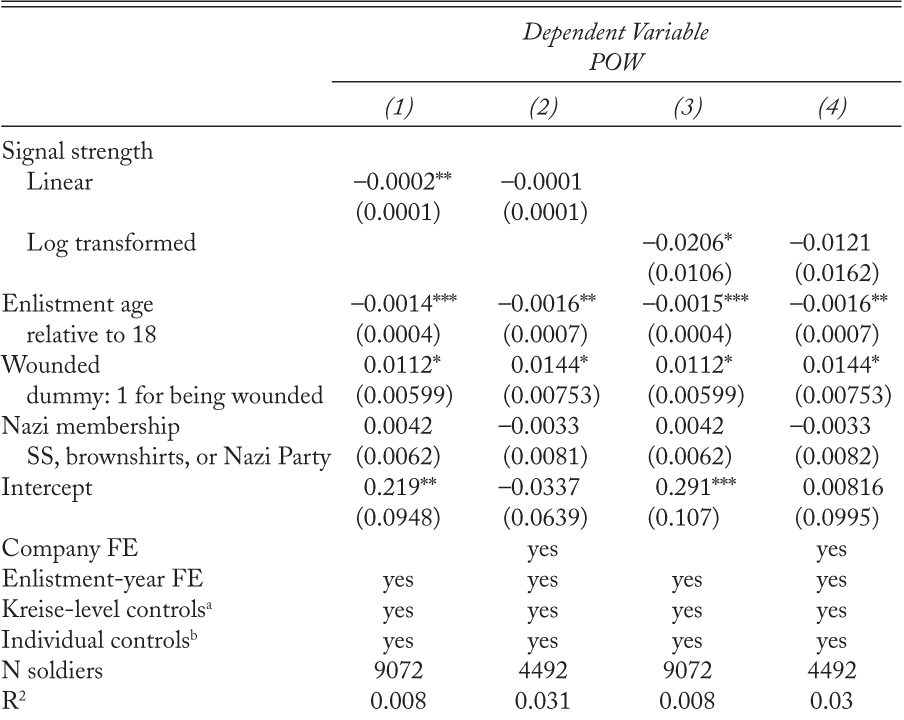
Last, if propaganda made soldiers more motivated to fight, one consequence could be that soldiers were less likely to surrender to the enemy. To test if this is true, we investigate whether exposure to radio propaganda made soldiers less likely to become a pow. We rerun the same models as our main tests but change the dependent variable from whether a soldier received a medal to whether the soldier surrendered to the Allies. We present the results in Table 8. Overall we find supporting evidence in all the models that soldiers who were more exposed to Nazi propaganda were less likely to become pows, and the results are statistically significant for the models without company fixed effects. This is impressive given the paucity of pows in our data set, which represents only 4 percent of all our observations. We believe this finding provides further evidence that soldiers exposed to propaganda were more motivated than other soldiers.
Additional Specifications
We run additional specifications to address other possible concerns. First, in Section 3 of the supplementary material, in line with Adena and colleagues, we create an S-shaped curve of potential radio signal exposure to discount very high signal strengths and very low signal strengths.Footnote 106 Just as above, with the S-curve variable of radio signal strength, we find that the higher the signal strength, the more likely the soldier was to receive a medal.
Second, in Section 4 of the supplementary material, we test to see whether the soldiers were exposed to roughly the same level of combat.Footnote 107 Some may argue an alternative explanation for our findings— that more motivated soldiers may be more likely to be sent into combat and receive decorations. The fact that our results are robust to the inclusion of company fixed effects—which attempt to control for whether a soldier was in a combatant or noncombatant unit or was present in the most fiercely fought campaigns of the war, such as Stalingrad—suggests this is unlikely. However, as a further test we rerun our analysis to see whether soldiers with increased potential exposure to radio broadcasts were more likely to be wounded or killed. Overall, we find that radio signal strength had no statistically discernible effect on a soldier’s risk of being killed or wounded.
Radio Tower Signal and Prisoners of War

***p ≤ .01, ** p ≤ .05, * p ≤ .1; Kreise clustered standard errors in parentheses
a Kreise-level controls include the fifth-order polynomial of population, the share of Jewish and Catholic population in 1933, the share of unemployed and partially employed in 1933, the share of white- and blue-collar workers in 1925, the logged distance to the closest city, the percentage of Nazi vote in 1933, the logged average property tax in 1930, and the number of welfare recipients, social renters, and war participants per thousand people.
b Individual controls include whether the soldier was Catholic or married, the soldier’s economic class, a dummy for living in a large city, and his relative height and weight.
A critic may argue that this result casts doubt on our main hypothesis that soldiers with more potential exposure to propaganda should be more motivated. If these soldiers are more motivated, should they not also be more likely to risk death and injury? First, for wounds at least, there is not a clear story between motivation and the likelihood of reporting a wound. A nonmotivated soldier might be willing to exaggerate an injury to get out of combat, or, to keep fighting, a very motivated soldier might not report a wound. Second, historical evidence suggests that the risk of death and injury for soldiers in close proximity to the battlefield involves a substantial degree of randomness. A soldier hiding behind a tree one kilometer from the enemy’s front line still runs a significant risk of death through aerial bombing or shelling. In fact, the lack of connection between individual frontline soldiers’ actions and the risk of death is a major source of post-traumatic stress and the prevalence of charms and religious symbols among frontline soldiers.Footnote 108 Thus, although more motivated soldiers should be, ceteris paribus, more likely to be killed or wounded, there is likely to be substantial randomness in the mapping from motivation to death and wounds. By contrast, potential exposure to combat should have substantially affected a soldier’s risk of death or injury, with far less measurement error.
Third, to ensure that our results are not driven by a few outliers and to simplify the interpretation of our results, in Section 5 of the supplementary material we use distance to closest radio tower as a proxy for potential propaganda exposure.Footnote 109 In terms of distance, we break our sample into “close,” “middle,” and “far away.” Distance to the closest radio tower provides nearly identical results to our main findings and mimics exactly what we would expect: soldiers who lived away from the radio tower are much less likely to receive a medal than those who are close and those who are in the middle category.
Fourth, in Section 6 of the supplementary material we restrict our sample to the Nordrhein-Westfalen region to ensure that our story holds for the majority of our sample.Footnote 110 The results are very similar to our main models and in many respects, even stronger.
Fifth, we claim that radio towers were placed to maximize listener-ship both before and after the Nazis’ rise to power. If radio towers were located strategically by the Nazis to bolster support from those who were predisposed to sympathize with the regime, there may be a threat to our inference about the effect of exposure to propaganda. To alleviate this concern, in Section 7 of the supplementary material we also rerun our analysis by eliminating any soldier who was ever exposed to a broadcast from towers built after 1933 and find that our results remain largely unchanged.Footnote 111
Last, we run an additional test to address any concerns about our measure of propaganda exposure. To get a sense of the overall radio signal exposure in our main tests, we average the yearly radio signal strength from 1933 until the soldier joined the army. Occasionally, towers were added or upgraded, which could increase the exposure level of soldiers. Perhaps the soldier’s maximum exposure to propaganda mattered more than his average exposure over time. To alleviate this concern we rerun our analysis in Section 8 of the supplementary material using a soldier’s maximum radio signal exposure as our main explanatory variable.Footnote 112 Overall we find identical results across all these tests.
Robustness Tests
We show that exposure to radio broadcasts is positively related to decorations. To end up with these results, we picked a reasonable set of plausible control variables and presented a select few finalized models. This is standard practice when researchers have a good sense of which variables should affect the outcome of interest. But given the uneven coverage of our variables, including or excluding controls can change our sample dramatically. Further, some of our control variables, while important, are arguably posttreatment effects and thus cause our estimate of radio signal strength to be biased. To ensure that our effects of radio signal strength are genuine, and to guard against the possibility of model dependence, we employ eba, a global sensitivity analysis that evaluates the coefficients of interest for every combination of plausible control variables. The strength of eba is its ability to test the significance of a key independent variable in the face of uncertainty about the inclusion of control variables.Footnote 113
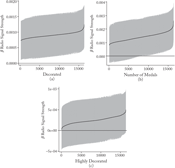
To conduct our eba, we divide all control variables into two groups: a set of mandatory control variables that is always included in every model specification and a set of optional control variables. Then we estimate a separate model for each possible combination of the optional control variables with the mandatory controls. For each model there are fourteen optional controls, which give us 16,383 model specifications.Footnote 114 We include only a few mandatory control variables in our eba analysis—all of kreise-level controls and a fixed effect for the year in which the soldier joined the army—to alleviate concern about whether the state of the war at the time of enlistment might be biasing our results. For our optional variables we include all other control variables in our models. Every combination of these control variables is run in its own separate regression; we compile the results to test the robustness of our main finding.
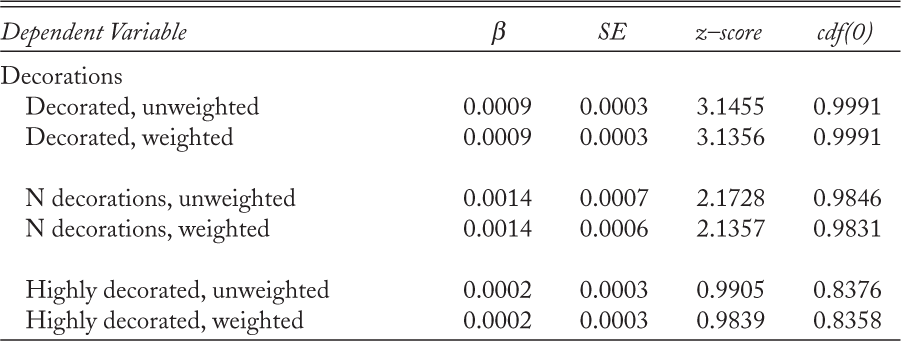
Overall, our findings from the eba are robust. We test our three decoration dependent variables using the eba: decorated, number of medals, and highly decorated. The eba results are largely congruent with our main regression results. Our results for whether the soldier was decorated and how many medals he received are very robust (see Figure 4). All the 16,383 model specifications for whether a solider was decorated and the number of medals he received are the same direction as our main results and statistically significant at the 95 percent level. It is unsurprising that these variables pass the Sala-i-Martin cdf(0) test at the 0.99 level, as shown in Table 9. Our results for being highly decorated are more sensitive to model specification. All the regression results have zero within the 95 percent confidence interval, and the results do not go above the 0.95 level in the Sala-i-Martin cdf(0) test. Overall, our eba results suggest that our findings are robust to model specification and provide confidence in our main findings.
In addition, as with any study claiming causality, omitted variable bias is of central concern. We control for many important channels that could affect our causal mechanism, but there is always a possibility that we missed a variable correlated with both our dependent variable and our independent variable of interest, thus confounding our results. The question is: How would this unobserved variable affect our results?
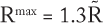
To address this question, we implement procedures developed by Emily Oster to perform a sensitivity analysis on the possibility of an unobserved omitted variable biasing our results.Footnote 115 Previously, scholars would observe the movement of ols estimates as they added various controls. If the estimate of interest was stable to the inclusion of the controls, then the estimate was considered to be robust to the possibility of omitted variable bias. But Oster shows that movements in the R-squared term are equally important in assessing bias.Footnote 116 We employ this technique to see if our results of signal strength are robust to the possibility of omitted variable bias. Specifically, we use Oster’s recommended threshold under which (1) the inclusion of the unobservables would explain 1.3 times our fully specified models, (2) the degree of selection on unobservables and observables is equal, and (3) the net effect of omitting the unobservables is to bias the coefficients away from zero. Oster chooses 1.3 as the threshold because it is the value below which 90 percent of the findings from randomized controlled trials would remain robust.Footnote 117 If the effect is in the same direction after the application of Oster’s procedure, we can say that our results are robust. We present our results in Table 10, in which all our results for signal strength are positive and thus robust to the threat of omitted variable bias.
Extreme Bounds Analyses of the Effect of Signal Strength on Decorations

Results of Sala-i-Martin Extreme Bounds Analysis

Results of Oster Omitted Variable Sensitivity Analysis

Conclusions
This article presents evidence that propaganda can have a significant effect in motivating ordinary soldiers to fight, that is, individuals can be persuaded to take significant risks to further ideological goals. Potential exposure to Nazi radio propaganda prior to enlistment is associated with a significant increase in the probability of receiving decorations and in the number of decorations received. This work also extends current research on the media’s effects on individuals’ preferences by showing that the media can persuade people to act even in situations that subject them to high risk.
Yet there are limitations to our findings. First, since our study does not contain information on soldiers’ personal social ties, we cannot say directly how important ideology is relative to unit cohesion. But we can say that propaganda is an important determinant of motivation even for mass army conscripts, something that classical primary unit–cohesion theory dismissed. Moreover, we do not believe these are mutually exclusive. It is possible that primary unit ties work in conjunction with propaganda, since propaganda may convince soldiers both to fight and to persuade their comrades to fight—something that is strongly suggested by the qualitative literature.Footnote 118 But given the limits of our data, we cannot directly test this.
Second, the impact of propaganda may be contingent on regime type. Nazi Germany established a state monopoly on the mass media and banned the expression of non-Nazi viewpoints. A state in which individuals have more access to information contradicting official propaganda may not be able to call on such reserves of commitment from its soldiers, as many Allied leaders feared about their own troops at the time.Footnote 119
Third, some types of ideas may lend themselves to combat motivation more easily than others. Nazi ideology, which glorified conformity and war, may have been more likely to motivate men to fight than would liberal democracy, which prizes individual rights. One interesting avenue for future research lies in examining the types of messages that liberal democratic societies can craft should they seek to produce comparable reserves of commitment.
At the same time, it is possible that the proliferation of media sources in the contemporary world, even in many nondemocratic countries, makes it harder to maintain a Nazi-like monopoly on the media and therefore more difficult to inculcate political ideas for which one would kill or die. Moreover, studies of such radicalization suggest that it requires potential recruits to cut themselves off from alternative sources of information.Footnote 120 If a more diffuse global media environment makes it harder for extremist ideologies to motivate people to kill and die, then this has hopeful connotations for global security.
Fourth, this article covers only one country in one period of time. We cannot know the boundary conditions of the causal relationship between propaganda and motivation. National norms of obedience, trust in authority, human capital, and economic development, as well as the extent to which propaganda is congruent with preexisting beliefs, could affect susceptibility to propaganda.Footnote 121 Nonetheless, Nazi Germany was not chosen as an easy case to establish the importance of ideas for combat motivation. To the contrary, the historical debate over this question has been intense.Footnote 122 Moreover, as the initiator of the bloodiest war in recorded history, Nazi Germany is neither an obscure nor an unimportant case.Footnote 123 Nevertheless, future research could explore the sources of variation in susceptibility to propaganda by exploiting similar sources of exogenous variation in societies with background conditions different from those found in Nazi Germany.
Appendix
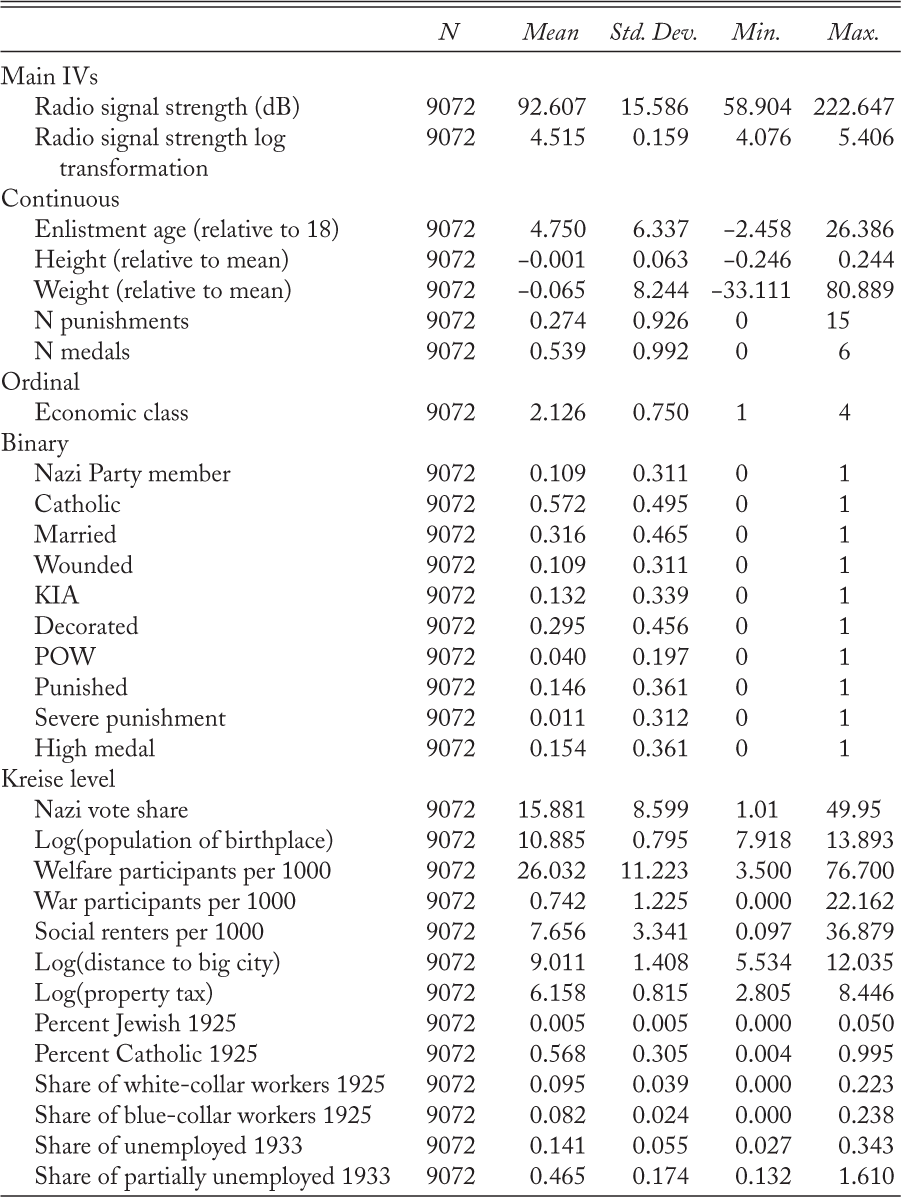
Summary Statistics

Supplementary Material
Supplementary material for this article can be found at https://10.1017/S0043887118000345.
Data
Replication data for this article can be found at https://10.7910/DVN/LVFRCL.
Acknowledgments
We are grateful for the feedback provided by Simon Weschle, Jan Pierskalla, Arturas Rozenas, Daniel Krcmaric, Keith Dowding, Paul Kenny, Jana von Stein, Ben Goldsmith, and the participants in the seminar at the Juan March Institute, Madrid, Spain, April 22, 2016. Special thanks to Heidi Madden for her invaluable help as a German-language research librarian when we started this project. We are also thankful to the anonymous reviewers of World Politics, whose comments improved this project.
Funding
This research was partially funded by the Spanish Ministry of Economy and Competitiveness and by the European Regional Development Fund (ERDF) Grant no. ECO2016-77205-P
Authors
Benjamin Barber IV is an assistant professor in the Department of Strategy at IE Business School in Madrid, Spain. His research focuses on the intersection between business and politics. He can be reached at benjamin.barber@ie.edu.
Charles Miller is a lecturer in international relations at the School of Politics and International Relations of the Australian National University. His research focuses on military effectiveness and military conflict. He can be reached at charles. miller@anu.edu.au.