African Americans constitute a politically homogenous liberal bloc, or so it is often assumed. This assumption, yet untested, has important consequences for public opinion scholarship. The significant homogeneity of black voting behavior and Democratic partisanship over time can easily lead to the assumption of an overwhelmingly liberal or non-ideological black electorate. This work takes stock of public opinion among blacks and whites with an eye toward regional distinctiveness.
By unpacking public opinion based on race and region, my findings further a more nuanced understanding of ideological preferences in the contemporary electorate. What underlies public opinion in recent years when disaggregated by race and region? What insights can be gathered from utilizing both self-identification and multidimensional measures of ideology to explain differences within and between these groups? Finally, are blacks and whites more polarized within the South and, if so, what are the implications for American politics?
Until the election of Barack Obama, a significant proportion of African Americans and whites, to a lesser extent, preferred to report “don’t know” when asked about ideological self-identification. Since the 2008 election, the proportion of African Americans adopting ideological group labels has increased significantly. Additionally, the new reality of political polarization has manifested primarily in the South and is inseparable from racial considerations. The primary aim of this paper is to elucidate these recent changes.
CONTEMPORARY IDEOLOGY IN THE SOUTH AND BEYOND
The southern realignment of the late twentieth century cannot be detached from racial considerations. As blacks entered the electorate as Democrats, southern whites increasingly abandoned the Democratic for the Republican Party. Whereas the party of southern conservative whites and Jim Crow was once firmly Democratic, this shift toward the Republican Party turned the ideological makeup of the parties upside-down. This story is a common feature of the southern politics literature (Black and Black Reference Black and Black2009). The assumption is usually that party dynamics changed, whereas ideology remained the same or, at least, similar. Is this really the case, though? This paper documents variation in two measures of ideology over time by race and region. The results show southern whites continue to adhere to conservative political preferences, while southern blacks are overwhelmingly liberal and populist. Non-southerners do not share the same dramatic gap in political preferences.
Though partisanship tends to drive political orientations among most citizens, ideology is the glue that binds preferences. Converse’s (Reference Converse and Apter1964) claim that most of the public is non-ideological does not comport well with the recent trend of southerners and non-southerners alike adopting ideological labels. This shift points to a populace that is not only capable of ideological thinking, but is doing so in a manner that suggests increasing polarization along racial and regional cleavages.
The drive to identify with an ideological group also challenges the assumption of a non-ideological black population (Dawson Reference Dawson1994). With the rise of the black middle class and elite cues moderating on “black issues” in recent years, the once homogenous black population has become increasingly heterogeneous in their policy preferences (Tate Reference Tate2010). Conversely, southern whites are often assumed to be relatively homogenous in their preferences for conservatism and the results below backup this claim. Whereas Ellis and Stimson (Reference Ellis and Stimson2012) argue that the conservative label tends to be more popular among Americans because of the negative connotations associated with the liberal label, this is unlikely among blacks.
The policies supported by the American Right have often been detrimental to the advancement of minority group interests. The historical association of conservatism with racism and Jim Crow in the US could help explain blacks’ aversion to the conservative label. Similarly, part of the reluctance to adopt ideological labels may stem from deep associations between African Americans and the Democratic Party. A culture of liberalism in the black community could push some blacks to adopt liberal identification.
The recent era of polarization has clarified the connection between partisanship and ideology, and the Democratic Party is associated with liberal ideology (Fiorina Reference Fiorina, Abrams and Pope2005; McCarty, Poole, and Rosenthal Reference McCarty, Poole and Rosenthal2006; Abramowitz and Saunders Reference Abramowitz and Saunders2008). Recent shifts in black ideological self-identification could reflect a general trend toward bringing issue positions and ideological self-identification in line with partisan identification (Carsey and Layman Reference Carsey and Layman2006). Blacks continue to overwhelmingly identify with the Democratic Party, and the clear ideological cue of liberal ideology could increase the likelihood that blacks will sort into a liberal self-identification.
Similar to the ideological non-identification of blacks demonstrated below, Luks and Elms (Reference Luks and Elms2005) show that between the 1970s and 1990s there was an increase in blacks who refused partisan identification. They also suggest that political climate in the South following the Civil Rights Movement could help explain the partisan polarization along racial lines. This account might also help explain why ideological polarization between the races is more apparent in the South than elsewhere.
Black political attitudes are malleable when exposed to racial stimuli (Davis and Davenport Reference Davis and Davenport1997). The election of Barack Obama could help explain the recent shift toward adopting ideological labels among blacks, in particular. Additionally, the increasingly polarized political climate in American politics could also explain some of this shift. As individuals bring their ideology in line with their partisanship, the overwhelmingly Republican South is increasing conservative identification among whites, while the salience of Democratic partisanship in recent years can help explain the increased liberalism of blacks, both in terms of policy preferences and self-identification. As demonstrated below, historical and contemporary factors can help explain racial and regional trends in ideological variation over time.
DATA AND MEASUREMENT
The American National Election Study time-series dataset (1972–2012) is used to explain descriptive ideological variation based on race and region. Ideology can be measured in a number of ways. The most common measure, self-identified ideology, is typically measured on a 7-point scale ranging from extremely liberal to extremely conservative with moderate in the middle. The other primary measure of ideology accounts for multiple dimensions derived from policy preferences (Claggett and Shafer Reference Claggett and Shafer2010; Ellis and Stimson Reference Ellis and Stimson2012; Carmines, Ensley, and Wagner Reference Carmines, Ensley and Wagner2015). The economic dimension is drawn from a New Deal era framework concerning the scope and size of government. Some scholars are involved in a contentious debate over whether this construct has less of an impact on American political views, possibly replaced by a “culture war” and increased polarization (Fiorina Reference Fiorina, Abrams and Pope2005; Abramowitz and Saunders Reference Abramowitz and Saunders2008). A second dimension has also been proposed, constituting social and cultural preferences (Shafer and Claggett Reference Shafer and Claggett1995; Ellis and Stimson Reference Ellis and Stimson2012; Carmines, Ensley, and Wagner Reference Carmines, Ensley and Wagner2015). The social dimension draws on perceptions of cultural norms and how society should be organized. This project assesses recent trends by race and region utilizing both measures of ideology.
The policy-based ideology measure utilizes confirmatory factor analysis to derive latent factor scores from economic and social policy batteries. Footnote 1 Scores are standardized with higher values indicating more conservative opinions and are used to create five ideological groups. This is accomplished by combining those who are consistently conservative/liberal on the economic/social dimensions, as well as those who are on the off diagonal (populist/libertarian). Respondents near the mean on both dimensions are classified as moderate. For example, a respondent well above the social mean and well below the economic mean (social conservative/economic liberal) is considered populist, whereas a respondent who scores high above the mean on both dimensions is considered a “consistent conservative”.
IDEOLOGICAL SELF-IDENTIFICATION BY RACE AND REGION
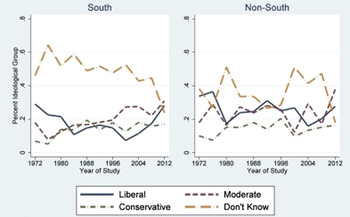
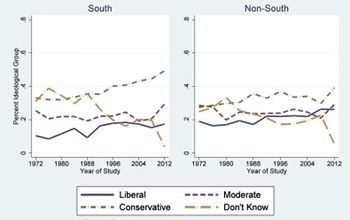
Ideological self-identification by race and region is displayed in figures 1 and 2. As expected, white respondents tend towards conservative identification and black respondents tend toward liberal identification. An increasing number of white respondents adopt the conservative label, but this trend is most apparent among southerners. In 1972, 33% of southerners chose the conservative label. However, this figure has risen to almost 50% as of 2012. Non-southern whites are also increasingly likely to adopt a conservative label, but this trend is not as dramatic as the one displayed by southern whites. Between 1972 and 2012, the gap between ideological identities is smaller among non-southern whites compared to southern whites and there is remarkable consistency in the proportions of respondents claiming ideological labels.
Ideological Self-Identification by Region (Blacks only)
Source: National Election Study, 1972–2012.

Ideological Self-Identification by Region (Whites only)
Source: National Election Study, 1972–2012.

The second clear trend among white respondents is the decline in refusing an ideological identification, and this is also more evident among southern whites. The drive to adopt ideological labels, though not specific to black respondents, is clearest among them. Among black respondents the largest group identification for all years until 2012 was taking no ideological group identification at all. Around 40-50% of the black population consistently took on no ideological identification, preferring ambivalence to certain ideological self-identification. The aversion to ideological labels among blacks is higher than what is seen in the general public (Treier and Hillygus Reference Treier and Sunshine Hillygus2009). However, liberal and moderate identification has risen among blacks. Until the late 2000s, significantly more blacks chose the “don’t know” category compared to other groups.
Whereas refusing or answering “don’t know” when asked for an ideological self-identification was the most common answer for black respondents in recent decades, this paradigm appears to be shifting.
In the last decade, the impetus to ideologically identify has increased for all ideological labels. Whereas refusing or answering “don’t know” when asked for an ideological self-identification was the most common answer for black respondents in recent decades, this paradigm appears to be shifting. Furthermore, the lack of ideological identification in the black community was most apparent among southern blacks, with more than 40% consistently falling into the refusal/don’t know category for ideological self-identification. However, from 2000–2012, the proportion of southern black respondents dropped by more than half (52.7% to 23.8%). Since 2000, southern and non-southern blacks have followed a similar pattern in adopting ideological self-identification, demonstrating a declining regional distinction.
This drop in “don’t know” responses accompanies a large increase in both liberal and moderate ideological labels among blacks. The results point to a black public that is sorting, but doing so along different lines and in a distinct manner from the rest of the public. Whereas the American public at large has little problem identifying as “conservative” (Ellis and Stimson Reference Ellis and Stimson2012), blacks are more averse to taking on a conservative ideological label largely because of a historically antagonist platform of the Republican Party toward minorities. As blacks are monolithically Democratic in partisan identification, this growing ideological distinction could help explain intragroup dynamics for a salient political and social group, as well as further our understanding of the different origins of mass polarization in American politics.
These results counter the popular narrative of a homogenous liberal population; especially considering liberal identification was the least utilized label from 1996–2004. Was this phenomenon a particular choice or simply ambivalence? An often-used explanation for ideological self-identification is political knowledge. However, results not shown here suggest that the drive to ideologically identify is not a result of variation in education. The increase in ideological self-identification under the presidency of Barack Obama suggests a conscious choice in the black community by many individuals to embrace ideological identification, rather than remain ambivalent to ideological labels.
The aforementioned shifts in identification occurred between 2008 and 2012, a politically salient time due to an “Obama effect”. This suggests that increased political salience led blacks overall to be more likely to take on ideological labels and distinguish themselves politically. President Obama does not necessarily inspire political motivations among blacks based on racial loyalty (Lewis, Ford, and Franklin Reference Lewis, Ford Dowe and Franklin2012), but some scholars have demonstrated this “Obama effect”. Among blacks, Barack Obama increased voter registration and turnout (McKee, Hood, and Hill Reference McKee, Hood and Hill2012) and support for his policies (Tesler Reference Tesler2012). The salience of President Obama clearly has the ability to sway black public opinion.
IDEOLOGICAL DIMENSIONS BY RACE AND REGION
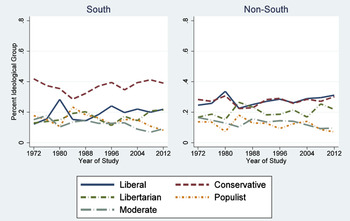
Next, we turn to variation in operational, or policy-based, ideology displayed in figures 3 and 4. Similar to ideological self-identification, white non-southerners are the least polarized group. A consistent majority of non-southern whites are conservative or liberal, but the difference between these groups is minimal. Non-southern whites appear to not be as polarized as southern whites where conservative policy-based ideology is the most common political orientation by far. A significant proportion of southern whites are consistently conservative across the entire time series. As of 2012, around 40% of southern whites hold conservative views, with liberals and libertarians each constituting about 22% of southern whites. These patterns suggest consistently conservative policy positions drive most southern whites.
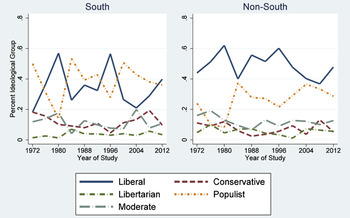
Policy-Based Ideology by Region (Blacks only)
Source: National Election Study, 1972–2012.

Policy-Based Ideology by Region (Whites only)
Source: National Election Study, 1972–2012.

The multidimensional, policy-based measures show that while a large segment of blacks hold consistent liberal views on policy, another (sometimes) equally large segment holds liberal views on economic issues, but conservative views on social issues (i.e. populists). Moderate, conservative, and libertarian groups make up significantly less of the black population in all years, regardless of region. In terms of regional distinction, though, conservative policy views have been more common among southern blacks, and moderate views among non-south blacks. More significantly, liberals outnumber populists among non-southern blacks since 1972, consistently accounting for around 40% to 60% of respondents. Conversely, southern black respondents are more likely to hold populist policy views in most years of the time series.
However, recent years suggest less regional distinction in policy-based ideology. Between 2004 and 2012 there was an almost 20% rise in the proportion of southern black respondents who were consistent liberals, a decrease of 15% holding populist views, and almost 10% decrease in consistent conservatives. A similar, yet attenuated, pattern can be seen among non-southern blacks as populism has declined slightly and liberalism rose between 2008 and 2012. Though there remain more liberals and fewer populists among non-southern blacks compared to southern blacks, the two groups have come to resemble one another in recent years. The historical regional distinction in policy-based ideology and decline of this division is even more apparent when examining ideological self-identification.
Southerners are clearly more ideologically polarized between racial groups. Most southern blacks prefer liberal and populist views, whereas a majority of southern whites prefer conservative views.
Comparing whites and blacks on this measure of ideology demonstrates that blacks tend to prefer liberal and populist views, while whites tend to prefer conservative views (and liberal among non-southern whites). In the non-south, this ideological divergence might be less consequential as liberal ideology is the preferred political orientation of most whites and blacks. However, there are sharp differences in ideological position between whites and blacks in the South. Southerners are clearly more ideologically polarized between racial groups. Most southern blacks prefer liberal and populist views, whereas a majority of southern whites prefer conservative views. Though some southerners might agree on social issues, they may disagree on economic policies, thus leading to conflict over the role of government. This gap in views could help explain the growing partisan polarization by race that has become a defining feature of American politics.
Carmines et al. (Reference Carmines, Ensley and Wagner2015) convincingly demonstrate individuals holding consistent preferences on the economic and social issue dimensions are more likely to be politically advantaged. Southern legislators and governors implement more conservative policies. Therefore, white southerners might be more likely to have their policy preferences realized compared to black southerners. Saunders and Abramowitz’s (Reference Saunders and Abramowitz2004) finding that ideology might be a stronger motivation for Republicans than Democrats bolsters this claim. These findings not only support the claim that polarization is inextricably tied to race, but also to region. Southern whites and blacks are dividing by ideological self-identification and policy-based ideology.
IMPLICATIONS AND CONCLUSION
Black public opinion is not monolithic, it varies over time, and regional ideological distinctions have attenuated in recent years. Where once there were regional distinctions within the black community based on ideological self-identification and policy-based ideology, these distinctions are now declining. However, as southern and non-southern blacks are both increasingly likely to adopt ideological group labels, the path to ideological identification is slightly different for each group. Comparing whites by region, there is a more diverse mix of ideologies outside the South, but southern whites prefer conservative identification and policies. Finally, the races are much more polarized in the South compared to the non-south.
Historically, the ideological labels of liberal and conservative have been explicitly attached to a polarized racial history. This polarization has made clear the choices between identification for African Americans, particularly in the South. Whereas the term conservative is popular among most Americans, this is not the case for African Americans. Conservatives have consistently been attached to the ideas of Jim Crow, segregation, lynching, and civil rights opposition. More recently, conservatives oppose programs that specifically attempt to alleviate racial inequalities, oppose government benefits to blacks specifically based on stereotypes and prejudice, and use racially charged words (i.e. “welfare”) to downplay the racial element in American individualism discourse. For African Americans, the term conservative still carries social stigma, which is not the case for a majority of southern whites.
Where once many blacks avoided ideological labels, they now adhere to them, and heterogeneously so. An intuitive explanation for this phenomenon is the motivation to minimize conflictual pressures or cognitive dissonance. This decreasing trend in ambivalent ideological labels among blacks is likely to continue into the future. The question is: as more and more blacks attempt to reduce cognitive dissonance, will they polarize by region in the labels they choose? If this is the case, a newly sorted, yet historically salient, black political coalition could have evolving and significant consequences for American politics generally and southern politics specifically.
The ideological trends presented here broadly correspond with increased sorting and partisan polarization. Southerners might be causing the bulk of ideological polarization along racial lines, but further analysis is necessary to make definitive claims. Should the trend of declining populist and growing liberal views continue alongside the adoption of ideological labels other than conservative for most blacks, Republican hopes of capturing black votes are likely to fail. The black population in the South is the largest in the country and rising. Therefore, the consequences of these ideological changes will be most apparent in the region. Considering nearly half of southern whites adhere to a conservative identity, it appears that ideological polarization of the races in the South will continue.