Introduction
The Temple of Elegant Loyalty ( Wen Zhong Si) was commissioned by the Qing government to commemorate the service of high official Li Hongzhang against the Taiping. Its name derived from the honorific granted to Li upon his death in accordance with Qing commemorative practices. According to the North-China Herald, however, the ‘common people’ of Wuxi, the city in which the memorial was constructed, called it ‘the temple of the man who sold his country’ (賣國寺 Mai Guo Si)—a reference to concessions Li had been forced to make in diplomatic negotiations with Russia.Footnote 1 This anecdote underscores a problem with fixing meaning to historical events and actors through acts of commemoration. This article will explore how different groups and individuals sought to fix the meaning of the foreign interventions in the Taiping war (1850–64). The debates these commemorations sparked became proxy for debates among foreign and Chinese actors about the extent of the foreign role in China and, by extension, the scope of Chinese sovereignty. More broadly, the commemoration of the interventions offers a case study in the politics of war memory in a transnational setting. The differing agendas of the groups involved created multidirectional waves of commemoration as the activities of one interest group inspired both complementary and contrasting commemorations of the period among others. At the same time, as transnational, these commemorations were prone to highlight distinctive differences in Qing, European, and American memorial cultures, provoking as many disputes over the form of commemorations as over their content.
The Taiping civil war (1850–64) broke out when Hong Xiuquan, a failed civil service examination candidate who believed himself to be the younger brother of Jesus Christ, declared his intention to overthrow China's Qing dynasty (1644–1911).Footnote 2 Hong's call to arms came just as British, American, and French communities had established their privileged position on the China coast, underwritten by the treaties that followed the Qing defeat in the Opium War (1839–42). Although some foreigners fought as mercenaries for both sides in the conflict as early as 1853, many more became involved after the Taiping armies advanced on the treaty port of Shanghai in 1860 and 1862.Footnote 3 These advances were repulsed by British and French troops as foreign diplomats felt that the Taiping threatened trade and the security of foreign landlords’ property in the city.Footnote 4 Although the Anglo-French force abstained from further intervention after 1862, British, French, and American officials continued to support their citizens serving as mercenaries commanding Qing troops. Although more commonly known among Chinese scholars as the Taiping Rebellion, or the Taiping Revolutionary Movement, as several American scholars have recently pointed out, the conflict is more aptly cast as a civil war.Footnote 5 With a death toll of upwards of 20 million people, this was not a rebellion that faced inevitable suppression, but a contest between two competing states for China's future, and one in which the outcome was far from certain. During the bloody campaigns in Jiangnan in the last four years of the war, hundreds of foreign fighters serving the Qing died, though many admittedly from disease. This led to the vexed question of how to remember these men and of how to commemorate the service of those veterans still living.
The memories of these events must be set in two frames: that of lived experience and that of collective historical memory. Memory cannot be reduced to an individual phenomenological experience. Historians of memory, whether their focus is on individuals giving voice to their own, often traumatic, experiences, as with holocaust survivors, or on the construction of collective narratives, such as those of nation states, have accepted that memories are also social.Footnote 6 Even our personal narrative memories are constructed in a dialogue with those around us.Footnote 7 Individual and social memories typically have a lifespan of no more than 80 years, passing with the generation that experienced and constructed them. As Aleida Assmann points out, when memories cross this barrier in time, they become mediated, relying not on a collection of experiences, but on artefacts, memorials, and collective commemorations.Footnote 8 Once memories pass out of the realm of an individual lifespan, they are no longer experiences people have, but rather narratives that are made.Footnote 9 Some of these narratives are actively remembered while others are ‘archival’ memories—that is to say, they reside in a set of artefacts, documents, and symbols that are not currently significant, but may in future be drawn on to construct or bolster collective identities.Footnote 10 We must therefore ask why, at any given point, some memories are given prominence over others. The memory of the foreign veterans of the Taiping war faded after the fighters themselves dispersed from China in the years after the conflict's end. It was stored, however, in the local foreign and Chinese communities’ archival memory, to be remembered when the presence of foreigners in the country was challenged by rising Chinese nationalism in the 1920s.
This study complements a growing literature on the commemoration of foreign fighters in civil wars and of the memory of the Taiping war in particular. The foreign interventions in the Taiping conflict were not unique. The involvement of the international brigades in the Spanish Civil War (1936–39), for example, also raised disputes about how foreign fighters should be commemorated.Footnote 11 Nevertheless, the memory of foreign contributions to a war within a host nation are usually subsumed by attempts to come to terms with the memory of the war as a whole such that commemoration becomes a matter for the fighters’ home nation, if at all.Footnote 12 The Taiping case is unique because a foreign community with exclusive privileges including exemption from Chinese law remained in China for almost 80 years after the war's end. This fact added to the tensions Tobie Meyer-Fong has recently highlighted within the Qing government over efforts to commemorate its victory over the Taiping, which lasted until the dynasty's fall in 1911.Footnote 13 Memories of the foreign role in suppressing the Taiping were no less contentious, but had a longer afterlife, lasting at least as long as foreign-treaty privileges and treaty-port communities. Different groups, whether Qing, foreign communities, foreign metropolitan governments, or Chinese nationalists, sought to encourage distinct interpretations of the events based on their views on the continuing role of foreigners in China.
This article will argue that, to understand the evolution of collective memories in a transnational, and multi-lingual, environment, we have to conceive of them as ‘multidirectional’.Footnote 14 That is to say, memories are not always in competition with each other. While commemorations often provoke competing narratives, this competition exists within a broader framework in which even attempts to emphasize historical memories that other communities might not recognize could spark parallel commemoration by those same communities. Foreign individuals and communities in China remembered the Taiping war to promote their own achievements, or to make the case for their continued relevance to the country's development. Importantly, these commemorations were not just the efforts to shore up foreign legitimacy in China that Robert Bickers has documented.Footnote 15 As they drew on a critical moment in Qing history, they were open to contributions and challenges from successive generations of Chinese. Conflicts occurred principally when commemorations took material rather than written form, and thus carried meaning across linguistic boundaries. The range of attempts to shape collective memories of the foreign role in the Taiping war over time highlight the plurality of groups involved, both foreign and Chinese, as well as reflecting the changing nature of alliances of interest on the China coast.
I will trace commemorations of the foreign role in the Taiping war broadly chronologically as they played out through three distinct media that together illustrate the changes in that memory over time. The first contentious site of commemoration was the issuing of medals to foreign fighters for their service to the Qing. These medals, deliberately modelled on British awards and therefore having the potential to undermine the British honours system, caused as much conflict within the British community over whether they could be worn as between British and Qing officials. The second form of commemoration was the construction of monuments to the foreign dead. These monuments were often constructed by Qing officials, keen to promote their own role in leading foreign troops as well as to encourage a policy of adopting foreign support to reform the empire. Newspaper reports and travelogues suggest that these monuments, once constructed, were largely ignored by Chinese and foreigners alike. Nevertheless, remaining on the landscape, they became sites of renewed attention in the 1920s and 1930s, largely when they were threatened with demolition. Finally, consciousness of the significance of these monuments, either as reminders of continued foreign dominance or of past foreign sacrifices for China, was fostered by the foreign and Chinese histories of the Taiping war. Commemorations of intervention served as a proxy for the negotiation of the foreign role in a China that remained, until 1943, when extraterritoriality was abrogated, a site of divided, and contested, sovereignty.Footnote 16
Medals for the men
The very first attempt to commemorate the service of foreign fighters—the issuing of war medals by Qing officials—demonstrates the divisions among different groups with interest in foreign relations with China that made later memories of the interventions so unstable. The first such division was between foreign states and their citizens in China, based both on different views of the foreign role in China as well as on class distinctions. While many British soldiers in particular wanted to be rewarded for their contribution, their government wished to forget its decision to encourage British citizens to become involved in a Chinese civil war altogether. After a number of controversies, including the murder by Qing troops of Taiping prisoners whose surrender a British army officer had negotiated, Prime Minister Lord Palmerston declared in parliament that intervention in China had failed.Footnote 17 Requests for British medals for veterans of the conflict, similar to those offered to soldiers who had fought in the Arrow War (1856–60) in China, were swiftly rejected because their service against the Taiping was not ‘of sufficient importance’.Footnote 18 In addition to differing ideas about the significance of their contribution, veterans disagreed with the diplomatic establishment about the form any commemoration should take. Veterans wished to be remembered using forms, such as British-style medals, that they recognized and many Qing officials, perhaps following a long-standing Qing tradition of patronage of other cultures within their empire, saw no problem with this.Footnote 19 For senior British diplomats in China and the British government, however, disagreeable attempts to remember a policy they wished to forget were compounded by what appeared to be an attempt to imitate, and hence undermine, the British honours system.
Initial Qing attempts to reward the foreigners in their service using their own commemorative practices were largely unsuccessful. These took a variety of forms including issuing merit medals ( gongpai) and signifiers of rank such as hat buttons (
 dingdai), feathers (
 ling), and official clothes, most famously what foreigners called the ‘yellow riding jacket’ (
 huang magua). These efforts were often attempts to encourage loyalty among the foreign troops under Qing command rather than to commemorate services already rendered. The Qing court bestowed a fourth-grade martial hat button (
 sipin wuzhi dingdai) on the American fighter, Frederick Townsend Ward, in the same month as they accepted his service leading a force of Chinese troops they had dubbed the ‘Ever Victorious Army’ (
 , Changshengjun).Footnote 20 Some foreign fighters clearly valued these awards. Most notable was Charles Gordon, who led the Ever Victorious Army after Ward's death in battle in 1862. On receiving the yellow riding jacket signifying his status as one of the emperor's imperial body guards, he proudly told his mother that ‘I think the Chinese government trusts me more than any foreigner ever has been trusted’.Footnote 21 Most British fighters, however, rejected these awards in favour of forms of commemoration they understood, such as British-styled military medals, and went as far as advising Qing officials on how to adapt their versions to more closely reflect British awards.
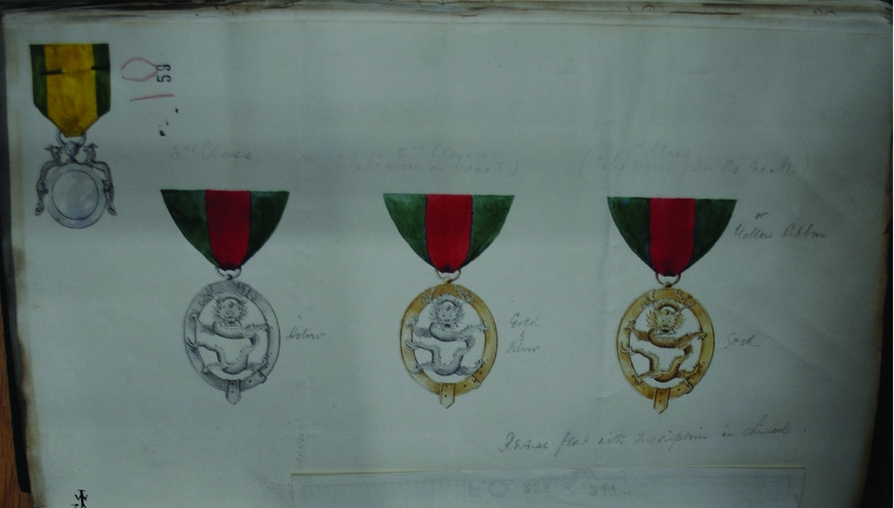
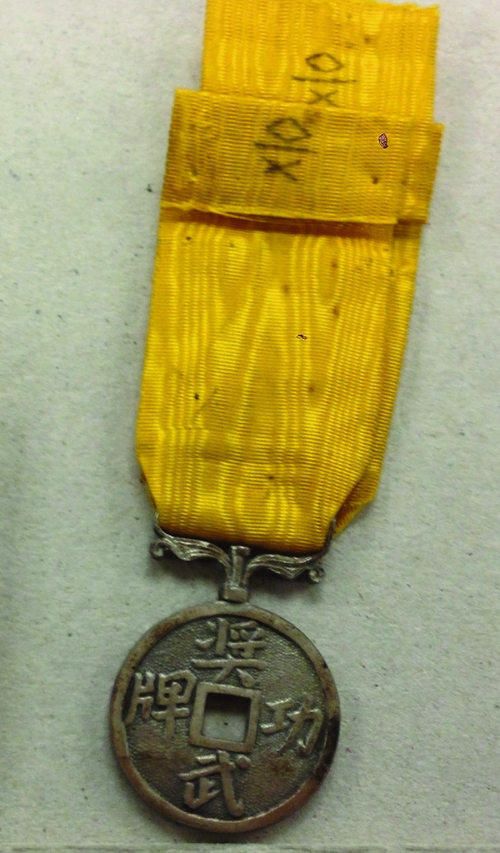
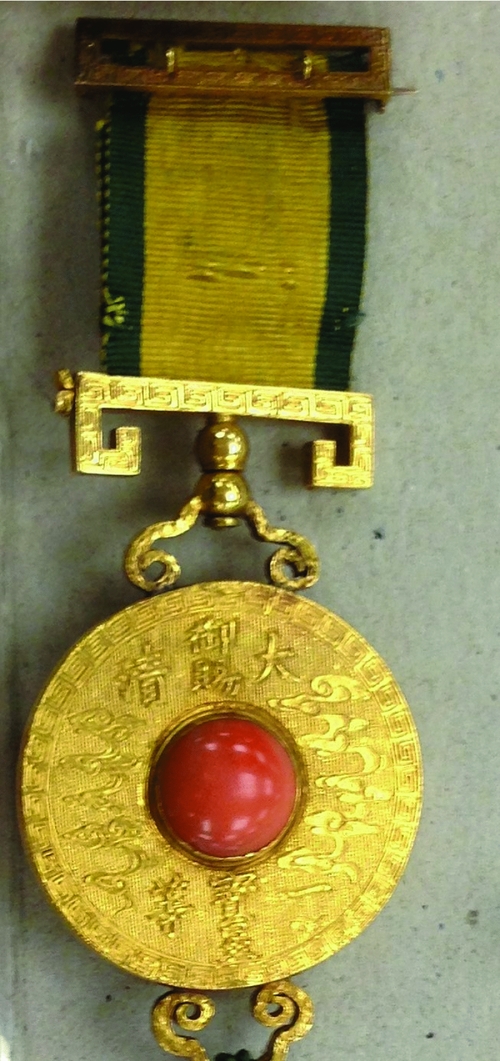
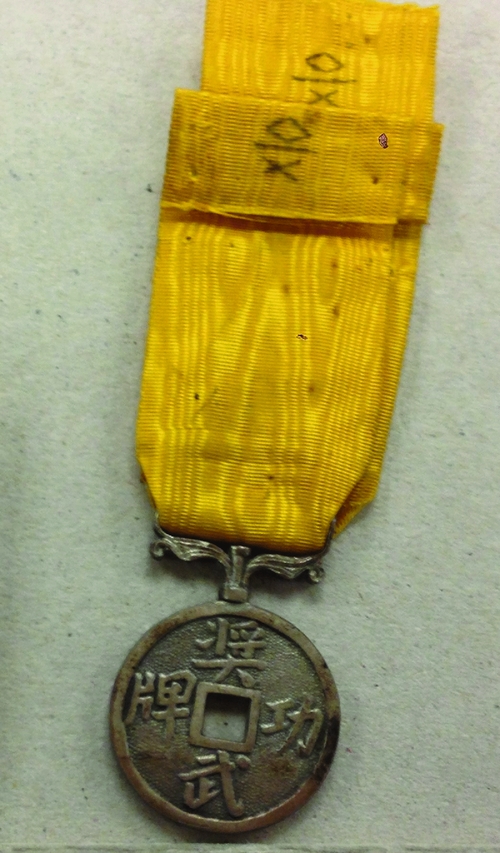
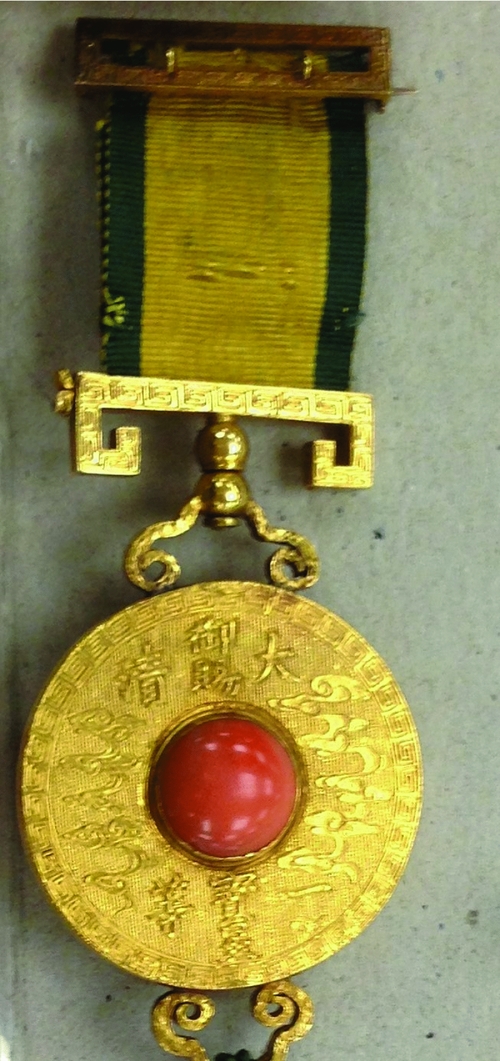
In early 1863, Li Hongzhang, then governor of Jiangsu, proposed the creation of foreign-style medals to resolve the problem, noted by Prince Gong, one of the regents of the Tongzhi emperor, that foreign fighters saw Qing awards as ‘empty of status’ (虛名 xu ming).Footnote 22 British consular and military officials played a role in shaping his proposals. The British consul at Shanghai, Walter Medhurst, was dismissive of the first medals proposed, complaining that the square holes in the middle of them made them resemble Qing copper cash currency. He suggested that British officers would only be happy with ‘something more in the shape of an order’—that is to say, medals resembling existing British military orders.Footnote 23 The officers thus drew up their own proposals (Figure 1), which Medhurst passed on to Li. The surviving medals strongly suggest that Li acted on this advice. The square hole in the original medal (Figure 2, a later example issued to French forces) was removed by the time later medals were cast. Additionally, the yellow-and-green colour scheme on the ribbon of one of Medhurst's proposed medals is identical to that on medals issued in 1865, at the end of the Taiping campaign (Figure 3).
Merit medals proposed by British officers.Footnote 24

Traditional-style merit medal issued to French forces in 1864.Footnote 28
Merit medal issued to customs official for service against the Taiping near Fuzhou in 1865.Footnote 31
A similar, though apparently separate, process took place at Tianjin, highlighting the decentralized nature of the Qing state. In March 1863, the Nian, a distinct group of rebels from the Taiping but intermittently allied with them, advanced on the city.Footnote 25 Captain Coney, a British military officer then in charge of training Qing troops at the port, and acting British consul, John Gibson, rode out to meet them with the newly drilled force. After a short exchange of fire, and a charge by a Mongolian cavalry unit, the rebels fled.Footnote 26 Chonghou, then trade minister for the northern ports of Tianjin, Niuzhuang, and Yantai, consulted Gibson about appropriate awards for his service. Gibson declared that he did not want traditional Chinese rewards or Qing titles, but instead only wanted a merit medal.Footnote 27 On investigating further, Chonghou developed a new system of Chinese awards, distinct from those established by Li for the 1862 campaign. He noted that he had discovered, presumably after consultation with Gibson, that ‘foreigners are partial to having precious stars ( baoxing)’.Footnote 29 The term is possibly a transliteration of the British ‘Order of the Bath’ taken from the text of the Treaty of Tianjin because two British officials mentioned in the text were members of that order.Footnote 30 Gibson, and presumably the military officials who received the award, wanted something that resembled an English order that might provide them with status among their peers. Indeed, despite criticism of the medals by senior British officials, the award became popularly known as ‘the order of the dragon’.Footnote 32
Almost as soon as the ‘precious stars’ were issued, senior British diplomats sought to prevent their citizens from accepting them. This action should be understood in the context of the nature and purpose of the British honours system. In Britain, honours arose from the system of knighthood—a form of military honour recognizing service in battle.Footnote 33 Although, by the Stuart period (1603–1714), knighthood had lost this functional role, the titles remained as one of the building blocks of the honours system.Footnote 34 These awards operated within a status marketplace. An honours system that gave out too many honours, as the administrators of the Prussian system did in the late nineteenth century, would undermine the prestige of the status it was created to confer.Footnote 35 By the mid-nineteenth century, the British honours system had the dual functions of ensuring the loyalty of those upon whom titles were conferred, as well as reinforcing class hierarchies. It is not a coincidence that the Order of the Star of India, conferred on both British and Indian administrators, was created shortly after the Indian rebellion was suppressed.Footnote 36 Similarly, in the 1860s, the British government re-established the Order of St Michael and St George for colonial officials elsewhere in order to inspire a sense of belonging, and loyalty, to the metropolitan government.Footnote 37 The British empire was, in David Cannadine's words, ‘ornamentalist’, as it sought to structure its territories along the same class lines as those in the metropole.Footnote 38
As a result of the honours system's importance, the acceptance of foreign orders was rigorously policed. Regulations on accepting foreign awards were revised in 1855, probably in response to the service by British subjects in the forces of foreign armies during the Crimean conflict. The regulations were explicitly referred to by officials responding to requests from recipients to wear medals bestowed by the Qing for service in the Taiping war.Footnote 39 The regulations were based on a distinction between orders, which implied lifelong membership of a group patronized by the monarch, such as the order of the garter, and medals that were awarded for specific military achievements. The first clause of regulations on foreign orders stated that no British subject could accept a foreign order without the queen's permission. Medals, meanwhile, could be accepted without consulting the government, but could not be worn without the queen's permission.Footnote 40 Another clause made the ultimate purpose of the legislation clear. Permission to wear medals or orders did not authorize ‘the assumption of any style, appellation, rank, precedence or privilege appertaining to a Knight Bachelor of Her Majesty's Realms’.Footnote 41 The awarding of foreign honours and medals had to be policed because such awards, particularly when they were designed to resemble British orders, risked undermining the hierarchical structures reinforced by the domestic honours system. These regulations were also rigidly enforced outside China. In 1856, soon after the regulations were updated, citizens of Glasgow were refused permission to wear the Légion d'Honneur bestowed by Louis Napoleon because the work they had carried out for the Paris grand exhibition was not of a military nature.Footnote 42
Senior diplomats’ refusal to grant British subjects permission to wear Qing medals were not based just on a fear of the undermining the British honours system. They were also a result of specific anxieties about the class of recipient, which highlights the divisions within the British presence in China. Rutherford Alcock, then British Minister in China, noted that the medals were to be rejected because ‘The decoration in question . . . is not an imperial order but an imitation of the stars conferred on members of foreign orders devised by a provincial governor and by him bestowed . . . upon all foreigners’ who had fought against the rebels.Footnote 43 Alongside British army officers, many of the British fighters in the Qing ranks, to use Charles Gordon's description of his own men, were ‘not gentlemen’.Footnote 44 That is to say, they were not of the officer class. As well as a failure to be discerning, Qing officials were often discerning in the wrong way. When Chonghou wished to bestow a higher-ranking medal upon Consul Gibson than that accorded to Captain Coney, who had actually led troops in battle, Lord Bruce, British Minister in China from 1860 to 1864, refused to allow Gibson to accept the award. Bruce argued he could not ‘assent to the Chinese notion of putting the services of a civilian official above those of a military officer for conduct in the field’.Footnote 45 For the highest-ranking British diplomatic officials, the new Chinese orders were inadequate because, as Thomas Wade, who succeeded Bruce as British Minister, suggested, in their view, Qing officials simply did not understand the ‘nature and purpose’ of decorations.Footnote 46
Criticism of the medals by senior diplomats and refusal to grant permission to wear them did not diminish their lustre in the eyes of recipients, who wished to be remembered for their service at a time when this was exactly what the British government wished to forget. Gordon was still dealing with letters from his former officers requesting medals in 1871, seven years after his force disbanded.Footnote 47 Some such requests had to be refused, as in the case of Colonel Rhode, whose distinction in fighting for the Qing was somewhat diminished by his subsequent service in the rebel lines.Footnote 48 A Mr Ferns complained to the admiralty that he had been issued with a large silver medal for his services, which was supposed to be passed on to him by Commander Boyle. The unscrupulous commander, however, had allegedly had it melted down and recast in a smaller size, leaving Ferns with a mere ‘miniature’ version.Footnote 49 Among British subjects outside of the diplomatic establishment, who were unlikely to receive similar recognition from their own state for service against the Taiping, the baubles of the Qing were much in demand. Interestingly, this does not appear to have been the case for French fighters, with no major conflict over the issuing of medals surviving in French consular archives. Indeed, Zuo Zongtang, who oversaw the French-led Chinese force, the Ever Triumphant Army, noted that his fighters were uninterested in the new form medals.Footnote 50 This is perhaps because they were styled on British, rather than French, awards and so held no special attraction to French fighters.
In addition to creating conflict between British soldiers and their government, the medals also created conflicts within the Qing government over their mode of distribution, in turn leading to further criticism of the new medals from foreign observers. For the central Qing government, headed by the three regents of the child Tongzhi emperor, Prince Gong, and the dowager empresses, Ci'an and Cixi, foreign-style medals were a way of ensuring equal rewards so that different groups of foreigners did not feel slighted. When Zuo asked the court how his French fighters should be rewarded, he was told that they should receive the same medals as the British.Footnote 51 This attempt to create a unified system of rewards for foreigners was frustrated at a time when the central court was, in any case, losing some of its power to its generals in the provinces.Footnote 52 Zuo refused to issue the same medals as his counterparts in other provinces, regarding them as too expensive.Footnote 53 The end result was the issuing of seven distinct styles of medal over the course of the campaign.Footnote 54 Equally open to dispute was the mode of conferral of the medals. Some local Qing officials arranged, at the request of their foreign recipients, to have the medals bestowed by the central government.Footnote 55 Zuo, however, flatly refused, arguing that, if awards were directly issued by the central government, they may cause foreigners to be ‘disrespectful to our empire's prestige’ ( xie guoti).Footnote 56 These disagreements over how to commemorate the foreign role in the war would reflect wider policy differences among Qing officials about the role foreigners might play in the country after it.
The nuance of this difference of opinion among officials was lost on foreign officials for whom the issue of direct contact with the Qing emperor was a long-running sore. The British and French ministers dismissed the awards because they did not come directly from the emperor.Footnote 57 This was despite the fact that such medals were to be stamped with the words ‘imperially bestowed’ ( yu ci) and that, in practice, all officials memorialized the regents of the Tongzhi emperor to request permission before bestowing any form of award.Footnote 58 The perceived local control over the issue of awards ran contrary to the entire rationale of foreign honours systems, in which the monarch was the fountain of honours, which were often bestowed by him or her in person and were thus a sign of their personal favour.Footnote 59 It will also have reminded foreign officials of the supposed aloofness of the Qing court at a time when they were trying to organize the protocols for an audience with the emperor. No audience had been held since Lord Amherst's shambolic mission to China in 1816, when he was barred from access to the emperor because he refused to perform the koutou.Footnote 60 After the Arrow War, the audience question was deferred by the death of the Xianfeng emperor in 1861 and his replacement by the child Tongzhi emperor, with whom no audience could be held until he reached maturity. In this context, the differences of opinion among Qing officials over the type of medals to award and their mode of bestowal were interpreted as yet another technique for delaying foreigners access to the emperor to preserve his prestige.
The issuing of medals as a commemoration of the service of foreign soldiers was fraught with difficulties because of the array of different interest groups in China, with clear disagreements among both Chinese and foreign groups about the foreign role in the country. The British government's representatives wished to forget their foray into a Chinese civil war and even more so as the soldiers they had tacitly permitted to join the Qing ended up causing more harm than good. A number of fighters who had initially fought for the Qing switched sides for the promise of better pay, leading the North-China Herald to dub them ‘the dregs of society’.Footnote 61 While these men sought foreign-style medals to commemorate their service, senior officers were often dismissive of them. Gordon allegedly sold his medal to raise funds for victims of the Lancashire cotton famine, while, as we have seen, he held Qing awards such as the yellow riding jacket, a recognition of status on the dynasty's own terms, in high regard.Footnote 62 In awarding medals, Qing officials mainly sought to reward foreign fighters either to pacify their demands for increased pay or to ensure their loyalty. Even then, there was disagreement between officials about whether foreign service merited a whole new form of medal and mode of bestowal, with Zuo Zongtang resolutely resisting the proposal. When acts of commemoration take physical form, they become ensnared in the constraints and meanings of those forms. These debates, and those over whether foreign interventions in China's affairs should be commemorated at all, continued when discussion turned from rewards for the living to memorials to the dead.
Monumental memories
The monuments to the foreign dead, constructed both by Qing and foreign actors, gave rise to disputes that, unlike those over the Taiping war medals, had a long afterlife. Scholars of memorial structures have noted that, once built, they can either continue to be sites of active commemoration, be disavowed through destruction or neglect, or become contested.Footnote 63 Given their obvious presence on the landscape, allowing monuments to fall into disrepair suggests neglect of the memories they represent. The fate of three Taiping war monuments highlights both the number of interest groups with a stake in the memory of the foreign role in the war and the multidirectional nature of commemoration in a transnational environment: a memorial hall to Frederick Townsend Ward, an obelisk celebrating the Anglo-French recapture of Ningbo and a soldier's cemetery at Shanghai. The creation and reception of these monuments were heavily influenced by the changing nature of Sino-foreign alliances and antagonisms over time. In the decade after the war, both the foreign community in China and Qing officials were minded to celebrate the foreign dead, even if they sometimes disagreed over the form these commemorations should take. By the 1920s, with the Qing dynasty overthrown and Chinese nationalism on the rise, the collective memory of the Taiping war was far less settled.
Qing officials’ efforts to commemorate the foreign dead built on an established but evolving Qing memorial culture. In the Qianlong reign (1735–96), monuments to Qing conquests were placed strategically, as in Guangxi province, where they might serve as a solid reminder to rebellious locals of Qing authority.Footnote 64 Shrines were also constructed to commemorate loyal officials, such as Guan Tianpei, who died at Humen in 1841 resisting the foreign advance on Canton during the Opium War.Footnote 65 The scale of the Taiping war, and the loss of life resulting from it, led the Xianfeng emperor in 1853 to decentralize the creation of memorials that had hitherto been the prerogative of the court.Footnote 66 Local officials, such as Zeng Guofan and Li Hongzhang, used their new power to commemorate their own role in winning the war, as distinct from the contribution of the central Qing state, in order to bolster their own reputation. From the early 1860s onwards, Li oversaw the construction of memorials to the Huai army, which he commanded and which was responsible for the recapture of much of Jiangsu from the Taiping.Footnote 67
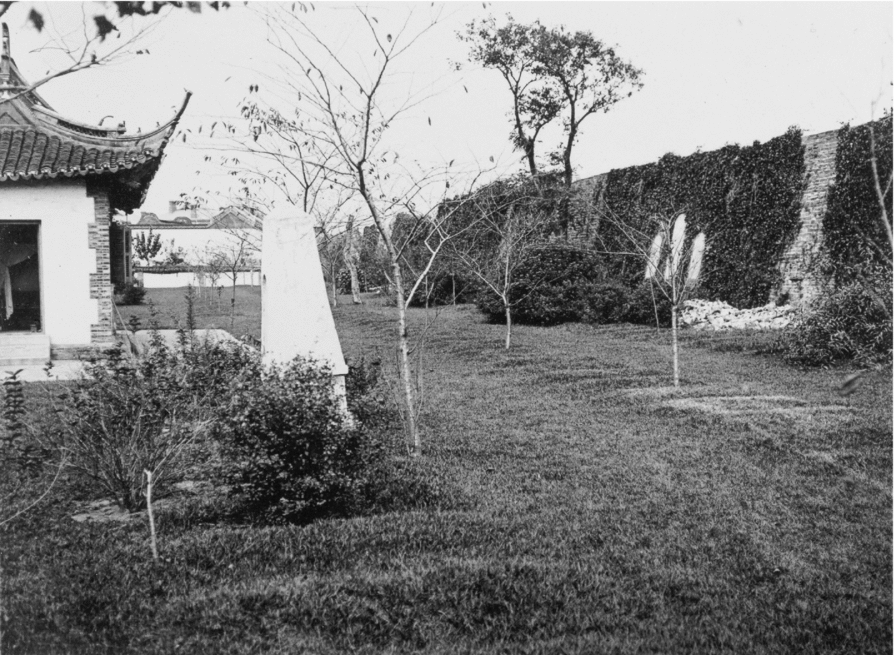
The different origins of the memorials to the foreign dead highlight shared Qing and foreign efforts at commemoration of the war in its immediate aftermath, even if there were disagreements over their form. The construction of Ward's memorial hall seems to have been part of Li's efforts to promote his own role in winning the war. It was not the only one. He also constructed a monument to the Ever Victorious Army as a whole, which was resented by the foreign community because of its insufficient grandeur.Footnote 68 The Ward memorial's construction was delayed for 14 years because the American Chargé d'Affaires, Samuel Wells Williams, originally a missionary, resisted what he saw as an attempt at the pagan deification of Ward.Footnote 69 The imposing Ningbo obelisk, commemorating the Anglo-French recapture of the city, was also constructed by local Qing officials, perhaps bolstering their own reputations or, as was the case with other commemorative efforts that took place while the war was ongoing, to placate the foreigners still in their service.Footnote 70 The final memorial to be discussed, the soldier's cemetery at Shanghai (Figure 4), was constructed by the international settlement's foreign-run Municipal Council. It was initially a practical space, housing some 300 soldiers and sailors buried without individual tombstones, who had largely died of Cholera, between 1862 and 1865.Footnote 71 This was to change when the space, as with the Ward and Ningbo monuments, became contested in the 1930s.
The Soldier's Cemetery at Shanghai.Footnote 72

The monuments built in the 1860s and 1870s were largely ignored between 1880 and 1920, perhaps because this was a period in which the foreign communities in China felt relatively secure in their privileged position in the country. Characteristic of this absence of commemoration was the failure to create a memorial following the death of Charles Gordon at Khartoum in 1885 while serving the Egyptian Khedive fighting another group of religiously inspired rebels. One reason for this was probably the existence of the Ever Victorious Army monument, though, as highlighted, it was not favourably received by foreigners. On receiving news of Gordon's death, members of the foreign community did consider constructing their own memorial, but it was decided that the funds raised for this purpose should instead be used to support Gordon's relatives.Footnote 73 This failure to commemorate Gordon was symptomatic of a disinterest in his activities in China. When, in 1880, news circulated that Gordon planned to return to China, some treaty-port newspapers could not even correctly report which group of rebels he had helped suppress.Footnote 74 This was in stark contrast to Gordon's reception at home. Gordon's death in part led to a rewriting, usually by metropolitan historians, of histories of the foreign role in the Taiping war. Gordon himself was interred in St Paul's Cathedral and his service in China was commemorated with the polite fiction, engraved in gold on his tomb, that ‘he saved an empire by his warlike genius’.Footnote 75
The relative neglect of Gordon was not indicative of a lack of interest in commemoration from the 1880s, but perhaps a lack of interest in the memory of the Taiping war specifically, as the commemoration of other heroes of the foreign community illustrates. The first such hero, Augustus Margary, was a British vice consul who was ambushed and killed while returning from a covert diplomatic mission to Burma. The British community in Shanghai formed a committee in December 1875 to discuss commemorating Margary, and unveiled a statue in his honour in Shanghai in 1880.Footnote 76 Similarly, the British community were moved by the death in office in 1885 of the British Minister in China, Harry Parkes, whom they saw as an uncompromising proponent of their interests. A statue in his honour was unveiled on the Bund in 1890.Footnote 77 As with Margary, Parkes was commemorated for what he represented—a forceful British hand in China. These commemorations took place at a time when the British government in London supported the interests of their subjects in China. Indeed, the Margary affair was used to extract more concessions from the Qing government in the form of the Chefoo convention.Footnote 78 Gordon, however, represented foreign sacrifice for Chinese interests—a message with less salience for the attitudes and ambitions of the British community of the 1880s.
The ‘reawakening’ of the Taiping memorials from the 1920s should be seen in the context of changing visions of China's place in the international order. Following the First World War, the British, American, and French governments began to consider, on the urging of the Chinese government, the renegotiation of their citizen's extraterritorial rights in China. Extraterritoriality, or the right of exemption from Qing law, had been perceived by the foreign community to be a cornerstone of their presence in China since it was granted in 1843. Negotiations to end it were sped up by the events of 30 May 1925. The Shanghai Students Federation organized a protest in the international settlement in response to the murder of a striking mill worker by a Japanese foreman.Footnote 79 When protesters reached a police station on Nanking road, a police inspector gave orders to fire. Eleven students were killed and a further 20 were seriously wounded.Footnote 80 The incident sparked mass anti-foreign protests, demonstrating to senior foreign diplomats that the demands of Chinese nationalists had to be taken seriously. The same year saw the founding of the Shanghai British Residents Association—an organization aimed at resisting moves to sell out their interests in the country.Footnote 81 One journalist encapsulated the perceived role of the foreign community in China, complaining that ‘Foreigners are doing nothing but good works for China and the Chinese . . . the Chinese are in some respect like children who have not yet grown up and are only partially civilised’.Footnote 82
The American community in Shanghai in this period shared these concerns, but was also increasingly conscious of the need to assert its own identity, which may have influenced the first commemorations of the Taiping war. Between 1911 and 1924, the American population in China saw a 154 per cent increase, compared with only a 43 per cent increase for the British.Footnote 83 This encouraged the remembrance of a specifically American community history in the city. By the 1910s, foreign observers noted that Ward's tomb had been entirely neglected and was being used as a venue for Daoist rituals.Footnote 84 During the 1920s, however, the site became the location for an annual pilgrimage made by the American community. The roots of this new activity lay in the need of veterans living in Shanghai to participate in American memorial activity following the First World War. This reflected a rise in interest in public remembrance after the war, with an emphasis on memorial sites reflecting community grief rather than glorious national victories.Footnote 85 In 1919, the veterans’ organization the American Legion was established for this purpose. Branches were soon set up around the world, including at Shanghai in 1920.Footnote 86 The group's membership voted to call its branch the Frederick Townsend Ward Post because Ward remained the most notable American citizen to have died fighting in China.Footnote 87 On American Memorial Day in 1921, the post arranged a pilgrimage to Ward's tomb—an event the post's commander described as part of its ‘Americanization programme’, underlining its importance for emphasizing the distinct American role in the country.Footnote 88 All of the key American dignitaries in Shanghai attended, including the consul general and Commander H. I. Cone, chief of staff of the US Asiatic Fleet.Footnote 89
Although Ward's tomb was initially reinvigorated as a useful focal point for Memorial Day commemorations, as the 1920s progressed, the site took on a new meaning. The tomb, gradually restored, became almost proxy American territory and Ward's memory was taken to remind American citizens of their role in China. In 1923, as part of the Memorial Day celebrations, a granite memorial tablet bearing the American shield was installed at the tomb, presumably funded by subscriptions from the Ward Post, as were subsequent renovations.Footnote 90 In 1924, another memorial was unveiled and a fund of $300 was contributed by the legion to establish a troop of boy scouts at Songjiang who, in return, would keep the tomb well maintained.Footnote 91 Shortly before the 30 May incident, at the annual meeting at Ward's tomb, Judge Purdy, chief justice of the US Supreme Court for China, used Ward's memory in his eulogy to remind those gathered of their duty to the Chinese. He argued that Ward had been at the vanguard of a civilizing mission that Americans had a duty to continue in China so that it could become one of the ‘splendid galaxy of self-governing nations encircling the pacific’.Footnote 92 In four years, Ward had gone from forgotten figure to honoured emblem of the United States of America's role in China. Visits to his tomb continued annually until 1937. These were not small affairs: on the final visit in 1937, around 100 Americans took part.Footnote 93 After 1937, as a result of the Japanese invasion of China, the pilgrimage was, however, abandoned.
The extent of the renewed significance of Ward's tomb for the American community was revealed by their response to threats to it from the Japanese. Members of the legion had worried that Ward's tomb was not clearly marked as American property, and was thus not to be interfered with. On 25 May 1938, two officers of the Ward Post raced in a Red Cross truck towards the site, armed with paint and a large American flag. On arrival, they hoisted the flag and painted a duplicate, which they draped over his tomb.Footnote 94 For good measure, the American consul general at Shanghai sought, and received, assurances from Japanese consular officials that precautions would be taken to ensure that the tomb was not damaged. The politics of Ward's remembrance had more to do with contemporary circumstances than with either the man or his deeds. Although the symbolic marking of Ward's tomb was a reaffirmation of American interests in China, the event also marked an actual spatial retreat. No further pilgrimages were held until after the end of the Second World War. Although efforts were later made by the Ward Post's former commander to establish American ownership of the site, these were overtaken by events.Footnote 95 When the communists captured Shanghai in 1949, the Ward Post went into exile, where it remains.Footnote 96 Ward's remains were reportedly dug up by the Chinese Communist Party (CCP) in 1955 and the tomb was paved over, though Songjiang locals apparently remembered its earlier existence as late as the 1990s.Footnote 97
The soldier's cemetery at Shanghai, a site of commemoration for the British community, followed a similar pattern to that of Ward's tomb and was perhaps encouraged by renewed commemorations there. As early as the late 1880s, just 25 years after the bodies were first buried, the missionary, Arthur Moule, highlighted the graves’ neglect.Footnote 98 In 1912, and again in 1924, further complaints about the cemetery were also made to the Shanghai Municipal Council, the body governing the international settlement.Footnote 99 In 1938, the council finally acted, announcing the bodies would be moved to the Hongqiao Cemetery. A key rationale for this was that the old graveyard was now part of the Nandao refugee zone.Footnote 100 The dead of the Taiping war, neglected for so long, were to be rescued from the chaos of the Sino-Japanese conflict. The reburial did not pass without ‘an impressive military ceremony’.Footnote 101 The bronze plate attached to the new memorial stated that the decision to move the bodies had been taken to ‘secure from violation their last earthly resting place’.Footnote 102 Symbolically and spatially, the removal represented a retreat of British interests within the confines of the international settlement's existing cemeteries. Although linked to a wider change in attitudes to war graves after the First World War, the move was also intended as a mark of respect to men who had, in the North-China Herald’s words, died having ‘fought China's battles’.Footnote 103 As in the case of Ward, those long dead served to highlight the continued purpose of the foreign communities at the time of their greatest insecurity.
A strikingly similar process of reaffirmation in the face of spatial retreat can be seen in the fate of the Anglo-French obelisk at Ningbo. The monument was not entirely ignored after its construction. In 1906, a British naval captain, acting on instructions from the commander-in-chief of the China station, oversaw refurbishment works paid for by the British, French, and Qing governments. Other than this, little interest was shown in the monument by either the British or French communities until the nationalist government threatened to demolish it in the 1930s. Instead, the foreign community paid for the removal of the obelisk from the Chinese city to the foreign cemetery across the river.Footnote 104 The removal of the monument and the ceremony to mark its rededication in the foreign cemetery were intimately bound up with resistance to the nationalist campaign to limit foreign influence in the country. The chairman of the foreign cemetery committee noted that the monument had been moved because, ‘owing to changed and changing conditions’, it had become ‘a source of embarrassment to the Chinese authorities’. At the ceremony, the British consul suggested that the Anglo-French recapture of Ningbo highlighted both countries’ roles ‘as the defenders of civilisation against the forces of disorder’ outside of Europe. If memories of the foreign role in the Taiping war were a ‘source of embarrassment’ to the nationalist Administration, they invoked ideas for some in the foreign community of their raison d’être in China.
The monuments to the foreign dead attracted uneven attention over time, reflecting the changing relations between the foreign communities in the treaty ports and their Chinese hosts as well as changing global memorial practices. Initially, the foreign community in China and Qing officials both saw a need to commemorate the dead. Indeed, Qing officials reportedly continued to pay homage at Ward's tomb into the twentieth century, long after it had been neglected by the American community.Footnote 105 These may even have been the ‘Daoist rituals’ that a foreign sojourner noted as a sign of the tomb's neglect. The fall of the Qing in 1911, the rise in Chinese nationalism in the 1920s, and the changes in European and American memorial cultures following the First World War all changed this. The monuments, as part of the foreign communities’ archival memory, were reinvigorated to remember a forgotten history. This was a history with the salient lesson that the foreign community had been and could remain a stabilizing force in a chaotic country. This was all the more potent because the 1920s and 1930s were a time of fighting between Chinese groups, whether warlord factions or nationalists and communists, just as the 1860s had been. This commemorative activity ceased when the foreign community itself departed after the communists took full control in 1949. The monuments themselves appear to have disappeared in the chaotic 30 years that followed, before the country began its post-Mao reforms.Footnote 106 Conflicts over the positioning of the memorials to the foreign dead did not arise in isolation. They were also borne out in, and perhaps influenced by, the changing narratives within written histories of the events.
Written histories
The writing of histories of the intervention, unlike medals and statues, did not prompt disputes between Chinese and foreign agents or states. Medals and monuments, as visual symbols, could give rise to disputes between groups who spoke different languages in a way in which written word accounts could not. Nevertheless, histories of the intervention kept alive their memory for mono-linguistic audiences, and could still serve specific agendas at the expense of others. English-language histories of the intervention were shaped by the death of Gordon, who emerged in popular memory as the British hero who saved China. The multidirectional nature of commemoration in a transnational environment meant that this inspired American historians to review the life of Ward. This revision of history may have provided inspiration for the American Legion's visits to his tomb. Tobie Meyer-Fong has highlighted that the disputes between local Qing officials and populations and the central Qing court over how to celebrate victory over the Taiping continued until the fall of the Qing. Nonetheless, these efforts elided the fact that not all of the Jiangnan population, or even all of the ruling local elite, had backed the dynasty.Footnote 107 The dispute about the foreign role in the war continued beyond the fall of the dynasty at least until foreign-treaty privileges in the country were terminated. As a new generation emerged in Jiangnan, one committed to Chinese nationalism, their histories suggested that their predecessors had stood with, rather than against, the Taiping, just as they stood against foreign dominance in the country.
The first Anglophone history of the foreign role in the war reflected a prevailing belief among British policy makers in the need to collaborate with the Qing to ensure order in China—an order the Taiping armies had threatened.Footnote 108 The ‘Ever Victorious Army’ was published in 1868 by Andrew Wilson, who had already authored strident criticisms of Britain's belligerent Opium-War-era stance towards the Qing empire.Footnote 109 He explicitly stated he had written his history to promote the British government's new policy of supporting and strengthening the Qing state.Footnote 110 He hoped to do so by dispelling the myth, propagated by The Times, amongst other sources, that the Ever Victorious Army had somehow won the Taiping war for the Qing.Footnote 111 By presenting the Qing as a capable military force in their own right, Wilson was implying that their continuing efforts to stabilize the country were worthy of British support. The almost 20-year silence following Wilson's account was at least in part influenced by the controversy that still surrounded the interventions, particularly after the Qing massacre of Taiping prisoners at Suzhou in 1863.
This narrative changed following Gordon's death at Khartoum in January 1885, ushering in a wave of hagiographies that highlight the multidirectional nature of memory in a transnational environment. Gordon's death transformed him into the imperial martyr par excellence, particularly as Gladstone's government had prevaricated about getting involved, leaving it too late to dispatch a relief force to rescue him. The flurry of publications after his death portrayed Gordon, with more or less nuance, as the saviour of the Qing.Footnote 112 This was partly because these works were not histories, but were instead representative of the bombastic nature of much Victorian biography, later skewered by Lynton Strachey as ‘tedious panegyric[s]’.Footnote 113 Nevertheless, the change in narrative after Gordon's death, and the passage of time, detoxified discussion of the rebellion, resulting in a flurry of memoirs from the late 1880s.Footnote 114 The Gordon hagiographies, and nationalistic rivalries, had a multidirectional impact, stimulating a revival of interest in Frederick Townsend Ward.Footnote 115 These works, all by American authors, stressed that Ward had been ‘overlooked by fame’ and that, while he was dismissed as an adventuring mercenary, Gordon had been treated as not just ‘an actual man, but a figure in stained glass’.Footnote 116 Regardless of their rival national heroes, both sets of works had the same overall effect: countering Wilson's account and recasting the Taiping war as one that foreigners had won for the Qing. When foreign communities in China began celebrating the dead of the Taiping war again in the 1920s and 1930s, it was this account they remembered. The narrative's few detractors, such as William Hail, who protested not unreasonably in the pages of the North-China Herald that Zeng Guofan's armies would have won the war with or without foreign help, only serve to highlight its dominance.Footnote 117
While Anglophone histories and biographies moved from downplaying the foreign role in the Taiping war to eulogizing it, surviving Chinese narratives moved in the opposite direction. Immediately after the war, Qing historians appear to have promoted the foreign role in the war, at a time when foreign support was being sought to implement reforms within the empire. Their work should be placed in the context of long-standing Chinese historiographical traditions, adopted by the Qing, in which history served a dual purpose. First, historians were tasked with providing an accurate record of past events. Court historians kept diarized records that were kept from a ruler's eyes to prevent him editing interpretations of events of which he did not approve. During the spring and autumn period (770–476 bce), a grand historian recorded that Cui Zhu, first minister of the state of Qi, had murdered his brother. On reading this, Cui demanded the line be removed. The historian refused and was executed, only to be replaced by his younger brother, who recorded the same detail. He too was killed and the process was repeated until the fourth brother, when Cui finally accepted that history could not be altered according to his whims.Footnote 118 Apocryphal though this anecdote may be, it illuminates the tradition in which Qing historians saw themselves to be working. Equally important was history's function as a ‘mirror to aid government’.Footnote 119 Historians were expected to illustrate the ideal social order by apportioning praise and blame to noteworthy individuals and actions.Footnote 120
The only Qing history to focus exclusively on the foreign intervention laid claim to both of these traditions and drew on the foreign interventions as a lesson for future policy for the government. The Record of the Foreign Armies ( Yang Bing Jilüe) was compiled by Dong Xun, a minister in the Zongli Yamen, the office managing Qing foreign relations, in the mid-1860s.Footnote 121 Dong explicitly affirmed the Record’s accuracy while celebrating the work of the foreign soldiers it took for its subjects.Footnote 122 Dong's work was influenced by his background and resulting political beliefs. Dong had personally witnessed the destruction wrought by powerful European armies at the Summer Palace in Beijing against ineffective Qing resistance during the Arrow War and was a member of the committee tasked with making peace with foreign diplomats. After this, he took up an active role in the foreign-supported reform initiatives underway in the capital, including administering the examinations at the newly established translators school and inspecting the foreign-trained Peking Field Force.Footnote 123 Given Dong's pro-reform leanings, it is unsurprising that he should wish to paint such a positive picture of the foreign contribution to the suppression of the Taiping. His account ignored problematic episodes such as the British and French armies’ refusal to fight in the summer of 1862 because of what they viewed as Qing ineptitude on the battlefield, and instead emphasized their role in breaking the Taiping siege of Shanghai in January of the same year.Footnote 124 The Record thus presented the foreign interventions in the best possible light. As a factual record, and as a ‘mirror to aid government’, the work aimed to persuade officials of the need for foreign-supported reforms. Published only in Chinese, and apparently predominantly circulated within official circles since there is no record of wide publication, the work was aimed at an audience of Qing policy makers.Footnote 125
In the first decades after the war, it was not just reforming officials who had an interest in glossing over the incessant diplomatic spats that the foreign armies’ support in suppressing the Taiping had provoked. For different reasons, both local officials and many within the Jiangnan elite remembered the interventions positively. As is evident in the building of memorials to both his own armies and foreign fighters, Li Hongzhang, governor of Jiangsu, was keen to commemorate the war to highlight his own role in a triumphant victory. In an extension of this strategy, he commissioned Du Wenlan's Record of the Suppression of the Southern Rebels ( Pingding Yue Fei Jilüe).Footnote 126 The account praised the foreign role in the war while omitting regrettable events that might have cast doubt on Li's management of the Ever Victorious Army, such as the defection of Ward's immediate successor as commander, Henry Burgevine, to the Taiping.Footnote 127 Li was not alone. Similar details were also omitted from the history sections of local gazetteers—guidebooks written by officials for officials who frequently moved from one part of the empire to another, as an introduction to their new jurisdiction. The Songjiang prefecture gazetteer, compiled in 1883, neglected to mention some of the more lamentable practices of the Ever Victorious Army during the period it used the town as its base.Footnote 128 This included Burgevine shutting Songjiang's gates and threatening to behead local officials unless his troops were paid.Footnote 129 The omission of these particulars from otherwise detailed accounts may reflect an antipathy among the Jiangnan elite towards the Taiping informed not only by the destruction they wrought, but also by their social prejudices, regarding them as ‘déclassé outsiders’ from the poor southern provinces.Footnote 130 Those opposed to them—foreign, Qing, and Chinese—were more likely to have been treated favourably by the historical record.
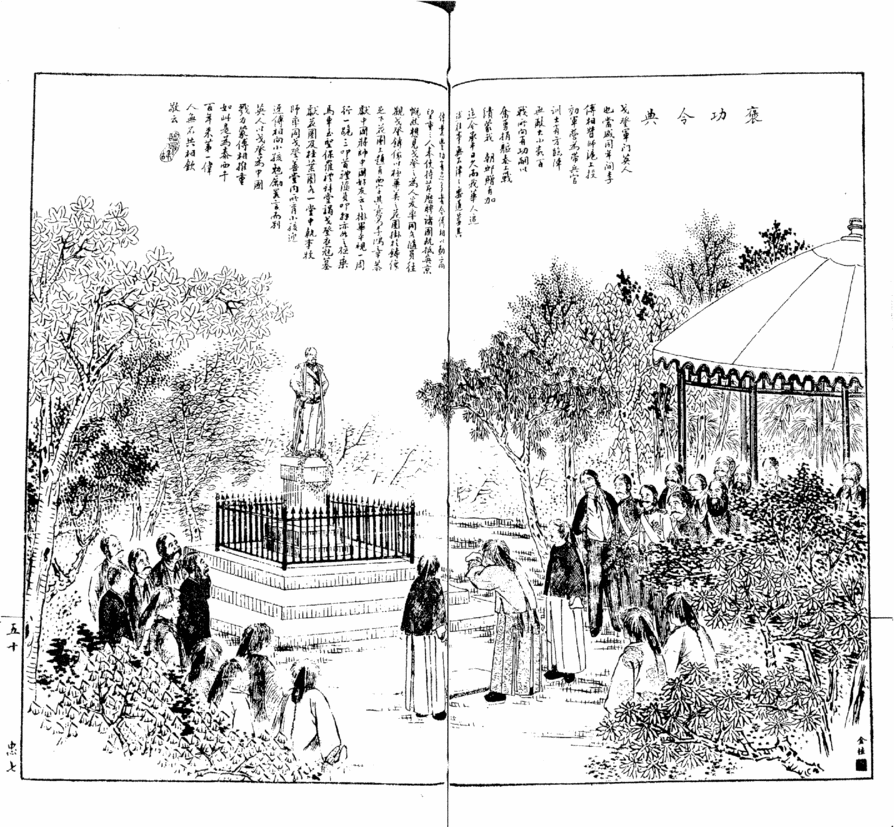
This positive view of the interventions was echoed in the Chinese-language press in the first 30 years after the war, suggesting that their readership—Chinese merchants in Shanghai and its surroundings—remained grateful for the expulsion of the Taiping. When Gordon returned to China in 1880, the Shenbao, the premier Chinese-language newspaper in Shanghai from 1872, reprinted a translated article from the North-China Daily News discussing his service against the Taiping and potential new role serving the Qing against Russia.Footnote 132 Shenbao offered no comment on the article, but its inclusion suggests that the newspaper felt that its Chinese readership would be interested in Gordon's past and present exploits.Footnote 133 More concrete evidence of the continuing interest in Gordon amongst a Chinese readership in Shanghai can be found in Dianshizhai pictorial's coverage of Li Hongzhang's visit to pay his respects at Gordon's statue in England in 1896 (Figure 5). Li visited London as part of a diplomatic world tour. The text accompanying the article, in addition to providing details of Li's visit, included effusive praise for Gordon's service, suggesting China would not find another like him in ‘hundreds of thousands of years’.Footnote 134 The magazine, publishing from within the safety of the foreign concessions, was not averse to criticizing the Qing government, so its editors were not simply following the established Qing narrative of the interventions.Footnote 135 They clearly felt Gordon's service was of interest to Dianshizhai’s wide readership, and that the author's sentiments might be shared by them.
Depiction of Li Hongzhang's 1896 visit to Gordon's statue in England in Dianshizhai Pictorial.Footnote 131

By the mid-1890s, however, Dianshizhai’s editors, who had been in favour of foreign-aided technological and military development, were regarded as conservative by a new generation of reformers who took a very different line on the foreign interventions against the Taiping.Footnote 136 The Qing defeat in the Sino-Japanese war (1894–95) bolstered the cause of anti-Qing reformers and revolutionaries. When the dynasty collapsed in 1911, it was initially replaced by revolutionaries who identified the Taiping as their forbears. The first president of the new republic, Sun Yatsen, was, like Hong Xiuquan, a Hakka ( Kejia) from Guangdong and, in his youth, was referred to as ‘little Hong’.Footnote 137 He later claimed that the stories he had heard of the Taiping's battles as a boy had inspired his subsequent revolutionary activity.Footnote 138 This led to increased interest in the history of the movement. Historical research on the movement was difficult to conduct in China, however, because the Qing had been so effective in extinguishing traces of the rebels, including their surviving documents. This changed in 1921, when new Qing documents on the Taiping were discovered in a private family archive. This led the historian Ling Shanqing, who described the Taiping as ‘a ray of light, after which we returned to darkness’, to publish an Unofficial History of the Taiping Heavenly Kingdom.Footnote 139 Ling's work encouraged a flurry of activity among Chinese historians keen to travel to libraries across the world collecting surviving Taiping documents.Footnote 140 The foreign interventions against the Taiping were remembered by many of these scholars as an act of imperialist aggression.Footnote 141
This revival of the memory of the Taiping civil war was not universally welcomed, reflecting the very divisions in Chinese society opened up by the Taiping themselves. This was particularly the case after Sun's successor, Chiang Kaishek, orchestrated a purge of communists in 1927. Against this backdrop, for nationalist anti-communists, the Taiping again fell out of favour. Chiang gave his soldiers a pamphlet on Zeng Guofan's suppression of the Taiping. In his foreword, he expressed the hope that his generals would be able to crush the communists just as Zeng had put down the would-be revolutionaries of earlier times.Footnote 142 Historians who shared Chiang's political outlook also began to play down the Taiping and hence the role of foreigners in their suppression.Footnote 143 This interpretation was later dismissed as ‘borderline propaganda’ by Lo Erh-kang, who would become the pre-eminent Taiping historian in communist China.Footnote 144 This division mirrored that which the Taiping themselves had opened up within Jiangnan society, between proponents of the status quo and supporters of revolution. Despite the division among historians in the republican period, neither group had an interest in actively promoting the foreign role in the Taiping war, as both ultimately aimed to end foreign-treaty privileges in China. As a result, monuments to it sat uncomfortably on the landscape.
Conclusion
The changes in memories of the Taiping war reflect changing ideas about the foreign role in China over time. Memories of the Taiping war crossed Assmann's 80-year divide between the social memory of participants to form a political memory, constructed by interest groups through imbuing importance in acts and sites of remembrance.Footnote 145 The memory of the war was initially celebrated by Qing officials, members of the Jiangnan elite, and by foreign veterans, if not by their governments. This convergence in memory of the Taiping war did not last, as Chinese nationalism rose in prominence and foreign communities in China felt threatened. British and American commemorations of the interventions ended with the end of the foreign treaty-port communities after the Second World War.Footnote 146 After the end of extraterritoriality in 1943, and the subsequent departure of almost all foreigners from the China coast, sovereignty in the country was no longer divided and the debates over the role of foreigners in the Taiping war were no longer transnational. There were no treaty-port communities left to cling to their past in order to preserve their future. Amongst Anglophone historians, the Taiping movement and the foreign response to it have generated only a handful of monographs in almost 40 years.Footnote 147 For commemorations to continue, they need an audience.
In China, however, only now are efforts to remember the interventions beginning to fade. Over the course of the early twentieth century, recollections of the Taiping war had travelled in the opposite direction to those of the foreign communities. In the words of one scholar writing in 1940, the Taiping had gone ‘from being a story grandmothers told their grandchildren to make them cry, to being a topic of conversation amongst civilised people over tea’.Footnote 148 The communist leadership took ending China's ‘century of humiliation’ at the hands of foreigners as a keystone of their legitimacy. Initially, remembering the evils done by foreigners, in suppressing the revolutionary potential of Hong Xiuquan's regime, bolstered that narrative.Footnote 149 The changing contemporary fate of the memory of the Taiping, however, is most clearly illustrated in the transformation of the museum in their honour in Nanjing. Originally, it was a site to commemorate the Taiping as anti-imperialist heroes but, in the China of the 2010s, the government appears to take rather less interest in championing a revolt by dispossessed rural communities against an urban ruling elite. The museum now markets istself through the garden in which it is situated: ‘The Best Garden of Old Nanjing.’ Indeed, it is this alone that is the focus of online reviews by Chinese visitors.Footnote 150 In Hong Kong and Taiwan, which lacked the same political imperatives, historians have remained interested in the period, questioning whether the Taiping were unique or just another armed peasant rebellion, akin to those that have littered China's dynastic history.Footnote 151
The case of the efforts to remember the foreign role in the Taiping war suggests that commemoration in a transnational environment can create as many disputes over form as they do over content. In order for events to be remembered beyond the lifespan of their participants, they must take material form to be stored in a community's archival memory. With an issue as emotive as commemorating war dead, cultural differences can create tensions. The medals issued to foreign fighters and the original Qing plan for Ward's tomb created more conflict because they clashed with British and American expectations about these forms than they did as acts of commemoration in themselves. These conflicts only occur when commemorations take a non-linguistic material form. Histories of the interventions helped shape their different readerships’ perspectives on the foreign role in the Taiping war, but conflict only arose when efforts to remember the interventions took the form of medals and monuments, lacking the divisions in comprehension created by the written word.
The divergent recollections of the foreign role in the Taiping war on the China coast also reflect the multidirectional nature of memory in a transnational setting. In an age of European and American empire building, China was far from the only extra-European territory where Western fighters became involved in civil conflicts between rival factions. Indeed, as his death at Khartoum highlights, it was not even the only place where Charles Gordon became involved in extra-European disputes. What made China different was the continuing division of sovereignty into the mid-twentieth century, with distinct foreign communities living side by side with a Chinese population amongst which nationalist sentiments were rising. This meant that efforts at commemoration, or, in the case of the Ningbo monument, the deconstruction of commemorations, caused counter-reactions or inspired different memories of the events. By the 1930s, the historian, Yang Yitang, suggested that his history of the Taiping movement had been inspired by a recent trip to Wusong, in the suburbs of Shanghai, where he had heard locals reminiscing about how they, 70 years previously, had bravely fought the foreign imperialists.Footnote 152 It is most likely that this was the ‘they’ of political memory, in that members of the community had heard the story and identified with it, for they are unlikely to have been methuselah-esque veterans themselves.Footnote 153 The fact that actual Taiping supporters in Shanghai in the 1860s were in short supply did not matter. The political memory of the period did.