Introduction
Fresh-market small fruit and vegetables are important Floridian agricultural commodities. Economically valuable Florida horticultural markets include strawberries [Fragaria × ananassa (Weston) Duchesne ex Rozier (pro sp.) [chiloensis × virginiana]], bell peppers (Capsicum annum L.), tomatoes (Solanum lycopersicum L.), cucumber (Cucumis sativus L.), watermelon (Citrullus lanatus (Thunb.) Matsum. & Nakai), and cantaloupe (Cucumis melo var. cantalupo Ser.). These crops had a total production value in Florida of $1,051 million in 2017 (USDA 2018) and are produced using an annual plasticulture system.
In plasticulture production, broadleaf and grass weeds emerge from within the planting hole and between the rows (row-middles). Nutsedge species (Cyperus spp.) also emerge throughout the bed by penetrating the plastic mulch. Vegetable plasticulture production integrated pest management (IPM) faces many challenges, such as limited herbicide registrations, relay cropping, crop rotations, and limited tillage during production (Boranno Reference Boranno1996). Banning of the fumigant methyl bromide in 2005 has changed plasticulture production IPM strategies. Research since the ban has predominantly focused on testing fumigant alternatives (Csinos et al. Reference Csinos, Sumner, Johnson, Johnson, McPherson and Dowler2000; Gilreath et al. Reference Gilreath, Motis, Santos, Mirusso, Gilreath, Noling and Jones2005; Santos et al. Reference Santos, Gilreath and Motis2006) or PRE herbicide applied under the plastic mulch (Boyd Reference Boyd2015; Boyd and Reed Reference Boyd and Reed2016; Dittmar et al. Reference Dittmar, Monks, Jennings and Booker2012; Gilreath and Santos Reference Gilreath and Santos2005). The emphasis on row-middle weed control, particularly emerged vegetation, has been limited (Boyd Reference Boyd2017; Gilreath and Santos Reference Gilreath and Santos2004).
The presence of weeds in row-middles may affect yield (Gilreath and Santos Reference Gilreath and Santos2004), shelter pests such as insects (Bedford et al. Reference Bedford, Kelly, Banks, Briddon, Cenis and Markham1998), nematodes (Townshend and Davidson Reference Townshend and Davidson1960), and diseases (Freeman et al. Reference Freeman, Horowitz and Sharon2001), and impede plastic mulch removal. Reliance on a single mechanism of action for various POST weed control use patterns, such as row-middle applications, has become an industry norm. Other use patterns include late-season fallow burndown, pre-plant burndown, and crop termination. Currently, broad-spectrum herbicides such as glyphosate and paraquat are used extensively. This practice has led to paraquat resistance in American black nightshade (Solanum americanum Mill.) (Bewick et al. Reference Bewick, Kostewicz, Stall, Shilling and Smith1990) and goosegrass [Eleusine indica (L.) Gaertn.] (Buker et al. Reference Buker, Steed and Stall2002), and glyphosate resistance in ragweed parthenium (Parthenium hysterophorus L.) (Fernandez et al. Reference Fernandez, Odero, MacDonald, Ferrell and Gettys2015). Some problematic species, such as pusley species (Richardia spp.), are not typically controlled with a single application of glyphosate (680 to 840 g ae ha–1) (Chandran and Singh Reference Chandran and Singh2003; Jha et al. Reference Jha, Norsworthy, Bridges and Riley2008).
Glufosinate is a broad-spectrum, POST herbicide with potential for row-middle use in Florida. In most species, the generally low glufosinate translocation reduces drift concerns (Besançon et al. Reference Besançon, Penner and Everman2018; Everman et al. Reference Everman, Mayhew, Burton, York and Wilcut2009; Maschhoff et al. Reference Maschhoff, Hart, Baldwin, Maschhoff, Hart and Baldwin2000). Glufosinate inhibits glutamine synthase and leads to toxic buildup of ammonium (Sellers et al. Reference Sellers, Smeda and Li2004; Velini et al. Reference Velini, Trindade, Barberis and Duke2010). Incorporation into row-middle IPM strategies provides an additional mode of action to alleviate resistance concerns.
Although glufosinate is nonselective, differential efficacy has been reported depending on species, growth stage, and application rate (Petersen and Hurle Reference Petersen and Hurle2001). Applying herbicide mixtures may remedy differential efficacy concerns and provide additional benefits such as reduced production costs associated with time and labor, reduced soil compaction, and delayed development of herbicide resistance (Hatzios and Penner Reference Hatzios and Penner1985). Nutsedge species are a target species for mixtures, as these species typically infest both the beds and the row-middles. Difficulty in controlling these species arises from their production of perennial tubers that survive tillage (Neeser et al. Reference Neeser, Aguero, Swanton and Neeser1997; Wills and Briscoe Reference Wills and Briscoe1970) and a general lack of available herbicide efficacy on sedges. Halosulfuron does control nutsedge species and reduces tuber production and viability (Boyd and Dittmar Reference Boyd and Dittmar2018; Webster and Grey Reference Webster and Grey2014). Halosulfuron is often mixed with paraquat to broaden the control spectrum and enhance overall control of nutsedge species in row-middles.
Glufosinate has been shown to interact with selective herbicides, though the nature of that interaction, either antagonism, additive, or synergism, is dependent on species, application rates, herbicides included, and time after treatment (Lanclos et al. Reference Lanclos, Webster and Zhang2002). For example, glufosinate has been shown to antagonize clethodim (Burke et al. Reference Burke, Askew, Corbett and Wilcut2005) and reduce glyphosate translocation (Besançon et al. Reference Besançon, Penner and Everman2018). Glufosinate (420 g ai ha–1) and halosulfuron (5 g ai ha–1) have been shown to interact antagonistically in controlling barnyardgrass [Echinochloa crus-galli (L.) P.Beauv.], broadleaf signalgrass [Urochloa platyphylla (Munro ex C. Wright) R.D. Webster], and spreading dayflower (Commelina diffusa Burm. f.) (Lanclos et al. Reference Lanclos, Webster and Zhang2002). Glufosinate is of interest because it provides an additional mode of action for POST burndown treatments, but testing will be required to show efficacy on weed species problematic to Florida vegetable production. The research objective was to test the efficacy of glufosinate on emerged vegetation in vegetable plasticulture row-middles and its suitability in a mixture with halosulfuron in controlling nutsedges.
Materials and methods
Experiments were conducted at two locations in 2016 at the Gulf Coast Research and Education Center (27.75947ºN, 82.2612ºW) in Balm, FL, to evaluate glufosinate efficacy in row-middles. The experimental design was a randomized complete block with four blocks. The crop in experiment 1 (site 1) was tomatoes (‘HMX1823’), whereas the crop in experiment 2 (site 2) was zucchini squash (‘Spineless Beauty’) (Cucurbita pepo L.). Although the crop differed, the production spaces (i.e., both the beds and row-middles) were managed entirely the same.
The experiment was initiated on March 10, 2016, when beds were formed, drip tape laid, and the beds covered in plastic mulch. Plot size was 7.6 m by 1.2 m within the row-middle. Each plot was composed of two row-middles, each flanking the bed. Herbicides were applied on April 19, 2016 for site 1 and April 20, 2016 for site 2. Herbicides included glufosinate-ammonium (glufosinate) (Rely®280, Bayer CropScience LP, Research Triangle Park, NC), paraquat (Gramoxone® SL, Syngenta Crop Protection, LLC, Greensboro NC), diquat (Reglone® Desiccant, Syngenta Crop Protection, LLC, Greensboro NC), and halosulfuron (Sandea® Canyon Group LLC. C/O Gowan Co., Yuma AZ). Experimental treatments included: glufosinate at 656 g ai ha–1, glufosinate at 983 g ha–1, paraquat at 560 g ai ha–1, diquat at 560 g ai ha–1, halosulfuron at 53 g ai ha–1, a mixture of glufosinate + halosulfuron (656 + 53 g ha–1), a mixture of paraquat + halosulfuron (560 + 53 g ha–1), and a nontreated control. Weed densities, recorded 1, 2, and 4 wk after treatment (WAT), were measured using a 0.144-m2 quadrat. One quadrat was placed in each row-middle and the values averaged per plot. Weed presence was recorded to the species level where possible. Many individual species densities were low, so values were pooled to permit analysis by groups. These groups included nutsedge spp., grasses, Brazil pusley, and other broadleaves.
Orthogonal contrasts were planned a priori and analyzed using a t-test. The orthogonal contrast analysis approach was selected because desirable comparisons had already been incorporated into the experimental design and traditional means comparison would lose power by performing all pairwise comparisons of the eight treatments, including undesirable comparisons. Therefore, the statistically powerful but limited applicability (limited comparisons) of orthogonal contrasts was selected to analyze the field data. The null hypothesis was that differences between least square means for the preplanned contrasts equaled 0. Four types of contrasts were planned: (1) comparison of each treatment to the control, (2) comparison of the high glufosinate dose to the low dose, (3) comparison of halosulfuron alone to a mixture of paraquat and glufosinate, and (4) comparison of mixtures. Contrasts were performed using ESTIMATE option in PROC GLIMMIX (SAS version 9.2, SAS Institute Inc., Cary, NC). Contrasts were arranged to emphasize a negative value if the desired treatment was effective. For contrast type 1, the control (larger) densities were subtracted from the herbicide treatments. For contrast type 2, the low dose was subtracted from the high dose of glufosinate. For contrast type 3, halosulfuron was subtracted from the mixture. For contrast type 4, the halosulfuron and paraquat mixture was subtracted from the halosulfuron and glufosinate mixture. Model assumptions of constant variance and normality were verified. If assumptions could not be verified, then square or cube root transformations were employed. Differences in least square means are reported and are back-transformed when necessary.
Mixture interaction and efficacy on nutsedge species was of primary concern. To assess and qualify the interaction, the Colby method was employed using a percent-of-control comparison for mixtures (Colby Reference Colby1967). This method is a modification of the Gowing approach, which uses percent growth inhibition (Gowing Reference Gowing1960) and transforms the values into percent-of-control. This predicts the anticipated mixture efficacy based on performance of the individual herbicides when used alone. This was calculated as:
 $$E = {{{X_1}{Y_1}} \over {100}}$$
([1])
where E is the expected reduction in nutsedge density based by the mixture, X 1 is the actual reduction in nutsedge density for herbicide 1, and Y 1 is the actual reduction in nutsedge density for herbicide 2. Should the observed response be greater than the expected, the relationship is synergistic; should it be less than expected, then the herbicides are mutually antagonistic; and should the expected and actual responses be equal, then the herbicide combination is considered additive (Colby Reference Colby1967).
Results and discussion
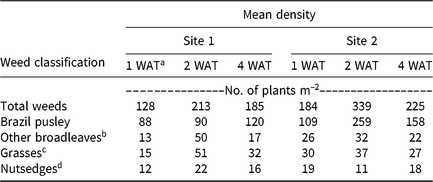
No crop injury was observed at either site. The weed community across both sites was largely similar (Table 1). Both sites were heavily infested with Brazil pusley. Other broadleaf species included common ragweed (Ambrosia artemisiifolia L.) and wild radish (Raphanus raphanistrum L.). Grass species were predominantly goosegrass and smooth crabgrass (Digitaria ischaemum (Schreb. Muhl.). Purple nutsedge (Cyperus rotundus L.) was the predominant nutsedge species, though yellow nutsedge (Cyperus esculentus L.) occurred within the fields.
Weed densities found in vegetable plasticulture row-middle untreated plots over time for both sites at Balm, FL, in 2016.

a Abbreviation: WAT, wk after herbicide treatment.
b Other broadleaf species present were predominantly common ragweed and wild radish.
c Grass species present were predominantly goosegrass and smooth crabgrass.
d Nutsedge species present was predominantly purple nutsedge, although yellow nutsedge was also present.
Total weeds
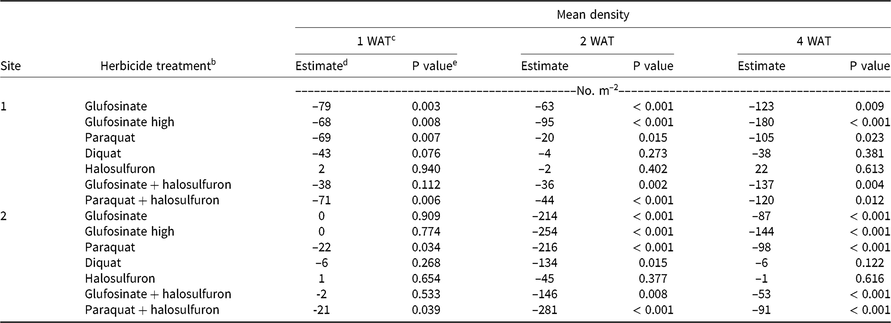
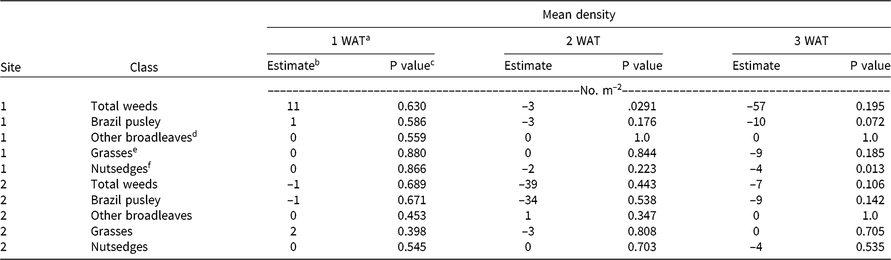
Compared with controls, the low and high rates of glufosinate, paraquat, and mixtures of halosulfuron with paraquat or glufosinate reduced total weed densities (Table 2). The high rate of glufosinate gave the best control (considering both duration and extent), followed by the lower rate of glufosinate and paraquat. The high rate of glufosinate tended to give better control (Table 3).
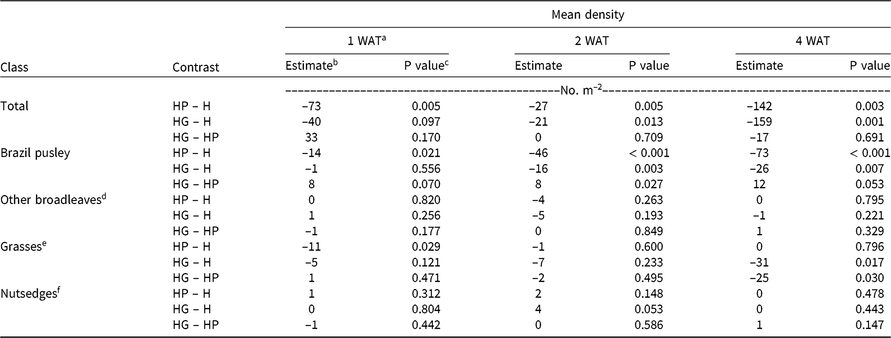
Including either paraquat or glufosinate in a mixture with halosulfuron decreased weed densities compared to halosulfuron alone by 2 WAT at site 1, with no difference between mixes (Table 4). At site 2 the trend was similar, though the paraquat and halosulfuron mixture did outperform the glufosinate and halosulfuron mixture at 2 WAT (Table 5). When mixtures were compared to paraquat or glufosinate applied alone, it appeared that paraquat and glufosinate were providing most of the control (Table 2). The glufosinate + halosulfuron mixture appeared to suffer from mutual antagonism across most timings, compared to glufosinate alone. Overall, the mixtures were not different, and glufosinate appears to be a suitable alternative to paraquat.
Impact of herbicide application on mean total weed density compared to controls in Florida vegetable plasticulture row-middles at Balm, FL, in 2016. a

a For comparison, see Table 1 for control plot mean weed densities.
b Herbicide treatment refers to herbicide application in the row-middle. Associated rates for each treatment are as follow: glufosinate (656 g ai ha–1), glufosinate high (983 g ha–1), paraquat (560 g ha–1), diquat (560 g ha–1), halosulfuron (53 g ha–1), glufosinate + halosulfuron (656 + 53 g ha–1), and paraquat + halosulfuron (560 + 53 g ha–1).
c Abbreviation: WAT, wk after herbicide treatment.
d Estimate refers to the estimated difference in least square means between the associated control and treatment found within the row. Estimates were calculated by subtracting the control from the associated treatment, where a negative indicates a reduction in weed density by the associated treatment.
e P value refers to the probability that the estimated difference in least square means for the associated treatments is equal to zero with a significance level of 0.05.
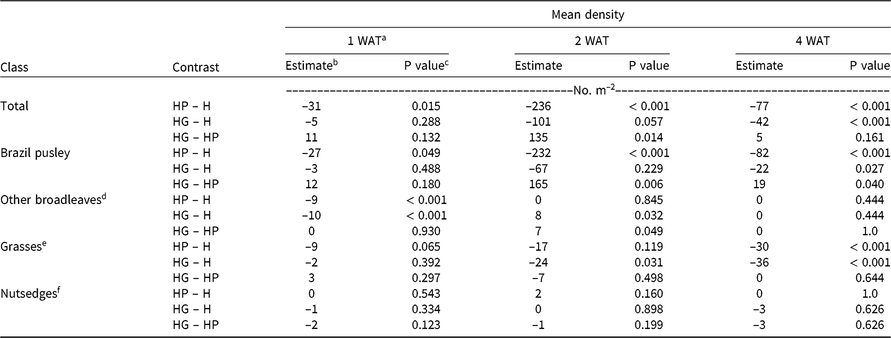
Impact of increasing glufosinate dose from 656 to 983 g ai ha–1 when applied to Florida vegetable plasticulture row-middles on weed densities over time at two sites in Balm, FL, in 2016.

a Abbreviation: WAT, wk after herbicide treatment.
b Estimate refers to the estimated difference in least square means between the associated control and treatment found within the row. Estimates were calculated by subtracting the high dose of glufosinate from the low dose, where a negative indicates a reduction in weed density by the associated treatment.
c P value refers to the probability that the estimated difference in least square means for the associated treatments is equal to zero with a significance level of 0.05.
d Other broadleaf species present were predominantly common ragweed and wild radish.
e Grass species present were predominantly goosegrass and smooth crabgrass.
f Nutsedges present were predominantly purple nutsedge, though yellow nutsedge was also present.
Impact of applying halosulfuron (H) alone versus mixing halosulfuron with paraquat (HP) or glufosinate (HG) on weed densities in vegetable plasticulture row-middles at site 1 in Balm, FL, in 2016.

a Abbreviation: WAT, wk after herbicide treatment.
b Estimate refers to the estimated difference in least square means between the associated control and treatment found within the row. Estimates were calculated by the orientation in the contrast column, where a negative indicates a reduction in weed density by the associated treatment.
c P value refers to the probability that the estimated difference in least square means for the associated treatments is equal to zero with a significance level of 0.05.
d Other broadleaf species present were predominantly common ragweed and wild radish.
e Grass species present were predominantly goosegrass and smooth crabgrass.
f Nutsedges present were predominantly purple nutsedge, though yellow nutsedge was also present.
Impact of applying halosulfuron (H) alone versus mixing halosulfuron with paraquat (HP) or glufosinate (HG) on weed densities in vegetable plasticulture row-middles at site 2 in Balm, FL, in 2016.

a Abbreviations: WAT, wk after herbicide treatment.
b Estimate refers to the estimated difference in least square means between the associated control and treatment found within the row. Estimates were calculated by the orientation in the contrast column, where a negative indicates a reduction in weed density by the associated treatment.
c P value refers to the probability that the estimated difference in least square means for the associated treatments is equal to zero with a significance level of 0.05.
d Other broadleaf species present were predominantly common ragweed and wild radish.
e Grass species present were predominantly goosegrass and smooth crabgrass.
f Nutsedges present were predominantly purple nutsedge, though yellow nutsedge was also present.
Broadleaves
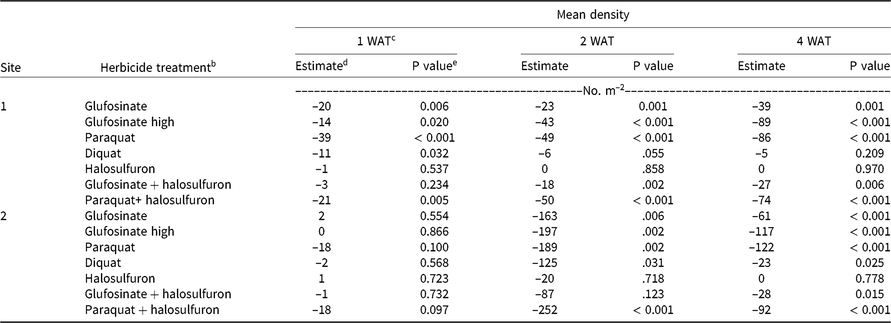
Compared to the control, Brazil pusley densities were reduced when using glufosinate or paraquat alone or in a mixture (Table 6). As with total weed populations, there was a delay in control of 1 wk at site 2. Unexpectedly, diquat did not consistently reduce weed densities. This was particularly evident at 4 WAT, when efficacy was lost at site 1 and reduced at site 2. Halosulfuron alone was not effective at controlling Brazil pusley, whereas mixtures with glufosinate or paraquat did reduce Brazil pusley densities, probably as a result of the influence of glufosinate and paraquat (Table 6). Furthermore, the addition of either glufosinate or paraquat with halosulfuron increased efficacy by 4 WAT (Tables 4 and 5). Paraquat mixed with halosulfuron was most effective in reducing Brazil pusley densities across both sites, making it the best solution for Brazil pusley control. Confirming this result is the finding that increasing the rate of glufosinate did not reduce Brazil pusley densities at any timing across both sites (Table 3).
Brazil pusley control percentages with the low glufosinate dose at 2 and 4 WAT were 26% and 33% in site 1 and 63% and 39% in site 2 (Table 6). The high glufosinate dose increased control at 2 and 4 WAT to 48% and 74% in site 1 and to 76% and 74% in site 2. Glufosinate applied at 0.983 kg ha–1 provided 64% and 59% Brazil pusley control at 15 and 30 d after treatment (Jhala et al. Reference Jhala, Ramirez and Singh2013).
Glufosinate holds potential for not only row-middles but also preplant or fallow-period burndown applications. Both Florida pusley (Richardia scabra L.) and Brazil pusley have demonstrated tolerance and survival to single applications of glyphosate (Chandran and Singh Reference Chandran and Singh2003; Jha et al. Reference Jha, Norsworthy, Bridges and Riley2008; Sharma and Singh Reference Sharma and Singh2001). Currently, the most effective nutsedge control in fallow periods is either repeated applications of glyphosate or alternating cultivation and glyphosate (Miller et al. Reference Miller, Dittmar, Vallad and Ferrell2014). Incorporation of glufosinate into IPM strategies focused on nutsedge provides an additional effective control strategy for burndown and row-middle applications to control pusley escapes.
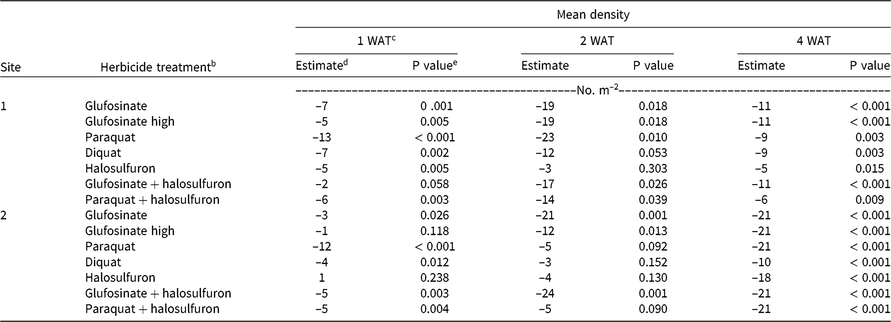
In general, the other broadleaf species present in the study were more susceptible to diquat and halosulfuron, with control also provided with glufosinate and paraquat (Table 7). Increasing the rate of glufosinate did not provide additional control for other broadleaves (Table 3). Mixtures with halosufuron were effective in reducing densities compared with controls (Table 7); this result reflected the influence of paraquat and glufosinate, with no difference in broadleaf densities between mixtures (Tables 4 and 5).
Impact of herbicide application on mean Brazil pusley weed density compared to controls in Florida vegetable plasticulture row-middles at Balm, FL, in 2016. a

a For comparison, see control plot mean weed densities in Table 1.
b Herbicide treatment refers to herbicide application in the row-middle. Associated rates for each treatment are as follow: glufosinate (656 g ai ha–1), glufosinate high (983 g ha–1), paraquat (560 g ha–1), diquat (560 g ha–1), halosulfuron (53 g ha–1), glufosinate + halosulfuron (656 + 53 g ha–1), and paraquat + halosulfuron (560 + 53 g ha–1).
c Abbreviation: WAT, wk after herbicide treatment.
d Estimate refers to the estimated difference in least square means between the associated control and treatment found within the row. Estimates were calculated by subtracting the control from the associated treatment, where a negative indicates a reduction in weed density by the associated treatment.
e P value refers to the probability that the estimated difference in least square means for the associated treatments is equal to zero with a significance level of 0.05.
Impact of herbicide application on mean broadleaf weed densities, excluding pusley species, compared to controls in Florida vegetable plasticulture row-middles at Balm, FL, in 2016. a

a For comparison, see control plot mean weed densities in Table 1.
b Herbicide treatment refers to herbicide application in the row-middle. Associated rates for each treatment are as follow: glufosinate (656 g ai ha–1), glufosinate high (983 g ha–1), paraquat (560 g ha–1), diquat (560 g ha–1), halosulfuron (53 g ha–1), glufosinate + halosulfuron (656 + 53 g ha–1), and paraquat + halosulfuron (560 + 53 g ha–1).
c Abbreviation: WAT, wk after herbicide treatment.
d Estimate refers to the estimated difference in least square means between the associated control and treatment found within the row. Estimates were calculated by subtracting the control from the associated treatment, where a negative indicates a reduction in weed density by the associated treatment.
e P value refers to the probability that the estimated difference in least square means for the associated treatments is equal to zero with a significance level of 0.05.
Grasses
Paraquat, diquat, and halosulfuron did not provide control of grass species compared with controls (Table 8). Glufosinate provided control by 2 WAT, but control was lost by 4 WAT at site 1. Increasing the rate of glufosinate did not increase grass control (Table 3). Compared to controls, mixtures containing paraquat or glufosinate were inconsistent at reducing grass densities across sites (Table 8). The addition of glufosinate to halosulfuron did consistently increase control compared with halosulfuron alone across both sites (Tables 4 and 5). The influence of paraquat to produce greater control by reducing grass densities was inconsistent across sites, which led to a difference between mixtures at site 1 at 4 WAT (Table 5).
Impact of herbicide application on mean grass species densities compared to controls in Florida vegetable plasticulture row-middles at Balm, FL, in 2016. a

a For comparison, see control plot mean weed densities in Table 1.
b Herbicide treatment refers to herbicide application in the row-middle. Associated rates for each treatment are as follow: glufosinate (656 g ai ha–1), glufosinate high (983 g ha–1), paraquat (560 g ha–1), diquat (560 g ha–1), halosulfuron (53 g ha–1), glufosinate + halosulfuron (656 + 53 g ha–1), and paraquat + halosulfuron (560 + 53 g ha–1).
c Abbreviation: WAT, wk after herbicide treatment.
d Estimate refers to the estimated difference in least square means between the associated control and treatment found within the row. Estimates were calculated by subtracting the control from the associated treatment, where a negative indicates a reduction in weed density by the associated treatment.
e P value refers to the probability that the estimated difference in least square means for the associated treatments is equal to zero with a significance level of 0.05.
Control with the low glufosinate rate on grasses was variable by 2 WAT and was 75% and 89% between the two sites (Tables 1 and 8). Previous research demonstrated only 43% control when applied at the two- to four-leaf stage on goosegrass at 410 g ha–1 (Burke et al. Reference Burke, Askew, Corbett and Wilcut2005). Goosegrass tolerance to glufosinate is due to limited translocation (93% of radioactivity retained in the treated leaf) and metabolism (44% was found metabolized) (Everman et al. Reference Everman, Mayhew, Burton, York and Wilcut2009). Applying glufosinate during high relative humidity (55% vs 80%) has increased efficacy on catchweed bedstraw (Galium aparine L.) and field mustard (Brassica rapa L.) (Petersen and Hurle Reference Petersen and Hurle2001). Application during cool periods (15 C) may reduce metabolism and increase efficacy, as demonstrated in Liberty-Link soybeans, but this may also decrease absorption and requires further study (Pline et al. Reference Pline, Wu and Hatzios1999). Care should be taken if mixing with clethodim, as antagonism has been demonstrated on goosegrass controls (Burke et al. Reference Burke, Askew, Corbett and Wilcut2005).
Nutsedges
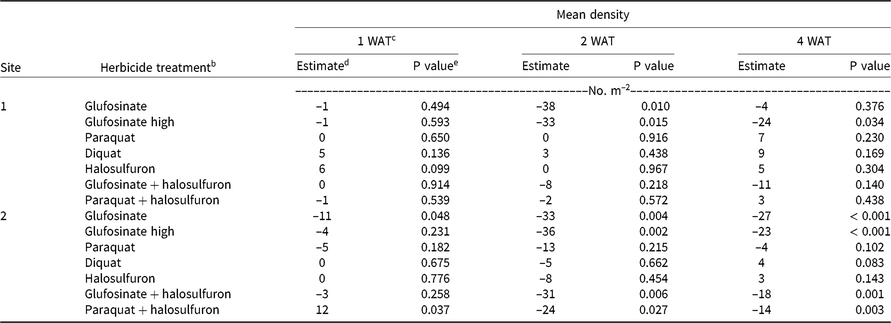
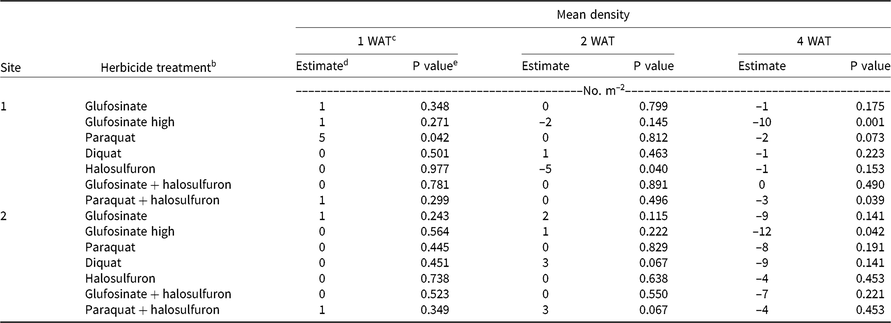
The low rate of glufosinate did not reduce nutsedge densities compared to controls, whereas the high rate consistently did reduce densities across sites at 4 WAT (Table 9). The difference between the two doses was not consistently significant across sites (Table 3). This inconsistency was probably due to higher spatial variability and lower nutsedge densities overall compared with other weed classes considered (Table 1). Diquat was not effective at reducing nutsedge densities compared to controls. Paraquat demonstrated some early (1 WAT) density reductions, but this difference did not persist.
Impact of herbicide application on mean nutsedge densities compared to controls in Florida vegetable plasticulture row-middles at Balm, FL, in 2016. a

a For comparison, see control plot mean weed densities in Table 1.
b Herbicide treatment refers to herbicide application in the row-middle. Associated rates for each treatment are as follow: glufosinate (656 g ai ha–1), glufosinate high (983 g ha–1), paraquat (560 g ha–1), diquat (560 g ha–1), halosulfuron (53 g ha–1), glufosinate + halosulfuron (656 + 53 g ha–1), and paraquat + halosulfuron (560 + 53 g ha–1).
c Abbreviation: WAT, wk after herbicide treatment.
d Estimate refers to the estimated difference in least square means between the associated control and treatment found within the row. Estimates were calculated by subtracting the control from the associated treatment, where a negative indicates a reduction in weed density by the associated treatment.
e P value refers to the probability that the estimated difference in least square means for the associated treatments is equal to zero with a significance level of 0.05.
Surprisingly, halosulfuron did not reduce nutsedge populations, particularly at 4 WAT (Table 9). This result is probably a consequence of application timing, given that treatments were applied at 40 d after bed formation. Halosulfuron applied at 28 d after sprouting had reduced suppression compared with applications made after 14 d in the greenhouse (Norsworthy et al. Reference Norsworthy, Schroeder, Thomas and Murray2005). Differential efficacy of halosulfuron on purple nutsedge based on the presence of inflorescence has been speculated in field observations (Boyd and Dittmar Reference Boyd and Dittmar2018). Applications made after 6 wk of shoot growth reduced tuber production and viability but did not provide complete corm and foliage necrosis (Webster and Grey Reference Webster and Grey2014). Later application timings may be unsuitable for control, because purple nutsedge tuber number has doubled by 6 wk (Sun and Nishimoto Reference Sun and Nishimoto1997). A month after planting, a single tuber produces new corms and shoots and begins tuber production (Horowitz Reference Horowitz1972). Shoot densities were probably not reduced by halosulfuron, because at the trial locations (row-middles), nutrient-driven, rhizome-linked corm and shoot production would be lower overall; another variable could have been size-based tolerance to halosulfuron, though this requires further study.
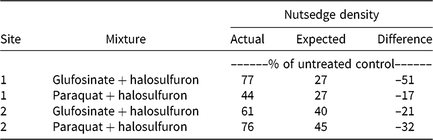
Mixing glufosinate with halosulfuron did not reduce nutsedge densities compared to controls (Table 9). Mixing halosulfuron with paraquat produced some transient reductions in nutsedge densities compared with controls, but these reductions were not consistent spatially or temporally. The addition of paraquat or glufosinate to a mixture with halosulfuron did not reduce densities compared to halosulfuron alone at any timing across both sites. When expressed as a percent of the untreated control, both glufosinate and paraquat when mixed with halosulfuron demonstrated antagonism on reduction of nutsedge densities (Table 10). Reduced translocation of glyphosate when applied with glufosinate has been demonstrated in giant foxtail (Setaria faberi R.A.W.Herrm.) and velvetleaf (Abutilon theophrasti Medik.) (Besançon et al. Reference Besançon, Penner and Everman2018). Halosufluron is phloem mobile, is translocated within the plant, and may be antagonized by glufosinate. Increased herbicide doses have been shown to overcome herbicide antagonism in mixture (O’Donovan and O’Sullivan Reference O’Donovan and O’Sullivan1982; Rhodes and Coble Reference Rhodes and Coble1984). Given that the high dose of glufosinate was more effective in reducing nutsedge densities, future research could explore higher doses when mixed to maximize efficacy.
Mixture interactions of halosulfuron with paraquat and glufosinate on nutsedge control in plasticulture row-middles at 4 wk after treatment.

Overall, glufosinate appears to be a suitable candidate as an alternative broad-spectrum POST herbicide for row-middle applications in Florida vegetable production. Glufosinate reduced total weed densities to a comparable degree with paraquat, which is the industry standard. Broadleaf control, including Brazil pusley, was comparable between glufosinate and paraquat. If the high dose can be applied legally, it may be a better option for grass control than paraquat. Unfortunately, mixing either paraquat or glufosinate with halosulfuron did not appear to be a reliable option for POST control of nutsedge in row-middles. Using ammonium sulfate in mixture or with glufosinate alone may increase efficacy on nutsedge (Maschhoff et al. Reference Maschhoff, Hart, Baldwin, Maschhoff, Hart and Baldwin2000), though it requires further study.
Author ORCIDs
Shaun Michael Sharpe http://orcid.org/0000-0002-7683-703X
Acknowledgments
This project was funded in part by Bayer. No conflicts of interest have been declared.