Much of the iconography displayed on Zapotec effigy vessels focuses on representations of maize and associated motifs. There is also evidence from effigy vessels, historical sources and ethnographic studies that the Zapotec offered animal and human blood in rituals related to maize, a practice widely documented for other ancient and present-day Mesoamerican communities (Nuttall Reference Nuttall1904; Thompson Reference Thompson1961). Linking these two observations, this paper examines how maize and blood were central elements in ancient Zapotec religious practices and how they were related conceptually. Previous studies have covered a lot of ground in identifying and interpreting the iconography of Zapotec urns (Caso Reference Caso1928; Caso and Bernal Reference Caso and Bernal1952; Mongne Reference Mongne1985; Rickards Reference Rickards1938; Sellen Reference Sellen2007; Shaplin Reference Shaplin1975; Urcid Reference Urcid2001, Reference Urcid2005), but many theories have gone untested and unchallenged. In this paper I offer several new insights that illustrate the core concepts present in these ritual objects, and discuss how the effigy vessels and their images have broader associations in Zapotec religion and society. The iconographic information gleaned from the comparative analysis of the effigy vessels suggest that the main theme involved in the ancient representations was fertility, underscored by a sacred pact forged between humans and the gods associated with sustaining the growth cycle of this important plant. The element that connected sacred beings with humans was blood, the vital liquid that stimulated fertility and that had to be spilled to insure the continuity of life. Much of the visual evidence I will present support ideas put forth by Joyce (Reference Joyce, Dobres and Robb2000, Reference Joyce, Hendon and Joyce2004) that consider bloodletting rituals as a fundamental part of ancient Zapotec ideology linked to the founding of their most important city: Monte Alban.
In the sixteenth century, the Spanish priest Diego de Durán recorded a chilling account of a traditional sacrifice held over from pre-Conquest times:
…en cierta provincia mixteca hubo sacrificio de los miembros genitales por los cuales sacaban cuerdas por ellos de a quince y de veinte brazas [approximately 1.80 m] y otros para hacerse imposibilitados de no pecar los hendian por medio (cosa que hace temblar las carnes) a trueque de que los tuviesen por siervos del demonio y por hombres santos penitentes y castos y honestos que era en lo que mas hincapie hacian…. (Durán Reference Durán1995 [1581]:174–175)
The length of this cord, 15 and 20 brazas as cited by Durán, coincides with Toribio de Benavente Motolinia's (Reference Motolinia and O'Gorman1989 [1541]:116) earlier and more detailed description of a similar act. These observations of genital perforation—that horrified and intrigued the Spanish priests—are just a sample of the many colonial era texts that describe the mortifications indigenous people inflicted on their bodies. Autosacrifice and bloodletting was a widespread and common occurrence among the agricultural cultures of Mesoamerica, and almost no part of the body was spared from the rope, reed, cactus spine, or obsidian blade (Klein Reference Klein and Carrasco2006).
From Durán's perspective, the mutilation of genital flesh involving a long cord was to keep spiritual men virtuous; however, there are other reasons why it may have been carried out. Passing a cord through the penis would have been extremely painful, and probably required the participant to generate a tide of endorphins, perhaps aided by narcotics, to survive the ordeal. Furst (Reference Furst and Robertson1976:184) proposed that by inflicting a massive “jolt” to their system the bloodletters obtained a heightened psychological state of ecstasy. In this altered state visions were sought and deified ancestors and guardian spirits were invoked. Nájera (Reference Nájera Coronado1987:70) suggested that it might be an initiation rite, a way for young men to spiritually cleanse themselves before entering manhood. In short, this intense act of genital mutilation was not only about destroying the male reproductive organ so that penitence was assured, but also possibly about the psychological condition it induced and the sociological context of the participants.
These reasons stated, perhaps the primary purpose of genital mutilation was the collection of blood for offerings involving ancestors, a position held by many authors who have studied the ancient Maya (Nájera 1987:69; Schele and Miller Reference Schele and Miller1986:175–176; Stuart Reference Stuart1984:11). Blood sacrifices allowed a variety of favorable conditions to be solicited from the gods via the ancestors, including rain, the fertility of the earth, the health of the people, military power, and even the Sun's vitality (López Austin Reference López Austin, de Montellano and de Montellano1988:326). Bloodletting is closely linked to the fundamental Mesoamerican idea of “indebtedness,” where humans are mere vassals of the creators and spend their lives paying off their debt through self-sacrifice (Graulich Reference Graulich, de Montellano and de Montellano1997:114). Accordingly, presenting one's own blood represented the greatest sacrifice because it involved surrendering a fundamental part of one's body. The blood drawn from the male member was considered the most potent for its life-giving powers (Furst Reference Furst and Robertson1976:182), and was offered up to insure the continuance, abundance and fecundity of the crops. In particular, this vital red liquid was placed in the earth to symbolically feed the most important staple, and the gods' gift to ancient man, maize.
The earliest evidence that the Zapotec were involved in the practice of bloodletting comes from archaeological finds dating to the Formative period (500–200 b.c.) and consists of specialized cutting and perforating tools used in the act, such as obsidian blades, stingray spines, and shark's teeth (Flannery Reference Flannery and Flannery1976; Marcus and Flannery Reference Marcus, Flannery, Renfrew and Zubrow1994:60–62). The method of using a cord, made from perishable materials, would probably not show up in the archaeological record. However, evidence for bloodletting with this implement can be seen in artifacts commonly known as “urns,” effigy vessels usually found in association with graves and burials. In the central valleys of Oaxaca these effigy vessels were produced in vast quantities between the Pe and Xoo phases (300 b.c.–a.d. 800). A highly esteemed object, Zapotec urns have been collected with great vigor over the last one hundred and fifty years, and as a result most examples are now in public or private collections. The great majority of effigy vessels in museums were collected before the advent of modern archaeological practice, thus few have any association to contextual data, and some lack even a reported provenance. Furthermore, many urns in these collections have been determined to be fakes, which has created a great deal of havoc in earlier research that included them in iconographic studies. Opportunely, in recent years several of these older collections have been analyzed using a variety of chronometric techniques, including thermoluminescence (TL), and hundreds of fakes are now identified (e.g., Goedicke et al. Reference Goedicke, Henschel and Wagner1992; Mongne Reference Mongne1987; Sellen Reference Sellen2004, Reference Sellen2005). Thanks to a growing database of faux urns and a greater understanding of their historical context and how they were made, experts can now readily detect these objects simply by visual examination.
In earlier studies, Javier Urcid and I have proposed that the urn effigies are idealized representations of ancestors impersonating deities related to the sacred calendar (Sellen Reference Sellen2002, Reference Sellen2007; Urcid Reference Urcid2001, Reference Urcid2004, Reference Urcid2005). We have argued that the entities in the calendar lists are similar to those known in other Mesoamerican cultures that are considered fundamentally pantheistic, suggesting that they may be considered deities. In particular, our studies have shown that the deities displayed on the urns are the same patron deities that correspond to the Mesoamerican layered conception of the cosmos, nine for the underworld and 13 for the sky-world. The two important series of patron deities play a central role in Mesoamerican religion and ritual, and are inextricably linked with time reckoning and divination.
EVIDENCE OF BLOODLETTING ON ZAPOTEC URNS
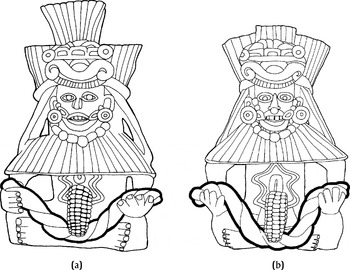
There are two urns in museum collections that illustrate genital bloodletting—one in the Ethnographic Museum, Berlin, and the other in the British Museum, London. Before examining these objects we must first clarify their authenticity. Mongne (1984:Plate 143, 1987:39) suggested that the urn in Berlin is a fake, based on what he considered to be a bizarre constellation of iconographic attributes. However, in 1992 the artifact was tested with TL and was proven to be authentic (Goedicke et al. Reference Goedicke, Henschel and Wagner1992:71, Test no. 117). The object in London is similar but not identical to the Berlin piece, and could constitute a recent copy. Fortunately, Sheridan Bowman (personal communication 2006) of the British Museum had this object tested with TL and the results confirm that it was also made in antiquity.
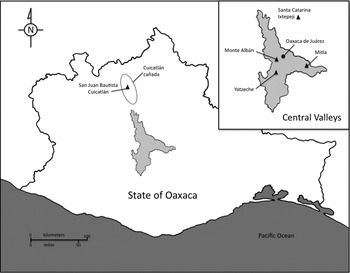
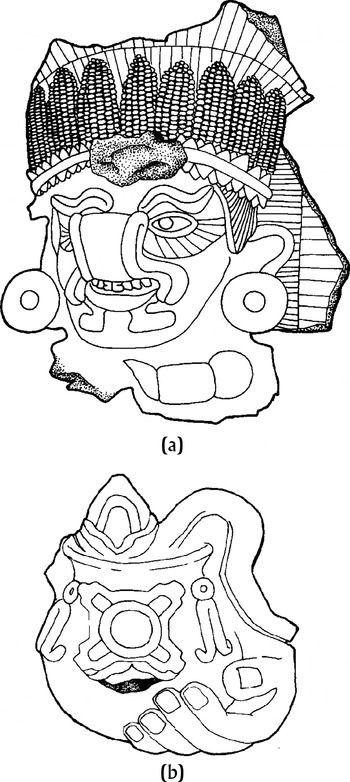
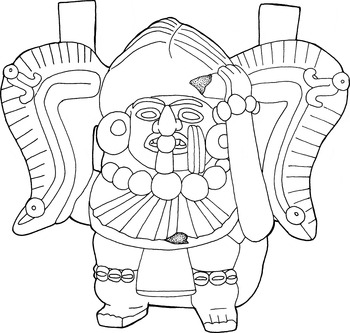
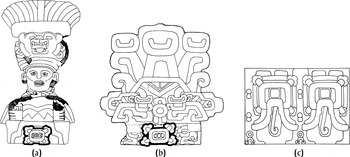
The urns are almost the same height—the London urn is 22 cm and the Berlin urn is 21.9 cm. The Berlin urn is missing part of its headdress so it may have been somewhat taller (Figure 1). Both objects were fabricated with light brown clay and had applications of yellow pigment. The figures are in a sitting position and in each hand hold the end of a twisted cord that passes through the tip of a press-molded corncob, emerging from a five-pointed plate positioned at the midriff. Both figures wear a conical hat with an appliqué in the form of glyph C attached to the front. Although the similarities between the two objects are striking, they are not identical, unlike many Zapotec urns that are produced in series (most commonly in groups of 2, 4, and 5). Furthermore, their provenance is different: the object in the British Museum reportedly comes from Cuicatlan, Oaxaca, but it is not clear if this means a particular archaeological site near the present day town of San Juan Bautista Cuicatlan, or the general region of the Cuicatlan cañada, an area just north of the central Oaxacan valleys (see Spencer Reference Spencer1982); and the Berlin object is from Yatzechi, a town in the southern arm of the central valleys of Oaxaca (Figure 2).
Ceramic effigy vessels showing bloodletting: (a) British Museum (Catalogue No. 1946/AM 19/6); (b) Ethnographic Museum, Berlin (Catalogue No. 28354). Drawings by the author.

Map of Oaxaca with some of the sites and areas mentioned in the text. Drawing by the author.

Caso and Bernal (Reference Caso and Bernal1952:99) were the first to comment on the Berlin urn. They did not illustrate the object but, rather, chose to make a reference to it in an earlier publication by Fuhrmann (1922:Plate 65). The scholars noted that the urn was unique and that the corncob-penis was a symbol for male fertility. They mentioned the five-pointed plate connected to the corncob and suggested that it may represent female genitalia. Their rather ambiguous observations led them to interpret the effigy as a maize god in a role that emphasizes fecundity and ancestry.
A decade later both of these pieces were published in a short article by Boos (Reference Boos1968), where he proposed they were linked to a unique maize fertility concept. Boos (Reference Boos1968:7) argued for a dual sexuality of the figure and boldly stated that the corncob was being inserted into a “vaginal opening” represented by the five-pointed plate displayed on the vessel, emphasizing the concept of human copulation.
Other scholars have commented on the iconography of these artifacts. Schuler-Schömig (Reference Schuler-Schömig1970:87–88, Plate 117) described the vessel in the Berlin Museum, asserting that the corncob was part of the figure's loincloth. She thought the twisted rope was a decorative element and noted that the corncob was tied to it. Schuler-Schömig was not in agreement with Boos' interpretation of the object, and proposed that the corncob, which she observed had been partly destroyed, symbolized the malignant side of the god of maize because the cob was allowed to deteriorate. Recently, Eubanks (Reference Eubanks1999:147–148) interpreted the corncob element as the “loincloth” of the person represented. Similarly, Deimel and Ruhnau (Reference Deimel, Ruhnau and Davis2000:18), suggested that the Berlin object represents Pitao Cozobi, the Zapotec maize god, because of the “cob of corn displayed on the front of his loincloth.”
An alternative to these views coincides with what is known about ancient Mesoamerican practices of bloodletting as described in accounts presented at the beginning of this article. This view was first put forth by Urcid (personal communication 1999) and then later by the present author (Sellen Reference Sellen2002:13). From our perspective the figure on the vessel is passing a rope through an incision in the penis, represented by the image of a corncob. The two urns are the only Zapotec artifacts this author knows of that explicitly show the bloodletting act. It is possible that an urn figure in the Museum für Völkerkunde in Vienna, Austria, is displaying the bloodletter's cord in the right hand, though there are other uses for cords in the Mesoamerican tradition (Figure 3a). Another effigy vessel in a private collection in California also shows this cord being grasped by the left hand (Figure 3b). The figure wears a Tlaloc mask and is seated with a turtle shell strapped to his back, signifying that this person had the role of a Xicani, a priest with the ability to perform supernatural feats and human sacrifice (Urcid Reference Urcid2001:Figure 4.108; Sellen Reference Sellen2007:Figure 4.8). Priests may have carried the bloodletter's cord as part of their accoutrements, and Maya nobility used these instruments extensively in their ritual life (Joralemon Reference Joralemon and Robertson1974:59; Schele and Miller Reference Schele and Miller1986:117; Stuart Reference Stuart1984:7).
Ceramic effigies with persons holding blood-letting cords: (a) Museum für Völkerkunde, Austria (Catalogue No. 274); (b) Anonymous Private Collection; (c) Gardiner Museum (Catalogue No. 83.1.126). Drawings by the author.

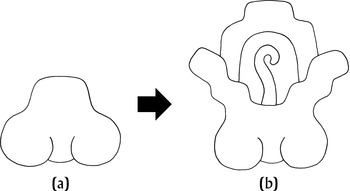
(a) Zapotec representation of a maize kernel; (b) The maize kernel germinated. Drawings by the author.

The cords represented in the Zapotec effigies I have presented are much shorter than the ones mentioned by Durán and Motolinia who allude to rope 20 to 30 m long—lengths that seem implausible considering their use. Perhaps these religious men were exaggerating the measurements, either to advance their proselytizing agenda, or because of their reliance on hyperbole, a standard tool of medieval literature. For these reasons a cautionary stance should be taken with this information. Nonetheless, the sixteenth-century sources all imply that the longer the length of cord passed through the penis incision the greater the penitence; the Spanish priest Fray Diego de Landa (Reference Landa1973 [1560]:49) wrote of Maya priests passing the longest length of cord possible. Representing a long cord in ceramic effigies would have been a visual challenge for an artisan, and for this reason I think much shorter lengths are rendered. For example, one of these cords can be easily identified in a Maya artifact (reportedly from Campeche) where a man holds a short piece of rope by both ends. We can clearly see the devastating effect the repeated passage of the cord had on his member, cleaving the head in two (Figure 3c).
In early written documents from Oaxaca there is a peculiar silence regarding the act of genital bloodletting, although many authors mention the taking of blood from the ears and tongue (Burgoa Reference Burgoa1989 [1674]:II:168, 230, 316; Asensio Reference Asensio and Acuna1984 [1580]:330–331). One account mentions genital bloodletting obliquely. In the sixteenth century Ximénez Ortíz told how the Zapotec inhabitants of Ixtepeji (now Santa Catarina Ixtepeji) (see Figure 2), offered blood to a large idol:
…y con vnas navajuelas agudas o perdernales se cortauan las orejas y narizes y las lenguas, y se las horadauan y pasauan por los agujeros muchos palillos y despuntandose las orejas y beços, y otros las partes secretas…. (Ximénez Ortíz Reference Ximénez Ortíz and Troncoso1905 [1579]:17)
In this context the “partes”—perforated by “sticks” (palillos)—are genitalia, and were often referred to as “secret parts” (las partes secretas), perhaps because the priests of this era avoided direct references to reproductive anatomy, or the “instrumentos de la generación” as they were called (see “partes,” Real Academia de Español Reference Española1963 [1737]:5:136). After the conquest this rite met with a quick demise because the Spanish associated it with idolatry and witchcraft (Klein Reference Klein and Carrasco2006), but in some places tongue and genital bloodletting continued. In a 1544 idolatry trial, Don Francisco, one of the Mixtec lords of Yanhuitlan, was accused by his Indian slave: “y que muchas bezes el d[ic]ho don franc[is]co se sacrifica por que no se le parezca en la lengua y sus partes deshonestas” (Archivo General de la Nación, Inquisición, Volume 37, File 5). Here the genitals are referred to using the term “deshonesta” rather than “secreta.”
BLOOD AND FERTILITY
The male member modeled after a corncob is a salient metaphor for fertility, underscoring the connection between agriculture, bloodletting and Mesoamerican world views regarding the dawn of man. This relationship is alluded to in a central Mexican myth describing Quetzalcoatl's descent into the underworld where he collected the bones of the dead from the Lord of the Underworld in order to create a new race of people. A female goddess, Cihuacohuatl, ground the bones as she would maize, and Quetzalcoatl sprinkled his penis blood over them to create the vassals of the gods, the people of the Fifth Sun (from the Codex Chimalpopoca [Feliciano Velázquez Reference Feliciano Velázquez1992:121]). A remarkable parallel is also found in the Popol Vuh, a Quiche Maya story of how life was formed. In this myth the present-day people were made from yellow and white maize meal (Tedlock Reference Tedlock1985:63–64). Visual evidence for the relationship between maize and blood is also available. On page 53 of the Codex Borgia a pair of male penitents pierce their members with bone awls, resulting in two streams of blood that irrigate animated depictions of maize (Anders et al. Reference Anders, Jansen and García1993). In this scene the original sacrifice of Quetzalcoatl is reenacted in an ongoing ritual inextricably tied to agricultural cycles. These mythical passages lay the foundation for a reciprocal arrangement of great antiquity, whereby blood feeds the maize and maize, in turn, feeds the people.
The powerful relationship between maize and blood persists today among indigenous groups in Mesoamerica and is well documented. Among the Zinacantecos the tortilla is often referred to as “our flesh and blood” (Furst Reference Furst1978:199). Sandstrom (Reference Sandstrom1991:247) took the Nahua saying sintli ne toeso, “corn is our blood,” as a metaphor to emphasize maize as a crucial, life-sustaining force responsible for creating the soul's energy or “heat” (tonali in Nahautl); without this food the souls loses energy—“cools”—and the person eventually dies. Monaghan (Reference Monaghan1995:217–218) has pointed out two important concepts among the Mixtec regarding maize and blood. First, blood is one of the principal seats of ánima, roughly translated as one's “spirit.” He notes that the tortilla is called “animao,” and concludes that maize is not only important to subsistence but also essential to being human. Second, the Mixtec equate blood with human seed (Monaghan Reference Monaghan1995:112). These ethnographic fragments are connected to the ancient belief that people were engendered from maize. The myths and ethnographies help us understand why people in antiquity sacrificed blood—a metaphor for seed—from the male reproductive organ. Blood can be seen as a substance that was a catalyst for fertility, because when sprinkled on seeds or burned with incense it had the power to create life; the act of drawing it from the penis was as important as the substance itself. In summary, agricultural themes were a singular preoccupation among the ancient Zapotec, as was the corresponding blood sacrifice that played a central role in this society's ritual activity.
The two urns analyzed are patent indicators of the relationship between maize and blood; however, the previous interpretations of their iconography obscured the central idea of bloodletting as a catalyst for fertility. We have long known that the study of Zapotec effigy vessels opens a window onto ancient life, but if we are to gain a deeper understanding in this regard, we must first resolve the meaning of the complex symbols and motifs displayed on these artifacts. The following iconographic study will demonstrate that the general narrative present in these vessels is overwhelmingly about maize, its growth cycle, and the associated forces of nature that influence its success as a plant.
ICONOGRAPHIC EVIDENCE FOR MAIZE ON ZAPOTEC URNS
The ancient Zapotec covered a variety of surfaces with the maize image, including tomb murals and stone monuments, but especially ceramic effigies. Maize can be rendered with either a high degree of realism or with an abstract form, and there is a diversity of different representations of maize on Zapotec urns (Boos Reference Boos1966; Caso and Bernal Reference Caso and Bernal1952; Eubanks Reference Eubanks1999; Mongne Reference Mongne1985; Sellen Reference Sellen2007; Shaplin Reference Shaplin1975; Urcid Reference Urcid2001). Maize represented in a realistic way is easy to identify, in particular because Zapotec artisans would press the clay directly on the cobs, create a mold, and then attach the ceramic positive to their creations. However, maize and related concepts were not always presented with this degree of realism, and the visual dictionary used by the artisans was complex. The wide range of renderings includes a glyphic form that was used in the Zapotec calendar (Urcid Reference Urcid2001:183, Figure 4.84), as well as parts of the maize plant at different stages of development. Perhaps as a result of this diversity of representation, contemporary readings of ancient Zapotec iconography have also been varied. A number of the forms that I would consider maize-related imagery have been interpreted as different types of plants, including flowers and cactus, while others have regarded these same symbols as constellations.
Although previous studies have covered a lot of ground, none of them comprehensively identifies the various parts of maize plants and other related maize concepts employed by the ancient Zapotec. One of my purposes here is to summarize these interpretations, put forth my own view, and discuss how these images have broader associations in Zapotec religion. My method of analyzing the ceramic effigy vessels involves documenting as many forms of one particular type as possible in order to compare the variation and range of design elements, and to understand how certain motifs were deployed in the context of the urns. By studying variation many clues are presented that can help us unlock the iconicity of specific forms.
THE MAIZE KERNEL GLYPH
In the iconography of the effigy vessels a glyph representing a maize kernel is present in a diversity of contexts. It has two principal forms: one is a trilobate shape with two ends that curl under the base (Figure 4a); the other is a variation of the former where the top part is split open to reveal a hooked element on an oval frame (Figure 4b).
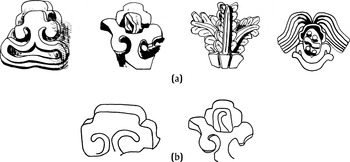
Caso and Bernal were the first to describe these glyphs from an object they excavated at Monte Alban, from mound Y.W., Number 8. It is a Cocijo figure seated on a pedestal with a backrest: “The back is decorated with flower motifs and in the central part there is another motif in the form of a hook, that is very similar to the central element of some pectoral plates of other urns” (1952:Figure 64, 46 [translation by author]). In their description the researchers did not make a connection between the shape they referred to as a “flower,” and the other similar motif displaying the element in the shape of a hook. Furthermore, they did not discuss why they thought the first motif represented a flower. Others, such as Boos and Shaplin, maintained that these glyphs were representations of maize (Figure 5). Boos (Reference Boos1966:67) presented a series of symbols and called them the “highly stylized representations of the stalk, leaves, and ears of the maize plant,” but he did not specify which one of these descriptions corresponded to the elements he illustrated. The position of Shaplin (Reference Shaplin1975:116) was more focused, and she interpreted the glyph in its closed form as “generalized and symmetrical foliage of corn,” and in its open form as the “maize shoot.” Although these treatments were very general, both Boos and Shaplin recognized that various representations of the maize plant exist in the effigy vessels.
Drawings of elements of maize presented by: (a) Boos (Reference Boos1966); and, (b) Shaplin (Reference Shaplin1975).

Building upon these last two proposals, I have suggested that this glyph shows maize in distinct moments of growth: the trilobate form represents the maize kernel, and the form that has spread open to reveal a hook, is the germinated seed (Sellen Reference Sellen2002:Figure 8). The hook shape possibly represents the shoot, composed of a coleoptile, or protective sheath that surrounds the new leaf that tends to curl upon emerging. The evidence for this position comes from the context of the effigy vessels, where the juxtaposition of various glyphs is organized as a sequential narrative that describes the ontogenesis of maize.
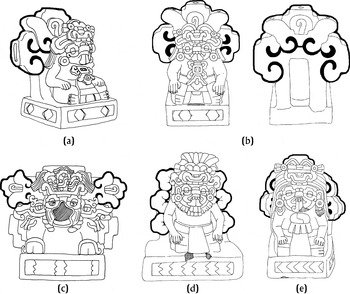
A type of urn that illustrates this narrative is that of the Zapotec deity for rain and lightning, Cocijo, seated on a pedestal with a backrest, reminiscent of a throne. The upper part of the throne is decorated with the kernel glyph that in some cases illustrates a transition from seed to germination (Figure 6a). For example, the object from the Royal Ontario Museum has two maize grains that are oriented towards the sides. The open kernel glyph is placed between these and shown at top of the throne's backrest (Figure 6b). The piece from the Ethnographic Museum in Sweden shows a feline lying on the pedestal. Although the front part of the face is broken, the figure can readily be identified as wearing a Cocijo mask judging from the distinctive trilobate plaques around the eyes. This artifact shows a slightly different variation on the theme, and rather than initiate the narrative with a maize kernel, it starts with the germinated stage and ends with a fully developed ear of maize at the top of the headdress (Figure 6c). From these objects it is possible to identify three elements that mark important steps in the life cycle of maize: the seed, the germinated seed, and the developed corncob.
Effigy vessels of the same type showing the maize kernel glyph: (a) Museo de las Culturas de Oaxaca (Catalogue No. 0679); (b) Royal Ontario Museum (front and back) (Catalogue No. 1936); (c) Ethnographic Museum, Sweden (Catalogue No. 23.8.307); (d) Smithsonian Institution (Catalogue No. 115002); (e) University of Pennsylvania Museum (Catalogue No. 29-41-707). Drawings by the author.

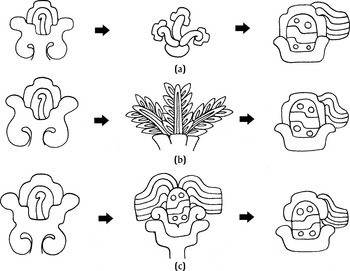
A slightly more complex composition occurs in the headdress of another type of urn figure. In these examples the face of Cocijo is the central element in a large and top-heavy headdress, although in one case the face is replaced by this deity's central Mexican homologue, Tlaloc (Sellen Reference Sellen2002:Figure 5). Flanking the emblematic faces are clusters of seeds and plants that represent maize at different stages of growth. When isolated and illustrated in a linear fashion the ontogenesis becomes more evident (Figure 7). The first stage is when the grain, swollen from moisture, germinates and breaks open to display a stem. The second stage shows the emerging plant, where the leaves unfurl in a spiral pattern so that no two occur opposite each other on the stem, a characteristic of the sub-class of angiosperms known as monocots (Looper Reference Looper1993:2, Figure 8). The icon for this stage varies greatly, and one example even shows an underdeveloped cob. The difficulty from the artist's point of view would have been how to illustrate this intermediate stage, given that the plant's structure does not change a great deal except in height. As we can observe a number of visual solutions were employed, resulting in different icons. The final stage is a fully developed ear of maize. At this point the mature cob shows some defining characteristics, such as the wavy lines and dots that cross it, as well as the inclusion of the maize's silk formed at the top. The identification in Zapotec iconography of the glyph for maize (fully developed) has been well established in the literature (Caso and Bernal Reference Caso and Bernal1952:20; Mongne Reference Mongne1985:II:Figure 58; Shaplin Reference Shaplin1975:113; Urcid Reference Urcid2001:178–184).
The ontogenesis of maize as displayed in the headdresses of three Zapotec effigy vessels: (a) Museo Dolores Olmedo (Catalogue No. 32); (b) Cleveland Museum of Art (Catalogue No. 44.78); (c) Museum für Völkerkunde, Austria (Catalogue No. 55.158). Drawings by the author.

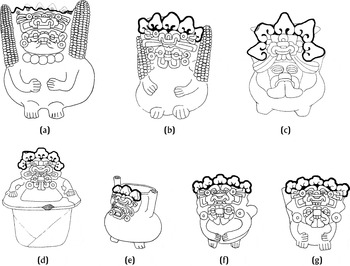
Representations of Cocijo and maize kernel glyphs: (a) Museo Nacional de Antropología (Catalogue No. 6-6708); (b) Frissell Museum (Catalogue No. 4279); (c) Monte Albán, grave VI-17; (d) Museo Nacional de Antropología (Catalogue No. 6-1546); (e-g) Royal Ontario Museum, (Catalogue Nos. 1452, 184, and 182, respectively). Drawings by the author.

Another context for the kernel glyph is arranged in a neat row above the glyph C in Cocijo's headdress. This characteristic, corresponding to the Xoo phase (a.d. 500–800) (Martínez López et al. Reference Martínez López, Winter, Markens and Lind2000:126), is typical of Cocijo heads that are molded in one piece and then pasted onto the sides of small globular vessels. In some cases these pots, usually between 9 and 12 cm tall, have parallel pouring tubes applied to each side. In six of the seven documented objects there are a series of five grains, while in one example there are three. In two objects the pour tubes are decorated with corncobs, strongly suggesting a function related to maize ritual (Figure 8).
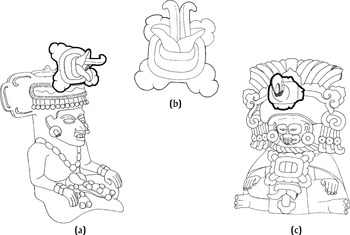
These same globular pots appear in the compositions of larger ceramic urns, held by figures that cradle them in both hands, as if they were offering them. The kernel glyph is inserted into the mouth of these vessels, accompanied by two curved leaf-like forms, decorated with what appears to be eyes that stream out from each side (Figure 9). Frequently, the type of figure that holds this vessel is wearing either a Cocijo mask or a mask with a curled up nose and pronounced marks over the eyes, however there are cases where there is no mask worn at all. Once again, there is a clear connection with maize in these figures. In the large effigy from the Amparo Museum in Puebla (124 cm tall), cobs of maize are placed in a row in the headdress. A similar urn is in the American Museum of Natural History (Figure 10), but all that is left is the head and the globular pot that was once held by both hands. As in the previous example, in the middle of the pot we can see the maize kernel glyph, but this time it is a germinated version, and the front of the pot is decorated with the milpa glyph (see next section). Some of the examples required reconstruction as the structure of the leaf-like elements and the kernel glyph is quite delicate and are often damaged or missing their constituent parts, complicating the identification of this particular cluster of elements (see Figure 9b–9d).
Offerings that illustrate the kernel glyph: (a) Standing effigy vessel holding a smaller globular pot, Amparo Museum (Catalogue No. 631), compared with globular pots from similar effigy vessels: (b) Southwest Museum (Catalogue No. 1763.G.1); (c) Saint Louis Museum of Art (Catalogue No. 380.1978); (d) Museo Nacional de Antropología (Catalogue No. 6-7891). Drawings by the author.
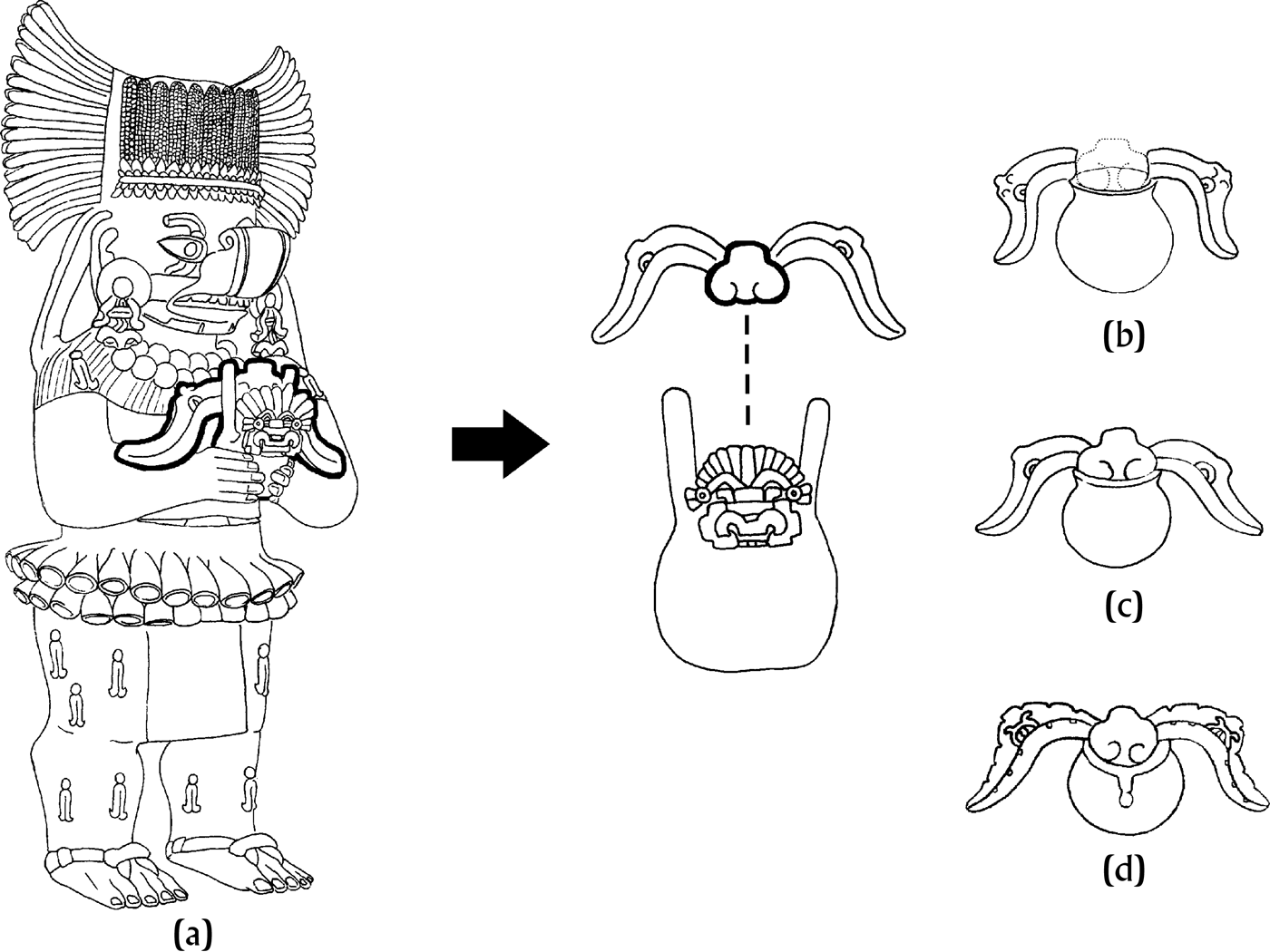
American Museum of Natural History (Catalogue Nos. 30.3/2301A and B). Fragments of same object; not to scale. Drawings by the author.

Lee Parsons (Reference Parsons1980:149) interpreted the leaf-like glyph as water, though he did not give specific reasons. Certainly there is some similarity between the “eyes” on these curved forms and the Reptile's eye glyph that is often found in many contexts in Zapotec art, such as its repetition in undulating waves that decorate the bases of some urns, carved stones, and also the sides of temples (cf. Sellen Reference Sellen2006; Urcid Reference Urcid2001:222). Therefore, considering these leaf-like forms as water, perhaps even as animated liquid, has some basis. A Zapotec effigy vessel that is now in the United Arab Emirate (UAE) lends supports to this theory. The object consists of a figure attached to a globular pot with two pouring spouts, and similar to the vessels already described, two leaf-like forms emerge from the mouth of the pot. (Unfortunately no dimensions are given for this particular piece but it is probably about the same size as those previously discussed) (Figure 11). We can see that the figure's left hand holds a fragment of a band that crossed over the forehead, while the right arm has completely broken off. One side of the face is crossed with a double vertical line, but originally the other side would also have had this feature, as it corresponds to the glyph P (Sellen Reference Sellen2007:Figure 4.51; Urcid Reference Urcid2001:Figure 4.101). There are a number of more complete Zapotec effigy vessels that show these same characteristics, and it is clear that they are carrying large vessels on their backs using tump lines (Sellen Reference Sellen2005:Figure 8). Given this context, the leaf-like forms on the UAE vessel could indeed be interpreted as water flowing from the vessel on the figure's back.
Effigy vessel for sale online by Barakat Gallery. Present location: United Arab Emirate. Drawing by the author.

The association of the kernel glyph with the small globular vessels, either in the headdresses of the stamped Cocijo faces or inserted into the mouth of a vessel which is held by urn figures, gives us a clue regarding the possible ritual use of these pots. Some may have been used as containers for the grain and in turn as votive offerings related to maize ritual, while others—especially those with spouts—probably contained liquid, either blood or water because both can be used as a fertilizing agent. Though water cannot be discounted, many accounts highlight blood as a preferred substance in a ritual context. In the Madrid Codex there is a series of four figures that are letting blood from their ears and dripping it over cacao seeds, which has been interpreted as an act of fertilization (Nájera 1987:71). In a variation of this ritual, the Pipiles, a Nahuatl speaking group from the coast of Guatemala and El Salvador, place seeds in jícaras and bury them next to altars. A large brazier is placed on top of these offerings and resins are deposited in the vessel. Four priests sacrifice blood from different parts of their bodies using sticks that are subsequently burnt with the resins in the brazier. After the ceremony the priests send word to the male members of the community to have sexual relations with their wives, so that they are charged with a fertilizing energy as a result of the sympathetic magic (Nájera 1987:71). If the small, globular Cocijo vessels found in many Zapotec burials did hold maize seeds, they may have been used in similar rituals.
In various cultures of Mesoamerica maize kernels have a multiplicity of uses beyond basic sustenance, including divining, counting, and curing (Messer Reference Messer and Long1996:318; Monaghan and Hamann Reference Monaghan and Hamann1998:131–132). Shortly after the Conquest, the Spanish friar Juan de Córdova (Reference Córdova1987a [1578]:387) reported on the use of different Zapotec divining techniques, one of them being the casting of maize kernels (sortear con maizes). In the seventeenth century, Don Diego, the informant of the Spanish inquisitor Gonzalo de Balsalobre, wrote of the practice of divination with maize (echar suertes con maizes) and mentioned that 13 grains were necessary for the ritual (Balsalobre 1892 [1656]:238). In a more contemporary perspective, Elsie Clews Parsons (Reference Parsons1936:315) cites three as being a significant number among the curanderos of Mitla, and in one form of divining the kernels are grouped into threes. Thirteen and three are common numbers in Mesoamerican ritual practice, but Alcina Franch (Reference Alcina Franch1993:77–81) pointed out that although there was variation in the number of objects utilized for divining in Zapotec culture at the end of the seventeenth century and beginning of the eighteenth, five was the norm. This is a significant number because it reflects the fourfold character of the universe and its center. According to Córdova (Reference Córdova1987b [1578]:202), the four Cocijo were responsible for all that happened on the earth. Thus evoking these deities by way of divination with five grains of maize, one for each corner and the center, would have been a logical action in ancient Zapotec society, and representing these seeds on the deity's headdress in the context of small globular pots, suggests a function that involved these elements.
Maize develops in many recognizable stages, and I have argued that these stages were arranged and juxtaposed on effigy vessels to create a simple narrative that marked the transition of this plant from the seed to the mature product. The maize plant in its different forms is also very closely associated with images of Cocijo—the deity for rain and storms—since the benevolence or malignance of this supernatural determined the success or failure of the crop by providing the correct climatic conditions for its growth, or by controlling plagues. This last point is well illustrated on pages 27 and 28 of the Codex Borgia, where the central Mexican rain god Tlaloc is shown presiding over cornfields that have been subjected to a variety of adverse conditions such as flooding, droughts, and pests (Anders et al. Reference Anders, Jansen and García1993).
THE MILPA GLYPH
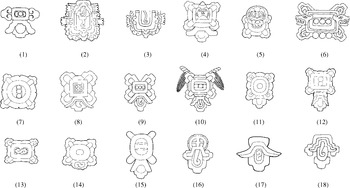
The maize kernel glyph as the germinated seed is repeated in another context in the iconography of many Zapotec effigy vessels, attached to a pectoral plate that hangs on a cord around the neck. This plate has a great deal of variation and is basically composed of two images (Figure 12). The first part of the image is a rectangular or circular plate that resembles a cartouche, and in the middle of this cartouche there are often a series of small dots, though this last element varies in design and sometimes the dots are replaced with simple ridges. Usually there are three dots, but these can range in number from one to three. The plate is often decorated on all four corners with small posts that are capped off with a trilobate shape. At the bottom of this rectangle or circle, the open kernel glyph is sometimes attached, with the curled stem pointing down.
Variation in the milpa glyph: (1) Museo Nacional de Antropología (Catalogue No. 6–6443); (2) Barbier-Mueller Collection, Barcelona, Spain (Catalogue No. 503–11); (3) Smithsonian Institution, Washington, DC (Catalogue No. 133.1980); (4) Museo Nacional de Antropología (Catalogue No. 6–596); (5) Frissell Museum, Mitla (Catalogue No. 1984); (6) Frissell Museum, Mitla (Catalogue No. 1825); (7) Kerr (Reference Kerr2011:Photo No. 6456); (8) Museum of Anthropology and Ethnography, Florence; (9) Museo Nacional de Antropología (Catalogue No. 6–33); (10) Museo Dolores Olmedo, Mexico City (Catalogue No. 32); (11) Saint Louis Art Museum, Catalogue No. 114.1980; (12) Museo Nacional de Antropología, Catalogue No. 6–630; (13) Sotheby's auction, New York, (1991, No. 194); (14) Sotheby's auction, New York (1998, No. 126); (15) Milwaukee Public Museum (Catalogue No. 50461); (16) American Museum of Natural History, New York (Catalogue No. 164/322767); (17) Guy Loudmer (auction catalog), Paris; (18) Smithsonian Institution, Washington, DC (Catalogue No. 115034). Drawings by the author.

Because this glyph is such a prominent element on Zapotec urns, many have attempted to decipher its iconicity and meaning. A very early, unpublished attempt was by the Oaxacan historian Martínez Gracida (Reference Martínez Gracida1910:I:55, 74, 76), who tended to rely on Nahuatl nomenclature for his interpretations. He called the glyph the “plaque of Olinemeztli,” and interpreted it as a very stylized “Nahui Ollin” (4 Movement), a Nahuatl calendrical sign. The dots within the cartouche were “stars or asteroids” and he referred to the open kernel glyph as the sign for “Acatl” (reed), which he believed symbolized fire. According to Martínez Gracida all these elements mentioned had a chronological value in the Zapotec calendar, although he did not specify how they functioned in this context. Caso and Bernal took a more descriptive approach to the pectoral plate. They pointed out that it frequently occurred on vessels associated with Cocijo, although they also emphasized that this context was not exclusive. The authors made no specific interpretation of this element as a whole, but they did recognize the dual nature of the composition, and suggested that what I have identified as the open kernel glyph represented a “stylized flower” (Caso and Bernal Reference Caso and Bernal1952:20). Shaplin (Reference Shaplin1975:174), in keeping with her other plant identifications, called the pectoral plaque a “stylized representation of corn.” Whittaker (Reference Whittaker1980:28, Figure 5) called it the glyph for “festival,” and Münch (Reference Münch1983:Figures 12 and 23) referred to it as “5 flower,” a rectangular representation of the earth and the four seasons. He maintained that the “flower” below represented the beginning of the year Cocijo, or the Fifth Sun. Mongne (Reference Mongne1985:I:169) proposed that the pectoral plate represented a maguey plant in flower. And finally, Winter and Peeler (Reference Winter, Peeler and Winter1994:92) argued that the three dots that frequently occur within the cartouche, could symbolize the constellation Orion.
The range of opinion regarding this glyph is diverse, and in general the studies have used little visual evidence to guide their attempts. Furthermore, few researchers have paid attention to the glyph's variability, and have preferred instead to use its most common form that comes from urns produced during the Xoo phase (a.d. 500–800). The exception being Mongne (Reference Mongne1985:II:Figures 95 and 96), who presented a detailed analysis of the pectoral plate, how it has changed through time, and employed eight examples to compare its variability. Although I am not in agreement with his interpretation, the method is sound. Analyzing the variability of the glyph can help us understand its iconicity and ultimately what it symbolizes.
To begin with, the variety of forms illustrated in Figure 12 demonstrates that the cartouche is not always accompanied by the open kernel glyph, and vice versa, the open kernel glyph will appear without the cartouche. For this reason Caso and Bernal's assessment that the image is often a dual composition is correct. The open kernel glyph's orientation on the pectoral plate—with the hooked element always pointing down—coincides with the same orientation as the glyph for maize (also known as glyph J) when it appears in the pectoral area (Figure 13). The reason behind this positioning is not clear, but it may be because this is the traditional way maize cobs are strung up to dry, or for that matter how they are strung on cords and hung around people's necks, as one can see in the example in Figure 13c. Analyzing the variability of the pectoral plates also allows us to critically assess Winter and Peeler's (1994) hypothesis that the three dots in the cartouche represent the three stars of the constellation of Orion. We can see from a quick comparison that this characteristic varies from one to three dots to none, thus undermining the central premise of their argument.
Effigy vessels with upside-down glyph for maize as pectoral plate: (a) Museo Nacional de Antropología (Catalogue No. 6-248); (b) Frissell Museum (Catalogue No. 1773); (c) Museo Dolores Olmedo (Catalogue No. 32). Drawings by the author.

Two pectoral plates shown in Figure 12 (numbers 2 and 3) differ from the other examples in terms of their baroque design. Despite the complexity of the images, I believe they show the same elements of maize on the sides of the plate. On the bottom of the plate we can clearly see the kernel glyph, and on the two sides this has opened up to display another form that has a crown-like top (Figure 14a). This last form is similar to early Olmec representations of maize, and although the Zapotec urns were produced considerably later, the image may have its roots from an earlier time, or be the result of a regional style (Figure 14b).
Comparison of maize in Mesoamerican art: (a) Roll-out of the design on the pectoral plate of effigy vessel in the Barbier-Mueller Collection (Catalogue No. 503-11); (b) Olmec representations of maize (Taube Reference Taube, Clark and Pye2000:299). Drawings by the author.

If we can identify the open kernel glyph in this composition, then what is represented by the other part of the combined image, namely the cartouche with the exterior posts and dots in the middle? I propose that this is a two-dimensional, abstract representation of a milpa. I have chosen to use a Spanish word to describe this glyph because English words are either too general or too determinative, for example “field” or “cornfield.” The milpa, from the Nahuatl milli, is a field used for agriculture that normally involves maize production, however today, as in ancient times, maize is grown together with other types of plants such as squash and beans. In his dictionary of Zapotec, Córdova (Reference Córdova1987a [1578]:207) indicates that this was a practice during colonial times when he translates the words pizàaèla and pizàayèla as large beans grown between the maize. Therefore, the word milpa reflects land subject to a multiplicity of agricultural uses. I am inclined to use a Zapotec word to designate the glyph but then one would have to choose out of many language variations. In the sixteenth century the Zapotec used quèela, quiñàa and yòo to refer to land (Córdova Reference Córdova1987a [1578]:375). Generally, quèela refers to a field that has been seeded and irrigated, whereas quiñàa appears to be considered barren land, synonymous with yòo, which simply means earth. The word quèela for milpa appears in modified form in present-day Zapotec: in the Zapotec of Juarez it is yela (Nellis and Goodner de Nellis Reference Nellis and Nellis1983:301), while in San Bartolome Zoogocho it is yel (Long and Cruz Reference Long and Cruz1999:369). Conversely, the Zapotec of Tehuantepec use the word ñaa for the milpa (Pickett Reference Pickett1971:43), which suggests that quèela and quiñàa may have been very similar concepts.
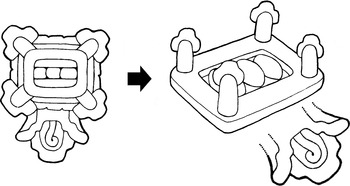
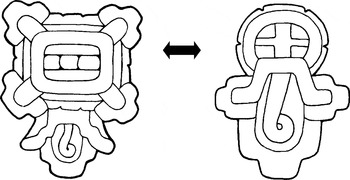
If one were to consider the pectoral plate rendered in three dimensions, the plate could represent the flat surface of the earth with four corners, and in each corner there is a maize plant (Figure 15). These posts are often topped with the same trilobate design found on the more fully developed ears of maize seen earlier (Figure 7). Furthermore, in some cases the ends of the posts are curled (Figure 12, numbers 6 and 13), much like the hooked stem that emerges from the open kernel glyph, and this helps identify the posts as maize plants. In other cases the cartouche is decorated with the kernel glyph (Figure 12, numbers 2 and 3), rather than showing the posts. Identifying the design that lies within the cartouche is difficult because of its abstraction and great variability. However, given the context, in the many cases the dots appear to be generic representations of seeds. The milpa interpretation also leads to interpreting the instances of grooves and ridges within the cartouche as furrows caused by planting (Figure 12, number 15). Finally, the open kernel glyph attaches to the bottom of the milpa, symbolizing its potential for germination and fertility.
Conversion of the pectoral plate from a two-dimensional form to three dimensions. Drawings by the author.

I have converted the pectoral plate to three dimensions to visualize it better, and remarkably there is one case where the Zapotec artisans also presented it in a similar fashion. The glyph can be seen in the headdress of an excavated urn from the early Pitao period (a.d. 200–350) (Winter Reference Winter1994:62). Caso and Bernal (Reference Caso and Bernal1952:153–154) called this the Transition period and identified urns with large “lampshade”-style headdresses as characteristic of this time. We can see that the open kernel glyph has two hooked shoots springing forth from the center of a plate decorated with four trilobate corners (Figure 16a). One of these shoots is reconstructed in the drawing because it had broken off, and the plate is rotated 90° to more clearly see the similarity (Figure 16b). Another urn from the Pitao period may have had this same design in the headdress (Figure 16c), but unfortunately most of the details, such as the centerpiece and the four posts on the corners, are damaged. Mongne (Reference Mongne2000:60–61, Figure 17) placed the authenticity of this piece in doubt, citing formal and aesthetic characteristics not previously observed in Zapotec urns. I inspected this object carefully when it was still in the Frissell Museum, however, and in my opinion it shows many characteristics of antiquity, including the paste, the manufacturing technique, the presence of root imprints on the surface, and the iconographic congruency of all the elements.
Effigy vessels that show the milpa glyph in the headdress: (a) Museo de las Culturas de Oaxaca, Tomb 14, Monte Alban; (b) Hypothetical reconstruction of milpa glyph from previous artifact; (c) Frissell Museum (Catalogue No. 1786). Drawings by the author.

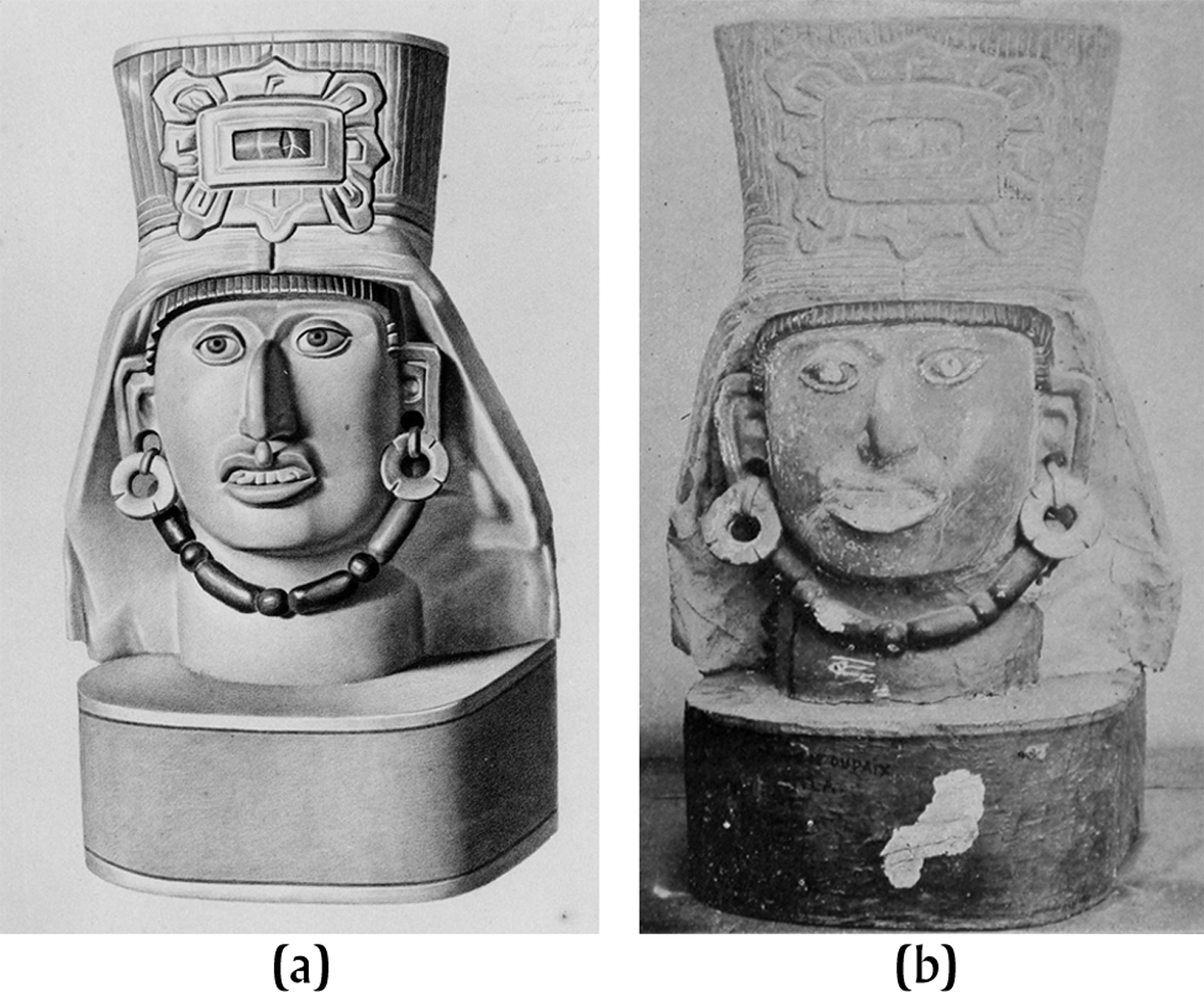
Ceramic or plaster bust from the Dupaix expedition: (a) Drawing by Maximiliano Franck (1827). Photograph courtesy of the British Museum, London; (b) Photograph from Mexico's National Museum, ca. 1900 (Galindo y Villa Reference Galindo y Villa1905:Plate 26).

Another object from Zapotec culture illustrates the milpa glyph in the headdress. The unusual piece comes from the collection of the Austrian explorer Guillaume Dupaix and was acquired during one of his trips to Oaxaca, either in 1806 or in 1807–1808, although in his travel narrative he does not mention the exact location or date of the find. A German illustrator by the name of Maximiliano Franck drew it in 1827. (Today these drawings are held in the library of the Department of Anthropology in the British Museum, London.) At the bottom of his drawing he wrote that the object was in the National Museum in Mexico City. The artifact surfaced again in a publication from the Museo Nacional in 1901, and the heading stated: “Objects in the Mixtec-Zapotec collections of the National Museum of Mexico (Dupaix expedition)” (Galindo y Villa Reference Galindo y Villa1905:Plate 26) (Figure 17a and 17b). It is difficult to judge the authenticity of the object from a photograph, however it is unlikely that fakes were being produced during the years of Dupaix's expeditions given that there was little interest in pre-Hispanic antiquities before his legacy began to be published in the 1830s. Based on this information, I would consider the artifact authentic, or perhaps a faithful plaster copy of a genuine artifact. If either scenario can be proved beyond a doubt, then we have yet another example of a Zapotec urn that displays the milpa glyph in the headdress.
Further evidence that this form represents the idea of a milpa is that it can be substituted by a glyph of a similar meaning. This can be attested in the case of one effigy vessel where the milpa glyph in the form of a pectoral plate is replaced by the glyph E (Figure 18). Urcid (Reference Urcid2001:139, 170, Figure 4.76) has established that the glyph E, a design generally consisting of a cross with a dot in the center or simply five points, represents the quadripartite division of the world. The glyph E has a calendrical value, functioning as a day sign and also as a year bearer in the Zapotec calendar, and Urcid demonstrated its association with word Xoo in Zapotec, meaning “powerful,” “force,” “earthquake.” This interpretation is reinforced by close semantic and iconographic associations to its glyphic counterpart among the highland cultures of Mexico, known as Ollin, “movement-earthquake” in Nahuatl. There are many cases, however, where the glyph E is displayed in contexts without associated coefficients, suggesting that it may have a multiplicity of meanings. In the case of the pectoral plate mentioned above, it would appear that the milpa glyph and glyph E can substitute each other because they both represent the same general idea, namely the four-part division of the earth.
Substitution of the milpa glyph for the glyph E. Drawings by the author.

The configuration of the earth in four parts and five parts (including the center) constitutes a basic conceptual map of the cosmos that was deeply held by the peoples of Mesoamerica. Even today the milpa is considered a microcosm of that same scheme and constantly used as a stage for agricultural ritual. For example, over half a century ago in San Bartolo Loxicha, Oaxaca, a blessing of the milpa required that a turkey be sacrificed in the center, burying the animal's blood in a hole in the ground. During the ritual killing a prayer was spoken to evoke four of the principal deities, the King of the Earth, the Creator of the Earth, the Creator of Rain, and the Santísima Trinidad (Carrasco Reference Carrasco and Bernal1951:95). Similarly, in Mitla, Oaxaca, farmers would bury a live chicken in the center of a recently cleared field to insure abundant crops (Parsons Reference Parsons1936:301). In order to avoid the milpa drying up, the highland Mazatecs of Huautla, bury five offerings, one in the center and four in the corners of the field, while the lowland Mazatecs from the towns of Jalapa, Ichcatlan and Soyaltepec, place four witnesses in the milpa the night before seeding (Weitlaner Reference Weitlaner1961:Table 16). The indigenous conception of the earth is reflected in their rituals held in the milpa, and thus it is not surprising that their forbearers created a specific representation of this important agricultural area.
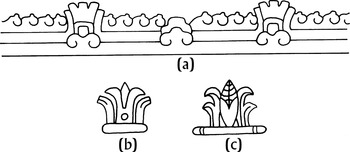
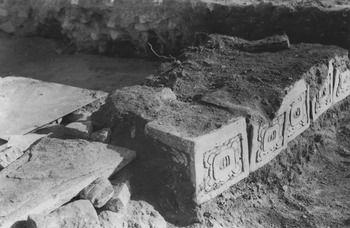
If the interpretation of this glyph as a representation of a milpa is correct, does it have the same meaning when it is found in contexts other than urns? The glyph can be seen adorning the sides of ceramic boxes and, in one case, five of these boxes were discovered placed in a row in the patio above Tomb 103, Monte Alban (Figure 19). It is possible that these boxes were meant to be used in an agricultural rite that required the number five, four in the corners and one in the center, reflecting once again the sacred division of the cosmos. Another example of this symbol can be found on the pedestal base of an urn (Figure 20a), within the frame of the glyphic convention identified as “mountain” or “hill” that functions as a place name or toponym. This placement makes sense because in the highland cultures of Mexico some prominent place names include the word for milpa, and a well-known example is Xochimilco, “the place of the field of flowers” (Siméon Reference Siméon1992 [1885]:773). A similar arrangement can be seen on a ceramic plaque from Monte Alban that has the glyphic name 3U set upon a toponym which is composed of the milpa glyph with two bird heads attached to either side (Figure 20b). (We do not yet know how to read this place name in Zapotec.) Finally, the milpa glyph is carved in relief on a large, open-ended, ceramic cylinder (Figure 20c). In this case the glyph is associated with water signs in the shape of “hairpins” that appear to be falling around it, strongly suggesting a relationship between rainfall and the maize field. As with other Zapotec glyphs, it would appear that the symbol for milpa acquires nuanced meanings according to its context.
Five ceramic boxes carved in relief, in situ in the patio of the residence above Tomb 103, Monte Alban. Photo courtesy of the Instituto Nacional de Antropología e Historia.

The milpa glyph in different contexts: (a) Museo Frissell (Catalogue No. 12641); (b) Museo de Sitio, Monte Alban (Catalogue No. 10-604186), drawings by the author. (c) Museo Nacional de Antropología (Catalogue No. 6-2123), drawing by Javier Urcid.

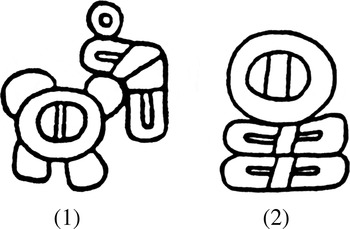
It is also possible that the milpa glyph had a calendrical form. Urcid (Reference Urcid2001:Figure 238, Numbers 1 and 2) documented two calendrical glyphs that he designated Zeta (Figure 21). Both signs consist of a rounded cartouche divided in half by a vertical band. Caso (Reference Caso1928:Figure 8, Number XIV), classified the first of these as the glyph E, but as an alternative Urcid suggested that both forms may be a variant of the “knot” glyph. These glyphs may represent the milpa, especially the example shown in number 1 that has four posts adorning the cartouche. Since I have established that the milpa glyph can be substituted by the glyph E, then it follows that the glyph Zeta could also substitute glyph E in a calendrical context, and a way to prove this beyond a doubt would be to find the glyph Zeta functioning as a year bearer.
The glyph Zeta. Drawing by Javier Urcid.

Zapotec artisans, working with a few core concepts, created a complex tapestry of images, and if my reading of their iconography is correct, they focused a large part of their effort elaborating on the concept of maize and the elements necessary to produce it in abundance. The maize plant is represented as a seed, as a germinated seed, as the emerging plant, and as the fully developed cob. The milpa also is represented, which is a logical extension of the previous ideas. Furthermore much of this maize imagery, such as the kernel glyphs, is strongly associated with Cocijo, the deity for rain and lightning. In addition, some urns with Cocijo masks also bear the blood glyph, an aspect I explore next.
THE BLOOD GLYPH
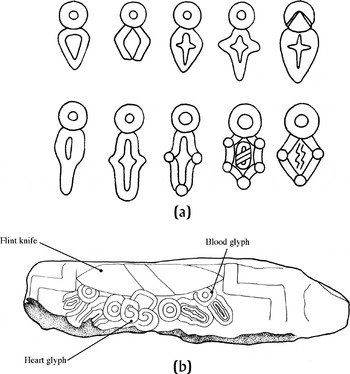
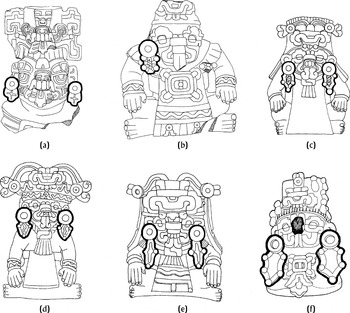
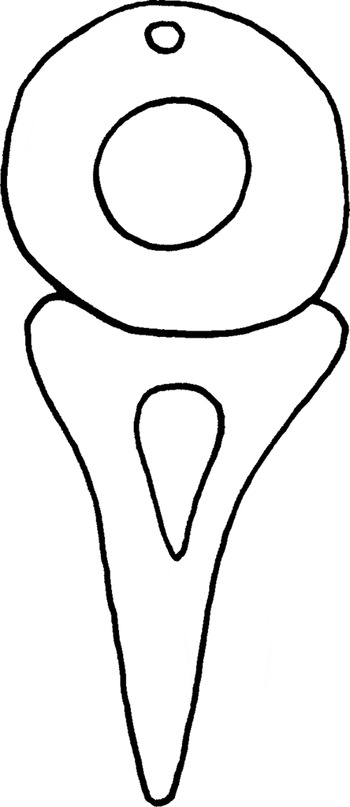
This glyph was first identified by Marcus (Reference Marcus1974) as the representation of a drop of blood, and later on Urcid (Reference Urcid2001:230–231) elaborated on its context. The shape of the glyph has a great deal of variation, but its general form is that of a circle with an elongated triangular element hanging below it that sometimes resembles a cross (Figure 22a). In certain contexts the interpretation as a drop of blood is obvious. For example, on a fragment of carved stone from Las Tejas Morelos, Ocotlan, Oaxaca, the blood glyph is associated with a sacrificial knife and the trilobate representation of a heart, framed within a stepped mountain sign. In this toponymic reference the blood appears to drip from both the knife and the heart (Figure 22b). The glyph has a calendrical form which Urcid designated “Epsilon,” and to date only two examples have been attested. In its non-calendrical contexts the glyph appears associated with the mouths of different animals, including bats, jaguars, birds, and alligators (Urcid Reference Urcid2001:230). One context Urcid did not mention is its placement on the ears of urn figures. Most of the examples I have been able to document are Cocijo urns, but the glyph is by no means exclusive to this type (Figure 23). When the glyph is in this context the circle that constitutes part of the symbol integrates with the ear spool worn by the effigy figures. Moreover, in two examples (Figure 23 b and 23c), there is a bar representing the coefficient “5” inside each of the elongated shapes that hang down from the ear spool, perhaps indicating a calendrical value.
The blood glyph compared: (a) Variations from effigy vessels; (b) Toponym carved in relief on a stone from Tejas de Morelos, Ocotlan, Oaxaca. Drawings by the author.

Effigy vessels showing the blood glyph on ear spools: (a) Royal Ontario Museum, Toronto (Catalogue No. 1945); (b) Museum of Anthropology and Ethnography, Florence; (c) Frissell Museum, Mitla; (d) Field Museum, Chicago (Catalogue No. 241092); (e) Peabody Museum, Harvard (Catalogue No. 172720); (f) von Winning and Stendahl (Reference von Winning and Stendahl1968:Figure 237). Drawings by the author.

Why does the glyph for blood appear in this context? A common place for bloodletting was behind the ear. Father Burgoa mentions this several times in his Geographical Description:
…hallaron sobre el nefando altar, de que les servía el risco, todas las víctimas de la ofrenda, muchas plumas de varios colores salpicadas de sangre, que se habían sacado debajo de la lengua, y detrás de las orejas… (Burgoa Reference Burgoa1989 [1674]:II:230)…y sangran a la criatura de una vena que tenemos detrás de las orejas, o debajo de la lengua, con un instrumento de perdenal, hueso o la uña para que se dejan crecer la del índice, con deformidad muy aguda…. (Burgoa Reference Burgoa1989 [1674]:II:316)
Furthermore, there is archaeological evidence that this glyph may actually have been used as an earring. Drennan (Reference Drennan1976:229, Figure 78d) reported a large shell ornament (approximately 4.5 cm long) with the same shape as the Epsilon glyph from the site of Fábrica San José. Urcid (Reference Urcid2001:230, Figure 4.137, Number 6) surmised that since this shape is perforated in the upper part of the circular portion, that it might have been hung as a pendant or an earring (Figure 24). Thus the glyph's repeated association with Cocijo may have been due to bloodletting rituals related to cultivation.
Shell pendent in the form of the blood glyph. Drawing by Javier Urcid.

The motifs that can be found on Zapotec urns cover a wide range of themes, but the ontogenesis of maize and bloodletting are central concepts, perhaps because the agricultural peoples of Mesoamerica needed to sacrifice at the deepest level in order to reap the life-giving bread of the earth. Woven into this scheme are the ancestors who mediate the relationship between human beings and the gods, as bloodletting was an act connected with the evocation of ancestors (Boone Reference Boone1984; Schele and Miller Reference Schele and Miller1986). For example, the Mixtec leaders of Yanhuitlan offered human blood and also directed the rituals that involved ancestors when adverse conditions threatened the community (Sepúlveda y Herrera Reference Sepúlveda y Herrera1999). In times of crises—such as drought or plague—Mixtec leaders would employ mortuary bundles with calendrical names that referred to those deified ancestors (Pohl Reference Pohl, Smith and Masson2000). This particular relationship between humans and gods is well described by Monaghan (Reference Monaghan1995). He argues that the ancestors of the present day Mixtec people establish a pact—which he calls the “covenant”—with the deities of the earth, sky, and rain in order to practice agriculture; thus humans are bound to reciprocate, and carry out the required sacrifice to honor their promise. Further to this idea in the context of antiquity, Joyce (Reference Joyce, Dobres and Robb2000:74) has proposed that the ancient Zapotec evoked this pact each time they offered blood or sacrificed a human being.
Zapotec urns, and other smaller and related effigy vessels, may have been used in blood sacrifice rituals, involving either human or animal blood, and in this sense these vessels served as a medium through which mortals communicated with the netherworld, via idealized representations of their ancestors. This contact was activated through bloodletting, either by presenting one's own vital liquid, or the common substitute of animal blood. The blood from humans and animals was not the same in terms of its value in ritual acts, human clearly being more potent. Nonetheless, animal blood may have been substituted for human when the latter was not available. Although the evidence is scant, there are some clues that blood sacrifice was carried out with the urns. A few urns have been found containing the remains of animal bones, and in particular birds. Some of this evidence comes from early collectors of Zapotec urns who excavated sites with little regard for their context (Rickards Reference Rickards1938:149; Sologuren Reference Sologuren1907:Numbers 241, 515, and 568). However, one case was documented in a controlled archaeological context (Figure 6a) (Caso et al. Reference Caso, Bernal and Acosta1967:127), and a small number of urns found in caches have contained obsidian blades, beads, shells and greenstone figurines (Caso and Bernal Reference Caso and Bernal1952:10). As Marcus and Flannery (Reference Marcus, Flannery, Renfrew and Zubrow1994:61) have pointed out, the blades and the skeletal remains of animals regarded as appropriate for sacrifice, such as birds, are both residues that can indicate a bloodletting ritual. In colonial times animal blood was also used in agricultural ritual. The Spanish inquisitor, Gonzalo de Balsalobre (Reference Balsalobre1900 [1656]:238), recorded that when collecting the first ears of green maize from fields, the Zapotec would sacrifice a black hen, sprinkling its blood over thirteen pieces of copal and over in the patio of the house. Centuries earlier this same rite may have involved sacrificing a bird and placing its blood and decapitated body inside the recipient part of an urn. This would explain why bird bones and obsidian blades are found in some vessels. It is equally possible then that human blood was also deposited, directly or by way of another type of material such as paper, reed, or cord. By carrying out these blood sacrifices the ancients were evoking their ancestors and activating the sacred pact.
The millenary cultures that developed maize into the versatile food that we know today frequently represented it in their myths and artistic expression as a pillar of humankind and precursor to civilization. From the early Formative societies, the role of maize was much more than a staple food, as Taube (Reference Taube, Clark and Pye2000:328) said, “it constituted a model of their world, serving as a symbol of the four corners or directions as well as the central axis mundi, a conduit of divine power.” The iconographic representations of maize and blood found on Zapotec urns agree with that statement, and like other Mesoamerican cultures, show us how important these basic elements were in reaffirming their humanity.
RESUMEN
Las culturas milenarias que desarrollaron el maíz hasta lograr el alimento versátil que conocemos hoy en día, con frecuencia lo representaban en sus mitos y expresiones artísticas como el pilar de la raza humana y precursor de la civilización. Por tanto no es de sorprender que gran parte de la iconografía expuesta en las vasijas efigie zapotecas se concentra en representaciones del maíz y otros motivos asociados. De igual manera existen evidencias, a partir de vasijas y fuentes etnográficas, de que los zapotecas ofrecían sangre animal y humana en los rituales relacionados con el maíz, una práctica ampliamente documentada en otras comunidades mesoamericanas del pasado y del presente.
Este trabajo examina cómo el maíz y la sangre fueron elementos centrales en las prácticas religiosas zapotecas de la antigüedad y cómo estos estaban ligados conceptualmente entre sí. En este estudio identifico y comparo los componentes de plantas de maíz y otros conceptos agrícolas relacionados, en la iconografía de distintos tipos de vasijas cerámicas que provienen del periodo clásico. Con el empleo de fuentes coloniales y estudios etnográficos mi propósito es ubicar los elementos en contexto: sugiero que el tema principal de las representaciones antiguas era el ciclo de vida de la planta de maíz, que se sostuvo a través de un pacto sagrado entre dioses y humanos, lo cual aseguró un ciclo de abundante y continuo crecimiento de esta importante planta. El lazo de unión entre los seres sagrados y los seres humanos era la sangre, el líquido detonador de la fertilidad, que se vio necesario derramar para poder asegurar la continuación de la vida.
Si bien los estudios previos han cubierto gran parte del terreno en cuanto a la identificación e interpretación de la iconografía zapoteca, muchas teorías no han sido puestas a prueba y permanecen sin discutir. En consecuencia, uno de mis propósitos aquí es resumir estas interpretaciones, presentar mi punto de vista y discutir cómo estas imágenes tienen asociaciones mucho más amplias en la religión zapoteca. El material visual que usaré para este estudio procede de las vasijas efigie de cerámica, debido a que son bastante ricas en contenido iconográfico. El método que utilizo para analizar este material requirió la documentación de tantas formas de varios tipos como fuera posible, para poder comparar la variación y el rango de diseño en los objetos.
ACKNOWLEDEGMENTS
The research for this article was made possible by a grant from the Royal Ontario Museum's Maya Research Fund, generously endowed by Andrew Stewart. I thank Javier Urcid, Ron van Meer, Rex Koontz, and Byron Hamman for their comments and helpful suggestions for improving this work. In particular I appreciate Byron's sharing of archival information from the Archivo General de la Nación. I am grateful to Sheridan Bowman of the Department of Conservation, Documentation and Science, British Museum, for permission to quote the unpublished result of the thermoluminescence authenticity test carried out on the effigy vessel in Figure 1a (catalogue number 1946/AM 19/6). Finally, I would like to dedicate this article to the memory of the late Thomas Smith-Stark, whose friendship, guidance, and lasting contribution to Zapotec studies will be truly missed.