Introduction
In 1939, the holiday camp entrepreneur Billy Butlin was negotiating to buy land on a coastal site on the Llŷn Peninsula in north west Wales.Footnote 1 When war broke out the Admiralty commissioned him to develop the site as a training camp but, under the terms of a secret deal, it would be transferred to him at the end of the war. The camp occupied a highly controversial place, in Welsh affairs and beyond, for several years and the story of its passage from military to commerce illustrates the politics both of town and country planning and of rurality in Wales in the mid-twentieth century. For its supporters, Butlin's holiday camp represented not only an expansion of holidaying opportunities in a brave new post-war world, but also an injection of money into a marginal, rural area. For its opponents, the camp transgressed a series of moral geographies. Defenders of coastal nature foresaw mass leisure breaking out of its urbanised bounds; advocates for Welsh rural culture feared alien activities and influences; and Welsh nation-builders opposed the transfer of Welsh land to a private concern and the British state. Moral geographies were, therefore, being mapped out and transgressed at various spatial scales, ranging from the body of the individual leisure-seeker to the Welsh nation and the British state. The Battle of Butlin's, as the case came to be known, tells us much about the relationship between landscape, conduct, social order and national identity in the middle of the twentieth century.
Chaos at the coast
The coast has long generated fascination and anxiety. Alain Corbin notes that the lure of the coast was not a spontaneous development but that constructions of space and forms of sociability developed and then spread.Footnote 2 He also notes that the sexual element in these forms of sociability was the subject of moral concern. James Walvin develops a sense of the coast and its resorts as a ‘social vacuum’ where, as early as the Victorian period, rigid social norms, such as inhibition about the unclothed body, were left behind.Footnote 3 For Rob Shields the seaside resort is a liminal space, between sea and land, and metaphorically on the edge of accepted modes of behaviour.Footnote 4 Here ‘normal’ behaviour is suspended and a form of ‘carnivalesque’, with its attendant celebration of the body, can come into being.Footnote 5
The rapidly increasing scale of the holiday habit in the twentieth century highlighted explicit ideas of social class in debates on the coast.Footnote 6 In the mid 1920s, Walvin notes, only around sixteen per cent of the wage-earning labour force enjoyed holidays with pay,Footnote 7 but by 1937 around forty per cent of the population spent at least a week's holiday away from home, and this figure was expected to double with the passing of the 1938 Holidays Act.Footnote 8 Embedded into this massive increase in scale was a culture that Walvin typifies as ‘an earthy vulgarity’.Footnote 9 This fascinated the intelligentsia, typified by the ethnographic organisation Mass-Observation's study of the holiday habits of the residents of Worktown (Bolton) at Blackpool.Footnote 10 Such investigations revealed a desire that leisure should be ‘improving’ but a fear that mass leisure was, in fact, corrupting: ‘Worktown investigators were often repulsed by what they saw as the tacky commercialism of Blackpool. For them, Blackpool was a symbol of the modernist primitivism of the passive working class’.Footnote 11 The philosopher and countryside campaigner C. E. M. Joad ferociously attacked the way in which, for the masses, the seaside resort incomprehensibly ‘embodies and exhausts their conception of the good life’.Footnote 12 But far worse was the spread of the mass holidaying habit across previously ‘unspoilt’ coastline:
Let us suppose that after a long search you have found a place which seems to you fairly solitary. There are no pier, parade, shops, or hotels; but there is a small inn at which you can stay overlooking the sea. You arrive there, we will suppose, late in the evening. Not a soul is to be seen and you go to bed congratulating yourself on having at last found solitude by the sea. The impression persists during breakfast; by ten o'clock at latest it is shattered. The place, it turns out, is approached by road. . .and this road is your undoing. For presently the cars begin to arrive and from ten to six the place, being a cul-de-sac, is an inferno of petrol fumes and throbbing engines. The cars decant their contents of whining children, nagging mothers and bored fathers.Footnote 13
By the 1930s, many were concerned at the prospect of continuous sprawl and urbanisation along the coast.Footnote 14 North Wales – close to the conurbations of North West England – was under particular pressure and entrepreneurial landowners exploited this. When a census in August 1934 listed 2340 ‘casual’ tents and caravans in their district the Rhyl Urban District Council promoted a private Bill allowing them to regulate the use of land for camping.Footnote 15 The Public Health Act of 1936 granted limited powers to all local authorities but the laws were weak and often flouted. In 1937, one North Wales resident complained to the Ministry of Health that ‘“squatter” camps of huge dimensions have sprung up along this Coast until . . . there are at least fifty thousand men, women and children “squatting” along the main road within a coast line of two miles’.Footnote 16 Many built for themselves in the makeshift world of the plotlands, but whilst these huts, shacks and cabins were a democratic response to general demands for leisure, for some they ‘epitomized brashness and disorder, in sharp contrast to established standards of integration and order’.Footnote 17 The Council for the Preservation of Rural Wales reported in 1939 that Anglesey was in danger of being ruined, Meirionydd was ‘being gradually disfigured by haphazardly planned bungalows’, and the Llŷn coastline was ‘in danger from sporadic bungalow development: bungalows dotted all over the place’.Footnote 18 These concerns, moreover, were being heightened by government moves towards the extension of ‘holiday with pay’ rights.
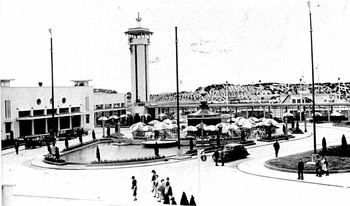
In a 1944 report for the Ministry of Town and Country Planning, the naturalist and physical geographer Alfred Steers noted that unspoilt areas of cliff, dune, marsh and estuary remained, many of them in Wales. However, most of his report detailed scenic degradation: ‘In many places the ugly and misplaced huts and shacks that sprang up between the two world wars are almost worse than the industrial areas . . . In North Wales travellers along the Holyhead railway will be familiar with the extensive and unsightly spread of shacks between Point of Ayr and Prestatyn’.Footnote 19 Like so many inter-war commentators, Steers located the problem in a lack of planning, leading to ‘uncontrolled and disorderly overgrowth’.Footnote 20 But he insisted that these huts, caravans and converted buses represented a desire for the open-air that must be satisfied and in this he echoed a desire amongst the more progressive planners to understand what it was that drove people to country and coast. Whilst many focused on education, aesthetic and moral, as a palliative,Footnote 21 one potential solution to the problem of scenic disorder was the holiday camp. It offered permanence as opposed to the ‘sporadic’ nature of casual campgrounds, and total design and management. Holiday camps had their origins in the tented structures run by families or institutions like the Trades Unions, but commercial initiative meant that by 1937 there were over one hundred camps in Britain accommodating half a million people annually.Footnote 22 For politicians, these camps could help ensure that those granted holidays with pay could actually be accommodated,Footnote 23 but aesthetically they also offered a solution to the threat of sprawl on the coast. Dudley Stamp noted that he ‘would rather see five thousand in a camp than those five thousand spread around in two thousand bungalows each with a quarter of a mile of coast’.Footnote 24 The Minister of Town and Country Planning, W. S. Morrison spoke more positively of ‘an enriching creation of architectural amenities, if we make the right choice of places, lay out the new buildings in compact and well-planned arrangements, and design them in suitable and harmonious forms’.Footnote 25 Although noting that some earlier examples had been ‘squalid and disordered in the extreme’, the Government committee on land utilisation in rural areas chaired by Lord Justice Scott eventually viewed the development of commercial holiday camps favourably when its report was published in 1942.Footnote 26 Significant professional interest was generated in the design and layout of camps.Footnote 27 When the designs for the Prestatyn Holiday Camp in North Wales (Figure 1) were unveiled in 1939, the Council for the Preservation of Rural Wales welcomed this innovative example of the modernist architecture that had become associated with health, leisure and fitness. The architect claimed that the entire conception, ranging from layout to curtains, had been subject to stringent artistic control because ‘There is abundant evidence that people of all classes in this country react to artistic surroundings’.Footnote 28 The camp gestured to its seaside location through a whimsical mock ship called the Prestatyn Clipper containing the swimming pool, the Wheelhouse Cocktail Bar and the camp controller's observation post. From a sixty foot observation tower visitors could see, on a clear day, points of interest like Snowdon and Blackpool Tower. For planners and guardians of scenic amenity, such camps became a way of regulating the aesthetic liminality of the seashore, of ordering its democratically sprawling character and concentrating visual and social disorder into the potentially managed spaces of the institution.
The Prestatyn Holiday Camp in 1939 (from Liverpool Daily Post [Welsh Edition] June 24th 1939). Reproduced by courtesy of the Liverpool Daily Post.

Butlinism
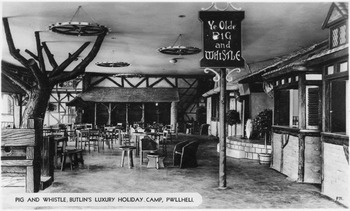
The foremost name in the British holiday camp industry was Butlin's. Born in 1899 into a fairground family, Billy Butlin opened his first amusement park in Skegness in 1927 and introduced the Dodgem Car to Britain in 1928.Footnote 29 He first experienced holiday camps in Canada and eventually opened his first ‘Luxury Holiday Camp’ in Skegness in 1936. The Clacton camp followed in 1938 and both camps proved to be hugely successful. For Butlin the camp was a response to the humiliations of the traditional boarding house holiday. Holidaying in Barry Island in South Wales in his twenties, he recounts that he ‘felt sorry for [himself], but . . . felt even sorrier for the families with the young children as they trudged around wet and bedraggled, or forlornly filled their time in amusement arcades until they could return to their boarding houses’.Footnote 30 For this flamboyant, and occasionally ruthless, entrepreneur, ‘Butlinism’ came to represent facilities and entertainment for the masses of a standard hitherto denied to them. As an illuminated sign on his Skegness camp proclaimed, ‘Our true intent is all for your delight’.Footnote 31 For around three pounds per person per week in peak season in the 1930s, campers had four meals a day and free entertainment and activities. Chalets were well-equipped with electricity and cold (and later hot) water on tap. In their eclectic architecture, from themed Dungeon Bars and Viennese Ballrooms to streamlined moderne coffee lounges, the camps offered an escape from monotony (Figure 2). Musical shows and bathing beauty contests also offered a touch of glamour; at Skegness, the cricketer Len Hutton (having just scored 364 against Australia) faced Gracie Fields's bowling using a bat made of local confectionary rock. But there was a degree of artifice to the camps. From papier-maché skulls embedded in fake rocks at the Dungeon Bar to painted-on flowers in chalet front gardens, the impression of glamour and comfort was achieved at minimal cost. ‘Spontaneous’ fun was often the product of a fixed timetable (including the famous tannoy wake-up calls) and the efforts of the army of redcoated entertainment managers. When a painless and friendly way was needed to empty the huge bars when serving stopped for the night, Butlin's instituted a ‘spontaneous’ conga line (with a tune in the style of the Salvation Army's “Come and join us”, ironically) that wound its way between the tables and through the door.Footnote 32 The image of the camps was occasionally misleading in other ways. Whilst Butlin maintained that his camps were for the working classes, the charge of three pounds per week, rising to around six pounds per week after the war, was arguably out of reach for most ordinary working families, and Walvin estimated that only five per cent of visitors in the early post-war period were in fact working class.Footnote 33
Ye Olde Pig and Whistle pub at Butlin's Luxury Holiday Camp, Pwllheli. Reproduced by courtesy of the Butlin's Archives.

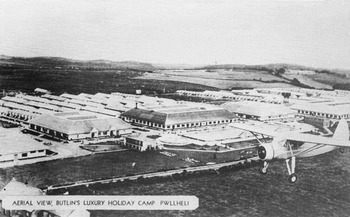
Having initially been approached by local landowners, Butlin had been in negotiations for a holiday camp site at Penychain near Pwllheli in Wales (and another near Ayr in Scotland) when war broke out. His existing camps were requisitioned for military training and he was contracted by the Admiralty to build a training camp on the south coast of England, but with the fall of France this plan was scrapped. Butlin persuaded the Admiralty that Pwllheli and Ayr might be suitable alternative locations. An agreement was negotiated whereby Butlin built what were, in effect, holiday camps, and leased them to the Admiralty for one pound. He would then purchase the camps at the end of the war for around sixty per cent of their building cost, thus giving him a cheap holiday camp and a head-start on competitors. As Butlin's biographer innocently put it ‘Bill Butlin wanted to help the country, and it so happened that the assistance he gave in camp-building eventually rebounded in his own favour’.Footnote 34 Under wartime regulations the Admiralty did not need planning permission to build what was named HMS Glendower (after the fifteenth-century Welsh prince and nationalist icon Owain Glyndŵr) and work began with only minimal consultation, for reasons of military secrecy, with the Llŷn Rural District Council. Initial building work was finished by January 1941 and it was only then, with assurances of local support, that Butlin revealed his involvement and sought formal permission for his holiday camp (Figure 3). Pwllheli Town and Llŷn Rural District Councils welcomed the camp's injection of money into the local economy and its promise of jobs for returning ex-servicemen but the County Council took a more strategic view. The County's planning consultant, the eminent planner Patrick Abercrombie, and his equally eminent assistant, the architect and polemicist Clough Williams-Ellis, objected to the sabotaging of rational survey and planning in North Wales. Abercrombie's Caernarvonshire Regional Planning Scheme had proposed that the whole of the Llŷn Peninsula be preserved as ‘one of the choicest scenic areas in the British Isles’.Footnote 35 A doubling of the camp's size by July 1941 prompted a caustic letter from Abercrombie to the Admiralty.Footnote 36 But the legal picture was confused and although Abercrombie consulted a number of notable planning figures they could not rule definitively. As Clough Williams-Ellis put it later, ‘Never in my life have I encountered such a conflict of opinions in “informed circles” both as to the actual facts or the legal position’.Footnote 37 In the meantime, Butlin had been contracted by the Ministry of Supply to provide entertainment for female munitions workers living in hostels. He was also involved in the Holidays at Home campaignFootnote 38 and so was ‘obviously getting himself well in with all the important Departments’.Footnote 39 Abercrombie and Williams-Ellis regretfully accepted the camp as a fait accompli and decided to press for aesthetic concessions; the latter met Butlin in October 1941 with an eleven-point memorandum demanding design modifications and assurances about public coastal access.
Aerial view of Butlin's Pwllheli in the 1950s. Reproduced by courtesy of the Butlin's Archives.

But their response also reflected a modern insistence on the need for national-scale planning. Alfred Steers argued that there had to be improved accommodation for visitors and often in places where at present there was none. Whilst recognising the scenic qualities of the Welsh coastline, he argued that local preservationist desires might have to be over-ruled and the coast treated as one unit for the purposes of planning by a national authority with ‘effective powers’.Footnote 40 Crucially, Abercrombie had learnt that Steers, then engaged on his work for the Ministry of Town and Country Planning, thought the Penychain site would usefully relieve pressures on the more valuable scenery and nature to the west.Footnote 41 Abercrombie agreed in principle that camps like Butlin's were a natural and suitable form of concentration.Footnote 42 In a foreword to Alfred Steers's 1946 book The Coastline of England and Wales, Abercrombie would note that the planner need have ‘no fear whatever of increased building on the coast, provided it makes use of the knowledge accumulated in this book and displays a proper sense of landscape design and compact siting. There is an opening for several new seaside towns and many coastal villages and holiday camps’.Footnote 43 He specifically referred to the Italianate village of Portmeirion, some ten miles from Butlin's camp, where Williams-Ellis had produced a coastal settlement of imaginative beauty and colour.Footnote 44 John Dower, a planner then formulating national parks policy, suggested Penychain was a suitable place to make a contribution to the millions of extra places needed after ‘holidays with pay’.Footnote 45 Williams-Ellis, an advocate of firm state planning, agreed: ‘Wales will quite properly be expected to provide its quota of [holiday camps] – certainly not less than other regions’.Footnote 46 The local branch of the Council for the Preservation of Rural Wales, led by Williams-Ellis's sister-in-law Cecily, remained resolutely opposed to the camp's visual intrusion,Footnote 47 but amongst the professional planners, the view of planning as a strategic discipline eventually triumphed. The County Council finally approved the camp plan early in 1944, albeit by a narrow majority.
But this marked the beginning, not the end, of the Battle of Butlin's. A vigorous public debate ensued, with the opposition shifting from simple issues of visual impact. As Abercrombie noted to Williams-Ellis ‘there is much in this besides town-planning: Butlin, nationalism, drink, water, morals, Sunday trading etc.!’Footnote 48 Local public opinion had apparently been in favour of the camp's economic benefits, in the first instance, with promises of employment, ‘overspill’ accommodation and a demand for four thousand pounds worth of provisions per week.Footnote 49 But in the light of a concerted opposition movement that shifted the debate onto wider terrain and ensured extensive press coverage, opinion gradually swung against Butlin's. Referring to an ‘extraordinary change . . . in public opinion’Footnote 50 the Caernarfon County Council in June 1944 withdrew its outline planning permission and called for a Ministerial inquiry. Resolutions against Butlin's were passed by a series of Welsh local authorities and other public bodies. The Labour-dominated Welsh Parliamentary Party unanimously called for a public inquiry. Visiting North Wales in September 1945 the new Minister of Town and Country Planning, Lewis Silkin, ordered an informal conference to resolve the issue. Eventually chaired by George Pepler, this was held in Pwllheli Town Hall over two days in February 1946.
Hi-de-hiking
Much of the opposition centred on notions of moral geographies – of appropriate activities in appropriate locations – and on the potential transgression of these geographies by Butlin's camp. Dave Matless has pointed to discourses on the morality of recreation and the open-air in the inter-war period and to a moral sub-text in deliberations on Steers's 1944 report.Footnote 51 These echoed around the Llŷn Peninsula. Using language that was perhaps insensitive in 1943, rights of way campaigner Humphrey Baker supposed ‘that Butlin's are entitled to some lebensraum, since so many people seem to like that sort of holiday, but it would be absurd to throw away the best of our coastal scenery on people of that kind’.Footnote 52 In January 1944 Thomas Jones, a former Cabinet Secretary and a member of the Council for the Preservation of Rural Wales’ national executive, argued in a letter to The Observer that it was as vital to ration scenery as it was food ‘otherwise the supply will be looted by the mob’.Footnote 53 Butlin was the wartime spiv, a trafficker in coastline whose greed was transgressing Welsh cultural geographies:
We submit that Snowdonia is certainly not the place for Mr Butlin. It is not his spiritual home. Skegness may be just right for ‘Dungeon Bars’ and Clacton-on-Sea for ‘gay Viennese nights’ . . . But to bring relays of 4,000 campers . . . to enjoy these luxuries at this quiet coast will destroy its peculiar qualities for everybody. Wales is not Canada. Its pools of silence are few and small, and it ought to be beyond the pale of possibility to make these hills resound with jazz. The land of eagles, the altar of the snows, old ‘ere Babylon was dust’ is not ‘the common muck of the world’.
According to Jones it was a matter of ‘multitude and solitude’, of defending Spartan, contemplative recreation: ‘Nature denies her enchantment to the many gathered by cheap facilities. If the divisor is small the share of each is great; if large, it is nil’.Footnote 54 Butlin successfully purveyed to the ‘tumultuous throng’ but that throng, and its demand for Hollywood glamour, should be kept within the geographic bounds of commercialised modernity: ‘why not extend at Rhyl or Prestatyn, where four thousand invaders a fortnight would hardly be noticed? Their crowds have no saturation point, and there, unlike Lleyn, the natives will not insist that the bar-tenders serving American cocktails shall be Welsh-speaking’.
Butlin seized on Jones's apparent elitism.Footnote 55 Who, he asked:
Are the ‘mob’ of ‘spoilers’ and ‘looters’ so loosely condemned? Not, surely, those brave, patient, kindly men and women who answered Mr Churchill's call for toil and sweat and blood? Not, surely, those unsung heroes of the blitz? Definitely not those who fought through Hell from Alamein to Italy? – those who made Wales safe for Dr Jones?
He floridly suggested that he would bring the eternal values of Nature to all:
If, during our short-lived annual holiday we can lift our eyes to the immemorial hills – the distant spire of towering Snowdon – and we are enriched, is Dr Jones the poorer? . . . No, the dawn upon the cloud-kissed hills, the setting of the summer sun, and the peace of those high places, are the common heritage of all men.
He sought to play a part in the ‘social renaissance’ of Britain and to ‘inspire an entirely new conception of holidays for thousands for whom holidays at one time connoted an unchanging and unchangeable locale and programme year after year; and to many more who could not afford a holiday at all’.
Butlin won the, apparently unlikely, support of Cyril Joad.Footnote 56 Joad was, famously, wracked with moral ambivalence; he believed in the working classes’ rights to be in the countryside but detested the cultural and aesthetic devastation they brought with them. He agreed that the camp would lessen the aesthetic disorder of ‘frowsy bungalows’ and that ‘Just as a sewage farm accumulates and concentrates refuse and prevents it from spreading, so does the camp concentrate those very elements whose unchecked spread would overwhelm the countryside’.Footnote 57 But Joad's more positive case for the camp rested in part on its sociological virtues. He sketched out the dismal old-fashioned boarding-house holiday, complete with ill-tempered landlady and bad food: ‘the wife nagged, the children whined, while the husband lounged and yearned after the girls on the prom. Or the whole family sat listlessly on the beach’.Footnote 58 He contrasted this with Butlin's glittering world of extravagance, activity and good service:
Men and women whose lives are spent in monotonous routine jobs experience for the first time on these holidays the joy of the awakened mind, the exercised talent and the pouring out of energy in vivifying initiative and strenuous endeavour. They do not all passively receive; they actively contribute, and so contributing find the outlet for the personality which their working lives deny.Footnote 59
Butlin's camps were potentially an institutional version of the robust camaraderie that Joad had sought through rambling. Joad was also developing a moral geography around the camp, suggesting it might help townsfolk attain a ‘correct’ appreciation of nature. Opponents argued that the camp should be put on an already despoiled site but why, Joad asked, should people ‘who look at concrete and bricks all the year round be required to look at the bricks of Blackpool and the concrete of Colwyn Bay all their holidays? Why should they not look at Snowdon?’Footnote 60 Joad imagined Butlin in the role of aesthetic educator:
You cannot . . . jump overnight from the Blackpool holiday in a mob to the mountain holiday with a few overnight. You must first be given the chance to see mountains, and then you may learn to love them. Well, my Pwllheli camp performs the office of a kindergarten for future mountaineers.Footnote 61
Campers would see Snowdonia in the distance and coaches could take them into the mountains to satisfy their curiosity. Formalised recreation of this kind, with a mass of potentially unruly individuals coalesced into a supervised group, appealed to many in the amenity movement at this time.
When Cyril Joad's hymn of praise to Butlin was republished in the New Statesman and Nation in 1946 one critic, challenging the notion that environment could reform the campers, asked ‘Is Cyril Joad trying to pull our legs. . .? We all know his pet paradox about the education of the countrygoer’Footnote 62 but all the evidence was that Butlin would merely import the vulgarities of Blackpool – ‘the side-shows, the dance bands, the hutments, and, let us be frankly anti-social and admit it, the appalling human screams and shouts’ – to Snowdonia. Whilst Butlineers might well find time for mountaineering ‘they will think the impresario has let them down if he does not erect tents for ices and shrimp teas at frequent intervals’. Another correspondent warned that it was a ‘point of honour’ for all Butlin's campers to reply to the cry of ‘Hi-de-hi’ with ‘Ho-de-ho’: ‘It will scarcely reassure those who care for the peace of Snowdonia to know that they may henceforward meet a vocal kindergarten antiphonally hi-de-hiking and ho-de-hoking all over the place and so ‘jollying-up’ the crags of their quiet affection’.Footnote 63
The Defence of Llŷn
Whilst one debate on the vices and virtues of Butlin's revolved around the ‘correct’ appreciation of the countryside and the proper place for vulgarity, the emerging opposition addressed different moral geographies. A group calling itself the Lleyn Defence Committee was formed in 1944. Thomas Jones, author of The Observer attack on Butlin, was the President and one of the Secretaries was also secretary of Plaid Cymru (the Welsh Nationalist Party). Other Plaid Cymru members on the Lleyn Defence Committee included the party president, the Reverend J.E. Daniel. Whilst the Lleyn Defence Committee's first memorandumFootnote 64 restated the case for the protection of nature and of scenic beauty, it sought to establish two major principles which had hitherto been marginalised but which were fundamental in contemporary understandings of the Welsh rural environment and of Butlin's incongruous place within it.
Culture and continuity
The first principle related to cultural continuity and Llŷn's role as a heartland of Welshness. This role had been firmly established by the 1930s with the Census pointing to the continued strength of the Welsh language in its fortresses of the north and west.Footnote 65 The gwerin, the rural folk, of Llŷn were represented as an educated peasantry living simple lives free from the moral depredations of urbanity, but they were threatened by continued cultural incursions from outside. This conflict of cultures had been articulated most strongly in the mid-1930s with the establishment of a Royal Air Force aerodrome further west along the Llŷn Peninsula. This inflamed cultural and moral opposition to such an extent that three prominent members of Plaid Cymru were imprisoned for setting fire to the new buildings. Greeted by around 15,000 people in Caernarfon after their release, this act of protest was arguably one of the most potent in the development of nationalist politics in Wales.
For the Lleyn Defence Committee the establishment of a Butlin's camp posed a similarly grave threat to Welsh culture. Llŷn was portrayed, again, as a vital repository of Welshness: ‘To the Welshman, whether at home or abroad, Meirion and Môn, Lleyn and Eifionydd are a sanctuary and a focal point for his deepest patriotism’.Footnote 66 Elsewhere, Wales was already subject to the ‘continuous infiltration’ and ‘invading elements’ of English culture; but Llŷn remained a cultural heartland. Addressing the Ministry's informal conference in 1946, J.E. Daniel proclaimed that Llŷn was ‘the finest flower of our rural Welsh culture . . . Some of the greatest names in the literature and life of Wales . . . have been produced by the kind of society that has existed and still exists here’.Footnote 67 Societies like Llŷn's were, he claimed, ‘very close-knit. Culture, religion and life . . . are all intertwined; the warp and the weft are very closely joined’.Footnote 68 But this organic wholeness was threatened by the Butlin's camp, ‘a whirlpool of mechanised pleasure’Footnote 69 which would become a ‘vortex, whirling ever more quickly, and it will tend, because of its unmanageability, because of its unabsorbability, to suck into itself all the things that we now regard as valuable in this land of ours’.Footnote 70 The camp's uncontrollable modernity would draw all into its currents. This cultural destruction could not be ameliorated by visual improvements, Daniel thundered: ‘We prefer the twenty thousand saints which our tradition says are buried at Bardsey Island, and what they stand for, to the twenty thousand trees Mr Butlin is going to put in the camp!’Footnote 71
Ward and Hardy suggest that it was believed that post-war acceptance of the camps was likely to ‘depend more on their external impact than on what actually went on within the compound’,Footnote 72 but this was not the case at Penychain. Its impact was largely conceived in terms of the activities and behaviours it appeared to encourage, and the subsequent threats to morality. The harbingers of immorality were identified by a vocal religious lobby as ‘gay Viennese nights’, ‘dungeon bars’ and Sunday afternoon bathing beauty competitions, activities which the Lleyn Defence Committee argued would be ‘monstrous incongruities on these quiet Welsh shores’.Footnote 73 A correspondent familiar with Butlin's camp at Skegness warned the people of Llŷn of ‘ankle displays’ and ‘shapely knees contests’.Footnote 74 Here, both the classical body of the bathing beauty and its counterpoint, the grotesque body of the ‘knobbly knees’ contest, came to literally embody English modernity.Footnote 75 The North Wales Congregational Union ‘specially feared the increased and unnecessary dangers to the moral and religious standards that would follow the establishment of a camp of this kind’.Footnote 76 A series of resolutions by religious bodies early in 1944 resulted in the creative claim by the Lleyn Defence CommitteeFootnote 77 that seventeen thousand out of Llŷn's adult population of twenty thousand opposed Butlin.
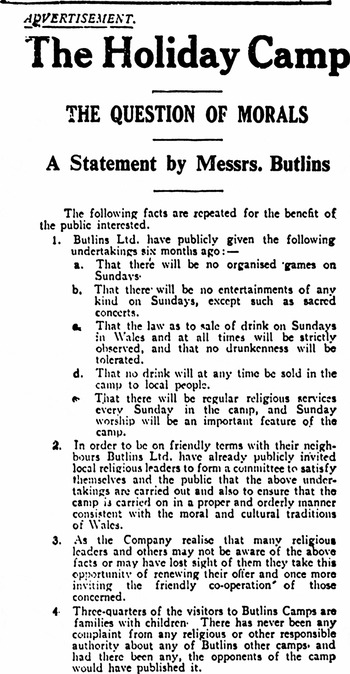
Butlin claimed that the camp would be sensitive to religious and moral sensibilities.Footnote 78 Indeed, hinting at the way in which the governance of his camps had made them attractive to planners, he suggested that unruly behaviour that offended his family clientele would be dealt with ‘ruthlessly’.Footnote 79 In one of a series of page-length adverts (Figure 4), in Welsh and English, placed in the regional pressFootnote 80 he promised that the business of the camp would be ‘carried on in a proper and orderly manner consistent with the moral and cultural traditions of Wales’ and that local religious ministers had been invited to form a supervisory body. He promised that on Sundays a full open-air service would be held, there would be no organised games or tournaments, and no alcohol would be available (and indeed locals would not be served at any time). Butlin's solicitor was less conciliatory, attacking what he saw as Welsh backwardness.Footnote 81 Another supporter accused ministers of medieval intolerance – ‘A parade of bathing belles, to them, is fraught with moral danger’ – and noted that ‘ministerial students in general are regarded by their fellow students of the University of Wales as the filthiest minded section of the college community’.Footnote 82
‘The Question of morals’. A Butlin's campaign advertisement (from Caernarfon & Denbigh Herald, May 12th 1944). Reproduced by courtesy of the Caernarfon and Denbigh Herald.

‘A nation of flunkeys’
The second issue was that of nation-building and the control of Welsh economic and political life, woven together with a pronounced anti-capitalism. Butlin claimed that the camp, attended by four thousand people per week, would generate huge demand for agricultural produce; twelve thousand eggs, six tons of potatoes and four hundred gallons of milk per week, for instance. He promised to employ five hundred staff year-round and up to one thousand in summer, with preference for returning soldiers, many of them partially disabled.Footnote 83 The Lleyn Defence Committee, however, suggested that the scale of Butlin's enterprise threatened to create a private monopoly and a culture of dependency. This, together with the seasonal nature of the demand, would not provide the stability needed to invest in the agricultural and social infrastructure of the area. Griffith Evans of the Lleyn Defence Committee also argued that Butlin's commercial scheme was centred on the notion of private property, and as such could not deliver the kind of social reconstruction needed in post-War Wales:
We look in vain for signs of the co-operation principle, of profit sharing or of the motive of service. The charge of £5 per week per head puts the camp out of reach of the large majority of those who have sweated and bled to make Wales safe for the rest of us, and to whom Mr Butlin makes such moving references.Footnote 84
In their pamphlet The Lleyn Camp: For Capitalist Monopoly? or For Public Service? the Lleyn Defence Committee attacked Butlin's ‘materialist capitalist monopoly’Footnote 85 and offered a simple choice between ‘a luxury holiday, high pressure amusement camp, for those who can afford £5 per head per week’Footnote 86 or a cooperative venture based on social service and welfare. The camp could host residential colleges for schoolchildren, teachers’ training facilities, long-term technical classes, and up to a thousand convalescents, creating a year-round attendance of some four thousand per week, far exceeding Butlin's summer-only total. The camp could also be used for youth rallies from April to May and as a State holiday camp over Christmas. Such use would offer the necessary security for the longer-term development of the region, and agriculture could thus be developed confidently. This vision recalled similar, earlier visions of a revived rural Wales, developed by the likes of H.J. Fleure and R. George Stapledon. It was also repeated in a Nuffield College report which proposed the planned and coordinated development of tourism, industry and agriculture in North Wales.Footnote 87 The proposal, ‘a choice between perverted “development” and real progress’,Footnote 88 won widespread support from social service organisations, Trades Unions and Miners’ Welfare groups, as well as from Urdd Gobaith Cymru (the Welsh League of Youth) who had been running youth camps since the 1920s. By October 1945, resolutions in favour of the social service camp had been passed by over sixty Welsh local authorities, as far afield as industrial South Wales. Accounting creatively, the Lleyn Defence Committee announced the support of over ninety per cent of Wales's population.Footnote 89
The nationalism of these proposals was crucial. The failure to disclose the full terms of Butlin's agreement with the Admiralty, despite numerous questions in Parliament, undermined Welsh territorial sovereignty and the creation of a private monopoly in Llŷn damaged ‘our self-respect as a nation’.Footnote 90 The Liverpool Daily Post columnist Celt disliked ‘the assumption that we are content to be a nation of entertainers, of waiters and waitresses’Footnote 91 and the Caernarfonshire Labour MP Goronwy Roberts spoke of the danger that, in a tourism-dominated economy, the Welsh might become ‘largely a nation of flunkeys’.Footnote 92 More potently, J.E. Daniel, in a passage that elided threats to national pride with a threatened femininity, also saw a ‘chance to ensure better and more regular employment for the girls of Llŷn than “handing plates to fat strangers” in the summer months’.Footnote 93 For the Lleyn Defence Committee, the proposed social service camp built on ‘a new view of Wales and of what it should be – self-reliant, self-respecting, enterprising, and trusting to its own energies and initiative’.Footnote 94 It would be part of the emergence of a new and modern nation after the war, with a technical college at the camp training the Welsh in the scientific skills of modern nationhood. The Board of Education planned to relocate entire schools from the industrial south, thus bringing those children into contact with their rural heritage. Griffith Evans suggested that simply undertaking the journey from South Wales to the camp could instil a sense of national community.Footnote 95The Western Mail, usually reticent in supporting apparently ‘nationalist’ causes, supported this wholeheartedly, referring to the psychological and physical benefits of the schools camps established by the Special Areas Commissioner in South Wales during the depression of the 1930s.Footnote 96 If Butlin could make this investment for the sake of profit, it reasoned,
Surely Wales has the imagination and courage to face [the purchase price] for the sake of intensifying and deepening its system of education with all the social benefits accruing in the way of health, initiative, fellowship and public spirit. There is another inestimable benefit – the unification of Wales and the consequent marriage of North and South Wales, too often thought of as apart.Footnote 97
‘Piccadilly to Penychain’
When Lewis Silkin visited North Wales in September 1945 he ‘stressed that North Wales did not belong to the Welsh people. It belonged, he said, to the whole of the people of Great Britain’. He added that ‘You are fortunate and priviledged in residing here . . . but you are trustees for the whole of Britain’.Footnote 98 His declared wish to see North Wales as a holiday Mecca for the people of Britain, the Empire, and the World aroused specific fears about Butlin's. When the conference he commissioned was convened a few months later it received extensive coverage in the British press. It was preceded by a march by over one hundred ex-servicemen chanting ‘We want Butlin’ and bearing banners proclaiming ‘Best Defence for Lleyn – Butlin's Camp’ and ‘Dole! No, Give us Butlin’.Footnote 99 The conference was a theatrical affair punctuated by cheers, boos and applause from both sides; George Pepler, chairing, frequently threatened to clear the gallery. Butlin himself appeared, greeted with energetic applause, to read out letters from chaplains at Skegness in defence of his moral values. Butlin's opponent Goronwy Roberts MP found himself on the defensive, pledging that the Welsh Parliamentary Party would at least ‘see to it that we have gay Welsh nights and not gay Viennese nights’.Footnote 100 The amenity case was misrepresented, as he put it, by Williams-Ellis who noted that the camp was ‘rather grim . . . but not vulgar, which is almost a treat in itself these days. (Applause).’Footnote 101 Most importantly, however, he restated the strategic argument that holiday camps would resist sporadic development and were ‘almost as great a national necessity in peace as are service camps in time of war. (Applause)’.Footnote 102 Highlighting the irony of the camp being named after Owain Glyndŵr, one Lleyn Defence Committee member argued that his name might once again become a symbol of Welsh unity if given to a camp devoted to ‘the simpler, sounder, saner amenities of improved health, renewed vitality, fellowship, initiative, social service to your children and ours’.Footnote 103
The following month Lewis Silkin announced that Butlin could keep the camp. Pwllheli's jubilant Mayor hoisted the Red Dragon over the Town Hall, whereas the British Legion flew the Union Jack. Butlin argued that his camp, far from being an alien incursion, would ‘appeal to thousands who have never been to Wales before and who will appreciate not only the wonderful scenery, but also the thrill of living in a country where the people, language, and customs are new to them’.Footnote 104 As one supportive journalist put it, Butlin ‘thinks that when people go to Wales . . . they want a Welsh atmosphere, and he means to see they get it. There will be real Welsh men and women to provide the service at the Caernarvonshire camp’.Footnote 105 Butlin's adverts featured women in traditional Welsh costume, and the collectors’ badges tactfully evolved from the swimsuited woman of 1947 to designs based on the Red Dragon and Welsh costume.Footnote 106 However, hopes of an ‘authentic’ relationship to place were challenged by rumours that Butlin proposed changing the ancient name of Penychain on the camp's railway halt sign to the cheery campers’ mispronunciation ‘Penny Chain’.
Amongst the opposition, Goronwy Roberts MP felt it inevitable that tourists ‘will bring Margate to Moelfre, Blackpool to Bethesda and Piccadilly to Penychain’.Footnote 107 Griffith Evans claimed that:
One of the last bulwarks of Welsh tradition has been thrown to the dogs. Profits made at this camp will be spent in Piccadilly rather than be ploughed into the planned development of one of the truest Welsh areas. The opportunity for development of Lleyn as a unit embracing food production and the provision of holidays essentially Welsh in character and under national direction is permanently lost. This forms the strongest possible argument for self-government.Footnote 108
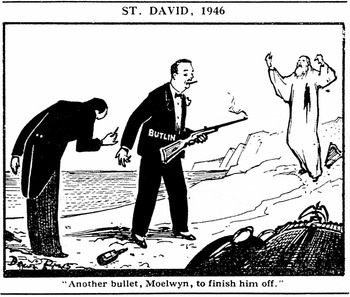
Plaid Cymru acknowledged that Butlin was a formidable operator, but he had been aided by a Labour government: ‘Labour butlinized Pwllheli. Wales will remember’.Footnote 109 A cartoon encapsulated their vision of the issue (Figure 5). The spiv-like Butlin stands on a hitherto tranquil Llŷn beach, seen over the bonnet of a limousine, with symbols of degeneracy scattered about him. He orders his obsequious servant Moelwyn (the Labour ex-MP Moelwyn Hughes who represented Butlin in the public conference) to hand him another bullet to finish off the mortally wounded figure of St David, seen dropping his harp to the sand. Welsh culture had been killed in its sanctuary.
The Butlinization of Llŷn (from The Welsh Nationalist, Vol. 15 No. 3, 1946). Reproduced by courtesy of Plaid Cymru – The Party of Wales.

Conclusion
During the Battle of Butlin's, several themes that were generating animated discussion about rural Britain came to the fore. Tensions between local-scale preservationism and national-scale strategic planning were highlighted, at the beginning of the era of post-War reconstruction. The character of mass leisure was dissected, particularly its impact on hitherto undeveloped areas. The presumed behaviour of Butlin's ‘working class’ clientele was a potent, if complex, issue. Eventually, the strategic and aesthetic benefits of concentrating the leisure impulse into holiday camps proved irresistible, driven by the laudable aim of extending holidays with pay. According to Chris Rojek, one enduring feature of what he calls Modernity 1 is the way in which the carnivalesque is ‘pruned and replanted at the periphery of society’ where it can be policed to ensure that leisure is orderly and decent.Footnote 110 In this case, however, the planting of this leisure space on the coast of rural North Wales disrupted other visions of cultural and social order. The creeping Anglicisation of rural Wales was now supplemented by large-scale activities sanctioned by the State.
The pioneering Welsh film Yr Etifeddiaeth (The Heritage), first screened in 1949, ostensibly told the story of a young black boy from Liverpool who had been evacuated to the Llŷn Peninsula in 1939. He was soon ‘conquered by that Welshness that no enemy has ever subdued. He became part of the Heritage, jealously guarded throughout the changing centuries’. The film largely concentrated on depicting a cultured and vibrant rural polity that had resisted invaders and slowly evolved over the generations – the Llŷn for which the Battle of Butlin's had been waged. But the film also echoed the campaign against Butlin in refusing to tell a story of closure. This folk culture was reinventing itself through modern dairy cooperatives, the mechanisation of agriculture and weaving, and even a harp made out of aluminium. Into this evolving pastoral polity, however, had come tourism's ‘sun-drenched invaders’, a new scale of invasion that permeated everywhere and transcended the protecting powers of geography: ‘The fastnesses of Snowdonia have been taken by storm . . . Climb high into the heart of Snowdonia and the new legend ‘Bed and Breakfast’ will have arrived there before you’. But the newest invader, Butlin's Pwllheli camp, threatened through its sheer bulk:
And the latest visitor, bigger than the fort on top of Yr Eifl, more colourful than the cities that lie under the waves of the lost hundred, more crowded than the National EisteddfodFootnote 111 of Wales in August. The camp by the chapel. The new beside the old. The challengers have come face to face.
The film shows smiling girls on bicycles, a waterpolo match, and, most tellingly, a bathing beauty parade against the backdrop of a neighbouring chapel. The camera cuts to a clutch of devotees congregating outside the chapel door:
Sunday morning in the little chapel by the mighty camp. The few gather together to cherish a birthright . . . The heritage that was given to be developed and to be bequeathed to the children, so that they too might stay within the glory.
As the strains of a Welsh hymn swell, the screen fills with the image of the sun setting on a Llŷn beach. Although the final lines are a curious mix of optimism and pessimism, the visual juxtaposition of mighty camp and modest chapel suggests that the sun is setting on the heritage.
Coda
The camp operated as Butlin's Pwllheli (and later Starcoast World) until 1997, when it was transferred to a sister brand, Haven, and renamed Hafan y Môr. It is still open. A programme on S4C (the Welsh language television channel) in 1997, commemorating Butlin's fiftieth year in North Wales, revealed a remarkable degree of affection for the camp, together with gratitude for its economic sustenance. It noted that Butlin made his camp available for a local Eisteddfod as early as 1947, and that it was extensively used by the Sunday School Movement. Famously, Butlin also gave cheap holidays to preachers and their families. But, as the late Orig Williams (aka the wrestler ‘El Bandito’) noted of his youth: ‘I'd heard that it was a place for whores and thieves, and – if that was true – then this was the place for me! . . . There were people from Liverpool, from all parts of Britain, and also . . . decent, comely Welsh people from Pen Llŷn and Eifionydd, flocking here to try to meet these Liverpudlians. But they came under the wire!’Footnote 112
Acknowledgements
This paper has taken rather longer to write than Butlin took to build his camp, so thanks to those who commented on it at various conferences and seminars over the years! I am grateful to Dave Clarke, Marcus Doel and two anonymous referees for providing recent helpful feedback. Many thanks to Roger Billington of the Butlin's archive for his kind help with illustrations.