Hurricane Sandy was a tropical cyclone that affected much of New York City in October 2012. The second costliest storm in US history, Sandy resulted in over $50 billion in damage.Reference Blake, Kimberlain and Berg 1 A total of 28 nursing homes and adult care facilities in New York City evacuated under emergency conditions after the storm began. 2 The Rockaway Peninsula, in the southern part of the borough of Queens, sustained extensive damage including loss of homes, widespread power outages, and the temporary closure of several facilities. A large number of nursing homes and other chronic care facilities were built in the Rockaways during post-World War II urban renewal programs because planners felt that residents would tolerate the peninsula’s relative isolation from the rest of New York City.Reference Pollak 3
Hurricane Sandy struck the New York City metropolitan area on October 29, 2012. Despite a mandatory evacuation order for the general population in the Rockaways, hospitals and chronic care facilities were not evacuated by city officials owing to the perceived risks of relocating this vulnerable population. In the Rockaways, facility administrators instructed to remain in place increased staffing and supplies and moved residents to upper levels away from flooding. 4
Prior experience of nursing home administrators in Louisiana following Hurricanes Katrina and Rita suggests that the risks of evacuation include mortality or morbidity of residents, transportation problems, and staffing shortages. Risks of sheltering in place include supply problems, facility damage, and similarly, staffing problems.Reference Dosa, Grossman and Wetle 5 The decision as to whether the best course is to evacuate or shelter in place is dependent on the risk to the facility and its residents as well as the risk posed by an anticipated event.Reference Dosa, Hyer and Brown 6
Only after the impact of the storm was apparent were approximately 5 hospitals and 30 residential facilities citywide, which had originally been instructed to shelter in place, evacuated owing to power losses and flooding.Reference Gibbs and Holloway 7 Without detailed plans regarding receiving facilities, displaced patients often waited in vehicles without definitive destinations.Reference Caruso 8 Weeks after the storm, hundreds of evacuated residents remained in temporary facilities without relocation plans. 9 More than 6300 patients were ultimately evacuated from 37 hospitals, nursing homes, and other residential care facilities throughout the city. Many residents remained in temporary housing for extended time periods.Reference Gibbs and Holloway 7
Previous studies of nursing homes that experienced disasters such as floods, wildfires, and hurricanes have found that while most long-term care facilities (LTCFs) met federal guidelines for written emergency plans, fewer than half met Centers for Medicare and Medicaid Services (CMS) checklist guidelines for specifics such as articulation of plans for adequate staffing, methods for handling resident illness or death, and resident identification and tracking.Reference Levinson 10 A 2008 study of over 2000 nursing homes nationwide demonstrated that while most had specific plans for providing necessities like food and water during an emergency, only 31% had plans that identified evacuation routes, and 42% detailed procedures for working with local emergency managers.Reference Castle 11 That survey, however, did not assess actual outcomes following emergencies (eg, whether backup power systems functioned as planned or prescription medications were available following an event). New York State regulations require nursing homes and hospitals to have backup emergency power sources, but other adult care facilities (eg, assisted-living facilities) are not subject to this requirement.Reference Gibbs and Holloway 7
Many of these issues became apparent at nursing homes, skilled nursing facilities, and assisted-living facilities in the Rockaways during and after Hurricane Sandy. We conducted a cross-sectional study of these institutions located in the Rockaway Peninsula in order to evaluate unique needs identified before and during the storm and describe the perceptions of facility administrators regarding preparedness and recovery.
METHODS
Design and Setting
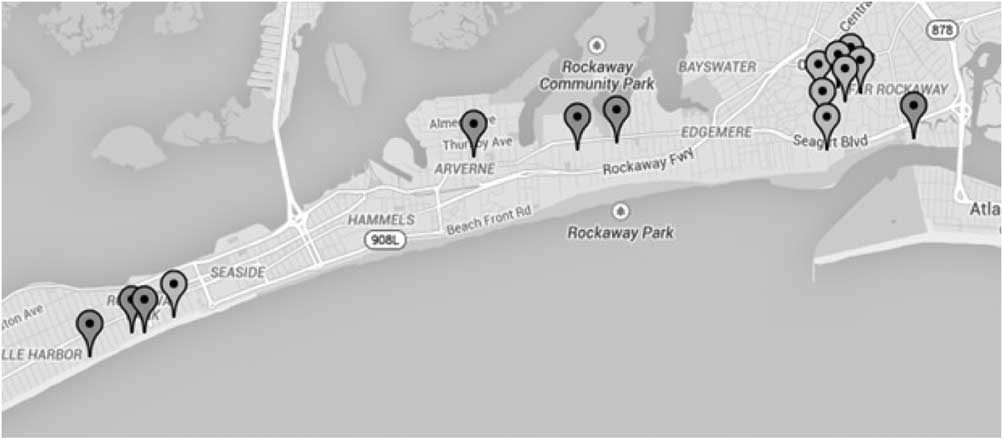
The Rockaway Peninsula is an 11 by 0.75–mile land mass located on the southern coast of the New York City borough of Queens. Regions selected for inclusion were ZIP codes 11691 through 11694, covering roughly three-quarters of the peninsula and representing the most highly impacted areas (Figure 1). LTCFs in the area of interest were identified by using the most recent US Census, and were confirmed by searching Google Maps (Google Inc, Mountain View, CA) for “chronic care facilities” and “nursing homes.” Identified facilities were divided into 3 clusters based on zip code: Far Rockaway (zip code 11691), Averne (zip code 11692), and Rockaway Park (zip codes 11693 and 11694).
Location of Participating Facilities on the Rockaway Peninsula.

Participating Facilities
Enumerators contacted facilities by phone to obtain administrative permission to conduct the study. When unable to establish phone contact, the survey enumerator sought permission in person.
Survey enumerators visited all participating facilities and conducted in-person surveys with administrators or spokespersons familiar with the experience during Sandy, with the goal of completing 1 survey per facility. When possible, surveyors obtained confirmatory surveys from additional individuals at each facility. Any questions with inconsistent answers were excluded from the final analysis. All staff members present during Hurricane Sandy were invited to participate. Participants were given the option to refuse to participate in the survey or any of its sections.
Methods and Measurements
A written questionnaire was adapted from a prior post-storm needs assessment study conducted in the Rockaways and the US Centers for Disease Control’s Community Assessment for Public Health Emergency Response (CASPER) Toolkit.Reference Subaiya, Moussavi and Velasquez 12 , 13 Questions solicited information about demographics, access to basic utilities, storm preparedness, relief efforts, and Sandy’s long-term financial and infrastructural effects on LTCFs.
The survey was administered over a 2-month period from November to January 2015.
Ethics Approval and Consent to Participate
This study was categorized as exempt by the Institutional Review Board of Columbia University (AAAN7120). No participant identifiers were collected, and there were no questions regarding HIPAA-protected sensitive information.
Analysis
All statistical analyses were conducted by using STATA 13 (College Station, TX) software. Data were double-entered and errors were cross-referenced to actual surveys before finalizing data entry. Results are presented as frequencies with proportions.
RESULTS
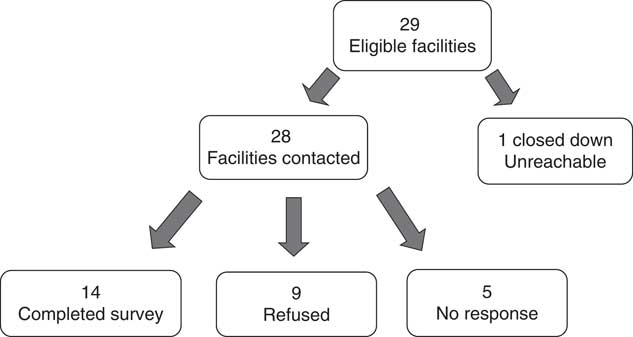
Twenty-nine facilities were identified for study participation, including nursing homes, assisted-living facilities, and other residential adult care facilities. Representatives of 14 facilities agreed to participate, 9 declined, and 5 did not respond (Figure 2). Two facilities permanently closed after the storm but representatives from one of these agreed to participate. Representatives of the second closed facility were not available for contact. Excluding the facility unable to be contacted, there was an overall 50% participation rate. All respondents were present at the facility and experienced the storm personally and were facility administrators or identified by administrators as qualified to provide responses. No subjects declined to answer any part of the survey, and all completed surveys were included in the final analysis. Confirmatory surveys were conducted in all but 3 facilities and individual questions with inconsistent responses were excluded from the final analysis.
Survey Response Rate: Rockaway Peninsula, New York City; November 2014–January 2015.

Study Participants
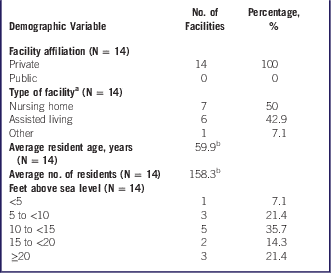
Nine facilities were located in ZIP code 11691, 2 in ZIP code 11692, 0 in ZIP code 11693, and 3 in ZIP code 11694. Fourteen facilities were identified as nursing homes, 6 as assisted-living centers, and 1 as an “adult-living” facility servicing primarily adults with mental illness (Table 1). Facilities had an average of 158 residents with a mean age of 60 years and an average of 12.5 residents per staff member.
Population Demographics of the Facilities Reported as Frequencies

a Respondents were permitted to select more than one answer.
b Mean value.
Preparation
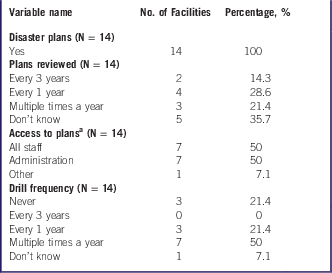
All facilities had disaster plans prior to Hurricane Sandy, with 5 having flood-specific plans and 3 having hurricane-specific plans. Fifty percent reported that all staff had access to disaster plans while the remainder reported that only administrators had access. Plans were reviewed at least once a year in half of facilities and disaster drills were conducted at least yearly in 10 facilities (Table 2). Three facilities had conducted drills specific to hurricanes or floods, with the majority anecdotally explaining they only conducted fire and evacuation drills.
Preparation of Facilities Reported as Frequencies

a Respondents were permitted to select more than one answer.
All but one facility increased staffing levels and increased stockpiles of food and medication in preparation for Hurricane Sandy. Immediately before the storm, 8 facilities confirmed transportation plans, 5 contacted local fire or police, and 4 contacted residents’ families. Twelve facilities had transportation contracts for possible evacuation.
Storm Effects
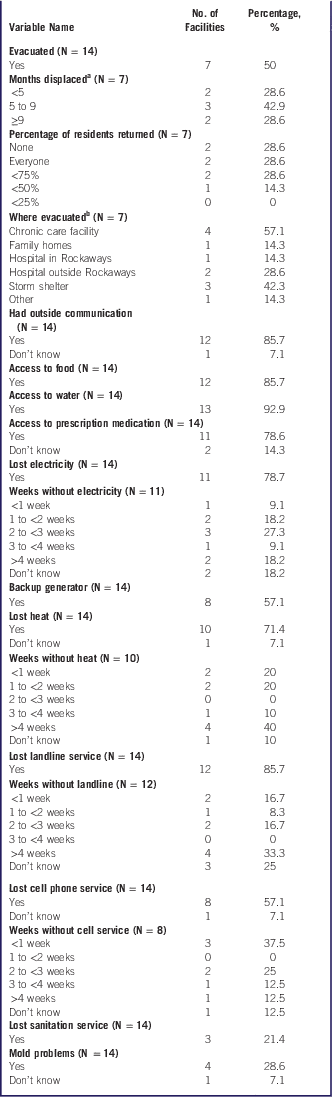
Half of the facilities in the study evacuated. All evacuated facilities were located at an elevation of 10 feet or less above sea level. The majority of residents were evacuated to another LTCF or a storm shelter. Five of the 7 evacuated facilities reported that residents were displaced for 5 months or more (Table 3).
Basic Utilities Access and Evacuation Status of Facilities Reported as Frequencies

a One facility permanently closed down after evacuation and was included in the ≥9 months category.
b Respondents were permitted to select more than one answer.
Almost all facilities had access to food and water after the storm. Whereas 8 had a backup generator, 11 facilities were without electricity for an average of 18.3 days. Almost three-quarters (10 facilities) lost heat, for an average of 24 days. Twelve lost landline telephone service, for an average of 28.3 days. Eight facilities lost cell phone service, for an average of 17 days. No injuries or fatalities were reported.
Relief Efforts and Recovery
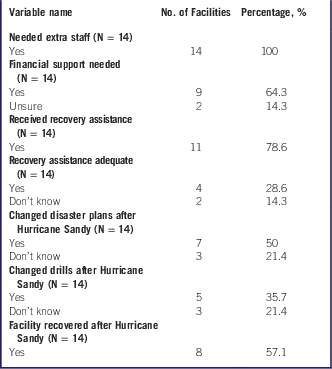
All facilities reported needing additional staffing both during and after Sandy. While most facilities received assistance with recovery efforts, primarily from government organizations, less than one-third (4 participants) felt that assistance was adequate (Table 4). Nine LTCFs reported a need for financial assistance related to rebuilding and recovery. The majority of facilities paid for repairs from their own funds. One facility received insurance reimbursement and 2 reported having received some federal or state funding. No facilities filed for bankruptcy, although the participating closed facility indicated that its closure was due to insufficient funds.
Recovery and Disaster Preparation Changes of Facilities After Hurricane Sandy Reported as Frequencies

Two years after Hurricane Sandy, 3 facilities reported still receiving recovery assistance. Eight facilities felt fully recovered, 6 of which were facilities whose residents sheltered in place during the storm. Half of the facilities changed their emergency plans after Sandy; 2 facilities added more drills and 5 added different types of drills.
DISCUSSION
Hurricane Sandy led to LTCF disruption through the destruction of infrastructure and access to basic utilities and resources. Many facilities were underprepared for both evacuation and sheltering in place, leaving them unable to support their populations sufficiently.
All of the facilities we surveyed had a disaster plan and drill system but most were not specific for hurricanes or floods. Our data and other reports suggest that generic drills did not prepare LTCFs to move patients in the midst of a storm.Reference Caruso 8 Without planning specific to an event like Hurricane Sandy, many facilities were unprepared for a proper response, increasing evacuation time and delaying access to transportation and relief resources. Previous research suggests that most emergencies in LTCFs are not fires, which suggests that the focus of drills should be redirected to the most likely events each facility may face.Reference Vogt 14 Respondents also suggested that many facilities did not follow New York State Department of Health guidelines to review and revise emergency plans and procedures at least twice per year.Reference Servis and Fage 15
Additionally, our results suggest that local geographic variation, or “microgeography,” could be included in determining need for LTCF evacuation rather than relying solely on current, standard evacuation zones. In our study, all LTCFs below 10 feet above sea level ultimately evacuated, whereas those at higher elevations remained in place. While all of the facilities in the Rockaways were in New York City Hurricane Zone A at the time (and are currently in Zone 1), the facilities on higher ground in the Rockaways are located in an area noted to be “not at risk” even according to FEMA 500-year floodplain preliminary work maps. 2 , 16 , 17 Addressing this discrepancy between evacuation recommendations (ie, evacuation zone) and risk assessment may allow emergency planners to better distribute resources in the future.
In September 2016, CMS finalized a rule that establishes emergency preparedness standards for a variety of Medicare and Medicaid participating providers, including nursing homes and skilled nursing facilities. All covered entities are required to establish a 4-point plan: (1) risk assessment and planning, (2) policies and procedures, (3) communication plans, and (4) training and testing. Stipulations specific to nursing homes include a directive to have a plan to account for missing residents and the requirement to develop a means for sharing information about the emergency plan with families and residents as facility administrators see fit. 18 The impact of the new regulation will likely be related to compliance and to planning related to regional emergencies such as Hurricane Sandy. Notably, assisted-living facilities are not subject to federal regulation and instead are subject to state-specific oversight. Additionally, in 2013, New York City announced plans to require nursing homes and adult care facilities within the 100-year floodplain to meet new standards for the protection of electrical equipment, power systems, and water pumps. 2
Limitations
This study had limitations. Facilities that experienced adverse outcomes as a result of Hurricane Sandy may have been reluctant to participate. Conversely, those who did not experience hardship may not have been inclined to participate in a project that seemed unrelated to their experiences. Conducting the survey 2 years after Sandy may have led to recall bias, although some studies indicate that individuals’ recall of hurricane-specific events immediately after an event is well correlated with recollections many months later.Reference Norris and Kaniasty 19 Nonetheless, conducting the study 2 years after the event also allowed for analysis of long-term storm effects that would otherwise not have been possible.
CONCLUSIONS
Our findings provide insight to the immediate and long-term challenges faced by assisted-living and nursing facilities in the wake of a regional event that tested the limits of local emergency plans. The data reinforce that recovery requires long-term resources and planning. More than 2 years later, many LTCFs had not completely recovered, reporting residual financial long-term effects. Facility managers could use these data to consider revisions to their own emergency plans and to devise drills specific to extreme weather events as emergencies that affect multiple facilities in their particular region. Current systems could be strengthened to maintain utilities, placing top priority on electricity.
While our data represent a discrete population in a geographically specific area affected by Hurricane Sandy, the experiences of these LTCFs during this extreme weather event should inform future investigations of LTCF response to disasters, as well as the formation of policy focused on both preparedness and recovery. Understanding the challenges of LTCFs during extreme weather events helps to create a foundation for improving emergency planning and allocating resources for a more resilient system in the future.
Acknowledgments
Thanks to Erik Campano and Barrett Torre for assisting with participant recruitment. The authors acknowledge Jimmy Duong for assistance on data analysis in conjunction with the Irving Institute for Clinical and Translational Research at Columbia University Medical Center. We also thank Columbia University College of Physicians and Surgeons Scholarly Projects Program for providing grant money to purchase data collection supplies.
Additional Information: This paper was submitted as part of the special section Caring for Older Adults in Disasters. Disaster Med Public Health Prep. 2017;11:25-152. doi: https://doi.org/10.1017/dmp.2017.4.
Funding
Funding for data collection tools was provided by the Columbia University College of Physicians and Surgeons.
Author Contributions
L. Jiang and C. Tedeschi conceptualized the study based on prior work completed by S. Subaiya. S. Subaiya and C. Tedeschi provided key insight into study design and execution. L. Jiang collected the data and completed data entry. L. Jiang and S. Subaiya created the statistical analysis plan and L. Jiang analyzed the data. L. Jiang drafted the article and all authors contributed substantially to its revision.