I. INTRODUCTION
Recently, there has been increasing demand for power supply devices and systems to be made smaller by increasing the working frequency to the megahertz band and to control higher levels of electric power by using silicon carbide or gallium nitride power semiconductors. Reference Gutfleisch, Willard, Brück, Chen, Sankar and Liu1,Reference Araghchini, Chen, Nguyen, Harburg, Jin, Kim, Kim, Lim, Lu, Piedra, Qiu, Ranson, Sun, Yu, Yuu, Allen, del Alamo, DesGroseilliers, Herrault, Lang, Levey, Murray, Otten, Palacios, Perreault and Sullivan2 In devices and systems that control high levels of electric power at high working frequencies, soft magnetic components such as inductors and transformers must be able to control the high magnetic fluxes that accompany the electric power. The soft magnetic materials used in these components require high permeability, high saturation magnetization, and low magnetic loss at high frequencies in the megahertz band. High saturation magnetization is necessary to prevent magnetic saturation particularly in devices and systems that control high levels of electric power. Magnetic loss is mainly composed of hysteresis loss and eddy-current loss. Low coercivity is necessary to reduce hysteresis loss, and high electrical resistivity is necessary to reduce eddy-current loss. Low coercivity can also contribute to high permeability when low coercivity is achieved through low magnetic anisotropy, which can produce high permeability. In general, there are two kinds of magnetic materials: magnetic metals and magnetic oxides, the latter of which are called ferrites. Magnetic metals have high saturation magnetization but low electrical resistivity, which causes high eddy-current loss at high frequencies. In contrast, ferrites have high electrical resistivity but low saturation magnetization. One structure that is able to offer both high saturation magnetization and high electrical resistivity is a nanogranular structure composed of magnetic metallic nanoparticles that have a high saturation magnetization in an insulating matrix that has high electrical resistivity. Magnetic nanogranular thin films have been fabricated and their effectiveness has been verified. Reference Ohnuma, Fujimori, Mitani and Masumoto3 In addition, nanogranular structures are able to produce excellent soft magnetism when the structure is controlled at the nanolevel. When the total of the size of each magnetic metallic nanoparticle plus the interparticle distance is smaller than the magnetic exchange length in the nanogranular structure, each nanoparticle interacts with its neighboring nanoparticles through magnetic exchange coupling. The magnetization of the nanoparticles is therefore thought to proceed concurrently, and excellent soft magnetism with low coercivity and high permeability can be obtained in nanogranular thin films. Reference Herzer4,Reference Yao, Ge, Zhou and Zuo5 However, these films are extremely thin (at most several micrometers thick) and are unsuitable for use as magnetic components in devices and systems that control high levels of electric power. Relatively thick bulk materials (at least several millimeters thick) are required for these devices and systems. For this reason, it is necessary to fabricate bulk materials that have a nanogranular metal/oxide structure and millimeter thickness.
In our previous work, we successfully fabricated a bulk nanogranular composite composed of magnetic nanogranular flakes and an insulating oxide matrix. Reference Suetsuna, Suenaga and Harada6 The flattened flakes have a large aspect ratio (ratio of diameter to thickness), which enables high magnetic permeability under a low demagnetizing field, high ferromagnetic resonance frequency as derived from the Kittel equation, and low eddy-current loss due to the decreased thickness of the conductive flakes. Reference Kittel7–Reference Zhao, Zhang and Xiao9 In each of the fabricated magnetic nanogranular flakes, magnetic metallic nanoparticles were highly dispersed throughout the oxide matrix, and the nanogranular magnetic metal/oxide structure produced good magnetic properties featuring relatively high permeability, relatively high saturation magnetization, relatively low coercivity, and low eddy-current loss at high frequencies in the megahertz band. To fabricate these nanogranular flakes, we selected a very simple technique of high-power mechanical milling of core/shell nanoparticles. This technique made it easy to mill and mix the metallic phase and oxide phases when the kinetic energy was properly controlled. The flake shape was also easily obtained by milling in an appropriate solvent.
In the present work, the behavior of the formation of nanogranular flakes through high-power mechanical milling and subsequent annealing was investigated in detail and the flake fabrication parameters were optimized to improve electrical and magnetic properties such as electrical resistivity and coercivity. In addition, surface modifications were applied to the nanogranular flakes to further improve their coercivity.
II. EXPERIMENTAL PROCEDURE
Two kinds of particles were used as starting materials for fabricating the nanogranular flakes: mixed micrometer-sized particles of metal and oxide and core/shell nanoparticles of metal/oxide. For the mixed micrometer-sized particles, Fe particles of size 3–5 μm (≥3 N, Kojundo Chemical Laboratory Co., Ltd., Sakado, Japan), Co particles of size 5 μm (≥2 N, Kojundo Chemical Laboratory Co., Ltd.), and SiO2 particles of size 0.8 μm (3 N, Kojundo Chemical Laboratory Co., Ltd.) were mixed at compositions of Fe0.7Co0.3 (mixture of Fe and Co), Fe–22 wt% Si (mixture of Fe and SiO2), and Fe0.7Co0.3–4 wt% Si (mixture of Fe, Co, and SiO2). For the core/shell nanoparticles, core/shell nanoparticles with compositions of Fe0.7Co0.3–22 wt% Si, Fe0.7Co0.3–4 wt% Si, and Fe0.5Ni0.5–4 wt% Si were fabricated by the direct thermal plasma method as described in our previous work. Reference Suetsuna, Suenaga, Takahashi and Harada10
Magnetic nanogranular flakes were fabricated by milling the core/shell nanoparticles using a high-power planetary ball mill (Planet M2-3F, Nagao System Inc., Kawasaki, Japan) in which the ball and container were made of partially stabilized zirconia. The typical weight ratio of ball to nanoparticles was 40, the speed ratio of rotation to revolution was 2.5, and the revolution speed was 700 rpm. Dry premilling was performed first in only the case of Fe0.7Co0.3–4 wt% Si and Fe0.7Co0.3 at a revolution speed of 850 rpm to promote milling and mixing at the nanolevel. Main milling was performed in acetone for between 20 min and 3 h in an argon atmosphere, and flakes were readily obtained. The flakes were then annealed in flowing hydrogen at 300–800 °C for 1 h to relieve internal lattice strain and to reduce partial oxidation of the flakes, and the influences of annealing temperature on the internal lattice strain, crystalline grain size, and coercivity were investigated.
To investigate the influence of surface modification of flakes on the coercivity, the surfaces of Fe0.5Ni0.5–4 wt% Si flakes were coated with a SiO2 layer by the conventional sol–gel method after milling and subsequent preannealing at 360 °C for 1 h in flowing hydrogen. Flakes were stirred in a solution of tetraethyl orthosilicate (TEOS), water, and acetone [TEOS:water:acetone = 1:6:11 (mol)] at 80 °C, and then heated at temperatures up to 350 °C in an argon atmosphere to obtain SiO2-coated flakes. The flakes were annealed again at temperatures from 360 to 450 °C for 0 h (without any holding time) in flowing hydrogen to relieve the internal strain, promote the formation of a SiO2 phase on the surface of the flakes, and reduce partial oxidation of the flakes.
The crystalline phases of the core/shell nanoparticles and flakes were identified by x-ray diffractometry (XRD; SmartLab (9 kW) XG, Rigaku Corp., Tokyo, Japan) using Cu Kα radiation at 45 kV and 200 mA. The crystalline grain size and root-mean-square strain of the internal lattice strain were investigated by using the Halder–Wagner approximation for the Fe0.7Co0.3–4 wt% Si system: Reference Halder and Wagner11
 $${{{\beta ^2}} \over {{{\tan }^2}\,\theta }} = {{K\lambda } \over D}{\beta \over {\tan \,\theta \,\sin \,\theta }} + 16\!\mathop {{\varepsilon _{\max }}}\nolimits^2 \quad ,$$
 $${\varepsilon _{\max }} = {{\sqrt {2\pi } } \over 2}\sqrt {\overline {{\varepsilon ^2}} } \quad ,$$
where β is the integral breadth, θ is the diffraction angle, K is a constant, λ is the wave length of the x-rays, D is the crystalline grain size, εmax is the maximum strain, and
 $\sqrt {\overline {{\varepsilon ^2}} }$
is the root-mean-square strain. The crystalline grain size can be derived from the slope of the line
 ${{{\beta ^2}} \over {{{\tan }^2}\,\theta }}$
as a function of
 ${\beta \over {\tan \,\theta \,\sin \,\theta }}$
in Eq. (1), and the root-mean-square strain can be derived from the intercept of the line and Eq. (2). The measured integral breadth of the sample was corrected by using standard LaB6 powder (SRM 660b, National Institute of Standards & Technology, Gaithersburg, Maryland) according to the following equation:
 $$\beta = {\beta _{{\rm{sample}}}} - {{\beta _{{\rm{La}}{{\rm{B}}_6}}^2} \over {{\beta _{{\rm{sample}}}}}}\quad ,$$
where βsample is the integral breadth of the sample and
 ${\beta _{{\rm{La}}{{\rm{B}}_6}}}$
is the integral breadth of the standard LaB6 powder.
Macroscopic structures were examined by scanning electron microscopy (SEM; SU8020, Hitachi High-Technologies Corp., Tokyo, Japan) and nanostructures and compositions were examined by transmission electron microscopy (TEM; JEM-2100F, JEOL Ltd., Tokyo, Japan; accelerating voltage: 200 kV) with an energy-dispersive x-ray spectroscopy (EDX) elemental analysis system (JED-2300T, JEOL Ltd.). Semiquantitative EDX analysis of the nanogranular flakes was performed by taking the averages of five sets of metallic nanoparticles and the surrounding matrix in the flakes, and the analysis of the core/shell nanoparticle was also performed by taking the averages of five sets of the core and shell in five core/shell nanoparticles.
The electrical resistivity of the flakes was examined by the four-probe method using a digital multimeter (Model 2002, Keithley Instruments Inc., Cleveland, Ohio) and a four-point probe with probe spacing of 2 mm (SR4-S, Astellatech, Inc., Kanagawa, Japan). Prior to electrical resistivity measurements, the Fe0.7Co0.3–4 wt% Si nanogranular flakes fabricated from core/shell nanoparticles were uniaxially pressed at 1000 to 12,000 kgf/cm2 without any binder into a pellet of diameter 10 mm and thickness 1 mm. Flakes of Fe0.7Co0.3 and Fe0.7Co0.3–4 wt% Si fabricated from mixed micrometer-sized particles were similarly uniaxially pressed without any binder for comparison with Fe0.7Co0.3–4 wt% Si nanogranular flakes fabricated from core/shell nanoparticles. All the flakes were annealed in flowing hydrogen after milling and pressed in an atmosphere of low oxygen level to eliminate the influence of the oxidation on the electrical resistivity. Measurements were conducted on the 10 mm diameter face of the pressed samples. Note that the weights of all the pressed samples were almost unchanged after the measurements compared to shortly after the pressing, suggesting that all the flakes were little oxidized. The electrical resistivity was calculated by the following equation:
 $$\rho = F \times t \times R\quad .$$
Here, F is a resistivity correction factor, t is thickness of the sample, and R is the measured electrical resistance of the sample. A value of F = 3.3185 was used for the pressed samples of diameter 10 mm and thickness 1 mm [the F value was determined by using the standard samples of pure Ni (6.84 μΩ cm) and NiCr (108 μΩ cm)].
Magnetostatic properties were measured to obtain the saturation magnetization and coercivity at room temperature by using a vibrating sample magnetometer (VSM; VSM-5, Toei Industry Co., Ltd., Tokyo, Japan). Maximum applied magnetic field was 16 kOe in the VSM measurements. In the case of the flakes, the magnetic field was applied roughly parallel to the flattened planes of the flakes.
III. RESULTS AND DISCUSSION
A. Lower concentration of magnetic nanoparticles in the nanogranular flakes
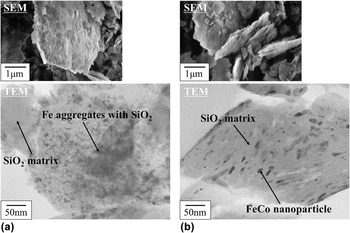
Mixed micrometer-sized particles of metal and oxide with a composition of Fe–22 wt% Si and core/shell nanoparticles of metal/oxide with a composition of Fe0.7Co0.3–22 wt% Si that had a crystalline grain size of 26 nm were each milled for 3 h using a high-power planetary ball mill. Figure 1 shows SEM and TEM images of the flakes that were fabricated in both cases. In the samples prepared by using mixed micrometer-sized particles, aggregates of the Fe phase with the SiO2 phase were observed and the boundaries between the Fe phase (metallic phase) and the SiO2 phase (oxide phase) were found to be extremely obscure by TEM-EDX analysis. In contrast, the FeCo nanoparticles (metallic phase) were relatively highly dispersed throughout the SiO2 matrix (oxide phase) and the boundaries between the metallic phase and oxide phase were very clear in the samples prepared using core/shell nanoparticles. Therefore, phase segregation of the metallic phase and oxide phases was promoted more by milling using the core/shell nanoparticles than by milling using the mixed micrometer-sized particles. This suggests that it is very important to start from metal/oxide materials with sufficient phase segregation at the nanolevel to fabricate nanogranular flakes with a sophisticated metal/oxide nanostructure by milling.
SEM and TEM images of the flakes fabricated using (a) mixed micrometer-sized particles of metal and oxide of composition Fe–22 wt% Si and (b) core/shell nanoparticles of metal/oxide of composition Fe0.7Co0.3–22 wt% Si.

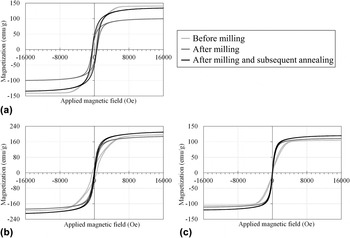
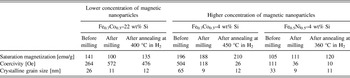
Figure 2(a) shows the magnetization curve before milling, after milling, and after annealing in flowing hydrogen for the Fe0.7Co0.3–22 wt% Si system fabricated using core/shell nanoparticles [Figs. 2(b) and 2(c) shows the magnetization curve for the Fe0.7Co0.3–4 wt% Si system and Fe0.5Ni0.5–4 wt% Si system, respectively]. Table I summarizes saturation magnetization, coercivities, and crystalline grain sizes before milling, after milling, and after annealing for the Fe0.7Co0.3–22 wt% Si system for comparison with the Fe0.7Co0.3–4 wt% Si and Fe0.5Ni0.5–4 wt% Si systems. The saturation magnetization and coercivity were obtained from the magnetization curve in Fig. 2, and crystalline grain size was obtained from the Halder–Wagner approximation in XRD analysis. The annealing temperatures were determined to obtain minimum coercivities. Coercivity was increased by milling in the Fe0.7Co0.3–22 wt% Si system, but was slightly decreased by subsequent annealing because the internal lattice strain was partially released. Despite this, the value of coercivity was much larger after annealing than before milling. This increase in coercivity was thought to be caused by not only the residual internal lattice strain but also the small crystalline grain size and the low concentration of highly dispersed nanoparticles. The crystalline grain size decreased after milling and then increased slightly after annealing. However, the final crystalline grain size remained smaller than that before milling, leading to high coercivity. The magnetic exchange coupling between neighboring magnetic nanoparticles is thought to be very weak when there is a low concentration of highly-dispersed magnetic nanoparticles in the nanogranular flake, because the interparticle distance is large. Reference Suetsuna, Suenaga, Sakurada, Harada, Tomimatsu and Takahashi12 Therefore, the nanoparticles with small crystalline grain size were likely to behave independently with little magnetic interaction, and the coercivity of the flakes remained large.
Magnetization curves before milling, after milling, and after annealing for (a) Fe0.7Co0.3–22 wt% Si system, (b) Fe0.7Co0.3–4 wt% Si system, and (c) Fe0.5Ni0.5–4 wt% Si system fabricated using core/shell nanoparticles.

Saturation magnetization, coercivity, and crystalline grain size before milling, after milling, and after annealing for the Fe0.7Co0.3–22 wt% Si, Fe0.7Co0.3–4 wt% Si, and Fe0.5Ni0.5–4 wt% Si systems fabricated using core/shell nanoparticles.

B. Higher concentrations of magnetic nanoparticles in the nanogranular flakes
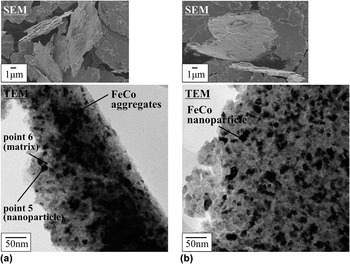
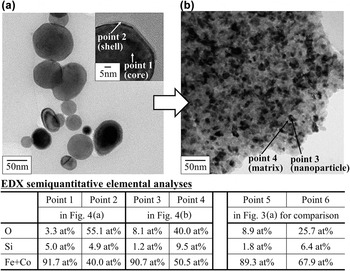
Figure 3 shows the SEM and TEM images of the nanogranular flakes after milling and subsequent annealing, fabricated by using the mixed micrometer-sized particles of Fe0.7Co0.3–4 wt% Si and by using core/shell nanoparticles of Fe0.7Co0.3–4 wt% Si. From the SEM images in Fig. 3, the surface of flakes fabricated using core/shell nanoparticles was a little flatter than that of the flakes fabricated using the mixed micrometer-sized particles. This suggests that mixing was better promoted by core/shell nanoparticles than by mixed micrometer-sized particles. In addition, the TEM images in Fig. 3 and semiquantitative EDX analysis results in Fig. 4 show that the FeCo nanoparticles (metallic phase) were more highly dispersed in the oxide matrix (oxide phase) and the boundaries between the metallic phase and oxide phase were more distinct compared to the case of using mixed micrometer-sized particles, in which aggregates of FeCo phase were observed. The behavior of the phase segregation of metallic phase and oxide phases was investigated when the nanogranular flakes were formed from the core/shell nanoparticles by milling and subsequent annealing. Figure 4 shows TEM images with semiquantitative EDX analysis results for the core/shell nanoparticles (before milling) and nanogranular flakes (after milling and subsequent annealing). The shell (point 2 in Fig. 4) had much larger amounts of oxygen than the core (point 1 in Fig. 4) in the core/shell nanoparticles. The matrix (point 4 in Fig. 4) also had much larger amounts of oxygen than the nanoparticle (point 3 in Fig. 4) in the nanogranular flake, which reflects the phase segregation of the metallic phase and oxide phase in the core/shell nanoparticle as starting materials. The oxide matrix in the nanogranular flake (point 4 in Fig. 4) had a larger ratio of silicon to FeCo (=9.5/50.5 ≈ 0.19) than that of the shell in the core/shell nanoparticles (=4.9/40.0 ≈ 0.12) (point 2 in Fig. 4). In contrast, the nanoparticle in the nanogranular flake (point 3 in Fig. 4) had a smaller ratio of silicon to FeCo (=1.2/90.7 ≈ 0.013) than that of the core in the core/shell nanoparticles (=5.0/91.7 ≈ 0.055) (point 1 in Fig. 4). These results indicate that large amounts of silicon diffused toward the shell or matrix (oxide phase) from the core or nanoparticle (metallic phase) during milling and subsequent annealing, which probably means that the stable matrix of SiFeCo complex oxide was able to protect the metallic nanoparticles from further oxidation. For comparison, the EDX analysis results for the flakes fabricated using the mixed micrometer-sized particles of Fe0.7Co0.3–4 wt% Si are also shown in Fig. 4 (the analysis was conducted in the regions where the aggregations of the FeCo phase were relatively suppressed in the flakes, and the analyzed points are shown as point 5 and point 6 in Fig. 3). The difference of the compositions between the nanoparticle (point 5 in Fig. 3) and the matrix (point 6 in Fig. 3) in the flakes was smaller than that in the case fabricated using core/shell nanoparticles (point 3 and point 4 in Fig. 4). Therefore, the phase segregation of metallic phase and oxide phases in the nanogranular flakes was more promoted by using core/shell nanoparticles than by using the mixed micrometer-sized particles.
SEM and TEM images of flakes after milling and subsequent annealing, fabricated using (a) mixed micrometer-sized particles of composition Fe0.7Co0.3–4 wt% Si and (b) core/shell nanoparticles of composition Fe0.7Co0.3–4 wt% Si.

TEM images with semiquantitative EDX analysis results for (a) core/shell nanoparticles before milling and (b) nanogranular flakes after milling and subsequent annealing for the Fe0.7Co0.3–4 wt% Si system [the TEM image of (b) and EDX analysis results of point 3 and point 4 were referred from the data in our previous report Reference Suetsuna, Suenaga and Harada6 ].

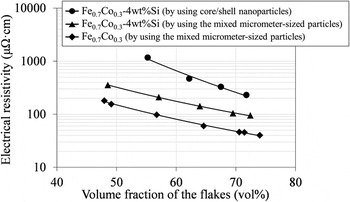
Promoting the phase segregation of metallic phase and oxide phases effectively increased the electrical resistivity of the nanogranular flakes. We have previously found by conductive atomic force microscopy (AFM) measurements that the metal/oxide nanogranular structure controls the microscopic flow of electric current. Reference Suetsuna, Suenaga and Harada6 In the present work, the degree of macroscopic flow of electric current was investigated by measuring the electrical resistivity of the pressed sample of nanogranular flakes. Figure 5 shows the electrical resistivity of the pressed sample of nanogranular flakes fabricated using core/shell nanoparticles (Fe0.7Co0.3–4 wt% Si) and flakes fabricated using mixed micrometer-sized particles (Fe0.7Co0.3 and Fe0.7Co0.3–4 wt% Si). The electrical resistivity of all the samples was decreased as the volume fraction of the flakes in the samples was increased, because the contact resistance of the conductive flakes was decreased. The electrical resistivity of the nanogranular flakes fabricated using core/shell nanoparticles of composition Fe0.7Co0.3–4 wt% Si was higher than that of the flakes fabricated using mixed micrometer-sized particles, and much higher than that of the flakes of composition Fe0.7Co0.3 fabricated using mixed micrometer-sized particles. This shows that the sophisticated metal/oxide nanogranular structure at the nanolevel increased the electrical resistivity of the flakes macroscopically as well as microscopically.
Electrical resistivity of the pressed sample of nanogranular flakes fabricated using core/shell nanoparticles (Fe0.7Co0.3–4 wt% Si) and mixed micrometer-sized particles (Fe0.7Co0.3 and Fe0.7Co0.3–4 wt% Si).

Nanogranular flakes of composition Fe0.5Ni0.5–4 wt% Si were also fabricated similarly. The saturation magnetization, coercivity, and crystalline grain size of the Fe0.7Co0.3–4 wt% Si system and Fe0.5Ni0.5–4 wt% Si system before milling, after milling, and after annealing in flowing hydrogen are summarized in Table I. The saturation magnetization after annealing was 210 emu/g for the Fe0.7Co0.3–4 wt% Si system, and that was 120 emu/g for the Fe0.5Ni0.5–4 wt% Si system. These values were much larger than those of commercial NiZn ferrites used in the megahertz band (e.g., 67 emu/g for HF30 ferrite made by TDK Corp.). In both the systems of Fe0.7Co0.3–4 wt% Si and Fe0.5Ni0.5–4 wt% Si, the crystalline grain size and coercivity decreased drastically after milling. During milling, the crystalline grain size of the magnetic metallic phase decreased and metallic phase became rearranged to form a nanogranular structure of magnetic metallic nanoparticles in an oxide matrix, as shown in Figs. 3 and 4. It is thought that each magnetic metallic nanoparticle interacted with its neighbors through the magnetic exchange coupling in the flakes, which drastically decreased the coercivity. Note that the decrease in coercivity by milling occurred when the nanogranular flakes contained a higher concentration of highly-dispersed magnetic nanoparticles. This is in contrast to when the concentration was lower, as described in Sec. III. A, where the coercivity was increased by milling although the crystalline grain size decreased. The coercivity further decreased after annealing in flowing hydrogen, and the crystalline grain size increased slightly. It is thought that the annealing released internal lattice strain, thus decreasing the coercivity. The nanogranular flakes had low demagnetizing fields because of their flattened shapes when each magnetic metallic nanoparticle magnetically interacted with its neighbors in the flakes; the magnetizations of the nanogranular flakes were more likely to saturate than those of the core/shell nanoparticles before milling (in this case, the nanoparticles had high demagnetizing fields because of their sphere-like shapes), as shown in Figs. 2(b) and 2(c).
C. Improving coercivity in the nanogranular flakes
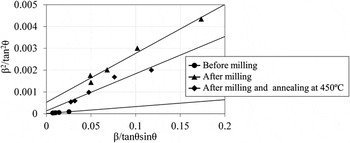
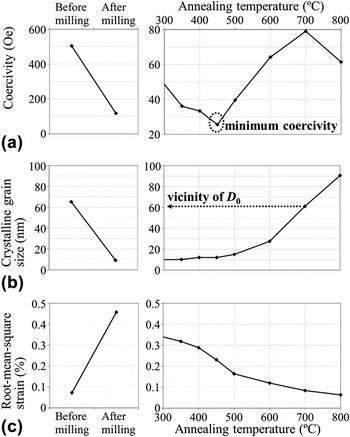
To understand the relation between the crystallographic structure of the nanogranular flakes and the magnetic properties, we investigated the crystalline grain size, internal lattice strain, and coercivity before milling, after milling, and after annealing in the Fe0.7Co0.3–4 wt% Si system. Figure 6 shows plots of the Halder–Wagner approximation for the nanogranular flakes in the Fe0.7Co0.3–4 wt% Si system. The crystalline grain size and root-mean-square strain were obtained from the slope and intercept of the approximated line of Eq. (1). Figure 7 shows the crystalline grain size, root-mean-square strain, and coercivity before milling, after milling, and after annealing at a certain annealing temperature. After milling, the coercivity decreased drastically although the root-mean-square strain was large (in general, large lattice strain should contribute to increasing the coercivity). Therefore, the significant low coercivity after milling was attributed to strong magnetic exchange coupling when there was a high concentration of highly-dispersed magnetic nanoparticles in the nanogranular flake and the crystalline grain size was small (it is well known that the coercivity can be drastically decreased when the total of the size of each magnetic metallic nanoparticle plus the interparticle distance is smaller than the magnetic exchange length in the nanogranular or nanocrystalline structure Reference Herzer4,Reference Yao, Ge, Zhou and Zuo5 ). After milling and subsequent annealing, the crystalline grain size increased and the root-mean-square strain decreased as the annealing temperature was increased. In general, decreasing lattice strain should contribute to decreasing coercivity. On the other hand, increasing crystalline grain size below the certain crystalline grain size (D 0) should contribute to increasing coercivity (below D 0, each magnetic nanoparticle strongly interacts with its neighbors through the magnetic exchange coupling to decrease the coercivity, but the interaction is weakened as the crystalline grain size increases below D 0 (Refs. Reference Herzer4 and Reference Yao, Ge, Zhou and Zuo5)). It therefore follows that the coercivity had a minimum value of 26 Oe at around 450 °C; the effect of decreasing lattice strain on decreasing coercivity was larger than the effect of the crystalline grain growth on increasing the coercivity at temperatures below 450 °C, because the crystalline grain growth was relatively small at around 450 °C [9 nm (before annealing) → 12 nm (at 450 °C)], as shown in Fig. 7(b) and Table I. The suppression of the crystalline grain growth of the metallic nanoparticles at around 450 °C was thought to be brought by the nanogranular structure, in which the metallic nanoparticles were surrounded by the oxide matrix. As the annealing temperature was increased above 450 °C, the crystalline grain growth was promoted to increase the coercivity; the effect of the crystalline grain growth on increasing the coercivity was larger than the effect of decreasing lattice strain on decreasing coercivity, because the crystalline grain growth was large. When the annealing temperature was further increased, the coercivity had a maximum value at around 700 °C, and it decreased as the temperature was increased above 700 °C. This was thought to be brought by decreasing lattice strain and increasing crystalline grain size above D 0 (increasing crystalline grain size above D 0 reduces domain wall nuclei or domain reversal nuclei to decrease coercivity). Reference Herzer4,Reference Yao, Ge, Zhou and Zuo5
Halder–Wagner plots before milling, after milling, and after annealing for the Fe0.7Co0.3–4 wt% Si system fabricated using core/shell nanoparticles.

(a) Coercivity, (b) crystalline grain size, and (c) root-mean-square strain before milling, after milling, and after annealing at a certain annealing temperature for the Fe0.7Co0.3–4 wt% Si system fabricated using core/shell nanoparticles.

Similarly, for the Fe0.5Ni0.5–4 wt% Si system, a minimum coercivity of 10 Oe (10.49 Oe, to be precise) was obtained as shown in Table I, comparable to that of commercial NiZn ferrites used in the megahertz band (e.g., 10 Oe for HF30 ferrite made by TDK Corp.). The coercivity of the Fe0.5Ni0.5–4 wt% Si system was smaller than that of the Fe0.7Co0.3–4 wt% Si system, probably because the magnetic anisotropy of the Fe0.5Ni0.5–4 wt% Si system was smaller than that of the Fe0.7Co0.3–4 wt% Si system (magnetic anisotropy constant of Fe0.5Ni0.5 is approximately 5–10 × 102 J/m3 [Ref. Reference Bozorth and Walker13], and that of Fe0.7Co0.3 is approximately 1 × 10⁴ J/m3 [Ref. Reference Shih14]).
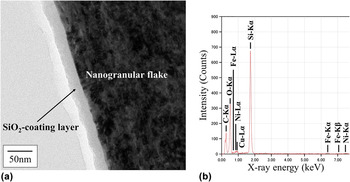
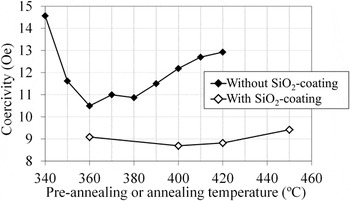
To decrease the coercivity further, the surface of the Fe0.5Ni0.5–4 wt% Si nanogranular flakes was modified by coating the surface with a SiO2 layer. Figure 8 shows a TEM image of the SiO2-coated nanogranular flake prepared by the sol–gel method (the coating layer was composed of silicon and oxygen by EDX analysis, as shown in Fig. 8). A SiO2 layer approximately 25 nm thick was formed on the surface of the nanogranular flake. This SiO2 layer improved the coercivity as well as the electrical resistivity. Figure 9 shows the coercivity of the Fe0.5Ni0.5–4 wt% Si nanogranular flakes after SiO2-coating as a function of annealing temperature. Nanogranular flakes were pre-annealed at 360 °C for 1 h in flowing hydrogen before the SiO2-coating, and the flakes were annealed again at each temperature for 0 h (without any holding time) in flowing hydrogen after the SiO2-coating. For comparison, the pre-annealing behavior of the uncoated nanogranular flakes is also shown in Fig. 9 (only pre-annealing for 1 h was conducted in this case). In both cases of with and without SiO2-coating, the coercivity had a minimum value at a certain annealing temperature; the coercivity was thought to be determined by both the effects of decreasing lattice strain and increasing crystalline grain size when the annealing temperature was increased, in the same way as described in Fig. 7. The coercivity of the SiO2-coated flakes was lower after annealing compared to the uncoated flakes, and a minimum coercivity of 8.7 Oe was obtained (the saturation magnetization of the SiO2-coated flakes was almost the same with that of the uncoated ones because the SiO2–coating layer was very thin). It is known that the coercivity of a magnetic thin film can be decreased by lamination with a nonmagnetic intermediate layer because the magnetic domain structure changes and the energy of the domain walls is decreased. Reference Clow15,Reference Middelhoek16 In the present work, the nanogranular flakes can be considered as a quasi-thin film because they had an average diameter of approximately 10 μm and an average thickness of approximately 100 nm according to SEM observations. Therefore, each flake could magnetically interact with neighboring flakes through the SiO2-coating layer, leading to smaller coercivity by decreasing the energy of the domain walls. In the future, further improvement of the coercivity should be possible by optimizing the thickness of the SiO2 layer and the nanogranular flakes, and by improving the orientation of the nanogranular flakes when the flakes are compacted to form a bulk composite.
(a) TEM image of the SiO2-coated Fe0.5Ni0.5–4 wt% Si nanogranular flake with (b) EDX analysis.

Coercivity of Fe0.5Ni0.5–4 wt% Si nanogranular flakes with and without SiO2-coating as a function of annealing or pre-annealing temperature. In the case of the flakes with SiO2-coating, annealing temperature (0 h) dependence of coercivity after pre-annealing at 360 °C for 1 h and subsequent SiO2-coating was shown. In the case of the flakes without SiO2-coating, pre-annealing temperature (1 h) dependence of coercivity was shown.

IV. CONCLUSIONS
Nanogranular flakes in which magnetic metallic nanoparticles were highly dispersed in an oxide matrix were fabricated by a simple milling process starting from core/shell nanoparticles of magnetic metal/oxide. The fabricated nanogranular flakes exhibited high electrical resistivity because of the metal/oxide nanogranular structure. The flakes also exhibited good soft magnetism with low coercivity because each magnetic nanoparticle in a flake interacted with its neighbors through the magnetic exchange coupling when there was a high concentration of highly dispersed magnetic metallic nanoparticles. The coercivity of the flakes could be decreased significantly by annealing and by modifying the surfaces of the flakes. In the FeNi–4 wt% Si flakes, a minimum coercivity of 8.7 Oe was obtained.