Background
Although myriad sources define the term ‘violence’ differently, the most commonly used description is considered to be an act of intentionally coercing oneself or another person by using physical or mental force that causes intimidation, injury, or death. 1
According to the Occupational Safety and Health Administration (OSHA), workplace violence is defined as any act or threat of physical violence, harassment, and intimidation, as well as other threatening destructive behavior occurring in the workplace. It ranges from threats and verbal abuse to physical attacks, and even murder. It can influence and involve personnel, patients, and visitors. 2 In the report on violence in healthcare, which was provided jointly by the World Health Organization (WHO), the International Labour Organization (ILO), and the International Council of Nurses (ICN), it was revealed that 50% of all healthcare workers (HCWs) are exposed to violence at least once in their professional lives. Reference Balamurugan3 In terms of different working fields, the Prehospital Emergency Medical Services Personnel (PHEMSPs) are the most disadvantaged group for violence among HCWs. While HCWs working in the hospital have partially protected areas, such as restricted access areas, protective measures, and hospital security, PHEMSPs do not have such a defense system. Since most of the studies conducted use hospital information systems, any verbal and physical attacks, injuries, and battering, as well as psychological violence related to PHEMSPs, are largely not reflected in the reports. Reference Pozzi4
In previous studies that examined violence in the field of healthcare, it has been revealed that dissatisfaction, lack of communication, lack of information, and indecision, as well as uncertain or bad clinical conditions (of patients), increase violence against HCWs. Reference Yang, Wu and Wang5–Reference Li, Yan and Shi7 As the causes of violence in the field of healthcare were being investigated, the world was trying to jointly produce solution plans, millions of people were infected with COVID-19, and the world entered into a pandemic. Reference Lu, Zhao and Li8,9
WPV has increased since the early stages of the pandemic, and the International Committee of the Red Cross (ICRC) in its report (August 18, 2020) revealed that more than 600 incidents of violence, harassment, or stigmatization had occurred against HCWs, patients and medical infrastructure due to the COVID-19 outbreak. Reference Devi10 In the same report, it was determined that 67% of HCWs were exposed to acts of violence as a result of deficiencies of medical infrastructure, especially due to the pandemic, and that the resulting acts of violence occurred not only in countries with financial limitations, but also in countries with high economic success.
In Turkey, care in an ambulance is always provided by a group of 3 individuals: PHEMSP paramedics, Emergency Medical Technicians (EMTs), or doctors. A doctor is not always present in such a group, in which case the ambulance crew will consist of only EMTs and paramedics. The aim of this study is to determine the effect that the presence of a pandemic has on the violence inflicted on PHEMSPs.
Materials and Methods
Research Design
The approach of this study is of phenomenological design. In this method, the researcher is concerned with the subjective experience of the participant and examines the perceptions and meanings they attribute to events. Facts can appear in various forms such as events, experiences, perceptions, and orientations, as well as concepts and situations in the world. 11-Reference Yıldırım and Şimşek13 The focus of this study is the violent experiences of PHEMSPs during the pandemic process.
Data Collection
Ethics approval for the study was granted by Cyprus University (No. 2021/21). To collect data, PHEMSPs were first invited via social media to participate in the research. This ensured the participation of HCWs who were actively working during the pandemic period, including doctors, paramedics, and EMTs. Participants filled out a form confirming their voluntary participation and data were collected through structured interviews. When 20 participants from each group were reached, the data was analyzed.
The interviews with 60 participants were conducted online due to the pandemic. Data was collected for 3 months, approximately 6 months after the pandemic had been officially announced in the Republic of Turkey (March 11, 2020).
Research Sample
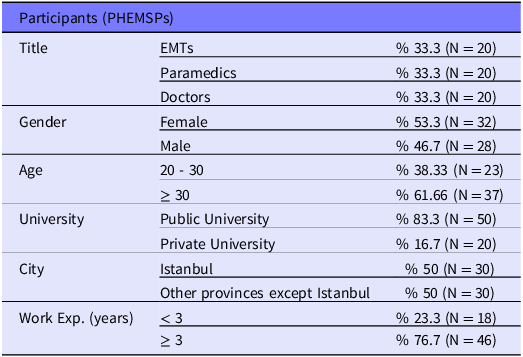
The study group consists of the first EMTs (n = 20; 33%), paramedics (n = 20; 33%), and doctors (n = 20; 33%) who completed the voluntary participation form. These 60 participants are healthcare professionals who have actively worked in the ambulance team in the transport of COVID-19 patients during the pandemic process (Table 1).
Demographics of the participants

Of the PHEMSPs, 46.7% (n = 28) were male and 53.3% (n = 32) were female. Their ages ranged from 22 to 59 years, with 36 of them aged 30 and below. Of the HCWs, 83.3% (n = 50) were graduates from public universities and 16.7% (n = 10) graduated from private universities. Their experience of the work ranged from 5 months to 17 years, with 76.7% (n = 46) of the individuals having had at least 3 years of experience. Their working hours ranged from 155 - 288 hours in a month. 50% (n = 30) of the participants work in Istanbul, which is the province with the highest number of COVID-19 cases in Turkey.
Analysis of Data
The data was analyzed in the following stages: (1) a coding and extraction stage; (2) a compilation stage; (3) a category development stage; and (4) a validity and reliability stage. After the interviews were conducted, transcripts of the interviews were made. The codes were determined by transferring these transcripts to descriptive index tables. At this stage, empty descriptive index tables were given to an expert and asked to extract the codes. Then, the codes experienced by at least 50% of the participants were revealed as themes by the researchers. The researchers’ codes were compared with the experts’ codes to calculate the reliability of the research. In order to calculate the reliability of this study, the codes by the researcher and those by the expert that were found to be similar were accepted as a ‘Consensus,’ while those that were different were described as ‘Disagreement.’ The number of ‘Consensus’ and ‘Disagreement’ codes were determined and the reliability of the study was calculated using the 1994 Miles and Huberman’s formula:
 $${\rm{P}} = {{{\rm{Na}}} \over {{\rm{Na}} + {\rm{Nd}}}} \times {\rm{\;}}100$$
Where P = Percentage of Consensus; Na = Consensus; and Nd = Disagreement
The reliability was found to be P = 88.90%. Reference Miles and Huberman14 In this formula, when P = 70% and above, the study is considered reliable. The type of violence occurring in the codes was determined as being either physical attacks or verbal abuse.
Results
As a result of the analysis of the data, 3 main themes emerged as the source of violence: (1) Violence caused by the nature of the disease, (2) Violence caused by society, and (3) Violence caused by working areas and systems.
Violence Caused by the Nature of the Disease
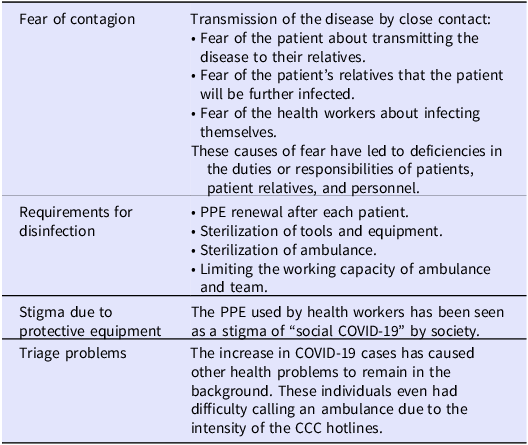
Due to the contagion factors of the disease, severe situations have arisen for PHEMSPs throughout the COVID-19 pandemic. The reasons for the theme ‘violence caused by the nature of the disease’ are presented in Table 2.
Reasons for violence caused by the nature of the disease

It was observed that a widespread fear of contagion prevailed over society during the pandemic. When the fear of contagion is examined in itself, 3 different aspects emerged: the patient’s fear about transmitting the disease to relatives; the relatives’ fear that the patient will be further infected; and the HCW’s fear about infecting themselves. These 3 fears led the relatives of the patient to not support HCWs during the patient’s transportation and intervention. In these situations, individuals directed verbal and physical abuse towards the PHEMSPs.
Another reason for violence caused by the nature of the disease is the requirements for disinfection. PHEMSPs were required to provide ambulance equipment (PPE disinfection and ventilation) after the transportation of each COVID-19 case. Before the pandemic, equipment and ambulances were disinfected for cases where specific diagnoses were encountered. However, after the pandemic began, it became mandatory to do this after each case. Since the disinfection process takes time, if the ambulance arrived later for cases that were considered more urgent than COVID-19, the HCWs in the ambulance were exposed to both verbal and physical abuse from the relatives of the patient.
In the early stages of the COVID-19 pandemic, people distressed by the medical coveralls and clothing (PPE) worn by HCWs, regarded it as shameful to be sick. As a result of this, HCWs stated that they were stigmatized by people due to their protective equipment.
With the increased cases the COVID-19 pandemic caused, cases related to other health problems remained in the background and triage problems emerged. Two different situations stand out here. In particular, the presence of ‘dyspnea’ and ‘chest pain’ complaints in COVID-19 patients merited triage priority. Due to this triage, other cases were forced to wait longer in the emergency calling system. In these cases, the relatives and patients perceived PHEMSPs as being responsible for this situation. The PHEMSPs then experienced verbal and physical abuse from many of the relatives of the patients.
Violence Caused by Society
Occupational groups that experience the most social violence are regarded as those that are directly related to people. In this context, HCWs (who intervene every day in the health of hundreds of individuals they do not know) are occasionally exposed to violence. The codes for the theme of ‘violence’ caused by society are given in Table 3.
Reasons for violence caused by society

It was seen that only the regulations on personnel rights regarding the financial and ‘material support’ that were made for HCWs during the pandemic were presented in the media, which revealed societal bias against HCWs. Although the participants were unaware of the answers that others had provided during the interviews, all HCWs without exception, stated that they had been harassed by patients, and relatives because of the wages they receive. There is a perception among the public that the wages of HCWs are much higher than the salaries of other civil servants, and the perception by society regarding high wages is also reinforced by the healthcare system managers. For this reason, all HCWs are psychologically exposed to abuse from society.
Ambulances had been requested by patients who said they had an urgent need, but did not, and simply wanted the convenience of using an ambulance (such as reaching the hospital early, not wanting to use their own vehicle, and not spending money on transportation). In this case, violence was experienced when the HCW did not accept these attempts to misuse health services.
The fact that during the pandemic, both the source of contamination and the magnitude of the pandemic were not fully understood by society, caused trust problems between HCWs and patients. The main source of trust issues was the fact that some patients’ relatives did not allow the transfer of the patients to hospital. This was detected more frequently in relatives of patients who did not accept the diagnosis of COVID-19. These relatives, who did not accept the diagnosis and opposed the transfer of the patient to hospital, thought that patients in serious conditions would contract COVID-19 in the hospital. PHEMSPs who went to the scene to intervene were faced with verbal abuse such as swearing, insults, shouting, and threats by both the patients and their relatives. Verbal abuse sometimes began when the emergency call system was contacted, before the PHEMSPs had even arrived on the scene. The extent of this abuse was not only verbal but also physical. Verbal abuse was observed at every phase, starting with the activation of the call system, arrival at the scene, patient intervention, and hospital transfer. However, the physical abuse intensified especially after the intervention at the scene was complete and a decision had been made to transfer the patient to hospital or treat them at home.
Violence against HCWs, which is frequently presented in the press and social media, did not diminish during the pandemic. During the period, the data obtained confirms that violent events increased. In addition, there are almost no HCWs who have not been subjected to written, verbal, and physical abuse from society.
Violence Caused by Working Areas and Systems
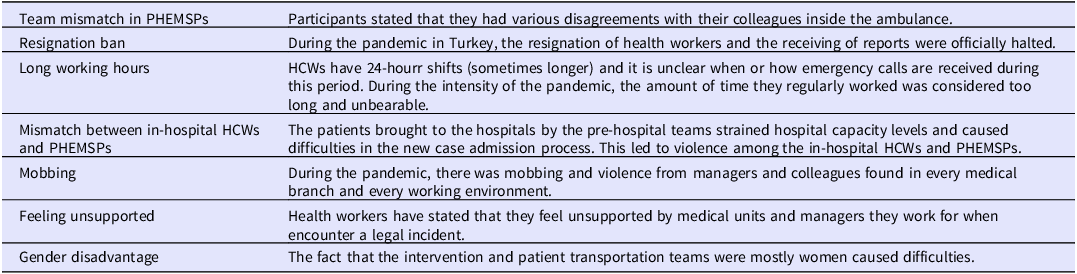
Within the scope of the theme of ‘violence caused by working areas and systems,’ the following codes arose: team mismatch in PHEMSPs; resignation ban; long working hours; mismatch between in-hospital HCWs and PHEMSPs; mobbing; feeling unsupported; and gender disadvantage. In the analyses performed, anecdotes from the participants assisted in the creation of these codes. The codes for the theme ‘violence caused by working areas and systems’ are presented in Table 4.
Reasons for violence caused by working areas and systems

The participants stated that they experienced team mismatches and had various related disagreements in ambulances with their colleagues. They attributed most of these disagreements to the fact that the pandemic continued for far longer than expected, the working conditions were too harsh, workers stayed on shifts for too long, and the support and personal rights that were given to HCWs due to the pandemic were not equal. It has been said that this period had devastating consequences for the psychological states of HCWs. The result of this team mismatch even reached levels of physical violence.
Each HCW works under the district and provincial healthcare directorates. In general, a resignation ban was imposed for HCWs during the pandemic in the country and certain situations, such as receiving reports for temporary leave or vacation were officially halted. Reference Gazete15 Considering the provinces, it is evident in the anecdotes that the administrators in local governments not only controlled the HCW, but also threatened them.
It is commonly known that HCWs work 24- hour shifts and sometimes even longer. It is unknown when and how often an emergency call will be received during this 24- hour period. When the expectations of a HCW who has endured long working hours are not met, the relatives of a patient can easily complain.
There was also often a mismatch between in-hospital HCWs and PHEMSPs. There is a statement that a doctor wanted the patients and their relatives who had been transferred to the pandemic hospital by the ambulance team to be sent back. The doctors in the pandemic hospital complained about the doctor in the ambulance team for unknown reasons. The lack of communication between the 2 teams caused incompatibility.
In every occupational group or in every working environment, examples can be found of mobbing and violence from managers or colleagues. It is incorrectly emphasized by social media and news channels that HCWs supported each other during the COVID-19 pandemic and that they wanted to spend the pandemic together. However, HCWs and the participants of this research were exposed to verbal abuse during this period, particularly from management and administration.
The white code requires a legal challenge after it is given when security is in danger. In this situation, the support of administrators who manage the HCW is required. HCWs feeling unsupported by ministries and directorates concerning their legal efforts (premised on the belief that they were victims) caused distrust towards their profession. Most of the participants stated in the interviews that they experienced physical violence in unsafe locations.
Among the participants, women particularly stated that they had serious problems in transporting patients via stretcher. Within the findings, it was revealed that 2 female HCWs in an ambulance had difficulties in carrying a single male patient. The ambulance driver did not want to help transport the patient and, in addition, the relatives of the patient also did not want to help. There have been higher levels of gender disadvantage for HCWs during the COVID-19 pandemic because the disease is contagious and no-one, including the relatives of the patient, wanted to approach the patient on the stretcher.
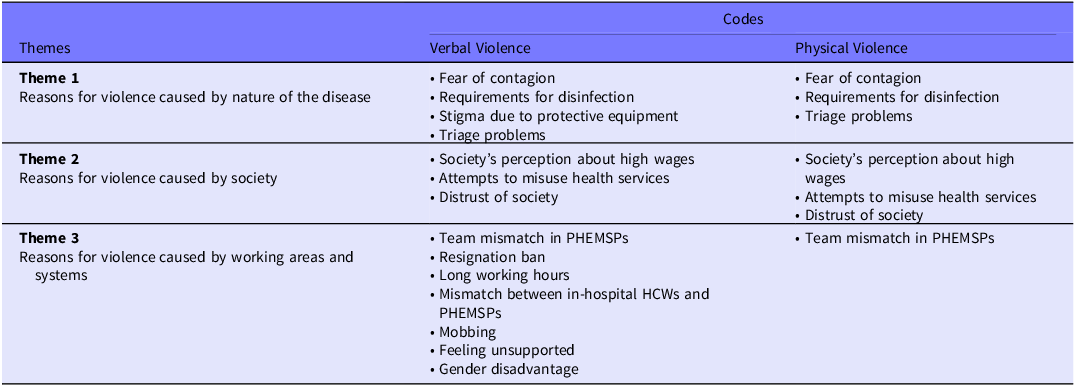
Violence caused by the negative situations that emerged during the pandemic is classified as either physical or verbal violence. Different codes in different themes have revealed these 2 types of abuse. The reasons for abuse and violence due to the nature of the disease have been determined as the fear of contagion, the requirement for disinfection, and triage problems that caused both verbal and physical abuse. In addition to these reasons, it was observed that the stigma of protective equipment prompted verbal abuse but did not lead to physical violence. The reasons for violence caused by society have been identified as the misperception concerning high wages of HCWs, attempts to misuse health services, and distrust by society. All 3 of these reasons have resulted in both physical and verbal attacks. The reasons for the violence caused by working areas and systems are team mismatch in PHEMSPs, the resignation ban, long working hours, and the mismatch between in-hospital HCWs/PHEMSPs, as well as mobbing, feeling unsupported, and gender disadvantage. Only team mismatch in PHEMSPs caused both physical and verbal attacks, while the other reasons were linked to verbal abuse only. The causes of physical and verbal attacks revealed by these codes that comprise each theme are presented in Table 5.
Causes of verbal and physical violence revealed through codes: the themes

Discussion
The increasing trend of WPV is identified with the pandemic worldwide. Reference Ferri, Silvestri and Artoni16 Studies have revealed that all HCWs who were at the forefront of the COVID-19 pandemic had experienced physical and verbal abuse, the negative effects of which were observable. Reference Wang, Lu and Kelifa17
When the areas where violence had occurred were examined, hospital emergency service areas had the highest most violence occurred. Reference Shaikh, Baig and Hashmi18 The reasons for the violence are among the most important issues in studies conducted during the COVID-19 pandemic. Reference Khan, Shaikh and Baig19 All these issues are similarly included in the themes of this study.
The management of patients begins with PHEMSPs prior to hospital admission, therefore, PHEMSPs are at a disadvantage. Health workers in the hospital are in a safe environment and a security system is activated at the earliest stages of possible violence. However, PHEMSPs often do not have knowledge of the safety of the environment at their destination. Time wasted is evident when similar procedures are followed by PHEMSPs when law enforcement is called in after a violent incident at a destination.
While analyzing the data of the study, the main aim was to determine the ‘source of violence.’ The first step in producing national and international solutions is to identify the problem. This study has identified 3 main sources for the violence experienced by PHEMSPs during the pandemic: the nature of the disease, society itself, and the working areas and systems.
The causes of violence due to the nature of the disease include a fear of contagion, requirements for disinfection, stigma due to the protective equipment involved, and triage problems. The WHO has stated that the most significant transmission routes for the virus are through droplets and between people in close contact. 20 The WHO urged people to take precautions, emphasizing that the number of cases increased, based on the closeness of contact, and the duration of the shared environment, as well as the increase of shared items and materials. With the high infection rate and relatively high mortality rate during the pandemic, both society and HCWs have naturally raised concerns regarding COVID-19. Reference Lin21
The strong effect of contact in the spread of the disease has increased fear compared to other diseases that society has faced recently. The COVID-19 pandemic has had psychological consequences among healthcare workers including fear, anxiety, and depression. Scales measuring fear levels, such as the COVID-19 Fear Scale (FCV-19S), have also been created. Reference Ahorsu, Lin and Imani22
Another reason for violence due to the nature of the disease is the requirement for disinfection. COVID-19 patients were not transported in filtered or different ambulances. This creates the requirement for sterilization after each potential Covid 19 case has been transported. This sterilization process was added to the workload of the HCW, as well as an extended ambulance arrival time for patients and relatives. Although this issue negatively affected both sides, it developed into verbal and physical attacks (especially time-based) adding additional stress to PHEMSPs.
As COVID-19 continues to spread around the world, healthcare workers face the frightening risk of working without personal protective equipment (PPE). For example, in the USA, as of March 27, the risk of running out of face masks has emerged. Reference Thompson23 While the inadequacy of PPE in the world causes crises among countries, certain countries, such as Turkey, struggle against the negatives created by their unique cultural perspectives. Reference Bhatti, Rauf and Aziz24 When PHEMSPs using PPE went to a home to administer treatment, the patients and their relatives did not want the intervention due to fear of exclusion from the public. This situation often turned into violence against the healthcare workers.
Another cause of violence is triage issues. One of the signs of a disaster is that the critical needs of the affected population exceed the available resources. Based on available resources, patients should be evaluated promptly for optimal care and treatment. Reference Kahn, Lerner and Cone25 Ambulance priority was determined by triage, especially for COVID-19, pneumonia, and Acute Respiratory Distress Syndrome (ARDS), as EMS calling system teams received so many calls for new cases. It has been suggested that approximately 80% of cases show mild symptoms, 20% require hospitalization, and approximately 5% of these require intensive care treatment. Reference Richardson, Hirsch and Narasimhan26 However, the patient’s fear of illness and the fear of encountering the environment during transportation to hospital created an ambulance demand far above these rates. Those who complained of respiratory symptoms caused excessive demand. For this reason, the triage deficiencies experienced caused the health workers to be blamed and violence to be committed against them.
One of the reasons for the violence caused by society, through the increase in social media use, is the perception that health workers receive high wages. Reference Venegas-Vera, Colbert and Lerma27 During the pandemic process, news that additional payments were made to protect the personal rights of health workers circulated in the social media, and this misinformed perception often turned into violence against HCWs. Another reason for violence caused by society is the attempts to misuse health services, especially by patients who made demands without having serious medical conditions or needs. This situation could not be mitigated under the intense pandemic conditions and, as a result, it was the HCWs who were punished and exposed to violence.
Distrust is another reason for violence caused by society. In many countries, public confidence indicators regarding HCWs were high at the beginning of the pandemic. However, as the pandemic progressed, it was observed that these confidence levels decreased. The social trust trend in Europe and Turkey has similarly been declining. 28,Reference Varanda, Gonçalves and Craveiro29
During the pandemic and in every country, HCWs have been exposed to system-based censorship and mobbing. During the pandemic in particular, the denial of HCW resignations was an extremely damaging regulation for personnel who were psychologically and physically exhausted during this period. Reference Özkan, Akbaş and Yaman30–Reference Ekşi, Gümüşsoy and Utanır32 They had already taken on more responsibility and were under triage obligation; as a result of the long working hours and the increase in hospital occupancy, the negative impact on HCWs intensified.
The EMS, which had previously had more personnel to identify groups and distribute the workload, experienced personnel shortages after the pandemic began, which increased the burden on PHEMSPs. In 1 study, protests against the health care system by HCWs led to police violence; the protesters were concerned with how doctors were receiving more adequate provisions of PPE, better quarantine conditions, and higher compensation if suspected of having contracted COVID-19.24 PHEMSPs are comprised of three different professional groups (doctors, EMTs, and paramedics) working within the same team. The unbalanced distribution of support for personnel rights during the pandemic has been an obstacle to team harmony and is a threat to the system.
Increasing workloads, diseases, and other disadvantages caused by the pandemic have negatively affected intra-group communication and the ability of personnel to work cohesively as a group; this has even led to cases of verbal abuse and physical violence among HCWs themselves.
Conclusion
During the COVID-19 pandemic, the workload of PHEMSPs, their working hours and responsibilities have also increased beyond their regular routines. They have struggled with the virus both individually and in terms of public health. In addition to the increase in violence against HCWs during the pandemic, it should be kept in mind that PHEMSPs are a more vulnerable group due to the environments in which they work. Violence against healthcare workers shows that they are exposed to many new threats, even though they are needed more during the pandemic period. These situations, which force the capacity of the health system especially before the hospital, show the need for additional measures in extraordinary situations. Long-term multidisciplinary responses supported by social psychology, law, health, and management sciences are also needed. Although the emerging themes of violence may seem different from the previous ones, it is clear that health professionals are targeted as a result of social insecurity, which feeds panic, and denial as well as stigmatization behaviors. The key role of communication and community engagement is emerging to increase people’s trust. This can be done by including those who have the disease, local governments, opinion leaders, and traditional/social media in the measures to be taken. Trying to curb disinformation and rumors can reduce violence in extraordinary situations such as a pandemic. National plans should also be drawn up in the early stages of a pandemic with the consideration of legal deterrent measures.
Limitations of the Study
The data of the study were collected for 3 months, approximately 6 months after the COVID-19 pandemic was officially declared in Turkey. Data are limited to the violence experiences of PHEMSPs who were active during the peak of the pandemic.
Data availability statement
The authors agree to the conditions of publication including the availability of data and materials in our manuscript.
Acknowledgements
All authors are acknowledged for their contributions to the article.
Author contribution
All authors are responsible for the conception and design of the study. SY is responsible for data collection and analysis. The manuscript was written and approved by all authors.
Funding
The author(s) received no financial support for the research, authorship, and/ or publication of this article.
Competing interests
The author(s) declared no potential conflicts of interest.
Ethical standard
This study was approved by local ethics committee. The principles outlined in the Declaration of Helsinki have also been followed with respect to the research, authorship, and/ or publication of this article.
Informed consent
Written consent was obtained from the participants for their anonymized information to be published in this article.
Abbreviations
EMS, Emergency Medical Services; EMT, Emergency Medical Technician; HCWs, Healthcare Workers; OSHA, Occupational Safety and Health Administration; ILO, The International Labor Organization; ICRC, International Committee of the Red Cross; PHEMSPs, Prehospital Emergency Medical Services Personnel; PPE, Personal Protective Equipment; WHO, World Health Organization; WPV, Workplace Violence.