Introduction
Dementia, a pathological condition affecting cognitive function and interfering with daily life activities, constitutes a significant global public health challenge. The number of affected individuals is projected to reach 78 million by 2030 (World Health Organization [WHO], 2021). In middle-income countries in Asia, including Thailand, the economic burden of dementia is substantial, with annual health care costs per patient ranging from US$590.78 to US$25,510.66 (Mattap et al., Reference Mattap, Mohan, Fairley, Allotey, Stephan, Reidpath, Siervo, Robinson and Chaiyakunapruk2022). Therefore, a comprehensive understanding of the factors influencing cognitive function and the progression of cognitive decline in older adults in the preclinical stage of dementia is crucial for delaying the onset of this condition.
Mild behavioral impairment (MBI) is classified within the stage of transitional cognitive decline and is recognized as an early indicator of neurobehavioral changes associated with dementia, including alterations in mood and personality (Ghahremani et al., Reference Ghahremani, Nathan, Smith, McGirr, Goodyear and Ismail2023). In contrast to mild cognitive impairment (MCI), which primarily involves memory deficits, MBI is characterized by non-cognitive symptoms, such as changes in behavior and personality, without significant cognitive impairment (Ghahremani et al., Reference Ghahremani, Nathan, Smith, McGirr, Goodyear and Ismail2023). MBI is recognized as an early indicator of dementia and is incorporated into the National Institute on Aging – Alzheimers’ Association (NIA-AA) Research Framework for Alzheimer’s disease at stage 2 (preclinical disease; Ismail et al., Reference Ismail, McGirr, Gill, Hu, Forkert and Smith2021). It may persist across the cognitive continuum in older adults (Ghahremani et al., Reference Ghahremani, Nathan, Smith, McGirr, Goodyear and Ismail2023). Evidence indicates that MBI is present in 15.2% of the general older population (WHO, 2021) and is prevalent in 80% of older adults with chronic conditions, particularly diabetes and hypertension (Lin et al., Reference Lin, Wang, Xu, Hu, Zhang, Ke, Huang, Ding, Li, Hou and Jia2022). Notably, most transitional cognitive decline cases in older adults are found in individuals living in the community who do not rely on others for daily functioning (Lin et al., Reference Lin, Wang, Xu, Hu, Zhang, Ke, Huang, Ding, Li, Hou and Jia2022). Consequently, these older adults may have limited awareness of their cognitive decline, which may lead to the development of dementia. Therefore, preventing or delaying the progression of dementia in this group is crucial.
The biopsychosocial model (BSM) provides a comprehensive framework for understanding cognitive impairment by incorporating both biological and psychosocial factors (Engel, Reference Engel1977). These factors can be classified as either modifiable or non-modifiable. Modifiable factors include biological variables, such as physical health conditions, and psychosocial variables, such as perceived stress and social support (Engel, Reference Engel1977). In the context of the BSM, MBI is proposed as a mediator that links psychosocial factors to disruptions in cognitive processes, ultimately contributing to the development of dementia. According to this model, psychosocial factors can trigger behavioral and emotional changes, which, in turn, affect cognitive function. These early behavioral changes, represented by MBI, act as a critical mechanism through which psychosocial factors influence cognitive health over time. The inclusion of MBI as a mediator is essential because it provides insight into how psychosocial factors can lead to cognitive decline, particularly before clinical dementia manifests. In addition, empirical research suggests that an individual’s physical health, particularly the presence of unmanaged chronic diseases, such as diabetes and hypertension, is correlated with the severity of MBI (Roehr et al., Reference Roehr, Luck, Pabst, Bickel, König, Lühmann, Fuchs, Wolfsgruber, Wiese, Weyerer, Mösch, Brettschneider, Mallon, Pentzek, Wagner, Mamone, Werle, Scherer, Maier and Jessen2017). However, these physical and psychosocial factors can be improved through lifestyle changes – such as engaging in at least 150 minutes of moderate-to-vigorous physical activity (PA) per week – which can help manage the complications of chronic diseases (Suriyawong et al., Reference Suriyawong, Kao, Robbins, Ling and Malete2023) and reduce the risk of dementia in older adults (Arora et al., Reference Arora, Santiago, Bernstein and Potashkin2023).
The modified psychosocial factors also significantly influence cognition in older adults. Higher perceived stress is associated with cognitive impairment, while greater social support is associated with lower levels of cognitive impairment, particularly among individuals with chronic conditions. For example, Koyanagi et al. (Reference Koyanagi, Oh, Vancampfort, Carvalho, Veronese, Stubbs and Lara2019) found that high perceived stress increased the likelihood of MCI by 1.14 times compared to low perceived stress (95% confidence interval [CI] = 1.11–1.18) in a sample of 32,715 older adults with chronic conditions from six middle-income countries (China, Ghana, India, Mexico, Russia, and South Africa). In contrast, perceived social support from family, friends, and health care professionals is critical for the well-being of older adults, playing a significant role in preventing and delaying the onset of dementia (Barnes et al., Reference Barnes, De Leon, Wilson, Bienias and Evans2004; Ertel et al., Reference Ertel, Glymour and Berkman2008; Kim et al., Reference Kim, Hawkins, Lee and Kim2023; Peng et al., Reference Peng, Burr and Han2023). However, there is a lack of evidence regarding how psychosocial factors are related to MBI in older adults, particularly in Thailand.
Therefore, improving modifiable factors, including managing stress and enhancing social support, could substantially reduce the severity or delay the onset of cognitive disorders such as dementia. However, it’s crucial to consider cultural influences on these factors. Research has shown that the relationship between social support and cognitive function can vary across different cultural groups (Zahodne et al., Reference Zahodne, Watson, Seehra and Martinez2018). This is particularly important in Thailand, where cultural values such as strong family ties, close-knit communities, and deep respect for elders may uniquely shape how people experience and benefit from social support and manage stress (Thanakwang et al., Reference Thanakwang, Isaramalai and Hattakit2014). These cultural differences, when compared to Western societies, highlight the need for research specifically focussed on understanding these relationships within the Thai context. Currently, such research remains limited in Thailand and other Southeast Asian countries with similar cultural influences.
Thailand is facing a rapidly aging population, with over 20% of its residents now classified as older adults (WHO, 2023). Recognizing this demographic shift, the Thai Ministry of Public Health has prioritized preventing cognitive decline in its long-term health plan (2023–2037) (Ministry of Public Health, Thailand, 2022). However, research on MBI and its impact on cognitive function in Thai older adults remains limited, hindering the development of effective prevention strategies (Reuben et al., Reference Reuben, Kremen and Maust2024). This study addresses this gap by examining the relationship between key biopsychosocial factors (e.g. stress, social support, PA), MBI, and cognitive function in older adults with transitional cognitive decline. Specifically, we investigate how psychosocial factors influence cognitive health through MBI, with MBI acting as a mediator in the relationship between these biopsychosocial factors and cognitive function. Furthermore, we explore the role of chronic diseases as potential moderators of these relationships. Our hypotheses are as follows: (1) higher perceived stress and lower social support will be associated with greater MBI, (2) greater MBI will be associated with poorer cognitive function, and (3) chronic diseases will moderate the relationships between psychosocial factors, MBI, and cognitive function. This knowledge is crucial for developing culturally relevant interventions that can mitigate MBI and reduce the burden of dementia on individuals, families, and communities in Thailand (Reuben et al., Reference Reuben, Kremen and Maust2024).
Methods
Sample
Older adults with transitional cognitive decline, residing in two provinces of Thailand – Song Phi Nong District in Suphan Buri Province and Saraphi District in Chiang Mai Province – were selected for the study. Participants were recruited through convenience sampling from chronic diseases and memory clinics at sub-district health promotion hospitals between March 24, 2024, and July 04, 2024. Clinic nurses referred participants who met the transitional cognitive decline criteria, as determined by their responses to three key questions based on the NIA-AA’s definition of transitional cognitive decline along the Alzheimer’s disease continuum in the Thai language: (1) Have you noticed a change in your memory over the past 1–3 years? (2) Has this change persisted over the last 6 months? (3) Are you personally concerned about this change? (Jack et al., Reference Jack, Bennett, Blennow, Carrillo, Dunn, Haeberlein, Holtzman, Jagust, Jessen, Karlawish, Liu, Molinuevo, Montine, Phelps, Rankin, Rowe, Scheltens, Siemers, Snyder and Sperling2018). Transitional cognitive decline was identified in participants who reported subjective cognitive decline and concerns about this decline, in addition to endorsing at least one other symptom indicative of transitional cognitive decline. This classification required affirmative responses to at least two questions, including those related to perceived decline and concerns about it (questions 2 and 3). In addition, other symptoms indicative of early cognitive decline include difficulty in complex tasks, increasing reliance on external memory aids, and self-reported difficulties in everyday activities, which aligns with the prior research recommendation (Rabin et al., Reference Rabin, Smart, Crane, Amariglio, Berman, Boada, Buckley, Chételat, Dubois, Ellis, Gifford, Jefferson, Jessen, Katz, Lipton, Luck, Maruff, Mielke, Molinuevo and Sikkes2015).
Participants were included if they met the following criteria: (1) male or female sex and age of 60 years or above; (2) with or without chronic disease; however, if a chronic disease was present, it had to include at least hypertension or diabetes based on their self-report and medical records; and (3) ability to understand the Thai language. Participants were excluded if they met the following criteria: (1) diagnosis of Alzheimer’s disease or another form of dementia, (2) a Thai Mental State Examination score below 24/30 (suspected dementia), (3) signs of prodromal dementia (e.g. MCI) with a Montreal Cognitive Assessment (MoCA) score below 26, or (4) a major depressive disorder, psychosis, or severe health conditions (e.g. unstable cancer/late stage of cancer, acute myocardial infarction, disability, or bedridden state) that could impair their ability to respond to questionnaires.
The sample size was determined using Fisher’s z-transformation to achieve 90% power at a p-value of 0.01, aiming to detect a correlation of 0.25 between MBI and cognitive function. This effect size was chosen based on previous research indicating a moderate correlation between these constructs in older adults with transitional cognitive decline (Ismail et al., Reference Ismail, McGirr, Gill, Hu, Forkert and Smith2021). The minimum sample size calculated was 230 older adults with transitional cognitive decline.
Procedures
Recruitment for the study began following approval from Suan Dusit University Institutional Review Board in Thailand (SDU-RDI-HS 2023-024). The principal investigator then met with potential participants attending chronic disease clinics at sub-district health promotion hospitals. Two clinic nurses, who served as research assistants, screened older adults using an interview-based assessment tool comprising three key questions based on the NIA-AA’s definition of transitional cognitive decline along the Alzheimer’s disease continuum. Subsequently, these nurses conducted cognitive assessments using the Thai Mental State Examination to exclude older adults suspected of having Alzheimer’s disease and other forms of dementia. Once eligibility was confirmed, the research assistants explained the research details, including risks and benefits, and obtained consent for participation (details were provided during the informed consent process). They were informed of their right to withdraw at any time without the need to provide a reason. 410 older adults with transitional cognitive decline voluntarily agreed to participate in the study. Thereafter, in-person data collection occurred in a private counselling room at the sub-district health promotion hospitals. The research assistants reviewed the completed measures for missing responses and inquired about any omissions. If a participant found any item distressing, the assistant refrained from further questioning on that item.
Measurements
Demographic characteristics
A demographic survey developed by the research team in the Thai language was used to assess participants’ demographic characteristics including the following: (1) age, (2) sex, (3) personal monthly income, (4) marital status, (5) educational level, (6) occupation, and (7) chronic disease status.
Mild behavioural impairment
The mild behavioral impairment checklist (MBI-C), developed by Ismail et al. (Reference Ismail, Agüera-Ortiz, Brodaty, Cieslak, Cummings, Fischer, Gauthier, Geda, Herrmann, Kanji, Lanctôt, Miller, Mortby, Onyike, Rosenberg, Smith, Smith, Sultzer and Lyketsos2017), was translated into Thai following a rigorous process by Sanprakhon et al. (Reference Sanprakhon, Suriyawong, Longphasuk, Khatichop, Arpaichiraratana, Wongwiseskul, Rattanaselanon, Pipatpiboon and Thaipisuttikul2025). First, permission to use and translate the MBI-C was obtained from the original authors. The translation was conducted by two independent bilingual researchers, followed by back-translation into English by a third independent translator to ensure consistency between the versions, adhering to the WHO (2016) guidelines. Finally, a panel of three experts in geriatric mental health in Thailand reviewed the translated version for content validity and cultural appropriateness. The checklist comprises 34 items across five domains: (1) interest, motivation, and drive; (2) mood or anxiety states; (3) ability to delay gratification, impulse control, eating behaviors, and/or reward responsiveness; (4) social norms, social awareness, and empathy; and (5) fixed beliefs and sensory experiences. Each item is rated based on the frequency of the behavior observed: 0 = never or rarely, 1 = sometimes, 2 = often, and 3 = very often. The score for each domain is calculated by summing the ratings of the items within that domain. For example, if a domain has five items rated on a scale of 0–3, the total score for that domain could range from 0 to 15. Higher scores on the MBI-C indicate greater impairment in the relevant behavioral domains associated with cognitive function. The Thai version of the MBI-C was validated with 120 older adults with transitional cognitive decline, yielding a Cronbach’s α coefficient ranging from 0.84 to 0.94 Sanprakhon et al. (Reference Sanprakhon, Suriyawong, Longphasuk, Khatichop, Arpaichiraratana, Wongwiseskul, Rattanaselanon, Pipatpiboon and Thaipisuttikul2025), consistent with the reliability testing conducted by Cui et al., Reference Cui, Dai, Miao, Zhong, Liu, Liu, Jing, Bai, Kong, Sun, Li, Guo, Rosa-Neto, Gauthier and Wu2019 on a sample of 50 older adults with transitional cognitive decline in China (α = 0.94).
Physical activity
The Thai version of the International Physical Activity Questionnaire-Short Form, translated by Pothirat et al. (Reference Pothirat, Chaiwong, Liwsrisakun, Phetsuk, Theerakittikul, Choomuang and Chanayart2021; α = 0.96), consists of seven questions assessing PA levels (vigorous, moderate, and low intensity) in minutes over the past 7 days. The scores are calculated as metabolic equivalent task minutes per week, with higher scores reflecting higher levels of PA. The total activity time per type of activity is capped at 180 minutes (3 hours).
Perceived stress
The Perceived Stress Scale, developed by Cohen et al. (Reference Cohen, Kamarck and Mermelstein1983), comprises 10 items assessing older adults’ feelings over the past month. Each item is rated on a 5-point Likert scale, ranging from 0 to 4. The total possible score ranges from 10 to 40, with scores of 10–20, 21–31, and 32–40 indicating low, moderate, and high levels of perceived stress, respectively. Permission to use, the Thai version of the scale has demonstrated good internal consistency (α = 0.85; Wongpakaran & Wongpakaran, Reference Wongpakaran and Wongpakaran2010).
Social support
The 12-item Multi-Dimensional Scale of Perceived Social Support is used for assessing perceived social support across three dimensions: support from family (items 3, 4, 8, and 11), support from friends (items 6, 7, 9, and 12), and support from others (items 1, 2, 5, and 10). Each item is rated on a 7-point Likert scale. The scores of all 12 items are summed to compute the total perceived social support score. Higher scores on each subscale and the overall scale indicate greater perceived social support. The Thai version of the scale has demonstrated good internal consistency (α = 0.92; Wongpakaran &Wongpakaran, Reference Wongpakaran and Wongpakaran2012) with permission to use in this study.
Cognitive function
Cognitive function is assessed using the Thai version of the MoCA (Nasreddine et al., Reference Nasreddine, Phillips, Bédirian, Charbonneau, Whitehead, Collin, Cummings and Chertkow2005). MoCA is translated to Thai, validated, and tested-retested reliability (α = 0.92) by Hemrungrojn (Reference Hemrungrojn, Tangwongchai, Charoenboon, Panasawat, Supasitthumrong, Chaipresertsud, Maleevach, Likitjaroen, Phanthumchinda and Maes2021). The MoCA has demonstrated high test–retest reliability (ICC = 0.92, p < 0.001) and good internal consistency (α = 0.82) in previous research (Nasreddine et al., Reference Nasreddine, Phillips, Bédirian, Charbonneau, Whitehead, Collin, Cummings and Chertkow2005). This tool evaluates various cognitive domains, including visuospatial/executive skills, naming, attention, language, abstraction, delayed recall memory, and orientation. The total possible score is 30, with an additional 1 point given to individuals with ≤12 years of education; a score of ≥25 indicates normal cognitive function (Nasreddine et al., Reference Nasreddine, Phillips, Bédirian, Charbonneau, Whitehead, Collin, Cummings and Chertkow2005).
Statistical analysis
Descriptive analyses were conducted using the Statistical Package for the Social Sciences version 28. The data distribution of all variables, particularly the outcome variables, was evaluated using the Kolmogorov–Smirnov test and Shapiro–Wilk test (Mishra et al., Reference Mishra, Pandey, Singh, Gupta, Sahu and Keshri2019). Percentages and patterns of missing data were analyzed using Little’s missing completely at random test (MCAR). A missing pattern appeared to be random (χ2 = 1173.05, df = 13419, p = 1.000) and with less than 10% of missing values noted. Multiple imputations (10 data sets) were conducted using Mplus to maximize the use of all available data (Jakobsen et al., Reference Jakobsen, Gluud, Wetterslev and Winkel2017).
A robust statistical analysis package (Mplus version 8.7) was utilized to examine the relationships between the variables simultaneously. Four global fit indices were calculated to estimate the model fit, including the χ 2/df (≤3) (Hair et al., Reference Hair, Black, Babin and Anderson2019; Kline, Reference Kline2000), root mean square error of approximation (RMSEA; <0.08) (Chen et al., Reference Chen, Curran, Bollen, Kirby and Paxton2008; Hu & Bentler, Reference Hu and Bentler1999), comparative fit index (CFI), and Tucker–Lewis index (TLI; ≥0.95) (Hair et al., Reference Hair, Black, Babin and Anderson2019; Hu & Bentler, Reference Hu and Bentler1999). The minimum threshold for considering model modification was set at a modification index greater than 10.00 to increase the parsimony of the model (Muthen & Muthen, Reference Muthen and Muthen2017). Both unstandardized and standardized coefficients were calculated to evaluate the direct and indirect associations between the hypothesized variables (Chou & Bentler, Reference Chou and Bentler2002).
A mediation analysis was performed using the Mplus IND function to explore the mediating effect of MBI on the significant relationship between modified factors (psychosocial factors, physical health condition factor) and cognitive function. The approach adhered to the assumptions of mediation analysis as outlined by Jung (Reference Jung2021). This analysis was prompted by the significant relationship found between moderate-to-vigorous PA and perceived stress (independent variables) and cognitive function (dependent variable). The 5,000 BC bootstrap method and BC bootstrapping of the 95% confidence intervals (CIs) for indirect effects were used to test the significance and degree of the mediating effects (Muthen & Muthen, Reference Muthen and Muthen2017).
The DIFFTEST procedure within Mplus was utilized to determine the moderating effects of chronic disease status, building upon the significant relationships previously identified through structural equation modelling. Within the existing structural equation model, participants were categorized into two groups based on their chronic disease status (yes versus no), followed by a comparative analysis. Those who reported having at least one chronic disease – specifically including hypertension or diabetes – were placed in the ‘yes’ group, with confirmation from their medical records. Participants who did not report having any chronic diseases were categorized in the ‘no’ group. The moderation analysis began with the most constrained model (the nested model), wherein initial assumptions held that all pathways were equal across the groups based on the chronic disease status. Gradually, pathways were selectively relaxed, one by one, enabling the examination of group disparities and the evaluation of changes in the χ 2 values (∆χ 2). This systematic approach yielded valuable insights into the notable variations observed among these groups.
Results
Demographic characteristics
The sample consisted of 410 older adults, with two-thirds being women. The average age was 70.26 years (SD = 7.43), and most participants were married. Over three-quarters had completed primary education. The most common occupations were farmers and general labourers. The average monthly income was 7,966 Baht. The majority of participants (78.50%) had at least one chronic disease, with hypertension (84.47%) and dyslipidaemia (39.13%) being the most prevalent, as shown in Table 1.
Participant demographics (n = 410)

Structural equation model
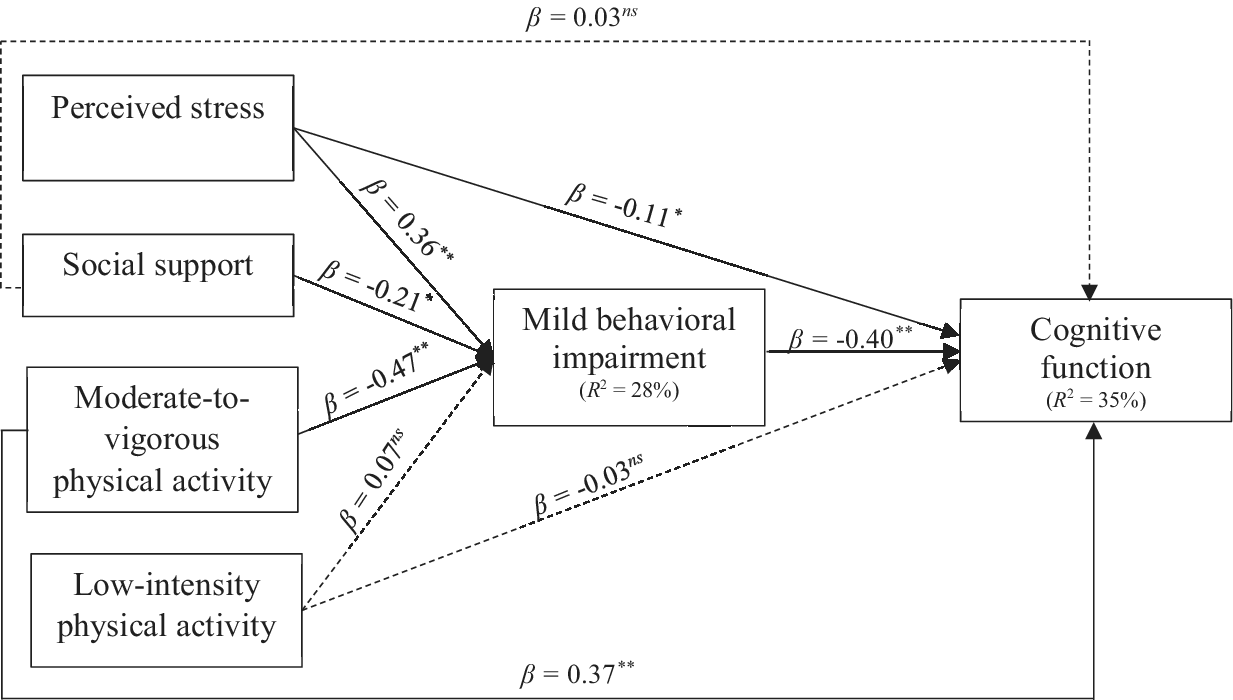
Figure 1 illustrates the structural equation model examining the interrelationships between perceived stress, social support, PA, MBI, and cognitive function. The initial model demonstrated a strong fit with the data, indicated by good model fit indices (χ 2/df = 0.00, RMSEA = 0.000 [90% CI = 0.000–0.000], CFI = 1.000, TLI = 1.000), suggesting no need for further adjustments. The structural equation model effectively explained 35.0% and 28.0% of the variance in cognitive function and MBI, respectively.
Structural model. Notes: * = p < 0.05, ** = p < 0.001, ns = p > 0.05; dotted lines indicate a non-significant relationship.

The psychosocial factors, notably higher perceived stress, were correlated with increased MBI (β = 0.36; p < 0.001) but correlated with lower cognitive function (β = −0.11; p < 0.05). Social support from family, peers, and others exhibited a negative correlation with MBI (β = −0.21; p < 0.05). Moreover, moderate-to-vigorous PA was correlated with MBI (β = −0.47; p < 0.001), whereas low-intensity PA showed no significant correlation with MBI (p = 0.465).
Moderate-to-vigorous PA is correlated with enhanced cognitive function (β = 0.37; p < 0.001). Lastly, MBI showed a moderate negative correlation with cognitive function (β = −0.40; p < 0.001).
Mediation analysis
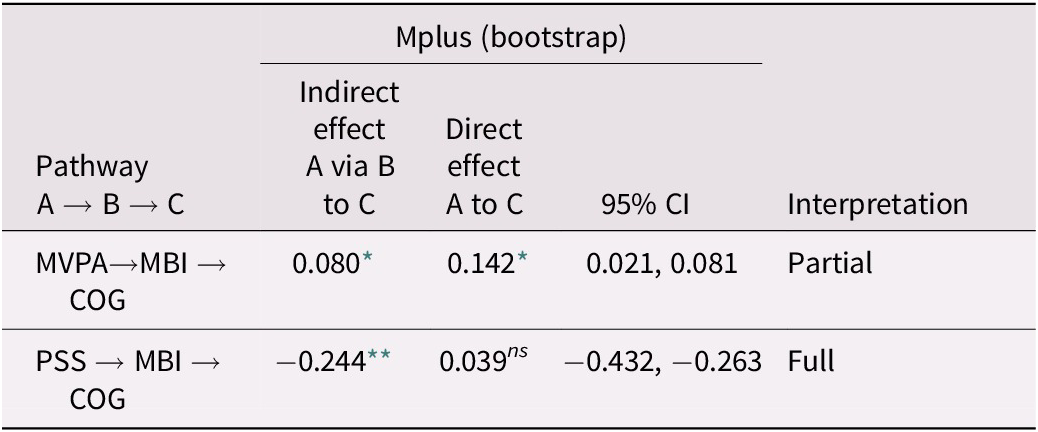
Mediation analysis was conducted to examine the indirect effects of moderate-to-vigorous PA and perceived stress on cognitive function through MBI. Moderate-to-vigorous PA indirectly increased cognitive function through MBI (indirect effect = 0.08; p = 0.001). The direct effect of moderate-to-vigorous PA on cognitive function remained significant (direct effect = 0.142; p = 0.002). Regarding the mediating effects of MBI on the relationship between perceived stress and cognitive function, there was no direct relationship noted between perceived stress and cognitive function (p = 0.443). However, perceived stress exerted an indirect influence on cognitive function through MBI (indirect effect = −0.244; p < 0.001), as summarized in Table 2.
Mediating effect of MBI on the relationship between moderate-to-vigorous physical activity and cognitive function

Notes: COG = cognitive function, MBI = mild behavioral impairment, MVPA = moderate-to-vigorous physical activity, PSS = perceived stress.
* = p < 0.05,
** = p < 0.001, ns = p > 0.05.
Moderation analysis: group comparison
Moderation analysis was conducted to examine whether the presence of chronic diseases moderated the relationship between perceived stress, moderate-to-vigorous PA, MBI, and cognitive function. Table 3 demonstrates that the relationship between perceived stress and MBI in the group with chronic diseases was significantly stronger than that in the group without chronic diseases (∆χ 2 = 4.236; p = 0.025). While the other moderation analyses were not statistically significant, the associations between MVPA, perceived stress, MBI, and cognitive function were similar across groups (p > .05).
Moderating effect of chronic disease status on the path coefficients: A comparison between the groups with and without chronic diseases

Notes: COG = cognitive function, MBI = mild behavioral impairment, MVPA = moderate-to-vigorous physical activity, PSS = perceived stress.
* = p < 0.05,
** = p < 0.001.
Discussion
The aims of the study were to examine the relationship between biopsychosocial factors (PA, perceived stress, and social support), as recommended by the BSM on cognitive function in older adults with transitional cognitive decline using a structural equation model. The BSM includes biological and psychological factors that influence health and well-being. In this study, we focus on the modifiable psychosocial (perceived stress and social support) and biological factors (physical health: PA) – since these are modifiable factors that can be targeted for interventions. Although biological factors (e.g. genetics, age) and fixed psychosocial factors (e.g. education) are important components of the BSM, they were not directly examined in the current study.
This study found that a 1-point increase in the perceived stress score was correlated with a 0.11-point decrease in the cognitive function score (β = −0.11) among the older adults with transitional cognitive decline in the community. This phenomenon could be viewed through the BSM (Engel, Reference Engel1977), which served as the conceptual framework of the study. Based on the BSM, dementia is influenced by a combination of biological and psychological, all of which interact to affect cognitive function. In our study, modified psychosocial factors, perceived stress, would play a significant role in decreasing cognitive function. These findings align with a study by Chen et al. (Reference Chen, Liang, Zhang, Crawford, Sakel and Dong2019), which found that among older American-Chinese adults (average age 72.3 years), those with multiple chronic conditions and high stress levels had lower general cognitive function scores, even after accounting for factors like age, sex, income, and education. Specifically, a 1-point increase in the stress perception score was related to a 0.02-point decrease in episodic memory (p < 0.001), a 0.014-point decrease in working memory (p < 0.001), and a 0.022-point decrease in the perceptual speed score (p < 0.001). This also aligns with the findings of Foong et al. (Reference Foong, Hamid, Ibrahim, Haron and Shahar2016), who examined the correlation between perceived stress and general cognitive function among 2,322 Malaysian older adults. They found that working memory score measured by the digit span test (DST) was related to perceived stress core (β = −0.07, p < .001)
Although there are limited studies confirming the relationship between MBI and perceived stress, one study has confirmed an association between MCI – an early warning sign of dementia – and perceived stress among healthy older adults in low-to-middle-income countries (Koyanagi et al., Reference Koyanagi, Oh, Vancampfort, Carvalho, Veronese, Stubbs and Lara2019). This mechanism is thought to be explained by the fact that stress in older adults may increase cortisol hormone levels, which could affect the hippocampus (responsible for learning and memory) and the prefrontal cortex (associated with thinking and emotions). These changes are believed to contribute to cognitive decline and potentially increase the risk of dementia (James et al., Reference James, Stromin, Steenkamp and Combrinck2023). However, it is important to note that the exact mechanisms relating stress and dementia remain complex and not entirely conclusive. In addition to stress hormones, perceived stress may also contribute to poor cognitive performance through unhealthy lifestyle choices, such as poor dietary intake and reduced PA (D’Amico et al., Reference D’Amico, Huang and Fiocco2021). Furthermore, other biological mechanisms, including increased inflammation and poor cardiometabolic health, may also play a role in the negative impact of stress on cognitive function (Jurgens & Hayes, Reference Jurgens and Hayes2023).
In the present study, perceived social support from family, friends, or others correlated with MBI (β = 0.21). MBI is a neurobehavioral manifestation of degenerative diseases that may indicate an increased risk of cognitive problems in the early stages or lead to cognitive impairment (Rouse et al., Reference Rouse, Small, Schinka, Loewenstein, Duara and Potter2021). However, previous studies on the relationship between MBI and psychosocial factors, such as perceived social support, remain limited. Nevertheless, studies on older adult health have consistently highlighted the importance of perceived social support from various sources such as family, friends, or health care professionals in maintaining older adult health, particularly in preventing dementia (Barnes et al., Reference Barnes, De Leon, Wilson, Bienias and Evans2004; Ertel et al., Reference Ertel, Glymour and Berkman2008; Kim et al., Reference Kim, Hawkins, Lee and Kim2023; Peng et al., Reference Peng, Burr and Han2023). The present study assessed perceived social support from various sources, including family, friends, and others (i.e. health care professionals, village health volunteers, and a special person) among older adults with transitional cognitive decline. One theory that can explain the mechanism underlying the effect of social support in preventing cognitive decline is the socioemotional selectivity theory (Baltes & Baltes, Reference Baltes and Baltes1990). According to this theory, as individuals age, they prioritize emotionally meaningful relationships, which may include social support from various sources such as family, friends, or health care professionals. These meaningful social connections can foster a sense of emotional well-being and reduce stress, potentially contributing to better cognitive health by promoting positive social interactions and emotional fulfillment, which are crucial for maintaining cognitive function in aging individuals.
The present study found that moderate-to-vigorous PA was associated with a slight decrease in MBI and an improvement in cognitive function. Previous research has shown that lifestyle modifications, particularly engaging in moderate-to-vigorous PA, help to manage chronic diseases and their complications (Suriyawong et al., Reference Suriyawong, Kao, Robbins, Ling and Malete2023). In this study, nearly 80% of the participants had multiple chronic diseases, including hypertension or diabetes, both of which are significant factors in cognitive impairment (Lin et al., Reference Lin, Wang, Xu, Hu, Zhang, Ke, Huang, Ding, Li, Hou and Jia2022). Older adults with chronic diseases are at a higher risk of developing dementia than those without these diseases (Yen et al., Reference Yen, Wei, Yip, Hwu and Hsu2022). Additionally, moderate-to-vigorous PA is related to a reduced risk of dementia in older adults (Arora et al., Reference Arora, Santiago, Bernstein and Potashkin2023; Zhu et al., Reference Zhu, Wadley, Howard, Hutto, Blair and Hooker2017). Thus, engaging in such PA supports cognitive function and may help mitigate the severity of cognitive impairment. Conversely, low-intensity PA did not show a correlation with cognitive function in this study. This contrasts with some previous reports, including the systematic literature review by Tse et al. (Reference Tse, Wong and Lee2015), which examined the effects of low-intensity PA on cognitive function in healthy older adults. Their review found that 2 out of 15 studies showed significant improvements in cognitive function with low-intensity PA. The present study’s sample may have underreported the amount of low-intensity PA conducted due to response bias or inaccuracies in memory recall.
Herein, MBI was moderately correlated with cognitive function, indicating that greater behavioral impairment was associated with poorer cognitive performance. Research on factors contributing to cognitive decline in older adults with MBI is still limited, particularly in Thailand. However, evidence suggests that MBI is linked to impairments in multiple cognitive domains. Ismail et al. (Reference Ismail, McGirr, Gill, Hu, Forkert and Smith2021) found that older adults with MBI performed worse on executive function, attention, short-term memory, and episodic memory tests. Notably, those with MBI exhibited significant executive function deficits at baseline and experienced further declines in visuospatial ability and processing speed over a three-year follow-up. Furthermore, strategies such as stress management and lifestyle modifications, including increased PA, can help mitigate cognitive decline and delay dementia progression. Therefore, early intervention targeting MBI risk factors is crucial in preventing or delaying the onset of dementia, including Alzheimer’s disease, in older adults.
The mediation analysis in the current study revealed that moderate-to-vigorous PA was associated with improved cognitive function in older adults with transitional cognitive decline, both directly and indirectly through its association with reduced MBI. In contrast, increased perceived stress was indirectly associated with poorer cognitive function via its relationship with MBI, with no direct effect observed. These findings suggest that stress reduction programs may benefit cognitive function by addressing MBI; however, other potential mediators not examined in this study may also play a role. Given these findings, future interventions should prioritize moderate-to-vigorous PA, as it appears to support cognitive function through both direct and indirect pathways.
In this study, the comparative analysis revealed that the association between perceived stress and MBI was stronger in older adults with chronic diseases than in those without chronic diseases. This suggests that higher perceived stress levels are more strongly correlated with greater MBI in individuals with chronic diseases. One possible explanation is that chronic diseases may contribute to sustained physiological stress responses, such as prolonged activation of the hypothalamic–pituitary–adrenal axis and increased systemic inflammation, both of which have been linked to neuropsychiatric symptoms and cognitive decline (Sharan & Vellapandian, Reference Sharan and Vellapandian2024). Furthermore, older adults with chronic diseases often experience greater disease-related distress compared to those without this condition (p = .003; Hwang & Oh, Reference Hwang and Oh2024), which may heighten psychological stress and exacerbate MBI symptoms. Given these findings, interventions aimed at improving cognitive function and reducing cognitive impairment should incorporate stress reduction strategies, particularly for older adults with transitional cognitive decline and chronic diseases.
This study is subject to several limitations. First, the cross-sectional nature of the design precludes inferences of causality. While observed associations suggest relationships between stress, social support, PA, MBI, and cognitive function, it cannot be definitively concluded that these factors directly influence cognitive health. In addition, conducting a mediation analysis using cross-sectional data is limited because the temporal relationship between the variables cannot be established, which makes it difficult to infer causal mechanisms. Second, the reliance on self-reported measures, particularly for PA and social support, introduces potential recall and social desirability biases, which may affect the accuracy of the findings. Although clinic nurses administered the questionnaires, the possibility of these biases still exists as participants may have over- or under-reported their behaviors or experiences. These biases could lead to inaccuracies in the reported associations and may influence the results by either exaggerating or underestimating the relationships between the variables. Third, the sample comprised older adults with transitional cognitive decline residing in two provinces in Thailand. This sampling method was chosen because it enabled the recruitment of participants from a diverse group of older adults with chronic diseases attending local clinics, providing a relevant sample for exploring transitional cognitive decline in community-dwelling older adults. However, this convenience sample may be subject to volunteer bias, as individuals who self-select into studies may differ from those who do not, potentially limiting the generalizability of the findings to other populations. Future research employing longitudinal designs with objective measures and diverse samples is recommended to further investigate these relationships and enhance generalizability.
Conclusion
This study presents the significant relationship between perceived stress and cognitive function in older adults with transitional cognitive decline as well as the significant impact of social support on MBI only. Furthermore, it underscores the beneficial effects of moderate-to-vigorous PA on both cognitive function and MBI. The mediation analysis reveals that moderate-to-vigorous PA both directly and indirectly affects cognitive function, whereas perceived stress was directly associated with cognitive function via MBI. These findings suggest that interventions should prioritize moderate-to-vigorous PA to mitigate cognitive decline in older adults with transitional cognitive decline. Notably, individuals with chronic diseases may experience greater increases in MBI when faced with stress than those without. The relevance of this research in the Thai context is significant, given the country’s aging population and rising rates of chronic diseases. The Thai sample provides a unique opportunity to explore how cultural factors intersect with cognitive health in this demographic. The findings underscore the need for culturally relevant interventions that target modifiable factors, such as stress reduction and PA, to prevent or delay cognitive decline in older adults with transitional cognitive decline, particularly those with chronic diseases.
Data availability statement
Data supporting the results of this study can be obtained from the corresponding author upon reasonable request.
Acknowledgements
We express our gratitude to all the individuals who voluntarily took part in this study. This study was adapted from the subproject entitled ‘The association between lifestyle behaviors, mild behavior impairment, cognition, and quality of life in older adults with transitional cognitive decline using structural equation modeling’. The study was conducted as a subprotocol of the overarching project, /The study of early signs of dementia and development for intervention to decrease early signs of dementia among older adults with subjective cognitive decline’ (Protocol No. HS028/2023).
Financial support
This work was supported by the Thailand Science Research and Innovation (TSRI) (Grant # FF67–193078, 2024).