I. INTRODUCTION
David Ricardo discussed two types of equivalence between taxation and bond financing of government expenditures. The first is the contemporaneous equivalence of taxation and deficit financing of government expenditures for a closed economy, or one in which government bonds are sold only to domestic residents in terms of their opportunity cost—the forgone private sector output.Footnote 1 The contemporaneous equivalence argument does not hold precisely if part of government debt is sold abroad. The second is the intertemporal equivalence of the government’s borrowed funds being equal to the present value of future taxes to retire the debt. The first (contemporaneous) equivalence derives simply from economic analysis that must inform decision makers about the “true cost” or “burden” of government spending rather than the form of its financing. Ricardo employed his belief that the public typically does not act in accordance with the second (intertemporal) equivalence to argue his own preference of taxation instead of deficit financing. Deficit financing, Ricardo argued, tends to shift the cost of government financing disproportionately onto some (minority) members of the community, and thus impairs the community’s capital accumulation and economic growth.Footnote 2
Robert Barro (Reference Barro1974 and 1976) and James Buchanan (Reference Buchanan1976), on the other hand, have popularized the notion that the general public acts upon the intertemporal equivalence of bond- and tax-financed government expenditures, and immediately adjusts its savings in accordance with budget deficits, and they attribute the same argument to Ricardo. Barro’s (Reference Barro1974) earlier analysis was aimed at contradicting the Keynesian notion that bond-financed government expenditures expand aggregate demandFootnote 3 through a wealth effect on the part of bondholders who increase their consumption expenditures, e.g., Alan Blinder and Robert Solow (1973). In Barro’s view, even parents anticipating their death before the arrival of the tax liabilities would save enough to make bequests that take care of the higher taxes their heirs would be paying. Thus, for a given level of government expenditures, switching between bond and tax financing would leave aggregate demand unchanged. Barro’s argument turns out to be both inconsistent with Ricardo’s own analysis as well as being unnecessary for his intended goal of undermining the effectiveness of deficit financing to change an economy’s aggregate demand.
Referring to David Ricardo’s own writings, several previous critics have noted the error of Barro’s (and Buchanan’s) attribution of the intertemporal equivalence behavior of the public to Ricardo. Gerald O’Driscoll (1977) argues that Ricardo might have concluded as Barro does, had he followed the logic of his (Ricardo’s) own analysis, but Ricardo did not. Relying partly on O’Driscoll’s analysis, Martin Feldstein (Reference Feldstein1982) also distinguishes what he calls “pre-Ricardian analysis” from the modern Ricardian equivalence proposition. Giuseppe Tullio (Reference Tullio1989, p. 729) observes, “The equivalence of bond financing and taxation has been wrongly attributed to Ricardo.” Mark Blaug (Reference Blaug1996) also argues that “there is no real equivalence between paying for government expenditures by taxation or by borrowing, so that the modern ‘Ricardian equivalence theorem’ that some commentators have read into [chapter 17 of Ricardo’s Principles] is yet another misnomer associated with the name of Ricardo” (p. 132). Also following O’Driscoll’s interpretation of Ricardo’s analysis, Nancy Churchman (Reference Churchman2001) argues: “While Ricardo anticipated Barro’s reasoning, he came to an opposite conclusion as far as concerns its application” (p. 37), and describes Barro’s analysis as “the unfortunately named ‘Ricardian Equivalence’” (p. 115). N. Gregory Mankiw (2010, p. 484), among the textbook authors, also declares: “It is one of the great ironies in the history of economic thought that Ricardo rejected the theory that now bears his name!” For a summary of the empirical literature attempting to demonstrate the error of the modern Ricardian proposition, see John Seater (Reference Seater1993).
However, the refutations of Barro’s (and Buchanan’s) attribution of the modern Ricardian equivalence proposition to Ricardo have tended to divert attention from Ricardo’s contemporaneous equivalence explanation that is more relevant to current debate over government deficit spending. Thus, some of Barro’s critics continue to argue or fail to fault the Keynesian belief in the expansionary effect of deficit spending on the basis of government bonds’ being perceived as net wealth, e.g., Feldstein (Reference Feldstein1982), Tullio (Reference Tullio1989), Churchman (Reference Churchman2001),Footnote 4 and Mankiw (2010).
In defense of having accepted Buchanan’s (Reference Buchanan1976) attribution of his analysis to Ricardo, Barro’s (Reference Barro1989) also focuses on Ricardo’s intertemporal equivalence explanation rather than on the contemporaneous equivalence explanation, and invokes what he terms Stigler’s Law, namely, the proposition that “nothing is named after the person who discovered it.” He declares: “as far as I have been able to discover, David Ricardo (Reference Ricardo1951) was the first to articulate the theory. Therefore, the attribution of the equivalence theorem to Ricardo is appropriate even if he had doubts about some of the theorem’s assumptions” (1989, p. 39n). Relying mostly on Buchanan’s (Reference Buchanan and Irwin1958) interpretation of Ricardo’s analysis, Dennis O’Brien (Reference O’Brien2004, p. 317) also endorses the view of Ricardo’s parentage of the modern Ricardian equivalence idea, arguing that
Ricardo … laid the foundation for what has subsequently become known as ‘Ricardian Equivalence’—the idea that taxes and debt creation both impose the same burden on the wartime generation. In the hands of latter economists this became the proposition that government deficits would not stimulate the economy because people adjust their consumption in response to the stream of future tax payments.
In this paper, I emphasize the distinction between Ricardo’s explanation of the contemporaneous equivalence between tax and bond financing of government expenditures and his explanation of the intertemporal equivalence between current bond finance and the capitalized value of future tax payments, but which few take into account in their spending decisions. The contemporaneous equivalence in terms of the foregone output from private investment expenditures is what is required to argue the inefficacy of deficit financing in changing aggregate demand for a closed economy. Were the government to borrow some of its funds from abroad, current aggregate demand would rise from deficit spending, and future generations also would bear some of the tax burden to retire the debt. Ricardo’s contemporaneous equivalence analysis also renders unnecessary the invocation of the irrationality assumption on the part of the public to reject Barro’s future tax-capitalization hypothesis as some have argued, e.g., Churchman (Reference Churchman2001, p. 38) and Tullio (Reference Tullio1989, p. 729). Rationality or irrationality in consumption decisions has little to do with the opportunity cost of government spending, however financed. It also turns out that statistical tests of Barro’s Ricardian equivalence theorem have so far been improperly designed. They have tested changes in aggregate consumption rather than the intentions behind individuals’ consumption or savings behavior as Barro’s theorem claims, a point some earlier critics also have noted.
II. ORIGINATING THE MODERN RICARDIAN EQUIVALENCE THEOREM
Robert Barro’s (Reference Barro1974) original intertemporal equivalence argument, which James Buchanan (Reference Buchanan1976) subsequently dubbed Ricardian,Footnote 5 was intended to negate the presumption of “a positive effect on aggregate demand of ‘expansionary’ fiscal policy” (p. 1096)—the neutrality of fiscal policy—employing an overlapping-generations model.Footnote 6 According to the argument, if the government grants a tax relief to generation 1 (old) and runs a budget deficit financed by new bond issues, the same generation would anticipate a higher future tax burden and thus increase their own savings accordingly rather than spend the tax relief on themselves. Thus, the tax relief would not promote the increased consumption spending that most analysts typically attribute to a net-wealth effect from government bonds, e.g., Blinder and Solow (1973, p. 323): “it has always been a central tenet of Keynesian macroeconomics that bond-financed government spending has a net expansionary impact on the level of economic activity”; see also Martin Feldstein (Reference Feldstein1982).Footnote 7
Barro further argues that the increased government debt would not raise the level of interest rates because of the increased demand for government bonds (increased savings rate) prompted by households’ capitalization of their future tax liabilities. Also, if members of generation 1 engaged in intergenerational transfers, such as bequests,Footnote 8 to members of generation 2 (young), they would increase their current savings enough to relieve the younger generation of the burden of increased future taxes. Subsequently, Barro (Reference Barro1989, p. 38) also presents his Ricardian equivalence proposition as one to refute the claim “in the language of Franco Modigliani (1961) [that] the public debt is an intergenerational burden that leads to a smaller stock of capital for future generations.” Barro bases his argument on a rationality assumption about individuals that some analysts believe to be unassailable, but his critics consider implausible; see Barro (Reference Barro1989) for his reactions to some of the criticisms.
Barro’s Reference Barro1974 analysis also attempts to build upon arguments by James Tobin (Reference Tobin1971) and Martin Bailey (Reference Bailey1962) disputing the alleged expansionary effect of government debt financing. Tobin (Reference Tobin1971) questions the possibility that a community would deceive itself about its status of wealth, which Barro (Reference Barro1974, p. 1096) cites in support of his own argument about individuals’ inclination to capitalize their future tax liabilities: “How is it possible that society merely by the device of incurring a debt to itself can deceive itself into believing that it is wealthier? Do not the additional taxes which are necessary to carry the interest charges reduce the value of other components of private wealth?”
Barro next cites Bailey’s (Reference Bailey1962) explanation of what people would do ifthey considered the tax liabilities of increased government debt to support his own view that individual government bondholders do not perceive such bonds as net wealth:
It is possible that households regard deficit financing as equivalent to taxation. The issue of a bond by the government to finance expenditures involves a liability for future interest payments and possible ultimate repayment of principal, and thus implies future taxes that would not be necessary if the expenditures were financed by current taxation.… If future tax liabilities implicit in deficit financing are accurately foreseen, the level at which total tax receipts are set is immaterial; the behavior of the community will be exactly the same as if the budget were continually balanced. (quoted in Barro Reference Barro1974, p. 1096)Footnote 9
However, neither Tobin’s nor Bailey’s argument provides a good basis for Barro’s claims about individuals’ reaction to increased government indebtedness. Society does not decide whether it is richer by its accumulation of government debt, but, rather, individual bondholders do. And, the perception of government bonds as net wealth by their purchasers appears logically consistent although, for the community as a whole, government bonds are not net wealth. They are merely an instrument for transferring the public’s wealth to government for its spending. Such individual perception of government bonds is also consistent with savers’ perception of their other financial assets, including corporate bonds and deposits with financial intermediaries, as net wealth, even though these financial assets are the liabilities of their issuers.
Bailey’s argument also appears to be a weak one upon which to base Barro’s claims about individual bondholders’ future tax capitalization. First, Bailey argues the possibility that the public regards deficit financing as being equivalent to taxation, but not that people necessarily do so. Even if they did, individual bondholders may not necessarily expect that their future taxes would amount exactly to the portion of the government debt they acquire through their bond purchases. Indeed, for a closed economy, all government expenditures necessarily must be paid for either through borrowed funds or by taxes collected from the community (but ultimately through taxes alone), hence the contemporaneous equivalence. This follows from the government’s budget constraint that Barro (Reference Barro1989, pp. 38–39; 2010, pp. 260–263) well notes: G = T + ΔBg, where G = government expenditure, T = taxes, and ΔBg= change in the stock of government bonds.Footnote 10
But the reality that, for a closed economy, whatever a government spends must first be taken from the community does not translate into individual bondholders’ decision not to regard government bonds as part of their net wealth. Furthermore, Bailey’s argument is that of a hypothetical; namely, what would happen “if future tax liabilities implicit in deficit financing are accurately foreseen.” He does not claim that the community is, in fact, accurate in its perception. Barro thus appears to have turned hypothetical statements about a possible community behavior into a claim about what every individual in a community actually does: “each householdsubtracts its share of [the expected value of future taxes] from the expected present value of income to determine a net wealth position” (1989, p. 39; italics added).
It turns out that Buchanan’s (Reference Buchanan1976) attribution of Barro’s argument to Ricardo is inaccurate. Buchanan (Reference Buchanan and Irwin1958, p. 44) earlier had concluded that, for Ricardo to argue that taxation or government debt must impose contemporaneously the same burden on an economy, he must have assumed that taxpayers immediately capitalize their future tax liabilities whenever governments run deficits: “Ricardo assumes that the creation of the debt, with its corresponding obligation to meet the service charges from future tax revenues, causes individuals to write down the present value of their future income streams”; see also Buchanan (Reference Buchanan and Irwin1958, p. 104). Buchanan thus saw in Barro’s future tax-capitalization proposition just a restatement of an old argument. But the textual evidence does not support Buchanan’s attribution of that behavioral assumption of individuals to Ricardo. Below, I restate Ricardo’s explanation of the contemporaneous equivalence of taxation and government borrowing in terms of the opportunity cost of government spending’s being the same, a point the modern Ricardian proposition appears to miss.Footnote 11
III. RICARDO ON THE EQUIVALENCE OF DEBT AND TAX FINANCE
Ricardo’s focus in explaining the contemporaneous equivalence between debt and tax finance was to note their “real expense” in terms of the opportunity cost of government spending, not the intertemporal equivalence of the present value of future taxes to the amount currently borrowed. Ricardo also sought to underscore the point already made by others that, for a closed economy or where only domestic residents purchase government bonds, only the debt’s principal constitutes a burden, not the interest incurred on it. The principal is what the government spends and is thus withdrawn from the community’s capital or savings, whereas the interest is merely a transfer from those who are not the public’s creditors—the non-bond purchasers—to the public’s creditors through future taxes:
Taxes which are levied on a country for the purpose of supporting war, or for the ordinary expenses of the State, and which are chiefly devoted to the support of unproductive labourers,[Footnote 12] are taken from the productive industry of the country; and every saving which can be made from such expenses will be generally added to the income, if not to the capital of the contributors. When, for the expense of a year’s war, twenty millions are raised by means of a loan, it is the twenty millions which are withdrawn from the productive capital of the nation. The million per annum which is raised by taxes to pay the interest of this loan, is merely transferred from those who pay it to those who receive it, from the contributor to the tax, to the national creditor. The real expense is the twenty millions, and not the interest which must be paid for it. (Ricardo Works, 1, p. 244)
Ricardo also cites with approval, as having been “conceived and expressed in the true spirit of the science,” J.-B. Say’s paraphrasing of the same argument advanced by Jean-François Melon in 1734: “It is true that the general wealth is not diminished by the payment of the interest on arrears of the debt: The dividends are a value which passes from the hand of the contributor to the national creditor.… The society is deprived not of the amount of interest, since that passes from one hand to the other, but of the revenue from a destroyed capital” (Works, 1, p. 244n). David Hume ([1752] 1970) earlier cites Melon’s argument, but with a stinging rebuke that it derives from “loose reasoning and specious comparisons” (p. 96) and also likely to “be carried to a length that is ruinous and destructive” (p. 97).Footnote 13
Ricardo also argues that the same transfer of interest expense would have occurred had the government raised the loan amount through taxes instead. Those who would have been unable to pay their share of the tax out of their own incomes would borrow from some others in the community. The borrowers subsequently would pay their creditors their loan principal and interest. Thus, the main difference between borrowing to pay one’s tax obligations and paying future taxes to service the public debt is that the former entails a private debt settlement whereas the latter entails a loan intermediation by the government, Ricardo explains:Footnote 14
Government might at once have required the twenty millions in the shape of taxes; in which case it would not have been necessary to raise annual taxes to the amount of a million. This, however, would not have changed the nature of the transaction. An individual instead of being called upon to pay 100l. per annum, might have been obliged to pay 2000l. once and for all. It might also have suited his convenience rather to borrow the 2000l., and to pay 100l. per annum for interest to the lender, than to spare the larger sum from his own funds. In one case it is a private transaction between A and B, in the other Government guarantees to B the payment of interest to be equally paid by A. (Ricardo Works, 1, pp. 244–245)
Clearly, then, the equivalence between bond and tax finance of public expenditure is in the amount the government spends, net of interest on the debt. Ricardo elaborates the point in the article “Funding System”: “In the case of a loan [to government], A advances the money, and B pays the interest, and everything else remains as before. In the case of war-taxes, A would still advance the money [to some taxpayer B], and B pay the interest, only with this difference, he would pay it directly to A; now he pays it to government, and government pays it to A” (Works, 4, p. 188).
Nowhere in Ricardo’s arguments does he claim that individuals capitalize their future tax liabilities when governments resort to debt financing in order to determine their consumption expenditures or savings. Indeed, Ricardo goes to a great length to argue that, although paying a large lump-sum tax is economically equivalent to paying small amounts over a long period of time—the intertemporal equivalence—people do not act in accordance with that equivalence:
In point of economy, there is no real difference in either of the modes [of financing]; for twenty millions in one payment [of taxes], one million per annum forever, or 1,200,000l. for 45 years [to service a twenty million debt], are precisely of the same value; but the people who pay the taxes never so estimate them, and therefore do not manage their private affairs accordingly. (Ricardo Works, 4, p. 186; italics added)
Not only do people not act in accordance with the intertemporal equivalence that Ricardo explains above, he also anticipates the main reason why it would be difficult to convince taxpayers of it. He notes that they would think someone else would be paying the future taxes: “It would be difficult to convince a man possessed of 20,000l., or any other sum, that a perpetual payment of 50l. per annum was equally burdensome with a single tax of 1000l. He would have some vague notion that the 50l. per annum would be paid by posterity, and would not be paid by him” (Works, 4, p. 187).Footnote 15 And, in contrast to the future tax capitalization by individuals claimed in the modern Ricardian equivalence proposition, Ricardo (ibid.; italics added) declares: “That an annual tax of 50l. is not deemed the same in amount as 1000l.ready money, must have been observed by every body.”
It was because Ricardo believed that few act in accordance with the equivalence of a large lump-sum tax to a long series of small taxes that he judged tax finance of government expenditures to be economically more defensible than bond finance. Bond finance, Ricardo (Works, 1, p. 247) argues, “is a system which tends to make us less thrifty—to blind us to our real situation.”Footnote 16 It encourages savings by individuals only “to the amount of the interest of such expenditure, and therefore the national capital is diminished in amount” (Works, 4, p. 188; italics added). Tax finance, on the other hand, forces every taxpayer to increase their savings up to their tax liabilities, and, thus, preserves the nation’s capital for productive private investment, Ricardo insists. Ricardo’s argument here is in clear contradiction to Barro’s Ricardian equivalence proposition that “a decrease in the government’s saving (that is, a current budget deficit) leads to an offsetting increase in desired private saving, and hence to no change in desired national saving” (1989, p. 39; italics added).Footnote 17 Similarly, Ricardo’s argument appears to conflict with O’Brien’s (Reference O’Brien2004, p. 316) view that Ricardo accepted the modern Ricardian equivalence proposition “on the grounds that individuals wrote down the capitalized value of their income streams to allow for future payments of debt-service taxes,” partly basing that interpretation on Ricardo’s argument (in Works, 1, pp. 247–248, cited below).
Indeed, besides some taxpayers’ anticipating posterity to pay a part of their future tax liabilities, Ricardo also argues that some may even yield to the temptation to emigrate to a lower tax country rather than to bear the burden of higher taxes in their own country of birth:
A country which has accumulated a large debt, is placed in a most artificial situation; … it becomes the interest of every [tax] contributor to withdraw his shoulder from the burthen, and to shift this payment from himself to another; and the temptation to remove himself and his capital to another country, where he will be exempted from such burthens, becomes at least irresistible, and overcomes the natural reluctance which every man feels to quit the place of his birth, and the scene of his early associations. (Ricardo Works,1, pp. 247–248)
In modern times, Swiss bank accounts or tax havens may substitute for an actual emigration to a lower tax jurisdiction.
Thus, rather than having argued that all taxpayers increase their current savings rate in anticipation of their higher future tax liabilities, Ricardo’s point was that some taxpayers do not increase their savings rate, while others may remove their capitals or savings from the country in order to avoid paying higher future taxes on income from such wealth. And, since the government’s expenditures must be financed mostly by funds collected from the community, Ricardo considered it a matter of unfairness to burden disproportionately one class of the society—namely, the government bondholders—to the relative relief of some others—the non-bondholders—by the resort to debt financing:
It is by the profuse expenditure of Government, and of individuals, and by loans, that the country is impoverished; every measure, therefore, which is calculated to promote public and private economy, will relieve the public distress; but it is error and delusion to suppose, that a real national difficulty can be removed, by shifting it from the shoulders of one class of the community, who justly ought to bear it, to the shoulders of another class, who, upon every principle of equity, ought to bear no more than their share. (Ricardo Works, 1, p. 246)
My interpretation of Ricardo’s arguments differs from O’Driscoll’s (1977) supporting Barro’s conclusion about individuals’ behavior that has been influential with some analysts. O’Driscoll believes that Ricardo considered “taxation and public debt are equivalent ‘in point of economy,’ though not in point of fact” (1977, p. 208). He appears to interpret “in point of fact” to mean the public’s failure to act in accordance with the intertemporal equivalence—a large lump-sum tax being equal to the capitalized value of small future taxes—for which Ricardo cites taxpayers’ expectation of passing the future taxes on to posterity. He does not appear to recognize Ricardo’s treatment of the burden of government spending in terms of the withdrawal of funds from the community’s capital, whether through taxation or borrowing; hence, the contemporaneous equivalence. Thus, O’Driscoll credits Ricardo with less analytical consistency than Barro: “Ricardo, the nineteenth-century theorist of equilibrium, could not carry over to this problem his usual assumption of perfect foresight;[Footnote 18]Barro, the twentieth-century Ricardian, is undoubtedly the more consistent on this point” (p. 209). But when one interprets Ricardo’s “in point of economy” to mean the contemporaneous equality of the burden of taxation and government debt in the amounts spent by government, or the opportunity cost for a closed economy, O’Driscoll’s treatment of Ricardo’s analysis turns out to be inaccurate.
IV. FISCAL POLICY NEUTRALITY WITHOUT THE MODERN RICARDIAN EQUIVALENCE
Indeed, one can explain fiscal policy neutrality or the complete crowding-out of private-sector spending by government spending for a closed economy or where government debt is sold only to domestic residents without resort to the modern Ricardian equivalence proposition or future tax capitalization by recognizing the government’s budget constraint, G = T + ΔBg, as Barro (Reference Barro1989) himself does, as well as invoking the total expenditure constraint, TE = Y – Δ(Hd – Hs) = C + I + G. That is, government expenditure (G) has to be financed by tax revenues (T) and/or the sale of government bonds (ΔBg), and total expenditure (TE) equals income (GDP) less the change in the public’s excess demand for money (currency, Δ(Hd – Hs)); C = private consumption spending, I = private gross investment spending = ΔFAp (FAp = private sector financial assets or IOUs). Given the excess demand for money, variations in government spending must be fully offset by variations in private-sector spending, since the public’s savings are used to purchase government (ΔBg = αY) and private-sector bonds or financial assets (ΔBp = ΔFAp = фY). And taxes do not have to be lump sum for the neutrality to occur, since all taxes must be paid out of income (T = tY).Footnote 19 Thus, we can trace the process of government spending displacing private-sector spending without resort to speculations about people’s motives for purchasing government bonds or their degree of rationality. Also, taking note of the fact that, for a closed economy, all expenditures, except those financed by a central bank’s money creation, depend on current income helps us to recognize that the government expenditure multiplier effect, upon which belief in the expansive power of fiscal policy is based, does not exist.Footnote 20
The main problem with the modern Ricardian equivalence proposition is its presumption that all individuals capitalize their future tax liabilities as government debt increases and, therefore, leave their consumption expenditures unchanged. The proposition appears quite unrealistic, since few individuals react to changes in government indebtedness that way, even if capitalizing future tax liabilities may appear to be a rational course of action. So far, empirical investigations of the proposition have not tested that presumption directly—determining the reasons for changes in individuals’ savings rates. Rather, there have been indirect tests of the effect of government debt on aggregate consumption spending. A statistically insignificant coefficient of government debt in a consumption function model has tended to be interpreted as supporting the Ricardian equivalence hypothesis; see, for example, John Seater (Reference Seater1993, pp. 172–173). Yet, the estimated zero effect could be explained by at least two alternative factors that do not derive from individuals’ future tax capitalization.
One explanation is that aggregate consumption demand may not change even as bondholders consider government bonds as net wealth. Savings are the acquisition of interest- or dividend-earning assets out of income (S = ΔFAd = ΔBg +ΔFAp). Thus, having purchased government bonds, the bondholders have no other means by which they could purchase more goods and services for consumption unless they borrowed. Feeling wealthier does not, by itself, enable one to engage in more purchases. Thus, the claim that bondholders increase their consumption spending because of a wealth effect, without also noting that they would have had to reduce their own savings in order to increase consumption, cannot be correct.
Secondly, although some taxpayers may not anticipate having to pay higher future taxes because of increased government indebtedness and, therefore, do not save more currently, the government’s expenditures would still have to be financed by funds acquired from the public in a closed economy. Thus, the failure of some in the community to increase their savings, following a tax cut, would have to be matched either by increased savings by others (induced by higher interest rates on government bonds) or by a shifting of some funds away from private borrowers towards purchasing more government bonds. Such shifting of savings may leave total community savings, and thus consumption, unchanged, even as the government’s indebtedness has increased. Neither the displacement of private-sector borrowing by government borrowing, nor the disproportionate increased savings by some in the community, is what the modern Ricardian equivalence theorem claims. But they are the consequences Ricardo himself noted as resulting from increased government debt.
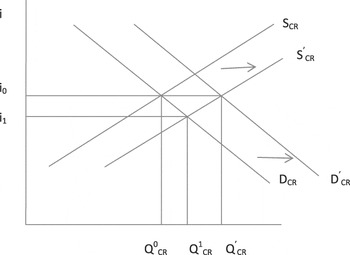
Barro also claims the failure of interest rates to rise in the US during the early 1980s in the presence of increased government debt as proof of the validity of the modern Ricardian equivalence proposition. But a tax cut by the government increases disposable incomes and, thus, increases the flow of savings or increases the demand for financial assets [S = Y(1 – t) – C – ΔHh = ΔFAd, where ΔHh = change in households’ demand for cash] at existing interest rates—a shift of the savings-supply curve to the right (see figure 1).Footnote 21 In the absence of an increase in government debt to be financed by increased borrowing (increased supply of bonds), such a rightward shift of the savings-supply curve (increased demand for financial assets) would have lowered equilibrium interest rates (raised the price of bonds or financial assets), all else given.Footnote 22 But the increased government borrowing may shift the economy’s credit-demand curve to the right (moving along the upward-sloping, increased savings-supply curve) by the same amount as the excess supply of credit (increased demand for financial assets) resulting from the tax cut, therefore leaving equilibrium interest rates unchanged. That is, the increased demand for credit by the government (increased supply of bonds) raises the level of interest rates (decreases price of bonds) beyond the equilibrium level to which they would have declined (risen). If the increased supply of savings (increased demand for financial assets) is less than the increased government demand for credit (increased supply of bonds), equilibrium interest rates would rise (price of bonds fall). Interest rates would fall (price of bonds or financial assets would rise) if the increased supply of savings (increased demand for bonds or financial assets) exceeds the increased government demand for credit (increased supply of bonds). Because of the numerous other factors that affect equilibrium interest rates (inverse of the price of bonds or financial assets), besides changes in the government’s budget deficit, the level of interest rates is quite an unreliable indicator of the effect of changes in government debt.
A tax cut shifts the savings/credit supply curve to the right, creating an excess supply (Q0CRQ′CR) at i0 and decreases the equilibrium interest rate to i1. Increased budget deficit increases the demand for credit and raises the equilibrium interest rate.

Moreover, aggregate data on savings and consumption expenditures do not tell us much about individuals’ reactions to increased government debt. Thus far, the econometric tests using aggregate data, including Levis Kochin’s (Reference Kochin1974)Footnote 23 that Barro (Reference Barro1976) cites in support of his Ricardian equivalence proposition, have missed accurately evaluating individuals’ reactions; hence, the theorem. John Seater (Reference Seater1993) almost accepts this conclusion. He notes that “An initial reading of [the aggregate consumption studies] literature is both confusing and disheartening, suggesting that such tests are uninformative about Ricardian equivalence and that aggregate data are inherently unilluminating” (p. 174). But he is, nevertheless, convinced that when the problems he notes about the studies he reviewed are corrected, “the aggregate consumption data almost always fail to reject Ricardian equivalence.”Footnote 24 This, even though his own attempted corrections do not test individuals’ reactions to variations in the level of government debt.
V. IMPLICATIONS AND CONCLUSIONS
Barro often limits his Ricardian equivalence proposition to arguing about a change in government financing towards more debt and less taxation, while keeping the level of government spending unchanged. The modern Ricardian equivalence theorem thus presumably avoids having to deal with whether increased government spending hurts an economy’s growth. But the effect of government spending on an economy was Ricardo’s principal concern in his discussion of the nature of financing government expenditures. Ricardo argued that (for a closed economy) whatever the government spends must first be taken from the public, and that impairs the community’s capital (savings) accumulation and economic growth, particularly when financed by borrowing. That is why he considered reductions in the level of government spending a surer way to promote economic prosperity than raising taxes in order to reduce the public debt. Ricardo’s argument is, thus, very relevant to current debate on public debt.
By limiting the modern Ricardian equivalence proposition mainly to a switching of the modes of financing, Barro’s argument misses addressing the more relevant issue. If increased government indebtedness has neutral effects on the economy because the public presumably increases its savings in anticipation of increased future taxes, it legitimately may be argued that increased government spending imposes no negative growth effects on an economy. That would be the exact opposite of Ricardo’s concerns and that of other classical writers, including Adam Smith, on the need to restrict government spending to the spheres that may not be safely left to private enterprise; see also Levy (Reference Levy, Buchanan, Rowley and Rollison1986) and Tullio (Reference Tullio1989). Indeed, Barro (Reference Barro1989, p. 37) downplays concerns about the negative economic consequences of budget deficits in the US, arguing:
This crisis scenario has been hard to maintain along with the robust performance of the U.S. economy since late 1982. This performance features high average growth rates of real GNP, declining unemployment, much lower inflation, a sharp decrease in nominal interest rates and some decline in expected real interest rates, high values of real investment expenditures, and (until October 1987) a dramatic boom in the stock market.
Surely, the tax cuts and regulatory reforms of the Reagan administration must be considered far ahead of budget deficits in explaining the positive economic performance in the US during the early 1980s. Similarly, it would be misleading to cite the coincidence of lower nominal interest rates in the United States and rising federal government deficits between 2008 and 2010 as proof of the Ricardian equivalence proposition’s validity without considering the significant increase in Federal Reserve purchases of US Treasury securities, the sharp recession between 2008 and 2009, and the shaken business confidence during the same period.Footnote 25
Barro (Reference Barro1989, pp. 48, 52) also appears puzzled by the reluctance of “most macroeconomists” and “most analysts” to accept his proposition as being relevant to a modern economy. But most analysts know that they themselves do not increase their own savings as a result of having capitalized their higher future tax liabilities as government indebtedness increases. Nor do they believe that they change their consumption spending in response to changes in government indebtedness.
Besides, the variations in the public’s aggregate savings that the modern Ricardian equivalence proposition is supposed to show can be explained in alternative ways that are more convincing. It is also not irrational not to curb one’s consumption spending because of increased government indebtedness if one expects (a) to die soon, (b) not to leave any bequests, or (c) to be able to escape the burden of higher future tax liabilities through emigration or by shifting savings to tax havens. The modern Ricardian equivalence proposition’s claim of future tax capitalization by all individuals as the only rational response to government debt thus appears to be unwarranted.
All government spending has to be financed either through taxation and/or bond issues. Either form of financing draws funds from the public’s savings in a closed economy. The burden of government spending for a closed economy or when government debt is bought by domestic residents only is thus concurrent with its amount, not deferred into the future, Ricardo argued. Future interest payments on the debt are merely transfers from non-bondholders to the public creditors. Emphasizing that point, instead of the government debt’s burdening future generations, almost ignoring the current opportunity cost to the economy, as recently has been asserted regarding the rising deficit spending in the US, is more consistent with Ricardo’s analysis. Besides being the exact opposite of what Ricardo himself wrote about taxpayers’ behavior in response to increased government indebtedness, the modern Ricardian equivalence proposition misses the essence of Ricardo’s criticism of deficit financing.