Exploring Discharge Destination Following Severe Stroke
Every year, 15 million people worldwide experience a stroke (World Heart Federation, 2016), with approximately one-third of survivors displaying severe disabilities (Hakkennes, Hill, Brock, Bernhardt & Churilov, Reference Hakkennes, Hill, Brock, Bernhardt and Churilov2012). Patients with severe stroke often present with a combination of motor, sensory, communication and cognitive impairments, which are typically compounded by other medical complications (Pereira et al., Reference Pereira, Graham, Shahabaz, Salter, Foley, Meyer and Teasell2012). All stroke patients, regardless of severity, should receive rehabilitation for their stroke-induced impairments. However, patients with severe stroke are often considered poorer rehabilitation candidates because they tend to make slower and less significant functional gains compared to mild or moderate stroke patients (Camicia, Wang, DiVita, Mix & Niewczyk, Reference Camicia, Wang, DiVita, Mix and Niewczyk2016; Pereira et al., Reference Pereira, Foley, Salter, McClure, Meyer, Brown and Teasell2014). Clinicians are therefore less likely to prioritise patients with severe stroke in light of scarce healthcare resources (Hakkennes, Hill, Brock, Bernhardt & Churilov, Reference Hakkennes, Hill, Brock, Bernhardt and Churilov2013).
While some studies (Camicia et al., Reference Camicia, Wang, DiVita, Mix and Niewczyk2016; Pereira et al., Reference Pereira, Foley, Salter, McClure, Meyer, Brown and Teasell2014) report slower and less significant functional gains, a growing body of evidence is adding contrasting findings, suggesting that people with severe stroke can make significant gains during rehabilitation (Barker, Brauer & Carson, Reference Barker, Brauer and Carson2009; Mirkowski et al., Reference Mirkowski, Pereira, Janzen, Mehta, Meyer, McClure and Teasell2018; Tabernig, Lopez, Carrere, Spaich & Ballario, Reference Tabernig, Lopez, Carrere, Spaich and Ballario2018). Furthermore, it has been suggested that rehabilitation may increase the number of patients returning home following severe stroke. Specifically, Langhorne, Bernhardt and Kwakkel (Reference Langhorne, Bernhardt and Kwakkel2011) suggested that rehabilitation in an organised multidisciplinary stroke unit could result in more patients, including patients with severe stroke, returning home, while Teasell, Foley, Bhogal, Chakravertty and Bluvol (Reference Teasell, Foley, Bhogal, Chakravertty and Bluvol2005) found that patients with severe stroke were able to return home after making statistically significant improvements in activities of daily living (ADL) performance. Determining where patients with severe stroke are discharged to will thus assist in ensuring appropriate allocation of resources so that these patients can have equal and adequate access to rehabilitation (González-Fernández, Christian, Davis & Hillis, Reference González-Fernández, Christian, Davis and Hillis2013; Meijer, Ihnenfeldt, van Limbeek, Vermeulen & de Haan, Reference Meijer, Ihnenfeldt, van Limbeek, Vermeulen and de Haan2003). Several studies have focused on predicting discharge destination of patients with severe stroke. A comprehensive literature review by van der Cruyssen, Vereeck, Saeys & Remmen (Reference van der Cruyssen, Vereeck, Saeys and Remmen2015) found that patients with severe stroke were less likely to be discharged home than patients with less severe strokes (i.e. patients with more severe stroke were more likely to be discharged to other facilities); however, the systematic review focused only on discharge from acute hospital facilities [i.e. outcomes following discharge from inpatient rehabilitation facilities (IRFs) were not explored] and included studies largely conducted in the United States of America (USA). Hakkennes et al. (Reference Hakkennes, Hill, Brock, Bernhardt and Churilov2012) investigated predictors of discharge destination (IRF vs. Others, including home) for patients with acute severe stroke in Victoria, Australia. Severe stroke was defined as scores of 15 or less on the Mobility Scale for Acute Stroke (Ilett, Brock, Graven & Cotton, Reference Ilett, Brock, Graven and Cotton2010). The study included 108 patients after excluding those admitted from residential care. Younger age, pre-stroke functional independence, bladder and bowel continence, higher cognitive abilities and better mobility significantly predicted discharge to IRFs. However, further external validation of the predictor model was required to determine its applicability to other healthcare systems globally.
Pereira et al. (Reference Pereira, Foley, Salter, McClure, Meyer, Brown and Teasell2014) also examined predictors of discharge destination (Home vs. Long-term care) for patients with severe stroke undergoing rehabilitation in Ontario, Canada. Stroke severity was determined using the Ontario rehabilitation hospitals system, Rehabilitation Patient Groups (Sutherland & Walker, Reference Sutherland and Walker2008). The study included 189 patients after excluding those admitted from residential care and those with prior strokes. Younger age, caregiver availability and higher admission Functional Independence Measure scores significantly predicted discharge home. However, the use of telephone interviews to obtain patient information was a limitation of the study, as patients who were unable to speak over the telephone were excluded, and hence, the final sample could have been insufficiently representative of patients with severe stroke.
Younger age was predictive of discharge to IRFs in the Hakkennes et al. (Reference Hakkennes, Hill, Brock, Bernhardt and Churilov2012) study but predictive of discharge home in the Pereira et al. (Reference Pereira, Foley, Salter, McClure, Meyer, Brown and Teasell2014) study. This lack of agreement regarding age could be attributed to differences in stroke care pathway and discharge destination dichotomisation between both studies. For example, patients in the former study were in the acute phase along the stroke hospitalisation continuum and, thus, were more likely to require rehabilitation before returning home, regardless of age, as compared to patients in the latter study, who were further along the continuum and had already received rehabilitation. Furthermore, Pereira et al. (Reference Pereira, Foley, Salter, McClure, Meyer, Brown and Teasell2014) dichotomised discharge destination as Home versus Long-term care, while Hakkennes et al. (Reference Hakkennes, Hill, Brock, Bernhardt and Churilov2012) grouped these two destinations into an overarching category (Others) and compared it to IRFs. Neither study explored the context of the geographical location of the hospital on discharge home.
Although few studies have explored discharge destination predictors specifically following severe stroke, there have been numerous studies that have examined a wide variety of discharge destination predictors for stroke patients in general. Two international reviews (Mees, Klein, Yperzeele, Vanacker & Cras, Reference Mees, Klein, Yperzeele, Vanacker and Cras2016; van der Cruyssen et al., Reference van der Cruyssen, Vereeck, Saeys and Remmen2015) identified 18 and 19 such studies, respectively. Some factors were relatively consistent in their predictive ability. For example, across both reviews, length of stay (LOS) was found to significantly predict discharge destination. Longer LOS was predictive of institutionalisation, while shorter LOS was predictive of discharge home (Elwood et al., Reference Elwood, Rashbaum, Bonder, Pantel, Berliner, Yoon and Bansal2009; Gregory, Han, Morozova & Kuhlemeier, Reference Gregory, Han, Morozova and Kuhlemeier2006; Nuyen, Spreeuwenberg, Groenewegen, van den Bos & Schellevis, Reference Nuyen, Spreeuwenberg, Groenewegen, van den Bos and Schellevis2008; Tinl, Kale, Doshi, Guarino & Beninato, Reference Tinl, Kale, Doshi, Guarino and Beninato2014).
The two aforementioned systematic reviews by Mees et al. (Reference Mees, Klein, Yperzeele, Vanacker and Cras2016) and van der Cruyssen et al. (Reference van der Cruyssen, Vereeck, Saeys and Remmen2015) also found that other factors, such as gender and stroke type, were inconclusive in their ability to predict discharge destination. While gender was not a significant predictor of discharge destination in the majority of studies identified in the reviews, females were more likely to have less favourable discharge outcomes (i.e. not home), and males were more likely to return home where gender was a predictor (Freburger et al., Reference Freburger, Holmes, Ku, Cutchin, Heatwole-Shank and Edwards2011; Mayo et al., Reference Mayo, Hendlisz, Goldberg, Korner-Bitensky, Becker and Coopersmith1989; Stein et al., Reference Stein, Bettger, Sicklick, Hedeman, Magdon-Ismail and Schwamm2015). Stroke type was also inconclusive between the reviews. Studies in the van der Cruyssen et al. (Reference van der Cruyssen, Vereeck, Saeys and Remmen2015) review found that patients with haemorrhagic strokes were less likely to be institutionalised (Gregory et al., Reference Gregory, Han, Morozova and Kuhlemeier2006; Onukwugha & Mullins, Reference Onukwugha and Mullins2007), while patients with non-haemorrhagic strokes were more likely to have a less favourable discharge outcome (Mayo et al., Reference Mayo, Hendlisz, Goldberg, Korner-Bitensky, Becker and Coopersmith1989). However, studies in the Mees et al. (Reference Mees, Klein, Yperzeele, Vanacker and Cras2016) review found that stroke type did not significantly predict discharge destination.
The above reviews have provided valuable information on discharge destination predictors. However, there are several limitations. Some predictors in these reviews have not been extensively examined. For example, only three studies in the van der Cruyssen et al. (Reference van der Cruyssen, Vereeck, Saeys and Remmen2015) review investigated geographical region as a predictor (Gregory et al., Reference Gregory, Han, Morozova and Kuhlemeier2006 – USA; Gregory & Han, Reference Gregory and Han2009 – USA; Mayo et al., Reference Mayo, Hendlisz, Goldberg, Korner-Bitensky, Becker and Coopersmith1989 – Canada). These authors found that patients living in rural regions were more likely to return home, while patients from metropolitan regions were more likely to be discharged to IRFs. Similarly, only two studies in the same review investigated private health insurance cover as a predictor (Frontera, Egorova & Moskowitz, Reference Frontera, Egorova and Moskowitz2011 – USA; Onukwugha & Mullins, Reference Onukwugha and Mullins2007 – USA). Frontera et al. (Reference Frontera, Egorova and Moskowitz2011) focused on patients with subdural haematoma only and classified patients according to four insurance categories (Medicaid, Medicare, Private and Uninsured). Over 70% of patients in the study had Medicaid or Medicare, with Medicaid patients significantly more likely to require a long-term nursing facility (Frontera et al., Reference Frontera, Egorova and Moskowitz2011). Onukwugha and Mullins (Reference Onukwugha and Mullins2007) found that patients without insurance were less likely to be admitted for further medical care, with the authors suggesting that a lack of insurance may reflect that the uninsured patients were unable to pay for post-hospitalisation care. Private health insurance in Australia typically has two types of cover (which may be taken out together or individually): hospital cover (termed ‘hospital cover’ in this manuscript) and extras cover (termed ‘allied health cover’ in this manuscript). Extras cover usually includes allied health cover and often encompasses non-hospital inpatient health and rehabilitation services. None of the studies in the Mees et al. (Reference Mees, Klein, Yperzeele, Vanacker and Cras2016) review investigated the above two factors, and none of the studies in either review investigated discharge ward as a discharge destination predictor. Another important limitation running through these two reviews is that methodological evaluations of the studies included in the reviews were limited. The authors also acknowledged that meta-analyses of the reviewed studies were difficult due to differences in sample sizes, factors investigated and discharge destination categorisation in each study.
The aims of the current study were to describe the discharge pathways of patients with severe stroke from a single tertiary hospital in Queensland, Australia, and to identify predictors of discharge destination for these patients. It was decided to focus upon a single tertiary hospital in one state in Queensland, as the state holds approximately 20% of Australiaʼs population (Australian Bureau of Statistics, 2018). In the current study, common predictors such as age, gender, stroke type and LOS were explored, as well as geographical region, private health insurance and discharge ward. No previous studies have explored the predictive abilities of the above factors for patients with severe stroke in the Australian context. Predictors identified in other studies may not be entirely applicable for Australia due to global differences in healthcare systems, and caution must be exercised when generalising those findings to the Australian context.
As previous research has suggested that severe stroke may be associated with less favourable discharge outcomes (i.e. not home) (Pereira et al., Reference Pereira, Graham, Shahabaz, Salter, Foley, Meyer and Teasell2012; van Bragt et al., Reference van Bragt, van Ginneken, Westendorp, Heijenbrok-Kal, Wijffels and Ribbers2014; van der Cruyssen et al. Reference van der Cruyssen, Vereeck, Saeys and Remmen2015), it was hypothesised that the majority of patients with severe stroke would not be discharged home. It was further hypothesised that age, LOS, discharge ward, geographical region and private health insurance would be significant predictors of discharge destination. More specifically, older patients with longer LOS, discharged from acute wards, living in metropolitan Queensland and without hospital cover were hypothesised to be less likely to return home.
Methods
Design
This study employed a descriptive, retrospective design to map discharge destinations for patients with severe stroke. In addition, this study also explored factors that predicted discharge destination.
Participants
This study was approved by the Metro South Human Research Ethics Committee and The University of Queensland Human Research Ethics Committee, and was part of a larger project that explored unmet needs and service access of stroke patients. The larger study sample consisted of patients with stroke admitted to a tertiary metropolitan public hospital in Brisbane, Queensland, Australia. Informed consent from participants was not required according to the Public Health Act (2005), as the project required using de-identified information that had been previously collected as part of routine hospital care. Public Health Act (2005) approval to use the information was obtained from the Queensland Government Department of Health. Retrospective data were collected from the hospital electronic medical record system. The current study sample consisted of patients with severe stroke from the larger dataset.
Inclusionary criteria were principal diagnosis of stroke (codes I60–I64) using the International Classification of Diseases (Australian modification) 2010 (ICD-10-AM), and admission and discharge between January 2011 and December 2016 inclusive. Exclusionary criteria were non-severe (i.e. LOS < 23 days) single stroke admissions. Where patients had more than one stroke in the time period, at least one stroke had to be severe (i.e. LOS > 22 days) for the patient to be included in the study (see Procedure for rationale). Patients with severe stroke who died in hospital or had an unspecified stroke (i.e. neither haemorrhage nor infarct) were also excluded.
Variables
The outcome variable in this study was discharge destination, which was dichotomised as Home (pre-admission location) and Others (including long-term care facilities, other hospitals and correctional facilities). Independent variables were chosen based on previous studies and available data. Measures of interest included gender (Male, Female), age upon admission, private insurance cover for hospital accommodation (Yes, No), private hospital cover for allied health services (Yes, No), geographical region (Metro, Rural and Others), stroke type (Haemorrhage, Infarct) and LOS. In addition, discharge ward (Acute, Rehabilitation) was evaluated as a predictor.
Procedures
LOS was used as a proxy measure for stroke severity (Camicia et al., Reference Camicia, Wang, DiVita, Mix and Niewczyk2016; Freburger et al., Reference Freburger, Holmes, Ku, Cutchin, Heatwole-Shank and Edwards2011; Hakkennes et al., Reference Hakkennes, Hill, Brock, Bernhardt and Churilov2012; Pereira et al., Reference Pereira, Foley, Salter, McClure, Meyer, Brown and Teasell2014; Stein et al., Reference Stein, Bettger, Sicklick, Hedeman, Magdon-Ismail and Schwamm2015) as no systematic or formal assessment was used to determine severity at the time. Deb and colleagues (Reference Deb, Reddy, Alam, Razvi, Paul, Babu and Prabhakar2014) suggested that severe stroke was associated with longer LOS. While multiple studies have documented LOS for patients with severe stroke (Camicia et al., Reference Camicia, Wang, DiVita, Mix and Niewczyk2016; Deb et al., Reference Deb, Reddy, Alam, Razvi, Paul, Babu and Prabhakar2014; Pereira et al., Reference Pereira, Foley, Salter, McClure, Meyer, Brown and Teasell2014), the average of 22.2 days (Camicia et al., Reference Camicia, Wang, DiVita, Mix and Niewczyk2016) was used as a benchmark for severe stroke in the current study as their participant criteria most closely reflected that of the current study. All stroke cases were included, regardless of aetiology and occasions of occurrence, whereas other studies were more restrictive in participant criteria and characteristics. Hence, severe stroke was defined as LOS > 22 days in the current study.
Patient information (i.e. discharge destination, gender, age at admission, LOS, discharge ward, stroke type, health fund cover and suburb) was extracted from the larger dataset and entered into a Microsoft Excel spreadsheet. Patients were then assigned a de-identified number to ensure confidentiality. Discharge destination was dichotomised into two broader categories from the original dataset – Home [i.e. usual residence (including residential aged care facilities if this was the patientʼs pre-admission address), discharged at own risk, non-return from leave] and Others (i.e. residential aged care services, other healthcare establishment, episode change, correctional facility, hospital transfer and other), while specific hospital wards were grouped into the broader categories of Acute and Rehabilitation. Participants were only identified as Others for discharge destination (including discharge to a residential aged care facility, another hospital and another healthcare facility) if the participant did not reside at that location at the time of admission to hospital with the stroke. Stroke type was coded by hospital staff using the ICD-10-AM for the larger dataset, and then grouped into the broader categories of Haemorrhage and Infarct for the current study. The variables of hospital accommodation cover and allied health services cover were grouped according to patients’ health fund coverage as indicated in the larger dataset.
The Australian Statistical Geography Standard (Australian Bureau of Statistics, 2017) was used to guide the creation of a three-level categorisation for the geographical region in which patients resided – Metropolitan, Rural and Others, and patients were then stratified into these regions based on their suburbs. The categorisation was based on the Australian Bureau of Statistics Remoteness Areas (Australian Bureau of Statistics, 2016). Metropolitan referred to Major Cities of Australia (Remoteness Area Category 0); Rural referred to Inner Regional Australia (Remoteness Area Category 1), Outer Regional Australia (Remoteness Area Category 2), Remote Australia (Remoteness Area Category 3), Very Remote Australia (Remoteness Area Category 3) and Other referred to other Australian states and overseas.
Data analysis
The data were transferred into STATA (version 14) for analysis. Descriptive statistics were used to describe patient characteristics and were presented as means and standard deviations for continuous variables, and proportions for categorical variables. LOS and age were plotted to assess the normality of the underlying distribution. LOS was not distributed normally, with outliers of longer LOS. Hence, outliers more than three standard deviations above the mean (i.e. LOS > 243) were removed, using the three-sigma rule (as used elsewhere by Pukelsheim, Reference Pukelsheim1994) to ensure normality of LOS distribution. The Lowess smoothing plot was used to check for linearity of the logit, and variance inflation factor (VIF) values were used to check for collinearity between variables. Collinearity was ruled out as VIF values for all variables were below 10 (Marquardt, Reference Marquardt1970).
Binomial logistic regression with forced entry was used to identify predictors of discharge destination, with gender, age, geographical region, hospital cover, allied health cover, discharge ward and LOS as variables. Values of p < 0.05 were considered significant, and results of the regressions were presented as odds ratios with 95% confidence intervals. Predictive model accuracy was assessed using the estat classification tool in STATA.
Results
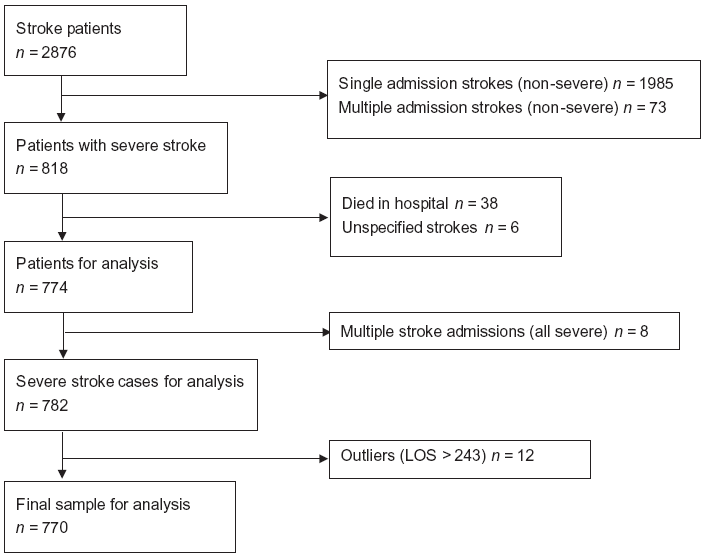
A total of 2876 patients were admitted with a principal diagnosis of stroke. After exclusion, 774 patients remained in the study sample (Fig. 1). Eighteen of the 774 patients had multiple (i.e. 2) stroke admissions between January 2011 and December 2016. Of which, eight were admitted for severe strokes on both occasions. For the purposes of this study, number of admissions rather than number of patients was used for analyses. Hence, the additional eight admissions were included in the total sample, resulting in 782 admissions. After removing outliers, 770 admission cases were included in the final analysis.
Population hierarchy chart.

The regression model contained eight independent variables – age, LOS, gender, hospital cover, allied health cover, discharge ward, stroke type and geographical region. The full model containing all predictors was statistically significant (χ2 (10, N = 770) = 164.61, p < 0.001), indicating that the model was able to distinguish between patients who returned home and patients discharged elsewhere. The model as a whole explained 36.50% (Nagelkerke R 2 = 0.365) of the variance in discharge destination and correctly classified 63.50% of cases. The Hosmer–Lemeshow goodness of fit was significant (χ2 (10, N = 770) = 19.36, p = 0.013), suggesting that the model was not a good fit.
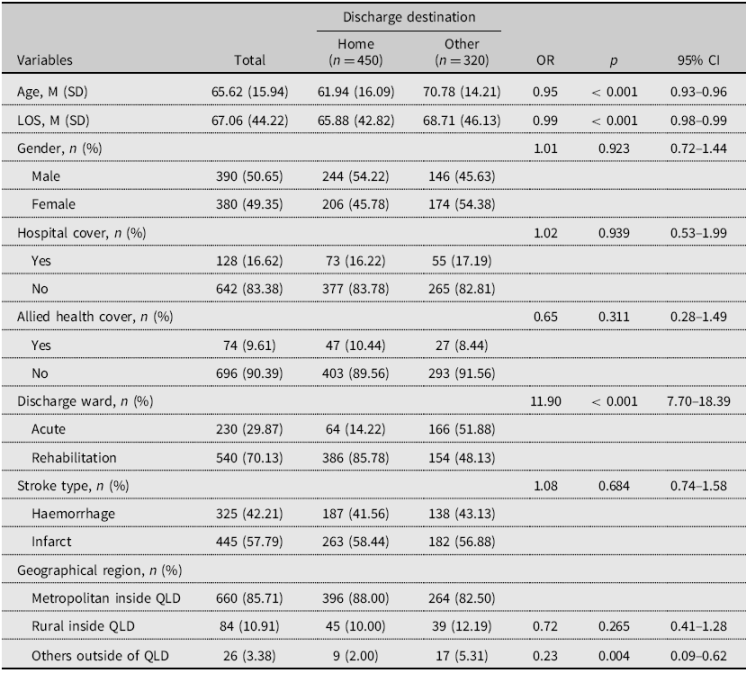
Table 1 details patient characteristics across the two discharge destinations. Of the 770 patients included in the analysis, 450 (58.44%) were discharged home, and 320 (41.56%) were discharged elsewhere. Patients who returned home were generally younger than those discharged elsewhere. LOS was also relatively shorter for patients who returned home than for those discharged elsewhere. Additionally, the results suggested that male patients with infarcts, without hospital and allied health cover, discharged from rehabilitation wards and living in metropolitan Queensland were more likely to return home (see Table 1).
Patient Characteristics and Results of Logistic Regression Analysis for Discharge Destination (Home vs. Others)

CI, confidence interval; LOS, length of stay; OR, odds ratio; QLD, Queensland.
For the results of the logistic regression for discharge destination, four of the independent variables (age, LOS, discharge ward and geographical region) were statistically significant (p < 0.05) in predicting discharge destination (see Table 1). The results indicated that with every year increase in age, the odds of discharge home were likely to decrease by 5.40%. Similarly, for each day increase in LOS, the odds of discharge home were likely to decrease by 1.40%. Patients discharged from rehabilitation wards were 11.69 times more likely to be discharged home than those discharged from acute wards, while patients living outside of Queensland were 76.84% less likely to be discharged home compared to those from metropolitan Queensland. Gender, hospital cover, allied health cover and stroke type were not statistically significant predictors (p > 0.05) of discharge destination.
Discussion
The aims of this study were to describe the discharge pathways of patients with severe stroke from a single tertiary hospital in Queensland, Australia, and examine the ability of sociodemographic variables to predict discharge destination. Although it was hypothesised that the majority of patients with severe stroke would not return home, the results did not support this hypothesis as more patients were discharged home than to other destinations. Specifically, it was found that over half of patients were discharged home. Furthermore, age, LOS, discharge ward and geographical region emerged as significant predictors of discharge destination. These results highlight the importance of these variables in influencing the outcomes of patients with severe stroke.
The difference in the original hypothesis and the results could possibly be accounted for by new models of care. For example, Langhorne et al. (Reference Langhorne, Bernhardt and Kwakkel2011) suggested that rehabilitation provision in an organised multidisciplinary stroke unit could result in more patients, including patients with severe stroke, returning home. Furthermore, Teasell et al. (Reference Teasell, Foley, Bhogal, Chakravertty and Bluvol2005) found that patients with severe stroke were able to return home after making statistically significant improvements in ADL performance. These findings lend support to the current studyʼs results, given that the majority of the patients in this study were discharged from rehabilitation wards. It is also possible that in some cases scarce resources for non-home-based care mean that families are being asked to look after increasingly severely disabled relatives at home. In the present study, the mean age of participants who returned home was 61.94 years while the mean age of participants who did not return home was 70.78 years. While this appears quite young for the stroke population, it must be noted that the average age of stroke is decreasing due to an increase in the presence of traditional risk factors for stroke in younger adults (Maaijwee, Rutten-Jacobs, Schaapsmeerders, Van Dijk & de Leeuw, Reference Maaijwee, Rutten-Jacobs, Schaapsmeerders, Van Dijk and de Leeuw2014).
Age, LOS, discharge ward and geographical region emerged as significant predictors of discharge destination. As anticipated, older patients were less likely to return home. Old age is often reported to be accompanied by physical changes and medical comorbidities, which increase the likelihood of dependence on caregivers (Ween, Alexander, D’Esposito & Roberts, Reference Ween, Alexander, D’Esposito and Roberts1996). Furthermore, Pereira et al. (Reference Pereira, Foley, Salter, McClure, Meyer, Brown and Teasell2014) found that caregivers of older patients, often spouses, were generally older than those of younger patients, and those older caregivers reported a reduced capacity to care for their spouses due to their own deteriorating health and old age.
Longer LOS, as predicted, was also found to be associated with decreased odds of returning home in the current study. This was consistent with previous studies (Elwood et al., Reference Elwood, Rashbaum, Bonder, Pantel, Berliner, Yoon and Bansal2009; Gregory et al., Reference Gregory, Han, Morozova and Kuhlemeier2006; Nuyen et al., Reference Nuyen, Spreeuwenberg, Groenewegen, van den Bos and Schellevis2008; Tinl et al., Reference Tinl, Kale, Doshi, Guarino and Beninato2014). Longer LOS has been associated with lower ADL scores, suggesting that patients who remained in hospital longer were less likely to be functionally independent and, thus, more likely to be discharged to long-term care facilities (Ohwaki, Hashimoto, Sato, Tokuda & Yano, Reference Ohwaki, Hashimoto, Sato, Tokuda and Yano2005).
As expected, patients discharged from rehabilitation wards were more likely to be discharged home. Although there has not been much research surrounding discharge ward as a discharge destination predictor per se, several studies have examined the impact of inpatient rehabilitation on discharge destination (Bindawas, Mawajdeh, Vennu & Alhaidary, Reference Bindawas, Mawajdeh, Vennu and Alhaidary2016; Hakkennes, Brock & Hill, Reference Hakkennes, Brock and Hill2011). Patients who received inpatient rehabilitation in these studies had significantly improved functional outcomes and were more likely to be discharged home. It must be noted that there is usually a selection process for which patient is admitted to a rehabilitation ward in the first place. Therefore, if a patient is admitted to a rehabilitation ward, there is an increased likelihood of improved functional outcomes and discharge home. This means that the improved functional outcomes and discharge home may have indeed been due to the effect of the rehabilitation; however, they may also have reflected the effect of the selection of which patients receive rehabilitation.
There is a need to determine who will benefit most from rehabilitation in a setting where healthcare funding and resources are scarce (Hakkennes et al., Reference Hakkennes, Hill, Brock, Bernhardt and Churilov2013). Research has suggested that though patients with haemorrhagic strokes tend to have greater disabilities and slower recovery time than patients with infarcts, they generally achieve significantly greater functional gains with rehabilitation (Katrak, Black & Peeva, Reference Katrak, Black and Peeva2009; Koyama, Sako, Konta & Domen, Reference Koyama, Sako, Konta and Domen2011). The present study supports the same result in that stroke type (haemorrhagic or infarct) was not a significant predictor of discharge home. Interestingly, Lynch, Luker, Cadilhac and Hillier (Reference Lynch, Luker, Cadilhac and Hillier2016) found that rehabilitation clinicians were less likely to provide active goal-directed therapy to patients with severe stroke who they anticipated would be discharged to residential care. This could be reflective of clinicians’ perceptions that patients discharged to care facilities have poorer rehabilitation potential and would be unlikely to make substantial functional gains.
In the present study, patients residing outside of Queensland were less likely to be discharged home than those who were from metropolitan Queensland. This could be explained by the need for air travel to return home if they did not reside in Queensland. Given the general poor health of patients with severe stroke, the physical and emotional stress of air travel could lead to further health complications such as venous thromboembolism and respiratory difficulties (Bourell & Turner, Reference Bourell and Turner2010; Philbrick, Shumate, Siadaty & Becker, Reference Philbrick, Shumate, Siadaty and Becker2007). Discharge home thus might not be a viable option for patients with severe stroke who reside outside of Queensland.
There were a number of non-significant predictors in the present study. As hypothesised, gender, stroke type and allied health cover were not significant predictors of discharge destination in the current study. The findings regarding gender and stroke type were consistent with those of other studies in the literature (e.g. Ohwaki et al., Reference Ohwaki, Hashimoto, Sato, Tokuda and Yano2005; Tinl et al., Reference Tinl, Kale, Doshi, Guarino and Beninato2014).
Although geographical region (Metro vs. Rural) and hospital cover were hypothesised to be significant discharge destination predictors, the results suggested that they were not. The current study findings contradicted those of other studies, where patients without private health insurance cover and living in rural regions were more likely to be discharged home (Gregory & Han, Reference Gregory and Han2009; Onukwugha & Mullins, Reference Onukwugha and Mullins2007). However, these differences in results could be attributed to differences in discharge destination categorisation between the studies. For example, Gregory and Han (Reference Gregory and Han2009) categorised destination as Home and IRF, whereas IRF was not included as a discharge destination in the current study. The present study explored discharge destination from the total length of hospital stay (i.e. patients were discharged from either acute or rehabilitation wards); IRF was not therefore a discharge destination in the present study. Future research could explore the differences in discharge pathways from only acute hospital setting (i.e. with IRF as a discharge destination).
Limitations
There are several limitations to this study. Firstly, the study employed the use of retrospective data. In the absence of research questions and aims guiding data collection, other sociodemographic patient information that could have informed potential predictors may not have been collected, such as pre-admission locations and whether these patients received rehabilitation services prior to discharge. Furthermore, the retrospective nature of the study led to the use of LOS as a proxy for stroke severity due to the absence of formal severity measures at the time of data collection. This could have resulted in confounding effects on the other variables for this population. It is possible that people who would be classified clinically as having a mild or moderate stroke could still end up in the severe LOS category. There is a need for future, prospective studies that involve data collection from a number of hospital sites and include a broader range of variables. Additionally, post codes were not available for out of state patients, preventing further exploring of cross-border transfer issues. Even though 20% of Australiaʼs population is based in Queensland, the generalisability of the results is limited by the restriction of the sample to a single hospital (albeit large hospital) in Queensland. It must also be noted that the model explained 36.50% (according to Nagelkerke R 2) of the variance in discharge destination. This suggests that other variables not explored in the current study may predict discharge destination. Finally, though the exclusion of patients with LOS > 243 days was necessary to fit the statistical assumptions for the regression model, this could have increased the likelihood of selection bias. The study sample could therefore have had an under-representation of the most severe patients and thus influenced the generalisability of the results to the wider severe stroke population.
Conclusion
This study has shown that the majority of patients with severe stroke admitted to a single tertiary hospital in Queensland, Australia were discharged home. It has also demonstrated that discharge destination was influenced by age, LOS, geographical region and discharge ward. However, it is important to understand that the discharge processes depend on a complex interaction of the identified predictors as well as factors beyond those examined in this study. The model is not proposed as tools to determine these outcomes but rather to assist in quicker identification of patients most suitable for discharge home and aid in rehabilitation planning processes. The study also adds weight to the argument that severe stroke does not necessarily equal poor candidacy for therapy. The information gathered may also assist clinicians in planning and advocating for alternative therapy options such as home care and rehabilitation services via telehealth, in the hopes of improving the outcomes for patients with severe stroke.
Acknowledgements
The authors would like to thank Professor Asad Kahn and Professor Steven McPhail for assistance with data analysis.
Financial support
This project did not receive financial support.
Conflict of interest
Emma Finch has no conflicts of interest to disclose. Wei Lin Teoh has no conflicts of interest to disclose.
Ethical standards
The authors assert that all procedures contributing to this work comply with the ethical standards of the relevant national and institutional committees on human experimentation and with the Helsinki Declaration of 1975, as revised in 2008.