In the closing scenes of Suspiria Footnote 1, a group of women of varying ages, dressed in loose, wavy clothing, sit on short stools, forming a semicircle in the dark basement of a Tanzakademie in 1970s Berlin. A summoning ritual is underway, and the camera pans out to reveal two more female bodies arranged in a star shape; their faces are obscured by their long, wavy hair, hanging in front of them like veils. One dancer’s knees are turned inward, resting against the bare ribs of another body. The dancer’s limp wrists are held up by a woman with long grey curls covering her exposed breasts. She is mouthing the word “geboren” (German for “being born”). The camera frame keeps expanding to reveal a line of naked female dancers standing in front of them. They rise and fall to the floor as if already possessed by the entity they seek to summon. They start on their knees, jerk their torsos abruptly, and open their chests to the ceiling. They soon contract again, curling their spines and resting their heads on the floor, before they repeat the sequence. On the sidelines, a monstrously deformed female figure, with sagging flesh full of glistening blisters and poorly healed wounds, watches them gleefully. She is anticipating her rebirth, which, if successful, would signal a return to dark historical times.
A few decades later, in an idyllic rural commune in Sweden, where the plot of Midsommar (Aster Reference Aster2019) takes place, a different ritual unfolds. In a wooden hut, a group of naked women is standing in a circular shape, breathing in synchronicity. Akin to the chorus in an ancient Greek tragedy, they frame a mating ritual taking place in the fictional village of Hårga. They hold on to each other’s shoulders and vocalize as they witness the coerced intercourse between a female commune member and a man visiting the commune as an outsider. The man has been drugged and forced to participate in this ritual, which seeks to produce the future offspring of the commune and ensure the continuation of their extremist ideologies into the next generation. The ritual is rife with violence (due to the non-consensual nature of the intercourse depicted), yet its darkness is disguised by the warm smiles painted on the chorus’s faces and the communal, meditative quality of their movements as they oscillate gently side by side, held together by bent elbows.
At first sight, the narratives of these two critically acclaimed horror films from the late 2010s unfold in vastly different contexts. Yet, upon a more careful look, their similarities begin to emerge. The movement vocabularies, aesthetics, and choreographic approaches used, the transformations that the protagonists undergo from everyday women into monstrous-femmes, and the ways both films approach historical reckoning warrant a parallel analysis.
As discursive artifacts, horror films are sites where allegorical conflicts can be tested and resolved in often outrageous scenarios. It is thus no coincidence that, historically, horror has risen in popularity during times of crises, disguising contemporary anxieties into abhorrent monsters and giving viewers an opportunity for imaginary retribution. Suspiria and Midsommar, both produced primarily by American film studios, are situated within the sociopolitical, temporal, and geographical contexts of their release: a period marked by the resurgence of the #MeToo movement and the alarming rise of White supremacist rhetoric in the US. These considerations are present in both films as the young White female protagonists negotiate their agency and the legacies of White supremacy in the respective communities they are navigating. Both protagonists do so by responding to embodied stimuli, either through dance training (Suspiria) or through participation in embodied folk rituals (Midsommar), thereby necessitating their analysis in tandem.
The films’ exploration of White supremacy is a widely recognized trait discussed extensively in existing scholarship. While this critical discussion is more prevalent for Midsommar (Andres Reference Andres2021; Baran Reference Baran2023; Bigelow Reference Bigelow2023; Imre Reference Imre, Baker, Iacob, Anikó and James2024; Spadoni Reference Spadoni2020) than for Suspiria (Belling Reference Belling2023; Howard and Murphet Reference Howard and Murphet2022; Lim Reference Lim2023), a common methodological thread unites them: the tendency to approach the films’ ethnonationalist portrayals from a narrative or genre-driven perspective. Thus, with the notable exceptions of Belling (Reference Belling2023) and Lim (Reference Lim2023), the existing scholarship on the historical underpinning of both films largely overlooks the central role that embodiment plays in their narratives.
The need for an embodied analysis is particularly salient given the history of the “corporeal turn” in film studies, which, inspired by scholarship on film phenomenology in the legacy of the works of feminist film scholars (Clover Reference Clover1992; Creed Reference Creed1993, Reference Creed2022; Williams Reference Williams1991, revisited recently by Diffrient Reference Diffrient2023), has long discussed horror as a “body genre.” While foundational, the discourse of the “body genre” is primarily concerned with audiences’ sensory responses, and overlooks the embodied knowledge prioritized within dance studies frameworks and choreographic analysis approaches. In this article, I propose a slight reframing of the “body genre” by shifting the focus from audience response to the dancing bodies themselves and the embodied archives that inform the choreographic sequences in the two films. I bring dance studies and choreographic analysis into conversation with film studies and horror studies to explore how dance and embodied gestures reckon with the legacies of White supremacy in Suspiria and Midsommar.
I lean on Kartik Nair’s (Reference Nair2022) and Usha Iyer’s (Reference Iyer2020) phenomenological approaches to consider the “corporeal history” of film bodies. Echoing Iyer, Nair proposes an understanding of the “onscreen body as a ‘composite’ assemblage made up of other bodies, such as the onscreen dancing body, as a composite made up of backup dancers, doubles, and dance teachers” (2022, 160). This framework helps trace not only the bodies captured on screen but also their ghosts—those absent in flesh and blood yet still shaping the corporeal renderings onscreen.
The mention of ghosts is a deliberate nod to the framework of hauntology that informs this article. The term hauntology was first introduced by Jacques Derrida (1993/Reference Derrida2006) in his book Specters of Marx, which concerned spectrality as an unavoidable non-presence that “haunts” the structure of every hegemony. In the context of horror films, and specifically the subgenre of folk horror, which describes both films, hauntology is “posited in opposition to nostalgia” (Andres Reference Andres2021, 85) and refers to elements or artifacts from the cultural and social past that return in the manner of a ghost. Mark Fisher, a prominent champion of the inclusion of the term in academic cultural study, offers a helpful breakdown of hauntology in two areas that pertain to this article’s scope:
The first refers to that which is (in actuality is) no longer, but which remains effective as a virtuality (the traumatic ‘compulsion to repeat,’ a fatal pattern). The second sense of hauntology refers to that which (in actuality) has not yet happened, but which is already effective in the virtual (an attractor, an anticipation shaping current behaviour). (emphasis in original Reference Fisher2012, 19)
This tension —between an actuality that no longer exists and a future shaped by its absence, as articulated by Fisher— is evident in both films. It permeates the films’ narrative arcs and is latent in specific objects the protagonists engage with, enriching each film’s chronotope. In line with the framework of hauntology, I refer to such instances as ghosts. In this article, ghosts manifest in two distinct ways: either as immaterial ideology that shapes the embodied repertoire captured on screen (such as “Laban’s ghost”), or as material objects that play a pivotal role in foreshadowing the films’ climax (such as a book or a journal that the characters engage with). As the following sections describe, these ghostly traces are deeply embedded in the movements of the protagonists, as they unearth authoritarian and extreme nationalist aesthetics, trigger the protagonists’ monstrous transformations, and ultimately awaken their sense of individual agency.
Folk Horror and the Ghosts of Totalitarian Aesthetics
Luca Guadagnino’s Suspiria follows Susie Bannion (Dakota Johnson) as she leaves her Mennonite family in Ohio and travels to Berlin during the German AutumnFootnote 2 of 1977 to study dance at the prestigious Tanzakademie (Dance Academy) of Madame Blanc (Tilda Swinton). The academy turns out to be a coven of witches, and throughout the film, viewers follow Susie, who gradually grows into her powers and takes on the lead role in the revival of a company repertory piece called Volk (German for “people”). Susie’s natural talent for dance assists with her quick ascension in the echelons of the Tanzakademie until she is eventually reborn as Mother Suspiriorum Footnote 3 (Mother of Sighs), a demonic entity that the coven seeks to revive.
Ari Aster’s Midsommar tells the story of Dani (Florence Pugh), a young woman whose sister kills their parents and commits suicide in the opening moments of the film. Dani is in a dysfunctional relationship with Christian (Jack Reynor), a self-absorbed PhD student in Anthropology who repeatedly dismisses her feelings and gaslights her. In the process of recovering from the grief of the traumatic loss of her parents, Dani reluctantly joins Christian on a field trip with his graduate school friends to the idyllic Swedish village of Hårga to observe the community’s traditional midsummer festivities. As it is slowly revealed, the Hårgans are a White supremacist cult who methodically isolate Dani and coax her to become one of them. Dani’s transition to their skewed morality is a slow process and is achieved through partaking in hallucinogenic drugs and absurd rituals. One of the key moments in the film is Dani’s participation in the Maypole dance ritual, where she is deemed the winner and crowned May queen. This moment signals her surrender to the community as she begins to view herself as one of them, fully embracing her role as the new “leader” of the commune.
These brief plot summaries introduce some of the common threads between the two films. Their narrative arcs follow young female protagonists who travel from the US to Europe and immerse themselves in close-knit local communities with arguably skewed belief systems and questionable practices. Both women are propelled to go on these journeys in response to the severing of their relationships with their maternal figures, a narrative trope explored in more detail in later sections. They gradually become enmeshed in the communities they enter, and both films’ climaxes revolve around complex dance rituals, which herald the demise of many of the other characters.
This narrative structure is typical of what Adam Scovell has defined as the “folk horror chain” (Reference Scovell2017, 17-18). The chain is as follows: Landscape - Isolation - Skewed Belief Systems and Morality - Happening/Summoning. This sequence of events translates into characters finding themselves in a new (often rural) landscape, isolating them from the rest of the world. As they attempt to adjust to this new environment, the protagonists become susceptible to the skewed belief systems upheld by the communities they enter. In both instances, the skewed beliefs pertain to extremist ideologies of White supremacy, which drives the characters’ internal conflict. Will they become complicit in these legacies, or will they break the cycle?
Beyond rendering the narrative progression of the “folk horror chain” clear, these brief plot descriptions also preface the catalytic role that dance plays in both films. In Suspiria, movement is the locus of occult power, given shape under the creative direction of choreographer Damien Jalet. The film is haunted by rich references to German Ausdruckstanz pioneers (such as Rudolf von Laban and Mary Wigman) and other female proponents –often deemed “mothers” of European and American modern dance, who were alive and active (perhaps even complicit) during the era of National Socialism in the 1930s. Set in the 1970s amidst real events, the National Socialist legacy is built into Suspiria as a hauntological virtuality and a constantly looming, albeit dormant, omnipresent threat.
The repertory piece that the Tanzakademie is rehearsing for, titled Volk, is historicized as a piece initially choreographed in 1948 in response to the restrictions imposed on the arts during the National Socialist rule in Germany, a period when artistic production was strictly censored and forced to align with the goals of the Propaganda Ministry (Karina and Kant Reference Karina and Kant2004). Even though the piece was created after artistic freedom was reinstated, Volk’s choreography is still haunted by the ghosts of totalitarian aesthetics, such as the choreographic tactic of juxtaposing a soloist (a stand-in for the leader) with a movement choir. Hans Fischer refers to this as Führerschaft [Leadership], a concept that positions the soloist “as leader, as center, or as opposition to the moving mass of the dancers” (Reference Fischer1928, 241). In her analysis of Wigman’s choreographic work, Susan Manning (Reference Manning2006) identifies a similar dynamic, which she captures with the term Führerprinzip (leadership principle). Even though Midsommar is not haunted by real historical figures or legacies, the totalitarian aesthetic of the Führerprinzip is still present in the ways invented folk traditions come to life and in the meticulously choreographed moments that permeate the film.
Midsommar’s choreographer, Anna Vnuk, revealed in an interview that the entire film is, in some ways, a complex dance routine (Vnuk cited in Healy Reference Healy2022, 75). Associate choreographer Tove Skeidsvoll confirmed this in our interview as well, by highlighting how the placement of actors in every single frame seemed like “a very carefully orchestrated choreography” (Skeidsvoll Reference Skeidsvoll2024) to cultivate an extreme sense of community. For instance, viewers observe pairs of background actors folding sheets with choreographic precision, twirling under the stretched fabric in graceful unison before folding it in half. In another scene, young girls are plucking flowers from a field. They all move backwards in unison and bend their knees in the exact same fashion as one another to collect the blooms. Everything appears to be a carefully orchestrated ritual lacking any trace of spontaneity. The purpose behind such extreme unison was to create an unsettling sense of synchronicity that defies individuality and evokes a level of militaristic discipline akin to that of totalitarian regimes, such as National Socialism. In fact, several artifacts in the film deliberately evoke connections to such legacies and incorporate them into the mythology of the Hårgan commune.
Much of Midsommar’s narrative revolves around Nordic runes, which the commune residents study extensively. The meanings attributed to the runes are fictional, yet early on, it is suggested that they are associated with extremist ideologies. A book with a bright yellow cover titled The Secret Nazi Language of the Uthark is featured in several scenes and suggests that the Hårgan community is espousing Nazi ideology. The “secret language” of the runes also extends to the choreography. Vnuk studied the runes and assigned a gesture to each, which was later used to create the movement sequences featured in many scenes, including the highly nuanced yet subtle gestures shared across community members. Throughout the film, Dani’s gestures gradually align with those of the Hårgans, thus further solidifying her progressive acceptance of the cult’s ideas.
The centrality of dance and embodied ritual at the core of these invented Hårgan customs helps narratively solidify their traditions as long-established cultural practices. Compared to the international visitors invited to Hårga who stand out as individuals (due to their casual clothing choices, mannerisms, and diverse ethnic backgrounds), the Hårgans appear like an unnaturally uniform collective devoid of individual quirks or personality. Even though Dani gradually embraces Hårgan mannerisms, she still maintains her individuality to some extent, which continues to set her apart in a dynamic akin to the Führerprinzip.
Having prefaced some of the ways in which Susie’s and Dani’s embodiment is informed by hauntological references to extremist White supremacist ideologies, the next section delves deeper into the historical references haunting the gestural and narrative landscapes of the films and examines their negotiation as (invented) traditions.
Gestural Hauntings and Invented Traditions
In Suspiria, dance is how occult power is activated. This becomes clear early in the film when Susie auditions, and her dancing awakens Mother Markos, the dormant former “mother” (i.e., previous company director) of the Tanzakademie. Markos’s supernatural awakening is paralleled to the unearthing of dark aspects of history. Wesley Lim (Reference Lim2023) has extensively addressed dance and the use of breath in Suspiria as vehicles for evoking German history and the National Socialist legacy of Ausdruckstanz. Lim examined breath in conjunction with dance in the film’s first half, primarily focusing on Susie’s audition and subsequent rehearsals for Volk, which introduced audiences to Susie’s occult potential. The audition is the first time audiences are introduced to Susie’s supernatural abilities, as her movements cause Olga’s (a former company member played by Elena Fokina) demise. Lim (Reference Lim2023) has thoroughly illustrated how Mary Wigman’s legacy of Ausdruckstanz is present in Volk and Suspiria and has briefly discussed Laban’s influence through the lens of movement principles. I build on Lim’s argument concerning the history of Ausdruckstanz that informs the movement sequences in Suspiria, uncovering further hauntological references in the film, such as indirect allusions to Laban’s principles, which I refer to as “Laban’s ghost.” “Laban’s ghost” allows for an examination of the absence of masculinity in Suspiria and a consideration of the role that the male gaze plays in portrayals of the monstrous-feminine. Given that the coven operates as a matriarchy, the monstrous-feminine is narrowed down to a consideration of the monstrous maternal. The choice to juxtapose the live and moving bodies of the female academy members with Laban’s ghostly presence deliberately speaks to the erasure of male influence and the centering of the feminine experience.
Suspiria is a film that deliberately centers on women and their roles and experiences in dealing with the aftermath of Nazi Germany. It is no coincidence that the only male character of significance in the film (Dr. Klemperer) is played by Tilda Swinton in make-up prosthetics. This choice frames the company hierarchies (and the film’s semiotics) as matriarchal and, as I will later argue, poses questions about labeling important female dancers as “mothers” of a genre.
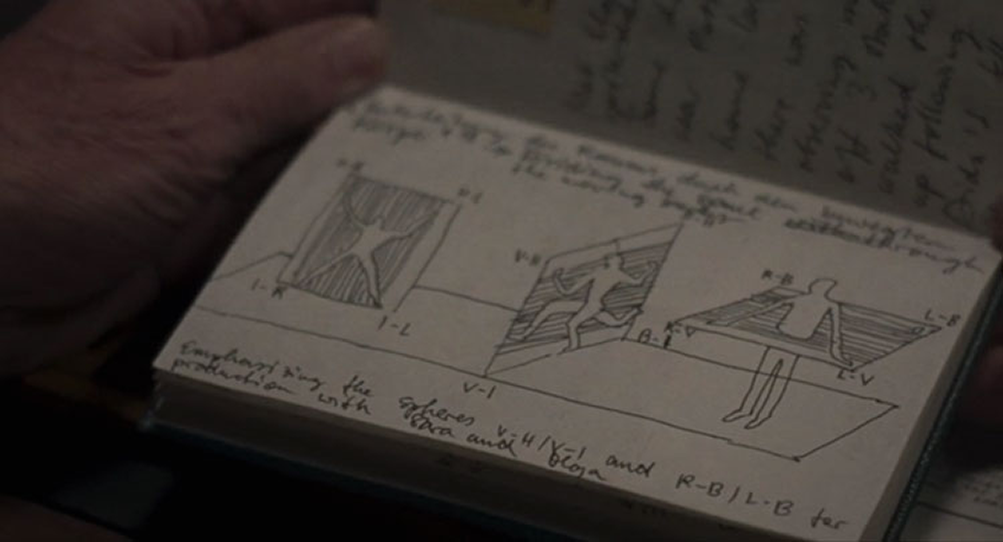
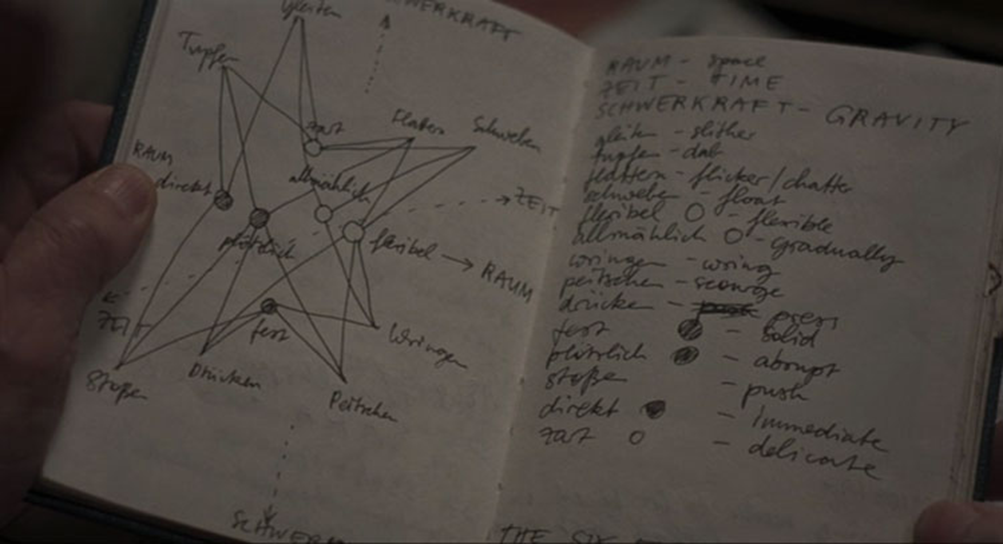
In the film’s first half, psychiatrist Dr. Klemperer investigates the disappearance of a Tanzakademie member, Patricia (Chloë Grace Moretz), who was once his client. In the process of gathering clues, he skims through Patricia’s journal, and the camera zooms to two instances of handwritten notes that are sketches directly referencing Laban’s theories (Photos 1 and 2). Digitally drawn versions of these sketches appear in various scholarly books documenting Laban’s theories (such as Thornton Reference Thornton1971; Laban Reference Laban and Ullman1975; Ullman Reference Ullman1975), thus weaving direct connections between Laban’s philosophical mysticism and Suspiria’s occult mythology. Laban’s principles of effort-space affinity (Photo 2), which correlate the inner psychological space to the external space of bodily movement, are explored in several dance sequences choreographed for the film. As such, Laban’s influence on the development of German Ausdruckstanz is covertly credited. Laban’s name is never mentioned by any of the characters in the film, yet his legacy is present in the performers’ movements and solidifies the film’s chronotope.
Screenshot from Suspiria (2018) 45:05. Drawings of Laban’s Cardinal Planes depicted in Patricia’s diary.

Photo 1. Long description
The sketch consists of three panels arranged horizontally across a page of Patricia's diary. Each panel features a simplified human figure interacting with a specific geometric plane.
* The left panel shows a figure standing with arms and legs outstretched, contained within a vertical rectangular plane labeled with the initialisms H-R at the top left and H-L at the top right, and I-R and I-L at the bottom corners.
* The center panel depicts a figure in a dynamic, walking-like pose bisected by a sagittal plane that runs front-to-back. Labels include V-H at the top and V-I at the bottom.
* The right panel shows a figure standing upright with a horizontal plane passing through the waist. The plane is labeled with R-B, L-B, R-V, and L-V at its corners.
Handwritten cursive text surrounds the drawings at the top and bottom of the page. The bottom text includes technical references to the planes such as V-H forward slash V-I and R-B forward slash L-B.
Screenshot from Suspiria (2018) 44:39. Drawing evoking Laban’s effort-space affinity principles depicted in Patricia’s diary.

Photo 2. Long description
The left page contains a hand-drawn diagram consisting of two overlapping four-pointed stars forming an eight-pointed geometric shape. At the center are several small circles, some filled and some hollow, labeled with German terms like ‘plötzlich’ and ‘allmählich’. Lines radiate from these central points to the outer vertices of the stars, which are labeled with action verbs including ‘Tupfen’, ‘Gleiten’, ‘Flattern’, ‘Schweben’, ‘Wringen’, ‘Peitschen’, ‘Drücken’, and ‘Stoßen’. Three dashed arrows extend beyond the diagram toward the edges of the page, labeled ‘SCHWERKRAFT’ pointing up, ‘ZEIT’ pointing right, and ‘RAUM’ pointing left.
The right page contains a vertical list of German words followed by their English translations.
• RAUM - space
• ZEIT - TIME
• SCHWERKRAFT - GRAVITY
• gleiten - slither
• tupfen - dab
• flattern - flicker/chatter
• schwebe - float
• flexibel (hollow circle) - flexible
• allmählich (hollow circle) - gradually
• wringe - wring
• peitschen - scourge
• drücke - press
• fest (filled circle) - solid
• plötzlich (filled circle) - abrupt
• stoße - push
• direkt (filled circle) - immediate
• zart (hollow circle) - delicate
Patricia’s journal emerges as a tangible hauntological object that directly links the characters to the historical legacy of the dance repertory they embody. As such, its function is similar to the yellow book (Secret Nazi Language of the Uthark) featured in Midsommar, which the characters engage with in the opening of the film. As another hauntological object, the yellow book foreshadows the commune’s extremist beliefs, which are then given flesh in their embodied rituals. Like “Laban’s ghost”, which is continuously evoked by the movement qualities embodied in Suspiria, the runes in Midsommar, and the choreographic gestures that Vnuk attached to each of them also permeate the symbolism of the film.
Returning to Suspiria and to the symbolic significance of Patricia’s diary, the sketches featured in it are presented as notes in preparation for her role in Volk. Since the beginning, Volk is framed as a contested site, celebrated for its historical significance, yet recognized as a relic of a dark time. After Susie volunteers to be the lead in Volk, she rehearses in the main studio and disagrees with Madame Blanc about how the piece should be performed and the transition from floorwork to jumps. Susie’s insistence on changing the repertoire may be understood as a push to sever ties from the company’s past. This tension between choreographer and disciple offers commentary on the passing down of repertoire and embodied knowledge from one generation of dancers to the next.
Explaining the dynamics of the movement, Blanc says, “There are two things that dance can never be again: beautiful and cheerful.” This quote directly references a 1937 declaration by the German Minister of Propaganda, Joseph Goebbels, who proclaimed that dance “must be cheerful and show beautiful female bodies and have nothing to do with philosophy” (Guiducci Reference Guiducci2018). In the timeline of German dance history, the roots of Ausdruckstanz following World War I were rife with grotesque experimentations (such as Mary Wigman’s Hexentanz [Witch Dance]). However, following the establishment of National Socialism, under the strict guidelines of the Ministry of Propaganda, Ausdruckstanz morphed into a form that emphasized stereotypical gender roles and prompted female dancers to embody grace and happiness. As such, Volk emerges as a site of resistance to totalitarianism and its male gaze.
Catherine Belling discusses how Suspiria and Volk excavate historical trauma and argues that the work of the witches in the film is to “resist and finally overthrow Nazi aesthetic theory and the patriarchal ideology that underpins it.” (2023, 226) Viewing Volk as a site of feminist agency against patriarchal structures of ethnonationalism prompts conversations about the film’s critical reception and the male gaze.
While some scholars, such as Belling (Reference Belling2023), view Suspiria as a feminist film resisting the heteropatriarchal male gaze, others, such as Macumber (Reference Macumber2024), argue against it, grounding the image of the witch in histories of misogyny that perpetuate patriarchal power structures. I posit that a close analysis of the dancing featured in the film and the tensions between the choreographer and their disciple uncover complicated dynamics between the past and the present. Madame Blanc’s insistence on performing repertory unaltered is twofold. On the one hand, it evidences an agony to maintain women’s agency and avoid compliance with the male gaze, which aligns with the historical moment in which Volk was produced. On the other hand, through a hauntological lens, Blanc’s resistance to change turns Volk into a nostalgic ghost that embodies the trauma of the time it was created and compulsively reproduces it with every iteration. These tensions, negotiated in the act of learning and embodying past choreographies situated within the strict matriarchal hierarchies of the Tanzakademie, are rife with critiques of the totalitarian control enacted by the choreographer “genius figure” represented by Blanc.
The process of passing down embodied and occult knowledge across generations, the matriarchal company hierarchies, and the naming of the former directors as “mothers” introduces another dimension for understanding the trope of the “dance mother.” In dance history, figures such as Isadora Duncan, Martha Graham, and Doris Humphrey have anecdotally and affectionately been called the “mothers of modern dance.” Acknowledging that it is a highly gendered term that has been attributed to biologically female and cisgender individuals in Western concert dance history, the recurrence of the maternal archetype in Suspiria and its pairing with the figure of the witch raises questions about the abject aspects of both tropes. Further complicating these considerations is the fact that Madam Blanc’s character is meant to be a composite of many of these influential female figures of modern dance.Footnote 4
Taking a brief detour to relate these notions of abjection to Western concert dance history, “the mother” and “the witch” figures have populated the stage since the era of Romantic Ballet Blancs (Banes Reference Banes1998; Carroll Reference Carroll1990). However, in most representations, the witch appears as a crone and, more often than not, “becomes an extreme paradigm of woman as Other” (Banes Reference Banes1998, 135). Not coincidentally, Wigman’s Hexentanz (the Reference Wigman1926 rendition) also addressed notions of death, the demonic, and the dark aspects of motherhood (Banes Reference Banes1998; Manning Reference Manning2006; Kolb Reference Kolb2016). The analogy between the actual historical figures deemed “mothers” and their fictional on-screen representation in the face of Madame Blanc prompts a rethinking of the role of “mother” in line with the modernist trope of the individual “genius figure” and the ways that dance, embodied repertoire, and Whiteness factor into discourses of power.
The weaving of real historical references into the film’s narrative is present, yet significantly more subtle in Midsommar, and is limited to the Maypole tradition and the dance that accompanies it, as well as the previously mentioned references to Norse runes. The dancing featured in Midsommar draws on Swedish traditional dances, such as Små grodornaFootnote 5, yet the accompanying music has been composed for the film and only loosely references folk elements. The runes and their meaning are loosely inspired by the Norse runic alphabet but have been appropriated to suit the film’s narrative. Runic symbols are embroidered on the outfits and referenced through embodied gestures, a testament to how questionable past practices are passed down from one generation to the next through the reproduction of embodied archives and rituals. The choice to reference Nordic runes in the context of the year when the film was released is in line with the contemporaneous rise of right-wing ethnocentric rhetoric in the US, as extremist groups were appropriating Northern European traditions and falsely weaving them into nationalist narratives.Footnote 6
A critique of such appropriative practices is embedded in the film, as it is revealed, early on, that many of the Hårgan “traditions” are invented. Upon her arrival at the commune, Dani examines a wall of pictures documenting all past May Queens. Based on the number of images on the wall, the practice of crowning a queen dates back to roughly the 1980s, suggesting that even though the ritual is presented as a long-held tradition in the community, it is a relatively recent invention. This realization frames the commune as a siloed community that bears no relevance to actual Swedish cultural practices but appropriates them and operates under its own set of questionable rules. Folk dance practices have often been sites celebrating invented traditions or constructed narratives of lineageFootnote 7, so it is apt that this genre is featured most prominently in Midsommar.
The Rebirth of the Monstrous-Feminine
Historically, in the horror genre, the feminine has been mainly framed as abject (Kristeva Reference Kristeva and Roudiez1982), and emphasis has been put on virginity and purity (Clover Reference Clover1992; Harrington Reference Harrington2018). However, as Creed (Reference Creed2022) observes, since the turn of the millennium, especially since the 2010s onward, augmented by the #MeToo movement, many films present male protagonists as the abject, violent other against whom the monstrous-feminine revolts. As previously noted, the revolting monstrous-feminine is a recurring trope in Western concert dance history, since the narrative of men being victimized by female autoeroticism was first observed in Romantic Ballet Blancs.Footnote 8 Viewed in the context of this legacy, Suspiria similarly toys with narratives of autoeroticism as a locus of destructive power, as the quality of Susie’s movements becomes evidently more sensual in the scenes leading up to the film’s climax, before her rebirth as the coven’s new “mother.” In the matriarchal hierarchies of Suspiria, there are no male protagonists to revolt against (the only male character of any narrative significance, Dr. Klemperer, is played by Swinton), thus the monstrous-feminine emerges in the absence of masculinity.
On the night of Volk’s premiere, the stage floor is marked with long stripes of red tape laid out in the shape of an elaborate star reminiscent of a pentagram. Undoubtedly, this is a reference to witchcraft, but it also simultaneously evokes “Laban’s ghost” through the effort-space affinity sketch captured in Patricia’s diary (Photo 2). Susie is positioned in the center with the other dancers framing her, emerging as the leader, initiating the movements that everyone else responds to. The group around her taps their chests and extends their arms, transferring their energy to Susie. Everyone’s exhales synchronize as Susie absorbs their energy and channels it into a jumping sequence. She is embodying the repertoire unaltered after failing to convince Madam Blanc to implement her suggested changes. Her arms open to the sides as her knees rise to meet her elbows in a high jump, followed by two more bounces with straight legs.
The relationship between Susie and the rest of the ensemble demonstrates the Führerprinzip, juxtaposing the leader to a movement choir. The dancers’ movements are angular and animalistic, referencing poses and dynamics observed in early Ausdruckstanz experimentations such as Mary Wigman’s Hexentanz. The choreography thus seems to capture the tension between two opposing ideologies: the dynamics between individual and group captured in the Führerprinzip, which can be read as a residue of Nazi aesthetics, bridged with the individuality characteristic of early Ausdruckstanz that valued personal expression instead of striving for a unified group aesthetic. Volk thus has a dual hauntological function: it evokes the trauma of the past while simultaneously foreshadowing its potential repetition as this performance solidifies Susie’s readiness for the summoning ritual.
Following the performance, Susie returns to rehearsals the next day. Yet, having experienced a surge of power during the premiere, the quality of her movements during this rehearsal is evidently different. She seems overtaken by an animalistic instinct that she cannot tame, as though some energy is calling her that she cannot resist. Her movements become more sensual, and there is a deliberate narrative shift of Susie embracing her sexuality, which highlights her “aberrance” in the horror setting and sets the tone for her upcoming rise to power. Early in the film, in a flashback to Susie’s time in Ohio, her mother catches her pleasuring herself in a closet and punishes her. In preparation for the summoning ritual, Susie denounces her birthmother, thus signaling a complete severance from her past, where she was made to feel ashamed for autoerotic pleasure. Leading up to the ritual, Susie’s dreams have a sensual and surreal quality that further exacerbates the narrative arc of her awakening sexualityFootnote 9.
As feminist film and horror scholars (Clover Reference Clover1992; Creed Reference Creed1993; Harrington Reference Harrington2018) observe, horror films often value virginity, and any display of openly embracing one’s sexuality is considered a deviation that needs to be punished. Yet biological motherhood oftentimes presupposes sexual activity, which is frequently absent from archetypal portrayals of motherhood, where the emphasis is on purity and the self-sacrificial and nurturing mother. In the matriarchal hierarchies of the Tanzakademie, these lines are blurred, as motherhood is partly about caring for and training the next generation of dancers, but mostly it is about power. The magnitude of the coven-mother’s power is monstrous and is explored through a focus on the abject aspects of the maternal archetype.
The final ritual, or the “Summoning” stage of the folk-horror chain, takes place in a room beneath the academy, and it is the first time Mother Markos (also played by Tilda Swinton in prosthetics) appears on screen for a continuous shot. Helena Markos is a nude, deformed, elderly woman whose flesh is decomposing and oozing abject fluids. Excited and anticipating Susie’s arrival, Mother Markos begins touching herself. The image of the abject crone figure engaging in autoerotic pleasure solidifies Markos as the ultimate Other. Across her, Madame Blanc, in a long, bright red dress, is presented as the opposite–a figure of poise and composure. Susie descends between them, simultaneously embodying abjection and poise, signaling a new era.
As described in the opening of this article, the ritual features three overlapping layers of action. In the back, the academy’s administrators are seated in a choral formation, with two more groups forming elaborate shapes before them. Everyone’s breaths are synchronized, setting a rhythm and composing the soundscape for this final “happening”. Two dancers’ abdomens are sliced with a vertical incision (its placement referencing early C-section practices), and their intestines are passed around to all other dancers and company members, who receive them and pulse them between their palms in a gesture reminiscent of resuscitating a heart.
Their movements are animalistic and spasmodic, at times evoking images of women in an orgasmic state. Their rhythmic breathing gradually gives way to chanting the word geboren, once more evoking the archetype of the mother. Susie is momentarily caught between Mother Markos’ excitement and Madame Blanc’s reservations as the latter pleads with them to stop the ritual. This moment is rife with hauntological symbolism, as it encompasses a confrontation among three timelines: Mother Markos (the past), Madame Blanc (the present), and Susie (the future). The on-screen presentation of three generations of witches competing for power also evokes the triptych of Maiden (Susie), Mother (Blanc), and Crone (Markos), often found in folk tales. When Blanc lifts her arm in a final attempt to interrupt the ritual –a gesture like the fascist salute –Markos decapitates her through magical force initiated by a similar arm extension, and all of Markos’s supporters begin chanting Markos’s name in celebration. It momentarily appears as though Mother Markos is ready to rise as the coven’s matriarch and reinstitute the old ways.
Instead, at that moment, Susie is reborn as Mother Suspiriorum and summons Death, who enters as a black-robed skeletal monster with abnormally large hands and pointy nails, effectively killing all of Markos’s supporters and Markos herself. With the two previous coven mothers dead, and the virtuality of any future that their legacies could have set in motion terminated, the reins of the Tanzakademie now belong to Susie. Following this takeover, the ritual culminates in a bloodbath, accentuated by a saturation of red on the screen. Despite the violence she has unleashed, Susie is pleased and serene. Mouthing the words “I am the mother,” she tears her chest with her fingers to reveal an opening that pulses like a birth canal. The remaining dancers are in disarray, and the atmosphere becomes erratic, with flashing lights producing a stroboscopic effect on the dancers’ movements. “Yes, dance! Keep dancing. It’s beautiful, it’s beautiful.” Susie whispers as she joins them, breaking the Führerprinzip pattern. Her arms are open to the sides, her elbows point angularly upward, and her head hangs down. Then, she opens this shape to look up in what resembles godly exaltation as her breath punctuates the accompanying sound score. Around her, the remaining dancers spin uncontrollably, seemingly entirely overtaken by the awakened power.
In the words of Belling, in this scene, Susie rises as the young Mother of Sighs, “a compassionate matriarch, for whom beauty is no longer deformed by the male gaze” (2023, 229). Completing the folk horror chain, this final “summoning” simultaneously subverts the traditional chain structure, as Susie’s choice to embrace beauty ushers the Tanzakademie into a new era, no longer haunted by its traumatic past. This ending opposes folk-horror conventions where the newcomer either succumbs to the skewed morality of the community they enter or meets their demise at the community’s hands. Susie prevails and emerges as the coven’s new mother, thus solidifying her position as a monstrous-feminine. A similar motif is observed in the narrative conclusion of Midsommar, where Dani rises to power shortly after she emerges as the last person standing after the Maypole dance competition.
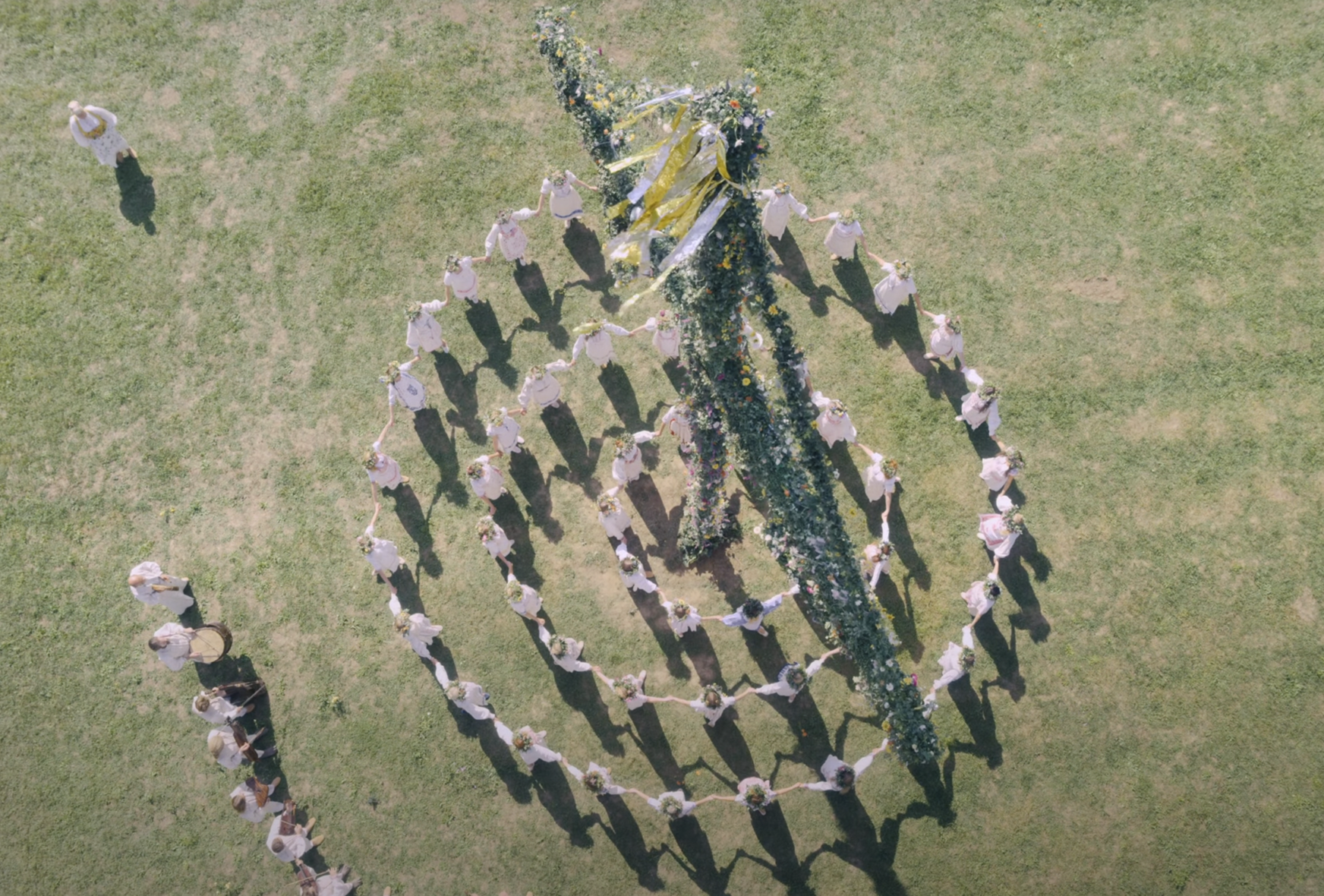
Dani’s monstrous transformation begins when she switches into white Hårgan regalia, drinks a hallucinogenic tea concoction she is offered, and joins the commune women as they form three concentric circles around the Maypole (Photo 3) to participate in the community’s ritual of crowning the next May Queen. Each of the three circles moves in a different direction, creating a dizzying effect intensified by the whirling camera choreography. One of the community elders informs the observers of the legend of Hårga. The dance they embody is based on a Swedish folk tale about the devil coming to play music in a village disguised as a fiddler. The devil enchants the youth, who are forced to dance themselves to death. The Hårgan Maypole tradition is presented as an homage to that tale, where, in defiance of death, the young women must dance until they fall. The legend of Hårga (Hårgalåtten - meaning the Hårga Song) is a reference to an existing folk song dating back to 1785. Skeidsvoll (Reference Skeidsvoll2024) confirmed that these references indeed exist in Swedish folklore. As the folktale goes, the villagers danced until their bodies disintegrated, and all that was left were their heads bouncing to the music.
Screenshot from Midsommar (2019) 1:37:56. Aerial view of the dancers around the maypole.

As is typical of many folk dances, the movements appear simple: skipping, spinning, bowing at the waist, and unfolding the spine with arms reaching high. Dani is smiling and enjoying herself, seeming unfazed as other dancers succumb to the dizzying effects of swirling and withdraw from the competition one by one. Eventually, only eight dancers remain. Mirroring the progression of the ritual in Suspiria, the dancing here, too, becomes increasingly ecstatic as the performers grow exhausted and seem to enter a trance that keeps them going despite their fatigue. This sentiment is accentuated by the editing, which superimposes two and sometimes three transparent images of Dani whirling, heightening the sound of her breath and dimming the music volume in the background, thus evoking Dani’s drugged state. When the camera refocuses and the image becomes clear again, Dani is one of only three dancers left standing. For Dani, this performance is the last rite of passage into the commune’s skewed morality, as it cultivates a sense of belonging, which she has been missing since the death of her parents.
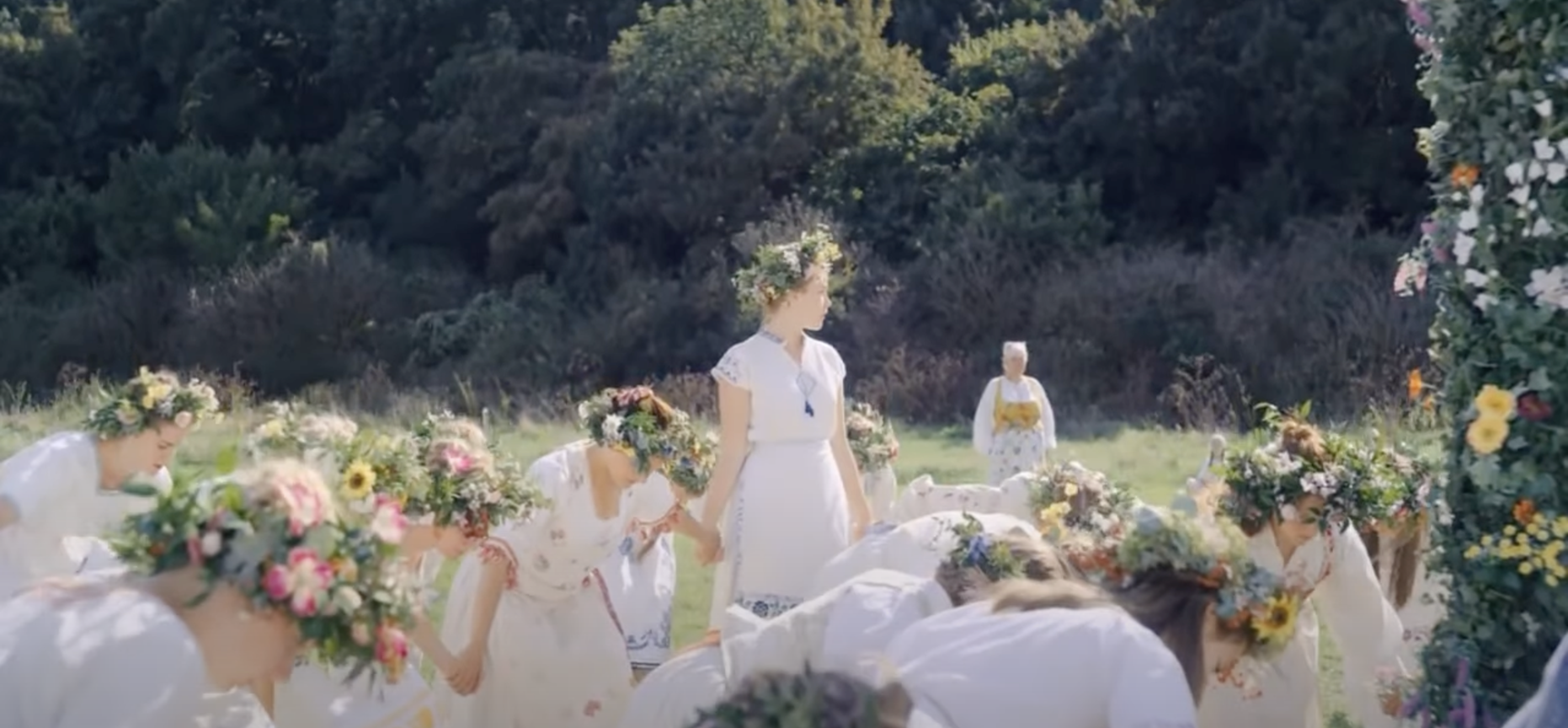
The whiteness of the community’s costumes, the overwhelming Whiteness of the cast, the emphasis on youth, and the youthfulness and carelessness embedded in the dancing make an inescapable reference to the commune’s extremist beliefs and their ties to Nazi ideology. The choreographic and directorial choice to single out Dani since the beginning of the May Queen competition (Photo 4) foreshadows her role as the commune’s rising leader. The emphasis on Dani’s individuality, juxtaposed with the homogeneity of the other Hårgans, echoes the Führerprinzip aesthetic.
Screenshot from Midsommar (2019) 1:39:24. Dani is standing up, while all other dancers around her are bowing.

The parallels that can be drawn between the way Midsommar presents invented traditions as longstanding cultural practices and the rhetoric popularized by extremist right-wing groups in the US are striking, especially as far as the construction of White nationalist fantasies is concerned. In her analysis of Midsommar and the production of White Fantasy, Anikó Imre (Reference Imre, Baker, Iacob, Anikó and James2024) uses the example of the January 6, 2021, events and the Nordic-inspired headdresses and tattoos that some participants displayed to address the creation of lineage narratives. According to Imre, “White nationalisms tap into viral networks and archives of fantasy to perform their own versions of a long-lost community by adopting its trappings, costumes, and rituals” (Reference Imre, Baker, Iacob, Anikó and James2024). A similar mechanism of ritual built on fantasy is featured in Midsommar, as the May Queen celebration suggests. Dani’s participation and enjoyment raise questions about complicity and embracing “invented tradition” without critically questioning its roots. In the film, the gradual alignment of Dani’s gestures with those of commune members is a subtle yet clear indication of her growing complicity.
The following scene in the movie is yet another elaborately choreographed ritual that begins with everyone seated at the table following Dani’s crowning as this year’s Mayqueen. Shortly after everyone is seated, Dani is taken away to perform a pagan ritual of blessing the crops while a group of young women lure Christian in a different direction. The film montage cuts back and forth between Dani blessing the crops and Christian reluctantly making his way to perform a mating ritual. Christian is evidently drugged as he enters the room, where twenty nude women of varying ages are framing Maja, who is lying on a bed of flowers waiting for him. The chorus of women is holding on to each other’s elbows in a semi-circle, gently swaying side by side as they hum. The visual analogies between the women’s positioning here and in the closing ritual of Suspiria are striking. Even though Midsommar does not explore occultism, the pagan beliefs of the cult, the intensely ritualistic manner that they approach procreation in this scene, and the fact that all participants in the ritual (other than Christian) are women allude to the witch archetype. The commune is already established as antithetical to mainstream society, and the implication of witchcraft plants the seeds for further associations with monstrosity.
Christian proceeds to have intercourse with Maja, yet it appears to be a purely mechanical act bereft of any emotion or personal investment. Choreographically, the Hårgan women are in extreme unison, maintaining their semi-circular shape, which both frames and accentuates Christian’s outsider status. He appears utterly lost and overcome by their influence. Steadily, the participation of the women in the ritual intensifies. From being mere spectators framing the events (such as a classical corps de ballet or a Chorus in ancient Greek tragedy), through Maja’s invitation, they become involved in the act by helping Christian find a rhythm and echoing Maja’s pleasureful moans or (in an act of extreme empathy) joining in and touching themselves. The soundscape of this scene is another nod to Suspiria’s final summoning, as it consists of the performers’ breaths and moans. The rising volume of their vocalizations catches Dani’s attention, who peeks through the hut’s keyhole and witnesses Christian cheating on her. She runs away, feeling betrayed and sick, as a group of commune women escort her.
Dani is crying and hyperventilating from the shock. Her cries become sorrowful, heaving breaths that (in another act of extreme empathy and unison) are imitated by the other women and soon escalate to wailing screams. At first, Dani is taken aback by the other women’s mimetic wails, but then she gradually gives in and sets the tone for everyone. The camera pans out and offers a panoramic view of the choreography. The group kneels on the floor, huddled, with Dani in the middle. They rest one arm on each other’s backs in a comforting gesture, breathing and heaving in unison like a singular organism. The shape is pulsing with each screaming breath, imitating a heartbeat steadily pushing out blood. This sorrowful ritual is juxtaposed with the ecstatic moaning vocalization of the group empathizing with Maja. Even though the sequence of events described here could be viewed as three distinct scenes, for the purpose of this analysis, I treat them as one extended three-part ritual.
The on-screen alternation between the mating scene and Dani’s grieving scene evokes references to the birthing process, thus inviting a consideration of the maternal and its relevance to the monstrous-feminine. The rhythmic screams of the women supporting Dani are reminiscent of the breathing exercises associated with birthing contractions, suggesting Dani’s “rebirth” as the commune’s new May Queen. Maja, on the other hand, participates in a mating ritual with an outsider to produce offspring that ensure the commune’s growth and avoid incest. The surrendering of Dani’s individuality and her metaphorical “rebirth” as a Hårgan are facilitated and accelerated by her embodied participation in Hårgan customs. The raw emotion and support the commune members offer her shatter her defenses. The extreme empathy and the collective embodiment of her grief offer her a sense of belonging. She accepts her role as the commune’s new leader, reveling in her newfound power and disregarding their violent history and any reservations she had when she first arrived in Hårga.
Like Susie’s character arc, Dani’s rise to power and monstrous transformation are completed shortly after she participates in the dance ritual and is sealed through her complicity in violence, as the closing section further explores. Even though Midsommar lacks direct references to occultism, the person that Dani turns into shares many elements with the figure of the witch. Dani’s choices mark her as a social and unregenerate outcast who can no longer return to her previous life. Like Susie, Dani also unleashes death by ordering the killing of Christian in the closing scene and thus signaling the final rupture of her relationship with him –and potentially also an allegorical break from Christian religious morality in favor of paganism, as implied by Christian’s name. The film’s conclusion thus suggests that Dani’s path to individual agency is only achieved through complicity with a skewed morality, thus completing and simultaneously complicating the traditional folk-horror chain. The final sacrificial “happening” completes the folk horror chain because it signals Dani’s surrender to the commune. Yet, it also complicates the chain, because Dani, for the first time, chooses herself over Christian, and this choice renders her a revolting monstrous-feminine against her formerly controlling partner.
All these symbolic threads of centering femininity in pagan rituals paint the image of a revolting and monstrous-feminine that breaks away from the modern heteropatriarchal world she came from and becomes closely aligned with the abject witch archetype, in which the witch is reclaimed as a positive symbol of resistance. Dani frees herself from a dysfunctional relationship by giving in to the commune. The closing scene finds Christian inside a bear carcass burned in a yellow hut, along with other self-sacrificing commune members and some of the visitors who were killed earlier. Instead of grieving Christian’s death, Dani’s response to his murder is a smile.
Dance and Monstrosity as Sites of Agency
The narrative arcs of both films, culminating in violent rituals, involve similar choreographic structures, yet explore them in vastly different settings. Both films examine the legacy of Nazi ideology and White supremacy and weave these concepts into the gestural and choreographic choices as described. Extremist references are built into pagan rituals, either through explorations of witchcraft in Suspiria or through the invented traditions of Midsommar. The ways these contested histories interweave with the protagonists’ awakening agency and maternal references draw attention to negotiations of femininity and female agency in the #MeToo era.
In stereotypically gendered discourse, the feminine is often associated with notions of care, nurture, and reproduction. Yet, in both films, care is paired with violence, and the maternal archetype is framed as monstrous, thus subverting conventional rhetoric. The archetype of the “mother” is an all-too-common trope in horror films, one often associated with biological determinism for a female’s role in society, predominantly explored in a domestic setting. Women’s reproductive and menstrual cycles are frequently explored in horror films, where occult beliefs fuel female power.
In Suspiria and Midsommar, the protagonists’ awakened power stems from their moral transformation, which aligns with Scovell’s folk-horror chain. The time Susie spends with the coven and Dani with the Hårgan commune profoundly alters their morality and sense of self, and dance seems to be the medium that completes their agential awakening. The type of dance used for this representation, be it the restaging of Volk in Suspiria or the Maypole dance in Midsommar, evokes a Dionysian state of being. Both Susie and Dani momentarily lose themselves in the movement and enter an ecstatic state. The threads connecting Dionysian ecstasy, female subjectivity, and dance speak to the all-consuming and destructive power of the histories negotiated through dancing and frame the ecstatic performers as “monsters,” grounding their monstrosity on a moral shift rather than a corporeal metamorphosis.
This framing of the female performers as “monsters” is in line with Jeffrey Jerome Cohen’s (Reference Cohen and Jeffrey1996) seminal essay “Monster Culture, Seven Theses”. According to Cohen, “the monster dwells at the gates of difference” (Reference Cohen and Jeffrey1996, 7) and “polices the borders of what is possible” (Reference Cohen and Jeffrey1996, 12). A monster never behaves as expected, and this unpredictability transfers to the things it signifies. As performance scholar Michael Chemers reflects, “signs need to behave predictably within their systems” (Reference Chemers2018, 7) for meaning to be derived, and monsters “argue against the stability of sign systems in ways that reveal an uncomfortable, but often thrilling insecurity” (ibid.). In other words, Susie and Dani, and the women who surround them in their respective rituals, emerge as monsters because of their aberrance from social norms. They embrace rituals of violence that oppose the stereotypical mold of care associated with femininity, yet even so, their acts are still justified as care (either self-care or care for others).
Closely revisiting the associations between care and violence, Dani and Susie become the main perpetrators of violence in the closing scenes of both films. Volk in Suspiria and the runic gestures embedded in much of Midsommar’s choreography are embodied renderings of violent histories. Thus, the protagonists’ hauntological embodiment suggests their complicity with said violence and forewarns a revisiting of that history.
The concluding scenes of both films show the protagonists having no remorse for their actions. Instead, they revel in the carnage they caused, which aligns with the trend that Barbara Creed (Reference Creed2022) observes as “the return of the monstrous-feminine.” Both female protagonists turned monsters unremorsefully and unapologetically continue their lives in the aftermath of the extreme violence they perpetrated, which signals a break from conventional horror tropes. Contrary to the long-established final girl trope (Clover Reference Clover1992), where the protagonist’s violence is justified as an extreme act of self-defense, for Susie and Dani, violence is not about survival; it is a choice. Suspiria and Midsommar thus disrupt the paradigm of defeating the monster as a narrative conclusion and embrace abject femininity. Viewing this occurrence in line with the #MeToo movement prompts a reconsideration of monstrosity as a site of resistance. The fact that dance is the means through which monstrosity is achieved speaks to the centrality of embodied agency as a site for interrupting and breaking harmful patterns. The films echo evolving cultural attitudes about women’s empowerment in the horror genre and beyond. Yet, they simultaneously also imply that the only way for women to gain agency in the context of the extremist legacies and the highly oppressive structures that the protagonists are navigating is if they become monstrous, a quality that can be accessed through embodied participation in established rituals.
Both films’ narrative arcs are overly dramatized cinematic exaggerations that issue a warning about the cyclical nature of history and draw attention to how trauma, the threat of violence, and extreme ideology are passed on from one generation to the next through embodiment. Viewing the films in the context of the time they were released, when ethnocentric White supremacist populist rhetoric was on the rise, the negotiation of violent history through dance speaks to how extremism is not an abstract concept but an everyday lived occurrence. It is present in the daily embodied rituals and gestures one engages in, as seen in the subtle gesturing of commune members in Midsommar or in the reconstruction of acclaimed dance repertory pieces, such as Volk, in Suspiria. Both examples allow for a meditation on the possibilities of monstrosity.
The revolting and monstrous-feminine that emerges in the aftermath of historical reckoning poses questions about implicit complicity, especially when it comes to participation in dance through the restaging of repertory pieces or the performance of folk traditions. Thus, returning to the notion that horror movies provide audiences a space to negotiate contemporary fears and concerns, the monstrous transformations of Susie and Dani can be viewed as a hauntological omen for a future that has not yet happened but is pregnant with the possibility.
Acknowledgements
Thank you to my colleague Andrea Harris for her feedback in identifying and unpacking the Laban references.