

The purpose of this study conducted by a panel of INRA scientists was to analyse pain in farm animals. Scientists with competence in various disciplines of human- and life-science extracted and integrated pertinent data from scientific publications, which in turn provided a basis for responding to the following questions: How to describe, understand and alleviate pain in farm animals? This synthesis draws upon work in the fields of ethics, economics, law and biology.
A complicated social debate
The involvement of the social sciences, as requested by the organisers of this project, proved to be extremely fruitful. Their analysis reveals a large body of relevant work from several disciplines, including philosophy, ethics, anthropology, sociology, law and economy. Across these disciplines there is a general consensus concerning the importance of the conditions of the life of animals for the various actors. The analysis also underlines the difficulties that arise when animal pain is separated from other concepts, such as suffering and welfare of animals.
The current focus on the question of animal pain, in particular that of farm animals, reflects a variety of changes in our society.
• There have been major advances in the understanding of pain and clinical attention given to this issue in humans, and consequently in animals. Although pain was previously considered to be unavoidable, it can now be reduced, or even eliminated.
• Urbanisation has separated the public from farm animals and there is little awareness of breeding and management practices. City dwellers rarely have contact with farm animals; the only animals with which they interact are pets, which have a different status to farm animals and a closer relationship with their human owner.
• The systems of animal production that have developed in response to commercial demands give rise to a multitude of questions.
• The range of stakeholders involved in the debate has expanded enormously. Previously, the breeders alone made the decisions. At the present time, however, all of the actors in the production network, from the breeders to the commercial distributors, are involved in the debate, as well as associations for animal welfare/protection.
Animal pain, human pain: need for an integrated approach
Scientific study of the physiology of pain has involved close collaboration between a number of disciplines, including neurobiology, physiology, veterinary science and animal production. As discussed above for the social sciences, the analysis of the literature reveals that animal pain, suffering and welfare cannot be readily separated.
Clinical studies of human pain have also been very important. To a great extent, our current understanding of this question is based upon studies of humans and laboratory animals. This research has resulted in significant alterations in the conceptualisation of pain, and greater awareness of the range of situations in which it occurs. In particular, assessment of pain in non-verbal humans necessitated a change from self-evaluation to hetero-evaluation, the obligatory method for studying animals. The originality of this approach should also be noted: while animal studies are often presumed to provide data that are relevant to human questions, in the present context, the human model is a source of information to address animal issues.
The chosen definition of pain in animals is similar to that established by scientists and clinicians who work on human pain. This definition has three primary components: nociception, emotions and consciousness.
Pain is an aversive sensory and emotional experience represented by the animal's ‘awareness’ of tissue damage, or the threat of such damage.
The assessment and description of animal pain remain difficult
Pain, as described in this manner, occurs in non-human mammals, and presumably to a lesser extent in birds. Whether it exists in fish, amphibians, reptiles or invertebrates continues to be a subject of scientific debate.
An animal's subjective experience of pain can only be assessed indirectly, using various physiological and behavioural indices, observable tissue damage and livestock performance. This multi-parametric method may provide a basis for developing graded scales of pain. At the present time, however, validated pain scales only exist for dogs; validation trials with cats and horses are ongoing.
Numerous factors foster the occurrence of pain
To identify painful stimuli or events encountered by farm animals, it is useful to consider the context of the rearing system in which they live. It should be recalled that the primary objectives of these systems are profitability, security and safety of food production, and health of the animals. The analysis shows that certain systems increase the risk of pain as a consequence of space limitations, poor environmental conditions, physiological or nutritional disturbances associated with attempts to maximise production, and unstable social groups. Moreover, health risks for animals and the humans who work with them may increase when the personnel do not pay adequate attention to animal pain. Alternative production systems, in particular those that practice organic methods, emphasise the prevention and treatment of pain.
Painful procedures may be employed to treat problems that result from the rearing situation, or because of considerations of product quality or worker health and safety. The primary examples include: castration of piglets and calves, horn trimming in cattle, de-beaking in poultry, tooth clipping and tail docking in piglets.
Pain associated with slaughter has also been the subject of an analysis that considers not only the slaughter technique per se, but also the transport and pre-slaughter contexts. When stunning techniques are correctly applied, animals will be unconscious when slaughtered. A considerable interval between the moment of throat cutting and unconsciousness is observed in a significant percentage of cattle when stunning is not used.
Suggested methods to reduce pain in farm animals based upon the present study
The ongoing study generated a number of proposals for the reduction of pain in farm animals. Alternative rearing methods that limit pain and are currently practiced, or being developed, in several countries, are reported. These methods are consistent with the approach that has been labelled ‘3Ss’ that is analogous to the ‘3Rs’ approach adopted for animal experimentation.
• The first solution is to eliminate (suppress) sources of pain that provide no benefits for the animals or the breeders. For example, tail docking of cattle has recently been eliminated. Tooth clipping of piglets is likewise unnecessary. Dehorning can be gradually obviated by introducing genetically hornless animals into the reproductive population. Genetic selection for resistance criteria, which is now practiced with chickens and cattle, has lowered the incidence of painful mastitis in cows and lameness in cattle and chickens. This issue is a major focus of ongoing research.
• The second solution involves substituting (substitute) a less painful method for one that is known to be a source of pain. Accordingly, it is preferable to castrate piglets and calves at the youngest possible age. In a similar manner, when dehorning of calves is practiced, it should be performed at a very young age with cauterisation of the areas that produce the horns. Grinding the teeth of piglets is preferable to clipping them. De-beaking of poultry has been replaced by less painful beak trimming. Improved breeding and housing systems may limit the risks of wounds and deaths resulting from aggressive interactions or when animals are moved, especially in slaughterhouses.
• Finally, general or local-acting pharmacological analgesics may alleviate (soothe) pain that is knowingly elicited, as is the case for mutilation, or unpredictable, for example, lameness in cattle. These treatments take into account the duration of pain, which may continue after the intervention in the case of certain mutilations or pathological conditions. Moreover, effective stunning techniques can lessen the pain associated with slaughter.
It is interesting to note the following steps and initiatives that are relevant to the problem of animal pain:
• The French government has instituted a plan (anti-pain) to limit human pain. It underlines three essential recommendations for limiting pain in patients that could also be applied to animals: development of methods to evaluate and monitor subjects in pain; training of professional staff; the need for further fundamental and applied research.
• In Switzerland, an ongoing study of agricultural breeding and production systems will allow the concomitant assessment of pain in these different contexts.
• Commercialisation of products derived from animals may point out the care taken by the various actors in the production network to limit animal pain, which would serve as an alternative method to foster more humane agricultural practices.
• Pain is taken into account in the international plan drawn up by The World Office of Animal Health (l'Office Mondial de la Santé Animale), which is evidence of the worldwide preoccupation with this issue.
This report further clarifies the conceptualisation of pain in farm animals and the methods used to study that problem. In addition, it identifies painful situations and possible solutions to eliminate or at least attenuate pain. The considerable body of pertinent data allows the proposal of confident conclusions. However, this investigation also points out the need for additional research to elucidate the question of animal pain and do away with current uncertainties and controversies.
Research priorities
Elucidation of the underlying basis and methods of evaluation of pain in particular species
The present investigation revealed limitations in the scientific knowledge of pain in farm animals.
For certain taxonomic groups, such as fish and birds, there has been little scientific study of mechanisms and situations that may provoke pain. Relevant research with fish provides only fragmentary understanding of nociception and stress in a few species. Although relatively more research has been devoted to pain in birds, the current data base remains limited and further in-depth studies are needed.
Across the total range of farm animals, there is a need for clear measures of pain that would provide a basis for the development and validation of multi-parametric pain scales. Differences in the focus of ongoing research between species reflect the current state of knowledge of those animals. While there is a major requirement for the construction and validation of multi-parametric pain scales for pigs and ruminants, particular emphasis needs to be given to identification and validation of nociceptive criteria in fish, while a wide array of issues should be investigated in avian species.
Further elucidation of precise physiological indicators of unconsciousness is needed, and would also have practical implications for slaughter routines. Likewise, the relationship between unconsciousness and pain (or its absence) is poorly understood. There is a general need for greater specification of the role of emotions and consciousness in the expression and perception of animal pain. Additional research should assess the influence of the social/psychological context, including the relationship between animals and human handlers, on pain.
Sources of pain in farm animals
The identification and quantification of sources, or potential causes, of farm-animal pain remain difficult. Analysis of the available scientific evidence suggests a number of research questions that should be addressed, and stresses the importance of acquiring information concerning the frequency of particular painful procedures (notably mutilations) and details of the methods employed in this context (descriptions of the procedures per se, training of staff, analgesic protocols). Because of the paucity of relevant data a thorough analysis of risks is not possible. It would also be useful to conduct systematic evaluations of the prevalence of presumably painful diseases, the factors that contribute to the occurrence and increase of such maladies, and their economic impact (associated costs and losses). Moreover, there is little information regarding the frequency and methods of slaughter of diseased farm animals (aside from euthanasia performed by veterinary surgeons). While the short-term effects of injuries and mutilations are known to at least some extent, long-term effects, such as the existence of hyperalgesia or pain associated with amputation (phantom-limb pain) remain unclear. Likewise, the consequences of these aversive practices for animal–human interactions have been the subject of little scientific investigation.
Finally, further understanding of the attitudes and perception of pain, as well as its detection and treatment, by the different members of the agricultural production network would be beneficial.
Possible solutions to the problem of pain in farm animals
The alleviation of pain in farm animals can be addressed by different research strategies. For example, identification of improved housing/treatment methods and genetic selection for specific traits could eliminate or reduce sources of pain, such as injuries and lesions. Genetic selection for robustness (i.e. effective adaptation of the animal to its environment) could contribute to the avoidance of painful situations. Elucidation of the underlying molecular basis and variability of the selected traits would allow those markers to be incorporated into the selection criteria. At the present time, there are few analgesic procedures that are appropriate for poultry and fish. Thus, there is an obvious practical need for research concerned with the development and validation of such analgesics.
Socio-economic consequences of addressing the problem of animal pain
As seen above, it is possible to identify and alleviate pain in a number of farm species, especially mammals. However, precise assessments of the costs and benefits associated with the various pain-control methods have not been conducted. The economic impact of proposed solutions would presumably vary across the various levels of the production/distribution network. Furthermore, different characteristics of animal products (e.g. animal pain during rearing, meat hygiene and palatability, environmental considerations) would not be affected in an identical manner. Knowledge of consumers’ attitudes (acceptance, e.g., of biotechnology, substitution of vaccination for castration in piglets, or systematic use of analgesics), and their likely response to the economic consequences of attempts to control animal pain would be important before introducing those solutions. Would the public support modifications of agricultural methods based upon concerns for animal pain? Detailed studies of the broad socio-economic consequences associated with the goal of pain reduction are needed across the entire range of farm-animal production and distribution.
Regulatory mechanisms and the legal status of animals
Both for individual countries and on an international scale an evaluation of the socio-economic impact of a possible change in the legal status of animals will be necessary. The current wide array of recommendations and regulations pertaining to farm animals (local codes, European rules, national laws and recommendations, requirements of specific products/brands) pose problems of interpretation and implementation for agricultural workers. A global analysis of potentially painful practices would facilitate the establishment of coherent regulatory mechanisms and foster clearer public understanding of the realities of farm animal production.
Appendix: methodology
1. Definition and organisation of the project
The collective scientific assessment (ESCo) was conducted in support of a public mandate: in response to a complex question, an international multi-disciplinary data base was reviewed to ascertain the existing body of relevant scientific knowledge and to identify major uncertainties, deficiencies and controversies.
The ESCo project was initiated in 2002 in accordance with the principles established by the INRA charter of scientific investigation. The Institute provided necessary administrative support for the project (gathering and updating reference material, certification of the qualifications and independence of participating experts, and transparency of the procedures). The experts are solely responsible for their contributions. The ESCo does not formulate opinions or recommendations apart from future research needs.
The monitoring committee
The monitoring committee was composed of members appointed by the commissioning body. It was responsible for validating the official directive, meeting two or three times during the course of the project to examine whether the orientation of ongoing work conformed to the original terms of reference, and, if warranted, modified the scope of work in progress to reflect recent political and regulatory developments. At the same time, progress of the work and problems encountered by the experts, such as the absence of bibliographic material, were reported and discussed. At the completion of the assessment, the committee met for the presentation of the conclusions. During this seminar the final version of the report was presented.
The scientific experts
The ESCo is the joint effort of a group of scientists from different disciplines with converging interests in the multi-faceted question of animal pain. This group of about 20 scientists was divided into sub-committees that were responsible for the bibliographic analysis and drafting of the report. External experts were also consulted when appropriate.
For each ESCo dossier, a scientific chairperson was appointed by the pertinent INRA director. These chairpersons were all experienced, competent scientists who approached the problems under consideration from a broad perspective and provided effective leadership for their co-workers.
The scientists worked on the ESCo for ∼1 year following the official approval of the project.
The final report reflects the comments and suggestions of the external referees who read the initial draft.
INRA was responsible for the administrative support of the ESCo. This included facilitating and organising the work of the scientific experts and collaboration with other agencies. The ESCo had complete access to INRA library facilities and databases, and that agency also provided secretarial, management and editorial assistance, organised scientific meetings and prepared printed versions of documents produced by the ESCo.
Results of the ESCo
The work of the ESCo culminated in an electronically published report in French that is several hundred pages long, and an abbreviated version intended primarily for policy makers and its English translation; these documents are available on-line on the INRA website (http://www.inra.fr/presse/expertise_douleurs_animales_chez_animaux_elevage).
The abbreviated document highlights the major points of the assessment report in a manner that should make it useful for addressing the problems that originally motivated the creation of the ESCo. The scientific conclusions did not take into account the current economic and political context since that was not the object of the project.
The conclusions of the ESCo were presented and discussed at a conference open to the public.
2. Participating scientists
The ESCo can be defined as a critical analysis of the available academic knowledge. Therefore, the main criterion for the choice of participants was scientific competence, as evidenced by their peer-reviewed publications and evaluations/recommendations by colleagues. Complementary criteria were also taken into consideration, such as scientific administration and leadership activities (e.g. directing French or European research programmes), membership in governmental work committees, or participation in the scientific evaluation of various projects (e.g. political initiatives, management policies).
This recruitment strategy based upon scientific competence, rather than practical experience in the field, should be underlined to avoid misunderstandings following publication of the ESCo.
To assure the involvement of diverse scientific ‘cultures’ and techniques, and strengthen the credibility of the evaluation, the work was conducted independently of INRA supervision, and scientists external to that institute also participated in the project. The group of scientists was composed of 11 INRA researchers plus 9 affiliated with other institutions (Veterinary schools, CNRS, Collège de France, French health service, Universities). More than a dozen additional scientists made contributions to particular themes considered by the ESCo.
3. Bibliographic note
During the course of the evaluation, the group of scientists analysed a great number of scientific publications and international reports that served as the basis for the final results and conclusions. Approximately 1400 bibliographic references are cited in the report. Technical support was provided by two INRA information specialists whose responsibilities included information and document retrieval, organisation and reproduction of the extensive body of bibliographic material, and compilation of the list of cited references.
Principal sources of information
Web of Science: A product of Thomson Scientific (formerly ISI), this is the most extensive database for scientific publications in the entire world. All domains of Science and Social Science are covered, thereby allowing searches that cut across several specialty areas or the identification of articles whose content falls at the interface between traditional disciplines.
CAB Abstracts (CABI Publishing): This database covers the published literature related to ‘agriculture’ from a broad perspective (animal production, veterinary science, health, economics, rural sociology, human food consumption).
Econlit (American Economic Association): A database primarily devoted to economy and management. Sources of cited articles include periodicals (400 titles), monographs, edited volumes, congress proceedings, theses and working papers/reports.
Medline/PubMed (National Library of Medicine, USA): A bibliographic database covering all domains of biomedicine (biochemistry, biology, clinical medicine specialty areas, economics, ethics, pharmacology, public health, toxicology, veterinary medicine).
Additional sources of scientific and technical data were also considered: European Food Safety Authority (EFSA) – scientific documents, ProdInra (institutional archives of INRA publications), Cairn, Renaweb, Techni-porc and Vigie-Viande.
Methodology
Keywords validated by the ESCo scientists were combined in search queries and were used to survey the bibliographic databases. Definition and refinement of the keywords necessitated frequent interactions between the information specialists and ESCo scientists.
More than 10 000 bibliographic references were collected. The original body of literature was reduced and refined by a lexical analysis performed with Le Sphinx® software. This resulted in a working bibliography of 1200 references (format Endnote TM), that was supplemented by specific targeted searches.
Throughout the evaluation period, research articles and technical documents were forwarded directly to the ESCo scientists. A collaborative web-site (SilverPeas®) enabled the scientists to interact via a computer network.
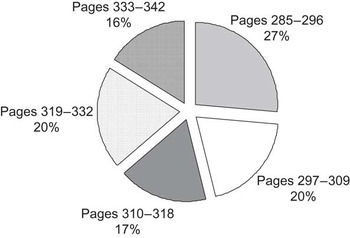
Proportion of total references cited in each of the articles.

Cited references
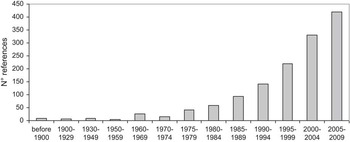
A total of 1391 references are cited in the report. As seen in Figure 1, the number of bibliographic citations was roughly similar across the five articles. Recent work accounted for most of the citations; 30% of the references were published within the last 5 years (Figure 2).
Publication year of bibliographic references cited in the report.

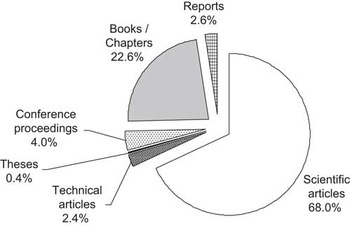
The majority of cited articles were published in international scientific journals (68%), which is consistent with the stated definition of the project (Figure 3). An international journal of applied ethology was the source of the greatest number of references; this was followed by 14 veterinary and agricultural science journals (Table 1).
Percentage of cited references from various categories of publications.

Scientific journals in which the greatest number of cited references were published

A secondary category of cited material consisted of scientific and technical reports published by international institutions (e.g. EFSA, ANSES, European Commission, ITP), and papers presented at international symposia (e.g. organised by the International Society for Applied Ethology, the American College of Veterinary Anesthesiologists, or the International Veterinary Academy of Pain Management).
Finally, articles published in technical journals, such as INRA Productions Animales, Les Journées de la Recherche Porcine, and Cattle Practice, were a source of information concerning painful agricultural practices and alternative procedures.
The major themes of the ESCo as reflected by the reference titles
The credibility of the ESCo is dependent on the bibliographic references. It is therefore interesting to verify a posteriori not only the quality of the cited references, but also their relevance to the major themes addressed by the ESCo.
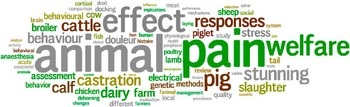
A frequency analysis of the words appearing in the titles of the cited references was performed with the program Wordle.net. The size of the words in Figure 4 is proportional to their frequency of occurrence in the reference titles. For example, the word ‘pain’ appeared in the title of 199 references, while ‘castration’ was found in only 61 titles. This figure portrays the correspondence between the major themes treated by the ESCo and the content of the bibliographic material.
Word cloud depicting the relative frequencies of occurrence of words appearing in the titles of the references cited in the ESCo report. (http://www.wordle.net/)