It is the royal fountain of favor that produces the best harvest on the field of sovereignty.
Sultan Abdülhamit IIFootnote 1In the early morning of 31 July 1908, Najib Pasha Malhamé was rudely awakened by Young Turk officials who put him under house arrest in his luxurious Istanbul mansion. His older brother and neighbor in leafy Yeniköy, Salim Pasha Malhamé, had been tipped off about imminent government plans to arrest them and had snuck out of the city a few nights before, as had their Damascene colleague Ahmad ʿIzzat Pasha al-ʿAbid.Footnote 2 Najib Pasha, who, like his brothers, was a Maronite Christian with an Ottoman passport, had failed to read the writing of the Young Turk Revolution on Istanbul's tabloid walls. A botched anarchist assassination attempt on this palace favorite a year earlier had generated little pity in the capital's press. Popular protest against Abdülhamit II's regime grew even louder after 24 July 1908, when the Ottoman sultan grudgingly reinstated the 1876 constitution, and thousands of people celebrated in the streets of Istanbul.Footnote 3 In pro-Young Turk rallies, the Malhamés were singled out as epitomes of a nepotism that had apparently mushroomed under Abdülhamit II. In late July 1908, Francophone student demonstrators gathered on the Grand Rue de Pera to chant their disapproval to the tune of the Cadet-RousselFootnote 4:

Footnote 5Footnote 6Footnote 7
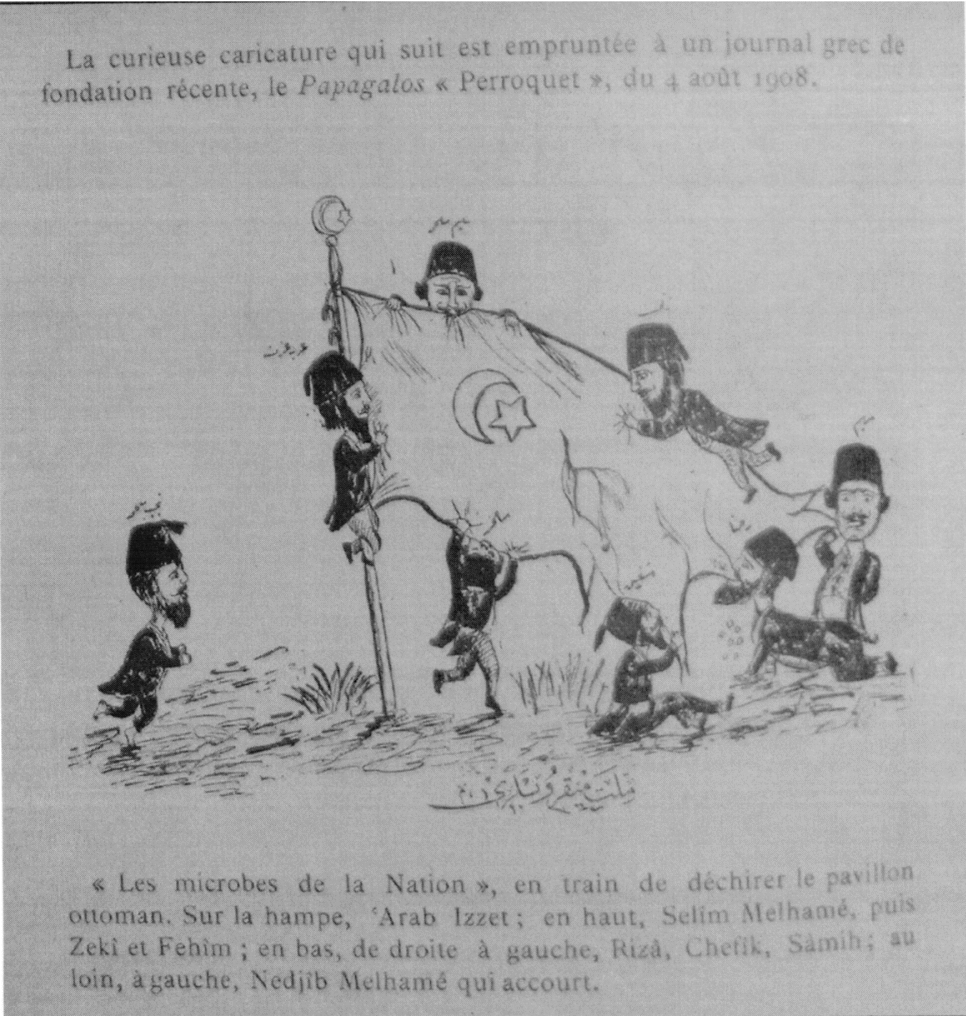
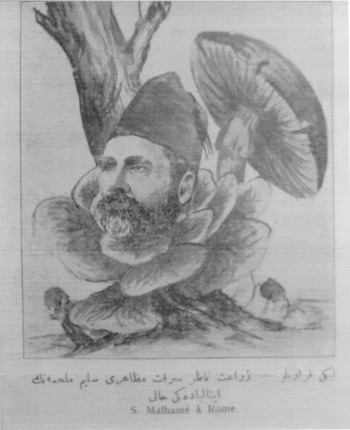
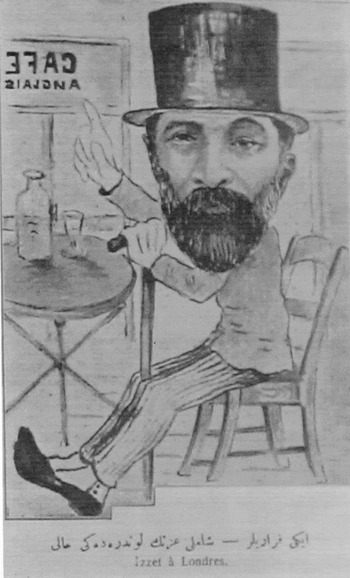
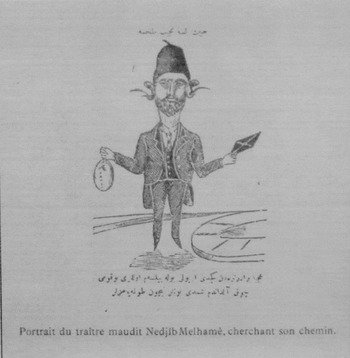
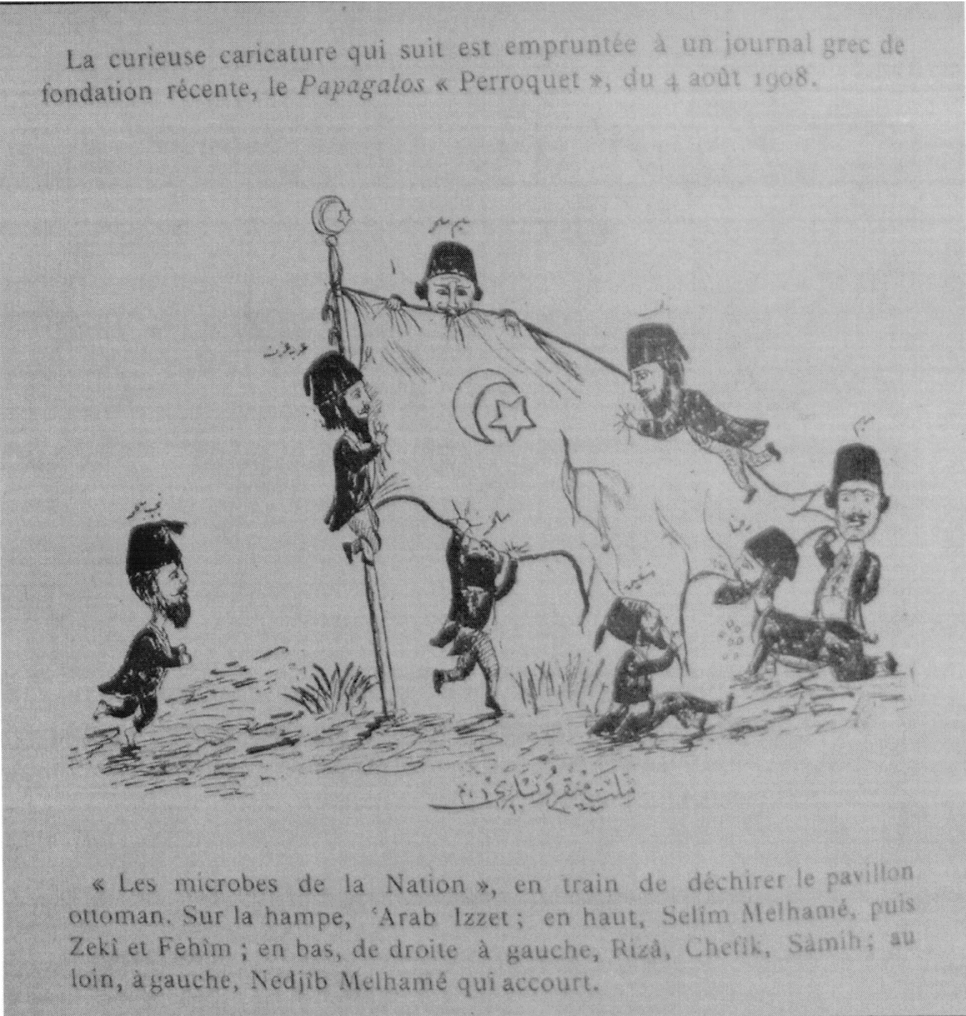
The revolutionary press echoed these slogans.Footnote 8 Abdülhamit II's former favorites were caricatured as many-headed hydrae, snakes, vampires, scorpions, and horned rams.Footnote 9 But no other Hamidian protégés featured as prominently as the Malhamés and ʿIzzat Pasha (1854–1924).Footnote 10 A cartoon in the Greek newspaper Papagalos on 4 August 1908, entitled “The Parasites of the Nation,” shows them among eight miniature pashas gnawing at the Ottoman flag and dressed in the Istanbouline fashion characteristic of late Ottoman bureaucrats (see Figure 1).Footnote 11 A few weeks later Servet-i Fünun printed cartoons of “the two fugitives” that showed Salim Pasha Malhamé's head sprouting out of a tree fungus (see Figure 2) and ʿIzzat Pasha in a top hat enjoying a drink in a “Café Anglais” in London (see Figure 3). Another, titled “Najib Lost His Way,” depicts Najib Pasha in a three-piece dinner jacket, fez, and tie, looking lost at a turn in the road (see Figure 4). He holds a plump bag of money in one hand and a letter, possibly a carnet de passage, in the other.
“The Parasites of the Nation.” From Papagalos, 4 August 1908. Reprinted in Revue du Monde Muselman 6 (September–December 1908): 162.
“Two Fugitives: Salim Pasha Malhamé in Italy.” From Servet-i Fünun, 26 October 1908, 380.

“Two Fugitives: ʿIzzet Pasha in London.” From Servet-i Fünun, 26 October 1908, 380.

“Najib Lost His Way.” Unknown source, reprinted in Revue du Monde Muselman 6 (September–December 1908): 168.

Why were these figures such prominent scapegoats of the Hamidian regime?Footnote 12 Why did the 1908 revolution spare Abdülhamit II's long-term grand viziers Küçük Said Pasha (1838–1914) and Kamil Pasha (1832–1913), his quietly dismissed chief secretary Tahsin Pasha (1858/59–1932/33),Footnote 13 and the sultan himself? What misdeeds catapulted the Malhamés into the limelight of the revolution while other, more senior Ottoman politicians escaped Young Turk justice? The superficial answer is that the Young Turks did not rebel against the authority of the sultan but rather his “Arab entourage.”Footnote 14 However, Young Turk caricatures were neither Orientalist stereotypes of Arabs nor merely those of “individuals who represented the abuses of the old regime.”Footnote 15 Rather, the caricatures that associate sartorial refinement and access to Europe with nefarious human acts—particularly embezzlement and spying—deploy nationalist stereotypes of the unpatriotic Levantine. The issue, then, requires a more thorough investigation of the intersection between the Levantine world of business and the Hamidian world of politics. By focusing on the institutional sites where the Malhamés wielded power—namely, the court of Abdülhamit II, the Ottoman Public Debt Administration (PDA), the Ministry of Agriculture, Mines, and Forests, and the European concession business—I argue that both the Levantine and the Hamidian spheres needed the Malhamés, who excelled as servants of the regime.
Based on research in the Ottoman, Arabic, and European press, published and unpublished intelligence reports, consular correspondence, and an unlikely German family archive,Footnote 16 as well as interviews with Malhamé descendents, this article reconstructs how a family of Hamidian associates from provincial Beirut rose to political prominence in the imperial center. The six Malhamé brothers—Salim, Najib, Habib, Philippe, Alexandre, and Shukri—appear in many scattered references in Ottoman and Arabic memoirs, Turkish literature, and Lebanese historiography, and they surface repeatedly in Ottoman and European archives.Footnote 17 This article aims to bring them from the footnotes to the center of late Ottoman historical narratives.
The point is neither to exonerate the Malhamé brothers nor to confirm their ill repute but instead to elucidate the convergence of the milieu of Ottoman bureaucrats and Levantine entrepreneurs that made the Malhamé phenomenon possible. Examining the rise of the Malhamés to the pinnacle of Ottoman power and their subsequent construction as “malfamés” disrupts the already complex social and discursive formation of Turk and Arab, Muslim and Christian, foreign and native. Straddling imperial and provincial as well as state and nonstate arenas enabled the Malhamés, like the better studied Muslim ʿIzzat Pasha, to thrive as transimperial power brokers. I deploy a transimperial framework that situates the Malhamés’ multisited brokerage and patronage in polyglot networks both across the Ottoman Empire and between it and competing empires. The Malhamés’ early careering had more in common with the European “men on the spot” who, in Benjamin Disraeli's pithy aphorism, realized that “the empire is a career” than they did with Albert Hourani's paradigmatic Arab provincial notables.Footnote 18 They did not hail from a time-honored family of intermediaries between the imperial government and local society. Rather, they were talented, self-made professionals. They became indispensible troubleshooters for their empire not dissimilar to, for example, the Irish dragoman and chief intelligence officer at the British embassy in Istanbul, Gerald Fitzmaurice.Footnote 19
Olivier Bouquet's recent Les pachas du Sultan demonstrates how bureaucratic career patterns depended on patronage networks and were indices of wider changes in governance and mobility in the Ottoman Empire.Footnote 20 The term “career,” as two new imperial historians of Britain have argued, connotes not only “a sense of volition, agency and self-advancement but also accident, chance encounter, and the impact of factors beyond the control of the individual.”Footnote 21 The biographical passages of this article draw out the restlessness of the Malhamé brothers in the service of Abdülhamit II and convey the inchoateness implicit in the notion of “careering.”
Finally, I argue that Abdülhamit II's style of rule opened the doors of imperial politics to loyal Levantines. Oliver Schmitt has recently offered a circumscribed definition of 19th-century Levantines as a socioreligious group who operated in the interstices “between the confessionally structured Ottoman society and the system of interstate privileges or ‘Capitulations.’”Footnote 22 They tended to be Catholics of European descent who resided in mixed Ottoman cities in the eastern Mediterranean. During the 18th century, parish churches in Pera had become the loci for the emergence of a particular Levantine identity among Catholic business families.
Schmitt's timely work historicizes a socioeconomic category that has too long existed either as a vague racial construct, as in Abdallah Naaman's Les Levantines: une race, or—more appealingly—as a romantic interpellation in Ammiel Alcalay's enchanting After Jews and Arabs.Footnote 23 Schmitt also deconstructs the pejorative discourse of Young Turks and Turkophiles like the Scottish diplomat David Urquhart, who claimed that the Levantine was a “parasite” who “not only prevents communication between Turks and the Europeans, but perpetuates old antipathies, misrepresents the one to the other, disqualifying Europeans from judging the Turks or Rayas, by instilling their own prejudices, and debasing Europeans in the eyes of the Turks, by our apparent identity with them.”Footnote 24 I part with Schmitt's argument that the Levant is exclusively and essentially an “ethno-confessionally” defined Catholic space. In his search for an actor category, Schmitt reduces the Levantine to a parochial identity that stood apart from—and in opposition to—the profound transformations of the Ottoman state during the 19th century. If, as Schmitt shows, Levantine elites were discriminating, hierarchical, and exclusionary vis-a-vis non-Catholics and lower-class Europeans alike, then their identity claims should not be adopted uncritically as an analytical category.Footnote 25
The absence of Levantine self-identification in the Malhamé records stands in sharp contrast to the public stereotyping and scapegoating of them as Levantines in the above caricatures. This article does not venture to discover an identity of which the Malhamés may or may not have been aware. Instead, I employ an instrumentalist perspective and focus on the Malhamés’ pursuit of self-interest and modes of self-preservation. I treat the Levant and Levantine actors as a historically evolving, regionally bounded instantiation of transimperialism. The Levant of the Malhamés and their fellow travelers was a transimperial space of common and conflicting interests sustained by a community of diverse Levantine networks operating between the state and the world economy.
Within the Levantine community of networks, French Catholics like the Crespins and Glavanys had stood at the apex of Levantine society for generations. As the proliferation of family trees from the late 19th century suggests, the Levantine elites’ myths of distinction were narrated in genealogical and diasporic terms of multiple “elsewheres.”Footnote 26 But Ottoman Christian families like the Phanariot Orthodox Musurus or the Syrian Catholic Duhanis were invested in this space too. Certain Muslim pashas were also popular figures on Pera's social circuit.Footnote 27 Levantine elites sought out associations with palace favorites such as ʿIzzat Pasha, who—unusual for a paradigmatic Damascene family of notables—had missionary schooling and a mastery of European languages.Footnote 28 At a time of state consolidation and Hamidian suspicion of foreign conspiracies, these officials represented a favored link between Levantine entrepreneurs and the Ottoman government. All of these ethno-confessionally diverse elites were a world apart from Levantine journalists, intellectuals, and anarchists who championed cosmopolitan ideas about equality and democracy and tended, if anything, to support the Young Turk opposition.Footnote 29 They also eschewed solidarity with lowly Levantines, those southern European déclassés, migrants, and laborers who inhabited the urban fringes of eastern Mediterranean port cities.Footnote 30
MABEYN: THE PROVINCE AT THE CENTER
The legacy of the Hamidian period from 1876 to 1909 has been a contested issue for modern Turkey. As the prolific historian and journalist Orhan Koloğlu asked over twenty years ago: “are we the children of Abdülhamit II or the Young Turks?”Footnote 31 Turkish historiography long viewed Sultan Abdülhamit II's rule as an authoritarian interruption of the enlightened path from Tanzimat reforms toward Kemalist democracy and secularism. The claims in Western sources that Abdülhamit II was driven by pan-Islamic zeal to combat the Christian West have been taken up by both Western scholars and Islamic revisionists in Turkey.Footnote 32 Most late Ottoman historians now agree that Hamidian rule was a continuation of the Tanzimat period. At the same time, the question of the late Ottoman legacy for modern Turkey has shifted away from Koloğlu's dichotomy between the Hamidian and Young Turk eras and toward a reevaluation of the contradictions of Abdülhamit II's rule itself. By and large, this revisionist scholarship has focused on the first ten years of his rule.Footnote 33 This article extends to the next two decades.
This important historical reevaluation is not merely a Turkish story any more than the history of the British Empire is merely an English one. The relations between the Ottoman center and the provincial peripheries first came into scholarly focus in the 1970s. Initially, Turkish scholars deemed the peripheries rebellious and corrupt sites of historical “involution” that the Tanzimat reforms from 1839 to 1876 dragged into modernity.Footnote 34 The Tanzimat were led by European-trained Ottoman statesmen who sidelined the sultan and concentrated state power in the ministries of the Sublime Porte. In the 1980s, Ottoman social historians demonstrated how post-Tanzimat institutions offered new nodes of inclusion for ethnic and religious minorities. It is here that the Malhamés first appeared, as examples of Abdülhamit II's policy to reduce the power of the Sublime Porte and to foster the loyalty of Arab provinces after the secession of Balkan territories in 1878 and the European occupations of Tunisia in 1881 and Egypt in 1882.Footnote 35
With Hasan Kayalı's groundbreaking research on the constitutional periods, Arabs and Jews emerged as complex agents of late Ottoman politics rather than passive beneficiaries of imperial magnanimity.Footnote 36 They were among the most active and radical elected politicians in the Ottoman parliament. In the last decade, Ussama Makdisi, Thomas Kühn, Selim Deringil, and others have argued that late Ottoman perception and treatment of Arabs in the Tanzimat, Hamidian, and Young Turk periods were informed less by cultural integration and political inclusion than by a politics of difference comparable to European imperialisms and colonialisms.Footnote 37 The Malhamés were neither elected nor colonial officials. But they were caught up in the paradox of the late Ottoman culture of imperialism that Ussama Makdisi lays out: on the one hand, they internalized and emulated Western notions of civilization, time, and progress. On the other hand, they were committed to restraining European colonialism, maintaining Ottoman sovereignty, and asserting imperial mastery over the empire's far-flung provinces and regions beyond.Footnote 38 In practical terms, the Malhamés’ range of activities shows many parallels with the careers of the Musurus, who were
invested, both personally and politically, in the preservation of the Ottoman Empire against the onslaught of enemies from within the Empire and from Europe. They were involved in a mind-boggling range of issues that came out of the larger political changes—from the conflicts in Jerusalem and the Balkans that led to the Crimean War, to Balkan national movements and rebellions, to the securing of loans for the Ottoman Empire, the establishment of the Ottoman Bank, . . . to the question of reforms and British involvement in Ottoman Egypt.Footnote 39
When Abdülhamit II assumed the sultanate in 1876, he inherited a bankrupt state, shrinking territories, and diminished sovereignty. During his thirty years of autocratic rule, Ottoman governmental structures were revitalized while his ambitious economic-recovery plan showed signs of ferment in the 1890s.Footnote 40 But the sultan also increasingly bypassed key sectors of government and relied on a patronage system of rewarding loyalty in order to get things done. His personalized rule has been most associated with the Mabeyn building, the entrance to the sultan's vast “Yıldız compound”—François Georgeon speaks of a “city within the city”—and sole institutional conduit between his palace and his government as well as the European dragomans.Footnote 41 It was the nerve center of the empire and the site of Abdülhamit II's shadow cabinet of chamberlains, undersecretaries, and informants who are often referred to in the literature as his “palace camarilla.”Footnote 42 In the 1880s, the Mabeyn was dominated by the Aleppo-born Abu al-Huda al-Sayyadi (1850–1909), who headed the widespread network of Rifaʿi Sufis and was the sultan's powerful religious advisor.Footnote 43 After al-Sayyadi's influence waned in the mid-1890s, his rival ʿIzzat Pasha al-ʿAbid (1854–1925) became the sultan's qarin—or closest advisor—and according to British dragoman reports, the “avatar of ‘the Hamidian system.’”Footnote 44
LEVANTINE ASCENDANCIES
When Mehmet II conquered Constantinople in 1453, a compact between the sultan and the Genoese community recognized the “Latin” character of Galata but placed it under Ottoman jurisdiction. Christian residents who submitted to the sultan's authority acquired zimmi status and were granted Ottoman protection, while others were categorized as müstemen: foreign, non-Muslim residents who enjoyed codified trade privileges. Galata soon attracted Greeks and Armenians as well as Jews and Muslims expelled from Spain.Footnote 45 As Sephardic merchants settled on the slopes of Galata, its former Latin residents moved up the Pera Hill to join European embassies that moved there from across the Golden Horn. This sparked urban growth along what was to become the Grand Rue de Pera.
France's favorable renegotiation of its Capitulations in 1740 set in motion an avalanche of Catholic zimmi merchants seeking French protection. After the French Revolution, the Levantine community in Galata/Pera acquired the image of unpatriotic rootlessness in European circles, in part because it was staunchly royalist and its Catholicism was stubbornly supranational. Shunned by France, Levantine Catholics began to intermarry with Orthodox and Protestant Christians who enjoyed Capitulatory privileges. Free trade agreements with other European states after 1838 widened the Capitulatory system at the expense of Ottoman fiscal sovereignty and balance of trade. Adding rights to privileges, the Hatt-ı Gülhane of 1839 replaced the category of zimmi with an imperial commitment to religious equality. In the 1860s the Tanzimat reformers passed laws to rein in the proliferation of Capitulation grants that had so benefited the expanding Levantine business elite. Ottoman state consolidation and centralization under Abdülhamit II, which significantly coincided with the expansion of European high finance, jeopardized Levantine control over Ottoman finances. The established Levantine families reacted by opening their ranks to Ottoman Christians who were well positioned inside the Hamidian state apparatus so as to give themselves a business advantage over their European rivals. It is this transformation in the relationship between French-Catholic Levantines, European imperialists, and the Ottoman state that facilitated Salim Malhamé's Levantine ascent.
The Glavany—Crespin—Lorando family cluster into which Salim was to marry illustrates how Galata and Pera's leading Levantines mixed trade and marriage alliances. Joseph André Crespin arrived in Galata from France in his twenties and opened a brokerage office in 1788. In 1792 he merged his business with that of Giorgio Lorando, a Venetian merchant with deep roots in Galata. Ten years later, Joseph's marriage to Giorgio's daughter consolidated the Crespin–Lorando business partnership. The couple's sons married into another established Levantine family, the Glavany.Footnote 46 The Lorandos, Glavanys, and Crespins all had streets off the Grand Rue de Pera named after them.Footnote 47 They were at the center of Pera society. Together with other Levantine real estate tycoons and banking dynasties in Galata they constituted the inner circle of bankers who restructured Ottoman state finance during the Crimean War (1853–56) and invested in a host of municipal works and large-scale infrastructural developments in Istanbul.
When Alexandre Crespin consented to his daughter Aimée's marriage to the Ottoman national Salim Malhamé, it must have been quite unusual, for this junior bureaucrat from the Arab provinces had neither a European passport nor European protection. What the groom had to offer was a stellar résumé, a Catholic pedigree, and a promising imperial career. The Malhamés came from a long line of Maronite warriors and merchants who claimed Ghassanid, that is, pre-Islamic, Arab descent.Footnote 48 They originally hailed from al-ʿAkura in the mountains above Tripoli. The family was given the name al-malḥama—or “epic slayer”—for the bravery in battle of a certain Jabbur at the end of the 17th century. The Malhamés fell on hard times after the battle of ʿAyn Dara in 1711 decimated the Yamani faction to which they belonged. With Beirut's economic boom in the early 19th century, the Malhamés emerged as respectable merchants, brokers for ailing feudal estates, and supporters of Yusuf Karam Bey's revolt against Ottoman rule over Mount Lebanon in 1865 and 1866.Footnote 49 Salim and Najib's father, Bishara (1824–67), was an undistinguished litigation attorney. Their Alexandria-born mother, Warda al-Jarwa (1835–1915), descended from a schismatic Syrian Orthodox patriarch in Aleppo who declared union with Rome in 1783 and founded the Syrian Catholic Synod of Sharfeh in Mount Lebanon.Footnote 50 Her father, who had moved to Mehmed ʿAli Pasha's Egypt, was awarded the title of Marquis by the Vatican. Bishara and Warda al-Jarwa baptized their oldest son, Salim, in Beirut on 15 October 1851.Footnote 51 Salim attended ʿAyntura College, where, like his contemporary ʿIzzat Pasha, he learned multiple languages. Salim left for Istanbul sometime after his father's death in 1867 to study at the prestigious Franco-Ottoman Lycée de Galatasaray. His colleagues remembered him as a “remarkable student . . . but penniless. . . . Very tall, large, and rosy faced, unpredictable and curious, he possessed all the physical advantages for an impressive career in the Ottoman service.”Footnote 52
His marriage to “French grande dame” Aimée Crespin (1855–1944) on the Princes’ Islands in 1881 gave Salim Malhamé access to Pera's high finance and banking circles as well as “the sympathy of the foreign ambassadors.”Footnote 53 Aimée's good name gave Salim a leg up in Galata's high-end property market. In his early years in the Ottoman service, Salim Malhamé owned a bachelor's apartment next to an imam and a residence of prostitutes on Rue Voyvoda in what was soon to become the empire's Bank Street. By the time the Banque Impériale Ottomane (BIO) had decided to buy out Salim and his neighbors for the construction of its new headquarters,Footnote 54 he and his wife lived in her family's property on Rue Glavany.Footnote 55 In April 1889, Salim bought an upscale property on 31 Sıra Selviler near Taksim Square. Despite his recent pay raise to 147.85 Ottoman lira as director general in the PDA, the list price of 8,000 gold lira (U.S. $1,832) for the prestigious Kabuli Mansion would have seriously stretched Salim's budget. It was likely his good name at the BIO and his connections to Levantine banking families that allowed him to bid for the property. It was registered, significantly, in Aimée Crespin's name.Footnote 56
A survey of the Indicateur Constantinopolitain between 1889 and 1908 shows that as the Malhamé brothers “moved up” they remained in close residential proximity to each other in Pera.Footnote 57 In 1900, Philippe and their mother lived in the same apartment block on Rue Serkis, and Habib Malhamé lived on Rue Sagh around the corner, while Najib moved opposite to Salim's residence on Sıra Selviler, the most prestigious street in the neighborhood after the Grand Rue de Pera. Salim and Najib also rented Yeniköy yalısı (summer residences) on the Bosphorus near the European diplomatic corps in Terapia. Such moves suggest a close-knit family, though rumors of jealousy between Salim and Najib persisted.Footnote 58
Salim may have consciously prepared his family's future in continental Europe. His five daughters married into Italian and German aristocracy, and his ties to the Italian court were recognized by King Umberto I, who awarded him the Order of the Crown of Italy in 1895. Three years later, Salim Pasha was on the organizing committee for Emperor Wilhelm II's stay at the Yıldız palace and subsequent journey to Mount Lebanon and Palestine, which solidified German–Ottoman friendship in the aftermath of the international outcry over the massacre of Armenians.Footnote 59 There were allegations in pan-German circles during the Weimar period that Salim Pasha had asked the German ambassador, the towering Marschall von Bieberstein, to find well-born suitors for his daughters Marie and Selma.Footnote 60 The young women, who had had a German maid from early childhood, did marry German officers in Abdülhamit II's and the Young Turks’ corps of military advisors. The correspondence between Marie and her suitor, Wilderich von Fürstenberg, suggests, however, that the nuptial pattern of Salim Pasha's children was also a reflection of the Malhamés’ social circles in Pera.Footnote 61 Marie's letters were written in idiomatic German by an emotionally expressive, remarkably confident, and self-consciously vain young woman who made Wilderich work hard before she accepted his multiple marriage proposals. She enjoyed playing golf outside Istanbul and attended Leishman's summer ball in July 1907, one of the highlights of late Levantine society, at the American ambassador's residence. In late 1907, she wrote passionate love letters to Wilderich during her European tour of Paris, Vienna, Rome, and Venice with her father, brother, sister, and maid. When Wilderich once failed to write back for two days he received a subtle reminder from Salim Pasha—who British intelligence conceded “[i]n private life . . . has an appearance of a ‘brave bourgeois’; homely, kindhearted, domesticated, and extremely hospitable.”Footnote 62
THE EMPIRE AS A CAREER
By the time the Young Turks came to power, almost 100,000 bureaucrats worked as career pilgrims around the empire. The Ministry of the Interior dispatched them based on their rank and skill set, evidence of which was kept in the Hamidian personnel record system (sicill-i ahval idaresi). On the whole, the careers of late Ottoman pashas followed certain rules and regular intervals of progression. Almost half the pashas had fathers who were senior state officials, but few looked back at over two generations of pashas in the family. Pashas often recruited protégés in their teens, who followed their mentors on assignments. With time, the successful protégé became patron to the next generation.Footnote 63 These bureaucrats were, on the whole, well-educated and well-connected individuals, notwithstanding frequent accusations of ineptitude and parasitism by both Western observers and Ottomans. They were Islamic scholars, poets, philanthropists, freemasons, lawyers, engineers, historians, doctors, and diplomats. They evinced refined tastes and acute political judgment, often spoke several languages, and received foreign decorations.
The Ottoman personnel record system constitutes a rich biographical repository of the administrators who managed the empire and its populations.Footnote 64 It was also an essential part of the Mabeyn's system of surveillance.Footnote 65 Bouquet has suggested that the personnel record system encouraged a collective resume-writing exercise: “for the first time in the history of the empire, the employees [were] asked to construct a narrative of their own lives” in relation to the state.Footnote 66 Thus, Salim Malhamé's narrative sketches the journey of a provincial boy who started low but progressed through courage and tenacity. The Ottoman state recognized his achievements at every stage with salary increases, promotions, and decorations. One is left with the impression that the benevolent state allowed the individual to flourish or, in Bouquet's Foucauldian terms, “the technology of power enable[d] an autobiographical technology of the self.”Footnote 67
Salim Malhamé (1851–1937) entered the Ottoman civil service in 1871 as junior clerk in the Council of State Archives.Footnote 68 Two years later, he returned to Syria on assignment with the new governor general, ʿAbd al-Latif Subhi Pasha (1818–86).Footnote 69 Salim and Subhi Pasha showed up again in Istanbul following the latter's dismissal in February 1873. Subhi Pasha arranged for his protégé's immediate entry into the foreign-language office of the Foreign Ministry. Like his more high-profile colleague ʿIzzat Pasha, Salim Malhamé careered through the ranks of the Hamidian bureaucracy. He volunteered for the Ottoman–Serbian War in 1876 and was selected to work on the Rumeilia Boundary Commission following the war with Russia two years later.Footnote 70 Soon he was recruited by the central Tax Administration (Rüsum İdaresi) and then moved to the high-paying and sensitive international PDA; in 1888 he became its only Ottoman director general.Footnote 71 Initially, the PDA board had “every reason to be satisfied with the services rendered.”Footnote 72 But when it transpired in 1892 that Salim Malhamé had neglected his duties at the PDA because he was engaged in “Yıldız politics” over the succession of the governor of Mount Lebanon, its French president, Caillard, sacked him.Footnote 73
The sultan had appointed Salim Pasha as the Ottoman representative to the ambassadorial committee that decided on the governors of Mount Lebanon and even pushed for Salim's nomination as governor. Salim's bid was scuppered by French veto.Footnote 74 However, the pool of contestants had been stacked with associates of the Malhamé circle, and the successful candidate, Naum Pasha Duhani, was an ally of Salim Pasha.Footnote 75 An irate French consul in Beirut who called the Malhamés a “most pernicious dynasty” was convinced that “Naum Pasha had become a protégé of the Malhamés without realizing that they are keen to have him out of Mount Lebanon and be replaced by Salim Pasha.”Footnote 76 But by then, Salim Malhamé had bigger fish to fry. In fact, his 1892 rejection facilitated his meteoric rise in Ottoman politics and transimperial finance. In February 1893, he was promoted to the rank of vizier and appointed to head the newly combined Ministry of Forests, Mines, and Agriculture, a position he held until his flight from Istanbul. In his capacity as minister he was in charge of the General Exhibition of Agriculture and Industry of 1896 and of reviving the moribund imperial system of technical schools. Salim Pasha was also the personal envoy of the sultan on the Ottoman commission that renegotiated the Muharram Agreement with the PDA in 1902 and 1903. His hard bargaining for a more favorable deal brought him the enmity of European ambassadors and the anglophile Grand Vizier Küçük Said Pasha.Footnote 77
Najib Malhamé (c. 1856–1927) was the adventurer in the family. A shadowy figure in Ottoman politics, his career was far less orthodox than his older brother's, and he left no traces in the sicill-i ahval. He does appear in the Ottoman records as a highly effective troubleshooter in some of the key hot spots of Hamidian diplomacy and internal security. Yet Najib constantly felt underappreciated and passed over.Footnote 78 He first came to the attention of the Ottoman and French authorities in 1890 as the Turkish interpreter of Mustafa bin Ismaʿil, a dapper former Tunisian prime minister in exile in Istanbul and a member of Abu al-Huda al-Sayyadi's Rifaʿi network. After Ismaʿil Bey's death in 1892, Najib went to Tunisia, where he co-edited an Arabic newspaper with another Maronite journalist. Al-Basira's pan-Islamic content and Najib's criticism of European colonialism in North Africa disturbed the French Resident, who closed the journal and expelled Najib in 1897.Footnote 79 Back in Istanbul, Najib convinced the sultan to attach him to the Ottoman embassy in Paris to lead the counterinsurgency against Young Turk exiles in France and Switzerland. Despite strong opposition from the French authorities, he did this with some measure of success, offering bribes and concessions to critical journalists to cease their activities while placing his own, pro-Hamidian articles in the European press.Footnote 80
The sultan rewarded Najib's efforts with his first senior-official posting. In October 1898 he became imperial commissioner of Bulgaria. Sofia had been a political minefield since the peace treaties of San Stefano and Berlin in 1878 had delivered an ambiguous mixture of statehood, Ottoman sovereignty, contested borders, and Macedonian insurgency.Footnote 81 Moreover, the country had become a safe haven for the Young Turk opposition in the 1890s.Footnote 82 Najib Malhamé arrived in Sofia in the wake of a spate of assassinations and at a time when the conversion of the Bulgarian crown prince from Catholic to Orthodox heightened political tensions in the concert of Europe.Footnote 83 His brief to deal with the lingering problem of Muslim properties and refugees infuriated Orthodox and Muslim Bulgarians alike, who were offended by the choice of a “Catholic” Arab commissioner. A lavish lifestyle impressed neither the Bulgarian press nor the prince and his government. When violent demonstrations erupted against Najib at his residence in Sofia in late 1901, he tendered his resignation.Footnote 84 The reputation he earned in Bulgaria for embezzling funds collected from the Muslim population returned to haunt him during the revolution.Footnote 85 But back in Istanbul he became the sultan's aide-de-camps at large and was rumored to be one of his top internal security officers and the unofficial head of the sicill-i ahval commission.Footnote 86 He soon vindicated the sultan's trust.
On 21 July 1905, a huge bomb exploded outside the Hamidiye Mosque in Istanbul. The assassination attempt on the sultan killed twenty-six and injured dozens more but missed the intended target on his way back to the palace.Footnote 87 Many thought the bomb was planted by Zionists because of Abdülhamit II's refusal to sell Palestinian land; others believed that Bulgarian revolutionaries were behind it. An investigation led by Najib Malhamé established the forensic evidence pointing to anarchist-Tashnak plotters, found more explosives across Pera, unraveled Armenian networks in Geneva and Sofia, and had most culprits arrested. British intelligence attested to Najib's “able hands” in the investigation. This verdict was due, in part, to his turning the convicted anarchist plot leader Eduoard Joris into an informant on other anarchists and Armenian revolutionaries. Abdülhamit II awarded him with the title of pasha at the rank of vizier. Soon afterward, he was appointed gidish me'muru, responsible for the sultan's safety during his processions between palace and mosque.Footnote 88
Salim and Najib's success in Istanbul did not go unnoticed in Beirut. When the Maronite patriarch Mgr. Elias Huwayyik visited Rome, Paris, and Istanbul in late 1905, he pointed to Najib Pasha's feats as a sign of Maronite loyalty to the sultan. Throughout the patriarch's Istanbul stay, the two Malhamé brothers treated him as royalty. Salim Pasha's Yeniköy “summer residence” deeply impressed the patriarch, who marveled at “the precious goblin carpets, silk-covered settees, and every kind of richly decorated furniture.”Footnote 89 Salim and Najib staged a statesman-like audience with the sultan for their patriarch, who credited the Malhamé brothers with a new dawn in Ottoman–Maronite relations amid anticlerical stirrings in Mount LebanonFootnote 90: “Let them say whatever they want about Abdul Hamid. He has elevated two of my community and has shown a particular affection for me; for all his faults and qualities, we see naught but his qualities.”Footnote 91 The patriarch returned to Mount Lebanon with a sultanic endorsement of the Maronite community's autonomy and reassurances not to incorporate it into the imperial millet system.Footnote 92
A few months after Huwayyik's visit, the sultan sought Najib Pasha's council on a diplomatic crisis in the Sinai. Anglo-Egyptian troops had occupied positions at Taba in an attempt to force a border demarcation between Egypt and the Ottoman Empire.Footnote 93 This enraged the Ottoman government, which viewed it as an encroachment on Ottoman suzerainty over Egypt. As tensions escalated and the British Mediterranean fleet approached the Gulf of Akaba, the sultan dispatched Najib Pasha Malhamé to the British ambassador in Istanbul and the Ottoman ambassador to London, Etienne Musurus, to the British foreign minister, Edward Grey, to avert the looming naval attack.Footnote 94 Through missions such as these, the Malhamé brothers established a reputation in Istanbul's diplomatic circles as shadow foreign ministers.Footnote 95 However, the sultan's attempts to install his trusted troubleshooter as ambassador in Paris and later in London were blocked by the Quai d'Orsay and Whitehall, respectively, on the grounds of Najib's alleged anti-French and anti-British politics.Footnote 96 Likewise, British diplomats in Istanbul feared in 1907 that Etienne Musurus’ replacement by the Ottoman ambassador in Italy would “make room [in Rome] for Salim Pasha.”Footnote 97 The sultan had dispatched Salim Malhamé on a sensitive mission to Rome that year as part of his ongoing struggle to stem Italy's colonial designs on Libya.Footnote 98 Salim Pasha returned to warn his sultan not to concede mining rights in Tripoli to the Banco di Roma, arguing by analogy that “the Boers had lost Transvaal because they allowed the British to exploit their mines.”Footnote 99
Salim and Najib Malhame were good readers as well as prolific writers of imperialism. Since Najib's early career in Tunis, they had placed articles in the French, English, and Arabic presses to improve Abdülhamit II's public image and to garner respect for the sultan's style of government.Footnote 100 They became prominent ideologues of the power shift from the Sublime Porte, which they viewed as subservient to European ambassadors, to the Yıldız Palace, which they viewed as the more authentic and effective site of Ottoman power.Footnote 101
THE BUSINESS OF EMPIRE
The younger Malhamé brothers made their careers in the PDA and its affiliated monopolies. Habib Malhamé advanced through the ranks of the Tobacco Régie, the largest corporation in the empire, before winding up as a senior officer in the Ministry of Police in 1907. In the 1900s, Philippe Malhamé was promoted from imperial inspector for public works to councilor of state for finance. In the Şurayı Devlet he joined Najib's father-in-law, Salim Raʿad, who worked in the legal department.Footnote 102 The youngest brothers, Alexandre and Shukri, were long-serving directors of the Tobacco Régie in Salonika, Yanina, and Jerusalem.
The PDA was constituted in 1881 as a compromise to overcome Ottoman bankruptcy and protect foreign investment while avoiding the total colonization of state finance.Footnote 103 The Ottoman government was forced to relinquish its sovereignty in key areas of export production and tax revenue such as tobacco, salt, and silk to service the loans Abdülhamit II's predecessors had squandered. This accelerated Ottoman exposure to European financial crises and led to uneven economic growth within the empire.Footnote 104 Popular resistance to the PDA was widespread. Despite the pressures of the European powers for less protectionism and more privileges, the new economic regime also stabilized the currency, protected silk, salt, fishery, and minerals industries, reined in foreign speculation, and generated technology transfer in other sectors of the economy.Footnote 105 Abdülhamit II was reluctant to award business concessions directly to European companies.Footnote 106 Granting concessions to loyal subjects helped regain a measure of control over the Ottoman economy and created a class of Levantine entrepreneurs among Ottoman bureaucrats in the PDA and its affiliates. Concessions also became potent political tools to buy out the opposition. For example, Najib Malhamé was able to persuade the Maronite Young Turk Salim Shidyaq to close his Paris-based journal Hürriyet with a concession for drinking-water distribution in Beirut.Footnote 107 The Malhamés were strategically well placed to exploit the Hamidian rules of the concession business: they had intimate knowledge of provincial investment potentials and the decision-making process in government; they were well informed about local and global economic trends; and, notwithstanding their opposition to European expansion, European diplomatic and business circles sought them out as contacts inside the Ottoman administration.
At the center of this enterprise sat the oldest Malhamé brother, Salim Pasha, the enduring minister for mines, forests, and agriculture. He would receive European concessionaires while sitting by his desk and puffing his nargile, surrounded by his experienced Armenian staffers. His pretense at “Oriental repose” embarrassed at least one German consul who had assumed the minister spoke only Turkish during some negotiations over cotton farming.Footnote 108 The offices of the Ministry of Mines, Forests, and Agriculture on Sultan Ahmed Square, which were housed on premises restored and expanded by the Italian Art Nouveau architect Raimondo d'Aronco,Footnote 109 were the gateway and battleground for European, Levantine, and Ottoman entrepreneurs. Salim Pasha was in charge of negotiating concessions in key areas of the empire's capitalist development: projects varied from the production of lumber in Albania to the exploitation of coal mines on the Black Sea coast and commercial banana plantations in Alanya.Footnote 110 Judging by Donald Quataert's and Stanford Shaw's research, the ministry played an important role in raising the empire's productivity and training a cadre of Ottoman technical experts.Footnote 111 Salim Malhamé was instrumental in setting up a model sericultural station in Bursa.Footnote 112 As the director general of the silk revenue ceded to the PDA in the 1880s, he spearheaded the revival of a local industry that had been threatened by silkworm disease and competition from the Far East. Tax exemptions for cultivators, higher taxation for foreign competitiors, silk-raising training grounds, and a Pasteurian research institute helped triple the Bursa station's production in twenty years.Footnote 113 Salim Pasha saw his ministry's role as preventing the empire from—in his own words—becoming “a second Transvaal: over-run, exhausted, and finally absorbed by foreign adventurers possessing no really permanent interest in the land or its people.”Footnote 114
Although there is no evidence of independent wealth, Salim Pasha Malhamé speculated on the Istanbul stock exchange. His transactions for 1898 indicate that he favored shares in gold mining companies in southern Africa.Footnote 115 His holdings in Transvaal, Rand, and Lydenburg gold mines on the heels of vast gold discoveries in 1885 and new deep-level mining surges in 1889 attest to Salim Malhamé's understanding of the opportunities of colonial capitalism. In Transvaal, as elsewhere in the colonized world after the Berlin Conference of 1885, investment risks diminished considerably as colonial powers intervened militarily to secure the interests of shareholders like Salim Malhamé. He may or may not have realized the irony that his investments had contributed to the very condition in Transvaal he struggled for the Ottoman Empire to avoid. It is unlikely, however, that his divestment from this colonial economy in 1898 was for ethical concerns. Rather, it appears he had to cut his losses after the Istanbul stock market crashed when fraudulent speculations in South African gold by his bank director Sir Edgar Vincent were uncovered.Footnote 116
An unsuccessful oil concession bid by Habib Malhamé in 1901 is instructive because it underscores the role European investors ascribed to well-connected Ottoman subjects in the struggle for concessions. Corporate interest in Ottoman oil was initially a subsidiary of the Baghdad railway expansion, and in 1888 Abdülhamit II instructed his personal banker, the Armenian Hagop Zarifi, to incorporate prospective oil fields in Mosul and Baghdad provinces into Privy Purse properties. Concession hunters could obtain the rights to develop them either by an official contract, an imperial firman, or an annual “permis de recherche.”Footnote 117 One such permit for petroleum exploration around Mosul held by Tahsin Pasha, the sultan's chief of staff, lapsed before he could convert it into a concession. In November 1901, William d'Arcy, who had just acquired the Persian oil concession, approached Habib Malhamé to help him develop the Iraqi oil fields. The plan was to apply for a forty-five-year concession for the “exploration, working and disposal of petroleum, naphtha and similar products” in Mosul and Baghdad provinces.Footnote 118 The plan failed to attract the necessary funds and faltered. The establishment of a Société Ottomane des Pétroles only materialized in 1912 after multinational oil consortia and the British admiralty had pushed out Ottoman entrepreneurs and intermediaries. But the preliminary agreement between Habib Efendi and d'Arcy's representative shows that Habib Efendi was chosen as an agent in the expectation that his contacts in Istanbul could crack the Hamidian stranglehold on the Iraqi oil fields. In return for funding Habib Malhamé's joint-stock company, the concession was to be transferred to d'Arcy and the Credit Lyonnais for a sizable stake.
In the 1900s, the Malhamé brothers concentrated their assets on investments in and around Beirut. Salim Pasha's shares in the Beirut–Damascus railway and the Beirut port company evince his sense of the prospects of his hometown. The concessions for both projects were originally held by his brother-in-law, Joseph Mutran, who sold them to the French entrepreneur Edmond de Perthuis and his consortium of investors. Both projects were completed by 1894, and Salim Malhamé continued to sit on the companies’ boards of directors until 1909.Footnote 119 In 1906, Salim Raʿad obtained the concession to develop a tramway service for Beirut from the minister of public works on the condition that work begin within three months.Footnote 120 Raʿad's son-in-law, Najib Malhamé, founded the Société anonyme Ottomane des Tramways et de l'Electricité de Beyrouth and stacked the board of directors with Malhamé hands, including Philippe, Habib, and Salim Raʿad.Footnote 121 A year after they floated it on the Brussels and Istanbul stock markets, the Beirut Gas Company bought the company—for the handsome sum of one million French francs.Footnote 122
These and other financial transactions of the Malhamés were closely monitored by the press. Istanbul's leading newspaper, Servet-i Fünun, ran critical stories about the Malhamés’ affairs from its foundation in 1891.Footnote 123 In 1901, one of its editors reportedly “threatened [Salim Malhamé] with a revolver after a heated argument inside the Yıldız palace.”Footnote 124 After the revolution, other papers spoke out: Stamboul called Habib Efendi “un des plus notoires mouchards,” while İkdam summed up, “Everyone knows what deep wounds have been dealt our blessed country by scoundrels of this sort, men of no religion, faith, country or pedigree.”Footnote 125 Levantine publications sympathetic to the Young Turk revolution like Le Réveil de la Turquie alleged that “Salim made the most out of his post and increased the income of his ministry, selling all of Turkey's forest to concessions from which 50 percent slipped into his own pocket. In the space of ten years, he amassed a fortune of fifteen million [Ottoman lira].”Footnote 126
Despite the damning reports of their business conduct, some Malhamés did return to the Ottoman Empire, albeit in much diminished roles, when the Young Turks finally deposed Abdülhamit II after the countercoup of April 1909. Philippe Malhamé continued to cohold a rural development company in the Sayda region funded by the Ottoman Agricultural Bank.Footnote 127 Habib, who was arrested at the Ottoman border in August 1908, resurfaced in Damascus in 1910 with a project for the creation of an Anglo-Syrian agricultural credit bank.Footnote 128 By 1913 he worked for the Ottoman government again as imperial inspector of public works in the province of Beirut.Footnote 129 Najib Pasha, who had announced he would run for the December 1908 parliamentary elections, instead faced a long and inconclusive trial on charges of embezzlement and even torture.Footnote 130 But he was acquitted in April 1909 and championed Ottoman decentralization and Kamil Pasha's liberal government.Footnote 131 After the Young Turk amnesty law of 1912, he befriended Enver Pasha through the offices of his friend the pan-Islamic intellectual Shakib Arslan. The leading Young Turk politician realized the value of Najib's experience and information and secretly gave him an allowance to work for him. His mere presence in London in 1913, when a spate of English articles criticized French designs on Syria, was enough for the French ambassador to suspect Najib Pasha behind them.Footnote 132 During the same summer, Salim Malhamé and Ahmad ʿIzzat al-ʿAbid attended the first Arab Congress in Paris. There are no indications that they sought a prominent role or that they were invited by the nationalists to play one. Yet the Paris police prefect was anxious enough to report it to the Quai d'Orsay.Footnote 133 During World War I, Najib offered to go to Syria to “advise the Christians on their political loyalty to the state.”Footnote 134 But when he arrived in Damascus, the Ottoman plenipotentiary, Cemal Pasha, rejected his services. Najib disappeared from the historical record until the Maronite Patriarch Huwayyik campaigned for his nomination as the first president of the Lebanese Republic in 1926, a year before Najib's death.Footnote 135
CONCLUSION
The general sense in revolutionary Istanbul was that the root cause of the empire's “corruption” was not Abdülhamit II but the Mabeyn and the officials associated with it. As a foreign resident put it after the failed countercoup in 1909: “many had then [in 1908] said that this sovereign, so clever and so versatile, would never again attempt to rule despotically, but, freed from the baneful influence of his former favourites, would take an honourable place as the leader of a New Turkey.”Footnote 136 Instead, formal power returned to the Ottoman parliament and the Sublime Porte, which Kamil Pasha and Said Pasha dominated until the 1913 military takeover by a triumvirate from the Committee of Union and Progress.
The Young Turk ousting of the Yıldız Palace “camarilla” in 1908 catapulted the Malhamés into the historical limelight as typecast caricatures at the height of their power and at the very moment of their demise. The Malhamés and their Levantine network were not just figments of the imagination. This article has thrown light on how the social and business milieu and the careers of Salim Pasha Malhamé and his brothers intertwined. Incongruous and unrepresentative as the story of the Malhamé brothers may seem in Turkish, Arabic, and European historiography—being a story of neither Westernization nor despotism—tracing their activities reveals the mutual transformations of modern Levantine and Ottoman history. The Malhamés assembled their composite identification as Maronite Christians, Arab natives, and loyal Ottomans into a transimperial network and potent diplomatic arsenal. Moreover, as similar career trajectories of Salim's patron, Abdülatif Subhi Pasha, and his ally and occasional rival, Ahmad ʿIzzat Pasha al-ʿAbid, illustrate, Levantine networks included some Muslim pashas with the right credentials. Mavericks like ʿIzzat Pasha and the Malhamés were indispensable for the functioning of the Ottoman state in the late 19th and early 20th centuries. Crises in Bulgaria, Egypt, Libya, and Mount Lebanon arose out of specific historical circumstances. But these were all regions where European imperialism threatened Ottoman economic and political sovereignty. Abdülhamit II realized that his empire's survival necessitated a multilateral approach to the European balance of power. If, as Engin Akarlı has argued, Abdülhamit II lacked an institutional basis for conflict resolution, and “the political clouds in Europe had to be observed closely,” then transimperial Levantine networks, such as those of the Malhamés, provided the knowledge, and displayed the will, to sustain the Ottoman state in significant arenas of power.Footnote 137