The acquisition rate of methicillin-resistant Staphylococcus aureus (MRSA) nasal colonization during neonatal intensive care unit (NICU) stay was reported to be 6.1% (95% confidence interval 2.8–10.6) in a meta-analysis. Reference Zervou, Zacharioudakis, Ziakas and Mylonakis1 MRSA colonization is known to be a risk factor for MRSA infection. Neonates with MRSA colonization on admission were 24 times more likely to develop a MRSA infection compared with those without MRSA colonization. Reference Zervou, Zacharioudakis, Ziakas and Mylonakis1 MRSA remains a major cause of healthcare-associated infections in the NICU.
In a national survey conducted in the United States, 72% of NICU patients underwent periodic screening culture tests; MRSA decolonization with nasal mupirocin treatment was attempted in 37% of patients. Reference Milstone, Song and Coffin2 In a previous study, 23 of 37 (62%) neonates treated with mupirocin had no subsequent nasal colonization of MRSA prior to discharge. Reference Popoola, Budd and Wittig3 In a recent randomized trial, 86 (83%) of 104 infants treated with mupirocin had undergone primary (ie, within 2 weeks after treatment) nasal decolonization of S. aureus. Reference Nelson, Shaw and Gross4 To the best of our knowledge, however, the effect of nasal mupirocin treatment on the extranasal decolonization of MRSA in neonates has not been investigated. Accordingly, we investigated the MRSA decolonization rates of the oral cavity and intratracheal aspirates in NICU patients receiving nasal mupirocin treatment.
Methods
We conducted a retrospective study involving neonates admitted to the NICU between April 2016 and March 2020 at Takatsuki General Hospital. Our NICU has 11 private rooms and an open bay area with 10 beds. This noninvasive observational study was approved by the institution’s ethics committee (approval number: 2020-11).
During the study period, we performed weekly surveillance culture tests of samples obtained from the oral cavity (buccal surface swab) in all NICU neonates and culture tests of tracheal aspirates from NICU neonates placed on mechanical ventilation. The nurses stored the collected tracheal aspirates in sterile specimen containers. All samples were cultured on blood agar, MacConkey agar, and chocolate agar plates. The neonates who tested positive for MRSA, based on the culture tests results of the buccal surface swabs or tracheal aspirates, underwent decolonization with nasal mupirocin treatment, which was applied to both nares 3 times per day for 5 days. Chlorhexidine gluconate bathing was not performed to decolonize the skin of MRSA-positive neonates. The use of chlorhexidine gluconate on the mucous membranes is prohibited due to the risk of anaphylaxis in Japan. The MRSA-positive neonates were placed on contact precautions and received care from nurses who were not in direct contact with MRSA-negative neonates. During the study period, no infection control initiatives changed in our NICU.
Neonates were selected from a hospital database of MRSA-positive neonates at any body site detected through culture tests. This study included neonates with MRSA colonization in the oral cavity or tracheal aspirates and underwent follow-up surveillance culture after the completion of mupirocin treatment. The primary outcomes of this study were the decolonization rates after nasal mupirocin treatment (1) in neonates whose MRSA was detected with oral swabs and (2) in neonates whose MRSA was detected in tracheal aspirates. Primary decolonization was defined as an MRSA-negative culture result of oral swab or tracheal aspirate performed after the completion of the 5-day mupirocin treatment. All descriptive statistical analyses in this study were conducted using the Statistical Package for the Social Sciences software version 23 (SPSS Japan, Tokyo, Japan).
Results
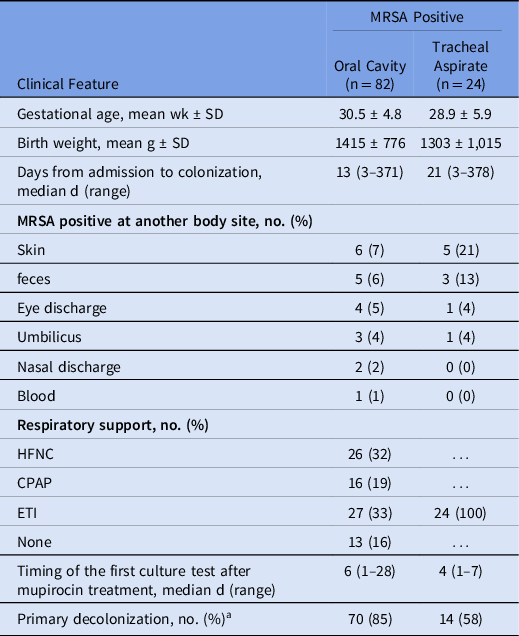
Of the 1,431 neonates admitted to our NICU during the study period, 169 (11.8%) neonates were identified as having MRSA positivity at any body site or tracheal tube by surveillance culture examination (Fig. 1). Among these 169 neonates, 140 had MRSA colonization in the oral cavity or tracheal aspirate (n = 131, oral cavity; n = 33, tracheal aspirate; n = 24, both sites). Of these 140 neonates, 123 neonates (88%), including 117 neonates with MRSA colonization in the oral cavity (group 1) and and 30 neonates with MRSA colonization detected via tracheal aspirate (group 2), underwent nasal mupirocin treatment. Overall, 82 neonates in group 1 and 24 neonates in group 2 underwent follow-up surveillance culture of oral swabs and tracheal aspirates, respectively, after the completion of mupirocin treatment. The clinical characteristics of the neonates undergoing follow-up surveillance cultures are shown in Table 1. Primary decolonization was observed in 70 neonates (85%) in group 1 and 14 neonates (58%) in group 2 who underwent follow-up cultures after completing the mupirocin treatment. Of the 70 neonates in group 1 and 14 neonates in group 2 with primary decolonization, 55 neonates in group 1 and 12 neonates in group 2 underwent additional follow-up cultures. Recurrent MRSA colonization occurred in 25 (45%) of the 55 neonates with primary oral cavity decolonization (group 1). In this group, the duration from primary decolonization to recurrent colonization was 19 ± 14 days (mean ± SD). The other 30 (55%) neonates in this group remained with MRSA-negative oral cavity cultures for 25 ± 22 days (mean ± SD) until discharge. In group 2, recurrent MRSA colonization occurred in 7 (58%) of the 12 neonates with primary tracheal aspirate decolonization. In this group, the duration from primary decolonization to recurrent colonization was 23 ± 12 days (mean ± SD). The other 5 neonates (42%) in this group remained with MRSA-negative tracheal aspirate cultures for 15 ± 7 days (mean ± SD) before tracheal extubation.
Flowchart of the study population. Note: MRSA, methicillin-resistant Staphylococcus aureus.

Clinical Features and Decolonization Rate of Neonates Treated With Mupirocin

Note. MRSA, methicillin-resistant Staphylococcus aureus; HFNC, high-flow nasal cannula; CPAP, continuous positive airway pressure; ETI, endotracheal intubation; SD, standard deviation.
a An MRSA-negative result of a culture test performed for the first time after the completion of mupirocin treatment.
Discussion
In the current study, we investigated the MRSA decolonization rates of NICU patients with MRSA colonization detected in the oral cavity and tracheal aspirates who received nasal mupirocin treatment. Primary decolonization was achieved in 85% of patients in group 1 and 58% of patients in group 2.
In a previous study involving healthy adults, mupirocin treatment eliminated 62% of pharyngeal S. aureus carriage after 5 weeks of administration. Reference Wertheim, Verveer, Boelens, van Belkum, Verbrugh and Vos5 The late timing of follow-up cultures in this previous study, compared with that in our study, might have affected the lower elimination rate. Ciliary movement in the nasopharynx is considered to transport mupirocin to the pharynx. Reference Watanabe, Masaki and Asoh6 We speculate that the transported mupirocin ointment could decolonize MRSA in the oral cavity. To the best of our knowledge, no previous studies have investigated the MRSA decolonization effect of nasal mupirocin treatment in tracheal aspirates. We hypothesize that the reduction of MRSA carriage in the oral cavity could reduce the risk of microaspiration of MRSA-contaminated oropharyngeal secretions into the lower respiratory tract of neonates in our study.
A previous study showed a significant reduction in the rate of MRSA infection by mupirocin administration among MRSA-colonized infants. Reference Schuetz, Hogan and Reich7 However, the pathophysiological process from nasal decolonization of MRSA to reduction of MRSA infection has remained unclear. Bacterial colonization in the oropharynx and tracheal secretions is recognized as a risk factor for developing ventilator-associated pneumonia (VAP), which is a major nosocomial infection among neonates. Reference Cernada, Brugada, Golombek and Vento8 Therefore, we hypothesize that the high rate of MRSA decolonization in the oropharynx and tracheal secretions in our study might explain the reduction of VAP. In addition, VAP is associated with late-onset sepsis in neonates. Reference Wu, Tsai and Lai9 Bacterial decolonization in the oropharynx and tracheal secretions with nasal mupirocin treatment might contribute to the reduction of the risk of MRSA sepsis by reducing the occurrence of VAP.
In a previous studyby Akinboyo et al, Reference Akinboyo, Voskertchian and Gorfu10 chlorhexidine gluconate bathing in addition to mupirocin treatment were implemented as part of infection prevention bundles for neonates with S. aureus nasal colonization. Their study showed a lower rate (39%) of recurrent S. aureus colonization than in our study. Chlorhexidine bathing combined with nasal mupirocin treatment may be beneficial in reducing the rate of recurrent MRSA colonization. Nelson et al Reference Nelson, Shaw and Gross4 reported a high recurrent S. aureus colonization rate (73%) after primary decolonization. Reference Nelson, Shaw and Gross4 The multiple site screening (nares, periumbilical, and groin) in their study could be the reason for the higher rate of recurrent colonization than those in our study. Nelson et al Reference Nelson, Shaw and Gross4 also showed a high rate of subsequent decolonization (78%) with additional mupirocin treatment for recurrent S. aureus colonization. Further studies are needed to confirm the effect of repeated treatment with mupirocin.
This study had several limitations. First, we did not perform weekly surveillance culture for the nasal cavity during the study period. Therefore, we could not predict or compare the decolonization effect of mupirocin treatment on the nasal cavity with that on the oral cavity or tracheal aspirate in neonates. Second, mupirocin treatment for methicillin-susceptible S. aureus carriage is not covered by the public health insurance in Japan. Therefore, the effect of nasal mupirocin treatment on extranasal decolonization of methicillin-susceptible S. aureus in neonates was not investigated in this study. Additionally, 3 of 70 and 4 of 14 neonates with primary oral cavity and tracheal aspirate decolonizations, respectively, received systemic anti-MRSA agents within 1 week of mupirocin treatment. These systemic antibiotics might have affected the culture results of primary decolonization.
In conclusion, nasal mupirocin treatment may be effective in reducing the rates of oral and intratracheal colonization of MRSA, thereby confirming the efficacy of nasal decolonization in reducing the risk of subsequent MRSA infections. Nevertheless, prospective multicenter studies are required to verify the effect of mupirocin treatment on extranasal decolonization of MRSA among neonates.
Acknowledgments
Financial support
No financial support was provided relevant to this article.
Conflicts of interest
All authors have declared no conflicts of interest in relation to this study.