

Introduction
Protein evolution occurs via mutations that change the composition or expression of the proteome of a population, sometimes by random nearly neutral drift, and sometimes via selection pressures imposed by the habitat (Bajaj and Blundell, Reference Bajaj and Blundell1984; DePristo et al., Reference DePristo, Weinreich and Hartl2005; Pál et al., Reference Pál, Papp and Lercher2006; Goldstein, Reference Goldstein2008; Hurst, Reference Hurst2009; Worth et al., Reference Worth, Gong and Blundell2009) After Darwin's theory of natural selection, Mendel's laws of inheritance, the modern synthesis of the 20th century, and the rise of structural biology and the central dogma, we know that nature selects favorable traits if their impact outweighs the random fixation dynamics, and we know how these changes are actualized via mutations in the DNA that translate to the proteome. Remaining major questions are: (1) how important is selection versus random drift and can we predict their relative importance? (Kimura, Reference Kimura1962; Blundell and Wood, Reference Blundell and Wood1975; Ohta Reference Ohta1992; Hurst, Reference Hurst2009). (2) What are the molecular properties selected for, and are they universal? (Hurst, Reference Hurst2009; Lobkovsky et al., Reference Lobkovsky, Wolf and Koonin2010; Liberles et al., Reference Liberles, Teichmann, Bahar, Bastolla, Bloom, Bornberg‐Bauer, Colwell, De Koning, Dokholyan, Echave and Elofsson2012). (3) How do we describe accurately and completely the evolution of populations from the arising mutation in the gene, via the molecular property of the protein, to its fixation and ultimate effect on the population? According to this view, the ultimate goal of biology is to bridge the genome, proteome, phenotype, and population together in one quantitative and predictive theory that explains the history, present, and future of biological structure on this planet.
In the 1960s, the observation of nearly constant evolution of homologous proteins (Margoliash, Reference Margoliash1963; Zuckerkandl and Pauling, Reference Zuckerkandl and Pauling1965, Reference Zuckerkandl, Pauling, Kasha and Pullman1962) led to the theory of (nearly) neutral evolution implying that most fitness effects are too subtle to dominate over random fixation dynamics of the population, thus producing an almost constant rate of evolution (Kimura, Reference Kimura1962; Ohta, Reference Ohta1992). This resulting, widely applied molecular clock is essential for dating phylogenies and evolutionary histories (Zuckerkandl and Pauling, Reference Zuckerkandl and Pauling1965; Kumar and Subramanian, Reference Kumar and Subramanian2002; Yi et al., Reference Yi, Ellsworth and Li2002; Meredith et al., Reference Meredith, Janečka, Gatesy, Ryder, Fischer, Teeling, Goodbla, Eizirik, Simão, Stadler and Rabosky2011). When applied to single individuals, variations in the clock specific to the mutated site are used to indicate pathogenicity of a human gene variant (Ng and Henikoff, Reference Ng and Henikoff2003; Flanagan et al., Reference Flanagan, Patch and Ellard2010; Shihab et al., Reference Shihab, Gough, Cooper, Stenson, Barker, Edwards, Day and Gaunt2013; Tang et al., Reference Tang, Dehury and Kepp2019). The evolution rate varies by many orders of magnitude between sites and proteins (Zuckerkandl and Pauling, Reference Zuckerkandl and Pauling1965; Gillespie, Reference Gillespie1984, Reference Gillespie1986; Drummond et al., Reference Drummond, Bloom, Adami, Wilke and Arnold2005) and can be used to distinguish neutral evolution (Kimura, Reference Kimura1991; Ohta Reference Ohta1992; Fay et al., Reference Fay, Wyckoff and Wu2002) from adaption or positive selection toward a new fitness optimum (Hurst, Reference Hurst2009).
Darwin's theory of evolution emphasized that positive selection of optimal function provides the fitness that ultimately determines the structure of life (survival of the fittest). This view has dominated biochemical thinking of enzymes as perfectly optimized catalysts, implying that evolution strives toward optimal function per se, e.g. maximal substrate turnover (k cat/K m) of highly optimized and conserved active sites as the main raison d’être (Radzicka and Wolfenden, Reference Radzicka and Wolfenden1995; Cannon et al., Reference Cannon, Singleton and Benkovic1996; Zhang and Houk, Reference Zhang and Houk2005; Hurst, Reference Hurst2009; Soskine and Tawfik, Reference Soskine and Tawfik2010). The connectivity of many proteins (i.e. the extent of their involvement in biochemical pathways) seemed to slow their rate of evolution, consistent with functional constraints on evolution (Fraser et al., Reference Fraser, Hirsh, Steinmetz, Scharfe and Feldman2002; Hahn and Kern, Reference Hahn and Kern2004; Wall et al., Reference Wall, Hirsh, Fraser, Kumm, Giaever, Eisen and Feldman2005). However, proteins are also subject to ‘non-function’ selection pressures directed toward e.g. proteome stability and efficiency of translation (Ehrenberg and Kurland, Reference Ehrenberg and Kurland1984; Hurst and Smith, Reference Hurst and Smith1999; Bloom and Adami, Reference Bloom and Adami2003; Reference Bloom and Adami2004; Drummond et al., Reference Drummond, Bloom, Adami, Wilke and Arnold2005; Lobkovsky et al., Reference Lobkovsky, Wolf and Koonin2010; Wylie and Shakhnovich, Reference Wylie and Shakhnovich2011). During early evolution, fierce competition produced evolutionary innovations in prokaryotes, and the rise of the eukaryotes (Lane and Martin, Reference Lane and Martin2010; Sousa et al., Reference Sousa, Thiergart, Landan, Nelson-Sathi, Pereira, Allen, Lane and Martin2013) heralded major biochemical innovations largely relating to advantages of size and metabolism, rather than function per se (Lane, Reference Lane2011). Under these conditions, the ability to efficiently harvest energy and chemical components was critical (Lane and Martin, Reference Lane and Martin2010; Sousa et al., Reference Sousa, Thiergart, Landan, Nelson-Sathi, Pereira, Allen, Lane and Martin2013).
The subsequent long periods of relatively stable evolution have seen active sites of proteins highly conserved by purifying selection near their fitness optima (Blundell and Wood, Reference Blundell and Wood1975; Casari et al., Reference Casari, Sander and Valencia1995) and most sequence variation occurs in other sites where nearly neutral substitutions probably dominate most recent evolution (Ohta, Reference Ohta1992). For the same reason, almost all protein evolution involves sequence variations that maintain the already adopted, highly conserved fold structure (Worth et al., Reference Worth, Gong and Blundell2009). The nearly neutral sites that dominate this evolution are subject to non-function selection pressures, i.e. selection pressures not directly reflecting optimal chemical turnover of the protein. Most importantly, they may contribute to optimal translational efficiency under favorable growth conditions (Ikemura, Reference Ikemura1985; Andersson and Kurland, Reference Andersson and Kurland1990). Selection at the gene level for translational efficiency and precision (Ehrenberg and Kurland, Reference Ehrenberg and Kurland1984; Andersson and Kurland, Reference Andersson and Kurland1990; Marais and Duret, Reference Marais and Duret2001; Akashi, Reference Akashi2003; Drummond et al., Reference Drummond, Bloom, Adami, Wilke and Arnold2005) is evident e.g. from codon bias and t-RNA isoforms (Robinson et al., Reference Robinson, Lilley, Little, Emtage, Yarranton, Stephens, Millican, Eaton and Humphreys1984; Kanaya et al., Reference Kanaya, Yamada, Kudo and Ikemura1999; Tuller et al., Reference Tuller, Waldman, Kupiec and Ruppin2010).
This review concerns the question: What drives protein evolution on most time scales where the function is already nearly optimal? To address this question, we must first discuss the typical properties of proteins. Proteins vary by three orders of magnitude in length (from tens to ten thousands of amino acids), they vary structurally via thousands of folds (Bajaj and Blundell, Reference Bajaj and Blundell1984; Mirny and Shakhnovich, Reference Mirny and Shakhnovich1999; Qian et al., Reference Qian, Luscombe and Gerstein2001; Koonin et al., Reference Koonin, Wolf and Karev2002), and by perhaps 5–7 orders of magnitude in abundance in eukaryotic cells (Jansen and Gerstein, Reference Jansen and Gerstein2000; Beck et al., Reference Beck, Schmidt, Malmstroem, Claassen, Ori, Szymborska, Herzog, Rinner, Ellenberg and Aebersold2011; Milo Reference Milo2013).
In stark contrast to these enormous variations, proteins across all domains of life are marginally stable in a narrow range of perhaps 30–100 kJ mol−1, barely preventing denaturation (DePristo et al., Reference DePristo, Weinreich and Hartl2005; Goldstein, Reference Goldstein2011). There are three possible origins of this phenomenon: marginal stability is a selected beneficial trait, it arises form random mutation-selection dynamics, or it reflects stability-constrained functional optimization. In the first case, marginal stability ensures efficient turnover of aged and damaged proteins and reuse of amino acids; a too stable fold may be hard to degrade. In the second case, because mutations arise randomly and anything random done to an optimized system tends to reduce optimality, protein stability is constantly challenged by mutations that destabilize by perhaps 5 kJ mol−1 on average (Tokuriki et al., Reference Tokuriki, Stricher, Schymkowitz, Serrano and Tawfik2007), and responsive selection keeps the protein stable (Taverna and Goldstein, Reference Taverna and Goldstein2002; Goldstein, Reference Goldstein2011). If so, marginal stability is not a selected trait but a consequence of the predominance of random drift, with mutation-selection dynamics constantly playing out near the denaturation threshold. Third, optimization of function occurs under the constraint of preventing denaturation. If so, marginal stability is not a selected trait or a consequence of random drift but reflects maximal trading of stability for function by investing protein fold-free energy to minimize transition state barriers of enzymes (Warshel, Reference Warshel1998). Each explanation does not exclude the others, as trade-offs and drift depend greatly on the protein, phenotype, and population, and they can ultimately be linked to the cost of managing the overall proteome, as discussed below.
The main determinants of evolution rate
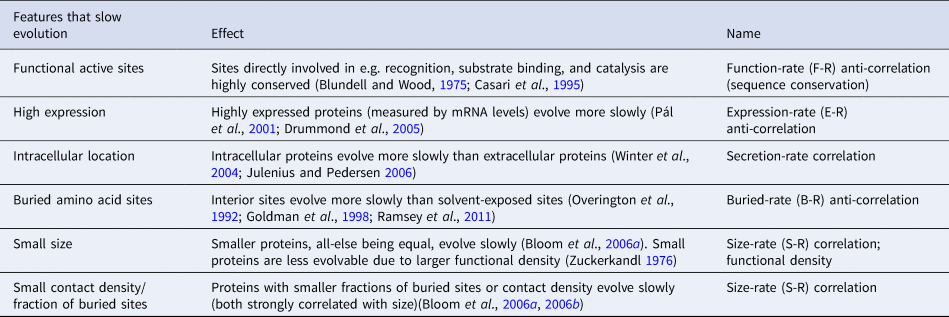
To understand the main drivers of evolution we must first understand the protein properties that mostly determine evolutionary rates in proteins on longer time scales. This rate is also used to classify and predict the functional impact of human variants e.g. in relation to disease (Glaser et al., Reference Glaser, Pupko, Paz, Bell, Bechor-Shental, Martz and Ben-Tal2003; Capra and Singh, Reference Capra and Singh2007; Thusberg et al., Reference Thusberg, Olatubosun and Vihinen2011; Tang et al., Reference Tang, Dehury and Kepp2019). Table 1 provides an overview of the most important relationships between a protein's properties and its evolution rate. As easily verified from sequence alignment, active sites in proteins are highly conserved due to strong purifying selection, because random deleterious mutations impair fitness more in highly optimized parts of the protein. Related to this, solvent-exposed sites in contrast evolve faster than average, consistent with their typically smaller functional and structural effects on the overall protein (Overington et al., Reference Overington, Donnelly, Johnson, Šali and Blundell1992; Goldman et al., Reference Goldman, Thorne and Jones1998; Ramsey et al., Reference Ramsey, Scherrer, Zhou and Wilke2011).
Important correlators of the evolution rate and size of proteins

The strongest descriptor of evolutionary rate is protein abundance or equally, mRNA levels, as these correlate (Gygi et al., Reference Gygi, Rochon, Franza and Aebersold1999); it typically spans 5–7 orders of magnitude in eukaryotes (Jansen and Gerstein, Reference Jansen and Gerstein2000; Ghaemmaghami et al., Reference Ghaemmaghami, Huh, Bower, Howson, Belle, Dephoure, O'Shea and Weissman2003; Beck et al., Reference Beck, Schmidt, Malmstroem, Claassen, Ori, Szymborska, Herzog, Rinner, Ellenberg and Aebersold2011; Milo Reference Milo2013). High expression is associated with slower protein evolution in both prokaryotes (Sharp, Reference Sharp1991; Rocha and Danchin, Reference Rocha and Danchin2004) and eukaryotes (Pál et al., Reference Pál, Papp and Hurst2001), including mammals (Jordan et al., Reference Jordan, Mariño-Ramírez, Wolf and Koonin2004; Zhang and Li Reference Zhang and Li2004), a phenomenon known as the expression-rate (E-R) anti-correlation (Drummond et al., Reference Drummond, Bloom, Adami, Wilke and Arnold2005; Bloom et al., Reference Bloom, Drummond, Arnold and Wilke2006a). Protein expression may explain half of the evolutionary rate variation in yeast (Drummond et al., Reference Drummond, Raval and Wilke2006) indicating a universal driving force of evolution. This remarkable relationship has been studied using many biophysical models focusing on protein stability, misfolding avoidance, and flexibility (Lobkovsky et al., Reference Lobkovsky, Wolf and Koonin2010; Geiler-Samerotte et al., Reference Geiler-Samerotte, Dion, Budnik, Wang, Hartl and Drummond2011; Wylie and Shakhnovich, Reference Wylie and Shakhnovich2011; Liberles et al., Reference Liberles, Teichmann, Bahar, Bastolla, Bloom, Bornberg‐Bauer, Colwell, De Koning, Dokholyan, Echave and Elofsson2012; Serohijos et al., Reference Serohijos, Rimas and Shakhnovich2012; Yang et al., Reference Yang, Liao, Zhuang and Zhang2012; Kepp and Dasmeh, Reference Kepp and Dasmeh2014; Sikosek and Chan, Reference Sikosek and Chan2014). All-else-being-equal, a protein's fitness impact should be proportional to its cellular abundance regardless of the specific selection pressure. Thus, any fitness function that scales with protein abundance may seem reasonable. Such models can explain about 60% of site-variations in the evolutionary rate (McInerney, Reference McInerney2006; Echave et al., Reference Echave, Spielman and Wilke2016). Protein stability has mainly been related to fitness via the copy number of misfolded proteins, assuming one-step unfolding (Serohijos et al., Reference Serohijos, Rimas and Shakhnovich2012; Dasmeh et al., Reference Dasmeh, Serohijos, Kepp and Shakhnovich2014a). These ideas are expanded further below. To summarize the tendencies of Table 1, compared to the average protein, the slowly evolving protein tends to be highly expressed, intracellular, smaller than average, and have a higher functional density, i.e. more important sites relatively to its size.
The E-R anti-correlation has been explained (Drummond and Wilke, Reference Drummond and Wilke2008, Reference Drummond and Wilke2009) as a selection against inefficient translation leading to toxic misfolded proteins, a theory originally proposed by Kurland and Ehrenberg (Ehrenberg and Kurland, Reference Ehrenberg and Kurland1984; Kurland and Ehrenberg, Reference Kurland, Ehrenberg, Cohn and Moldave1984, Reference Kurland and Ehrenberg1987). Protein synthesis is inherently error-prone, and translation operates with typical missense error rates of 1/1000 to 1/10 000 (Kurland and Ehrenberg, Reference Kurland and Ehrenberg1987). Considering the typical lengths (~100–1000) and total abundance of proteins (108) in eukaryotic cells, one can expect 1010–1011 protein-incorporated amino acids to exist at any time. Without error correction this could imply the constant existence of 106–108 erroneous amino acids in a typical eukaryote cell. This would make translation-error induced proteome variation of similar importance as typical, mostly heterozygote, natural sequence variation in a population. This of course raises the question how much of the actual observed proteome variation is due to genetic inheritance, somatic mutations, and translation errors. To be sure, one needs to sequence each gene and protein many times for several cells. Regardless of this complication, it is clear that the proteome varies much more in composition than implied by genetic variance alone.
Considering this, because the typical non-native residue destabilizes by ~5 kJ mol−1 (Tokuriki et al., Reference Tokuriki, Stricher, Schymkowitz, Serrano and Tawfik2007), as much as 10% of a proteome could be less stable than commonly assumed purely from wild-type sequence. For a cell with 108 proteins, this implies that 107 protein copies are randomly destabilized and subject to higher turnover that expected from their wild-type sequence. Post-translational modifications and specific degrons further diversify the proteome and complicate turnover further. Considering this, the additional destabilization from new arising mutations will aggravate costs only if the affected protein is quite abundant or subject to high turnover.
If the misfolded protein is selected against, regardless of the reason, highly expressed proteins are under stronger selection pressure because the copy number of misfolded proteins Ui scales with the total abundance of the protein Ai. Drummond and co-workers suggested a fitness function Φ depending exponentially on the total copy number of all misfolded proteins U = ∑Ui, with an unknown scaling constant c (Drummond and Wilke, Reference Drummond and Wilke2008):

The constant c can be derived from fundamental and simple assumptions and related directly to the cost of protein turnover, as discussed below.
The theory of proteome cost minimization
Darwin's theory of selection and the theory of nearly neutral evolution (Kimura, Reference Kimura1962, Reference Kimura1991; Ohta, Reference Ohta1992) together explain evolution as a process of selection and drift, whereas structural biology explains the molecular language of evolution via the central dogma. However, a complete theory of evolution requires us to also know the properties of the evolving protein that contributes to the organism phenotype, why it contributes, to what extent it contributes, and how this affects the wider evolution of the population in its ecological and historical context. As discussed extensively in the literature, it is increasingly clear that the functional traits selected for in classical positive Darwinian evolution have relatively little importance in many cases relative to other, partly hidden and perhaps universal properties of the proteins (Hurst and Smith, Reference Hurst and Smith1999; Bloom and Adami, Reference Bloom and Adami2003, Reference Bloom and Adami2004; Drummond et al., Reference Drummond, Bloom, Adami, Wilke and Arnold2005; Lobkovsky et al., Reference Lobkovsky, Wolf and Koonin2010; Wylie and Shakhnovich, Reference Wylie and Shakhnovich2011).
The most obvious universal property subject to selection pressure is arguably the cellular energy state. Before the era of structural biology and proteomics, Boltzmann (Reference Boltzmann1886) and Schrödinger (Reference Schrödinger1944) already speculated that life characteristically represents a well-defined organized (low-entropy) structure that maintains a thermodynamic non-equilibrium state relative to its high-entropy surroundings by constant energy turnover and associated heat dispersion. By this definition, expansion of life (fitness) implies expansion of this energy turnover. Lotka applied these ideas to Darwin's selection theory via his maximum power principle, arguing that evolution occurs by selection of the most energy-efficient organisms (Lotka, Reference Lotka1922). These ideas were then expanded into a much broader ecological view by Odum (Reference Odum1988). Thermodynamically, the system most capable of maintaining its structure by energy dissipation and with the ability to grow and reproduce these structures will prevail over other similar systems, and thus, be most fit.
The theory of proteome cost minimization (PCM) presented below was inspired by these views and further supported by the observations of consistent cost-bias in amino acid use across all kingdoms of life first discovered by Akashi and Gojobori (Reference Akashi and Gojobori2002). These findings were confirmed by Swire (Reference Swire2007) and explained in a fitness model by Wagner who showed, among other things, that gene duplications are highly selected against in terms of cellular energy costs (Wagner, Reference Wagner2005). The theory builds substantially on Wagner's seminal quantitative considerations (Wagner, Reference Wagner2005) and the important considerations of Brown et al. (Reference Brown, Marquet and Taper1993) who used Lotka's ansatz to explain mass and size optima of biological taxa in terms of evolutionary fitness caused by the different scaling of metabolic rates and reproductive rates with mass. The theory's central ansatz, inspired by these minds, is as follows: ‘Fitness is proportional to the energy per time unit available for reproduction after subtracting (proteome) maintenance costs’. Because fitness always has to be measured relative to a wild type after an instant of time, the energy of interest becomes a power (measured in watts or J s−1) as in Lotka's original thinking, and as such directly relates to the respiration rate of the organism, as discussed below.
The mechanistic basis for the theory is that (i) protein degradation increases many-fold with the lack of structure and partial unfolding in protein copies (Gsponer et al., Reference Gsponer, Futschik, Teichmann and Babu2008) and (ii) the cost of protein turnover is more than half of total metabolic costs in growing microorganisms (Harold, Reference Harold1987), and at least 20% in humans (Waterlow, Reference Waterlow1995). Accordingly, any increase in these costs reduces the energy available for other energy-demanding processes, notably reproduction (fitness) of microorganisms (Dasmeh and Kepp, Reference Dasmeh and Kepp2017) and cell signaling (cognition) in higher organisms (Kepp, Reference Kepp2019). One of many implications of the theory is that selection against misfolded proteins and toxicity of misfolding proteins measured in cell viability assays is not due to a specific toxic molecular mode of action as widely assumed, but to the generic adenosine triphosphate (ATP) burden of turning over the misfolded proteins within the cell.
In its simplest form, which is easily expanded, we assume a life cycle of a protein i as:

Fi represents the folded proteins, Ui represents misfolded proteins, and Di represent the degradation products, many of which are recycled for use in other proteins; the rate constant of each process is specific to the protein in question. Because the ultimate selection pressure acts only on Ui, one can easily relax the assumption of one-step unfolding to account for complex situations.
$k_{{\rm d}_i}$ is the rate constant (in units of protein molecules per s) for degrading the misfolded protein copies. The in vivo rate constants reflect the half-life (t ½) of the fully folded protein, and can thus be written at steady state as:

which varies substantially with the protein i, giving half-lives from minutes to days (Hargrove and Schmidt, Reference Hargrove and Schmidt1989). The model assumes that unfolded protein copies are always kept at a very small number in the cell, compared to folded copies, such that $k_{2_i}$ is much larger than $k_{{\rm d}_i}$
 and $k_{1_i}$
 . This is generally a good approximation, because ${k}^{\prime}_{{\rm d}_i}$
 is typically of the order of 10−4 s−1 but with order-of-magnitude variations. In contrast, $k_{{\rm d}_i}$
 acts directly on already misfolded protein and represents the rate of protein degradation if the chemical activation barrier to unfolding has been removed. Thus, $k_{{\rm d}_i}$
 is limited by the number of active proteases, the diffusion and proper orientation of the exposed peptide bond, and the actual k cat/K M of the proteases, with an upper limit of perhaps 106 to 108 M−1 s−1 per peptide bond hydrolysis (Wolfenden and Snider, Reference Wolfenden and Snider2001; Bar-Even et al., Reference Bar-Even, Noor, Savir, Liebermeister, Davidi, Tawfik and Milo2011). In terms of steady-state turnover, misfolded proteins are immediately targeted for degradation (Gsponer et al., Reference Gsponer, Futschik, Teichmann and Babu2008) and recruited by the ubiquitin–proteasome pathway that takes the protein out of the pool, and thus this process is not rate-limiting the overall protein flux but arguably operates near the diffusion limit.
Assuming one-step misfolding, Ui is related to the folding free energy of the protein ΔGi = −RT ln($K_{{\rm f}_i}$ ) via the equilibrium constant $K_{{\rm f}_i}$
 = Fi/Ui:

The last expression follows if there are many more folded than unfolded copies of the protein, which is almost always the case. Because folding equilibrium constants easily reach 1011 for a protein of typical stability (65 kJ mol−1 at 37 °C), the number of misfolded proteins at any given time is typically negligible, as they are immediately subject to turnover. Reasonable experimental values of $k_{{\rm d}_i}$ = 107 s−1, $K_{{\rm f}_i}$
 = 1011, and ${k}^{\prime}_{{\rm d}_i}$
 = 10−4 s−1 satisfy the relationship in Eq. (3) and thus justify the use of Eq. (2).
Equation (4) is well established and was first used in a fitness function by Bloom et al. (Reference Bloom, Wilke, Arnold and Adami2004) and has been specifically used to explain some of the E-R anticorrelation (Serohijos et al., Reference Serohijos, Rimas and Shakhnovich2012) and additional variations in evolutionary rates (Dasmeh et al., Reference Dasmeh, Serohijos, Kepp and Shakhnovich2014a). The advantage of this expression is that we can relate the number of misfolded protein copies, which is the property selected upon, directly to the total copy number Ai of the protein within the cell and to its thermodynamic stability, via the free energy of folding ΔGi (a negative number in kJ mol−1). RT is the thermal energy of the cell, and thus temperature enters directly as a fundamental physical parameter determining proteome Ui and ultimately cellular proteome costs and fitness, as discussed further below.
The critical step is now to write the fraction of the total respiration rate (in watts, or J s−1) of the cell due to the maintenance of a single protein i:

In this equation, in addition to the parameters already described above, $N_{{\rm a}{\rm a}_i}$ represents the number of amino acids in the protein i, and the cost constants $C_{{\rm s}_i}$
 and $C_{{\rm d}_i}$
 describe the average synthetic and degradation cost per amino acid in protein i in units of J (Kepp and Dasmeh, Reference Kepp and Dasmeh2014).
For the whole proteome of the cell, we can write the total cost per time unit as the sum of the costs of maintaining steady-state folded protein copy numbers within the cell:

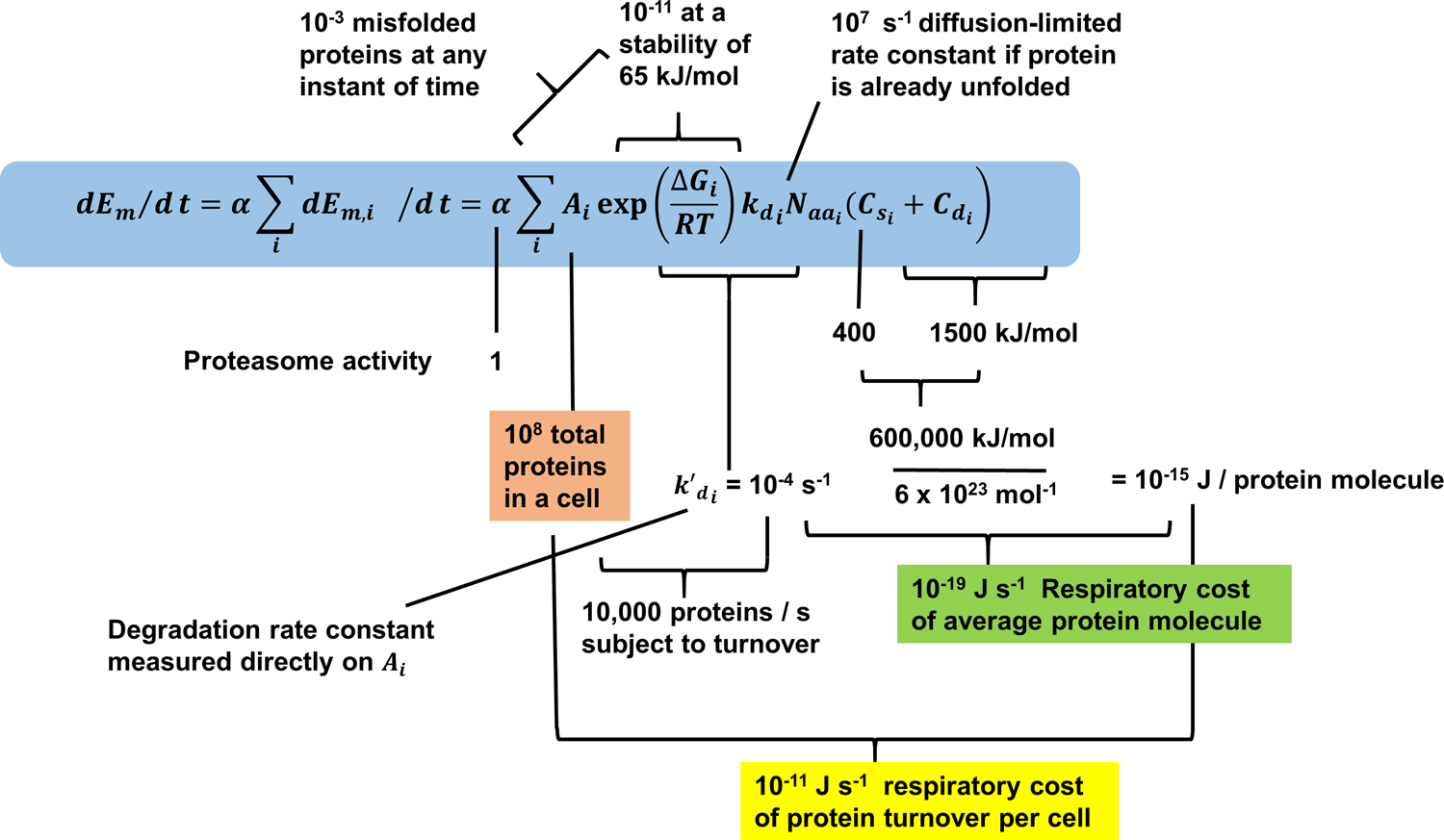
Importantly, we see that the total energy costs scale with Ai. Because Ai varies substantially for different proteins, e.g. from zero to a million, some proteins are much more important to the cell's energy budget than others. The scaling constant α represents the activity of the proteasome, which may be controlled with proteasome inhibitors, but a slight expansion of this expression can be done to (α + β + ⋯) taking into account the contributions of various degradation pathways (lysosome, proteasome, effects of N-end rule, etc.) to the overall turnover. Figure 1 summarizes some typical values for the parameters of the model applicable to eukaryote cells.
Schematic overview of order-of-magnitude terms of the PCM model. Typical values for yeast used as example. All values are subject to the well-known variations in copy numbers of individual proteins, degradation constants, length of proteins, and total number of proteins copies in a cell.

Selection dynamics of PCM
To understand how protein turnover costs affect evolution, we now use the central ansatz that fitness scales with the energy available for reproduction dE r/dt after subtracting the proteome costs of Eq. (6) from the total energy available to the cell either by production or supply, dE t/dt, divided by the respiration rate needed to run an individual, also taken to dE t/dt:

The division by dE t/dt formally ensures a dimensionless fitness function. For simplicity, we ignore the non-proteome energy costs because the purpose is to show that the cost of the proteome exerts a major effect on evolution by itself. Assuming that the total energy production is constant for all competing cells, minimization of dE m/dt maximizes fitness. When a new mutation arises in protein i, the selection coefficient is:

For clarity, we have assumed that the mutation only affects maintenance turnover costs and not energy production, and thus the total energy produced is the same before and after mutation and cancels in Eq. (8). If we further neglect epistasis, selection only acts on the mutated protein i:

This selection coefficient is a function only of protein properties, scaled by the general energy spent for reproduction of the organism, dE r/dt(WT), which can be taken as a constant of the order of 10−11 J s−1 (Harold, Reference Harold1987). It is perhaps more convenient to write Eq. (9) in terms of copy numbers and half-lives (t ½) which can be measured in live cells:

where we have used the relationship:

For a haploid organism, the probability of its fixation P fix is approximately (Kimura, Reference Kimura1962; Ohta Reference Ohta1992):

where N is the effective population size, and the last term comes from expanding the exponential of the small si. For neutral evolution, as si → 0, P fix → 1/N, and does not depend on any properties of the protein. At significant positive selection, si N is large, si is positive, and P fix → si. Very similar behavior applies to diploid organisms with slightly different factors of 2 and 4 (Kimura, Reference Kimura1962).
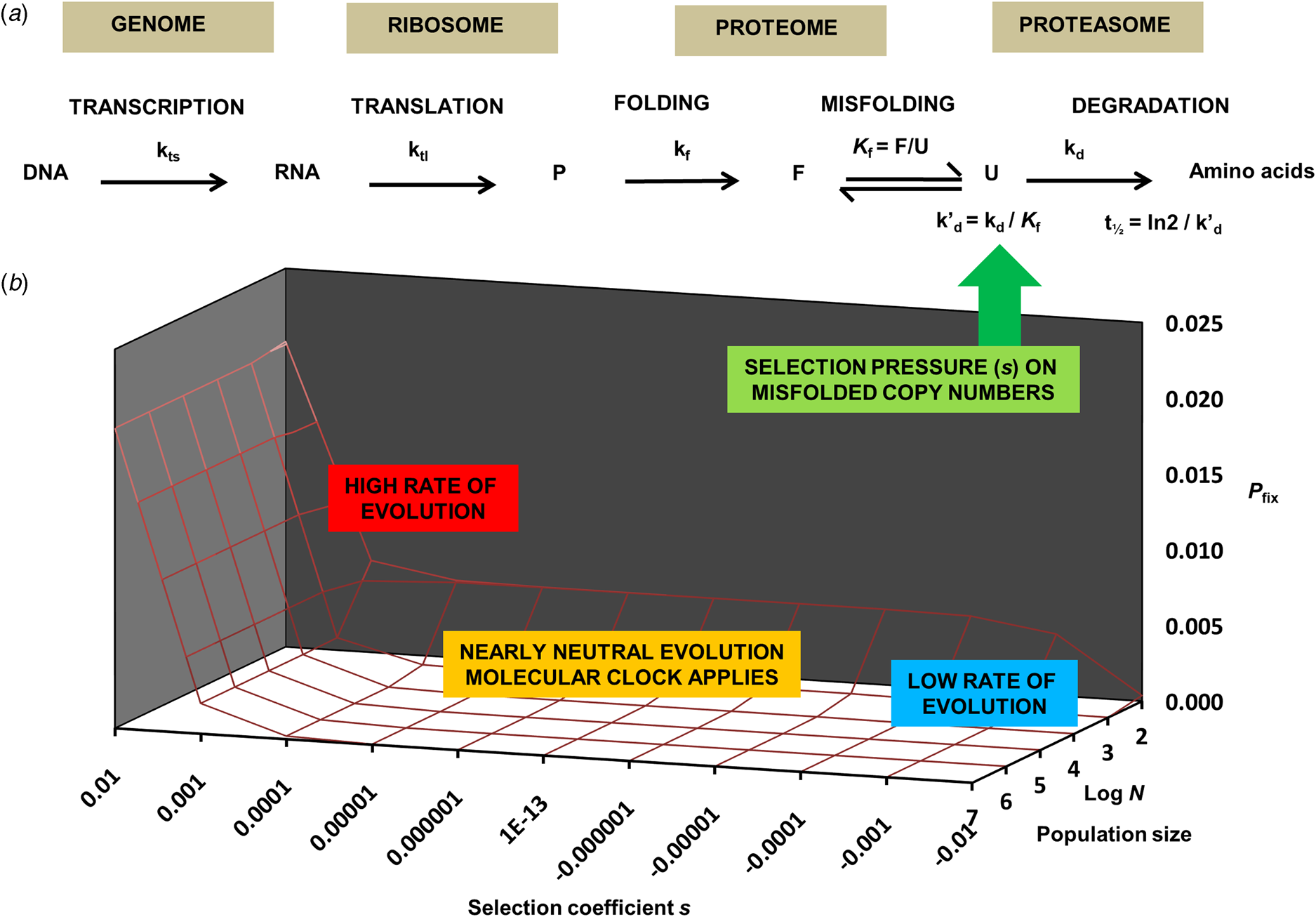
The simple kinetic scheme assumed for the PCM model is highlighted in Fig. 2a. From Eq. (10), considering the variations in the parameters, most of the proteome cost selection occurs by affecting the ratio Ai/t ½. Mutations that reduce the half-life of abundant proteins are thus particularly selected against. The typical behavior of P fix with N and si is shown in Fig. 2b. The absolute rate of evolution ω scales with the mutation rate and the probability of fixating new arising mutations:

where u is the absolute mutation rate; this expression can be expanded by life history variables such as generation time (Martin and Palumbi, Reference Martin and Palumbi1993), but this is beyond the scope here, as the proportionality of Eq. (13) generally applies, and P fix thus measures evolution rate. For an optimized evolutionary system, a typical arising mutation has a negative selection coefficient; if small relative to 1/N, it is subject to random fixation drift. From Eq. (13), such mutations will reduce the probability of fixation (and evolution rate) in proportion to the size of the negative selection coefficient. Figure 2b also illustrates why the molecular clock is generally successful at dating phylogenies, because 90% of randomly occurring mutations in the relevant selection-fixation space are subject to neutral evolution.
(a) Schematic overview of the processes of protein turnover, with the central dogma to the left and the proteome maintenance, the concern of the present paper, to the right. (b) Probability of fixation (P fix) plotted against selection coefficient s and log N (effective population size). Beneficial mutations with s > 0.001 have relevant P fix of more than 1% for most populations. Only in very small populations (<100) do other mutations get fixated (P fix ~ 1%), and neutral and slightly deleterious mutations become fixated to a similar extent until s approaches −1/N, whence P fix rapidly decreases.

To understand the slow evolution of abundant proteins discussed in the literature (Drummond et al., Reference Drummond, Bloom, Adami, Wilke and Arnold2005; Bloom et al., Reference Bloom, Drummond, Arnold and Wilke2006a; Drummond and Wilke, Reference Drummond and Wilke2008), we should identify low values of P fix in the evolution rate space of Fig. 2b. Most arising mutations (Fig. 2b) remain subject to nearly neutral evolution. However, more extreme selection coefficients will occur for highly abundant proteins, because the selection coefficient of a new arising mutation in a protein scales with the abundance and turnover rate of the affected protein. In contrast, less abundant proteins will typically have numerically smaller selection coefficients at any given effective population size. The next section gives a quantitative estimate of the fixation probabilities.
Typical PCM selection pressures and fixation probabilities for yeast
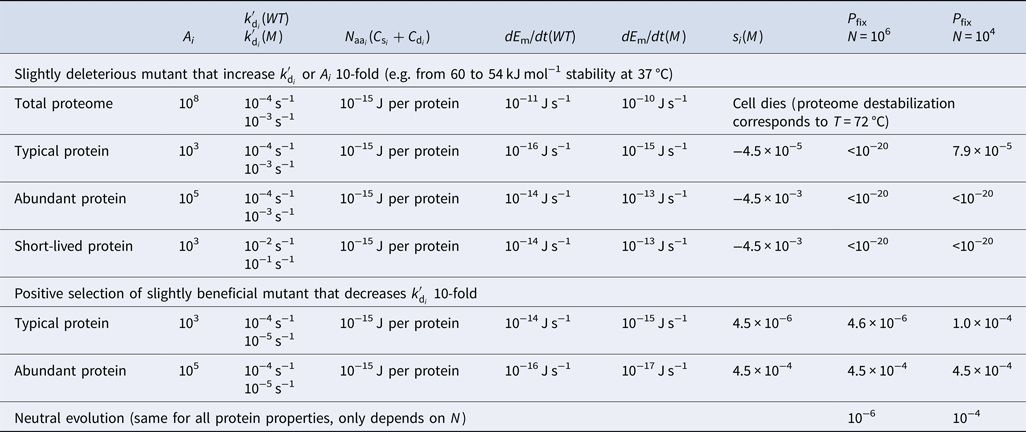
Table 2 summarizes some typical selection scenarios in yeast cells. A typical yeast cell respires at ~1 J s−1 g−1 and has a mass of 3 × 10⁻¹¹ g, giving dE t/dt ≈ 3 × 10⁻¹¹ J s−1. $C_{d_i}$ is perhaps 1 ATP per peptide bond or 30 kJ mol−1 (Benaroudj et al., Reference Benaroudj, Zwickl, Seemüller, Baumeister and Goldberg2003). The biosynthetic costs of the amino acids vary from 10 to 80 ATP (Wagner, Reference Wagner2005), the average amino acid composition of the yeast proteome gives ~25 ATP, or 750 kJ mol−1 as typical. If half of the amino acids are recycled, neglecting amino acid transport cost (Waterlow, Reference Waterlow1995), this reduces to 375 kJ mol−1. Additional costs of the polypeptide chain synthesis, neglecting chaperones, is ~11–19 ATP, or 330–660 kJ mol−1 (De Visser et al., Reference De Visser, Spitters and Bouma1992). Amino acid transport and chaperones (which need to be synthesized independently) increase costs further. Under growth conditions where most selection probably occurred historically, very few amino acids are recycled, and thus the specific turnover costs per amino acid in a protein molecule $\lpar C_{{\rm s}_i} + C_{{\rm d}_i}\rpar$
 may easily reach 1500 kJ mol−1. However, the amino acid-specific values vary little compared to the protein-specific ${k}^{\prime}_{d_i}$
 and A i, and thus we use a value of 1500 kJ mol−1 in Table 2. With a typical protein of 400 amino acids, this implies 10−15 J s−1 of turnover cost per protein molecule, which varies perhaps by 3–4 orders of magnitude, mostly due to $N_{{\rm a}{\rm a}_i}$
 (protein length) and $C_{{\rm s}_i}$
 (the biosynthetic cost of the amino acids) consistent with the empirically known sequence biases (Akashi and Gojobori, Reference Akashi and Gojobori2002; Wagner, Reference Wagner2005; Swire, Reference Swire2007).
Effect of arising mutants in a haploid organism ($N_{{\rm a}{\rm a}_i}$ = 400; dE t/dt = 3 × 10⁻¹¹ J s−1)
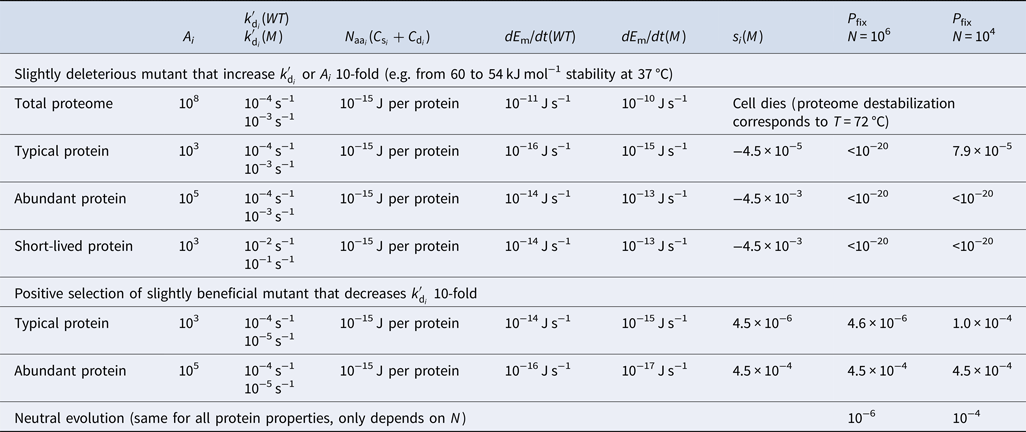
WT, wild-type value of property; M, Mutant value of property.
The exponential of Eq. (1) can be expanded as 1 − cU because the values of cU are much smaller than 1. Accordingly, the empirically proposed (Drummond and Wilke, Reference Drummond and Wilke2008) fitness cost constant c can be expressed in terms of fundamental protein turnover parameters, and we argue that c is protein-specific. The PCM fitness function, Eq. (7), can be written as:

Comparing the exponential-expanded fitness functions 1 − cU proposed by Drummond and Wilke (Reference Drummond and Wilke2008) and Eq. (14), the dimensionless protein-specific and effective total cost constants are:

Separation of Ui from its cost constant ci does not apply in general, as each type of unfolded protein has specific costs, and thus c represents an average cost of handling all misfolded proteins regardless of type. Using the typical values of $k_{{\rm d}_i}$ = 107 s−1 and $N_{{\rm a}{\rm a}_i}\lpar {C_{{\rm s}_i} + C_{{\rm d}_i}} \rpar$
 = 10−15 J s−1 (Fig. 1, Table 2) gives 10−8 J s−1 for one molecule of protein i. When dividing by dE t/dt ~ 10−11 J s−1, this gives a cost constant c i ~ 1000. Summing over all misfolded copies (U ~ 10−3) gives a correction to the fitness function of the order of unity, in agreement with energy allocated to reproduction and proteome turnover being of the similar magnitudes as total respiration rates of growing cells (Harold, Reference Harold1987).
A single protein's contribution to fitness is proportional to its relative abundance, all else being equal. If Ai = 1000, then Ui = 10−8 misfolded copies of this particular protein exist at any time, using the typical parameters given in Fig. 1 and Table 2, giving a total contribution to fitness of 10−5. Typically arising, slightly deleterious mutations in typical proteins will affect evolution rates in small populations of the order of N ~ 104, which probably played a major role in evolution in the wild (Gillespie, Reference Gillespie2001; Piganeau and Eyre-Walker, Reference Piganeau and Eyre-Walker2009), mainly because historic population bottlenecks dominate the apparent effective population size (Willis and Orr, Reference Willis and Orr1993; Hawks et al., Reference Hawks, Hunley, Lee and Wolpoff2000; Bouzat, Reference Bouzat2010). The calculation example in Table 2 gives a fixation probability of 7.9 × 10⁻⁵ for such typical mutations.
However, some proteins are much more systemically important than such a typical protein. The most important contributor to ci is the degradation rate constant $k_{{\rm d}_i}$ , which varies by many orders of magnitude for different proteins, and to obtain the fitness we need to multiply this constant by A i, or equally, the fold-stability weighted Ui. Abundance can span 5–7 orders of magnitude (Jansen and Gerstein, Reference Jansen and Gerstein2000; Ghaemmaghami et al., Reference Ghaemmaghami, Huh, Bower, Howson, Belle, Dephoure, O'Shea and Weissman2003; Beck et al., Reference Beck, Schmidt, Malmstroem, Claassen, Ori, Szymborska, Herzog, Rinner, Ellenberg and Aebersold2011; Milo Reference Milo2013), whereas protein length $N_{{\rm a}{\rm a}_i}$
 spans about three orders of magnitude, up to ~30 000 amino acids (e.g. titin), with a reasonably small variance of gamma-distributed protein sizes (Zhang, Reference Zhang2000). PCM theory thus suggests that selection acts both on expression level and protein length, as indeed seen experimentally (Bloom et al., Reference Bloom, Drummond, Arnold and Wilke2006a). In small populations (N = 104), a typical slightly deleterious mutation (less stable by 5 kJ mol−1, or a 10-fold higher turnover rate) in a highly expressed protein (105 copies) will have essentially no probability of fixation (<10−20, middle right, Table 2). Cost selection in such moderate-sized populations can thus explain the relatively slower evolution of abundant proteins.
Large effective populations can also contribute to the E-R anti-correlation: random mutation-selection dynamics resulting from purifying or compensatory selection of new residues after accepting slightly deleterious mutations occur more frequently in less abundant proteins that have more neutral selection coefficients. In contrast, these dynamics are less important near the steeper fitness optimum of the more optimized, abundant proteins that pose larger costs to the proteome. The relative importance of these two mechanisms depends on the historic effective population size and the population bottlenecks on long evolutionary timescales. One can model such effects by explicit evolution simulations but this is beyond the scope of the current study.
For comparison to experiment, it is more convenient to use the fitness function:

where t ½i is the experimental in vivo half-live of the protein i, which accounts for real cellular life-times distinct from biophysical protein stability, e.g. effects of the N-end rule (Varshavsky, Reference Varshavsky1997; Mogk et al., Reference Mogk, Schmidt and Bukau2007; Gibbs et al., Reference Gibbs, Bacardit, Bachmair and Holdsworth2014). All the properties in Eq. (16) are either observable or deducible from the protein's sequence.
Scaling relations of proteome costs: mass, metabolism, and eukaryote evolution
The examples given have centered on yeast as model cell, with ∑Ai = 108. Eukaryote cells vary greatly in size, the total copy number of proteins, and metabolic respiration rates, and prokaryotes typically feature smaller volumes, protein copy numbers and lower metabolic total respiration rates by 2–3 orders of magnitude (Milo, Reference Milo2013). The question then emerges how these orders-of-magnitude differences affect the proteome turnover and the associated effects described above. Proteins are degraded differently due to specific degrons of their sequences, but the overall rate of protein turnover typically scales with the general activity of the proteasome (except for those proteins that are not degraded by the proteasome). Accordingly, a scale factor of proteasome activity α (Eq. (6)), as modulated by proteasome inhibitors, will be an important control parameter in experimental tests of the theory as well as in efforts to understand protein turnover in relation to cellular energy costs, cell viability, and fitness. Although long-term proteasome inhibition is toxic, mild instantaneous proteasome inhibition should prove a useful tool in testing some of the mechanisms described here.
Additional scaling relations are relevant to discuss. Notably, from Eq. (8), any scaling of the metabolic rate by a number a characteristic of the organism will not affect the selection coefficient, if the fraction of energy devoted to reproduction is constant, commonly between 0.1 and 0.7 of total respiration costs (Harold, Reference Harold1987; Hawkins, Reference Hawkins1991), because the advantage of the mutation with lowered maintenance costs can be considered a perturbation:

This relation requires comparison of the mutant and wild-type proteins under the same growth conditions.
Based on cell volume and protein copy measurements and associated calculations (Milo, Reference Milo2013), and using the assumption that a typical protein volume is 10 000 Å3, proteins take up 1–4% of the cell volume of any cell and more importantly, regardless of the cell type, across prokaryotes and eukaryotes, including human cells. From this, we conclude that the total protein copy number Ai scales approximately linearly with cell volume. In contrast, the basal specific metabolic rate of both cells and whole organisms tends to scale with M 3/4, rather than M (Kleiber's law) (Kleiber, Reference Kleiber1932, Reference Kleiber1947; Savage et al., Reference Savage, Allen, Brown, Gillooly, Herman, Woodruff and West2007). Size, all-else-being equal, lowers the specific surface area of the organism and thereby increases metabolic efficiency by reducing the mass-weighted thermodynamic force required to maintain the non-equilibrium boundary (reduced heat dispersion per unit of biomass). Size also potentially minimizes average, mass-specific chemical and electric signaling distances within the organism. Such scaling laws of mass and volume and their implication for bioenergetic costs were discussed by Lynch and Marinov (Reference Lynch and Marinov2015).
For these reasons, the specific resting metabolism decreases with volume or mass, and equally, with total protein copy number of the organism. Accordingly, size carries an evolutionary advantage of the order of the mass-specific metabolic rate, as explained in detail by Brown and co-worker who developed the framework relating mass to fitness (Brown et al., Reference Brown, Marquet and Taper1993). The advantage is of the order of:

However, as pointed out by Brown et al. (Reference Brown, Marquet and Taper1993) whereas ecological life-history variables (e.g. foraging efficiency) favor large organisms, the reproduction rate favors smaller organisms and scales with M −1/4. Thus, organism size has an evolutionary optimum with respect to both energy and time, which is distinct for different taxa due to the different life-history variables and associated scaling parameters (Brown et al., Reference Brown, Marquet and Taper1993). A yeast mutant with a larger size of 1%, all-else being equal, would thus be predicted by PCM theory to have a selective advantage of (1.01/1)3/4 -1 = 0.007 if all the saved energy is spent on reproduction. This energy is clearly enough to enforce positive selection at all relevant population sizes from 102 to 107, including early population bottlenecks (Fig. 2).
Combining the ansatz of PCM theory (that fitness scales with the energy left for reproduction per time unit after subtracting maintenance costs) with Kleiber's law leads to several potentially important explanations for size advantage relevant to emergence of life in general and eukaryotes in particular. A central weakness of endosymbiont theory, not mentioned by the otherwise important reviews on this topic (Gray et al., Reference Gray, Burger and Lang1999; Lane Reference Lane2011), is the problem of evolutionary advantage immediately after the symbiosis event. The argument goes as follows: at the very beginning, the actual process of symbiosis must have had immediate costs of intrusion and aligning the cellular machineries, and must thus also have provided immediate selective advantages in competition will non-symbiotic cells. According to PCM theory, fitness scales with energy left for reproduction, and thus the immediate total maintenance costs must have reduced.
Imagine a simple doubling of the cell size by a unification event. All else being equal, the new organism would carry the double amount of proteins, the double volume, the double mass, and would require the double amount of energy to reproduce these cell constituents, giving the same fitness as the competing non-symbiont cells, but then reduced by the costs of the endosymbiosis event itself. However, the immediate advantage offered by reducing the specific surface area of the ancestral eukaryote cell would reduce the basal metabolic maintenance rate. The saved energy could then be immediately converted into a larger fraction of the total energy budget being devoted to the proteome of larger cells and organisms, thus compensating the cost of the actual symbiosis event. If this is correct, endosymbiosis will be successful only when and if the mass-specific metabolic rate saved by mass increase outweighs the energy costs of the symbiosis event itself.
Evidence for PCM during evolution
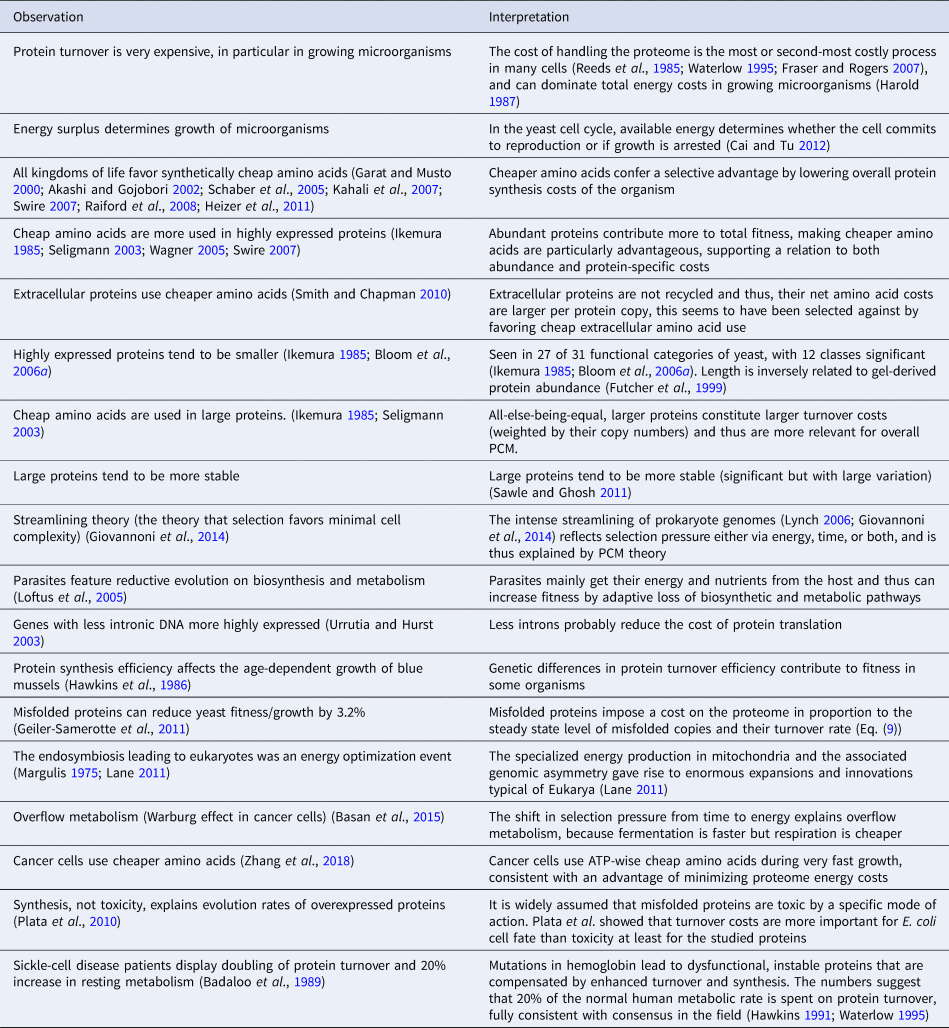
Some support for the theory of proteome cost minimization is summarized in Table 3. The following section discusses some of these facts briefly.
Events and facts supporting the PCM theory

Major evolutionary events mainly represented bioenergetic advantages
During the longest and earliest timescales where much of the primary cellular biochemistry evolved, unicellular growth conditions provided the context for the evolutionary innovation both in terms of respiration and photosynthesis (Blankenship, Reference Blankenship1992; Sousa et al., Reference Sousa, Thiergart, Landan, Nelson-Sathi, Pereira, Allen, Lane and Martin2013). Most of the important biochemical pathways being at least qualitatively evolved at the point when eukaryotes had formed (Nisbet and Sleep, Reference Nisbet and Sleep2001; McGuinness, Reference McGuinness2010). Early qualitative innovations such as the electron transport chain, fatty acid and amino acid metabolism, and photosynthesis indicate the primary importance of obtaining and maintaining the bioenergy production (Sousa et al., Reference Sousa, Thiergart, Landan, Nelson-Sathi, Pereira, Allen, Lane and Martin2013), a tendency further documented by the rise of eukaryotes whose advantages largely related to energy efficiency by outsourcing and optimizing energy production as argued above and elsewhere (Margulis, Reference Margulis1968, Reference Margulis1975; Gray et al., Reference Gray, Burger and Lang1999; Lane Reference Lane2011).
Energy surplus determines growth of microorganisms
For unicellular organisms, the cell cycle determining the decision to grow (and thus contribute to population fitness) is largely based on an assessment of available energy (Cai and Tu Reference Cai and Tu2012): thus, budding yeast grows during the G1 phase until the nutrient level determines whether it commits to reproduction and enters the DNA biosynthesis S phase and subsequent mitosis, or if cell growth is arrested due to low resources (Cai and Tu Reference Cai and Tu2012).
Protein turnover is very expensive
Protein turnover is typically the most or second-most expensive process in cells: At one extreme, protein synthesis may account for 3/4 of all energy spent in growing microorganisms (Harold, Reference Harold1987). In humans, protein synthesis typically requires 20 kJ kg−1 body mass, or 20% of the basal metabolic rate to produce typically 300 g of protein per day (Reeds et al., Reference Reeds, Fuller, Nicholson, Garrow and Halliday1985; Waterlow, Reference Waterlow1995). This number does not include regulation and degradation costs, RNA synthesis, and uncertain costs relating to nitrogen metabolism, reuse, transport, or synthesis of amino acids, which together are substantial (Reeds et al., Reference Reeds, Fuller, Nicholson, Garrow and Halliday1985; Hawkins, Reference Hawkins1991). In mammals, protein degradation may cost 10–20% of total energy spent (Hawkins, Reference Hawkins1991; Fraser and Rogers, Reference Fraser and Rogers2007). Ubiquitin requires ATP to bind proteins targeted for degradation, and the lysosome and calcium-dependent proteases require ATP for active calcium and proton transport (Hawkins, Reference Hawkins1991). These various features render protein turnover (synthesis and degradation) the most or second-most (next to ion pumping) energy-consuming process even in mammals.
Life uses cheap amino acids
The synthetic costs of the 20 amino acids vary roughly from the order of ~10 (Glu, Ala, Gly, etc.) to ~75 (Trp) phosphate bonds (Akashi and Gojobori, Reference Akashi and Gojobori2002; Heizer et al., Reference Heizer, Raymer and Krane2011). Biosynthetic costs explain some of the amino acid bias in sequences not due to translational efficiency and other effects (Craig and Weber, Reference Craig and Weber1998; Akashi and Gojobori, Reference Akashi and Gojobori2002; Akashi, Reference Akashi2003) and can affect the rate of evolution (Barton et al., Reference Barton, Delneri, Oliver, Rattray and Bergman2010). Selection toward cheaper amino acids or smaller proteins can reduce total energy expenditure substantially, by an estimated 0.1% per ~4 expensive amino acids (Akashi and Gojobori, Reference Akashi and Gojobori2002). A general evolutionary preference for synthetically cheap amino acids was first suggested (for aromatic residues in Escherichia coli) (Lobry and Gautier, Reference Lobry and Gautier1994) and later demonstrated (Akashi and Gojobori, Reference Akashi and Gojobori2002) and confirmed by others (Wagner, Reference Wagner2005; Heizer et al., Reference Heizer, Raiford, Raymer, Doom, Miller and Krane2006) in prokaryotes, where cheaper amino acids tend to be used more in highly expressed proteins across functional classes, with similar observations seen for yeast (Raiford et al., Reference Raiford, Heizer, Miller, Akashi, Raymer and Krane2008). These findings have been confirmed in many cases (Garat and Musto, Reference Garat and Musto2000; Kahali et al., Reference Kahali, Basak and Ghosh2007; Raiford et al., Reference Raiford, Heizer, Miller, Akashi, Raymer and Krane2008; Heizer et al., Reference Heizer, Raymer and Krane2011) including mammals (Heizer et al., Reference Heizer, Raymer and Krane2011). Biosynthetic cost minimization as an evolutionary driver was identified first in certain bacteria (Akashi and Gojobori, Reference Akashi and Gojobori2002; Schaber et al., Reference Schaber, Rispe, Wernegreen, Buness, Delmotte, Silva and Moya2005) and later in all domains of life (Swire, Reference Swire2007). Cys is apparently not significantly selected for cost (Swire, Reference Swire2007), perhaps relating to its unique involvement in highly conserved cystine bridges and metal sites.
Prokaryote streamlining
The fact that prokaryotes have maintained their general morphology until today whereas Eukarya is represented by rich morphological diversity reflects the existence of some selection pressure that kept prokaryotes simple but afforded major degrees of freedom to Eukarya. The well-known intense streamlining of the small efficient prokaryote genomes has led to the formulation of the so-called streamlining theory of microbial evolution (Lynch, Reference Lynch2006; Giovannoni et al., Reference Giovannoni, Thrash and Temperton2014), which argues that streamlining toward small efficient genomes have been an ongoing selection pressure of prokaryote evolution. Fold structures are the phenotype ultimately selected upon, and structure-based phylogeny implies that ancestral organisms can have been quite complex, but then later lost some of this complexity (Kurland and Harish, Reference Kurland and Harish2015; Harish and Kurland, Reference Harish and Kurland2017). This distinction between sequence and phenotype (fold structure) is also central to the debate on two versus three kingdoms of life (Mayr, Reference Mayr1998; Woese, Reference Woese1998; Kurland and Harish, Reference Kurland and Harish2015). Streamlining can result from both selection pressures on time, energy, and space and fits the predictions of PCM theory, as discussed further below.
Highly expressed proteins are more streamlined
Highly expressed genes tend to code for smaller proteins (Jansen and Gerstein, Reference Jansen and Gerstein2000) with less introns (Urrutia and Hurst, Reference Urrutia and Hurst2003), in support of selection pressure toward minimizing proteome handling costs. Selection against mistranslation can also be understood as selection against biosynthetic cost because translational efficiency is effectively a way to minimize the cost of expensive ‘proofreading’ and other machinery operating on mistranslated gene products (Ikemura, Reference Ikemura1985). Additional support for the selection on highly abundant proteins directly relating to turnover costs is the well-known relationship between expression levels and protein half-life (Belle et al., Reference Belle, Tanay, Bitincka, Shamir and O'Shea2006).
Unstable proteins reduce cell growth
Support for the PCM theory also comes from studies that compare the biophysical properties of overexpressed wild-type and mutant proteins directly. Destabilizing mutants of lacZ in E. coli reduce cell growth to a similar extent as wild-type protein expressed at the same level, arguing for quantity (expression levels subject to turnover) as the cause of toxicity rather than qualitative features of the protein variants (Plata et al., Reference Plata, Gottesman and Vitkup2010). An implication of this is that reduced cell viability in assays of overexpressed misfolding proteins, often used as models of neurodegenerative disease, may in fact reflect energy deficits as described by PCM theory. If so, misfolded proteins are generally not toxic by a specific mode of action (such as membrane pore formation or seeding of misfolding leading to loss of function) but rather because of the ATP costs (Kepp, Reference Kepp2019).
Trading function for cost
Classical Darwinian evolution considers the struggle and selection for optimal function the primary mode of evolution (Richmond, Reference Richmond1970; Hurst, Reference Hurst2009). This aspect of Darwinism has dominated biochemical views of enzymes as perfectly optimized proficient catalysts that accelerate chemical reactions by orders of magnitude, implying that evolution strives toward optimal function per se, including maximal substrate turnover of enzymes (Radzicka and Wolfenden, Reference Radzicka and Wolfenden1995; Cannon et al., Reference Cannon, Singleton and Benkovic1996; Zhang and Houk, Reference Zhang and Houk2005). However, proteins are also subject to non-function selection pressures that are distinct from, and sometimes in conflict with, optimality of function (Hurst and Smith, Reference Hurst and Smith1999; Bloom and Adami, Reference Bloom and Adami2003; Reference Bloom and Adami2004; Drummond et al., Reference Drummond, Bloom, Adami, Wilke and Arnold2005; Lobkovsky et al., Reference Lobkovsky, Wolf and Koonin2010; Wylie and Shakhnovich, Reference Wylie and Shakhnovich2011). Indeed, actual comparison of enzyme kinetic parameters shows that many enzymes are distinctly suboptimal, most likely because of evolutionary and biophysical constraints (Bar-Even et al., Reference Bar-Even, Noor, Savir, Liebermeister, Davidi, Tawfik and Milo2011).
A standard view is that proteins have evolved to use their excess fold-free energy to optimize the active sites for function, the most notable example being pre-organized active sites with electrostatic fields favoring the free energy of the transition states, to increase k cat/K M (Cannon et al., Reference Cannon, Singleton and Benkovic1996; Warshel, Reference Warshel1998; Adamczyk et al., Reference Adamczyk, Cao, Kamerlin and Warshel2011; Morgenstern et al., Reference Morgenstern, Jaszai, Eberhart and Alexandrova2017; Fuller et al., Reference Fuller, Wilson, Eberhart and Alexandrova2019). Although not directly pointed out by Warshel and co-workers, this mechanism contributes to making proteins marginally stable because, all-else-being equal, any potential excess fold-free energy has been diverted into optimizing the electrostatic field of the folded structure to reduce the transition state's free energy and thereby increase catalytic proficiency. The mechanism also largely explains the widely observed stability-function trade-offs in protein engineering (Tokuriki et al., Reference Tokuriki, Stricher, Serrano and Tawfik2008). Correspondingly, in the laboratory, without many biological constraints, function of a high-stability starting protein may be optimized beyond the level seen in the wild (Bloom et al., Reference Bloom, Labthavikul, Otey and Arnold2006b; Tokuriki and Tawfik, Reference Tokuriki and Tawfik2009). This is particularly relevant in the context of ‘directed evolution’, i.e. the intended human evolution of new improved protein mutants employing yeast cells with short generation times in static environments where selection pressure can be effectively controlled (Francis and Hansche, Reference Francis and Hansche1972; Hall Reference Hall1981).
PCM theory argues that even functional proficiency often evolved conditionally on cost. To appreciate this, we consider the requirement of a certain total substrate turnover of each enzyme per time unit to maintain homeostasis. The proficiency of function is for enzymes typically defined by k cat, measuring how many substrate molecules convert into product per time unit per enzyme molecule. At steady-state, both the maximum turnover (V max) and the turnover at low substrate concentration are proportional to the total enzyme concentration [E] and k cat (Northrop, Reference Northrop1998; English et al., Reference English, Min, van Oijen, Lee, Luo, Sun, Cherayil, Kou and Sunney2005).
Now consider a typical arising mutation in an enzyme i required to make a product at a certain rate, i.e. dPi/dt. Because the protein is evolutionarily optimized (but not necessarily optimal), mutations will tend on average to be hypomorphic and reduce the turnover constant k cat,i but with a broad scatter and many nearly neutral effects with a random chance of fixation. If the mutation reduces k cat,i substantially, e.g. by modifying the active site, the substrate turnover will be greatly reduced, and the organism will need to increase the local enzyme concentration [E] by expressing more enzyme per time unit to maintain a comparable substrate turnover (compensatory expression), thereby increasing Ai. More specifically, the rate of product formed by enzyme i under Michaelis–Menten kinetics is (Cannon et al., Reference Cannon, Singleton and Benkovic1996; Northrop, Reference Northrop1998)

Equation (19) represents the standard equation multiplied on both sides by the cell volume to convert from concentrations to absolute copy numbers. For simplicity, we can ignore the last term and assume zero-order kinetics in [S], which represent selection of the enzyme for maximum rate at saturated substrate concentration when [S] is much larger than the Michaelis constant K M,i. The cost of maintaining the enzyme is

Accordingly, the specific cell-wide cost of maintaining steady state produced concentration of Pi is

If measured in concentrations instead, the cost scales with the volume of the cell V cell to which the steady state applies. We have ignored the costs associated with producing the substrate and transporting the substrate and products, which can easily be included into the model.
Equation (21) predicts that the ratio of the two time constants for turnover of the enzyme and turnover of the substrate together define the cost of producing Pi at steady state. The two time constants are in units of s−1, and $N_{{\rm a}{\rm a}_i}\lpar {C_{{\rm s}_i} + C_{{\rm d}_i}} \rpar$ is of the order of 10−15 J for a typical protein. Considering again a typical arising mutation, even if ${k}^{\prime}_{{\rm d}_i}$
 is not increased (which it typically is), a reduction in k cat,i of a typical hypomorphic mutation will require compensatory expression of the enzyme, increasing Ai to maintain the rate of production of Pi, Eq. (19). This increase in Ai will then increase the total cost of obtaining the product with the same factor (Eq. (20)). Equation (21) summarizes this cost–function relationship because k cat,i and Ai are inversely related if homeostasis in Pi is required. If compensatory expression is 100%, a ten-fold reduction in the enzyme's k cat,i requires a 10-fold increase in the enzyme's expression, and the specific and total costs of producing Pi increases 10-fold.
Accordingly, even mutations that only impair function also increase the proteome costs: a 10-fold increase in ${k}^{\prime}_{{\rm d}_i}$ (loss of kinetic stability, misfolding) or decrease in k cat,i will have approximately the same 10-fold increase in cellular costs, according to Eq. (21), ignoring the mutation-induced changes in the amino-acid synthesis and degradation costs. If required, the assumption of 100% compensatory expression can easily be modified by a scale factor between 0 and 1 in the above equations. Evidence for compensatory expression is well-known, a dramatic example being homozygous sickle cell disease (Table 3), where dysfunctional, instable hemoglobin mutants cause a doubling of protein turnover and degradation in patients and a 20% increase in total resting metabolism (Badaloo et al., Reference Badaloo, Jackson and Jahoor1989). Considerations of loss and gain of function mutations associated with other diseases may be viewed in this light (Kepp, Reference Kepp2015, Reference Kepp2019).
Because of the above considerations, we expect a function–cost trade-off acting during evolution of many proteins. We obtain the important possibility that the main advantage of a mutant may not be a functional improvement of the protein per se, but a reduction of its cost per unit of function, in the simplest case the ratio ${k}^{\prime}_{{\rm d}_i}/k_{{\rm cat}\comma i}$ . Co-optimization of cost versus function is fundamental to many optimization processes and follows the basic principle that if several inputs are available at different functionality and price, the optimal system uses the input whose cost per unit of function is lowest. Such systems will tend to use less functional input if its cheaper price outweighs the loss of function. This suggests that at least some of the widely observed inverse relationships between function and stability (Tokuriki et al., Reference Tokuriki, Stricher, Serrano and Tawfik2008; Bonet et al., Reference Bonet, Wehrle, Schriever, Yang, Billet, Sesterhenn, Scheck, Sverrisson, Veselkova, Vollers, Lourman, Villard, Rosset, Krey and Correia2018; Du et al., Reference Du, Zielinski, Monk and Palsson2018) in reality reflect a cost–function trade-off as summarized by Eq. (21). The laboratory can change selection pressures drastically away from those in the wild, notably in the form of ‘directed evolution’ (Francis and Hansche, Reference Francis and Hansche1972; Hall Reference Hall1981). In nature however, the situation is more complicated, because the stability affects the proteome costs and thus fitness. Newly arising mutations may impair both stability and function, but both have a direct negative fitness effect in terms of cost.
The theory thus predicts that highly abundant proteins, because they are more cost-selected, are more likely to display suboptimal functionality, all else being equal (after adjusting for other correlating variables such as size). The trade-offs will be habitat- and strategy-dependent, and the preferential use of very functional but expensive input may be restricted to high-nutrient habitats and growth media.
Time or energy?
We expect that variations in the habitat's selection pressure should affect the proteome function–cost trade-offs. This should be evident when comparing organisms adapted to different environments. The most obvious biophysical properties of the habitat are time, energy, space, and temperature, which all enter directly in the model, Eq. (12). Selection for time, i.e. ‘survival of the fastest’, can be considered the default mode, and enters via the central ansatz of the theory, that ‘fitness is proportional to the energy per time unit available for reproduction after subtracting maintenance costs’, i.e. Eq. (6): Φ = dE r/dt = dEt/dt − dE m/dt. Fitness scales inversely with the time step dt required for directing a unit of surplus energy sufficient to complete a reproductive event. Temperature enters as a modifier of the protein stability's role in the turnover ΔGi/RT. We also note that a model of protein minimization driven mainly by considering space as a limiting parameter leads to some of the same consequences as protein cost minimization (Brown, Reference Brown1991). Accordingly, all these biophysical properties may potentially act as selection pressures.
Reasonably, cells have been optimized to maximize growth rates by enabling their proteomes to be produced as fast as possible within the necessary function and stability restrictions. Translational speed and accuracy imply selection for smaller and more streamlined genomes, and accuracy mainly reflects the time–cost trade-off of correcting errors during protein synthesis rather than correcting them later in e.g. a misfolded protein (Kurland and Ehrenberg, Reference Kurland, Ehrenberg, Cohn and Moldave1984; Drummond et al., Reference Drummond, Bloom, Adami, Wilke and Arnold2005). We can thus reasonably view time as the ‘default mode’ of selection when energy is plentiful (i.e. survival of the ‘fastest’). If the growth rate is proportional to the synthesis rate of the proteome, then large, highly expressed, and slowly folding proteins will be growth-limiting either at the ribosome or during subsequent folding by chaperones of the rate-limiting proteins.
To account for both time and energy together, for simplicity we only consider two processes, one that is energy-limited and one that is time-limited:
(1)
(22)$$\hskip-6pc{\rm ATP} + {\rm cell}\to {\rm Budding}\;{\rm cell}\;\lpar {{\rm G1\semicolon \;}\,{\rm S}} \rpar $$
(2)
(23)$$\hskip-7.5pc{\rm Budding}\;{\rm cell}\to 2\;{\rm cells}\;\lpar {{\rm G2}\comma \;{\rm M}} \rpar $$


In this simple model, if energy is limited, the cell will enter a dormant state and growth rates are controlled by energy efficiency of the proteome according to PCM theory. If energy is plentiful, growth rates are limited by the rate of producing the new cell, restricted by the speed of synthesizing the proteome rather than its cost. Other models of proteome optimization have emphasized translational speed and accuracy and minimization of protein size (Ehrenberg and Kurland, Reference Ehrenberg and Kurland1984; Brown, Reference Brown1991) due to space restrictions on flux control. One can also consider analogous microkinetic models such as:
(1)
(24)$$\hskip-7pc{\rm ATP} + {\rm R}\hbox{-}{\rm chain}\to {\rm R}\hbox{-}{\rm chain}\hbox{-}{\rm ATP}$$(2)
(25)$$\hskip-5pc{\rm R}\hbox{-}{\rm chain}\hbox{-}{\rm ATP} + {\rm aa}\to {\rm R}\hbox{-}{\rm chain}\hbox{-}{\rm ATP}\hbox{-}{\rm aa}$$


Here, the ATP needed for the ribosome (R) to catalyze chain elongation by an amino acid (aa) must be available to the ribosome, and if the concentration of ATP is low, then this step is rate-limiting the protein synthesis. If energy is plenty, then step 2, the chain elongation (and subsequent protein folding by e.g. chaperones) is limiting growth and subject to selection pressure.
It should be clear that both the cell-cycle and microkinetic model imply that both energy and time can be relevant selection modes, i.e. survival of the ‘fastest’ (scenario 2) survival of the ‘cheapest’ (scenario 1). One can consider r- and k-strategies as resulting from specialization toward these regimes. Experimentally, one may test the two cases via competitive growth assays with variable space and energy restrictions. Importantly, the two selection modes (time and energy) lead to several of the same implications, notably with a selective advantage for streamlining and particular selection on highly expressed proteins as they may limit both time and energy costs of growth (Wang et al., Reference Wang, Kurland and Caetano-Anollés2011).
One recent study that casts light on this is a study of pathways choices among different sequenced organisms (Du et al., Reference Du, Zielinski, Monk and Palsson2018). The study found that different organisms select specific choices of precursor pathways based on both metabolic cost and synthetic efficiency. Cost selection occurs in energy-poor habitats, whereas in energy-rich habitats, the default selection mode is time. There are correlations between time and energy advantages. Notably, the synthesis time of expensive amino acids is all-else-being-equal long as more phosphate bonds must be recruited during synthesis. The cost of handling misfolded proteins can limit growth substantially, as seen in a case of ~3% growth rate reduction in yeast upon folding-stability-impaired mutants of only one protein (YFP) (Geiler-Samerotte et al., Reference Geiler-Samerotte, Dion, Budnik, Wang, Hartl and Drummond2011).
The shift in selection pressure from time to energy can also explain the important phenomenon of overflow metabolism, the tendency of using more expensive, but faster fermentation rather than respiration during growth (Basan et al., Reference Basan, Hui, Okano, Zhang, Shen, Williamson and Hwa2015). PCM theory implies that microorganisms shift to fermentation in rich habitats and growth media, because time is the main selection pressure, whereas in poorer habitats, respiration becomes favored and selected upon because energy is restrictive, although combinations of strategies will probably be common. The choice between these options depending on energy availability could be relevant to many growth assays, but perhaps also to the Warburg effect of cancer cells (Basan et al., Reference Basan, Hui, Okano, Zhang, Shen, Williamson and Hwa2015). Cancer cells are remarkable by being under selection both for time and space in competition with each other against the selection pressure of the body's immune system. Cancer cells tend to use cheaper amino acids (Zhang et al., Reference Zhang, Wang, Li, Chen, He, Zhang, Liang and Lu2018), in accordance with PCM theory, but when energy is widely available, growth-limiting space and time restrictions would favor the Warburg effect over oxidative phosphorylation, although other contributing effects such as mutation impacts and oxygen availability are relevant as well.
Temperature, thermostable proteins, and thermophilic organisms
As mentioned above, the habitat temperature also imposes a selection pressure on evolution according to the PCM theory, because it directly modifies protein stability ΔGi/RT and thereby, the fitness function, Eq. (11). To appreciate this, we used a sign convention of negative ΔGi for a stable protein, and the ΔGi is the optimal stability of the protein at its temperature of operation (sometimes called T*), typically reflecting to some extent the organism's experienced extrema temperatures in the relevant habitat (Robertson and Murphy, Reference Robertson and Murphy1997). The protein has been optimized to display its maximal stability at this T*, with ΔGi typically harmonic in the temperature, and increasing or decreasing the temperature away from T* will thus increase the number of misfolded proteins Ui and increase the associated turnover costs, thereby reducing fitness, Eq. (11) (Robertson and Murphy, Reference Robertson and Murphy1997).
Using the theory, we can better understand adaptation of proteomes to hot or cold environments (thermophiles and psychrophiles, respectively) (Li et al., Reference Li, Zhou and Lu2005; Mozo-Villiarías and Querol, Reference Mozo-Villiarías and Querol2006; Luke et al., Reference Luke, Higgins and Wittung-Stafshede2007; Fu et al., Reference Fu, Grimsley, Scholtz and Pace2010). Adaptations to a warmer habitat is largely expected to be a question of optimizing the proteome's copy-number-weighted median protein T* (the most representative T* of the proteome of the cell) toward the T of the habitat, to minimize the average copy number of misfolded protein copies in the cell at any given time, again to minimize proteome costs and maximize energy available for reproduction. Many studies of thermophilic proteins and thermophilic adaptation may be seen in this light, without going into further details, as this is a large and complex topic (Tekaia et al., Reference Tekaia, Yeramian and Dujon2002; Sawle and Ghosh, Reference Sawle and Ghosh2011; Venev and Zeldovich, Reference Venev and Zeldovich2018), but the essential implications should be clear. In particular, thermophilic organisms are predicted to adjust protein thermostability mainly for the most abundant and quickly turned-over proteins that pose the largest economical cost to the proteome.
PCM, aging, and neurodegenerative diseases
Proteome cost minimization has been argued to explain a substantial part of the evolution on longer evolutionary timescales, producing clear biases in the use of amino acids and explaining the E-R anti-correlation by slowing the probability of fixating new mutations in abundant, expensive proteins, and giving rise to important cost–function trade-offs. The evolution that shaped these relations mainly occurred in single-cell organisms, and it is thus of interest to consider whether the theory has implications also for evolution of higher organisms and in particular the evolution of aging.
A note is required first on intrinsically disordered proteins (IDPs), which make up a substantial fraction of all proteins in a typical cell. IDPs are disordered as part of their natural function, which can be expected to require structural plasticity or specific conformational changes as the local environment changes, or upon interaction with binding partners (Uversky et al., Reference Uversky, Oldfield and Dunker2008). The required disorder may lead to particular sensitivity and potential elevated cost of turnover. The common involvement of IDPs in protein misfolding diseases hints to the importance of proteome maintenance, which we argue should be counted in bioenergy units (Kepp, Reference Kepp2019).
All higher organisms use oxidative phosphorylation as the most effective energy-producing process, using the O2 of the planet's atmosphere produced by the photosynthetic organisms as primary electron acceptor. The free radical theory of aging argues that aging arises from the incurred damage due to the activity of reducing O2 to water, as the radical side products of the respiratory chain leads to a consistent mutagenic pressure that needs to be countered by DNA repair and antioxidant defenses (Speakman et al., Reference Speakman, Selman, McLaren and Harper2002; Harman, Reference Harman2003).
Different higher organisms have evolved different trade-offs between life history variables relating mainly to the generation time (Kirkwood and Rose, Reference Kirkwood and Rose1991; Shanley and Kirkwood, Reference Shanley and Kirkwood2000; Kirkwood, Reference Kirkwood2011). Shorter lifespan implies specialization toward shorter generation time, which again implies less energy invested in maintenance of the proteome. Based on the discussion above, this specialization emphasizes time over energy. Each strategy probably involves an aging program to ‘dispose the soma’ after reproduction to make space for the next generation, although this remains debated (Westendorp and Kirkwood, Reference Westendorp and Kirkwood1998; Speakman et al., Reference Speakman, Selman, McLaren and Harper2002). Aging may thus be a direct consequence of the reproductive strategy. Some organisms specializing toward long lifespan (i.e. r- versus k-strategists) also diversify toward complex lifestyles with capacity for technology transfer, e.g. cetaceans and apes. Compared to primates, rodents on average have shorter generation times, lifespans, larger litter size, and have traded lifespan for fecundity (Speakman et al., Reference Speakman, Selman, McLaren and Harper2002; Wensink et al., Reference Wensink, van Heemst, Rozing and Westendorp2012). In long-living organisms, proteome misfolding may cause death, perhaps because PCM can no longer be afforded beyond what was evolutionarily beneficial. It is reasonable to argue that the aging program of long-living mammals largely reflect the (active or passive) giving up of the maintenance of the proteostatic machinery to enable the rise of the next generation (Taylor and Dillin, Reference Taylor and Dillin2011; Hipkiss, Reference Hipkiss2017).
This discussion is well illustrated by superoxide dismutase 1 (SOD1). SOD1 is one of the most abundant proteins in primates and Ai can reach 100 000 copies per cell (Dasmeh and Kepp, Reference Dasmeh and Kepp2017), it is the central antioxidant defense protein of the mitochondria thus directly linking energy and aging (Perry et al., Reference Perry, Shin, Getzoff and Tainer2010), it is one of the few proteins known to directly extend lifespan upon induction (Tolmasoff et al., Reference Tolmasoff, Ono and Cutler1980; Landis and Tower, Reference Landis and Tower2005), and one of the few genes of great apes known to have undergone non-synonymous positive selection (Fukuhara et al., Reference Fukuhara, Tezuka and Kageyama2002; Dasmeh and Kepp, Reference Dasmeh and Kepp2017). Deposits of misfolded SOD1 is a hallmark of age-triggered amyotrophic lateral sclerosis (Valentine et al., Reference Valentine, Doucette and Potter2005). The tendency toward aggregation and misfolding of natural human SOD1 variants correlates with their pathogenicity (Lindberg et al., Reference Lindberg, Byström, Boknäs, Andersen and Oliveberg2005; Wang et al., Reference Wang, Johnson, Agar and Agar2008; Kepp Reference Kepp2015), and wild-type overexpression by itself is enough to trigger disease (Wang et al., Reference Wang, Deng, Grisotti, Zhai, Siddique and Roos2009). Recent amino acid substitutions in SOD1 of great apes correlate with longer life span and tend to increase the net charge and stability of SOD1, thus increasing the thermodynamic and kinetic stability of the protein (k d and ΔGi) (Dasmeh and Kepp, Reference Dasmeh and Kepp2017). Via its abundance and functional importance, any impairment of SOD1 either in terms of function or stability will produce comparatively very large PCM costs. The combination of the features summarized above strongly argues for a relationship between PCM, evolution of aging, and age-triggered neurodegenerative diseases.
According to the PCM theory, neurodegenerative diseases are caused by the increased energy spent on maintaining the proteome of old humans, which leaves less energy available for neuron and motor neuron function. Protein turnover and neuron signaling costs perhaps 20–25% and 50% of the brains energy budget (Hawkins, Reference Hawkins1991; Attwell and Laughlin, Reference Attwell and Laughlin2001; Raichle and Gusnard, Reference Raichle and Gusnard2002), respectively, and as age advances, the supply of energy may no longer satisfy the increasing maintenance costs of the proteome (Kepp, Reference Kepp2019). Familial inherited mutations that tend to produce more aggregation-prone protein will increase turnover costs per time units according to PCM theory and will accordingly also accelerate the time at which available energy no longer satisfies the needs of synaptic transmission, leading to earlier clinical age of onset of disease (Kepp, Reference Kepp2019).
Conclusions
Darwin's theory of evolution emphasized ‘survival of the fittest’, where the ‘fit’ represented optimal functional proficiency. This concept has dominated the thinking of the field, including the biochemical view of enzymes as optimally proficient for their catalytic reaction (Radzicka and Wolfenden, Reference Radzicka and Wolfenden1995; Zhang and Houk, Reference Zhang and Houk2005). Proteomic data have shown that most effects on the speed of evolution act via non-functional, universal selection pressures (Pál et al., Reference Pál, Papp and Hurst2001, Reference Pál, Papp and Lercher2006; Drummond et al., Reference Drummond, Raval and Wilke2006). The main outstanding challenge in evolution is arguably to provide a predictive quantitative theory that captures these universal selection pressures and predicts real evolutionary histories, including the relative magnitude of drift and selection in specific cases, the nature of the selection pressures, and how it acts upon a population via the individual, the cell, the protein, and the gene.
This paper has reviewed the theory that a universal selection pressure is minimization of the ATP cost of an organism's proteome (‘survival of the cheapest’). The magnitude and variations of the fundamental parameters show that most of the proteome cost selection acts via the ratio Ai/t ½, i.e. the abundance to half-life ratio of the protein. This selection combines with the selection for functional proficiency, typically in a cost–function trade-off between being ‘fit’ and ‘cheap’. The data in Table 2 suggest that cost selection occurred both during the earliest period of prokaryote evolution, during the rise of eukaryotes, particularly explaining the immediate advantages of the larger eukaryote cells due to reduced mass-specific metabolic costs, and during the long periods of relatively uneventful nearly neutral evolution that maintains nearly constant molecular clocks of many phylogenies.
The theory has several implications e.g. for stability-function and time-energy trade-offs, thermophile evolution, and human neurodegenerative diseases. One implication of the theory is that nature has not generally evolved the most proficient enzymes, in terms of turnover numbers (k cat/K M), but the lowest cost of substrate turnover, as given by the ratio of Eq. (21). The theory thus predicts that most proteins may be engineered to obtain higher functional proficiency but that this will typically come with an associated increased total cost of the protein pool (e.g. via lower stability), which may however be less of an issue in the laboratory. The breakdown of this cost–function trade-off may be a central reason why directed evolution and protein-engineering strategies that aim to enhance protein performance even for natural functions are successful at all.
Financial support
This research received no specific grant from any funding agency, commercial, or not-for-profit sectors.
Conflict of interest
The author declares that he has no conflict of interest associated with this study.