INTRODUCTION
Aquaculture is very often based on exotic species. These species pose a potential threat of escaping to the local environment. In addition to the possibility of introducing new pathogens or diseases, exotic species may establish sustainable populations that could theoretically compete with native species and alter the local ecosystem. The cases of escapees or release specimens of aquariums are similar. In the present study, we report a single record of the inland mariculture escapee, the Atlantic native Southern Flounder Paralichthys lethostigma Jordan and Gilbert, 1884, for the first time in the Mediterranean and a second record of the Red Drum Seiaenops ocellatus (Linneaus, 1766) from the Mediterranean coast of Israel. In addition, we report the collection of a single specimen of the Giant Snakehead, Channa micropeltes (Cuvier, 1831), from the freshwater Lake Kinneret (Sea of Galilee), Israel
MATERIALS AND METHODS
On 7 December 2009, a non-native flatfish was collected at a depth of 35–50 m, between Tel Aviv and Hadera, on the Mediterranean coast of Israel, by the trawler F/V Aliya (Captain M. Zamel). The specimen was later identified as Paralichthys lethostigma. It was deposited in the Fish Collection of the National Natural History Collections of the Hebrew University (HUJ) and received the catalogue number HUJ 20352.
On 5 March 2010, a commercial fisherman using a trammel net in Lake Kinneret (Sea of Galilee) caught a specimen of Channa micropeltes, measuring 548 mm standard length (SL) (571 mm total length (TL)) and weighing 2836 g. The specimen was deposited in the same place and received the catalogue number HUJ 20025.
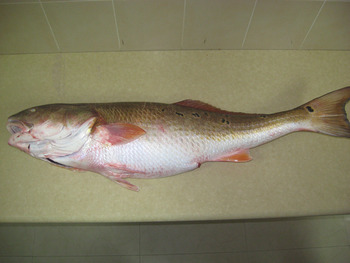
On 30 September 2011, a large (ca. 800 mm TL) specimen of the Red Drum Seiaenops ocellatus was captured by hook and line in the vicinity of Ashdod, Israel. The fish was photographed (Figure 5) but was not saved.
RESULTS
SYSTEMATICS
Order PLEURONECTIFORMES Bertrand, 1763
Family PARALICHTHYIDAE Gill, 1864
Genus Paralichthys Girard, 1858
Paralichthys lethostigma Jordan and Gilbert, 1884
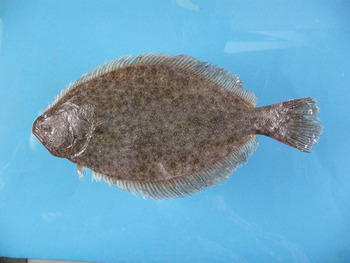
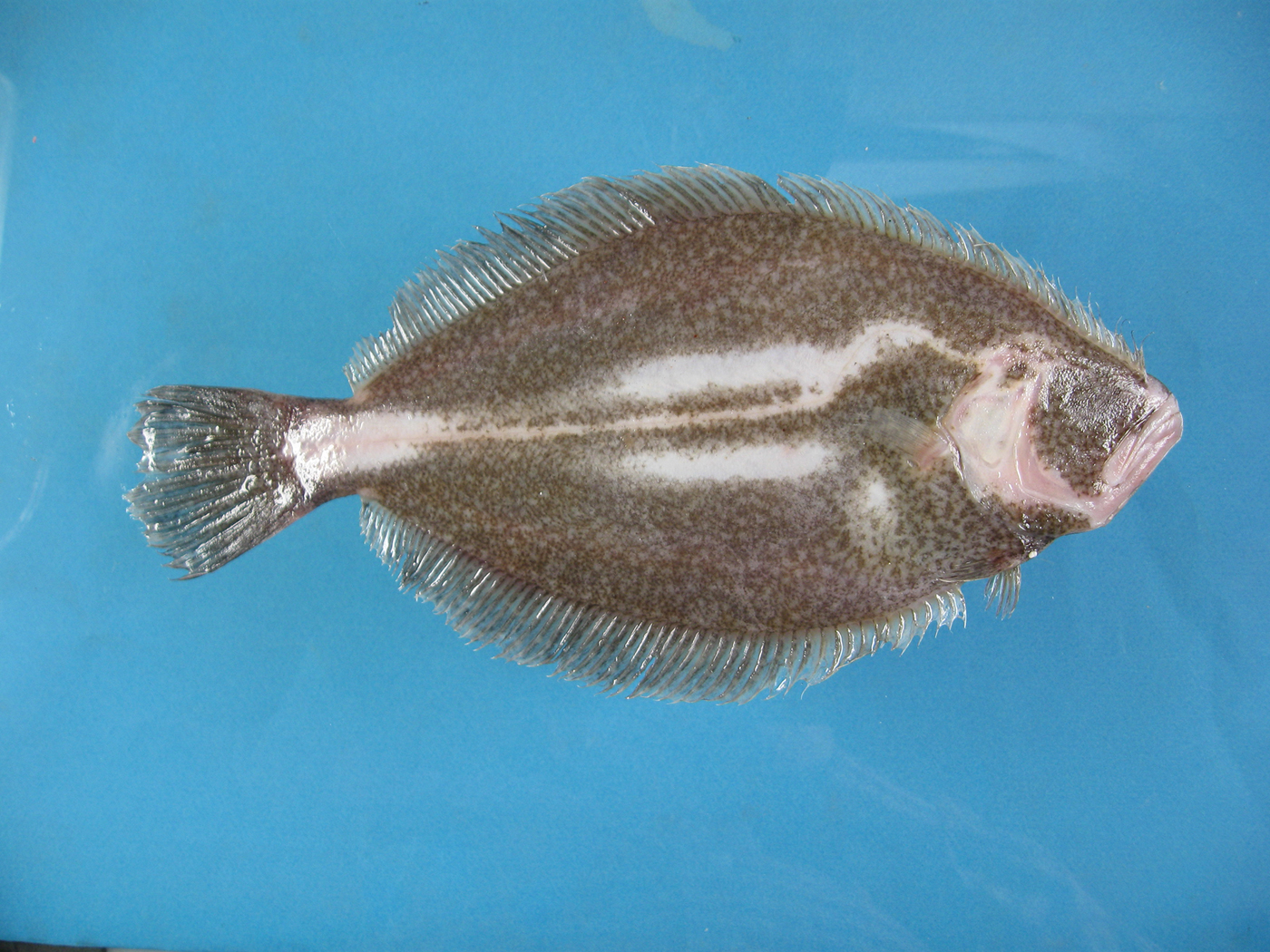
(Figures 1 & 2)
Paralichthys lethostigma, 214 mm (SL), ocular side, Mediterranean coast of Israel, HUJ 20352.

Paralichthys lethostigma, 214 mm (SL), ventral side, Mediterranean coast of Israel, HUJ 20352.

Paralichthys lethostigma Jordan and Gilbert, 1884, p. 146.
DESCRIPTION OF MEDITERRANEAN SPECIMEN
Flat fish lying on the right side with oval body. Body depth (at the 35th dorsal fin ray) 2.2 times in SL. Small head (3.6 times in SL). Large mouth, upper jaw reaching back to the posterior vertical of eye. Two large canine teeth at the anterior of each jaw, followed by a series of well separated, small canine teeth. Elliptic eyes, their longer axis length 5.4 times in head length. Narrow and flat interobital, without ridge between the eyes, 12.8 times in head length. First gill arch with five rakers on the upper limb and 15 on the lower limb. Dorsal fin with 82 rays, originating slightly in front of the eye and terminating at the origin of the caudal peduncle. Anal fin with 60 rays originating below pectoral fin base and terminating below dorsal fin end. Well-developed pectoral fins with 12 rays on the ocular side and 13 rays on the blind side. Small ventral fins with 6 rays, originating at the vertical of preopercle rear. Caudal fin symmetrical and slightly round. Lateral line on both sides, arching above pectoral fin.
Colour: ocular side brownish grey with numerous dark spots covering the entire body, except the fins. Blind side mostly greys with small dark dots, with long narrow white stripe on the lateral line and wider elongated areas above and below it. Pectoral fin, operculum and jaws are white.
REMARKS
The morphology and counts agree with Randall & Vargara (Reference Randall, Vargara and Fischer1978) and Munroe (Reference Munroe and Carpenter2002). The genus Paralichthys, previously placed in the family Bothidae, consists of 20 species (Froese & Pauly, Reference Froese and Pauly2014). Paralichthys lethostigma can be distinguished from its co-generics by the combination of lacking prominent ocelleted spots on the ocular side, 80–95 dorsal rays, body depth of more than 2.1 times in SL and no ridge between the eyes.
Its native distribution is the Atlantic coast of North America, from North Carolina to north Mexico. It is a highly eurythermic species, living between 7 and 30°C, and euryhalinic, often entering brackish waters in estuaries. Adults are voracious predators, consuming fish and large invertebrates.
Paralichthys lethostigma was first introduced to Israel in 2001 to assess its suitability for local aquaculture. They were raised in inland closed systems in Ma'agan Michael and Atlit on the Mediterranean coast of Israel. After three years in Atlit hatchery, the females reached the weight of 2–3 kg while the males were closer to 1 kg. At that stage, the fish spawned and ca. 10,000 fingerings were hatched. Shortly thereafter, all adults and juveniles died and the enterprise was closed (E. Zohar, personal communication).
SYSTEMATICS
Order PERCIFORMES Rafinesque, 1815
Family CHANNIDAE Gronow, 1763
Genus Channa Gronow, 1763
Channa micropeltes (Cuvier, 1831)
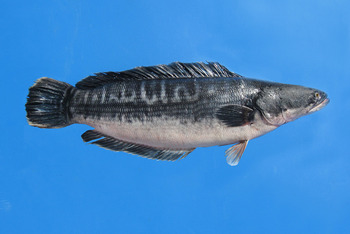
(Figure 3)
Channa micropeltes 549 mm (SL), Lake Kinneret, 5 March 2010, HUJ 20025.

Channa micropeltes (Cuvier, 1831), p. 427 (Java, Indonesia).
SHORT DESCRIPTION OF THE KINNERET SPECIMEN
Elongated body with large and depressed head (3.4 times in SL). Large mouth, jaws reaching back well beyond the eye. Small eye (11.4 times in head length) located at the anterior part of the head. Short snout (4.5 times in head length) and wide interorbital (3.2 times in head length). Both jaws with series of sharp well-separated canine teeth. Long dorsal fin with 44 rays originating at the vertical of both pectoral and pelvic fins bases and terminating above the end of anal fin. Anal fin with 27 rays originate under the tenth dorsal fin ray. Pectoral and pelvic fins rounded. Caudal fin slightly rounded with wide base. Entire body covered with small scales extending from the top of the head to the line of the anterior nostrils.
Colour: body, flank and top of the head dark grey with 13 horizontal white bar-like marks, some with rounded upper or lower end, connected in some cases to the next bar. Belly and vertical surface of head white. All fins except for the white pelvic fins are dark grey. The lower margin of anal fin and upper and lower margin of caudal fin are white.
REMARKS
Morphological measurements and meristic counts (especially the large number of small scales (82–110 in lateral line, as expressed in its scientific name ‘micropeltes’, meaning ‘small scales’ in Greek)) agree with Rainboth (Reference Rainboth1996) and Courtenay & Williams (Reference Courtenay and Williams2004). The colour pattern is almost identical to that of Rainboth (Reference Rainboth1996) (Figure 208) and Courtenay & Williams (Reference Courtenay and Williams2004) (p. 93 – upper image and p. 97).
Channa micropeltes inhabits standing and slow flowing water at 7–20°C. It is a fast growing species reaching 1.5 m and weighing over 20 kg. Adults are fierce predators, consuming mainly fish and, to a lesser extent, large invertebrates. Spawning is among plants; both parents guard the eggs and fingerlings.
The native range of C. micropeltes is southern Asia, Indonesia to Cambodia and Laos. It was most likely introduced to India some time ago (Courtenay & Williams, Reference Courtenay and Williams2004) and recently, a single record was reported from Le Caldane, Tuscany, Italy (Piazzini et al., Reference Piazzini, Segos, Favvilli and Manganelli2014). In the US, it was recorded from Maine, Massachusetts and Rhode Island (Courtenay & Williams, Reference Courtenay and Williams2004). The best known case was the discovery of an established population in Maryland, which led to the defaunation of an entire pond near the town of Crofton (Courtenay & Williams, Reference Courtenay and Williams2004).
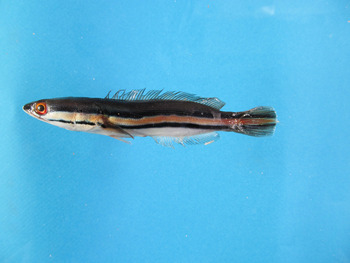
Young specimens of C. micropeltes are colourful, with a bright orange-yellow longitudinal line and are, therefore, popular in the aquarium trade. Although their importation to Israel is prohibited, the fish importers try to smuggle them in as rare species. Some of the shipments are caught and confiscated and eradicated by the local authorities. The 87 mm SL specimen shown in Figure 4 was part of a shipment that was confiscated on 7 January 2013 at Ben-Gurion International Airport.
Channa micropeltes, 87 mm (SL), confiscated on 7 January 2013, at Ben-Gurion International Airport, Israel, HUJ 20353.

SYSTEMATICS
Order PERCIFORMES Rafinesque, 1815
Family SCIAENIDAE Cuvier, 1828
Genus Sciaenops Gill, 186
Sciaenops ocellatus (Linneaus, 1766)
Sciaenops ocellatus (Linneaus, 1766, p. 483) (Carolina, USA).
A large specimen (Figure 5) was collected by hook and line near Ashdod, Israel. The specimen was photographed but was not saved. This is the second record of this species in the Mediterranean (see Golani & Mires, Reference Golani and Mires2000).
Seiaenops ocellatus ca. 800 mm, 30 September 2011, vicinity of Ashdod, Israel, hook and line.

DISCUSSION
The eastern Mediterranean is the most invaded marine ecosystem in the world (Edelist et al., Reference Edelist, Rilov, Golani, Carlton and Spanier2013). Most non-native species in this region are of Red Sea origin (Lessepsian migrants), entering the Mediterranean via the Suez Canal (Golani, Reference Golani, Golani and Appelbaum-Golani2010). However, the number of records of aquaculture fish escapees is very low. The first such report was by Golani (Reference Golani1997) of the hybrid species of Morone saxatilis and Morone chrysops, from the coast of Israel. Golani & Mires (Reference Golani and Mires2000) mentioned the occurrence of Sciaenops ocellatus from the same region. Several years later, Dulčić & Kraljević (Reference Dulčić and Kraljević2007) collected Pagrus major in the Adriatic Sea. The present record of Paralichthys lethostigma constitutes the fourth record of an aquaculture fish species escapee in the Mediterranean. It should be noted that, in contrast to the Lessepsian migrants, most of which established sustainable populations in the Mediterranean (Golani, Reference Golani, Golani and Appelbaum-Golani2010), none of the aquaculture escapees succeeded in establishing a sustainable population in the Mediterranean, unlike in Taiwan where this non-native species did establish a population (Liao et al., Reference Liao, Chen and Shao2010).
Golani & Mires (Reference Golani and Mires2000) enumerated 40 non-native fish species that were found in the Israeli freshwater system. In the following years, several species were added to this list (Snovsky & Golani, Reference Snovsky and Golani2012; Golani & Snovsky, Reference Golani and Snovsky2013). The record of Channa micropeltes is of high interest and potential threat. This species is notorious as having a high colonization ability, as in Maryland and other areas in North America (see (Courtenay & Williams, Reference Courtenay and Williams2004).
However, several years have passed since its collection in Lake Kinneret and so far there are no signs of this species reproducing there.
ACKNOWLEDGEMENTS
We wish to thank M. Zamel for providing the specimen of Paralichthys lethostigma.