INTRODUCTION
Civilizations throughout human history have often invented or adopted from past traditions a vegetative motif that symbolizes the metaphysical principles of cosmogenesis, natural creation, eternal recurrence, and/or human hopes for everlasting life in the hereafter. Known variously as kalpa vrksa to Brahmins, haoma to Parsis, yggdrasil to the Norse, arbor vitae to Christians, or more generically as the world tree, sacral tree, cosmic tree, or tree of life to historians and mythologists (Arnold Reference Arnold and Carrasco2001; Callaway Reference Callaway2006; Cook Reference Cook1974; Danthine Reference Danthine1937; Evans Reference Evans1901; James Reference James1966; Jones Reference Jones1986; McDonald Reference McDonald2002; Miller and Taube Reference Miller and Taube1993; Parpola Reference Parpola1993), the motif generally represents a primeval fount of living creation or a vegetative prop (axis mundi) of universal laws that embodies the natural processes of life and death.
Mythic and iconographic concepts of a cosmic tree seem to spring spontaneously to life in the human imagination, as similar vegetative forms appear recurrently in the written and artistic records of distant and isolated cultures throughout the world. Visual and literal expressions of the plant are often encountered in temple sanctums and burial chambers of celebrated aristocrats and priests, with essentially equal frequency on bas-reliefs, mural paintings, grave stones, votive objects, jewelry, libation implements, and personal seals (Goodyear Reference Goodyear1891; McDonald Reference McDonald2002, Reference McDonald2004; Parpola Reference Parpola1993; Schele Reference Schele and Robertson1974). Artistic depictions of the world tree provide an endless source of fascination and historical perspective on past civilizations and their cosmological views.
The interpretation of world tree imagery among Mesoamerican peoples (Miller and Taube Reference Miller and Taube1993) presents greater challenges than analogous iconic trees of Europe and Asia (Cook Reference Cook1974; James Reference James1966; McDonald Reference McDonald2002, Reference McDonald2004; Parpola Reference Parpola1993), as the efforts of Spanish clergy to destroy all vestiges of Amerindian beliefs and religious practices during the age of conquest and inquisitions eliminated all but a few examples of this once pervasive symbol of Mexico and Central America. What now remain are disconnected remnants of an abstract motif that once played a focal role in the religious views of Mesoamerican cultures, the more intact and complete specimens of which are encountered on stucco reliefs, stone stelae, ceramic paintings and codices of lowland Maya communities from the Classic to Postclassic periods (sixth to thirteenth centuries). Collectively, these images suggest an ancient and enduring concept of a cosmic plant since the birth of Maya civilization in the Preclassic and Early Classic periods (Freidel et al. Reference Freidel, Schele and Parker1993:135–137; Guernsey Reference Guernsey Kappelman2004:113; Hansen Reference Hansen, Grube, Eggebrecht and Seidel2006:Figure 74). A more detailed understanding of this vegetative motif would facilitate ongoing attempts to decipher glyphic and iconographic records of historical Maya communities.
Most Classic and Postclassic impressions of the Maya world tree portray a plant whose basal stem is rooted in a watery substrate that the Maya identified as the underworld of the gods, Xibalba (Figures 1a.1, 2a), or “Place of Fear” (Miller and Taube Reference Miller and Taube1993:177). The trunk of such trees conventionally ascends from the skull of an aquatic god known as the Water Lily Monster (WLM) or “Quadripartite God” (Figures 2a, 3a, 4, 5a; Schele and Freidel Reference Schele and Freidel1990:Figure 6:12) and usually branches thrice at its summit in a cruciform manner, each of three equal stalks terminating in a polypetalous or treble floral motif (Figures 1a, 2a, 4, 5a). Typically, the lower two opposite branches emanate at perpendicular angles from the trunk and occasionally terminate in a stylized “square nosed” serpent motif (Figures 1a, 2a, 3a, 4a, 5a), while a stout, central branch extends upward to provide a perch for a cosmic bird. Hence, both plant and animal elements convey the concept of a vital linkage between an aquatic underworld, the earth and its celestial realms. In addition, a pliant, bicephalic, skeletal serpent with prominent water lily ear flares conventionally entwines itself within the cosmic tree's lateral branches (Figures 2a, 3a, 4a, 6a), implying again a living connection between the creative forces of the earth and sky.
(a) The ceramic “cosmic plate” focuses on a Classic Maya world tree. (1) the outer face (not shown) and inner rim are surrounded by a red band, denoting a water line, while the lower register presents parallel red lines supporting 3-stacked bars, another water symbol, suggesting an aquatic origin of the world tree. (2) Tridents that cradle two circlets symbolize water lilies on the upper rim of the bowl, behind which water lily leaves (not shown) decorate the outer face of the bowl; the trefoil motifs are usually interpreted erroneously as Venus symbols. (3) The Water Lily Monster is observed in the lower register with a sak nik symbol for an ear flare (= water lily). Two personified water lily buds display the face of WLM, one with a bony mandible and one without. (4) A bicephalic serpent with a crocodile head exhibits a polypetalous floral ear plug (= water lily) and a trident and double circlet motif (= water lily) in its jaw. (5) The other end of the bicephalic serpent emerges on the opposite side of the bowl, presenting a down-turned head of the WLM with a sun-platter, stylized water lily leaf and water lily insignia (sak nik) upon his head (= the “Quadripartite God”). (6) An anthropomorphized water lily god, Chahk Xib Chahk, arises from the watery netherworld with three flourishing branches, each of which produces water lily buds that match closely with the face of the WLM, below. (7) Two branches sprout from the cranium of Chahk Xib Chahk, the right branch transforming into a water lily serpent, whose ear is decorated symbolically as an open nik’ sign, and a personified water lily bud. (8) The central branch gives rise initially to a Water Lily Jaguar, whose head and ear produces a water lily bud that bears a nen (“mirror”) sign. (9) Extending beyond the jaguar, a WLM face with a water lily ear flare personifies a peduncle that terminates in two water lily buds, one of which is personified and bears a crossbar on its forehead (compare with Figure 7a). (10) A mythic bird hovers over the canopy of the aquatic tree with a sak nik (“white flower”) motif on his head. Ribbon-like motifs that dangle from his body match closely with water lily peduncles and symbols of the underworld WLM. Ceramic, Nakbe, Guatemala, date unknown. (b) A god blows a conch while reclining upon a water lily leaf. The WLM bears a bud with a nen symbol and a trefoil and double-orb water lily motif. Ceramic, northern Yucatan, date unknown. (c) A small-faced WLM produces a series of water lily buds: three upon the cranium and one bearing feathers as an ear flare. Ceramic, provenance, and date unknown. Drawing by author after photographs K1609, K7146, and K8728, © Justin Kerr.

(a) Bas relief frieze of Maya world tree from the Temple of the Cross, Palenque, Chiapas, seventh century. (1–2) The WLM/Quadripartite God sustains a world tree by the “quadripartite badge,” a platter bearing a solar/floral insignia that contains a “shell scroll” (water lily leaf bud?), “stingray spine” (water lily leaf?) and sak nik (trefoil with basal bar and cartouche with cross bands), a water lily flower symbol. Atypically, WLMs at Palenque display bifid scrolls as water lily ear flares. (3) The skeleton of a bicephalic water lily serpent with water lily ear flares is formed by alternating yax (“green”) and circular water symbols, presumably attributing vegetative characteristics to the reptile's body (i.e., as a peduncle). (4) The meaning of highly stylized, “square-nosed serpent” motifs that emerge from the lateral flowers is obscure, but they seem to complement the pliant serpent that dangles across the tree's boughs (compare Figure 6). (5) The triad of treble-campanulate floral motifs with a pair of infixed circlets are water lily symbols (compare Figures 1b–c, 2c–2d, 3b–3c, 7a). (6) A polypetalous flower motif, reading nik’ (“flower”), likely a water lily symbol (see Figure 7a), floats between the tree's crown and the cosmic bird. (7) A cosmic bird with a water lily ear flare (compare Figure 2b) perches upon the terminal flower so as to associate its plumage with a corolla (compare Figures 2a, 8b). (b) Cosmic birds often display water lily ear flares and water lily symbols for tail feathers. Note also the personified sun motif that dangles from his neck. Ceramic, provenance and date unknown. (c) Water lilies are conventionally symbolized by a trident that cradles two circlets. These compare precisely with those of the world tree. Ceramic, provenance and date unknown. (d) The standard trident and two circlet motif is often highly stylized. Ceramic, provenance and date unknown. Drawing by author after photographs K5227, K7226, and K8928, © Justin Kerr, and Maudslay Reference Maudslay1974:vol. IV, Plates 73, 76.

(a) House D, Pier C, Palenque, Chiapas, seventh century. A deified dynast assumes the garb of a god and dances across a water lily grove with a world tree. (1) The WLM produces leaves and flowers that provide a substratum for this plant-god. A series of tetramerous flowers with cross bands and circular symbols observed previously as the water lily serpent (Figure 2a.3) emerge from the lotus grove. (2) True to convention, the world tree has a WLM skull bearing a quadripartite badge on its cranium, including the “white flower” (sak nik) glyph, a sign of the water lily. (3) The cosmic dancer wears a headdress comprised of a WLM with water lily eyes (bar with three circlets and a down-turned corolla; compare Figure 5b) and a stylized water lily sign on his snout. (4) Three highly derived “square nosed serpent” motifs extend from the three-branched vegetative motif (compare Figures 2a, 4) and sustain a k'an cross symbol (a portal motif) and half the image of the tetramerous water lily symbols emerging from the water lily patch below the cosmic dancer. (b) Temple of the Cross, Palenque, Chiapas, seventh century. The Quadripartite God produces a stream of water with an embedded mi glyph, conceivably a lateral perspective of floating, tetramerous flowers observed in Figure 3a1. (c) Three trefoil water lily signs emanate from the ear of WLM, out of which emerges a stylized leaf and flourishing water lily stalk, the peduncle bearing a prominent “zero“glyph, mi (Montgomery Reference Montgomery2002:169), half the image of the cross-bar tetramerous flowers emerging from the water lily patch (Figure 3a.1). Ceramic, provenance and date unknown. Drawing by author after photograph K3640, © Justin Kerr, and Maudslay Reference Maudslay1974:vol. IV, Plates 32, 35.

(a) The sarcophagus lid of the famous dynast, K'inich Janaab Pakal, conserves the most famous image of the Maya world tree. (1) The WLM, fixed within his own jawbone, sustains Pakal and the world tree upon the quadripartite badge. (2) The conventional sun-platter contains a conspicuous “white flower” (sak nik) motif, on which the king reclines. (3) The bicephalic water lily serpent with water lily ear flares undulates through the branches with bodily segments comprised of partial nen and jade signs. (4) Water lily and mirror motifs move up the world tree trunk toward the branch tips. (5) Three branches terminate with a lateral perspective on a polypetalous flower bearing “mirror” signs (= water lily). These symbols are homologous to the two-orbed, trefoil motifs on the tree on the Tablet of the Cross (Figure 2a). (6) A pair of itz (“nectar”) glyphs floats above the cosmic tree's canopy, each presenting a facial infix that relates dually to a “flower” and “sun” glyph that is often symbolic of water lilies, with three beaded pegs that represent an emission of nectar. (7) The cosmic bird with the face of the WLM and a water lily ear flare assumes his standard position on the tree's summit. Temple of Inscriptions, Palenque, Chiapas, seventh century. (b) Itzamnaaj wears a headdress with a square-nose serpent emerging from a stylized water lily on the forefront and a derived “white flower” (sak nik) on the backside. (c) A square-nosed WLM produces a water lily stalk from his head. Note the double-circlet te’ sign on the peduncle. Drawing by author after photograph K1218, © Justin Kerr.

(a) Temple of the Foliated Cross, Palenque, Chiapas, seventh century. A long-leaved permutation on the Maya world tree. (1) A k'an cross, representing an ol portal to Xibalba, replaces the standard sun-plate on the head of the WLM and presents an opening for the burgeoning world tree. (2) Lord Sun-Face (K'inich Ajaw), a possible symbol of the water lily, hangs at the heart of the personified world tree. (3) The face of God E emerges from the lateral branches; these motifs are often identified as corn cob motifs due to the long foliate scrolls and hair tassels (compare, however, Figures 5b–5c). 4. The world tree's canopy sustains a living image of the basal Water Lily Monster skull, whose ears and cranium present water lilies, the former of which present bifid vegetative motifs the latter a large trefoil with a nen sign. (5) A cosmic bird with water lily ear flares perches upon the mirrored flower motif. (b) Stele 1, Bonampak, Chiapas, eighth century. A WLM with water lily eyes and water lily ear flares serves as a conduit for God E through the ears and cranium. (c) The WLM with water lily trefoils and a flower emerging from his head provides a portal for the upturned face of God E. Note that the forehead of God E displays a polypetalous flower and water lily trefoil instead of a corn cob. Ceramic, provenance and date unknown. Drawing by author after photograph K7669, © Justin Kerr, and Maudslay 1974:vol. IV, Plates 80, 81.

This world tree lacks the standard basal WLM skull, a well-developed cruciform structure or water signs. (1) Nevertheless, the coiling, serpentoid water lily peduncle bearing nen signs sustains the tree motif from an aquatic underworld and produces buds and treble motifs as buds. (2) The WLS exhibits its standard floral ear flares. (3) The WLS disgorges a fruiting water lily stalk with four prominent sepals from its lower jaw. The serpent's coiling body appears to mirror the image of its vegetative co-essence in the underworld. (4) Treble water lily floral motifs terminate the aerial branches of the water lily world tree. Ceramic, provenance and date unknown. Drawing by author after photograph K8540, © Justin Kerr.

The trunk of the Maya world tree often exhibits the face of a deity that is normally identified as God C (Schellhas Reference Schellhas1904) by modern Mayanists (Callaway Reference Callaway2006:51; Looper Reference Looper2003:8; Schele and Miller Reference Schele and Miller1986:77), whose image is believed to suggest a sacred attribution to the vegetative motif (Schele and Freidel Reference Schele and Freidel1990:409). Or otherwise, the arboreal face mirrors a living or skeletal image of the WLM or Quadripartite God, usually observed at the base of the tree (Figures 1a, 2a, 3a, 4a, 5a, 6a), and possibly implies this creature's ascent into the living (mesocosmic) realms of the Maya cosmos from the underworld. The trunk and branches are also infixed with a variety of glyphs and symbolic signs that denote a “tree,” “wood,” or vegetative entity (te’; Callaway Reference Callaway2006:92; Looper Reference Looper2003:167; Montgomery Reference Montgomery2002:229; Thompson Reference Thompson1971:56), a water lily (naab’, T501, Montgomery Reference Montgomery2002:97), “mirror,” “brilliance” or “shining” (nen as the li or il glyphs, T24; Montgomery Reference Montgomery2002:161; Schele and Miller Reference Schele and Miller1983; Stuart Reference Stuart, Guernesy, Clark and Arroyo2010:291), the sun (k'in, T574; Montgomery Reference Montgomery2002:151), and “jewels” (uh; Callaway Reference Callaway2006:67, 71), ostensibly describing physical aspects of the plant on a literal basis.
The Maya world tree is usually portrayed as the focal feature of a mythic or historical narrative scene and is often flanked by a pair of gods or dynastic personages disguised as gods that pay tribute to the plant (Maudslay Reference Maudslay1974:vol. IV, Plates 76, 81). This iconographic pattern suggests a mythical dimension to the plant and implicates the motif in religious practices of palace life and the role of kingship (Figure 3a). An aristocrat or sacrificial human figure is occasionally placed at the base of the tree (Figures 4a, 5a; Arnold Reference Arnold and Carrasco2001; Freidel et al. Reference Freidel, Schele and Parker1993:Figures 4:25a, 4:29b), in which case the plant is involved in the birth or death of this individual and his or her subsequent passage into, or emergence from, the aquatic Netherworld of the Maya.
Most modern discussions on the Maya world tree begin and end with references to stucco reliefs on the walls of Palenque's principal structures from the seventh to eighth centuries. Modern interpretations of these images have varied considerably since their discovery by Europeans during the nineteenth century (Callaway Reference Callaway2006:1, 22–23), with Stephens (Reference Stephens1841:346–347) initially recognizing the motif as the central feature of Palenque's mysterious artwork and likening the image to a Christian cross with a strange bird atop. Brinton (Reference Brinton1969:97–102, 124) equated the motif with a cross but also recognized arborescent features that share close relationships with a symbolic bird and serpent. Seler (Reference Seler1901–1902:16–19) later hypothesized the cruciform plant symbolized the cardinal points of the Maya cosmos while also emphasizing the motif's close association with the Maya sun god, K'inich Ajaw. Maudslay (Reference Maudslay1974:vol I, p. 51; vol. IV, p. 37) acknowledged that the basal skull feature of Palenque's iconic trees shared standard features of dynastic headdresses depicted on murals among distant ruins at Copan and Yaxchilan.
Since these early observations and commentaries, advances in the decipherment of Maya glyphs have revealed two possible names for the world tree. One of the earlier glyphic readings (Freidel et al. Reference Freidel, Schele and Parker1993:53; Schele and Freidel Reference Schele and Freidel1990:426, n.8) interprets Palenque's Tablet of the Cross as wakah-chan, meaning “raised-up sky,” based on the combined Maya glyphic number six with a postfixed phonetic sign of ah (wakah) and the glyph for “sky” (chan). Callaway (Reference Callaway2006:78–80, 84–86) questions this translation, however, noting that this expression relates to the edifice itself (as noted earlier by Schele and Freidel Reference Schele and Freidel1990:426, note 8), preferring instead glyphic references to the plant as uh te’, the “jade-tree” or “jewel-tree” (Callaway Reference Callaway2006:67, 71–3). Whatever the original name of the plant, archeologists have interpreted the Maya world tree in various ways: as a symbol for eternal recurrence (i.e., cyclic birth and death; Callaway Reference Callaway2006:16; Kubler Reference Kubler1969:27), a celestial map of the Milky Way (Freidel et al. Reference Freidel, Schele and Parker1993:87–87), or a vegetative bridge between the natural, celestial, and netherworld, through which kings ascend and descend as personifications of the cosmic plant (Callaway Reference Callaway2006:75; Freidel et al. Reference Freidel, Schele and Parker1993:69–100; Schele and Freidel Reference Schele and Freidel1990:242–244, 255). A recent thesis on the subject suggests, however, that all of these interpretations are now dated and in need of revision (Callaway Reference Callaway2006:1).
BOTANICAL IDENTIFICATIONS OF THE MAYA WORLD TREE
Attempts to determine the botanical identity of the world tree or at least delineate the more salient botanical aspects of the plant have given rise to divergent views among anthropologists, with little or no input from plant biologists. Two prevailing opinions identify the plant as either an emergent tree of tropical lowland forests, the kapok tree (Ceiba pentandra Gaertn.) (Callaway Reference Callaway2006:36, 89; De la Fuente Reference De la Fuente1965:135–139; Miller and Taube Reference Miller and Taube1993:186; Ruz Lhuillier Reference Ruz Lhuillier1963:116) or maize plant (Zea mays L.) (Callaway Reference Callaway2006:77–79; Miller and Taube Reference Miller and Taube1993:48; Schele Reference Schele and Robertson1974:43; Taube Reference Taube and Carrasco2001:218–220; Stuart Reference Stuart, Benson and Griffin1988:198). Both of these plants are well-known among contemporary Maya communities, but for different reasons: the former on account of its large stature and the latter for its role as a staple food crop. These distinctive plants share very little in common, however, with respect to their physical appearance and characteristics, ecological associations, and mythic functions, and therefore seem mismatched in terms of a dualistic botanical entity.
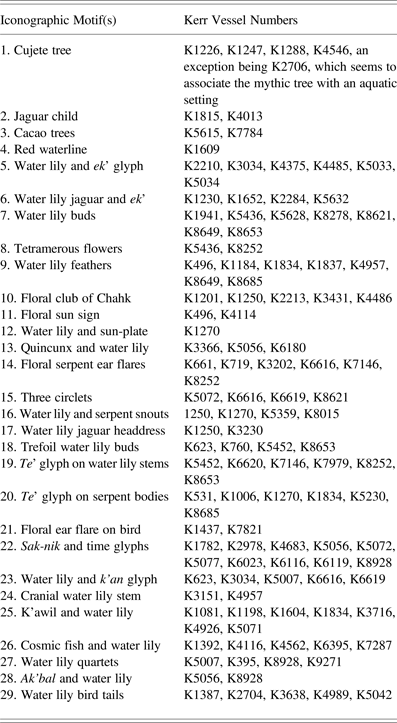
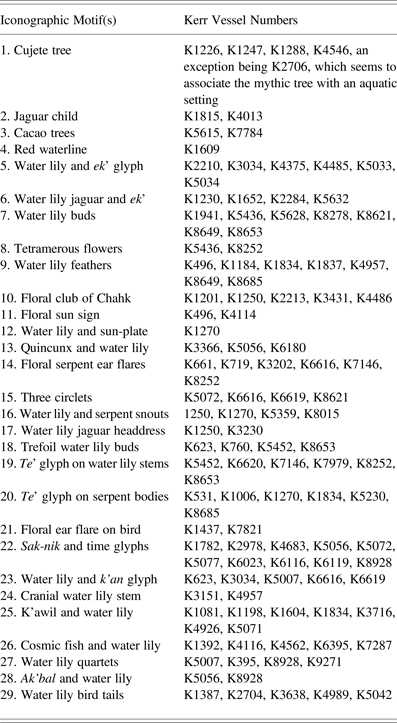
Maya ceramic paintings involve a number of mythical tree themes and provide ample evidence that the calabash tree (or cujete, Crescentia spp.) played an occasional role in Maya mythology (Table 1.1). In this case, a hunter figure with a blowgun snipes a cosmic bird from a tree with large, rotund, cauliflorous fruits. Although Callaway (Reference Callaway2006:Figure 2.8) interprets this plant as a kapok tree, ceibas never exhibit cauliflory. A similar tree is occasionally observed on ceramic paintings that involves the birth or appearance of a baby jaguar in the Maya underworld (Table 1.2), but this plant seems to relate to mythic themes that are peripheral to the cruciform world trees at Palenque and on ceramic paintings that highlight the plant's origin in the Maya aquatic netherworld. Thompson (Reference Thompson1971:10, 71) noted that various modern Maya communities of Chiapas attribute cosmic roles to ceiba trees in their forests and zócalos—as either the root of creation or ladder to the heavens—yet the kapok tree is never identified with baby jaguars and cosmic birds in contemporary mythology. The occasional depiction of a cacao tree in association with a decapitated human head is also known from antiquity (Table 1.3), suggesting a mythic role for this utilitarian tree species; but, again, this particular plant and its ribbed, cauliflorous fruits bear little resemblance to conventional portrayals of an aquatic world tree (i.e., one that emerges from water lines or the cranium of the WLM or Quadripartite God, see below).
Sources of corroborative ceramic images from the Justin Kerr Vase Data Base, available at www.famsi.org/research/kerr/.
An equal number of commentators (De la Fuente Reference De la Fuente1965:136; Ruz Lhuillier Reference Ruz Lhuillier1963:116; Kubler Reference Kubler1969:27; Schele and Miller Reference Schele and Miller1986:195, Plate 75) have identified specific renderings of the world tree as a corn plant, usually citing a highly stylized execution of the plant inside Palenque's Temple of the Foliated Cross (Figure 5a), primarily on the basis of this tree's long and strappy leaves. Freidel et al. (Reference Freidel, Schele and Parker1993), among many others, interpret the image of a human face that emerges between the leaves of this tree's lateral branches (Figure 5a.3) as an anthropomorphic representation of a corn ear, while suggesting that glyphic references to the world tree at Palenque and Copán (eighth century) as Na-Te'K’an, “First Tree Precious Yellow” or as yax te’, meaning ”green tree” (Freidel et al. Reference Freidel, Schele and Parker1993:53, 96) refer to a corn plant's yellow infructescence. Nevertheless, discernible images of corn ears or kernels are never observed in association with these flower-bearing world trees of the Maya, and therefore call this particular interpretation into question as well.
Anthropological discussions on the botanical aspects of the world tree are often sketchy and inconsistent with critical morphic attributes of the abstract motif but arguments in favor or against specific perspectives and interpretations of the motif are rarely, if ever, supported or contested by botanical specialists, as the fields of iconography and mythology are generally ignored by natural scientists. This is unfortunate, given that animal and plant symbolism of early civilizations is based primarily and directly on human reflections on their natural environments.
In this study, world tree images on two ceramics, four Classic stucco reliefs, and two stone stelae are examined with respect to their morphic, symbolic and mythic characteristics, with an aim to better elucidate the botanical identity and meaning of the motif. Preclassic murals at San Bartolo, Guatemala, are examined subsequently to explore the origins of Classic iconographic practices. The Maya conventionally portrayed their cosmological and religious views by means of highly stylized, abstract images, these deriving fundamentally from their unique perceptions of the natural world and particularly aquatic habitats, which they recognized as the ultimate source and domain of their pantheon. Indeed, the most popular plant motif in Maya arts was a white-flowered water lily, Nymphaea ampla (Salisb.) DC., which was widely employed as a symbol of the Maya Netherworld and its aquatic inhabitants, the plant's physical and behavioral aspects often reflecting many of the signatory attributes and behaviors of their gods and goddesses (Hellmuth Reference Hellmuth1987; McDonald and Stross Reference McDonald and Stross2012; Rands Reference Rands1953).
The Maya use of abstract figures and symbolic forms can be so extreme as to render many images unintelligible to even experienced specialists in the arts of Mesoamerica: hence a variety of divergent opinions on the origin and meaning of these symbols and the symbolic significance of the tree itself. Efforts to decipher and interpret Maya iconography are best served, therefore, by first examining artistic works that are realistic in their execution, after which more stylized specimens and their complex symbolic associations are more effectively analyzed. When interpretations of symbols are hypothetical and/or arguable, or even when not, they are supported by similar patterns of symbolism observed at different sites, from different time periods and in different artistic media.
THE WORLD TREE ON CERAMICS
One of the more unique and revealing portrayals of the world tree is observed on the famous Maya ceramic painting from the Peten of Guatemala (Figure 1a), the so-called “cosmic plate,” which integrates several typical elements of the Maya world tree in a mythic scene that involves interactive images of the WLM, Water Lily Serpent (WLS; i.e., a snake with prominent water lily ear flares) (McDonald and Stross Reference McDonald and Stross2012), Water Lily Jaguar, a crocodile, cosmic bird, and principally, a personified, three-branched vegetative motif in the guise of an anthropomorphic, underworld god known as Chahk-Xib-Chahk (Figure 1a). The panorama emerges from a pool of water that represents an aquatic portal to Xibalba, the Maya Netherworld, about which a host of gods intermingle between the lower, middle, and heavenly realms of the natural world. The rim of the plate is outlined by a continuous red band, a standard symbol for water surfaces in Maya iconography (Hellmuth Reference Hellmuth1987:vol. I, p.102; Coe Reference Coe1975:19), just as a centralized band of red, three-stacked bars (a standard symbol for water) establishes a water line that traverses the lower register of the plate (Figure 1a.1), through which arises the focal image of the cosmogram: an anthropomorphized image of the world tree (Figure 1a.1). The outer side of the plate is similarly marked by several red lines and a series of water lily leaf motifs (Table 1.4).
On both sides of the flying bird on the upper rim of the bowl we observe two stylized motifs upon the netherworld's watery surface (Figure 1a.2), each portrayed as a trident/trefoil that cradles a pair of orbs between three teeth. These symbols are normally interpreted as a Venus sign or more generically as a “star” glyph (ek’, T510af; Montgomery Reference Montgomery2002:89) by epigraphers and iconographers (Mazariegos Reference Mazariegos2006), as first suggested in 1913 by Spinden (Reference Spinden1975:92, 93, Figures 132c, 132 g, 132j, 132k). In this and many other instances, however, when floating on a water surface or in association with underwater gods, these symbols (including T510) can be reasonably identified as stylized or symbolic water lilies (compare Figures 2a.4, 2a.c–2a.d, 3c, 7a, Table 1.5; McDonald and Stross Reference McDonald and Stross2012:101, Figures 5a–5c; Milbrath Reference Milbrath1999:187, Figures 5.7c, 5.7f–5.7 g). That the symbol is associated with water surfaces certainly points to a flower symbol rather than a stellar feature of the sky, as does the symbol's close associations with the Water Lily Jaguar on ceramic paintings (Table 1.6), whose body and vegetative head piece is often covered with this symbol. This interpretation does not discount, of course, the possibility that the glyph for “star” is symbolized as a water lily sign (or vice versa), since both of these natural features of the Maya cosmos are white and resplendent, aerial features that occur in constellations: the former in deep space, the latter on the surface of standing bodies of water.
Correlative water lily symbols, motifs, and natural characteristics. (a) Water lily flowers are usually portrayed in profile, highlighting three of four sepals as a trident or trefoil motif that is suspended by thick and supple stalks. A radial perspective emphasizes a polypetalous flower. Buds and flowers are often decorated with cross-bars or a face that is often associated with the Maya Sun God (K'inich Ajaw). Both lateral and frontal perspectives of the flower are associated with sprays of long bird feathers, presumably to symbolize large water lily petals. Water lily leaves emphasize the blade's dentate margins and reticulate venations with prominent purple punctae on the undersurface. Ceramic, provenance and date unknown. (b-e) Nymphaea ampla from northern Veracruz. (b) Young, bulbous and smooth water lily stems that produce leaves and flowering stalks bear the general aspect of a human cranium (i.e., the WLM skull). (c) The circular, yellow, syncarpous ovaries of water lilies with a radiate androecium suggest the image of radiant sun. The ovary cup fills with water on the first day of anthesis and shimmers in sunlight: hence the habit of placing nen (“mirror”) symbols within buds and perianths. (d) Water lily buds, flowers, and fruits produce four prominent sepals, lateral views of which reveal three visible calyx segments (hence the use of trident or trefoil motifs in Maya symbolism). (e) Laminas exhibit prominent reticulate venation and dark purple punctae. Developing leaf blades unroll from the midvein outward, suggesting the source of the supposed “stingray spine” motif of the quadripartite badge (see Figures 2a.2, 4). Photographs and drawing by author. Drawing after photograph K8498, © Justin Kerr.

In close proximity to the water lily motifs on the outer edges of the plate is observed a floating, bicephalic “cosmic serpent” with a crocodilian head at one end (Figure 1a.4) and an inverted head on the tail (Figure 1a.5). Stuart (Reference Stuart2005:68–72) nominates this creature as “Starry Deer Crocodile” based, in part, on peculiar physical features that he identifies as starry eyes (Looper Reference Looper, Mittman and Dendle2012:202) and cervid ears and feet. Nevertheless, the images of cosmic crocodiles that Stuart (Reference Stuart2005:Figures 43b, 45a, 136) cites from Copan and Yaxchilan suggest instead a flowery reptile, as the three-toed, clawed feet are clearly saurian, while the “long-lashed” eyes with crossbars may just as well be interpreted as a naab’ sign, the ears as a water lily motifs. Indeed, the crocodilian head on the cosmic plate presents a trident with two orbs for an eye and a polypetalous floral ear plug, both of which can be interpreted as water lily symbols (McDonald and Stross Reference McDonald and Stross2012), just as many similar crocodiles and WLMs from the Maya netherworld bear water lilies on their snouts, ears eyes and legs (Freidel et al. Reference Freidel, Schele and Parker1993:218, 278, Figure 6:17; Looper Reference Looper2003: Figures 3.6, 4.8, 5.17; Maudslay Reference Maudslay1974:vol. I, Plates 59a–59b, 85, 95c; vol. III, Plates 35a–35b, 51c; vol. IV, Plates 18, 36; Schele and Mathews Reference Schele and Mathews1998:114).
The inverted WLM/Quadripartite God head (McDonald and Stross Reference McDonald and Stross2012:94, Figures 5b–5f, 9a–9c) on the reptile's tail (Figure 1a.5) also displays a water lily ear flare and sak nik or “white flower” sign; i.e., a trident, bar and cartouche (Freidel et al. Reference Freidel, Schele and Parker1993:183, Figure 4.2) , sometimes including a ajaw sign (stylized human face) or cross bands, which likewise symbolize the white-flowered Nymphaea ampla (McDonald and Stross Reference McDonald and Stross2012). This upturned, jawless head on the left side of the crocodile exhibits all the standard features of WLM (Figure 1a.5; McDonald and Stross Reference McDonald and Stross2012: 84–86, Figures 6a–c), just as it shares identical facial features with a WLM observed in the depths of this scene (Figure 1a.1). A symbolic relationship, if not equivalency, of the WLM and Quadripartite God was recognized by Thompson (Reference Thompson1971:72–73), who likewise identifies the WLM (and, by association, water lilies) as a symbol of the crocodile itself, while assuming that both symbolic forms embody the concept of an abundant earth in fertile, watery terrain.
The vertical alignment of iconic elements arising from Xibalba on the cosmic plate defines the essential dimensions of the Maya worldview, these being an aquatic underworld, a middle world (mesocosm) on the surface of the watery medium, and a celestial realm, across which a divine bird has taken flight (Figure 1a). The vegetative skull on the lowermost register of the plate, in the depths of the Maya underworld, is the WLM, an aquatic denizen that conventionally wears water lily ear flares and sak nik (“white flower”) ear plugs while producing water lily buds, flowers, and/or fruits from his cranium (Figures 1a.3, 1b–1c, 2.1, 3a.1, 3b–3c, 4.1, 5a.1, 5b–5c). In this case, however, paired stalks that emerge from the WLM's cranium terminate in personified water lily buds instead of full-blown flowers, each face seeming to mirror the face of the WLM at the base of the plate and possibly the face of the emergent human form, Chahk-Xib-Chahk (Figures 1a.3, 1a.6, 1a.8). Bud motifs with a pointed apex that extend from the WLM are clearly homologous with water lily bud motifs on other ceramic paintings (Figures 1b–1c, 6.2, 7a; McDonald and Stross Reference McDonald and Stross2012:Table 1.7), not unlike the emergent, personified buds that flourish above the water's surface, having emerged from three offshoots emanating from the waist-deep image of Chahk (Figure 1a.6).
Chahk, whose facial features are usually the same as those of the WLM, except for a pug-nose and topknot of hair (McDonald and Stross Reference McDonald and Stross2012), is fully personified in this instance and produces a pair of supple stems from his head (as does the WLM below) in addition to a third branch from his left arm. While each supple arm extension produces variations on water lily bud motifs at their tips, the stalk that slips underneath Chahk's right arm transforms into the head of a WLS at its apex (Figure 1a.7; McDonald and Stross Reference McDonald and Stross2012:Figure 7), whose personified water lily bud ear flare is subtended by a polypetalous ear plug with a face sign (ajaw) in its center, both of which features are often associated with water lily flowers (Figure 7a) and glyphs (see below). This branch compares closely with a central stalk that emerges from Chahk's head, which produces a series of four water lily buds. The first of these buds emerges from the ear of a roaring Water Lily Jaguar, whose tridentate bud bears a nen sign, an elliptical cartouche with two cross hatches (sometimes a pair of curved, eccentric arcs; Schele and Miller Reference Schele and Miller1983), which appears frequently within water lily buds and flowers (Figure 1a.5, 1a.8–1a.9, 1b–1c, 4.4, 6, 7a; McDonald and Stross Reference McDonald and Stross2012). Distal from the Water Lily Jaguar is observed another personified water lily motif with a water lily ear flare, seeming to suggest the skyward migration of the underworld face via the water lily peduncle. Moving up the same branch is another personified water lily bud by the image of Chahk's face in the middle of the stalk (Figure 1a.8), and then another whose forehead bears a rounded cartouche with crossbands, a symbol that is often associated with water lily buds and flowers (Figures 3a.1, 3a.4, 4.3,7a), and the aforementioned sak nik insignia. Above this personified bud we observe another bud that matches closely with buds of the WLM below (Figures 1b–1c, 7a).
Directly above Chahk's thick and supple appendages a bird is observed in flight. Various epigraphers identify this bird as Muut Itzamnaaj (Taube et al. Reference Taube2010:30; although Stone and Zender Reference Stone and Zender2011:47 express doubt in present readings) and most Mayanists identify this avian form as the co-essence of the Maya underworld god of creation, Itzamnaaj. Generically known as the Principal Bird Deity, the creature normally perches upon the central bough of the world tree (Figures 2a, 4a, 5a) or the medial coil of WLS (McDonald and Stross Reference McDonald and Stross2012:Figures 6a–6b) and is therefore believed to symbolize the celestial domain of the cosmogram (Freidel et al. Reference Freidel, Schele and Parker1993: 71, 420). However, this heavenly bird is also associated with the underworld, insofar as the creature wears water lily symbols on various areas of his body as well as aquatic serpent features on his wings. In this instance, a sak nik sign (circlet-bar-trident motif = water lily flower; McDonald and Stross Reference McDonald and Stross2012) is attached to the bird's head. Hellmuth's (Reference Hellmuth1987:vol. I, p. 195) recognition that the bird inhabits the Maya's watery Netherworld complements the creature's close relationship with the world tree's aquatic source. In summary, Guatemala's cosmic plate portrays a Maya world tree that reflects all the basic attributes of a water lily plant: a series of thick and supple, budding peduncles that extend skyward from a watery source. No trace of a corn plant, kapok stems or flowers is observed.
A similar but simplified image of the water lily world tree is observed on a ceramic vessel of unknown provenance (Figure 6) that distinctively lacks a WLM at its roots and a conventional cruciform canopy. Only two discernible branches that terminate in trident motifs (= water lilies; Figure 6.4) are observed, yet true to type, a coiling serpent entwines the tree's branches while displaying a prominent water lily ear flare (Figure 6.3) and a water lily fruit with four calyx segments below the jaw (Figure 6.2; compare Figure 7d, Table 1.8). The coils of this WLS are supported by budding water lily stalks at the base of the tree (Figure 6.1), a standard symbol of the aquatic Maya Netherworld; and interestingly, the convoluted water lily stalks exhibit loosely knotted coils that match closely with the body of the canopy's WLS. A bird (not shown here) flies over the aerial stems of the WLS plant.
As noted by McDonald and Stross (Reference McDonald and Stross2012:Figure 8G), Nymphaea peduncles at Dzibilchaltun exhibit many standard attributes of the Water Lily Serpent, as they are often depicted as thick and supple coils with water drops and nen-signs. If these authors are correct in identifying the water lily serpent as a symbol of the water lily plant, then conceptually, the recurrent associations of a world tree, water lily plant, water lily serpent, water lily monster, and Chahk may well reflect some sort of metamorphic or causal relationship between these disparate members of the Maya pantheon. Since this particular world tree also lacks physical or symbolic references to a corn plant or kapok tree, while exhibiting various aspects of a water lily plant, we can reasonably assume that this tree is likewise rooted in the Maya watery netherworld.
MORPHIC AND SYMBOLIC ASPECTS OF NYMPHAEA AMPLA
A ceramic painting in the Kerr Vase Data Base (Figure 7a) that employs a number of water lily motifs provides an unusually clear and relatively complete frame of symbolic reference to aid in the decipherment of world tree imagery. Twin mythic figures sit within or beside natural and stylized depictions of water lilies, the left plant bearing large, petiolate blades with prominent veins and conspicuous dark-punctae on the leaf undersurface (Figures 7a, 7e); each of these features is a conspicuous characteristic of Nymphaea ampla (Figure 7e; McDonald and Stross Reference McDonald and Stross2012). Water lily flowers that emanate from the lap and backside of the left twin are executed in profile as a trefoil/trident motif, an ancient and ubiquitous symbol in Maya iconography that exhibits three out of four calyx segments (Figures 1b–1c, 2a.5, 2b, 2d, 3b–3c, 5b–5c, 7a, 7d) with a pair of darkened, semicircular orbs inside the perianth (McDonald and Stross Reference McDonald and Stross2013; Rands Reference Rands1953:Figures 5a, 5c–5h).
The twin figure on the right emerges from a frontal view of the flower that presents a radial configuration of rounded water lily petals with alternating feathers (Figure 7a). The rotate arrangement of feathers is a rare perspective on the more typical, lateral perspective of a flower that conventionally produces a fascicle of feathers (Figures 1c, 6a, 8b, Table 1.9; McDonald and Stross Reference McDonald and Stross2012:Figures 7a, 9b). As hypothesized by McDonald and Stross (Reference McDonald and Stross2012), recurrent associations between feathers and petals in Maya iconography imply a symbolic equivalency between floral and avian features of the Maya pantheon (i.e., feathers = petals).
(a) Stela F, Quirigua, Guatemala, eighth century. A Guatemalan dynast commemorated as the personification of the world tree. (1) Ankles of the world tree take the form of a WLM so as to symbolize its aquatic source. (2) A “plaited rope” motif terminates in two sak nik signs around the knees of the world tree. (3) A pair of itz glyphs (water lily sun-flower signs with nectar falling) dangle on plaited rope motifs that issue from serpent maws. (4) A simplified, bicephalic “square-nose serpent motif” envelops the facial image of God C. (5) A bicephalic, water lily serpent skeleton, the ears of which present prominent water lily trefoils, drapes across the canopy and headdress of the personified world tree. (6) A (damaged) pectoral bar terminates at both ends in polypetalous flower with an infixed ajaw sign, apparently symbolizing the lateral branches of the trees cruciform canopy. (7) A plumose, polypetalous (bird?-) god with a trefoil as a headdress crowns the world tree. (b) Rosalila Temple, Copan, Honduras, ca. seventh century. A dynast wears a Chahk headdress that presents two prominent trefoil water lily ear flares, below which the king displays two stylized “ears of Chahk” (xikin Chahk), a name for the Maya water lily, depicted as a trefoil suspended a plaited motif and sustaining clusters of feathers. (c) Machaquilá, Guatemala, ninth century. The ankles of dynasts on commemorative steles are often decorated with water lilies (trefoil in association with three orbs and WLM). Drawings by the author after on-site photographs.

We also note that both twin figures uphold a stylized water lily stem/rod that is intersected by a horizontal, narrow, ellipsoid blade, this being a signatory attribute of Chahk-Xib-Chahk that most Mayanists identify as a “lightning rod” (Figure 1; Schele and Miller Reference Schele and Miller1986:46; Taube Reference Taube1997:22). In this case, however, it appears that the supposed lightning rod is actually a floral standard that produces a spray of feathers, as would be the case for other depictions of this implement on stucco reliefs in House D at Palenque (Greene Robertson Reference Greene Robertson and Robertson1974:Figures 11, 13) and on various ceramic paintings (Table 1.10).
Lateral perspectives on stalked buds and/or berries that reach around the frontal view of the flower contain cross-bands or prominent faces known as ajaw insignias (Figure 7a), a facial motif that can entail different readings, depending primarily on the context of its presentation. In this case, the sign reads as nik’, or “flower” (T535, Montgomery Reference Montgomery2002:183), but in other circumstances the symbol reads as ajaw, or “lord” (T533; Montgomery Reference Montgomery2002:27). Both glyphs share direct and indirect, dual associations with a quadripartite flower sign (nik and k'in, Stone and Zender Reference Stone and Zender2011:222–223, Figures 97.1–97.5) that usually relates to the concept of a “day” or the “sun,” just as several alternative glyphs for the sun and days employ variant elaborations on a tetramerous flower or quincunx (T585), the latter likely representing a sun emerging from a quadripartite calyx (Thompson Reference Thompson1971:142; Stross Reference Stross1986:8). This correlative relationship between various solar and quadripartite floral signs is likely based on the solar aspect of Nymphaea ampla corollas, whose radiate configuration of yellow stamens around a bright, golden ovarian disk open to the sun at daybreak and close before dusk during the flower's three-day cycle (Figure 7c; McDonald Reference McDonald2002; McDonald and Stross Reference McDonald and Stross2012).
The most common glyph for the sun, k'in (T544; Montgomery Reference Montgomery2002:151), a cartouche infixed with a quatrefoil motif, is unanimously interpreted as a quadripartite flower. And since the k'in sign is occasionally associated with the WLM and WLS (Table 1.11; McDonald and Stross Reference McDonald and Stross2012:Figures 7d, 9b), this symbol clearly relates in many cases to the large and tetramerous, polypetalous features of Nymphaea, the only aquatic plant group of Mesoamerica that exhibits this combination of characteristics. When attached to the crocodile tail, or at times when detached, the WLM skull often supports a large plate that displays a prominent k'in or k'an sign, which usually contains three associated motifs that collectively comprise the so-called quadripartite badge (i.e., a sak nik motif, upright triangular object and shell-like item; Figures 2a.1, 3a.2; Freidel et al. Reference Freidel, Schele and Parker1993:94, 418; McDonald and Stross Reference McDonald and Stross2012:94–95), whence the modern name for this creature: the Quadripartite God. The sun-plate and its variant portrayals as a quadripartite flower sign often marks the spot at which the WLS (Table 1.12) or world tree emerges from the underworld into the natural realm, and clearly relates to the same four-lobed floral symbol known as the ol portal (discussed below), through which water lily stalks are seen emerging in Figure 5d. Consequently, if the birthplace the world trees is the watery surface of Xibalba, then these floral signs must represent in this context a tetramerous flower that floats on water, while connoting as well a solar aspect and symbolic meaning (Looper Reference Looper, Mittman and Dendle2012:201). This perspective is consistent with the placement of trident floral motifs on the edge of the cosmic plate (Figure 1a.2), whose profiles conceivably represent the radial view of the k'in quatrefoil (i.e., a tetramerous water lily).
The sun-and-flower relationship is similarly apparent in the k'inich glyph (T1010a.184.74, meaning “sun-eyed” or “sun-faced”), which features the face of the Maya Sun God (God G, Taube Reference Taube1997:50–56) with several quatrefoil k'in signs on his forehead, cheek, arms, and ear ornament, the latter of which is flanked above and below by a pair of trefoils and water lily signs (Montgomery Reference Montgomery2002:152; Stone and Zender Reference Stone and Zender2011:Figures 62.1–62.2; Taube Reference Taube1997:Figures 22b, 22d–22e, 22g, 23a, 23c,). The Sun God's detached ear ornament is also an alternative glyph for k'inich (T74.184; Montgomery Reference Montgomery2002:152), but with a pair of larger, more detailed trefoils with double circlets above and below the k'in sign that suggest the ik’ glyph (= breath or scent, T23; Montgomery Reference Montgomery2002:94; Stone and Zender Reference Stone and Zender2011:223, Figure 97.1): a sign that is recurrently associated with water lilies, water lily serpents (Taube Reference Taube1997:59), water lily trefoils, itz and nik’ signs (Maudslay Reference Maudslay1974:vol. I, Plate 59b; vol. II, Plate 35; Stone and Zender Reference Stone and Zender2011:175, Figures 73.2–73.5). When employed as a heraldic title, Stone and Zender (Reference Stone and Zender2011:152–153) translate the floral k'inich glyph as “great sun”; in the context of a god's title, K'inich Ajaw or Ajaw K'in, the rendering is “Lord of the Sun.” Consequently, a floral motif is central to the Sun God's glyphic identity: a sun who often rests upon a water surface instead of rising from a terrestrial horizon (Hellmuth Reference Hellmuth1987:vol. I, pp.213–216). Might not these images refer, therefore, to an aquatic flower with solar qualities rather than a solar orb? In this respect, it is likely relevant in Maya epigraphy that the glyph for serpent, kan or chan (T764), also means “sky,” “four,” and “sun-Lord” (T1010; Montgomery Reference Montgomery2002:57), agreeing conceptually with morphic characteristics of sun-like, tetramerous water lily flowers.
A variant glyphic form of “Sun Lord,” k'in-ni ajaw (T168:544:116; Montgomery Reference Montgomery2002:153), employs an alternative “flower” glyph to represent the sun as either nik’ (T533v, T535; Montgomery Reference Montgomery2002:183) or nikte’ (T646v, T299:646v:87; Montgomery Reference Montgomery2002:184–185), in which case the sign comprises a quincunx formed by a central circlet within a cartouche that is surrounded by four opposing pairs of dashes in the round, sometimes bearing a single or quartet of paired volutes to signify “breath” or “scent” (Stone and Zender Reference Stone and Zender2011:223, Figure 97.1; Stuart and Stuart Reference Stuart and Stuart2008:Plate 18A). Nikte’ reads as “flower” literally but, once again, the Maya conflated the concepts of flower and sun, sometimes portraying the cartouche as either a floral k'in sign (sun) or ol portal (Stone and Zender Reference Stone and Zender2011:Figure 97.5), the central opening of which provides passage to the supernatural, watery domain of the gods (Freidel et al. Reference Freidel, Schele and Parker1993:367, Figure 8:22), suggesting again common meanings for similar designs for a sun-plate or flower plate. Since the quincunx symbol is frequently embedded within water lily images on ceramics (Table 1.13), a direct relationship between the water lily and sun is emphasized.
This common sun-and-flower association is also apparent in another alternative sign for nik’ or nich (“flower”): an ajaw face wearing a peculiar helmet that might represent an upturned, sacrificial sun-plate (T533v, T535; Montgomery Reference Montgomery2002:183). As earlier noted, the ajaw sign reads in this case as “flower” (Figures 2e, 7a), calling to mind the placement of this same face within the four-lobed k'in eyes of the Maya Sun God on a throne of Altar U at Copan (Stone and Zender Reference Stone and Zender2011:Figure 62.1). This same symbolic association, as noted by Stuart (Reference Stuart2005:167, Figure 134) and Hellmuth (Reference Hellmuth1987:vol. II, Figure 161), is observed on an early Classic cache vessel that juxtaposes the faces of GI and K'inich Ajaw, as though they were reflective aspects of the same divinity, bearing the same k'in bowl observed upon the head of WLM to form the Quadripartite God. This is the supposed sun-plate that creates an opening for the Maya world tree's entry into the mesocosm (Figures 2a.1, 3a.2).
An ajaw face that lacks an upturned plate can still be read as flower (nik’), as would be the case in the ubiquitous sign for “white flower:” sak nik (T179; Montgomery Reference Montgomery2002:213). In this case, however, the nose, mouth and eyes of the lord-face is figured inside the cartouche of a sak glyph, meaning “white” or “pure” (T58; Montgomery Reference Montgomery2002:213) (i.e., an empty cartouche with a horizontal bar and two or three perianth segments to one side [McDonald and Stross Reference McDonald and Stross2012:81, 88–89, Figure 3.e, 9.b–9.c], these presumably portraying the lateral view of tetramerous flower). By placing the ajaw glyph within the cartouche, the glyph is read as “white flower,” which routinely applies to the white Maya water lily (McDonald and Stross Reference McDonald and Stross2012), in that this sign often replaces stylized water lily flowers on the ear flares of various aquatic gods (Maudslay Reference Maudslay1974:vol. I, Plate 94) as well as the tails and snouts of the WLS.
Montgomery (Reference Montgomery2002:27) suggests that the ajaw glyph, when used to denote the last day sign in the Tzolk'in calendar, designates the Sun God specifically. This interpretation apparently follows Thompson (Reference Thompson1971:142), who notes that the equivalent day in the Aztec calendar is denoted by a central Mexican flower sign for xochitl (“flower”) and yet also represents the Aztec young Sun God, Xochipilli (Flower Prince). These views are clearly consistent with the Maya practice of placing ajaw faces within floral rosettes (Figures 2a.6, 4a.6, 5a.2, 8a.6) and floral ear flares of WLM (Figures 1b, 7b, Table 1.14), the bicephalic serpent (Maudslay Reference Maudslay1974:vol. I, Plate 85; vol. II, Plate 62) and the Quadripartite God, a personification of the sacrificial “solar plate” (Figures 2a.1, 4a.1, 5a.1; Freidel et al. Reference Freidel, Schele and Parker1993:414). In most uses of the floral sun symbol, as exemplified in Figure 7a and cited throughout the synthesis of McDonald and Stross (Reference McDonald and Stross2012), the flower in question is a water lily.
The alternative reading of “lord” and/or “flower” for a glyph that relates to a Sun God is clearly reflected in iconographic practices of various Maya communities in the Early and Middle Classic periods. We observe, for example, two very overt associations of the young and nascent Sun God with water lilies at Palenque, where the head of the god emerges into the living realm from a full-blown water lily flower (Maudslay Reference Maudslay1974:vol. IV, Plate 37). Given the snake-like features of this flower's peduncle, the image seems to mirror the recurrent image of Maya gods and ancestors emerging from the maw of the WLS (McDonald and Stross Reference McDonald and Stross2012:Figures 6b, 7b–7e, 9f). A variation on this symbolic theme is also evident on the shield of the celebrated dynast from Palenque, Pakal (“Shield”), which portrays the frontal view of GI's face fixed between a quartet of water lily flowers (Maudslay Reference Maudslay1974:vol IV, Plate 88), thereby suggesting a flower-and-sun quincunx. Foreshadowing these sun-and-flower motifs at Palenque, related forms are observed on early Classic ceramics from Tikal, where GI's face bears floral k'in glyphs (quatrefoils) on his cheeks and head and water lilies or “breathing” floral signs on his head (Hellmuth Reference Hellmuth1987:vol. II, Figures 160d–160i). An ancestor of Pakal that appears on the side of the dynasts sarcophagus, K'inich Ahkal Mo’ Nahb, assumes the identity of GI on Temple XIX's platform by wearing this god's insignia on his headdress (Stuart Reference Stuart2005:Figures 87, 88a): a radiate, polypetalous flower with an infixed ajaw face, reading nik’, from which emerges the coiled neck of a heron or cormorant with a long bill and captured fish. That this bird is a waterfowl implies that the Sun God's floral insignia is a water lily and, indeed, this interpretation is supported by the aforementioned Early Classic vessel images from Tikal of the Sun God with water lilies and the same bird (Stuart Reference Stuart2005:Figures 88b–88c). Given these aquatic associations and the mythic origins of GI from the mythic land of Matwil (Stuart Reference Stuart2005:167–169), a place whose word-root, mat, means either “cormorant” or “merganser” (Stuart Reference Stuart2005:169), it is no wonder that GI “is also clearly a deity of the water” (Stuart Reference Stuart2005:168). GI seems to originate, therefore, from lakes and ponds instead of the sea, and likely relates to a floral sun emerging from standing waters instead of a heavenly orb arising from the sea.
In this same vein, it is noteworthy that solar orbs are almost non-existent in Maya iconography, save only for a few specimens at Chichen Itza which were probably inspired by iconographic influences from central Mexico. Yet the co-occurrence of sun signs and water lily flowers and symbols pervade lowland Maya territories. These symbolic associations seem to have early origins, as connections between GI and his water lily trefoil ear ornaments are observed on Early Classic cache vessels and the Hauberg stela (Stuart Reference Stuart2005:Figures 126, 133–134). In fact, the floral motif that surmounts GI on the Hauberg stela is almost indistinguishable from the floral motif that surmounts the foliated world tree at Palenque (Figure 5a).
A number of serpent gods throughout the world that share close symbolic associations with the sun are symbolized by both lotus flowers and aquatic serpents (Goodyear Reference Goodyear1891; McDonald Reference McDonald2002, Reference McDonald2004), and no less so those of the Maya (McDonald and Stross Reference McDonald and Stross2012), whose vegetative serpents are often associated with various water signs to identify their aquatic source (i.e., a pyramidal stack of three bars, shell scrolls and na signs) (Figure 6; Schele and Miller Reference Schele and Miller1986:47). Since the snake-like peduncles of budding water lilies ascend into the air upon the initiation of anthesis and then recoil underwater after three consecutive days of flowering, bearing daily matinal flowers with solar qualities, it is plausible to relate this flowering habit to the three-branched, three-flowered, Maya world tree (Figures 1a, 2a, 3a, 4, 5a; McDonald Reference McDonald2002; McDonald and Stross Reference McDonald and Stross2012). A similar but evidently analogous iconographic practice is employed by both Nilotic and Indian cultures that historically portrayed lotus flowers in clusters of three or as three-branched, lotus-trees of life (McDonald Reference McDonald2002, Reference McDonald2004). The frequent placement of three dark circlets in a bar at the base of the water lily trefoil/trident in Maya symbolism (Figures 2d, 5b, Table 1.15; McDonald and Stross Reference McDonald and Stross2012:Figures 4d, 7b) may also relate to the exposure of the plant's golden disk for three consecutive days.
BAS RELIEFS ON STUCCO WALLS
With a broader understanding of water lily symbolism and the poorly appreciated, diverse roles of this aquatic plant in Maya iconography, a reassessment of the characteristics and symbolic attributes of world trees at Palenque and elsewhere provides new and unexpected insights into Maya symbolism. The Late Classic period Tablet of the Cross (Figure 2a), for example, commissioned and commemorated by K'an Bahlam, son of the celebrated dynast K'inich Janaab’ Pakal in 692 (Miller Reference Miller1999:112), portrays a world tree that shares many of the symbolic features observed on the cosmic plate. In this rendering, however, the collection of four symbolic elements that rest upon the cranium of WLM (Figure 2a.2), forming the “quadripartite badge” (Greene Robertson Reference Greene Robertson and Robertson1974), includes a plate that bears a sun or floral sign and a prominent sak nik emblem on its side (compare Figure 7). This glyphic symbol was observed earlier on the tail end of a bicephalic crocodile (Figure 1a.5) but assumes here a central, fixed position between the WLM and world tree trunk. Per the usual, the WLM and skeletal bicephalic serpent that drapes the branches of the panel's tree exhibit identical water lily ear flares, presumably drawing a symbolic connection between these aerial and underworld zoomorphic gods, even though artisans at Palenque consistently portray water lily ear flares of serpents and WLM as two thickened volutes instead of three (Figures 2a.1, 2a.3; Schele and Freidel Reference Schele and Freidel1990:Figure 6:12). Interestingly, inscriptions associated with the world tree at Palenque describe the “jeweled tree” (uh te’) as an earth-born plant that offers tribute to the sky in the form of jewels and ear flares according to Callaway (Reference Callaway2006:63); and since ear flares are usually depicted as water lily trefoils (McDonald and Stross Reference McDonald and Stross2012), water lily production was evidently a significant role of the Maya world tree.
The water lily serpent (note ear flares; Figure 2a.3) assumes a conventional position in the boughs of the cosmic plant and is obviously iconic. In this case, the segmented body of the water lily serpent is formed by yax glyphs (T16; Montgomery Reference Montgomery2002:286), meaning “green,” so as to attribute a vegetative aspect to a zoomorphic motif. On a symbolic level, the water lily ear flares of the serpent seem to complement the three campanulate, treble motifs that terminate each of the world tree's branches (Figure 2a.5), which Freidel et al. (Reference Freidel, Schele and Parker1993:183, Figures 4:2e, 4:2g) identify specifically as a white flower/serpent maw motif, noting that, “[t]he bell-shaped objects on the ends of its branches (with square-nosed serpents emerging from them) are the iconic representation of these white flowers.” Given that the white flower motifs exhibit the standard features of white water lilies (i.e., trefoils that cradle a pair of prominent circlets) (McDonald and Stross Reference McDonald and Stross2012), as observed in a simplified form (Figure 2c) or a highly stylized motif (Figure 2d), we may reasonably assume that this world tree sustains three flowering water lily stalks, much like Chac-Xib-Chac on the aforementioned cosmic plate.
From the flowers of the horizontal lateral branches a peculiar, linear series of studded beads emerges from the highly abstract depictions of square-nosed serpents (Figure 2a.4), which many authors have interpreted as stamens of a ceiba flower (Callaway Reference Callaway2006:36; Freidel et al. Reference Freidel, Schele and Parker1993:394–396; Stone and Zender Reference Stone and Zender2011:227). A closer inspection of these structures (Figures 2a.4, 3a.4, 4.6) reveals, however, that they bear no particular resemblance to the fused and fasciculate stamen filaments that form the exserted staminal column of bombacaceous (i.e., Ceiba) flowers (Freidel et al. Reference Freidel, Schele and Parker1993:Figure 9:2), nor do the three, solitary campanulate floral features of the branches call to mind the fasciculate inflorescence, pentamerous corollas, or diagnostic exserted androecium of Ceiba flowers. It is perhaps noteworthy that a series of three or four studded beads of similar form that dangle from radial flower signs for “nectar” (itz; T152, Montgomery Reference Montgomery2002;Figure 6.6) may be homologous motifs, in which case the supposed stamen motifs might refer to a stream of nectar. Whether this is the case or not, there is no clear explanation as to how a square-nosed serpent represents a kapok flower.
On the other hand, we know of occasional ceramic paintings in which the square-nose serpent projects flowers from his snout (Taube et al. Reference Taube2010:41) or, more specifically, water lilies from his snout, ears, and/or tails (Figure 4b), much like the WLM (Figure 4c, Table 1.16). A modified sak nik with a water symbol (large circlet flanked by two small circlets), signifying a white water flower, is attached to this square-nose serpent on the headdress of Itzaamnaaj (Figure 4b), in the same manner that it occurs in association with the water lily flower on the ears and head of the Water Lily Jaguar (Table 1.17; Taube Reference Taube1997:Figure 24e).
A series of related glyphs denoted by a line with two circlets or a circlet next to an irregular ellipsis are observed on the outer surface of the tree trunk and within the horizontal branches (Figure 2a). These are recognized as te’ glyphs (T514v; Montgomery Reference Montgomery2002:229; Freidel et al. Reference Freidel, Schele and Parker1993:414) and are usually transcribed as “tree,” “wood,” or “forest.” But the sign can also denote a vegetative quality or herbaceous feature, since they relate at times to maize plants (Thompson Reference Thompson1971:56, 291) or herbaceous plant features in a linguistic context, such as “flower” (nikte’). With respect to water lilies, an herbaceous plant group, the sign is frequently placed within or upon the plant's stems and flowers (Figures 1a.6, 2a, 3a.1, 5a.1), just as they occupy peduncles that emanate from the cranium and ears of WLM (Table 1.19) and tubular bodies of WLS (Table 1.20), who also wears a polypetalous flower infixed with ik’ (scent or breath) signs that pours forth nectar (itz glyph; Stone and Zender Reference Stone and Zender2011:54, Figure 2). Peduncles of budding water lily stalks surrounding Pakal’s ancestors on the side of his sarcophagus exhibit these same signs internally and externally (Schele and Mathews Reference Schele and Mathews1998:Figure 3.26). Comparing similar bud motifs at Palenque (Stuart Reference Stuart2005:Figures 4, 19d, 29a, Portrait H), Chichen Itza (Maudslay Reference Maudslay1974:vol. III, Plate 35a), and on various ceramics (Table 1.18), a more general transcription for te’ as “plant” (instead of “tree” or “wood”) seems in order.
The central, vertical branch of this world tree supports a celestial bird that displays a spray of feathers upon its floral perch (Figure 2a.5), thereby linking two zoomorphic symbols of the earth and sky (i.e., serpent and bird) with a divine plant that pervades the upper realms of space, as was the case in the cosmic plate (Figure 1a). Since the bird exhibits a water lily ear flare (Figure 2a.5) and is associated with a polypetalous flower that bears an ajaw face, a standard feature of water lily signs (Figure 7a; compare Thompson Reference Thompson1971:Figure 2.2 with Figures 10.48–10.63), it is not unreasonable to associate the bird's feathers with the nik’ sign's petaloid features, as hypothesized by McDonald and Stross (Reference McDonald and Stross2012).
The celestial bird usually exhibits the facial features of the WLM or Chahk and occasionally exhibits water lily ear flares (Figure 2a.7, 2b, Table 1.21), by which the bird relates indirectly to the base of the tree and the water lily upon which serves as a perch. Indeed, the widespread Mesoamerican concept of a feathered serpent is based on the fusion of snake and avian symbolism that Mayanists have called the “Water Lily Bird Serpent” (Bassie Reference Bassie2002:38; Hellmuth Reference Hellmuth1987:vol. I, pp. 184–186). McDonald and Stross (Reference McDonald and Stross2012) suggest the constant symbolic associations between water lily motifs and snake-bird symbolism is based on the morphology of Nymphaea, whereby avian motifs symbolize the plant's plumose (large-petalous) corollas and serpent motifs represent the plant's peduncles.
On a nearby stucco frieze on Pier C of House D at Palenque, a dancing Lord that wears the jade skirt of a Maya god cradles a miniature, three-branched world tree in his right arm, complete with the WLM skull and sun-plate (Figure 3a.2). While prancing across a flourishing lotus grove beneath his feet (Figure 3a.1), the water's surface denoted once again by a line of stacked-bar water signs, the cosmic dancer dons a two-tiered headdress with superimposed WLM masks, the lower of which exhibits water lily motifs for eyes (Figures 3a.3, 7b; McDonald and Stross Reference McDonald and Stross2012:Figure 4i). Tetramerous floral motifs that alternate with an elliptical symbol are observed arising from the water lily patch along the border of the scene (Figure 2a.4). These same motifs are frequently associated with the world tree's water lily serpent, and one may assume these quadripartite flowers are stylized water lilies, given their close association with water lily plants, their four narrow sepals (Figure 7d), and a corolla formed by four petals, with cross-bands in the center of the motif, a common symbolic attribute of water lilies, as observed on the cosmic plate (Figure 1a.8), the twin-figure ceramic (Figure 7a), and the “white blossom” sign of the quadripartite badge (Figure 2a.2). We observe this same motif upon the stylized square-nose serpent motif on the uppermost branch the dancer's world tree, but here only half of the symbol is employed as if it was embedded within the stalked beaded motif (the mi glyph, connoting “nothing,” Montgomery Reference Montgomery2002:170). In a related context, the same mi glyph is attached to a serpentoid water lily peduncle that grows from the sak nik ear plug of a WLM (Figure 3c), suggesting homology between water lily stalks and the square-nose serpent branch of a world tree. This symbol, along with tridentate cartouches containing k'an crosses, quadripartite badges, and related insignias that are often identified as signs of “soul fragments” (ch'ulel) of the Maya (i.e., Freidel et al. Reference Freidel, Schele and Parker1993:201, Figure 4.18; Schele and Miller Reference Schele and Miller1986:Plate 111b) and are often attached to water scrolls in ritual scenes (Figure 3b), share close associations with water lily symbolism (McDonald and Stross Reference McDonald and Stross2012).
PAKAL'S SARCOPHAGUS AT PALENQUE
Since the discovery of the sarcophagus of K'inich Janaab’ Pakal, a famous Late Classic (seventh century) dynast, in which the king is portrayed as a jade-skirted deity fixed between the maw of the WLM and a flourishing tree of life (Figure 4), the modern, typological concept of a Classic Maya world tree has been set in stone. Inscriptions on this temple describe this king as “First Father” (associated at Palenque with the underwater Sun God, GI), who, as a boy of ten, is said to have established cosmic order a year and half after the creation of the present world. He appears to emerge from, or perhaps submerge himself into the source of the world tree, the primordial sea of creation, or Lakamha (“Vast Waters,” the Maya name for Palenque; Stuart and Stuart Reference Stuart and Stuart2008:115–117, 186), perhaps as a water lily, since his glyphic name, Janaab’ Pakal, a crosshatched ellipsis with four empty orbs on corners and quincunx of orbs in center (T624; Montgomery Reference Montgomery2002:107), means “flower shield.” As earlier noted, the title matches closely with Pakal’s coat of arms at Palenque, which bears the face of an underworld Sun God between four water lilies facing the quarters of space (Maudslay Reference Maudslay1974:vol. IV, Plate 88).
While some commentators (Schele and Miller Reference Schele and Miller1986:268–269; Miller Reference Miller1999:111) interpret the reclined position of Pakal as an act of falling into the WLM's maws of death, resulting in the world tree's ascent from his belly, the central position of the king seems rather to reflect the image of a birth scene of a god from the WLM (Figure 4.2), or perhaps the birth of a king or his divine return to the world of the gods in the guise of, or perhaps by means of, the Maya world tree. This latter interpretation is, of course, one of several compelling possibilities, but the placement of the tree on the lid of a sarcophagus clearly implies some sort of resurrection experience involving the deceased king's journey to the Maya netherworld. Pakal reclines directly upon the floral sak nik sign of the quadripartite badge, which seems to complement glyphic commentaries at Palenque that employ this sign for death (T179) to describe a “diminished white flowery soul,” his white flower having expired or diminished in the natural world (Freidel et al. Reference Freidel, Schele and Parker1993:183, Figure 4:2). Likewise, the Maya glyph for death, och ja’ (T361:501), tracing from as early as 378 c.e. at Tikal (Coe Reference Coe1999:90), and depicting a water lily glyph (naab’) topped by an unidentifiable sign (Montgomery Reference Montgomery2002:194), translates literally as “entered the water.” This transformative turn of events may well relate to Pakal’s death and/or rebirth on his sarcophagus lid as a water lily world tree.
Pakal’s world tree bears all the marks of his son's tree on the Tablet of the Cross (Figure 2a), including a basal WLM with water lily ear flares (Figure 4.1), quadripartite badge (Figure 4.2), the draping body of a water lily serpent (Figure 4.3), water lily motifs on the tips of the cruciform branches (Figure 4.5), and a heavenly bird with a water lily ear flare (Figure 4.7). Several variations on these themes underscore, once again, the crucial role of the water lily. First, we observe nen signs and water lily flower glyphs (a down-turned, hatched ellipsis, the naab’ or imix glyph) arising consecutively up the plant's trunk (Figure 4.4), as though the insignias are moving through the central stem toward the branch tips. This interpretation is supported by the placement of polypetalous flower profiles at the tips of the tree's three branches in lieu of trefoils, each of which encompasses a nen sign (Figure 4.5). Serpent heads emerge from the flowers, as was observed in the Tablet of the Cross tree (Figure 2a.4), with the same peculiar image of repeating beaded pegs.
The nen-sign, a glyph for “mirror” (il or li; Montgomery Reference Montgomery2002:95, 161), usually formed by an ellipsis with a pair of lines through the center, is recurrently associated with the water lilies and flowers of the water lily world tree (Figures 1b, 4.4, 6.1; Maudslay Reference Maudslay1974:vol. I, Plate 95c) and may also have a material explanation in iconographic expression. Unlike other flowering plants of the world, water lilies are unique in their habit of producing a thimbleful of nectar in the flower's golden, cupular ovarian disk during the first day of anthesis (Figure 7c). Often called a water bath, this copious exudate serves to detain pollen vectors (bees and flies in diurnal water lilies) within the flower so as to wash pollen grains off their bodies (Schneider Reference Schneider1982; Wiersema Reference Weirsema1988). Flowers over-brim with liquid by mid-day, thereby enhancing the reflection of light off the ovary's yellow surface. A recent and revised rendering of the nen sign by various epigraphers (Schele and Miller Reference Schele and Miller1986:43; Stuart Reference Stuart, Guernesy, Clark and Arroyo2010:291) as “shining” or “shiner” seems appropriate in the context of a water lily's golden, shimmering hub.
In contrast, the symbolic relation between an aquatic cranium and water lily stalks seems like an unlikely symbolic association (Figure 1b), since large, sunken bones hardly suggest the natural source of large and fragrant flowers. But once again, a closer examination of the source of fertile water lily stalks and leaves provides a possible explanation; for young, submerged water lily rhizomes are observably round, brown, and smooth before attaining sizes in excess of 3 cm in diameter (Figure 7b), suggesting the image of a human cranium in dimension and general aspect. As a means of asexual propagation, several bulbous offshoots develop and disarticulate from mature rhizomes on an annual basis and may, therefore, explain their symbolic representation as a jawless skull (Figures 1a.3, 3a.1, 3c).
The placement of naab’ or imix insignias within the trunk of the world tree either identifies the tree as a water lily motif or otherwise endows the boughs of an archetypal tree with primordial, procreative water lily flowers. That these signs arise from a sun/floral plate that bears a sak nik object/symbol seems again to underscore the relevance of the water lily in cosmic tree iconography, insofar as imix glyphs are often conflated with sak nik signs (Thompson Reference Thompson1971:Figures 2.1–2.2). Indeed, essentially all day signs of the Tzolk'in calendar are framed by a sak nik (“white flower”) glyph, with differing infixes of the cartouche denoting particular days (Thompson Reference Thompson1971:Figures 6–11), beginning with the first day of all 20-day cycles: Imix (Water Lily). In this connection, it is also noteworthy that the iconographic symbol of an annual time-cycle (tun) is a water lily leaf and flowering shoot on a serpent head (McDonald and Stross Reference McDonald and Stross2012:87; Miller and Taube Reference Miller and Taube1993:148, 184). Other days are distinguished, however, by distinctive infixes, such as the ik’, akbal, k'an, lamat or quincunx signs (Thompson Reference Thompson1971:Figures 6–10), the final day culminating with an ahau infix, which essentially reads as sak nik, the same white flower that begins the twenty-day count (imix). The ik’ glyph (T503; Montgomery Reference Montgomery2002:94) is particularly relevant in this context, in that this sign, usually read as “wind” or “breath,” can be interpreted as a floral scent when it is associated with flowers in Maya epigraphy and iconography (Saturno et al. Reference Saturno, Taube, Stuart and Hurst2005:11; Taube et al. Reference Taube2010:27–28, 43), notwithstanding Thompson's (Reference Thompson1971:73) suggestion that the symbol connotes the idea of germination or “coming to life” on the basis of its association with the word for breath. Thompson (Reference Thompson1971:Figure 12) also demonstrates, however, that the aforementioned infixes associated with the twenty-day count are incorporated into, or associated with water lily symbols and gods in Maya iconography, a premise that is abundantly supported by water lily symbolism on ceramics (Table 1.22).
Thompson (Reference Thompson1971:72) also noted that Imix and k'an (“yellow” or “precious”) glyphs (T281 ms; Montgomery Reference Montgomery2002:147) share close symbolic associations, and explains this relationship by interpreting the color of “gold” as an indicator of corn kernels and the water lily symbol of as an indicator of “abundance” (Thompson Reference Thompson1971:10, 70). Nevertheless, the sign is normally associated with the water lily (Robicsek and Hales Reference Robicsek and Donald1981:Tables 6a–6e, 7a–7e, 8c), and may therefore refer to the bright yellow color perceived within the shimmering ovarian disk of this aquatic flower. This interpretation is also supported by the frequent placement of k'an glyphs on the foreheads of the WLM and Quadripartite God (Table 1.23; Stone and Zender Reference Stone and Zender2011:127, Figure 49.3), possibly replacing water lilies that occupy the same position of the WLM (Table 1.24), and by the critical observation that corn cobs are rarely portrayed in Maya iconography.
The placement of naab’/imix signs in Pakal’s tree of transcendence might relate directly to allusions to four world trees in the sixteenth century Yucatec account of creation of the Chilam Balam of Chumayel (3100–3120, and also 1439–1481; Edmonson Reference Edmonson1986:103–105, 156–157), which speaks of the simultaneous appearance of four cosmic trees as mainstays to the sky (Knowlton Reference Knowlton2010:65), each pertaining to the domain of four divine “Fathers of the Land” (ba cab) at the four cardinal points of a flattened, flooded terrain. Hence the Bacabs themselves were considered the “sustainers of the sky” by the informants of Friar Diego De Landa (Garibay Reference Garibay1966:62). Different color forms of these trees are called ymix che, a term that is translated into English as merely “ymix trees” by modern commentators without specifying the literal meaning of imix. These four trees clearly relate to a similar reference to a quincunx of cosmic trees in the Chilam Balam of Tizimin (925–965; Edmonson Reference Edmonson1982:48–49) that arise after the flattening of the Earth in the guise of a red imix che in the east, a white variety in the north, black in the west, yellow in the south, and then a green imix che in the middle, presumably the first world tree (yax cheil cab) as axis mundi (Knowlton Reference Knowlton2010:145). While Thomson refers to these trees as the imix yaxche (Thompson Reference Thompson1971:71), or, more specifically, as the ceiba tree (Thompson Reference Thompson1971:10), known today as the yá’axché (Stone and Zender Reference Stone and Zender2011:171), neither one of the Chilam Balam texts conflates the yaxche plant with the Bacabs or four Chahk trees, as they refer to these plants specifically and consistently as imix che. It seems possible that Imix refers to the first day of a twenty day time cycle, and might therefore be read as “first-day tree,” but the close association of this day name with the water lily sign in epigraphy may be more than coincidental.
It is noteworthy that the word yax has two meanings in epigraphy and common parlance—“green” or “first” (T16, Montgomery Reference Montgomery2002:286; Stone and Zender Reference Stone and Zender2011:171)—the former of which is descriptive in nature, the latter probably mythic with respect to iconographic and epigraphic practices. In all likelihood, the modern application of the term to the ceiba tree in the modern age and by Diego de Landa's informants soon after the conquest, yaxché (Garibay Reference Garibay1966:60), is descriptive in terms of plant pigmentation, insofar as the bark of most New World Bombaceae is conspicuously green and photosynthetic on both young and middle-aged trunks, as well as large lateral branches. Kapok trees are simply green trees, often from top to bottom, but no more or less so than yax and jade signs at Palenque that surround world trees or otherwise denote water surfaces, water lily flowers and the body of WLS (Figure 2a.5; Thompson Reference Thompson1971:Figures 45.3, 45.5, 45.12–45.13).
In several passages of the Chilam Balam texts from Chumayel, Tizimin and Maní, the sun and moon share mythic associations with a flower and cosmic tree. Priests from Tizimin speak (1570–1594; Edmonson Reference Edmonson1982:71–72), for example, of the creation of the sun and moon at a location known as Yaxche, where the Sun Eye of a little tree that followed the track of four rain gods (Chahks) was born and returned to heaven after bearing a flower sun (sun-flower?). The specific location of this cosmic event, Yaxche, clearly relates to a “little” sun-bearing tree and flower, which hardly calls to mind a ceiba. This event likely relates to an account of the birth of the Sun God (Ah Kin Xocbiltun) at Maní (Craine and Reindorp Reference Craine and Reginald1979:120) during the “Flower Katun,” which states that the sun arose from the center of a quadripartite floral plate (Thompson Reference Thompson1971:142). This mythic image matches closely with the iconographic image of a water lily k'in plate, Palenque's Sun God (GI) emerging from a flourishing water lily, or Palenque's supposed “night-sun’” (GIII) arising from a round shield with four water lilies demarcating the sun's cardinal points (Maudslay Reference Maudslay1974:vol. IV, Plates 37, 88). By association, might these images relate to Chumayel's belief of sun priests as katun cycle keepers, whose red, white, black and yellow, honey-filled flowers are visited by honeybees of these same color (1545–1575; Edmonson Reference Edmonson1986:106–107), each ostensibly servicing cosmic flowers from the four world trees that exhibit these same colors at the four corners of the world? Such interpretations are easy to challenge on many grounds, of course, but none of these scenarios explicitly call to mind a kapok tree.”
It is also notable that the sides of Pakal’s sarcophagus are decorated with the images of ten relatives or close associates of the king, each exhibiting a personal glyphic identification in their headdress and a specific pictorial association with one or two vegetative motifs, including numerous water lily buds in association with fruits of the cacao, avocado, zapote, and other comestible plants. There are no discernible images of maize plants or ceiba trees on the lid or sides of Pakal’s sarcophagus, only recurrent water lilies flowers and buds, the king's diminishing white flowery soul relating directly to his resurrection as (or through) the water lily world tree. According to inscriptions at this site, he followed “the call of his ancestors and forbears, he walked the path into the underworld, which his predecessors had walked before him” (Eberl Reference Eberl, Grube, Eggebrecht and Seidel2006:314), the underworld being the swampy waters of Xibalba.
PALENQUE'S TEMPLE OF THE FOLIATED CROSS
In agreement with most historians (Coe Reference Coe1999:134, Kubler Reference Kubler1969:27; Schele and Miller Reference Schele and Miller1986:195, Plate 75), Thompson (Reference Thompson1970:208) envisaged the Panel of the Foliated Cross on a nearby structure at Palenque as a corn plant, basing this interpretation on the lateral branches of the tree and their distinctive strap-shaped leaves, as well as the dangling ponytail of a god whose face emerges between these leaves. For over a century historians have interpreted this god's hair as corn silks, his head ostensibly representing a personified corn ear (God E) (Schellhas Reference Schellhas1904:24; Taube Reference Taube1997:41–49). However, on both botanical and iconographic grounds, this interpretation is questionable, because flowering world trees never exhibit vegetative or fruiting structures (ear and kernel) of Zea, including those trees that were worshipped within and nearby Palenque's Temple of the Foliated Cross (Figures 2a, 3a, 4). The divine owner of this temple, the sun/flower-faced K'inich Kan Bahlam, God GII of the Palenque triad (Stuart Reference Stuart2005:19), is likely portrayed on the tree god's floral pectoral. Moreover, the floral element that supports the perching cosmic bird–with opposite calyx segments, a rounded corolla, and infixed nen glyph–assumes the position and bears various characteristics of water lilies on the Tablet of the Cross (Figure 2.a) and Pakal’s sarcophagus (Figure 4).
The conspicuous absence of a water lily serpent in the boughs of this world tree is noteworthy, but true to its type, the familiar placement of a WLM skull with prominent water lily ear flares and nik’ signs (“flower”) as ear pendants at the root of the tree indicate a conventional aquatic origin, which in no way reflects the characteristics of domesticated Zea (Freidel et al. Reference Freidel, Schele and Parker1993:94, 418). To be sure, this seems a most unlikely place for a corn plant to sprout. The WLM of this particular tree lacks a quadripartite badge, but he does support a k'an cross portal hole of emergence (Stross Reference Stross2006:25, 29) from which the trunk of a trifurcating tree arises (Figure 5a.1).
In keeping with symbolism of trees observed on ceramic and stucco friezes (Figures 2.1, 4.4–4.5), nen signs decorate both the base of the trunk and the canopy's trefoil summit (Figure 5a.4), apparently implying their generation from the skull at the base of the tree. The cosmic locus of entry into the world of the gods, the underworld sun glyph (k'in) (T544; Montgomery Reference Montgomery2002:151) on the WLM forehead (Figure 2a.1), which is occasionally replaced with a k'an cross (Figure 5a.1), meaning “yellow” or “precious” (T28ams; Montgomery 202:145), seems to relate to the golden ovarian disk in the center of a sun-like water lily (McDonald and Stross Reference McDonald and Stross2012) rather than a ripe corn ear (Freidel et al. Reference Freidel, Schele and Parker1993:55, 96). The resplendent, floral sun sign that dangles from the world tree's necklace lends credence to this interpretation (Figure 5a.2).
Another consideration that questions the strict identification of God E as a corn plant relates to the close associations between the same long-haired, tonsured version of God E (Taube Reference Taube1997:46) and the WLM on widely distributed Maya ceramics and stelae, including the famous Stela 1 at Bonampak (Figure 5b), where God E emerges from both the cranium and water lily ear flares of the WLM. In this instance, God E is clearly born from (or as?) an aquatic flower instead of a terrestrial corn plant. A similar ceramic painting (Figure 5c) employs this same god in a WLM representation, again without suggesting any relation to a tall, terrestrial grass (Zea). Hence the three strappy leaves that subtend the emergent face on the lateral boughs of the Foliated Cross might well represent stylized water lily sepals that are viewed in profile (Figure 5a), as is the case in Figures 5b and 5c. This interpretation is also corroborated by the placement of floral portals with four prominent perianth segments on the craniums of WLM craniums at Tikal and Río Azul (Hellmuth Reference Hellmuth1987:vol. I, p. 213, Figure 172), and the intimate association of te’ glyphs and water lily buds with four-lobed floral ol (transcendental) portals on Pier A of Palenque's Temple of the Sun (Callaway Reference Callaway2006:56, Figure 2.47). A similar ol portal is observed at the base of a world tree on a ceramic painting that lacks a canopy but exhibits six ascendant water lily buds (Figure 5d); inside this quatrefoil we observe the same crossed bands that reside within tetramerous water lily flowers (Figures 1a.5, 1a.9, 2a.2, 3a.1, 3c, 7a) and a human figure that seems to be entering the world tree via the WLM with a four-lobed, floral k'in sign on his sun-plate.
DYNASTIC WORLD TREE PERSONIFICATIONS ON STELAE AT QUIRIGUA AND COPAN
The close iconic associations between dynasts and the world tree at Palenque are expressed in a unique manner on stelae at Quirigua and Copan, where the lives of kings were commemorated by the erection of large, personified, stone pillars that represent dynasts as embodiments of the Maya world tree. The largest of these monolithic monuments, Stela F at Quirigua (Figure 8a), superimposes the image of king K'ak Tiliw on all the standard features of a world tree. Keeping with convention, the personified tree stands upon a WLM and as his ankles are adorned with images of this same god (Figure 8a.1), as is the case for stelae throughout Guatemala, such as those at Machaquilá (Figure 8c), so as to imply an underworld origin and destiny of the “white flowery” soul (Looper Reference Looper2003:129). Although Looper (Reference Looper2003:129) identifies the jewelry and decorative attributes of Stela F with a ceiba tree, no specific features of this world tree justify this interpretation. Rather, we observe two large itz (“nectar”) signs—i.e., ajaw faces within polypetalous corollas, a symbol of the water lily (Figure 8a.3, compare to 7a)—located near the knees of the standing figure, which dangle from a plaited, bejeweled rope that issues from mouths of flanking serpent heads around the hip region. Another plaited bar motif is situated between these dangling floral motifs, the tips of which present trefoils with a bar and cartouche (Figure 8a.3): the familiar water lily sak nik emblem. As a matter of convention, the plaited rope, a “twisted or crossed-bands” motif according to Proskouriakoff (Reference Proskouriakoff1950:Figures X.E1-E2, XI.GI-G6) or the “mat” sign according to Schele and Miller (Reference Schele and Miller1986:44) and Robicsek (Reference Robicsek1975:184–204), is often placed just below a water lily flower, as observed on the headdress of a personage at Copan (Figure 8b), whose ears are decorated with large water lily trefoils that are subtended by the motif, ostensibly associating the kings floral ear flares with those of his headdress: the xikin Chahk (“ear of Chahk”), a contemporary Yucatecan name for water lilies with a presumably ancient origin (McDonald and Stross Reference McDonald and Stross2012).
Just below the waist of K'ak Tiliw we observe the standard image of a god's face that normally appears on the trunk of the world tree (Figure 8a.4). A pair of square-nosed serpent heads flank the divine face, while another bicephalic, skeletal serpent motif dangles from the plumose canopy of the personified tree, each head producing a large, trefoil water lily ear flare (Figure 8a.5). The supple body of the bony snake entwines a pectoral bar just below the chin of the human face, the ends of which produce polypetalous flower motifs and ajaw faces (Figure 8a.6; Schele and Miller Reference Schele and Miller1986:Figure 1.4e) that seem to mirror the image of the plaited rope bar traversing the king's knees (Figure 1a.2). This particular feature seems to borrow from the lateral branches of the cruciform tree on Pakal's sarcophagus (Figure 4) and can therefore be identified as water lilies.
The summit of this personified world tree is correctly identified by Looper (Reference Looper2003:132) as a highly stylized celestial bird, as is the trefoil floral crown of the creature, which Looper associates with nectar (itz). As earlier noted, the image of a trefoil with conspicuous nectar exudates does not suggest the image of a ceiba flower nor a corn ear, but more likely represents a dripping water lily during the first day of anthesis (Figure 7c), such as the human-faced, polypetalous flowers observed around the knees of the personified world tree (Figures 8a.2–8a.3). Moreover, the reverse face of Stela F displays several variations on the aforementioned themes, which Looper (Reference Looper2003:133) recognizes as a heavenly cord that extends from the cosmic bird headdress in the form of a water band flanked by “full-figure water lily personifications.” One can only conclude, therefore, that the king himself is, once again, the personification of a water lily world tree.
Lowland Maya communities at Copan produced another interesting menagerie of personified world tree stelae that conserve the basic symbolic elements of the iconic plant. We observe, for example, the standard features of Quirigua's Stela F on Stela N at Copan, where a human face emerges from the crown of the personified tree (Figure 9a). In this case, king K'ak' Yipyaj Chan K'awil (“Smoke Shell”), the penultimate ruler of this famous site, upholds a pectoral bar that exhibits the familiar features of the arboreal bicephalic serpent, from which emerge two gods (K'awil and the “Jester god”) that share the facial features of Chahk-Xib-Chahk (Figure 9a.1). The former of these deities is associated organically with water lilies (Table 1.25; Schele and Matthews Reference Schele and Mathews1998:Figure 5.8), and no less so the latter god (Figure 1a; McDonald and Stross Reference McDonald and Stross2012:92–94, Figures 8a–8h). Indeed, we observe the same gods exiting the maws of a bicephalic WLS with prominent water lily ear flares that stretches across the world tree of Pakal at Palenque (Figures 2, 4a.3). Although these serpent heads lack a water lily ear flare, it is notable that the ear region of the cosmic dragon is marked instead with three symbols that normally occur within or under water lily ear flares: i.e., the nen glyph, bar , and three circlets (Figure 9a.1; McDonald and Stross Reference McDonald and Stross2012). Furthermore, the bar supports a damaged radial view of a water lily that exudes nectar, a familiar feature of personified word trees (Figure 8a) and pectoral bars (Looper Reference Looper2003:Figures 3.31–3.32, 4.31, 4.36, 6.9).
(a) Stela N, Copan, Honduras, eighth century. Variation on a personified Maya world tree. (1) Representing the lateral branches of the world tree, the king holds a pectoral bar on his breast that terminates at its opposing tips in the open maw of dragons, from which emerges anthropomorphic gods. The bar supports a centralized itz glyph: a water lily flower with three pegs that drip nectar drops. The dragon's ears lack the standard trefoil but present instead a bar with three circlets and a nen sign, these being standard symbolic features of water lilies. (2) The paired faces of a god flank the dragon headdress and disgorge serpentine stalks that terminate in the maw of a serpent and water lilies (see Figure 9b). (3) An asymmetrical water lily with three basal circles ties off on the head of the king's dragon-face headdress. (4) A symbolic water lily serpent symbol (tube terminating in a sak nik sign) extends in opposite directions of the water lily stalk. (b) A side panel of Stela N exhibits a ropy, vegetative dragon. (1) The coils of a dragon extend from a god's maw (see Figure 9a.2) and terminate as a saurian head that matches closely with frontal view of the face on the king's headdress on the front panel (see Figure 9b). (2) Asymmetrical water lily flowers that are consumed by a cosmic fish terminate the opposite end of the serpent/peduncle. Drawings by the author after on-site photographs.

Additional characteristics of Stela N emphasize the role of water lily symbolism, such as the large, asymmetrical water lily with a knotted peduncle upon the crown the king's headdress, the petals of which are consumed by a fish (Figure 9a.3). The same ravenous fish is observed frequently on ceramics relating to the WLM (Figures 2c–2d; Table 1.26). We also observe a ropy extension opposite the water lily stalk (Figure 9a.4) that terminates in a damaged sak nik sign, seen also on Stela H (Freidel et al. Reference Freidel, Schele and Parker1993:278, Figure 6:17), which together symbolize the water lily serpent (McDonald and Stross Reference McDonald and Stross2012). To support this interpretation, serpentoid stems that emerge from the mouths of the paired divine faces to each side of the saurian headdress extend up and down the sides of the stele in a fashion that some historians have likened to an intertwining umbilical cord (Figure 9b.1; Guernsey and Reilly Reference Guernsey Kappelman and Reilly2001; Looper and Guernsey Reference Looper and Kappelman2001; Schele and Mathews Reference Schele and Mathews1998:44–45). The tips of these thick and supple stalks terminate in a lateral perspective of a saurian head whose gaping mouth is observed in a frontal perspective on the Smoke Shell's headdress (Figure 9a.3), as well as asymmetrical water lily motifs that open before the gaping mouth of the cosmic fish. Consequently, the ascent and descent of the cosmic serpent-plant is accomplished by means of seasonal and daily movements of water lily peduncles (McDonald and Stross Reference McDonald and Stross2012), the supposed umbilicus of white flowery souls.
PRECLASSIC WORLD TREE PROTOTYPES AT SAN BARTOLO
Recent discoveries of intact murals at San Bartolo in the Petén provide a surprisingly clear window into early developments of world tree imagery of Mesoamerica and decisive evidence that many and various Classic Maya conventions in symbolism were established by the first century b.c. (Saturno et al. Reference Saturno, Taube, Stuart and Hurst2005; Taube et al. Reference Taube2010). San Bartolo's murals reveal a rich panorama of imaginative forms in a narrative context, within which are observed a variety of symbolic images that relate directly and specifically to both Classic and Postclassic iconography. Saturno et al. (Reference Saturno, Taube, Stuart and Hurst2005) and Taube et al. (Reference Taube2010) offer some initial and thorough interpretations of San Bartolo's mythic personas, zoomorphic and botanical figures in terms of their possible relations to later modes of mythic and artistic expression among Maya communities. The present discussion will focus primarily on the symbolic attributes of two well-preserved tree images and explore their obvious relationships with sacred tree symbolism of Classic attribution.
From the outset, it is noteworthy that Nymphaea is one of several identifiable plant elements that set the mythic stage at San Bartolo. At the base of a descending stream motif whose currents contain a diving serpent and anthropomorphic god we observe the distinctive leaves and flowers of a plant that Taube et al. (Reference Taube2010:41, section P20 in Figure 7) interpret as a water lily (Figure 10d). This botanical determination is justified, as the succulent and supple petiole that articulates with the center of a leaf blade, and a lamina that exhibits dentate margins and veins that emanate centrally, are clearly consistent with water lily leaf morphology. The lateral view of an attached flower exhibits an equally thick and supple peduncle that subtends three acute calyx segments beneath a white, polypetalous corolla, while a radial perspective of the corolla is colored with white and yellow pigments: the natural coloration of N. ampla flowers.
(a) West Wall, San Bartolo, Guatemala, first century b.c. An aerial flower motif above Tree Number 6 is portrayed as an akbal sign surrounded by a polypetalous corolla and four naab’/imix insignias. The same flower is worn as a floral attribute on the headdress of a cosmic bird that soars above and perches upon Tree Number 8. A lateral perspective of the same flower discharges nectifarous droplets and emanates red swirls that presumably symbolize a strong scent. (b) A highly stylized WLS with an akbal sign within its body, a water lily bud for a tail and flower bearing a fascicle of feathers on its dorsal side is portrayed on a ceramic vessel of unknown age. Drawing by author after photograph K5056, © Justin Kerr. (c) West Wall, San Bartolo, Guatemala, first century b.c. A calabash tree sustains a cosmic bird with a captured serpent in its beak. Note a series of similar floral motifs are shared by the bird and snake, stylized features of which are standard characteristics of water lilies in the Classic period (i.e., trefoils, asymmetrical perspectives, triad of circlets, mat motif, etc.). Wings of the bird also exhibit symbolic features that relate to water lily imagery. (d) West Wall, San Bartolo, Guatemala, first century b.c. A water lily plant flourishes beneath a stream of water that carries an aquatic god and serpent. (e) West Wall, San Bartolo, Guatemala, first century b.c. A sak nik sign with an infixed ik’ sign—the glyph for day 2 in the Tzolk'in calendar—assumes a position below the cosmic bird as he descends toward a calabash tree. Solid reddish circlets below the floral sign probably symbolize scent and match the trefoil floral motifs associated with the bird's headdress, tail feathers and pectoral flower medallion. Drawings by the author after on-site photographs.

To one side of the water lily leaf and flowers is observed a triad of personified divinities within a quatrefoil, or ol portal, a widespread Mesoamerican motif that historically signifies a point of spiritual transference between the natural and supernatural world of the Maya, often in association with a watery environment, caves, the k'an cross, ik’ and yax signs, as well as flowery quatrefoils (Guernsey Reference Guernsey2010:80, 89; Hellmuth Reference Hellmuth1987:vol. I, p. 213; vol. II, Figures 174–178). The juxtaposition of a water lily and ol portal seem more than coincidental in light of the close association between these two symbolic elements in Classic Maya iconography. One of the divinities that occupies the ol portal is identified (P19 on the West wall) by Taube et al. (Reference Taube2010:Figure 52) as an anthropomorphic aspect of the WLS, although this zoomorphic god is rarely personified to such an extent in Classic and Postclassic imagery. This identification is based on a trefoil floral motif on the forehead, a long snout and prominent ear flare, all three of which features are shared by WLS and WLM (McDonald and Stross Reference McDonald and Stross2012:83–92, Figures 5a–5f, 6a–6d, 7a–7f). Notwithstanding the identification of the trefoil as a frangipani flower (Plumeria spp.) by Thompson (Reference Thompson1971:11, 147), a plant whose flowers are visibly pentamerous and whose highly distinctive vegetative features (thick young stems with large and prominent leaf scars) are unknown in iconographic records, the association of quatrefoil portals, quatrefoil flower motifs, tetramerous flowers and/or calyx segments, are usually intended to represent a radial perspective on water lily flowers (Figures 2a.1, 3a.1, 5d, 6.1, 6.3, 11b; Guernsey Reference Guernsey2010; McDonald and Stross Reference McDonald and Stross2012:89–90, 93–94; Taube et al. Reference Taube2010:78).
Foremost among water lily symbols, the classic white flower glyph (sak nik), comprised of a trefoil, bar and attached cartouche (Schele and Mathews Reference Schele and Mathews1998:47, Figure 1.22; McDonald and Stross Reference McDonald and Stross2012:81, 88–89, 97, Figures 3e, 8c, 8f, 9a–9e), figures prominently at San Bartolo (Figure 10e) and is associated there with three prominent orbs, a standard feature of water lily signs and images (McDonald and Stoss Reference McDonald and Stross2012:79, Figures 2b, 2e–2f, 2i). Muralists at San Bartolo added to this sign a prominent ik’ sign (or “T” sign) within the cartouche to indicate “wind,” “air,” “breath,” “life” or “spirit” (Stross Reference Stross1986:3), as well as a series of circlets that diminish in size, a common feature of floral motifs at San Bartolo that various iconologists interpret specifically as breath or aromatic exhalations (Saturno et al. Reference Saturno, Taube, Stuart and Hurst2005:11; Taube et al. Reference Taube2010:27–28, 43). The infixed, upright treble motif with a cleft middle lobe can be read as ik’ as well (T23; Montgomery Reference Montgomery2002:94), but this form is also suspiciously similar to a yax glyph (Montgomery Reference Montgomery2002:286; Stone and Zender Reference Stone and Zender2011:123), connoting green, and might also describe a vegetative aspect of the floral trefoil.
This insignia is clearly a prototype to glyphs that indicate day-two (ik’) and day-four (k'an) of the Tzolk'in calendar and likely relates as well to the enduring Maya practice of placing the ik’ insignias inside polypetalous, floral medallions, such as those worn by an elite at Palenque (Hellmuth Reference Hellmuth1987:vol. II, Figure 74 h). Since these same elites are also wearing water lily buds in their hair, this symbol is likely a water lily insignia. We observe a similar motif in association with personified Maya world tree gods at Copan during the Classic period (Maudslay Reference Maudslay1974:vol. I, Plates 59a–59b), but often with an ajaw glyph replacing the ik’ (Figures 5a.2, 8a.2, 4, 9a.1). Likewise, the same sign at Palenque is associated with water lily serpent/peduncle motifs (feathered peduncles terminating in trefoils) and a Classic aquatic bird motif—the shell-wing serpent (Stone and Zender Reference Stone and Zender2011:175, Figures 73.2–73.3)—which is intimately associated with water lilies and WLS (Hellmuth Reference Hellmuth1987: vol. I, pp. 147–150, Figures 83a, 83c, 84, 85a). Indeed, in a discussion on the conventional use of le (water) signs for water at San Bartolo and elsewhere, Taube et al. (Reference Taube2010:Figure 56) illustrate a related water line motif on a tablet from Temple XIV at Palenque that exhibits alternating le (water), naab’ (water lily) and ik’ (T23; also naj, or “first”; Montgomery Reference Montgomery2002:94, 177) signs. In such a context, the breath symbol clearly relates to the intensely sweet scent that emanates from water lily flowers during all three days of anthesis.
A number of divine human figures at San Bartolo interact with each other on a substratum that has been identified as a polychrome skyband by Taube et al. (Reference Taube2010:4), but without a clear explanation for this interpretation. Since this basal platform stretches across the lower register of the mural, an alternative interpretation might recognize a water line, on the basis of the line's red coloration, a standard feature of waterlines in Classic Maya symbolism (Hellmuth Reference Hellmuth1987: vol. I, p. 102; Coe Reference Coe1975:19), as well as aquatic animals and gods observed just above the red band, some exhibiting le signs that denote water (Taube et al. Reference Taube2010:8), possible nen (“shining”) signs, and half ol portal motifs. Nevertheless, San Bartolo's scenes do not appear to take place in an aquatic underworld, but focus instead on the Maya mesocosm (domain of living creation) with some emphasis on the descent of the Principal Bird Deity from the sky realm.
A series of sacrificial scenes depicted on the West Wall of Substructure–1A—each performed on various animals under the canopy of distinctive tree motifs that Taube et al. (Reference Taube2010:11) identify as world trees—betray an iconographic practice that is employed throughout Maya history: the integration of ritualized practices by Maya aristocrats with the mythic activities of divine plants, animals and personages. At San Bartolo, each sacrificial scene involves a distinctive animal and tree species.
A comparison of the trunks, branching patterns, foliage, flowers and fruits of each tree reveals four distinct species of Mesoamerican rainforests, two of which can be identified with some botanical confidence. Tree Number 8 (Figure 10c; Taube et al. Reference Taube2010:Figures 57–68) exhibits a contoured and convoluted trunk, closely set, obelliptic leaves, solitary and zygomorphic flowers, and round, cauliflorous fruits; this plant is comfortably determined as a calabash tree. The other identifiable tree (Figure 11a; Taube et al. Reference Taube2010:section 4 of Figure 7) exhibits a moderately buttressed root, swollen trunk and palmately compound leaves, suggesting a kapok tree (Figure 10c), even though the trunk lacks the conspicuous thorns of Ceiba stems. The adjacent tree (Tree Number 2) is clearly supernatural and less amenable to a species determination, as it ascends from the head of a massive serpent and presents very common features: i.e., a distinctly straight trunk, canopy of simple, lobate leaves, and no fertile structures. The same can be said of Tree Number 11, owing mostly to extensive damage of the mural, allowing for only a partial glimpse of the canopy and foliage.
(a) West Wall, San Bartolo, Guatemala, first century b.c. A kapok tree (?) sustains a cosmic bird that has sacrificed an iconic serpent (note trefoil earflare and tail piece). Similar floral designs are associated with the bird's tail, pectoral medallion and aromatic (or air-moving?) wings. (b) North Wall, San Bartolo, Guatemala, first century b.c. A priestess or goddess with a triad of water lily motifs in her headdress pays respect to anthropomorphic demiurge (compare with Figure 3a.1). The gourd surmounted upon the flowers is involved with the creation of human children at the far-end of this narrative mural. Drawings by the author after on-site photographs.

While it is unclear whether these plants exemplify world trees per se, or merely an eclectic assortment of charismatic arborescent elements that set a natural stage for supernatural activities, the associated, fantastical human and zoomorphic gods figures that surround or surmount these trees clearly place the plants in a mythical context. This conclusion is also supported by the fact that the symbolic attributes of the attendant supernatural creatures complement iconographic conventions of world trees in later historical periods. While the associated zoomorphic forms are undoubtedly prototypes of Maya iconic creatures in Classic and Postclassic world tree imagery, the context in which they appear at San Bartolo is distinctive in several respects.
As noted, Tree Number 8 bears the hallmark characteristics of a calabash tree, whose highly distinctive characteristics as a species are generally absent on Classic world trees at Palenque and Copan. This tree does seem to relate, however, to one type of world tree on a few aforementioned ceramics that involve the sniping of a cosmic bird from the boughs of a calabash plant (Table 1.1). San Bartolo's calabash tree seems to lack any obvious symbolic or supernatural attribution, save for two, uncharacteristic, upright fruits that support a divine bird with a writhing serpent in its beak (Figure 10c): the central narrative theme of San Bartolo's West wall murals. These two animals, each familiar to the Maya world tree in Classic Maya iconography, occupy more space than the tree itself and thereby emphasize the plant's symbolic or mythic significance. Most of the physical and symbolic characteristics of this bird and serpent are shared by avian and ophidian associates of Classic cosmic trees but they convene at San Bartolo under somewhat different mythic circumstances. The serpent does not cohabit the tree and entwine itself comfortably across the canopy but, rather, dangles subordinately from the beak of a victorious raptor that proudly displays his outstretched wings. This repeating motif characterizes all four trees at San Bartolo, with each bird and serpent displaying prominent, highly stylized floral motifs.
The floral features of San Bartolo's zoomorphs share few if any features of the pendant, cauliflorous, curved and tubular flowers on the calabash tree trunk, but display instead floral features that exhibit symbolic attributes that are associated with water lilies during the Classic period. The writhing serpent, for example, whose body is twisted tightly about the bird's beak in a manner that is consistent with the portrayal of serpentoid water lily stalks (Figures 1a, 2a, 6, 6a, 8a, 10c.2), is bicephalic, ostensibly identifying him as a prototype to the Classic celestial or cosmic serpent/monster (Freidel and Schele Reference Freidel, Schele, Benson and Griffin1988:73; Schele and Miller Reference Schele and Miller1986:47; Thompson Reference Thompson1970:212–214). He exhibits a trefoil and assymetrical floral motif on opposing heads (Figures 11c.2, 11c.4), each surrounded by red-pigmented scrolls and a series of circlets that diminish in size, an apparent symbol for fluxions of air or aromatic qualities (Figures 10a, 10c.2, 10c.4, 10e, 11a.5; Saturno et al. Reference Saturno, Taube, Stuart and Hurst2005:11; Taube et al. Reference Taube2010:27–28, 43). Importantly, the serpent's snout-flower on the right-sided head is comprised of a trefoil that articulates with a circlet, which together form the standard features of the sak nik sign, a sign for Nymphaea in later periods. The opposing head of the defeated snake displays, however, a distinctive, highly stylized, lobate leaf blade subtended by a bifurcate base (forming a quasi-trefoil) of questionable botanical identity upon the snout, while the ear flare of this head presents a white comb-like floral feature with three prominent dots that are cradled by a curved calyx segment, this floral design matching closely with assymetrical water lily ornaments on the ears of WLS (Figures 3c, 5a.1, 5c, 8b, 9a.3, 9b.2; McDonald and Stross Reference McDonald and Stross2012:Figures 4a, 4h, 5d–5f, 7f, 9a–9b). A minor, anthropomorphized waterfowl with a duck bill and a finger pointed in the direction of the descending bird (god number 10; Taube et al. Reference Taube2010:Figure 32A) is observed at the base of the calabash tree; this aquatic deity wears a serpent belt around his waist with the same trefoil ear flare and floral-trefoil tail feature. Taube et al. (Reference Taube2010:Figure 33B) match this duck-billed god with a clearly identical figure on a Late Classic vessel, who exhibits a water lily ear flare, ik’ symbols on his arms and back, and a WLS motif as a headdress, comprising a knotted peduncle and water lily leaf, water lily bud and sak nik glyph on the end of the stylized serpent's tail. If either of these ophidian motifs slithered into the branches of the tree, they would fit the precise image of iconic WLSs on world trees at Palenque and Copan (Figures 2a, 4a, 6, 8a).
Floral features of the perching Principal Bird Deity are variable at San Bartolo but each variation is consonant with stylized flourishes that are conventionally employed in later water lily imagery. Prominent among these is an elaborate neck pendant that is fashioned as a trefoil attached to a cartouche with an infixed mat motif (Figure 10c.6). The mat motif itself, known variously the “plaited” or “braided mat” motif in published accounts of this ubiquitous symbol (Proskouriakoff Reference Proskouriakoff1950:64, 70, Figures 22.A1, 25, 26; Cohodas Reference Cohodas1982:Figure 3), is frequently attached to water lilies (Figures 8a.2, 8b; Hellmuth Reference Hellmuth1987: vol. II, Figures 33, 64, 80a, 80d; McDonald and Stross Reference McDonald and Stross2012:Figure 7f) and probably symbolizes the plant's serpentoid/writhing stalks (Figure 9b.1; McDonald and Stross Reference McDonald and Stross2012:79, 84) and/or convolute peduncles during fruition. A variation on this symbolic form may also be recognized in the peduncle bundler during Classic and Postclassic periods (Figures 2c, 9a.3; Hellmuth Reference Hellmuth1987:vol. II, Figures 17a, 17c, 63, 64, 80c; Maudslay Reference Maudslay1974:vol. I, Plate 95c; McDonald and Stross Reference McDonald and Stross2012:Figures 4h, 6a, 6d), typically formed by a large, single-knotted cord element that secures a cartouche and trefoil or water lily flower. Taube et al. (Reference Taube2010:Figure 38) cite three examples of the water lily peduncle bundler on trefoil “earspool assemblages” at San Bartolo and relates them to similar motifs associated with early ear spools and the Maya Sun God at Tikal and Kaminaljuyu. This seems to establish San Bartolo's floral ear ornaments as prototypes to water lily ear ornaments of WLM, WLS, and Chahk in Classic and Postclassic periods and may also account for an early origin for the modern Yucatec word for water lily, xikin Chahk, “ear of Chahk” (McDonald and Stross Reference McDonald and Stross2012:93, Figures 8a–8f).
While the generic trefoil that dangles from the bird's ear ornament is consistent with water lily ear flares of the Principal Bird Deity at Palenque (Figures 2a.7, 2b, 4a.7, 5a.5), an aromatic (breathing), four-cornered, floral medallion at the forefront of bird's headdress (Figure 10c.1) is equally suggestive of a water lily, insofar as the corner orbs suggest a tetramerous calyx and the radiate perianth segments a polypetalous corolla. Copious nectar drippings that fall from a lateral perspective of the radial floral medallion also suggest a water lily characteristic. A similar but larger execution of this same aromatic flower (Figure 10a) floats above the head of god number 5 (Taube et al. Reference Taube2010:Figures 7, 47–68), where four naab’ signs (T501, T501v, Montgomery Reference Montgomery2002:96, 178; McDonald and Stross Reference McDonald and Stross2012:Figure 3a) mark the corners of a tetramerous flower that compares closely with the water lily war-shield of Pakal at Palenque (Maudslay Reference Maudslay1974:vol. IV, Plate 88) and other water lily quartets in Maya floral imagery (Table 1.27, Hellmuth Reference Hellmuth1987:vol. II, Figure 61). Within this flower's corolla are observed two dark orbs formed by several darkened, concentric circlets, a detail that seems to be homologous with similar dark circlets portrayed in later renderings of Maya water lilies (Figures 1a.2, 2a.4, 2c–2d, 3c, 7a; McDonald and Stross Reference McDonald and Stross2012:Figures 5a–5c). These appear to bear some relation to the ak'bal (“darkness”) sign and are likewise associated with the WLS (Figure 10b, Table 1.28), WLM (Thompson Reference Thompson1971:272, Figure 12.1) and much later depictions of the cosmic bird's floral headpiece (Figure 2b).
The trefoil bird tail that produces a fascicle of long, arching feathers is also consistent with water lily imagery (Figure 3a), as the motif is subtended by a large circlet, infixed here with San Bartolo's ubiquitous and enigmatic “U” insignia (Figures 10c.7, 11a.3). This sign is also associated with various floral motifs, trilobed or otherwise, and the trunks of trees numbers 2 and 4 (Taube et al. Reference Taube2010:Figure 5, Individuals 3, 6, 11, Figures 38.A–38.C) at San Bartolo. Given the Classic and Postclassic habit of identifying the Principal Bird Deity's tail with water lily buds and flowers (Table 1.29), one is inclined to interpret this floral tail as a water lily as well. Indeed, Hellmuth (Reference Hellmuth1987:vol. II, Figures 136a–136b) illustrates a ceramic from Tikal that portrays a pair of similar birds with coiling serpents dangling from their beaks and tails that terminate in water signs and a corolla that produces a fascicle of feathers.
In a similar vein, the wings of each of cosmic bird on all four trees bear a symbolic motif that likewise exhibit hints of water lily symbolism, in that its upper fringe carries a semicircular radiate, polypetalous flower motif, with three prominent pointed features as calyx segments (Figures 10c.5, 11a.1). That crossbars, paired dark orbs, and nen signs observed at the center of these floral motifs (Taube et al. Reference Taube2010:31) likely relate to the habit of placing each of these same signs within water lily flowers (Figures 1a.3, 1a.5, 1a.9, 1b–1c, 2a.2, 2c–2d, 3c, 4a.5, 6.1, 7a, etc.). Hellmuth (Reference Hellmuth1987:vol. II, Figures 113–114) notes these same insignias (ak'bal insignias, cross bars, and k'in signs) are associated with bird wings on early stelae at Kaminaljuyu and that they are clearly associated with the WLM trefoil ear flares on Altars 9 and 10. A related employment of water lily insignias is observed on a Tzakol ceramic painting that portrays a series of water lily glyphs in association with a metamorphosing birdman with nen signs decorating the shoulders of his outspread wings (Hellmuth Reference Hellmuth1987:vol. II, p.149). Even more consistent with the correlative use of water lily signs in association with San Bartolo's cosmic bird, Hellmuth (Reference Hellmuth1987:vol. II, p.128) cites a sculpted bowl that portrays a bird whose outstretched wings are decorated with trefoils and stylized cartouches bearing ak'bal and k'in signs and a tail composed of three, superimposed trefoil/corolla motifs with a nikte’ sign (“flower,” T646, T646v) at its base. Interestingly, San Bartolo's “U” motif is observed within the central cartouche of the nikte’ glyph on this ceramic and the bird carries a twisting bicephalic snake within his beak that exhibits heads that are decidedly reminiscent of those at San Bartolo.
Conceptually, the expanded wing of San Bartolo's cosmic bird is likened to an expanded flower, much as feathers are symbolic of water lily petals (McDonald and Stross Reference McDonald and Stross2012). This novel interpretation is supported by the Preclassic placement of k'in signs on outstretched wings in association with a twisted snake motif with a trefoil tail (Hellmuth Reference Hellmuth1987:vol. II, Figure 134). Hence the interpretations of these paired signs by Taube et al. (Reference Taube2010:33) as a daily sun and nocturnal underworld sun, even while recognizing close and repeating floral associations, may well relate to the solar aspect of an aerial flower and the dark aspect of a later submerged flower. Perhaps this is why muralists at San Bartolo (Taube Reference Taube2010:31) and Maya ceramicists frequently identified the forearm of the cosmic bird's wing as a serpent head (Bardawil Reference Bardawil and Robertson1976). Since cosmic birds throughout Maya history exhibit all of the aforementioned attributes, as well as similar facial features, feet, nen signs on top of their heads, water lily trefoils on their tails (Hellmuth Reference Hellmuth1987:vol. II, Figures 128–132, 136a–136b) and so on, we can only assume that these stylized floral forms are homologous with more realistic water lily motifs placed on birds during Classic and Postclassic periods.
The Principal Bird Deity on San Bartolo's calabash tree assumes an identical, victorious posture on the kapok tree (Figure 11a), but here his outstretched wings exhibit a triad of calyx segments, a semicircular arrangement of petals, and “shining” nen signs. The bird's undamaged left wing is surrounded by red scrolls (wind or floral scents, as earlier noted), which Taube et al. (Reference Taube2010:43) interpret as the movement of air from the beating of wings, but which might just as well be interpreted as breath or scent arising from floral wings. In this scene the serpent represents a sacrificial victim, insofar as the decapitated head (observed just above the image of bleeding, sacrificial deer) is portrayed toward the side of the snake's limp body with sprays of blood. While the decapitated head exhibits a water lily trefoil earflare with a cut leaf surmounting this motif, the attached head terminates in two trefoil floral motifs, both emitting floral aroma signs (Figure 11c.5). These repeating motifs clearly relate to the attachments of trefoils on serpents and birds on world trees at Palenque, Copan, and other sites.
While the West wall of San Bartolo's Substructure–1A focuses in large part on a bird and its tree perches, images of the North wall pertain primarily to a creation myth that seems to relate to the birth of humankind, in that a series of linked images culminate in a magnified scene of the bloody parturition of human children from a gargantuan gourd-like fruit at the far side of a terrestrial serpent (Saturno et al. Reference Saturno, Taube, Stuart and Hurst2005:Figure 5). While the interpretation of this complex and puzzling painting is beyond the scope of the present study, various human and anthropomorphic gods in these scenes indicate that water lilies were involved here as well.
One of several female participants in this creation scene pays obeisance to the most prominent divinity at San Bartolo: a snaggle-toothed human form that Taube et al. (Reference Taube2010:57–60) identify as the corn god. The woman wears a head band composed of three, tetramerous floral motifs with cross bars filling the flower's central disk (Figure 11b), these matching precisely with stylized water lily flowers that surround lotus groves at Palenque (Figure 3a.1). As noted earlier, the presentation of three flowers is a Maya convention that apparently relates to water lily anthesis, which lasts for three days before the peduncles draw the flower below the water's surface to initiate fruition. It is also noteworthy that the same gourd that gives birth to children at the far end of the narrative is mounted on this woman's water lily headband (Figure 11b). Conversely, we note that the large gourd that gives birth to children with bloodstained umbilical cords (Saturno et al. Reference Saturno, Taube, Stuart and Hurst2005:Figure 5) is sustained by a pair of floral motifs that suggest water lily flowers—i.e., two double-trident motifs flanked by three darkened tridents, forming a quartet of flowers.
While the foregoing discussion focuses primarily on lotus imagery at San Bartolo, this is not to imply that the water lily is the one and only significant plant in Maya iconography and/or mythology; indeed, the same gourd is displayed on the head of a worshipper just to the left of the worshiping woman, but this fruit gives rise to a vine with rounded leaves, thereby introducing one of many other botanical ambiguities involved in the cosmological views of the Maya. Archeological records of the Maya are filled with distinctive plants that have yet to be identified, much less explored in terms of their mythic and/or symbolic significance. Nevertheless, the treasure trove of images on the Preclassic murals at San Bartolo indicate that water lily symbolism was front and center among herbaceous and arborescent motifs many centuries before they were integrated into the tree motif itself, and that this particular plant species was obviously crucial to the practice of religion among Preclassic Maya communities.
In retrospect, comparisons of early water lily and tree imagery at San Bartolo with selected world trees from Palenque and Copan, and those presented on various Preclassic to Postclassic ceramics, seem to suggest that the descendants of Preclassic Maya communities deconstructed the symbolic zoomorphic figures of their ancestors and grafted them onto a more integrative, highly stylized, symbolic plant. The distinctive features of the calabash tree, such as cauliflorous flowers and fruits and fascicled leaves, and those of the kapok, such as swollen trunks and palmately compound leaves, do not figure into Classic world tree executions that conventionally spring from the flower-marked cranium of an aquatic skull. The twisted serpents with floral ear ornaments that dangle from the beak of the cosmic bird at San Bartolo seem to slip the grip of the Principal Bird Deity and come to rest comfortably on the three-boughed canopy of the Classic tree, while the bird itself either perches or flies about the canopy without a hint of authority or predatory proclivities. Moreover, various floral attributes and motifs that occur on San Bartolo's bird and serpent—including trefoils, rosettes, water lily peduncle bundlers, nen, ik’, akbal, te’, k'in, k'an signs, and such—tend to migrate from the bird and snake and reposition themselves upon or within the cosmic trees of Palenque and Copan, assuming symbolic roles upon or within the plant's trunk (Figures 2a, 4, 5a, 8a, 9a), boughs (Figures 1a, 2a, 3a, 4, 5a, 6, 9a) and flowers (Figures 1a, 2a, 4, 5a, 8a), or in association with the WLM and Quadripartite God (Figures 1a, 2a, 3a, 4, 5a), while still maintaining symbolic associations with zoomorphic origins. To determine how and why this came to pass, or where these developments took place, will require additional studies and perhaps new and revealing insights from future archeological discoveries. But one key to understanding the shadowy processes of these iconographic and presumably mythic developments is the central role of water lily symbolism.
DISCUSSION AND CONCLUSIONS
Upon re-examining the physical and ecological aspects of the Maya world tree at Palenque, Quirigua, Copan, and on ceramics from various lowland sites, conventional interpretations of these vegetative motifs as either a corn plant or kapok tree appear to be untenable in many cases. The widely accepted habit of identifying the tree as both a corn plant and bearer of soul-flowers (Freidel et al. Reference Freidel, Schele and Parker1993:218)—based on the questionable assumption that the close association of water lilies and the supposed “corn-tree” is meant to symbolize “the controlled agricultural world, the waters of the canal system and the water lilies that grew in them; the maize rising from the fields; and the water birds that searched for fish and food in the canals” (Schele and Miller Reference Schele and Miller1986:182) — is problematic, given the absence of definitive corn plant features on the world tree and the biological inconsistency of maize plants growing from aquatic substrates. Similarly, the highly generalized interpretation of the naab’ glyph as a mere indicator of fertility and/or abundant food (Thompson Reference Thompson1971:72) seems incomplete.
A botanical assessment of Maya symbolism necessitates that we at least recognize a central role for an aquatic, herbaceous plant in the conception and historical development of the Maya world tree. If such is the case, new and considerable implications arise from this interpretation, one being the recognition that planetary phenomenology has received undue emphasis with respect to Maya world tree imagery. The narrow interpretation that “every major image from Maya cosmic symbolism was probably a map of the sky” (Freidel et al. Reference Freidel, Schele and Parker1993:87), that the water lily-bearing, bicephalic, crocodilian serpent among lotus groves is a sky symbol that represents the milky way or heavenly vault (Stuart Reference Stuart2005:72; Looper Reference Looper, Mittman and Dendle2012:202–203), or that iconographic representations of Chahk on the cosmic plate (Figure 1a) represent the rise of Venus from the waters of creation, after which he transforms himself into a bloody, sacrificial “vision serpent” that represents Maya kingship (Schele and Miller Reference Schele and Miller1986:304), seem contrived in light of the foregoing discussion. Although the latter authors inconsistently identify identical, personified water lily buds on the world tree of the cosmic plate (Figure 1a) as either leaves, “personifications of blood,” personified heads, and personified water lilies (Schele and Miller Reference Schele and Miller1986:310–311, Plates 122b–122c), no trace of stars or blood-letting rituals are observed on the plate.
The most conspicuous and recurrent planetary symbol in world tree imagery involves the sun, an important element in Maya cosmology that often implicates the use of ajaw and nik’ signs; yet both of these glyphs relate equally to radiate, polypetalous floral motifs, quatrefoils and lateral views of these sun-flower insignias in the guise of a trefoil that is a prominent aspect of the world tree itself. As deduced in the present essay, the sun-and-flower associations can usually be explained in terms of the water lily morphology, circumstantial support for which is based on the absence of realistic solar and stellar images among Maya ruins and tombs. This general view is also supported by considering the principal calendric events outlined in the Chilam Balam of Chumayel of 1782, which pay little heed to the rotations of the sun and stars, but rather to cyclic biological phenomena, such as seasons for spawning fish, egg-laying turtles, the appearance of “white flowers,” among other biotic processes (Milbrath Reference Milbrath1999:59). Glyphic and iconographic references that establish a connection between two important dynasts at Palenque (Pakal and Kan-Bahlam) and the Sun God may well relate to floral incarnations of the sun-like flower, given the close associations of this plant with the Maya world tree (Figure 2a, 3a, 4, 5a; Maudslay Reference Maudslay1974:vol. I, Plate 51; vol. IV, Plate 37). Close symbolic associations between water lily motifs and quatrefoil ol portals with respect to pedestals of dynastic stelae (Baudez Reference Baudez1994:Figure 114), creation scenes (Figure 5d; Greene Robertson Reference Greene Robertson and Robertson1974:Figure 24), and ball court participants (Cohodas Reference Cohodas and Robertson1974:Figure 7) apparently represent variations on this theme. While the water lily is unarguably the most pervasive and enduring plant motif in Maya iconography (Rands Reference Rands1953), our understanding of its role in Maya religion, mythology and iconographic practices has yet to reach full florition.
RESUMEN
Las representaciones iconográficas del árbol cósmico entre las culturas Mesoamericanas han sido interpretadas por historiadores de diversas maneras, algunas de ellas contradictorias entre sí. Las imágenes de las plantas veneradas por los mayas se han identificado como el pochote (Ceiba pentandra), el maíz (Zea mays), el cacao (Theobroma cacao) y otras plantas útiles. El significado simbólico de tales motivos también se ha interpretado como un signo de realeza, un puente divino entre el dominio celestial y el terrestre, o como un conducto trascendental para el rey y sus ancestros. A pesar de estas diversas opiniones, los esfuerzos para resolver los desacuerdos en términos botánicos, y entre las hipótesis que explican el papel central que juega el árbol en la simbología y mitología maya, han sido escasos e insuficientes. El presente estudio pretende investigar los aspectos morfológicos, ecológicos e iconográficos del árbol con base en sus manifestaciones físicas y míticas en las artes visuales. Para ello se utilizan y comparan restos antiguos de pinturas, cerámicas, murales de estuco y estelas de piedra. Empezando con obras de arte del Período Clásico y terminando con murales del Preclásico de San Bartolo en el Petén, Guatemala, el estudio llega a conclusiones sorprendentes.
Varios de los glifos y símbolos que se asocian con el árbol sagrado representan una planta acuática con flores de apariencia solar y tallos con aspecto de serpiente. Esta planta tiene relaciones íntimas con un pájaro divino, lo cual conecta el motivo vegetal con el concepto mesoamericano de la serpiente emplumada. También se asocia este motivo con un cocodrilo cósmico que presenta y sostiene las flores del árbol. Otras asociaciones simbólicas del árbol—tales como el jaguar acuático y varias figuras antropomórficas del agua—se marcan frecuentemente con los glifos que significan “agua” y “flor blanca.” Por lo tanto, se concluye que esta flor no pertenece a un árbol tropical de las selvas mesoamericanas sino a una planta acuática que se distribuye ampliamente en los pántanos y tierras bajas de los mayas: el lirio acuático, Nymphaea ampla DC.
La costumbre de identificar dioses y líderes dinásticos como personificaciones del lirio acuático desde el Preclásico hasta el Posclásico revela varias dimensiones nuevas e inexpicables acerca de la importancia crítica y duradera de esta planta en las prácticas religiosas y las gestiones de la realeza maya. Todo lo anterior sugiere que debería cambiarse el enfoque de algunas interpretaciones de la mitología: de fenómenós astrales a cuestiones bióticas relacionadas con la mortalidad del individuo y los ciclos recurrentes de la vida.
ACKNOWLEDGMENTS
Brian Stross of The University of Texas, Austin, provided useful comments on early drafts of the manuscript and Steven Beasley provided assistance in fieldwork. Luis Materon reviewed the resumen while Justin and Barbara Kerr granted permission to make line drawings from their extensive catalog of ceramic paintings from the Vase Database of the FAMSI website.