INTRODUCTION
Caprellids are small crustaceans which constitute an important trophic link between primary producers and higher trophic levels in marine ecosystems (Woods, Reference Woods2009). They feed mainly on detritus (Guerra-García & Tierno de Figueroa, Reference Guerra-García and Tierno de Figueroa2009) and have been proposed as useful marine bio-indicators (Guerra-García & García-Gomez, Reference Guerra-García and García-Gómez2001; Ohji et al., Reference Ohji, Takeuchi, Takahashi, Tanabe and Miyazaki2002; Guerra-García et al., Reference Guerra-García, Baeza-Rojano, Cabezas, Díaz-Pavón, Pacios and García-Gómez2009a) and a potential marine finfish aquaculture resource (Woods, Reference Woods2009).
As pointed out by Guerra-García et al. (Reference Guerra-García, Cabezas, Baeza-Rojano, Espinosa and García-Gómez2009b), knowledge of the ecology and taxonomy of amphipod species in the coasts of the Iberian Peninsula is still fragmentary (Jimeno & Turón, Reference Jimeno and Turón1995; Bellan-Santini & Ruffo, Reference Bellan-Santini, Ruffo and Ruffo1998). Most of the studies have been focused on the Strait of Gibraltar (Guerra-García, Reference Guerra-García2001; Guerra-García & Takeuchi, Reference Guerra-García and Takeuchi2002; Guerra-García et al., Reference Guerra-García, Sánchez-Moyano and García-Gómez2000, Reference Guerra-García, Sánchez-Moyano and García-Gómez2001, Reference Guerra-García, Corzo and García-Gómez2002, Reference Guerra-García, Baeza-Rojano, Cabezas, Díaz-Pavón, Pacios and García-Gómez2009a,b) and information dealing with distribution, diversity and abundance patterns of caprellids along the whole Iberian Peninsula is lacking. Recently, Guerra-García et al. (Reference Guerra-García, Cabezas, Baeza-Rojano, Espinosa and García-Gómez2009c) studied the distributional and ecological patterns of caprellid species associated with the subtidal alga Stypocaulon scoparium (L.) Kützing along the Iberian Peninsula. The present work deals with the caprellids associated with the intertidal alga Corallina elongata, to confirm patterns of caprellid species distribution along all of the coasts of the Iberian Peninsula and to explore their relationships with environmental variables. Corallina elongata is distributed along the Mediterranean and Atlantic, and constitutes one of the dominant algae in the intertidal ecosystems of the Iberian Peninsula (Jimeno & Turón, Reference Jimeno and Turón1995; Pereira et al., Reference Pereira, Lima, Queiroz, Ribeiro and Santos2006; Guerra-García et al., Reference Guerra-García, Maestre, González and García-Gómez2006). This red calcareous alga, with its dense tufts of fronds provides protection from wave action and abrasion by water-borne particles, representing an adequate habitat for a variety of animals (Grahame & Hanna, Reference Grahame and Hanna1989).
MATERIALS AND METHODS
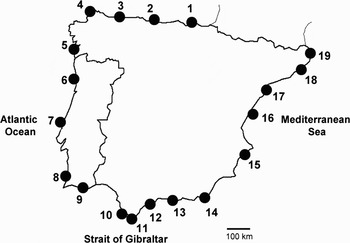
The present study was conducted along the whole Iberian Peninsula. Nineteen stations were selected along the Atlantic and Mediterranean coasts, including the Strait of Gibraltar (Figure 1). We selected relatively undisturbed enclaves with low human pressures to avoid the effect of anthropogenic influence on the natural biogeographical and ecological patterns of species.
Map of Iberian Peninsula showing the sampling stations. (1) Ogella; (2) Oyambre; (3) Cetarea; (4) Baleo; (5) Cabo Silleiro; (6) Labruge; (7) Playa Azul; (8) Vale dos Homens; (9) Castelo; (10) Bolonia; (11) Isla de Tarifa; (12) Torreguadiaro; (13) Cerro Gordo-Herradura; (14) Cabo de Gata; (15) Cala del tío Ximo; (16) Benicassim-Oropesa; (17) Torrent del Pi; (18) Cala de Sant Françesc; (19) l'Estartit.

Sampling was conducted in summer 2008. The following environmental parameters were measured in situ at each sampling site: water temperature, pH, conductivity, dissolved oxygen and turbidity. Three measurements were made for each parameter and mean values and standard deviation were calculated (see Guerra-García et al., Reference Guerra-García, Cabezas, Baeza-Rojano, Espinosa and García-Gómez2009 for more details).
Corallina elongata was selected as substrate and three replicates (quadrats 20 × 20 cm) were randomly sampled in each station. Corallina elongata was distributed along the low intertidal level and sublittoral in most of the stations and the intertidal belt was selected for this study. The surface was scraped and the seaweed and associated fauna were collected. The samples were fixed in 80% ethanol, brought to the laboratory and sieved using a mesh size of 0.5 mm. Caprellids were sorted and identified to species level. Volume of C. elongata of each replicate was estimated as the difference between the initial and final volume when placed into a graduated cylinder with a fixed amount of water (see Pereira et al., Reference Pereira, Lima, Queiroz, Ribeiro and Santos2006). Dry weight was also measured (after 24 hours at 70°C). To estimate the cover of C. elongata in each locality, we used five random quadrats of 50 × 50 cm subdivided into 25 square units of 10 × 10 cm with thick fishing line. The presence/absence of the species was recorded for each unit and data were expressed as cover percentage (mean ± SD of the 5 replicates).
The affinities among stations based on the environmental parameters were established through principal component analysis (PCA). The affinities based on caprellid data were measured through cluster analysis using the UPGMA method (unweighted pair-group method using arithmetric averages), based on the Bray–Curtis similarity index. The relationships between environmental measures and caprellid assemblages were studied by canonical correspondence analysis (CCA). Multivariate analyses were carried out using the PRIMER package (Clarke & Gorley, Reference Clarke and Gorley2001) and the PC-ORD programme (McCune & Mefford, Reference McCune and Mefford1997).
RESULTS AND DISCUSSION
Abiotic data and abundance of Corallina elongata along the Iberian Peninsula
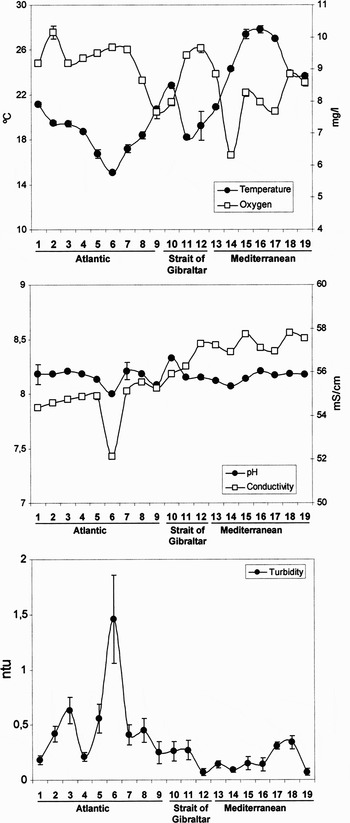
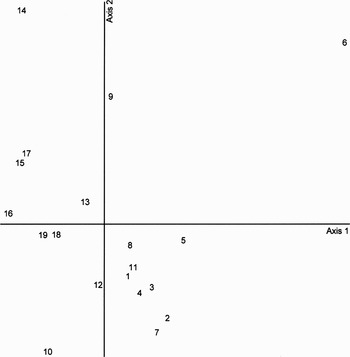
The Atlantic coast was characterized by higher values of oxygen concentration and turbidity and lower values of temperature and conductivity than the Mediterranean coast (Figure 2). Values of pH were rather similar in all stations, ranging between 8 and 8.5. Temperature was negatively correlated with oxygen (r = −0.69, P < 0.01) and turbidity (r = −0.54, P < 0.05) and positively with conductivity (r = 0.73, P < 0.01). Station 6 showed the minimum value of conductivity and temperature and the maximum value of turbidity, probably due to river influence. The PCA carried out using all the physicochemical measures (Figure 3) showed a clear separation between Atlantic stations (positive end of axis 1) and Mediterranean stations (negative end of axis 1). Axis 1 absorbed 64% of the total variance and correlated with temperature (r = −0.88, P < 0.01), conductivity (r = −0.88, P < 0.01) and turbidity (r = 0.83, P < 0.01), being these parameters that explained best the ordination of stations. Axis 2 correlated with pH (r = −0.81, P < 0.01) and oxygen (r = −0.57, P < 0.05).
Abiotic variables measured at each station (Mean ± SD).

Principal component analysis based on the abiotic data. Numbers indicate the stations.

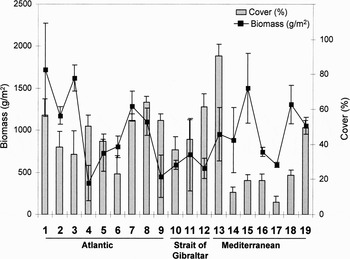
Cover of Corallina elongata was negatively correlated with seawater temperature (r = −0.49, P < 0.05); in Atlantic stations cover of C. elongata was around 50%, while cover in the Mediterranean rarely exceeded 20% (Figure 4). Biomass, however, did not show a different behaviour between the Mediterranean and Atlantic, ranging approximately from 500 to 1500 g m2. Consequently, although Mediterranean intertidal was characterized by lower cover percentages of C. elongata, the patches in which the alga was present showed a similar biomass to Atlantic stations. On the other hand, values of volume of C. elongata were significantly correlated with dry weight (r = 0.95, P < 0.001, N = 19).
Cover percentage and biomass of Corallina elongata (Mean ± SD) at each station.

Caprellid community
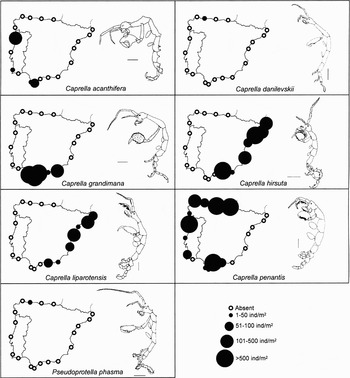
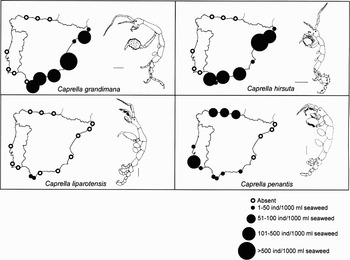
Seven caprellid species were found during the present study associated with intertidal Corallina elongata: Caprella acanthifera Leach, 1814, Caprella danilevskii Czerniavski, 1868, Caprella grandimana Mayer, 1882, Caprella hirsuta Mayer, 1890, Caprella liparotensis Haller, 1879, Caprella penantis Leach, 1814 and Pseudoprotella phasma (Montagu, 1804) (Figure 5). Some caprellid species found in the present study have been reported as common species on many different substrata (see Guerra-García, Reference Guerra-García2001; Vázquez-Luis et al., Reference Vázquez-Luis, Guerra-García, Sánchez-Jerez and Bayle-Sempere2009): P. phasma and C. acanthifera can tolerate stressed habitats of low flow and high rates of sedimentation and organic matter, while C. penantis is associated with clean and oxygenated waters (Guerra-García & García-Gómez, Reference Guerra-García and García-Gómez2001). Presence of Pseudoprotella phasma and C. danilevskii was occasional in this study. Caprella acanthifera and C. penantis were clearly restricted to Altantic waters and the Strait of Gibraltar, while C. hirsuta and C. liparotensis were abundant only in Mediterranean stations. Caprella grandimana was the dominant species in the Strait of Gibraltar. Although C. penantis has been traditionally reported in many sites of the Mediterranean (Krapp-Schickel, Reference Krapp-Schickel and Ruffo1993), the pattern showed by the present study is very clear: the species disappears in Mediterranean stations, coinciding with higher temperatures and lower levels of oxygen. This species has been considered one of the most sensitive species to environmental stress (Guerra-García & García-Gómez, Reference Guerra-García and García-Gómez2001) and, recently, has been proposed as an excellent tool for monitoring heavy metals (Guerra-García et al., Reference Guerra-García, Baeza-Rojano, Cabezas, Díaz-Pavón, Pacios and García-Gómez2009a) so we cannot discard that this species is disappearing from the Mediterranean due to global warming (Guerra-García et al., Reference Guerra-García, Sánchez and Ros2009c). Caprella penantis and C. hirsuta showed exactly the same pattern in Corallina elongata than in Stypocaulon scoparium (see Figure 6 and Guerra-García et al., Reference Guerra-García, Sánchez and Ros2009c for details). However, Caprella grandimana on Corallina elongata was restricted to the Strait of Gibraltar while it was distributed along the whole of the Mediterranean on S. scoparium. On the other hand Caprella liparotensis was highly abundant in the Mediterranean on Corallina elongata, but absent in S. scoparium. Maybe, the process of ecological competence of Caprella grandimana with C. liparotensis is involved in the marked differences for this species with regard to the substrate. On the other hand, the abundance of C. penantis along the Atlantic sites could be also related with the absence of C. liparotensis, since this species has been frequently reported from the Atlantic coast (Krapp-Schickel, Reference Krapp-Schickel and Ruffo1993; Pereira et al., Reference Pereira, Lima, Queiroz, Ribeiro and Santos2006). On the other hand, detritus content in S. scoparium can be much higher, and this alga is usually found in more protected enclaves than Corallina elongata (personal observation); these differences could be also related with caprellid composition.
Abundance patterns of caprellid species associated with intertidal Corallina elongata found during the study. Figures redrawn from Guerra-García et al. (Reference Guerra-García, Sánchez and Ros2009c).

Abundance patterns of caprellid species associated with subtidal Stypocaulon scoparium. Data taken from Guerra-García et al. (Reference Guerra-García, Sánchez and Ros2009c).

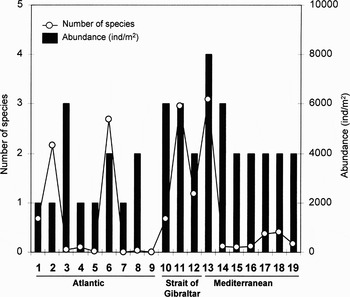
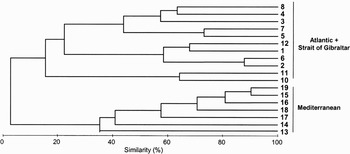
The number of caprellid species associated with C. elongata was higher in the Strait of Gibraltar; while the higher abundances were registered in the Strait of Gibraltar and the Mediterranean coast (Figure 7). The cluster elaborated with the caprellid data in the different stations clearly showed two groups of sites; one formed by Mediterranean stations and the other one clustering the Atlantic and Strait of Gibraltar stations. Consequently, this analysis showed that the Strait of Gibraltar was more similar to the Atlantic in terms of caprellid species composition (Figure 8).
Number of caprellid species (S) and abundance (ind/m2) at each station.

Cluster analysis based on the caprellid composition of each station.

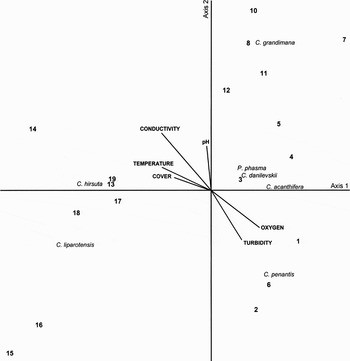
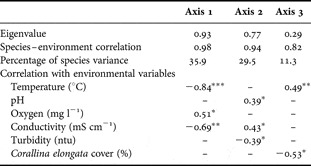
Figure 9 and Table 1 show the results of the CCA. First axis, which absorbed 35.9% of total variance, was significantly correlated with temperature, conductivity and oxygen. Species such as Caprella hirsuta was associated with stations characterized by higher temperature and conductivity. Caprella penantis was the species which best correlated with higher oxygen concentration. These results support the idea of this species as especially sensitive to a lack of oxygen and hydrodynamism (see Guerra-García & García-Gómez, Reference Guerra-García and García-Gómez2001; Guerra-García et al., Reference Guerra-García, Baeza-Rojano, Cabezas, Díaz-Pavón, Pacios and García-Gómez2009a, Reference Guerra-García, Sánchez and Rosc).
Graph representation of the stations and caprellid species with respect to the first two axes of the canonical correspondence analysis.

Summary of the results of the canonical correspondence analysis.

*, P < 0.05; **, P < 0.01; ***, P < 0.001.
ACKNOWLEDGEMENTS
Financial support of this work was provided by the Ministerio de Educación y Ciencia (Project no. CGL2007-60044/BOS) co-financed by FEDER funds, and by the Consejería de Innovación, Ciencia y Empresa, Junta de Andalucía (Project no. P07-RNM-02524).