1. Introduction
Between 1983 and 1989 Argentina established a set of state-led institutions to guide its transition from dictatorship to democracy. The most well-known of those institutions are a truth commission (TC) (1983–1984), the Junta Trials (1985–1986), and the 1986 and 1987 amnesty laws.Footnote 1 The role of international law – especially human rights law and crimes against humanity – in the transition is well documented.Footnote 2 Yet, the extent to which Argentina’s transition was intertwined with international law and subject to its jurisdictional force deserves greater attention.
In this article I analyse how the Argentinian TC’s report (the Report) accounts for the state-violence of the 1976–1983 dictatorship, and how international law is implicated in the making of this account. I focus on the Report because of its importance as the official means of recording, representing and disseminating the state’s account of how and why systematic forced disappearances of people occurred during the dictatorship.
Nearly 40 years ago, Argentina’s 1983–1984 TC, officially called Comisión Nacional sobre la Desaparición de Personas (National Commission on the Disappeared), or CONADEP, concluded its investigation with the delivery of its Report.Footnote 3 For the newly-elected democratic government, the Report was important because it would not only explain CONADEP’s investigation (about the dictatorship’s violence, understood as the country’s ‘past’), but also create an archival record that would ensure the dictatorship continued to be remembered in a particular way.Footnote 4 To that end, the government published the Report as a publicly-accessible book, titled Nunca Más: The Report of the Argentine National Commission on the Disappeared, which became popularly known in Argentina as el Nunca Más (Never Again).Footnote 5 The Nunca Más reproduced the Report almost in its entirety, and can still be found in ordinary bookshops throughout the country.Footnote 6
There is a towering literature analysing the global influence, overarching success and limitations of CONADEP, as well as its contribution to pioneering, from the Global South, an institution that has become a core case study in the research and practice of transitional justice.Footnote 7 One of the achievements attributed to CONADEP is that the vast majority of Argentinians do not contest the fact of the dictatorship’s forced disappearance of 30,000 people.Footnote 8 However, the Report/Nunca Más remains central in Argentina’s public debate over what exactly happened, and the meanings attached to this history. At the heart of this debate is the state’s account of why the disappearances occurred, an account that is presented in the Prologue to the Report/Nunca Más. The contestation over the state’s account played out, once again, in the last decade. In 2006 the government of the day decided to re-write the Prologue for a new edition of the Report/Nunca Más.Footnote 9 In 2016, that re-write was removed and replaced with the original 1984 Prologue by a new oppositional government. This recent struggle over control of the Prologue points to the ongoing influence on Argentina’s public life of CONADEP’s account.
The argument that I develop is that, through the Report/Nunca Más Prologue, CONADEP draws on the authority of international law to establish the unlawfulness of the dictatorship’s state-violence. In doing so, CONADEP subjects the meanings and interpretations of the dictatorship’s state-violence to a Eurocentric/Anglo-American lawfulness embedded in, and mobilized by, international law and its institutions during the late-Cold War.Footnote 10
To develop this argument, I re-read the Prologue as a literary text that is doing international law’s legal work. I show how the Prologue does that work, even though it had a narrow mandate to conduct a public investigation and not to develop an account of lawfulness.Footnote 11 This way of reading the Prologue, as a work of both literature and law, draws on scholarship in the field of law and literature.Footnote 12 One of the contributions of this scholarship to the study of law has been to show how international law ‘co-operates’, or operates together, with literary works to create, reinforce and deploy legal subjectivities according to particular normative worldviews.Footnote 13 My reading of the Prologue is informed in particular by Joseph Slaughter’s work on the co-operative, ‘mutually enabling’ relationship between international human rights law and literature.Footnote 14 For Slaughter this relationship is not so much about ‘a narratological alliance’ between human rights and literary texts; rather, the relationship is fundamentally one of ‘complicity’.Footnote 15 That is, literature does not occupy a domain separate from (international) law, but is deeply complicit in ‘disseminating and naturalizing the norms of human rights’, by ‘making them both legible and commonsensical’ for society.Footnote 16 This is what interests me here: how the Prologue’s engagement with international law generated a fundamental ‘mutually enabling’ relationship,Footnote 17 which gave the Report/Nunca Más account both narrative coherency and lawful authority for Argentinians, as well as internationally.
Specifically, my analysis shows how the Report/Nunca Más enabled CONADEP to authoritatively establish the unlawfulness of the dictatorship’s state-violence, in part because of the Prologue’s literary form, or genre, as a prologue, and in part because of the language it used, which drew on the language of international law to describe and categorize events that occurred during the dictatorship.Footnote 18 In doing that, the Prologue creates a coherent, singular account of the violent conduct of the state under dictatorship, out of the disparate, plural accounts of the dictatorship’s violence. At the same time, the Prologue uses international law’s promise – that the establishment of a democracy under the rule of (international) law will put an end to all forms of state-violence against society – to authoritatively deploy CONADEP’s (and thus the state’s) account.Footnote 19
I begin in Section 2 by focusing on the literary work that the Prologue does as a ‘prologue’ to the Nunca Más/Report (rather than as an introduction or executive summary). The analysis draws on records of CONADEP’s sessions, which I obtained during a visit in 2018 to Argentina’s Archivo Nacional de la Memoria (National Archive of Memory). The analysis shows how CONADEP-commissioners carefully designed the bi-partite structure of the Report/Nunca Más, to provide a normative account of the dictatorship.
In Section 3, I then turn to the content (rather than the form) of the 1984 Prologue, to examine the language that it uses. To do this, I re-read the Prologue in light of the major events and debates surrounding the creation of CONADEP in 1983, and the delivery of its Report in 1984, within the international context of the late-Cold War. The analysis shows how the Prologue, using international law’s language and mobilizing its promise, crafts ‘the’ meaning and interpretation of the dictatorship’s unlawfulness according to a Eurocentric/Anglo-American lawfulness. Footnote 20
Finally, in Section 4, I show how CONADEP’s account, as crafted through the Prologue, continues to shape the meanings and interpretations of Argentina’s ‘past’. I do this by discussing the public debates sparked in 2006 by the Kirchner government’s insertion of a new Prologue in the re-edition of the 1984 Nunca Más/Report, and how in 2016 the Macri government removed the 2006 Prologue and re-inserted the original 1984 Prologue. The analysis shows how the literary form of the prologue, and the language and promise of international law, continue to shape Argentina’s public life according to the international lawfulness of the day.
2. Writing the Prologue, writing the Report/Nunca Más
2.1 A report ‘to enlighten’
The minutes recording CONADEP’s sessions reflect the care the commissioners placed on ensuring the Report/Nunca Más communicated to Argentinians, and the international community, the ‘right’ account about the dictatorship’s state-violence.Footnote 21 This sense of care was driven not only by the responsibility and complexity of having to produce a document on which the official account about the dictatorship’s state-violence would rest, but also by the socio-political circumstances in which CONADEP was created and operated.Footnote 22
As I explain in detail in Section 3 of this article, although the creation of CONADEP in 1983 was one of the first decisions taken by president Raúl Alfonsín, Footnote 23 it was not part of his government’s original plan.Footnote 24 Alfonsín, from the political party Unión Cívica Radical, unexpectedly won the 1983 elections, Footnote 25 which were called by the military junta after Argentina lost the 1982 Malvinas/Falklands War against the United Kingdom.Footnote 26 By then, it was impossible to publicly deny the fact that thousands of people disappeared during the dictatorship. It was impossible to deny, not only because the Junta itself confirmed the disappearances,Footnote 27 but more fundamentally, because of the years of struggle of relatives of the desaparecidos (disappeared people) to expose the disappearances. In Argentina, in addition to the Madres and Abuelas de Plaza de Mayo’s ongoing public demonstrations in front of the Casa Rosada (the government’s offices), relatives of the desaparecidos legally registered the disappearances before a judge with the civil law legal form of habeas corpus.Footnote 28 Internationally, many human rights organizations also published reports documenting the disappearances. Footnote 29 And yet, while the fact of the disappearances was no longer contested, what remained unanswered was why and how the disappearances occurred, and the whereabouts of the desaparecidos.
In this context, Alfonsín committed himself and his government to provide an official answer about the desaparecidos, and to do so by putting the military on trial in a civilian court.Footnote 30 To do that, the government persuaded the congress to approve Decreto 158/83, to revoke the Junta’s self-amnesty law. Footnote 31 Yet, even with Decreto 158/83, relatives of the desaparecidos and human rights organizations were sceptical that a trial would ever take place.Footnote 32 For that reason, they proposed to the government the creation of a parliamentary investigatory commission, comprising members of congress from all political parties, with a mandate to find the desaparecidos and the circumstances in which they went missing. Footnote 33 Against this, the government considered that the political circumstances would make it impossible for political parties to work together. Footnote 34 Instead, the government proposed the creation of a ‘special commission of notables’ or of ‘citizens’, Footnote 35 comprising activists or members of prominent human rights organizations, well-known and respected in ‘public life’ for their ‘commitment to the defence of democracy and human rights’. Footnote 36
Following a similar institutional design to commissions of inquiry used in common law countries,Footnote 37 CONADEP was created with presidential decree Decreto 187/83 (Decreto), just a few days after Alfonsín’s inaugural address. Footnote 38 The Decreto authorized CONADEP to ‘clarify the facts related to the disappearance of people in the country’. Footnote 39 The Decreto also stated that CONADEP’s investigation was an ‘issue’ that ‘transcend[ed] public powers’, Footnote 40 because the ‘facts’ that it was charged with investigating concerned ‘grave violations of human rights’. Footnote 41 Furthermore, the Decreto declared that the investigation was a response to the ‘the legitimate interest[s]’ of both Argentinian ‘civil society’ and the ‘international community’. Footnote 42 In light of that, the Decreto established that the investigation’s outcome would be recorded in the form of a ‘report’, which would ‘offer a detailed explanation of the facts investigated in order to enlighten national and international public opinion’ about the tragic episodes in which thousands of people disappeared in Argentina. Footnote 43
The commissioners began work in December 1983 in Buenos Aires. Nine months later, CONADEP formally delivered the Report/Nunca Más to Alfonsín in a televised ceremony at the Casa Rosada. Footnote 44 During the ceremony, CONADEP’s president, internationally renowned Argentinian writer Ernesto Sábato, handed over the Report/Nunca Más, and gave a speech. The words that Sábato read were excerpts of the Prologue. Footnote 45 Alfonsín then expressed his gratitude to the commissioners for their service to the nation. Footnote 46 Regarding the Report/Nunca Más, Alfonsín said: ‘the country … needed to know the truth about what happened because on the basis of a lie or of darkness we cannot build national unity’. Footnote 47 With this ceremony, the Report/Nunca Más began to fulfil the purpose the state envisioned for it: ‘to enlighten’ Argentinian society, and the international community, with its account.Footnote 48 And yet, for CONADEP’s account to have such ‘enlighten[ing]’ power, the commissioners knew it was necessary to do more than merely report in writing the findings of the investigation. They knew that the Report/Nunca Más not only had to publicly communicate a coherent answer of how and why the disappearances occurred, but also that its content – its truth – had to carry a clear ethical judgement about the state’s wrong-doing.
2.2. Writing the Prologue
The idea of a bi-partite structure for the Report/Nunca Más, and the choice of the Prologue as its introductory text, emerged from three concerns: the Report/Nunca Más had to present a coherent narrative about the victims’ experiences of state-violence; it had to be compelling and intelligible, primarily to Argentinians but also to the international community; and it had to have very broad social reach.Footnote 49
To address these concerns, from the early stages of the drafting process the commissioners worked on giving the Report/Nunca Más an accessible structure and language.Footnote 50 To achieve that, the commissioners created a Drafting Commission,Footnote 51 which they decided should be assisted by ‘a trustworthy journalist’.Footnote 52 This would ensure that all of the theme-specific ‘essays’ written by CONADEP’s investigatory committees, would be coherently integrated in the report.Footnote 53 Additionally, the commissioners considered the writing of a prologue as the Report/Nunca Más’s opening text.Footnote 54
A draft of the Prologue was ready a little over a month before the Report/Nunca Más was due in late September 1984. It was Sábato who introduced it as ‘a project of a prologue’ to the commissioners.Footnote 55 While the minutes of the sessions do not record whose idea it was to choose that specific literary genre (prologue) to open the Report/Nunca Más, what is recorded is that the Prologue was deemed important because it ‘would contain the essential points of the Report’.Footnote 56
Even though the commissioners carefully thought through the relationship between the Prologue and the body of the Report/Nunca Más, as a literary genre the Prologue carried with it a particular function. From a literary point of view, a prologue is understood to ‘provide a directional framework for the reader’ prior to reading (or viewing, in the case of performances) the main body of the literary work.Footnote 57 Although the specific ‘directional’ function of the prologue depends on the literary genre of the text that follows it (e.g., a novel, poem, play, etc.),Footnote 58 in general terms prologues ‘have introductory features to something’.Footnote 59 Through a prologue, the audience gains ‘insights into the way in which a text was composed, and the attitudes which led to its creation, which are rarely found elsewhere’.Footnote 60 With a prologue, the author aims to ‘compel’ the reader ‘to take a position … in relation to’ a text’s story. Footnote 61 In other words, despite being a ‘minor’ literary text that complements a ‘major’ one, through a prologue the author seeks to create a desired affective bond between the story narrated in the main text and its audience.Footnote 62
Yet, as Slaughter reminds us, the use of prologues as compelling introductory texts is not exclusive to literature, nor have they only been used by writers or playwriters.Footnote 63 In the field of law, literary genres have a history of ‘cooperation in naturalizing’ and deploying law’s normative arrangements of how to live together.Footnote 64 Law-makers frequently turn to prologues (typically called ‘preambles’ in law) as the literary device that offers a socially accessible explanation of a law’s ‘origins and purposes’, with the aim of making it normatively accepted.Footnote 65 Generally, through such prologues, legislators ‘place the law in its historical and political context’,Footnote 66 and provide ‘reasons to assist in understanding’ the ‘object of the law’.Footnote 67 Yet, despite being common across different legal fields, prologues are especially prominent in constitutions and international treaties.Footnote 68 In constitutions, law-makers include a preambular section to ‘set the tone for the subsequent constitutional text’, and, in many cases, to ensure that the constitution’s articles are ‘read and interpreted’ as a coherent text.Footnote 69 In international law, prologues are also frequently used to ‘defin[e] in general terms, the purposes and considerations that led the parties to conclude the treaty’, and ‘may also incorporate the parties’ motivations for concluding the treaty by describing the foundation of their past, present, and future relations’.Footnote 70 Put differently, prologues allow law-makers to narrate ‘a creation story’ about the ‘need’ of a new legal form to re-organize international or state-society relations.Footnote 71 Narrating such a need in an accessible and compelling form gives the law social reach, ensuring that its normative content is known and, importantly, accepted.
Similarly, in the circumstances in which the Report/Nunca Más was written, through its final structure the Prologue deployed a normative narrative that directs its audiences as to how to interpret the body of the Report/Nunca Más.Footnote 72 In doing so, CONADEP, and by extension the state, could shape not only how the past would be remembered, but also how a future life in a lawful democracy would be imagined. During the drafting process of the Report/Nunca Más, the commissioners looked for ways to transmit to its audience how unethical, and how unlawful, the state’s violence was against Argentinian society, and ultimately, against ‘humanity’.Footnote 73 Many commissioners felt an ethical responsibility to produce the Report/Nunca Más, regardless of the fact that they were required to do it by the Decreto.Footnote 74 One of them emphasized that it was not a ‘political’ but ‘a spiritual necessity’Footnote 75 to give the report a ‘form and content’ faithful to the gravity of the evidence gathered throughout the investigation.Footnote 76 CONADEP’s minutes show how the commissioners understood that part of their public responsibility was to ensure that the Report/Nunca Más would ‘mar[k] a limit’ by ‘making an ethical decision’ about what was wrong and right in state-society relations.Footnote 77 Drawing that ethical line was fundamental, because it would publicly represent a normative threshold in the social imaginary between two forms of organizing state-society relations: dictatorship and democracy.Footnote 78 Importantly, while the dictatorship would be represented as the unethical and unlawful ‘past’, democracy would be the ethically lawful ‘future’. CONADEP’s account would enable Argentinian state–society relations to transition from being wrongful and in a state of ‘darkness’,Footnote 79 to being rightful and enlightened. But to leave the dictatorship behind and bring about democracy, CONADEP’s account needed to be socially known and normatively understood. As the deadline for the Report/Nunca Más approached, Sábato became especially concerned that these objectives would be met.
Aware of the risk that the Report/Nunca Más could be written in a highly technical language (even with the assistance of a journalist), Sábato emphasized to the commissioners that ‘a basically technical book will not be read widely, that is why it is important to make it dramatic, which can be achieved with the transcription of testimonies’.Footnote 80 Commissioner Horacio Huarte agreed with Sábato, and proposed that it was ‘necessary’ to structure the report in two clearly distinct parts.Footnote 81 One part would set out the ‘facts’, which would give the report ‘force … through objective content’.Footnote 82 The other part would impart ‘a message for the people’; it would be ‘a general part, which reaches all sectors’ and has ‘a broad political content’.Footnote 83 CONADEP’s minutes show how, for the commissioners, given the fragility of the situation, the priority was to make the normative meaning of CONADEP’s account accessible and intelligible.
Indeed, the seemingly simple structure of the Report/Nunca Más was not so simple.Footnote 84 CONADEP-commissioners used the Prologue to communicate a coherent and unitary narrative about the dictatorship’s state-violence, while guiding its audiences on how to interpret the un/lawfulness of the events. To that end, Sábato commissioned Gerardo Taratuto (a lawyer, playwriter, and screenwriter of the TV documentary on CONADEP’s investigation, also titled Nunca Más) to participate in the drafting. Footnote 85 The minutes record how, from that moment until the delivery of the Report/Nunca Más, Taratuto’s role was fundamental in giving the Report/Nunca Más narrative coherency and dramatic appeal.Footnote 86 In the resulting final form of the Report/Nunca Más, the Prologue would ‘frame’,Footnote 87 in general political terms, the emergence of state-violence and how the dictatorship practiced it, while the body of the Report would reproduce the testimonies and facts. By communicating this narrative to public audiences (primarily Argentinian, but also internationally), the Prologue sought to establish a particular interpretation of the unlawfulness of state-violence during the dictatorship.
It is that aim, of authorizing the new shared imaginary of lawful state-society relations, that points to the ways in which there is a ‘mutually enabling’ relationship between international law and the Prologue as prologue (that is, as a literary genre).Footnote 88 I now turn to unpack the Prologue’s text, and to discuss how the Prologue’s account of the dictatorship’s unlawfulness is doing international law’s legal work in this way.
3. Reading the Prologue: International law’s language and promise for Argentina
The Prologue begins not only by broadly situating in time (the 1970s) and place (Argentina) the socio-political context in which the dictatorship’s violence emerged, but also by describing it as being ‘torn by terror’. Footnote 89 However, this ‘terrorism’ was not unique to Argentinian society. According to the Prologue, it was a general ‘phenomenon’ that occurred in other states, such as Italy. Footnote 90 The Prologue presents the Italian state’s response to ‘the heartless attacks of Fascist groups, the Red Brigades, and other similar organizations’ as an example to follow. Footnote 91 The Prologue describes the conduct of the Italian state as one that ‘[n]ever at any time … abandon[ed] the principles of law in its fight against … terrorists’, and that ‘managed to resolve the problem through the normal courts of law’. Footnote 92 The Prologue sets this in opposition to what the dictatorial Argentinian state had done. Footnote 93 The conduct of the Argentinian state, since the coup d’état on ‘24 March 1976’, is presented as more like that of ‘an absolute state’, Footnote 94 which ‘misuse[s]’ its ‘power’ to ‘abduct, torture and kill thousands of human beings’. Footnote 95 Furthermore, the Argentinian state’s conduct in response to the ‘terrorist crimes’ is described as ‘far worse than the one [terrorist groups] they were combating’. Footnote 96
In Argentina, one predominant way of interpreting the Prologue – particularly through that opening paragraph – is to focus on whether it institutionalizes the ‘theory of two demons’.Footnote 97 The most common understanding of the ‘theory of two demons’ is that it seeks to explain the violence that occurred during the 1970s as being ‘the responsibility and outcome of two opposing forms of violence’,Footnote 98 one being the state, the other the guerrilla groups, such as Los Monteros and Ejército Revolucionario del Pueblo-Partido Revolucionario de los Trabajadores. According to Argentinian historian Marina Franco, the theory’s meaning largely depends on who is using it and for what purpose.Footnote 99 For those who support this theory, it is understood to justify the dictatorship’s state-violence, as a legitimate means of protecting the state and society against the violence caused by ‘the guerrilla of the left’.Footnote 100 In this view, left-wing political groups have ‘causal responsibility in starting the violence’ before and during the dictatorship.Footnote 101 Those who oppose the theory consider that it aims to ‘equat[e] the violence’ of both the state and guerrilla/left-wing groups, giving both sides ‘symmetry of strength and/or methods’ in prosecuting the violence, and ultimately assigns ‘equa[l] historical responsibilities’ for the conflict.Footnote 102
For many, especially groups of relatives of the desaparecidos, such as the Madres de Plaza de Mayo, the Prologue signals the state’s support for the ‘theory of two demons’.Footnote 103 In 2006, Hebe de Bonafini (current president of the Madres), in expressing her explicit disapproval of the 1984 Prologue and endorsing the Kirchner government’s decision to write a new prologue for the re-edition of the Report/Nunca Más, said: ‘[o]ur children were not demons: they were revolutionaries, wonderful and unique guerrilla members who defended the motherland’.Footnote 104 As this suggests, what is at stake in the Prologue, and in particular its opening sentences, is the question of whether CONADEP, and thus the state, sought to equate the violence of guerrilla/left-wing groups prior to the dictatorship with the violence of the 1976–1983 dictatorship.
Interpreting the Prologue only through the ‘theory of two demons’, however, frames the Prologue’s narrative as being just ‘an Argentinian problem’ that needed, and was given, ‘an Argentinian solution’ in the transition to democracy.Footnote 105 But if the opening paragraph is interpreted in a broader international context, not only in which the Prologue was written, but also in which the dictatorship occurred, then the ‘problem’ and ‘solution’ begin to take on a more global significance.
With the opening paragraph, the Prologue situates the ‘Argentinian problem’ in an international context that held great significance in Latin America: the Cold War.Footnote 106 The interventions of the Western Bloc, led by the US, and the Eastern Bloc, led by the USSR, in the public life of many Latin American states during this period, shaped socio-political, economic and legal relations between, and within, them.Footnote 107 As the renowned Mexican writer Octavio Paz said, ‘the models of development that today are offered to us by the West and the East are compendiums of horrors: can we invent more human models that correspond to what we are?’.Footnote 108 Paz’s words were a critique of what seemed to be an impossible endeavour for many Latin American states: to create their own ways to live together within the state – and importantly, to do so outside the Cold War’s ideological paradigms embedded in the models of US liberalism and USSR communism. In this context, the internal socio-economic and political struggles that many Latin American states were going through since before the Cold War did not cease, but rather took on an internationalized dimension. Struggles – or revolutions – to address socio-economic inequalities were caught between what Paz called ‘the models of development’,Footnote 109 actively promoted on both sides of the Cold War as mutually exclusive solutions to all of Latin America’s deep-rooted and longstanding socio-economic problems.Footnote 110
Reading the Prologue in light of the late-Cold War years anticipates the ‘post-conflict state-building’ model which international law and its institutions would formally promote after the Cold War in the 1990s.Footnote 111 In particular, the Prologue deploys a subtle yet powerful account of how international law offers a ‘state-building model’ to lay ‘civilizing’ legal foundations for state-society relations in the aftermath of violent conflict. That model promised to deliver the kind of peace, justice and economic prosperity enjoyed by the states in the Global North, through the embrace of democracy, the rule of law, and economic prescriptions for ‘development’, so that states in the Global South could finally be ‘free from either [Western or Eastern] pole’, and thus become masters of their own destiny.Footnote 112
3.1 Looking North, saving the South: Realizing international law’s promise
The transition from dictatorship to democracy that Argentina officially began in 1983 seemed to be the moment to realize international law’s promise. After a longer history of predominantly US interventions in Latin America – not limited to the Cold WarFootnote 113 – Alfonsín’s government remained concerned with interventions in Argentina’s post-dictatorial public life.Footnote 114 That concern was also coupled with the pressing need to establish credible legal grounds for democratic and non-violent state-society relations in the post-dictatorship. Alfonsín’s government attempted to address that concern through the creation of CONADEP (1983) and the Junta Trials (1985) – the transition’s signature public institutions. While CONADEP was set up to establish ‘the truth’ about the dictatorship’s state-violence, the Junta Trials would bring about ‘justice’.Footnote 115 In other words, both ‘truth’ and ‘justice’ would be established by the Argentinian state. For Carlos Nino – Alfonsín’s closest advisor, and directly involved in designing CONADEP and the Junta Trials – the transition demonstrated that there was no need for the international community to push for ‘an international duty to punish human rights violations of a prior regime’,Footnote 116 notably in the form of a Nuremberg-style tribunal.Footnote 117 That was the case, Nino argued, because the Argentinian state was leading the re-foundation of its own rule of law, and in doing that, setting its own institutional arrangements to peacefully coexist in democracy.Footnote 118
While there was no international intervention in the way that Alfonsín and Nino feared, the Prologue’s descriptions of the dictatorship’s violence reveal how CONADEP was, subtly but powerfully, subjecting the socio-political, legal and economic aspects of the transition to the ‘standards’ mobilized by international law and its institutions. This becomes apparent not only by paying close attention to the Prologue’s engagement with international law, but also in more subtle expressions of faith in the ‘civilizing’ and ‘saving’ possibilities of Western-based values and ideas.Footnote 119 For example, while the Prologue positions itself against the Junta’s forceful imposition of ‘Western, Christian values’,Footnote 120 it makes the Junta explicitly ‘responsible for’ tainting those values,Footnote 121 through kidnapping, torturing and forcing the disappearance of all those who dissented (called ‘subversives’ in the Junta’s rhetoric),Footnote 122 or who worked in the areas of socio-economic justice and labour rights. The Prologue’s fierce disapproval of how the dictatorship’s rhetoric used Western values to justify the practice of violence is not surprising. What is surprising, considering that Alfonsín’s government was committed to escape the Cold War’s ideological paradigms and interventions, is the Prologue’s defence of the virtue of Western values through democracy, which was presented as the ‘only’ political model capable of delivering peace, justice and economic prosperity. This is remarkably explicit in the Prologue’s concluding paragraph, which opens by affirming that ‘[g]reat catastrophes are always instructive’. Footnote 123 Then it claims that although Argentina’s dictatorship is the ‘most terrible’ ‘tragedy’ ‘ever suffered’, Footnote 124 the lesson is that ‘only democracy’ is able to ‘save a people from horror on this scale’, and ‘keep and safeguard the sacred, essential rights of man’. Footnote 125 The Prologue concludes by affirming that ‘[o]nly with democracy will we be certain that NEVER AGAIN will events such as these, which have made Argentina so sadly infamous throughout the [civilized] world, be repeated in our nation’ [sic]. Footnote 126 Although the Prologue concludes with the promise that democracy will ‘civilize’ and ‘save’ Argentina, throughout the text the Prologue creates the impression that international law, in the form being advanced in the Cold War’s final years, is necessary to achieve that.
3.2 The dictatorship’s unlawfulness, democracy’s lawfulness
The Prologue mobilizes the promise of ‘salvation’ and ‘civilization’, not by describing in detail what life within the democratic state will look like, but by drawing on the authority of international law to narrate the unlawfulness of the violence of the Argentinian state under dictatorship. For instance, the Prologue’s constant emphasis that the Report is ‘just’ describing facts, and is not a legal judgment or equivalent to justice,Footnote 127 is contradicted by the Prologue’s own references to the international legal forms that shape its description of the kinds of state-conduct that are unlawful. Thus the Prologue describes how the dictatorship’s state-violence was ‘the greatest and most savage tragedy in the history of Argentina’, Footnote 128 and argues that it ‘went far beyond what might be considered criminal offences, and takes us into the shadowy realm of crimes against humanity’. Footnote 129 According to the Prologue, what made that form of state-violence a crime against humanity was that, ‘[t]hrough the technique of disappearance and its consequences, all the ethical principles which the great religions and the noblest philosophies have evolved through centuries of suffering and calamity have been trampled underfoot barbarously ignored’. Footnote 130 In other words, the violence of the state violated international law (by committing ‘crimes against humanity’) as well as ‘universal’ religious and philosophical principles. According to the Prologue, those ‘universal’ principles informed the ‘sanctity of individual rights’, and were, in the first instance, given legal form through ‘the French Revolution’, and later through ‘the universal declarations of human rights’,Footnote 131 ‘the great encyclicals of this century’, and ‘constitution[s]’. Footnote 132 They were, and are, the symbols of ‘[e]very civilized nation’. Footnote 133 Additionally, although the Prologue acknowledges that the Argentinian state had been part of those ‘civilized nation[s]’, according to those universal principles and rights, Footnote 134 the Prologue explicitly declares that CONADEP’s investigation reveals that ‘human rights were violated at all levels by the Argentinian state’ during the dictatorship. Footnote 135
By stating that the acts of violence of the dictatorial state are a crime according to international law, the Prologue ‘attach[es]’ the definition of the Argentinian dictatorship’s particular forms of violence ‘to a larger normative story’ of progress and universality.Footnote 136 In this story a state ‘evolves’ from ‘barbaric to civilized’ through a process facilitated by state-created ‘closure mechanisms’ (e.g., trials),Footnote 137 which would make anew the legal grounds for state-society relations in the aftermath of state-violence in order to prevent a repetition of such violence. This story of progress and civilization was not only formally institutionalized as part of the operation of international law since the Nuremberg and Tokyo Trials,Footnote 138 but also universalized as ‘the way’ a state should hold accountable a previous government for acts categorized as ‘violent’, and therefore unlawful, by international law.Footnote 139 In this way, the Prologue represents CONADEP as the Argentinian state’s first institutional step in the process of becoming a ‘civilized’ state through the ‘reconstruction of the rule of [l]aw’,Footnote 140 just like the states in the Global North did after the Second World War.
As part of that ‘universal’ story of progress, the Prologue outlines what would be the second institutional step towards civilization and lawfulness: the Junta Trials, which would take place in 1985, a year after the delivery of CONADEP’s Report/Nunca Más. The Prologue explains that CONADEP was created not to judge the dictatorship’s ‘terrorism’, Footnote 141 ‘but to investigate the fate of the people who disappeared during those ill-omened years of our nation’s life’. Footnote 142 The Prologue specifies that the Report/Nunca Más, as the outcome of CONADEP’s investigation, is a way of breaking with the dictatorship-imposed silence about the desaparecidos. Footnote 143 The Prologue emphasizes that the findings of the investigation, set out in the body of the report/book, are not ‘the final word’ and cannot be considered to deliver ‘justice’ for the desaparecidos and their relatives. Footnote 144 The ‘final word’ had to be pronounced by ‘justice’, that is, by Argentinian civilian courts. Footnote 145 With this, the Prologue outlines and establishes the relationship between CONADEP and the Junta Trials, by differentiating between the contributions of both institutions to the re-establishment of civil and lawful state-society relations in democracy. While the Prologue describes CONADEP as the investigatory institution that delivers a facts-based account of the dictatorship’s state-violence, it presents the Junta Trials as the legal institution that judges and declares what is unlawful based on CONADEP’s account.
Although the Prologue describes as different yet complementary the work of both institutions, the creation of CONADEP and its role in the transition to democracy was more accidental than planned, unlike the Junta Trials. Alfonsín’s personal endeavour was to prosecute the military through a civilian court (like the Prologue states), but the political circumstances forced him to adopt a position he later described as somewhere between ‘what is desirable and what is possible to pay off the debts of the past; without losing sight of the future’. Footnote 146 According to Argentinian historian Marina Franco and sociologist Emilio Crenzel, most politicians – except for Alfonsín and a minority of his party (Partido Radical) and Partido Intransigente – rejected the idea of prosecuting the military, and were in favour of a ‘mantle of oblivion’. Footnote 147 Firmly against this, during his inaugural presidential speech in 1983, Alfonsín affirmed that his government would not ‘ac[t] as if nothing happened here’, Footnote 148 and was ‘determined to clarify the situation of the disappeared people’. Footnote 149 Moreover, Alfonsín promised that his government was going to ‘correct and eliminate forever’ the consequences of the dictatorship’s ‘irresponsible decisions’, Footnote 150 and ‘set the foundations for the free, grand, prosperous, fraternal and generous Argentina that we all want’. Footnote 151 To achieve this, the government promoted the revocation of the Junta’s self-amnesty law at congress. Footnote 152
However, even without the self-amnesty law, relatives of the desaparecidos and Argentinian human rights organizations were sceptical about the likelihood of putting the Junta on trial in a civilian court. The reason was that, under those political circumstances, Alfonsín’s government negotiated for Junta members to be tried at first instance by a military court (Supreme Council of the Armed Forces) with the possibility of appealing the ruling in a civilian court.Footnote 153 Yet, for relatives of the desaparecidos, justice could only be delivered by the state’s civilian institutions, not the military. Footnote 154 As I discussed in Section 2, that led Argentinian human rights organizations to propose the creation of an investigatory commission, comprised by members of congress representing all political parties. The aim of this commission was to locate the desaparecidos and explain the circumstances in which they disappeared. Footnote 155 But in the government’s view, such a commission would fail to deliver answers. Footnote 156 The government considered that the circumstances would make it impossible for political parties to collaborate, and it could ultimately generate social and political confusion with the outcome of civilian trials of the military – if they were ever to take place. Footnote 157 As an alternative, Alfonsín and his advisors proposed the creation of CONADEP. Footnote 158 Within days after Alfonsín’s inaugural address, CONADEP was created as a response to the ‘the legitimate interest[s]’ of both Argentinian ‘civil society’ and the ‘international community’. Footnote 159
Considering this background, the way in which the Prologue differentiates between both institutions (CONADEP and Junta Trials) is telling of the subtle legal groundwork CONADEP’s account established, so that the Junta Trials would be legally and politically feasible, and socially acceptable. Furthermore, the Prologue reveals how international law was embedded in CONADEP’s truth-making process, and gave the desaparecidos legal subjectivity. In turn, there would be an identifiable victim for whom to deliver justice through the Junta Trials. The Prologue does that by representing the forced disappearance of people conducted by the state as a legal action that violently stripped human beings of ‘their rights’, and in turn, transformed them into something similar to ‘mere objects’. Footnote 160 The Prologue then states that the desaparecidos were ‘[s]eized against their will’ and that they ‘no longer had civil presence [presencia civil]’,Footnote 161 because ‘[f]rom the moment of their abduction, victims lost all rights’.Footnote 162 To make the desaparecidos subjects of rights, the Prologue acknowledges that they ‘were not mere objects … and still possessed all the human attributes … They were people’.Footnote 163 With this, the Prologue gives legal meaning to the desaparecidos through international law’s category of ‘victim’ – which was conceived, and since then developed, in the context of the Second World War’s Nuremberg Trials.Footnote 164 This victim is typically considered as an ‘absent figure’, to which international law ‘promises’ legal ‘representation’ through its institutions – that is, trials, but also, since CONADEP, through TCs.Footnote 165 By 1983–1984, when CONADEP operated and delivered its report/book, the situation of the desaparecidos – from Argentina and elsewhere – were beginning to have legal form under international law. In 1977 Amnesty International issued a report about the dictatorship’s violence, which included a description of different forms of violence – torture, prisoners, and forced-disappearances – and a list of desaparecidos.Footnote 166 In 1982, the UN’s Working Group on Enforced or Involuntary Disappearances defined the forced-disappearances as ‘one of the cruellest forms of violation of the human rights of both the victims and their families’ committed by the state.Footnote 167 The Prologue’s recognition of the ‘inherent’ (human) rights of the desaparecidos, based on the ‘fact’ that they were human, began to give an identifiable international legal form to the desaparecidos. In turn it made the state directly responsible for violating international law.
Despite its narrow mandate,Footnote 168 the Prologue’s way of attributing international legal responsibility only to the Argentinian state, is telling of how international law does not hold equally accountable all international actors and institutions.Footnote 169 Tellingly, in September 1984, when the Report/Nunca Más was made public, the Argentinian state reached the first loan agreement of the post-dictatorship with the IMF.Footnote 170 Writing about this 20 years later, in his memoir, Alfonsín said that during dictatorship the state was ‘far away from the notion of the rule of [l]aw … [b]ut paradoxically it was during that period that Argentina was lent more money, which demonstrates the enormous hypocrisy of international financial organizations back then’.Footnote 171 But, as Argentinian historian Claudia Kedar’s analysis shows, even though the loan contradicted Alfonsín’s initial ‘anti-imperialist’ discourse, he was ‘ambivalent and not as hostile toward the IMF’ as it seemed.Footnote 172
The Prologue concludes by assuring its audiences that ‘only democracy … can save’ Argentina from state-violence, because ‘only democracy … can keep and safeguard the sacred, essential rights of humans’.Footnote 173 This redemptive image of democracy was also famously mobilized by Alfonsín, who said during his inaugural address: ‘with democracy one not only votes, but one is also educated, fed and healed’.Footnote 174 Yet, democracy and modern rule of (international) law were not ‘saving’ either the majority of Argentinians from sustained economic crises (aggravated with the public spending in the 1982 Malvinas/Falklands War), Footnote 175 or the state from inheriting the major foreign debt acquired by the dictatorship.Footnote 176 Indeed, for a majority of Argentinians, the desaparecidos, and the unceasing foreign debts and financial crises, both of which the democratic state inherited from the dictatorship, were two sides of the same coin.Footnote 177
4. Re-writing the 1984 Prologue
The fundamental aim of the Report/Nunca Más was to establish its account as authoritative. Yet, 36 years after its publication in 1984, the six pages of the Prologue continue to cause public debate.
In 2006, Argentina’s Secretary of Human Rights, Eduardo Duhalde, under the presidency of Néstor Kirchner, announced that the latest edition of the Report/Nunca Más would include a new prologue.Footnote 178 The reason, the government said, was that ‘[t]he original Prologue did not reproduce the political philosophy that animates the State today in the prosecution of crimes against humanity’.Footnote 179 Although the original 1984 Prologue was not removed from the 2006 edition of the Report/Nunca Más, many public figures – including Alfonsín and former commissioner Magdalena Ruíz Guiñazú – considered that the new prologue was an attempt to ‘re-write history … in the name of the present’s political interest’, Footnote 180 ‘a dangerous tendency to reinvent history’, Footnote 181 and ‘an example of intolerance and disfigurement of reality’. Footnote 182
Ten years later, in 2016, Mauricio Macri’s government announced its decision to remove the 2006 Prologue. As in 2006, the Secretary of Human Rights, Claudio Avruj, was responsible for communicating the government’s decision. At the new edition’s official presentation, Avruj said that it ‘show[ed] the Report as it was, without additional ideology’.Footnote 183 Avruj also emphasized that the removal of the 2006 Prologue was ‘a political debt we had from politics, from the State’.Footnote 184 Even Sábato’s son publicly welcomed the return to the original text.Footnote 185
At the time of this article’s writing, the 1984 Prologue remains the prologue to the Report/Nunca Más.Footnote 186 However, the writing (in 1984 and 2006) or removing (in 2016) of the prologues reveals the importance of who gets to be the author of ‘the account’. It also shows how unstable and plural official accounts of the past are, as well as the depth of their dependence on political interests contingent to the lawfulness advanced by international law at that time.
During the left-oriented Kirchner governments (Néstor’s 2003–2007 and Cristina’s 2007–2015), the state developed substantive public policies focused on memorialization and remembrance of the dictatorship’s violence as a state-violence that encompassed socio-economic inequality.Footnote 187 Part of the Kirchner governments’ policies was to create sites of memorialization and remembrance, by transforming public buildings which worked as clandestine detention and torture centres, or placing plaques on sidewalks to mark the place where a person was taken by the state’s security forces.Footnote 188 Another major decision of the Kirchner governments (especially Nestor’s) was to annul the amnesty laws passed during Alfonsín and Menem’s presidencies. This led to new trials against Junta members.Footnote 189 Yet, these trials also showed that one can become a desaparecido even in democracy. In 2006, Jorge Julio López, a key witness in the contemporary trials, disappeared following their conclusion.Footnote 190 This was the second time that López went missing. The first was during the dictatorship. Yet, this time he has not returned.
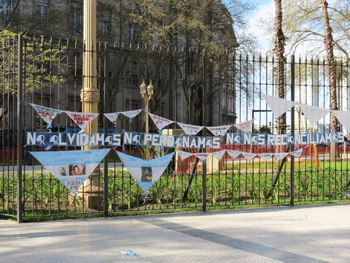
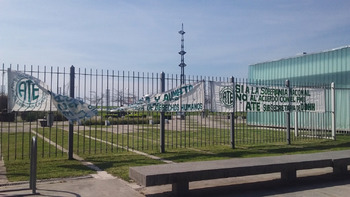
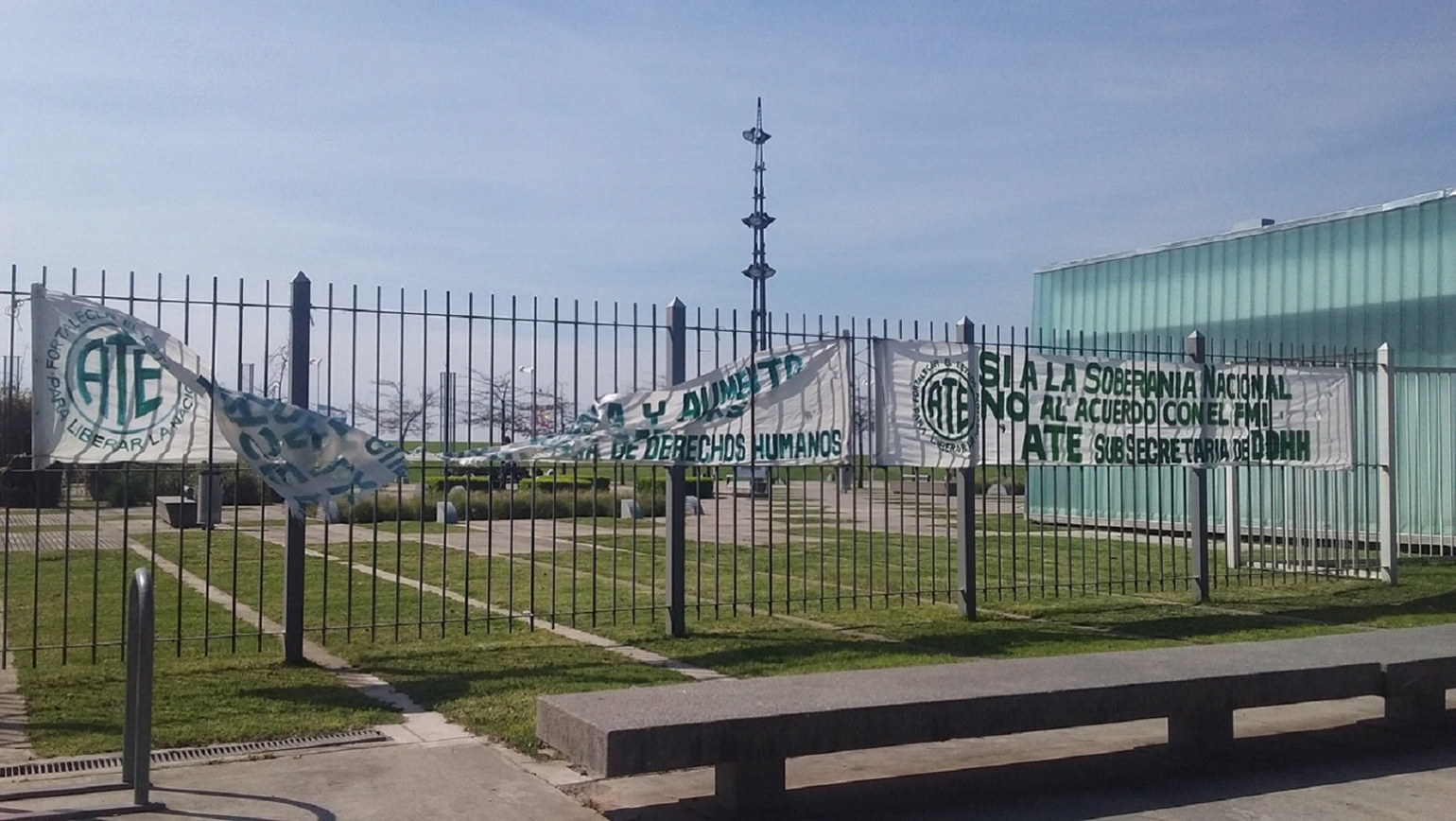
Apart from removing the 2006 Prologue, Macri’s right-wing government did not work much on memorialization policies. Rather, the efforts of Macri’s government were geared towards demonstrating that Argentina was a liberal Western-minded state. At the 2016 Clinton Global Foundation’s annual meeting, after being introduced by former US president Clinton, Macri said that under his presidency Argentina was on the road to ‘being part of the world again’.Footnote 191 Internationally, Macri’s government sought to demonstrate to Western states that Argentina was ‘again a reliable country’ and ready to receive ‘global corporations’.Footnote 192 With this, Macri aimed to undo the Kirchner administrations’ foreign and economic policy, which had prioritized South-South alliances (e.g., MERCOSUR over FTAA/NAFTA).Footnote 193 For that reason, the Kirchner governments’ foreign and economic policy was viewed with suspicion by Western states. To improve Argentina’s reputation amongst Western states, during Macri’s presidency Argentina hosted high-profile international events, including the G20 Summit.Footnote 194 Simultaneously, the Argentinian state was, once again, negotiating an IMF loan. Footnote 195 The success of the IMF negotiations was causing much social, political and economic distress to Argentinians. That could be seen not only in the September 2018 national strike, Footnote 196 but also in banners hanging from the façade of many sites of memorialization – such as CONADEP’s archives – or in posters made by the Madres de Plaza de Mayo.
Macri was not alone in his desire to show that Argentina was addressing the increasing socio-economic inequality, by becoming a liberal Western state and being internationally rule-of-law abiding. As I showed in the previous section, back in 1984 Alfonsín was in a similar position. But nearly two decades later, Alfonsín admitted his bewilderment about the operation of international law in Argentina. Alfonsín wrote:
I do not know this conflict will be resolved between an international norm that it is said to be imperative for all States and the right of peoples to “self-determination”, to decide the best way to resolve their democratic transitions …
In some instances, even the United Nations has legitimated the sanction of amnesty laws … Are all those amnesties null? Are societies obligated to always punish even if it is at the expense of making democracy fail? Those are the questions for a debate that I think reaches the entire world.Footnote 199
Alfonsín wrote these words in 2003, in a letter addressed to members of his party at congress. In the letter, Alfonsín openly disagreed with president Kirchner’s initiative to request the congress to annul the amnesty laws, which were passed in 1986 under Alfonsín’s presidency. Footnote 200 Kirchner’s government argued the laws were unconstitutional because they went against the UN Convention on the Non-Applicability of Statutory Limitations to War Crimes and Crimes Against Humanity – which Kirchner signed in 2003 right before the congress approved the laws’ annulment. Footnote 201 Alfonsín’s main point against Kirchner’s argument was that, what was once lawful before international law in 1984, had become unlawful in 2003. Alfonsín’s government believed that, by grounding the transition to democracy’s institutions, such as CONADEP’s account, in what was lawful under international law, Argentina would be seen as a civilized and lawful state by Western states. For Alfonsín, it was confusing that Kirchner’s memorialization policies were also grounded in an international law that still did not recognize Argentina as civilized unless it adopted the ‘new’ lawfulness. This reveals how fundamental decisions taken during Alfonsín’s presidency were ultimately subjected to the authority of international law and its institutions, while constraining the Argentinian state’s authority.
These recent debates show how, on one hand, the state’s decision to either write or remove prologues is contingent on the particular interests of the government of the day. On the other hand, it also shows how both international law and the prologue as a literary genre continued to be useful as a mode of reimagining the lawfulness of the state’s account about the dictatorship’s state-violence. Throughout, the 1984 and 2006 prologues consistently deployed the promise of democracy and the rule of (international) law as the pillars of an Argentinian state that would deliver peace, justice and prosperity. But in turn, the way in which the dictatorship’s unlawful state-violence is given meaning and understood is contingent on international law’s authorized conception of lawfulness.
5. Conclusions
On a chilly, rainy September afternoon in Buenos Aires, I encountered Juan Gelman’s powerful reflection: ‘One cannot let memory rest, one cannot lean back on the comforts of forgetfulness, because what is man if not memory?’Footnote 202 Gelman’s words are written on the walls of one of the most unsettling places I have visited: the former Escuela Superior de Mecánica de la Armada (ex-ESMA, or Higher School of Mechanics of the Navy).Footnote 203 Ex-ESMA was one of the dictatorship’s clandestine torture and detention centres in Buenos Aires. During Néstor Kircher’s administration, ex-ESMA was renamed Espacio Memoria y Derechos Humanos (Memory Space and Human Rights), and re-purposed as a site of memorialization without changing ESMA’s original architecture.Footnote 204 It is there, in a highly significant site, that CONADEP’s archives are kept, within the National Archive of Memory. Encountering Gelman’s words at that particular site after delving into CONADEP’s archives was puzzling. Standing before Gelman’s words I became aware of a complex tension at the heart of CONADEP’s account, between the need to craft a coherent normative account about the wrongfulness of the dictatorship’s state-violence, and the risks of doing so.
Gelman’s words can be interpreted as an invitation to wrestle with fixed accounts of ‘the past’. Gelman invites us to deal with the memories about how life – with its moments of joy and pain – makes us who we are as individuals and as a community. Gelman’s invitation, more than being written by one of Argentina’s most internationally renowned writers, speaks about, and bears witness to, the great personal loss that the Gelman family and all those of the desaparecidos have suffered. Not only were two Gelman children and a daughter-in-law amongst the desaparecidos, but Macarena, the granddaughter, was separated at birth from her parents and smuggled to Uruguay.Footnote 205 Joyfully, after decades of searching, Macarena and the Gelman family were reunited.Footnote 206
It is undeniable that the driving force of Argentina’s transition was the courageous struggle and resistance of Argentinians against the Junta’s violence, coupled with the vision and commitment of Alfonsín’s government to secure peaceful democratic coexistence. CONADEP’s work was remarkable in tracing and recording the facts – names and circumstances – in which at least 30,000 people were forcefully ‘disappeared’. Yet, Juan Gelman was openly critical of the Prologue to the Report/Nunca Más. Gelman, like many other Argentinians, disagreed about the way in which the Prologue narrated the facts by giving continuity to the dictatorship’s ‘theory of two demons’.Footnote 207 Taking those debates into account, this article analysed the Prologue’s narrative account in light of the late-Cold War’s international context. It has sought to show how a Eurocentric/Anglo-American understanding of lawfulness, embedded in international law, played a fundamental role in the framing of the Prologue’s narrative account.
As I discussed throughout this article, the main aim of CONADEP’s investigation was to give answers about the whereabouts of the desaparecidos and the circumstances in which they disappeared, primarily to their relatives, then to Argentinians and the international community. Furthermore, in doing so, CONADEP’s account was meant to establish a shared official account of the ethical wrongfulness of the forced disappearances. I began by showing in Section 2 how the Prologue was vital for communicating to Argentinians the state’s narrative about how and why the dictatorship’s state-violence caused the desaparecidos. Specifically, I discussed how the Prologue, in working as a specific literary genre (prologue) in the Report/Nunca Más, enabled CONADEP to establish a coherent, unitary narrative, so that Argentinians, and the international community, could understand and accept the unlawfulness of the dictatorship’s state-violence as recorded in the body of the text. I then unpacked the Prologue in Section 3 to show how it established the unlawfulness of the dictatorship’s state-violence by drawing on the language and promise of international law as mobilized in the late-Cold War. The Prologue promised Argentinians that the ‘new’ democratic state would be non-violent, and therefore lawful. I showed how in doing that, international law was actively shaping Argentinian public life according to a Eurocentric/Anglo-American lawfulness. The analysis shows how the way in which international law was subjecting Argentina’s transition-to-democracy to its authority occurred in more sophisticated and complex ways than as an overt foreign intervention (as Alfonsín’s government feared). I showed how international law ‘cooperated’ with the literary form of the Prologue to subtly yet powerfully subject the meaning and interpretation of the dictatorship’s unlawful state-violence to the authority of international law.Footnote 208 The analysis of the 2006 and 2016 rival prologues, in Section 4, reveals how international law continues to actively shape Argentinian public life by determining the meaning and interpretation of ‘the past’. In turn, international law continues to constrain the possibilities of crafting local accounts of the past that rival its authority and the state-society arrangements that it fosters. Footnote 209
While it can be considered that the Prologue establishes an Argentinian narrative – written by Argentinians working for an Argentinian institution (CONADEP) – international law was fundamental, not only in giving CONADEP’s account narrative coherency, but more importantly, lawful authority. One of the things that the Prologue shows is how international law did that not through one of its institutional ‘sites’ (e.g., international courts and tribunals, international organizations or treaties), but through seemingly ‘non-legal or non-international’ ones – such as a truth commission and its documents and/or artefacts. In a time when cultural and artistic expressions (broadly understood) are being incorporated into the research and practice of transitional justiceFootnote 210 and international law,Footnote 211 it is more important than ever to closely examine their interactions. The law and literature approach, or ‘the humanistic study of law’ followed in this article,Footnote 212 invites us to ask how, who, what for, and for whom ‘the past’ is represented by particular international law or transitional justice institutions. In turn, this approach opens the possibility of learning how to listen more carefully, and respectfully, to the nuances of how post-conflict societies are subjected to the authority of international law. And to do so, on their own, lawful, terms.
Fence surrounding the Casa Rosada (government’s office) with banners against the IMF (FMI in Spanish) during the Madres de Plaza de Mayo’s weekly demonstration in Buenos Aires. The banner says: ‘Out IMF’.Footnote 197

Banner against the IMF (FMI in Spanish) hanging from the street fence of Parque de la Memoria y Derechos Humanos in Buenos Aires. Banner says: ‘Yes to national sovereignty. No to the agreement with the IMF’.Footnote 198
Acknowledgements
I am grateful to the two anonymous reviewers for their encouragement and detailed suggestions, which significantly improved this article. I also thank LJIL’s editor, Machiko Kanetake, and managing editor, Paula Baldini Miranda da Cruz, for their editorial support. I am indebted to Argentina’s Archivo Nacional de la Memoria and its staff, especially Mariano Fatalla and Aníbal Calvo, for providing access to CONADEP’s archives, and assistance. For informative conversations in Buenos Aires, I thank Abuelas de la Plaza de Mayo, Juan Pablo Scarfi, and Roberto Gargarella. Special thanks to Shane Chalmers, Shaun McVeigh, Claerwen O’Hara, and Sundhya Pahuja for their support and generous engagement with this piece. This research was funded by the University of Melbourne Research Scholarship, and Melbourne Law School’s Research Support and Fieldwork Support Funds. While addressing this article’s final revisions, my uncle Samuel Guevara Fiallos became a shining star. I dedicate this article to him: a gifted musician, whose life will always remind me to embrace the beautiful complexity of being human. Unless otherwise indicated, all translations are my own.