We meet at this conference in a year which is a special anniversary of various landmark events in U.S. political history. Of course, that can be said regarding almost any year because of the pervasive and profound significance of politics, which is amplified by the special importance which we as political scientists attach to “the political.” Momentarily, I will cite some landmark events from particular years—years which, like this year, end in the number five or zero, as is our wont when considering the anniversaries of those major historical moments. I mean those events to serve as a backdrop for observations regarding American/U.S. politics, and political science more broadly, particularly in an era of growing racial diversity and economic disparity,
Let me state my core points and make a plea at the very outset: the levels and unique configurations of class inequality and racial diversity that have characterized the last several decades of U.S. history—and there is much evidence for this—raise big questions for political science and political scientists to study. And understanding the nexus between differences or hierarchies associated with class dynamics and race/ethnicity, and gender, is immensely important. Yet—with some notable exceptions—they are too often examined entirely separately, overlooked, or not sufficiently engaged by research in our discipline. Standard political science perspectives certainly have had something substantial to say about these. But rather more can be done in terms of theory and empirical analysis to capture the breadth and depth of the large and significant issues present when economic inequality is linked to racial disparity present.
Alternative perspectives, or other states of mind, can conceptualize and consider the issues differently and be more analytically open and disposed to considering different dimensions of inequality, as well as connections between them. (I would also hope for and look forward to newly developed theories, evidentiary bases, and methods that could be brought to bear on these issues as well.)
Now, I certainly recognize that the nature and magnitude of the issues I will identify present difficult intellectual challenges (which I, myself, have not entirely thought through, but I will explore today). Nevertheless, I’m convinced that political science should, and I’m entirely confident that we can, play a larger and more integral role in grappling with the political roots, meanings, and implications of these and other dimensions of inequality. I offer some observations about the research, or lack thereof, and indicate suggestions about how we might think about and do more in these respects.
I will come at these concerns as follows: (1) noting some developments that influenced the present in social and political terms, and other events in political science; (2) identifying intellectual guideposts that may help how we think about research issues of our day; (3) considering why race and class are not studied (more); (4) acknowledging that to be the case and how the questions have been studied, as well as noting some reservations about these; (5) providing several examples from research in which I have been involved, both directly and indirectly, which suggest how we might or can study these questions; (6) then concluding. I begin with reference to a number of landmark events in American history and in the history of our discipline to foreground and serve as a segue to broader points.
Developments
This year, 2015, marks 150 years since the end of the Civil War and ratification that same year of the Thirtenth Amendment to the U.S. Constitution, which ended slavery; ratification of the Fifteenth Amendment, regarding right to vote for former slaves, occurred in 1870 (and the fundamentally important Fourteenth Amendment was ratified in between, in 1868). These pre-date the establishment of the American Political Science Association by thirty years or more. The Nineteenth Amendment, regarding women’s suffrage, was ratified 95 years ago. It has been 80 years since the passage of the Social Security Act and of major labor legislation, as well the enactment of laws, leading to major infrastructure throughout the United States, including here in the San Francisco Bay area, which we use to this day.
It is fifty years since the passage of the Voting Rights Act (VRA) and of major Immigration legislation, which alone and in combination transformed the social composition of the United States and of its electorate. The Elementary and Secondary Education Act, Pell Grants, the Head Start program, and Medicare and Medicaid also emerged in 1965—as did the Watts riots in Los Angeles. It is forty years since the 1975 extension of the VRA to “language minorities,” and twenty-five years since the passage of the Americans with Disabilities Act (ADA). Hurricane Katrina devastated New Orleans ten years ago. Just five years ago, in 2010, the Affordable Care Act (ACA, often referred to as Obamacare) became law, and its signature importance was described in lively, expletive-deleted, terms by Vice President Joe Biden at the time.
To note but a few important developments in international relations—it has been seventy years since the first use of the atomic bomb, the end of World War II and the creation of the United Nations, first headquartered here in San Francisco. It has been 55 years now since the Cuban Embargo Act (October 1960), which was situated in the context of the Cold War United States. Regular U.S. combat troops were deployed in Vietnam in 1965 (fifty years ago); the United States completed its pullout from Viet Nam in 1975.
And we meet here in this place, California, which became a state 165 years ago in 1850, as part of the treaty ending the Mexican-American War, an event of tremendous importance in American history. California’s vast population (about 38 million) is by a large margin the biggest in the country, and comprises about ten percent of the nation’s population. It is also one of several “majority-minority” states in terms of its demographic profile.
One could easily go on and on, and I’m certain others could identify many other, and different, events but I leave it at that for now.
We can also identify a few landmarks within the American Political Science Association and our discipline and contemplate their significance, as well as how and how much they may or may not parallel the broader changes just noted. Founded in 1903, the association grew incrementally until after World War II, and its membership expanded dramatically in the 1960s and 1970s. In 1950 (65 years ago) Ralph Bunche received the Nobel Peace prize; he became the APSA’s first black president (in 1953–54). A major book award given by our association and a summer program for young aspiring political scientists came to bear his name, and his name has been recognized elsewhere in the world.

The first woman president of the APSA, Judith Sklar, gave her Presidential Address just a quarter century ago, in 1990. A decade ago in 2005, Margaret Levi, gave her presidential address, and Levi’s two immediate predecessors were Theda Skocpol and Suzanne Rudolph. This marked the first (and only) time the APSA has had three women presidents in succession. Tomorrow [September 4, 2015] the association will formally install its ninth (but only its ninth) woman president.
Also within our association, the Race, Ethnicity and Politics (REP) Organized Section was established 20 years ago. And the Perestroika movement emerged in 2000, 15 years ago. Formed within five years of each other, the REP section and Perestroika had some ostensibly convergent interests. But they also diverged, to some degree, in their intellectual orientations, in their social composition, and in other important ways. Footnote 1 We can also ponder what the emergence other formal entities such as additional Organized Sections might mean. One section to quickly note here is a new[er] one focusing on “Class Inequality,” which, along with the now-longstanding REP section, engages concerns about inequality, and at the same time brings some similar—yet also divergent—perspectives to bear on those and related questions. Whether, and if, these sections will intersect and interact remains to be seen, but their very co-existence in certain ways is consistent with some of my points about the frequent separation of race and class in the study of American politics; that separation may well be justified in many circumstances but the potential connections should not be overlooked.
The events highlighted here are obviously but a tiny, tiny slice, and touch upon only certain types of political phenomena and developments. But as we think about these, they begin to suggest the relation of political science to its subject matter and its relation to larger society—i.e., they raise questions about what we study, and why, as well as how we do and how we think we should study politics. Further, and in a related vein, as we bring critical lenses to that which we study, we also mirror the dispositions, attributes, and strengths or deficits of the socio-political and intellectual milieu of which we are a part and in which we are imbedded. Accordingly, this should lead us to be constantly mindful of what we assume or take to be “normal” or “natural” or “neutral” (or all of these) in the world of politics and in our scholarship.
How might we think about and approach these concerns? These types of concerns surface in various venues, including previous APSA presidential addresses, a few of which I will touch upon here. While these addresses are different they share important attributes: they are characterized by erudition and subtle passion and they affirm—and at the same time vigorously challenge—us as scholars and teachers of political science. My later comments are informed by the spirit of these perspectives.
Precedents and Guidance
Margaret Levi’s presidential address ten years ago thoughtfully revisited and rearticulated “why we need(ed) a ‘[new] theory of government,’” engaging issues of how to make governments more representative and effective. Footnote 2 I suggest we need to reconsider or create new (empirical) theories of race and class, and their intersection.
Two years ago, Jane Mansbridge implored us to join her in reflecting upon “what is political science for,” i.e., the basic purpose(s) of political science. Footnote 3 I suggest that studying issues such as race and economic inequality is a worthy goal, having the kind of substantive purposes and normative underpinnings that Mansbridge suggests.
On the other hand, several presidential addresses have called on us to be self-aware and self-critical as a discipline. In his 1981 presidential address, Charles Lindblom cautioned scholars of American politics against accepting, indeed perhaps creating, overly facile assessments of the American political system, and declared the need to adopt “another state of mind,” i.e., to take seriously alternative interpretations to the dominant, and what he saw as overly simplistic, characterizations of American politics. Footnote 4
And in one of the most provocative presidential addresses ever, in the early 1990s Theodore Lowi contended that we should be cognizant of and concerned that we could, and had actually, “become what we study.” Lowi posited that “U.S. political science is itself a political phenomenon.” And further, that “every [political] regime tends to produce a politics consonant with itself; therefore, every regime tends to produce a political science consonant with itself. Consonance between the state and political science is a problem worthy of the attention of every political scientist.” Footnote 5 I will explore partially the consonance of political science views and understandings of race and of class that mirror even as they may also seek to critically assess “real world” politics and “the state.”
Other Presidential Addresses focused on distinct features of American history and their implications for the substance of and the discipline’s approach to studying the political system. For example, Lucius Barker Footnote 6 in 1993 and Dianne Pinderhughes in 2008, Footnote 7 with different emphases, stressed the enduring and contemporary relevance of race as an element of American political history. In that spirit, I continue to seriously focus on race, but also extend to and grapple with its increased complexity, associated with Latinos, and Asians, and immigration, and other developments, and more directly bring class, and gender into account.
I note one more Presidential Address. Robert Putnam’s 2002 address spoke eloquently about pressing issues of social justice and said that “perhaps the most fundamental problem facing America, and most other advanced countries.” will be to reconcile “the demands of diversity, equality, and community.” He added that “this is a quintessential big issue” and “political scientists have a professional responsibility to contribute to this nascent debate.” Footnote 8
There is so much to agree with in the comments Putnam’s made at the time, and he was correct in suggesting that the issues would become more pressing. These thirteen years later affirm that the issues are indeed bigger ones—and this is so despite or perhaps because of the election of the first African American president in 2008, something that few, if any, would have anticipated in 2002.
At the same time, I would contend that issues regarding diversity and inequality were not then, in 2002, necessarily “nascent.” A considerable number of political scholars, particularly those studying race/ethnicity in American politics, had been examining the structures and the concentration of political and economic inequality among certain groups—racial minority groups—in the society for years. Attention to racial diversity and economic (in)equality had been examined and had been the staple of a larger body of research for a long time, and the interconnection between race and economic status was, of necessity, a central feature given the historical patterns. For example, arguments about “multiple theoretical traditions” Footnote 9 “faces of inequality,” Footnote 10 two-tiered pluralism, Footnote 11 and neo-liberal (economic) orientations and (racial) paternalism in 1996 welfare policy “reform,” and also links to criminal justice policy Footnote 12 had been made some years before. But much of this research had somehow escaped attention, was overlooked or ignored, or the focus on a range of inter-related inequalities was not recognized. Most pointedly here, however, political science needs to theorize and examine the dynamics of racial/ethnic, class, and gender inequality much further.
Theoretical Context and Framing
The critical policy junctures spotlighted earlier have mostly to do with civil rights and formal racial/ethnic equality on the one hand, but also to policies pertaining to economic opportunity and security and equality on the other hand. Those two are also deeply affected and mediated by gender and vice versa. Footnote 13 The rise in inequality in the United States (and elsewhere) challenges democratic governance. Better addressing this requires more and more nuanced attention that instills, but also goes beyond, the important goals of “accuracy” in our research endeavors regarding some aspects of the inequalities, and suggests that we think further in terms of the adequacy, i.e., fuller and more complete assessments and appropriateness of research, that it betters suits or fits the complex nature of the politics of class and race in our studies of these matters.
Other disciplines, particularly sociology, history, and economics, have extensively explored various aspects of these issues. But the distinctive and comprehensive analytical lenses that only political science is uniquely suited to bring have not been as prominent as they should and could be. Robert Reich gave a lively presentation at a Plenary session earlier today [September 3, 2015] titled “Why Economics [Policy] Is Too Important to Be Left to Economists.” My plea is that racial and class inequality is too important for political scientists to not do and to not have done more—and for so much of the study of these concerns to have been conducted in other fields. This raises the question of why there is often inattention or disconnect of race and class in political science research, and in public discourse as well. Several possible explanations, which are not mutually exclusive, come to mind.
Maybe it is simply that each phenomenon—class and race—is just not seen as being as important or prominent or as legitimate a political phenomenon or they are not seen being as consistently or deeply connected as I’m claiming or assuming. Alternatively, some might say these issues have in fact been studied quite a lot (and appropriately and effectively). If either of these is mostly or entirely the case, then my basic premise is called into question. But I think not, and will thus set those views aside.
More generally, they may not be studied more, or more directly, because race as well as class may be underspecified and underappreciated in common research approaches. Most pointedly, a number of major studies omit attention to race altogether—quite some number of analyses—including some which purport to assess inequality broadly or “general theories” of American politics. Also, some prominent research approaches tend to (unconsciously) “de-racialize” politics, while others de-politicize race; this may also occur in “real world” politics).
De-racialization of politics often occurs in (standard) “pluralist” renderings of politics and studies oriented around competitive, Footnote 14 or what I’ve come to think of as liberal, pluralism. Racial groups are not “really” fundamentally different substantively, in kind (qualitatively), than other groups, but only or mostly differ in degree (quantitatively, in the amount of resources, prestige, etc.). In a related vein, standard pluralism takes as given, as some of its basic tenets—such as fair “rules of the game,” multiple access points, dispersed/non-cumulative resources, etc.—that scholars of race believe need to be investigated in the first place. Even studies which, very appropriately, examine “biased pluralism” typically confine their analysis of bias to economic resource differentials, overlooking or understating (the potential impact of) race. Footnote 15
On the other hand, research perspectives may de-politicize race by overly emphasizing that the nature and workings of “civil society” is the primary—virtually sole—issue in democratic polities rather than politics, as such, including interest groups or state institutions and hence, muffles an understanding of race as a political phenomenon. Thus, studies with an emphasis on “civic association,” social networks, and communitarian-type underpinnings (or which also suggest a consensual, perhaps communitarian, pluralism) sometimes seem to assume away race as “political.” Footnote 16 In a different way, this may also occur when class and/or racial inequality is seen as largely a matter of “market” forces or of an “invisible [ostensibly non-political] hand.” Footnote 17
Other plausible explanations as to why race and class are not studied together as might be anticipated—and, I would suggest, than is desirable (and that if and when studied, they are approached separately)—may include normative, conceptual, and empirical reasons, and some combinations of these. Normatively, race has been fundamental, salient, and deeply troublesome, the “original sin,” because the specific form of inequality departs from—is the most fundamentally inconsistent with—American core values. While certainly disconcerting, economic inequality may be seen as the lesser evil, grounded in claims of achievement (rather than ascription, as is race) and thus in some ways is more legitimate to address in research. Also, race has been legally/formally addressed in civil rights legislation and is a protected category, which, to some, implies a degree of resolution in ways that arguably is not the case regarding class and rising economic inequality. Further attention to how race and class have been juxtaposed normatively (and in other ways) is revisited extensively in later sections of this essay.
From a conceptual standpoint, each notion—race and class—is complex, frequently ambiguous, fluid, having different meanings across time and by place, and are blurred in practical politics as well as in scholarly conceptualization and research. There is a great deal of differentiation within as well as between the political science research literatures, as well as in the “real world” as to how these phenomena are or can and should be understood, how to measure them and, more broadly, what they mean to begin with. For example, if we assume for the sake of argument that broad agreement on definitions can be achieved, other issues such as whether objective or subjective indicators of class should be used, and, if objective indicators, which one[s], if subjective ones, which ones? And there are many other such debates about these matters.
There are also (empirical) questions of “where to look for” these, which has differed a great deal. For example, within the literature on race there is a vast body of research unto itself on individual-level attitudes; there are debates about old-style racism and racial resentment, symbolic racism versus principled conservatism, explicit and implicit (racial) bias, and so on. Beyond these micro-level analyses, other research focuses on the macro- or meso-levels, typically posing somewhat different questions and reaching different answers. Cumulatively, over all conclusions are unclear or highly conditional, and there is little attention to matters of economic class and inequality.
I conclude this section by noting two observations from recent years which capture some of the dilemmas in our understanding and assessments of these issues.
Many decades after the achievements of the civil rights movement, our society is still plagued by inequality. To some extent, inequality is the enduring legacy of the age of Jim Crow, red-lining, and other once-legal practices. The more proximate cause, however, is the enormous rise in economic inequality in the last three decades, trends that have transformed our social structure and, tragically, reinforced in many ways the racial stratification of the past.” Footnote 18
Reducing [formal/legal racial] discrimination made it easier to justify rewarding the/an [economic] elite.” Footnote 19
These comments are but some of many examples showing that issues of race and class inequality have in fact been acknowledged and engaged in recent years. An enduring legacy, the past versus the proximate, and the rationalization and juxtaposition of the two social phenomena have been debated not just recently but more or less intensely from time to time and is still important to consider. A sampling of how these have been addressed in American previous scholarship is useful.
Sampling Political Science Thinking about Race and Class in American Politics
To some degree the simultaneous consideration of race and class and of racial groups and social classes has (at least implicitly) been a staple in American political science assessments of the nature and orientations of the American regime. At the Founding, the presence of slavery was central to debates about and became imbedded in the representational structure of the U.S. Congress and other constitutional provisions. At the same time, Madison (Federalist No. 10) claimed that the “most common and durable sources of factions” had been differences in economic standing—those “with and without property, creditors vs debtors, a manufacturing interest, a mercantile interest … divide [nations] into different classes.” Footnote 20 Explanations for “American exceptionalism,” i.e., its ostensibly smallish or minimalist welfare state and the forms it has taken, is often attributed to the difficulty historically of creating class-based political coalitions because of racial animus. Similarly, analyses on issues of race, and certain policies, by scholars of American political development (APD) have documented the impact of racial considerations on the formulation of policies regarding basic economic security, such as social security, Footnote 21 and other policies adopted during the eras “when affirmative action was white.” Footnote 22
In the aftermath of the civil rights legislation, race has been used to explain “why Americans hate welfare” Footnote 23 and the connections are also apparent in analyses of “how the poor became black,” Footnote 24 linking race and redistributive or economic security-related policies. The evolution of race as an issue was seen as integral to the “transformation” of American politics in the 1950s–1960s and beyond. Footnote 25 The broad and deep impact of race in the public policies and politics of the American states has been shown as well. Footnote 26 Also research on blacks and Hispanics regarding education policies demonstrated the importance of race as well as class factors. Footnote 27
Analyses concerning “disciplining the poor” make such connections as well. The convergence of racial “paternalism”and “neo-liberal” (economic) policies in the adoption and implementation of the 1996 “welfare reform” legislation has been powerfully demonstrated. Footnote 28 Furthermore, the importance of race, the implications of America’s broad racial dispositions, have been relevant beyond domestic politics as well, influencing U.S. foreign policy decisions, along with military, political economy, and other considerations. Footnote 29 Yet many such issues are under-explored in historical/institutional or in more contemporary contexts.
How race and class have played out in “actual politics” has been debated for many years. In 1974, Wolfinger, discussing “ethnic succession” in northeastern U.S. cities (particularly New Haven, Connecticut) argued that “irrespective of the lines of coincidence between ethnicity and class, ethnic consciousness retards political expression of class-based interests.” Footnote 30
On the other hand, Wolfinger characterized Glazer and Moynihan’s arguments in Beyond the Melting Pot (Reference Glazer and Moynihan1963) as a school of thought that “race allows us to talk about class,” i.e., ethnic politics is a way of having class politics “without offending egalitarian myths.” Footnote 31 In Glazer and Moynihan's words, which drew inferences about racial/ethnic politics and class by studying early twentieth-century politics in immigrant-heavy New York City: “In a democratic culture that has never much liked to identify individuals in terms of social classes . . . the ethnic shorthand is a considerable advantage.” Footnote 32
An analysis which brings further breadth and more completeness to these questions assessed relief (or welfare) policies of the early decades of the twentieth century (before the New Deal) in various U.S. localities found there were “three worlds of relief.” These worlds were shaped by race and class or economic forces, as well as by local institutions. That is, different racial/ethnic groups, different political economies, as well as different local political institutions—white ethnics in the industrialized northeast (who were included through “machine politics”), black sharecroppers in the south (excluded through Jim Crow and various other social mechanisms), Mexican fieldworkers in the southwest (constrained by deportation and other threats)—were relevant for local welfare policy (non)decisions. Footnote 33
In stark contrast, several major latter-day political science studies on inequality gave virtually no attention to race at all. A widely noted recent (2014) article tested four “theories of American democracy”: majoritarian electoral democracy, economic-elite domination, majoritarian pluralism, and biased pluralism. Economic inequality is at the center of the analysis and is accordingly considered carefully—particularly in the economic elite domination, and biased pluralism (meaning economically biased) theories. The article’s general finding that oligarchy as much (or more) than democracy accurately describes American politics is powerful and deeply sobering. But the word “race” is not mentioned at all in this article. Footnote 34 While one might thus accept the essential accuracy of the findings, one wonders if there can be an adequate assessment, particularly of a (purported) “theory[ies] of ‘American politics’” and equality—in which groups are a central component—which does not at least reference, much less examine, racial and minority groups as part of the analysis in some (significant) way.
Keith Banting and Will Kymlicka’s Footnote 35 considerations of “multiculturalism and the welfare state” may be instructive for present purposes. Their assessments of nations’ recognition of groups through “multicultural” policies and how this may affect levels of support for redistributive (welfare) policies is revealing. I draw on and seek to adapt their theoretical framing to inform understanding of political discourse and the politics of race and class issues I have been discussing. Banting and Kymlicka contend that those policy debates can be analyzed as to whether policies (multicultural, and welfare) are seen as “crowd[ing] out” each other in terms of public debates and public support for policies in that only finite time and attention and resources are available to address each (or both). Or, when the substance of one policy (multiculturalism) might undercut support for the other (welfare), “erosion” of a political coalition in support of the latter can occur. There can also be a “misdiagnosis,” where one set of observers perceive that others (are purported to) incorrectly diagnose the bases of inequality as to what is the “real problem,” leading the presumed “correct” perspective to dismiss the other. To give attention to one in actual policy leads to dismissal of the other. Banting and Kymlicka put forth evidence that supports, but also considerable evidence that refutes, the claims about crowding out, erosion, and misdiagnosis. Footnote 36 The understandings—the perceptions, and the realities—of the relation of race-based (or multiculturalism) and economic-based (welfare) policies is complex and requires careful theoretical, substantive, and normative reflection; by extension, that can also be said about race and class inequality more directly.
The issues seem yet more complex in the context of American politics debates and in political science research, given the country’s unique racial history. Not only are the two factors sometimes viewed as in tension or competition with one another as explanations. One may be seen to “absorb” the other, they may also obscure one another, and there are different views as to which is a legacy or proximate cause, which is primary or secondary, whether one affects (certain aspects of) inequality more, whether impacts are direct or indirect, whether they are viewed as compartmentalized or combined, whether they are assessed in absolute or aggregate versus relative terms, and on and on. We need to be attentive to the possibility that political discussions, and research, treat race and class in ways that conflates, confuses or offsets them, through commission or omission. At the same time, we need to recognize that is it frequently not “either/or,” but “both/and,” and that these are mediated by other factors such as gender, institutions, and so on.
The importance and breadth and depth of interactions and political implications of these social forces clearly present formidable challenges, but—or, therefore—ones we should take up. I give some examples of how this has been done and how more might be done.
Race and Class in American Politics and Political Science
The Great Divergence and Class—and Racial—Inequality
Economic inequality has, of course, received a tremendous attention associated with the great divergence of America’s rich from its middle class, which thrust it to the center of American politics, punctuated by the “great recession” beginning in 2007. To many observers, the income (and wealth) divide has supplanted race as the country’s primary political fault line. However, such a conclusion potentially overlooks or understates the persistent “racial structuring” of economic inequality and that race should be considered in relation to economic forces. The two may (perversely) supplement each other, but sometimes to a degree and in ways that are not altogether obvious.
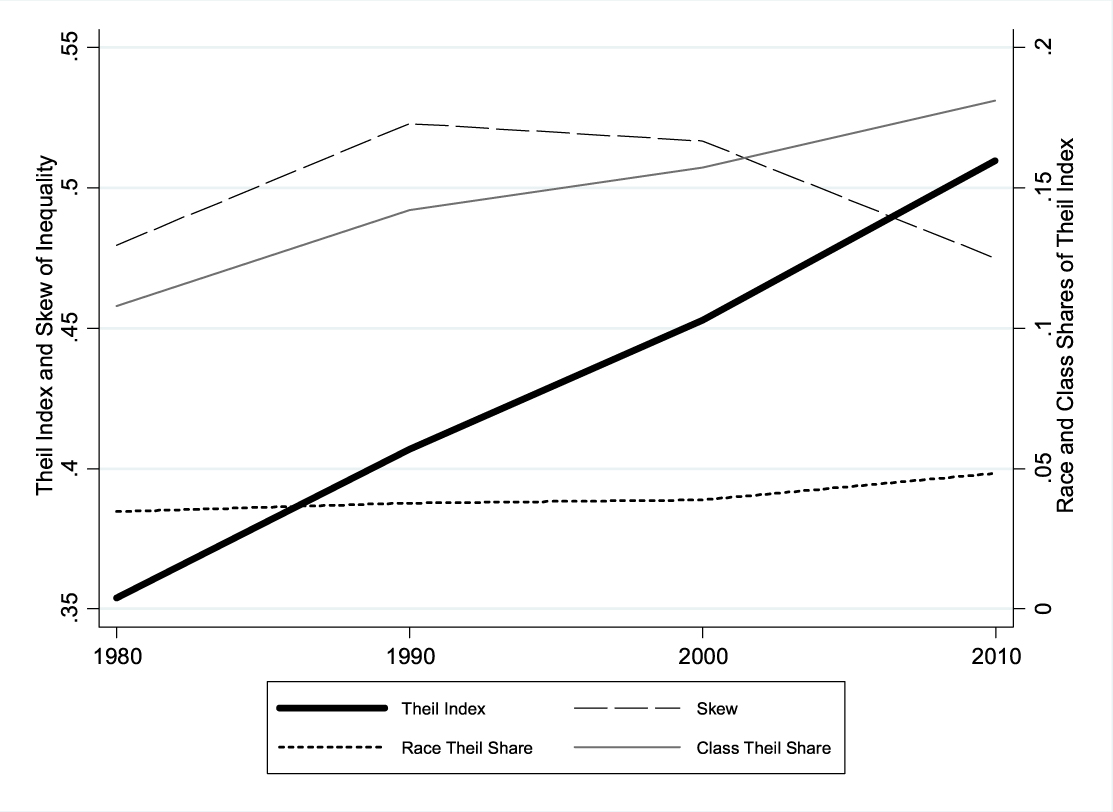
With that possibility in mind, a study of the U.S. states was undertaken which disaggregated or “decomposed” income inequality into “between-race” and “between-class” components (using the Theil Index), which facilitates understanding the breadth and depth or the structure of inequality. Drawing on data from three decades, 1980 to 2010, evidence (summarized in figure 2) shows—or simply, pointedly reaffirms—that economic inequality has, indeed, increased dramatically over that period. At the same time, the evidence indicates that inequality between races remained a steady share of total income inequality over this period nationally, and in most states. That between-race inequality has changed little (perhaps even gotten worse) is especially striking these many years after the Civil Rights or other legislation. Footnote 37
National trends in income inequality and its structure
Source: Hero and Levy Reference Hero and Levy2015.

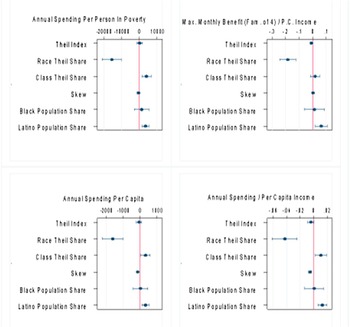
Beyond this powerful descriptive evidence, however, analysis also shows that between-race inequality influences state welfare-policy (measured several ways) decisions—substantially, and negatively so—whereas between-class and total levels of inequality (as well as the racial composition of the population itself) has not (refer to figure 3). Clearly, the upsurge in economic inequality is staggering, yet it is striking that it apparently has had essentially no impact on welfare policy in the states. On the other hand, (ongoing) between-race inequality does have major impacts. Footnote 38 (Other research on related issues and policies is less clear.) These findings underscore the importance of careful attention to race and class inequality in our analyses, as well as their implications for public polices.
Relationships of racial and class inequality, and demography on welfare policy in the U.S. states

President Obama’s 2015 State of the Union Address
Another piece of evidence I note is President Barack Obama’s [January 20] Reference Obama2015 State of the Union (SOTU) address. Footnote 39 Examining this speech is useful, at least for the illustrative purposes I intend here; though my observations are admittedly selective and suggestive, I think they help illuminate the parameters or the (acceptable) bounds of contemporary public discourse on these significant issues of class and race. SOTUs are one of the most visible, institutionalized events and rituals in American politics. In those speeches, a president identifies pressing contemporary concerns (as s/he sees them) in relation, at least implicitly, to larger values, goals, and policy agenda, and places them in a larger historical and political context. Footnote 40
Two aspects of the speech that I would bring attention to are, first, the organization or placement of issues and topics, i.e., where, at what point(s) in the speech, they are raised and, second, how issues associated with class or race are talked about, as well as whether race and class are discussed in some way that connects them to each other. In the case of President Obama, I recognize that these issues are yet more complex in that the message is presented by a unique and particular messenger, i.e., the first African American president. Footnote 41
It is not uncommon for SOTUs to be structured into sections on domestic policy on the one hand, and foreign policy on the other hand, and economic issues may be considered separately as well. A prominent theme in the 2015 SOTU address, one which was introduced not long after the first few pages of the speech, was middle-class economics. My very rough estimate is that about twenty percent of the address gave attention to such ostensible concerns, with an emphasis on economic opportunity. The day after the speech, media commentaries emphasized that theme as well. At the same time, some observers talked about the speech in terms of economic “inequality.” Notably, however, the word “inequality” appeared only once in the speech. Footnote 42 On the other hand, there were numerous mentions of “hard work[ing],” “effort,” and that one must “earn” and make oneself deserving. Also, equality of opportunity (not equality of condition or outcome) was said to be the appropriate goal. Interestingly, along with numerous mentions of middle class not once was the phrase “working class” mentioned; instead, middle class was juxtaposed to “lower income,” or “working families,” and other terms. (While the phrase “underclass” was once prominent in American political discourse, and suggested a combination of [lower] class and race, it is seldom heard these days. At the same time the now infrequent use of “working class” by politicians is interesting.)
Other words, having to do with “fair(ness),” a “fair shot,” and “fair share” were also frequently invoked. References to child care, sick leave, maternity leave, health care, etc. to support workers were also interspersed. A belief in the need for equality and fairness of opportunity, as well as mentions of wages—minimum wage (two mentions); high(er) wages (five mentions), as was “equal pay for women.” For the most part, issues relevant to economic well-being (or inequality per se) were not linked to racial factors (or racial inequality) at all.
Obama noted that “40% of our students choose community college” (emphasis added); this seems to assume or imply, perhaps too readily, a degree of free choice or agency, rather than possibly necessity, particularly if an individual might actually prefer other (higher, or better) alternatives. Footnote 43 Obama added that students must “earn it” [free community college tuition] with “grades and graduation.” Regarding unions, he said that “we still need laws that strengthen rather than weaken unions, and give American workers a voice,” and nothing more.
These broad comments about class issues, middle-class economics, etc. are “color blind,” and many observers, especially critics of race-conscious policies, would say they should be. But it is not inconceivable that they might have been raised at least somewhat differently, noting some disproportionate patterns. Finally, comments of an economic populism flavor—such as the super-rich, lobbyists, loopholes, bailouts—sprinkled the speech but were hardly prominent.
The second point I raise has to do with where and how issues associated with race are talked about, as well as whether race and class are discussed in some way that connects them to each other. It was not until toward the end of the SOTU speech (around pages 15–17 of a 17 page speech) that a set of domestic issues pertaining to certain social groups often having some gender or some racial/ethnic dimension, were discussed (again, recall that economic issues were posed early in the address). It seems fair to say these were discussed in tempered fashion and indirectly, and that racially-relevant issues were discussed in color-blind ways. This occurred in rapid succession and in a couple of pages, in something like the order I present here. The only time the word “race” is used in the entire speech (as a social trait or factor) is when Obama says (around page 15) that he “grew up in Hawaii, a melting pot of races and customs.” The allusion to an older narrative of race/ethnicity in the United States—a “melting pot”—is itself intriguing, as is the general tenor of his remarks on such concerns.
Obama makes a number of broadly and ostensibly group- and policy-related references, stressing commonalities or common ground, though difference is also part of the narrative. How he talks about, or does not talk about, the issues is notable. The “social construction of target populations” as developed by Ingram and Schneider Footnote 44 —in terms of groups being “(re)constructed” positively or negatively, and as weak or strong—comes to mind here, reframing so as to soften negative perceptions and making certain groups or behaviors seem less “deviant.”
To wit:
Passions still fly on immigration, but surely we can all see something of ourselves in the striving young student, and agree that no one benefits when a hardworking mom is snatched from her child, and that it’s possible to shape a law that upholds our tradition as a nation of laws and a nation of immigrants.
We may have different takes on the events of Ferguson and New York. But surely we can understand a father who fears his son can’t walk home without being harassed. And surely we can understand the wife who won’t rest until the police officer she married walks through the front door at the end of his shift.
This framing may be understandable and I am not necessarily criticizing this phrasing in the address, but emphasize its nature or content, which avoids any (direct) references to race (or racial), or class dimensions or to (in)equality. In both these instances, some notion of family (relations) and to certain virtues is invoked—the mom, who is hardworking, and her child, and the striving young student; the father and the son; the wife whose husband is a police officer. And what transpired in Ferguson and New York are “events” which we can “take” or view differently. This is not to say these descriptions are necessarily wrong, but the word choices and phrasing are interesting, I think. It is also stated that
We still may not agree on a woman’s right to choose, but surely, we can agree it’s a good thing that teen pregnancies and abortions are nearing all-time lows, and that every woman should have access to the health care that she needs.
The emphasis is on “access;” the actual ability to receive “health care that she needs” is less clear.
A paragraph toward the very end of the address again stresses commonality and unity, and here we do see broad allusion to economic well-being—improving life chances—and to race, in naming several groups, as well as to gender and sexual orientation:
[To] every child, in every neighborhood: your life matters, and we are as committed to improving your life chances as committed as we are to working on behalf of our own kids. … we are a people who see our differences as a great gift …a people who value the dignity and worth of every citizen: man and woman, young and old, black and white, Latino and Asian, immigrant and Native American, gay and straight, Americans with mental illness or physical disability. Everybody matters.
A couple of points about this last paragraph occur to me. The breadth and inclusiveness of groups noted is striking. The (broad) framing of economic well-being, in terms of “improving. … life chances,” though without specific reference to economic class or to economic (in)equality, is intriguing; e.g., there is no mention of other possible groupings such as “rich and poor,” or “middle class and working class,” or some such wording. Also interesting are the groupings and juxtapositions of social group dyads (as suggested by the placement of the commas) and the particular dyads selected, which don’t suggest an “intersectionality” (or, on the other hand, “cross-cutting cleavages”) of the various dyads, and is further interesting in how some of the dyads are presented. That is, racial groupings are “black and white”/“Latino Asian”—rather than, say, black, white, Latino, Asian (—i.e., all together). Whether this is accurate, or “correct,” or (un)desirable is open to debate, but we can at least take note of this and consider what to make of it.
To be sure, and to be fair, President Obama has discussed these and related issues in other, different venues and has spoken about them rather differently, and often more forcefully. On the other hand, where and how race and class are discussed in this 2015 SOTU—i.e., by and large separately, and each arguably in very muted ways—probably obscures more than articulates any links between these social forces in contemporary political discourse(s). Recognizing and seeking to understand this as part of understanding racial and class inequalities in contemporary society is worthy of further scholarly attention.
Task Force on Race and Class Inequalities in the Americas
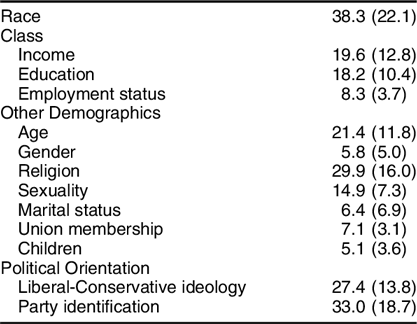
Finally, I bring attention to the APSA Task Force on “Racial and Class Inequalities in the Americas” which, as its name suggests, has engaged said issues directly. One of the papers for the Task Force Footnote 45 assesses the effect of race and class on the urban (cities) political arena in the United States with an array of data regarding the role of these, and a number of other factors. It finds that both factors significantly affect political behavior and policy outcomes, but that “race is the primary driver of urban politics across most contexts.” The impact of racial differences typically exceeds that of other factors frequently found to be powerful in politics, such as partisanship and ideology. “Minorities are grossly underrepresented among elected office and are more apt than whites to end up on the losing side of the vote, policy outcomes Local politics is “more likely to represent the interests of whites and the wealthy than the interests of minorities and the poor”; Footnote 46 refer to table 1.
Racial, demographic, and political divisions in urban elections: Average divide in vote for winning candidate in a group of U.S. cities

Hajnal and Trounstine (Reference Hajnal and Trounstine2015).
Source: Elections for mayor, council, advocate, comptroller, clerk, city attorney, and ballot propositions in New York, Los Angeles, Chicago, Houston, and Detroit.
Note: (Standard Deviation in Parentheses).
Another paper from the Task Force, by Paul Pierson, Footnote 47 contends that race has (likely) played an important role in the extreme and “asymmetric” political and policy polarization, and policy “drift,” in the American party system in recent years. He also points to the essentially unprecedented decisions of some of the U.S. states to not accept federal funds to expand Medicaid or to refrain from involving themselves with federal health care programs, and suggests racial and associated considerations may play a role in this (at least indirectly.)
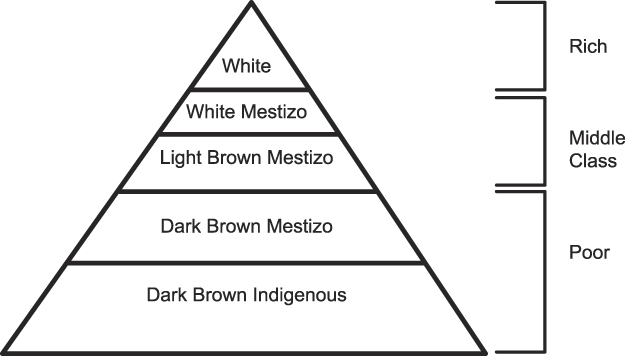
An assessment of Mexico, a self-perceived “mestizo” nation, shows distinct patterns of economic status associated with race and skin color in that country (refer to figure 4). Footnote 48 On the other hand, Banting and Thompson argue that because of the timing of the formation of the Canadian welfare state, racial factors (has) had little impact on its policies. However, the “powerful persistence” of economic inequality, which is disproportionately found among indigenous populations, is “puzzling.” Footnote 49 Other papers explore various other dimensions and venues and in other (Latin American) countries regarding class and racial inequality, and demonstrate their commonly deep and complex interrelations. The Task Force papers inform our understanding of fundamental questions of race and class in various contexts and with regard to an array of political dimensions in the United States and elsewhere.
But if we unpack Mestizos by race, Latin American countries are less homogenous and more discriminatory than It is often assumed
Source: Trejo and Altimirano Reference Trejo and Altamirano2015.

Conclusion
The distinct and increasingly complicated constellations of racial diversity and large economic disparities of recent decades represents a unique—and disconcerting—period in American political history. It beckons us to engage questions regarding what about the political system(s)—its ideas, institutions, interests, and other elements—are and have been implicated in or may be related to the causes and consequences of these developments. Political science research has had a good deal to say about all this already—and that is as it should be, because this is part of the purpose of political science, “what political science is for,” as Mansbridge might say. These reside squarely within our disciplinary domain. Accordingly, there is a vast amount more to be analyzed and much more that we, with our distinct critical theoretical perspectives, substantive foci, and varied approaches, can (and should) contribute to understanding these issues.
Considering and juxtaposing race and class, and bringing in assessments of gender as well, as regular practices in new theorizing and novel analyses of social and political factors germane to (in)equality spur us to vigorously engage major issues of our time, to pursue fundamental values which undergird political science inquiry. Beyond prominent mainstream theories, there are other rich analytical perspectives which have been developed that directly acknowledge racial legacies as well as class and its implications. A host of related questions that I have posed are but some of the pressing concerns which I hope—and urge—scholars of American politics—and throughout political science—to continue to or begin to address—indeed to embrace—such challenges in our studies. Yes, doing so is immensely challenging, and in various ways. But doing so reflects, (re)affirms, and furthers some of the most compelling purposes and aspirations of our discipline.