Implications
It is well known that stunning methodology affects animal welfare and carcass, as well as meat quality. In pigs, carbon dioxide (CO2) stunning results in good meat and carcass quality. However, it has some animal welfare disadvantages, as its inhalation is aversive and it induces a non-immediate loss of consciousness. Using high concentrations of nitrogen in combination with low concentration (<30%) of CO2 has been stated to reduce aversion. According to our results, using this method, aversion is reduced compared with CO2 stunning; however, longer time of exposure is required to reach an appropriate stunning. In addition, it leads to a reduced meat and carcass quality. This point can have important consequences in the applicability of these mixtures in commercial conditions, therefore further studies are required to reduce the negative impact observed in terms of product quality.
Introduction
The European Union legislation (Council Regulation (EC) No. 1099/2009) allows different methods for stunning pigs to minimize anxiety, suffering or pain during slaughter. The most widely used methods are electronarcosis and exposure to high concentrations of carbon dioxide (CO2). It has been stated that CO2 improves meat quality compared with electrical stunning by reducing the incidence of pale, soft and exudative (PSE) meat and ecchymosis in loins and hams (Velarde et al., Reference Velarde, Gispert, Faucitano, Manteca and Diestre2000 and Reference Velarde, Gispert, Faucitano, Alonso, Manteca and Diestre2001). In CO2 systems, pigs can be stunned in groups reducing restraining and handling stress (Velarde et al., Reference Velarde, Gispert, Faucitano, Manteca and Diestre2000; European Food Safety Authority (EFSA) 2004). Nevertheless, CO2 has some animal welfare disadvantages. The loss of consciousness is not immediate, and during the exposure to the gas, pigs may experience aversion (Raj and Gregory, Reference Raj and Gregory1995). Inhalation of CO2 causes irritation of the nasal mucosa, membranes and lungs (Peppel and Anton, Reference Peppel and Anton1993), and also induces severe respiratory distress causing hyperventilation and a sense of breathlessness (Gregory et al., Reference Gregory, Raj, Audsley and Daly1990).
Exposure to high concentrations of inert gases has also been evaluated for stunning pigs under experimental conditions (Raj and Gregory, Reference Raj and Gregory1996; Llonch et al., in press). Inert gases displace O2 in the atmosphere. A prolonged period of exposure to a hypoxic atmosphere (below 2% of O2 in atmospheric air) causes a depletion of O2 levels in the blood (hypoxia), and thus provoking a depolarization of the central nervous system (CNS; Bager et al., Reference Bager, Braggins, Devine, Graafhuis, Mellor, Tavener and Upsdell1992; Raj et al., Reference Raj, Johnson, Wotton and McKinstry1997) and its failure. In contrast to hypercapnia, Raj and Gregory (Reference Raj and Gregory1996) concluded that stunning with hypoxia, induced by high concentrations of argon, although a longer time of induction was needed and shorter period of unconsciousness was obtained, pigs did not show any sign of aversion. However, because of the negligible presence of argon in the atmosphere (<0.01%), the cost of this gas is prohibitive under commercial conditions. Some studies suggest that hypoxia provoked by the inhalation of high concentrations of nitrogen (N2) can obtain results similar to those obtained with argon (Raj et al., Reference Raj, Johnson, Wotton and McKinstry1997; Dalmau et al., Reference Dalmau, Rodríguez, Llonch and Velarde2010b). Owing to the elevated concentration of N2 in the atmosphere (80%) its extraction is easier and cheaper (2.4 times) than that of argon. However, the N2 relative density (kg/m3) is lower than that of air (0.97), which makes difficult its containability into an open well. Dalmau et al. (Reference Dalmau, Llonch, Rodríguez, Ruíz-de-la-Torre, Manteca and Velarde2010a) concluded that mixing N2 with CO2 improves its stability and uniformity compared with an atmosphere of saturated concentrations of N2 (>90%). The mixture of CO2 with N2 or argon in different proportions leads to hypercapnic hypoxia and causes a quicker depressive effect of the CNS (Raj et al., Reference Raj, Johnson, Wotton and McKinstry1997) compared with anoxia. Raj and Gregory (Reference Raj and Gregory1995) concluded that the majority of pigs (75%) do not find aversive a gas mixture with up to 30% by volume of CO2.
The potential application of hypercapnic hypoxia stunning in commercial conditions will depend also on its effects on meat and carcass quality. It is well known that meat quality is strongly influenced by behavioural and physiological response of the animals before slaughter (Cannon et al., Reference Cannon, Morgan, McKeith, Smith, Sonka, Heavner and Meeker1996). Increased physical activity and stress immediately before slaughter is associated with the presence of PSE meat (Monin, Reference Monin1988; D'Souza et al., Reference D'Souza, Dunshea, Warner and Leury1999; Terlouw, Reference Terlouw2005). Taking into consideration the suggestions of Raj et al. (Reference Raj, Johnson, Wotton and McKinstry1997) that the majority of pigs do not show aversion to the presence of 30% CO2 in air, gas mixtures of N2 with up to 30% CO2 (hypercapnic hypoxia) would induce less aversion than 90% CO2 (90C; hypercapnia), and consequently could improve meat quality compared with high concentrations of CO2. The aim of this study was to assess the effect of stunning with 70% N2 and 30% CO2 (70N30C), 80% N2 and 20% CO2 (80N20C) and 85% N2 and 15% CO2 (85N15C) on aversion, stunning effectiveness and meat and carcass quality compared with 90C.
Material and methods
Animals
The study consisted of two trials of 34 commercially crossbred female pigs, with a live weight of 92.6 ± 1.19 kg. The second trial was carried out 1 week later after the first one. Each trial was carried out during 2 slaughter days with an interval of 2 days. The animals were selected from a commercial farm and transported to the Institute of Research and Technology for Agriculture and Food (IRTA) facilities 3 days before the 1st slaughter day of each trial. Upon arrival to the facilities, pigs were divided into four groups of eight or nine pigs, and housed in pens of 18.2 m2 (8.3 × 2.2). Animals were fed ad libitum with the same feed used in the farm of origin until 12 h before being slaughtered, when all animals were fasted. Water was continuously available. Each group was assigned randomly to one of the four treatments.
Facilities
The experiment was carried out at the experimental slaughterhouse of IRTA-Monells, next to the housing pens, and equipped with a CO2 Dip Lift stunning unit (Butina, Alps, Copenhagen). This system consisted of a crate that descended into a well of 260 cm depth and 8 m3 of volume. The CO2 and N2 concentrations were controlled and mixed with two flowmeters (R-300-G Inox, Maquinsa, Madrid, Spain) at three bars of pressure, and a flow rate of 16 N m3/h (Dalmau et al., Reference Dalmau, Llonch, Rodríguez, Ruíz-de-la-Torre, Manteca and Velarde2010a). The concentration of CO2 and O2 were monitored at 120 cm depth with a portable infrared and electrochemical sensor, respectively (Map Check Combi O2/CO2, PBI-Dansensor, Barcelona, Spain). The housing pens were connected to the stunning unit by a straight corridor of 412 cm length and 60 cm wide. The corridor was bounded by stainless steel plates of 90 cm height, which prevented the pigs from seeing outside the corridor and turning back.
Slaughter procedure
Each treatment group was stunned with one of the following gas mixtures: 90C (or control), 70N30C, 80N20C and 85N15C, all with less than 2% O2 by volume in atmospheric air. On each slaughter day, two different treatments were carried out. In the first trial, the treatments of the 1st day were 90C and 85N15C, whereas in the second trial they were 80N20C and 70N30C. After each treatment, the stunning system was emptied and refilled with the next gas mixture. Within each group, pigs were randomly chosen and subsequently weighed. Further, they were placed at the beginning of the corridor and allowed to enter voluntarily into the stunning crate. After 30 s, if the pig had not entered the crate, using a rattle paddle from behind, they were gently pushed inside. Further, the crate was descended to the bottom of the well for 23 s, remained stationary during 223 s and ascended to the surface (23 s), so the total cycle of exposure was 270 s. After being shackled, the pig was bled out by means of an incision in the brachiocephalic trunk 35 s after the end of the exposure. Then, the pig was scalded and eviscerated and, after splitting, carcasses were kept in a conventional chilling room at 2°C to 3°C overnight.
Behaviour measurements
Handling in the raceway was scored as 0 if the pig entered the crate voluntarily or 1 if the animal required a gentle pushing into the crate. The behaviour of the animal in the stunning system was recorded with a videocamera (Sony Colour CCD AVC 565, Circontrol, Barcelona, Spain) placed on the roof of the crate and connected to a digital image recorder (VDVR-4S 550430, Circontrol, Barcelona, Spain). The video records were subsequently analysed using a behaviour analysis software (Observer XT 9, Noldus, Wageningen, The Netherlands). The presence or absence of the following behaviours inside the crate and its latency were assessed to determine aversion:
1. Retreat attempts: pigs backing away (Velarde et al., Reference Velarde, Cruz, Gispert, Carrión, Ruiz-de-la-Torre, Diestre and Manteca2007).
2. Escape attempts: pigs raising their forelegs on the side of the crate either before or when losing balance (Raj and Gregory, Reference Raj and Gregory1996).
3. Vocalizations: shouts or snores emitted by the animal during the induction to unconsciousness (EFSA, 2004; Rodriguez et al., Reference Rodriguez, Dalmau, Ruiz-de-la-Torre, Manteca, Jensen, Rodriguez, Litvan and Velarde2008). Only the vocalizations emitted before losing balance were considered as a sign of aversion, and therefore recorded.
4. Gasping: a very deep breath through a wide-open mouth, which may involve stretching of the neck. It is considered as an indicator of onset of breathlessness (Velarde et al., Reference Velarde, Cruz, Gispert, Carrión, Ruiz-de-la-Torre, Diestre and Manteca2007).
The onset and duration of the muscle excitation phase – defined as muscular contractions similar to spasms or convulsions (Forslid, Reference Forslid1987) of the whole body or part of it – and the time to loss of balance – defined by the inability of the animal to remain in a standing position and considered the first indicator of onset of unconsciousness (Raj and Gregory, Reference Raj and Gregory1996) – were also recorded. All recording times were synchronized with the beginning of the descent into the well.
After the stunning procedure, right after the exit from the stunner, the loss of sensibility was assessed through the absence of brainstem reflexes such as rhythmic breathing (by visual inspection of the thoracic ventilation) and corneal reflex (by touching the cornea with a blunt object) on the left side at 10 s interval until 2 min.
Carcass and meat quality measurements
After slaughter, each carcass was weighted individually. Meat quality measurements were performed on the Longissimus thoracis (LT), at the level of the last rib, and Semimembranosus (SM) muscles at the left side of the carcass. Muscle pH at 45 min post mortem (pH45) and at 24 h post mortem (pHu) were measured with a portable pH meter (Knick, Berlin, Germany) equipped with a Xerolyt electrode. Electrical conductivity at 24 h post mortem (ECu) was measured at the last rib level using a Pork Quality Meter (PQM-I, INTEK, Aichach, Germany).
Muscle samples of 88.1 ± 14.2 g (mean ± s.d.) from the LT muscle were collected at 24 h post mortem, at the 3/4 last rib level in cranial direction, to measure drip loss and meat colour. Drip loss was determined by re-weighting 48 h after sampling, following the reference method of OECD (Honikel, Reference Honikel1996). Colour was measured, after a blooming time of 5 min, using a spectrophotometer (Minolta CR-400) and determined using the CIELab L* (lightness) a* (redness) b* (yellowness) colour space (CIE, 1976). A subjective colour score was given by two trained observers using the Japanese Scale Colour (JSC; Nakai, Reference Nakai, Saito, Ikeda, Ando and Komatsu1975).
SM muscles showing pH45 ⩽ 6.00 and DRIP < 6 and CIE L* > 50 were classified as PSE, whereas samples showing pH45 ⩽ 6.00 and DRIP < 6, but the meat colour was not altered (CIE L* = 44 to 50; Faucitano et al., Reference Faucitano, Ielo, Ster, Lo Fiego, Methot and Saucier2010), were classified as red, soft and exudative (RSE). Those samples presenting pHu ⩾ 6.00 and DRIP < 3.0 and CIE L* < 44, were classified as dark firm and dry (DFD; Faucitano et al., Reference Faucitano, Ielo, Ster, Lo Fiego, Methot and Saucier2010). The presence of ecchymosis, defined as blood areas greater than 1 cm and darker in colour located in the hams (Velarde et al., Reference Velarde, Gispert, Faucitano, Manteca and Diestre2000), was also recorded.
Statistical analysis
Data were analysed with the Statistical Analysis System (SAS 9.2, SAS Institute Inc., Cary, NC, 1999 to 2001). Latency measures – such as time of the first retreat attempt, escape attempt, gasping, loss of balance, vocalization and muscle excitation – as well as meat quality parametric measures – such as pH45, pHu, drip loss, ECu, L*, a* and b* – were analysed with a mixed model ANOVA (PROC MIXED), with the ‘gas mixture’ as fixed effect and ‘live weight’ as a covariate. The ‘animal’ and ‘day’ were included as random effects in the model. When the ANOVA showed significant differences (P < 0.05), a least square means comparison test (LSMEANS) adjusted to multiple comparison test of Tukey was carried out.
The binomial variables such as handling in the raceway, presence of retreat attempts, escape attempts, loss of balance, gasping, vocalization, muscular excitation, RSE meat, ecchymosis, corneal reflex and rhythmic breathing were analysed using a generalized linear model ANOVA (PROC GENMOD) following a binomial distribution. The JSC was analysed using a PROC GENMOD with a multinomial distribution. The fixed effects considered were ‘gas treatment’, ‘time for loss of balance’ and ‘duration of muscular excitation’, and ‘live weight’ was included as a covariate. When significant effects (P < 0.05) were found in any meat and carcass quality measure, the correlation (PROC CORR) between the different measures of behaviour and quality was also analysed. The experimental protocol was approved by the Institutional Animal Care and Use Committee of IRTA.
Results
Aversion
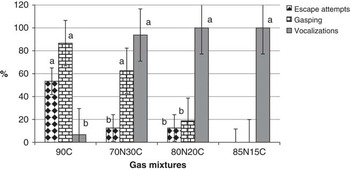
The percentages of pigs showing escape attempts, gasping and vocalizations are presented in Figure 1. No differences between treatment groups were seen in the percentage of animals that needed to be pushed into the crate (75.0%, 75.0%, 81.0% and 60.0% for 85N, 80N, 70N and 90C, respectively) and showed retreat attempts (88.0%, 94.0%, 69.0% and 93.0% for 85N, 80N, 70N and 90C, respectively) or in the time to perform it (5.5 ± 0.58 s). The percentage of animals that attempted to escape was higher (P < 0.001) when exposed to 90C than when exposed to N2/CO2 gas mixtures. The percentage of animals that gasped was higher in 90C and 70N30C than in 80N20C pigs (P < 0.001). No pig exposed to 85N15C showed gasping.
Percentage (%) of pigs that showed escape attempts, gasping and vocalizations during the exposure to 90% CO2 (90C), 70% N2 and 30% CO2 (70N30C), 80% N2 and 20% CO2 (80N20C) and 85% N2 and 15% CO2 (85N15C). Percentages with different superscript letters are significantly different (P < 0.001) among gas mixtures.

The onset of gasping and muscular excitation are shown in Table 1. Gasping occurred earlier in 90C than 70N30C and 80N20C animals (P < 0.01 and P < 0.05, respectively). In contrast, focusing on the vocalizations that occurred before the loss of balance, any animal exposed to 90C showed vocalizations, whereas a 19.0% (85N15C), 13.0% (80N20C) and 13.0% (70N30C) did.
Mean and s.e. of the time (s) to perform gasping, duration of the muscular excitation during the exposure to 90C, 70N30C, 80N20C and 85N15C

90C =90% CO2; 70N30C = 70% N2 and 30% CO2; 80N20C = 80% N2 and 20% CO2; 85N15C = 85% N2 and 15% CO2.
Means with different superscript letters are significantly different among gas mixtures.
*P < 0.05; **P < 0.01.
The time for loss of balance (28.1 ± 0.59 s) and the onset of muscular excitation (31.2 ± 0.73 s) were not different between treatments. Pigs exposed to 70N30C and 80N20C exhibited a longer (P < 0.05) duration of muscular excitation than 90C pigs (Table 1).
Loss of sensibility
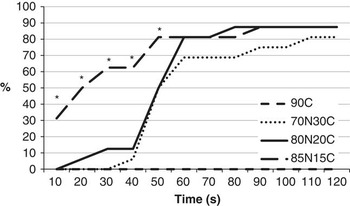
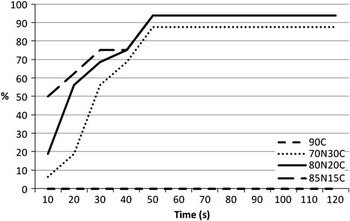
The percentages of pigs showing corneal reflex and rhythmic breathing are shown in Figures 2 and 3, respectively. Immediately after the end of the exposure, the animals showed neither corneal reflex nor rhythmic breathing. Before sticking, the corneal reflex remained absent in 70N30C and 90C. Lower (P < 0.01) percentage of pigs stunned with 80N20C recovered corneal reflex compared with 85N15C pigs (14% v. 71%, respectively). Seventy-two percent of animals stunned with N2 mixtures recovered rhythmic breathing before sticking; however, there was no difference between treatments. Moreover, 91.8% and 85.7% of the pigs exposed to N2 mixtures recovered rhythmic breathing and corneal reflex before death, respectively.
Cumulative percentage (%) of pigs that showed corneal reflex after the end of exposure to 90% CO2 (90C), 70% N2 and 30% CO2 (70N30C), 80% N2 and 20% CO2 (80N20C) and 85% N2 and 15% CO2 (85N15C). The presence of an asterisk means percentages significantly (P < 0.05) differed between treatments.

Cumulative percentage (%) of pigs that showed rhythmic breathing after the end of exposure to 90% CO2 (90C), 70% N2 and 30% CO2 (70N30C), 80% N2 and 20% CO2 (80N20C) and 85% N2 and 15% CO2 (85N15C). The presence of an asterisk means percentages significantly (P < 0.05) differed between treatments.

There was no difference in the time to perform rhythmic breathing recovery among treatments. In addition, the corneal reflex appeared earlier in 85N15C than in 80N20C and 70N30C pigs (P < 0.01 and P < 0.001, respectively) as it is shown in Table 2.
Mean and s.e. of the time (s) to perform corneal reflex and rhythmic after exposure to 90C, 70N30C, 80N20C and 85N15C

90C =90% CO2; 70N30C = 70% N2 and 30% CO2; 80N20C = 80% N2 and 20% CO2; 85N15C = 85% N2 and 15% CO2.
Means with different superscript letters are significantly different among gas mixtures.
Carcass and meat quality
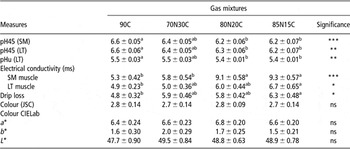
LSMEANS and standard errors of meat quality traits are shown in Table 3. The pH45SM and pH45LT were lower in animals stunned with 80N20C and 85N15C than in those stunned with 90C (P < 0.001 and P < 0.01, respectively). Although aversion signs observed during gas exposure do not appear to have an impact on meat quality variation, a negative correlation was found between the duration of the muscular excitation and both the pH45SM (r = 0.39; P = 0.001) and the pH45LT (r = 0.42; P < 0.001).
Mean and s.e. of the meat quality measurements in SM and LT in pigs stunned with 90C, 70N30C, 80N20C and 85N15C

SM = semimembranosus; LT = Longissimus thoracis; 90C =90% CO2; 70N30C = 70% N2 and 30% CO2; 80N20C = 80% N2 and 20% CO2; 85N15C = 85% N2 and 15% CO2; pH45 = pH at 45 min post mortem; pHu = pHat 24 h post mortem; JSC = Japanese Scale Colour.
Means with different superscript letters are significantly different among gas mixtures.
*P < 0.05; **P < 0.01; ***P < 0.001.
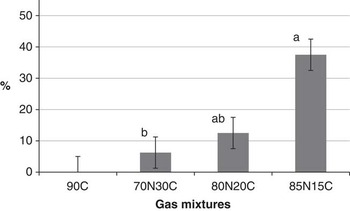
A percentage of carcasses was classified as RSE (Figure 4), which was affected by treatment (P < 0.05) but no effect on the meat colour was found. Despite the fact that pHu in LT was higher (P < 0.01) in 90C than in 80N20C and 85N15C pigs, DFD meat was not found in any of the treatments. The ECu of SM muscle was higher (P < 0.001) in animals exposed to 80N20C and 85N15C than in those exposed to 70N30C and 90C. In contrast, ECu in the LT muscle was higher (P < 0.05) in 85N15C than in 90C pigs. The correlations (r) between pH45 and ECu were −0.6 and −0.5 in SM and LT muscles, respectively (P < 0.001). Drip loss tended to be higher (P = 0.086) in 85N15C (6.3 ± 0.48) than in 90C pigs (4.8 ± 0.32). Subjective (JSC) and objective (L*, a* and b*) colour measurements were not significantly different between gas treatments. The percentage of carcasses with ecchymosis in hams was not different among the N2 and CO2 gas mixtures (25.5%), but it was significantly lower (P < 0.001) in animals stunned with 90C (0%).
Percentage (%) of carcasses with red, soft and exudative meat in pigs stunned with 90% CO2 (90C), 70% N2 and 30% CO2 (70N30C), 80% N2 and 20% CO2 (80N20C) and 85% N2 and 15% CO2 (85N15C). Percentages with different letters are significantly different (P < 0.05) among gas mixtures.

Discussion
Animal welfare
Retreat attempt is the first reaction of pigs when they are exposed to an unpleasant situation (Dodman, Reference Dodman1977). Holst (Reference Holst2002) reported more than a double proportion (49%) of pigs backing away when exposed to 90C than when exposed to atmospheric air (21%). Llonch et al. (in press) descended pigs into a pit full of CO2/N2 gas mixtures after being trained in atmospheric air, and suggested that the inhalation of these mixtures is more aversive than the inhalation of atmospheric air. In our study, the percentages of animals that showed retreat attempts during exposure to N2/CO2 mixtures and 90C were similar. However, there is a lack of information on the magnitude of this response caused by the descending movement (Raj and Gregory, Reference Raj and Gregory1996; EFSA, 2004) or by the inhalation of the gas mixtures. Thus, in cases in which the animals would not have been trained previously to be descended into a pit, retreat attempts may not be a good indicator of aversion to gas inhalation.
In our study, pigs exposed to 90C showed a higher percentage of escape attempts and gasping than pigs exposed to the N2/CO2 gas mixtures. This aversive behaviour could be because of either the irritation of the mucosa or the sense of breathlessness when this gas was inhaled. In this sense, the lower CO2 concentration of the gas mixtures may reduce the irritation of the mucosa and the sense of breathlessness, resulting in a lower aversion during the exposure. Although gasping is not an expression of aversion, it is considered a physiological reaction associated with breathlessness during the inhalation of high concentrations of CO2 (Raj and Gregory, Reference Raj and Gregory1996). It is because of residual medullary activity in the brainstem when it becomes hypercapnic (Gregory, Reference Gregory2004), and increases with higher CO2 concentration. Raj and Gregory (Reference Raj and Gregory1996) suggested that with concentrations up to 30% CO2 in a hypoxic atmosphere, the sense of breathlessness is moderate. However, in our study, based on the percentage of animals gasping, the sense of breathlessness was significantly lower when pigs were exposed to concentrations up to 20% CO2. In addition, it has to be noted that using 85N15C, no animal showed escape attempts or gasping. It is likely that, as hypothesized previously, the sense of breathlessness may be related to escape attempts, and thus the lower aversive behaviour will be found in the gas mixtures with the lowest concentration of CO2.
When exposed to 90C, none of the pigs vocalized during the induction to unconsciousness as shown by previous studies (Dodman, Reference Dodman1977; Ring and Schlager, Reference Ring and Schlager1988; Holst, Reference Holst2002). In contrast, between 12% and 19% of the pigs exposed to N2/CO2 gas mixtures vocalized before the loss of balance. Raj (Reference Raj1999) reported that sensibility evoked potentials recorded during exposure to argon-induced hypercapnic hypoxia disappeared before the onset of vocalizations. Therefore, it is not clear whether under our experimental conditions, vocalizations occurred when pigs were still conscious or not. Furthermore, it is hard to explain the presence of signs of aversion in N2-stunned pigs only. It may be assumed that the potential pain caused by the irritation of the mucosa may prevent pigs from vocalizing.
The time for loss of balance is considered the first behavioural indicator of the onset of unconsciousness (Raj and Gregory, Reference Raj and Gregory1996). When pigs are stunned with inert gases, the time for loss of balance increases compared with the pigs stunned with 90C; however, when a concentration of up to 30% CO2 is added to the inert gas, the time for loss of balance decreases to values similar to those seen with 80% CO2 (Raj and Gregory, Reference Raj and Gregory1996). Although both anoxia and hypercapnia cause a loss of consciousness, the mechanism is different. Inhalation of high concentrations of CO2 decreases the cerebral spinal fluid (CSF) pH, leading to inhibition of the cortical function (Rodriguez et al., Reference Rodriguez, Dalmau, Ruiz-de-la-Torre, Manteca, Jensen, Rodriguez, Litvan and Velarde2008), whereas brain hypoxia causes the inhibition of the reticular formation (EFSA, 2004), and results in an accumulation of extra-cellular potassium and a metabolic crisis, which – if long enough – leads to neuronal death (Rosen and Morris, Reference Rosen and Morris1991).The acidification of the CSF induces a quicker unconsciousness than hypoxia. However, the longer time to inhibit the CNS by hypoxia is enhanced by the addition of low concentrations of CO2 (<30% CO2).
In the treatments applied in this study, muscular excitation started between 2 to 4 s after the loss of balance. Some authors suggest that muscular excitation is caused by convulsions that result from the lack of modulation of the caudal reticular formation from higher centres, particularly the cerebral cortex and the rostral reticular formation (Dell et al., Reference Dell, Hugelin and Bonvallet1961; Ernsting, Reference Ernsting1965; EFSA, 2004). However, Rodriguez et al. (Reference Rodriguez, Dalmau, Ruiz-de-la-Torre, Manteca, Jensen, Rodriguez, Litvan and Velarde2008) exposed pigs to 90% CO2, and suggested that muscular excitation occurs before significant changes were shown in the brain function, which could indicate that pigs are conscious during this period. With the results of this study, it cannot be concluded whether muscular excitation in hypercapnic hypoxia inhalation occurred when the pigs were already unconscious and consequently whether it could be taken as a sign of aversion. As mentioned previously, muscular excitation is enhanced by the lack of modulation during hypoxia, which in turn is inhibited by the acidification of the CSF because of the inhalation of CO2. Thus, as already suggested by Raj (Reference Raj1999), higher the concentration of CO2 shorter the duration of muscular excitation.
The absence or presence of different easy reliable clinical brainstem reflexes (corneal reflex and rhythmic breathing) can be used to assess unconsciousness after CO2 stunning (Holst, Reference Holst2001). In our experiment, all animals were unconscious by the end of the exposure, with absence of both the physiological reflexes. However, according to the percentage of animals that recovered from corneal reflex and rhythmic breathing, the period of unconsciousness after exposure to 90C lasted until brain death due to exsanguination, whereas the majority of animals stunned with N2 mixtures recovered rhythmic breathing before sticking, and the majority of 85N15C pigs recovered corneal reflex as well. It is likely that the acidification of the CFS induces a longer period of unconsciousness than N2/CO2 mixtures. However, because of a more pronounced acidification effect of the 90C exposure compared with N2/CO2 mixtures, the reversibility of the metabolic disorders in hypercapnia may persist longer, and the return to consciousness can be delayed compared with 70N30C, 80N20C and 85N15C treatments. In fact, based on the percentage of pigs that recovered rhythmic breathing, 85N15C is the gas mixture that causes the shortest period of unconsciousness of all treatments. In brief, a higher CO2 concentration increases the duration of the unconsciousness (EFSA, 2004) during N2/CO2 mixtures stunning. Thus, in order to guarantee the unconsciousness of the animals until brain death when exposed to N2/CO2 gas mixtures, either longer time of exposure or additional methods to maintain brain inactivity are required, as already stated by Raj (Reference Raj1999).
Carcass and meat quality
Several studies have concluded that the stunning method has a large impact on blood splashes and bone fractures, as well as meat quality (Velarde et al., Reference Velarde, Gispert, Faucitano, Manteca and Diestre2000 and Reference Velarde, Gispert, Faucitano, Alonso, Manteca and Diestre2001; Troeger et al., Reference Troeger, Machold, Moje and Behrschmidt2005). Increased physical activity or stress immediately before slaughter is associated with a faster pH decline in the meat because of increased ATPase activity and lactate accumulation in the muscle (Monin, Reference Monin1988; D'Souza et al., Reference D'Souza, Dunshea, Warner and Leury1999; Terlouw, Reference Terlouw2005). Our hypothesis that aversion to gas mixture exposure during stunning could lead to an increase of stress immediately before slaughter and consequently have a negative impact on meat quality has not been supported by the results obtained from this study. In fact, although aversion occurred several seconds after the beginning of the exposure until the loss of balance (approximately 28 s), the stress response at this time might have been too weak to cause metabolic changes at the muscle level, resulting in poor meat quality.
Troeger et al. (Reference Troeger, Machold, Moje and Behrschmidt2005) showed that pigs stunned with mixtures of argon and CO2 with low concentrations of O2 had a longer and more intense muscle excitation phase compared with pigs exposed to high concentrations of either argon or CO2, which provokes an acceleration of the muscle glycolitic process at post-mortem time. Van der Wal (Reference Van der Wal1997) suggested that muscular contractions during and after stunning had a negative effect on pork quality, causing a more rapid drop in pH and a reduced water-holding capacity because of increased post mortem protein denaturation (Warris and Brown, Reference Warris and Brown1987). According to our results, animals stunned with 80N20C and 85N15C showed a longer muscular excitation and had a lower pH45 than the other experimental groups, suggesting that there was a negative correlation between duration of muscular excitation and pH45. An increase in the rate of post mortem pH fall increases the incidence of PSE meat (Troeger and Waltersdorf, Reference Troeger and Woltersdorf1991). For instance, in our study, no PSE pork was found; however, the higher prevalence of RSE meat, which is considered a milder form of PSE pork (Faucitano et al., Reference Faucitano, Ielo, Ster, Lo Fiego, Methot and Saucier2010), was found in animals stunned with 85N15C followed by 80N20C and 70N30C animals. In conclusion, the 90C treatment reduces muscular excitation compared with the N2/CO2 mixtures leading to a lower incidence of RSE meat.
The presence of ecchymosis in the ham was also affected by the duration of muscular excitation. In fact, increased muscular excitation during exposure to N2/CO2 mixtures caused a higher incidence of ecchymosis compared with 90C. Troeger et al. (Reference Troeger, Machold, Moje and Behrschmidt2005) suggested that the low concentration of residual O2 in the atmosphere also contributes to the occurrence of ecchymosis in the carcasses of pigs stunned with hypoxia. The lack of O2 in the blood vessels induces the release of catecholamines (Machold et al., Reference Machold, Troeger and Moje2003) and causes vasodilation (Wadsworth, Reference Wadsworth1994), resulting in increased blood supply and pressure. In our study, the range of O2 concentration in the gas mixtures (from 1% to 2% of volume in atmospheric air) did not show significant differences between groups, and consequently the differences in the incidence of ecchymosis may not be caused by differences in O2 concentrations. Thus, besides vasodilatation, ecchymosis may have occurred because of the rupture of muscle capillaries induced by the vigorous muscular contraction. This hypothesis can be validated by the superficial location of blood splashes, because the blood vessels on the surface are easier to tear due to muscle contraction and blood pressure rise compared with those located inside the muscle Troeger et al. (Reference Troeger, Machold, Moje and Behrschmidt2005). However, this effect was not homogeneous around the arteries of the surface, where some capillaries were torn when pressure increased.
Conclusions
According to our results, stunning pigs by the exposure to high concentration of CO2 (90C) leads to a higher aversion and breathlessness than 70N30C, 80N20C and 85N15C gas mixtures.
Loss of consciousness determined by the loss of balance is similar among the gas mixtures assessed. However, the time of unconsciousness is reduced with N2 gas mixtures with up to 30% CO2 compared with 90C when the same time of exposure is used.
Exposure to N2 and CO2 mixtures increases the duration of muscular contractions, which leads to a quicker drop of the early post mortem pH and consequently to a higher incidence of exudative pork and blood splashes.
In order to consider the N2 and CO2 mixtures as a good alternative to CO2 stunning in pigs, it should be taken into account the benefits on animal welfare in relation to the effects on meat and carcass quality.
Acknowledgements
This study was funded by the Instituto Nacional de Investigación y TecnologíaAgraria y Alimentaria of the Ministerio de Ciencia e Innovación of Spain (AGL2005-06671-CO2-01). We also thank Miss Mª José Bautista, Mr Albert Rosell and Mr Agustí Quintana for their technical support during the study.