Introduction
The aim of this article is to show how harm inflicted on nonhuman animals can be defended, albeit vaguely, by appeals to various views on social justice. Harm is something that we tend to avoid and prevent, but only certain instances of it seem to count as harms that law and morality seek to reduce or eliminate. Harm to human beings is firmly included in this category; but harm to nonhuman beings, not so much, not even in cases where the damages are clearly comparable. I will first describe the main kinds of harm that both human and nonhuman animals can encounter in terms of sentience, species-typicality, and self-awareness. I will then outline the defining features of responsible behavior and introduce an illustrative fictional case, in which a plethora of agents is involved in causing one specific harm, the death of a human being. In this case, it seems, we go to lengths to find ways of assigning responsibility for what various agents have jointly caused. I will then go on to sketch another case, this time one in which the harm befalls a nonhuman animal; and point out the relative lack of interest in apportioning responsibilities. After introducing my own model of views on justice and their mutual competition, I show how the rise of this rivalry of replacing simpler legal and ethical rules and principles supports the case of not taking the welfare of nonhuman animals seriously. I should note at the outset that here I partly contradict my own earlier views on the importance and beneficialness of justice, as understood in my depiction of it.Footnote 1 , Footnote 2 , Footnote 3 , Footnote 4
Kinds of Harm
When the debate on harming nonhuman animalsFootnote 5 , Footnote 6 , Footnote 7 (my experience of it dates back to the 1980s, and then extends sporadically to this millenniumFootnote 8 , Footnote 9 , Footnote 10 , Footnote 11 , Footnote 12 , Footnote 13 , Footnote 14 , Footnote 15) was predominantly ethical, the situation was quite clear. Ethicists from all schools of thought agreed that we should treat animals much better than we currently do in the wild, in intensive livestock farming, and in biomedical research. Some of them thought that we should talk about this in terms of animal rights,Footnote 16 others that we ought to emphasize virtues,Footnote 17 and yet others that the prevention of pain and suffering must be focal in these discussions,Footnote 18 but all agreed that harming animals the way we do is manifestly unacceptable. Animal welfare and animal rights may well be two different things, and their supporters do have their disagreements,Footnote 19 but, on a fundamental level, they still share a concern for the wellbeing of nonhuman animals.
Although legislation protecting animals from cruelty has existed already since the fifteenth century,Footnote 20 Jeremy Bentham’s statement of 1789 stands out. He wrote in An Introduction to the Principles of Morals and Legislation this famous passage:
The day may come, when the rest of the animal creation may acquire those rights which never could have been withholden from them but by the hand of tyranny. The French have already discovered that the blackness of skin is no reason why a human being should be abandoned without redress to the caprice of a tormentor. It may come one day to be recognized, that the number of legs, villosity of the skin, or the termination of the os sacrum, are reasons equally insufficient for abandoning a sensitive being to the same fate. What else is it that should trace the insuperable line? Is it the faculty of reason, or, perhaps, the faculty of discourse? But a full-grown horse or dog, is beyond comparison a more rational, as well as a more conversible animal, than an infant of a day, or a week, or even a month, old. But suppose the case were otherwise, what would it avail? the question is not, Can they reason? nor, Can they talk? but, Can they suffer? Footnote 21
The treatment of nonhuman animals in the care of people and in the wild has been the subject of many laws, treaties, and declarationsFootnote 22 , Footnote 23 since Bentham’s time, but he encapsulates the core message well from an anthropocentric, yet otherwise axiologically neutral, point of view. Whatever criteria we employ against harming people, we should also extend to nonhuman animals insofar as they meet them.
Harm to organisms and other entities can be objective, not necessarily dependent on experience; or subjective, by definition dependent on experience. Objective harms include phenomena like environmental decay,Footnote 24 , Footnote 25 the mutilation or death of a plant,Footnote 26 , Footnote 27 undetected trespasses on somebody’s property,Footnote 28 and deteriorations in an organism’s health status. All these can befall people and animals, as well as other kinds of entities, but people and many other animals are, in addition to them, also subject to personally or individually experienced harms. The subjective harms that can affect human and nonhuman animals are many and varied, but for the purposes of this article, it is enough to outline the main categories as listed in my own earlier work as well as in the work of others.Footnote 29 , Footnote 30 , Footnote 31 , Footnote 32 , Footnote 33 , Footnote 34 , Footnote 35
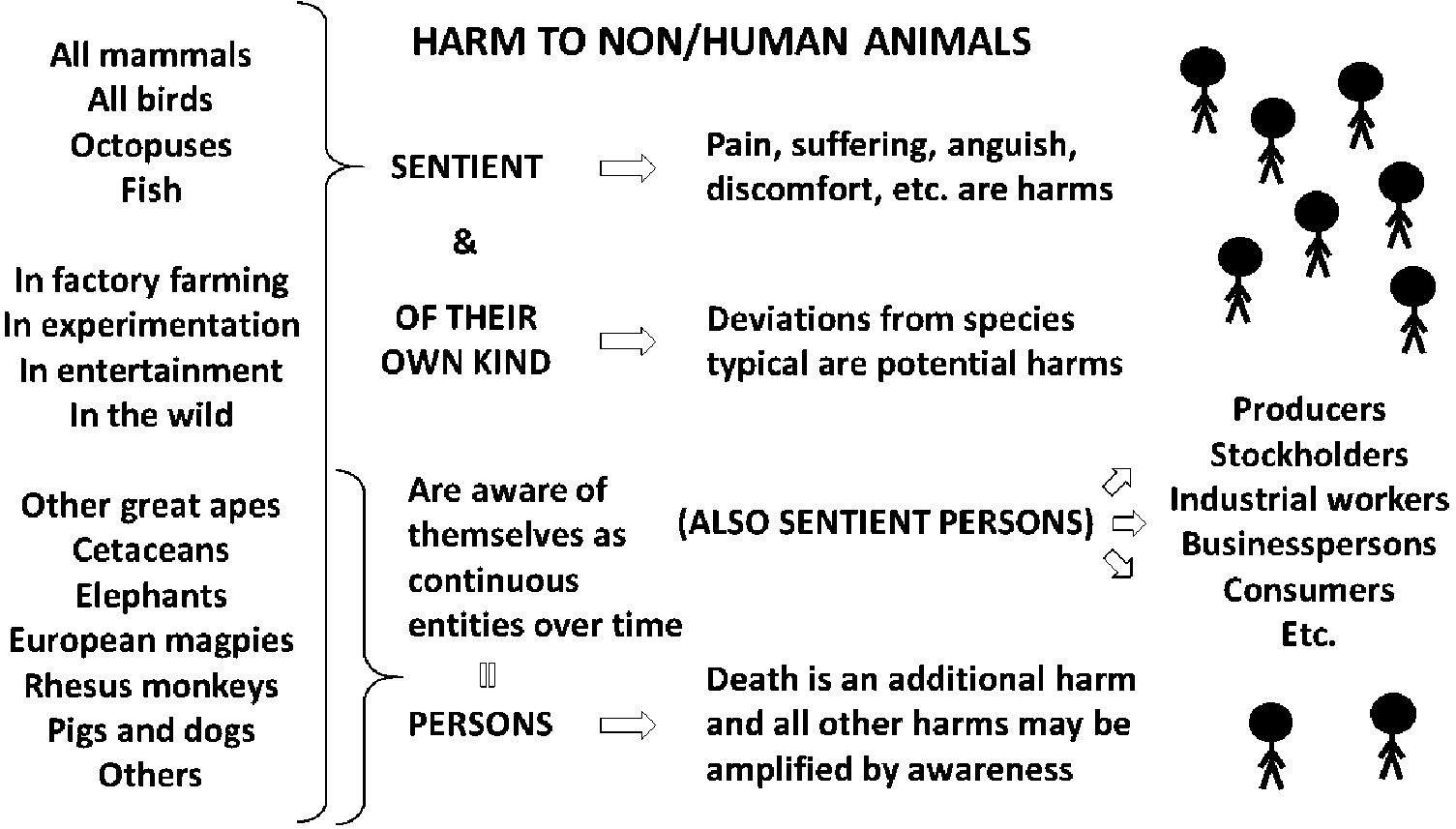
Many animals, in the wild, within medical research, in intensive livestock farming, and otherwise in human care, are sentient. They possess the ability to have subjective perceptual experiences, and most notably for animal ethics, an ability to experience pleasure and pain.Footnote 36 , Footnote 37 , Footnote 38 While some animal behavior scientists continue to question the precise definition of animal consciousnessFootnote 39 and sentience and their relevance,Footnote 40 neuroscientists seem to be more confident about the scientific foundation of the case.Footnote 41 The first clear category of subjective harm to human and nonhuman animals, then, is to expose them to suffering, which can have many guises, including pain, anguish, and discomfort. It is worth noting that the European Union has made sentience the starting point of its animal welfare regulation.Footnote 42
All animals are also of their own kind, which means that they have species-typical ways of conducting their lives.Footnote 43 Species-typical behavior usually goes hand in hand with animal welfare, which is why it is important not to interfere with it in the wild,Footnote 44 and why we should secure for companion, display, farm, and laboratory animals the freedom to express normal behavior—for instance, “by providing sufficient space, proper facilities and company of the animal’s own kind.”Footnote 45 Breaches against these are, however, the norm rather than the exception in many parts of industrial food production,Footnote 46 animal entertainment,Footnote 47 , Footnote 48 , Footnote 49 and our exploitation of the natural environment,Footnote 50 while scientific experimentation with animals is also struggling to get the balance right.Footnote 51
In addition to these, some animals are psychological persons. By this, I mean simply that they are aware of themselves as separate entities in space and time, and have memories, expectations, hopes, and fears.Footnote 52 , Footnote 53 We can express this idea in a more complicated way,Footnote 54 and we can challenge it on various grounds. The main normative significance of personhood in this sense is that we ought not to kill whoever possesses it against their own will.Footnote 55 If the criterion is seen to be necessary, that is, if we believe that the prohibition against ending a being’s life requires psychological personhood, we may think that the account leaves valuable ‘non-persons’—human embryos,Footnote 56 , Footnote 57 infants,Footnote 58 , Footnote 59 , Footnote 60 , Footnote 61 people with severe intellectual disabilities,Footnote 62 , Footnote 63 , Footnote 64 , Footnote 65 nonhuman animals with higher emotions,Footnote 66 and the like—without due protection. If the criterion is only seen to be sufficient,Footnote 67 however, we can identify another kind of harm, apart from violations against sentience and species-typicality, namely, the frustration of expectations by externally- and involuntarily-induced death.
Most adult human beings are sentient persons with their species-typical and individual needs and desires. Nonhuman persons includeFootnote 68 the other great apes (chimpanzees, gorillas, orangutans, and bonobos),Footnote 69 cetaceans (whales and dolphins),Footnote 70 , Footnote 71 elephants,Footnote 72 European magpies,Footnote 73 rhesus monkeys,Footnote 74 probably pigsFootnote 75 and dogs,Footnote 76 and quite possibly others. Sentient nonhuman beings include all mammals and birds, fish, octopuses, and more.Footnote 77 Figure 1 summarizes the forms of harm that can encounter different kinds of animals.
Forms of harm to nonhuman and human animals.

Conditions of Responsibility
Responsibility for harm is, in theory, a straightforward matter. You cause it, you make yourself responsible for it, give or take a few qualifications. Let me outline the basic elements in play.
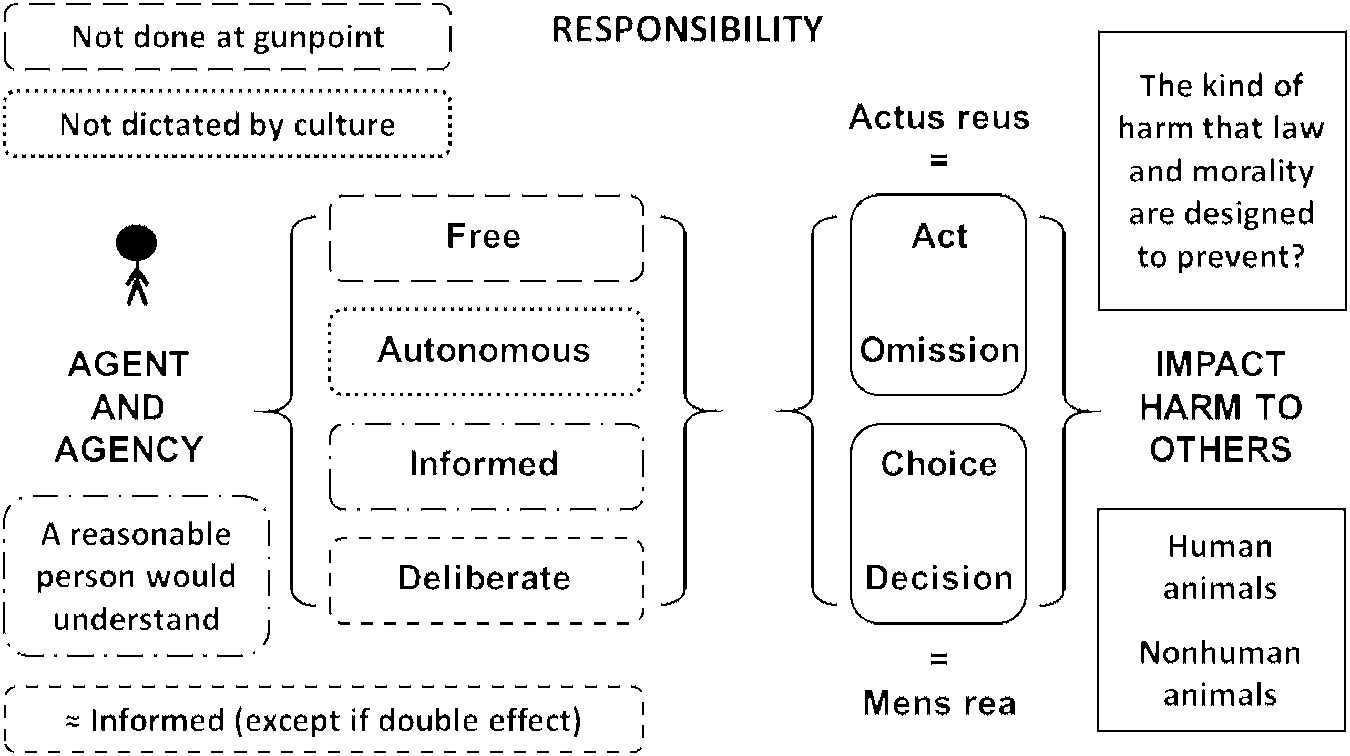
Responsible action requires an appropriate agent, and proper agency. To be well and truly responsible for harm, the agent and the deed must be free, autonomous, informed, and deliberate. All these have detailed specifications in legal and philosophical literature,Footnote 78 , Footnote 79 , Footnote 80 but simple characterizations will suffice to make the point here. Freedom means that outside forces do not coerce the agent to act or fail to act.Footnote 81 Autonomy in this context entails that culture, traditional or administrative, does not dictate the agent’s decisions.Footnote 82 To be informed does not necessarily imply that the agent would actually know everything about the choices and their impact; instead, it means that a reasonable person would understand the nature and consequences of the action or inaction in question, and that nothing prevents the agent from being such a person.Footnote 83 Actions and inactions usually count as deliberate, if they are informed in the sense just defined, a notable exception being cases in which they have two axiologically different outcomes.
The two outcomes excuse has a long history, starting with the thirteenth-century writings of Thomas Aquinas,Footnote 84 and scholars have applied it, the doctrine of double effect, to various medical and healthcare contexts, including abortion,Footnote 85 , Footnote 86 euthanasia,Footnote 87 and vaccinations against deadly diseases.Footnote 88 Put simply, “This doctrine says that if doing something morally good has a morally bad side-effect it’s ethically OK to do it providing the bad side-effect wasn’t intended. This is true even if you foresaw that the bad effect would probably happen.”Footnote 89 In a diluted form, this idea seems to offer a justification for some types of causing harm that are relevant to my narrative here, and I will return to this in the subsections below.
Other technical requirements of responsibility are the guilty deed (actus reus) constituted by an act or an omission and the guilty mind (mens rea) associated with the choice or the decision. These alone as criteria, however, would make us responsible for all and any consequences of our conduct, indeed of our very existence. Fyodor Dostoyevsky summarized the strict liability suggested by this in The Brothers Karamazov in Father Zosima’s testimonial:
There is only one salvation for you: take yourself up, and make yourself responsible for all the sins of men. For indeed it is so, my friend, and the moment you make yourself sincerely responsible for everything and everyone, you will see at once that it is really so, that it is you who are guilty on behalf of all and for all. Whereas by shifting your own laziness and powerlessness onto others, you will end by sharing in Satan’s pride and murmuring against God.Footnote 90
As this would probably not produce solid legal or ethical advice in real-life cases, it is just as well that we also have the other four criteria in place.
Responsibility for harm, then, is the function of all these factors. The next question is, what kind of harm are we talking about? Questions about probability and related features are essential to full analyses.Footnote 91 , Footnote 92 , Footnote 93 , Footnote 94 Even more pertinently, however, echoing the words of Antony Honoré and John Gardner,Footnote 95 we should ask in every instance: Is this the kind of harm that law and morality are designed to prevent? The answers, as we shall see, are different for human and nonhuman animals. Figure 2 delineates the main elements of responsibility for harm, as laid out in the above.
The main elements of responsibility for harm.

The Human Case
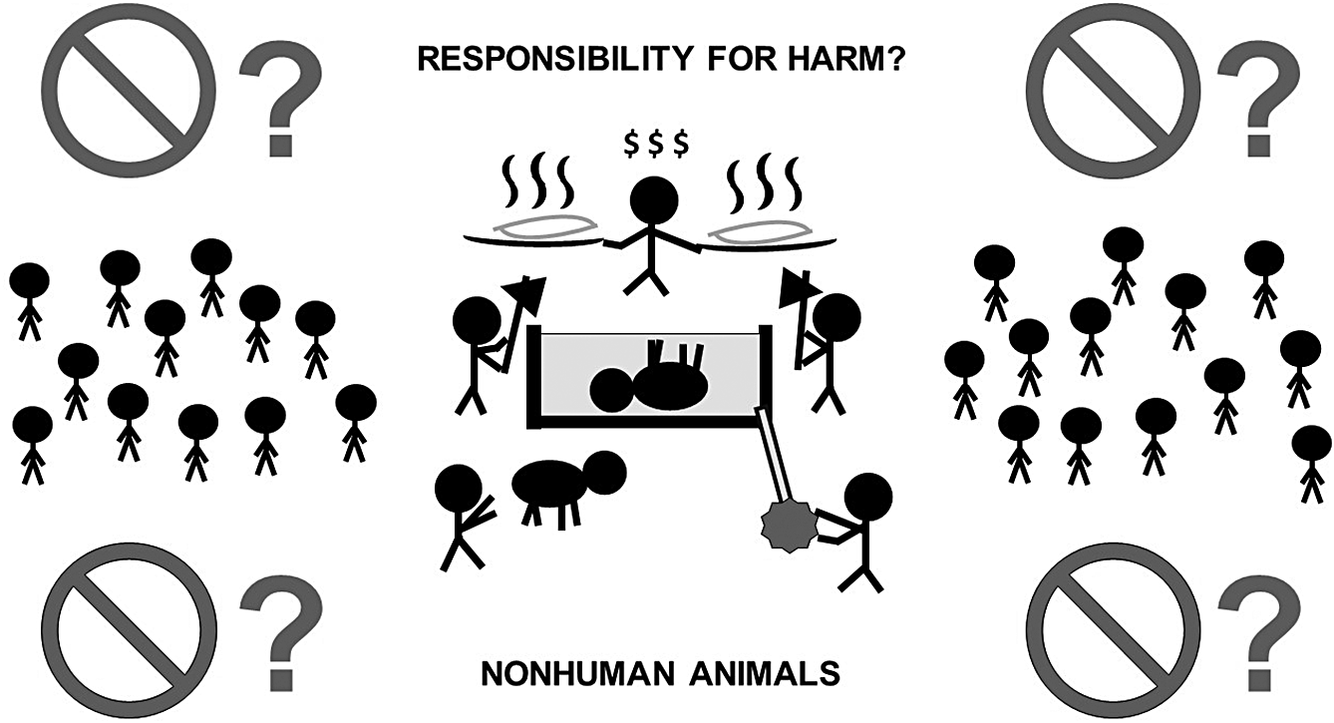
Figure 3 illustrates my example of how we can cause harm to human persons, what excuses we can make, and how law and morality respond to our excuses.
The human case.

The central figure is lying in a tub of water, drowned and dead. The two persons walking away from the tub with rolling pins in their hands assaulted the central figure and left their victim unconscious. There was no water in the tub at this point. The water poured in later, when a city maintenance worker opened, as a part of a routine, the crucial valve, without knowledge of the person in the tub. The sitting persons on the left saw the original assault, but did not interfere, one because of a pacifist conviction and the other due to a macho ideal of letting people fight it out. The businessperson with the dollar signs produced the rolling pins and sold them to the assailants. The other people on the right and on the left encouraged the attackers, because they saw the victim as a threat to their way of life.
When asked about their involvement, some of the people who egged the thugs on appeal to cultural reasons, claiming that they could not help themselves. The city maintenance worker says, “I was just doing my job.” The onlookers point out that they did not actually do anything,Footnote 96 and that, besides, their contribution to the death of the victim was not decisive.Footnote 97 , Footnote 98 The assailants and the businessperson share this defense, and the latter is prone to add that making a living by producing and selling useful products is hardly a crime.
When it comes to humans, however, we are quick to find flaws in excuses like these. Perhaps the maintenance worker should have checked before letting water flow into the tub, and is therefore guilty of negligence. Perhaps the onlookers had a duty of care in the case, as healthcare professionals,Footnote 99 police officers, security workers, or just decent human beings and upright citizens. We can probably dismiss the cultural defense without further ado, because although the pressure of tradition may well have a strong influence, its use as a justification for premeditated violence against individuals is suspect. This leaves us with the ‘not decisive contribution’ and ‘double effect’ excuses. They are best examined in the light of the jurisprudential principle called the ‘but for’ rule.
The But For Rule, Inconclusive Contribution, and Collateral Damage
As a caveat, I am not introducing the but for rule here because it would give, in and by itself, straightforward answers to questions of responsibility. It is an instrument for determining factual, not legal,Footnote 100 responsibility in primarily tort and secondarily criminal law, often criticized for its flaws,Footnote 101 and not always a reliable source of binding legal or moral solutions. Its attraction for my present case actually lies in its exceptions.
Anyway, this is how West’s Encyclopedia of American Law defines it:
To help determine the proximate cause of an injury […] courts have devised the “but for” or “sine qua non” rule, which considers whether the injury would not have occurred but for the defendant’s negligent act.Footnote 102
In other words, if the harm under consideration depends on my choice, decision, act, or omission, I am factually responsible for it. Put like this, the test can give both results that are intuitively too broad, and results that are intuitively too narrow. If the great-great-great-grandparents of the person who now lies dead in the water tub had not decided to have sex at the precise time when they did, conceiving one of the victim’s great-great-grandparents, the victim would not have existed, and the harm would not have occurred. Are they, then, responsible for the death? In a causal sense, they are, but legally and morally, this is not much to go by (although it raises interesting questions about parental responsibility).Footnote 103 , Footnote 104 , Footnote 105 , Footnote 106 The test can spread responsibility too widely, and we should augment it with other criteria. Mirroring this, an assailant can argue that while the assault may have contributed to the harm, we can identify many other agents who did, too, making it difficult to say whose deed was decisive. This means that the test can give a way out to someone who actually was an important factor in causing the harm, and again we need revisions to the rule.Footnote 107 Those revisions are the crux of my human case.
In the case described in Figure 3, only the maintenance worker who opened the vault and let the water flow into the tub is clearly factually responsible for the death. But for that act, the assaulted person would not have drowned. A case against the onlookers is possible—had they not stood idly by, the victim would not have been in the tub when the water flowed in—but the logic of such indirect negative causation is enough to give me at least a slight headache. All the others can say, quite truthfully, that the death could have occurred without their contribution. The individuals who encouraged the thugs can argue that the collective effect would have been there even if they had not promoted it. The businessperson can observe that rolling pins are available from other manufacturers and shops. Both assailants can claim that a blow thrown by the other rendered the victim unconscious.
Law and morality have not sanctioned all these excuses, however. The drift of the seminal Supreme Court of California ruling on the case of Summers v. Tice in 1948,Footnote 108 for instance, considerably weakens the case of the assailants. To cut a long story short, three people went hunting, two discharged their shotguns, and the third got a pellet in his eye and another in his lip. The third sued the other two, who both appealed to the but for rule, saying that the pellets could have come from the other hunter’s shotgun. The court ruled that the burden of proof is on the defendants, whose careless gun handling collectively caused the damage. Applied to my human case, the two thugs could be held similarly responsible (and more so, given their violent intent).
The doctrine of double effect could be the foundation of the businessperson’s plea in the human case. Producing rolling pins provides a service to the baking population and society, and this, with creating returns, is the primary purpose of the business. It is beyond the producer and seller’s control, if some deranged individuals choose to use the rolling pins as harmful weapons.
This, of course, makes sense, but cases exist where things have been seen in a different light. One such case is Sindell v. Abbott Laboratories, another Supreme Court of California ruling in 1980.Footnote 109 The outline of the story is as follows. A woman was estrogen medicated with the drug diethylstilbestrol (DES) during her pregnancy. Years later, her daughter got cancer, and sued a pharmaceutical company, Abbott Laboratories. The company pleaded that since DES is a fungible drug, made out of interchangeable and generic components, it was impossible to determine that their product was the one responsible for the outcome. True to form, however, the court ruled that, again, the burden of proof lies with the pharmaceutical companies, although a dissenting judge accused the verdict of political activism. No one has taken rolling pin factories to court using this precedent so far, but the case shows that law and morality can find fault in legitimate businesses, even if their contribution to damage is not straightforward.
The Supreme Court of California is not the ultimate judge in these matters, and it is not my point to prove anything specific by its rulings. They demonstrate a tendency, however, to take harm to human beings seriously. Those causally responsible are actively scrutinized, and harm to humans is clearly the kind of harm that law and morality seek to prevent.
The Nonhuman Case
Figure 4 illustrates my example of how we can cause harm to nonhuman beings.
The nonhuman case.

We harm nonhuman animals in many ways in industrial food production,Footnote 110 , Footnote 111 in laboratories,Footnote 112 in entertainment,Footnote 113 and in the wild.Footnote 114 Death, suffering, pain, anxiety, captivity, loss of habitat, violations of species-typicality, and loss of dignity are common, and their occurrence does not require particular cruelty or breaches of the minimal animal protection rules that we have.Footnote 115 Some people do the harassing, imprisoning, and killing, others facilitate them in their task, some stand idly by and watch this happen, businesspersons organize the production and sell the results to the general public, who by their attitudes and consumption habits encourage the killers and captors and their enablers. The picture bears a striking resemblance to that of the human case.
When it comes to assigning responsibilities, however, the resemblance evaporates. Although the factual responsibility for harm to animals is as clear as the harm to the dead human person in the water tub, most of us are not interested enough to draw the legal or moral conclusions. Animal welfare and animal rights activists try to get the message through, but the general publics are not too enthusiastic about it, at least not enough to demand radical changes. Harm to nonhuman animals in the ‘normal’ course of affairs is not something that law or morality seek to prevent.
The sharp distinction between human and nonhuman animals makes little sense, when we look at the situation from the viewpoint of ethics. According to consequentialist theories, we should prevent and minimize harm.Footnote 116 According to Kantian duty- or right-based ethics, we have an obligation not to harm unless it is somehow necessary.Footnote 117 According to virtue ethics, harming human or nonhuman animals for frivolous reasons is not a thing to be done.Footnote 118 How, then, can we justify our current general indifference in the face of animal suffering?
An Excursion to a Turn in Western Moral and Political Thought
The answer may lie in a significant historical turn in Western moral and political philosophy, and moral thought more generally. The 1970s and the 1980s, the times when straightforward animal ethics thinking was gaining ground, were the back end of Western philosophy’s reaction to the atrocities of the Second World War.Footnote 119 The theoretical turn toward justice as the focal concept had already began with John RawlsFootnote 120 and his critics,Footnote 121 , Footnote 122 , Footnote 123 , Footnote 124 , Footnote 125 , Footnote 126 but it was not in full swing yet. Instead, philosophers addressed a wide variety of practical problems: revenge on wartime Nazi collaborators,Footnote 127 , Footnote 128 gender inequality,Footnote 129 , Footnote 130 racism,Footnote 131 ethical warfare,Footnote 132 famine,Footnote 133 civil disobedience,Footnote 134 violence by omissions,Footnote 135 and many others. The normative grounds for solving these problems were simple and centered on causing harm and violating rights, often in combination.
Two developments steered analytical philosophers toward more complicated, and in a sense less helpful, considerations. One was the rise of neo-Aristotelian thinking,Footnote 136 , Footnote 137 , Footnote 138 , Footnote 139 , Footnote 140 , Footnote 141 which offered crisp criticisms against utilitarian harm-based solutions; the other was the hijacking of Kantian and rights-oriented approaches by Rawls, with his friends and foes. This is how I portrayed the situation twenty years ago:
The publication of A Theory of Justice has, paradoxically, also hindered the development of rights-based applied philosophy in the United States. The inventive and complex theory put forward by Rawls has during the last two decades bewitched the majority of American moral philosophers, and the result is that they have ceased to pursue applied ethics as an autonomous academic subdiscipline. Some of them have focused their attention on the criticism and development of the views presented by Rawls, and others have set out to find alternative theories of justice and individual rights. There are also a number of American moralists who have specialized in the application of ethical theories to problematic real-life situations. But their work in what might be called “casuistry”, or the mechanical application of authoritative moral doctrines, has tended to create new semi-philosophical professions rather than to further the scholarly study of ethical issues. Bioethics, business ethics and professional ethics are examples of activities which are now beginning to live their own lives quite apart from any truly philosophical concerns.Footnote 142
Apart from the decided unfairness toward casuistry (which does not necessarily involve the mechanical application of theories)Footnote 143 and a total oversight of the rising feminist and gender studies (also in philosophy),Footnote 144 , Footnote 145 , Footnote 146 I believe that this is not a bad description. At least I realize now that, for a long time after writing the passage, I tried to find a role for philosophers as philosophers amidst the ongoing professionalization of ethics.Footnote 147 , Footnote 148 , Footnote 149 , Footnote 150 , Footnote 151 , Footnote 152 , Footnote 153 , Footnote 154 , Footnote 155 , Footnote 156 , Footnote 157 The crux of the matter, however, is that with the introduction of justice talk and its ensuing diversification, a kind of undesired relativism set in,Footnote 158 , Footnote 159 and quite possibly blinded us from seeing, for instance, the continuing plight of nonhuman animals.
This turn in analytical philosophy, if verifiable, could explain the quick historical change that otherwise puzzles me. When, decades ago, I advocated animal welfare and animal rights, this was a simple and uncontroversial task, as all good social ethicists agreed that we should account for all human and nonhuman beings alike in our decisions. To borrow illustrative language from a different philosophical tradition, in Judith Butler’s terms,Footnote 160 , Footnote 161 all lives were grievable and all deaths mournable. When I returned to the scene, however, the nonspeciesist ethos was gone. Some still defended the lives of nonhuman animals, but others objected on various pragmatic and ideological grounds. Studies on social justice could provide a key to understanding this shift. (This may also relate to a wider cycle in philosophy that I have only just started to study.)Footnote 162 , Footnote 163 , Footnote 164 , Footnote 165 , Footnote 166 , Footnote 167 , Footnote 168 , Footnote 169 , Footnote 170 , Footnote 171 , Footnote 172 , Footnote 173 , Footnote 174 , Footnote 175 , Footnote 176 , Footnote 177 , Footnote 178 , Footnote 179 , Footnote 180 , Footnote 181
The Discursive Shift from Law and Ethics to Social Justice
How can a turn toward justice be detrimental? Is not justice always a good thing? I will try to explain this apparent paradox against the background of my own recent work.Footnote 182 , Footnote 183
Discussions on social justice start by considerations of equality. Most of us agree that we ought to treat all those included in our moral sphere with equality, equity, and fairness, we must hear them or consider their interests in decisions affecting them, and we should see to it that everyone counts as one and no one counts as more than one in political procedures. Beyond this, however, disagreement is rife on all possible fronts. In a map of political moralities that I have drawn, I have set competing theories to comparative places.Footnote 184 The three main dimensions that mark the distinctions in my map are control of means of production (private or public), the generality of moral and political norms (universal and same for all or positional and focusing on differences), and the nature and extent of our moral and political concern (tradition and our own first or calculable wellbeing and global reach).
The map distinguishes six main approaches to justice—care ethical, communitarian, neoliberal, capability, utilitarian, and socialist—and highlights their features, differences, and similarities. This reveals interesting details. In some cases, doctrines that share important premises still clash violently. In others, creeds that are at the opposite ends of a theoretical continuum can work together surprisingly well. Figure 5 shows the map, illustrates the dimensions and the locations of the main theories on the map, and sketches some of the oddities of their mutual relationships.
The map of justice, its main dimensions, and its apparent oddities.

Starting from the top right of Figure 5, feminism in its many forms extends from universalism to positionalism. Theoretically, this is an extraordinary stretch, but for practical purposes, the union seems to be quite natural. At the care ethical, possibly intersectional end,Footnote 185 women’s different moral abilities are central, and at the capabilities, possibly human rights, end,Footnote 186 , Footnote 187 , Footnote 188 oppressed women’s equal opportunities are focal, but both approaches serve the same end, namely the enfranchisement of women.
On the bottom right, classical liberalism proclaims that if we keep government interventions in free trade at a minimum, this will maximize, through the invisible hand of the market, the wealth of nations and humankind. The combination is peculiar, because it seems to embrace the diametrically opposed doctrines of egoism and altruism. This is not, however, a worry to the model, for several reasons. Adam Smith, the ‘founder’ of classical liberalism, did not mean that governments must keep their hands off businesses, but that we should remove all hindrances to the free market in the ideal sense—imperfect knowledge, unequal power relations, and the like.Footnote 189 Bernard Mandeville, who initiated the idea that private vices produce public good, presented it as a satirical provocation.Footnote 190 Moreover, the core claim made, that letting individuals pursue their own unlimited self-interest ultimately serves the interests of the majority, is an unverified empirical assertion.
The bottom left of Figure 5 is a reminder that positional identity politics can take different courses depending on whose identity we want to protect. Communitarian nationalists (and not all communitarians are nationalists) may disagree strongly with care intersectional feminists (and not all care ethics advocates are intersectional feminists), but this is just how things are at the nonuniversalist end of moralities. The clash is a reminder, though, that some, if not all, of the six theories named in the figure have further internal splits. Some conservative feminists who believe in the curing force of the feminine virtue differ fundamentally from more radical gender diversity advocates who embrace the lesbian, gay, bi, transsexual, queer, and so on differences.Footnote 191 Communitarians, too, come in different packages, some promoting traditional indigenous practices and others concentrating on racial and ethnic distinctions between ‘us’ and ‘them.’
The top left corner, finally, reminds us that in real-life politics, the distance between nationalism and socialism is not necessarily that great.Footnote 192 , Footnote 193 , Footnote 194 , Footnote 195 Both doctrines are collectivist (collectivism goes hand in hand with positionalism), and both find a common enemy in individualism, be that neoliberal, capability-oriented, or liberal utilitarian.
These unholy alliances apart, the extremes in Figure 5 diametrically oppose one another, as they conceptually should. The ensuing theoretical and ideological conflicts create a fragmented scene for discussions on what is right and what is wrong, and what we should and should not do. Some scholars have tried to save the day by introducing compromise views. According to these, we can find common ground through thought experiments by which we define our basic goods (John Rawls and his veil of ignorance),Footnote 196 wisely devised lists of central capabilities (Martha Nussbaum and her Aristotelian-Marxist-liberal approach),Footnote 197 or an appeal to the millennia-old values of the Western civilization (Jürgen Habermas and his axial-age principles of freedom and equality).Footnote 198 , Footnote 199 It seems, however, that attempts at moderation only encourage scholars at the edges of the map to produce even more extreme alternatives.
The map suggests, then, that the weakness of arguing in terms of political justice (instead of mutual ethical convictions) is this: since we can plausibly defend contradictory views within their own background assumptions and since these assumptions are difficult to challenge in the absence of a shared foundation, a kind of lackadaisical relativism is almost bound to set in.
The Shift to Justice Discourse and the Plight of Nonhuman Animals
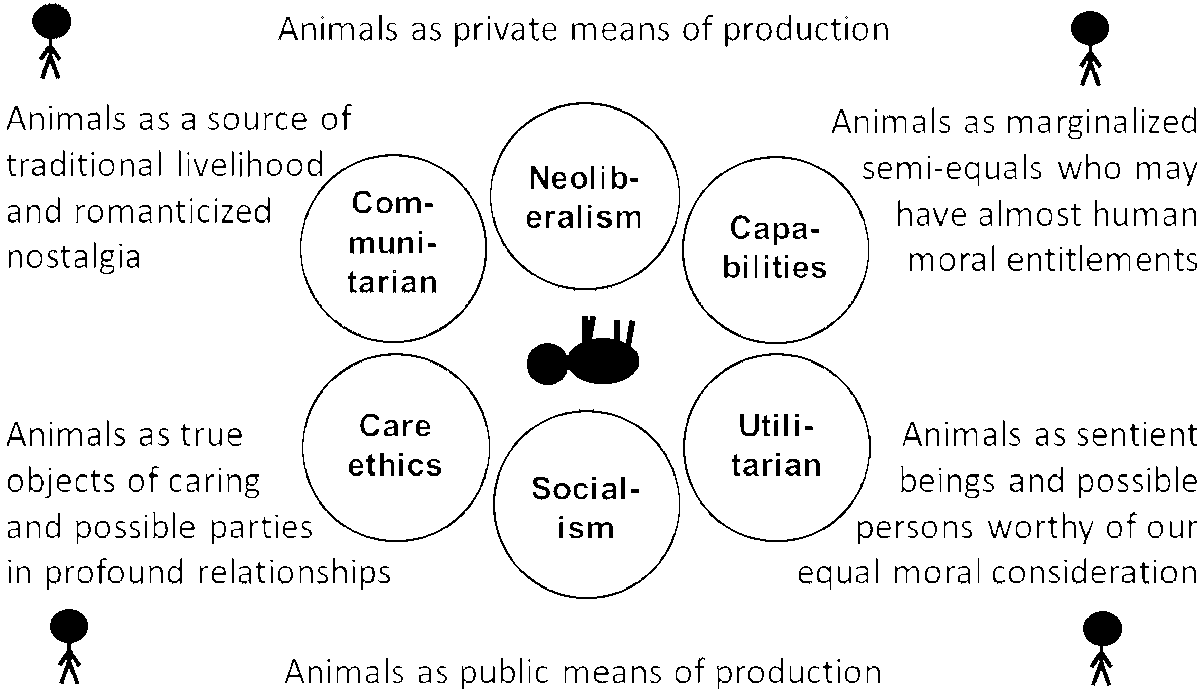
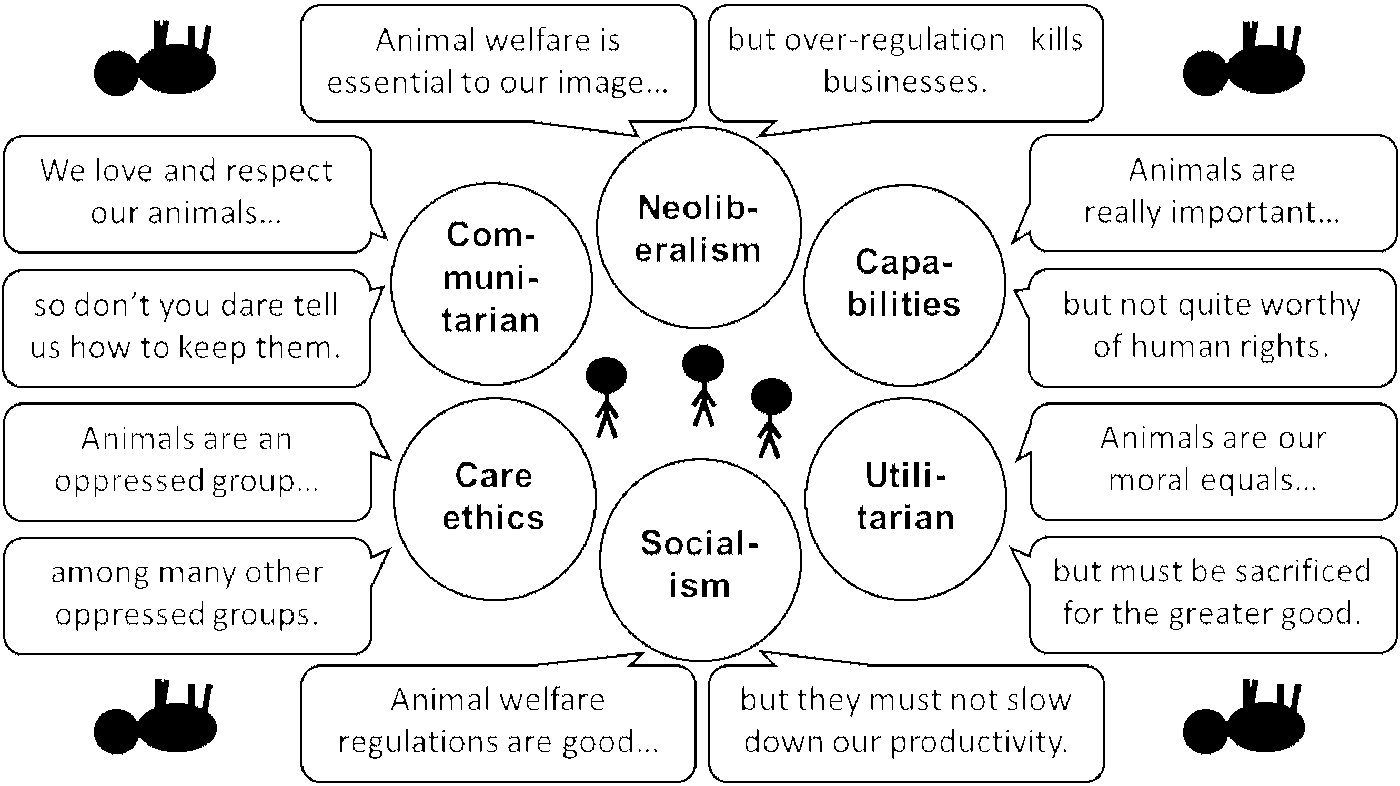
All theories of justice agree, on some level, that we should treat equally all those included in our moral sphere. Unfortunately for nonhuman animals, however, they are only included in ‘our moral sphere’ in one or two of the six (or nine with the compromise attempts) main approaches to justice. Figure 6 displays some main views on animals against the background of the theories of justice on my map.
Views on nonhuman animals and the main theories of justice.

NeoliberalismFootnote 200 and socialism,Footnote 201 the top and bottom doctrines in Figure 6, see nonhuman animals primarily as means of production. The fact that one considers them private and the other public property does not make a difference; the truth remains that these means of production are things, objects, and do not belong to our sphere of moral equals. We may treat them well either because this makes them more productive or because we want to create an ethical image for our business, but these considerations are instrumental and do not regard nonhuman animals as ends in themselves.
Communitarian thinking has many forms, and different versions interpret the status of nonhuman animals differently. Some traditional interpretations give certain animals special protections because they are sacred (the holy cows in India),Footnote 202 but as communitarians abhor measurements of calculable wellbeing, harm to animals, if needed, is otherwise not a problem.Footnote 203 Sacred species apart, the treatment of nonhuman life depends on human practices, customs, and traditions, and since these center on people, people take priority as holders of intrinsic moral worth.
The capabilities approach clearly has potential to take into account the wellbeing of marginalized groups, so in theory, nonhuman animals could gain support from the top right corner of Figure 6. The doctrine is designed to account for authentic or nonadaptive preferences that individuals do not even necessarily know that they have, so animal consciousness could be an example of possibly unclear minds that need our help in flourishing.Footnote 204 When it comes to the further development of such ideas, however, both main branches of the creed tend to wander to directions that are not necessarily helpful for the cause of nonhuman animals.Footnote 205 The version that refuses to draw universal lists of the most important capabilities remains steadily focused on human concerns.Footnote 206 , Footnote 207 The version that relies on a definite list of basic capabilities, in its turn, ultimately makes cultural judgements the cornerstone of morality, and these may go against, as well as for, animals in particular cases.Footnote 208
Care ethics is a strong candidate for an animal-friendly political theory. Feminist activism has supported animal welfare and animal rights,Footnote 209 and scholars have made visible contributions on the intellectual level.Footnote 210 The fight for animals may take the back seat, however, when all the world’s worries weigh on care ethicists and recognition and identity advocates. Struggling between conservative nationalists on one side and liberal utilitarian elites on the other may, quite legitimately, lead to the prioritization of human concerns over nonhuman ones. When people face discrimination based on their (perceived) gender, sexual orientation, ethnicity, race, nationality, age, disability, health condition, behavior, and so on, it is not unreasonable to turn the attention to these abuses first.
Utilitarianism, finally, is the one creed that can wholeheartedly embrace the welfare and entitlements of nonhuman animals.Footnote 211 From Jeremy Bentham on, notable utilitarians have stepped up to do this,Footnote 212 , Footnote 213 , Footnote 214 , Footnote 215 , Footnote 216 , Footnote 217 , Footnote 218 and the case for animals that I have sketched in the subsection on kinds of harm that can befall human and nonhuman beings above has a decidedly utilitarian flavor. This is not to say, however, that utilitarianism would be the hands-down solution to the issue. The majority of utilitarians, historical and contemporary, have paid little attention to nonhuman wellbeing, desires, and preferences, either because their focus has been on ‘higher’ human affairsFootnote 219 , Footnote 220 , Footnote 221 or because, of late, they have lost themselves in comparisons between severely intellectually disabled human beings and healthy animal persons.Footnote 222 , Footnote 223
Figure 7 illustrates the cacophonic discourse concerning ideas of animal rights and wellbeing against my map of justice.
Lines in the animal discourse and theories of justice.

Caveats and excuses abound in the case of nonhuman animals, and they are not challenged with the same vigor that confronts attempts to explain away harm to humans. I blame this on justice, sort of.
In the end, it is not that theories of justice, as such, would support cruelty to animals. They do not. It is not even that they, as such, would be indifferent to animal suffering. They are not. The damage, as I see it, is due to the discursive shift from simple ethics to complex politics. The disagreements between utilitarians, Kantians, and virtue ethicists did not prevent them from presenting a relatively united front against institutions that promote the suffering of nonhuman animals. The disagreements between theories of justice, however, with their primary focus on human winners and losers of policies and regulations, marginalizes the fate of nonhumans. Their miserable lives and premature deaths are not important, or mournable, to the extent that they were in the earlier discourse. This is how I believe that the discursive shift from law and ethics to political justice sealed, for now, the plight of nonhuman animals.