Mexico's Gulf Olmec civilization refers to the bundled Early-to-Middle Formative (3450–2350 b.p.)Footnote 1 cultural expressions traditionally associated with the coastal portions of southern Veracruz and northern Tabasco. This coastal region is perhaps best known as “Olman” or the “Olmec Heartland;” such designations reflect archaeological fancy that has varied over the last 60 years (Diehl Reference Diehl2004; Grove Reference Grove1997; Pool Reference Pool2007). San Lorenzo (Coe and Diehl Reference Coe and Diehl1980; Cyphers Reference Cyphers1997) and La Venta (Drucker Reference Drucker1952; Drucker et al. Reference Drucker, Heizer and Squier1959) remain the marquee Gulf Olmec settlements. Excavations of Gulf Olmec deposits beyond these centers' respective hinterlands are relatively uncommon, but archaeological surveys have identified Early-to-Middle Formative materials throughout the Gulf Olmec region (Borstein Reference Borstein2001; Kruger Reference Kruger1996; Pool Reference Pool2003; Santley and Arnold Reference Santley and Arnold1996; Symonds et al. Reference Symonds, Cyphers, Lunagómez and Cyphers2002).
Megalithic sculpture—documented using systematic as well as fortuitous methods—has also shaped our understanding of Olman. Such artwork holds a hallowed place in Gulf Olmec studies; historic overviews often begin with the nineteenth-century discovery of the first colossal head and go on to recount a treasure trove of sculpted pieces (see, for example, Benson Reference Benson, Benson and de la Fuente1996; Bernal Reference Bernal1969; Diehl Reference Diehl2004; Piña Chan Reference Piña Chan and Minelli1989; Pool Reference Pool2007). In fact, the spatial distribution of this artwork has come to demarcate the Gulf Olmec region itself—from Tres Zapotes on the west to La Venta on the east, extending southward to Las Limas (Bernal Reference Bernal1969:15; Cyphers and Zurita-Noguera Reference Cyphers, Zurita-Noguera, Lucero and Fash2006:Figure 2.1; Lowe Reference Lowe, Sharer and Grove1989:Figure 4.2). It is no stretch to say that megalithic sculpture literally put the Gulf Olmec “on the map.”
Given this long-standing emphasis, it is worth remembering that megalithic art is by no means the most ubiquitous form of Gulf Olmec sculpture. Nor can portable artifacts such as greenstone masks and jade axes claim that title. Instead, the honor falls to a more humble form of artistic expression—small clay figurines modeled by hand (Follensbee Reference Follensbee2000:21–22, Reference Follensbee, Halperin, Faust and Taube2009:77–78).
In this paper we discuss Early Formative (3250–2700 b.p.) figurines from the site of La Joya, Veracruz. Although La Joya is located within the region traditionally identified as Olman, the site does not exhibit the sculptural tradition that often warrants a Gulf Olmec designation (Diehl Reference Diehl2004:18–19). Moreover, La Joya represents one of the few Early Formative Olman domestic contexts excavated beyond the immediate vicinity of a Gulf Olmec center. Such studies draw attention to the variation that may have characterized different lifeways throughout the southern Gulf lowlands (Arnold Reference Arnold, Clark and Pye2000, Reference Arnold and Powis2005, Reference Arnold, Nichols and Pool2012; Grove Reference Grove1994; Pool et al. Reference Pool, Ceballos and Loughlin2010).
La Joya's figurine corpus provides an excellent opportunity to explore this variation. To date, San Lorenzo and San Lorenzo-like materials have dominated discussions of Early Formative Gulf Olmec lifeways; given this history, a comparison with the San Lorenzo figurine collection is as inevitable as it is informative. The San Lorenzo material was originally reported by Coe and Diehl (Reference Coe and Diehl1980), and subsequently re-examined by Follensbee (Reference Follensbee2000, Reference Follensbee, Halperin, Faust and Taube2009, Reference Follensbee, Orr and Looper2014) and Cheetham (Reference Cheetham, Halperin, Faust, Taube and Giguet2009, Reference Cheetham2010). The La Joya figurine database was detailed previously in an unpublished site report (Arnold and McCormack Reference Arnold and McCormack2002), presented at a professional conference (Follensbee and Arnold Reference Follensbee and Arnold2001), and served more recently as the basis for a Master's thesis (Vásquez Zárate Reference Zárate and Rafael2007).
The following discussion describes a subset of the human torsos and heads that make up the La Joya collection and compares them with material from San Lorenzo and other contemporaneous Gulf Olmec sites. This subset represents material from independently dated Early Formative contexts across La Joya; we do not include figurines recovered from mixed deposits, surface contexts, or material that clearly postdates the Early Formative (for example, fine paste and mold-made examples). Nor do we consider zoomorphic figurines or miscellaneous human limb fragments, although they may derive from dated Early Formative deposits. While restricting the dataset this way reduces the total number of examples, we believe it provides a more secure basis on which to assess Early Formative patterns at the site. The reader is referred to Vásquez Zárate (Reference Zárate and Rafael2007) for detailed accounting of the entire La Joya figurine dataset.
Our presentation reveals interesting similarities and differences when the La Joya material is compared with other Early Formative Olman collections. For example, torsos generally conform to the characteristics identified within contemporaneous figurine samples. At the same time, the La Joya figurine heads display marked differences when compared with the material from San Lorenzo and its hinterland sites. In fact, the majority of the collection reveals affinities with figurines recovered from central and north-central Veracruz. These differences highlight important intra-Olman variation and support the proposition that San Lorenzo materials represent only a portion of Gulf Olmec lifeways. As Pool (Reference Pool2009:251) recently noted:
“…we must also recognize that ‘Olmec’ is not a monolithic entity within Olman, either temporally or spatially. Investigators, especially those who conduct fieldwork outside Olman, tend to reduce the Gulf Olmecs to a single iconic site for any one period in their millennium-long history. To the contrary, while San Lorenzo may have been the biggest thing going on in Olman in the Early Formative period, it was by no means the only thing, and the same can be said for La Venta in the Middle Formative period.”
EARLY FORMATIVE ANTHROPOMORPHIC FIGURINES AT LA JOYA
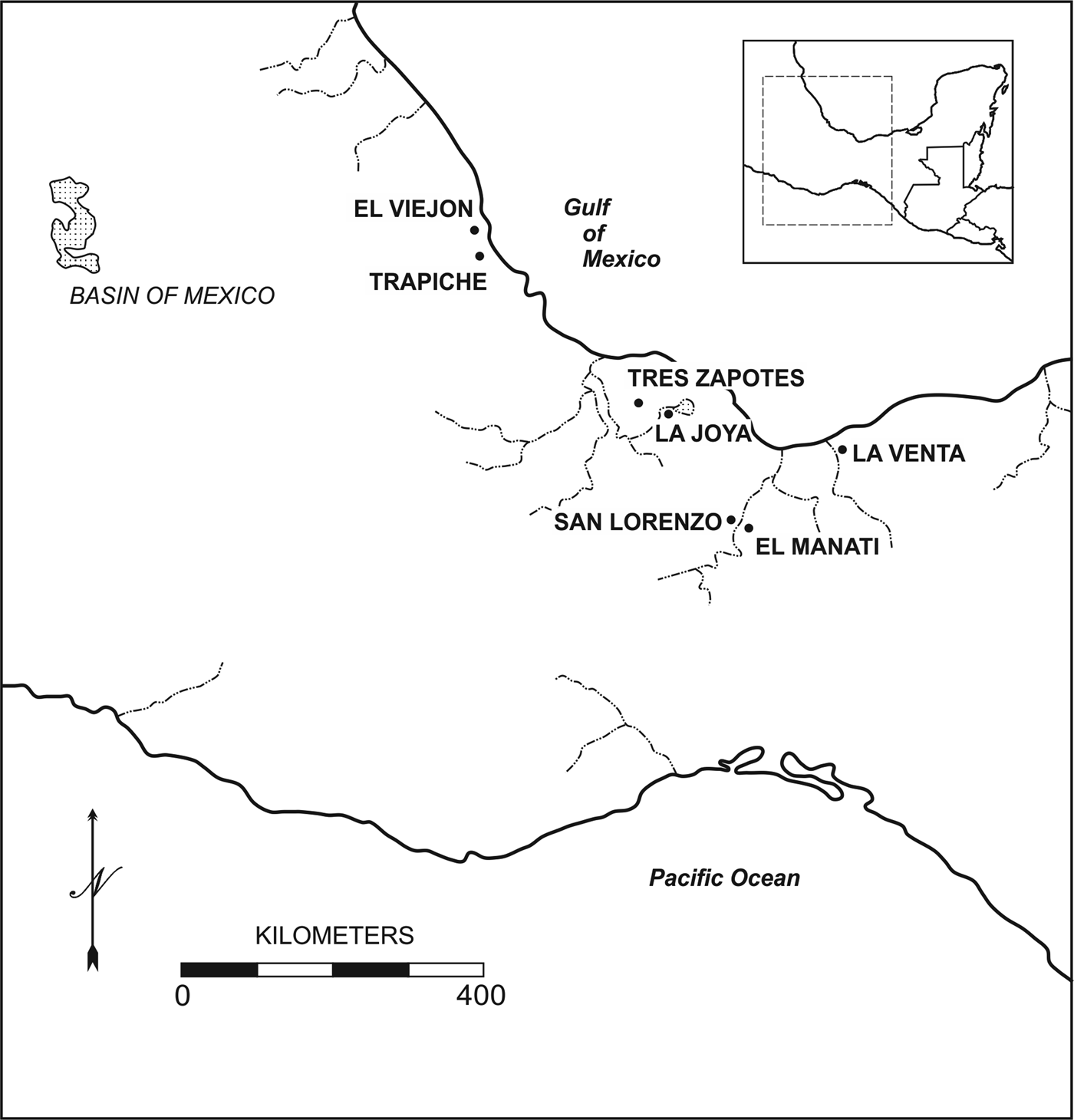
The site of La Joya is located in the Tuxtla Mountains of southern Veracruz, within the western part of the region delimited by Gulf Olmec megalithic sculpture (Figure 1). The Tuxtla Mountains is a volcanic uplift that covers some 6,400 km2 and rises above the surrounding Gulf Coast plain to an elevation of approximately 1,600 m. The Tuxtlas and the Gulf Olmec have long been linked; in fact, the San Martín Pajapan sculpture, one of the earliest reported megalithic artworks, was recovered from the eastern side of the sierra (Blom and La Farge Reference Blom and La Farge1926:45–46). Basalt used to produce other Gulf Olmec monuments also derives from the Tuxtlas (Williams and Heizer Reference Williams and Heizer1965). Based partly on these associations, olmequistas have proposed a variety of Olmec-Tuxtlas connections. For example, both Heizer (Reference Heizer and Benson1968:22) and Coe (Reference Coe1968:89) once suggested that the Tuxtlas were the original homeland of the Gulf Olmec. Coe and Diehl (Reference Coe and Diehl1980:391) later postulated that the Tuxtlas region was a “province” controlled by San Lorenzo rulers.
Map of Mesoamerica, showing La Joya and other sites mentioned in the text.

Archaeological research at La Joya was undertaken in the mid-1990s with such possibilities in mind. Specifically, our research sought to explore Gulf Olmec domestic activities, foodways, and corporate organization in areas beyond the immediate sustaining areas of Olmec centers (Arnold Reference Arnold, Clark and Pye2000; Arnold and McCormack Reference McCormack2002; McCormack Reference McCormack2002, Reference McCormack, Douglas and Gonlin2012; VanDerwarker Reference VanDerwarker2006). Thus, the archaeological record at La Joya provides insight into the cultural adaptations and residential lifeways that may have characterized a considerable portion of the region's non-urban Gulf Olmec occupation. Lacking the large-scale architecture and megalithic sculpture said to reflect Gulf Olmec political development, La Joya also provides an excellent opportunity to evaluate the extent of politico-economic dominance that Gulf Olmec centers may have exercised (Clark Reference Clark, Scarborough and Clark2007; Cyphers and Di Castro Reference Cyphers, Di Castro, Fash and Luján2009; Cyphers and Zurita-Noguera Reference Cyphers, Zurita-Noguera, Lucero and Fash2006; Diehl Reference Diehl2004; Pool Reference Pool2007).
Based on radiocarbon assay and ceramic cross-references, excavations at La Joya revealed a multi-component occupation that spanned the Early Formative through the Early Classic periods (circa 1300 b.c.–a.d. 450) (Arnold Reference Arnold2003, Reference Arnold and Powis2005; Arnold and McCormack Reference Arnold and McCormack2002). This occupation, however, was neither continuous nor constant; rather, the Early Formative (1300–850 b.c.) and the Protoclassic (100 b.c.–a.d. 300) periods represent the most intensive use of the site.
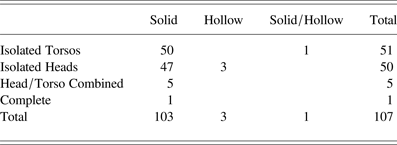
The Early Formative figurine collection discussed here includes a total of 107 pieces (Table 1). The material consists of 50 isolated heads, 51 individual torsos (some with appendages), five examples that include both head and torso, and one complete figurine. Solid items account for just over 96% of the pieces; the remaining figurines include three hollow head fragments and one combined hollow/solid body section. Although not represented in the above count, several hollow appendages, and many miscellaneous solid appendage fragments, are attributable to the Early Formative occupation.
Frequency of La Joya Early Formative anthropomorphic figurines

Early Formative figurines from La Joya were manufactured from local pastes using the same clay/temper ingredients, and in the same relative proportions, evident in the domestic ceramic inventories (see Arnold Reference Arnold2003, Reference Arnold, Pool and Bey2007). The majority of figurines were made using volcanic ash as the lone aplastic; the remainder includes both sand and volcanic ash with the clay. Given the parallel nature of the technical styles, it is reasonable to suspect that figurines, like ceramics, were produced within residential, non-specialized contexts.
La Joya's figurine collection derives mainly from primary and secondary sheet midden deposits. Seven pit features yielded a total of 14 individual specimens (9 torsos, 4 heads, 1 complete), accounting for just over 13% of the collection. The relatively small number of figurines deriving from such features is not surprising. Early Formative pit features are rare at La Joya and no burials were attributed to the Early Formative (Arnold Reference Arnold and Powis2005; Arnold and McCormack Reference Arnold and McCormack2002). Although the lone complete figurine was recovered from a pit feature, there is no additional evidence that such contexts produced less-damaged specimens. Thus, it appears that the majority of figurines were deposited as part of general household refuse, a pattern consistent with other Early Formative figurine collections (Blomster Reference Blomster, Halperin, Faust and Taube2009:123; Cheetham Reference Cheetham, Halperin, Faust, Taube and Giguet2009:152; Lesure Reference Lesure, Papadopolous and Urton2012:370; Marcus Reference Marcus, Halperin, Faust, Taube and Giguet2009:27).
Figurine Torsos, Clothing, and Sex/Gender Attributes
The 57 examples of Early Formative torsos from the La Joya collection parallel the forms and postures commonly documented elsewhere along the Mexican Gulf lowlands (Cheetham Reference Cheetham, Halperin, Faust, Taube and Giguet2009, Reference Cheetham2010; Coe and Diehl Reference Coe and Diehl1980; Follensbee Reference Follensbee2000:36–42, Reference Follensbee, Halperin, Faust and Taube2009, Reference Follensbee, Orr and Looper2014). This formal consistency suggests that Early Formative body styles/positions were produced according to a relatively narrow range of acceptable “ways of making” (Lesure Reference Lesure, Papadopolous and Urton2012:371). Nonetheless, this overall homogeneity also brings into sharp relief certain subtle distinctions that distinguish the La Joya figurine assemblage.
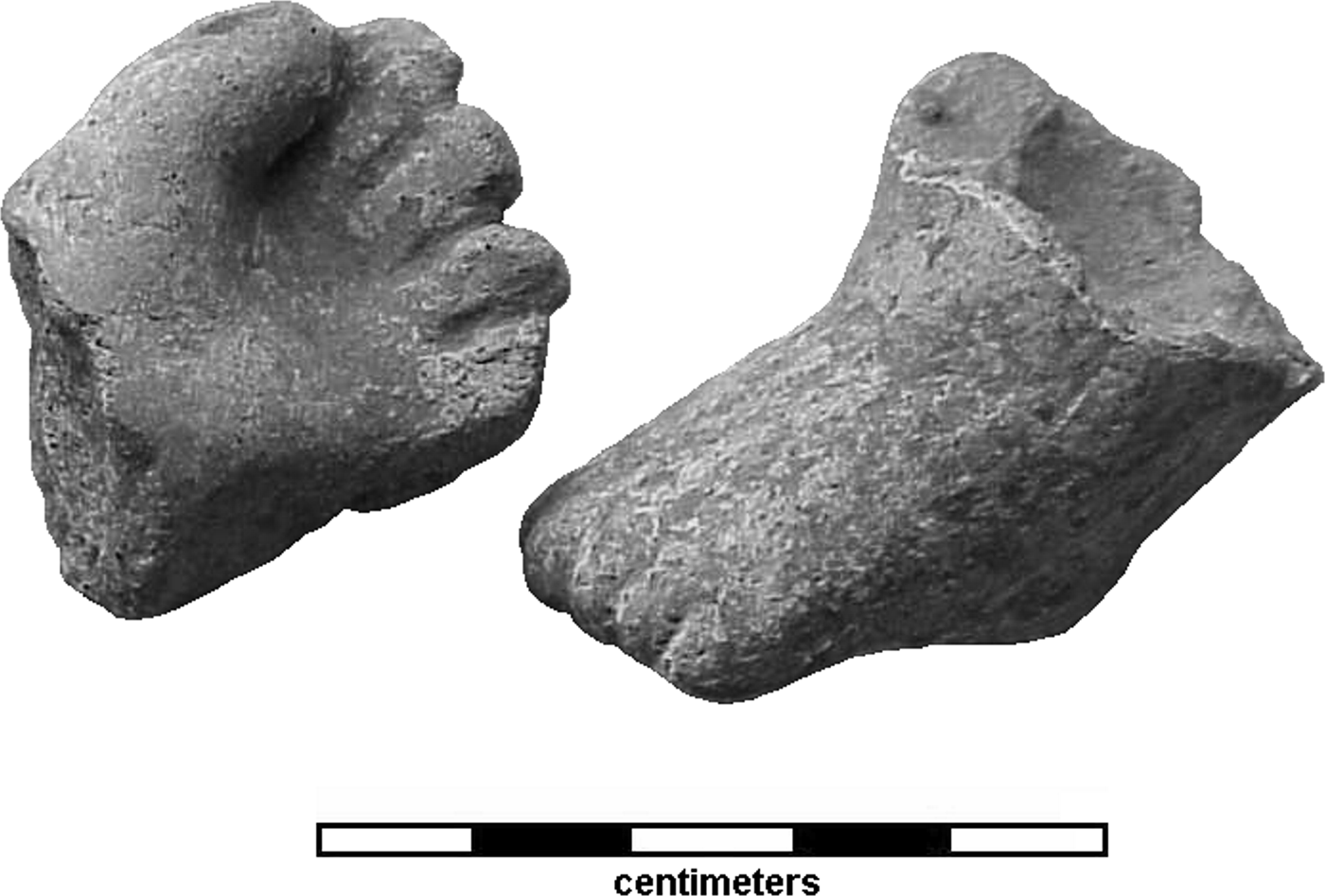
The La Joya figurine bodies include both hollow and solid examples. Hollow body fragments are very rare; our best examples include isolated limbs/appendages that are white slipped and polished, comparable to the better-known examples documented in highland Mexico (Blomster Reference Blomster2002; Flannery and Marcus Reference Flannery and Marcus2000) (Figure 2). As noted above, a single example includes a hollow torso attached to a solid leg. We also recovered a limb fragment consisting of a solid foot attached to a hollow leg.
Early Formative hollow figurine appendage fragments from La Joya.

Nonetheless, most figurine torsos are solid and undecorated. Following Follensbee (Reference Follensbee2000:36–42, Reference Follensbee, Halperin, Faust and Taube2009:81), we sort these specimens into one of three basic groups: a relatively naturalistic category, a more abstracted appearance, and a heavily abstracted, “grotesque” group.
The majority of Early Formative torso fragments within the La Joya collection fall within the relatively naturalistic category (n = 48; 84.21%). This group is characterized by realistic, fleshy features that have a rounded appearance. Within the naturalistic category is a subgroup that tends to be flatter and to have less-pronounced physical features. Although figurine data between sites are not always directly comparable, this somewhat flatter subgroup appears to occur more frequently at La Joya than at other Early Formative Gulf lowlands sites.
The second, more abstracted group at La Joya exhibits more geometric body shapes and parallels the traits noted at other Gulf lowland sites (Follensbee Reference Follensbee, Halperin, Faust and Taube2009:86–87). The bodies are generally flatter and more rectangular, but may also be cylindrical or take on a tapering pear shape. The abstracted group makes up 14% (n = 8) of the La Joya figurines, several times higher than the frequency found at other Gulf lowlands sites (Follensbee Reference Follensbee2000:Table 1). The single grotesque form within the La Joya collection constitutes less than 2% of the total, and this low value is comparable to the 4% that the Grotesque group makes up of other Gulf Olmec assemblages (Follensbee Reference Follensbee2000:Table 1, Reference Follensbee, Halperin, Faust and Taube2009:87).
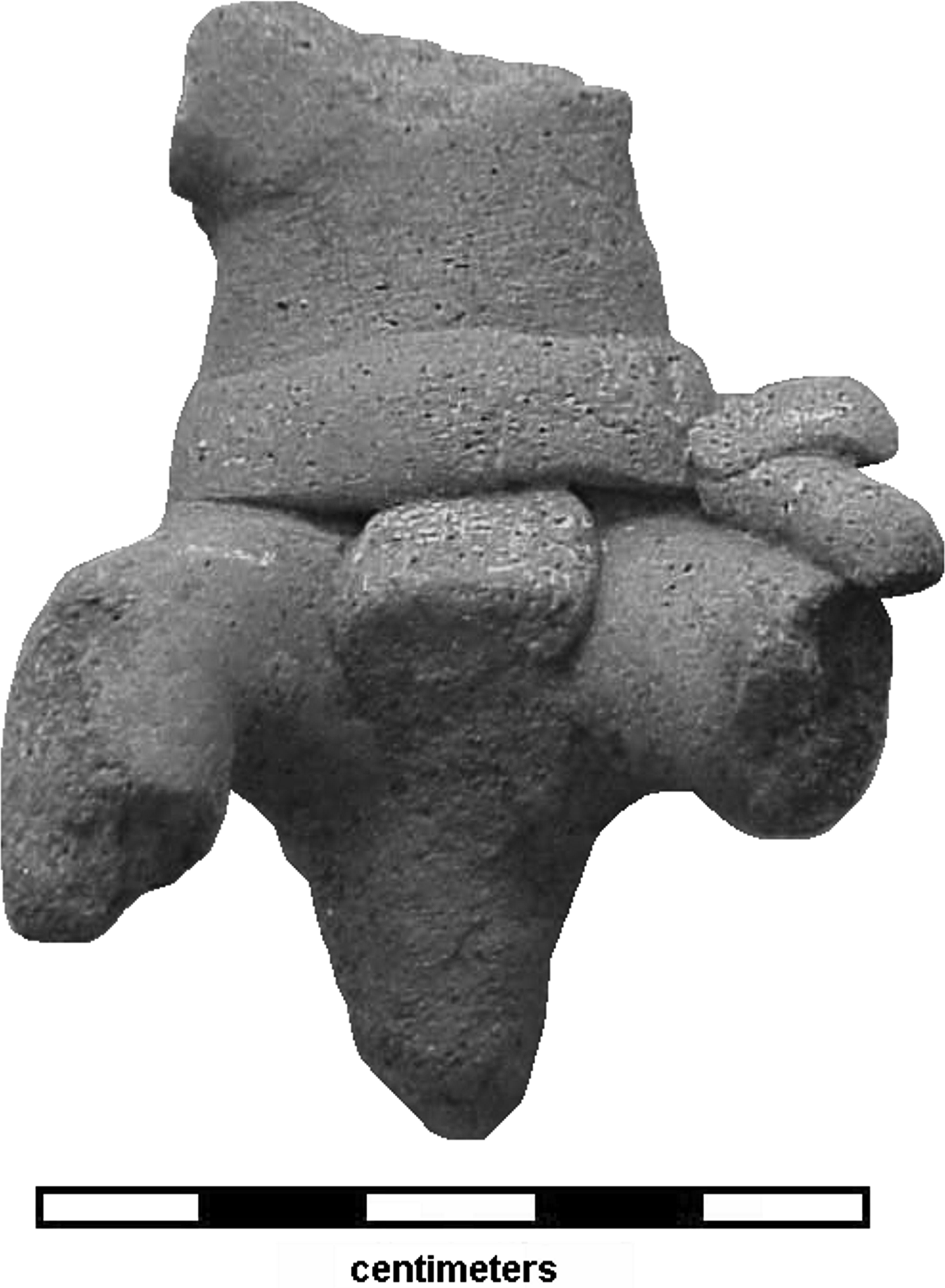
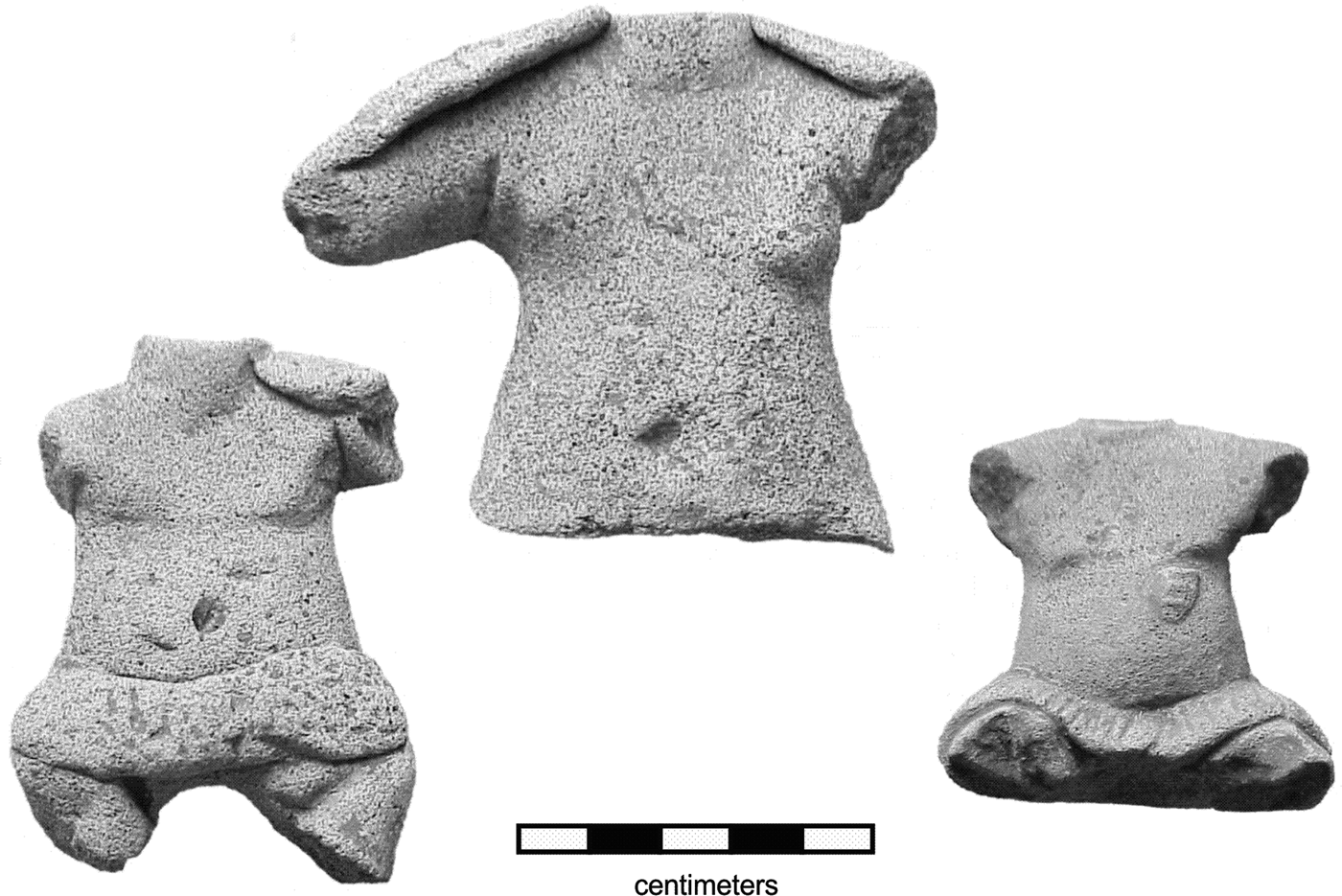
One factor contributing to the unexpected percentage of the abstracted group is the comparatively high frequency of tripod figurines at La Joya relative to other Gulf Olmec assemblages. These figurines are solid, have a third, tripod-like support on the back, and are usually clothed (Figure 3). Such tripod-supported figurines are commonly called “ballplayers” within the Gulf lowlands literature (Cheetham Reference Cheetham, Halperin, Faust, Taube and Giguet2009:158, Reference Cheetham2010:374; Coe and Diehl Reference Coe and Diehl1980:263, 268; Cyphers and Di Castro Reference Cyphers, Di Castro, Fash and Luján2009:41) and we retain that usage here. According to Coe and Diehl (Reference Coe and Diehl1980:395), ballplayer figurines are “heavily imbued with Olmec religious ideology and symbolism.” Cyphers and Di Castro (Reference Cyphers, Di Castro, Fash and Luján2009:42) relate ballplayer figurines to a “ritual re-enactment designed to reinforce the Olmec worldview,” while Cheetham (Reference Cheetham2010:392) suggests that the Olmec ballgame may have symbolized the “recreation of an animistic origin myth.” Cheetham (Reference Cheetham2010:388–389, 392) also underscores the rarity with which ballplayer figurines occur at sites outside of San Lorenzo.
Early Formative tripod-ballplayer figurine from La Joya.

Coe and Diehl (Reference Coe and Diehl1980:263) indicate that ballplayer figurines at San Lorenzo are often painted black and they include isolated limbs with black paint in their total ballplayer counts. Cyphers and Di Castro (Reference Cyphers, Di Castro, Fash and Luján2009:41) similarly note the use of black paint to decorate ballplayer figurines. At La Joya, however, the association of black paint and tripod figures does not seem to hold (see below). Ignoring the isolated limbs for the moment, Coe and Diehl (Reference Coe and Diehl1980:263–274) report a total of seven ballplayer torsos from San Lorenzo. Cheetham (Reference Cheetham, Halperin, Faust, Taube and Giguet2009, Reference Cheetham2010:Table 8.6) provides information regarding 18 ballplayer bodies from the site, which would constitute 13.7% of his analyzed San Lorenzo phase torso collection (n = 131) (Cheetham Reference Cheetham2010:Table 8.2).
Seven tripod figurines derive from secure Early Formative deposits at La Joya. With a resultant value of 12.28% (7 of 57) of the collection, it would appear these figurines are more common than at sites within San Lorenzo's hinterland (Cheetham Reference Cheetham2010:388–389) and approach the percentage from San Lorenzo itself. Cheetham (Reference Cheetham2010:375, 392), as well as Cyphers and Di Castro (Reference Cyphers, Di Castro, Fash and Luján2009:41), also emphasize a connection between ballplayers and the “One-eyed God” figurine images (or tuerto figurines [Cyphers and Di Castro Reference Cyphers, Di Castro, Fash and Luján2009:41]) originally noted at San Lorenzo (Coe and Diehl Reference Coe and Diehl1980:270). Although excluded from the present discussion, a re-deposited figurine head from La Joya is strikingly similar to a “One-eyed God” figurine from San Lorenzo (compare Vásquez Zárate Reference Zárate and Rafael2007:83 and Cheetham Reference Cheetham2010:Figure 8.20). Thus, it appears that this ideologically charged paraphernalia enjoyed unexpected popularity at La Joya, although we are currently unable to account for this emphasis at a modest residential site well beyond San Lorenzo's periphery.
Unlike the ballplayer torsos, the majority of La Joya's Early Formative clay figurines are unclothed and undecorated. Nonetheless, just over 42% (24 of 57) of all figurine torsos display garments. If we exclude the costumed ballplayers and consider only the naturalistic group, just under 30% (14 of 48) of the specimens exhibit some type of unambiguous garment. The garments and accouterments that occur are varied, but follow the canons of other Gulf Olmec assemblages (Cheetham Reference Cheetham, Halperin, Faust, Taube and Giguet2009, Reference Cheetham2010; Coe and Diehl Reference Coe and Diehl1980; Follensbee Reference Follensbee2000; Vázquez Zárate Reference Zárate and Rafael2007).
Cheetham (Reference Cheetham, Halperin, Faust, Taube and Giguet2009:155, Reference Cheetham2010:356) has recently argued that clothing is rare on Early Formative Gulf Olmec figurines. This conclusion, however, rests on a calculation that merits reconsideration. Cheetham (Reference Cheetham, Halperin, Faust, Taube and Giguet2009, Reference Cheetham2010) specifically includes all fragments of heads, hands, feet, as well as all miscellaneous, unidentified pieces to derive the percentage occurrence of garments such as skirts and bikini straps within the San Lorenzo assemblage (see Cheetham Reference Cheetham2010:Tables 8.2, 8.6). Given that skirts, bikini straps, and other such clothing should be specific to torsos, calculating their occurrence as a function of non-torso pieces unnecessarily minimizes that percentage.
Cheetham (Reference Cheetham2010:Table 8.8) notes 18 instances of “clothing and jewelry” within his San Lorenzo collection. Restricting the count only to examples of clothing—as opposed to other types of costuming such as pectorals and necklaces—leaves 15 examples. Divided by the total number of San Lorenzo phase figurine torsos (and excluding costumed ballplayers), then the percentage of torsos with clothing is actually 13.2% (15 of 113) (see data in Cheetham Reference Cheetham2010:Tables 8.2, 8.6, 8.8). This percentage is certainly less than the La Joya value noted above, but is much closer to the “nearly 17%” average for Formative period Gulf Coast figurines as reported by Follensbee (Reference Follensbee, Halperin, Faust and Taube2009:84). Thus, it is hard to reconcile these values with assertions that clothing is “very rare” within the San Lorenzo sample (Cheetham Reference Cheetham, Halperin, Faust, Taube and Giguet2009:155, Reference Cheetham2010:356). Instead, as Follensbee (Reference Follensbee2000:42–45, Reference Follensbee, Halperin, Faust and Taube2009:84) has proposed, it appears that clothing occurs on a low, but consistent, percentage of Early Formative Gulf Olmec figurines.
Scholars generally agree that most Early and Middle Formative figurines represent females (Blomster Reference Blomster, Halperin, Faust and Taube2009; Cyphers Reference Cyphers Guillen and Macías1989, Reference Cyphers Guillen1993; Derilo Tway Reference Derilo Tway2004; Follensbee Reference Follensbee2000, Reference Follensbee, Halperin, Faust and Taube2009; Lesure Reference Lesure, Claasen and Joyce1997, Reference Lesure1999; Marcus Reference Marcus1998, Reference Marcus, Grove and Joyce1999). We accept Blomster's (Reference Blomster, Halperin, Faust and Taube2009:129) observation that a simple female/male dichotomy does not necessarily exhaust the possible gender roles of Early Formative figurines, and it is quite likely that gender was occasionally conveyed through removable or perishable costuming (Follensbee Reference Follensbee2000:77, 149–151, Reference Follensbee, Halperin, Faust and Taube2009, Reference Follensbee, Orr and Looper2014; Marcus Reference Marcus, Halperin, Faust, Taube and Giguet2009). Nonetheless, we also concur with Follensbee's (Reference Follensbee, Halperin, Faust and Taube2009, Reference Follensbee, Orr and Looper2014) position that we should strive to establish the physical parameters of female/male sexed and gendered figurines before we explore possible alternative genders and temporary and/or perishable gender diacritics.
Gulf Olmec figurines rarely depict genitalia and the La Joya collection is no different. Nonetheless, other identifiable sexed and gendered physical features are evident. As detailed by Follensbee (Reference Follensbee2000:40, see also Reference Follensbee, Halperin, Faust and Taube2009), the most common indicators of female sex are a pinched waist directly under the chest, flaring hips and thighs, tapering limbs, and a pubic “Y” or triangle. Although breasts are characteristically de-emphasized within the La Joya collection, these female figurines tend to display more rounded, projecting breasts; among the flatter figurines, the breasts are concomitantly flatter, but they still assume a projecting form on each side of the upper torso.
Clothing can also provide a key to identify gender roles. The most common gendered garments worn by female figurines within the La Joya collection include a free-hanging skirt worn low on the hips and a shawl (Figure 4). Another female-gendered garment is the pubic apron, which consists of a low-slung belt and a free-hanging flap over the groin (Follensbee Reference Follensbee2000:43–54). Female figurines occasionally wear other accouterments such as pectorals (possibly iron-ore mirrors or greenstone disks) and may hold objects in their hands.
Early Formative female-gendered garments from La Joya.

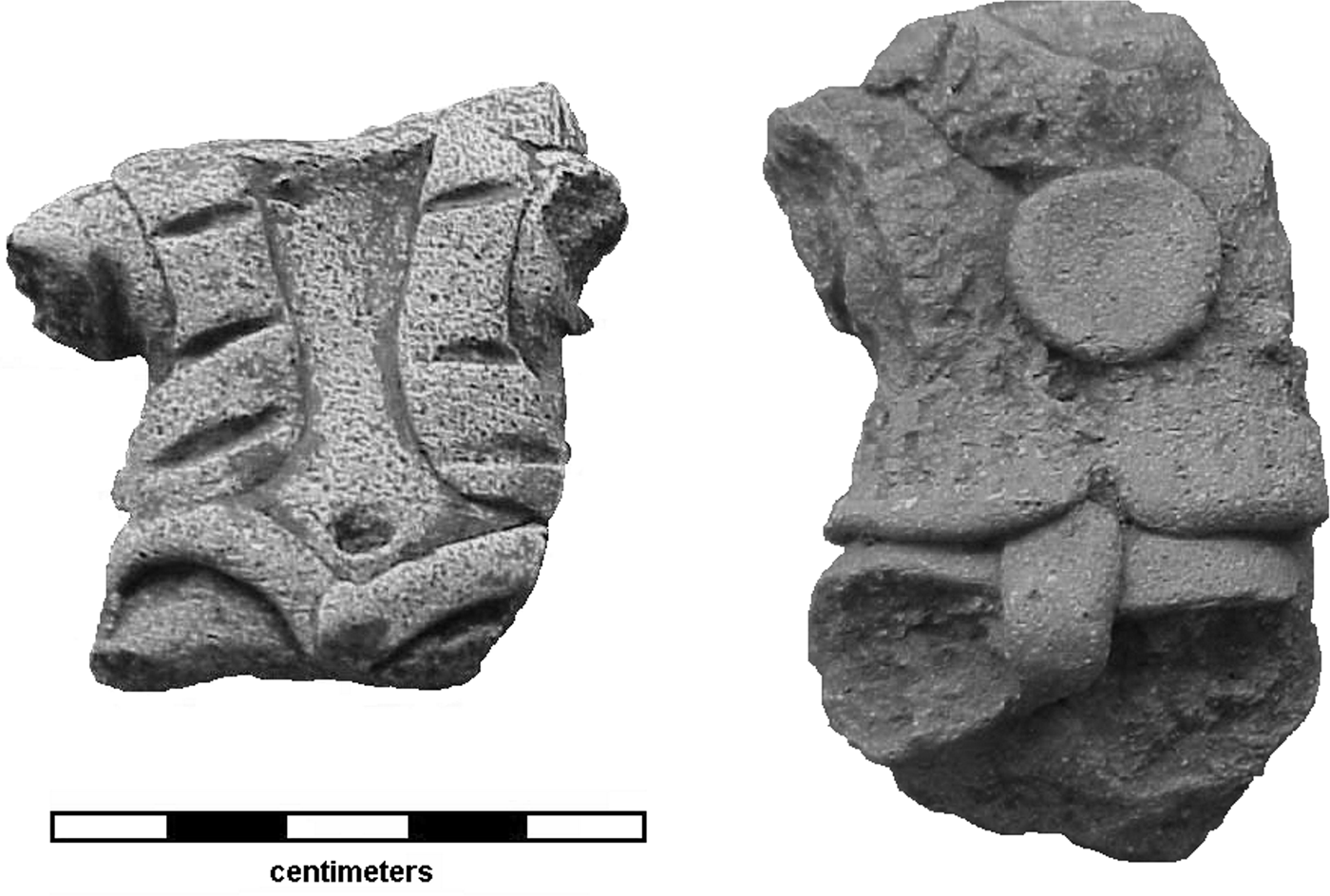
In contrast, the markedly different geometric bodies of the more abstracted group suggest a male identity. This possibility is supported by the strongly male-gendered garments worn by most of these figures (Figure 5). Garments include loincloths, sometimes wrapped tightly over a skirt, vests, and thick belts, occasionally with pendant pieces (Follensbee Reference Follensbee2000:45–46). These male-gendered garments rarely continue around the back of the figurines, suggesting that they were meant to be viewed primarily from the front. Coe and Diehl (Reference Coe and Diehl1980:268) make a similar observation regarding certain tripod-ballplayer figurines at San Lorenzo.
Early Formative male-gendered garments from La Joya.

Based on these criteria, most of the figurines within the naturalistic group are identified as female. Of the 48 figurine torsos within that group, 16 specimens (33.33%) were either too fragmentary or androgynous to determine sex or gender. Within the remaining 32 examples, 19 (59.37%) were identified as female while another six (18.75%) were cataloged as probably female. In contrast, only four examples (12.5%) were identified as male, while another three (9.37%) were characterized as probably male. Six of the female/possibly female figurines also have a braid that falls down the neck or back; none of the male/possibly male images exhibit this feature.
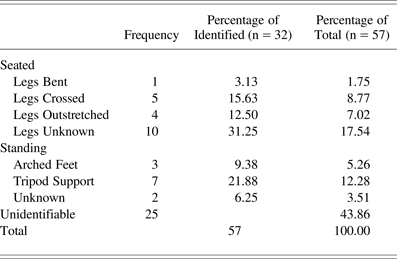
Thirty-two of the 57 Early Formative La Joya bodies assume identifiable postures, but these positions vary (Table 2). Seated figures (n = 20; 62.5%) are almost twice as common as standing figures (n = 12; 37.5%). These values diverge from the San Lorenzo figurine assemblage, in which 85% of the figures were seated and only 15% were standing (Cheetham Reference Cheetham, Halperin, Faust, Taube and Giguet2009:Table 6.2). Again, the unexpected number of tripod ballplayers at La Joya affects these values. Nonetheless, the overall pattern from both sites supports Stark's (Reference Stark and Stark2001:208–209) suggestion that, along the Gulf lowlands, the common figurine stance shifts from a seated to a standing posture between the Formative and Classic periods.
La Joya Early Formative anthropomorphic figurine torso poses

In contrast to the Early Formative figurines reported from the Valley of Oaxaca (Marcus Reference Marcus1998), seated figurines at La Joya are not predominantly male nor does the seated position in general seem to imply “an authoritative rigidity” (Cheetham Reference Cheetham, Halperin, Faust, Taube and Giguet2009:152, Reference Cheetham2010:351). Rather, our seated figurines appear to be mainly female; their postures range from legs out-stretched or slightly bent in a “plié-like” pose to legs crossed in “tailor-fashion” (see, for example, Cheetham Reference Cheetham2010:8.4; Coe and Diehl Reference Coe and Diehl1980:261; Follensbee Reference Follensbee2000:37). A single seated form has one leg bent upward and the second curved underneath, very much like the armless Monument 34 recovered at the San Lorenzo (Coe and Diehl Reference Coe and Diehl1980:342; see also Cheetham Reference Cheetham2010:Figure 8.2e, 352). Follensbee (Reference Follensbee2000:442, 444; Reference Follensbee, Halperin, Faust and Taube2009:103, 105) identifies this particular pose as showing power/dominance (see also Marcus Reference Marcus1998:122, 133). Arm positions on the La Joya figurines vary; some examples have hands placed on the hips, other examples rest one hand on the legs, and some have a hand resting upon the stomach.
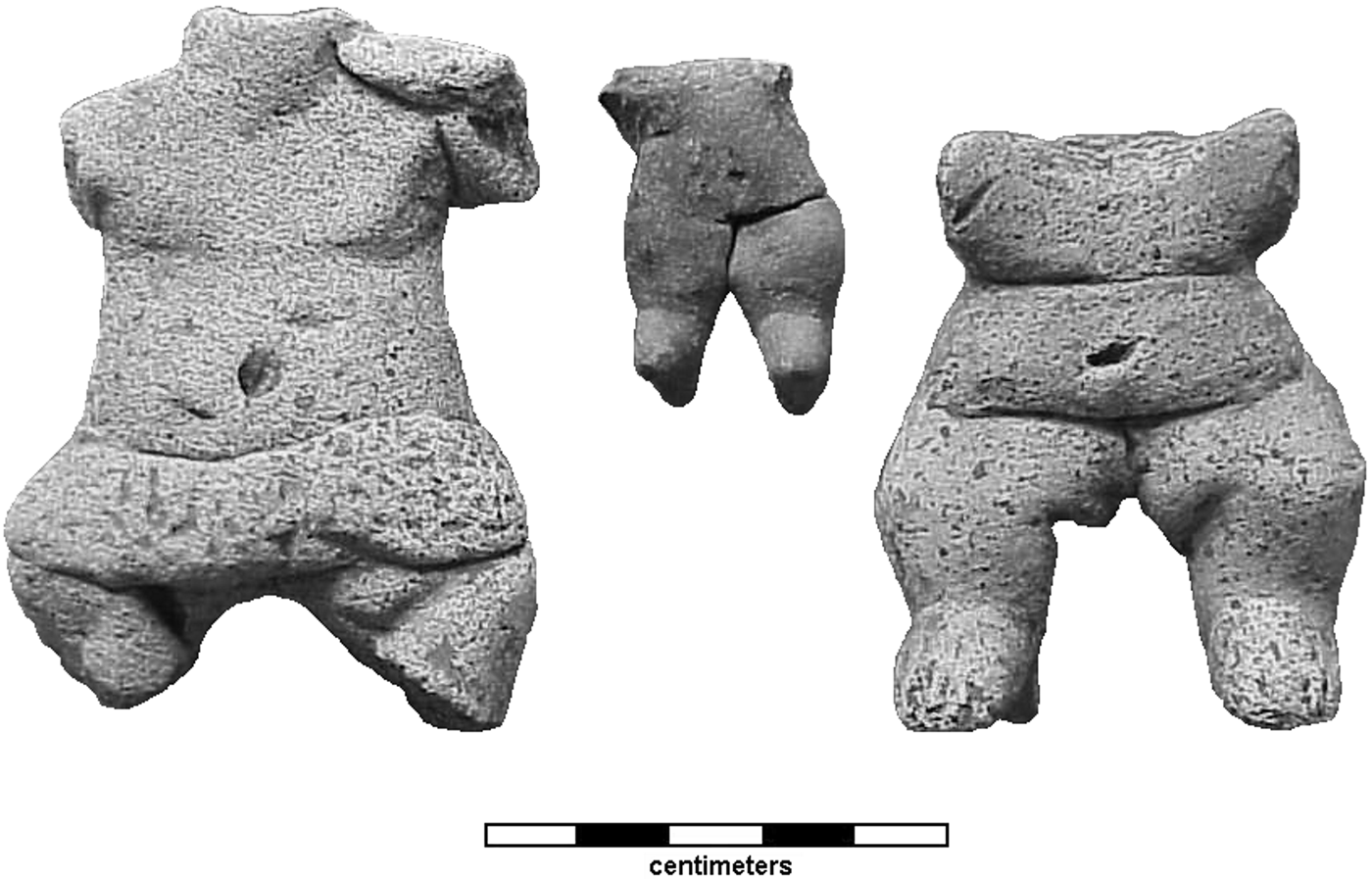
The remaining 12 posed figurines stand upright. As noted above, over one-half (n = 7) of these include the tripod-ballplayer forms. Another three bodies are characterized by straight legs that end in arched feet; this feature allows the body to stand upright without additional support (Figure 6). Two figurines could be identified as standing, but lack complete legs to determine how they may have remained upright.
Early Formative free-standing figurines from La Joya.

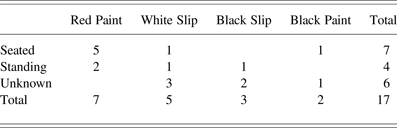
Seventeen torso fragments (29.82%) are decorated by painting or slipping (Table 3). Red painting and white slipping are the most common decorative treatments; seven examples have red paint and five body fragments carry a white slip. Black slipping occurs on three examples and black painting is evident on two torsos.
Decoration on La Joya Early Formative anthropomorphic figurine torsos

There does not appear to be a significant relationship between body posture and the presence of slipping or painting. Decorated bodies constitute about one-third of the identified posed bodies, whether they are standing (4 of 12) or seated (7 of 20). Almost one-fourth (6 of 25) of the torsos with an unknown posture were decorated. Only two tripod figures exhibit painting and/or slipping: one example is painted black and the second tripod figure is slipped white. Thus, as mentioned above, tripod-ballplayer figurines are not strongly associated with black paint at La Joya. Nor is this association noted in Cheetham's (Reference Cheetham2010) re-analysis of the San Lorenzo figurine data (compare against Coe and Diehl Reference Coe and Diehl1980:263; Cyphers and Di Castro Reference Cyphers, Di Castro, Fash and Luján2009:41).
In sum, the Early Formative figurine torso collection from La Joya generally follows the stylistic canons identified for similar samples elsewhere along the southern Gulf coast. The overwhelming number of figurines are solid and the majority are undecorated (that is, neither painted nor slipped). The majority of figurines assume a naturalistic appearance and most of the figurines probably depict female sex and/or gender. A large minority of the La Joya specimens exhibit some kind of clothing; some of these garments are probably gendered. Most of the figurines are seated, with tripod-ballplayers constituting the majority of standing examples. The comparatively higher percentage of these tripod specimens in the La Joya material is noteworthy, but we are currently unable to account for their unexpected occurrence.
Figurine Heads
Although figurine bodies have garnered increased attention in the literature, figurine heads remain the lingua franca when discussing small clay images. This long-standing emphasis probably persists because head styles are “time sensitive” (Lesure Reference Lesure2005:247; see also Lesure Reference Lesure, Papadopolous and Urton2012:376–378), traditionally serving as ready chronological markers in the absence of other dating techniques. Nonetheless, the following wry caution from Kent Flannery (Reference Flannery and Flannery1976:2) regarding an overzealous fixation on figurine heads still rings true:
As Grove, Angulo, and I rattled back along the highway in our Jeep, each of us in his own way sat marveling at the elegance of a research strategy in which one could define the nature of a foreign presence in a distant drainage basin from just seven fragmentary figurine heads in the bottom of a supermarket sack.
In keeping with analytical conventions, we grouped our figurine heads based on combinations of particular eye, mouth, and nose treatments (see Barba de Piña Chan Reference Barba de Piña Chan1993; Reyna Reference Reyna1971). Early Formative figurine heads at La Joya include eyes formed by single depressions, double depressions, punctations, and “plow” or “plough” strokes (Blomster Reference Blomster, Halperin, Faust and Taube2009; Marcus 1989, Reference Marcus1998; Tolstoy Reference Tolstoy, Sharer and Grove1989). Mouths are designated by modeling, punctation, and by the application of a small, creased clay tab. Noses may be modeled or added as a separate triangular piece of clay; in profile this latter trait often takes on a “hawkish” appearance. Nostrils may be absent or indicated through punctation. Overall, these figurines are characterized by long oval faces exhibiting a length-to-width ratio of approximately 1.7:1.
After an initial description of the La Joya figurines (Arnold Reference Arnold, Arnold and McCormack2002; Follensbee and Arnold Reference Follensbee and Arnold2001), we became aware that our Early Formative collection shared remarkable similarities with material from the site of El Trapiche reported by García Payón (Reference García Payón1966, Reference García Payón, Ekholm and Bernal1971 [see discussion in Vásquez Zárate Reference Zárate and Rafael2007]). Given the obvious similarities of the artifacts, and the historical precedent of García Payón's investigations, we adopt some of his nomenclature here. Recent reports of Early Formative figurines from Tres Zapotes likewise employ the Trapiche terminology (Pool et al. Reference Pool, Ceballos and Loughlin2010 [compare against Drucker Reference Drucker1943; Weiant Reference Weiant1943]).
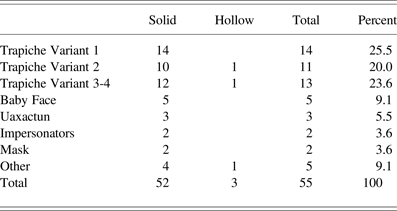
The most common figurine heads from Early Formative contexts at La Joya belong to the Trapiche Group,Footnote 2 which constitutes almost 70% (n = 38) of the collection under consideration (Table 4). The Trapiche Group includes heads with eyes made from a single or double impression, an opened mouth made from a creased clay tab, and an applique, “hawkish” nose. Lacking within the Trapiche Group is a clear eyebrow, arched or otherwise indicated. In profile these heads frequently curve backward, but this shape does not necessarily indicate purposeful cranial deformation as it may in other Early Formative figurine assemblages (Blomster Reference Blomster2002; Cheetham Reference Cheetham, Halperin, Faust, Taube and Giguet2009:160–161; Marcus Reference Marcus1998:62 [compare to Lesure Reference Lesure, Papadopolous and Urton2012:379–380]). Rather, this distinctive form may be promoted from a manufacturing process whereby the figurine heads were modeled against the producer's thumb.
La Joya Early Formative anthropomorphic figurine heads by groups

A second characteristic of Trapiche figurines is the presence of elaborate hairstyles and headdresses. These figurines display an impressive array of coiffures, occasionally with a ponytail or braid down their back. Included among these head treatments are “turbans,” “helmets,” and single or double “discs.” Such headgear may reflect elaborate hairstyles (Follensbee Reference Follensbee2000:47–49, 71; Marcus Reference Marcus1998:31–38) and may also indicate gender roles, age grades, and/or other forms of social affiliation (Vásquez Zárate Reference Zárate and Rafael2007:144–156; see below).
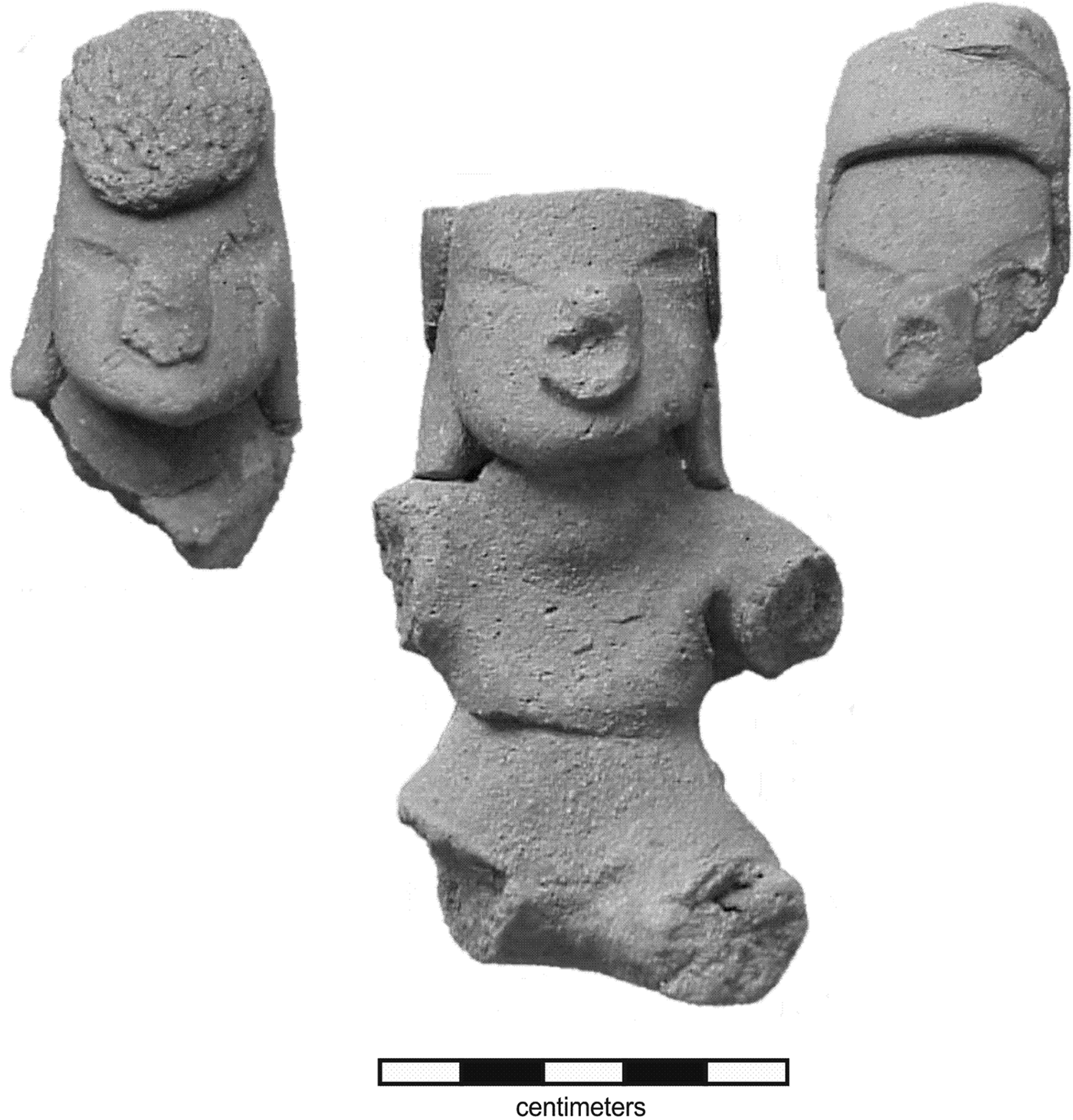
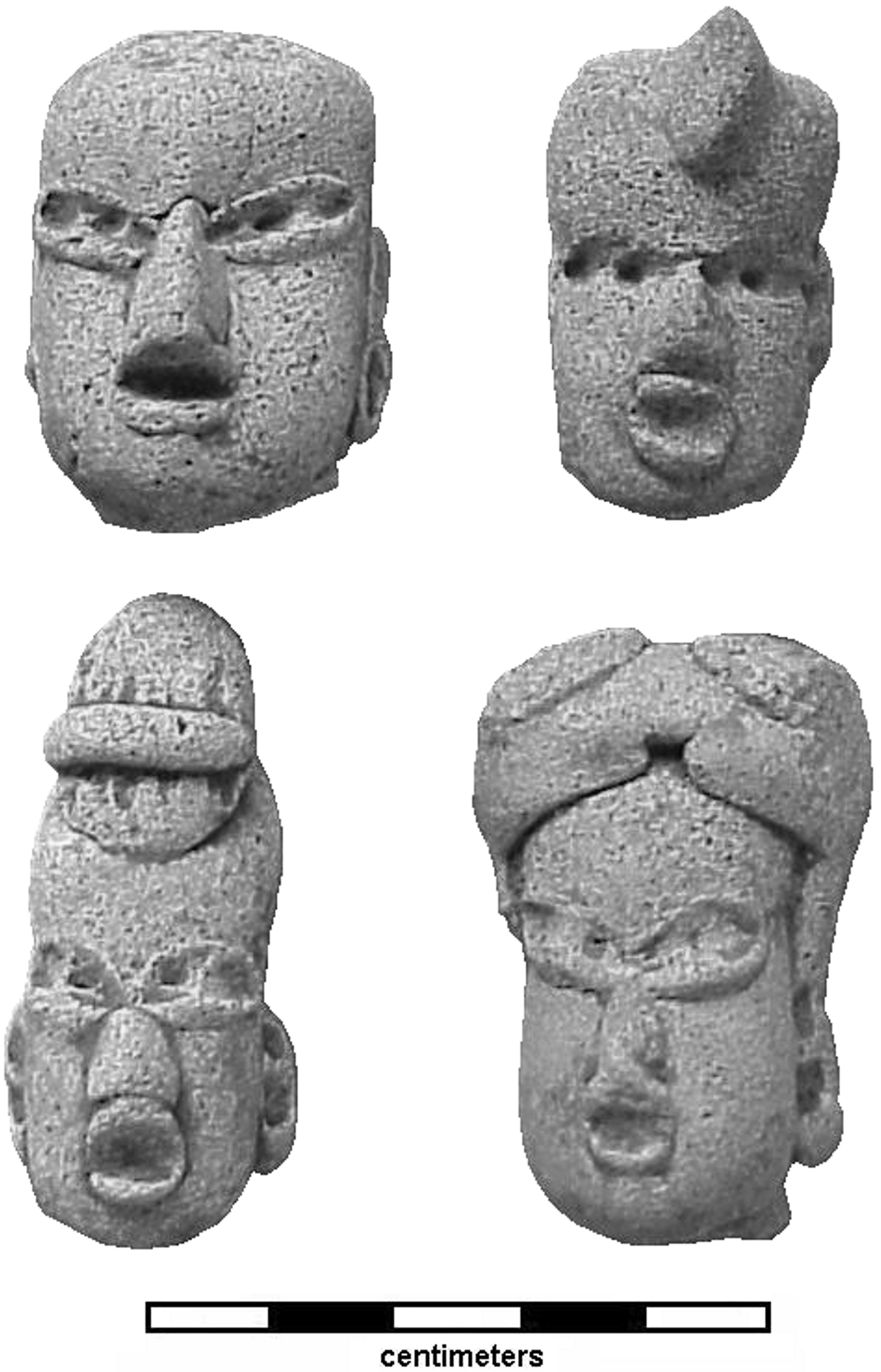
We identify three subgroup variants within our general Trapiche category. Trapiche Variant 1 consists of figurine heads whose eyes are indicated by a single horizontal, or slightly angled, depression (Figure 7). Twenty-five percent (n = 14) of the Early Formative collection falls within this subgroup. Three of the figurines were decorated: one with a white slip and two with black paint. Noteworthy is the fact that this subgroup includes over one-half (n = 3) of all examples in which the head remained attached to the body. Interestingly, no specimens similarly articulated occur within the remaining Trapiche subgroups. Despite the small sample size, this disproportionate association is striking and may reflect a behavioral difference with respect to the use of the Trapiche Variant 1 clay images relative to the other Trapiche figurines.
Early Formative Trapiche Variant 1 subgroup figurines from La Joya.

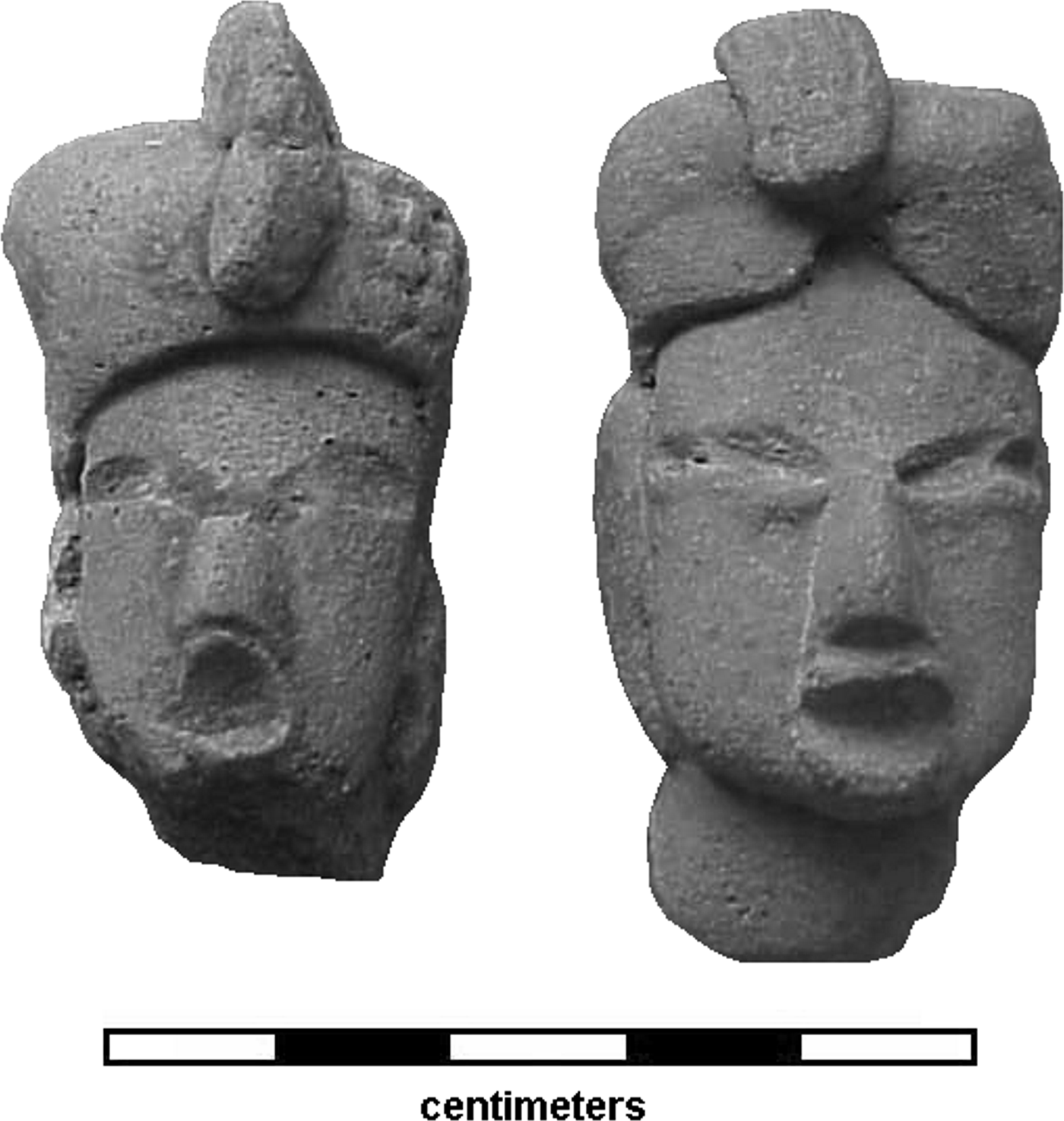
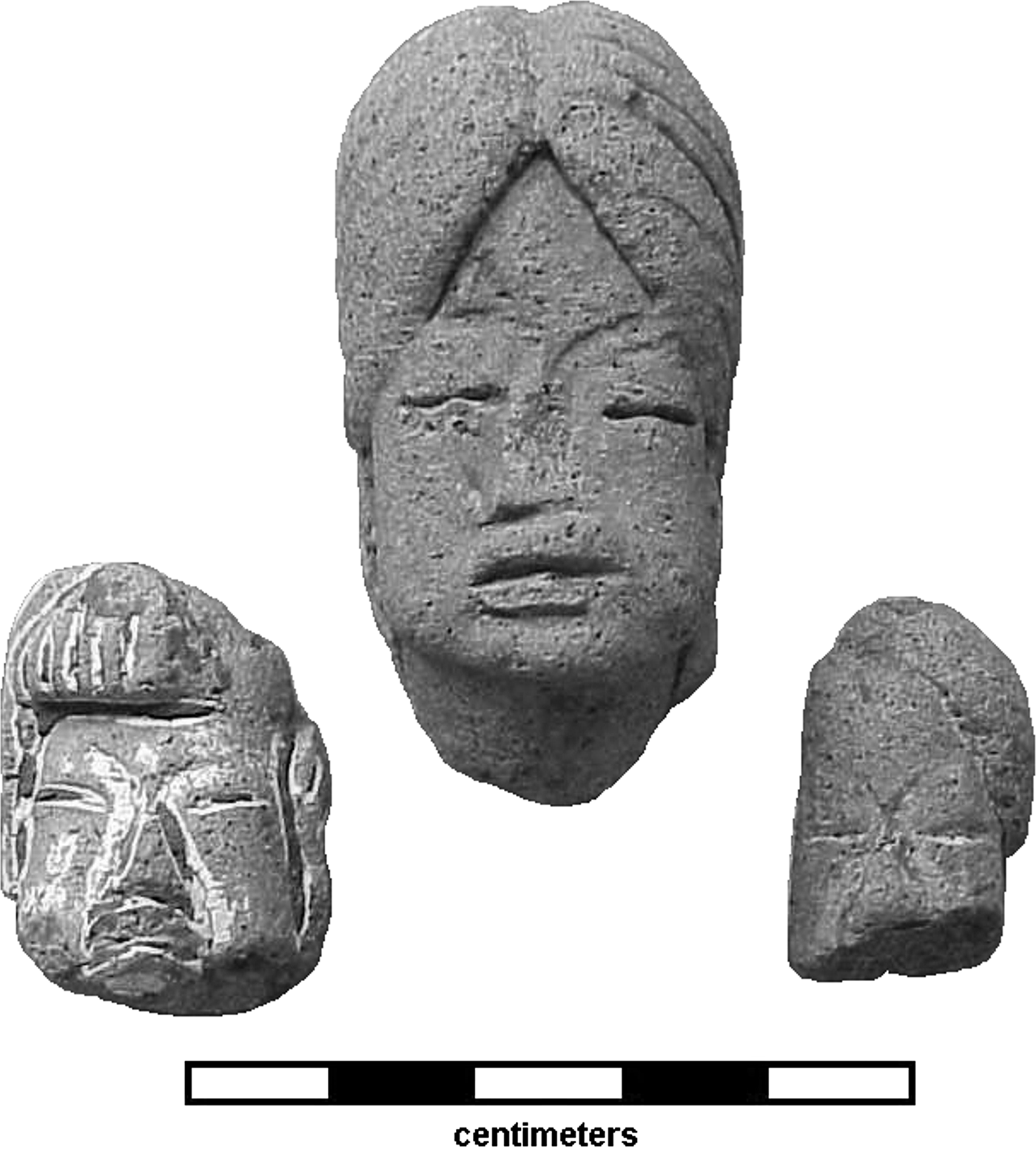
Trapiche Variant 2 includes figurines whose eyes have been executed using a double-depression, creating an inverted “V” (Figure 8). With 11 examples, this subgroup contributes 20% to the present collection. Three of these Trapiche Variant 2 specimens were decorated with red coloring; one was slipped while the other two were painted. The Trapiche Variant 2 subgroup also includes one of the few large, hollow head fragments recovered at La Joya.
Early Formative Trapiche Variant 2 subgroup figurines from La Joya.

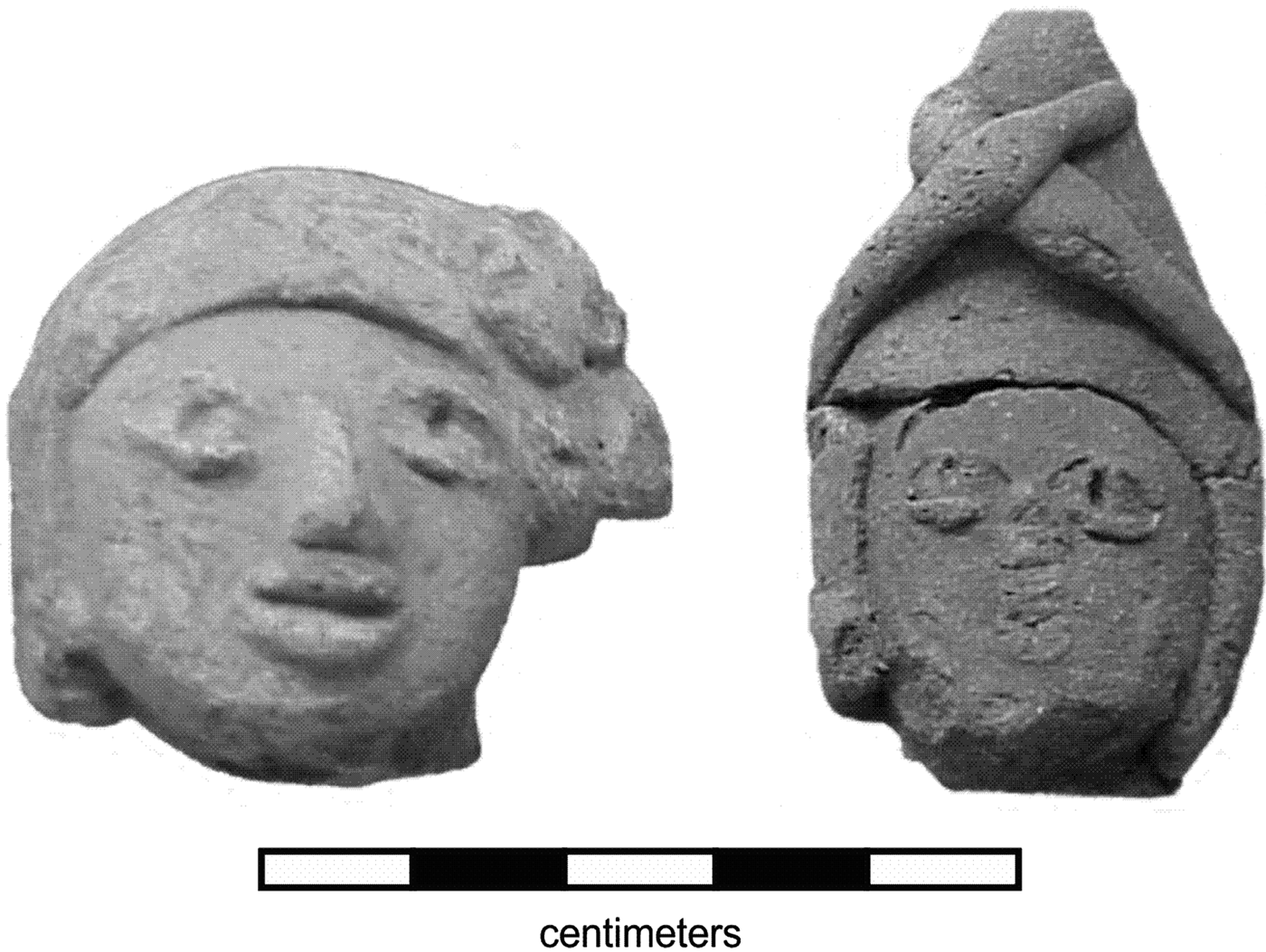
Our final Trapiche subgroup is Trapiche Variant 3–4 (Figure 9), which includes just over 23% (n = 13) of the figurine heads. This collection combines heads with a mouth/nose treatment similar to those mentioned above, but the eyes are formed by a “drag and punch” incision with a central punctation marking the pupil. On rare occasions the mouth is terminated by punctations in each corner. Four of the Trapiche Variant 3–4 figurines were decorated red (three painted and one slipped), two exhibited a white slip, and one figurine was painted black. Elaborate headdresses and hairstyles continue to characterize this subgroup, although shaved and tonsured heads appear more commonly in Trapiche Variant 3–4 than the other two Trapiche subgroups.
Early Formative Trapiche Variant 3–4 subgroup figurines from La Joya.

Given La Joya's location within the “Olmec Heartland,” as well as the overall similarities with other Early Formative Gulf Olmec collections in terms of body styles/postures, we expected to retrieve a majority of figurine heads that resembled the material from San Lorenzo (Cheetham Reference Cheetham, Halperin, Faust, Taube and Giguet2009, Reference Cheetham2010; Coe and Diehl Reference Coe and Diehl1980). Surprisingly, that was not the case. According to published analysis, this “traditional” style is described as “bald with double slit eyes, highly arched ‘Oriental’ eyebrows, thick frowning lips, and triangular flat noses” (Coe and Diehl Reference Coe and Diehl1980:264 [compare against Blomster Reference Blomster2002]). Nonetheless, Coe and Diehl's (Reference Coe and Diehl1980) own data immediately contradicted this description; only about 30% of the San Lorenzo figurine heads are actually bald (see Cheetham Reference Cheetham, Halperin, Faust, Taube and Giguet2009:162).
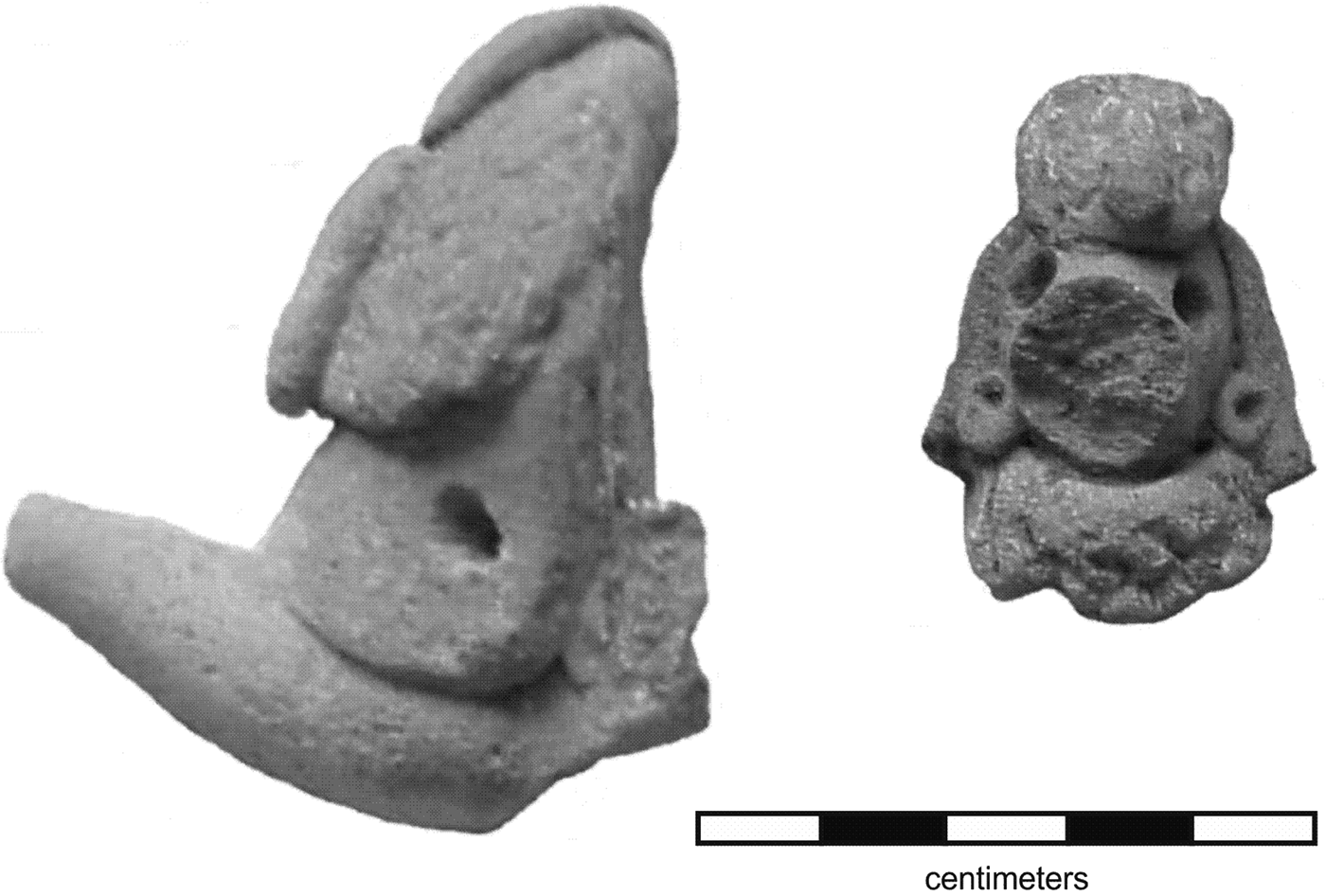
Regardless, we recovered very few figurines that were reminiscent of the “traditional” San Lorenzo style. The closest resemblance is seen in our Baby Face group, particularly with respect to the presence of an arched eyebrow (Figure 10). Noteworthy is that fact that our Baby Face group figurines are seldom bald but, instead, exhibit hair or other headdresses. With a total of five examples this (somewhat) “traditional” Gulf Olmec appearance contributes less than 10% to our Early Formative figurine collection. Three of these figurines are decorated, suggesting a disproportionate emphasis on decoration within this group. This pattern, however, may simply result from the small number of pieces. All three decorated examples were slipped white and one of those specimens was also painted red.
Early Formative Baby-Face group figurines from La Joya.

We call our fifth Early Formative figurine group Uaxactun, invoking the name originally used by Weiant (Reference Weiant1943:90) at Tres Zapotes but later modified by García Payón (Reference García Payón1966:135, 138, Lámina LII). Characteristics of our Uaxactun group include an eye created by depressing a small filet of clay and then applying a punch to mark the pupil (Figure 11). The heads tend to be oval in shape and recovered examples generally sport headdresses. Only three examples of Uaxactun figurines were identified in the collection: one undecorated, one with a white slip, and one painted red.
Early Formative Uaxactun group figurines from La Joya.

Two figurines apparently represent masked performers or supernatural impersonators. One complete head includes a long projecting snout beneath an elaborate headdress; the snout has been broken off of the second example (Figure 12). Both the paste and technical style of these figurines are consistent with the general Trapiche group (Vásquez Zárate Reference Zárate and Rafael2007:79–80). The second, incomplete specimen displays evidence of a white slip.
Early Formative Masked Performers/Impersonators from La Joya.

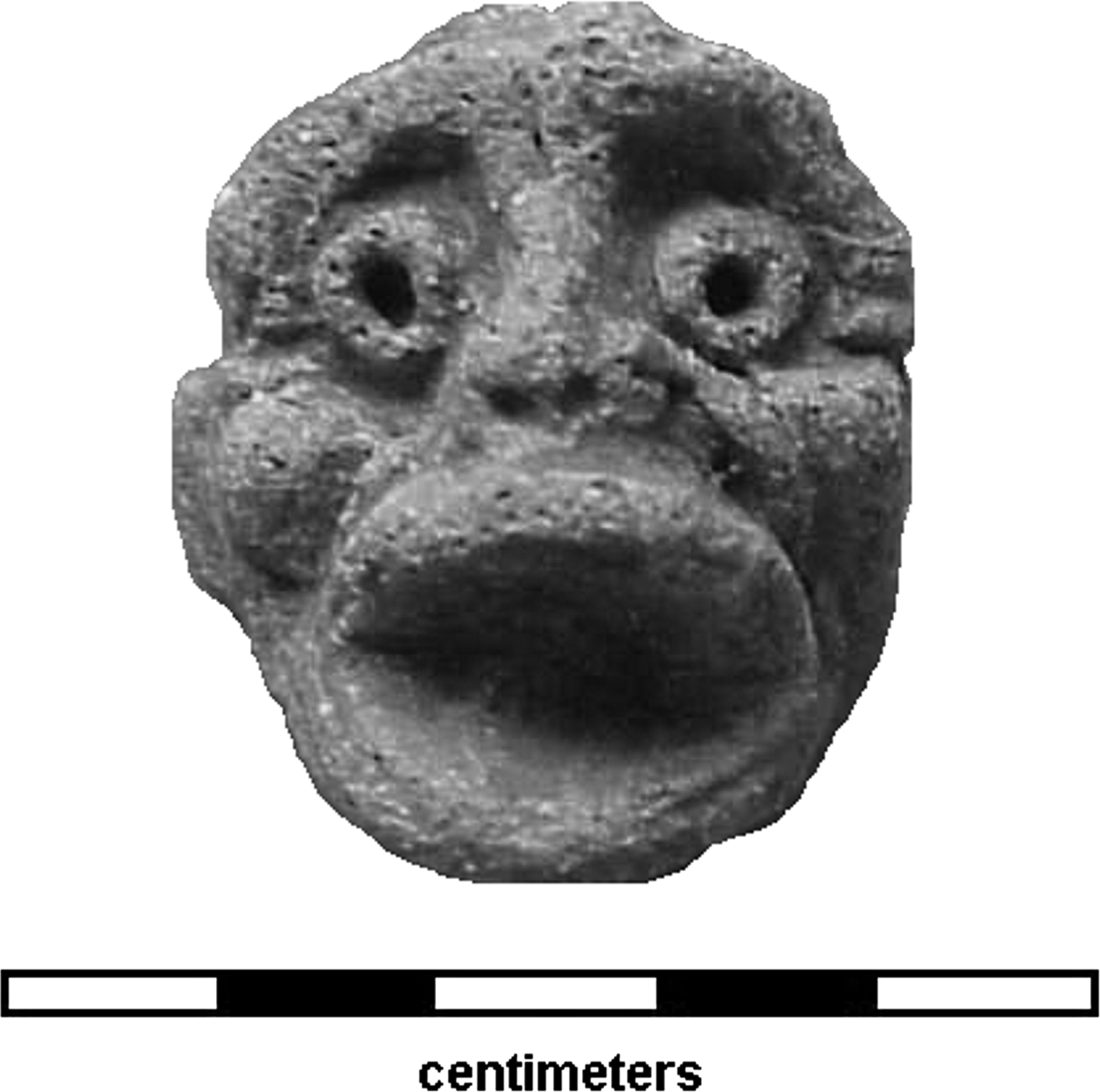
Our collection also contains two miniature clay masks. One example is relatively flat, with openings for the eyes and mouth. The depiction of the eye and pupil is reminiscent of the Uaxactun group noted above. The second mask may represent a simian (Figure 13); there are small holes at the temples and a thin piece of cordage could have been used to suspend this mask from a necklace or possibly place it on another figurine. There is no evidence that this specimen was permanently attached to a body. Neither mask was slipped nor painted. Miniature ceramic masks have also been identified in Early Formative deposits in San Lorenzo and highland Mexico (Cheetham Reference Cheetham, Halperin, Faust, Taube and Giguet2009:171; Marcus Reference Marcus1998:50, 62–63).
Early Formative Miniature Clay Mask from La Joya.

Five additional figurines were so different that they were ultimately grouped as “Other.” All of these specimens are decorated: three have red paint, one is slipped white, and one has a black slip. Among the red painted figurines is the rear portion of a large hollow head. While it might be tempting to consider this specimen an example of the much celebrated “hollow ‘baby’ figurine style” (Blomster Reference Blomster2002:171; Vásquez Zárate Reference Zárate and Rafael2007:66–72), here we simply list it as unidentified Other.
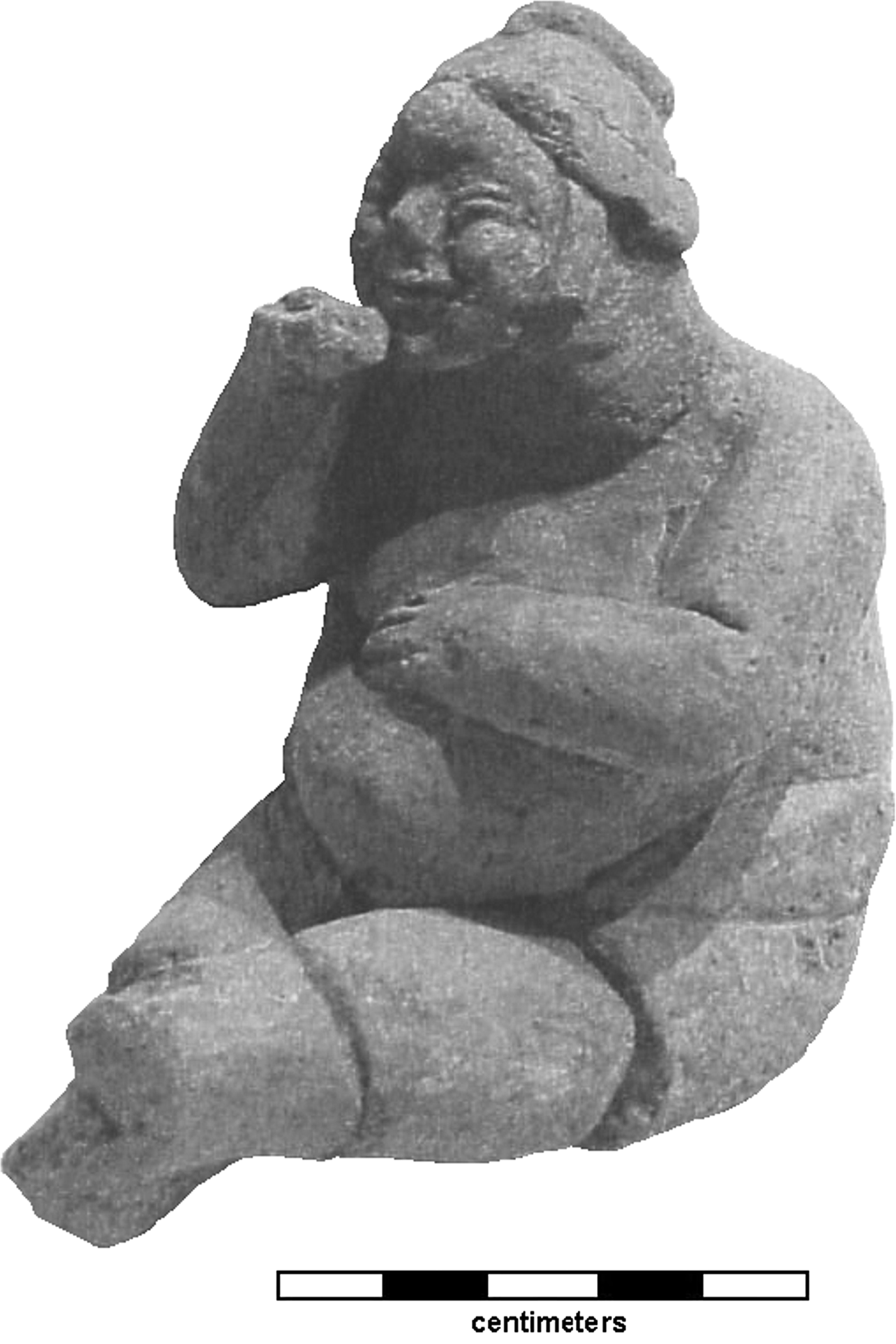
The lone complete Early Formative figurine also belongs within our Other group (Figure 14). This figurine, affectionately dubbed “La Gordita,” was recovered from an Early Formative pit feature in association with a radiocarbon date of 2950 ± 50 b.p. (AA 32679). La Gordita has very distinctive modeled and applique facial features that do not conform to any of the groups discussed above; nonetheless, there is no indication that these features constitute a mask. The figurine has a corpulent body with a prominently rounded chest and a large, distended belly, possibly indicating pregnancy. La Gordita is seated with legs straight out and crossed at the ankles, and wears a wide, low-slung belt and a skirt. The left arm rests across the stomach, while the right hand is turned palm-upwards and cupped below and slightly in front of the chin. The hair has been wrapped around the head in a turban-like manner and a long ponytail/braid falls down the nape of the neck onto the back. The figure carries evidence of red hematite paint, primarily about the face. Although not an exact replica, La Gordita resembles a solid female figurine reported from Chicharras phase (3200–3100 b.p.) San Lorenzo (Coe and Diehl Reference Coe and Diehl1980:Figure 308).
Early Formative “La Gordita” figurine from La Joya.

Headdresses and Hairstyles
As noted above, La Joya figurines are characterized by an abundance of elaborate hairstyles and headdresses. In fact, a “splitter” might be forgiven if they felt compelled to consider each figurine unique with respect to its headgear. Given that the Trapiche group constitutes the largest component of the current collection, we emphasize these examples in the following discussion. The reader is directed to Vásquez Zárate (Reference Zárate and Rafael2007) for a more thorough treatment.
It is quite possible that headgear signaled a variety of social conditions, such as age-grade affiliation, gender roles, marital status, and/or temporary social positions during community activities (Barba de Piña Chan Reference Barba de Piña Chan1993:324–325; Cyphers Reference Cyphers Guillen, Serra Puche and Navarete1988:93; Marcus Reference Marcus1998:45–46). Moreover, it is unlikely that such headgear was employed on a daily basis; rather, it would have been most common during public activities, such as attending markets and/or participating in corporate festivals (Vásquez Zárate Reference Zárate and Rafael2007:147–148). Thus, it is worth considering that a single individual might be represented by several figurines over the course of his or her life, created at different times and in response to different circumstances.
Hairstyles may also reflect gender. Unfortunately, it can be difficult to distinguish between hair and headgear within the La Joya collection, as the figurines may represent individuals with cloth or other material interwoven into their hair (Marcus Reference Marcus1998:31–38). Nonetheless, certain associations are plausible; for example, we have already identified a correlation between a single ponytail/braid down an individual's back and a female torso. La Gordita provides an excellent example of this association.
Follensbee (Reference Follensbee2000:47–51) suggests that bald or partially shaved heads within the San Lorenzo assemblage most likely represent female hairstyles. Other researchers propose that a partially shaved head may reflect a male figurine; these treatments may indicate a high status (Marcus Reference Marcus1998:96–97) or may be associated with boy's initiation rituals (Vásquez Zárate Reference Zárate and Rafael2007:148). As noted above, there is a tendency within the La Joya material for topknots, sideknots, and other isolated hair patches to characterize the Trapiche Variant 3–4 group.
In sum, the majority of La Joya's Early Formative figurine heads find their greatest similarity with material from the site of El Trapiche, located along the north-central Veracruz coast (García Payón Reference García Payón1966, Reference García Payón, Ekholm and Bernal1971). Our Trapiche figurine heads are generally ovoid and exhibit appliqued noses and mouths. A few examples of hollow figurines occur within the Trapiche group. Eyes are formed through either a single, oblique impression, produced with two “plow-strokes” in the form of an inverted “V,” or created with an impressed clay filet and a punctation to indicate the pupil. Trapiche figurines exhibit an impressive diversity of hairstyles and headgear, probably designed to represent a suite of temporary and longer-term social roles.
The remaining figurine heads include instances of more familiar Gulf Olmec examples. A small percentage was placed within a San Lorenzo-like “Baby Face” group, while a few specimens were similar to the Uaxactun style identified elsewhere along the southern Gulf lowlands. Remaining figurines include examples of possible impersonators along with examples of individual masks. Perhaps our most intriguing specimen is La Gordita, a complete, large solid seated figurine that appears to represent a pregnant woman with an elaborate hairstyle, a long braid down the back, and red hematite paint applied to the face.
CONCLUSION
The Early Formative figurine assemblage from La Joya follows several artistic canons present in other published Gulf Olmec collections. It also departs from these conventions in notable ways. Manufacturing techniques, body positions, decoration with paints/slips, and types of costuming are consistent with material from San Lorenzo and other sites within the southern Gulf lowlands (Coe and Diehl Reference Coe and Diehl1980; Cheetham Reference Cheetham2010). At the same time, the high proportion of Trapiche-style figurines, and the minimal proportion of “traditional” San Lorenzo figurines, have yet to be reported from Early Formative collections within the eastward portion of Olman.
These differences underscore the material, and probably behavioral, heterogeneity that likely characterized Early Formative lifeways along the southern Mexican Gulf Coast. More than 20 years ago Grove (Reference Grove1994) called attention to the environmental and contextual diversity that comprised the “Olmec Heartland.” Research at La Joya has explored this variation and examined ways in which behaviors within the western portion of the region seem to differ from its eastern side (Arnold Reference Arnold, Skibo and Feinman1999, Reference Arnold, Clark and Pye2000, Reference Arnold and Powis2005). Recent fieldwork at Tres Zapotes echoes this variability; for example, obsidian acquisition within western Olman may have diverged significantly from patterns identified at San Lorenzo (Pool and Ortíz Ceballos Reference Pool, Ceballos, Uriarte and González-Lauck2008; Pool et al. Reference Pool, Ceballos and Loughlin2010). Research at Tres Zapotes has also recovered Early Formative figurines that would fit comfortably within our Trapiche subgroups and has confirmed that these figurines outnumber the “traditional” San Lorenzo style (Pool et al. Reference Pool, Ceballos and Loughlin2010:99, Figure 6).
These observations, however, should not be taken as evidence of a simple, solid eastern-western Gulf Olmec divide. For example, research conducted at El Remolino (Wendt Reference Wendt2003, Reference Wendt2010), a site within the immediate hinterland of San Lorenzo, also raises questions regarding the homogeneity of Gulf Olmec material culture and, consequently, our ability to identify Gulf Olmec “influence” outside the Gulf coast region. Detailed investigations at El Remolino identified minimal amounts of conventional Gulf Olmec diagnostics, such as Calzadas Carved and Limon Incised pottery (Wendt Reference Wendt2010:Table 1). Wendt (Reference Wendt2010:110) asks rhetorically, “How is it that a site just 5 km from San Lorenzo, and likely a San Lorenzo Olmec secondary center, exhibits such low frequencies of so-called ‘San Lorenzo Olmec pottery’?” His answer is that, despite years of research, archaeologists still have a poor understanding of the variability that characterizes Gulf Olmec material patterns (Wendt Reference Wendt2010:116–117). As Pool et al. (Reference Pool, Ceballos and Loughlin2010:103) frame it, “Early Formative Gulf Olmec society was not a homogeneous entity, and it cannot simply be reduced to San Lorenzo.”
The figurine patterns reported here support the need for a greater appreciation for, and understanding of, Gulf Olmec variability. Suggesting that sites in southern Veracruz without Early Formative megalithic sculpture should be removed from the “true Olmec core zone” is one response (Diehl Reference Diehl2004:18–19), but defining away the problem it is not a long-term solution. Nor should we assume that the presence and/or frequency of megalithic sculpture provide the most salient “yardstick by which the relative importance of Olmec sites is measured” (Cyphers and Zurita-Noguera Reference Cyphers, Zurita-Noguera, Lucero and Fash2006:35). Early Formative variability along the southern Gulf lowlands should not be framed solely, or even primarily, by the presence/absence of megalithic sculpture (Arnold Reference Arnold, Nichols and Pool2012). Prior studies with inordinate emphasis on large stone artwork have created a myopic view of the “Olmec Heartland.” Despite this traditional focus, the humble clay figurine remains the most ubiquitous form of Gulf Olmec sculpture. Ultimately, these small artifacts will prove as crucial to our understanding of Early Formative lifeways as the most colossal Olmec head.
RESUMEN
Este artículo proporciona información sobre las figurillas antropomórficas del periodo formativo temprano (3250–2700 b.p., sin calibrar) las que pertenecen al sitio de La Joya, ubicado en la Sierra de los Tuxtlas, Veracruz, México. Aunque localizado en la región llamada “el corazón Olmeca,” dicho sitio no muestra la escultura megalítica que frecuentemente se usa para definir la ocupación Olmeca del Golfo. Además, esta muestra representa una de las pocas colecciones de figurillas del formativo temprano excavadas fuera del “hinterland” de un centro Olmeca del Golfo.
La mayoría de las figurillas son sólidas, moldeado por mano y hecho en un estilo naturalístico. Sus pastas remedan las recetas cerámicas que caracterizan la alfarería cotidiana del formativo temprano del sitio (Arnold Reference Arnold2003); dicha semejanza indica que las figurillas probablemente fueron elaboradas, usadas y depositadas en contextos domésticos. La mayoría de las figurillas no tienen decoración; pero adentro del grupo decorado, la forma de decorar mas común es con una pintura rojo, siguiendo en frecuencia por un engobe blanco, un engobe negro y finalmente una pintura negra.
La muestra de figurillas se caracteriza por dos posturas: la forma sentada es dos veces mas común que la posición parada. Se encuentran las figurillas sentadas con piernas cruzadas en la misma proporción de las piezas sentadas con sus piernas extendidas. Es notable la relativa alta frecuencia de los ejemplos parados con un soporte trípode (jugadores de pelota), especialmente en comparación con las muestras de figurillas reportadas en otros sitios del formativo temprano en el istmo (Cheetham Reference Cheetham2010).
La mayoría de las figurillas no tienen ninguna indicación de ropa. Sin embargo, aproximadamente un cuarto de los cuerpos tienen vestidos. Ropa como una falda colgada baja en las caderas y un chal representan el género femenino; se indica el género masculino por un chaleco y un cinturón grueso. La muestra de las figurillas de La Joya no soporta las conclusiones de algunos autores que es muy raro encontrar una vestida figurilla de la Olmeca de Golfo (Cheetham Reference Cheetham, Halperin, Faust, Taube and Giguet2009:155, Reference Cheetham2010:356).
La mayoría de las caras y cabezitas no conforman al estilo “tradicional” de Olmeca del Golfo. Más bien el conjunto parece más al material de El Trapiche, un sitio localizado en la costa norte-central de Veracruz (García Payón Reference García Payón1966, Reference García Payón, Ekholm and Bernal1971). Estas cabezas, denominadas “Trapiche,” tienen una forma ovoide con una nariz y boca aplicada. También se encuentran algunos fragmentos de ejemplos huecos. Los ojos son formados por una impresión oblicua y singular, o por dos impresiones en la forma de un “V” invertida, o por un pedacito de barro con una impresión y punzada singular para indicar la pupila. Las figurillas Trapiche también tienen una diversidad de tocados, probablemente para indicar un rango de papeles sociales temporales y de largo plazo.
Las otras figurillas incluyen ejemplos de los estilos Olmeca del Golfo mejor conocidos. Una pequeña porcentaje conforman al estilo “Cara de Niño” de San Lorenzo y otras representan el estilo “Uaxactun” encontrado por otras partes de la planicie costera Veracruzana. Ejemplos adicionales incluyen un grupo de caras cubiertas con máscaras de trompa y dos ejemplos de máscaras solas. La pieza más notable se llama “La Gordita;” es una figurilla completa, sólida y sentada, que posiblemente representa una mujer embarazada. La Gordita tiene pintura rojo en la cara y una cola de caballo atrás su respalda.
El patrón de las figurillas de La Joya subraya la necesidad para un mejor conocimiento de la variabilidad que caracteriza la material cultural del Olmeca del Golfo. A pesar del énfasis tradicional en la escultura megalítica, las figurillas humildes del barro son la escultura mas ubicua en el formativo temprano. Al fin de la cuenta, estos artefactos serán tan valiosos como cualquier cabeza colosal para mejorar nuestro entender de los Olmecas del Golfo.
ACKNOWLEDGMENTS
An earlier version of this paper was presented at the 66th Annual Meeting of the Society for American Archaeology. We would like to thank Cynthia Otis Charlton and Charles Kolb for the invitation to participate in that session. Fieldwork at La Joya was conducted under permit from the Instituto Nacional de Antropología e Historia, Mexico, and was supported by the National Science Foundation (BCS-9423592 [1994] and REU Supplement [1995]) and internal grants from Loyola University Chicago. Several individuals provided important input and graphical assistance over the life of this manuscript. We would especially like to thank Shannon Fie, Joyce Marcus, Don McVicker, Barbara Stark, and an anonymous reviewer for their comments and editorial suggestions.