Introduction
In cacao (Theobroma cacao L.), monocultures are commonly implemented to maximize yields during the first 15 years of cultivation. Yet, as trees age beyond 15–20 years, cacao yields decrease due to depleted soils, physiological stress, as well as pest and disease pressure, which often results in the abandonment of plantations and the spread of the agricultural frontier into remaining forests (Ahenkorah et al., Reference Ahenkorah, Halm, Appiah, Akrofi and Yirenkyi1987; Clough et al., Reference Clough, Faust and Tscharntke2009; Foley et al., Reference Foley, DeFries, Asner, Barford, Bonan, Carpenter, Chapin, Coe, Daily, Gibbs, Helkowski, Holloway, Howard, Kucharik, Monfreda, Patz, Prentice, Ramankutty and Snyder2005; Tscharntke et al., Reference Tscharntke, Clough, Bhagwat, Buchori, Faust, Hertel, Holscher, Juhrbandt, Kessler, Perfecto, Scherber, Schroth, Veldkamp and Wanger2011). While the overaged tree stocks on old plantations can be rehabilitated by implementing different measures, problems such as declining soil fertility, farmer poverty and climate change adaptation call for the diversification of plantations through the establishment of agroforestry (Jaimez et al., Reference Jaimez, Araque, Guzman, Mora, Espinoza and Tezara2013; Schroth et al., Reference Schroth, Läderach, Martinez-Valle, Bunn and Jassogne2016; Somarriba and Beer, Reference Somarriba and Beer2011). In fact, cacao agroforestry can stabilize or improve nutrition and farm income, food and income security, and offer a higher return on labour than on cultivating solely cacao (Alvim and Nair, Reference Alvim and Nair1986; Armengot et al., Reference Armengot, Barbieri, Andres, Milz and Schneider2016; Cerda et al., Reference Cerda, Deheuvels, Calvache, Niehaus, Saenz, Kent, Vilchez, Villota, Martinez and Somarriba2014; Schneider et al., Reference Schneider, Andres, Trujillo, Alcon, Amurrio, Perez, Weibel and Milz2016). Agroforestry can further enhance biodiversity, carbon sequestration, soil fertility, and pest and disease control (Rice and Greenberg, Reference Rice and Greenberg2000; Schroth et al., Reference Schroth, Krauss, Gasparotto, Aguilar and Vohland2000) and such systems have been shown to have higher resilience to the effects of climate change (Schroth et al., Reference Schroth, Läderach, Martinez-Valle, Bunn and Jassogne2016).
In order to rehabilitate overaged plantations and establish agroforestry systems, cacao trees may be cut and re-planted. However, this implies an unproductive phase of 3–5 years (de Almeida and Valle, Reference de Almeida, Valle and Da Metta2010; Schneider et al., Reference Schneider, Andres, Trujillo, Alcon, Amurrio, Perez, Weibel and Milz2016), which is economically challenging if not impossible for smallholders as they often lack the financial means to support themselves through this phase (Alliot et al., Reference Alliot, Cortin, Feige-Muller and Ly2015). An alternative expected to re-establish high yields faster than re-planting is the rehabilitation of old trees by crown pruning. In this method, the cacao tree is cut back to the leader structure, thereby removing rotten wood parts and damage caused by stem borers. The pruning might rejuvenate the trees and induce higher cacao yields after the trees have re-grown to an optimal height and crown shape (Nair et al., Reference Nair, Virakthmath, Mallika and Chadha1994; Rouse et al., Reference Rouse, Ozores-Hampton, Roka and Roberts2017). One advantage of this method is that it allows the subsequent cultivation of the cacao trees at an optimal size, allowing for efficient harvest and management. The open canopy may further enable the conversion of a full-sun plantation to agroforestry by allowing light to pass through, thereby facilitating the growth of planted tree seedlings and by-crops. However, as scientific evidence is sparse (but see Nair et al. (Reference Nair, Virakthmath, Mallika and Chadha1994)), it is unclear whether crown pruning is a feasible strategy for the rehabilitation of overaged cacao plantations and whether the parallel establishment of agroforestry is possible. Yet, evidence on the establishment of agroforestry in combination with rehabilitation pruning provides necessary information on how to enable the transition from monocultures to ecologically sound production systems.
Despite their numerous economic and ecological benefits, agroforestry systems are insufficiently implemented. Apart from generating a conductive socio-economic environment, it is therefore necessary to design and test systems that optimally address farmers’ needs and constraints. One approach that targets small-scale farmers are high-diversity agroforestry systems. These systems are characterized by high planting density and diversity as well as stratification. External inputs are used to a marginal extent, while an abundance of valuable by-crops is produced, which may offset lower cacao yields inherent to this system. By-crops are additional crops to the cash crop cacao, from which a product may be harvested such as food, fodder, timber or medicine (e.g. banana, cassava or fruit trees). Additionally the system incorporates companion species that provide mainly services such as biomass or nitrogen for soil improvement (e.g. Gliricidia). One focus of the approach is to improve soil fertility through management techniques, since the incorporation of shade trees per se may not be sufficient in achieving that (Blaser et al., Reference Blaser, Oppong, Yeboah and Six2017). Management techniques include frequent pruning and mulching, as well as keeping organic material that accumulates at harvest such as cocoa husks and banana stems in the plots where they can decompose.
Another approach to agroforestry is to implement simplified systems, which include a limited number of agroforestry tree species and are manageable with techniques similar to monocultures, making the systems an attractive option for commercial growers. Whether or not companion trees limit or support each other is context specific, changes over time and depends on tree species (Riedel et al., Reference Riedel, Dorn, Plath, Potvin and Mody2013; Tscharntke et al., Reference Tscharntke, Clough, Bhagwat, Buchori, Faust, Hertel, Holscher, Juhrbandt, Kessler, Perfecto, Scherber, Schroth, Veldkamp and Wanger2011). It is therefore necessary to specifically test the effect of each agroforestry system on cacao tree performance and yield, taking into consideration management and the respective method of establishment.
Pests and diseases are a major threat to cacao cultivation that leads to the abandonment of plantations, especially aged monocultures (Tscharntke et al., Reference Tscharntke, Clough, Bhagwat, Buchori, Faust, Hertel, Holscher, Juhrbandt, Kessler, Perfecto, Scherber, Schroth, Veldkamp and Wanger2011). Hence, protection of the cacao tree is an indispensable part of cacao cultivation. In Malaysia, relevant pests and diseases include vascular-streak dieback disease, VSD (Oncobasidium theobromae), black pod disease, (Phytophthora sp.), cocoa pod borer (Conopomorpha cramerella (Lepidoptera: Gracillariidae)) and mirids (Helopeltis spp. (Hemiptera: Miridae)). Agroforestry systems may provide internal control mechanisms, such as increased presence of antagonists and reduced stress of cacao trees (Schroth et al., Reference Schroth, Krauss, Gasparotto, Aguilar and Vohland2000; Tscharntke et al., Reference Tscharntke, Clough, Bhagwat, Buchori, Faust, Hertel, Holscher, Juhrbandt, Kessler, Perfecto, Scherber, Schroth, Veldkamp and Wanger2011). In contrast, pathogens like Phytophthora that benefit from humidity can show a higher prevalence in agroforestry (Abdulai et al., Reference Abdulai, Jassogne, Graefe, Asare, Van Asten, Läderach and Vaast2018; Pumarino et al., Reference Pumarino, Sileshi, Gripenberg, Kaartinen, Barrios, Muchane, Midega and Jonsson2015; Schroth et al., Reference Schroth, Krauss, Gasparotto, Aguilar and Vohland2000). Some studies have shown that Phytophtera incidence is negatively related to tree diversity, possibly due to microbial antagonists, leaf endophytes and entomopathogenetic fungi (Bos et al., Reference Bos, Steffan-Dewenter and Tscharntke2007; Tscharntke et al., Reference Tscharntke, Clough, Bhagwat, Buchori, Faust, Hertel, Holscher, Juhrbandt, Kessler, Perfecto, Scherber, Schroth, Veldkamp and Wanger2011). In any case, the effects of agroforestry on pests and diseases depend on species composition and biological characteristics as well as physical properties related to system design and management (Pumarino et al., Reference Pumarino, Sileshi, Gripenberg, Kaartinen, Barrios, Muchane, Midega and Jonsson2015; Schroth et al., Reference Schroth, Krauss, Gasparotto, Aguilar and Vohland2000). It is therefore imperative to consider the effects on pests and diseases specifically for each system when aiming to rehabilitate plantations and implement agroforestry systems.
Here we present results from a study on the rehabilitation of an overaged full-sun cacao plantation using agroforestry and rehabilitation pruning. We tested three different production systems: a high-diversity agroforestry system, a low-diversity agroforestry system and a common practice monoculture. We assessed their performance in combination with rehabilitation pruning and addressed the following questions: (1) How does a drastic rehabilitation pruning affect cacao tree survival, growth and yield? (2) What are the effects of two different agroforestry systems on cacao tree performance, cacao yield and total system yield in the first 5 years after the establishment of agroforestry? and (3) What are the effects of rehabilitation pruning and agroforestry on pest and disease incidence on cacao pods? Specifically, we tested the following hypotheses: (A) Cacao yield of overaged, low producing cacao plantations can be improved through rehabilitation pruning. (B) Survival and re-growth of cacao trees after rehabilitation pruning differ among production systems. (C) The low-diversity agroforestry system provides cacao yields that are similar to those of a common practice monoculture. (D) The high-diversity agroforestry system provides total system yields that are higher than the total system yields of the less diverse systems. (E) The incidence of pests and diseases of cacao pods is reduced in agroforestry systems than intensive monocultures.
Materials and Methods
Study site
The research was conducted in a commercial cacao plantation near Kuala Lipis (Selborne estate), in central peninsular Malaysia (4°14′ 59″ N, 101°58′49″E, elevation 84 m a.s.l.). The study site is characterized by undulating topography and tropical monsoon climate (mean annual precipitation 2300 mm) with uniform temperatures throughout the year (mean annual temperature 26.6°C) and the rainy season from September to January (data recorded with weather station next to the trial (U30-NRC, Onset, USA). The soil at the study site is acidic (pH 4.9) and heavy (clay content 56%), with an organic carbon content of 2.05% in the 0–25 cm layer at the start of the trial. The site is surrounded by commercial cacao and rubber (Hevea brasiliensis) plantations. The cacao trees at the trial site were planted in 1989 and the plantation was managed as intensive full-sun monoculture following the continuous removal of initial shading by Gliricidia sepium during the initial years. Despite continuous input of mineral fertilizers and pesticides and high frequencies of weeding and pruning, cacao production had declined from 1.65 t dry beans/ha in 1998/99 to below 0.6 t dry beans/ha in 2009/10. At Selborne estate, the three cacao clones PBC123, PBC140 and PBC159 are cultivated at a density of 1111 cacao trees/ha. Clones are planted in rows, with alternating four rows of each clone.
Experimental setup
The trial was initiated in June 2011 by conducting a rehabilitation pruning and establishing three production systems: a low-diversity agroforestry (AFLD), a high-diversity agroforestry (AFHD) and a common practice full-sun monoculture (COM). Data assessment was done according to cacao years (Oct–Sept) according to the harvest period (e.g. year 1: Oct 2011–Sept 2012). To assess the effect of rehabilitation pruning, a reference system (REF) of non-rehabilitated cacao trees was cultivated in common practice full-sun monoculture analogue to the COM system. AFLD was characterized by the combination of cacao with three timber species (Swietenia sp. (mahogany), Azadirachta excelsa (sentang) and Aquilaria malaccensis (agar tree); 68 trees/ha), the service legume G. sepium (278 trees/ha) and the perennial leguminous cover crop Arachis pintoi (Supplementary Material Figure S1). AFHD was characterized by high plant density, diversity and stratification, and was managed according to the principles of organic agriculture. The system incorporated 16 agroforestry tree species, including those mentioned above as well as H. brasiliensis (rubber tree), Elaeis guineensis (oil palm), Albizia saman (rain tree) and several fruit trees, with a combined density of 1849 trees/ha (Supplementary Material Figure S2). Additionally, Musa spp. (banana), Manihot esculenta (cassava) and Pennisetum purpureum (napier grass) were grown to quickly build a canopy (shade delivery), to provide a mid-term harvest for additional income and to produce large amounts of biomass, which could be mulched. REF and COM were full-sun systems. Three replicates of each system were established. Total plot size was 50 × 50 m enclosing a central net plot of 27 × 27 m, in which measurements were taken. The spacing of the cacao trees in all treatments was the same as the planting density at Selborne estate, namely, 3 × 3 m, with 1111 cacao trees/ha. Net plots included 81 cacao trees and were positioned such that each of the cacao clones PBC123, PBC140 and PBC159 was represented.
Agronomic management
In COM, AFLD and AFHD, cacao trees were rehabilitated by pruning back the entire canopy thereby removing all twigs and leaves and cutting the main branches to below any existing visible rotten wood parts and defects caused by stem borers. Overall, 52% of the standing biomass (dry mass) of the cacao trees was removed during the rehabilitation pruning. Pruning was done at the beginning of flowering (June), half a year before the main harvest. In AFHD all pruned material was used as a mulch layer covering the entire surface of the plot, and the bananas, cassava and napier grass planted beforehand to protect the soil and retain the nutrients in the plots. In COM and AFLD, the pruned material was placed in piles between the cacao rows in the plot. Due to a VSD outbreak on the young branches of the rehabilitated plantation, a sanitation pruning was done in November of year 1, cutting infected branches to 30 cm below the infected tissue. In addition, copper oxide was applied in all systems and cacao trees in COM and AFLD were sprayed bi-weekly with the systemic fungicide Nativo (active ingredients Tebuconazole 50% and Trifloxystrobin 25%) until June of year 1. Maintenance tree pruning included the regular cutting of water shoots/suckers throughout the year in all systems and was done according to established procedures at Selborne estate. Though the existing cacao trees had been cultivated to a height of 4 m in REF in accordance with the management practices at Selborne estate, the target height of the rehabilitated systems was lower (3.0–3.5 m) to optimize management and harvest activities.
REF and COM are high-input systems managed according to recommendations of the Malaysian Cocoa Board. In REF, COM and AFLD, insecticides, fungicides, mineral fertilizer and ground mineral limestone were applied annually, in accordance with the management at Selborne estate (Supplementary Material Table S1). Starting in year 3, rock phosphate was applied annually in these systems. Weeding was done by applying herbicides in REF and COM. In AFLD, weeding was done manually around the cacao and agroforestry trees using a machete and with herbicides in the surrounding general plot, while A. pintoi was cut regularly with brush cutters. In AFHD, organic fertilizer (chicken dung pellets) was applied in years 4 and 5. No pesticides were used and weeding was done manually with a machete. Gliricidia and rain trees were pruned regularly to optimize shade and the cut-off was mulched. Fruit and timber trees were pruned regularly, observing the best practices for each of the respective species. Banana leaves and stems of harvested bushes, as well as the periodically cut napier grass, were mulched. Cassava was partially harvested in year 1 with the remaining plants being drastically pruned and mulched.
Measurement of cacao tree survival and development
Cacao tree survival was calculated as the number of cacao trees present after 5 years divided by the number of trees present at start of the trial. All trees of the net plot were considered. Tree development was recorded for four focus trees of each clone in all 12 plots (three replications of four production systems; N = 144 trees) by measuring total tree height and the size of the crown (the canopy of the cacao tree including all leaves and branches). Tree height was recorded yearly, with the baseline measurement taken directly after the rehabilitation pruning. Crown sizes in the pruned systems were measured in cacao years 3 and 4, after the tree crowns had re-grown. Measurements in REF were done once in year 2, since height and crown size were maintained constant throughout the experiment. Total tree height was measured at the highest point of the tree crown using an expandable meter and a clinometer. To quantify crown size, we determined the productive crown volume by measuring total crown volume and crown density (Schomaker et al., Reference Schomaker, Zarnoch, Bechtold, Latelle, Burkham and Cox2007). Total crown volume was calculated from three orthogonal measurements of crown diameter, whereas crown density was determined by separately estimating the density of each quarter of the crown. Productive crown volume was then derived by subtracting the estimated missing crown volume from the total crown volume. We determined the following six parameters to assess the physiological condition of the pruned cacao trees: dry leaves/VSD, dry tips, leaf herbivory, amount of mature leaves, amount and quality of new branches, and bark/stem health. Parameters were estimated visually by applying a scale ranging from 1 to 4 (Supplementary Material Table S2), in half-yearly assessments during the first two years after pruning.
Assessment of yield, pests and diseases
Recording of cacao yield and pest and disease incidence on pods commenced in year 2, when the pruned trees started to yield again. The yield from REF in year 1 was not monitored but it was estimated to range between 600 kg dry beans/ha (according to data from Selborne management) and 800 kg/ha (average annual yield for the monitored years for the reference). Yield was quantified continuously (bi-weekly) throughout each harvest period (October to June) during 4 years by recording the fresh bean yield (kg/tree) of six to nine focus trees per net plot and clone (mean = 8.06, SD = 0.8, total: N REF = 78, N COM = 74, N AFLD = 70, N AFHD = 68). The variation was due to cacao tree mortality during the experiment. In addition to the focus tree measurements, we recorded the complete cacao yield of each net plot. Net plot yield was extrapolated to kg/ha as actual stock yield and full stock yield by projecting to a full stock of 1111 trees/ha. For comparability with standard literature, fresh bean yield was converted to dry bean yield by multiplying fresh bean weight by 0.38 (Phillips-Mora et al., Reference Phillips-Mora, Arciniegas-Leal, Mata-Quirós and Motamayor-Arias2012). Additionally, we determined the crown-specific yield of the focus trees, by dividing the total bean yield by the mean productive crown volume. In order to assess incidence of pests and diseases of pods, pods were differentiated into categories as follows: pods affected by black pod disease, by cocoa pod borer, by rodents, by Helopeltis spp. (directly or indirectly (rotten, germinated and unripe)) or by other causes, and healthy, undamaged pods. Data on pests and diseases were standardized by dividing the amount of pods counted in each category by the number of total pods per tree, summed for all years.
Banana and other fruit yields were assessed regularly by weighting all appearing bunches and fruits. Cassava was harvested in March of year 1, by removing 50% of the plants. Cassava yields were determined by extrapolating the weight of the washed tubers of 10 randomly selected sample plants per plot according to the stock density at net plot level. Yields were converted to a per hectare scale. To compare total system yield, cumulative dry matter was calculated by adding the dry weight of cacao, cassava and banana. Fresh tuber yield of cassava was converted to dry yield using a factor of 0.30 (Chaura, Reference Chaura2002) and fresh yield of banana was converted to dry yield using a factor of 0.26 (Schneider et al., Reference Schneider, Andres, Trujillo, Alcon, Amurrio, Perez, Weibel and Milz2016). The commercial timber volume of the timber trees was calculated using the diameter at breast height and the commercial height (distance between stump height and utilization limit (e.g. main fork of major defect of a tree)) measured at the end of the experiment.
Data analysis
Tree survival was analyzed with mixed effects binary logistic regression (forced entry), testing for production system and clone, and considering plot as a random factor (glmer (tree survival ∼ system + clone + (1|plot), family = binomial()). The analysis was repeated three times using different regression baselines of the predictor variable production system: to test for the effect of tree pruning, REF was used as baseline; to test for the effect of agroforestry, COM was used as baseline; and to compare high- and low-diversity agroforestry, AFHD was used as baseline. In all regressions, the clone PBC123 was used as baseline category of the predictor variable clone.
Multilevel linear mixed effects models (maximum likelihood) were used for the analysis of continuous parameters (Pinheiro and Bates, Reference Pinheiro and Bates2000). Tree height, productive crown volume and overall yield (dependent variables) were analyzed using a repeated measures model by considering production system and clone as fixed between-subject factors and year as fixed within-subject factor, the interaction of production system and clone, and plot and tree as nested random factors (lme(dependent variables ∼ year + system + clone + system:clone, random = ∼1|plot/tree). To account for the differential cacao tree height after pruning, height at the start of the experiment was included in the analysis of tree height as it significantly improved the model. Yield per tree of the individual years and crown-specific yield (dependent variables) were analyzed considering production system and clone as fixed factors, the interaction of system and clone and plot as random factor (lme(dependent variables ∼ system + clone + system:clone, random = ∼ 1|plot)). If the interaction effect was significant, clones were compared separately among production systems. Overall cacao plot yields were analyzed using a repeated measures model, considering production system as fixed between-subject factor, year as fixed within-subject factor and plot as random factor (lme(cacao plot yield ∼ year + system, random = ∼ 1|plot). Cacao plot yields of the individual years, cumulative dry matter yield of cacao and by-crops (dependent variables) were analyzed considering production system as fixed factor and plot as random factor (lme(dependent variables ∼ system, random = ∼ 1|plot)). Tukey’s test was used as Post Hoc procedure in all models. The proportions of pods affected by pests and diseases and vigour parameters were compared among production systems and clones by Kruskal–Wallis tests. Subsequent individual comparisons were made by comparing the difference of mean ranks to critical values according to Siegel and Castellan (Reference Siegel and Castellan1988). Analysis was performed using R 3.2.3 (2016, The R Foundation for Statistical Computing).
Results
Effects of rehabilitation pruning and production systems on cacao tree survival and development
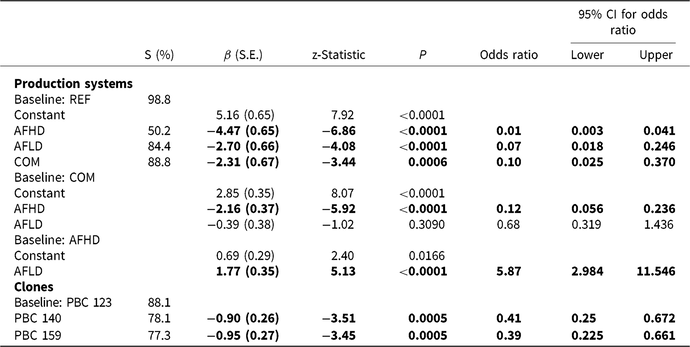
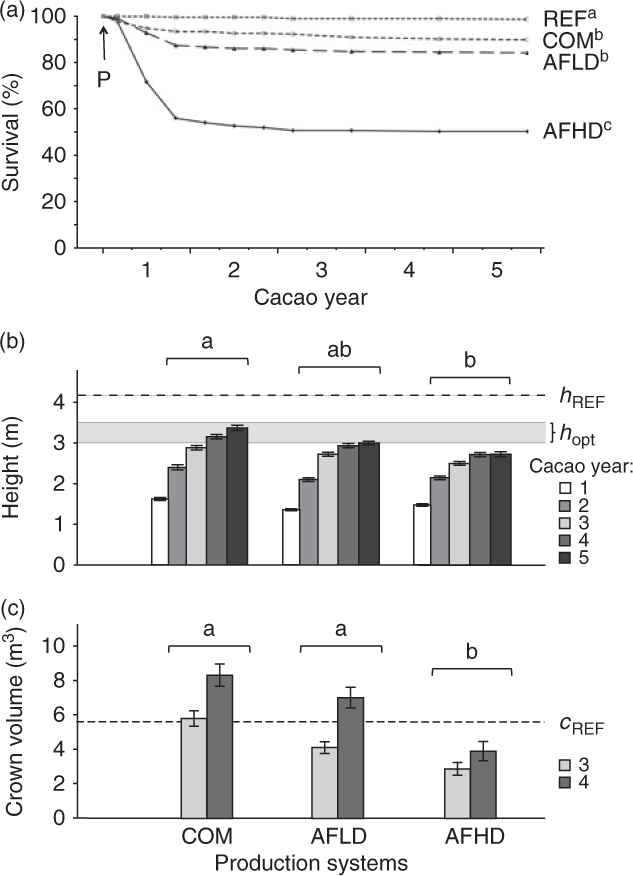
Five years after the rehabilitation of the old plantation, cacao tree survival differed significantly among production systems (Table 1). The rehabilitation pruning had a negative and significant effect on survival, as survival after 5 years was significantly higher in REF (99%) than in the pruned systems. The effect of agroforestry differed between the agroforestry systems: while cacao tree survival did not differ significantly between AFLD (84%) and COM (89%), survival was significantly reduced in AFHD (50%) compared to the other two systems. Mortality rates were highest in the year directly after the tree pruning, when cacao survival decreased to 56% in AFHD, 88% in AFLD and 94% in COM (Figure 1). In subsequent years, no major changes in cacao tree survival were observed.
Effects of production system and clone on survival of the cacao tree T. cacao in a rehabilitated plantation in peninsular Malaysia

Statistical analysis was done by mixed effects binary logistic regression (forced entry), testing for production system and clone; plot was considered as random effect. AFHD = agroforestry system with high tree diversity (16 agroforestry tree species); AFLD = agroforestry system with low tree diversity (three agroforestry tree species); COM = common practice full-sun monoculture; REF = reference system (common practice full-sun monoculture without rehabilitation pruning); S = Survival (trees present in year 5/ trees present at establishment *100); CI = confidence interval. Effects significant at p < 0.05 are highlighted in bold.
Survival (A; %), height (B; mean ± SE; m) and productive crown volume (C; mean ± SE; m3), of cacao trees in four production systems of a rehabilitated plantation in peninsular Malaysia over four cacao years. AFHD = agroforestry system with high tree diversity; AFLD = agroforestry system with low tree diversity; COM = common practice full-sun monoculture; REF = reference system: common practice full-sun monoculture without rehabilitation pruning. Contrasting small letters refer to significant differences among the production systems (survival: logistic regression, height and productive crown volume: repeated measures linear mixed effects models, p < 0.05).

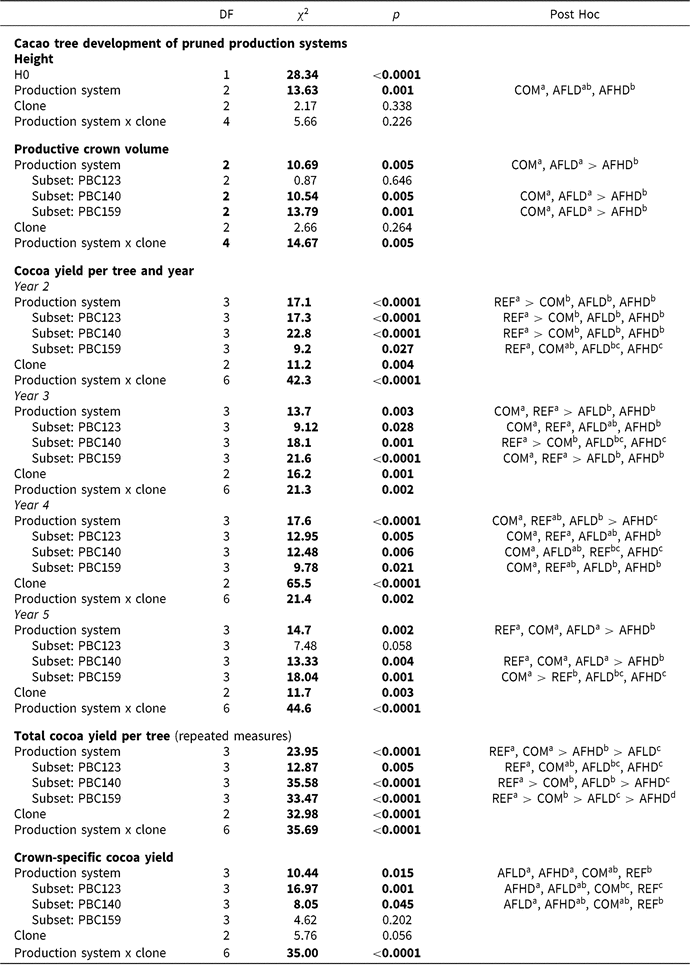
Production systems had significant effects on cacao tree development (Table 2 and Figure 1). While tree height did not differ significantly between AFLD and COM or between AFLD and AFHD, height was significantly lower in AFHD compared to COM. Whereas the target height of 3–3.5 m was reached by COM in year 3 and by AFLD in year 4, cocoa trees in AFHD had not reached the target height by the end of the 5-year trial period. With regards to productive crown volume, the effects of production systems differed among clones: while crown volume of PBC123 was not significantly affected, crown volume of PBC140 and PBC159 was significantly lower in AFHD than in AFLD and COM (Table 2). While COM achieved a mean productive crown volume similar to the reference in year 3, crown volume of COM and AFLD exceeded the reference in year 4 (Figure 1). Visual tree vigour assessments of the pruned systems showed significantly lower vigour scores in both agroforestry systems than in COM and significantly lower vigor scores in AFHD than in AFLD (Table S3). Leaf herbivory was significantly higher in AFHD than in AFLD and significantly higher in both agroforestry systems than in COM.
Effects of production system and clone on height (m), productive crown volume (m3) and yield (kg dry beans/tree) of the cacao tree T. cacao in a rehabilitated plantation in Malaysia

Statistical analysis was done with multilevel linear models using maximum likelihood (Pinheiro and Bates, Reference Pinheiro and Bates2000; Twisk, Reference Twisk2006). Tree height, productive crown volume and total yields over time were analyzed with repeated measures mixed effects models, considering production system as fixed between-subject factor, year as fixed within-subject factor, the interaction of production system and clone, and plot and tree as nested random factors. To account for the differential cacao tree height after pruning, starting height (H0) was included into the analysis of tree height as it significantly improved the model. Cocoa yield/tree of the individual years and crown-specific yield were analyzed by performing mixed effects models, considering production system and clone as fixed factors, the interaction of system and clone, and plot as random factor. If the interaction effect was significant, clones were compared separately among production systems. Tukeys Post Hoc tests were done to compare individual groups. Contrasting letters a, b, c refer to significant differences between production systems. Post Hoc tests were considered significant at p < 0.05. AFHD = agroforestry system with high tree diversity; AFLD = agroforestry system with low tree diversity; COM = common practice full-sun monoculture; REF = reference system: common practice full-sun monoculture without rehabilitation pruning. Effects significant at p < 0.05 are highlighted in bold.
Effects of rehabilitation pruning and agroforestry on cacao yield
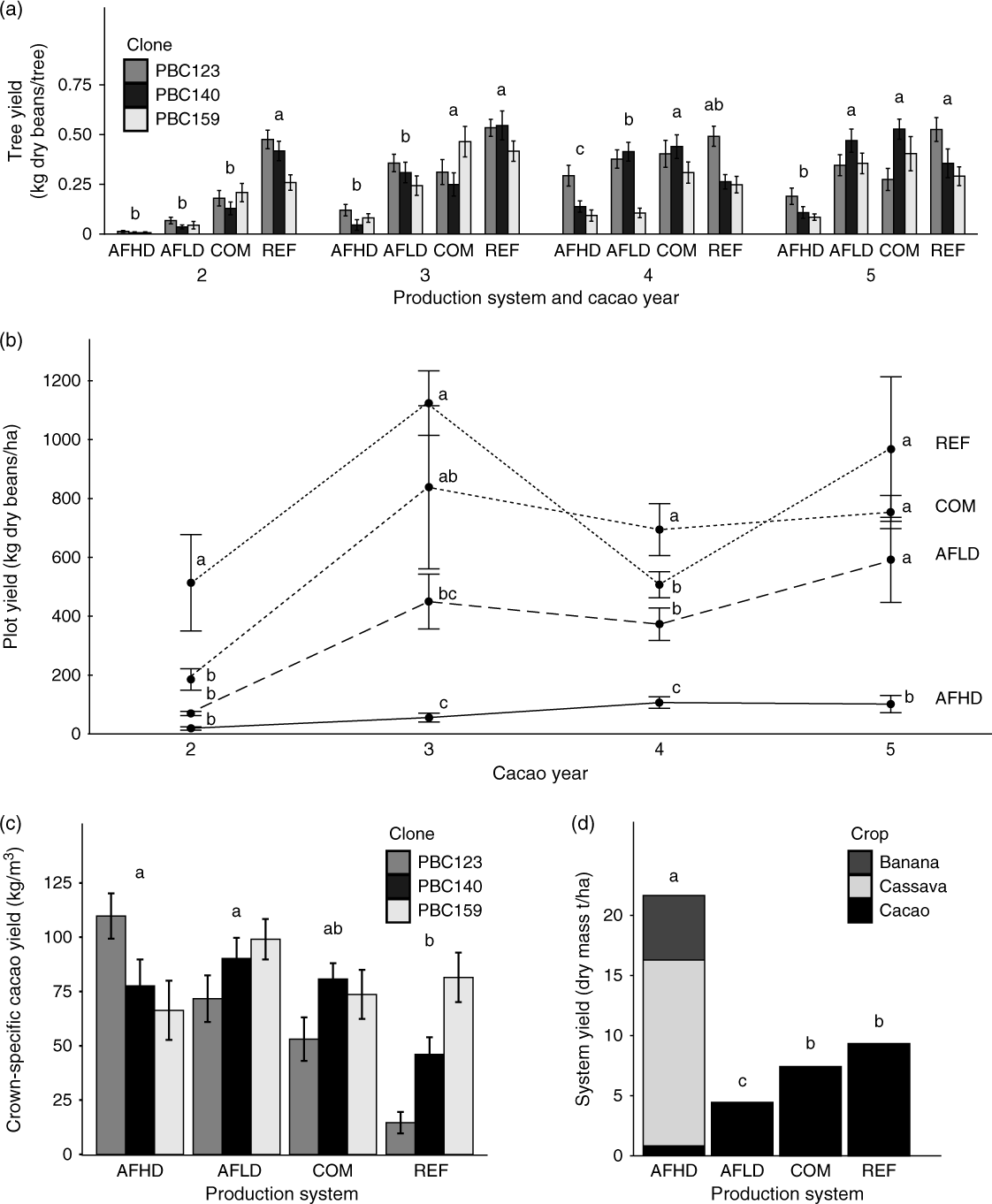
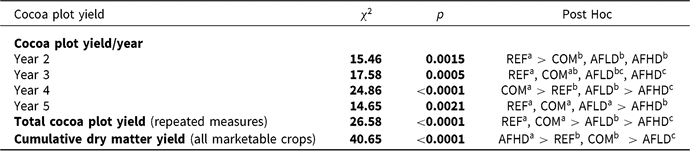
Production systems had significant effects on cacao yield that changed over time and varied among clones (Tables 2 and 3; Figure 2). Since interaction effects of production systems and clones were highly significant, system effects on individual clones were analyzed separately and are shown in Table 2 alongside the main effects. In year 2, the pruned systems yielded a low amount of cacao beans (Figure 2) that lay significantly below the reference, considering the main effect on the focus trees (Table 2) as well as actual and full stock plot yield (Table 3). In year 3, the yield of all systems increased, mostly in COM, where yield was no longer significantly different from yield in REF (main effect on the focus trees, actual and full stock plot yield). Cacao plot yield of AFLD was intermediate and did not differ significantly from COM. Yet, the yield of the focus trees was significantly lower in AFLD than in COM, due to the low yield of the clone PBC159 (Figure 2A; Table 2). Cacao yield of AFHD remained low but did not differ significantly from AFLD. In year 4, cacao yield of PBC159 decreased in REF, COM and AFLD and yield of PBC140 decreased in REF. As a consequence, COM, REF and AFLD had similar cacao yields per tree, which did not differ significantly considering the main effect. Plot yields of COM were significantly higher than the other systems. Cacao yield of AFHD increased but remained low and significantly below the other systems (considering plot yields and the main effect on the focus trees). In year 5, yields of REF, COM and AFLD were higher than year 4 and did not differ significantly considering plot yields and the main effect on the focus trees. Cacao yield of AFHD remained constant and lay significantly below the yield of the other systems. The crown-specific yield of the focus trees was significantly higher in the agroforestry systems than in the reference (Table 2) and intermediate in COM. However, a significant interaction revealed that the system effect varied among clones (Figure 2C).
Cacao and system yield in four production systems of a rehabilitated plantation in peninsular Malaysia over four cacao years for the clones PBC123, PBC140 and PBC159. A = Cacao yield per tree (mean ± SE; kg dry beans/tree, based on yield of the focus trees); B = cacao plot yield of the actual tree stock (mean ± SE; kg dry beans/ha); C = Crown-specific cacao yield (kg dry beans/m3); D = total system yield of marketable products (dry mass of banana, cassava and cacao in t/ha). AFHD = agroforestry system with high tree diversity; AFLD = agroforestry system with low tree diversity; COM = common practice full-sun monoculture; REF = reference system: common practice full-sun monoculture without rehabilitation pruning. Contrasting small letters refer to significant differences among the production systems within the years (linear mixed effects models, p < 0.05).

With regard to the total cacao yield over 4 years, REF (3110 ± 320 kg cacao/ha actual stock yield) achieved the highest yield followed by COM (2470 ± 290 kg/ha). However, the REF system yielded an additional harvest of around 600 kg/ha (source: Barry Callebaut) to 800 kg/ha (study average of the system) in the first year after pruning which was not the case for the regenerated systems. The total cacao yield of AFLD is (1480 ± 270 kg/ha), lay significantly below REF and COM and significantly above AFHD (280 ± 70 kg/ha). Regarding the full cacao tree stock of 1111 trees/ha, the total potential cacao yield of the systems over 5 years amounts to 3210 ± 350 kg/ha (plus an additional harvest in year 1) in the reference, 3020 ± 480 kg/ha in COM, 1800 ± 220 kg/ha in AFLD and 580 ± 140 kg/ha in AFHD.
The cacao yield of the high diversity agroforestry was supplemented by a yield of 6830 kg bananas/ha, which were mainly harvested in years 2 and 3. Additionally, 17 200 kg cassava/ha were harvested in year 1 in AFHD. Furthermore, smaller amounts of oil palm fruits, oranges, star fruit and soursop were harvested in AFHD. Due to the banana and cassava harvest, the cumulative dry matter yield of all marketable crops was substantially and significantly higher in AFHD than in the other systems (Figure 2, Table 3). The 5-year-old timber trees in the agroforestry systems achieved a total commercial timber volume of 5.6 m3/ha in AFLD and 5.9 m3/ha in AFHD. The average dry bean yields per year of the clones in the reference system were 0.94 ± 0.09 kg/tree (=1033 kg/ha; PBC123), 0.69 ± 0.06 kg/tree (=767 kg/ha; PBC140) and 0.41 ± 0.04 kg/tree (=456 kg/ha; PBC159).
Effects of production system on cacao plot yield (kg dry beans/ha) of the actual tree stock in a rehabilitated plantation in Malaysia

Statistical analysis was done with linear models (maximum likelihood) by performing mixed effects models for the cocoa yield of the individual years and the cumulative dry matter yield, considering production system as fixed factor (DF = 3) and plot as random factor and a repeated measures mixed effects model for the total yields over time, considering production system as fixed between-subject factor, year as fixed within-subject factor and plot as random factors (Pinheiro and Bates, Reference Pinheiro and Bates2000; Twisk, Reference Twisk2006). Contrasting letters a, b, c refer to significant differences between production systems. Post Hoc tests were considered significant at p < 0.05. AFHD = agroforestry system with high tree diversity; AFLD = agroforestry system with low tree diversity; COM = common practice full-sun monoculture; REF = reference system: common practice full-sun monoculture without rehabilitation pruning. Effects significant at p < 0.05 are highlighted in bold.
Incidence of pests and diseases of cacao pods
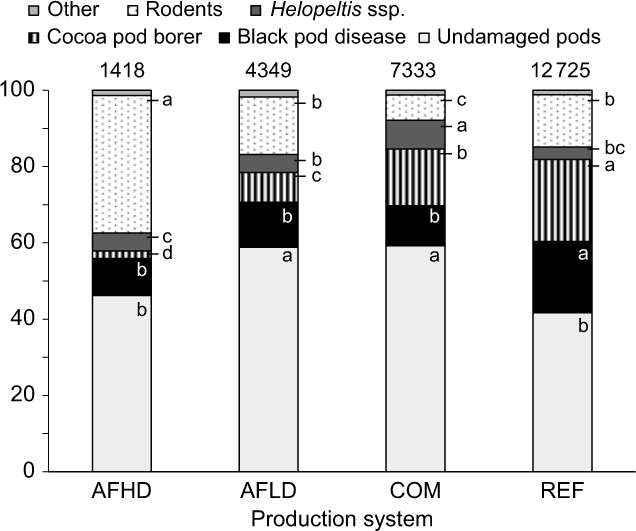
The proportion of healthy pods was significantly higher in COM and AFLD than in AFHD and REF (Figure 3; Supplementary Material Table S3). The proportion of pods affected by Phytophthora sp. (black pod rot) was significantly higher in REF than in the pruned production systems, which did not differ from each other significantly. The proportion of pods affected by C. cramerella (cocoa pod borer) was significantly higher in the monocultures than in the agroforestry systems. Damage by C. cramerella was highest in REF, followed by COM and AFLD and lowest in AFHD. The proportion of pods affected by Helopeltis spp. was significantly higher in COM than in the other systems. Helopeltis damage was significantly lower in AFHD than in AFLD and did not differ significantly among the agroforestry systems and the reference. The proportion of pods affected by rodents was significantly higher in AFHD than in AFLD and REF and significantly below the other production systems in COM.
Pests and diseases of cacao pods in four production systems of a rehabilitated plantation in peninsular Malaysia. Columns indicate the percentage of cacao pods affected by the pest or disease. AFHD = agroforestry system with high tree diversity; AFLD = agroforestry system with low tree diversity; COM = common practice full-sun monoculture; REF = reference system: common practice full-sun monoculture without rehabilitation pruning. Numbers above the columns indicate the total number of pods. Contrasting small letters indicate significant differences of the different categories among the production systems (Kruskal–Wallis tests, p < 0.05).

Discussion
Effect of rehabilitation pruning on cacao tree performance, cacao yield and total system yield
Rehabilitation pruning was carried out with the aim of increasing productivity and rebuilding an easily manageable canopy without incurring a prolonged unproductive phase (as it is the case with re-planting). It may further serve as an opportunity to establish agroforestry by temporarily opening the cacao canopy. Pruning had a negative effect on cacao tree survival, mainly due to increased mortality during the initial 12 months. It is likely that a severe VSD infection and the additional sanitation pruning contributed to this mortality. Gradual tree mortality may not necessarily result in reduced harvests, as observed by Bastide et al. (Reference Bastide, Paulin and Lachenaud2008), who recorded stable cacao yields in spite of a mortality of 33% over 21 years in Indonesia, due to an increase in productivity of the remaining trees. However, even if neighbouring trees may compensate for missing trees in the long term, the reduced tree stocks together with the re-growth phase during which the pruned trees grow to an optimal height and shape lead to reduced short-term yields after rehabilitation pruning (Nair et al., Reference Nair, Virakthmath, Mallika and Chadha1994; Negussie et al., Reference Negussie, Achten, Norgrove, Mekuria, Hadgu, De Both, Leroy, Hermy and Muys2016).
The finding that the pruned trees started to yield again in year 2 confirms that the unproductive phase after pruning is shorter compared to the unproductive phase of 3–5 years which is usual after felling and re-planting cacao trees (de Almeida and Valle, Reference de Almeida, Valle and Da Metta2010; Schneider et al., Reference Schneider, Andres, Trujillo, Alcon, Amurrio, Perez, Weibel and Milz2016). Therefore, pruning might be a favourable alternative to re-planting if cacao production is comparable in the long term. In this trial, the aim to increase productivity through rehabilitation pruning above the low reference yield of 600–800 kg/ha was not reached after 5 years. However, due to the negative effects of the VSD infestation, it remains uncertain whether pruning is a means of yield improvement in a different, more favourable setting. Furthermore, the decreasing yield difference over the years among the reference (REF), the pruned monoculture (COM) and the low-diversity agroforestry (AFLD; yield of COM became similar to REF from year 2 and yield of AFLD from year 3), suggests that the yields of the pruned systems might exceed the reference yield in the mid and long term. To mitigate the yield gap after pruning, it is advisable to minimize mortality by conducting the pruning in the absence of diseases and reducing disease pressure through plant protection, thereby preventing excessive sanitation pruning (Norgrove, Reference Norgrove2007). Under varying environmental conditions timing and intensity of pruning is pivotal for balancing light and water availability and conserving micro-environments for cocoa production (Niether et al., Reference Niether, Armengot, Andres, Schneider and Gerold2018). Furthermore, it might be advantageous to conduct the pruning directly after the main harvest period in January and February, in order not to affect the harvest of the following year.
The successful growth of timber trees and by-crops in the agroforestry systems demonstrates that pruning allows for the establishment of agroforestry on extant cacao plantations without requiring clear-cutting of the cacao trees. Rehabilitation pruning might enable small-scale farmers, who cannot wait out a prolonged unproductive phase, to transition from monocultures to more sustainable production systems.
Effects of agroforestry on cacao tree development, cacao yield and total system yield
Cacao tree survival and re-growth after pruning were slightly lower but did not differ significantly between AFLD and COM, showing that agroforestry can be established without negative effects on cacao tree development. Similar to growth, yearly cacao yield in AFLD was slightly lower or similar to COM. Although total yield was lower in AFLD than in COM, yield in the final year, when the cacao trees in AFLD had reached the optimal height, was no longer different. This and the equal crown-specific yield in AFLD and COM indicate equal yields in both systems over time. The finding that yields in the structurally simple agroforestry system were similar to the monoculture corresponds with the finding that slight shading below 25% has little effects on cacao yields (Zuidema et al., Reference Zuidema, Leffelaar, Gerritsma, Mommer and Anten2005). Yet, since effects of shade trees depend on species identity as well as on local climatic and soil conditions (Asare et al., Reference Asare, Asare, Asante, Markussen and Raebild2017), agroforestry systems need to be evaluated individually. Furthermore, since tree–tree interactions change over time and also manifest below ground, the development of the agroforestry species has to be considered as well as root competition (Riedel et al., Reference Riedel, Dorn, Plath, Potvin and Mody2013; Schroth, Reference Schroth1998). In our study, the companion species present in the AFLD system (A. pintoi, G. sepium, timber trees) did not hinder the growth of cacao trees. Since G. sepium grows well on degraded lands, provides protein-rich fodder, and may further increase water uptake and tree growth due to its complementary water use to cacao (Carr and Lockwood, Reference Carr and Lockwood2011; Tscharntke et al., Reference Tscharntke, Clough, Bhagwat, Buchori, Faust, Hertel, Holscher, Juhrbandt, Kessler, Perfecto, Scherber, Schroth, Veldkamp and Wanger2011). Considering the root system, G. sepium roots show moderate horizontal growth and do not affect cacao trees negatively (Schroth, Reference Schroth1998). Overall, the species can be considered favourable companion suitable for a range of agroforestry systems. Similarly, the timber species used in the system (Swietenia sp., A. excelsa, A. malaccensis) proved to be a feasible option to provide shade to cacao. The cover crop A. pintoi is known to enhance soil fertility and suppress weeds and may have supported cacao tree performance in the system (Yucailla et al., Reference Yucailla, Orozco, Burgos and Hernandez2016). Overall, the AFLD system is a favourable choice if agroforestry is desired without incurring mayor cacao yield losses.
In the high-diversity agroforestry (AFHD) cacao tree survival, development and yield were reduced. The high mortality might be due to less-effective plant protection to counteract VSD (copper-based fungicides instead of the systemic fungicide used in AFLD and COM). Another possible explanation is a shortage of nutrients, since a switch from mineral to organic fertilization can cause an initial decline in plant-available nitrogen (Prasad Datta et al., Reference Prasad Datta, Kumar Rattan and Chandra2010). The fact that the cacao yield per crown volume is the same as in the agroforestry systems and the monoculture indicates that the lower cacao yield in the systems was a consequence of the delayed development. In the same way, the observed tree vigour was reduced in AFHD, with insufficient growth of new branches and an insufficient amount of mature leaves delaying re-growth after the rehabilitation pruning. Reasons for the slower growth might be the high shading in the system or root competition due to the high density of agroforestry trees (Schroth, Reference Schroth1998; Zuidema et al., Reference Zuidema, Leffelaar, Gerritsma, Mommer and Anten2005). Furthermore, leaf herbivory was highest in AFHD. This might be linked to the fact that no insecticides were used. In Bolivia, production systems based on the same principles of successional agroforestry as AFHD produced yields ranging from 105 to 510 kg/ha (Schneider et al., Reference Schneider, Andres, Trujillo, Alcon, Amurrio, Perez, Weibel and Milz2016) indicating that cacao production in such a system is limited. Yet, the low cacao yield is inherent to the production system that is based on the production of a variety of by-crops, such as banana, cassava, and fruit and commercial timber, as it can be advantageous to smallholders (Leakey and Tchoundjeu, Reference Leakey and Tchoundjeu2001). In our trial, total system yield was highest in this system due to an extensive harvest of banana and cassava. Furthermore, higher system yields of diverse agroforestry systems can result in increased farmer income due to higher revenues and a higher return on labour (gross margin divided by working days)(Armengot et al., Reference Armengot, Barbieri, Andres, Milz and Schneider2016). Overall, our results show that low input, high-diversity agroforestry systems have the potential to increase nutrition, food security and income of smallholders and represent a feasible option to support farmers during the first years after plantation establishment, when cacao harvests are lacking (Leakey and Tchoundjeu, Reference Leakey and Tchoundjeu2001).
Pests and diseases of cacao pods
The fact that the proportion of pods affected by pest and diseases was higher in REF (58%) than in COM (41%) suggests a positive effect of pruning. The higher pest and disease incidence might be caused by plant protection being less effective in the reference system, as pesticide application was impeded in the upper parts of the large trees. The reduced pest and disease incidence in the pruned monoculture might be due to reduced canopy connectivity and altered microclimate, which have been found to hinder dispersal and prevent damage of diseases and herbivores (Dias et al., Reference Dias, Santos, Santos, Almeida, Cruz and Carneiro2000; Schroth et al., Reference Schroth, Krauss, Gasparotto, Aguilar and Vohland2000). Rehabilitation pruning coupled with regular maintenance pruning might therefore be promising components of a cost-effective, locally realizable pest management strategy that holds potential to reduce the amount of pesticides and associated negative effects on human health and the environment. However, resource concentration effects cannot be ruled out, as the number of pods and beans was higher in REF than in the pruned systems, making the system more attractive to herbivores (Root, Reference Root1973).
The finding that incidences of C. cramerella were lower in AFLD (8%) than in COM (15%) and negligible in AFHD (2%) together with the observation that Helopeltis sp. damage in AFHD was the lowest indicates that the cacao trees in the agroforestry systems may benefit from associational resistance towards pod-affecting insect herbivory. Further, this confirms the assumption of reduced herbivory in polyculture (Pumarino et al., Reference Pumarino, Sileshi, Gripenberg, Kaartinen, Barrios, Muchane, Midega and Jonsson2015; Schroth et al., Reference Schroth, Krauss, Gasparotto, Aguilar and Vohland2000). Damaging herbivores might be repelled from the agroforestry due to resource dilution effects or increased top-down control by antagonist species (Root, Reference Root1973). Yet, the fewer number of pods produced in the agroforestry systems in itself may have reduced the attractiveness of the systems for C. cramerella. Furthermore, the altered microclimate certainly also affects pests and disease incidence, natural enemies as well as the susceptibility of the cacao trees (Schroth et al., Reference Schroth, Krauss, Gasparotto, Aguilar and Vohland2000). Still, the fact that AFHD, a system not treated with insecticides, registered lower losses than production systems under regular spraying schemes may be an indication for the self-regulating potential diverse agroforestry systems rendering such systems attractive for smallholders lacking the means to afford chemical plant protection. A drawback of the AFHD system was the higher amount of damage incurred by rodents.
Since the amount of Phytophthora sp. damage to pods did not differ between COM and the agroforestry systems, our results contradict the assumption that Phytophthora infestation in agroforestry is higher, due to less aeration and higher humidity compared to full-sun systems (Schroth et al., Reference Schroth, Krauss, Gasparotto, Aguilar and Vohland2000). Instead, the year round presence of mulch and the additional leaf layer might prevent the spores from becoming airborne. However, due to the higher number of cacao pods in the reference system and the dissimilar crown volume in the production systems, additional work is needed to fully clarify the effect of agroforestry and resource concentration on Phytophtora and C. cramerella infestation. Bos et al. (Reference Bos, Steffan-Dewenter and Tscharntke2007) observed lower incidences of black pod disease under constant shade but increased shade tree diversity. While cacao tree pruning (reduced shade) reduced Phythophthora incidence, agroforestry (increased shade and tree diversity) did not increase Phythopthora incidence. These findings conform to our results. The varied performance of the cacao clones in the production systems demonstrated that, in order to successfully implement agroforestry, adequate selection of cacao clones is imperative (Avila-Lovera et al., Reference Avila-Lovera, Coronel, Jaimez, Urich, Pereyra, Araque, Chacon and Tezara2016; Owusu-Ansah et al., Reference Owusu-Ansah, Curnow and Adu-Ampomah2013).
Conclusions
Our study revealed that rehabilitation pruning is not a suitable way to increase short-term cacao yields in the presence of plant diseases such as VSD. For pruning to be successful, timing and attendant circumstances have to be considered carefully. Yet, as the successful growth of agroforestry trees after cacao pruning demonstrates, rehabilitation pruning is an effective measure to take for the establishment of agroforestry on extant plantations. As the unproductive phase after pruning is reduced compared to re-plantings, rehabilitation pruning may be an advantageous diversification strategy for smallholders. Low-diversity agroforestry is a feasible system for larger-scale commercial purposes that offers comparable cacao tree performances and yields to monocultures, while at the same time producing timber. High-diversity agroforestry is an economically attractive option for smallholders, since lower cacao yields can be compensated by yields of a wide range of by-crops that may generate substantial income, improve nutrition and help compensate for cacao losses during the regeneration gap. Additional work is needed to elucidate the effects of below-ground competition on cacao tree development and yield in agroforestry systems. Standardizing the amounts of resources among production systems could yield interesting results on the potential of agroforestry to limit pest and diseases without the confounding effects of resource concentration.
Supplementary materials
For supplementary material for this article, please visit https://doi.org/10.1017/S0014479718000431.
Author ORCIDs
Judith Riedel 0000-0001-5195-7652
Acknowledgements
We thank three anonymous reviewers for providing helpful comments on the manuscript. We thank Cinzia Anselmi and Lachlan Monsbourgh for supporting the project; Niels Vanhoudt, Hafiz Ikhram, Ayyamani Jagadish and the plantation workers for help with fieldwork; Joachim Milz for the support with the management of the production systems and the Barry Callebaut Group for funding this research.
Financial support
This research was funded by the Barry Callebaut Group.