


Introduction
Rice is cultivated in over 100 countries and is a staple food for more than 3.5 billion people globally (Muthayya et al., Reference Muthayya, Sugimoto, Montgomery and Maberly2014; Rao et al., Reference Rao, Wani, Ramesha, Ladha, Chauhan, Jabran and Mahajan2017). Cooked rice is the most commonly consumed form, while the demand for processed rice products has been increasing in response to modern lifestyle needs (Lu and Collado, Reference Lu, Collado and Bao2019). Among these products, rice noodles are particularly favoured in East and Southeast Asian countries, including China, Thailand and Vietnam. Their market has also expanded to other parts of the world due to their high nutritional value and distinctive flavour characteristics (Li et al., Reference Li, You, Chen, Gu, Zhang, Holler, Ban, Hong, Cheng and Li2021).
China is the largest rice-producing country, encompassing a broad range of climatic zones with various rice cropping systems (Chen et al., Reference Chen, van Groenigen, Yang, Hungate, Yang, Tian, Chen, Dong, Huang, Deng, Jiang and Zhang2020). In southern China, the double-season rice cropping system is especially prevalent (Huang et al., Reference Huang, Chen and Cao2022). This system involves planting early-season rice followed by late-season rice within the same calendar year, typically from March to November. Early-season rice is often of lower quality than late-season rice, possibly due to higher temperatures during the grain-filling period. This quality issue limits its market competitiveness, leading to reduced motivation among farmers to grow it. Nonetheless, early-season rice is well-suited for producing rice noodles. To boost the marketability of early-season rice and stabilize its planting area, certain provinces in southern China, such as Hunan, have initiated projects to identify specific early-season rice varieties optimal for rice noodle production (Huang et al., Reference Huang, Xiao, Chen and Cao2021). These initiatives prioritize achieving high yields and ensuring the production of high-quality rice noodles.
Rice noodles are generally made from milled rice (Huang et al., Reference Huang, Xiao, Chen and Cao2021), and the yield of rice noodles per unit of land area can be divided into three main components: grain yield per unit of land area, milled rice rate and noodle yield per unit of milled rice weight. However, limited information is available on varietal differences in the yield of rice noodles per unit of land area, and even less is known about the key factors responsible for high rice noodle yields per unit of land area.
Among the components affecting rice noodle yield per unit of land area, grain yield can be further broken down into four factors: panicle number per unit of land area, spikelet number per panicle, spikelet filling percentage, and grain weight (Xiong et al., Reference Xiong, Flexas, Huang, Cui, Wang, Douthe and Lin2022). However, no consistent conclusion has been drawn regarding which of these factors is most crucial for high grain yield per unit of land area in early-season rice, as different studies emphasize different components. For example, Wu et al. (Reference Wu, Nie, Liao, Shah, Cui, Wang, Lian and Huang2013) found that grain yield per unit of land area had a parabolic relationship with the number of panicles per unit of land area but was not related to the other three yield components in early-season rice when examining different planting densities and nitrogen application rates. Chen et al. (Reference Chen, Cao, Shan, Yin, Huang and Zou2019) observed a positive correlation between grain yield per unit of land area and grain weight, while the other three components showed no significant association, based on an analysis of six early-season rice varieties. Huang et al. (Reference Huang, Guo, Zeng, Huang, Zeng and Xie2024) suggested that genetic improvements in grain yield per unit of land area of early-season rice in southern China from 2000 to 2020 were mainly due to an increase in the number of spikelets per panicle.
The cooking and eating qualities are two critical aspects for evaluating the overall quality of rice noodles (Huang et al., Reference Huang, Xiao, Chen and Cao2021; Xiao et al., Reference Xiao, Liao, Hu, Zhang, Chen, Cao, Fang and Huang2022; Guan et al., Reference Guan, Liu, Gan, Xiong, Qiao, Mo, Song, Fu, Liu and Lin2023). The cooking quality is usually assessed by indicators such as the cooked break rate and cooking loss rate, while the eating quality can be measured directly through sensory evaluation by humans or indirectly through the analysis of texture properties. According to Guan et al. (Reference Guan, Liu, Gan, Xiong, Qiao, Mo, Song, Fu, Liu and Lin2023), there is a parabolic relationship between the sensory-based eating quality score and the hardness of cooked rice noodles. Specifically, the sensory-based eating quality score increases with rising hardness, peaking at a hardness level of 2450 g, and then declines. Additionally, a higher hardness is accompanied by increased springiness, resilience and chewiness of cooked rice noodles (Huang et al., Reference Huang, Xiao, Chen and Cao2021).
The chemical properties of milled rice are crucial for determining the cooking and eating qualities of rice noodles (Bhattacharya et al., Reference Bhattacharya, Zee and Corke1999; Fari et al., Reference Fari, Rajapaksa and Ranaweera2011; Xiao et al., Reference Xiao, Liao, Hu, Zhang, Chen, Cao, Fang and Huang2022). Specifically, higher amylose content in milled rice flour generally leads to lower cooked break rate and cooking loss rate in rice noodles, as well as increased hardness in the cooked noodles (Bhattacharya et al., Reference Bhattacharya, Zee and Corke1999; Fari et al., Reference Fari, Rajapaksa and Ranaweera2011). However, other important chemical attributes of milled rice, such as amylopectin and protein content, also affect the quality of rice noodles. Fari et al. (Reference Fari, Rajapaksa and Ranaweera2011) identified a positive relationship between the protein content in milled rice flour and the cooking loss rate of rice noodles. Xiao et al. (Reference Xiao, Liao, Hu, Zhang, Chen, Cao, Fang and Huang2022) found that the hardness and chewiness of cooked rice noodles were negatively associated with the amylopectin content in milled rice flour. These findings suggest that the quality characteristics of rice noodles are influenced by various chemical properties of milled rice flour. To explore whether the relationships between noodle quality traits and chemical properties are influenced by other factors, partial correlation analysis can be used. This approach examines the correlation between two variables while controlling for the effects of one or more additional factors.
In this study, rice noodle yield per unit of land area and its components, cooking traits of rice noodles, texture properties of cooked rice noodles, and chemical properties of milled rice were examined across 15 early-season rice varieties over two years. The objectives of this study were to (1) determine differences in the yield and quality of noodles produced from different early-season rice varieties and (2) identify the key characteristics responsible for the high yield and high quality of noodles made from early-season rice.
Materials and methods
Site and soil characteristics
Field experiments were conducted at the joint research farm of Hunan Agricultural University and Hengyang Academy of Agricultural Sciences during the early-rice growing seasons of 2022 and 2023. The farm is located in Meihua Village, Xidu Town, Hengyang County, Hunan Province, China (26°53′ N, 112°28′ E). The experimental site is characterized by a subtropical monsoon climate. The average daily temperatures and solar radiation during the grain-filling period (from heading to maturity) of early-season rice were 29.4°C and 18.0 MJ/m2/d in 2022, and 29.0°C and 16.1 MJ/m2/d in 2023, respectively. The experimental field featured purple sandy soil, and the chemical properties of the top 20 cm of soil were as follows: pH = 5.98, organic matter content = 31.6 g/kg, available N content = 119 mg/kg, available P content = 16.0 mg/kg and available K content = 71.0 mg/kg.
Experimental design and crop management
The experiment involved 15 early-season rice varieties commonly used for rice noodle production: E1703, Guangluai 4, Liangyou 287, Liangyou 42, Lingliangyou 179, Qiliangyou 785, Xiangzaoxian 24, Yuezaoxian 17, Zhefu 7, Zhongjiazao 17, Zhongzao 25, Zhongzao 39, Zhuliangyou 4024, Zhuliangyou 729 and Zhuliangyou 819. These varieties were planted using a completely randomized block design with three replicates and each plot measuring 30 m2.
Pre-germinated seeds were sown in a seedbed on March 25. After 25 days, the seedlings were manually transplanted with a hill spacing of 20 cm × 16 cm, placing three seedlings per hill. A basal fertilizer application of 75 kg N/ha, 75 kg P2O5/ha and 75 kg K2O/ha was applied one day before transplanting. The first top dressing, consisting of 45 kg N/ha, was applied 7 days after transplanting. The second top dressing, which included 30 kg N/ha and 75 kg K2O/ha, was applied at panicle initiation. The plots were continuously flooded to a depth of 5 to 10 cm from transplanting until 1 week before maturity, at which point they were drained for harvesting. Plant diseases, insects and weeds were controlled with appropriate pesticides.
Sampling and measurement
At maturity, ten hills of rice plants were sampled from each plot. The plant samples were threshed by hand after counting the number of panicles. To separate filled from unfilled spikelets, they were submerged in tap water. Three 30 g subsamples of filled spikelets, along with all unfilled spikelets, were used to determine the spikelet count. The filled spikelets were counted using a digital automatic seed counter (SLY-C, Zhejiang Top Cloud-Agri Technology Co., Ltd., Hangzhou, China), while the unfilled spikelets were counted manually. The filled grains were then oven-dried at 70°C until reaching a constant weight. Yield components, including panicle number per m2, spikelet number per panicle, spikelet filling percentage and grain weight, were calculated. Rice plants were harvested from a 5 m2 area in each plot. Grain yield per unit of land area was calculated by adjusting to a moisture content of 0.135 g H2O/g.
Approximately 3000 g of rice grains were collected from each plot, sun-dried and then stored at room temperature for 3 months. A sample of 100 g of stored rice grains were de-hulled and polished using a laboratory milling machine (JGMJ8098, Jiading Cereals and Oils Instrument Co. Ltd., Shanghai, China) to assess the milled rice rate and the chemical properties of the milled rice. A further 10 g of the whole milled rice grains were ground into flour with a high-speed blender (YS-02, Yanshan Zhengde Machinery Equipment Co. Ltd., Beijing, China) and sieved through a 100-mesh screen for the analysis of amylose, amylopectin and protein content. The amylose content was measured using the iodine colorimetric method outlined by Yang et al. (Reference Yang, Tang, Zhao, Piao, Lee, Wan and Bai2023), incorporating minor modifications. Briefly, 100 mg of rice flour was mixed with 1 ml of 95% ethanol and 9 ml of 1 mol/l NaOH, followed by boiling in a water bath for 10 min. After cooling, the mixture was diluted to 100 ml. Then, 2.5 ml of this solution was combined with 0.5 ml of 1 mol/l acetic acid and 1.0 ml of iodine solution (containing 2% KI and 0.2% I2) and further diluted to 50 mL. The absorbance was measured at 620 nm using a double beam UV-Visible spectrophotometer (L8, INESA Analytical Instrument Co., Ltd., Shanghai, China). The amylopectin content was calculated by subtracting the amylose content from the total starch content, which was measured using a digital polarimeter (P850 Pro, Jinan Hanon Instruments Co., Ltd., Jinan, China). The protein content was determined by multiplying the N content by a conversion factor of 5.95 (Champagne et al., Reference Champagne, Wood, Juliano, Bechtel and Champagne2004), with the N content quantified using a segmented flow analyser (Skalar SAN Plus, Skalar Inc., Breda, The Netherlands).
The remaining stored rice grains were processed into milled rice using a commercial milling machine (6N-4A, Hunan Tingwang Machinery Co., Ltd., Shuangfeng, China) for rice noodle production. Exactly 1000 g of the milled rice was soaked for 10 h at room temperature. The soaked rice was then processed into rice noodles using an automatic rice noodle-manufacturing machine (5-MFD15B, Hunan Fenshifu Machinery Technology Co., Ltd., Loudi, China). After production, the noodles were placed in an optimization chamber with an initial humidity of 95% and an initial temperature of 35°C for 8 h to ensure even water distribution throughout the noodles. The weight of the noodles was recorded. Rice noodle yield per unit of land area was calculated by multiplying the grain yield per unit of land area, the milled rice rate and the rice noodle yield per unit weight of milled rice.
To assess the cooking and texture properties of rice noodles, 30 noodles were randomly selected and cut into 20 cm-long sections. The noodles were boiled in distilled water for 7 min and then weighed. The number of broken noodles was recorded, and the solids lost to the cooking water were measured after oven-drying at 105°C. The cooked break rate (the number of broken noodles/the total number of noodles × 100) and the cooking loss rate (the dry weight of solids lost to the cooking water/the weight of uncooked rice noodles) were calculated according to Xiao et al. (Reference Xiao, Liao, Hu, Zhang, Chen, Cao, Fang and Huang2022). The texture properties, including hardness, springiness, resilience and chewiness, were evaluated using a texture analyser (Rapid TA+, Shanghai Tengba Instrument Technology Co. Ltd., Shanghai, China).
Statistical analysis
The data were analysed using analysis of variance (ANOVA) with Statistix 8.0 (Analytical Software, Tallahassee, FL, USA). The ANOVA statistical model included factors for variety, year and their interaction. To assess relationships between variables, a correlation plot analysis was conducted using Origin 2024 (OriginLab Corp., Northampton, MA, USA). This analysis examined the relationships between rice noodle yield per unit of land area and its components (grain yield per unit of land area, milled rice rate and rice noodle yield per unit of milled rice weight); between grain yield per unit of land area and its components (panicle number per m2, spikelet number per panicle, spikelet filling percentage and grain weight); between cooking properties (cooked break rate and cooking loss rate) of rice noodles and the chemical properties (amylose, amylopectin and protein content) of milled rice flour; and between texture characteristics (hardness, springiness, resilience and chewiness) of cooked rice noodles and the chemical characteristics of milled rice flour. Partial correlation analysis was performed to evaluate the relationships between the cooking properties and texture properties of cooked rice noodles relative to the chemical properties of milled rice flour, using SPSS 20.0 (SPSS Inc., Chicago, IL, USA).
Results
Rice noodle yield and its components
Rice noodle yield per unit of land area was significantly influenced by variety and the interaction between variety and year, but was not significantly impacted by year (Table 1). Noodle yield per unit of land area of the 15 varieties ranged from 4.30 to 6.47 t/ha in 2022 and from 4.46 to 5.95 t/ha in 2023. In 2022, the Liangyou 179 variety had the highest rice noodle yield per unit of land area, but was not significantly different from those obtained from Zhuliangyou 4024, Zhuliangyou 819, Liangyou 287, Zhuliangyou 729 and E1703 varieties. In 2023, the Zhuliangyou 4024 variety had the highest rice noodle yield per unit of land area, but was not significantly different from Zhuliangyou 729, Liangyou 287, Xiangzaoxian 24, Zhongjiazao 17, Liangyou 42, Zhongzao 25, Zhongzao 39, Qiliangyou 785 and Zhuliangyou 819 varieties. Collectively, the Liangyou 287, Zhuliangyou 4024, Zhuliangyou 729 and Zhuliangyou 819 varieties possessed high rice noodle yields per unit of land area over both years.
Noodle yield per unit of land area and its components of 15 early-season rice varieties cultivated in Hengyang, Hunan Province, China in 2022 and 2023

LSD (0.05) values define the comparison of varieties for each year.
* and ** indicate significance at P < 0.05 and P < 0.01, respectively; NS denotes non-significance at P < 0.05.
Grain yield per unit of land area was significantly impacted by variety, year and their interaction (Table 1). Grain yield per unit of land area across the 15 varieties was 5.58 to 7.81 t/ha in 2022 and 5.36 to 7.58 t/ha in 2023, exhibiting a mean of 6.91 and 6.74 t/ha, respectively. Milled rice rate was significantly influenced by variety, but not by year and the interaction between variety and year. The average milled rice rate over the 2 years ranged from 59.0 to 68.5% for the 15 varieties. Rice noodle yield per unit of milled rice weight was significantly impacted by variety and year, but not by their interaction. The average rice noodle yield per unit of milled rice weight over the 2 years was 1.25 to 1.33 kg/kg for the 15 varieties. The average rice noodle yield per unit of milled rice weight across the 15 varieties was 1.28 and 1.27 kg/kg in 2022 and 2023, respectively.
The number of panicles per m2 and the number of spikelets per panicle were significantly influenced by variety and the interaction between variety and year, but were not significantly affected by year (Table 2). The number of panicles per m2 of the 15 varieties ranged from 227 to 332 in 2022 and from 255 to 311 in 2023. The number of spikelets per panicle of the 15 varieties was 90 to 143 in 2022 and 102 to 145 in 2023. The spikelet filling percentage and grain weight were significantly influenced by variety, year and their interaction. The spikelet filling percentage across the 15 varieties ranged from 67.7 to 87.9% in 2022 and from 65.9 to 84.0% in 2023, exhibiting means of 80.3 and 76.3%, respectively. The grain weight of the 15 varieties was 25.6 to 32.6 mg in 2022 and 24.1 to 31.0 mg in 2023, with means of 28.8 and 27.5 mg, respectively.
Grain yield components of 15 early-season rice varieties cultivated in Hengyang, Hunan Province, China in 2022 and 2023
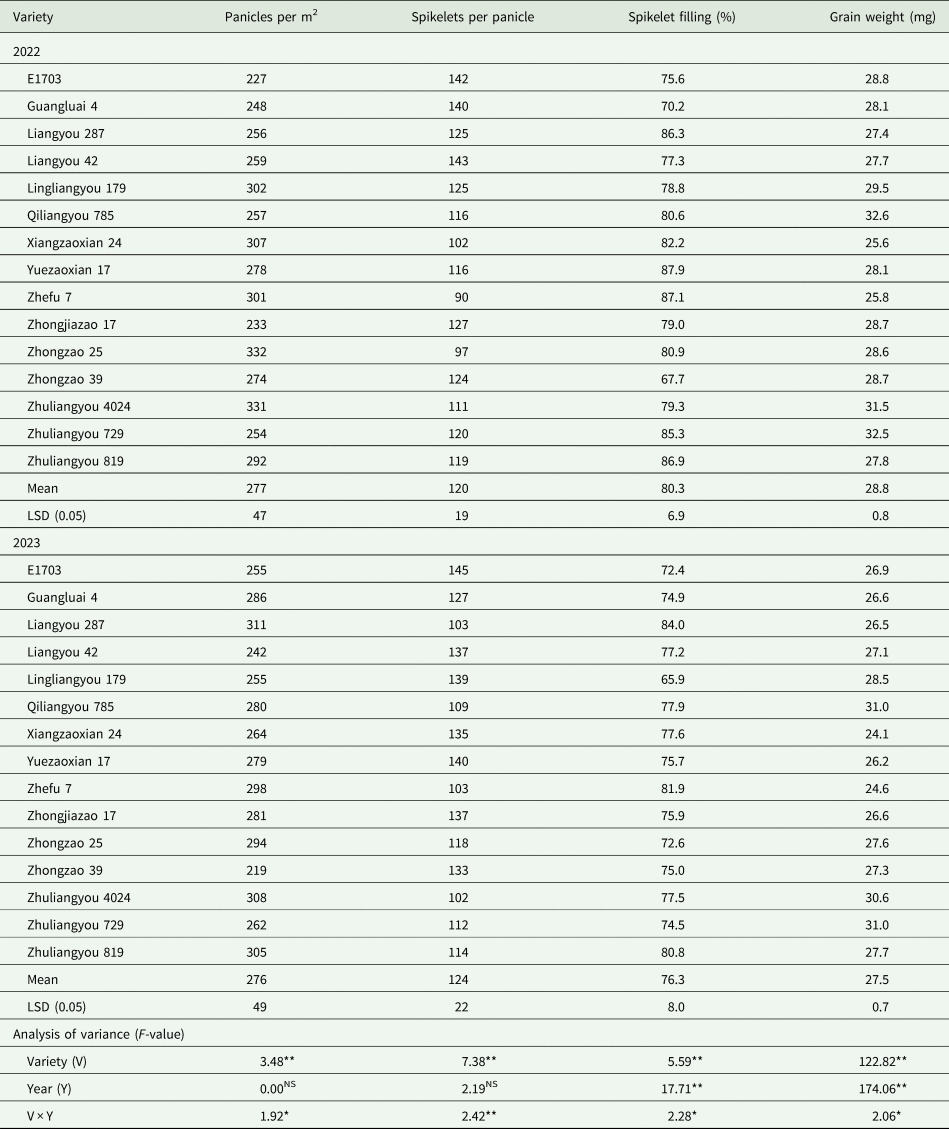
LSD (0.05) values define the comparison of varieties for each year.
* and ** indicate significance at P < 0.05 and P < 0.01, respectively; NS denotes non-significance at P < 0.05.
Correlation plot analysis demonstrated that there were significant positive correlations between rice noodle yield per unit of land area with grain yield per unit of land area and rice noodle yield per unit of milled rice weight, while the correlation between rice noodle yield per unit of land area with milled rice rate was not found to be significant (Fig. 1a). Rice noodle yield per unit of land area was more tightly correlated with grain yield per unit of land area (r = 0.857) than rice noodle yield per unit of milled rice weight (r = 0.663). Grain yield per unit of land area was not significantly associated with the number of panicles per m2, the number of spikelets per panicle and spikelet filling percentage, but was significantly positively related to grain weight (Fig. 1b).
Correlation plot analysis of noodle yield per unit of land area with grain yield per unit of land area, milled rice rate and noodle yield per unit of milled rice weight (a) and between grain yield per unit of land area with panicles per m2, spikelets per panicle, spikelet filling percentage and grain weight (b) across 15 early-season rice varieties grown in Hengyang, Hunan Province, China in 2022 and 2023. ** indicates a significant relationship at P < 0.01. NS denotes a non-significant relationship at P < 0.05.

Rice noodle quality and chemical properties of milled rice
The cooked break rate of rice noodles was significantly impacted by variety, year and their interaction (Table 3). The cooked break rate of rice noodles produced from the 15 varieties ranged from 0.0 to 10.0% in 2022 and from 0.0 to 14.4% in 2023, exhibiting means of 2.2 and 4.5%, respectively. The Liangyou 42, Zhuliangyou 4024 and Zhuliangyou 729 varieties had a cooked break rate of 0.0% in both years. The Liangyou 287, Qiliangyou 785, Xiangzaoxian 24, Zhongjiazao 17 and Zhuliangyou 819 varieties exhibited a low cooked break rate in both 2022 (2.2 to 3.3%) and 2023 (0.0 to 4.4%). The cooking loss rate of rice noodles was significantly affected by variety and the interaction between variety and year, but was not significantly impacted by year. The cooking loss rate of rice noodles produced from the 15 varieties was 5.2 to 15.5% in 2022 and 4.2 to 17.7% in 2023. The E1703, Guangluai 4, Zhongjiazao 17, Zhongzao 25, Zhuliangyou 4024 and Zhuliangyou 729 varieties exhibited a low cooking loss rate in both 2022 (5.2 to 7.1%) and 2023 (4.2 to 5.7%). Overall, rice noodles made from the Zhuliangyou 4024, Zhuliangyou 729 and Zhongjiazao 17 varieties had high cooking quality (both low cooked break rate and low cooking loss rate) over both years.
Cooking quality of rice noodles and texture properties of cooked rice noodles produced from 15 early-season rice varieties cultivated in Hengyang, Hunan Province, China in 2022 and 2023
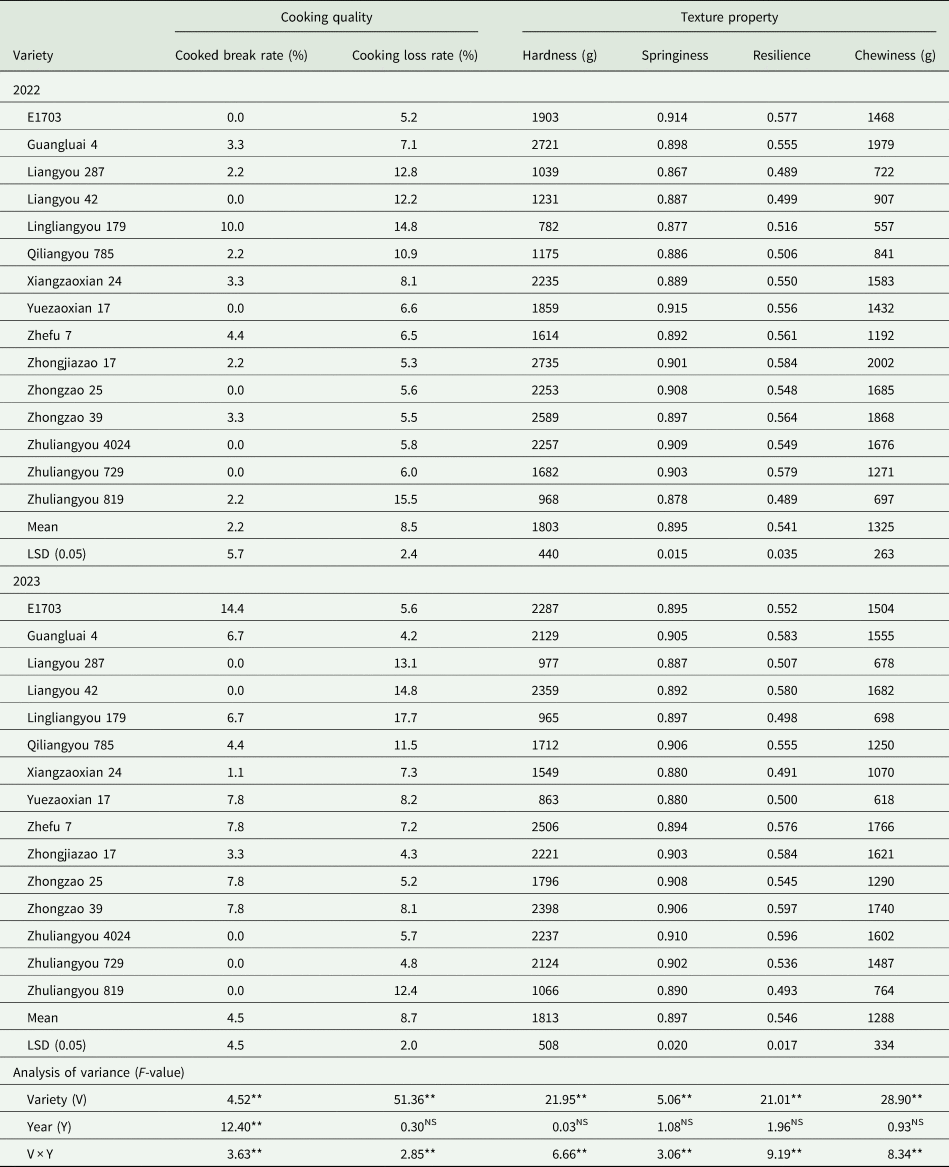
LSD (0.05) values define the comparison of varieties for each year.
** indicates significance at P < 0.01; NS denotes non-significance at P < 0.05.
The hardness, springiness, resilience and chewiness of cooked rice noodles were significantly affected by variety and the interaction between variety and year, but were not significantly influenced by year (Table 3). The hardness of cooked rice noodles made from the 15 varieties ranged from 782 to 2735 g in 2022 and from 863 to 2506 g in 2023. The E1703, Guangluai 4, Zhongjiazao 17, Zhongzao 39 and Zhuliangyou 4024 varieties exhibited a high hardness in both 2022 (1903 to 2735 g) and 2023 (2129 to 2398 g). The springiness of cooked rice noodles produced from the 15 varieties was 0.867 to 0.915 in 2022 and 0.880 to 906 in 2023. The E1703, Zhongjiazai 17, Zhongzao 25, Zhuliangyou 4024 and Zhuliangyou 729 varieties had a high springiness in both 2022 (0.901 to 0.914) and 2023 (0.895 to 0.910). The resilience of cooked rice noodles made from the 15 varieties ranged from 0.489 to 0.584 in 2022 and from 0.491 to 0.597 in 2023. The Guangluai 4, Zhongjiazao 17, Zhongzao 39 and Zhuliangyou 4024 varieties had a high resilience in both 2022 (0.549 to 0.584) and 2023 (0.583 to 0.597). The chewiness of cooked rice noodles made from the 15 varieties ranged from 557 to 2002 g in 2022 and from 618 to 1766 g in 2023. The Guangluai 4, Zhongjia zao 17, Zhongzao 39 and Zhuliangyou 4024 varieties exhibited a high chewiness in both 2022 (1676 to 2002 g) and 2023 (1555 to 1740). Overall, rice noodles produced from Zhongjiazao 17 and Zhuliangyou 4024 had high eating quality (high hardness, springiness, resilience and chewiness) over both years.
Amylose, amylopectin and protein content in milled rice flour were significantly influenced by variety and year but not by their interaction (Table 4). The average amylose content in milled rice flour over the 2 years ranged from 20.3 to 30.4% for the 15 varieties. The average amylose content in milled rice flour across the 15 varieties was 26.1 and 24.2% in 2022 and 2023, respectively. The average amylopectin content in milled rice flour over the 2 years was 48.1 to 58.6% for the 15 varieties. The average amylopectin content in milled rice flour over the 15 varieties was 51.2% in 2022 and 53.5% in 2023. The average protein content in milled rice flour over the 2 years ranged from 6.21 to 7.94% for the 15 varieties. The average protein content in milled rice flour over the 15 varieties was 7.05 and 6.80% in 2022 and 2023, respectively.
Amylose, amylopectin and protein content in milled rice flour of 15 early-season rice varieties cultivated in Hengyang, Hunan Province, China in 2022 and 2023
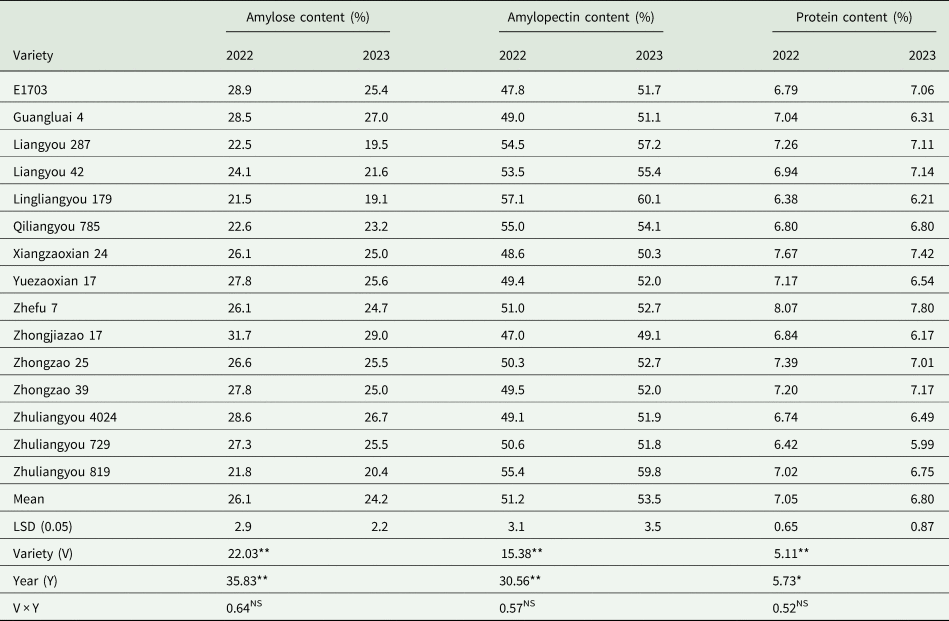
LSD (0.05) values are for the comparison of varieties for each year.
* and ** indicate significance at P < 0.05 and P < 0.01, respectively; NS denotes non-significance at P < 0.05.
Correlation plot analysis revealed that the cooked break rate of rice noodles did not show a significant relationship with amylose content, amylopectin content, or protein content in milled rice flour (Fig. 2a). The cooking loss rate of rice noodles was significantly negatively correlated with amylose content and significantly positively correlated with amylopectin content, but it did not show a significant correlation with protein content. The hardness, springiness, and resilience of cooked rice noodles were all significantly positively related to amylose content, with no significant correlation to either amylopectin content or protein content. The chewiness of cooked rice noodles was significantly positively associated with amylose content and significantly negatively associated with amylopectin content, though it was not significantly related to protein content.
Correlation plot analysis (a) and partial correlation analysis (b) between cooking properties (cooked break rate and cooking loss rate) of rice noodles and texture properties (hardness, springiness, resilience, and chewiness) of cooked rice noodles with chemical properties (amylose, amylopectin, and protein content) of milled rice flour over 15 early-season rice varieties grown in Hengyang, Hunan Province, China in 2022 and 2023. ** and * indicate significant relationships at P < 0.01 and P < 0.05, respectively. NS denotes a non-significant relationship at P < 0.05.
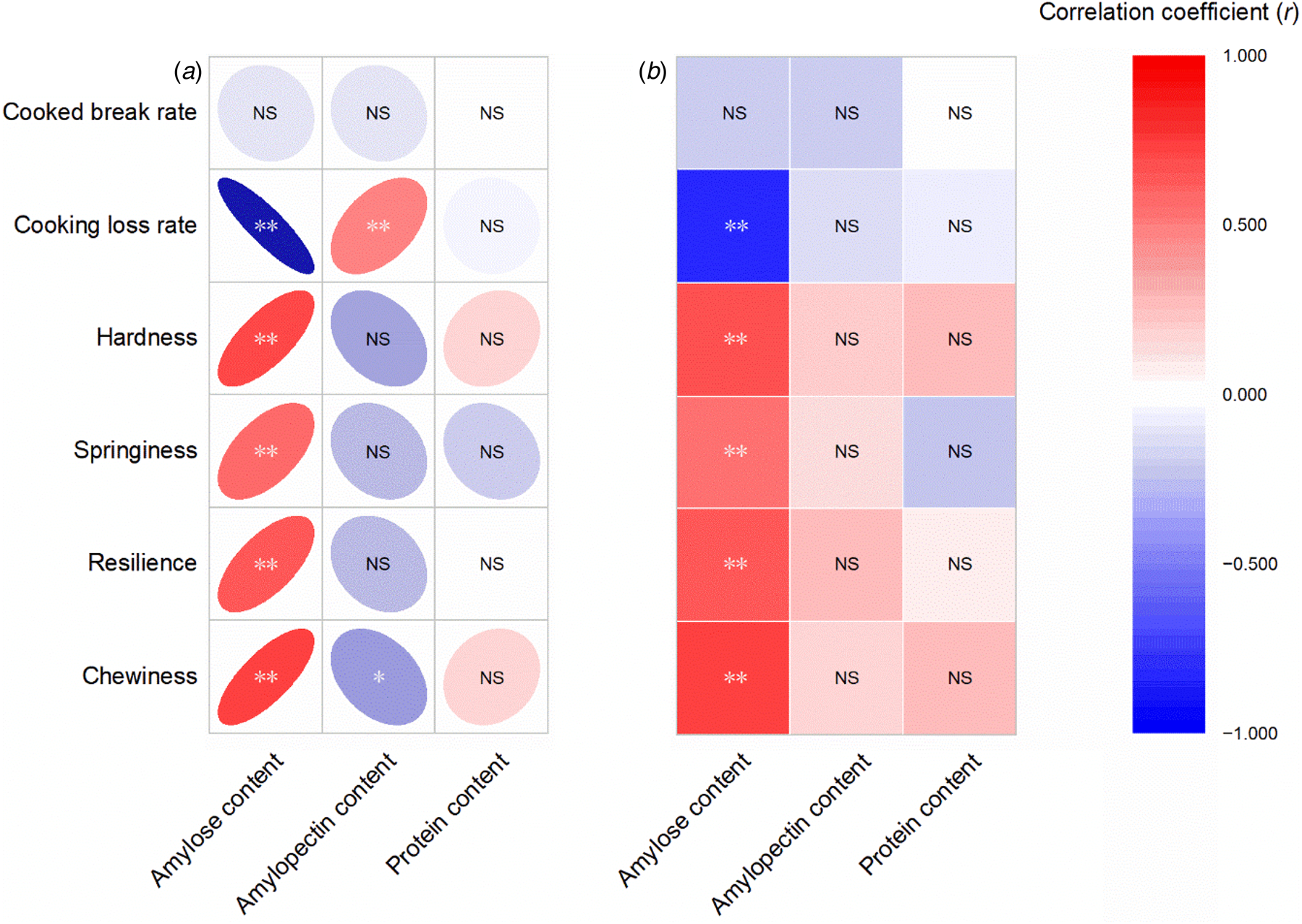
In partial correlation analysis, when controlling for amylopectin and protein content, no significant association was found between the cooked break rate of rice noodles and amylose content. The cooking loss rate remained significantly negatively correlated with amylose content. Meanwhile, the hardness, springiness, resilience, and chewiness of cooked rice noodles were significantly positively correlated with amylose content (Fig. 2b). When amylose and protein content were held constant, no significant relationships were observed between any rice noodle quality traits and amylopectin content. When amylose and amylopectin content were controlled, there were no significant correlations between the quality traits of rice noodles and protein content.
Discussion
Advancing rice varieties that generate both high-yield and superior-quality rice noodles is crucial for the rice noodle industry. Previous studies have predominantly concentrated on the quality traits of rice noodles derived from different rice varieties (Fari et al., Reference Fari, Rajapaksa and Ranaweera2011; Han et al., Reference Han, Cho and Koh2011), whereas there has been a notable lack of information regarding the varietal differences in rice noodle yield. Our study addresses this gap by examining 15 early-season rice varieties, revealing significant variations in both the yield and the cooking and eating qualities of rice noodles. Through a thorough evaluation of rice noodle yield per unit of land area, as well as their cooking and eating qualities, we found that Zhuliangyou 4024 stands out as an early-season rice variety capable of producing rice noodles with both high yield and exceptional quality.
The yield of rice noodles per unit of land area is influenced by several factors: grain yield per unit of land area, the rate of milled rice, and the yield of rice noodles per unit weight of milled rice. In this study, we found that while there were significant correlations between rice noodle yield per unit of land area and both grain yield per unit of land area and the yield of rice noodles per unit weight of milled rice, the association with grain yield per unit of land area was stronger. Additionally, the yield of rice noodles per unit weight of milled rice showed relatively little variation across different rice varieties. This consistency can be attributed to the standardization process, where rice noodles from various varieties were treated in an optimization chamber set at 95% humidity and 35°C for 8 h, minimizing differences in water content. Consequently, the primary factor contributing to the variation in rice noodle yield per unit of land area appears to be the difference in grain yield per unit of land area among the rice varieties.
Grain yield per unit of land area is determined by several factors: panicle number per unit of land area, spikelet number per panicle, spikelet filling percentage and grain weight (Xiong et al., Reference Xiong, Flexas, Huang, Cui, Wang, Douthe and Lin2022). Our study revealed that the differences in grain yield per unit of land area among varieties were primarily associated with variations in grain weight. Specifically, grain yield per unit of land area was significantly related to grain weight, but not to panicle number per unit of land area, spikelet number per panicle or spikelet filling percentage. This result contrasts with the findings from Wu et al. (Reference Wu, Nie, Liao, Shah, Cui, Wang, Lian and Huang2013) and Huang et al. (Reference Huang, Guo, Zeng, Huang, Zeng and Xie2024), but aligns with the research by Chen et al. (Reference Chen, Cao, Shan, Yin, Huang and Zou2019). Grain weight is a relatively stable character among varieties because the potential size of the grain is constrained by the size of the hull (Song et al., Reference Song, Kuroha, Ayano, Furuta, Nagai, Komeda, Segami, Miura, Ogawa, Kamura, Suzuki, Higashiyama, Yamasaki, Mori, Inukai, Wu, Kitano, Sakakibara, Jacobsen and Ashikari2015). Thus, developing varieties with higher grain weight is a promising approach to enhancing grain yield per unit of land area in early-season rice. Although a previous study has suggested that high grain weight in early-season rice may be linked to elevated grain cytokinin levels (Chen et al., Reference Chen, Cao, Shan, Yin, Huang and Zou2019), there is still limited information on the genetic mechanisms influencing grain weight in early-season rice. A deeper understanding of these genetic mechanisms is crucial for breeding early-season rice varieties with improved grain weight.
Previous studies have established strong links between the quality of rice noodles and the chemical properties of milled rice, specifically amylose, amylopectin and protein content (Bhattacharya et al., Reference Bhattacharya, Zee and Corke1999; Fari et al., Reference Fari, Rajapaksa and Ranaweera2011; Xiao et al., Reference Xiao, Liao, Hu, Zhang, Chen, Cao, Fang and Huang2022). However, these studies primarily relied on correlation analysis, which may overlook the influence of other chemical properties on the observed relationships between rice noodle quality and specific chemical components. To address this, our study employed both correlation and partial correlation analyses to explore the connections between rice noodle quality traits and the chemical properties of milled rice. Correlation analysis revealed that the cooking loss rate of rice noodles and their chewiness were significantly associated with amylose and amylopectin content, while the hardness, springiness and resilience of cooked rice noodles were significantly related only to amylose content. However, partial correlation analysis indicated that all these quality traits were significantly correlated solely with amylose content, after accounting for the influence of other chemical properties. This suggests two key points: (1) it is crucial to control for the effects of other chemical properties when investigating the relationship between specific quality traits of rice noodles and individual chemical components of milled rice, and (2) selecting early-season rice varieties with high amylose content is vital for producing high-quality rice noodles.
Considering the parabolic relationship between the human sensory-based eating quality score and the hardness of cooked rice noodles, as reported by Guan et al. (Reference Guan, Liu, Gan, Xiong, Qiao, Mo, Song, Fu, Liu and Lin2023), alongside the linear correlation between noodle hardness and amylose content identified in this study, an optimal amylose content in milled rice can be determined for achieving the highest eating quality of rice noodles. According to Guan et al. (Reference Guan, Liu, Gan, Xiong, Qiao, Mo, Song, Fu, Liu and Lin2023), the peak human sensory-based eating quality corresponds to a noodle hardness of 2450 g (Fig. S1a). Using the linear regression equation relating noodle hardness to amylose content (y = 142.18x – 1770.8) from our study (Fig. S1b), we estimate that the optimal amylose content in milled rice for achieving this peak quality is approximately 30%. However, further investigations, including sensory analysis, are necessary to confirm this finding. In addition, it is important to note that noodle hardness can also be affected by the processing method (Li et al., Reference Li, You, Chen, Gu, Zhang, Holler, Ban, Hong, Cheng and Li2021). For example, rice noodles produced using twin-screw extrusion tend to be harder than those made with single-screw extrusion (Guan et al., Reference Guan, Liu, Gan, Xiong, Qiao, Mo, Song, Fu, Liu and Lin2023). Therefore, the optimal amylose content in milled rice for achieving the best eating quality of rice noodles should be adjusted according to the processing method used.
Our study found that both the yield and quality traits of rice noodles were influenced not only by the variety but also by the year and the interaction between variety and year. For example, the grain yield per unit of land area was significantly lower in 2023 compared to 2022. This difference might be linked to the lower average daily solar radiation during the grain-filling period in 2023 compared to 2022 (Table 1). Additionally, the hardness of cooked rice noodles made from the variety Lianyou 42 was significantly lower in 2023 (1231 g) compared to 2022 (2359 g), a 48% decrease (Table 3). This suggests that Lianyou 42 might be particularly sensitive to variations in solar radiation during the grain-filling period. These results emphasize the need for further research to assess the stability and adaptability of early-season rice varieties for rice noodle production.
Conclusions
Significant varietal differences exist regarding the yield and quality of rice noodles. Zhuliangyou 4024 is an early-season rice variety that can produce both high-yield and high-quality rice noodles. Selecting early-season rice varieties with high grain weight and high amylose content in milled rice can achieve high-yield and high-quality rice noodles.
Supplementary material
The supplementary material for this article can be found at https://doi.org/10.1017/S0021859624000601
Acknowledgements
The authors thank other members of the Rice and Product Ecophysiology for their help with this study.
Authors’ contributions
MH conceived and designed the study. CL, SF, LL, FC and JC conducted data gathering. CL, ZX and MH performed statistical analyses. CL and MH wrote the article.
Funding statement
This study was supported by the National Key R&D Program of China (2023YFD2301401), the Joint Fund of the Natural Science Foundation of Hunan Province and the Government of Hengyang City (2021JJ50076), and the Earmarked Fund for China Agriculture Research System (CARS-01).
Competing interests
None.
Ethical standards
Not applicable.



