Signficant outcomes
-
∙ 11β-dehydroxysteroid dehydrogenase type 1 (11β-HSD1) knockout results in an antidepressive-like phenotype in mice.
-
∙ Provides further evidence for the neurobiological dissociation between the forced swim test (FST) and tail suspension test (TST) as tests for antidepressant-like activity.
Limitations
-
∙ Heterozygous mice were not included in the study.
-
∙ Further behavioural tests, such as for anxiety, or social behaviour, were not assessed in the present study. Moreover, the behavioural phenotype following chronic stress exposure was not addressed.
Introduction
The aetiology of depression remains poorly understood despite substantial research efforts over the last 50 years. It is clear that exposure to chronic or traumatic stress plays a role in the pathogenesis of major depressive disorder and this has allowed a glucocorticoid theory of depression (Reference Holsboer1,Reference Pariante and Miller2) to develop. Indeed one of the most consistent findings in patients with major depression – is altered activity of the hypothalamic–pituitary–adrenal (HPA) axis [reviewed by (Reference Holsboer1,Reference Pariante and Miller2)]; although negative findings have also been reported (Reference Young, Carlson and Brown3). Thus, increased levels of cortisol in the plasma, CSF and urine, as well as a hyper-cortisol response to adrenocorticotropic hormone (ACTH) have been demonstrated in patients with major depression. In contrast, it has also been shown that chronically depressed patients, and those with ‘burn out’, can display decreased cortisol levels (Reference Bremmer, Deeg, Beekman, Penninx, Lips and Hoogendijk4), suggesting that deviation from appropriate HPA axis activity may be associated with major depression. Furthermore, enlarged pituitary and adrenal glands have also been reported in major depression and it is believed that these physiological adaptations are the result of increased hypothalamic secretion of corticotrophin-releasing factor (CRF) (Reference Holsboer1,Reference Pariante and Miller2). In fact, the combined dexamethasone (DEX)/CRF test, which takes plasma cortisol as its readout, has been put forward as a diagnostic marker in depression (Reference Ising, Kunzel, Binder, Nickel, Modell and Holsboer5). DEX binds to peripheral glucocorticoid receptors (GR), which results in decreased ACTH synthesis and secretion, and, consequently, cortisol secretion in control subjects (Reference Ising, Kunzel, Binder, Nickel, Modell and Holsboer5). This DEX-mediated suppression of cortisol is impaired in, at least a subset of, depressed patients. However, in other patients the response quickly normalizes despite the maintenance of clinical depression suggesting it may be a better surrogate of stress [reviewed in (Reference Ising, Kunzel, Binder, Nickel, Modell and Holsboer5)]. This, together with numerous studies assessing GR number, affinity and efficacy, support the view that GR function is altered in patients with major depression (Reference Pariante and Miller2).
The altered cortisol levels reported in depressed patients play a significant role in the altered functioning of GRs, as it is the main substrate (Reference Pariante and Miller2). Furthermore, Cushing’s syndrome, characterised by excessive circulating levels of cortisol, and adrenal hyperplasia are often associated with major depression (Reference Bornstein, Schuppenies, Wong and Licinio6). Two enzymes, both 11β-HSDs, provide the principle pathways for the interconversion of active and inactive glucocorticoids, corticosterone and 11β-dehydrocorticosterone (DHC) in rodents, respectively (cortisol and cortisone in humans). 11β-HSD type 1 (11β-HSD1) is a reductase enzyme that acts together with its cofactor NADP(H) to reactivate 11β-DHC in vivo (although in vitro it acts bidirectionally), which leads to increased local glucocorticoid activity. Conversely, 11β-HSD type 2 (11β-HSD2) inactivates corticosterone, with its cofactor NAD and is located primarily in regions containing mineralocorticoid receptors (MR) in order to prevent excessive glucocorticoid activation of MRs. It has also been demonstrated in vitro that there is a positive feedback system in place whereby applicaton of cortisol increases 11β-HSD1 mRNA expression (Reference Li, Gao, Wang, Duan, Myatt and Sun7). The two enzymes also have a differential distribution throughout the body, with high levels of 11β-HSD1 being observed in the liver, adipose tissue and the brain, whereas 11β-HSD2 is primarily located in the kidney, placenta and the brain (Reference Paterson, Seckl and Mullins8). More specifically within the brain, 11β-HSD1 shows a widespread distribution, in the hippocampus, hypothalamus, brainstem, cerebellum and cortex whereas 11β-HSD2 expression is confined to discrete nuclei controlling blood pressure and salt balance, such as the lateral hypothalamus and nucleus tractus solitarius (Reference Paterson, Seckl and Mullins8).
Therefore, given their roles, it has been hypothesised that targeting of these two enzymes may be of therapeutic benefit to a wide range of disorders, from metabolic diseases to major depressive disorder. However, to date the evidence for their involvement in major depressive disorder is mostly circumstantial, such as findings from clinical studies suggesting that depressed patients have reduced activity of 11β-HSD compared with controls; although it was not possible to differentiate between type 1 and type 2 (Reference Poor, Bufa and Biro9). More recently, it has been observed that a single-nucleotide polymorphism in the 11 β-HSD1 gene was associated with elevated salivary cortisol and a higher risk for the incidence of depression (Reference Dekker, Tiemeier and Luijendijk10).
Genetic ablation of 11β-HSD1 and/or 11β-HSD2 results in viable mice and have been extensively characterised in relation to metabolic and inflammatory processes [see (Reference Paterson, Seckl and Mullins8) for review]. Thus, 11β-HSD1−/− mice have been shown to have enlarged adrenals, to maintain a diurnal corticosterone rhythm but with an earlier peak and demonstrate an elevated and prolonged stress response (Reference Harris, Kotelevtsev, Mullins, Seckl and Holmes11). Furthermore, pre-treatment with corticosterone (5 mg/kg, i.p.) 10 min before restraint stress lead to a further initial rise in corticosterone compared with wild-type mice (Reference Harris, Kotelevtsev, Mullins, Seckl and Holmes11). While 11β-HSD2−/− ablation is associated with an anxiogenic and depressive phenotype (for review see (Reference Wyrwoll and Holmes12)), it is not known whether 11β-HSD1−/− mice have an altered phenotype in behavioural tests relevant to depression and the antidepressant response.
Aims of the study
Therefore, the aim of the present study was to assess the impact of constitutive knockout of the 11β-HSD1 gene on depressive-like behaviour in mice. In order to do so, the FST and TST, two of the most commonly utilised preclinical tests of antidepressant activity, were performed. These tests are locomotor based and can often result in false negative or positive results. Therefore, in order to control for possible alterations in general locomotor activity, mice were assessed for locomotor activity in a novel environment.
Materials and methods
Animals
Male 11β-HSD1+/+ and 11β-HSD1−/− mice weighing 30–46 g at the start of the experimental period were used in the present studies. The animals were housed in groups of 2–4 and maintained on a 12-h light : dark cycle (lights on 06:00 a.m.) in a temperature-controlled colony (22–24°C). The animals had free access to food and water. Animals were allowed to habituate for at least 7 days before surgery. All experimental procedures were subject to institutional review and conducted in accordance with the Veterinary Authority of Basel-Stadt, Switzerland.
Behavioural studies
FST
The FST was performed as previously described (Reference Cryan, Kelly, Neijt, Sansig, Flor and van Der Putten13–Reference Toth, Neumann and Slattery15). Briefly, mice were placed individually into plexiglass cylinders (24×21 cm), which were filled to a depth of 15 cm with water (25±1°C). The mice were removed after 6 min, dried and returned to a new cage. Water was changed between each test. A video camera placed directly above the cylinder recorded each test session for subsequent analysis. The rater of the test session was blind to the genetic background being scored. The behavioural measure scored was immobility time during the final 4 min of the 6-min test period as previously validated (Reference Cryan, Kelly, Neijt, Sansig, Flor and van Der Putten13,Reference Porsolt, Bertin and Jalfre16).
TST
One week after the completion of the FST test the mice were subjected to the TST test, which was performed as previously described (Reference Cryan, Kelly, Neijt, Sansig, Flor and van Der Putten13,Reference Mombereau, Kaupmann, Froestl, Sansig, van der Putten and Cryan14). Briefly, mice were individually suspended by the tail to a hook using adhesive tape (distance to the tip of the tail=2 cm). A video camera placed directly in front of the mice recorded each test session for subsequent analysis. The rater of the test session was blind to the genetic background being scored. The behavioural measure scored was immobility during the entire 6 min test session as previously validated (Reference Cryan, Kelly, Neijt, Sansig, Flor and van Der Putten13). Four mice were excluded from behavioural analysis (one wildtype and three KO); two fell off, one grabbed the edge of the TST box and one climbed its tail.
Locomotor activity
A possible confound of the above two behavioural tests is differences in baseline locomotor activity (Reference Cryan and Mombereau17), which can result in false positive results. Therefore, the mice were assessed for locomotor activity over a 30 min period. One week following the TST test, animals were placed in automated locomotor activity cages (31 cm length, 19 cm width, 16 cm height; TSE, Bad Homberg, Germany). Distance travelled was measured by the number of beam-breaks as previously described (Reference Mombereau, Kaupmann, Froestl, Sansig, van der Putten and Cryan14). Data were collected using a personal computer in 5 min intervals. All mice were experimentally naïve to the locomotor test cage.
Statistics
FST and TST were analysed using Student’s t-test and locomotor activity was analysed using a repeated measures ANOVA and Student’s t-test using SPSS v12. The level of significance was set at p<0.05.
Results
FST
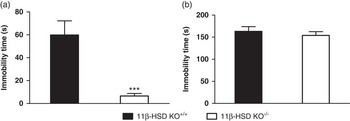
The FST is one of the most utilised, and validated, animal tests of antidepressant-like phenotypes in genetically-modified mice. Here we demonstrate that 11β-HSD1−/− mice display a significant reduction in immobility time compared with wildtype mice [Fig. 1a; t(22)=13.447; p<0.001].
Antidepressant-like behaviour of 11β-HSD1−/− mice. (a) 11β-HSD1−/− mice (n=12) display reduced immobility time in the forced swim test (FST) compared with WT (n=12) indicative of an antidepressant-like effect. (b) No difference in immobility time between 11β-HSD1−/− mice (n=9) and WT (n=11) was observed in the tail suspension test (TST). Data represent mean±SEM. Student’s t-test was performed for each test with ***p<0.001. 11β-HSD=11β-dehydroxysteroid dehydrogenase type 1.

TST
Another well-validated animal test predictive of a depressive- or antidepressant-like phenotype following pharmacological or genetic manipulation is the TST. Unlike the results of the FST, genetic deletion of 11 β-HSD1 did not result in a significant difference in behaviour in this test [Fig. 1b; t(18)=1.562; ns].
Locomotor activity
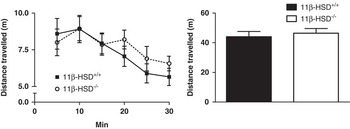
In order to rule out the possibility that the results obtained from the FST and TST were influenced by differences in locomotor activity, mice were tested in a novel environment for horizontal activity. No significant difference in locomotor activity between the genotypes was observed for any of the 5 min bins of the 30 min test (F 1,22=0.28; p>0.05) or of total distance travelled [Fig. 2 inset; t(22)=0.27, ns].
Deletion of the 11β-dehydroxysteroid dehydrogenase type 1 (11β-HSD1) gene does not alter spontaneous locomotor activity. (a) 11β-HSD1−/− mice (n=12) display reduced immobility time in the forced swim test (FST) compared with 11β-HSD1+/+ mice (n=12) indicative of an antidepressant-like effect. Data represent mean±SEM. Student’s t-test and repeated measures ANOVA was performed.

Discussion
The present study demonstrates that constitutive knockout of the 11β-HSD1 gene results in an antidepressant-like phenotype as revealed by a significant reduction in immobility time in the FST. This decrease in immobility was specific as a separate test on general locomotor activity did not reveal significant differences between 11β-HSD1−/− and wildtype mice. These results confirm the involvement of 11β-HSD1 in depression and antidepressant-related behaviour.
The glucocorticoid theory of major depression postulates that an excess of circulating glucocorticoids, leading to hyperactivity of the HPA axis, which in turn causes damage to relevant brain structures, such as the hippocampus. A key enzyme involved in the conversion of inactive to active glucocorticoids is 11β-HSD1. Despite numerous studies indirectly suggesting that this enzyme may be involved in depression and depression-related behaviour, this is the first study to directly examine 11β-HSD1 in animal tests of depressive-like/antidepressant-like behaviour. Genetic deletion of 11β-HSD1 was shown to significantly reduce immobility time in the FST compared with wildtype mice (Fig. 1a); one of the most widely used preclinical tests of antidepressant activity (Reference Cryan and Mombereau17). This striking reduction in immobility time suggests that deletion of the main enzyme responsible for the activation of 11-DHC to corticosterone leads to an antidepressant-like phenotype. However, no difference was observed in the TST (Fig. 1b), which is another commonly utilised mouse test of antidepressant efficacy. This finding, while initially seeming incongruous may be a result of the different biological substrates that underlie the behaviour in both tests (Reference Cryan, Mombereau and Vassout18). Thus, while the mouse FST can be insensitive to SSRIs they are generally reported as active in the TST [for reviews, see (Reference Cryan, Mombereau and Vassout18,Reference Porsolt and Lenegre19)]. Furthermore, both genetic ablation and pharmacological antagonism of GABAB receptors have been shown to reduce immobility in the FST but not in the TST [see (Reference Cryan, Mombereau and Vassout18) for review]. There are also examples whereby treatments are active only in the TST, most notably the atypical antidepressants rolipram and levoprotiline (Reference Porsolt and Lenegre19). Therefore, the lack of response in the TST does not negate the antidepressant-like phenotype witnessed in the FST. However, until the underlying biological substrates of these two tests are determined it remains unclear as to which systems may be more important for the antidepressant phenotype observed in 11β-HSD1−/− mice.
The altered behaviour in the FST cannot be due to deficits in locomotor activity caused by ablation of the 11β-HSD1 gene as no difference was observed in general locomotion in a novel environment (Fig. 2). This suggests that increased conversion of 11-DHC to corticosterone is not required for the initially high level of locomotor activity observed when a rodent is placed into a novel environment. More importantly for the present study, this implies that the decreased immobility time in the FST is related to an antidepressant-like phenotype and not to altered activity. Furthermore, 11β-HSD1−/− mice do not display an altered anxiety-phenotype compared with wildtype mice in the elevated plus maze or open field tests [see (Reference Wyrwoll and Holmes12) for review]. Therefore, the observed antidepressant-like phenotype in 11β-HSD1−/− mice in the FST would seem to be a specific phenomenon.
The altered diurnal corticosterone rhythm in 11β-HSD1−/− mice, with an earlier rise, which coincides with the time when the present studies were performed (Reference Harris, Kotelevtsev, Mullins, Seckl and Holmes11), and the elevated corticosterone response exhibited in response to restraint stress would make it seem paradoxical that such mice exhibit antidepressant-like activity. However, a number of additional factors must also be considered, which suggest that despite elevated corticosterone levels 11β-HSD1−/− mice have attenuated glucocorticoid action within cells. Thus, despite the increased adrenal weight, 11β-HSD1−/− mice were revealed to produce less corticosterone in vitro in response to an ACTH challenge (Reference Kotelevtsev, Holmes and Burchell20). Furthermore, corticosteroid-binding globulin (CBG) levels do not differ between 11β-HSD1+/+ and 11β-HSD1−/− mice, suggesting that despite the elevated circulatory corticosterone the majority is bound to CBG preventing it from binding to GR. In addition, 11β-HSD1−/− mice, while having the same GR, MR and CRH mRNA levels in the hippocampus have been shown to have decreased GR mRNA expression within the PVN (Reference Harris, Kotelevtsev, Mullins, Seckl and Holmes11). Therefore, this, together with the lack of 11β-HSD1 in the negative feedback sites would lead to both decreased regeneration of corticosterone and decreased GR receptors for corticosterone to act, attenuating the negative feedback response.
It has been proposed, at least in the elderly population that both hypo- and hyper-cortisolemia is associated with major depression (Reference Bremmer, Deeg, Beekman, Penninx, Lips and Hoogendijk4). Therefore, dysregulation of 11β-HSD1 would appear to play an important role, at least in the elderly population, both in relation to cognitive decline and major depression. Further support comes from human studies showing that depressed patients have lower 11β-HSD activity compared with controls (Reference Poor, Bufa and Biro9). The activity is approximated from the levels of various steroid metabolites and as such cannot distinguish between the activities of the two forms of the enzyme (Reference Wyrwoll and Holmes12). Therefore, the current studies imply that 11β-HSD1 activity may underlie these findings as the ablation of 11β-HSD1 resulted in an antidepressant-like phenotype; despite unaltered activity of 11β-HSD2, as previously reported.
In summary, the present study demonstrates that ablation of the 11β-HSD1 gene results in an antidepressant-like phenotype in mice in the FST, which together with previous findings in 11 β-HSD2 knockout mice suggests a bidirectional effect these enzymes on depressive-like behaviour.
Acknowledgements
The authors would like to thank Hugo Buerki and Stefan Imobersteg for the technical assistance. Author’s Contributions: D.A.S. contributed to the experimental design, performance of the experiments, analysed the data and writing of the manuscript. D.P.U. contributed to the experimental design and writing of the manuscript. J.F.C. contributed to the experimental design and writing of the manuscript.
Financial Support
This work was supported by National Institutes of Mental Health/National Institute on Drug Abuse Grant U01 MH69062.
Conflicts of Interest
None.
Ethical Standards
All experimental procedures were subject to institutional review and conducted in accordance with the Veterinary Authority of Basel-Stadt, Switzerland.