Background
Many side effects associated with radiation treatment to the breast or chest wall are predictable and expected.Reference Sitton1 The monitoring of patients during treatment allows clinicians to assess and manage side effects and initiate early interventions.Reference Glean, Edwards, Faithfull, Meredith, Richards, Smith and Colger2 The weekly review clinic also provides an opportunity to assess and address the informational, physical, psychological and social needs of patients and their carers.Reference Meredith, Symonds, Webster, Lamont, Pyper, Gillis and Fallowfield3–Reference Coyler6
Until recently treatment reviews were conducted by the patient's consultant clinical oncologist or registrar; however, in recent years many departments have adopted a team approach and through role development many aspects of the weekly review are undertaken by trained senior nurses and senior therapeutic radiographers. This should ensure continuity of care and consistency of treatment assessment as patients are dealing with a small number of staff dedicated for this purpose. Patient care and review are a crucial component of the document issued by the Royal College of Radiologists’ Clinical Oncology Information Network (COIN) guidelines for external beam radiotherapy. Specifically, recommendations 64 and 65 state that there should be continuity of care for each patient and local protocols should specify the arrangements for frequency of review during treatment.7
There are 1,000–1,200 adjuvant breast patients treated with radiotherapy post-operatively or post-chemotherapy each year in the Beatson West of Scotland Cancer Centre (formerly Beatson Oncology Centre) and they are reviewed each week of their treatment by senior nursing/senior therapeutic radiographers at dedicated treatment review sessions. Before undertaking this role, review staff underwent a period of training which included formal lectures related to pathophysiology, counseling skills and skincare guidelines. In order to have an understanding of treatment-related issues, time was spent at diagnostic, new and metastatic clinics. In addition to this, a competency training record was completed by the Staff Grade clinical oncologist. The treatment review enables patients to have access to oncology breast clinical nurse specialists, breast specialist senior radiographers and outpatient nursing staff in order to assess and meet their treatment, psychosocial support, skin care and informational needs. This service has developed since 2001 owing to the number of patients receiving breast radiation treatment each year having to be ‘fitted in’ for review during busy routine adjuvant and metastatic breast clinics. Anecdotally, the main complaint from patients was that they were seen by a variety of medical staff, had very long waiting times, often for short consultations with not enough time to deal with concerns or questions. In addition there were no dedicated breast non-medical staff assigned to these clinics in order to address ongoing patient supportive needs.
There is a plethora of information in relation to ‘nurse-led’ clinics in breast cancer diagnosis and follow-up, but a paucity of research related to nurse/radiographer review during radiation treatment.Reference Pennery and Mallet8–Reference Morrison12
In order to assess the service changes, a survey of the review clinic was initiated.The objectives of this survey were to:
Evaluate the weekly review from the patient's perspective;
Assess whether supportive needs of patients are successfully identified by nursing/radiotherapy staff during the weekly review;
Provide a descriptive account of referrals/interventions initiated by review staff;
Identify areas for future patient care development.
Methods
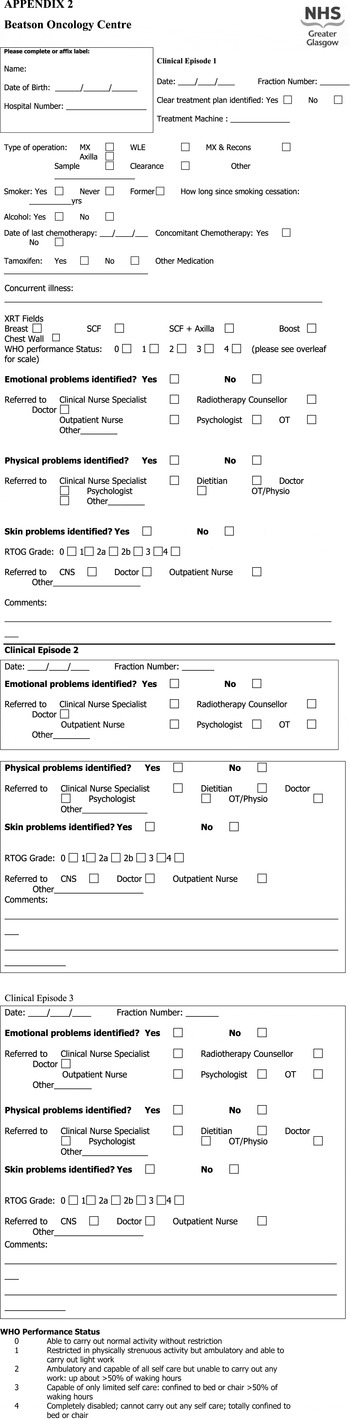
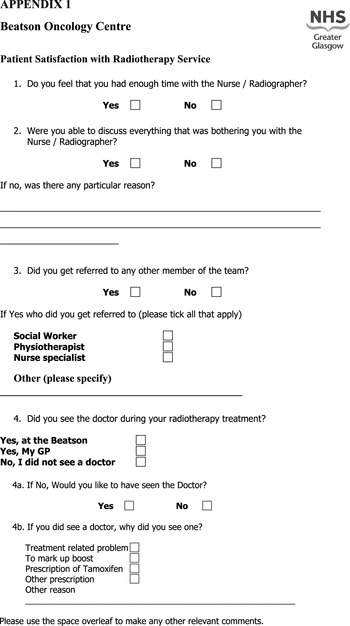
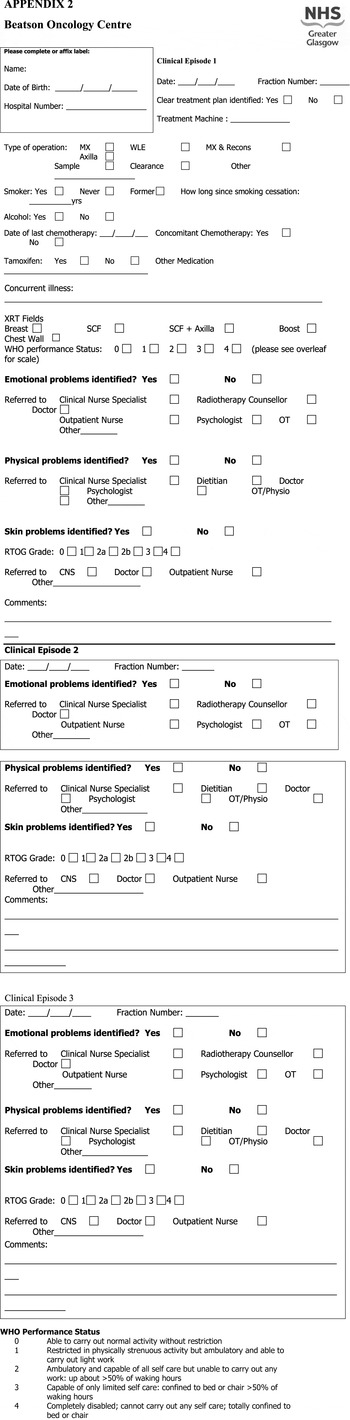
All patients attending for adjuvant breast or chest wall radiotherapy from 1st July 2003 to 30th June 2004 were invited to complete an anonymised patient questionnaire at the end of their treatment. The information captured by this questionnaire was subjective and reflected patient's experiences and recollections of their radiotherapy treatment and treatment reviews. It included satisfaction with the review and types of referrals to medical/non-medical staff. Completed forms were then posted by patients to the central audit office. (Appendix 1) In addition to this, review staff completed a detailed audit form which captured demographic information, clinical history and treatment intent at the first visit. At subsequent weekly review visits, data relating to patient assessment, interventions and referrals initiated were recorded on a standardized form which was developed by the breast clinical nurse specialist and breast specialist radiographer.(Appendix 2) At each review, skin reactions were graded using the Radiation Therapy Oncology Group (RTOG) scoring tool and the highest grade at completion of treatment was recorded. The RTOG skin toxicity scoring tool uses continuous visual assessment to encourage early intervention in acute reactions.Reference Cox, Stetz and Pajak13 Review staff identified and grouped patient concerns or problems under the headings of emotional or physical, thus permitting staff to refer on to appropriate support services.
Results
Review staff audit (Section 1)
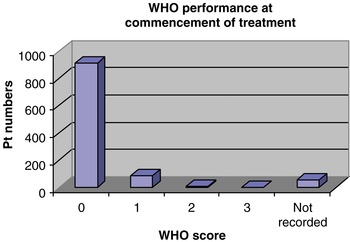
The number of forms completed by review staff and included within this data was 1,067. Patients were aged 23–85 years (mean 56.7 years). The type of surgery performed was 679 conservation procedures and 388 mastectomies. The WHO performance status of the majority of patients at commencement of treatment was 0 (Figure 1).
Who performance status of patients included in review audit at commencement of treatment.

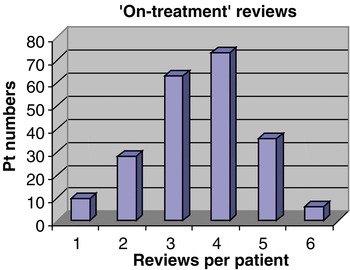
The total number of ‘on-treatment’ reviews per patient was recorded, with the majority having had between four and five reviews during their treatment equating to approximately 4,500 reviews over the data collection period (Figure 2). The number of reviews was dependant on the individual fractionation schedule for each patient. Our conservation schedule was 46 Gy in 23 fractions with a ‘boost’ of 12 Gy in 4 fractions, mastectomy schedule was 45 Gy in 20 fractions and mastectomy with immediate reconstruction was 50 Gy in 25 fractions.
Number of ‘on-treatment’ reviews per patient.

Eighty patients (1.8%) were identified as requiring informational and emotional support; 30 patients were provided with that support from the treatment review staff. The others were referred to the information and support radiographer (26), their general practitioner (10), breast clinical nurse specialist (9) or to their clinical oncologist (5). Three hundred and forty-two patients (7.6%) were identified with a physical problem needing onward referral. Common problems which were identified and thought to be treatment related were menopausal symptoms related to endocrine therapy, shoulder stiffness, breast/chest wall pain, breast/axilla seromas and lymphoedema. Non-treatment related problems identified included ear, urine, throat and chest infections, cellulitis, medication review, pain unrelated to treatment area, anxiety and loss of appetite. All of these identified issues resulted in referrals to a variety of medical and non-medical support staff. The majority of patients were referred to their clinical oncologists (188). Other referrals were to their general practitioners (72), physiotherapy (36), breast clinical nurse specialist (33), lymphoedema clinic (8), dietician (4) and clinical psychologist (1).
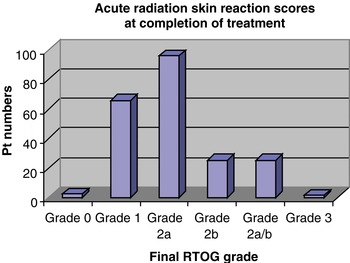
Skin reactions were as expected and on completion of treatment 808 patients had grade 1 or 2a skin reactions and only 1 patient had grade 3. (Figure 3).
Acute radiation reaction scores recorded at completion of treatment.

Patient satisfaction questionnaire (Section 2)
The number of questionnaires issued was 1,095 of which 865 (79%) were returned.
From the returned 865 questionnaires, there were high patient satisfaction scores recorded with the treatment review clinic in relation to time spent with review staff (99.7%) and ability to discuss all aspects of treatment and any concerns with review nurses/radiographers (99.1%).
Patients were asked whether they had been referred to any other services during their treatment.
The responses recorded indicated that 193 patients were referred to other members of extended breast team. Specific referrals were to breast clinical nurse specialist (154), physiotherapist (31), information and support radiographer (6) and social worker (2).
In total 544 patients were referred to their clinical oncology consultant/registrar or their general practitioners, during treatment. The majority of patients were expected referrals to their clinical oncologists to prescribe ‘boost’, or part two of their treatment and to review endocrine therapy (437). Reasons for GP referral were to obtain employment certificates, non-treatment related infections, prescriptions, routine checks related to pre-existing co-morbidities such as hypertension or to review anticoagulant therapy (107).
At first treatment review, all patients were informed that if they wished to be seen by medical staff for any reason during treatment it would be arranged. Two hundred and fifty-nine patients replied to the question ‘if you did not see a doctor during treatment, would you have liked to’. Thirty five replied yes, but there was no formal recording of the reason for this, whereas two-hundred and twenty four said no.
Free text was available in order to encourage positive and negative comments regarding any aspect of their treatment and treatment review. Of the 448 comments received, 416 were positive and 32 negative. Positive comments related to minimal waiting times for review, the skills, attitude, professionalism of treatment and review staff, the friendliness and helpfulness of reception staff, the availability of voluntary car drivers, the cleanliness and tranquility of the waiting areas. Negative comments were in relation to traveling time, distance to and from treatment, feeling ‘rushed’ by patient transport, financial costs of attending for treatment and not knowing where to access advice in relation to claiming benefits.
Discussion
The development of specialist roles within breast cancer nursing has become well established over the years, but nursing and therapeutic radiographer-extended roles within radiotherapy departments are still developing. Much of this development has been driven by changes to the way health care is to be delivered in the future with a focus on interdisciplinary team working to improve quality of patient care. Role development in therapeutic radiography began with the publication of a document by the College of Radiographers which described a practitioner role as desirable and realistic.14 A more recent booklet was produced by the Royal College of Radiologists which aimed to review skill mixes in clinical oncology departments, encourage development across boundaries and extension of existing roles.15
The majority of patients were very satisfied with the nurse/radiographer treatment review, since the time spent with patients allowed for problems, issues and concerns to be assessed and interventions initiated. Though not recorded formally, one of the findings of this survey, was that when patients were given time and privacy during the treatment review, many issues relating to the emotional and practical effect of their cancer diagnosis was discussed. Concerns related to changes in relationships with husbands/partners/children, loss of earnings, financial difficulties and help with childcare were some of the issues raised. Many patients also commented on feeling anxious towards the end of adjuvant therapy as issues related to follow-up and future prognosis surfaced. The need for tailored information and education has long been recognized within the cancer setting. Provision of accurate, personally relevant information has been found to decrease emotional distress, anxiety and encourage self-care activities. Patients want to know about their disease and treatment side effects, what to expect, when to expect them, short and long-term effects and how to manage them. Conflicting or inadequate information, mixed messages about expected treatment and side effects can lead to fear and uncertainty regarding outcomes.Reference Nial, Jones, Greene, Schipper and Jensen16–Reference Jahraus, Sokolosky, Thurston and Guo19 The continuity of dealing with a small number of dedicated review staff was highlighted by a number of patients who commented on this aspect of their care as a positive benefit.
Skills and competencies in areas such as patient assessment, education, counseling and time management require regular updating to ensure continuing best practice. Defined referral pathways to other services such as physiotherapy, counseling and clinical psychology were developed by the breast clinical nurse specialist in conjunction with the service leads to ensure appropriate and timely interventions. The recognition of problems and concerns, the range and number of referrals from the review visits have demonstrated that the nurses/radiographers involved were successful in identifying the supportive needs of patients but it is hoped that through time and in gaining more experience that the numbers of referred patients will be reduced.
The use of a validated tool such as the RTOG skin toxicity grading tool to record radiation skin reactions as part of the treatment review facilitates assessment and aids selection of management strategies according to local best practice guidelines. All of the information recorded during the treatment review was used to contribute to the ‘end of treatment’ letter sent to the patients’ referring surgeons and general practitioners by their clinical oncologist.
A recent report by Breast Cancer Care and Breakthrough Breast Cancer highlighted concerns from a small number of patients gathered during focus and telephone interviews regarding their experiences of using radiotherapy services. There were 48 participants, 26 within three focus groups from London and Sheffield and 22 interviewed by telephone in order to collect information relating to difficulties encountered and to make recommendations to the English National Radiotherapy Advisory Group. A number of key recommendations were suggested relating to service improvement across the United Kingdom. These were in relation to informational needs, improvement in communication and a greater emphasis on ‘patient-centered’ care.20
It is essential that those working in oncology continually strive to improve the experience of those patients and families/carers undergoing treatment. Whilst we are not complacent, it was encouraging to find that many of the positive comments received within the free text section of the patient satisfaction questionnaire were in relation to the professionalism of staff, the surroundings in which they were treated, the information given prior to and during treatment and the psychosocial support they had received.
Conclusion
The radiotherapy treatment review provides the opportunity to assess the holistic needs of patients during treatment. This prospective survey of non-medical review demonstrated that a diverse range of patient supportive needs were effectively assessed with interventions and referrals initiated. In addition, the use of a validated tool to record radiation skin reactions directed the selection of appropriate skin care management. Areas for future development which were identified as outcomes from this audit were for breast clinical nurse specialist/specialist breast radiographer to review patients at first follow-up visit post-treatment which would encourage continuity of care. Furthermore, a pilot dedicated to the end of treatment session that consists of an ‘exit’ patient interview and production of an information leaflet to address post-treatment concerns could potentially help reduce some of the anxiety associated with patients’ perceptions of not having continued hospital support and contact post-completion of treatment.
Appendix 1

Appendix 2