Neurodevelopmental impairment is a challenge for many patients with complex CHD who require surgical intervention with cardiopulmonary bypass during the early postnatal period. Reference Gaynor, Stopp and Wypij1 These patients can have a wide range of problems including developmental delay, neurologic impairment, or behavioural issues. Reference Wernovsky and Licht2,Reference Marelli, Miller, Marino, Jefferson and Newburger3 Bone marrow-derived mesenchymal stromal cells have been identified to have a high potential for treating a wide variety of diseases including ischaemic brain injury. Reference Eckert, Vu and Xie4–Reference van Velthoven, Sheldon and Kavelaars6 The cells also have extensive anti-inflammatory and immunomodulatory properties Reference le Blanc7,Reference Krampera, Glennie and Dyson8 that are directly linked to the processes underlying protection and repair in a variety of organs, such as heart, lung, kidney, and liver. Reference Hare, Traverse and Henry9–Reference Zhu, Lerman and Lerman13
The Mesenchymal Stromal Cell Delivery through Cardiopulmonary Bypass in Pediatric Cardiac Surgery study is a prospective, open-label, single-center, phase 1 trial aimed at determining the safety and feasibility of delivering allogeneic bone marrow-derived mesenchymal stromal cell via cardiopulmonary bypass during cardiac surgery (https://clinicaltrials.gov/ct2/show/NCT04236479). The primary hypothesis is that bone marrow-derived mesenchymal stromal cell intra-arterial delivery through cardiopulmonary bypass at the time of corrective cardiac surgery is safe and improves neurodevelopmental outcome and post-operative course. Reference Maeda, Briggs and Datar14,Reference Maeda, Sarkislali and Leonetti15 In addition to assessment of the safety and feasibility, outcomes from our phase 1 study will be compared with contemporary cases and historical data derived from a similar population at our centre to determine the sample size and primary and secondary outcomes of a larger efficacy and effectiveness trial. In order to define an optimal control group, we aimed in the current study to characterise past patients using the same inclusion and exclusion criteria for patients in the Mesenchymal Stromal Cell Delivery through Cardiopulmonary Bypass in Pediatric Cardiac Surgery trial including assessment of physiological biomarkers and post-operative outcome scores. This preliminary study is the initial review of control patients, which will be further analysed when comparing with enrolled patients.
Materials and methods
Study design
This is a retrospective study inclusive of infants up to 6 months old at the time of surgery who underwent a scheduled reparative two-ventricle repair without aortic arch reconstruction at Children’s National Hospital in Washington, D.C. from January 1st 2015 to December 31st 2020. Patients were excluded from the analysis if one of the following criteria were met: birth weight less than 2.0 kg, recognisable phenotypic syndrome, associated extracardiac anomalies of greater than minor severity, previous cardiac surgery, associated cardiovascular anomalies requiring aortic arch reconstruction and/or additional open cardiac surgical procedures in infancy, prior severe hypoxic event, and significant screening test values that place subjects at increased risk of complications from participation in the study. The same inclusion and exclusion criteria are used in our phase 1 trial (https://clinicaltrials.gov/ct2/show/NCT04236479).
Patients were allocated into one of three diagnostic groups: ventricular septal defect-type group, Tetralogy of Fallot-type group, and Transposition of the great arteries-type group. To determine outcomes associated with undergoing surgery during a particular time period, patients were also analysed in two groups by era: Group A (2015–2017) and Group B (2018–2020).
Outcome measures
All data were extracted from Children’s National’s electronic medical record. This information included physiological biomarkers and laboratory tests, pre-operative and hourly post-operative medication use, intraoperative data, and post-operative outcomes. For pre-operative data, primary diagnosis, age at operation, body weight at operation, and gender were collected. Operative data were abstracted from surgical reports including surgical interventions performed, cardiopulmonary bypass time, and aortic cross clamp time. Post-operative data were collected including length of cardiac ICU stay, operative mortality and late death up to 1 year post-surgery. STS definition was used for operative mortality. Reference Overman, Jacobs and Prager16
Inotropic score was created by Wernovsky to quantify the amount of inotropic support received by patients in two separate arms of a randomised clinical trial, in order to assure comparability of group comparisons following randomisation. Reference Wernovsky, Wypij and Jonas17 Inotropic score was calculated as follows: IS = dopamine dose (µg/kg/min) + dobutamine dose (µg/kg/min) + 100 × epinephrine dose (µg/kg/min). Vasoactive-inotropic score was created by Gaies, Reference Gaies, Gurney and Yen18 contains medications from inotropic score and adds milrinone, vasopressin, and norepinephrine, which were not available or widely used at the time of Wernovsky’s study. Vasoactive-inotropic score was calculated as follows: Vasoactive-inotropic score = IS + 10 × milrinone dose (µg/kg/min) + 10,000 × vasopressin dose (U/kg/min) + 100 × norepinephrine dose (µg/kg/min). Inotropic score and vasoactive-inotropic score was calculated every 3 hours from post-operative admission to the cardiac ICU up to 24 hours. Max inotropic score and vasoactive-inotropic score and mean vasoactive-inotropic score were calculated for analysis.
Pediatric risk of mortality III (PRISM III) is a third-generation, physiology-based predictor for paediatric ICU patients. Reference Pollack, Patel and Ruttimann19 The algorithm enables simultaneous estimation of the risk of new functional morbidity as well as mortality at hospital discharge. Reference Pollack, Holubkov and Funai20 Several studies have performed PRISM III analysis of patients post paediatric cardiac surgery. Reference Russell, Rettiganti, Brundage, Jeffries and Gupta21–Reference Karamichalis, del Nido and Thiagarajan24 It was determined via The Collaborative Pediatric Critical Care Research Network online calculator (https://www.cpccrn.org/calculators/prismiiicalculator/). The PRISM III score consists of 17 physiologic variables subdivided into 26 ranges. Physiologic variables and laboratory data were measured in the first 4 hours of stay in the Ccardiac ICU post-surgery (PRISM III-0), and in the first 4 hours after taking blood samples on post-operative day 1 (PRISM III-1).
Laboratory data were collected from the timing of admission to cardiac ICU post-surgery (day 0) and post-operative day 1 (day 1). A total of 14 biomarkers from each day were collected (white blood cell, haemoglobin, haematocrit, platelet, blood urea nitrogen, creatinine, prothrombin time and international normalised ratio, activated partial thromboplastin time, pH, partial pressure of oxygen, partial pressure of carbon dioxide, bicarbonate, lactate, and glucose).
Statistical analysis
Statistical analysis was carried out using Prism9 software package (GraphPad Software, Inc, La Jolla, CA). Continuous variables are expressed as mean ± standard deviation or median [interquartile range] and categorical variables are expressed as number of patients and frequencies (%). Demographics and clinical characteristics were compared between Group A and Group B with two-tailed, unpaired Student’s t test. Ordinary one-way analysis or two-way analysis of variance with Tukey comparison was used to compare diagnostic groups. All p values of less than 0.05 were considered to indicate a statistically significant difference.
Results
Diagnostic analysis
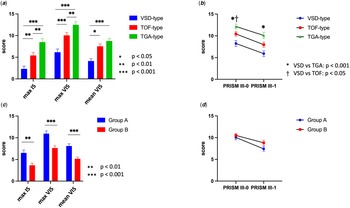
One hundred sixty-nine infants met eligibility criteria and were included in the study cohort. The cohort included 50 patients in the ventricular septal defect-type group, 75 patients in the Tetralogy of Fallot-type group, and 44 patients in the transposition of the great arteries-type group. Characteristics of the three diagnostic groups are presented in Table 1. Variables measured (age at operation, body weight at operation, gender, aortic cross clamp time, cardiopulmonary bypass time, cardiac ICU stay) were significantly different among the three groups according to the complexity of CHD type. Physiological biomarkers are presented in Supplementary Table S1. There were significant differences in white blood cell, creatinine, prothrombin time and international normalised ratio, partial pressure of carbon dioxide, bicarbonate, lactate, and glucose on day 0. We also found significant differences in haemoglobin, haematocrit, pH, bicarbonate, and lactate levels on post-operative day 1 among the three diagnostic groups. Within the physiological biomarkers with significant differences, lactate level on day 0 showed significant differences in multiple comparisons. All values for inotropic score, vasoactive-inotropic score, and PRISM demonstrated significant differences between diagnosis groups with two-way ANOVA, consistent with complexity of CHD type (Fig 1A-B, Supplementary Table S3). Of five outcome scores assessed with multiple comparisons, max inotropic score and vasoactive-inotropic score demonstrated significant differences between all diagnosis groups, showing high sensitivity. The results confirm lactate level and max inotropic score and vasoactive-inotropic score as important quantitative measures after paediatric cardiac surgery. In all analyses, ventricular septal defect-type cases received less inotropic support (by both inotropic score and vasoactive-inotropic score) and had more stable indices of oxygen delivery compared with Tetralogy of Fallot-type patients, who in turn received less inotropic support than neonates with transposition of the great arteries.
Post-operative scores. ( a ) max IS, max VIS, mean VIS among diagnosis groups. ( b ) PRISMIII-0 and PRISMIII-1 among diagnostic groups. ( c ) max IS, max VIS, mean VIS among era groups. ( d ) PRISMIII-0 and PRISMIII-1 among era groups. Data are shown in mean value with standard error of mean. IS, Inotropic score; PRISMIII, Pediatric risk of mortality III; TGA, Transposition of the great arteries; TOF, Tetralogy of Fallot; VIS, Vasoactive-inotropic score; VSD, Ventricular septal defect.

Patient characteristics according to the diagnostic groups

Continuous variables are expressed as median [interquartile range] and categoric variables are expressed as number of patients and frequencies (%). ACC, Aortic cross clamp; CICU, Cardiac intensive care unit; CPB, Cardiopulmonary bypass; TGA, Transposition of the great arteries; TOF, Tetralogy of Fallot; VSD, Ventricular septal defect.
Era analysis
The era cohort included 97 patients in Group A and 72 patients in Group B. Table 2 shows characteristics of the two groups. There were no significant differences in the distribution of diagnostic groups, age at operation, body weight, aortic cross clamp time, cardiopulmonary bypass time, and mortality. On the other hand, cardiac ICU stay in group B was significantly shorter compared to group A. Among biomarkers, there were significant differences in haematocrit, prothrombin time and international normalised ratio, lactate, and glucose on day 0 (Supplementary Table S3). We also found significant differences in prothrombin time and international normalised ratio, partial pressure of carbon dioxide, and lactate on day 1. Although there was no difference in PRISM score between the two groups, we observed lower inotropic score and vasoactive-inotropic score scores in group B compared to group A (Fig 1C-D, Supplementary Table S4). Together with shorter cardiacICU stay and lower lactate levels, our results indicate improved post-operative course in recent years at our centre.
Patient characteristics according to the era groups

Continuous variables are expressed as median [interquartile range] and categoric variables are expressed as number of patients and frequencies (%). ACC, Aortic cross clamp; CICU, Cardiac intensive care unit; CPB; cardiopulmonary bypass; TGA, Transposition of the great arteries; TOF, Tetralogy of Fallot; VSD, Ventricular septal defect.
Discussion
This preliminary study was designed to define a control cohort for our single-centre, safety, and feasibility phase 1 trial of bone marrow-derived mesenchymal stromal cell delivery through CPB. Analysis confirms lactate, max inotropic score, and vasoactive-inotropic score as important quantitative measures after paediatric cardiac surgery. Although surgical methods, anaesthesia management, and post-operative care for the study subjects have been well standardised over the last 5 years, our study suggests an improved post-operative course in recent years at our centre. The optimal control group for our safety and feasibility phase 1 trial therefore should include only patients from a more recent era.
Serum lactate levels have been shown to correlate with prognosis of children after cardiopulmonary bypass surgery. Reference Basaran, Sever and Kafali25,Reference Kalyanaraman, DeCampli and Campbell26 Consistent with previous studies, lactate levels were associated with complexity of both CHD type and cardiac surgery. Significant improvement of lactate levels in Group B compared to Group A suggests overall improvement in perioperative care over time.
Inotropic score and vasoactive-inotropic score have been associated with morbidity and mortality of infants after cardiac surgery. Reference Gaies, Jeffries and Niebler27 The scores have been used to assess post-operative course in neonates and infants undergoing congenital heart surgery. Reference Wernovsky, Wypij and Jonas17,Reference Gaies, Gurney and Yen18,Reference Gaies, Jeffries and Niebler27 Consistent with previous findings, max inotropic score and vasoactive-inotropic score in our studies demonstrated significant differences between all diagnosis groups that were consistent with complexity of CHD type and cardiac surgery. While there were significant differences in inotropic score and vasoactive-inotropic score between early and late era groups, PRISM did not capture the differences. Although both mortality and new functional morbidity following paediatric cardiac surgery can be predicted using the PRISM algorithms, Reference Berger, Holubkov and Reeder22 our results suggest lower sensitivity of PRISM to assess the effectiveness of modified treatment including cardiac ICU staffing changes on the post-operative course in neonates and infants with CHD. Since PRISM is mainly calculated with physiologic variables and laboratory data, these values might be affected by inotropic medication dose changes, which resulted in discrepancy between inotropic score/vasoactive-inotropic score and PRISM. PRISM still reflects patient illness with a lower score for PRISM-1 compared with PRISM-0.
Compared with critical CHD such as hypoplastic left heart syndrome, surgical and anaesthesia methods, and post-operative management for the subjects in the current study have been standardised over at least the last 5 years. Thus, we originally hypothesised that there would be few changes in post-operative physiological biomarkers and scores between the two groups by era (2015–2017 vs. 2018–2020). However, a significant improvement in the post-operative course was observed in recent years. As previously reported, it is likely that various factors including experience of nurses, surgeons, and cardiac intensivists cumulatively contributed to the improvement at our centre. Reference Pasquali, Jacobs and He28–Reference Anderson, Wallace and Hill30 Because the primary objective is to assess the safety and feasibility, a dose escalation phase 1 study like our trial typically does not recruit control patients. Because of small sample size of contemporary-matched patients, the outcome from a safety trial is often compared with an historical cohort for development of future efficacy study. Our study confirmed that careful assessment is required for defining the optimal control group and inclusion of historical cohorts into further analyses.
In addition to regular safety measures, our phase 1 trial will assess the frequency and characteristics of adverse events with the PC4 registry system Reference Gaies, Cooper and Tabbutt31 to define the safety and feasibility of bone marrow-derived mesenchymal stromal cell treatment. Comparison with historical control in our phase 1 study will also be used to define the sample size and primary and secondary outcomes of a future efficacy and effectiveness trial. Therefore, this analysis will assist in establishment of a robust study design for a larger study with a particular focus on neurodevelopmental outcome and early post-operative course after bone marrow-derived mesenchymal stromal cell treatment. Since this preliminary study was the first step to determine the selection of optimal historical control patients for the trial and to assess the feasibility of perioperative scorings, we have only focused on basic perioperative outcomes. As a second step, we will assess post-operative complications, cardiac function, and neurodevelopmental outcomes which are key outcomes for the MeDCaP trial. The data will also be retrieved from PC4 registry system.
In conclusion, our studies confirm max inotropic score and vasoactive-inotropic score as important quantitative measures after CHD surgery. Based on differences between diagnostic cohorts, clinical outcomes should be compared within diagnostic groupings. The optimal control group for our safety and feasibility phase 1 trial should include only patients from a recent era. Data from this study will assist in determining the optimal sample size and outcomes in future efficacy and effectiveness studies.
Supplementary material
To view supplementary material for this article, please visit https://doi.org/10.1017/S1047951122002633
Acknowledgements
None.
Financial support
This work was supported by National Institutes of Health (NIH) grant R33HL146394 (R.A.J., N.I.), R01HL139712 (N.I.), R01HL146670 (N.I.), and R21NS127051 (N.I.) and by the Office of the Assistant Secretary of Defense for Health Affairs through the Peer Reviewed Medical Research Programme under Award No. W81XWH2010199 (N.I.). We are thankful for the vision and generosity of the Foglia and Hill families who supported our programme.
Conflict of interest
None.
Ethical standards
The authors assert that all procedures contributing to this work comply with the ethical standards of the relevant national guidelines on human experimentation and with the Helsinki Declaration of 1975, as revised in 2008, and has been approved by the Institutional Review Board at Children’s National Hospital (Date: December 5, 2019, ID: Pro00011914).