Introduction
Alzheimer's disease (AD) is the most common form of dementia, characterized by gradually increasing cognitive impairment (McKhann et al. Reference McKhann, Drachman, Folstein, Katzman, Price and Stadlan1984). Typically, AD is regarded as a disease occurring in old age and estimates of prevalence and incidence do indeed increase exponentially with advancing age (Fratiglioni et al. Reference Fratiglioni, Launer, Andersen, Breteler, Copeland, Dartigues, Lobo, Martinez-Lage, Soininen and Hofman2000; Lobo et al. Reference Lobo, Launer, Fratiglioni, Andersen, Di Carlo, Breteler, Copeland, Dartigues, Jagger, Martinez-Lage, Soininen and Hofman2000). However, AD also affects younger people (under the age of 65 years), commonly referred to as early onset AD. Although it has been suggested that early onset AD follows a more aggressive course than late onset AD (Seltzer & Sherwin, Reference Seltzer and Sherwin1983; Greicius et al. Reference Greicius, Geschwind and Miller2002), only a few studies have addressed this possible difference and the results are conflicting, with one study showing a faster cognitive decline in young (Jacobs et al. Reference Jacobs, Sano, Marder, Bell, Bylsma, Lafleche, Albert, Brandt and Stern1994) and the other in older patients (Huff et al. Reference Huff, Growdon, Corkin and Rosen1987).
The apolipoprotein E gene (APOE) is an important risk factor for AD (Kuusisto et al. Reference Kuusisto, Koivisto, Kervinen, Mykkanen, Helkala, Vanhanen, Hanninen, Pyorala, Kesaniemi, Riekkinen and Laakso1994; Strittmatter & Roses, Reference Strittmatter and Roses1995; Slooter et al. Reference Slooter, Cruts, Kalmijn, Hofman, Breteler, Van Broeckhoven and van Duijn1998; Petersen et al. Reference Petersen, Thomas, Grundman, Bennett, Doody, Ferris, Galasko, Jin, Kaye, Levey, Pfeiffer, Sano, van Dyck and Thal2005). The presence of the ε4 allele increases the risk of AD and has been associated with an earlier age at onset (AAO), although this association may be less pronounced in patients under the age of 65 years (Poirier et al. Reference Poirier, Davignon, Bouthillier, Kogan, Bertrand and Gauthier1993; Strittmatter et al. Reference Strittmatter, Saunders, Schmechel, Pericak-Vance, Enghild, Salvesen and Roses1993; Kuusisto et al. Reference Kuusisto, Koivisto, Kervinen, Mykkanen, Helkala, Vanhanen, Hanninen, Pyorala, Kesaniemi, Riekkinen and Laakso1994; Slooter et al. Reference Slooter, Cruts, Kalmijn, Hofman, Breteler, Van Broeckhoven and van Duijn1998; Davidson et al. Reference Davidson, Gibbons, Pritchard, Hardicre, Wren, Stopford, Julien, Thompson, Payton, Pickering-Brown, Pendleton, Horan, Burns, Purandare, Lendon, Neary, Snowden and Mann2007). Conflicting results have been found with regard to the relationship between APOE ε4 and rate of cognitive decline in AD patients, with studies reporting slower (Frisoni et al. Reference Frisoni, Govoni, Geroldi, Bianchetti, Calabresi, Franceschini and Trabucchi1995; Stern et al. Reference Stern, Brandt, Albert, Jacobs, Liu, Bell, Marder, Sano, Albert, Castenada, Bylsma, Tycko and Mayeux1997), faster (Martins et al. Reference Martins, Oulhaj, de Jager and Williams2005) and the same (Slooter et al. Reference Slooter, Houwing-Duistermaat, van Harskamp, Cruts, Van Broeckhoven, Breteler, Hofman, Stijnen and van Duijn1999; Kleiman et al. Reference Kleiman, Zdanys, Black, Rightmer, Grey, Garman, MacAvoy, Gelernter and van Dyck2006) rate of cognitive decline in APOE ε4 carriers compared to non-carriers.
The aim of this study was to compare the rate of general cognitive decline as measured by the Mini-Mental State Examination (MMSE; Folstein et al. Reference Folstein, Folstein and McHugh1975) between AD patients with early disease onset and those with late disease onset. Furthermore, we investigated the additional influence of APOE genotype on the rate of cognitive decline.
Method
Subjects
We studied consecutive patients with sporadic AD from the out-patient memory clinic of the Alzheimer Centre of the VU University Medical Centre (VUmc). At baseline, all patients had undergone a standardized dementia assessment including medical history, informant-based history, physical and neurological examination, laboratory tests, neuropsychological testing, electroencephalogram (EEG) and magnetic resonance imaging (MRI) of the brain. Diagnoses of probable AD were made in a multidisciplinary consensus meeting according to the National Institute of Neurological and Communicative Disorders and Stroke (NINCDS) and the Alzheimer's Disease and Related Disorders Association (ADRDA) diagnostic criteria (McKhann et al. Reference McKhann, Drachman, Folstein, Katzman, Price and Stadlan1984). Patients aged ⩽65 years at diagnosis were considered to have early onset AD and patients aged >65 years were considered to have late onset AD. The duration of the cognitive complaints as reported by the patient and/or caregiver was recorded to estimate the disease duration at the time of diagnosis. To be included in this study patients had to have at least two MMSE scores obtained no less than 1 year apart. The resulting data set included 1194 MMSE scores from 291 patients. Follow-up time varied between 1 and 6 years (mean=2.3 years, s.d.=1.1) and patients had a median of three visits (range 2–14).
The study was approved by the local medical ethics committee. All patients gave written informed consent for their clinical data to be used for research purposes.
APOE
The APOE genotype was determined according to the following procedure. DNA was isolated from 10 ml blood samples in ethylenediaminetetraacetic acid (EDTA). The APOE genotype was determined at the Department of Clinical Chemistry of the VUmc with the LightCycler APOE mutation detection method (Roche Diagnostics GmbH, Mannheim, Germany). APOE data were available for 185 patients (early onset: n=69; late onset: n=116) and were analysed according to the presence or absence of an APOE ε4 allele.
Statistical analysis
Statistical analyses were performed using SPSS version 15.0 (SPSS Inc., Chicago, IL, USA). For group comparisons at baseline, χ2 tests, Mann–Whitney tests and t tests were used where appropriate.
Linear mixed models were used to assess associations between AAO (⩽65 years or >65 years) and the rate of cognitive decline as measured by the MMSE. This approach has increased statistical power as it accounts for within-person correlations over time, allows different numbers of assessments, and accounts for varying time intervals between assessments. All assessments, including baseline, were taken into account. A random intercept was assumed, that is baseline MMSE was allowed to vary between patients. The first model included terms for AAO, time, sex, and the interaction between AAO and time, with the MMSE score as the dependent variable. From this model, the baseline MMSE and annual change in MMSE for young and old patients could be estimated. The analysis was repeated after stratification according to APOE ε4 status, so that the effect of AAO on decline in MMSE over time could be estimated separately for APOE ε4 carriers and non-carriers.
Results
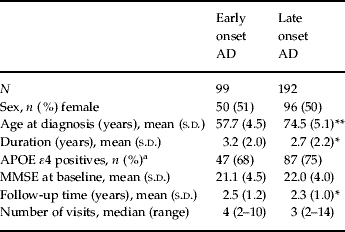
Ninety-nine (34%) patients had early onset AD and 192 (66%) had late onset AD (Table 1). The mean age for the patients with early onset was 57.7 years, and 74.5 years for the patients with late onset. Groups did not differ according to sex. Patients with early onset AD had longer disease duration than patients with late onset AD (t=2.1, p=0.04). No differences in baseline MMSE were found according to AAO (t=−1.7, p=0.10).
Baseline demographic and clinical characteristics
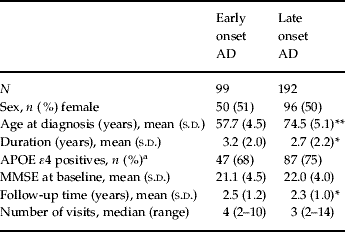
AD, Alzheimer's disease; APOE, apolipoprotein E; MMSE, Mini-Mental State Examination; s.d., standard deviation.
a APOE data available for 185 patients.
* p<0.05, ** p<0.01.
We used linear mixed models to compare the annual change in MMSE dependent on AAO (⩽65 years or >65 years). AAO was not associated with baseline MMSE [β (s.e.)=0.8 (0.5), p=0.14]. However, an interaction between AAO and time [β (s.e.)=0.6 (0.2), p=0.00] was found. AD patients with early onset were prone to a faster disease progression [estimated decline in MMSE=−2.4 (s.e.=0.1) points/year] than late onset AD patients [−1.7 (s.e.=0.1) points/year].
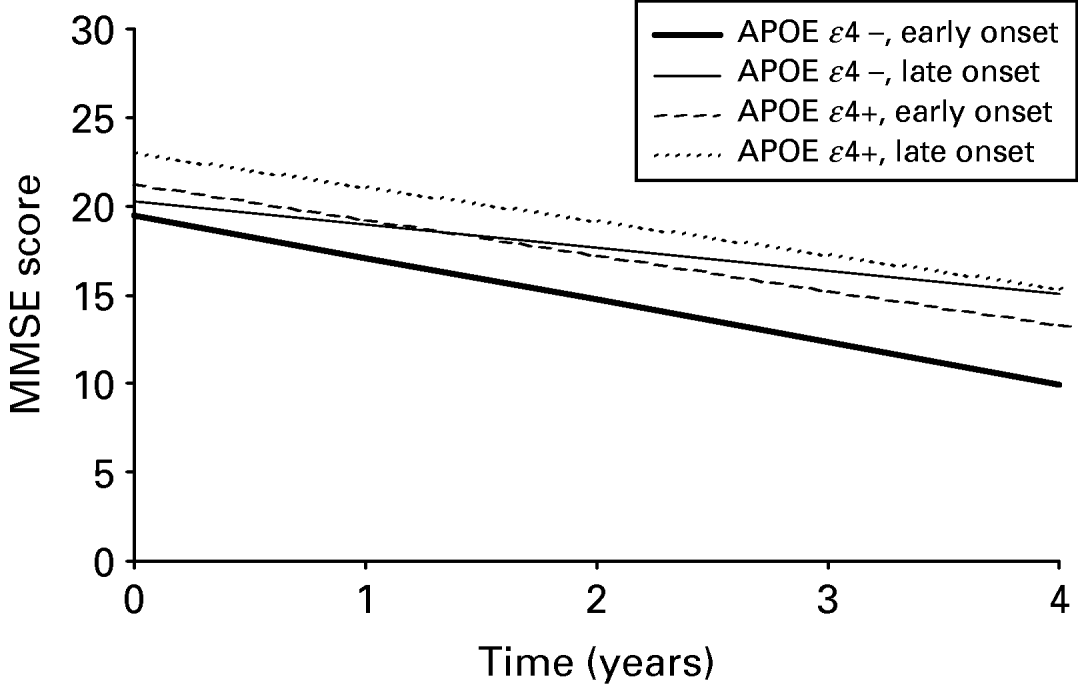
Subsequently, patients were stratified according to APOE genotype, to assess the effect of AAO on MMSE score over time for APOE ε4 carriers and non-carriers separately (Fig. 1). Of the non-carriers, 22 (43%) had early disease onset and 29 (57%) had late onset. Linear mixed models showed no association of AAO with baseline MMSE [β (s.e.)=0.9 (1.2), p=0.45], but an interaction between AAO and time [β (s.e.)=1.1 (0.4), p=0.01] was found. AD patients with early onset were prone to a faster disease progression [estimated decline in MMSE=2.4 (s.e.=0.3) points/year] than late onset AD patients [1.3 (s.e.=0.3) points/year].
Estimated regression lines of Mini-Mental State Examination (MMSE) score by time for early and late onset Alzheimer's disease (AD), stratified according to the apolipoprotein E (APOE) genotype. In APOE ε4 carriers, early and late onset patients show similar rates of cognitive decline. By contrast, in non-carriers, early onset patients show a faster rate of cognitive decline than late onset patients.
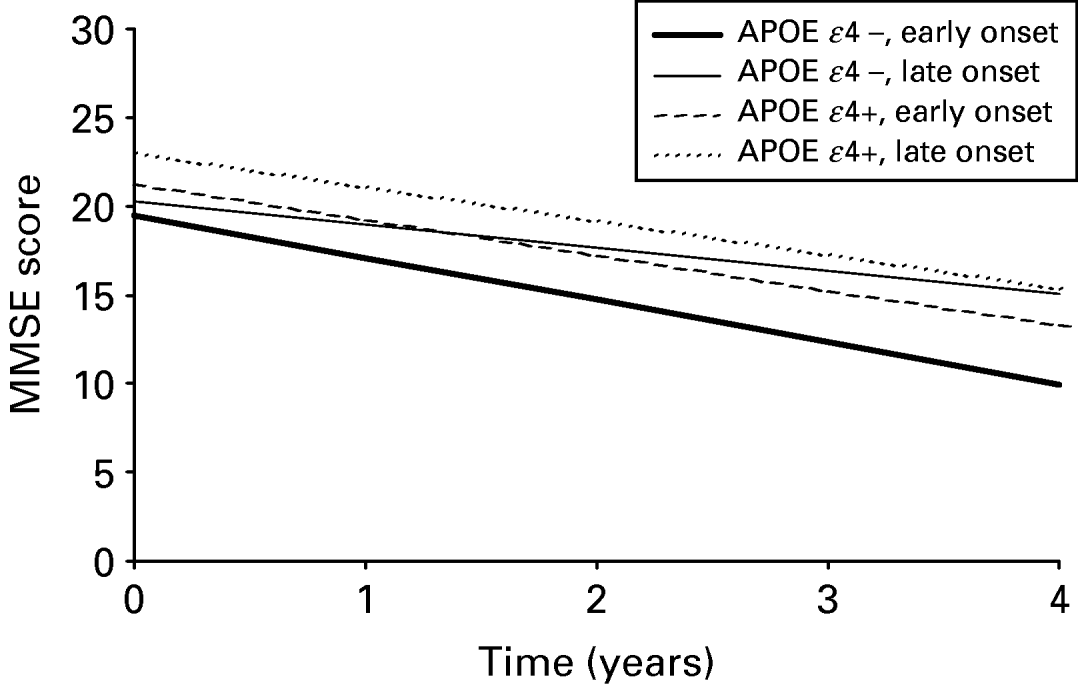
Of the APOE ε4 carriers, 47 (35%) patients had early disease onset and 87 (65%) had late onset. AAO was associated with baseline MMSE [β (s.e.)=1.7 (0.8), p=0.05]. Patients with early onset had lower baseline MMSE [β (s.e.)=21.3 (1.3)] than patients with late onset [β (s.e.)=23.0 (1.3)]. There was no interaction between AAO and time, indicating a similar decline over time [β (s.e.)=0.2 (0.2), p=0.47].
Discussion
We found that AD patients with early disease onset showed faster cognitive decline than patients with late onset, although patients with early and late onset AD did not differ according to disease severity at the time of diagnosis. This provides support for the hypothesis that early onset AD runs a more aggressive course than late onset AD. Moreover, we found that the effect of AAO was mostly attributable to APOE ε4 non-carriers. APOE ε4 non-carriers with early onset showed faster cognitive decline than non-carriers with late onset AD. This effect was not found in APOE ε4 carriers, where patients with early and late onset showed similar rates of cognitive decline.
Based on clinical observations, it has been suggested that young AD patients show faster cognitive decline than older AD patients. However, studies on the difference in cognitive decline between AD patients with early onset and those with late onset are scarce and their conclusions are conflicting. Our findings are consistent with a previous study in a relatively small sample, in which young AD patients showed faster decline on an extended version of the MMSE (maximum score=57) than older AD patients (Jacobs et al. Reference Jacobs, Sano, Marder, Bell, Bylsma, Lafleche, Albert, Brandt and Stern1994). By contrast, another study reported a faster rate of cognitive decline in late onset AD patients (Huff et al. Reference Huff, Growdon, Corkin and Rosen1987). However, the number of patients with follow-up data in that study was relatively small and the distribution of patients according to AAO was unclear. Furthermore, the authors state that although the rate of progression was more rapid in late onset AD, considerable overlap among values for the two patient groups was observed, which led them to conclude that AAO is not a strong predictor of rate of progression of dementia in patients with AD. The present study contains a large sample of AD patients with considerable follow-up, and a clear effect of AAO on the rate of cognitive decline was shown.
Furthermore, we have shown that the effect of AAO on the rate of cognitive decline is attributable to APOE ε4 non-carriers, and less so to APOE ε4 carriers. In non-carriers, early onset patients show a rate of cognitive decline twice that of late onset patients, whereas younger and older APOE ε4 carriers have a similar rate of decline. The conflicting results with regard to the relationship between APOE genotype and rate of cognitive decline in AD that have been reported by previous studies may well be explained by this effect. As these previous studies either included only late onset AD patients (Frisoni et al. Reference Frisoni, Govoni, Geroldi, Bianchetti, Calabresi, Franceschini and Trabucchi1995; Slooter et al. Reference Slooter, Houwing-Duistermaat, van Harskamp, Cruts, Van Broeckhoven, Breteler, Hofman, Stijnen and van Duijn1999) or made no distinction between patients with early and late onset (Stern et al. Reference Stern, Brandt, Albert, Jacobs, Liu, Bell, Marder, Sano, Albert, Castenada, Bylsma, Tycko and Mayeux1997; Martins et al. Reference Martins, Oulhaj, de Jager and Williams2005; Kleiman et al. Reference Kleiman, Zdanys, Black, Rightmer, Grey, Garman, MacAvoy, Gelernter and van Dyck2006), they may have missed the sensitive modifying effect of the APOE genotype.
Our finding of early onset APOE ε4 non-carriers showing the fastest cognitive decline is in line with a previous study by our group that reported that younger age, absence of APOE ε4 and low MMSE at baseline were associated with higher whole-brain atrophy rate (Sluimer et al. Reference Sluimer, Vrenken, Blankenstein, Fox, Scheltens, Barkhof and van der Flier2008). It is feasible that patients with early onset and absence of APOE ε4 not only show a faster cognitive decline but also have a higher rate of whole-brain atrophy. Although the presence of APOE ε4 is a risk factor for developing AD, our data suggest that, especially in patients with early onset, this same presence protects patients, once they have the disease.
It is possible that the patients with early onset AD presented at our memory clinic when they had progressed further into the disease process than the late onset AD patients. This would explain their faster cognitive decline because baseline disease severity has been shown to predict the rate of subsequent cognitive decline (Teri et al. Reference Teri, McCurry, Edland, Kukull and Larson1995; Ruitenberg et al. Reference Ruitenberg, Kalmijn, de Ridder, Redekop, van Harskamp, Hofman, Launer and Breteler2001). However, we do not think that this explains our findings, as the disease severity as measured by the MMSE at baseline was similar for patients with early onset AD and late onset AD.
The question of whether early and late onset AD should be considered as two subtypes of the same disorder or as two separate disorders is still under debate (Blennow et al. Reference Blennow, de Leon and Zetterberg2006). It should be noted that the age of 65 years used in this and most other studies to distinguish early disease onset from late onset is arbitrary. It has been shown that early and late onset AD patients share the presence of amyloid plaques, neurofibrillary tangles and neuronal loss, which indicates the same underlying neuropathology (Mann et al. Reference Mann, Yates and Marcyniuk1984). However, the difference we found in the rate of cognitive decline between both groups, especially in APOE ε4 non-carriers, might be considered as an argument to regard early and late onset AD as two entities, with specific characteristics. It might be speculated that in some AD patients, the disease process is so aggressive that it becomes apparent early in life, resulting in early onset of the disease. The faster rate of cognitive decline in younger patients might then be explained by this more aggressive process.
Among the limitations to this study is the fact that no post-mortem data were available. Therefore, it cannot be excluded that some patients were misdiagnosed as having AD, which might have contaminated the data. At baseline, however, all patients were clinically characterized in a uniform manner, and all patients fulfilled the clinical criteria for AD. Another limitation is the fact that AAO is clearly confounded by the patients' biological age. In this data set, it is not possible to determine the associations between the two. However, considering biological age in relation to change in cognition, older patients would be expected to show more cognitive impairment because it is well known that even healthy persons of old age show more cognitive decline than younger healthy persons. In this study, the opposite effect was found in AD patients; the patients with early onset showed more cognitive decline than those with late onset. The strengths of the current study include the relatively large group of AD patients that was followed for an average duration of >2 years. Furthermore, the applied statistical method of linear mixed models allowed use of all available MMSEs, up to 14 per patient.
In conclusion, we found that patients with early onset AD deteriorate faster than AD patients with late onset. The effect of AAO differs between APOE ε4 carriers and non-carriers. In APOE ε4 carriers, patients with early and late onset show similar rates of decline. However, APOE ε4 non-carriers with early onset show a far steeper cognitive decline than non-carriers with late onset. This adds to the notion that AD should be considered as a heterogeneous disorder with regard to clinical features and disease course. An aggressive disease course is most prominent in patients with early onset AD who do not carry the genetic risk factor for AD.
Acknowledgements
The Alzheimer Centre VUmc is supported by Alzheimer Nederland and Stichting VUmc fonds. The clinical database structure was developed with funding from Stichting Dioraphte.
Declaration of Interest
None.