Introduction
Climate change is perhaps the ultimate wicked problem (Rittel and Webber Reference Rittel and Webber1973). There is no universal agreement about either the nature of the problem nor about how it should be addressed. There is incomplete knowledge and uncertainty about which policy ideas or measures might be the most suitable, viable or desirable and there are intense disagreements about which economic incentives, financial instruments and technologies should be employed and about what kind of support, if any, they should be given and by whom.
The political challenge of addressing climate change manifests itself as a thorny interplay between competing actors, with each vying to shape government responses in line with their beliefs or interests. The capacity of policymakers to develop and implement strategies, plans or policies to tackle climate change is hampered by the lack of complete knowledge and the prevalence of contradictory information and misinformation. There is, therefore, a need for permanent participatory policymaking processes that enable and foster learning among all interested and affected actors. The essential role that learning plays in shaping how a policy process unfolds and on the types of policy options that are devised and implemented cannot be underplayed. Learning has been shown to be a fundamental element of adaptive comanagement (Baird et al. Reference Baird, Plummer, Haug and Huitema2014; Armitage et al. Reference Armitage, Marschke and Plummer2008), adaptive governance (Folke et al. Reference Folke, Hahn, Olsson and Norberg2005; Pahl-Wostl Reference Pahl-Wostl2009) and effective environmental management (Dessie et al. Reference Dessie, Wurzinger and Hauser2012).
The process of learning involves the collection and the analysis of data to evaluate the seriousness of a problem, an assessment of the risks and the impacts of potential responses or solutions to the problem and the dissemination of information that has been turned into knowledge among those who have an influence over the policy process. A desirable outcome of policy learning is for policy choices to be made based on the weight of the best available evidence. Ensuring that those with political power understand the nature of the problem and have access to accurate information about the measures that could potentially be adopted to address an issue is therefore crucial if a polity is to have an effective policy response.
An important potential obstacle to policy learning is the so-called echo chamber effect. It has been shown that individuals and organisations tend to obtain information from those with similar beliefs to their own (Colleoni et al. Reference Colleoni, Rozza and Arvidsson2014; Jasny et al. Reference Jasny, Joseph and Fisher2015). In policy networks of information exchange, this manifests itself as a tendency for actors to ignore information from sources that challenge their beliefs, and instead to rely on those with information that is likely to support or reinforce their beliefs. Policy forums where organisations with a wide range of interests and beliefs participate have potential to alleviate the effects of echo chambers. By providing opportunities for information to be exchanged they can foster policy learning, while also facilitating the development of evidence-based policy proposals.
This article uses survey data on the Irish climate change policy network and proposes exponential random graph models (ERGMs) to investigate (1) if the actors in the network tend to rely on those whose beliefs are similar to their own for policy advice and (2) if actors obtain policy advice from the organisations that they encounter at policy forums. Our results show that actors in the Irish climate change policy network do indeed tend to obtain policy advice from those with similar beliefs to their own. Results also show that actors tend not to obtain policy advice from the actors that they encounter at forums. In a descriptive analysis of our data, we show that the forums with the most participants do attract actors with different beliefs but that less than half the actors in the network participated in any forums and that even fewer participated in multiple forums. Thus, we conclude that the forums organised to contribute to climate change policymaking in Ireland are neither inclusive nor successfully fostering policy learning.
Theoretical framework
Heclo (Reference Heclo1974) with his idea of “collective puzzling” was perhaps the first to put forward a theory of learning as it pertains to the policy process, describing it as the process that state actors go through when they are trying to figure how the different variables that concern a policy problem fit together. Hall (Reference Hall1993) contends that actors engage in learning in “a deliberate attempt to adjust the goals or techniques of policy in response to past experience and new information” (Hall Reference Hall1993: 278). Henry (Reference Henry2016) has highlighted the synthesising of information, the solving of policy problems and the reaching of consensus on key issues as forms of learning that occur among groups of organisations involved in collaborative governance processes. Heikkila and Gerlak (Reference Heikkila and Gerlak2013) describe the process of policy learning as the acquisition, translation and dissemination of knowledge or information among actors with diverse bases of knowledge. Sabatier and Jenkins-Smith (Reference Sabatier and Jenkins-Smith1999) argue that actors engage in policy-orientated learning to improve their ability to induce decisionmakers to make policy choices in line with their core beliefs. May (Reference May1992) has distinguished between instrumental policy learning and social learning, describing the former as the act of learning about the viability of policy instruments or their design and the latter as referring to how policy problems are socially constructed. Reed et al. (Reference Reed, Evely, Cundill, Fazey, Glass, Laing, Newig, Parrish, Prell, Raymond and Stringer2010) have drawn attention to the need to differentiate between the outcomes of individual learning and those of group learning. Researchers have also focused on the belief systems of actors and cognitive change (Henry and Dietz Reference Henry and Dietz2012; Moyson Reference Moyson2017; Sabatier and Weible Reference Sabatier and Weible2007), on the diffusion of policy ideas across governments (Simmons et al. Reference Simmons, Dobbin and Garrett2006; Metz and Fischer Reference Metz and Fischer2016; Torney Reference Torney2017), on how policymakers draw lessons from the experiences of others (Rose Reference Rose1991), and on the behavioural changes of actors when confronted with challenges (Birkland Reference Birkland2004).
Over the past two decades, there has been a considerable growth in the quantity of research analysing the role of learning in environmental policy processes (Gerlak et al. Reference Gerlak, Heikkila, Smolinski, Huitema and Armitage2018). However, only a limited number of these articles have abstracted the process into several stages, and those that have done so have tended to focus on the relationship between learning and changed policy outcomes (Gerlak et al. Reference Gerlak, Heikkila, Smolinski, Huitema and Armitage2017). A notable exception is a study by Lee and van de Meene (Reference Lee and van de Meene2012) that investigates how cities learn about climate policies from one another. The authors construe learning as a three-stage process comprising of information seeking, adoption and policy change and focus their attention on the forces that drive cities to seek climate policy information. Following this line of thinking, we draw a clear distinction between the consequences of learning in terms of how new information can influence or change an actor’s policy beliefs and learning in terms of how political actors seek out or obtain policy-relevant information. This article investigates the information gathering stage of the learning process. It focuses on the relationship between the information-seeking behaviour of policy actors and their beliefs and on the extent to which organisations acquire policy advice from the actors they encounter at policy forums.
The tendency for social actors to form relationships based on similar beliefs has been extensively studied in the network literature and has been referred to as both value homophily (Mcpherson et al. Reference Mcpherson, Smith-Lovin and Cook2001) and belief homophily (Henry et al. Reference Henry, Lubell and McCoy2011). The phenomenon manifests itself as a systematic bias and routine in how and with whom actors interact in a social network. Due to confirmation bias, people and organisations often tend to prefer to draw on supporting rather than opposing information once they have committed to a set of beliefs so that they can avoid postdecisional conflicts. But the tendency is not only driven by bias as it may also serve a purpose. For example, it is usually easier for organisations to accomplish a task or to achieve a goal if they can work with those with similar beliefs.
The tendency for people to seek out and rely on information that affirms their beliefs can be particularly pronounced in the contentious and polarising debate over climate policy. The complexity of the issue and the implications of what many of the policy responses entail can drive actors to ignore or discount information that conflicts with their pre-existing beliefs and to overweight information consistent with their beliefs. It is often easier for sceptics to ignore the science because doing so means that they do not have to acknowledge the scale of the political and economic policy implications of the problem. Actors with pro-climate action beliefs may also tend to ignore opposing information as anything that downplays the seriousness of the issue or discredits their preferred policy options could be taken as an attack on their ideological beliefs.
The act of information seeking has become a partisan choice in climate policy processes in some countries. In the United States, for example, many policy actors exist in echo chambers where they tend to rely on information from sources that reinforce their beliefs rather than challenge them, regardless of the source’s legitimacy or scientific credibility (Jasny et al. Reference Jasny, Joseph and Fisher2015). The danger of actors relying on belief-affirming information is that it can drive a wedge between actors with conflicting beliefs and breed distrust. A lack of trust can reinforce actors’ beliefs, deepen the divide between competitors, strengthen the relationship between allies and reduce the possibility of a consensus emerging. Perhaps the most significant and damaging consequence of this is that it can lead to policy decisions that result in suboptimal outcomes. The arguments outlined here lead us to our first hypothesis.
Hypothesis 1: Organisations will tend to obtain policy advice from those whose beliefs are more similar to their own.
One potential way to alleviate echo chamber effects in policy networks is to organise policy forums. Policy forums have variously been referred to or described as collaborative institutions (Lubell Reference Lubell2004), policy committees (Leifeld and Schneider Reference Leifeld and Schneider2012) advisory groups (Agrawala Reference Agrawala1999; Parkins Reference Parkins2002), working groups (Klijn et al. Reference Klijn, Joop and Termeer1995) and bridging organisations (Crona and Parker Reference Crona and Parker2012). A growing body of research has investigated the role of forums in sharing information and building knowledge in environmental policymaking processes (Gerlak et al. Reference Gerlak, Heikkila, Smolinski, Huitema and Armitage2017). For the purposes of this article, climate change policy forums are defined as any public or advisory forum where organisations interested in national climate change policy meet with the objective of exchanging ideas and preferences, irrespective of their longevity, frequency or the interests represented.
Policy forums, then, are organised to bring together different organisations involved in a particular policy process (Fischer and Leifeld Reference Fischer and Leifeld2015). They tend to focus on a specific political issue, such as climate change, and have various objectives, such as raising the awareness of a policy problem, enhancing stakeholder knowledge, enabling the evaluation of policy options, improving the quality of decisions and decision-making processes and the creation of a space for policy learning.
The learning aspect of policy forums is the focus of this article. Forums can provide a space for organisations with diverging interests and policy preferences to meet and to learn from one another. For example, the Institute of International and European Affairs, a Dublin based think-tank, regularly organises events where public, private and third sector actors with an interest in climate policy issues can exchange information and engage in discussion. Such learning in policy forums potentially alleviates echo chamber effects in policy networks. As diverse actors come together to voice their concerns, they have the opportunity to gain new information and to learn about alternative points of view concerning the issue at hand from organisations outside their regular contacts. The extent to which policy actors cooperate with others and engage in consensus building exercises with those with whom they may disagree, on either the nature of a policy problem or its solutions, has an impact on how information is shared and how and what actors learn and teach one another (Sabatier and Jenkins-Smith Reference Sabatier and Jenkins-Smith1993). Forums enable participants to obtain information from actors outside their regular networks, thereby providing an opportunity for individual, social and policy learning. By bringing diverse actors together and by making the same information available to all participants, forums make it possible for a consensus to be established about the meaning of a problem, about how it should be defined, and about the costs and the benefits of possible policy responses.
The need for collaboration in climate policymaking has increased because the institutional arrangements of national governance have become more interdependent and complex. The participation at forums of a broad range of actors with diverging views is important for learning because knowledge about climate change has become increasingly specialised and distributed. It is therefore necessary that forums enable the participation of actors with different sets of knowledge, perspectives and policy preferences if they are to successfully foster learning. Without the inclusive participation of actors with differing views and areas of expertise, forums are restricted in their ability to scrutinise policies in terms of their efficiency and effectiveness. Lack of inclusive participation may also lead to policy proposals that are not broadly supported or considered legitimate by those affected. Public agencies or institutions are perhaps best placed to act as the bridging organisations that bring together different actors because they are the most likely to have the necessary resources and credibility. By organising forums, they can lower the cost of cooperation, mediate conflicts between disagreeing parties and facilitate the sharing of information and the negotiation of agreements. By deciding which actors participate, what gets discussed and what outcomes are projected they can also exert significant influence over the process and what they set out to achieve.
For individual organisations, an important reason to participate in policy forums is that it can reduce transaction costs. Organisations incur transaction costs when they are gathering information to develop an understanding of a policy problem, the potential policy responses and the preferences of other actors. Forums decrease these costs because they provide an opportunity for participants to meet and exchange information with those with which they may not otherwise have any contact. Actors participate in forums because they provide a space where they can voice their concerns, express their preferences, exchange information and learn from those outside their regular contacts without incurring significant transaction costs. The expectation is that benefits of participation will outweigh the costs (Hall and Taylor Reference Hall and Taylor1996; Feiock Reference Feiock2013).
Pairs of actors that encounter one another at multiple forums are more likely to be aware of one another’s existence and the kind of information each one has, increasing the probability that one of these actors would obtain policy advice from the other. This leads us to our second hypothesis.
Hypothesis 2: The probability that an actor in the Irish climate policy network obtains policy advice from another actor in the network increases as the two participate in more of the same policy forums.
Organisations may, of course, participate in forums for strategic reasons. They may wish to inform themselves about the positions of their political competitors. They may also seek to participate in as many forums as possible to convince others of their own preferences. At one extreme, strategic participation may result in forums becoming dominated or hijacked by self-interested actors that use the opportunity that they provide to advance their own organisational agenda or to narrow the range of possible policy options by presenting biased or selective information (McAllister et al. Reference McAllister, McCrea and Lubell2014). This means that forums are no panacea for solving policy problems. The purpose of this article, then, is not to investigate all the possible positive and negative functions of policy forums. Our objectives are (1) to ascertain if the actors in the Irish climate change policy network tend to rely on those whose beliefs are similar to their own for policy advice and (2) to determine if actors obtain policy advice from the organisations that they encounter at policy forums.
We also go beyond testing our two hypotheses by conducting a descriptive analysis of our forum data. The purpose of this is to establish which actors organised and participated in forums and to determine if actors with conflicting beliefs participated in the most popular forums.
Case, data and methods
The Republic of Ireland is a climate laggard (Little Reference Little2017; Little and Torney Reference Little and Torney2017). The country is unlikely to meet its EU renewable energy targets (European Commission 2017) and is currently on course to be one of only few countries that will not meet their EU2020 emissions reduction targets (EPA 2017). Ireland’s per capita emissions are the fourth-highest in the European Union and are approximately 50% higher than the EU average (Eurostat 2017). Ireland has been reluctant to set ambitious targets, largely due to the government’s plans to expand agricultural production – a sector responsible for 46.8% of Ireland’s non-EU trading system emissions (EPA 2017). The policy domain has been found to be particularly contentious, wherein actors with opposing beliefs exist and attempt to shape or influence national climate policy (Wagner and Payne Reference Wagner and Payne2017; Wagner and Ylä-Anttila Reference Wagner and Ylä-Anttila2018). The Irish climate change policy domain, therefore, offers an interesting and suitable case study for investigating and testing our two hypotheses.
Data
Data for this research were collected in late 2013 through a survey of the organisations involved in the Irish climate change policy process. The organisations surveyed were identified by analysing multiple documentary sources (Oireachtas 2009; Oireachtas 2010; Department of the Environment, Heritage and Local Government 2010; Department of the Environment, Community and Local Government 2012; Wagner and Payne Reference Wagner and Payne2017) and by consulting with four individuals with different areas of expertise in the debate over Ireland’s national climate policy. The documentary sources were consulted to draw up a preliminary list of potential organisations to survey. This list was presented to each of the four experts, who then identified the organisations they believed were important in Ireland’s national climate policy process. The experts’ lists were then compared to determine which of the organisations that a simple majority of the experts believed ought to be surveyed. This left us with 57 organisations, 52 of which responded to the survey. We remove the five nonrespondents from our analysis as we have no information on their policy beliefs.
Data on the policy beliefs of each organisation were collected by asking respondents to indicate on a five-point Likert scale (No, totally reject = 1, Neutral = 3, Strongly agree = 5) their opinion of 26 different climate policy ideas to address climate change.
Relational data were collected by asking each of the actors to indicate from which organisations they obtained policy advice and with which organisations they cooperated with regularly on climate policy issues. To collect policy forum data, we asked each respondent to indicate which actors in the network organised a policy forum that they participated in. Respondents were informed that policy forums in the context of this research referred to any public or advisory forum where groups of actors interested in national climate change policy met with the objective of exchanging ideas and preferences. Respondents were not asked to consider any other criteria (e.g. how often the forums are held, what interests were represented, who else participated or what their beliefs were). The three survey questions used to map the advice network, the cooperation network and the policy forum network, respectively, were:
Which policy actors provide your organisation with reliable advice about policy measures related to climate change?
Sometimes organisations support each other in the promotion of their respective interests. With which of the enlisted organisations does your organisation cooperate regularly?
Which policy actor(s) provides a forum (public or advisory) where your organisation participates to exchange ideas and preferences with other interested groups and persons about national climate change policy?
For these questions, the respondents were presented with a roster of all other actors in the network, which was identical to our list of 57 organisations to be surveyed.
Methods
We test our hypotheses by fitting ERGM to our data using the Statnet software package for the R programming language (Goodreau et al. Reference Goodreau, Handcock, Hunter, Butts and Morris2008). ERGMs are statistical models of networks that enable researchers to investigate hypothesised interdependent network processes that set out to explain an observed network structure (Robins Reference Robins2013). ERGMs are appropriate for this research as they allow us to investigate multi-theoretical hypotheses about network dynamics simultaneously and to investigate how they interact to produce the network of policy advice ties observed among the actors involved in Ireland’s climate change policy process. Expressed simply, ERGMs test if the structure present in an observed network is explainable by the set of network statistics and covariates included in a model, with the probability of these being present in a network expressed in terms of parameter estimates and their standard errors.
Variables
The dependent variable in our model is the policy advice network, represented by an n x n adjacency matrix where the rows and columns are the actors in the network, with the presence or absence of policy advice being obtained encoded using binary elements. The matrix corresponds to a network of directed ties between the actors that sought policy advice and those from which they obtained it. The ties are asymmetric and there are no self-loops because actors cannot obtain policy advice from themselves.
We test the first hypothesis by including in our model a distance matrix as an edge covariate that quantifies the similarity in the beliefs of each pair of actors in the network. The matrix is constructed by applying a method described by Cranmer et al. (Reference Cranmer, Leifeld, Mcclurg and Rolfe2016) to the data that we collected from respondents on their positions on 26 policy ideas. We first construct a dissimilarity matrix containing the Manhattan distance between the preferences of each pair of actors in the network. We then subtract each dissimilarity value from the maximum dissimilarity value to create a similarity matrix. This matrix is equivalent to an undirected and weighted network, with larger distances between a pair of actors implying more similar beliefs. The approximately 8% of responses that were left blank were coded as neutral. Three government departments were responsible for over half of these blank responses.
We include two endogenous network terms in our models to test for the presence of network structures that are indicative of the types of information-seeking dynamics that characterise echo chambers. The first of these is the geometrically weighted edgewise shared partner (GWESP) term, which models the tendency towards triadic closure (Hunter Reference Hunter2007). The term captures how frequently two directly connected actors are also indirectly connected to one another through a third actor. The second term that we include is the geometrically weighted dyad-wise shared partner (GWDSP) term, which captures the presence of configurations where actor i and actor j are both connected to actor k, regardless of whether i and j are connected to each other. We contend that echo chambers are present in the network if results show that actors tend to obtain policy advice from those with which they create closed triads and that policy advice-seeking behaviour that creates open triads is unlikely to occur.
We test our second hypothesis by transforming the forum network data into a square coparticipation matrix. This leaves us with a one-mode projection of the data in which for each element of the matrix there is a count of how many times a pair of actors participated in the same forums. This matrix is included in our model as an edge covariate. We also include a variable to control for the number of forums that each actor participated in. This allows us to separate policy advice seeking ties that are formed by actors that have a greater propensity to participate in forums from the advice ties between actors that jointly participate in forums.
Finally, we include several control variables that represent or capture commonly observed relationships found in policy networks. The first of these is the edge statistic, which allows us to model the propensity for actors to report policy advice-seeking behaviour. It is analogous to the intercept in a linear regression. Second, we include a reciprocity term to account for the tendency for actors to exchange policy advice. Third, we control for the tendency for actors to obtain policy advice from their regular cooperation partners by including an adjacency matrix constructed using the cooperation network data as an edge covariate. Fourth, we control for actor type homophily – the tendency for actors of the same type to form network ties (Leifeld and Schneider Reference Leifeld and Schneider2012; Gerber et al. Reference Gerber, Henry and Lubell2013; Fischer and Sciarini Reference Fischer and Sciarini2016). This phenomenon regularly occurs in policy networks because actors of the same type tend to deal with similar sets of issues and engage in similar types of activities. We include a nodefactor term for each actor type to control for the differences in each actor type’s propensity to seek policy advice and to separate the node-level effects from the dyad-level effects of homophily (Goodreau et al. Reference Goodreau, Handcock, Hunter, Butts and Morris2008). The organisations in the network are grouped into five types: government actors, scientific organisations, private sector actors, civil society organisations and nongovernmental organisations (NGOs). As the modal category, the set of government actors is used as the reference group.
Results
Before presenting our ERGM results, we briefly discuss the responses to our survey questions and provide a descriptive analysis of our forum data. Our objectives are to illustrate the diversity in the opinions of the actors in the network, to determine how inclusive the forums were and to measure the diversity in the beliefs of the actors that attended the forums with the most participants. Figure 1 presents the survey questions and illustrates the distribution of the responses, using the Likert package for R (Bryer and Speerschneider Reference Bryer and Speerschneider2016). It shows that a large majority of actors either agreed or disagreed with all but two of the policy ideas and that at least 65% of the respondents held a non-neutral stance on 19 of the questions.
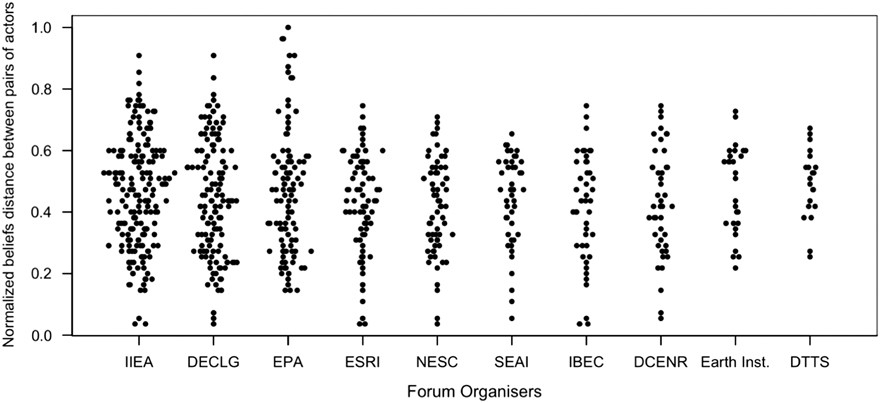
Normalized distance between the beliefs of each pair of actors that participated in the ten most attended forums. IIEA-Institute of International and European Affairs; DECLG-Department of Environment, Community and Local Government; EPA-Environmental Protection Agency; ESRI-Economic and Social Research Institute; NESC-The National Economic and Social Council; SEAI-Sustainable Energy Authority of Ireland; IBEC-Irish Business and Employers Confederation; DCENR-Department of Communications, Energy and Natural Resources, Earth Inst.-Earth Institute; DTTS-Department of Transport, Tourism and Sport
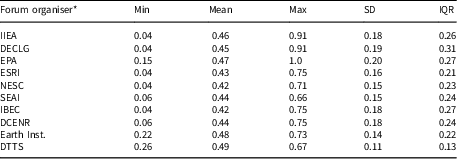
We use the beliefs distance matrix and the forums data to investigate who participated in the most popular forums and to examine the extent to which actors with different beliefs encountered one another at these forums. In Figure 2, the X-axis shows the organisers of the 10 forums with the most participants. The Y-axis refers to the normalised distance between the beliefs of pairs of actors. Each point on the graph refers to a pair of actors that participated in the forums organised by the actors named on the X-axis. Points towards the bottom of the graph refer to pairs of actors with very different beliefs, while a point at the top of the graph refers to a pair of actors with very similar beliefs. The figure shows that actors with views that span nearly the full breadth of all the views held by the actors in the network encounter one another at the eight best-attended forums. This implies that forum participants have opportunities to obtain advice and learn from those with beliefs dissimilar to their own. Table 1 presents summary statistics for the data describing the distance between the beliefs of each pair of actors that participated in the 10 forums with the most participants.
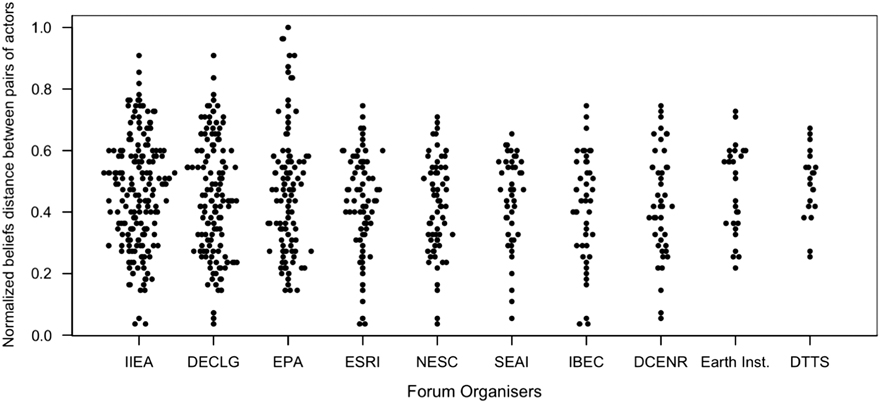
Normalised distance between the beliefs of each pair of actors that participated in the 10 most attended forums. IIEA = Institute of International and European Affairs; DECLG = Department of Environment, Community and Local Government; EPA = Environmental Protection Agency; ESRI = Economic and Social Research Institute; NESC = The National Economic and Social Council; SEAI = Sustainable Energy Authority of Ireland; IBEC = Irish Business and Employers Confederation; DCENR = Department of Communications, Energy and Natural Resources; Earth Inst. = Earth Institute; DTTS = Department of Transport, Tourism and Sport.
Descriptive statistics for the data describing the distance between the beliefs of each pair of actors that participated in the 10 best-attended forums
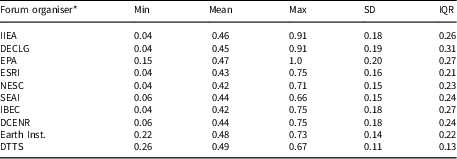
*IIEA = Institute of International and European Affairs; DECLG = Department of Environment, Community and Local Government; EPA = Environmental Protection Agency; ESRI = Economic and Social Research Institute; NESC = The National Economic and Social Council; SEAI = Sustainable Energy Authority of Ireland; IBEC = Irish Business and Employers Confederation; DCENR = Department of Communications, Energy and Natural Resources; Earth Inst. = Earth Institute; DTTS = Department of Transport, Tourism and Sport.
The Sustainable Energy Authority of Ireland, Teagasc, The Department of Jobs, Enterprise and Innovation, The Environmental Protection Agency and Bord na Móna participated in the most forums. The Institute of International and European Affairs (IIEA), an independent think-tank, organised the largest forums, with 19 other actors from the public, private and third sectors participating. The forums organised by the Department of Environment, Community and Local Government (DECLG) attracted 16 participants, most of which were government departments, public agencies or research institutions, although several NGOs and private sector actors also participated. Those organised by the Environmental Protection Agency (EPA) attracted 15 actors, most of which were research institutions and government agencies or departments. There were, however, several NGOs and a small number of private sector actors that participated. Most of the nine participants at the forums organised by the Sustainable Energy Authority of Ireland (SEAI) were from the private sector or involved in the energy sector. Forums organised by other actors in the network attracted very few participants and less than half the actors in the network participated in at least one forum. Even fewer participated in multiple forums. The forums can therefore not be said to be inclusive.
The Commission for Energy Regulation (CER) was the only nonrespondent to our survey that was named as a forum organiser by a similarly large number of actors, with eight organisations stating that they participated in forums organised by the CER. This makes the organisation the 9th most popular holder of forums. Seven of the participants were those involved in Ireland’s energy sector. The other was the Labour Party, who at the time of data collection presided over the Ministry for Communications, Energy and Natural Resources.
ERGM results
Table 2, below, shows that when the Akaike’s information criterion, the Bayesian information criterion and the log likelihood measures for goodness of fit are compared that model 5 performs best. The model provides evidence to support our first hypothesis – that organisations in the Irish climate change policy network will tend to obtain policy advice from those whose beliefs are more similar to their own. The same model provides evidence to reject our second hypothesis – the probability that an actor obtains policy advice from another actor in the network increases as the two participate in more of the same policy forums.
Results for the exponential random graph models with standard errors in parentheses
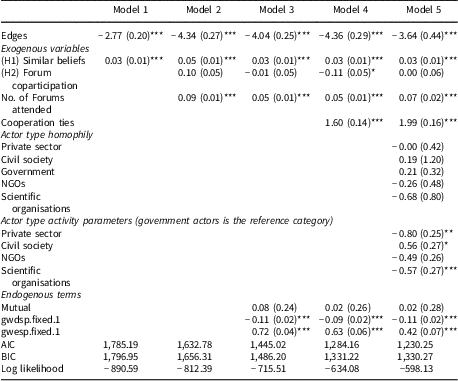
*0.01; **0.001; ***0.AIC = Akaike’s information criterion; BIC = Bayesian information criterion; NGO = nongovernmental organisation.
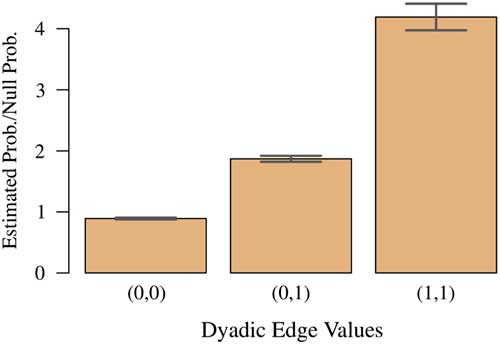
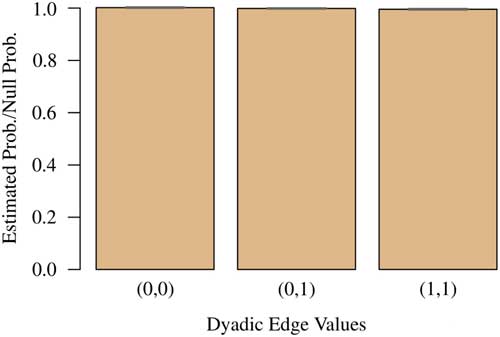
The coefficient for the similar beliefs variable is small because the unit of analysis is larger than most of the other variables in the model. We can determine what the magnitude of the similar beliefs parameter estimate means for the likelihood of a policy advice seeking tie to form between a pair of actors by conducting a microlevel interpretation of the coefficients (Desmarais and Cranmer Reference Desmarais and Cranmer2012). This requires calculating the ratio of the estimated probability of the shared beliefs variable in our model to that from a model where the coefficient for the same variable is set to zero, using a sample of 500 dyads. Figure 3, below, shows that a directed tie (0,1) is about twice as likely to form as no tie (0,0) when the parameter value from our estimated model is used, and that a reciprocated tie (1,1) is approximately four times more likely than no tie forming. These probabilities can be compared to those for the insignificant parameter estimate for the coparticipation in forums variable. Figure 4 shows that the probability of either a directed or a reciprocated policy advice seeking tie being formed between a pair of actors does not significantly change as they participate in more of the same policy forums.
Similar beliefs: estimated versus null.
Forums coattended: estimated versus null.
Our first hypothesis stemmed from the argument that actors involved in the contentious and polarising climate change policy debate would prefer to obtain policy advice from those whose views would support and reinforce their own rather than from those whose views would challenge or undermine them. The presence of a positive GWESP term and a negative GWDSP term indicates that actors in the network are more likely than chance to have relationships that close a triad than they are to leaving triads open. The positive and significant GWESP term indicates that actors that are connected because at least one of them obtains policy advice from the other are more likely than chance to have multiple shared partners, where these partners are either provided with or named as a source of policy advice. The negative and significant GWDSP term indicates that policy advice-seeking behaviour that creates open triangles is unlikely to occur. This means that in instances where neither actor in a pair obtained policy advice from the other then they are also unlikely to obtain policy advice from the same third actor (or for either of the two to be named by a third actor as a source of advice). Taken together, these findings indicate that actors are more likely to be circulating policy advice within closed triads than to be obtaining it from actors throughout the network.
Our second hypothesis was formulated to investigate if actors are obtaining policy advice from those they encounter at policy forums. We hypothesised that the probability that an organisation obtains policy advice from those they encounter at policy forums would increase as they participate in more policy forums together. The result leading us to reject the hypothesis suggests that policy forums are not enabling the type of policy learning that one might expect or hope to occur at these forums.
The negative and significant estimate for the edge term indicates that the density of the network is low and that the patterns of ties captured by the other terms in the models account for much of the policy advice-seeking behaviour observed in the network. The reciprocity term is insignificant in all models, implying that actors do not tend to exchange policy advice any more than would occur by chance. As can be seen from model 3 upwards, including the cooperation network as an edge covariate noticeably improves model fit. The positive and significant parameter estimate indicates that policy advice ties are formed between actors that cooperate regularly.
Results show that private sector actors and scientific organisations are less likely to have policy advice seeking ties than the government actors, while civil society actors are more likely to have policy advice ties. The actor type homophily term is insignificant for all actor types. This result is perhaps explained by the heterogeneity of the actors within some of the groups. For example, within the government actors group there are both left and right-wing political parties, and within the private sector group there are energy providers reliant on fossil fuels as well as companies producing renewable energy.
Discussion and conclusion
The study of policy learning in collaborative governing processes cannot limit its focus to the analysis of the outcomes of learning. It must also investigate how and from where political actors source the information that they use to learn about policy-relevant issues. This study set out to examine how beliefs and forums are related to policy advice-seeking behaviour. We approached this by investigating if actors in the Irish climate change policy network obtained policy advice from those with beliefs similar to their own and by investigating if actors obtained advice from those that they encounter at policy forums. Results indicate that actors in the Irish climate change policy network tend to rely on those with similar beliefs for policy advice and that they tend not to obtain policy advice from those that they encounter at forums. The results from our ERGM show that actors tend to obtain policy advice from those with which they create closed triads and that they tend not to engage in policy advice-seeking behaviour that creates open triads, providing evidence for the existence of advice-seeking behaviour indicative of echo chamber type network configurations.
Actors with diverging beliefs participated in the 10 forums with the most participants. Considering this finding in conjunction with the results of the ERGM, we can say that the forums are bringing a diversity of actors together and providing opportunities for information exchange and policy learning but that participants are not taking the opportunity to learn from those that they encounter at forums. Furthermore, this research has found that only a minority of actors participated in any given forum and that only a small set of actors participated in multiple forums. The views of the few actors that participated in multiple forums are therefore likely to be known by a broad range of actors in the network, putting them in a relatively strong position to exert discursive influence over Ireland’s national climate policy debate. Their positioning can be contrasted with that of the many actors in the Irish climate policy network that find themselves outside the policy forums network.
This article has contributed to the bodies of research investigating the function of forums in policymaking processes as well as to research analysing the information-seeking behaviour of policy actors. This study is distinctive because of its focus on the information gathering stage of the policy learning process and its use of ERGMs to enhance our understanding of the role of beliefs and policy forums in climate change policymaking. The result showing that actors tend to obtain policy advice from those whose beliefs are similar to their own is in line with the arguments made by the advocacy coalition framework (Sabatier and Jenkins-Smith Reference Sabatier and Jenkins-Smith1993) and is similar to results elsewhere (Leifeld and Schneider Reference Leifeld and Schneider2012; Fischer et al. Reference Fischer, Ingold and Ivanova2017). The results showing the presence of behavioural dynamics indicative of echo chamber type network configurations mirror results showing their presence in the US climate policy network (Jasny et al. Reference Jasny, Joseph and Fisher2015).
Our study differs from other research because the dependent variable in our analysis is the network of policy advice ties, rather than political/strategic information or scientific information-seeking behaviours that have been analysed elsewhere (Leifeld and Schneider Reference Leifeld and Schneider2012; Fischer et al. Reference Fischer, Ingold and Ivanova2017). Our finding that participating in policy forums does not lead actors to obtain policy advice from those that they encounter at forums is also novel. The result is, of course, a consequence of the peculiarities of the policy advice-seeking behaviour of the actors in the Irish climate change policy network, and as such, only allows us to make inferences about what this means for Irish climate politics. Nevertheless, the result illustrates how conducting a network analysis of a national level policymaking process can show how a polity is failing to create a process that is inclusive and participatory, which, in turn, may be helpful for thinking about how such failings might be addressed.
A limitation of this study is our reliance on a rather theoretically thin conception of learning, focussing only on self-reported relationships of policy advice-seeking behaviour. This choice, however, has allowed us to quantitatively measure relationships between the actors in the network as well as their beliefs, and to use statistical network techniques to analyse them. Furthermore, our choice of data and methods has limited our focus to processes within the policy network, thereby downplaying the role of other factors that may have effects on policy learning, including political, economic and social factors as well as the role of other information sources, such as the (social) media and actors outside the Irish climate change network. The relevance of these factors for policy learning could perhaps be understood by conducting in-depth interviews with individuals responsible for drafting policy positions.
As this study relies on cross-sectional data, we were unable to investigate if actors changed their beliefs after they obtained new information or to determine if it was social influence or social selection that shaped the formation of the policy advice ties in the network. This could be investigated in future research if another round of survey data were to be collected. Our survey question on forum participation relied on a roster of the organisations surveyed, and thus limited the list of possible forums to be analysed to those organised by the actors in the Irish climate change policy network. Nevertheless, we are highly confident that this approach has allowed us to identify all the forums relevant to the Irish climate change policy process (for details on the process of defining the network boundary, see the data section above). We do, however, acknowledge that our approach may not be suitable for other studies. For example, in other contexts it may be more appropriate to identify forums through web searches or by asking survey respondents to list the forums that they attended without presenting them with a list.
Organisers of policy forums often assume that simply bringing a large and maximally diverse population of policy actors together would foster policy learning. Our results, however, show that even forums that do bring together organisations with relatively diverse beliefs do not necessarily lead to learning. Research suggests that bringing a diversity of actors together to participate in forums can breed trust, narrow the divide between political foes and help facilitate consensus building (Vasseur et al. Reference Vasseur, Lafrance, Ansseau, Renaud, Morin and Audet1997; Ansell and Gash Reference Ansell and Gash2008; Levesque et al. Reference Levesque, Calhoun, Bell and Johnson2017). These findings, in conjunction with our finding that only a minority of actors participated in any of the Irish climate change policy forums, lead us to suggest that further extending the reach of the forums could be useful for other purposes. There is therefore a need to not only extend the reach of the forums but also to pay close attention to how they are internally organised. Participatory research at policy forums could help identify organisational practices within these forums that hinder learning, and invent new ones that may be more conducive to learning.
Supplementary material
To view supplementary material for this article, please visit https://doi.org/10.1017/S0143814X18000314
Data Availability Statement
Replication materials are available at https://dataverse.harvard.edu/dataset.xhtml?persistentId=doi:10.7910/DVN/DAE3PG.
Acknowledgements
We would like to thank the three anonymous referees and Fabrizio Gilardi at the Journal of Public Policy for their insightful and thoughtful comments. This research was funded by the Academy of Finland (Grant No. 266685), the Kone Foundation (Grant No. 085319) and the Helsinki Institute of Sustainability Science.