INTRODUCTION
Slash-and-burn is a common agricultural cropping practice in wet tropical regions. Typically, a natural area or a fallow is cleared and the biomass is left to dry. Thereafter, farmers burn this biomass because (1) it is the most labour-efficient method of removing it and (2) they believe that the burning increases crop yields (Büttner and Hauser, Reference Büttner and Hauser2003). In central Côte d'Ivoire, lands are typically cropped for a short period (1–3 years) without any fertilizer inputs, during which they lose fertility, and subsequently are abandoned to fallow for a varying period of time (Gautier, Reference Gautier1992). Traditionally, fallows could be of unlimited duration in the region because there was sufficient arable land available for all farmers. However, because of growing population and increasing land demand in the region, fallow duration has decreased to 3–4 years (Gautier, Reference Gautier1992) and shifting cultivation is proving less and less suitable. Thus, ways to improve the sustainability of agriculture is desirable with high priority.
One proposal is to slash the fallow vegetation but leave it unburnt, left to decompose in a slash-and-mulch system (Norgrove and Hauser, Reference Norgrove and Hauser2015) thereby releasing carbon and nutrients into the soil. This sort of practice meets the goal of the French ‘4 per mille, Soils for Food Security and Climate’ initiative involved in the Lima-Paris Action Agenda (Minasny et al., Reference Minasny, Malone, McBratney, Angers, Arrouays, Chambers, Chaplot, Chen, Cheng, Das, Field, Gimona, Hedley, Hong, Mandal, Marchant, Martin, McConkey, Mulder, O'Rourke, Richer-de-Forges, Odeh, Padarian, Paustian, Pan, Poggio, Savin, Stolbovoy, Stockmann, Sulaeman, Tsui, Vågen, van Wesemael and Winowiecki2017). Slash-and-mulch is also particularly important in West Africa savannas and forest–savanna interfaces where soil fertility is low due to their sandy status and high content of low-activity clays (Riou, Reference Riou1974). It is likely that this method could also improve the yield of the cultivated yams (Dioscorea spp.) as this important crop is very nutrient-demanding (O'Sullivan and Ernest, Reference O'Sullivan and Ernest2007). Should slash-and-mulch systems be shown to increase soil organic matter and nutrients and crop yields compared to slash-and-burn systems, there would be wide-ranging implications: in Côte d'Ivoire and other West African countries (e.g., Benin and Nigeria), yams constitute one of the main staple food items; indeed, more than 95% of the global yam production is from West Africa (Diby et al., Reference Diby, Hgaza, Tie, Assa, Carsky, Girardin and Frossard2009).
In forest and forest–savanna interface areas of West Africa, fallow lands are dominated by Chromolaena odorata (L.) King and Robinson (Asteraceae) or Siam weed (Kassi et al., Reference Kassi, Koné, Tondoh and Koffi2017; Koné et al., Reference Koné, Edoukou, Gonnety, N'Dri, Assémien, Angui and Tondoh2012; Norgrove and Hauser, Reference Norgrove and Hauser2015), which is reported as one of the most invasive weeds in the world. It colonizes perturbed spaces owing to a high production of wind-dispersed seeds that allows competition with herbaceous and shrub species (Mandal and Joshi, Reference Mandal and Joshi2014). Its area of distribution is wide, extending over central and western Africa, India, Australia, the Pacific Islands and Southeast Asia (Mandal and Joshi, Reference Mandal and Joshi2014). Such widespread secondary vegetation is subjected to slash-and-burn or to wildfire throughout West Africa (Maliki et al., Reference Maliki, Sinsin and Floquet2012). To date, no study has dealt with carbon emissions from these lands. Filling this gap at local and regional levels may help refine global carbon emission estimates (Ellicott et al., Reference Ellicott, Vermote, Giglio and Roberts2009).
Although the slash-and-mulch system is increasingly adopted by farmers in West and central Africa (Norgrove and Hauser, Reference Norgrove and Hauser2015), very few studies have addressed this system (Thurston, Reference Thurston1997), particularly in savanna areas. Furthermore, there are few studies that link biomass burning and subsequent crop yield. This study evaluates carbon and nutrient emissions in the atmosphere through C. odorata burning in central Côte d'Ivoire. It also compares yam growth and yield in slash-and-burn versus slash-and-mulch systems, and links results to soil carbon and nutrient dynamics. Our hypotheses were as follows: (i) a very high percentage of biomass carbon and elemental nutrients is lost through burning of the slashed and dried C. odorata; (ii) nutrient concentrations in the topsoil (0–15 cm) are higher in unburnt plots than in burnt plots at the time of yam planting and (iii) fresh yam tuber yield is higher on unburnt plots due to residue from decomposing mulch incorporation into soil mounds.
MATERIALS AND METHODS
Study area
The study was carried out in the forest–savanna interface area in central Côte d'Ivoire (Supplementary Figure S1, available online at https://doi.org/10.1017/S0014479718000327) near the village of Ahérémou-2 (6′10-6′15N, 4′55-5′00W and 120 m above sea level). The vegetation is a mosaic of secondary forests, shrubby and woody savannas. Fallow sites are dominated (>90% projective ground cover) by the pan-tropical invasive weed C. odorata, as commonly observed in West and Central Africa. Other plant species include: Spondia monbin (Anacardiacea), Phyllanthus muellerianus (Euphorbiaceae), Mucuna pruriens (Papilionaceae), Centrosoma pubescens (Papilionnacea), Dalbergiella welwitschii (Papilionacea) and Imperata cylindrica (Poaceae).
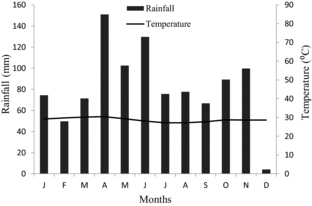
The climate is continually warm with four seasons based on precipitation: a long dry season from December to February, a long wet season from March to July, a short dry season in August and a short wet season from September to November. The annual rainfall during the study period (2014) was 991.9 mm, and the daily temperature averaged 28.8 °C. December and February were the driest months (Figure 1). Data were obtained from the Lamto Geophysical Station approximately 12 km from the study site. Wind speed in the region in general is low, i.e., 0.6 m s−1 (Le Roux, Reference Le Roux1995). Soils are Oxisols with granite as the main bedrock. The upper soil layer is generally sandy textured (60–80% sand). Clays consist of illites and slightly crystallized kaolinites with a low adsorption capacity (Riou, Reference Riou1974).
Monthly rainfall and air temperature over the year of study.

Experimental design and plot description
The field experiments were conducted from the end of February to December 2014 (farmer field conditions), over a total of 11 months. The experimental design consisted of five sites, established in the dominant C. odorata fallows of the region, each consisting of 50 × 50 m2 paired plots: slash and burnt biomass (SB) versus slashed and unburnt biomass, but left to serve as mulch (SM). Each set of paired plots was separated by a 5-m wide firebreak wherein biomass was completely removed. The five sites were 0.5–5 km distant from each other (Figure S1), and were set on 5- to 8-year old C. odorata fallows established on sandy clay to clayey sand (15–25% clay) soils. The most recent history of these fallows included a maximum cropping period of three years, generally as follows: the first year, yam (Dioscorea spp.) as main crop mixed with plantain (Musa spp.) and vegetables; the second year, plantain mixed with vegetables and sometimes cassava (Manihot esculenta); and the third year, plantain either cropped alone or mixed with cassava. Plots had all a low slope (<5%). Neither machinery nor chemical fertilizers had ever been used on the fields.
Plant sampling, timing of treatments and ash collection
At the beginning of the field experiment, in February 2014, during the long dry season, aboveground biomass was evaluated on five samples collected at five points well distributed over each plot using a 1 × 1 m2 frame. These samples were then oven-dried at 60 °C to constant weight. For each of the plant parts (stems, green leaves and dead leaves), samples from the five plots were thoroughly mixed to obtain a composite sample for chemical analyses.
The remaining aboveground biomass was slashed with machetes on all plots and left in situ to dry. Any large branches in the plots were removed. On the designated plots that were to be burnt (SB), plant residue management was done according to farmers’ practice, allowing for 3 weeks of drying; these plots were then burnt in the last third of March 2014. For the unburnt plots (UM), however, dry biomass was left at the soil surface as mulch.
On SB plots, the quantity of ash was determined using the technique of Mackensen et al. (Reference Mackensen, Hölscher, Klinge and Foölster1996). Prior to setting fires, five steel trays (50 × 50 cm2) were placed on the soil surface under the slashed biomass at five points well distributed within each plot. Fires were ignited in the direction of the wind so as to prevent deposition of particulates from SB on SM plots. The slashed biomass burnt almost completely, due to the long period of drying and the fact that C. odorata is an herbaceous plant. Any coarse residues remaining on the plots were from the few woody plants. Ash samples were collected within 30 min after fires to counter potential drift due to wind. A composite aliquot from each plot was stored in plastic bags for laboratory chemical analyses.
Soil sampling
Soil samples for chemical analyses were collected on each plot at two times: prior to slashing of vegetation (February 2014) and then just prior to mounding of soil in preparation for planting of yams (in mid-April 2014). Soil samples were collected from the 0–15 cm soil layer at five points well distributed over each plot, after plant residues or ash materials have been carefully removed from the soil surface. The five soil samples of each plot were thoroughly mixed into a composite sample, then air-dried at ambient temperature, crushed and sieved (2 mm) in preparation for chemical analyses.
Soil moisture was measured on soil cores collected at the same points as above using the cylinder method (Anderson and Ingram, Reference Anderson and Ingram1993). Soil cores were weighed fresh and after oven-drying at 105 °C for 48 h, moisture was calculated as
 $$\begin{equation}
{\rm{M}} = {100 \times \left( {{\rm{FM}}-{\rm{DM}}} \right)/{\rm{FM}}}
\end{equation}$$
where M is moisture (%), FM and DM are fresh and dry masses, respectively.
Laboratory analyses
Both soil organic and plant material carbon were determined using the Anne method (Nelson and Sommers, Reference Nelson, Sommers, Page, Miller and Keeny1982), which is a modified Walkley–Black (WB) method: samples were heated during oxidization, allowing for complete recovery of organic C and no need to apply a correction factor as done in the WB method. Nitrogen concentrations in soil and plant materials were determined by the Kjeldahl method (Anderson and Ingram, Reference Anderson and Ingram1993). Available phosphorus was extracted as per the Olsen–Dabin method (in a mixture of NaHCO3 and NH4F, at pH 8.5), and then assayed by colorimetry at 660 nm (Murphy and Riley, Reference Murphy and Riley1962). Major cations were extracted using a standard ammonium acetate (pH 7) buffer and measured by atomic absorption spectrometry (Anderson and Ingram, Reference Anderson and Ingram1993).
Calculations of carbon and nutrient loss due to burning
Loss of carbon (C) and five elements (N, P, K, Ca and Mg) during burning were calculated by subtraction: the measured values in slashed plant biomass prior to burning minus the values in ashes after burning (Rossiter-Rachor et al., Reference Rossiter-Rachor, Setterfield, Douglas, Hutley and Cook2008). As described above, sampled vegetation did not include the few woody species on the sites.
Carbon and nutrient stocks in slashed biomass and in ashes and losses of those elements were calculated as
 $$\begin{equation}
{\rm{ES}} & =& \left( {{\rm{PM}} \times {\rm{EC}}} \right)/100
\end{equation}$$\\
 $$\begin{equation}
{\rm{EL}} & = & \left[ {\left( {{\rm{ESB}}-{\rm{EA}}} \right)/{\rm{ESB}}} \right] \times 100
\end{equation}$$
Yam planting and yields
The preparation of soil mounds in which to plant yams had to wait until the first significant rain event occurs because wet soil is easier to work with, is conducive to seed germination and yams are less likely to rot compared to dry soil. In this case, the wait for rain was about three weeks (late March to mid-April 2014). Thus, the total time span between biomass cutting to mounding of ground for planting (i.e., start of yam cropping), as well as the time span between the two soil sampling events was 6 weeks. Because wind speed is insignificant, and hygrometry is conducive to ash moistening (particularly during the night) in this region, ashes were likely not significantly displaced from plots in this interim.
The yam species used for this study was Dioscorea alata, also called ‘Bètè-bètè’ in Côte d'Ivoire, the most cultivated species in the study region. In our study, yams were planted by traditional methods. Ground mounds were prepared whereby soil was hoe-ploughed at an approximate depth of 20 cm and heaped into 50-cm high mounds at the density of 10,000 ha−1. Yam setts (each approximately 100 g) were cut from a parent yam and buried one per mound. Plots were manually weeded twice over the growing period (from April to December) on SB plots, similar to local farming practices. Unburnt plots were weeded three times due to a more rapid weed growth. In this way, in general, the weeds were kept at similar levels in the two types of plots.
Stem length and the number of leaves on individual yam plants were determined on 100 randomly chosen mounds in each plot, 2 months after yams were planted. Tubers were harvested at maturity (December 2014) from each plot. Within each plot, fresh weights of yams were recorded from three 4 × 4 m2 frames (involving 16 mounds each) well distributed over each plot. The mean of the weights from the three quadrats on each plot was considered (the yield expressed in Mg ha−1). The number of tubers was also recorded in each case.
Statistical analyses
Statistical analyses were performed using R software (R Development Core Team, 2014). Paired t-tests were used to analyse the effect of treatments (SB vs. SM) on soil carbon and nutrient concentrations, yam growth parameters and yam yield. Changes in soil chemical parameters between the first and second sampling times were analysed using Student's t-tests. Multiple regressions were used to determine which soil variables best explained yam yield. A principal component analysis (PCA) was performed on the soil and yam data matrices to evaluate links among variables and to determine which variables best explain between-treatment discrimination. Results were considered significant when p < 0.05.
RESULTS
Carbon and nutrient loss during fire
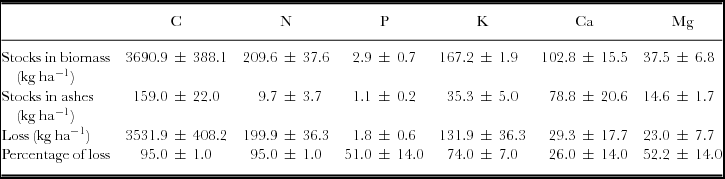
The average biomass yielded by C. odorata vegetation was 12.5 Mg dry mass ha−1, of which carbon represented 30%. Carbon and nitrogen were almost completely lost during fire (95% of the initial stock). Three-quarters of the potassium stock, half of the magnesium and phosphorus, and one quarter of the calcium stocks were also lost (Table 1).
Carbon and nutrient stocks in slashed C. odorata biomass and in ashes, and percentage transfer to the atmosphere during burning (mean ± standard error, n = 5).

Changes in soil parameters
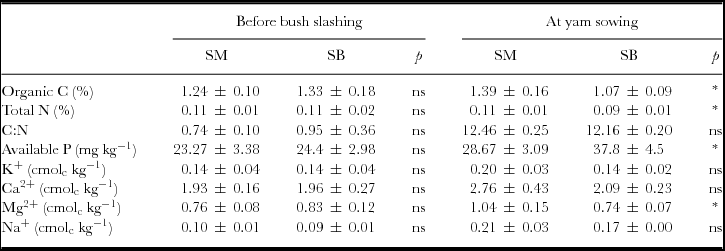
In the soil, before vegetation was slashed, there was no significant difference between treatments for any element (Table 2). However, 6 weeks later (after burning and at the time of mounding in preparation for planting of yams), soil concentrations of C, N and Mg2+ were significantly lower in SB compared to SM whereas available P was higher in SB (Table 2). Significant differences were neither recorded for the other soil chemical parameters nor for C:N ratio at that time. Soil moisture was significantly higher (p=0.004) on SM than on SB plots (29 ± 3% vs. 25 ± 3%).
Soil organic C and nutrient concentrations (mean ± standard error, n = 5) in the top 0–15 cm soil before C. odorata bush slashing and at yam sowing.

SB: Burnt plots; SM: Unburnt plots.
Differences between SM and SB were tested through the paired t-test.
*p < 0.05.
Between the two sampling periods, available phosphorus (p = 0.04) and Na+ (p = 0.0002) had significantly increased in SB, and Na+ (p = 0.01) had increase in SM. No significant change over time was observed for the other soil chemical parameters (Table 2).
Yam growth and yield parameters
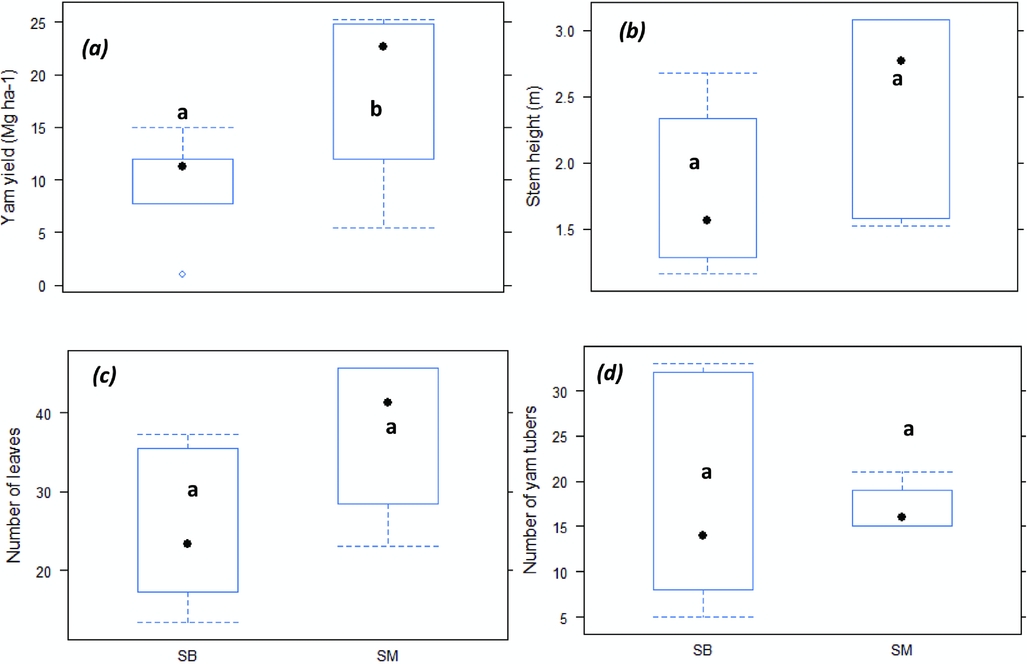
Fresh yam tuber yield was twice as great on SM than on SB plots (18 ± 4 Mg ha−1 vs. 9 ± 2 Mg ha−1; p = 0.01; Figure 2a). There was no significant difference in stem length, the number of leaves or the number of tubers (Figure 2b–d). Fresh yam tuber yield was significantly and positively influenced by soil nutrient concentration (p=0.02, R 2 = 0.97), particularly C (p=0.04), N (p=0.04) and K+ (p=0.04).
Yam growth and yield parameters: (a) Yam tuber yield, (b) Stem height, (c) Number of leaves and (d) Number of yam tubers. SB: Burnt plots; SM: Unburnt plots.

Parameters distinguishing plot types
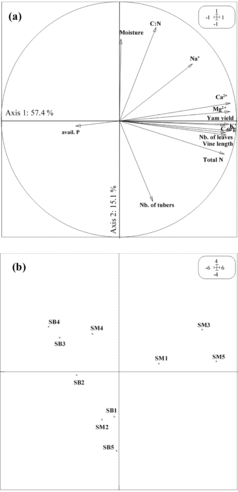
The normalized PCA revealed that Axes 1 and 2 accounted for 51.6% and 14.6% of the total variation in this study (Figure 3). This variation was driven along Axis 1 by soil organic C and total N (r = 0.9), exchangeable cations (r = 0.9), the number of yam leaves (r = 0.9), vine length (r = 0.9) and fresh yam tuber yield (r = 0.9), and driven along Axis 2 by the soil C:N ratio (r = −0.8) and soil moisture (r = 0.7) (Figure 3a). Projection of plots in the factorial plane 1–2 yielded two broad groups primarily along Axis 1 (Figure 3b). The first group was comprised of three unburnt plots characterized by the highest soil C, N and exchangeable cation concentrations, and yam growth and yield parameters. The second group was comprised of burnt plots and the two remaining unburnt plots, where soil fertility parameters and yam yield were the lowest.
Normalized principal component analysis (PCA) on soil attributes and yam growth and yield parameters: (a) correlation circle and (b) projection of the plots in the factorial plane 1–2. SB: Burnt plots; SM: Unburnt plots.

DISCUSSION
Loss of carbon and nutrients during fire
As commonly reported for other plant materials (Mackensen et al. Reference Mackensen, Hölscher, Klinge and Foölster1996; Rossiter-Rachor et al., Reference Rossiter-Rachor, Setterfield, Douglas, Hutley and Cook2008; Villecourt et al., Reference Villecourt, Schmidt and Cesar1980 and references therein), large fractions of carbon and nutrients from C. odorata were released into the atmosphere during fire in the present study. It is well known that the lower the temperature of vaporization of a given element, the higher the rate of volatilization of that nutrient. Based on this, the nutrients we explored would be ranked as follows, from lower to higher temperature of volatilization: N > P > K > Mg > Ca (Mackensen et al., Reference Mackensen, Hölscher, Klinge and Foölster1996). However, our study produced the following order based on rate of loss: C, N > K > Mg > P > Ca, showing a significant deviation regarding P. The proportion of lost P was similar to that of Mg, yet the temperature of volatilization of the former is normally lower than that of the latter. There is no apparent explanation for the lower level of P loss than expected. The fact that nitrogen and carbon had the highest (95%) losses is perhaps not surprising as they both have relatively lower temperatures of volatilization, from 200 °C to 350 °C (Fernández and Carballas, Reference Fernández and Carballas1997). This rate of loss under fires is close to those reported by Villecourt et al. (Reference Villecourt, Schmidt and Cesar1980) for the neighboring Lamto savanna (97% and 90%, respectively), and by Mackensen et al. (Reference Mackensen, Hölscher, Klinge and Foölster1996) in Brazil (96%).
As for calcium, temperature of volatilization (1484 °C) is far higher than fire temperature of 800 °C recorded in the Lamto reserve by Gignoux et al. (Reference Gignoux, Clobert and Menaut1997) and 600 °C by N'Dri et al. (Reference N'Dri, Soro, Gignoux, Dosso, Koné, Koné, N'Dri and Barot2018). Accordingly, this element was lost the least in our study, essentially through particulates. Magnesium and potassium have intermediate temperatures of volatilization, between 774 °C and 800 °C, explaining their intermediate rates of loss here. It is possible that our method used to estimate losses could have over-estimated loss, particularly for P, Mg and Ca, because ash collection trays were retrieved about 30 min after fires, and the finest ash fraction probably was still in the air and was not taken into account. Had we waited for a longer time before retrieving trays, ash drift due to even the very mild winds of the day could have distorted values even further. Overall, we consider the portion of any fine ash that might not have settled 30 min after fires as insignificant, relative to the much larger volumes of the ash samples. The estimated values for losses of C, N, P and cations when C. odorata slash is burnt is most likely close to the maximum possible in the study region due to the fact that (i) fallows were more than 5-years old, which corresponds to the maximum biomass yield by C. odorata (Gautier, Reference Gautier1992) and (ii) burning conditions were optimal: the slashed biomass was thoroughly dried in February (the driest month) and burnt almost completely.
Thus, the value obtained for carbon (C) may be used as an estimate of C emissions from C. odorata lands in the forest–savanna transition zone of Côte d'Ivoire. In other localities, however, adjustments in estimates of carbon emissions from these lands would need to be made, as C. odorata biomass yield varies across agroecological zones, age and level of lignification, all influencing carbon and nutrient stocks. For example, whereas the value of biomass recorded in our study was 12.5 Mg ha−1, biomass yield was 20–22 Mg ha−1 in 3–4 year C. odorata fallows in Southwestern Côte d'Ivoire (Slaats, Reference Slaats1995), a forest zone where annual rainfall averages 1900 mm. Witkowski and Wilson (Reference Witkowski and Wilson2001) reported a biomass yield of 7 Mg ha−1 for a South Africa coastal forest zone where annual rainfall averages 1500 mm and frost interferes with C. odorata development. Nevertheless, the quantity of C, N, P and cations lost from slashed vegetation when it is burnt, as shown in our study, is likely highly important in any region where soils are much poor in nutrients.
Changes in soil properties
Mechanisms responsible for the recorded differences in soil organic C, total N and Mg2+ concentrations between SB and SM may be due to several reasons. In SM the soil was protected by the mulch, thereby lowering soil temperature and limiting losses of nutrient through run-off. Also, it is likely that part of biomass C and nutrients was incorporated into the soil by microorganisms, an assumption based on the fact that C. odorata leaf litter is of a high quality and easily processed by decomposer fauna (Koné et al., Reference Koné, Edoukou, Gonnety, N'Dri, Assémien, Angui and Tondoh2012). In contrast, in SB, soil C mineralization and volatilization were most likely enhanced by increased soil temperature due to both the fire and subsequent exposure to sun (Fernández and Carballas, Reference Fernández and Carballas1997). These conditions are also conducive to N mineralization and loss through nitrification and denitrification although in any case, losses of the N-nitrate form, which is prone to leaching, were likely low because there was little rainfall between February and early March. Interestingly, the 18% soil N decrease in SB (relative to SM) was close to the 20% reported by Williams et al. (Reference Williams, Hallgren and Wilson2012) in an oak forest. All these results highlight the negative impact of C. odorata burning on soil fertility. The peculiar result with regard to available P in SB (significant increase between the two sampling times) may be due to the fact that the mineral form is highly immobile in soil. When vegetation is burnt and soils experience high temperatures, organic P forms are converted to mineral P that further accumulates in the topsoil.
Fresh yam tuber yield
Given that weed pressure was kept at the same level in the two types of plots, differences in fresh yam tuber yield is best explained by other factors. Specifically, the increase in yam yield in unburnt slash-and-mulch relative to slash-and-burnt plots is related to the higher soil concentrations in organic matter (C and N) and K+ (cf. PCA; Figure 3). Importantly, the three elements lost in greatest proportion during burning are those which positively influence yam yield. Thus, there is a clear link between burning/mulching and yam production. On the SM, the slashed biomass was incorporated into the constructed soil mounds and so nutrients were released over time through decomposition of mulch, ensuring a nutrient supply over the yam growing period. The incorporated mulch also may have contributed to the maintenance of soil moisture during the first months, further boosting yam growth. In contrast, when the mulch is burnt, yam seedlings can benefit from nutrients in mineralized form in the ashes but probably not over time. This is worsened by the sandy status of soils in the region (60% sans in the topsoil), which is conducive to pronounced nutrient leaching especially under the frequent rainfalls prevailing over the growing period. Our conclusion that the soil organic matter increases yam yields are consistent with results of other studies on the requirements and abilities of yams to take up and use available soil nutrients (Diby et al., Reference Diby, Hgaza, Tie, Assa, Carsky, Girardin and Frossard2009; Kassi et al., Reference Kassi, Koné, Tondoh and Koffi2017; O'Sullivan and Ernest, Reference O'Sullivan and Ernest2007). Over the course of the study in 2014, the rainfall was 797 mm compared to an average of 994 mm (over the period 1994–2013). The difference between yam yield under burnt and unburnt treatments could likely have been even greater, had the total rainfall over the growing period (April–December) been as usual.
In the context of poor soil quality, low human population density and sufficient land availability, slash and burn shifting cultivation is considered a rational option. However, human population is growing rapidly in Africa, and therefore land pressure is increasing. As a consequence, the length of fallow periods has become shorter and insufficient for full recovery of soil fertility (Norgrove and Hauser, Reference Norgrove and Hauser2015). In Central Côte d'Ivoire where this study was carried out, some farmers are obliged to cultivate grass savanna where soils are the poorest in the region. For both reasons (shortened length of fallow periods and the necessity to expand farming to even poorer soils), slash-and-mulch agriculture is a more sustainable option to traditional slash-and-burn agriculture and should be promoted. Certainly, it will not be easy to convince farmers to adopt this system but the doubling of yam yield is a valuable argument. The economic value of yam in Côte d'Ivoire is high enough, and the extra yield of slash-and mulch agriculture high enough to allow a farmer to pay for the extra-labour costs (branch removing prior to mounding, additional weeding, etc.). The findings of our research can be used in support of developing a sustainable yam production system in the region and in West Africa more generally.
CONCLUSION
This study is one of the first, if not the first, focusing on carbon and nutrient dynamics following C. odorata biomass burning. The study provided clear evidence of a significant loss of soil carbon and key nutrients with biomass burning, and a subsequent negative impact on yam crop production that same year. In contrast, simultaneous experiments on slash-and-mulch methods showed a doubling of yam production. Based on these results, we suggest that the slash-and-mulch practice should be promoted more strongly among yam farmers, agricultural practitioners and stakeholders in the framework of sustainable yam production.
Acknowledgements
This work was funded by the International Foundation for Science (IFS Project N° C/5602-1), the ASCAD (Académie des Sciences, des Arts, des Cultures d'Afrique et des Diasporas Africaines) postdoctoral fellowship and the Programme d'Appui Stratégique à la Recherche Scientifique (PASRES, project N° 105). We thank Diawara Adama (Director of the Lamto Geophysical Station) for access to climate data and Alan Andersen (Charles Darwin University, Australia) for English proofreading. We also thank the two anonymous reviewers and Prof. Patricia A. Werner (Australian National University, Camberra) for their assistance in improving earlier drafts of this paper.
SUPPLEMENTARY MATERIAL
To view supplementary material for this article, please visit https://doi.org/10.1017/S0014479718000327