Search method
Electronic searches were made on Pubmed, Medline and Exerpta Medica using search words (in various combinations): tobacco, smoking, smoking cessation, old age, elderly, smoking-related mortality, for the period 1970–2009. Some of the earlier papers were extracted separately as specific targets. Abstracts were selected on the basis of relevance to the topic and apparent data quality. 213 full papers were scrutinized, from which the cited 50 papers were chosen on the basis of relevance, data quality, overview scope and, in some cases, because the studies had been conducted recently. Some of the history of tobacco information was obtained by searching Google and by a manual library search.
Introduction
Tobacco has been used as a source of nicotine for at least 2000 and possibly 3500 years in North AmericaReference Brumley1 and almost certainly longer in South and Central America.Reference Bario2 Inhaling the smoke from smouldering tobacco leaves is now the main mode of use throughout the world, and that has probably been the case from early in its history. Tobacco is a native plant of the Americas and there is anthropological and archaeological evidence of its use in various ceremonies, including marriage, peace negotiations, declarations of war, healing, dance and celebration of a successful hunt.Reference Brumley1–Reference Chandler3 Nicotine at usual doses causes a pleasant mix of alertness, slightly heightened perception, calm and a feeling of well-being,Reference Pomerleau and Pomerleau4 without disinhibition, apathy or aggression. It has traditionally been used to promote relaxation, enjoyment and conviviality and, like the tea ceremony, involves a pleasing ritual when tobacco is smoked, particularly when taken in a pipe. It was probably used at higher doses to help promote the trance-like states achieved during shamanistic rituals among native American tribes people.Reference Wilbert5 There is narrative evidence that suggests older people played a prominent part in such ceremonies,Reference Chandler3, Reference Bevington and Hoaxie6 enjoying the effects of tobacco alongside their younger fellows.
It seems that for most of its history tobacco smoking has been viewed as a source of much good and little harm. Then, around the end of the nineteenth century, things changed and through the twentieth century tobacco smoking came to be understood as one of the most powerful causes of ill health and reduced life expectancy, particularly for older people. There are a number of factors that might be responsible for that shift. Firstly, tobacco became plentiful as a result of large-scale tobacco farming and thereby available to virtually everyone. Secondly, it remained a legal drug in virtually all countries, probably initially because of its apparent harmlessness and later as a source of large revenue incomes for governments. Thirdly, the invention and mass production of cigarettes and their affordability changed the pattern of use from ritual-occasional to casual-frequent, with a consequent large increase in the total exposure of individuals to the wide range of harmful chemicals in tobacco smoke. Fourthly, the secular upward trend in life expectancy over the last 150 years or so resulted in a rising proportion of smokers living long enough to suffer the health detriments of tobacco rather than dying from other causes before the smoking effects became manifest in most cases.
The impact of smoking on health is slowly accumulative.Reference Burns7 Though there is no safe level of smoking,Reference Bjartveit and Tverdal8 the pattern of use for centuries in the Americas and elsewhere, combined with the likelihood that most users, even the ‘elders’, would not live long enough to develop smoking-related disease, masked the malign effects of long-term smoking. Indeed, the true impact of cigarette smoking was not proven until the middle of the twentieth century when a number of seminal studies established the link with bronchogenic carcinoma,Reference Doll and Peto9 chronic obstructive pulmonary disease (COPD) and atherosclerotic arterial conditions, particularly coronary artery disease and peripheral vascular disease.Reference Doll and Peto10–13 These are mainly diseases of later life. Indeed, in the USA it has been shown that 70% of the smoking-induced excess mortality occurs in people over the age of 60, a large proportion of which is seen in old age.Reference Burns7 This then is the paradox: smoking is bad for peoples’ health because they live so long.
Smoking in old age
Though smoking prevalence is highest in young and middle-age adults in most countries, it remains highly prevalent in old age. Surveys in the UK in 2001 showed that around 16% of people over 65 were smokers. This included 20% of men and 24% of women in the 65–74 age band and 11% of those over the age of 75.Reference Dudleston, Hope, Littlewood, Martin and Ormston14–16 The fall in the proportion of smokers with age appears to be partly due to people quitting, and partly because of the higher death rate of smokers, thus leaving fewer in the very elderly age band. In the 1974 national UK household survey, 44% of people over 65 years were smokers,16 so there has been a substantial fall over 35 years. Elderly men represent a large proportion of heavy smokers (more than 20 cigarettes per day).Reference Dudleston, Hope, Littlewood, Martin and Ormston14 Heavy smoking elderly men are also the least likely to want to stop smoking or to try to do so. Despite the fall in the prevalence of current smokers it must be remembered that a large proportion of the contemporary cohort of elderly people, particularly men, have smoked significant amounts at some stage in life: an important negative contribution to their health status in old age.
Evidence for continued harm
The evidence for continued harm from smoking in old age is now well established. People who continue to smoke in old age have higher overall mortality and morbidity than those who stop smoking or have never smoked. Research in the USA has indicated that lifelong smokers lose an average of 12–15 years of life compared with age-matched never-smokers.Reference Burns7
Vascular risk
Older people, including those over the age of 75 years who continue to smoke, are more likely to suffer a myocardial infarction (MI), transient ischaemic attack (TIA) or stroke than their ex-smoker counterparts, even when compared with those who quit the habit in old age, and they have a higher risk of heart failure and symptomatic peripheral vascular disease. They also have a higher risk of developing chronic renal failure.Reference Bjartveit and Tverdal8, Reference LaCroix and Omenn17, Reference Last18
COPD
COPD is almost entirely a consequence of smoking. Due to its high prevalence and its long-term accumulative natural history, it has become one of the most prominent causes of poor health in old age. Furthermore, despite the decline in smoking in the UK and USA, the prevalence of COPD in the elderly population apparently continues to rise as a result of the high rates of smoking several decades ago.13, Reference Feinleib, Rosenberg and Collins19, Reference Soriano, Maier and Egger20 Tobacco consumption appears to be highest during the phase of social development characterized by rapid industrialization. This has certainly been the case in Western Europe and North America. It is predicted that rapidly developing economies, such as China and India, where cigarette consumption is high and rising, will experience the same trend in COPD prevalence in the middle of the present century.Reference Peto, Chen and Boreham21 People with COPD who continue to smoke in old age have a faster decline in their lung function than ex-smokersReference Cook, Evans and Scherr22, Reference Burr, Phillips and Hurst23 and are more likely to develop respiratory failure, need admission to hospital or suffer from an episode of pneumonia; they have a higher age-adjusted mortality rate from respiratory causes in old age.24
Malignant disease
There are several malignant conditions that have a higher incidence in smokers compared with non-smokers and long-term ex-smokers, including carcinoma of the bronchus, lip, tongue, pharynx, pancreas, stomach, colon, oesophagus, kidney, bladder and pancreas.Reference LaCroix and Omenn17 The majority of people with these tumours have reached older age by the time of diagnosis. Furthermore, there is evidence that the risk of some malignancies is reduced if smoking cessation is achieved in old age and maintained.Reference Bjartveit and Tverdal25 There are other subtle metabolic effects of smoking that become increasingly clinically important in old age. For example, proximal muscle strength and grip strength are impaired in smokers compared with non-smoker and ex-smoker controls and can improve with smoking cessation.Reference Rapuri, Gallagher and Smith26, Reference Yates, Djousse and Kurth27 This is probably in part due to the effect of inhaled chemicals that alter vitamin D activity in skeletal muscle. There are probably also direct toxic effects on skeletal muscle, though the clinical relevance of that factor is not understood. Non-smokers and ex-smokers tend to have better mobility and better functional scores than age-matched smokers.Reference Rapuri, Gallagher and Smith26 Smokers have a higher incidence of falls and osteoporotic fractures,Reference Kanis, Johnell and Oden28, Reference Vestergaard and Mosekilde29 the latter probably also due at least partly to interference with vitamin D action.
Dementia
There is now little doubt that current smoking is a risk factor for dementia, particularly Alzheimer's disease.Reference Reitz, den Heijer, van Duijn, Hofman and Breteler30 This association was found to be strongest in individuals who lack the APOEγ4 allele. Though an association with vascular dementia might be expected, this has not been conclusively shown. Smokers probably have a higher risk of developing peripheral neuropathies, though this has only been demonstrated conclusively in older diabetics.Reference Mitchell, Hawthorne and Vinik31 It is also likely that lesser impairments of sensory function contribute to the higher falls risk of smokers.
Drug interactions
Smoking can impair the efficacy or alter the pharmacokinetics of several drugs commonly used in older people, mainly by altering the rate of drug metabolism through enhancement of hepatic cytochrome P450 enzyme systems. A full list of such interactions is beyond the scope of this review, though there are sources in the published literature.Reference Zevin and Benowitz32, 33
Are there any benefits from smoking in old age?
Is smoking all bad? This is a contentious subject because though there is no doubt about the potential for harm, there are a few examples of benefit, some of which are supported by scientific evidence and some by reasoned argument. There appears to be a protective effect of smoking and ex-smoking, on the risk of developing Parkinson's Disease.Reference Ritz, Ascherio and Checkoway34, Reference Scott, Zhang, Stajich, Scott, Stacy and Vance35 This risk reduction shows a total-dose-dependent effect. The mechanism is not really clear, though modification of neurotransmitter patterns by prolonged exposure of the central nervous system (CNS) to nicotine is likely to be part of the explanation. There have been assertions made for other benefits. These include smoking as an aid to control the symptoms of anxiety and to improve concentration in the context of anxiety disorders and schizophrenia.Reference Patkar, Gopalkrishnan, Lundy, Leone, Certa and Weinstein36 These claims are supported by observational evidence but there are no properly conducted trials. One of the most persuasive contentions, made by elderly smokers in a structured questionnaire study conducted in Scotland,Reference Parry, Thompson and Fowkes37 is for smoking as an aid to social interaction; the process of sharing cigarettes, lighting up and enjoying the effects of nicotine with friends was seen as an integral part of the social life of several respondents.
Reasons to stop smoking in old age
It is no longer acceptable for clinicians to take the view that smoking cessation in old age is pointless; there are proven health benefits in terms of better function, reduced morbidity and lower mortality. The all-cause mortality risk reduction after smoking cessation over the age of 65 reached statistical significance within 1–2 years in most studies and approached that of never-smokers after 15–20 years.Reference LaCroix and Omenn17, Reference Critchley and Capewell38, Reference Critchley and Capewell39 Although some of the studies can be criticised for not clearly defining and separating ex-smokers and never-smokers, and for not including sufficient numbers of very old people, there is a consistent message that smoking cessation in early old age improves life expectancy. The effect of smoking cessation in later old age, above the age of 75 years, on all-cause mortality is less clear, though there are demonstrable benefits on morbidity and function and an improvement in life expectancy after around 5 years of smoking cessation in some studies.Reference Burns7, Reference Gratziou40
Overall, the evidence for the benefit of smoking cessation in older people far outweighs that for continued smoking. There are some almost immediate benefits of smoking cessation, the most important being a fall in the arterial thrombotic risk due to a reduction in platelet adherence and improvements in endothelial function.Reference Gratziou40 As stroke, TIA and MI have a very high incidence in older people, the total benefit of smoking cessation on acute arterial events is particularly high in that age group, even though the proportional benefit is less than that for middle-aged quitters. Exercise tolerance increases within days and continues to improve for at least several weeks.Reference Bjartveit and Tverdal25, Reference Gratziou40 The reasons for this are probably complex and multi-factorial.
Lung function improves after smoking cessation when measured by spirometry and there is an improvement in oxygen assimilation and utilization. In frail older people with COPD these relatively small physiological changes can result in measurable increases in maximum walking distance and a feeling of improved energy.Reference Burns7, Reference LaCroix and Omenn17, Reference Gratziou40 The prevalence of respiratory symptoms (one or more of cough, wheeze, dyspnoea and sputum production) also falls in elderly people after smoking cessation, probably due to a fall in the intensity of airway inflammation over time. The death rates from pneumonia and influenza are lower in former smokers compared with age- and sex-matched current smokers by a factor of 2–3, and approach that of non-smokers after 5–10 years of abstinence. Those who continue to smoke have around double the rate of hospitalization for pneumonia compared with ex-smokers.Reference LaCroix and Omenn17 Pre-operative smoking cessation reduces the rate of post-operative complications.Reference Moller, Villebro, Pederson and Tonnesen41
The risk of dying from several smoking-related malignancies is reduced after smoking cessation in old age, though the rate of risk decline is slower than that for arterial pathologies.Reference LaCroix and Omenn17 Data from the USA show a statistically significant fall in the risk of dying from cancer (all-cancer mortality) within 5 years of smoking cessation. The risk reduction was most clear for cancers of the pancreas, kidney, bladder and oro-pharynx in that study.13, 24 Another large study, carried out in China, also demonstrated a significant fall in the risk of death from a number of smoking-related malignancies, including carcinoma of the bronchus.Reference Lam, Li and Ho42
Smoking cessation in old age
Surveys have indicated that a large proportion of elderly smokers would like to quit, with the exception of heavy-smoking older men. In England, about 70% of smokers wished to stop, with the proportions varying little among adult age groups. Older smokers had about the same rate of smoking cessation attempts as younger people.Reference Dudleston, Hope, Littlewood, Martin and Ormston14–16 The evidence in favour of smoking cessation is persuasive and there is steadily increasing encouragement from healthcare staff, government, peers and the media for people of all ages to try to stop smoking.
Barriers to giving up smoking
Addiction. Nicotine is an addictive drug with unpleasant withdrawal symptoms, including craving. This is probably the main barrier to smoking cessation for most people who try to stop smoking. There are other barriers, including peer pressure from other smokers and a wish to conform to group behaviour and body language habits. There is no reliable evidence that older people have a pharmacological response to nicotine that is different from that of younger people. The rate of nicotine excretion is only about 25% slower in those over age 65, and there appears to be no substantial difference in the CNS or autonomic responses to nicotine in older age, so addiction probably remains the main reason for smoking cessation failure in older age.Reference Pomerleau and Pomerleau4, Reference Wilbert5, Reference Molander, Hansson and Lunell43
Beliefs about smoking. Some older people have been found to hold a belief that smoking cessation in old age would be too late to be of benefit, and some continue to retain the view that prevailed when they took up smoking in their youth, that is that smoking does no real harm. Some continued to associate smoking with youth, glamour and freedom and some mentioned smoking as an aid to weight control. As might be expected, it has been shown in UK studies that elderly non-smokers and ex-smokers were more likely than smokers to believe that smoking cessation has a positive effect on health.16 The commonest stated reasons for continued smoking among Nursing Home residents in the USA were the pleasure of smoking, boredom, craving and anxiety. Many viewed smoking as a treat and too enjoyable to be worth giving up. These powerful social and psychological factors that resist the argument for smoking cessation appear to be largely found in determined non-quitters and the very frail and aged. Fitter elderly smokers, particularly those who smoke less than 20 per day, appeared to be as willing as younger people to try to stop smoking.16, Reference Bandyopadhyay, O'Mahony and Pathy44
Motives for attempting smoking cessation in old age
Studies in different parts of the UK have consistently shown that health-related reasons dominate the motives for smoking cessation in old age16, Reference Keenan45 and was also a prominent factor in younger people.16 In the 65–74 year age group the second commonest reason was the high cost of cigarettes and the need to economize. Health, including the health of others, was stated as the most important factor by respondents in the USA, though older people appeared less concerned about the effect on health. Making an attempt to stop smoking was associated in the UK with higher levels of educational attainment, being hospitalized at the time of being advised to quit, being married to a non-smoker and being willing to acknowledge the importance of sustained motivation during smoking cessation. Studies have confirmed the effect of a current illness on smoking cessation, finding that quit rates were significantly higher after the diagnosis of a smoking-related illness, particularly myocardial infarction, stroke and cancer.16, Reference Bandyopadhyay, O'Mahony and Pathy44, Reference Keenan45
Helping older people to stop smoking
The evidence suggests that smoking cessation needs to be encouraged on a number of fronts in all age groups, and there is no logical reason to believe that older smokers are any different from their younger counterparts in this regard. It is difficult to identify which anti-smoking efforts have been most effective, though the overall downward secular trend in smoking prevalence in the UK is clear. In recent years there has been a manifest increase in the pressure within society to discourage smoking. Some of the measures adopted must have some influence on all smokers. These include tobacco taxation, banning smoking in public places, banning tobacco advertising and the reduction in the use of smoking as a style accessory in television and cinema. The susceptibility of older smokers to the last change is, of course, open to debate. Other campaigns appear to have concentrated on young people, particularly those utilizing poster and television media and naturally those pursued through education services. Opportunistic individual or small group encouragement to stop smoking is by nature contextual. So, for older people the likelihood of having a serious smoking-related illness that provides the trigger for strong encouragement to quit is far higher than for the young, and offers healthcare workers, including doctors, a chance to help their older patients to stop smoking that is known to be effective.Reference Maguire, Ryan and Kelly46
On the other hand, evidence from North American studies suggests that older smokers are as likely as younger smokers to respond to a targeted smoking cessation campaign, including brief intervention in a primary care setting. Unfortunately, there is evidence that elderly smokers in the UK and USA are far less likely to receive smoking cessation advice from their primary care doctors compared with younger patients, despite the fact that they consult more frequently.Reference Sachs-Ericsson, Schmidt, Zvolensky, Mitchell, Collins and Blazer47
There have been some studies of smoking cessation interventions that have specifically addressed the needs of older smokers. A recent study carried out in the USA showed that an intensive group therapy approach, supported by specialists in geriatric social work and smoking cessation was highly effective, with a sustained quit rate of 68% at 12 months.Reference Thomas, Supiano, Chasco, McGowan and Beer48 The group had a mean age of 67 years and included a high proportion of people with anxiety disorders and depression, so was probably not representative of older people at large. Successful smoking cessation appeared to be closely related to alleviation of their social and psychological problems.Reference Sachs-Ericsson, Schmidt, Zvolensky, Mitchell, Collins and Blazer47, Reference Thomas, Supiano, Chasco, McGowan and Beer48
The evidence for the utility of nicotine replacement therapy (NRT), such as nicotine trans-dermal patches, is strong for older people. Further, NRT is even more effective when combined with various forms of behavioural support, such as counselling and the provision of written information. However, for people undergoing extended cognitive behaviour therapy for smoking cessation, NRT appears to play no additional role.Reference Hall, Humfleet, Munoz, Reus, Robbins and Prochaska49
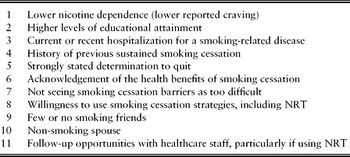
It is possible, based on a distillation of available evidence, to identify characteristics in an elderly smoker that increase the likelihood of successful smoking cessation (see Box 1). This could be an additional tool to help focus efforts in the primary and secondary care settings.
Characteristics in an elderly smoker that increase the likelihood of successful smoking cessation.

In addition to the opportunities to encourage smoking cessation in older people presenting to health services, there is evidence that extending the smoking cessation remit to social care workers enables a wider and more sustained network of support to be delivered in the community setting. A large study in Hong Kong showed that a focused smoking cessation education programme for social workers enhanced their knowledge of the topic, confidence and willingness to give smoking cessation help to elderly smokers.
The relation between smoking cessation and cognitive function
Quitting smoking requires a positive decision, a plan of action and sustained effort, often in collaboration with others. These subtle executive cognitive domains are often impaired in older people even when the more obvious manifestations of dementia are lacking. A study performed as part of the San Luis Valley Aging StudyReference Brega, Grigsby and Kooken50 showed that successful smoking cessation correlated with higher (better) scores on an executive function test, the Behaviour Dyscontrol Scale. Such impairment becomes more prevalent with age, so it can be anticipated that executive cognitive impairment will be a barrier to smoking cessation in a rising proportion of people with age. This suggests that patients with evidence of global cognitive impairment, or overt dementia, are unlikely to be able to benefit from smoking cessation advice. There have been no studies of smoking cessation outcomes in comparison with general measures of cognitive function in general use, such as the Mini Mental State Examination and that clearly provides a substrate for further study in this field.
Conflicts of interest
The author declares no conflicts of interest.