INTRODUCTION
Natural licks are activity hotspots for frugivorous bats in undisturbed forests of Amazonian Peru (Bravo et al. Reference BRAVO, HARMS, STEVENS and EMMONS2008, Bravo Ordoñez Reference BRAVO ORDOÑEZ2009) and Ecuador (Voigt et al. Reference VOIGT, DECHMANN, BENDER, RINEHART, MICHENER and KUNZ2007). Licks (known in Peru by their Quechua name: collpas) are unique places where several bird and non-volant mammal species consume soil (Brightsmith & Aramburú Reference BRIGHTSMITH and ARAMBURÚ2004, Emmons & Stark Reference EMMONS and STARK1979, Montenegro Reference MONTENEGRO2004, Tobler Reference TOBLER2008) and where several frugivorous bat species often congregate at night (Bravo et al. Reference BRAVO, HARMS, STEVENS and EMMONS2008, Voigt et al. Reference VOIGT, DECHMANN, BENDER, RINEHART, MICHENER and KUNZ2007). In south-eastern Peru, these bats drink on the wing from puddles or pools that collect in depressions left by terrestrial vertebrates; they do not visit dry licks or land on any substrate during their visits (Bravo & Emmons pers. obs.).
A few other published observations suggest that bats visit licks or pools with characteristics similar to licks (Bravo et al. Reference BRAVO, HARMS, STEVENS and EMMONS2008). For example, Ascorra & Wilson (Reference ASCORRA and WILSON1991) captured large numbers of Artibeus jamaicencis at a lick in north-eastern Peru. Ascorra et al. (Reference ASCORRA, SOLARI, WILSON, Wilson and Sandoval1996) found clay in the single faecal sample of A. planirostris they collected in south-eastern Peru, suggesting that bats may at times ingest soil or soil components. Despite growing awareness and documentation of lick visitation by bats, little is known about its causes or consequences.
Owing to dissolved or suspended soil-derived substances in water that collects in puddles or pools at licks, hypotheses for the intentional consumption of lick soil (geophagy) also apply to the ingestion of lick water. Since Amazonian soils are often relatively poor in nutrient elements, plants growing in them often contain low nutrient concentrations (Jordan & Herrera Reference JORDAN and HERRERA1981, Stark Reference STARK1970). Therefore, frugivorous species may use lick soil or water as reliable secondary sources of limited nutrients (Brightsmith et al. Reference BRIGHTSMITH, TAYLOR and PHILLIPS2008, Emmons & Stark Reference EMMONS and STARK1979). Alternatively, or in combination, frugivores may use the clay component of lick soil or water, for example to help bind or neutralize plant secondary compounds (Gilardi et al. Reference GILARDI, DUFFEY, MUNN and TELL1999, Voigt et al. Reference VOIGT, DECHMANN, BENDER, RINEHART, MICHENER and KUNZ2007). Bats probably do not visit licks to obtain water only (Bravo et al. Reference BRAVO, HARMS, STEVENS and EMMONS2008).
Although licks may serve as sources for a variety of minerals, clay, or other resources, herein we evaluate the hypothesis that licks are reliable sources of key cations (calcium, magnesium, potassium and sodium) to frugivorous bats. Sodium is one of the most important nutrients for animals. It is essential for the physiology of osmoregulation, nerve impulses and muscular function (Michell Reference MICHELL1995). Calcium is essential for milk and bone production (Barclay Reference BARCLAY1994, Booher Reference BOOHER2008). Magnesium and potassium are also essential minerals for vertebrates (Morris Reference MORRIS and Prosser1991).
In this study, we extended the observations of Bravo et al. (Reference BRAVO, HARMS, STEVENS and EMMONS2008), to determine patterns of lick use by bats across seasons and years. We compared bat activity, species richness, species composition, sex ratio, and reproductive condition among licks and non-lick forest and gap sites. We also compared general and seasonal patterns of selected chemical properties of lick water ingested by bats to those of other readily available water sources. These comparisons provided an assessment of the potential for bats to supplement their dietary intakes of key nutrients by drinking lick water, as supporting evidence for the hypothesis that licks are reliable sources of key nutrient elements to frugivorous bats in the south-eastern Peruvian Amazon.
METHODS
This study was conducted from 2005 to 2008 at Los Amigos Conservation Concession, located at the confluence of the Madre de Dios and Los Amigos Rivers in the Department of Madre de Dios in south-eastern Peru (12°30′–12°36′S; 70°02′–70°09′W). This private concession protects over 140 000 ha of Amazonian forest within the Moist Humid Ecological Zone (Holdridge et al. Reference HOLDRIDGE, GRENKE, HATHEWAY, LIANG and TOSI1971); for a comprehensive overview of the region, see Terborgh (Reference TERBORGH1983). The average annual temperature from 2005 to 2007 ranged from 23.9 °C to 24.1 °C, and annual rainfall ranged from 2152 to 2682 mm, unevenly distributed between the wet (October–April) and the dry (May–September) seasons, each of which may begin as much as a month or two earlier or later than these average dates of onset and termination.
Bat capture and data analysis
We selected three licks along the Los Amigos River for study (Lick 1: 12°32′35″S, 70°04′58″W; Lick 2: 12°30′23″S, 70°08′56″W; Lick 3: 12°27′29″S, 70°15′00″W; see Bravo et al. Reference BRAVO, HARMS, STEVENS and EMMONS2008 for further details concerning these three licks). We also selected three intact forest sites, one near each lick (i.e. the forest sites used in Bravo et al. Reference BRAVO, HARMS, STEVENS and EMMONS2008), as well as three natural gap sites, one near each lick. Each forest and gap site was from 300 to 500 m from its spatially associated lick.
From September to November (dry season) 2005, we captured bats at lick and forest sites (Bravo et al. Reference BRAVO, HARMS, STEVENS and EMMONS2008). From July to October (dry season) 2007 and from February to May (wet season) 2008, we captured bats at lick, forest and gap sites. We used 6 × 2.6-m, 36-mm mesh Japanese mist nets (AFO Banding Supplies, Manomet). Once a month, we captured bats at each of the sampling sites. Since bat activity is often reduced during bright moonlit nights (Morrison Reference MORRISON1978), we avoided opening nets 5 d prior to and after a full moon. In general, nets were opened at dusk (17h30–17h45) and closed at midnight (00h00). Due to the large numbers of bats at licks, we opened only one mist net, which captured as many bats as two or three people could comfortably process. On busy nights, to avoid causing unnecessary stress to the bats, we closed and opened the net as many times as needed to limit captures to the numbers that we could efficiently handle. In contrast, at forest and gap site types, we deployed between 5–10 mist nets along previously opened lines, and nets were never closed during the ~6-h sampling period. At all sites, each net was checked every 15 min. Each bat was taken from a net and placed in a clean cotton bag for transfer to the processing station about 100 m from the nets. Bats were kept in bags for no longer than 30 min before being processed. We identified, measured, weighed, marked and recorded sex and reproductive condition of each captured bat. We used field guides to identify bats to species (Emmons & Feer Reference EMMONS and FEER1997, Gardner Reference GARDNER2008, Tirira Reference TIRIRA2007). In addition, each individual bat was marked with a chainball necklace that carried a uniquely numbered aluminium band (Handley et al. Reference HANDLEY, WILSON and GARDNER1991). Bats were released after processing and cotton bags were cleaned. Faecal samples found in bags were removed and classified.
We defined bat activity as the number of bats per net h−1, for lick, gap and forest sites in the dry and wet seasons (as in Bravo et al. Reference BRAVO, HARMS, STEVENS and EMMONS2008). For all site types, we used all open net hours. We compared seasonal bat activity at different site types using a randomized block factorial ANOVA. The linear model treated each lick and its associated forest and gap sites as a block, and season and site type as factors. To meet the assumptions of the analysis, we square root-transformed the bat activity data prior to the analysis. We compared the means among the different factor levels that showed significant effects in the block factorial analysis with the Tukey's Honest Significant Difference method (Tukey HSD).
We determined species composition and relative abundance distribution of bats captured at all site types. We compared the distributions between paired site types (lick vs. forest, lick vs. gap, forest vs. gap) using two-sample Kolmogorov–Smirnov tests. In addition, we compared the species richness among lick, forest and gap sites using an individual-based rarefaction analysis (Hurlbert Reference HURLBERT1971) performed in PAST (PAleontological STatistics, ver.1.25).
We tested the independence of the proportion of frugivorous bats captured at each site type during the dry and wet seasons with a generalized linear model (GLM) with Poisson distribution. We fitted a saturated model and then tested the effect of the interaction terms by removing from the saturated model the interactions of interest and comparing models with an analysis of deviance that used a chi-squared test (Crawley Reference CRAWLEY2007). Using the same approach, we also tested the independence of sex and female reproductive condition at each site type during the wet and dry seasons. Finally, using chi-square goodness-of-fit tests we asked whether the sex ratios and the ratios of reproductive to non-reproductive female bats at each site type conformed to 50:50.
Water sampling and data analysis
From July to September 2007, February to April 2008, and July to September 2008, we collected water monthly from our three focal licks, as well as from a creek and an oxbow lake near each of the three focal licks (for a total of three creeks and three oxbow lakes). For the first two sampling periods, we collected water on the same days that we captured bats in the area. The final sampling was collected after we had finished with bat captures. We used two protocols for sampling water. In 2007, we collected 125 ml of water in acid-rinsed and dry Nalgene bottles. To collect a water sample, we conditioned the bottle by collecting and then discarding ~100 ml of water from near the water's surface. Then we collected 125 ml of water, which was kept cold and in a dark place until the analysis. The mineral analysis of calcium, magnesium, potassium and sodium of the samples was done by the Laboratory of Water and Soil of the Department of Water Resources and Soil at the Universidad Agraria La Molina (http://www.lamolina.edu.pe) in Lima, Peru using atomic absorption spectrometry (AAS). In 2008, we collected water following the protocol used in 2007, but in addition we filtered ~15 ml of each water sample with a 0.45-μm sterile Nalgene syringe filter into a sterile centrifuge tube. Filtered samples were placed into the refrigerator until analysis was performed. The Soil Testing and Plant Analysis Laboratory at Louisiana State University Agricultural Center (http://www.lsuagcenter.com) analysed the calcium, magnesium, potassium and sodium concentrations in the water samples using inductively coupled plasma (ICP) spectrometry. Finally, in September 2008, we collected samples from the Madre de Dios and Los Amigos Rivers for general comparative purposes.
We compared mineral concentrations of water among licks, creeks and oxbow lakes collected in three sampling periods. Specifically, we independently compared the concentrations of calcium, magnesium, potassium and sodium among water sources using one-way randomized block ANOVAs with repeated measures. For all cases, the linear models considered each lick and its spatially associated creek and oxbow lake as a block and each water sample taken at different times in each site as a repeated measure. To meet the assumptions of the analysis, we log-transformed mineral concentration data, with the exception of calcium concentrations for dry season 2008, which were squared-root transformed. We also analysed the effect of season on the concentrations of minerals at different water sources using only data from the wet and dry season of 2008, to minimize any effect of using different laboratories for water analysis in different years. We used factorial randomized-block ANOVAs with repeated measures. The linear models took each lick and its associated creek and oxbow lake as a block, season and water source as factors, and each sample taken at different times as a repeated measure. We square root-transformed concentration data for calcium and log-transformed concentration data of magnesium, potassium and sodium to meet the assumptions of the test. We used Tukey HSD to compare the means among the different values of the factors that showed significant effects. Finally, we measured in situ water pH and electrical conductivity (EC) each time we collected water at all sites. We used a waterproof pH/EC tester, which provides measurements of electrical conductivity corrected to 25 °C. We made three readings of pH and EC each time we collected water and then calculated the average value to be used in the analysis. Prior to calculating the average, we converted the pH values to [H+]. We compared pH values and EC among licks, creeks, and lakes using one-way block ANOVAs with repeated measures. Prior to the analysis we log-transformed the EC values to meet the assumptions of the ANOVA.
Unless specified, all analyses were performed in R (Crawley Reference CRAWLEY2007).
RESULTS
Bats at licks
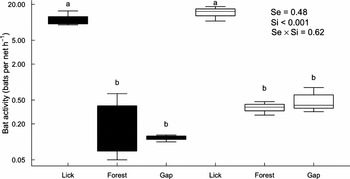
Across all sampling periods from 2005 to 2008, we captured 2409 bats in a total sampling effort of 2005 open net h. With sampling efforts of 167, 1280 and 558 open net h, we captured 1962, 260 and 187 bats at lick, forest and gap sites, respectively. There was a highly significant effect of site type on bat activity (F1,16 = 316, P < 0.01). However, there were no significant effects of season (F2,16 = 0.52, P = 0.48) or season-by-site-type interaction (F2,16 = 0.49, P = 0.62) on bat activity (Figure 1). Bat activity was significantly higher at licks than at forest and gap sites (P < 0.01), but there was no significant difference in bat activity between forest and gap sites (P = 0.99). On average, more than 10 bats per net h−1 were captured at licks compared with less than 1 bat per net h−1 captured in forests and gaps.
Bat activity (bats per net h−1) during the dry (black boxes) and wet seasons (white boxes) at lick, forest and gap sites in the south-eastern Peruvian Amazon. P-values are presented for season (Se) and site-type (Si) effects. Box plots show the median, upper and lower quartiles, and highest and lowest data values. Note logarithmic scale of y-axis.

Species composition and species richness
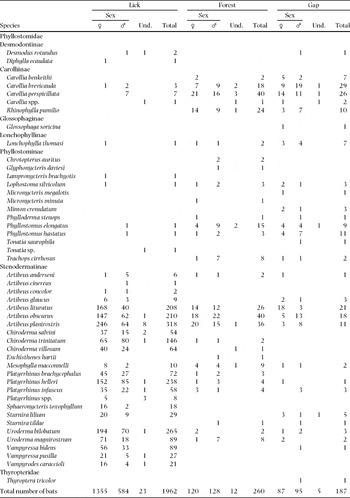
The relative abundance distribution of bats captured at licks differed from the distributions in forest and gap sites (licks vs. forest sites: D = 0.42, P < 0.01; licks vs. gaps: D = 0.52, P < 0.01; and forest sites vs. gaps: D = 0.25, P = 0.33). The main differences in species composition among site types were the relative abundances of bats of the subfamilies Stenodermatinae and Carolliinae. In contrast to licks, where stenodermatines were the most common species, at forest sites and gaps carolliines were also among the most common species (Appendix 1).
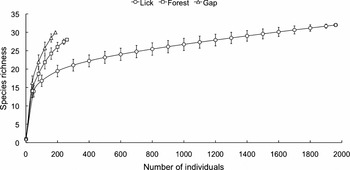
Species richness observed at licks was higher than at forest sites and gaps. At licks, we identified 34 species, whereas at forest sites and gaps we identified 28 and 30 species, respectively. The rarefaction curves showed a higher expected species richness for a given number of individuals at gaps and even higher at forest sites than at licks. Contrary to the forest sites and gaps, the curve for licks had an asymptotic shape, indicating that most of the expected species had already been sampled (Figure 2).
Rarefaction curves for bats at lick, forest and gap sites in the south-eastern Peruvian Amazon for all years and seasons combined. Vertical lines are ± SD.

Diet, sex ratio and reproductive condition
Seasonality did not have a significant effect on the proportion of frugivorous bats captured at different site types (Deviance = −0.3, P = 0.86). However, site type had a significant effect on the proportion of frugivorous bats captured (Deviance = −117.6, P < 0.01). Over 99% of bats captured at licks were frugivores (1953 out of 1962 bats), whereas at forest sites and gaps frugivores represented 86% and 78% of the total numbers of bats, respectively (Appendix 1). Moreover, most frugivorous bats at licks belonged to the subfamily Stenodermatinae (1942 out of 1953 frugivorous bats). Less than 1% of the individuals of frugivorous species belonged to the subfamily Carolliinae (11 out of 1953 bats), whereas at forest sites and gaps they represented 33% and 40%, respectively (Appendix 1).
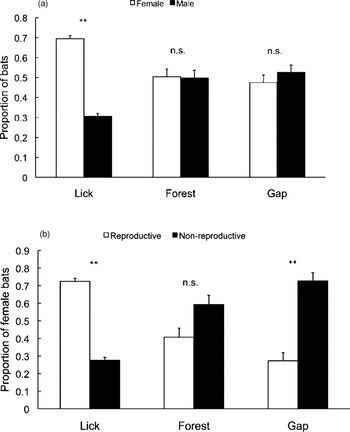
There was no significant three-way interaction among season, site type and sex of bats captured (Deviance = −2, P = 0.37), but there was a highly significant interaction between site type and sex of bats (Deviance = −39.1, P < 0.01). There was a consistently strong female sex bias at licks (χ2 = 150, P < 0.001) compared to the forest sites and gaps, where the ratio of male:female bats was not significantly different from 50:50 (χ2 = 0.006, P = 0.93 and χ2 = 0.45, P = 0.5, respectively). At licks, about 70% of captured bats were females (Figure 3a).
Patterns of use of lick, forest and gap sites by female and male bats (a) and by reproductive and non-reproductive female bats (b) in the south-eastern Peruvian Amazon for all years and seasons combined. Error bars are SD from the binomial distribution. Asterisks indicate significant differences (P < 0.001) and n.s. indicates non-significant differences (P > 0.05).

There was a significant interaction between site type and reproductive condition (Deviance = −80.9, P < 0.001), but no significant effect of season on the proportion of reproductive female bats (Deviance = −4.3, P = 0.11). A higher proportion of female reproductive bats was captured at licks (χ2 = 139, P < 0.001). At forest sites there was no difference in the proportion of reproductive and non-reproductive individuals (χ2 = 2.97, P = 0.08), and at gaps the proportion of non-reproductive female bats was higher (χ2 = 18.2, P < 0.001). At licks, 73% of the total number of captured female bats was in reproductive condition (Figure 3b).
Out of 245 faecal samples collected in the cloth holding bags, only eight obviously contained clay. Bats probably ingested the suspended clay in the water they drank from the lick puddles, since no bats had obvious clay on their faces and none was observed to land while in the vicinity of licks. Many bats were observed descending to the surfaces of lick puddles while in flight.
Mineral concentrations of water bodies across seasons and years
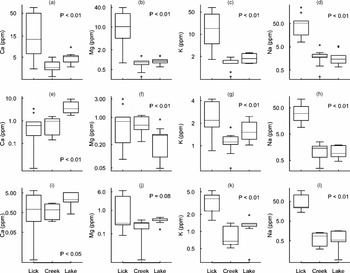
Concentrations of calcium, magnesium, potassium and sodium from the three collecting periods differed significantly among water sources (for all cases P < 0.01), with the exception of magnesium collected in the dry season of 2008 (P = 0.08; Figure 4). In 2007, lick water had higher concentrations of all minerals compared to creeks and oxbow lakes (Figure 4a–d). Similar patterns were observed for potassium and sodium during the wet and dry seasons of 2008 (Figure 4g, h, k, l). In contrast, the concentrations of calcium during the wet and dry seasons of 2008 were higher at oxbow lakes than at licks and creeks (Figure 4e, i). Magnesium was present in lower concentrations at oxbow lakes than at licks or creeks in the wet season of 2008 (Figure 4f), whereas there was no significant difference among water sources during the dry season of 2008 (Figure 4j). Mineral concentrations in the Madre de Dios and Los Amigos Rivers were very consistent: calcium (12.7 and 14.3 ppm), magnesium (1.9 and 1.7 ppm), potassium (1.1 and 1.6 ppm) and sodium (2.4 and 2.8 ppm).
Concentrations of calcium (Ca), magnesium (Mg), potassium (K) and sodium (Na) for lick, creek and lake water collected in July–September (dry season) 2007 (a–d), February–April (rainy season) 2008 (e–h) and July–September (dry season) 2008 (i–l) in the south-eastern Peruvian Amazon. Box plots show the median, upper and lower quartiles, highest and lowest data values, and outliers.

Seasonal mineral concentrations of water bodies in 2008
In 2008, there was no effect of season (dry vs. wet) on the concentrations of calcium (F1,40 = 0.08, P = 0.77), magnesium (F1,40 = 0.95, P = 0.33), potassium (F1,40 = 0.22, P = 0.28) or sodium (F1,40 = 2.93, P = 0.09) for all water sources combined (licks, creeks and oxbow lakes). However, the concentrations of all those minerals differed among water sources (P < 0.01 for all cases). Calcium concentration at oxbow lakes was significantly higher than at licks (P < 0.01) and creeks (P < 0.01), but the concentrations between licks and creeks were not different from each other (P = 0.7). Magnesium concentrations differed significantly between licks and oxbow lakes (P = 0.03). Potassium concentration was higher at licks than at creeks and oxbow lakes (P < 0.01 for both comparisons), and it was higher at lakes than creeks (P = 0.02). Sodium concentration was significantly higher at licks than at creeks and lakes (P < 0.01 for both comparisons) but there was no significant difference between creeks and oxbow lakes (P = 0.97).
pH and electrical conductivity
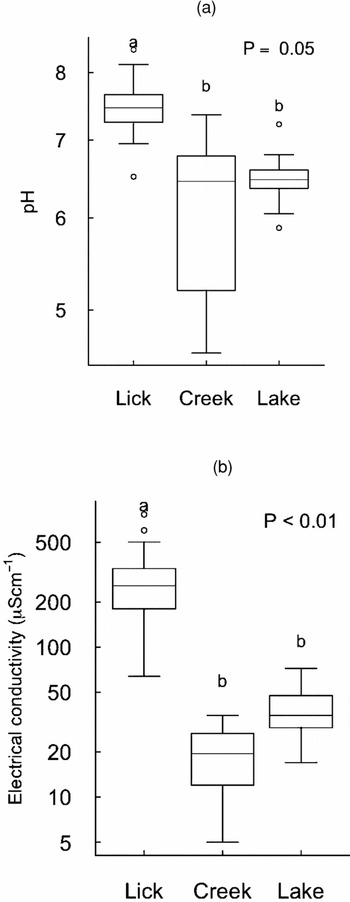
There were marginal differences in the pH of lick, creek and oxbow lake water (F2,6 = 4.99, P = 0.05, Figure 5a). Lick water had higher pH than creeks and oxbow lakes (P < 0.01 for both comparisons), which were similar to each other (P = 0.74). On average, lick water had pH 7.48, whereas creeks and oxbow lakes had pH 6.12 and pH 6.45, respectively.
pH values (a) and electrical conductivity (b) of lick, creek and lake water in the south-eastern Peruvian Amazon. Different letters between treatments indicate significant differences, whereas the same letter indicates no significant difference.

Electrical conductivity differed significantly among licks, creeks and oxbow lakes (F2,6 = 73.2, P < 0.01, Figure 5b). Specifically, there was a significant difference between licks and creeks (P < 0.01) and between licks and oxbow lakes (P < 0.01), but not between creeks and oxbow lakes (P = 0.1). On average, lick water had 291 μS cm−1 compared to 18.9 μS cm−1 and 38.6 μS cm−1 at creeks and oxbow lakes, respectively.
DISCUSSION
Licks and bats
This study confirms that regardless of the season, natural licks are activity hotspots for frugivorous bats in the south-eastern Peruvian Amazon, congruent with results from a previous study in a single dry season (Bravo et al. Reference BRAVO, HARMS, STEVENS and EMMONS2008). Hundreds of individuals of several species of frugivorous bat visit licks very consistently over time. Although the sampling effort at forest and gap sites was ~8 and ~4 times greater than at licks, respectively, the total abundance of bats at licks was 7–10 times greater than at non-lick sites. Moreover, the capture rate at licks was over 10 times greater compared with non-lick sites, which is similar to the results reported by Bravo et al. (Reference BRAVO, HARMS, STEVENS and EMMONS2008) for the same site used in the current study and Voigt et al. (Reference VOIGT, DECHMANN, BENDER, RINEHART, MICHENER and KUNZ2007) for a site in Ecuador.
In general, frugivorous species are expected to be common in neotropical assemblages (Ascorra et al. Reference ASCORRA, SOLARI, WILSON, Wilson and Sandoval1996). However, at licks they were exceptionally predominant. Furthermore, the total species richness and the asymptotic shape of the rarefaction curve for licks compared with non-lick sites suggests that only a subset of the whole community of bats is visiting licks, i.e. a subset mostly composed of frugivorous species. These patterns suggest that lick visitation is strongly related to frugivory.
Although frugivorous species of the subfamily Carolliinae are very common in this region (Ascorra et al. Reference ASCORRA, SOLARI, WILSON, Wilson and Sandoval1996, Voss & Emmons Reference VOSS and EMMONS1996), at licks they accounted for less than 1% (11 individuals) of all bats captured. In striking contrast, carolliine species, such as Carollia brevicauda and C. perspicillata, were among the most common species captured at forest and gap sites (Appendix 1). Therefore, lick visitation seems to be strongly associated to stenodermatine bats. Furthermore, stenodermatine bats are usually classified as fig specialists, whereas carolliine species are classified as Piper specialists (Fleming Reference FLEMING1988, Giannini & Kalko Reference GIANNINI and KALKO2004). Thus, lick visitation may not be related to frugivory in general, but to particular diets (Bravo et al. Reference BRAVO, HARMS, STEVENS and EMMONS2008).
This study across seasons allowed us to confirm that lick visitation by frugivorous bats is strongly female biased and, in particular, to reproductive females. Some studies conducted during short periods of time have shown these patterns (Bravo et al. Reference BRAVO, HARMS, STEVENS and EMMONS2008, Voigt et al. Reference VOIGT, DECHMANN, BENDER, RINEHART, MICHENER and KUNZ2007). Here we show the consistency of these patterns across seasons and years, which strengthens the argument for the importance of licks for reproductive female frugivorous bats in south-eastern Peru.
Licks as mineral sources
Licks are mineral-rich water sources in the Peruvian Amazon. Lick water was more basic and contained higher concentrations of dissolved salts than non-lick water sources, consistent with differences in mineral concentrations. Although lick water often contained higher concentrations of selected minerals compared with creeks and oxbow lakes, concentrations of some minerals changed between years. This difference might be explained by the use of different laboratories to conduct the analyses; by the effect of natural disturbances to licks, such as mechanical input of lick soil into the water produced by the presence of large geophagous mammals, e.g. tapirs or large herds of peccaries, previous to the water collection; or by changes in weather (drought/wet year). Despite the differences between years for some minerals, we wish to highlight the consistency of much higher concentration of sodium at licks than non-lick water sources across seasons and years (Figure 4d, h, l). To fully understand the patterns of availability of minerals at licks, we recommend additional long-term studies.
Lick-water minerals and bats
The intriguing question that still remains to be clearly answered is why frugivorous bats visit licks. The set of hypotheses that has been proposed to explain geophagy may also apply to bats that deliberately drink water that collects in licks. Lick soil (and water) may provide limited minerals (Brightsmith et al. Reference BRIGHTSMITH, TAYLOR and PHILLIPS2008), antacids (Davies & Baillie Reference DAVIES and BAILLIE1988), antidiarrhoeal components (Mahaney et al. Reference MAHANEY, AUFREITER and HANCOCK1995), or clay for binding potential dietary toxins (Gilardi et al. Reference GILARDI, DUFFEY, MUNN and TELL1999). These hypotheses are not mutually exclusive; more than one can explain geophagous behaviour (Brightsmith et al. Reference BRIGHTSMITH, TAYLOR and PHILLIPS2008). Even so, our results clearly show that lick water consumed by bats contains high concentrations of minerals that are limited in other water sources in the region.
During reproduction bats face numerous physiological constraints. To overcome those limitations, bats use a variety of mechanisms. Bats consistently have small litter sizes in relation to their body mass (Barclay & Harder Reference BARCLAY, HARDER, Kunz and Fenton2003, Speakman Reference SPEAKMAN2008). Moreover, bats increase the amount of food ingested during reproduction (Korine et al. Reference KORINE, SPEAKMAN and ARAD2004, Speakman Reference SPEAKMAN2008), but doing so can be energetically expensive (Korine et al. Reference KORINE, SPEAKMAN and ARAD2004). Thus, other less costly strategies may be employed. Among insectivorous bats, calcium limitation during reproduction appears to be common because of their low-calcium diets (Barclay Reference BARCLAY1994, Booher Reference BOOHER2008, Keeler & Studier Reference KEELER and STUDIER1992). To overcome this limitation some species mobilize calcium from their bones for foetus development and milk production (Hood et al. Reference HOOD, OFTEDAL and KUNZ2006, Kwiecinski et al. Reference KWIECINSKI, KROOK and WIMSATT1987), and others use secondary sources of calcium. Adams et al. (Reference ADAMS, PEDERSEN, THIBAULT, JADIN and PETRU2003) in Colorado, USA, reported larger numbers of reproductive female bats visiting calcium-rich water pools compared with other calcium-poor water pools. However, whereas many insectivorous species may have calcium-limited diets, frugivorous species could consume calcium-rich fruits (Nagy & Milton Reference NAGY and MILTON1979, O'Brien et al. Reference O'BRIEN, KINNAIRD, DIERENFELD, CONKLIN-BRITTAIN, WRANGHAM and SILVER1998, Wendeln et al. Reference WENDELN, RUNKLE and KALKO2000). But because during reproduction calcium requirements for frugivorous bats increase significantly, the amount obtained from fruits may not be sufficient to cover that demand and thus other sources may be used (Barclay & Harder Reference BARCLAY, HARDER, Kunz and Fenton2003, Iudica & Bonaccorso Reference IUDICA and BONACCORSO2003, Nelson et al. Reference NELSON, KUNZ and HUMPHREY2005). For bats in the Peruvian Amazon, considering the high calcium concentration of fruit reported for the Neotropics (Gilardi Reference GILARDI1996, Nagy & Milton Reference NAGY and MILTON1979, O'Brien et al. Reference O'BRIEN, KINNAIRD, DIERENFELD, CONKLIN-BRITTAIN, WRANGHAM and SILVER1998, Wendeln et al. Reference WENDELN, RUNKLE and KALKO2000), the results of calcium concentrations in different water sources, and the patterns of bat activity at licks presented in this study, we suggest that calcium supplementation is not the main cause for frugivorous bats to drink lick water. Specifically, changes in calcium concentrations at licks between years were not associated with changes in bat activity at licks. Furthermore, calcium concentrations in the Madre de Dios (12.7 ppm) and Los Amigos Rivers (14.3 ppm) were higher than at any other water source, as also shown by Hamilton et al. (Reference HAMILTON, KELLNDORFER, LEHNER and TOBLER2007; who reported 18.1 ± 0.49 ppm for the Madre de Dios River). Thus, even if calcium were limited in the diets of frugivorous bats, licks would not be the best secondary source of it. Therefore, because Ficus fruits in south-eastern Peru are calcium-rich (Gilardi Reference GILARDI1996), it is very likely that frugivorous bats that visit licks may obtain required amounts of calcium from their diets.
Contrary to the patterns observed for calcium, sodium shows a very consistent pattern across years and seasons. Its total average concentration at licks was more than 30 times higher than that of creeks and lakes. Furthermore, when sodium concentrations at licks are compared to concentrations in the Madre de Dios and Los Amigos Rivers, and to the results provided by Hamilton et al. (Reference HAMILTON, KELLNDORFER, LEHNER and TOBLER2007) for the Madre de Dios River and other water sources, it is evident that licks are sodium-rich water sources in the south-eastern Peruvian Amazon.
Sodium is very limiting to vertebrates in the Neotropics (Emmons & Stark Reference EMMONS and STARK1979, Stark Reference STARK1970). Abundant precipitation in the Amazon Basin causes leaching of sodium and as a consequence plants may become sodium deficient, and as most plants do not require sodium, they do not accumulate it (Stark Reference STARK1970). In that context, frugivorous and folivorous species may face sodium limitations, especially reproductive females. Contrary to Voigt et al. (Reference VOIGT, CAPPS, DECHMANN, MICHENER and KUNZ2008), who report sodium requirements for growth and reproduction of small mammals at 0.001 ppm of dry matter, the National Research Council (1995) and Dempsey (Reference DEMPSEY2004) report a minimal requirement of 500 and 600 ppm of sodium, respectively. In addition, Studier & Wilson (Reference STUDIER, WILSON, Handley, Wilson and Gardner1991) estimated a maintenance requirement for a 45-g Artibeus jamaicencis at 14 mg sodium per animal d−1 (based on a minimal requirement of 0.6 mmol d−1 for growing rats provided by Michell Reference MICHELL1995). The average concentration of sodium for eight species of Ficus from Madre de Dios, Peru was 29.9 ± 21.0 ppm (Gilardi Reference GILARDI1996). Dry fruits of Ficus insipida contained about 80 ppm of sodium (Gilardi Reference GILARDI1996), thus an 8-g fresh fruit (80% moisture) provides about 0.128 mg of sodium. But bats extract ~60% of the fruit juice (Morrison Reference MORRISON1980), so the amount of sodium per fruit is ~0.1 mg. Therefore, a bat feeding exclusively on Ficus needs to consume over 100 fruits d−1 to meet only the maintenance requirement. This number of fruits is substantially higher than the 8–10 fruits required to meet the daily caloric and protein needs (Studier & Wilson Reference STUDIER, WILSON, Handley, Wilson and Gardner1991). Thus, because of low-sodium diets, bats may need to invest extra energy flying and searching for food to meet a sodium requirement that increases during reproduction.
Sodium limitation in fruits consumed by stenodermatine bats may drive the consumption of sodium-rich lick water in the Peruvian Amazon. At licks, most frugivorous bats are stenodermatines, which are known fig specialists (Giannini & Kalko Reference GIANNINI and KALKO2004, Kalko et al. Reference KALKO, HERRE and HANDLEY1996) and many fig species in the area of study have been found to contain low levels of sodium (Gilardi Reference GILARDI1996). The consistency of high sodium concentrations at licks and the consistency in the patterns of lick visitation by female frugivorous species over time clearly suggests that licks may be important secondary sources of sodium in the Peruvian Amazon, in the same way many licks have been suggested to provide sodium for geophagous animals worldwide (Ayotte et al. Reference AYOTTE, PARKER, AROCENA and GILLINGHAM2006, Brightsmith & Aramburú Reference BRIGHTSMITH and ARAMBURÚ2004, Brightsmith et al. Reference BRIGHTSMITH, TAYLOR and PHILLIPS2008, Emmons & Stark Reference EMMONS and STARK1979, Holdø et al. Reference HOLDØ, DUDLEY and MCDOWELL2002, Klaus et al. Reference KLAUS, KLAUS-HÜGI and SCHMID1998, Mokhtar et al. Reference MOKHTAR, LEE, STUEBING, MOHAMED and ISMAIL1990).
Ultimately, more than one mineral could be provided by licks. Potassium and magnesium do not appear to be limited in fruits (Gilardi Reference GILARDI1996, Nagy & Milton Reference NAGY and MILTON1979, Wendeln et al. Reference WENDELN, RUNKLE and KALKO2000). However, during reproductive periods (pregnancy and lactation) bats increase their demands for all nutrients. Thus, even for those minerals that are available in fruits consumed by bats, licks may function as reliable sources in an otherwise nutrient-poor landscape.
Although we do not address the hypothesis that licks are sources of clay that may potentially bind secondary metabolites from bats diets, as suggested by Voigt et al. (Reference VOIGT, CAPPS, DECHMANN, MICHENER and KUNZ2008), we suggest that because of the low content of tannins in most ripe figs consumed by stenodermatine bats that visit licks (Wendeln et al. Reference WENDELN, RUNKLE and KALKO2000), the benefits of neutralization of toxins may not be the main explanation for lick visitation. However, we recommend experimental studies to determine whether one or more resources are sought by bats at lick water. Meanwhile, based on the present studies, we recommend natural licks to be considered as important conservation targets.
ACKNOWLEDGEMENTS
We extend our gratitude to the Peruvian Institute of Natural Resources (INRENA) for providing the research permits to do this study. For help in the field we thank the ACCA rangers, Y. Arteaga, R. Baez, M. Bravo, N. Castro, F. Carrasco, M. Cruz, Z. Ordoñez, J. Ramos, A. L. Rodales, M. Rodriguez, K. Salas, W. Torres and especially J. Rios. We also thank J. Eberhard, M. Hafner, J. Janovec, C. Meyer, N. Pitman, R. Stevens, M. Tobler and J. Yavitt for their comments on the proposal or for help with logistics of the study. We are grateful to S. Claramunt, J. Myers, E. Reid, C. Voigt and two anonymous reviewers for their comments on the manuscript. Financial support was provided by the Amazon Conservation Association (graduate student grant and seed grant award), American Society of Mammalogists, Bat Conservation International, Graduate Student Association – Biograds of Louisiana State University (LSU), Idea Wild, Louisiana Office of Environmental Education, LSU Graduate School, Rufford Small Grants and the U.S. National Science Foundation.
Species and total captures of bats at licks, forest and gap sites from 2005 to 2008, in south-eastern Peru. Sampling effort per site was 167, 1280 and 558 total open net h−1, respectively. Sex: ♀, female bats; ♂, male bats; Und., bats of sex undetermined. Nomenclature follows Gardner (Reference GARDNER2008).