


You don't have to be a Whig historian to discern progress in the socioeconomic status of women in the United States since the eighteenth century. Women's greatest gains came with the twentieth century's “grand gender convergence” (Goldin Reference Goldin2014). However, the nineteenth century featured a dramatic narrowing of the gender wealth gap—an increase in women's access to and control of property (Shammas Reference Shammas1994). Consider, for example, lifetime wealth accumulation: Looking at the gender mix of probated wealth holdings as a simple indicator, there was dramatic change. On the eve of the American Revolution, according to Alice Hanson Jones's (Reference Jones1980: 220, 224) pioneering work, less than one-tenth of probate inventories belonged to women, and women held less than one-twentieth of probated wealth. On the eve of the twentieth century, according to evidence compiled by Carole Shammas (Reference Shammas1994: 18), more than one-third of inventories belonged to women and they held perhaps one-quarter of probated wealth. A similar pattern is evident in terms of testation (will making). Across colonial America, women rarely accounted for more than 10 or 15 percent of testators; by the close of the nineteenth century, women commonly accounted for more than 40 percent of testators (ibid.: 18–19, and see the following text). Although the empirical record of wealth holding is far from complete, it is clear that the nineteenth century was a watershed in terms of American “women's ownership and control of property” (ibid.: 16).Footnote 1
The nineteenth century was also a watershed in terms of women's legal rights (Chused Reference Chused1994; Doepke and Tertilt Reference Doepke and Tertilt2009; Shammas Reference Shammas1994; Warbasse Reference Warbasse1987 [1960]). Starting around mid-century, states across the United States and governments across the British Empire passed a variety of married women's property acts (MWPAs) that substantially undermined the common law doctrine of coverture.Footnote 2 Before the MWPAs, in common-law jurisdictions (most of the United States) the wife was a feme covert, “a legal nonperson” whose legal identity was largely contained within and subordinate to her husband's (Weitzman Reference Weitzman1974: 1173).Footnote 3 The single woman was a feme sole with about the same rights of property and contract as a man. But those rights were lost (or suspended) with marriage; the husband gained ownership of the wife's personal property and control of her real property. The MWPAs granted the wife a broad range of rights, most notably for our purposes, rights to own and control the property she brought to the marriage or subsequently acquired.Footnote 4 The nineteenth-century reform of marital status law was arguably “the most substantial change in women's legal status in 700 years of the common law” (Shammas Reference Shammas1994: 9).Footnote 5
There is a simple and tidy narrative to connect this pair of nineteenth-century watersheds—the legislated expansion of married women's property rights caused the expansion of women's ownership and control of wealth. The actual history of marital law reform was untidy, in terms of politics and litigation, and it was uneven, geographically and temporally (e.g., Chused Reference Chused1983, Reference Chused1985; Hoff Reference Hoff1991: 127–35, 187–91; Holton Reference Holton2015; McCammon et al. Reference McCammon, Arch and Bergner2014; Siegel Reference Siegel1994a, Reference Siegel1994b; Warbasse Reference Warbasse1987 [1960]). But uncovering the facts of marital property law and women's wealth in the nineteenth-century United States may reveal clear examples (state by state) of legal change generating social change. If so, a quicker and more artful rewriting of the rules of marriage could have more swiftly advanced women's socioeconomic status. In these watersheds of women's wealth and marital law, perhaps the lesson is that reforming the law is a promising path to social progress.
“Re-assessing the married women's property acts,” Carole Shammas (Reference Shammas1994) offered a powerful interpretation connecting the legal reforms to the narrowing of the gender wealth gap across the nineteenth century. Noting analogies to the century's slave emancipations, Shammas (ibid.: 9) proposed the MWPAs for inclusion “in the pantheon of important historical events.” In Shammas's account, the acts granting wives property rights, per se, were of primary importance to women's wealth accumulation (with a lesser role for the later acts related to wives’ earnings, contracts, or business activities). Henceforth a woman could keep the property that she brought to her marriage or subsequently acquired.Footnote 6 Moreover, as Shammas discussed (ibid.: 16, 22; see also Baskerville Reference Baskerville2008: 239), the property acts increased the incentives for bequests to women.Footnote 7 Parents would be more inclined to gift or bequeath to their daughter when the property would not be taken by her potentially miscreant or misfortunate husband (or his creditors). Similarly, a husband's bequest to his widow would be greater when remarrying did not transfer the property to a new husband.Footnote 8
The proposed effects of MWPAs are simple in theory, but timing emerges as a complication when we turn to probate records for evidence. As Shammas (Reference Shammas1994: 16–17) explained, “Because the acts did not apply retroactively, . . . the biggest impact in probate records would not come until the women who had come of age around the time the legislation was passed began to die in large numbers . . . some thirty to forty years later.” Different states passed different acts at different times, and probate data for most states have yet to be tabulated or summarized. So, substantial empirical research would be required to confirm that the MWPAs preceded the expansion of women's wealth (with additional work then required to verify a causal relationship). Drawing on probate evidence from various locales, Shammas documented the narrowing of the gender wealth gap across the nineteenth century, but she had little evidence on the time path of women's wealth holding. Shammas conjectured (ibid.: 21) “that more change in female wealthholding occurred between the 1860s and the 1890s than had transpired in the previous two hundred years of American history.” But subsequent research has yet to confirm or contradict that generalization.
Scholarly attention to the potential effects of the MWPAs has tended to propagate the view that the acts were transformative legal change, focusing on changes in women's behavior or condition that came after related legislation. For the United States, Khan (Reference Khan1996) finds an increase in women's patenting activity across states after passage of MWPAs. Similarly, Geddes et al. (Reference Geddes, Lueck and Tennyson2012) use state-level data to show that school attendance by girls increased after MWPAs.Footnote 9 Across the Atlantic, Combs (Reference Combs2004, Reference Combs2005) makes a compelling case that England's MWPA of 1870 caused a marked shift in the composition of women's wealth holdings, from real estate to personal property.Footnote 10
Research on English Canada has documented a substantial increase in women's wealth holding that came after the passage of MWPAs there (Baskerville Reference Baskerville2008; Di Matteo Reference Di Matteo2013; Di Matteo and George Reference Di Matteo and George1992; Ingram and Inwood Reference Ingram and Inwood2000; Inwood and Van Sligtenhorst Reference Inwood and Van Sligtenhorst2004). That work provides some of the strongest evidence so far to advance the hypothesis that marital property law reform had substantial effects on women's wealth holding.Footnote 11 Baskerville (Reference Baskerville2008) forcefully advances this view. Setting out “to test the effects” of the MWPAs in Canada, Baskerville concludes that the “laws precipitated a fundamental change in the way men bequeathed wealth” (ibid.: 6, 238), resulting in a dramatic gender redistribution of wealth.Footnote 12
In sum, there is a substantial body of research consistent with a simple narrative connecting the two gender watersheds of the nineteenth century, with the MPWAs causing the narrowing of the gender wealth gap. But when we start filling in the empirical record of women's wealth holding across the eastern United States—the task of this paper—it turns out that the simple story will not stand. We marshal evidence from a wide range of probate records to reveal patterns in women's wealth holding since colonial times in Virginia and the eastern United States more generally. Our major result is quite simple: Across the eastern United States the gender wealth gap closed significantly in the period after the American Revolution and before the MWPAs.Footnote 13 The general pattern that emerges is that dramatic increases in women's probated wealth holding came before legislation reforming marital property laws. Only relatively modest increases in women's probated wealth holding came late enough to qualify as possible results of the MWPAs.Footnote 14
Substantially more research will be required to determine the sources and meaning of the nineteenth-century narrowing of the gender wealth gap. Most probably, it was unmarried women (spinsters and widows), rather than wives, who swelled the ranks of wealth-holding women in the probates before the late nineteenth century.Footnote 15 If so, the challenge will be to delineate the causal nexus between the growing numbers and the growing wealth of unmarried women in the eastern states, with a wide range of possible implications for women's history.Footnote 16 And perhaps it was reforms to marital property law that finally enabled wives to join the ranks of wealth holders in the later nineteenth century. In short, the MWPAs could yet emerge as a causal factor in the narrowing of the gender wealth gap. However, the evidence we present in the following text is starkly inconsistent with a formulation that assigns those acts a primary role.
Urban Virginia
The Virginia legislature debated, but did not pass, a MWPA in 1849.Footnote 17 It was not until 1877, well after the Civil War and Reconstruction, that Virginia joined the national trend of reforming the marital law of property.Footnote 18 One might expect that an expansion of women's wealth holding in Virginia also was delayed. In fact, the evidence suggests otherwise, starting with Suzanne Lebsock's (Reference Lebsock1984) meticulous study of The Free Women of Petersburg (Virginia). Three decades ago Lebsock documented the “increasing autonomy” (ibid.: xv) of free white women in Petersburg in the years 1784–1860, including evidence of increased property holding by women. Lebsock's research includes three findings of particular relevance here. First, the proportion of Petersburg wills authored by women increased by a factor of six, from just 7 percent in the late eighteenth century (1784–1800) to 44 percent in the two decades before the Civil War (ibid.: 130). Second, women's representation among owners of taxable land in Petersburg more than tripled over a similar period. Just 8 percent of the land owners were women in 1790. That fraction rose to 14 percent by 1820 and to 29 percent by 1860 (ibid.: 129–30). Third, in the period 1830–60, women accounted for 31 percent of probated decedents in Petersburg, a proportion much higher than typical of the colonial United States and not much below the proportions typical of the late nineteenth century, well after the passage of the MWPAs (Shammas Reference Shammas1994: 18–19, and see following text).Footnote 19 While Lebsock did not seek to generalize to the rest of Virginia (or beyond), the Petersburg results reflect a more general pattern. Looking across eastern Virginia, we see women increasing their ownership and control of property in the years between the American Revolution and the Civil War.
Consider first Henrico County, Virginia, embracing the city of Richmond and agricultural hinterland.Footnote 20 Women's representation in the probate records there increased dramatically across the first half of the nineteenth century. Table 1 presents four indicators of women's wealth holding, based on probate records of the Henrico County and Richmond City courts for the period 1750–1860. From the mid-eighteenth century until the early nineteenth, women accounted for less than one-tenth of inventories and of testators in Henrico's probate records.Footnote 21 In the three decades before the Civil War, women accounted for more than one-fifth of the inventories, and women accounted for more than one-third of the wills.Footnote 22 Perhaps more dramatically, women held only some 1 to 3 percent of probated wealth in the decades from 1750 to 1820, arguably an insignificant proportion. But by the 1850s, women held 18 percent of probated wealth, certainly a substantial change.
Women's probated wealth holding in Henrico County, Virginia
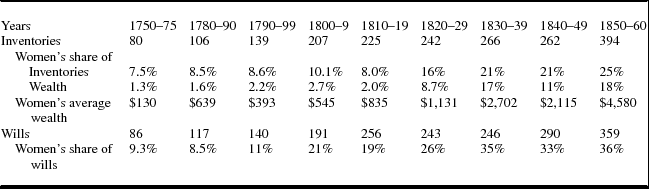
Sources: Library of Virginia Microfilm. Henrico County, Will Books 1–17; City of Richmond Hustings Court, Deed Books 1–5, Will Books 1–20. Renfrow Reference Renfrow2003 Henrico County Index to Wills and Administrations.
Notes: Will counts for 1750–1775 are from Renfrow Reference Renfrow2003; all other data are from the archival Deed and Will Books. Inventory appraisals until the early nineteenth century were usually recorded in Virginia pounds, which we converted to dollar values (at the rate of $10 to £3 [Irwin Reference Irwin, Eltis, Lewis and Sokoloff2004: 280]).
Although it had distinctly narrowed, the gender wealth gap in Henrico remained very large on the eve of the Civil War. With men holding 82 percent of probate wealth in the 1850s (89 percent in the 1840s, see table 1), gender equality was still a long way off. However, a more sanguine view is suggested by the rising value of women's mean wealth holding. From values of just hundreds of dollars early on, women's mean wealth holdings were counted in the thousands in the decades after 1830 (see table 1).Footnote 23 Clearly, Henrico women's wealth was on the rise, absolutely and relative to men's, long before Virginia's legislature first debated (1849) and later passed (1877) a MWPA.Footnote 24 Mirroring Lebsock's findings for the smaller city of Petersburg, Virginia, we see a narrowing of the gender wealth gap in antebellum Richmond and its agricultural hinterland.
Expanding the geographic range a little, consider next Fredericksburg, Virginia, a small city located about halfway between Richmond and Washington, D.C. Table 2 presents results from the probate records of Fredericksburg. With much smaller numbers of decedents than in Henrico, we look at broader time spans, but the results are broadly consistent with patterns discussed above. Women's representation among inventories and among testators sharply increased over the first half of the nineteenth century (well before Virginia's MWPA). Women's share of inventories rose from less than one in ten in the period 1782–1819 to one in three in the period 1840–60; across those periods, women's share of testators tripled. Throughout, women's wealth holding in Fredericksburg was very modest. Although women's mean wealth holding rose by a factor of 1.5 and their share of probated wealth more than doubled, women had just more than 10 percent of wealth in the years 1840–60. As was the case in Richmond, the gender wealth gap remained large, even if it had narrowed.Footnote 25 In any case, the key here is that other Virginia urban areas exhibited the pattern of expanding women's wealth that Lebsock found for antebellum Petersburg, Virginia.
Women's probated wealth holding in Fredericksburg, Virginia
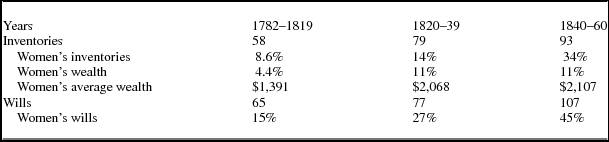
Source: Library of Virginia Microfilm. Fredericksburg Hustings Court, Will Books A–G.
Note: Inventories appraised in Virginia pounds have been converted to dollar values (see table 1).
Rural Virginia
The evidence from Richmond, Petersburg, and Fredericksburg reveals a general result for urban Virginia. But typically, Virginia and the broader South in the nineteenth century were rural, not urban. The obvious question then is whether the expanding role for women in urban Virginia was an exception to patterns in the more populous rural Virginia. Based on a sampling of rural Virginia counties, the answer is no. The Virginia counties of Bedford and Amelia (situated to the west) and Essex (to the northeast) were more typically southern than Henrico, with relatively larger slave populations and negligible urban population or industry. For example, in 1860, the share of slaves in population was 66 percent in Essex, 41 percent in Bedford, and 71 percent in Amelia, compared to 33 percent in Henrico. Bedford had but one town (Liberty, population 722 in 1860), Amelia and Essex had none (US Census Office 1864a: 516, 519). The 1860 census value of manufacturing products was just $24 in Bedford, $15 in Amelia, and $2 in Essex, compared to $210 in Henrico (University of Virginia Library 2004). For Essex and Bedford counties we have compiled the gender mix of probate inventories and wealth from the 1770s through the 1850s; for Amelia we have the gender mix of testators from the 1730s to the 1850s.Footnote 26
Looking first at Essex County from 1757 to 1860, we see a perhaps muted version of the pattern from urban Virginia (table 3). Women's representation among probate inventories roughly doubled, from some 10 to 13 percent in the mid- and later eighteenth century, to some 23 to 25 percent in the mid-nineteenth century. More dramatically, women's average wealth increased from some $600 to $700 to some $2,000 to $3,000. However, looking at women's shares of wealth reminds that empirical results are often untidy. Although women's shares of wealth tended to be greater later than earlier, in the years 1850–60 women had only 6 percent of probated wealth. That was just a little above the shares seen in the periods 1757–64 or 1765–74. Although women's wealth expanded in Essex County across the first half of the nineteenth century, progress in narrowing the gender wealth gap was uneven.
Women's probated wealth holding in Essex County, Virginia

Source: Library of Virginia Microfilm. Essex County Court, Will Books 11–28, General Index to Wills, No. 1.
Notes: Will counts are from the Index to Wills; evidence on estates is from the Will Books. Inventories appraised in Virginia pounds have been converted to dollar values (see table 1).
Further west, in Bedford County, women's wealth holding expanded more dramatically in the half century before the Civil War (see table 4). In the later eighteenth century, women were almost negligible among Bedford's probates—there were only 4 women among the 211 decedent estate holders in the period 1770–99, and those women owned less than one-half of 1 percent of the probated wealth. Then women's representation jumped up in the first two decades of the nineteenth century, to almost 10 percent of probated estate holders. That share continued to rise, and in the 1840s and 1850s women were one-fifth of wealth holders and they held almost one-tenth of the probated wealth. With men holding more than 90 percent of probated wealth, the gender wealth gap was still large on the eve of the Civil War. But the absolute expansion of women's wealth in Bedford was remarkable, with mean wealth levels of about $1,500 in the 1840s and 1850s, compared to just $100 or $200 in the late eighteenth century (see table 4).Footnote 27
Women's probated wealth holding in Bedford County, Virginia

Source: Library of Virginia Microfilm, Bedford County Court, Will Books 1–18.
Note: Inventories appraised in Virginia pounds have been converted to dollar values (see table 1).
There are also indications of increased women's wealth holding, albeit less dramatic, in evidence from Amelia County, not far east of Bedford. Until the late eighteenth century only about one-tenth of Amelia wills were written by women (see table 5). That proportion increased steadily in the decades that followed. By the early nineteenth century, women wrote about one-fifth of Amelia wills, and they wrote about one-third of wills in the three decades before the Civil War.Footnote 28 That alone is not conclusive evidence of increased property holding by women. Most simply, the observed changes in the gender mix of testators could simply reflect changes in relative rates of testation (women's up or men's down), with a stable gender mix of wealth holders. More generally, as noted in the preceding text (note 24), patterns in probate-based data are just a starting point for identifying patterns of wealth holding in the population at large. But the Amelia evidence does fit the general pattern of increased women's wealth holding in Virginia in the first half of the nineteenth century, well before the state passed its MWPA. That act in 1877 cannot be credited with causing the narrowing of the gender wealth gap that came before. Indeed, it is reasonable to suggest that the early-nineteenth-century expansion of women's property holding helps explain why the Virginia legislature was debating a MWPA in 1849 (Curtis Reference Curtis2012: 215).Footnote 29 And while that act failed to pass, the continued expansion of women's wealth holding in Virginia might help explain why the state eventually did pass its MWPA.
Women's representation among testators, Amelia County, Virginia
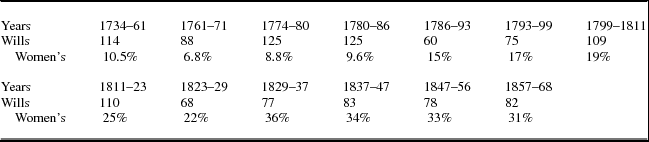
Source: SAMPUBCO (2011), Will Testators Lists, Amelia County, Virginia.
The South beyond Virginia
The evidence from Virginia indicates a general pattern there, with women's wealth expanding well in advance of the reform of marital property law. That might raise questions for a simple narrative that the MWPAs caused the narrowing of the gender wealth gap, but the one state could be set aside as an anomaly. Looking at the South beyond Virginia, however, Lebsock's Petersburg result appears as part of a more general pattern. Although more empirical research is required for more than tentative conclusions, evidence from the cities of Baltimore and Charleston, and from two Georgia counties, suggests that MWPAs followed rather than led the expansion of women's property holding across the southeastern United States.
Baltimore was the South's largest city in the nineteenth century (Gibson Reference Gibson1998: table 1) and therefore important to establishing a general pattern for the urban South. Maryland passed MWPAs in 1842 and 1843, much earlier than Virginia (Chused Reference Chused1983: 1368). However, well before Maryland's legal reforms there is evidence of an expansion of women's wealth holding in Baltimore. Sampling from microfilm indexes to the wills of Baltimore City and County, Richard Chused (Reference Chused1983) documented a substantial expansion in women's representation among will writers in the first half of the nineteenth century.Footnote 30 At the start of the century, just less than one-tenth of Baltimore wills were written by women; by 1840 that proportion had quadrupled (see table 6). The rising representation of women among Baltimore testators in the four decades before Maryland's MWPAs is consistent with the results from Virginia, with women's wealth increasing in advance of reforms to marital property law. However, the Baltimore evidence is not conclusive. First, gender patterns of will making provide only a rough indication of the gender wealth gap. More specifically, women's increasing representation among Baltimore testators was a partly a reflection of urbanization. Before the MWPAs, wives lacked the legal capacity to write a will. Testating women were spinsters or widows and they lived disproportionately in cities. As Baltimore City and Baltimore County became increasingly urban from 1800 to 1850, women's representation among testators there would have increased, simply as an artifact of the shifting composition of population.Footnote 31 More empirical research with Baltimore's probate records may clarify gender patterns of wealth holding there. Until then, evidence from other locales contributes to a general view.
Women's representation among testators, Baltimore City and County, Maryland

Source: Chused Reference Chused1983: 1373, 1365.
Moving further south, consider next, Charleston, South Carolina, another of the antebellum South's few major cities. Much smaller than Baltimore, Charleston was larger than Richmond and considerably older (US Census Office 1864a: 214, 452, 519). Sampling from a published index to Charleston wills, we can trace out the proportion of women among the city's testators over a long span of time. Much as in Virginia, we see evidence of increasing women's wealth, long in advance of reforms of marital property law. In the first half of the eighteenth century, women authored about 10 percent of Charleston wills. That proportion climbed unevenly over the next eight decades before holding at some 35 to 40 percent in the four decades before the Civil War (see table 7 and figure 1). Like Virginia, South Carolina waited until after the Civil War in 1868 to reform marital property law and end a husband's control of his wife's property.Footnote 32 So once again, we have evidence of an expansion of women's wealth holding long in advance of marital property reform.Footnote 33
Women's representation among testators, Charleston, South Carolina
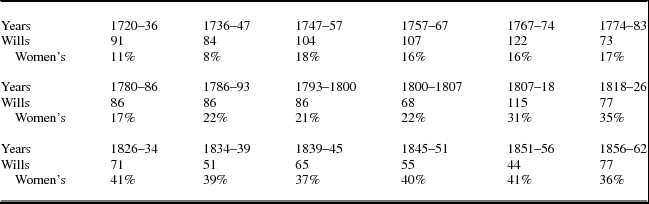
Source: Charleston Free Library 1974 [1950].
Note: Random sample of 51 pages from the “Index to Wills of Charleston County.”
Women's representation among testators, Charleston, South Carolina.

The increased representation of women among Charleston testators is suggestive. However, attention to probated wealth holdings in Charleston provides more conclusive evidence that women's wealth holding was rising long before marital law reform. Table 8 presents the proportion of inventories that belonged to women for selected periods, based on the handwritten indexes to “inventory books” in Charleston's probate records. Compared to sampling the published will index, this archival data source requires considerably more work, so we have results for just four of the volumes that recorded estate inventories and appraisals. But we find clear evidence that Charleston's gender wealth gap was narrowing in the century before the Civil War.
Women's representation in probate inventories in Charleston, South Carolina

Women held just 10 percent of the probate inventories in Charleston in the late 1760s (see table 8), a result similar to those from later eighteenth-century Henrico, Virginia. Four decades later, women's share of inventories had risen to about one-sixth. By the 1830s, that share had climbed to about one-quarter, the same level as in the late 1850s. With women's representation among inventories more than doubling in the six decades after the 1760s, we have a distinct narrowing of the gender wealth gap well in advance of South Carolina's reform of marital property law. The expansion of women's wealth holding in Charleston is a striking generalization of Lebsock's findings from the smaller Virginia city of Petersburg.
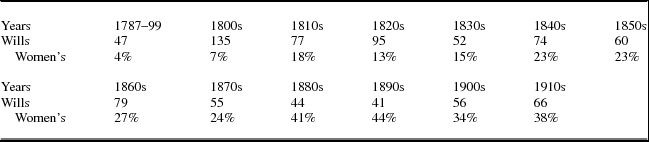
Expanding our geographic range further south, we can trace out the time paths of women's participation in will making for two counties of the Georgia Piedmont, Clarke and Greene. As in much of the antebellum South, in these counties slaves were most of the population and cotton was the staple crop.Footnote 34 Site of the University of Georgia and the small city of Athens, Clarke County was a little more urban than the rest of the South. Greene was more typically rural. However, the counties were similar in terms of the gender mix of testators over time. In both we see a sharp increase in the women's share of will making; and in both we see a dramatic increase well in advance of Georgia's MWPA.
Legislation for a MWPA in Georgia can be traced to at least 1851, and State Senator Andrew Stevens's “Women's Bill.”Footnote 35 But like Virginia and South Carolina, Georgia did not pass a MWPA until after the Civil War, in 1866 (Lebsock Reference Lebsock1977: 195; Warbasse Reference Warbasse1987 [1960]: 174). Long before that, women's participation in will making was expanding in Clarke and Greene counties (see tables 9 and 10). At the start of the nineteenth century, less than one-tenth of the wills in either county was written by women. By the late antebellum period, women wrote about one-fourth of wills. The level of women's will writing in these Georgia counties was lower than what we saw in the various Virginia cases, or in Charleston. That difference might be of interest, but what is important here is that again we see—here in rural Georgia—evidence of a rise in women's wealth holding well in advance of the state's MWPA. Perhaps we see effects of that act in the closing decades of the nineteenth century when women's participation in will making expanded further, reaching four-tenths or more. But the key for current purposes is the earlier narrowing of the gender gap in will making in these two Georgia counties. More empirical research is required, but so far the early-nineteenth-century expansion of women's property holding that Suzanne Lebsock found for Petersburg, Virginia, is emerging as a much more general result.
Women's representation among testators, Clarke County, Georgia

Source: Brooke Reference Brooke2009, Clarke County, Georgia, Will (Testator) List.
Women's representation among testators, Greene County, Georgia
Source: Brooke Reference Brooke2010, Greene County, Georgia, Will (Testator) List.
Evidence from the Northeast
When Carole Shammas (Reference Shammas1994) documented the narrowing of the gender wealth gap in the United States across the nineteenth century, some of her most compelling evidence came from the archival probate records of Bucks County, Pennsylvania, and from published tabulations of probate records for the state of Massachusetts. Both of those sources show a dramatic increase in women's representation among probated wealth holders across the nineteenth century, and in women's share of probated wealth. Those two cases figured prominently in Shammas's narrative, which highlighted the potential causal role of the MWPAs that were passed in Pennsylvania and Massachusetts in the mid-nineteenth century (ibid.: 18–21). However, we now have much more evidence on the time path of women's wealth holding, evidence that makes it difficult to argue that reforms of marital property law can explain the rise of women's property holding.
Looking at wealth holding over time in the northern states we see a pattern much like that in the South, with women's wealth rising during the first half of the nineteenth century. Contrary to views stressing the MWPA as a causal force, the years from the mid-eighteenth to mid-nineteenth centuries witnessed the most dramatic changes to women's wealth holding. The later decades of the nineteenth century saw further expansion of women's wealth, but the extent to which the MWPAs played a causal role there remains to be determined.
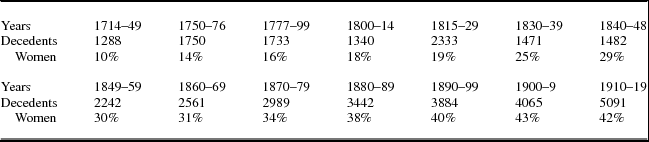
Drawing on archival probate records of Bucks County, Pennsylvania, Shammas (ibid.: 18) documented a dramatic narrowing of the gender wealth gap across the nineteenth century. The proportion of probate inventories held by women more than doubled, from about one in six (16.5 percent) at the close of the eighteenth century (1790–1801) to more than one in three (37.8 percent) near the end of the nineteenth century (1891–93). Drawing on online probate indexes, we find a very similar pattern in nearby Chester County, Pennsylvania (on the other side of Philadelphia from Bucks, about 20 miles to the southwest). As in Bucks, in Chester the proportion of women among probated decedents more than doubled across the nineteenth century, from about 17 percent to just more than 40 percent (see table 11). However, looking at evidence on the time path of women's wealth holding in Chester casts doubt on the causal role of Pennsylvania's MWPA, passed in 1848. Table 11 and figure 2 present evidence on the time path of women's wealth holding in Chester over almost two centuries, showing the proportion of women among probated decedents over the years 1714–1923.Footnote 36
Women's representation among probated decedents, Chester County, Pennsylvania
Source: Chester County, PA (2014), Wills and Administrations, 1714–1923, Index.
Notes: Probated decedents refers to those indexed with a will or administration bond or inventory.
Women's representation among decedents, Chester County, Pennsylvania.

Two results stand out. First, and most simply, Chester County women's wealth holding increased substantially in the century before legislation reforming marital property rights. Second, and less simply, most of the narrowing of the gender wealth gap in Chester in the eighteenth and nineteenth centuries could not have been a result of the state's MWPA. Looking across both the eighteenth and nineteenth centuries reveals a more dramatic narrowing of the gender wealth gap compared to the nineteenth century alone. Across the two centuries, the proportion of women among probated decedents more than quadrupled, from about 10 percent in the first half of the eighteenth century to more than 40 percent in the early twentieth century. Most notably for current purposes, the proportion of women among decedents had reached 29 percent by the time Pennsylvania passed its MWPA in 1848 (Geddes and Tennyson Reference Geddes and Tennyson2013: 153; Warbasse Reference Warbasse1987 [1960]: 236). After the act, the proportion continued to climb unevenly to exceed 40 percent at the century's end. Overall, the gender gap among Chester probated wealth holders closed by some 30 percentage points across the eighteenth and nineteenth centuries but more than half of the narrowing (19 of 30 percentage points) came before Pennsylvania's MWPA. Arguably, the impact of the MWPA is to be seen in the rising share of women among Chester decedents from the 1860s to the early twentieth century (the share rising from about 31 percent to about 42 percent). Over those years, the probate data increasingly included women who married subject to Pennsylvania's MWPA. However, it would be fallacious (post hoc) to rule out other explanations for the late-nineteenth-century rise in Chester women's wealth. It may turn out that the MWPAs are better understood as a result than a cause of the narrowing of the gender wealth gap. In any case, the striking result is that women's share of Chester probates tripled in the century before Pennsylvania's MWPA.Footnote 37
Turning to Massachusetts, we find results much like those from Pennsylvania. In making the case for the importance of the MWPAs, Shammas (Reference Shammas1994: 18) highlighted published data from nineteenth-century Massachusetts probate records to document the narrowing of the gender wealth gap there. In statewide tabulations of probate records, women held just 16 percent of probate inventories in the years 1829–31; six decades later, that proportion had climbed to 43 percent (in the years 1889–91). Shammas (ibid.: 20) attributed that narrowing of the gender wealth gap in Massachusetts to the state's MWPA passed in 1855. However, with the benefit of more evidence we can see that the state's MWPA came after a long period in which the gender wealth gap was gradually narrowing.
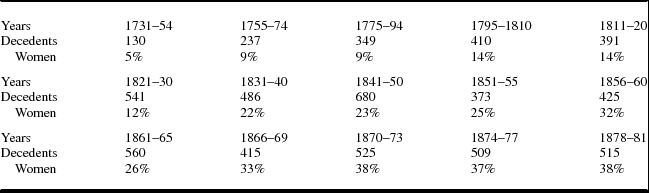
For evidence on the time path of wealth holding by gender in Massachusetts we draw on the published index to the probate records of Worcester County for the years 1731–1881, and on published tabulations of probate inventories for 12 years (1829–31, 1859–61, 1879–81 and 1889–91). The Worcester probate index lists names alphabetically over some 1,565 pages, but randomly sampling pages yields valuable evidence from modest effort. Table 12 and figure 3 trace out the time path of women's wealth holding across the eighteenth and nineteenth centuries for the county. With fewer observations early on, we graph averages for groups of years until 1855, after which we plot annual averages. The narrowing of the gender wealth gap in Worcester shows up quite dramatically: Circa the mid-eighteenth century (1731–54), women were only one-twentieth of probated decedents; toward the end of the nineteenth century (1878–81), women were almost four-tenths of probated decedents (see table 12). In broad terms, from the colonial period to the late nineteenth century the proportion women among the probated rose some 30 percentage points (from 8 percent in 1731–74 to 38 percent in 1878–81). And more than one-half of the increase (from 8 percent to 25 percent) came before the state's MWPA was passed in 1855 (Geddes and Tennyson Reference Geddes and Tennyson2013: 153; Warbasse Reference Warbasse1987 [1960]: 269).
Women's representation among probated decedents, Worcester County, Massachusetts
Source: Random sample of 304 pages from Harlow's (Reference Harlow1898) Index to the Probate Records of the County of Worcester, Massachusetts, 1731–1881.
Notes: Probated decedents are those with either a will (testates) or an administration (intestates). The index also covers guardianship records and various other minor records, which are excluded from our counts.
Women's representation among decedents, Worcester, Massachusetts.

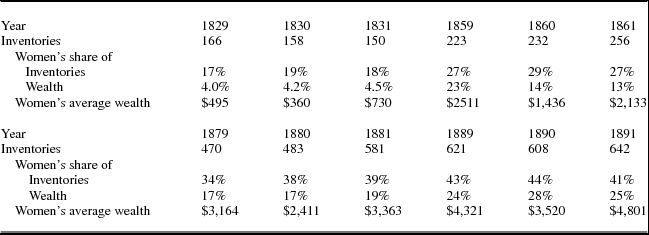
Published tabulations of inventories from Worcester's probate records provide another perspective on the narrowing of the gender wealth gap there, albeit with a much shorter time span. Table 13 presents the evidence.Footnote 38 Of particular interest, we see a substantial expansion of women's wealth holding between 1829–31 and 1859–61. In each of 1829, 1830, and 1831, women held less than 5 percent of inventoried wealth; in the years from 1859 to 1861, women held 13 percent or more. The absolute levels of women's wealth also rose sharply. In the three earliest years (taken together), women's mean inventory was just $523; 30 years later it had jumped to $2,010. The Massachusetts MWPA, passed in 1855, was not retroactive (Warbasse Reference Warbasse1987 [1960]: 269), so it was not a factor in the expansion of women's wealth evident from 1829–31 to 1859–61. However, the act could have played a causal role in the further expansion of women's wealth evident by 1889–91. In those years (taken together), women held 26 percent of inventoried wealth, a sizable jump from three decades earlier (in the years 1829–31, women held 16 percent of the inventoried wealth). And women's mean inventory had also grown substantially, more than doubling (from $2,010 to $4,211). It remains to be seen whether the later expansion of women's wealth holding can be causally linked to the MWPA. For current purposes the key point is that women's wealth holding in Worcester had been rising across the 10 decades prior to passage of the state's MWPA. In Worcester, Massachusetts, as in Chester, Pennsylvania, the first major narrowing of Worcester's gender wealth gap came too early to have been caused by the MWPAs.
Women's probated wealth holdings in Worcester County, Massachusetts
Patterns of gendered wealth holding across the northeastern United States remain to be documented, but at this stage we have one more set of results from a northern US locale, reinforcing our finding that the gender wealth gap was shrinking in advance of the expansion of married women's property rights. Drawing on online indexes, we can trace out women's participation in will writing in Dutchess County, New York, about 80 miles up the Hudson River. New York's famous MWPA was passed in 1848 (Chused Reference Chused1983: 1358; Warbasse Reference Warbasse1987 [1960]: 205). In the half century before that, women's share of will writers in Dutchess significantly increased (see table 14). From the late eighteenth century into the early nineteenth century, women wrote just less than one in ten wills in Dutchess County. Then during the first half of the nineteenth century, the share of wills written by women rose, to about one in six in the years 1814–34, and to almost one in four on the eve of New York's MWPA. The decades after the MWPA saw further increases in women's share of Dutchess wills, to more than 40 percent by the late 1870s, and that might reflect effects of New York's reforms to marital property law. However, the key for current discussion is the approximate tripling of women's share of wills over the four decades prior to the legal changes. Women's increasing representation among testators is not conclusive evidence of increased property holding by women, but it is certainly suggestive; and it is consistent with the broader range of evidence we have assembled.
Women's representation among testators, Dutchess County, New York
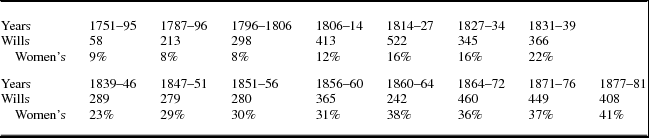
Source: SAMPUBCO (2012) Will Testators Lists, Dutchess County, NY.
Conclusion
The evidence we have presented documents a substantial expansion of women's wealth holding before the MWPAs. Across the eastern United States, in locales urban or rural, slave or nonslave, North or South, we find evidence of increased women's wealth holding, well in advance of, and around the time of, the nineteenth-century reforms of marital property law. Lebsock's (Reference Lebsock1984) finding of increasing autonomy for free white women in one antebellum Virginia city generalizes to the eastern United States. The entirety of our evidence represents a sharp challenge to a simple narrative that draws a causal line from the MWPAs to the narrowing of the gender wealth gap. Most simply, the legal reforms cannot be credited with the expansion of women's wealth holding that preceded them. Moreover, the very gradual growth of women's wealth holdings, across all the locales studied, is not the expected outcome of discrete policy changes. To the extent that marital law reform was a policy lever, change would have been “episodic” rather than “continuous” (Donohue and Heckman Reference Donohue and Heckman1991).
It is tempting to suggest a simple reversal of causation, with rising levels of women's wealth adding pressure for reform of coverture.Footnote 39 An alternative narrative could focus on the growth of personal relative to real property, which would have made marriage an increasingly unattractive choice for women of wealth.Footnote 40 Lebsock (Reference Lebsock1984: 26–27) found that wealthy widows in antebellum Petersburg “generally did not remarry.” They would have been more inclined to, had the Virginia legislature passed the MWPA of 1849; then marrying would not have cost a woman her personal property.Footnote 41 So the expansion of wives’ property rights can be seen as a reform that simply shored up traditional marriage among the propertied classes, leaving open the question of what difference the reform made to people further down the socioeconomic ladder.
However, there are both theoretical and empirical reasons against simply reversing the direction of causation between the MWPAs and the narrowing of the gender wealth gap. Theoretically, history is not so mechanistic. We'll learn more by considering the interplay of legal and social change, than by assigning primacy to one. Empirically, the gender wealth gap did narrow in the later nineteenth century, and more research may reveal a key causal role for the MWPAs. The current literature suggests two promising paths for further research. Baskerville (Reference Baskerville2008: 238, see also ch. 2) highlighted the effects of MWPAs in Canada on testation practices. For the United States, with appropriate research to document testation patterns, one could test for potential effects of marital law reforms on women's wealth across the states. Comparing 1860 to 1830, we would predict a shift of bequests toward women in Pennsylvania, which passed a MWPA in 1848, but not in Virginia, where the 1849 MWPA failed. More ambitiously, a substantial research effort could document testation patterns over time and across the states, yielding panel data for regression analysis modelling potential effects of the MWPAs.Footnote 42 More simply, with intestate succession dictating that daughters and sons share and share alike (Shammas et al. Reference Shammas, Slamon and Dahlin1987: 64–67), the acts could have generated a substantial redistribution of personal wealth among heirs of wealthy intestates, from their sons-in-laws to their married daughters. That possibility merits further research.Footnote 43
More than two decades have elapsed since Shammas (Reference Shammas1994) documented the dramatic expansion of women's wealth holding across the nineteenth century. Much remains to be explained, but our results demonstrate that the MWPAs were not some legislative switch that reversed a long-standing gender wealth gap. The acts may yet be revealed as an important contributor, but that will require more empirical research. So too will answering the major new question that emerges from our work: What explains the rise of women's wealth holding in the half-century or more before the MWPAs? We speculate that an answer will be found in an interplay between such factors as family wealth accumulation, the spread of companionate marriage, and increased literacy.Footnote 44 Our starting point might be Judith Sargent Murray's (Reference Murray1798: 168) perspective on parenting daughters:Footnote 45
I would give my daughters every accomplishment which I thought proper; and to crown all, I would early accustom them to habits of industry and order. They should be taught with precision the art economical; independence should be placed within their grasp; and I would teach them “to reverence themselves.”
Marriage should not be represented as their summum bonum, or as a certain, or even necessary event; they should learn to respect a single life, and even to regard it as the most eligible, except a warm, mutual and judicious attachment had gained the ascendancy in the bosom.
To the extent that such values were shared by other families of wealth in the late eighteenth century, the expansion of women's wealth over the subsequent century is not too surprising.



